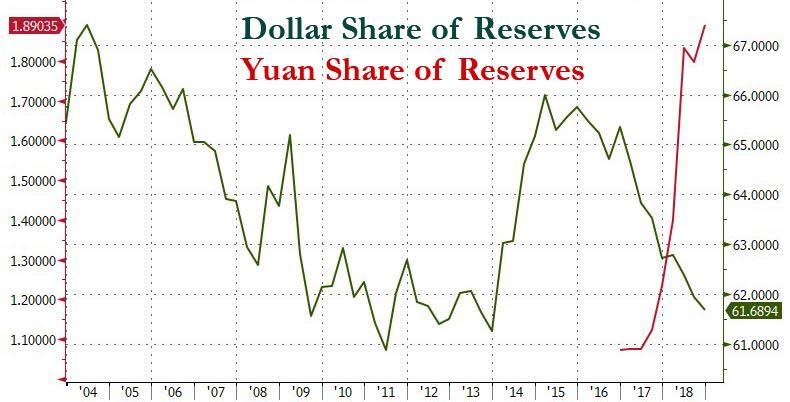
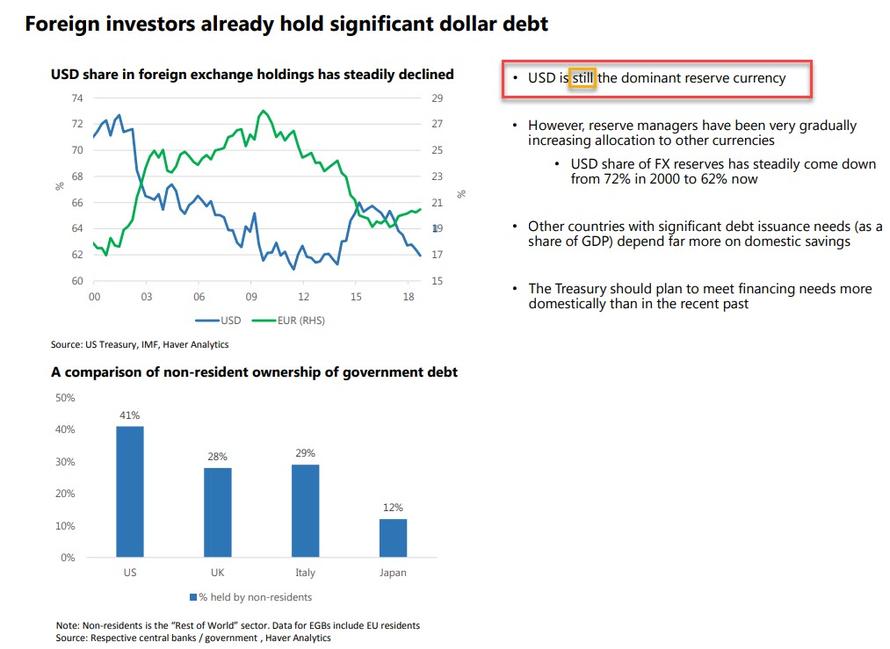
The dollar’s share of global central-bank reserves slumped to the lowest level since 2013 while holdings of the Chinese yuan rose for the fifth quarter in the past six, IMF data showed Friday.
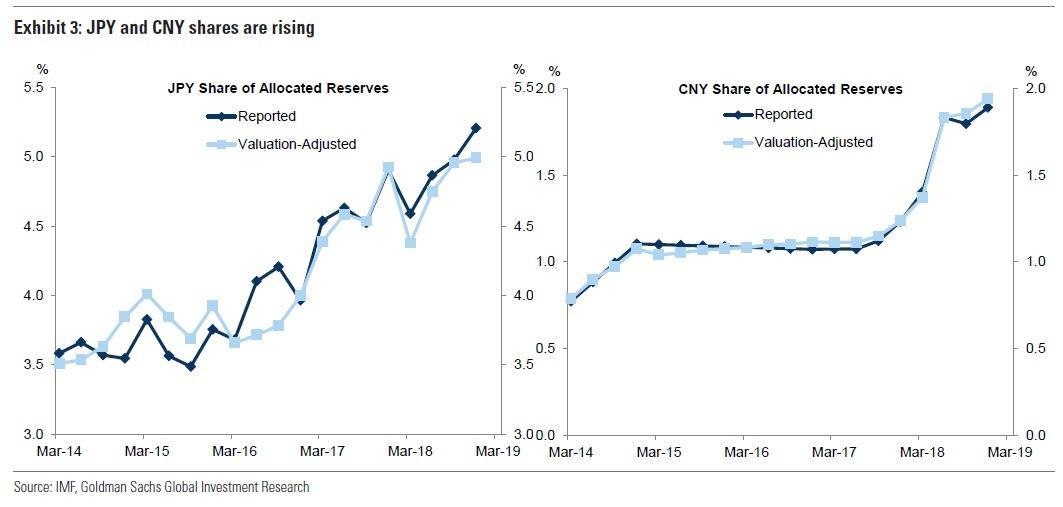
The U.S. currency accounted for 61.7% of global allocated foreign-exchange reserves in the fourth quarter, down from 61.9% and the tenth decline in the past 12 quarters according to the IMF’s Currency Composition of Official Foreign Exchange Reserves (COFER) for Q4 2018 report. The drop occurred despite a 1% jump in the value of the dollar in the fourth quarter. The euro, yen and yuan each gained as a share of allocated reserves. While modest at just 1.9%, reserve allocation to the Chinese Yuan has been increasing rapidly and is now almost double where it was two years ago.
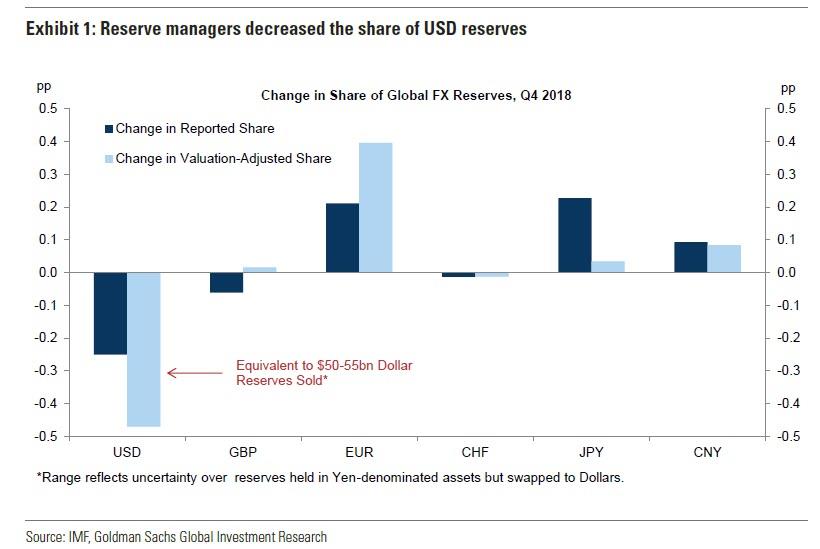
The chart below shows the main takeaways from the report: reserve managers actively decreased their allocation to USD—the share of USD reserves declined despite modest Dollar appreciation—while they actively added to EUR and CNY reserves. According to Goldman calculations, the drop in Q4 USD reserves was equivalent to just over $50 billion in dollar reserves sold.
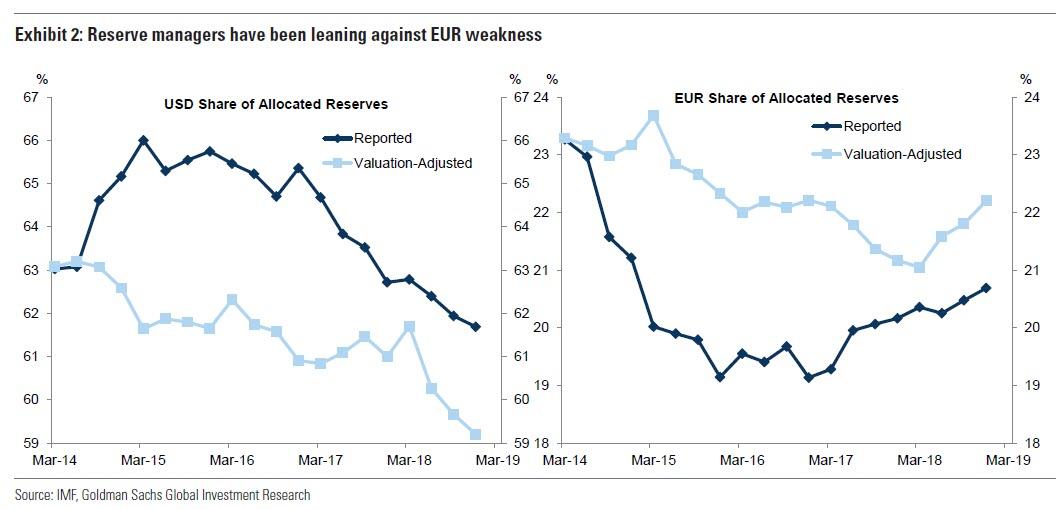
More specifically, the reported USD share of allocated reserves declined by another 0.3% in Q4. Cumulatively, the USD share has fallen by 3.7% since the end of 2016 and by 1.0% in 2018 (despite supportive Dollar price action). Against this, reserve managers continued to add to their EUR reserves with the reported EUR share increasing by 0.2% this quarter, and by 1.6% on net since the end of 2016. Both in Q4 and 2018 as a whole, reserve managers more than offset a weaker Euro to keep the share of EUR reserves on a rising trend, despite a number of political and growth tensions and concerns.
Meanwhile, as shown in the next chart, reserve managers continued to increase their allocation to JPY, although this was mostly due to yen appreciation in Q4. Still, at 5.2%, the share of JPY reserves is the highest it has been since June 2002. According to Goldman, this can be at least partially attributed to reserve managers purchasing Japanese securities on an FX-hedged basis in order to take advantage of the wide Yen cross-currency basis. However, it is worth noting that the USD share appears to be on a declining trend even after accounting for possible JGB asset swap trades.
Finally, the share of Chinese Yuan reserves continued to increase in Q4, which according to Goldman was almost entirely due to new inflows, and as the bank concludes “de-dollarization flows from Russia account for the substantial increase earlier this year.“
Commenting recently on the ongoing currency reserve trends, Standard Chartered’s head FX strategist Steven Englander said that political rifts between the U.S. and other countries could be to blame, but the numbers don’t offer firm conclusions.
Back in September, when the dedollarization trend first emerged, Alan Ruskin, global co-head of foreign-exchange research at Deutsche Bank said that the shift to allocated reserves could also be skewing the data: “I wouldn’t go too far in running with the idea that people are shifting out dollars in any aggressive sense.”
Still, the ramifications of the shift away from dollars are significant. For more than a half century, the dollar has been the reserve currency of choice for most of the world’s central banks, for its depth and stability in global markets.
That may be changing: as we reported at the end of January, the Treasury Borrowing Advisory Committee (or TBAC) is increasingly worried about the future status of the reserve currency as confirmed by the tongue-in-cheek observation that reserve managers have been very gradually increasing allocation to other currencies, and that the USD share of FX reserves has steadily come down from 72% in 2000 to 62% now even though the “USD is still the dominant reserve currency.”
The question is for how much longer.
via ZeroHedge News https://ift.tt/2HOPz0q Tyler Durden
“… March 28, marks one year that WikiLeakspublisher Julian Assange has been illegally gagged from doing journalism – any writing that expresses a ‘political opinion’? even on his own treatment, after pressure from the U.S. on Ecuador.”
On this date in 2018 Moreno imposed on Assange what Human Rights Watch’s legal counsel Dinah Pokempner described as looking “more and more like solitary confinement.” Moreno cut off Assange’s online access and restricted visitors to the Ecuador embassy in London where Assange has had legal political asylum since 2012.
Moreno cited Assange’s critical social media remarks about Ecuador’s allies, the U.S. and Spain. Assange’s near-total isolation, with the exception of visits from legal counsel during week days, has been augmented by the Ecuadorian government’s imposition of a complex “protocol,” which, although eased slightly in recent months in respect of visits allowed, has not improved Assange’s overall status over the last 12 months. In some respects, it seems to have worsened.
Truck in D.C.,March 28, 2019. (Pamela Drew, Twitter)
“Explicit threats to revoke Julian’s asylum if he, or any visitors, breach or are perceived to breach, any of the 28 ‘rules’ in the protocol. The ‘protocol’ forbids Julian from undertaking journalism and expressing his opinions, under threat of losing his asylum. The rules also state that the embassy can seize Julian’s property or his visitors’ property and hand these to the UK police, and report visitors to the UK authorities. The protocol also requires visitors to provide the IMEI codes and serial numbers of electronic devices used inside the embassy, and states that this private information may be shared with undisclosed agencies.”
The protocol does not spell out all the restrictions imposed on Assange and his supporters over the last year. A bombshell report by Cassandra Fairbanks on Tuesday revealed Ecuador’s demand that Assange and his lawyer be scanned before entering a “highly bugged and monitored” conference room with a journalist.
Describing her experience, Fairbanks said she had been: “Locked in a cold, surveilled room for over an hour by Ecuadorian officials, as a furious argument raged between the country’s ambassador and Julian Assange.”
The argument reportedly centered on Assange’s refusal to submit to a body scan in order to enter the conference room, where Fairbanks waited. Fairbanks reported that Assange shouted at the Ecuadorian ambassador, accusing the latter of acting as an agent of the United States government. The ambassador then told Assange to “shut up,” she reported.
WikiLeaks, writing via social media, has confirmed the “factual elements” of Fairbanks’ story.
Subject to Body Scans
Assange and his lawyers are now subjected to body scans in addition to conditions that, in the opinion of Ecuador’s former President Rafael Correa, already amounted to torture. In his argument with the ambassador, Assange protested that he was being treated like “a prisoner” and not a political asylee.
Assange’s supporters have claimed that rather than risk a public-relations fallout by removing Assange from the embassy by force, the U.S., UK and Ecuador are acting to hasten Assange’s physical and mental demise in hopes he will be forced to leave the embassy or become incapacitated.
WikiLeaks’ new Editor-in-Chief Kristinn Hrafnsson told RT in a televised interview: “We, of course, know that Lenin Moreno in Ecuador is willing to sacrifice Julian Assange for debt relief, that was reported by The New York Times in early December.”
“Julian Assange is the only publisher and journalist in the EU formally found to be arbitrarily detained by the UN human rights system. He is in dire circumstances, faces imminent termination of his asylum, extradition and life in a US prison for publishing the truth about US wars, and has been gagged and isolated since 28 March 2018. He has been kept in the UK from his young family in France for eight years (where he lived before being arbitrarily detained in the UK), has not seen the sun for almost seven years, and has been found by the United Nations to be subjected to “cruel, inhuman and degrading treatment.”
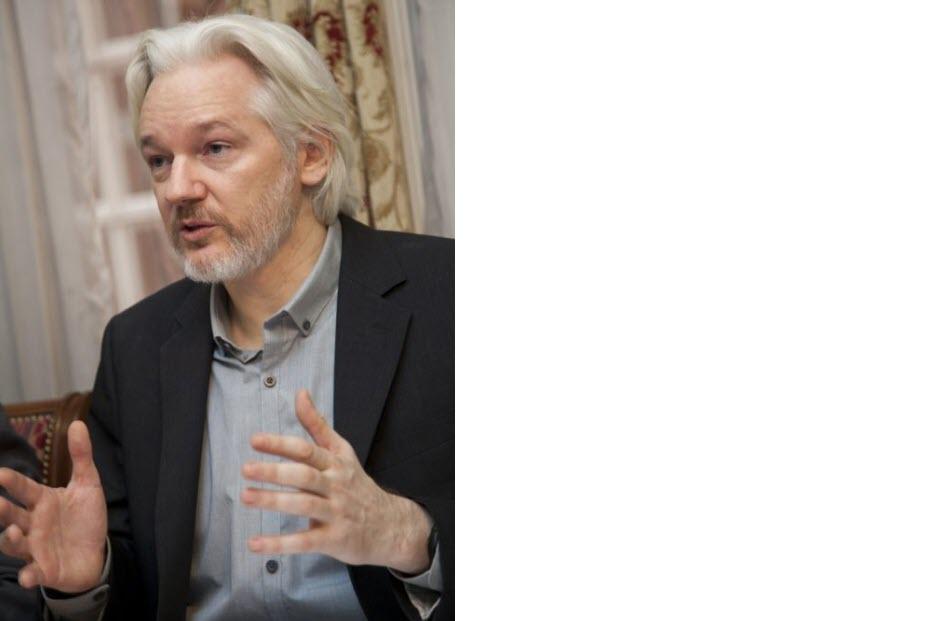
Julian Assange. (Wikimedia Commons)
On Thursday Ecuador’s foreign minister threatened additional “‘firm and sustained’ measures against Assange after@WikiLeaks reports on the@INAPapers offshore scandal involving the president and his brother,” WikiLeakstweeted.
Since Assange was cut off from the outside world, efforts by the United States to prosecute Assange and WikiLeaks have been exposed. That Assange had already been charged was inadvertently revealedby a cut-and-paste error by the U.S. attorney’s office of the Eastern District of Virginia. The prosecution of the publisher pertains to WikiLeaks’ Chelsea Manning-era publications, and possibly Vault 7, not to the 2016 U.S. presidential election.
Manning Back in Jail
Thursday also marks the passage of Manning’s third week of imprisonment for her refusal to testify before a grand jury convened to prosecute WikiLeaks and Assange. Since being jailed, Manning’s supporters have reported that she has been kept in solitary confinement, where she will remain indefinitely until either the grand jury is disbanded or she agrees to testify without legal counsel and under a veil of secrecy.
Presumably, prosecutors hope to coerce Manning to backtrack on her testimony during her court-martial in 2013, in which she testified she acted alone, and instead indicate that Assange worked to incite or aid her in retrieving leaked material. Pulitzer Prize-winning journalist Chris Hedges described the situation as “the new inquisition.”
The end of the collusion conspiracy theory came as a victory for Assange and WikiLeaks. Special Counsel Robert Mueller made it clear there would be no indictments against either for their roles during the 2016 election.
However, the damage has been significant, with Assange unable to comment and WikiLeaks saddled with residual, unresolved smears. Over the last three years, cable news pundits endlessly vilifiedWikiLeaks and Assange by claiming the publisher coordinated with the Trump presidential campaign and became an instrument of the Kremlin in 2016.
Meanwhile, The Guardian has allowed its outlandish story alleging that secret meetings took place between Assange and Paul Manafort in Ecuador’s London embassy three times between 2013 and 2016 to go un-retracted and unexplained. WikiLeaks has called the story “an intentional front page fabrication,” and launched a Gofundme campaign to raise funds to sue the newspaper. Hrafnssonconfirmed the lawsuit is progressing.
On March 28 last year, friends and supporters of Assange spontaneously came together on hearing the news that he had been cut off from the outside world by the Ecuadorian government. For more than 10 hours, participants and viewers from across the planet raised their voices to protest the injustice of Assange having been gagged.
The initial “Reconnect Julian“ event led to subsequent “Unity4J“ vigils. Over the past 12 months, demonstrations of support have unfolded across the globe, including many events organized by theSocialist Equality Party and a plethora of unaffiliated actions in solidarity with Assange.
The WikiLeaks founder’s mother, Christine Assange, wrote via social media: “At critical times throughout history, leaders have emerged to lead the fight for freedom. They risk their lives and liberty to do so. Most of us don’t have their courage, but we can unite to protect them.#FreeAssange#FreeManning“
Earlier Thursday, trucks emblazoned with supportive messages for Assange and Manning appeared inLondon and Washington, D.C.
via ZeroHedge News https://ift.tt/2CMEnNR Tyler Durden
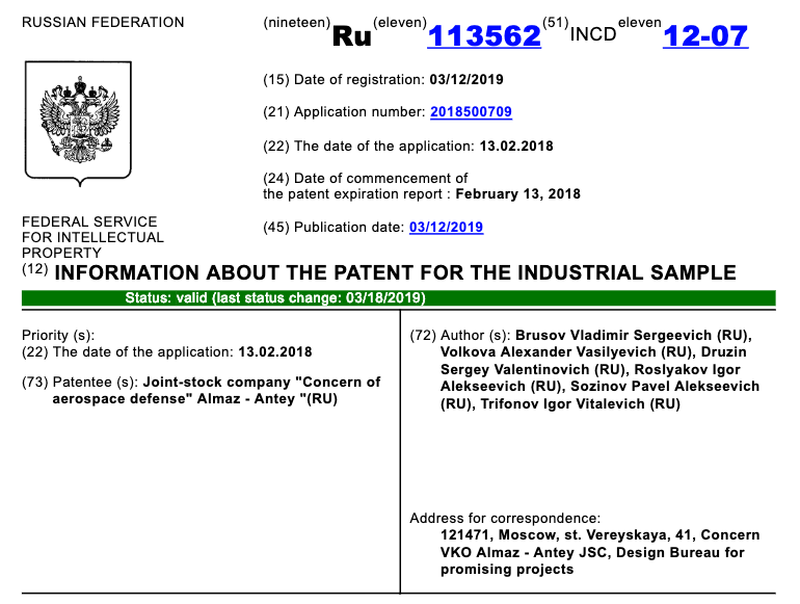
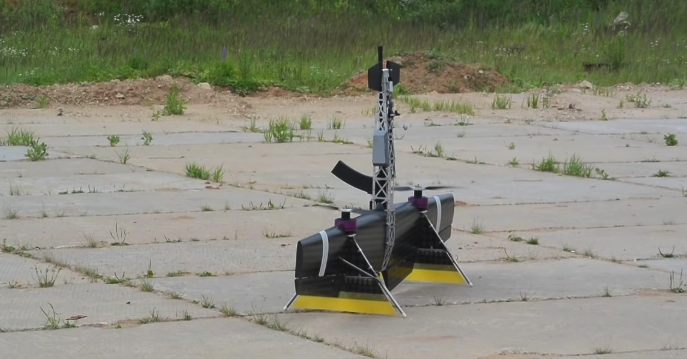
Last week, we were one of the first to uncover a patent from the Russian Federal Service for Intellectual Property that showed schematics of a new unmanned aerial vehicle (UAV) with a shotgun embedded into its airframe.
The unmanned interceptor is a tail-sitting drone and is classified as a Vertical Take-Off and Landing (VTOL) vehicle, meaning that it can take off and land vertically, and then fly horizontally.
Now we have located online videos of test demonstrations showing the interceptor discharging its Vepr-12 Molot semi-automatic detachable-magazine shotgun. Some videos show the drone blasting UAVs and RC planes from the sky, conducting combat maneuvers, and various ground tests.
The second video shows a group of Russians firing the Vepr-12 from the airframe of the inceptor.
Another video of ground test shows the unmanned interceptor firing at a target.
The fourth video demonstrates the drones impressive VTOL maneuvers.
The introduction of the inceptor follows several small armed drone attacks on Russian Khmeimim Air Base in Syria. These were the work of jihadists operating out of Idlib, such as Jabhat Fatah al-Sham, who launched the small makeshift drones in an attempt to penetrate Russian defenses, even targeting the Russian naval facility at the Syrian port city of Tartus.
Most of the drone attacks occurred in early 2018 were intercepted by Russian air defense systems, but six were landed by electric warfare specialist.
It marked the “first time that terrorists massively used unmanned combat aerial vehicles of an aircraft type that were launched from a distance of more than 50 kilometers, and operated using GPS satellite navigation coordinates,” the Russian ministry had said in a statement.
Small drones are a significant problem on the modern battlefield. No major military has adequately prepared nor has the proper weaponry to combat this new and emerging threat fully. After Russia experienced this threat first hand in 2018, it now seems that a drone-mounted shotgun could be the short-term solution.
via ZeroHedge News https://ift.tt/2V7Doij Tyler Durden
The shenanigans in the Westminster Parliament need little comment. We literally have a gridlock that frankly looks impossible to break.
A Government that has negotiated one of the worst treaties in history, and which has failed miserably on three occasions to get it through Parliament.
A Prime Minister who has promised to resign if her deal is successful, but who stays put now her deal has once again failed (let me know if you can think of a more ludicrous scenario).
A speaker who is having to be arm-twisted into allowing “Meaningless votes” since he won’t allow a “Meaningful vote” on the same deal as before (to be fair to him, I think he was quite right to insist that the Government cannot keep bringing the same deal back to the Commons over and over again until it gets the “right” answer, since this creates a dangerous constitutional precedent).
Parliamentarians whose instincts are still overwhelmingly Remain, but who dare not vote to Revoke Article 50 or for a “People’s Vote” lest their pesky constituents turf them out at the next election (note on the People’s Vote: I understand that it was People who voted last time) .
And a series of indicative votes, none of which were even recognised by the Government as having legitimacy, and none of which was able to command a majority in the House.
As things stand we are heading for a no-deal Brexit (or rather World Trade Organisation Brexit) on 12th April. Yet although this is the default, I put the chances of this happening at less than 5%, as I don’t think that Parliament has the stomach for it, and if push comes to shove they will somehow contrive to stop it happening.
So what now?
Well since all else seems to have failed, here’s a suggestion.
The main issue with the Withdrawal Agreement is the Backstop. The DUP have made it quite clear that they cannot and will not support the treaty whilst it includes the Backstop, or at least unless there are legal guarantees around this. In this I am in complete agreement, since with provisions within the Backstop would potentially lock the country into powerless vassalage for years, even decades to come, and with no means of exiting. It is in fact worse than our current situation, and it would serve to break up the United Kingdom, which wasn’t actually what 17.4 million people voted for.
Take the Backstop out of that agreement, and it would undoubtedly get a clear majority.
But of course the problem with this is that the EU has said that it is not prepared to renegotiate the Backstop. However, the closer we get to a no-deal Brexit (WTO Brexit), which doesn’t thrill the EU at all, and certainly isn’t Mr Varadkar’s option of choice, I remain unconvinced that faced with this stark reality they would necessarily be as hard nosed as they have been. And this for the simple reason that a no deal Brexit wouldn’t even have a Backstop at all. In other words, for all their posturing on the issue, and their apparent refusal to budge on an issue that they keep insisting is of the utmost importance, as things currently stand, they could potentially end up forcing a situation where Britain leaves and there is no Backstop at all.
This, incidentally, has been the problem with Mrs May’s “strategy” all along. At the same time as negotiating with the EU, the UK Government should have prepared for a no deal Brexit from day one, firstly in case it became a necessity, but also in order to act as a bargaining chip in negotiations with the EU. Had the EU known that the Government of the United Kingdom had spent two years preparing for the possibility of a no deal, the Withdrawal Agreement would no doubt look very different than it does.
So what I would suggest is as follows: an MP should propose another indicative vote, but this time on the Withdrawal Agreement minus the Backstop. Call it WA-B. This is, I believe, the only available deal that the House of Commons would pass with a reasonably clear majority. The Government could then go back to the EU and put the matter like this:
“The House of Commons has made it clear that it will not back the Withdrawal Agreement with the Backstop included. But it has also made it clear that it is prepared to support the Withdrawal Agreement minus the Backstop. In fact, this is the only deal it is prepared to back. The alternative is that on 12th April, the United Kingdom will formally leave the European Union and revert to World Trade Organisation rules. Which will mean no Backstop at all. So which would you prefer? To rethink the Backstop? Or to end up with a no deal Brexit where there is no Backstop anyway? The choice is yours.”
via ZeroHedge News https://ift.tt/2YFbIUv Tyler Durden
The Church of Scientology has fallen on hard times over the past decade as membership growth has slowed due to the many scandals and shocking revelations about the church, its doctrine and the lengths that leaders will go to punish apostates. Now, the Church can add another problem to its steadily growing list: Crossing the Russian government.
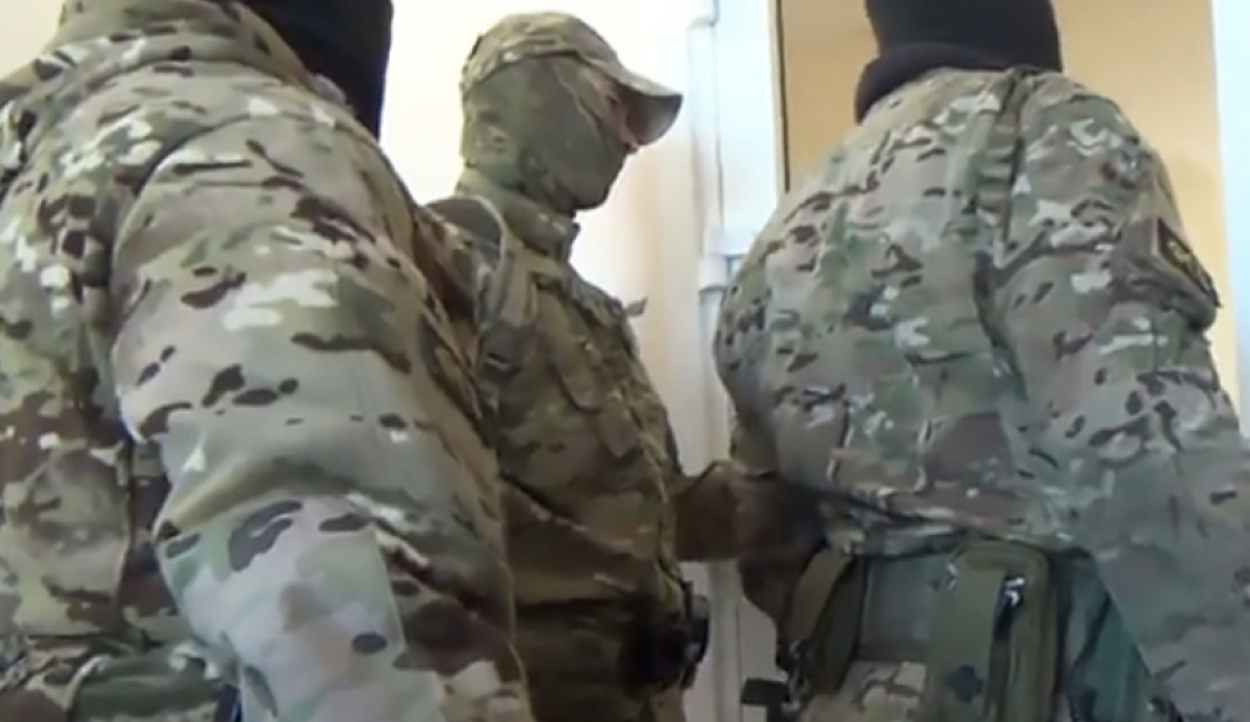
The Moscow Times reported Friday that Russian security forces had raided the offices of the Church of Scientology in Moscow and St. Petersburg a day earlier, purportedly in connection with a probe into a scheme to defraud homebuyers carried out by the Church. Investigators believe the church illegally transferred around 3 billion rubles ($45.6 million) to its headquarters in the US.
The news service for the state security agency, the FSB, reported that investigators believe the money was raised during seminars and training sessions held without a license, with between 3 million and 4 million rubles ($45,000 to $61,000) being raised every week in St. Petersburg.
“Early indications say more than 400 co-investors were defrauded out of around 800 million rubles [$12.3 million],” Interfax quoted St. Petersburg and Leningrad region police as saying.
Investigators reportedly opened the case in June 2017.
This isn’t the first time the Church has been raided by Russian authorities. Its St. Petersburg office has been raided at least three times before, once in 2017 and twice in 2018.
According to Newsweek, the US Commission on International Religious Freedom determined in 2017 that Russia was one of the worst violators of religious freedom. The Organization for Security and Cooperation in Europe has also raised issues with Russia’s crackdown on certain religious sects, including the Jehovah’s Witnesses, who have been derided as “Extremists”. This is believed to be due, in part, to the influence that the Orthodox Church has over Russian political life.
Watch a video of the raid below:
via ZeroHedge News https://ift.tt/2JUPfzg Tyler Durden
Two leading medical groups, the American Academy of Pediatrics (AAP) and the American Heart Association (AHA), issued a report this week encouraging legislators and policymakers to hike taxes on sugar-sweetened beverages—the most common of which is soda—and to restrict how companies market soda to kids. This is apparently the first time either group has publicly supported a food tax.
While both organizations are influential players in the public health debate, their reasoning behind new soda taxes doesn’t stand up to scrutiny, writes Baylen Linnekin.
C-SPAN in on basically every cable package in the country and you can also stream it live here. Washington Journal is a live call-in show, so ask a question if you’ve got one.
Rafia Zakaria reviews Dancing Bears: True Stories of People Nostalgic for Life Under Tyranny, by Witold Szablowski, in her latest article for Reason. A snippet:
When I was a little girl, my country held its first democratic election after more than a decade of military rule. The bald, mustachioed general who had led Pakistan for my entire life had died in a plane crash a few months earlier. A woman, the daughter of a previously slain prime minister, led her party to an electoral majority, and on a pleasant December morning we watched her sworn into office. This, we were told, was history. This was democracy. This was the beginning of freedom.
The people of my city, Karachi—particularly those who had voted for the new prime minister—decided to use their freedom right away. Large groups of them climbed onto motorbikes and into the backs of pickup trucks; they took over the city streets, waving flags and shooting firearms in the air. Everyone else, including my family, sat inside their houses, afraid. Within a few hours of the arrival of “freedom,” my father and grandfather and mother were nostalgic for the days of tyranny. Dictatorship, they decided, was safer and more orderly than the chaos of democracy.
Last year Turkey’s lira crisis quickly morphed into a Euro-zone crisis as Italian bond yields blew higher and the euro quickly reversed off a major Q1 high near $1.25.
It nearly sparked a global emerging market meltdown and subsequent melt-up in the dollar.
This week President Erdogan of Turkey banned international short-selling of the Turkish lira in response to the Federal Reserve’s complete reversal of monetary policy from its last rate hike in December.
The markets responded to the Fed with a swift and deepening of the U.S. yield curve inversion. Dollar illiquidity is unfolding right in front of our eyes.
Turkish credit spreads, CDS rates and Turkey’s foreign exchange reserves all put under massive pressure. Unprecedented moves in were seen as the need for dollars has seized up the short end of the U.S. paper market.
The government [Turkey] simply trapped investors and refuses to allow transactions out of the Turkish lira. Turkey’s stand-off with investors has unnerved traders globally, pushing the world ever closer to a major FINANCIAL PANIC come this May 2019.
There is a major liquidity crisis brewing that could pop in May 2019.
Martin’s timing models all point to May as a major turning point. And the most obvious thing occurring in May is the European Parliamentary elections which should see Euroskeptics take between 30% and 35% of seats, depending on whether Britain stands for EU elections or not.
That depends on Parliament and the EU agreeing to a longer extension of Brexit in the next two weeks.
Parliament has created “Schroedinger’s Brexit,” neither alive nor dead but definitely bottled up in a box no one dares open. And they want to keep it that way for as long as possible. Their hope is outlasting Leavers into accepting staying in the gods-forsaken fiscal and political black hole that is the European Union.
But back to Turkey. To me this looks like a very dangerous game that Erdogan is playing with the markets to remind everyone just how fragile the financial system is. Now that a real Brexit back on the table thanks to the British Parliament his gambit takes on even more significance.
I don’t credit Erdogan with understanding this complexity anymore than I credit most Remainer MP’s understanding the true stakes of defying Brexit.
If he did he wouldn’t lift this foreign investor trap until Jean-Claude Juncker drank himself to death after a Hitlerian tirade of memetic proportions.
Juncker after Merkel’s Deal Failed a Third Time
That’s the problem with politicians. Their own narrow interest has out-sized effects on the rest of the world because of the power they wield.
The core problem is that Turkey’s companies owe an enormous sum in corporate debt that is payable in dollars. What Erdogan has done is prioritize lira for them to pay their dollar obligations while barring anyone else from attacking the lira at the same time.
I don’t know for sure what’s happening here but I do know that the U.S. is playing hardball on anyone who is maintaining any economic ties to Iran, criticizing Israel and/or backing President Nicolas Maduro of Venezuela while we try and regime change him.
Turkey is doing all three of these things. And the combination of U.S. anger at Turkey’s sliding into the BRICS orbit, Turkey’s indebtedness and EU contagion risk creates a potentially explosive situation in credit and currency markets that Armstrong is now warning could become ground zero for the next financial crisis.
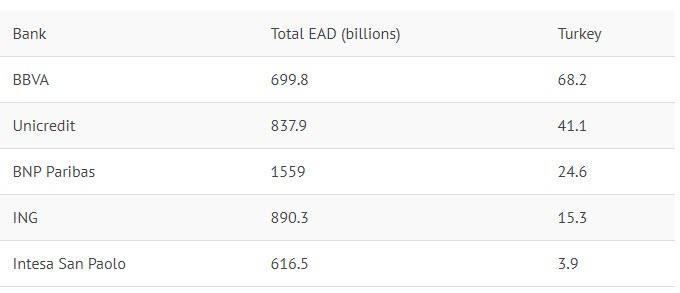
Erdogan’s proxy weapon in this fight is zombie banks in Europe. And not just any banks, some of the biggest banks in Europe. Zerohedge put out the list of the five European banks most exposed to Turkey according to Goldman Sachs.
With that disclaimer in mind, Goldman claims that Turkey exposure of EU banks is “limited in scope and scale” as Turkey accounted for <1% of total EAD and c.1% of Net Profit for Goldman’s EU banks coverage in 2018: of more 50 banks under Goldman coverage, five have Turkey exposure of >1% of total EAD, with gross exposure ranging from 10% of EAD for BBVA, 5% for Unicredit to 2% or less for ING (2%), BNP (2%) and ISP (1%). Also worth noting that European banks tend not to have 100% ownership of Turkish subsidiaries, so one needs to adjust for the actual shareholding.
The biggest banks in Italy, France and the Netherlands have multi-billion dollar exposure to a default on Turkish corporate debt.
Erdogan is staring at a major push-back from the U.S. and the EU over cozying up to Russia and it will not stop until he is removed from power.
As all of these interdependent systems, unintended consequences and perverse incentives have brought us to a very precarious moment in time.
Unspoken during all of the Brexit talk is the potential for real dislocation in the financial markets if the divorce is finalized to Brexiteer’s satisfaction. But the costs will be born hardest not on the working class but the financial and political class.
This is what is behind Project Fear and the slow motion betrayal of the Brexit Referendum of 2016. It is not the temporary inconvenience of having to pay 3% more for Italian wines or an extra ten minutes in line to take a holiday in France for the middle-class Briton Remainers who marched on London last weekend.
It is The Davos Crowd and their quislings in the British Civil Service and Brussels Byzantine Bureaucracy are the ones with trillions in assets at risk.
It is the British Deep State, so committed to the EU it helped back a coup against the President of the U.S. framing him as a Russian stooge straight out of a John LeCarre novel.
The mandarins who run the EU see their political project at risk. Turkey was a country slated to be subsumed by the murk of the EU.
And Erdogan put the kibosh on that after his country was nearly destroyed by U.S. incompetence in atomizing Syria. He has now emerged as a key political opponent of Brussels, as important as Viktor Orban in Hungary, Matteo Salvini and Luigi Di Maio in Italy or Vladimir Putin in Russia.
So it should come as no surprise that Turkey is emerging as the emerging market that comes under currency duress during this period of great uncertainty about the EU’s future.
Markets are finally taking these threats much more seriously now than they did last year. I told you then Turkey would survive. Qatar, China and Russia all came to Erdogan’s side to help Turkey through the shock.
But it was only a test of his resolve. It was a crucible to see if he could be brought back on side. And once Pastor Andrew Brunson was returned, the pressure on the lira mysteriously subsided.
But it’s clear with the way things have gone in Syria and with his opposition to Israel’s decisions recently that Erdogan is not redeemable as a NATO asset anymore. And the only reason Turkey hasn’t been kicked out of NATO is because treaties outlast leaders.
That’s why Brussels wants this Brexit deal and none other. It is a treaty which ensures the U.K. as a vassal state in perpetuity.
The U.S. equity markets just ended Q1 with the S&P 500’s highest closing quarterly price in history. The Dow Jones Industrials rallied to close just shy of 26,000. U.S. Treasuries are trading below the Fed’s benchmark rate throughout most of the yield curve.
And gold is holding onto $1300 despite furious selling above $1325 as traders scramble for dollars.
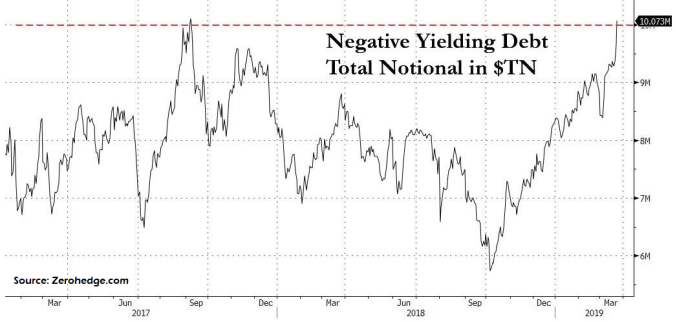
Since the equity markets peaked near the end of Q3 of last year, more than $5 trillion in debt globally has been pushed to negative yields as of Monday.
The German yield curve is negative out to 10 years.
The sound you hear is the air leaving the room as the world wakes up to the fact that no one in charge has any clue as to how to fix any of the messes they have created.
The mad scramble for collateral has begun. And the zombie plague may have been unleashed in Istanbul.
* * *
To support more work like this and get access to exclusive commentary, stock picks and analysis tailored to your needs join my more than 235 Patrons on Patreon and see if I have what it takes to help you navigate a world going slowly mad.
via ZeroHedge News https://ift.tt/2YyWekE Tyler Durden
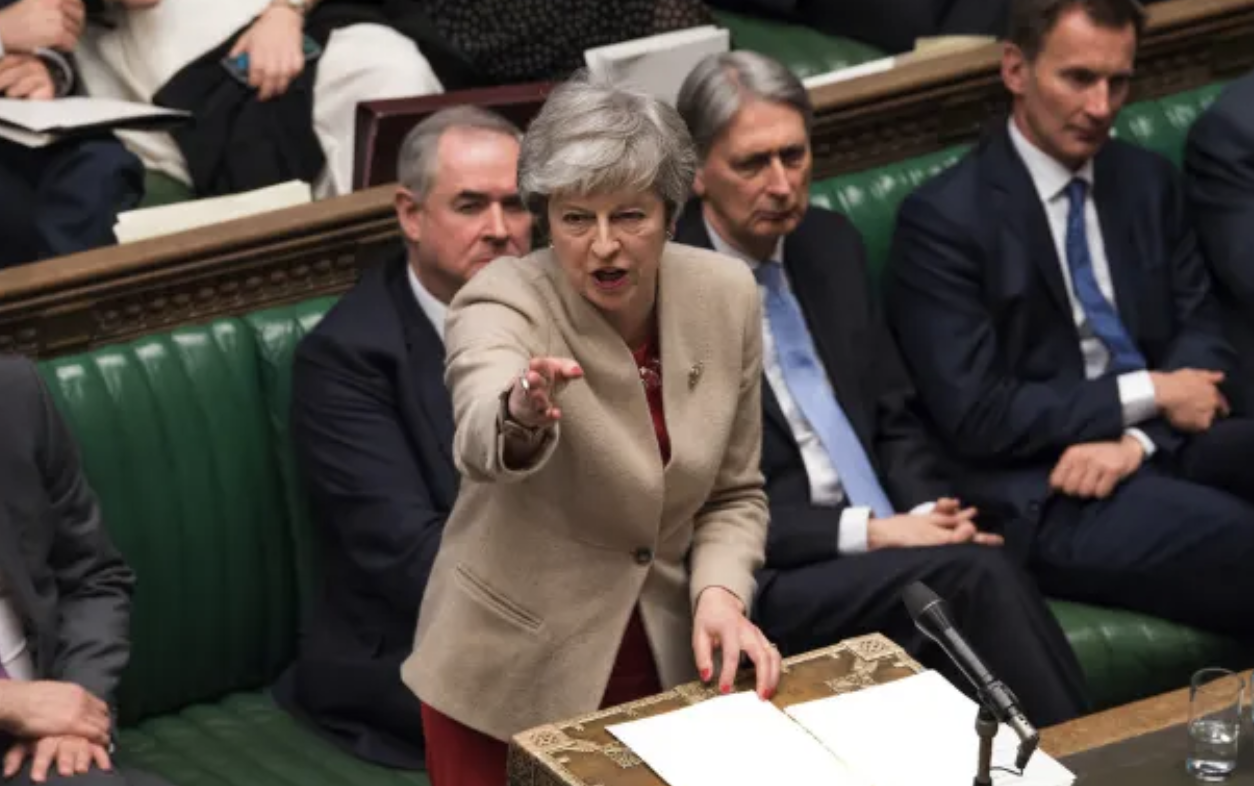
The withdrawal agreement that Prime Minister Theresa May negotiated with the EU27 is the deal that refuses to die. Despite being thrice rejected by the Commons – two of those defeats by historic margins – the prime minister is reportedly planning to bring the deal – which many declared “dead” on Friday – back for a fourth vote next week, as the European Union hints that it won’t allow another extension of Article 50.
If what would be the fourth vote on the deal fails, May would try calling another general election, even as some members of her own cabinet have reportedly opposed the idea and said she would need to resign before going to the country again. Of course, last time May called a general election in summer of 2017, it didn’t end so well. While May had hoped it would strengthen her hand in talks with Europe, the conservatives ended up losing their majority in the Commons, and Labour leader Jeremy Corbyn – once derided as an ineffectual Communist – emerged as a credible threat to the rival Tories.
In the hours since her deal was defeated by a margin of 58 votes, which, though not ideal, was a major improvement over the 149-vote margin of defeat from the second vote, unconfirmed rumors about where May’s government might go from here have flooded the British press.
Rumors have included a “runoff” vote between May’s deal and the most popular option from the indicative vote earlier this week (which would be a ‘softer’ deal where the UK stays in the Customs Union), to a general election, to a request for another short-term delay of Article 50. But European Commission chief Jean-Claude Juncker said the bloc was leaning toward a ‘no deal’ Brexit.
Faced with the imminent prospect of a general election, May and her aides believe more Brexiteers would decide to back her deal, Buzzfeed reports. May hinted at a general vote during remarks after the deal’s defeat.
The prime minister’s aides are preparing to call a fourth vote on her withdrawal agreement following Friday’s 58 vote defeat — the third time it has been rejected by MPs.
Downing Street insiders said this could come either in the form of another so-called “meaningful vote”, or by tabling the Withdrawal Agreement Bill and committing to allowing Parliament to set the negotiating mandate for the next stage of negotiations.
May’s aides are also looking at a “run-off” pitting May’s deal against the most successful alternative plan found at the next round of indicative votes, due on Monday and Wednesday.
A Number 10 official predicted that the alternative option most popular in Parliament would be the withdrawal agreement with a permanent customs union put to a confirmatory referendum.
Posed with a choice between that and May’s deal, it is believed more Brexiteer rebels would switch over to support the government.
Of course, to bring the deal back for a fourth vote, May would need to once again meet Speaker Bercow’s “substantially different” test – his ruling that she can’t bring the deal back unless significant changes are made. On Friday, she accomplished this by separating the withdrawal agreement from the non-binding political statement setting out a framework for the second round of negotiations on future relations between the UK and the block. Exactly how she would do it next week isn’t exactly clear. She could accomplish it by tabling a Withdrawal Agreement bill instead of the “meaningful vote” along with a commitment to allowing Parliament more control over negotiations during the second phase of talks, which would focus on the future relationship.
Furthermore, the prospect of another vote could trigger a mutiny among her MPs, who would likely refuse to support it unless May agrees to step down.
In any event, with the EU hinting that it doesn’t plan on giving any ground during an emergency summit next month, May probably understands at this point that if the deal isn’t passed, over the cliff the UK will go. With thousands of Britons marching on London Friday demanding Brexit, even if the EU would assent to one, another delay might be politically disastrous at home.
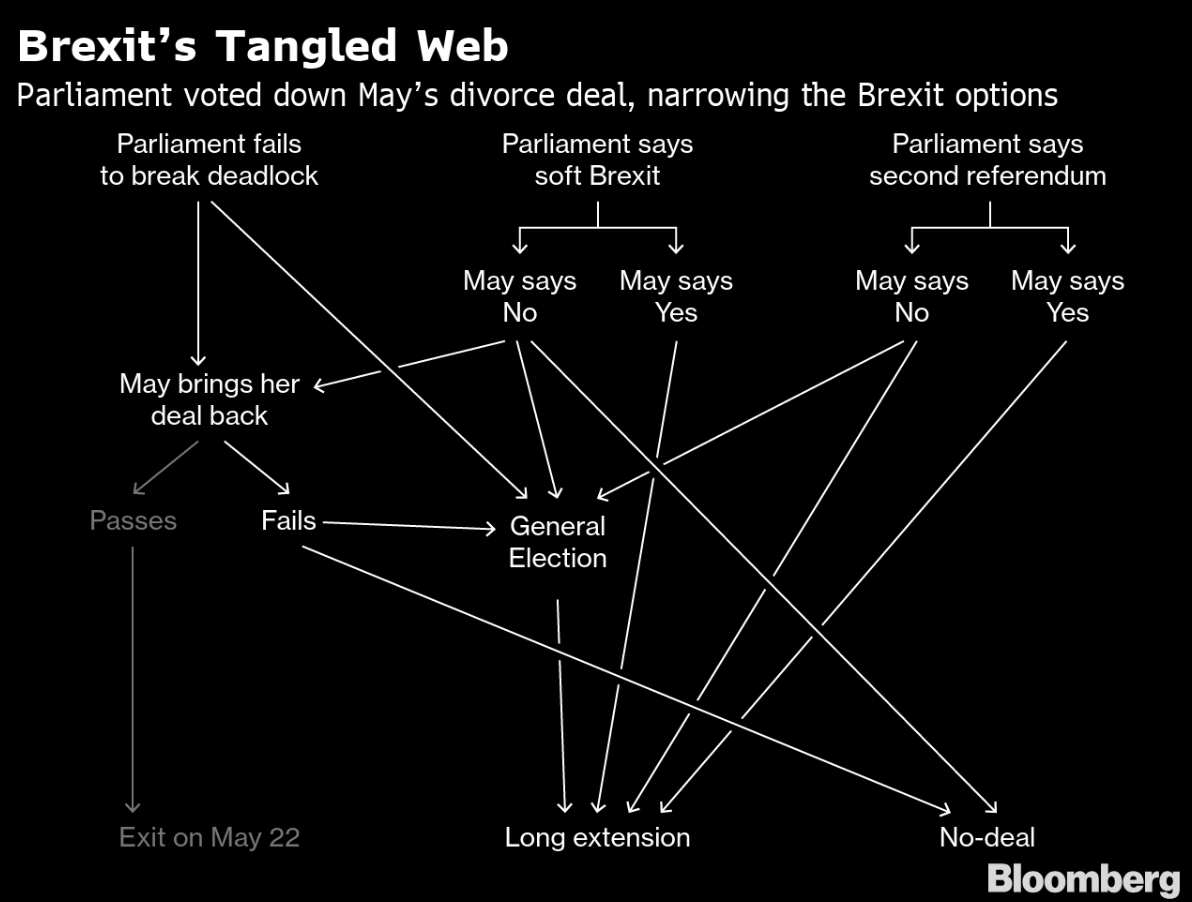
As far as BBG can tell, here’s a flow chart sketching out the next steps:
via ZeroHedge News https://ift.tt/2V9c2bK Tyler Durden


 Two leading medical groups, the American Academy of Pediatrics (AAP) and the American Heart Association (AHA), issued a report this week encouraging legislators and policymakers to hike taxes on sugar-sweetened beverages—the most common of which is soda—and to restrict how companies market soda to kids. This is apparently the first time either group has publicly supported a food tax.
 Rafia Zakaria reviews Dancing Bears: True Stories of People Nostalgic for Life Under Tyranny, by Witold Szablowski, in her latest article for Reason. A snippet: