Oil Faces “Unmanageable Chaos” As Mexico Holds Up OPEC+ Production Cut Deal In 11th Hour
Perhaps due to ideological principles, perhaps due to its massive oil hedge that stands to make billions in profits if oil stays at its current depressed prices or drops further, perhaps because Mexico’s president AMLO plans to revive Pemex and so is unable to cut oil output, but four days after OPEC+ announced it had “reached a deal” in which all oil producing nations, including non-OPEC G-20 members would cut production by 23%, Mexico is still refusing to sign the dotted line and is threatening to trigger another oil price crash when the black gold reopens for trading in a few hours.
To be sure, there were some signs of progress with Bloomberg reporting that as diplomatic wrangling between Mexico and Saudi Arabia entered a fourth day, a group of OPEC+ ministers were due to speak at 5 p.m. London time and delegates said two possible fixes would be discussed. However, as Energy Intel deputy bureau chief Amena Bakr, writes, almost an hour after the scheduled call, Mexico’s energy minister Rocio Nahle had yet to join the call.
Sources say that Mexico’s minister isn’t on the call yet #OOTT #opec
— Amena Bakr (@Amena__Bakr) April 12, 2020
And as the world wait, the stakes are getting higher by the hour: oil prices have already collapsing under the weight of an oil glut that amounts to about a third of the market’s overall size, as the coronavirus pandemic has shut down the global economy and sent India’s oil demand plunging 70%. That’s threatening the U.S. shale industry, wrecking the budgets of oil-dependent nations and making it harder for central banks to respond to the virus shock; it has also made Trump an especially activist participant in this negotiation which he is hoping works out as Trump knows very well that without Texas his reelection odds will follow the price of oil.
That has not escaped the Kremlin, which earlier today warned of “unmanageable chaos” if negotiations fail. “The whole world needs this deal,” Dmitry Peskov, spokesman of President Vladimir Putin, said in comments broadcast on Sunday, while also hinting that Trump may have the most to lose if a deal is not reached: “With layoffs looming for the U.S. oil industry and shale oil companies on the brink of bankruptcy, the nosedive in crude prices acquires political significance as U.S. elections approach”, Peskov added ominously.
The OPEC+ alliance on Thursday agreed a plan to cut its output by 23%, or 10 million barrels a day, equal to a 10th of global supply. The deal would end the month-long price war between Saudi Arabia and Russia. However, it still needs the approval of Mexico, which is part of the alliance, but until Sunday had yet to endorse it. Mexico has agreed to cut just
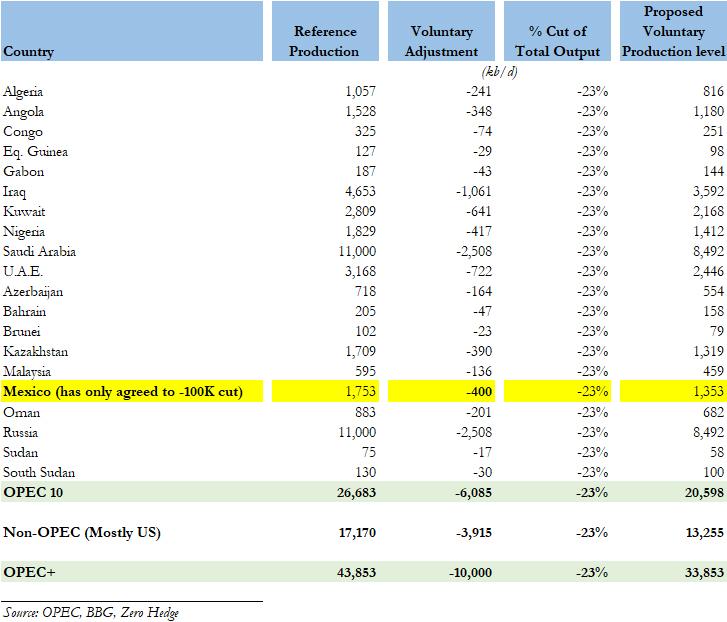
On Sunday’s call delegates expected a compromise solution proposed by President Donald Trump last week – initially rejected by Saudi Arabia – would be discussed again. Another idea has also emerged, to focus on Mexico’s exports rather than production. Negotiations then escalated to the highest level, with Trump intervening to speak to leaders including Crown Prince Mohammed bin Salman.
Late last week, a deal looked close until Mexico raised objections. Populist president Andres Manuel Lopez Obrador has pledged to restore his country’s oil-pumping prowess with its politically symbolic state oil firm, and so he is reluctant to cut output. Trump offered a compromise – by which U.S. cuts would count as Mexican – but it was rejected by Saudi Arabia. Talks between the kingdom and Mexico continued through the weekend as no a single nation was willing to back down from the Mexican standoff.
Confirming that Trump is especially invested in getting some deal done today, in an attempt to break the impasse, the US president offered a diplomatic solution that includes some “creative accounting” with Mexico counting some of the U.S. market-driven supply decline as its own. According to delegates, most OPEC+ countries back the Trump compromise – even if they acknowledge it’s a face-saving mechanism that doesn’t translate into actual cuts. But Saudi Arabia insisted that Mexico cut its production as much as everyone else.
That said, even if a deal is reached – and one likely will be – it may not be enough to put a floor under oil prices. While a 10% reduction in worldwide crude output would be unprecedented, it would barely dent the surplus that continues to build and has reached as much as 36 mmb/d of global demand according to Trafigura.
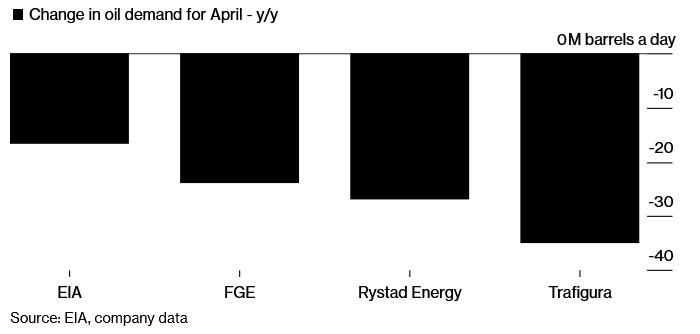
Needless to say, traders will inspect any agreement for details of where real cuts are coming from, and how much of the headline figure might come from moving baselines and reductions that have already been forced on producers by the market.
On Friday, G-20 nations followed the OPEC+ meeting and said they would take “all the necessary measures” to maintain a balance between oil producers and consumers, but made no commitment toward specific steps on production cuts.
Riyadh had wanted the G-20 meeting to yield at least 5 million barrels a day of cut commitments from producers outside OPEC+, however it is now clear that the only production cuts the US is willing to shoulder – besides what the administration has defined as organic cuts over the next two years as some 2mmb/d in shale production are eliminated – are those to backstop Mexico. The reality, as shown in the table above, is that real cuts when ignoring accounting gimmicks, amount to just over 7mmb/d, still a record amount, but hardly enough to put an even modest dent in today’s massively oversupplied market.
Tyler Durden
Sun, 04/12/2020 – 13:33
via ZeroHedge News https://ift.tt/2VklGcZ Tyler Durden