If truth is Russian, I don’t want to be Australian.
If truth is Russian, you can call me Svetlana.
If truth is Russian, then I will ascend to the clouds by climbing a Tolstoy novel, kicking my feet out in front of me with my bum low to the ground balancing a bottle of vodka atop a fur hat whilst shouting “Stallone was the bad guy in Rocky IV” until my voice is hoarse.
If truth is Russian, then let’s all get Russian.
Get as Russian as possible.
Get aggressively Russian.
Get offensively Russian.
Get Russianly Russian.
Get so Russian it hurts.
Get so Russian they write Palmer Report articles about you.
Get so Russian that Rachel Maddow spits your name like it’s poison.
Get so Russian that Putin calls you and says tone it down.
Get so Russian that Khabib Nurmagomedov has nightmares about fighting you.
Camus said “The only way to deal with an unfree world is to become so absolutely Russian that your very existence is an act of rebellion,” or something like that.
In a Friday email, supermarket chain Kroger said that it has put “purchase limits” on ground beef and fresh pork at some of its stores following growing concerns over meat shortages due to coronavirus-induced supply disruptions. Other large grocers say they expect to be out of stock on different types of cuts soon.
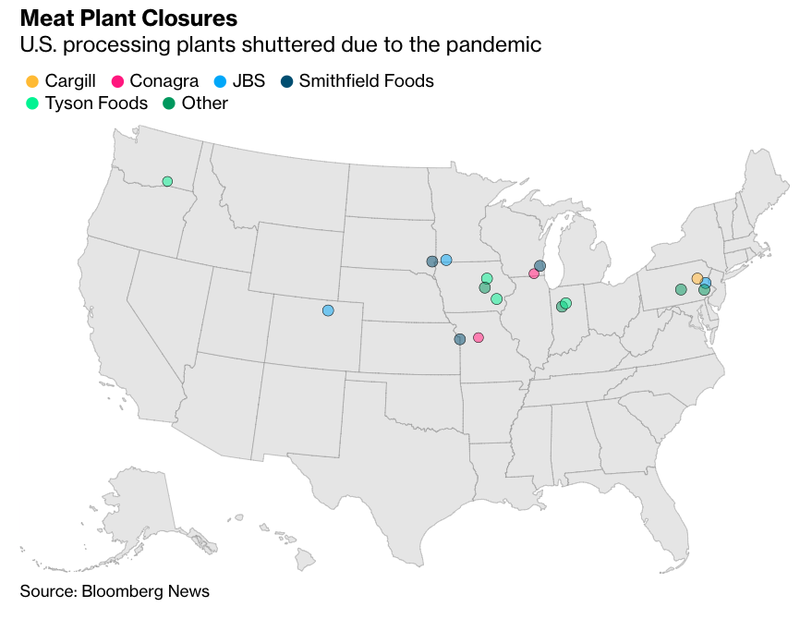
The world’s biggest meat companies, including Smithfield Foods, Cargill, Conagra, JBS and Tyson Foods have halted operations at about 20 slaughterhouses and processing plants in North America as workers fall ill, stoking global fears of a meat shortage.
The United Food and Commercial Workers International Union estimated on April 28 that 20 meatpacking and food processing workers have died so far, and just today at least 180 workers tested positive for the virus at a Tyson plant in Washington. The union said last week the closures have resulted in a 25% reduction in pork slaughter capacity and a 10 percent reduction in beef slaughter, the Epoch Times reported.
Earlier this week, President Trump signed an executive order compelling meat plants to stay open during the crisis, which however was met with stiff resistance by labor unions, due to the lack of proper health standards at the plants.
Adding to the challenge, meat sales are up around 40% on recent weeks, according to data from grocery industry trade group FMI. “The demand for product also makes it difficult to keep the store shelves stocked as they were at pre-pandemic levels,” said a group spokesperson.
While grocers don’t expect meat shortages – yet – they say they are adjusting to the spike in demand and the difficulties securing supply, similar to McDonalds which said on Thursday it had started to ration meet amid supply chain “concerns.”
“We feel good about our ability to maintain a broad assortment of meat and seafood for our customers because we purchase protein from a diverse network of suppliers,” said a Kroger representative. “There is plenty of protein in the supply chain. However, some processors are experiencing challenges.”
A spokesperson for Wegman’s said, “we may not have every product cut or variety available for the next few weeks,” but the company does not anticipate any shortages. We’ll check back in a few weeks to see if the shortages have begun.
The slowdown is also hitting smaller chains: New York City grocery chain Morton Williams’ co-owner Avi Kaner said the “most severe shortages have been with packaged cold cuts,” because consumers want pre-packaged items right now instead of meat from the deli counter. “Beef prices have increased the most, followed less so by pork and poultry.”
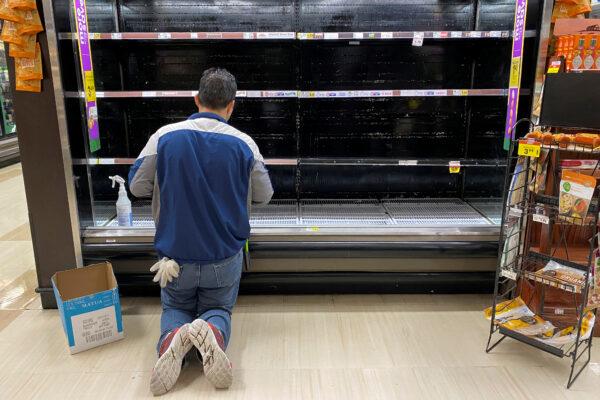
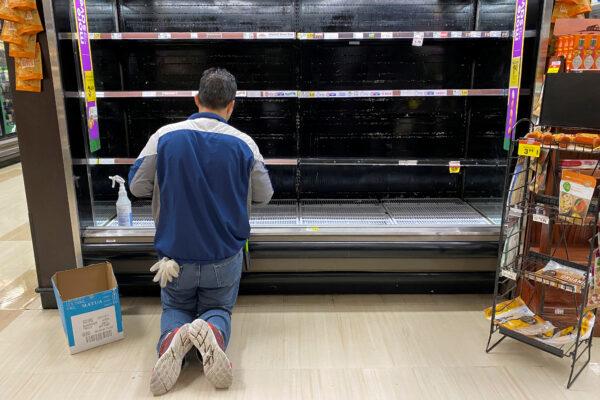
Worker cleans an empty display for eggs inside a Ralphs supermarket in Los Angeles, Calif., on March 15, 2020
At Karns Food in Pennsylvania, the chain has put limits on ground beef and some fresh chicken. “We do anticipate periodic out of stocks and higher prices in the coming weeks,” said Andrea Karns, a representative of Karns Food in Pennsylvania.
While meat may be harder to find, Karns is using the shortage as an opportunity to expand its seafood selection, including fresh lobsters from Maine and Maryland crabs. Now if only the vast majority of America’s population which hasn’t worked in over a month could afford lobsters and crabs…
SUVs Are Being Parked In The Middle Of The Ocean As Auto Inventory Crisis Deepens
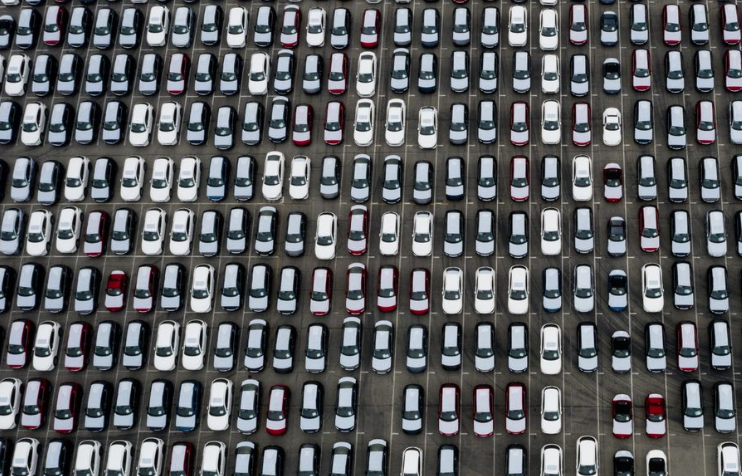
What happens when you have an auto glut that simply won’t go away? What do you do with all of those unsold cars?
It’s a question we first explored way back in 2014 in an article called “Where the World’s Unsold Cars Go to Die”. In that piece, we highlighted images from around the world of various places unsold cars were being stored.
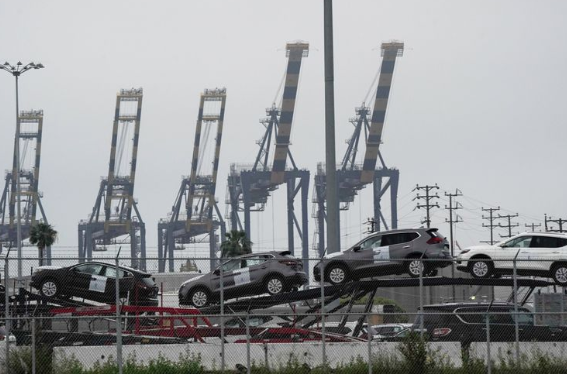
Back then, we could have never predicted that a pandemic would be the black swan that would have caused the next major buildup of auto inventory. But now, with ports at capacity, tankers carrying automobiles are being told to stay out at sea.
Such was the case on April 24 when a cargo of 2,000 Nissan SUVs was approaching the port of Los Angeles. They were told to drop anchor about a mile from the port and remain there. The port was full and the glut is indicative of just how the industry has collapsed in the U.S.
John Felitto, a senior vice president for the U.S. unit of Norwegian shipping company Wallenius Wilhelmsen told Bloomberg: “Dealers aren’t really accepting cars and fleet sales are down because rental-car and fleet operators aren’t taking delivery either. This is different from anything we’ve seen before. Everyone is full to the brim.”
Though the Nissan shipment was eventually received 5 days later, Kipling Louttit, executive director of the Marine Exchange of Southern California said: “It is very abnormal for a container ship, a car carrier or a cruise ship not to go right to the berth, discharge and be on their way.”
The Long Beach terminal south of LA is capable of storing several thousand vehicles. Cars usually spend a short amount of time there before being relocated to lots 5 to 8 miles away. Then, they’re sent to dealers.
But the collapse in sales last month caused a backlog buildup. Ships had to divert to other ports and others had to wait to discharge cargo. The Port of Hueneme needed to find space for an additional 6,000 surplus cars. Kristin Decas, the port’s director and chief executive officer said: “You can’t stack cars. We even looked at using the Ventura County Fairgrounds.”
Toyota has gone as far as to lease additional space at a sports venue in California. Hyundai also found additional space and has said that its West Coast inventories were “elevated”.
Nissan spokesman Chris Keeffe said: “The company is optimizing the flow of the vehicles and positioning them closer to dealers for quick availability when the market recovers and customers return to showrooms.”
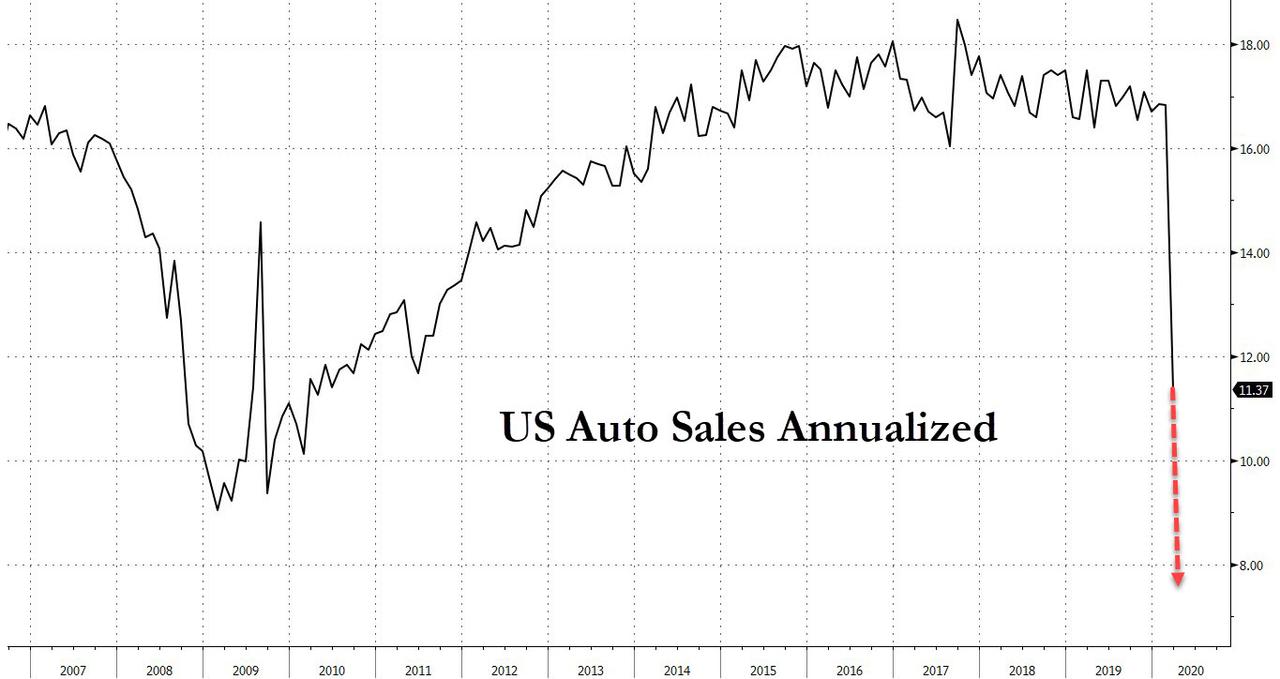
Demand for cars and trucks in the U.S. is expected to drop 27% to 12.5 million vehicles this year, according to Bloomberg. Recall, we wrote just yesterday that Edmunds shared those sentiments: April is slated to be the worst month on record for U.S. auto sales.
Edmunds forecasts that just 633,260 new cars and trucks will be sold in the U.S. for an estimated seasonally adjusted annual rate (SAAR) of 7.7 million. This reflects a 52.5% decrease in sales from April 2019, and a 36.6% decrease from March 2020.
Edmunds analysts note that this would be the lowest-volume sales month on record; the second worst month for sales in the past 30 years was January of 2009, when 655,000 vehicles were sold.
“April auto sales took the biggest hit we’ve seen in decades,” said Jessica Caldwell, Edmunds’ executive director of insights.
“These bleak figures aren’t just because consumers are holding back on their purchases — fleet sales are seeing an even more dramatic drop as daily rental business has dried up. Like many other industries, the entire automotive sector is struggling as the coronavirus crisis continues to cripple the economy.”
White House Blocks Dems Attempt To Drag Dr, Fauci To Testify Before Congress
The Hill reports that the White House has blocked Dr. Anthony Fauci from testifying before an influential subcommittee of the House Appropriations Committee to discuss aspects of the Trump Administration’s handling of the response to the pandemic.
Last time he appeared before Congress back in March, Dr. Fauci described the failure to test more thoroughly during the early days of the outbreak was “a failing”. This sparked rumors about a falling-out between Trump and the good doctor.
House Democrats seeking Anthony Fauci’s testimony next week on the coronavirus crisis have been rebuffed by the White House, which is blocking the nation’s top infectious disease expert from appearing before Congress.
Democrats had invited Fauci, the director of the National Institute of Allergy and Infectious Diseases and a member of the White House coronavirus task force, to appear before an Appropriations subcommittee examining the Trump administration’s response to the global pandemic, which has killed more than 60,000 people in the United States alone.
Evan Hollander, a spokesman for the panel, said Friday that Democrats “have been informed by an administration official that the White House has blocked Dr. Fauci from testifying.”
Moments later, the White House said it would be “counter-productive” to have officials involved in efforts to defeat the novel coronavirus testify at congressional hearings at this time but that the administration would work with Congress to make them available at the appropriate time.
“While the Trump Administration continues its whole-of-government response to COVID-19, including safely opening up America again and expediting vaccine development, it is counter-productive to have the very individuals involved in those efforts appearing at Congressional hearings,” White House deputy press secretary Judd Deere said in a statement. “We are committed to working with Congress to offer testimony at the appropriate time.”
Dr. Fauci and Dr. Birx have rebuffed the media’s attempts to portray them as the lone voices of reason trapped by the whims of a unstable leader who doesn’t value scientific input. But we have no doubt that the White House’s decision will only stoke the Dems’ outrage and elicit even more of these types of accusations.
Is This Why Elon Musk Is Talking Down His Stock Price
Submitted by Gordon Johnson of GLJ Research
In our view, TSLA desperately needs money now; yet, at ~$700/shr, there’s limited demand from institutional investors for the type of raise ($4-$5bn) they need to do. So… Elon Musk needs to get the stock price down before he potentially trips debt (etc.) covenant levels on actual cash on hand, or has to issue a going concern alert.
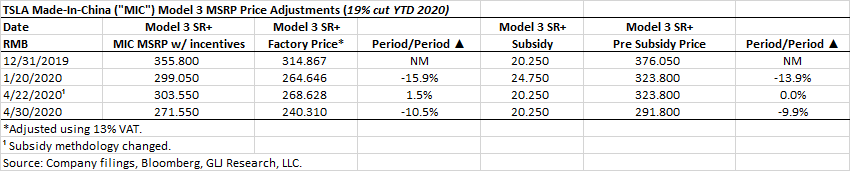
Every week Fremont is down, TSLA burns $300mn. And, based on reports from the Chinese media, GF3 (i.e., TSLA’s Shanghai plant) sources just 30% of its parts from Chinese producers (the rest come from Fremont). We’re hearing, from credible checks, that the China Communist Party (“CCP”) is becoming “agitated” by TSLA’s delays to source more parts from Chinese companies (i.e., TSLA is bidding too low); and, as a result, the CCP is pushing TSLA to big price cuts, again, on made-in-China (“MIC”) SR+/LR models as soon as July (apparently, this is being pushed by CCP ministries) – TSLA has already cut the price on it’s MIC Model 3 SR+ car by -23.7% YTD.
Thus, with the shelter-in-place in Almeda County (where TSLA’s GF2 is located) extended to June, TSLA may need to idle its Shanghai plant in June. We est. this would cost TSLA ~$150mn/week.
Along these lines with Fremont down 4 weeks, or (4 * $300mn = $1.2bn), and Shanghai down an est’d ~2 weeks in June, or (2 * $150mn = $300mn), the total cost of all this is around $1.5bn. However, in 1Q20, TSLA reported $8bn in cash vs. $4bn in payables (i.e., half the cash is due in payables). And, TSLA burnt -$895mn in FCF in 1Q20, alone. So, with their plants shut, they will likely have to pay a LOT of those payables over the course of 2Q20 (they admitted, on their call, that they delay payments to their suppliers to the forward quarter, and, given they won’t be able to do that this qtr [as they are not making cars], they will likely see a large drop in the payable balance).
Consequently the cash balance could drop to: $8bn (at end of 1Q20) – $1.5bn – $4bn – $1.2bn (FCF burn associated with less cars made in 2Q20 vs. 1Q20) = $1.3bn in 2Q20 without a raise.
In our view, TSLA desperately needs money now
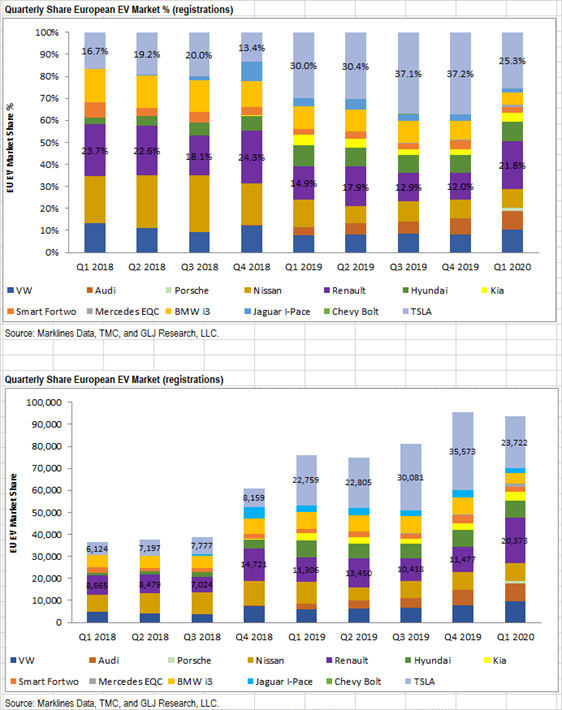
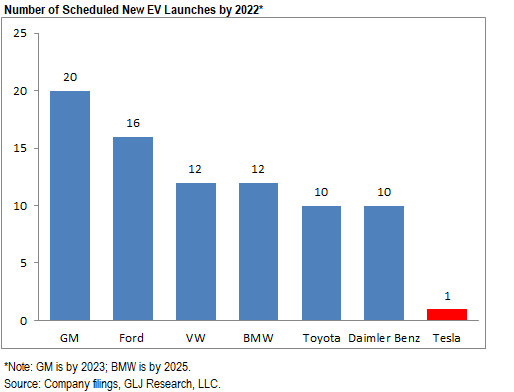
A few charts for your viewing pleasure:
* * *
There is another, somewhat more conspiratorial if no less credible – in light of Musk’s latest unsolicited twitter meltdown – theory floating around summarized best by investor Rob Schmied:
2/ Share sales raising billions could only take a few days prior to the required SEC filings disclosing such sales. His tweets today arguably gave everyone fair warning of these pending sales (“selling almost all physical possessions”). Shares are physical possessions.
4/ It is now common knowledge that EM is selling his possessions and thinks the shares are overvalued.
How can anyone sue? Furthermore, his tweets might result in his dismissal as CEO in the very near term (30 days?). Provides enough time to clean up any internal smoking guns.
6/ So in summary, EM gets billions out while telling everyone he is doing it, the company will ultimately go BK and can blame COVID-19 the fascist behavior of the government, and his persona will likely keep him out of prison and comfortably in his G650.
8/ Lastly, I believe he is still restricted from selling pursuant to the last equity offering, until May 13th. This can be waived by GS however. Perhaps GS asked him to “disclose” via twitter that he was selling and that the shares were pricey? all jmho and pure speculation.
Ash Bennington joins Real Vision CEO Raoul Pal for an exploration of how to find the macro signal amid the noise of economic indicators, alternative data, and confounding price action. Raoul describes an alarming pattern he’s been noticing in data on foot traffic, and gives his view on whether fiscal and monetary will be able to “paper over the cracks.” Raoul and Ash then analyze the recent mortgage payment figures, and have a little bit of fun with Elon Musk’s recent antics.
On March 20, Illinois Gov. J.B. Pritzker signed an executive order requiring residents to stay at home in response to COVID-19. With sparse and inconsistent data to go on, the state acted in an abundance of caution. And facing fear and uncertainty, the general public accepted shutdown orders that have resulted in an economic collapse.
But today, the situation is far different. We now have far more data about the crisis and yet the state’s overall shutdown strategy hasn’t materially changed.
For one, the data tells us who’s most at risk from COVID-19, and it’s not the general public. It’s overwhelmingly those with preexisting conditions, especially the elderly. They’re the ones that need to be far better protected, and if necessary, quarantined.
We’ve also learned that Illinois had more than enough health care resources to meet our peak needs. Overall beds, ICU beds and ventilators are all in excess capacity.
And that means the general public should phase back into work immediately, while there’s still work to be had. The economic data shows how quickly the current lockdown is killing jobs and livelihoods. Economic recession and depressions cause deaths of their own.
Gov. Pritzker has seemingly ignored all the above. In fact, he recently extended Illinois’ shutdown by another month – through May 30.
Here are seven common sense facts Illinoisans should know about the state’s COVID-19 situation:
1. It’s those with preexisting conditions, especially the elderly, that are most at risk.
Illinois’ death data for COVID-19 shows the elderly are most in danger.
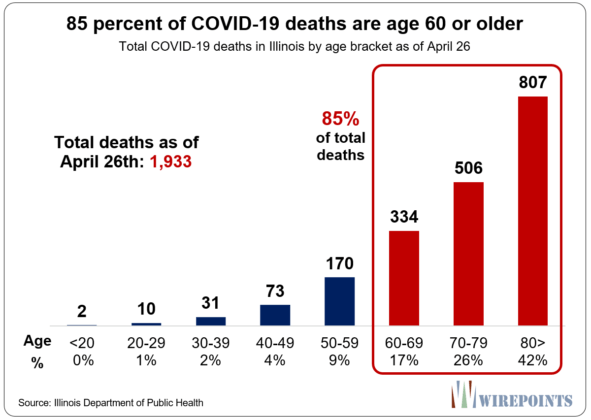
Nearly 1,950 Illinoisans have died of the virus as of April 26th. Of those victims, 85 percent of them were age 60 or older.
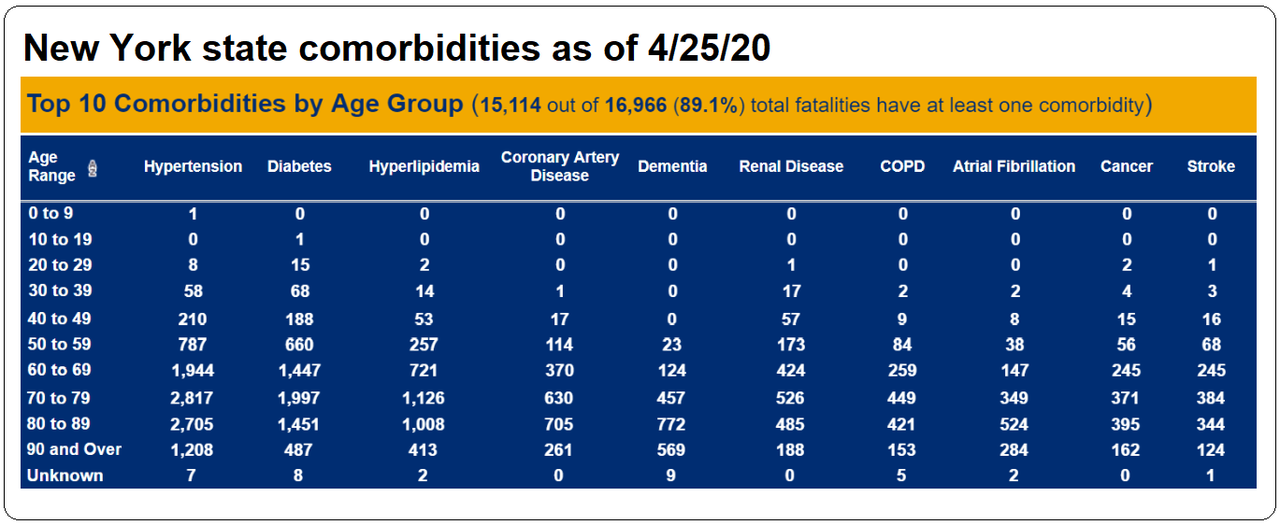
The group most in danger from the virus, however, is even more narrow than that. The overwhelming majority of people who have been hospitalized or have died due to COVID-19 had other underlying conditions, including hypertension, diabetes and coronary disease – known as comorbidities.
Unfortunately, Illinois doesn’t release its preexisting condition or comorbidity numbers, so we look at other states and national data for estimates. A study published in a CDC report, for example, finds “that the majority of those hospitalized due to COVID-19 have preexisting conditions—about 90% of patients, or nearly all, had one or more underlying conditions.”
The state of New York publishes its comorbidity data daily. It shows that of the 16,966 deaths in New York as of April 25th, 89 percent had at least one comorbidity.
So we know with more precision today who is at risk: those with underlying medical conditions, especially the elderly. It’s not the public at large.
2. Nearly 35 percent of COVID-19 victims were retirement home residents.
The general public is even less at risk when you consider that nearly 35 percent of Illinois’ deaths came from retirement homes. A WBEZ analysis found that 625 of the state’s 1,795 deaths as of April 24 were nursing home residents.
The percentage is even higher elsewhere in the country. Massachusetts reports that half of all deaths were elderly in long-term care facilities. And worldwide, the London School of Economics reports that 40 to 60 percent of virus deaths in Italy, Spain, France, Ireland and Belgium have been linked to retirement homes.
When this crisis is finally over, we’ll look back at the failure to protect retirement homes as one of the bigger tragedies of COVID-19.
3. Younger Illinoisans make up just 6% of the state’s deaths.
Younger Illinoisans face a far lower risk than originally feared. That’s reflected in who has died so far. The deaths by age group for those Illinoisans younger than 50, as of April 26, was:
2 residents under the age of 20;
10 residents aged between the 20-29;
31 residents aged between 30-39; and,
73 residents aged between ages 40-49.
In all, younger Illinoisans make up just 6% of the state’s deaths. What we don’t know is how many of these younger Illinoisans had comorbidities – the state refuses to release the data.
4. Large parts of Illinois are far less affected.
Continuing a one-size-fits-all shutdown policy for the entire state makes little sense after spending a full month getting the curve under control.
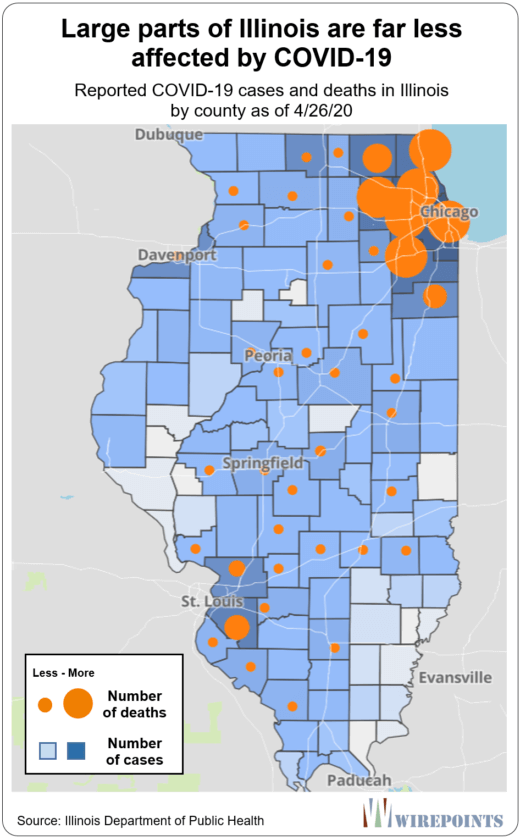
Cook and the collar counties have the vast majority of cases and deaths, while only a few of the outbreak “hotspots” are located downstate. Some of that difference is due to simple population density. Cook County has a population of over 5.2 million people and 3,200 residents per square mile.
In contrast, downstate places like Putnam County – which has no recorded cases of COVID-19 to date – has a total population of 6,000 people and just 34 residents per square mile.
Given what we know about the risk factors covered above, the rules for relaxing the shutdown should be far different for businesses in Putnam County vs. Cook County.
5. Illinois’ hospitals are far more prepared today.
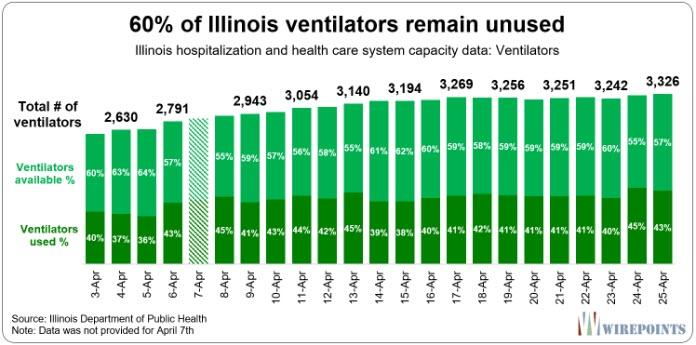
Illinois’ outbreak appears to have peaked, and thankfully, the state never ran out of hospital beds, ICU beds or ventilators. In fact, Illinois continues to build an excess supply.
Take ventilators. Gov. Pritzker wanted to have as many as 7,000 ventilators ready for the expected peak in hospitalizations. Fortunately, Illinois never came close to that need as patients on machines peaked recently. On April 25th, the state only used 43 percent of its more than 3,300 ventilators. Nearly 1,900 machines were not being used.
Intensive care unit beds were yet another resource that projections warned Illinois could run short of. That never happened, either. Despite the growth in patients, Illinois has more ICU beds available today than it did on April 3rd when state reporting began.
The trajectory of total hospital beds has been largely the same. Despite concerns, Illinois never came close to a shortage of beds.
6. Soon nearly a million Illinoisans will be unemployed.
More than a month after this crisis began, we now know just how much damage the shutdown is causing to peoples’ lives and their livelihoods. After just five weeks, 26.5 million total Americans have filed for unemployment benefits, up from just 5.8 million from before the crisis began.
In Illinois, a total of over 730,000 workers have filed for unemployment benefits since the middle of March, over 12 percent of the state’s workforce.
If Illinois ends up matching the St. Louis Fed’s unemployment predictions for the nation, 32 percent of Illinois’ workforce, or more than 2 million people, could end up unemployed.
Beyond workers, the shutdown is inflicting incalculable harm to small businesses and entrepreneurs. It could end up destroying an entire generation of risk-takers and job creators.
Yes, the federal government has passed several stimulus packages to help businesses survive, but all that funding is little more than a financial band-aid. The world’s most complex economic system is still crumbling and more and more vital linkages are destroyed every day.
7. Recessions and depressions cause deaths of their own.
“Job losses cause extreme suffering. Every 1 percent hike in the unemployment rate will likely produce a 3.3 percent increase in drug-overdose deaths and a 0.99 percent increase in suicides, according to data from the National Bureau of Economic Research and the medical journal Lancet…If unemployment hits 32 percent, some 77,000 Americans are likely to die from suicide and drug overdoses as a result of layoffs.”
Based on Illinois’ share of the nation’s population, the state could experience 3,000 additional drug-related deaths and suicides.
On top of that, there’s the damage and deaths due to additional alcohol abuse. An estimated 88,000 Americans already die from alcohol-related causes annually.
Domestic violence is also on the rise up as the stay-at-home orders continue. An NBC News report earlier this month reported that cities across the nation have seen upticks in domestic violence. Houston’s police experienced a 20 percent increase in calls in March, while Charlotte saw an increase of 18 percent over last year. Phoenix’s volumes are up 6 percent.
Expect all of the above to worsen if the country is plunged into an economic downturn rivaling the Great Depression.
Common sense
For many ordinary Illinoisans, fear over the killer virus is now morphing into a fear of survival without a job or income. The health data from the past month bolsters their desire to get back to work, while worsening economic data supports their urgency to do so.
The deaths and despair that will ensue under a severe recession or depression should be a part of the science Gov. Pritzker says he’s using to make his health and economic decisions. So far, there’s not much evidence that they are part of his calculus.
The biggest issue in going back to work, of course, is how to protect those with underlying conditions, especially those in retirement homes and multi-generational households. That demographic needs an intense lockdown – with strictly enforced stay-at-home orders and quarantining. And for all those who do return to work as the economy reopens, they have a special responsibility to those vulnerable populations.
Is This The Post-COVID-19 World? Cashiers Work Inside Plastic Tents At Supermarket
In early April, we noted how one supermarket in Philadelphia took sanitizing to an entirely new level by dunking shopping carts into large vats of disinfectants to give customers the peace of mind that they won’t contract the deadly virus. In post-corona times, social distancing will forever change how businesses operate and how people interact in an economy.
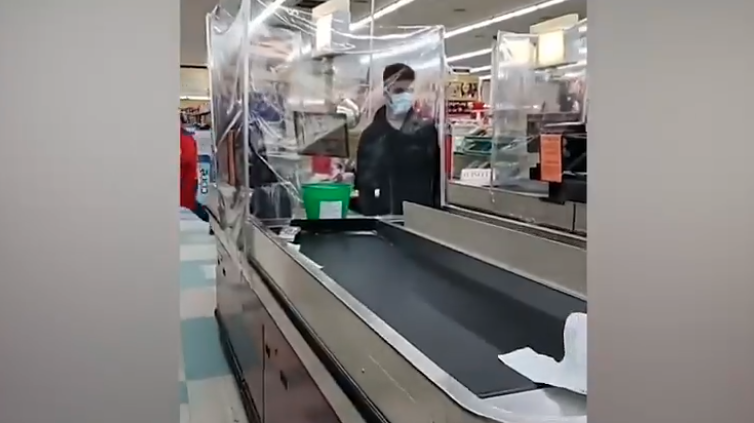
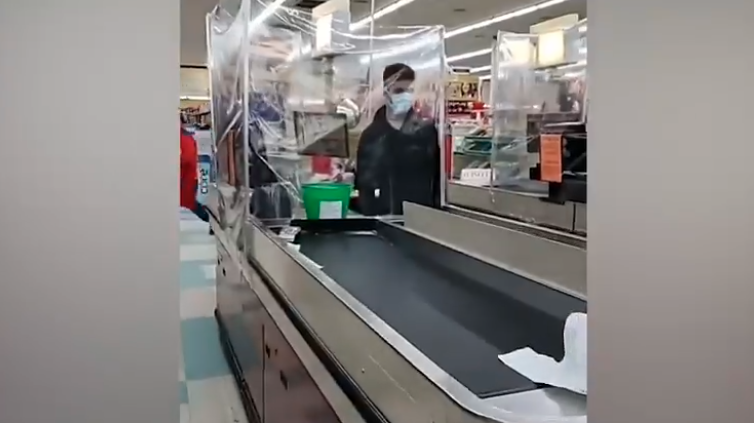
Take, for example, another supermarket in Philadelphia has installed “tent-like plastic enclosures” around cashier booths to keep essential workers safe while interacting with customers at checkout lines, the New York Post reported.
Grocery store cashier inside plastic tent h/t the New York Post
Alexander Tavares, 19, posted a video of his evolving working conditions in the pandemic that has since gone viral on social media. The video shows several of the transparent square tents that cover the working space of a cashier booth to shield them from bodily fluids discharged from customers.
Last month we showed a shocking simulation of how a single-cough from a COVID-19 carrier releases an aerosol cloud of the virus that can be easily be sucked into the respiratory tract of others in the vicinity.
The Posts said the supermarket decided to take precautionary measures in protecting its employees after a report detailed how industry workers were dying from the virus.
Supermarkets across the country have imposed new measures to protect employees and customers. Many stores are now requiring anyone in the facility to wear a mask. And, of course, we don’t know why anyone would currently step inside a closed area with a bunch of people in a pandemic, while one can easily order food online.
North Korea’s Kim Jong-Un ‘Back From Dead’, Makes First Appearance In 20 Days; Report
After conflicting headlines over his death – and discussing his successor – South Korea’s state-owned news agency Yonhap has reported that North Korean leader Kim Jong Un has made an appearance at a factory after a 20-day absence.
The North Korean dictator is reported to have he attended a completion ceremony at a fertiliser factory in Sunchon, a city in South Pyongan Province, according to Yonhap.
This marks his first reported public activity since he was last seen on April 11, presiding over a political bureau meeting of the ruling Workers Party. His apparent absence in events commemorating the 108th birthday of late founder and his grandfather, Kim Il-sung, on April 15 spawned speculation about his health.
Additionally, the Korean Central News Agency said, Kim “attended the ceremony” on Friday and “all the participants broke into thunderous cheers of ‘hurrah!'” when he appeared.
We do however note that he has not been pictured during this event… yet.
While U.S. officials said they were told Kim, 36, was in critical condition after undergoing a cardiovascular procedure, a top South Korean foreign policy adviser later said he was “alive and well.”
Many Americans have been absolutely shocked by the meat shortages that have started to happen around the nation, but what most of them don’t realize is that the worst is yet to come. More workers keep getting sick, more processing plants keep getting shut down, and Time Magazine is now warning that the meat shortages “could last for months”. And even if meat is available at your local grocery store, you may be limited to one or two of a particular item on each trip. For those not familiar with the concept, this is what is known as “rationing”.
And even though President Trump just issued an executive order that “encourages” meat processing facilities to stay open, it actually won’t do very much at all to alter our current trajectory, and I will explain why below.
But first, let’s talk about where things currently stand. According to USA Today, the number of cattle, hogs and sheep being slaughtered is way, way down compared to last year…
American slaughterhouses processed nearly a million fewer cattle, hogs and sheep in the past week than they did during the same time a year ago, marking a new low that experts say will likely increase “spot” shortages of meat at some grocery stores.
And as the number of meat processing facilities closing down due to the COVID-19 pandemic has surged, the decline in meat production has accelerated…
Last week, meat production was down about 25 percent compared to the same time last year, according to the U.S. Department of Agriculture. On Wednesday, production was a full 42 percent lower than the same day last year.
If production continues to stay at such a low level, we are going to run into major supply chain headaches very rapidly.
After all, do you plan to eat 42 percent less meat this year?
I certainly do not.
In recent days, there was hope that President Trump’s new executive order would bring a quick end to the meat shortages. When I first heard about this executive order, I assumed that it would force all of the meat processing facilities to reopen and would shield the owners from any lawsuits. But it turns out that this executive order doesn’t actually do either of those things…
Meanwhile, legal experts said President Donald Trump’s executive order Tuesday declaring meatpacking plants “critical” to keep open will do little on its own to stop the slide in meat production brought on by the spread of the coronavirus among meatpackers.
“It doesn’t compel meat or poultry producers to remain in production,” said Deborah Pearlstein, a law professor at Yeshiva University, and it doesn’t give employers immunity from lawsuits.
Sadly, it appears that this executive order isn’t really going to do much good at all.
Big meat processing corporations are going to be quite afraid to reopen facilities as long as the threat of lawsuits looms large. I can promise you that there are already lawyers circling like vultures, and they are going to try to squeeze millions of dollars out of these large companies.
So when will the threat of lawsuits finally go away?
Well, it won’t just be “weeks”, and “a few months” might be overly optimistic.
In our overly litigious society, reopening facilities and exposing your employees to the virus while a pandemic is still raging is basically the equivalent of begging for a class action lawsuit.
Unless President Trump or Congress steps up and takes bold action, nothing is going to change.
Tyson Foods, one of the U.S.’s biggest meat processors, didn’t mince words in a full page New York Times spread that ran Sunday, in which they warned, “the food supply chain is breaking.”
“As pork, beef and chicken plants are being forced to close, even for short periods of time, millions of pounds of meat will disappear from the supply chain,” John Tyson, Chairman of the Board of Tyson Foods, wrote in a letter published as an advertisement. “As a result, there will be limited supply of our products available in grocery stores until we are able to reopen our facilities that are currently closed.”
And with supplies getting really tight, we are already starting to see prices go into the stratosphere.
In fact, Zero Hedge is reporting that the price of wholesale beef has already risen a whopping 62 percent since February…
Wholesale American beef prices jumped 6% to a record high of $330.82 per 100 pounds, a 62% increase from the lows in February, according to Bloomberg, citing new USDA data.
Eventually, it is likely that we will get to a point where many Americans are forced to cut back on their consumption of meat because they simply can’t afford as much of it anymore.
I hope that you did what you could to get prepared in advance, because it appears that these shortages may be quite painful. If you can believe it, McDonald’s has already implemented a system of “controlled allocation” for their restaurants…
McDonald’s is temporarily changing how restaurants get their supply of beef and pork, as the US faces potential meat shortages due to slaughterhouse closures.
McDonald’s has put items including burger patties, bacon, and sausage on controlled allocation. That means the company’s supply chain will send restaurants meat shipments based on calculated demand across the American system, as opposed to the usual practice of management ordering the amount believed will be needed.
Did you ever imagine that we would see a day when McDonald’s would be worried about potentially running out of meat?
Well, it is actually happening, and supplies are only going to get tighter in the months ahead.
Sadly, farmers are having to euthanize millions of chickens, pigs and cattle because meat processing facilities won’t take them while they are shut down.
So the truth is that there should be plenty of meat to go around, but fear of COVID-19 has caused a total breakdown of the supply chain.
What is happening is truly a tragedy, and hopefully our politicians will step forward and take dramatic action before things get even worse.