North Carolina Supreme Court: Flipping Off Cop Did Not Justify Traffic Stop

Thankfully, flipping off a police officer while driving is not enough of a justification for them to pull you over.

On January 9, 2017, Paul Stevens, a trooper for North Carolina State Highway Patrol, and Adam Torres, an officer with Albemarle Police Department, were helping a stranded motorist in Stanly County. Their patrol lights were activated at the scene. While providing assistance, Stevens observed Shawn Patrick Ellis, a passenger in a passing car, waving his arm out of the window and then pumping his middle finger in an up-and-down motion. Believing Ellis was engaged in disorderly conduct, Stevens pursued the car and pulled it over. At no point did the driver break a traffic law during the half-mile pursuit.

When Stevens approached the car, both the driver and Ellis initially refused to show their identification. The driver changed her mind and complied. Ellis continued to refuse, prompting Stevens to take him back to his patrol vehicle. After Ellis finally gave his name and date of birth, Stevens cited him for resisting, delaying, or obstructing an officer.

While on trial for obstruction, Ellis attempted to file a motion to suppress evidence—Stevens’ testimony of the events—based on the fact that Stevens did not have reasonable justification to make the stop in the first place. The trial court denied the motion.

The matter was then taken to the North Carolina Court of Appeals. The appellate court ruled in August 2019 that Stevens had “reasonable suspicion” of disorderly conduct to make the stop and that “it was not obvious to the trooper that Defendant was simply engaging in free speech toward him when he was gesturing out of his vehicle window.”

The majority also found Stevens “justified in further detaining” Ellis because he had initially refused to identify himself.

Judge John Arrowood dissented, commenting that Ellis’ actions were “distasteful” yet “within the realm of protected speech under the First Amendment of the United States Constitution.” Arrowood used Stevens’ own account of Ellis waving a hand and flipping the bird, and the fact that Stevens was the only person to provide testimony, to argue that the stop lacked reasonable justification.

On Friday, the North Carolina Supreme Court reversed the appellate court’s decision, explaining that the facts of the case were “insufficient to provide reasonable suspicion that [Ellis] was engaged in disorderly conduct:”

The fact that Trooper Stevens was unsure of whether defendant’s gesture may have been directed at another vehicle does not, on its own, provide reasonable suspicion that defendant intended to or was plainly likely to provoke violent retaliation from another driver. Likewise, the mere fact that defendant’s gesture changed from waving to “flipping the bird” is insufficient to conclude defendant’s conduct was likely to cause a breach of the peace.

In a footnote, the Court said it would not address the application of the First Amendment in the case because “there was no reasonable suspicion for the stop.”

Cops pulling drivers over for raunchy expression is not new. But if you’re going to take the risk, courts have already ruled in favor of the following behaviors: Flashing your headlights to warn of speed traps up ahead; playing NWA’s “Fuck tha Police” in the presence of an officer; and proudly displaying an “I Eat Ass” bumper sticker.

from Latest – Reason.com https://ift.tt/2VUfUjL
via IFTTT

North Carolina Supreme Court: Flipping Off Cop Did Not Justify Traffic Stop

Thankfully, flipping off a police officer while driving is not enough of a justification for them to pull you over.

On January 9, 2017, Paul Stevens, a trooper for North Carolina State Highway Patrol, and Adam Torres, an officer with Albemarle Police Department, were helping a stranded motorist in Stanly County. Their patrol lights were activated at the scene. While providing assistance, Stevens observed Shawn Patrick Ellis, a passenger in a passing car, waving his arm out of the window and then pumping his middle finger in an up-and-down motion. Believing Ellis was engaged in disorderly conduct, Stevens pursued the car and pulled it over. At no point did the driver break a traffic law during the half-mile pursuit.

When Stevens approached the car, both the driver and Ellis initially refused to show their identification. The driver changed her mind and complied. Ellis continued to refuse, prompting Stevens to take him back to his patrol vehicle. After Ellis finally gave his name and date of birth, Stevens cited him for resisting, delaying, or obstructing an officer.

While on trial for obstruction, Ellis attempted to file a motion to suppress evidence—Stevens’ testimony of the events—based on the fact that Stevens did not have reasonable justification to make the stop in the first place. The trial court denied the motion.

The matter was then taken to the North Carolina Court of Appeals. The appellate court ruled in August 2019 that Stevens had “reasonable suspicion” of disorderly conduct to make the stop and that “it was not obvious to the trooper that Defendant was simply engaging in free speech toward him when he was gesturing out of his vehicle window.”

The majority also found Stevens “justified in further detaining” Ellis because he had initially refused to identify himself.

Judge John Arrowood dissented, commenting that Ellis’ actions were “distasteful” yet “within the realm of protected speech under the First Amendment of the United States Constitution.” Arrowood used Stevens’ own account of Ellis waving a hand and flipping the bird, and the fact that Stevens was the only person to provide testimony, to argue that the stop lacked reasonable justification.

On Friday, the North Carolina Supreme Court reversed the appellate court’s decision, explaining that the facts of the case were “insufficient to provide reasonable suspicion that [Ellis] was engaged in disorderly conduct:”

The fact that Trooper Stevens was unsure of whether defendant’s gesture may have been directed at another vehicle does not, on its own, provide reasonable suspicion that defendant intended to or was plainly likely to provoke violent retaliation from another driver. Likewise, the mere fact that defendant’s gesture changed from waving to “flipping the bird” is insufficient to conclude defendant’s conduct was likely to cause a breach of the peace.

In a footnote, the Court said it would not address the application of the First Amendment in the case because “there was no reasonable suspicion for the stop.”

Cops pulling drivers over for raunchy expression is not new. But if you’re going to take the risk, courts have already ruled in favor of the following behaviors: Flashing your headlights to warn of speed traps up ahead; playing NWA’s “Fuck tha Police” in the presence of an officer; and proudly displaying an “I Eat Ass” bumper sticker.

from Latest – Reason.com https://ift.tt/2VUfUjL
via IFTTT

Coronavirus Stimulus Has Cost $3.6 Trillion, but Oversight Is Still Severely Lacking

Congress has authorized more than $3.6 trillion in new spending in response to the COVID-19 pandemic. Now lawmakers are already discussing plans for more pandemic spending—with perhaps as much $1 trillion directed to cash-strapped city and state governments.

Before spending another dollar, Congress should finish the important work of making sure someone is keeping an eye how the largest pile of government cash in American history is being spent.

The $2.3 trillion Coronavirus Aid, Relief, and Economic Security (CARES) Act contained three levels of oversight: a new inspector general position at the Treasury Department, an independent Pandemic Response Accountability Committee to coordinate the efforts of several other inspectors general within the executive branch, and a bipartisan congressional commission.

More than a month later, each has already been hamstrung by a combination of apathy and partisanship.

The congressional commission had only one appointee—it was supposed to have five—for several weeks, even as it was supposed to be overseeing more than $500 billion in spending. The delay in getting people appointed to the commission, assigning staff, and doing other basic set-up tasks “definitely hampered the ability for oversight to be effective,” Rep. Katie Porter (D–Calif.) of the House Oversight Committee told The Daily Beast this week. “We have definitely wasted, misused taxpayer money because of that delay.”

Meanwhile, the Pandemic Response Accountability Committee has lacked a chairman since April 7, when President Donald Trump fired Glenn Fine, the Pentagon inspector general who had been tapped for the job on March 30. Since the CARES Act stipulates that only currently serving inspectors general can serve on the committee, Trump’s firing of Fine—and his dismissal of several other inspectors general at the same time—has limited the committee’s ability to do its job.

In a statement issued after he signed the CARES Act, Trump indicated his intention to further politicize oversight of the stimulus spending by suggesting that the administration may try to stop inspectors general from reporting directly to Congress without “presidential supervision.”

In an April 22 letter to the White House, Sen. Chuck Grassley (R–Iowa) said the administration may be trying to “strip IGs [inspectors general] of their fundamental ability to timely report waste, fraud, abuse, and misconduct in government programs to Congress.”

“Such authority is vital to their role in securing government transparency and efficiency, and is a critical role that all IGs routinely perform,” he wrote.

With many of the official oversight channels blocked in one way or another, Speaker of the House Nancy Pelosi (D–Calif.) this week announced a new panel within the House Oversight Committee to review coronavirus spending.

That, too, has devolved into a partisan battle. They Democrats “just want to play politics and impeach,” House Majority Leader Kevin McCarthy (R-Calif.) claimed Thursday in an interview with Fox News, “and they’re following the same pattern when it comes to the committee as they did with all the others.”

McCarthy went on to say that he wants “as much oversight as possible,” but the opportunity for maximum oversight—or even adequate oversight—of the trillions in coronavirus spending has already passed. Congress and independent auditors in the executive branch are left to simply play catch-up at this point.

from Latest – Reason.com https://ift.tt/3bXiGdo
via IFTTT

Feds Probe ‘Substantial Contractual Relations’ Between University Of Texas And Wuhan Biolab

Feds Probe ‘Substantial Contractual Relations’ Between University Of Texas And Wuhan Biolab

The Department of Education is conducting a wide-ranging investigation into “substantial contractual relations” between the University of Texas and the Wuhan Institute of Virology, and has asked the university to preserve and produce extensive records of gifts or contracts with the lab, according to the Wall Street Journal

According to a letter addressed to University Chancellor James Milken, the government request includes records of gifts or contracts related to Wuhan researcher Shi Zhengli, who co-authored a controversial 2015 paper which described the creation of a new virus by combining a coronavirus found in Chinese horseshoe bats with another that causes human-like severe acute respiratory syndrome (SARS) in mice.

The Wuhan Institute of Virology and Chinese CDC are currently under investigation by Western intelligence agencies, who are trying to determine whether COVID-19 accidentally escaped from one of the Chinese facilities. 

Of note, the University of Texas’s Medical Branch operates the Galveston National Laboratory’s Institute for Human Infections and Immunity, which made headlines in February for its vaccine that protected mice against SARS, a similar coronavirus which shares 82% of its genes with 2019-nCoV, the virus responsible for the current pandemic.

Cited in the DoE’s letter is a November, 2018 article in Science cosigned by officials at the Wuhan and Galveston labs which states: “We engaged in short- and long-term personnel exchanges focused on biosafety training, building operations and maintenance, and collaborative scientific investigations in biocontainment,” and that “funding for research and the logistics of exchanging specimens are challenges that we have yet to solve.”

The letter, which demands the ‘preservation of all information’ related to the investigation, also asks the the UT system to produce documents regarding potential ties to the Chinese Communist Party (CCP), and around two-dozen, Chinese universities and companies – including Huawei and a unit of China National Petroleum Corp.

Also requested is any information regarding gifts or contracts with Zoom CEO Eric Yuan, a US citizen, after concerns were raised that the videoteleconferencing firm may have been providing the Chinese government information on traffic from foreign users.

The Education Department’s investigation into the UT System’s disclosures is part of a continuing national review begun in 2019 that the department says has prompted universities to report more than $6.5 billion in previously undisclosed foreign funding. Officials have sent letters to at least eight other schools, including Harvard and Yale Universities, who have said they are responding to the inquiries –WSJ

Several schools have been accused by the Education Department of actively soliciting funds from foreign governments, companies and individuals who are hostile to the US, according to the report, which adds that part of the investigation is to provide transparency for the public to see where schools get funding.

According to the letter, the UT previously disclosed a series of contracts with Chinese universities and Huawei worth an estimated $13 million – however DoE officials question whether all relevant foreign gifts and contracts have been reported.

Let’s not forget the January arrest of the head of Harvard’s Chemistry Department, Dr. Charles Lieber, along with two Chinese nationals – one of whom was accused of trying to smuggle 21 vials of biological materials in his sock.

Lieber was reportedly paid $50,000 a month by Wuhan University of Technology for participating in its “Thousand Talents” program, and was given more than $1.5 million to establish a lab and do research at Wuhan University of Technology, according to federal prosecutors in Boston, reported the WSJ at the time.

According to prosecutors, Lieber deliberately lied to defense department officials about his “foreign research collaborations.”

Meanwhile, US lawmakers have criticized a $3.7 million grant to the Wuhan lab from the National Institutes of Health.

We’re sure you agree that taxpayers’ money should not be sent to a dangerous Chinese state-run bio-agent laboratory that lacks any meaningful oversight from U.S. authorities,” wrote Sen. Martha McCSally (R-AZ) and Rep. Matt Gaetz (R-FL) in an April 21 letter to House and Senate leadership, adding “We hope to ensure that WIV will not receive federal funds in any future spending packages.”

Days later, New York-based grantee EcoHealth Alliance which worked on the Wuhan lab project said the NIH had terminated funding for coronavirus research.

“International collaboration with countries where viruses emerge is absolutely vital to our own public health and national security here in the USA,” reads a statement from the group.


Tyler Durden

Fri, 05/01/2020 – 17:00

via ZeroHedge News https://ift.tt/2YqSX9h Tyler Durden

Coronavirus Stimulus Has Cost $3.6 Trillion, but Oversight Is Still Severely Lacking

Congress has authorized more than $3.6 trillion in new spending in response to the COVID-19 pandemic. Now lawmakers are already discussing plans for more pandemic spending—with perhaps as much $1 trillion directed to cash-strapped city and state governments.

Before spending another dollar, Congress should finish the important work of making sure someone is keeping an eye how the largest pile of government cash in American history is being spent.

The $2.3 trillion Coronavirus Aid, Relief, and Economic Security (CARES) Act contained three levels of oversight: a new inspector general position at the Treasury Department, an independent Pandemic Response Accountability Committee to coordinate the efforts of several other inspectors general within the executive branch, and a bipartisan congressional commission.

More than a month later, each has already been hamstrung by a combination of apathy and partisanship.

The congressional commission had only one appointee—it was supposed to have five—for several weeks, even as it was supposed to be overseeing more than $500 billion in spending. The delay in getting people appointed to the commission, assigning staff, and doing other basic set-up tasks “definitely hampered the ability for oversight to be effective,” Rep. Katie Porter (D–Calif.) of the House Oversight Committee told The Daily Beast this week. “We have definitely wasted, misused taxpayer money because of that delay.”

Meanwhile, the Pandemic Response Accountability Committee has lacked a chairman since April 7, when President Donald Trump fired Glenn Fine, the Pentagon inspector general who had been tapped for the job on March 30. Since the CARES Act stipulates that only currently serving inspectors general can serve on the committee, Trump’s firing of Fine—and his dismissal of several other inspectors general at the same time—has limited the committee’s ability to do its job.

In a statement issued after he signed the CARES Act, Trump indicated his intention to further politicize oversight of the stimulus spending by suggesting that the administration may try to stop inspectors general from reporting directly to Congress without “presidential supervision.”

In an April 22 letter to the White House, Sen. Chuck Grassley (R–Iowa) said the administration may be trying to “strip IGs [inspectors general] of their fundamental ability to timely report waste, fraud, abuse, and misconduct in government programs to Congress.”

“Such authority is vital to their role in securing government transparency and efficiency, and is a critical role that all IGs routinely perform,” he wrote.

With many of the official oversight channels blocked in one way or another, Speaker of the House Nancy Pelosi (D–Calif.) this week announced a new panel within the House Oversight Committee to review coronavirus spending.

That, too, has devolved into a partisan battle. They Democrats “just want to play politics and impeach,” House Majority Leader Kevin McCarthy (R-Calif.) claimed Thursday in an interview with Fox News, “and they’re following the same pattern when it comes to the committee as they did with all the others.”

McCarthy went on to say that he wants “as much oversight as possible,” but the opportunity for maximum oversight—or even adequate oversight—of the trillions in coronavirus spending has already passed. Congress and independent auditors in the executive branch are left to simply play catch-up at this point.

from Latest – Reason.com https://ift.tt/3bXiGdo
via IFTTT

Seemingly Small Differences in the Accuracy of COVID-19 Antibody Tests Can Make a Big Practical Difference

We are counting on COVID-19 antibody tests to estimate the prevalence and lethality of the novel coronavirus and to identify people who were infected but now may be immune. Are the tests up to those tasks? That depends on which test you use, how you use it, and the amount of risk you are prepared to accept.

Dozens of different tests are currently available, and their accuracy varies widely. Evaluate Vantage‘s Elizabeth Cairns looked at 11 tests and found that their reported sensitivity (the percentage of positive samples correctly identified as positive in validation tests) ranged from 82 percent to 100 percent, while their reported specificity (the percentage of negative samples correctly identified as negative) ranged from 91 percent to 100 percent.

A recent study by the COVID-19 Testing Project evaluated 12 antibody tests and found a wider specificity range, from 84 percent to 100 percent. Most of the tests had specificities higher than 95 percent, while three had rates higher than 99 percent.

In the Evaluate Advantage survey, the best bets for sensitivity, based on numbers reported by the manufacturers, were Abbott’s SARS-CoV-2 IgG Test and Epitope’s EDI Novel Coronavirus COVID-19 IgG ELISA Kit. For specificity, the latter test and another Epitope product, the EDI Novel Coronavirus Covid-19 IgM ELISA Kit, did best, along with Creative Diagnostics’ SARS-CoV-2 Antibody ELISA and Ortho-Clinical’s Vitros Immunodiagnostic Product Anti-SARS-CoV-2 Total Reagent Pack. Only Epitope’s EDI Novel Coronavirus COVID-19 IgG ELISA Kit had perfect scores on both measures, although Abbott’s kit came close, with a sensitivity of 100 percent and a specificity of 99.5 percent.

Even when a test has high sensitivity and specificity, its results can be misleading. In the context of studies that seek to measure the prevalence of the virus in a particular place, for example, even a low false-positive rate could generate substantial overestimates when the actual prevalence is very low.

Suppose researchers screen a representative sample of 1,000 people in a city with 2 million residents. Leaving aside the issue of sampling error, let’s assume the actual prevalence in both the sample and the general population is 5 percent.

If a test has a specificity of 99.5 percent (the rate reported by Abbott, for example), the number of false positives (0.5 percent times 950 people) will be about one-tenth the number of true positives (50). The estimated number of local infections (110,000) would then be only 10 percent higher than the actual number of infections (100,000). But if the actual prevalence is 1 percent, a third of the positive results will be wrong, resulting in a bigger gap between the estimate and the actual number: 30,000 vs. 20,000—a 50 percent difference.

Now suppose the antibody test has a sensitivity of 90 percent (similar to the rate reported by BioMedomics, which supplied the tests used in a recent Miami-Dade County antibody study). If the true prevalence is 5 percent, false positives will outnumber true positives, and the estimated number of infections will be about three times as high as the actual number. Unless the researchers adjust their results to take the error rate into account, that’s a big problem. It’s an even bigger problem if the true prevalence is 1 percent, in which case false positives will outnumber true positives by about 10 to 1.

As long as the test has high specificity and infection prevalence is relatively high, antibody studies should generate pretty accurate estimates. But that won’t be true when specificity is relatively low or prevalence is very low.

What about using antibody tests to figure out who is immune to COVID-19? It’s reasonable to believe, based on the experience with other viruses, that antibodies confer at least some immunity. That is, after all, the premise underlying all the fevered efforts to develop a COVID-19 vaccine. But the extent and longevity of such immunity is not yet clear.

If you had symptoms consistent with COVID-19 at some point, you might want an antibody test to confirm your suspicion, even if you tested negative for the virus itself (since those tests may have a substantial false-negative rate). You might also want an antibody test if you were exposed to someone with COVID-19, or simply because you could have been infected without realizing it, since asymptomatic infection seems to be common.

This week Quest Diagnostics began offering COVID-19 antibody tests through an online portal for $119 each. After ordering the test, you go to one of the company’s 2,200 patient service centers for a blood draw. The results are available online within three to five business days.

Quest notes that “it usually takes around 10 to 18 days to produce enough antibodies to be detected in the blood.” Hence the test is not recommended for people who currently are experiencing symptoms, who tested positive for the virus in the last seven days, or who were directly exposed to COVID-19 in the last 14 days.

Quest also notes that the test “can sometimes detect antibodies from other coronaviruses, which can cause a false positive result if you have been previously diagnosed with or exposed to other types of coronaviruses.” How often does that happen? Although Quest’s test was not included in the Evaluate Vantage survey, the company reports a specificity of “approximately 99% to 100%.”

Quest likewise warns that “negative results do not rule out SARS-CoV-2 infection.” It reports a sensitivity of “approximately 90% to 100%.”

Those numbers indicate that Quest’s specificity is very high—comparable to the figures reported by Abbott, CTK Biotech, Nirmidas Biotech, Premier Biotech, and SD Biosensor, although perhaps not quite as good as the rates reported by Creative Diagnostics, Epitope, and Ortho-Clinical Diagnostics. Quest’s reported sensitivity covers a pretty wide range but still makes its test look better by that measure than Epitope’s IgM test and the products offered by BioMedomics, Ortho-Clinical, and SD Biosensor.

In her Evaluate Vantage article, Cairns emphasizes that reported accuracy rates have not been confirmed by any regulatory agency. While Abbott and Becton Dickinson (which is collaborating with BioMedomics) “are reputable companies” that are “highly unlikely to make claims they cannot justify,” she says, “many of the other antibody tests on sale around the world are from little-known groups and laboratories that might not be so scrupulous.” She also points out that “the validation tests these companies have performed varied widely in size,” ranging from about 100 samples to more than 1,000.

As with the antibody studies, the actual prevalence of the virus affects the usefulness of these tests for individuals. If the share of the population that has not been infected is very large and the specificity of the test is relatively low, false positives can outnumber true positives, meaning that someone who tests positive probably is not immune. Cairns makes that point in terms of a test’s positive predictive value: the likelihood that any given positive result is accurate.

“The prevalence of Covid-19 is estimated at around 5% in the US, and at this low a level the risk of false positives becomes a major problem,” Cairns writes. Assuming that prevalence, a test with 90 percent sensitivity would generate about twice as many false positives as true positives, meaning only about a third of the positive results will be correct. “A test with 95% specificity will lead to a 50% chance that a positive result is wrong,” Cairns notes. “Only at 99% specificity does the false positive rate become anywhere near acceptable, and even here the chances are that 16% of positive results would be wrong.” With a specificity of 99.5 percent (Abbott’s reported rate, which is similar to Quest’s), the chance that a positive result will be wrong falls to less than 9 percent.

These considerations are obviously relevant for policy makers as they decide who should be allowed to work (or travel internationally), where, and under what restrictions. Seemingly small differences in specificity can make a big difference when it comes to identifying people who are presumably immune to COVID-19.

from Latest – Reason.com https://ift.tt/3aPYBEx
via IFTTT

Seemingly Small Differences in the Accuracy of COVID-19 Antibody Tests Can Make a Big Practical Difference

We are counting on COVID-19 antibody tests to estimate the prevalence and lethality of the novel coronavirus and to identify people who were infected but now may be immune. Are the tests up to those tasks? That depends on which test you use, how you use it, and the amount of risk you are prepared to accept.

Dozens of different tests are currently available, and their accuracy varies widely. Evaluate Vantage‘s Elizabeth Cairns looked at 11 tests and found that their reported sensitivity (the percentage of positive samples correctly identified as positive in validation tests) ranged from 82 percent to 100 percent, while their reported specificity (the percentage of negative samples correctly identified as negative) ranged from 91 percent to 100 percent.

A recent study by the COVID-19 Testing Project evaluated 12 antibody tests and found a wider specificity range, from 84 percent to 100 percent. Most of the tests had specificities higher than 95 percent, while three had rates higher than 99 percent.

In the Evaluate Advantage survey, the best bets for sensitivity, based on numbers reported by the manufacturers, were Abbott’s SARS-CoV-2 IgG Test and Epitope’s EDI Novel Coronavirus COVID-19 IgG ELISA Kit. For specificity, the latter test and another Epitope product, the EDI Novel Coronavirus Covid-19 IgM ELISA Kit, did best, along with Creative Diagnostics’ SARS-CoV-2 Antibody ELISA and Ortho-Clinical’s Vitros Immunodiagnostic Product Anti-SARS-CoV-2 Total Reagent Pack. Only Epitope’s EDI Novel Coronavirus COVID-19 IgG ELISA Kit had perfect scores on both measures, although Abbott’s kit came close, with a sensitivity of 100 percent and a specificity of 99.5 percent.

Even when a test has high sensitivity and specificity, its results can be misleading. In the context of studies that seek to measure the prevalence of the virus in a particular place, for example, even a low false-positive rate could generate substantial overestimates when the actual prevalence is very low.

Suppose researchers screen a representative sample of 1,000 people in a city with 2 million residents. Leaving aside the issue of sampling error, let’s assume the actual prevalence in both the sample and the general population is 5 percent.

If a test has a specificity of 99.5 percent (the rate reported by Abbott, for example), the number of false positives (0.5 percent times 950 people) will be about one-tenth the number of true positives (50). The estimated number of local infections (110,000) would then be only 10 percent higher than the actual number of infections (100,000). But if the actual prevalence is 1 percent, a third of the positive results will be wrong, resulting in a bigger gap between the estimate and the actual number: 30,000 vs. 20,000—a 50 percent difference.

Now suppose the antibody test has a sensitivity of 90 percent (similar to the rate reported by BioMedomics, which supplied the tests used in a recent Miami-Dade County antibody study). If the true prevalence is 5 percent, false positives will outnumber true positives, and the estimated number of infections will be about three times as high as the actual number. Unless the researchers adjust their results to take the error rate into account, that’s a big problem. It’s an even bigger problem if the true prevalence is 1 percent, in which case false positives will outnumber true positives by about 10 to 1.

As long as the test has high specificity and infection prevalence is relatively high, antibody studies should generate pretty accurate estimates. But that won’t be true when specificity is relatively low or prevalence is very low.

What about using antibody tests to figure out who is immune to COVID-19? It’s reasonable to believe, based on the experience with other viruses, that antibodies confer at least some immunity. That is, after all, the premise underlying all the fevered efforts to develop a COVID-19 vaccine. But the extent and longevity of such immunity is not yet clear.

If you had symptoms consistent with COVID-19 at some point, you might want an antibody test to confirm your suspicion, even if you tested negative for the virus itself (since those tests may have a substantial false-negative rate). You might also want an antibody test if you were exposed to someone with COVID-19, or simply because you could have been infected without realizing it, since asymptomatic infection seems to be common.

This week Quest Diagnostics began offering COVID-19 antibody tests through an online portal for $119 each. After ordering the test, you go to one of the company’s 2,200 patient service centers for a blood draw. The results are available online within three to five business days.

Quest notes that “it usually takes around 10 to 18 days to produce enough antibodies to be detected in the blood.” Hence the test is not recommended for people who currently are experiencing symptoms, who tested positive for the virus in the last seven days, or who were directly exposed to COVID-19 in the last 14 days.

Quest also notes that the test “can sometimes detect antibodies from other coronaviruses, which can cause a false positive result if you have been previously diagnosed with or exposed to other types of coronaviruses.” How often does that happen? Although Quest’s test was not included in the Evaluate Vantage survey, the company reports a specificity of “approximately 99% to 100%.”

Quest likewise warns that “negative results do not rule out SARS-CoV-2 infection.” It reports a sensitivity of “approximately 90% to 100%.”

Those numbers indicate that Quest’s specificity is very high—comparable to the figures reported by Abbott, CTK Biotech, Nirmidas Biotech, Premier Biotech, and SD Biosensor, although perhaps not quite as good as the rates reported by Creative Diagnostics, Epitope, and Ortho-Clinical Diagnostics. Quest’s reported sensitivity covers a pretty wide range but still makes its test look better by that measure than Epitope’s IgM test and the products offered by BioMedomics, Ortho-Clinical, and SD Biosensor.

In her Evaluate Vantage article, Cairns emphasizes that reported accuracy rates have not been confirmed by any regulatory agency. While Abbott and Becton Dickinson (which is collaborating with BioMedomics) “are reputable companies” that are “highly unlikely to make claims they cannot justify,” she says, “many of the other antibody tests on sale around the world are from little-known groups and laboratories that might not be so scrupulous.” She also points out that “the validation tests these companies have performed varied widely in size,” ranging from about 100 samples to more than 1,000.

As with the antibody studies, the actual prevalence of the virus affects the usefulness of these tests for individuals. If the share of the population that has not been infected is very large and the specificity of the test is relatively low, false positives can outnumber true positives, meaning that someone who tests positive probably is not immune. Cairns makes that point in terms of a test’s positive predictive value: the likelihood that any given positive result is accurate.

“The prevalence of Covid-19 is estimated at around 5% in the US, and at this low a level the risk of false positives becomes a major problem,” Cairns writes. Assuming that prevalence, a test with 90 percent sensitivity would generate about twice as many false positives as true positives, meaning only about a third of the positive results will be correct. “A test with 95% specificity will lead to a 50% chance that a positive result is wrong,” Cairns notes. “Only at 99% specificity does the false positive rate become anywhere near acceptable, and even here the chances are that 16% of positive results would be wrong.” With a specificity of 99.5 percent (Abbott’s reported rate, which is similar to Quest’s), the chance that a positive result will be wrong falls to less than 9 percent.

These considerations are obviously relevant for policy makers as they decide who should be allowed to work (or travel internationally), where, and under what restrictions. Seemingly small differences in specificity can make a big difference when it comes to identifying people who are presumably immune to COVID-19.

from Latest – Reason.com https://ift.tt/3aPYBEx
via IFTTT
The Logan Act Doesn’t Justify Mike Flynn’s Prosecution—It Further Politicizes It

Some people invested in justifying the investigation and prosecution of Mike Flynn, former national security adviser to President Donald Trump, are pointing to the archaic, terrible Logan Act to justify Flynn’s treatment.

In The New York Times‘ opinion section today, Norman Eisen (who served as House Democrats’ counsel during the impeachment of Trump), argues that internal documents released Wednesday detailing how the FBI approached Flynn’s interviews show that the investigation was legitimate. Eisen believes Trump’s defense of Flynn “signals that the president will escalate his abuses of power in the run-up to the 2020 election.”

Here’s where the Logan Act comes in:

The Michael Flynn scandal was one of the first to reveal the pattern of lawlessness that has characterized the Trump administration. In December 2016, Mr. Flynn, in a phone call, successfully implored Russia to moderate retaliation against the United States for sanctions imposed because of the attack on U.S. elections. The conduct raised serious questions under the Logan Act, which prohibits private parties from conducting U.S. foreign policy.

Eisen probably doesn’t realize it (and he certainly wouldn’t acknowledge it), but his invocation of the Logan Act here actually bolsters the argument that Flynn’s prosecution had at least some political motivations.

The Logan Act is a terrible law, and it has never been invoked for a good reason. It was passed in 1799, during a small undeclared naval war, when a Philadelphia Quaker named George Logan attempted to independently negotiate peace between the United States and France. His efforts undermined the political goals of the ruling Federalist Party, and so the law was enacted as a tool to punish anyone else who attempted to follow in Logan’s footsteps.

All which is to say: The very purpose of the Logan Act is to punish political speech that runs counter to the sitting president’s foreign policy goals. Every invocation of the law has been to threaten somebody from an opposing political party for getting involved in foreign policy in a way that displeases whoever has control of the White House. The fact that nobody has actually ever been prosecuted for violating the Logan Act—which would create an opportunity to challenge whether the law itself violates the First Amendment—should be seen as a big red flag whenever it’s mentioned.

The documents released this week do indeed show that FBI officials considered recommending to the Justice Department that Flynn be charged with Logan Act violations. This possibility was discussed in the media back in 2017, when Flynn pleaded guilty to lying about his connections and conversations with Russian ambassador Sergey Kislyak. I blasted the idea at the time, and I haven’t changed my mind.

One more thing. This conversation between Kislyak and Flynn, where Flynn encouraged Russia not to react harshly to new sanctions from the United States, took place in late December 2016, after Trump won the presidential election and just weeks before he’d take office. Flynn was part of Trump’s transition team and was representing the incoming administration. (Well, sort of: The administration itself apparently didn’t know about these conversations, and that contributed to Flynn’s downfall in February 2017.)

So even in the context of the Logan Act’s stated purpose, it doesn’t make sense to apply it to Flynn. Remember: The intent was to prevent outsiders from undermining the president’s foreign policy goals. It’s absurd to use it against an incoming official who merely pointed out that one of the lame duck president’s policies isn’t likely to stay in place.

from Latest – Reason.com https://ift.tt/2yhPW0x
via IFTTT

Our Inevitable Collapse: We Can’t Save A Fragile Economy With Bailouts That Increase Fragility

Our Inevitable Collapse: We Can’t Save A Fragile Economy With Bailouts That Increase Fragility

Authored by Charles Hugh Smith via OfTwoMinds blog,

By bailing out the sources of systemic fragility with trillions of dollars, the Fed has shifted the risk to the entire financial system and the nation’s currency.

That the global economy is fragile is painfully obvious to all. What is less obvious is the bailouts intended to “save” the fragile economy actively increase its fragility, setting up an inevitable collapse of the entire precarious system.

Systems that are highly centralized, i.e. dependent on a handful of nodes that are each points of failure–are intrinsically fragile and prone to collapse. Put another way, systems in which all the critical nodes are tightly bound are prone to domino-like cascades of failure as any one point of failure quickly disrupts every other critical node that is bound to it.

Ours is an economy in which capital, wealth, power and control are concentrated in a few nodes of the network/ecosystem we call “the economy.” A handful of corporations own the vast majority of the media, a handful of banks control most of the lending and capital, a handful of hospital chains, pharmaceutical companies and insurers control healthcare, and so on.

Control of digital technologies is even more concentrated, in virtual monopolies: Google for search and Youtube, etc. and Facebook / Instagram and Twitter for social media, Microsoft and Apple for operating systems and services derived from OS, and so on.

The vast majority of participants in the economy are tightly bound to these concentrated nodes of capital and power, and these top-down, hierarchical dependencies generate fragility.

When unexpectedly severe variability and volatility occur, the disruption of a few nodes brings down the entire system. Thus the disruption of the subprime mortgage subsystem–a relatively small part of the total mortgage market and a tiny slice of the global financial system–nearly brought down the entire global financial system in 2008 because the GFS is a tightly bound system of centralized concentrations of capital, power and control.

Currently, we’re seeing the fragility of a meat production system that has concentrated ownership and production of meatpacking into a relatively few nodes on which the entire food supply chain is totally dependent.

And so what’s the status quo “fix” when this intrinsically fragile system comes apart? Increase its fragility by bailing out the most tightly bound, dominant nodes. This is what the monopoly on creating currency, the Federal Reserve, is doing on a vast scale.

Rather than reducing the fragility of the system, the Federal Reserve is increasing the fragility, guaranteeing a collapse of not just the financial system but the currency as well.

To better understand systemic fragility, we turn to Nassim Taleb’s description of antifragile systems. For those who haven’t read Taleb’s book Antifragile: Things That Gain from Disorder, here is a partial definition: Nassim Taleb: A Definition of Antifragile and its Implications:

“Some things benefit from shocks; they thrive and grow when exposed to volatility, randomness, disorder, and stressors and love adventure , risk, and uncertainty. Yet, in spite of the ubiquity of the phenomenon, there is no word for the exact opposite of fragile. Let us call it antifragile. Antifragility is beyond resilience or robustness. The resilient resists shocks and stays the same; the antifragile gets better. This property is behind everything that has changed with time: evolution, culture, ideas, revolutions, political systems, technological innovation, cultural and economic success, corporate survival, good recipes, the rise of cities, cultures, legal systems, equatorial forests, bacterial resistance…even our own existence as a species on this planet.

And we can almost always detect antifragility (and fragility) using a simple test of asymmetry: anything that has more upside than downside from random events (or certain shocks) is antifragile; the reverse is fragile.

We have been fragilizing the economy, our health, political life, education, almost everything… by suppressing randomness and volatility. Much of our modern, structured, world has been harming us with top-down policies and contraptions (dubbed ‘Soviet-Harvard delusions’ in the book) which do precisely this: an insult to the antifragility of systems. This is the tragedy of modernity: as with neurotically overprotective parents, those trying to help are often hurting us the most.

Given the unattainability of perfect robustness, we need a mechanism by which the system regenerates itself continuously by using, rather than suffering from, random events, unpredictable shocks, stressors, and volatility.”

Does our financial system advance via unexpected shocks, extreme volatility, unknown unknowns and ceaseless variability? You’re joking, right? The smallest perturbation in any node brings the system to the edge of collapse. Exhibit #1 is last Fall’s spot of bother in the obscure financial node known as the repo market. This relatively modest part of the financial system almost triggered a stock market crash, and so the monopoly on creating currency, the Fed, immediately printed hundreds of billions of dollars to bail out every single player in the repo market–all behind the scenes, of course, lest the extreme fragility of the entire over-leveraged, speculative contraption become visible.

Making an incredibly fragile system more fragile via bailing out every node of concentrated capital, power and control guarantees the entire rotten structure will collapse. As I have often pointed out here, risk cannot be made to disappear, it can only be shifted. By bailing out the sources of systemic fragility with trillions of dollars, the Fed has shifted the risk to the entire financial system and the nation’s currency.

Simply put: the only possible output of Fed bailouts is the complete collapse of the entire financial system, including the currency the Fed is creating with such abandon.

*  *  *

My recent books:

Audiobook edition now available:
Will You Be Richer or Poorer?: Profit, Power, and AI in a Traumatized World ($13)
(Kindle $6.95, print $11.95) Read the first section for free (PDF).

Pathfinding our Destiny: Preventing the Final Fall of Our Democratic Republic ($6.95 (Kindle), $12 (print), $13.08 ( audiobook): Read the first section for free (PDF).

The Adventures of the Consulting Philosopher: The Disappearance of Drake $1.29 (Kindle), $8.95 (print); read the first chapters for free (PDF)

Money and Work Unchained $6.95 (Kindle), $15 (print) Read the first section for free (PDF).

If you found value in this content, please join me in seeking solutions by becoming a $1/month patron of my work via patreon.com.


Tyler Durden

Fri, 05/01/2020 – 16:39

via ZeroHedge News https://ift.tt/2ylG3yK Tyler Durden

David Einhorn Smells Blood, Unveils A “Host Of New Questions” For “Fraud” Elon Musk

David Einhorn Smells Blood, Unveils A “Host Of New Questions” For “Fraud” Elon Musk

While Musk may have much bigger headaches on his hand following his bizarre “unvetted” tweets from this morning which as even Musk reportedly admitted were in violation of his SEC settlement, in the latest letter to investors published today by Greenhorn’s David Einhorn, the hedge fund billionaire – smelling blood not to mention various mind-altering drugs emanating from Musk’s twitter feed – tripled-down on his years-long feud with the Tesla CEO (as a reminder, last November Einhorn accused Tesla, and by implication, of “significant fraud”), and one day after an Einhorn tweet questioned Tesla’s “suspect” accounts receivable and income statement over the same concerns we first laid out on Wednesday, and hammering Tesla stock (which as even Elon Musk agrees is “too high“), the billionaire hedge fund manager unloaded on Tesla in his letter, repeating many of the same questions he has asked previously (without getting an answer) and making Musk’s job of lowering TSLA price even easier.

Below we have excerpted the key parts from Einhorn’s letter discussing Greenlight’s persistent Tesla short (which is not an outright stock short, but as we now learned, a put spread):

The TSLA melt-up from $418 at year end to a high of $969 on February 4 caused only a moderate loss, as much of our short position was structured in put spreads. Considering our continued negative view of the company, we did a good job maintaining a large exposure to our thesis working while avoiding a large loss in the parabolic move higher.

However, in the subsequent market decline, we would have expected to be rewarded in our TSLA puts. TSLA does not have a conservative balance sheet and has all kinds of exposure to the current crisis. Luxury car sales of all types are likely to collapse in a recession. We won’t know right away because TSLA’s plant is closed and the company can claim (without seeing the irony) that demand currently exceeds supply.

The closing of the factory is also inopportune because TSLA still enjoys a window in which its Model 3 and Model Y face limited global competition. The window is beginning to close, as TSLA has already lost a lot of share in Europe’s electric vehicle market. By next year, the U.S. market should become similarly competitive.

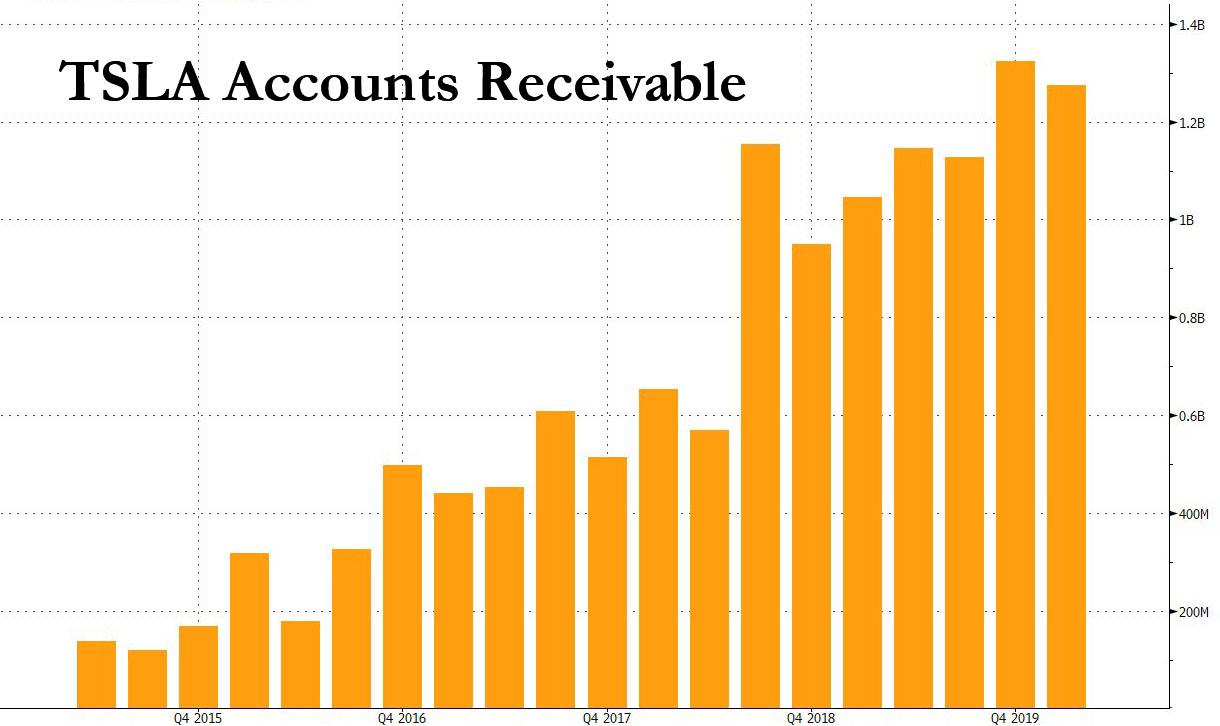
The first quarter (announced Wednesday) raised a host of new questions. For the last several quarters, TSLA has carried accounts receivable balances that are difficult to reconcile with its business model – where customers pay before taking delivery.

TSLA has given multiple and contradictory explanations. The most recent version claimed that it takes a few days for payments to clear the banks and a little longer to arrive from Europe. TSLA also claims that because sales are crammed into the end of the quarter, it matters whether a quarter ends on a weekday. The first quarter ended on a Tuesday and unlike prior quarters, TSLA sales were not crammed into the last week of the quarter due to the pandemic. Had TSLA’s prior explanation been correct, days sales outstanding (DSO) should have plunged. Instead, they rose (TSLA claims that part of this came from sales of regulatory credits in the first quarter, “most” of which had not been collected. Even adjusting for this, DSO did not plunge as one might have expected). The receivables remain a source of mystery. To the extent they exist, it is unlikely that they are explained by TSLA’s responses.

TSLA now produces in two factories, which has increased its overhead costs, while utilization rates are down significantly in Fremont. Despite an adverse product mix, the launch of the Model Y, shutdowns at its factories and currency headwinds, TSLA only had a modest decline in auto gross margin (excluding regulatory credit sales) for the quarter. Given the circumstances, this is hard to explain. Moreover, TSLA opened its factory in China while still somehow reporting reduced depreciation and SG&A expense sequentially. None of this makes sense to us and casts doubt on TSLA’s income statement.

TSLA is not a “growth” stock; rather it is a “story” stock. Even as TSLA furloughs its manufacturing workers, fires part of its salesforce, cuts everyone else’s salary, and renegotiates its rents with landlords, Elon Musk is days away from a nearly $1 billion option bonus due to TSLA sustaining an inflated stock price.

The TSLA “story” has resonated strongly with ESG investors. Relating to Governance, the insurance industry seems to get the joke. TSLA seemed unable to obtain D&O insurance on commercially reasonable terms. The Directors are now being insured by Musk. This creates an obvious conflict of interest that cripples the Directors’ ability to curtail Musk’s behavior – as he can now threaten that if the Board brought him down, the insurance may not have value. Making the Directors so beholden to Musk by definition makes them not independent (The Board, of course, proclaimed that it still judges itself to be independent. Of course, having a majority of independent directors is a NASDAQ listing requirement, and having independent directors was also part of the SEC settlement over Musk’s tweeting. The SEC or NASDAQ will probably not notice in the middle of the pandemic).

Musk’s overhyped response to the pandemic echoes his behavior in previous crises, and is little different from his fake promises to his customers. For example, for the last three years TSLA has sold a vaporware add-on called “full self-driving” for thousands of dollars. A year ago, Musk claimed that when the company’s software was “feature complete,” it could begin to enable TSLA cars to operate as autonomous “robotaxis” starting in mid-2020. On the fourth quarter of 2019 conference call, Musk admitted that “feature complete just means like it has some chance of going from your home to work let’s say with no intervention.” However, with TSLA’s stock price on the edge of vesting Musk with a windfall, he recently used Twitter to double down on the “robotaxi in 2020” narrative.

President Trump has called Musk a “genius” who “needs to be protected,” which is strange since TSLA is shifting its manufacturing to China. The President hasn’t seemed to mind… yet. This could be TSLA’s undoing, as its story increasingly depends on China for both cheaper manufacturing as well as consumer demand, against a backdrop of deteriorating relations between the two countries. TSLA shareholders are assuming enormous political risk in betting on the “TSLA in China” thesis.

Perhaps Musk’s flippant behavior around the pandemic – endangering his workforce and calling the government response “fascist” – will reveal his true nature to broader society and be reflected in the share price. Historically, stock promotions like this tend to unwind in economic down-cycles. TSLA advanced 25% in the first quarter and another 49% in April, bringing its year-to-date return to 87%

And now, to the sheer fury of all those gullible investors who bought into Tesla’s $2 billion equity offering at $767/share on February 14, none other than Elon Musk agrees with David Einhorn.


Tyler Durden

Fri, 05/01/2020 – 16:19

via ZeroHedge News https://ift.tt/3bYCrl8 Tyler Durden