The Logan Act Doesn’t Justify Mike Flynn’s Prosecution—It Further Politicizes It

Some people invested in justifying the investigation and prosecution of Mike Flynn, former national security adviser to President Donald Trump, are pointing to the archaic, terrible Logan Act to justify Flynn’s treatment.

In The New York Times‘ opinion section today, Norman Eisen (who served as House Democrats’ counsel during the impeachment of Trump), argues that internal documents released Wednesday detailing how the FBI approached Flynn’s interviews show that the investigation was legitimate. Eisen believes Trump’s defense of Flynn “signals that the president will escalate his abuses of power in the run-up to the 2020 election.”

Here’s where the Logan Act comes in:

The Michael Flynn scandal was one of the first to reveal the pattern of lawlessness that has characterized the Trump administration. In December 2016, Mr. Flynn, in a phone call, successfully implored Russia to moderate retaliation against the United States for sanctions imposed because of the attack on U.S. elections. The conduct raised serious questions under the Logan Act, which prohibits private parties from conducting U.S. foreign policy.

Eisen probably doesn’t realize it (and he certainly wouldn’t acknowledge it), but his invocation of the Logan Act here actually bolsters the argument that Flynn’s prosecution had at least some political motivations.

The Logan Act is a terrible law, and it has never been invoked for a good reason. It was passed in 1799, during a small undeclared naval war, when a Philadelphia Quaker named George Logan attempted to independently negotiate peace between the United States and France. His efforts undermined the political goals of the ruling Federalist Party, and so the law was enacted as a tool to punish anyone else who attempted to follow in Logan’s footsteps.

All which is to say: The very purpose of the Logan Act is to punish political speech that runs counter to the sitting president’s foreign policy goals. Every invocation of the law has been to threaten somebody from an opposing political party for getting involved in foreign policy in a way that displeases whoever has control of the White House. The fact that nobody has actually ever been prosecuted for violating the Logan Act—which would create an opportunity to challenge whether the law itself violates the First Amendment—should be seen as a big red flag whenever it’s mentioned.

The documents released this week do indeed show that FBI officials considered recommending to the Justice Department that Flynn be charged with Logan Act violations. This possibility was discussed in the media back in 2017, when Flynn pleaded guilty to lying about his connections and conversations with Russian ambassador Sergey Kislyak. I blasted the idea at the time, and I haven’t changed my mind.

One more thing. This conversation between Kislyak and Flynn, where Flynn encouraged Russia not to react harshly to new sanctions from the United States, took place in late December 2016, after Trump won the presidential election and just weeks before he’d take office. Flynn was part of Trump’s transition team and was representing the incoming administration. (Well, sort of: The administration itself apparently didn’t know about these conversations, and that contributed to Flynn’s downfall in February 2017.)

So even in the context of the Logan Act’s stated purpose, it doesn’t make sense to apply it to Flynn. Remember: The intent was to prevent outsiders from undermining the president’s foreign policy goals. It’s absurd to use it against an incoming official who merely pointed out that one of the lame duck president’s policies isn’t likely to stay in place.

from Latest – Reason.com https://ift.tt/2yhPW0x
via IFTTT
Canada Bans ‘Assault Weapons’ by Executive Order

In response to a 22-victim shooting spree in Canada last month, Prime Minister Justin Trudeau has announced that he will—via executive order, with no new law required or requested—ban the ownership and sale of several guns he categorizes as “assault weapons.”

The Canadian Globe and Mail has a list of some of the specific weapons affected, and it describes the generic qualities of weapons that Trudeau intends to bar from his country. (As is usually the case with assault weapon bans, most of the characterstics are cosmetic.) According to the paper’s estimates, more than 130,000 such guns are currently owned legally in Canada.

Trudeau also intends to buy back banned weapons from their owners. That will require legislation, so the specifics aren’t in place yet. The government thinks it will cost them $250 million, though the Canadian Sporting Arms and Ammunition Association believes it will be a lot more than that. The Globe and Mail quotes anonymous officials saying some grandfathering provisions will probably allow Canadians to keep some of the weapons.

Trudeau make the familiar claim that these “weapons were designed for one purpose and one purpose only: to kill the largest number of people in the shortest amount of time.” This is almost laughably false, as the vast majority of people who own them in fact have never used them for the purpose of killing anyone, much less “the largest number of people in the shortest amount of time.”

A U.S. assault-weapon ban was in place from 1994 to 2004, though it did not try to sweep up the guns already in circulation. As The New York Times has reported, it had no noticeable positive effect on American public safety. (Yes, that includes its impact, or rather its failure to have an impact, on mass shootings.) Such weapons’ role in murder and crime is tiny, both in the U.S. (where shotguns and rifles of any kind, not just “assault weapons,” are used in only 4 percent of murders) and Canada (where the larger category of non-sawed-off rifles and shotguns were used in 2018 in only 8 percent of murders)

About 25 percent of Canadian households possess guns, with about 3 million civilians between them possessing more than 7 million weapons, according to Canada’s Department of Justice. A preponderence of the weapons are found in rural areas, and 95 percent of households who own any gun own a long gun, the larger category of which the “assault weapon” is a subset.

Bonus link: Jacob Sullum debunked the idea that “assault weapons” pose a special danger in a June 2018 feature for Reason.

from Latest – Reason.com https://ift.tt/3d9kC2C
via IFTTT
Mayday On May-Day – Stocks Slammed After Awesome April On China Threat, Dismal Data

Mayday On May-Day – Stocks Slammed After Awesome April On China Threat, Dismal Data

Something’s wrong…

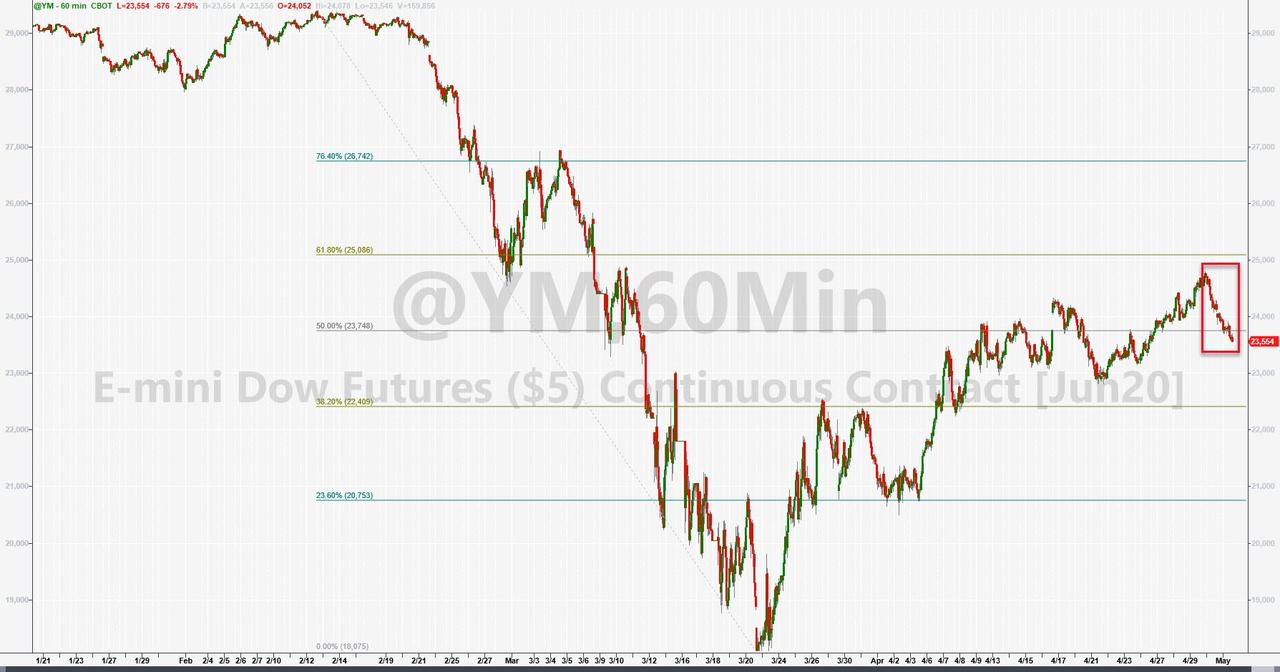
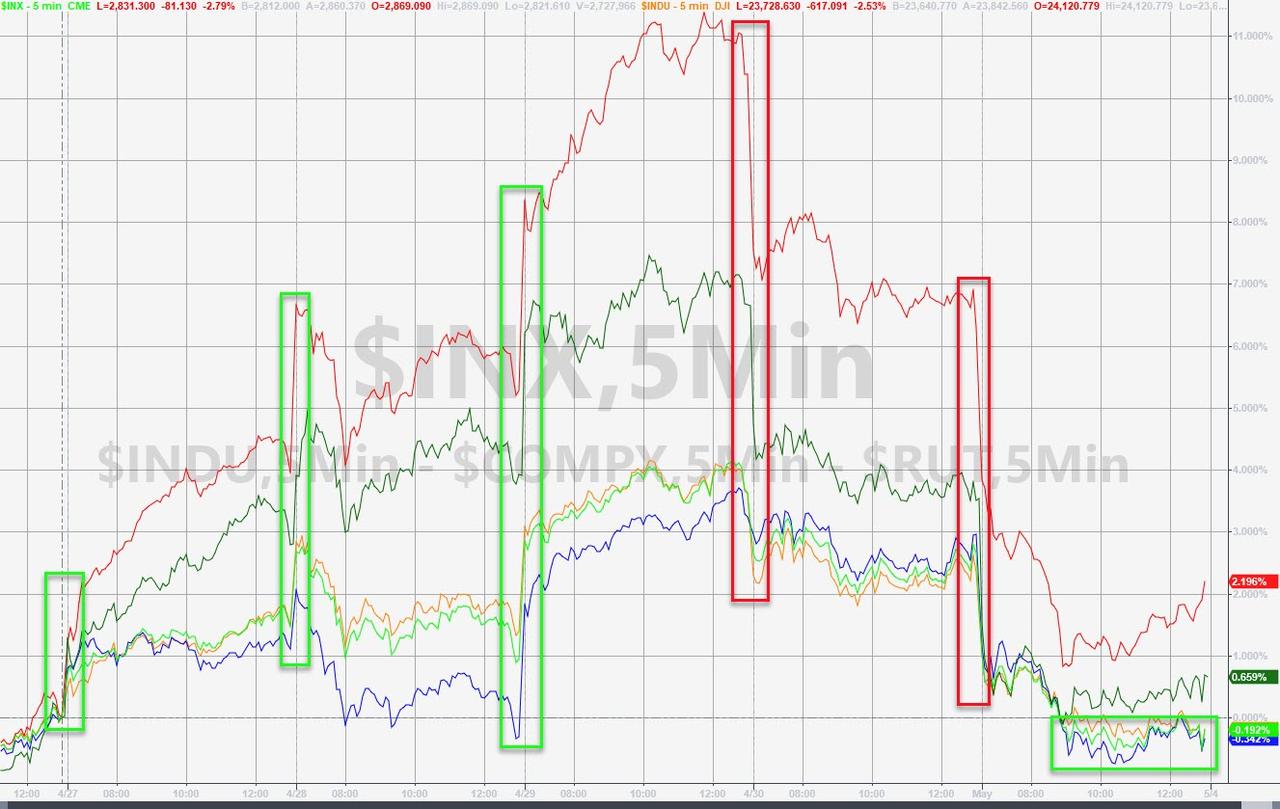
After the best stock market gains in decades in April, May is off to an ugly start… with the biggest 2-day drop in since the March collapse

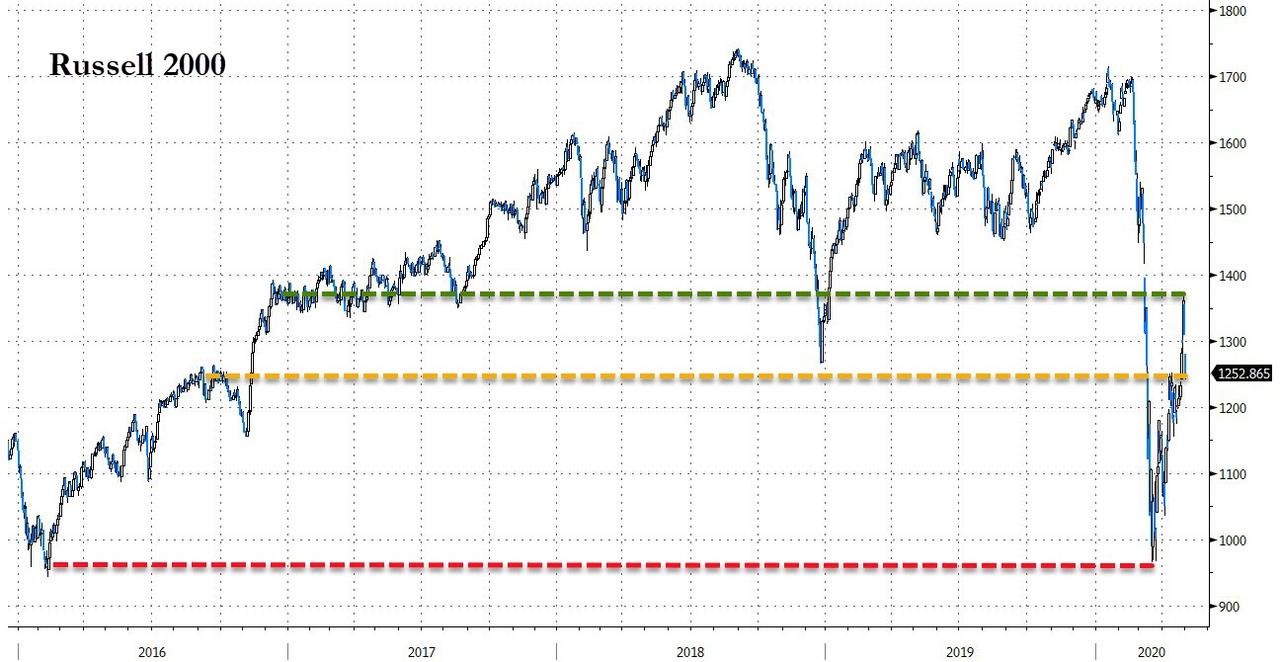
The week started out so well, but the last two days have seen all the gains given back with S&P, Dow, and Nasdaq all red on the week (but Small Caps managed to cling to some gains)

The Dow is down over 1300 points from yesterday’s highs, and back below the 50% retrace line…

Small Caps are back below the Dec 2018 lows…

Source: Bloomberg

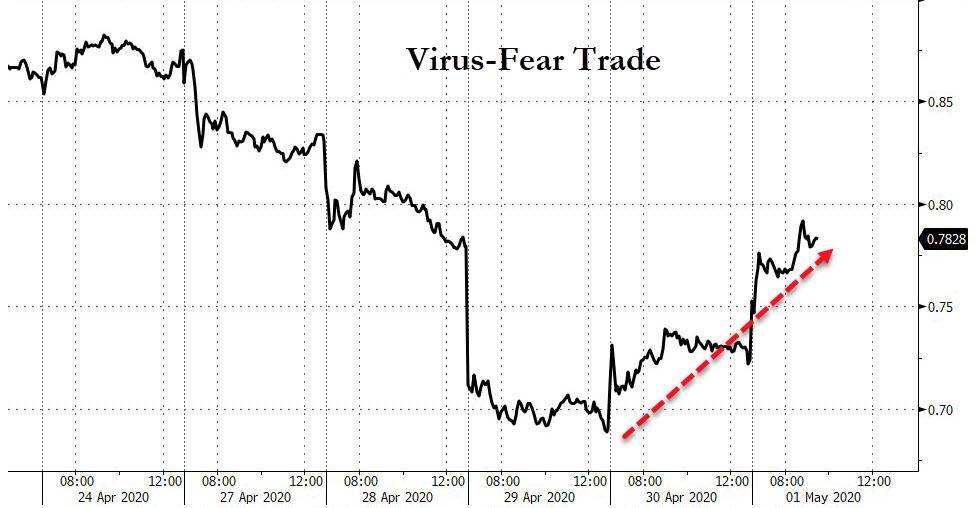
The virus-fear trade is back…

Source: Bloomberg

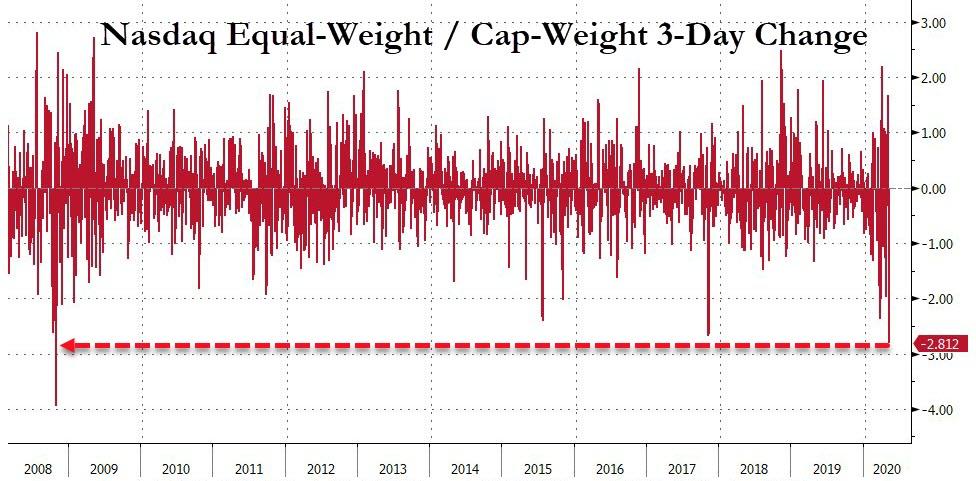
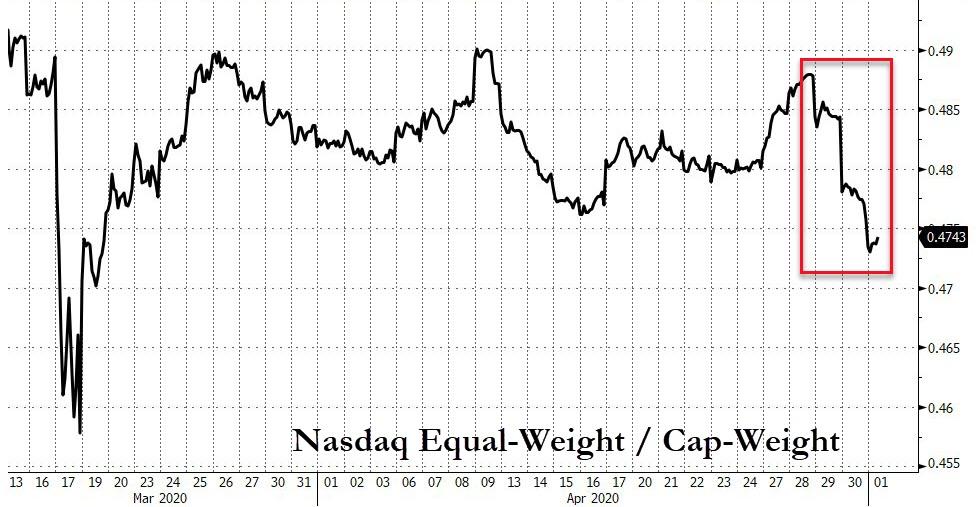
The last 3 days saw the worst performance of equal weight vs cap weight Nasdaq since 2008…

Source: Bloomberg

…back to its weakest level in over six weeks…

Source: Bloomberg

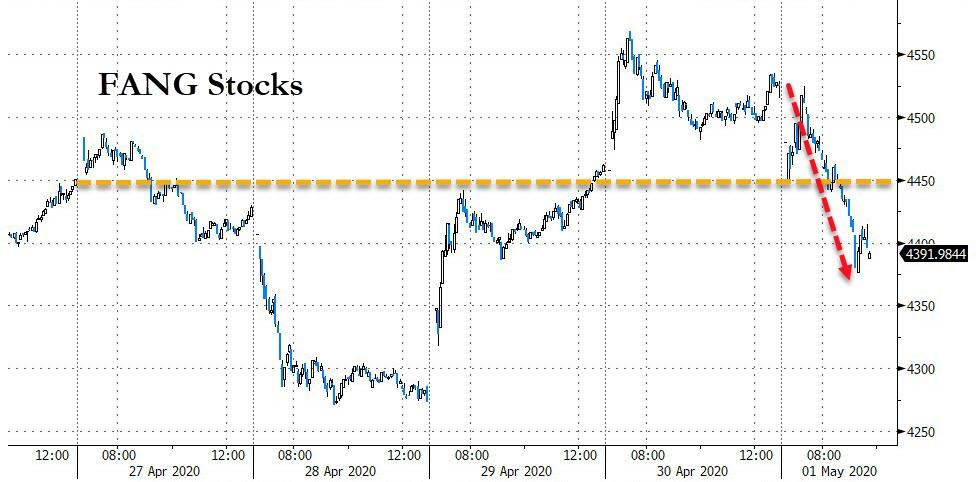
Today was the worst day for FANG stocks since March 16th after reaching a new record high yesterday (and the first down week in the last six)

Source: Bloomberg

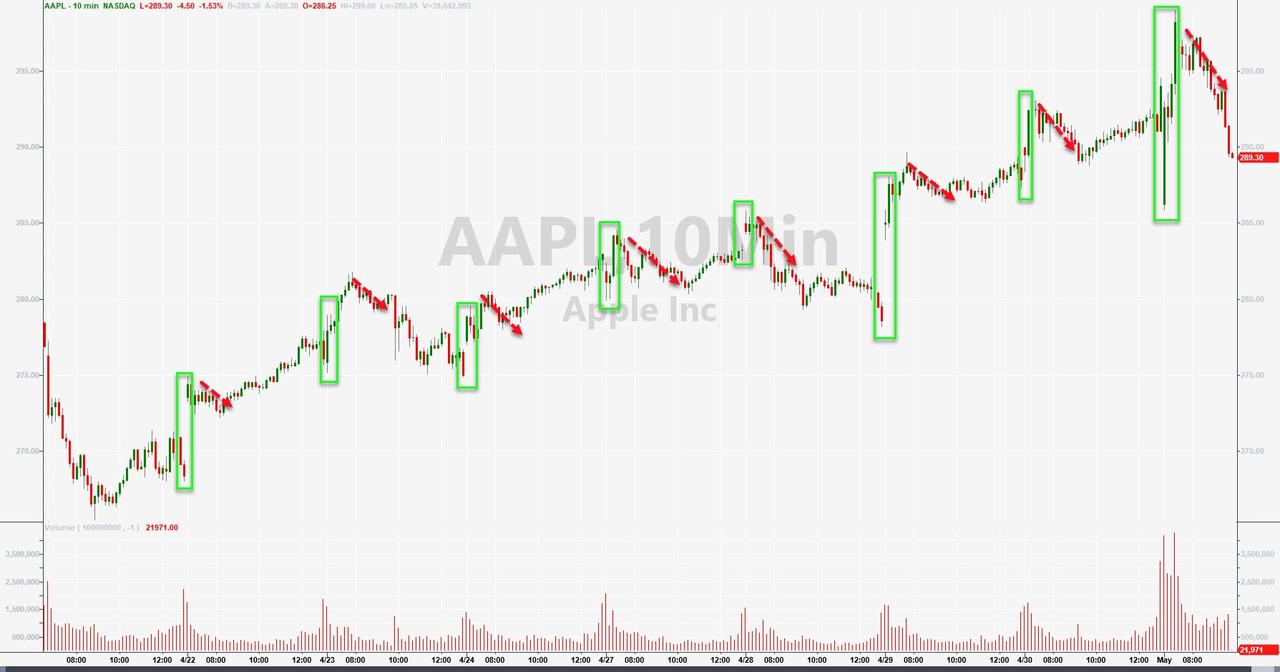
AAPL had its 8th straight day of panic-buying at the open and selling… (after an ugly session overnight following earnings)…

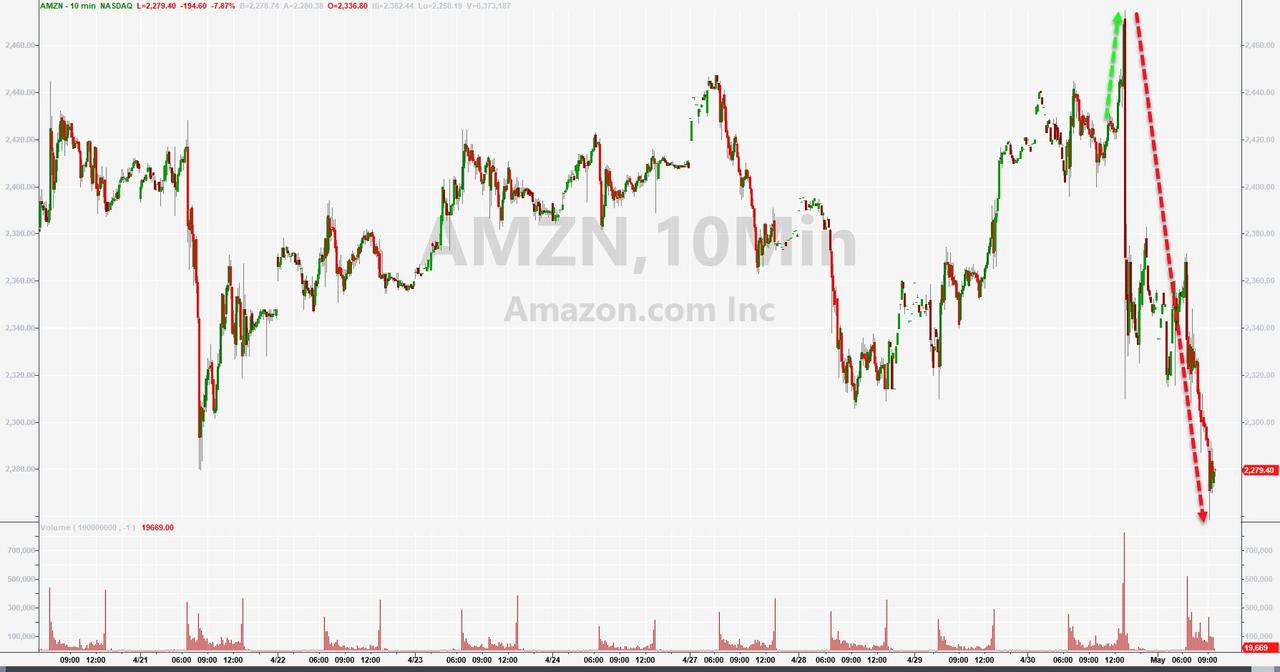
AMZN hit a new record high at the close last night and has fallen ever since…

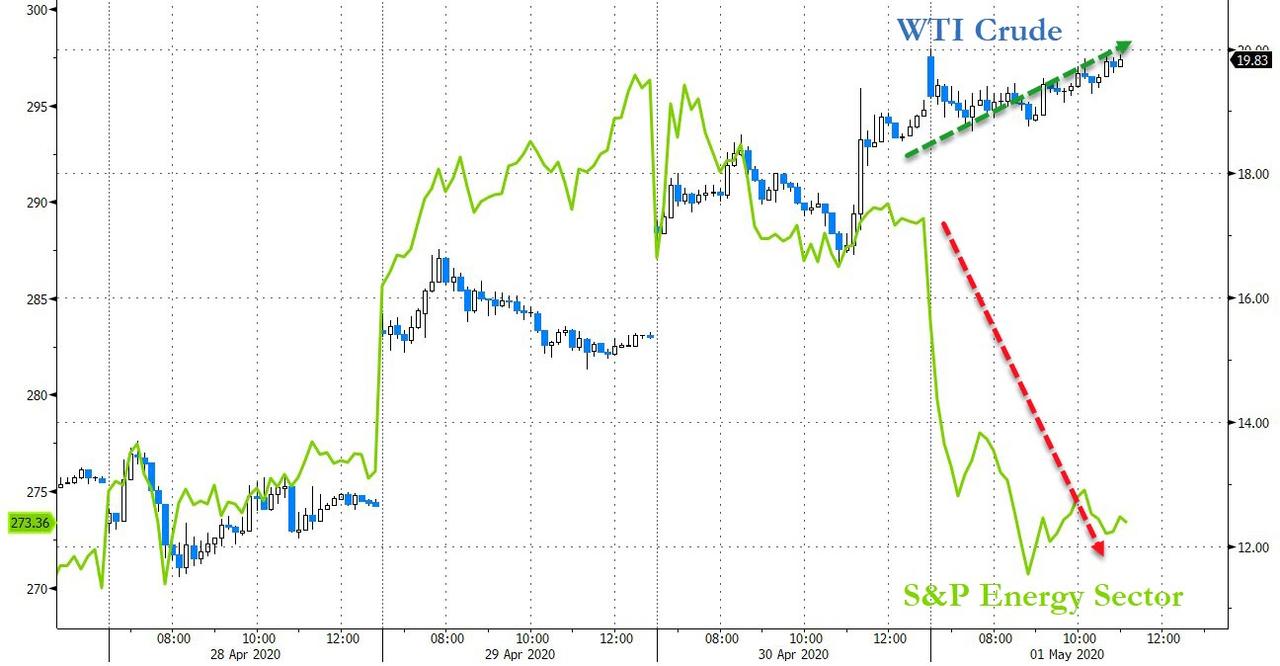
Energy stocks were clubbed like a baby seal today, despite oil price gains…

Source: Bloomberg

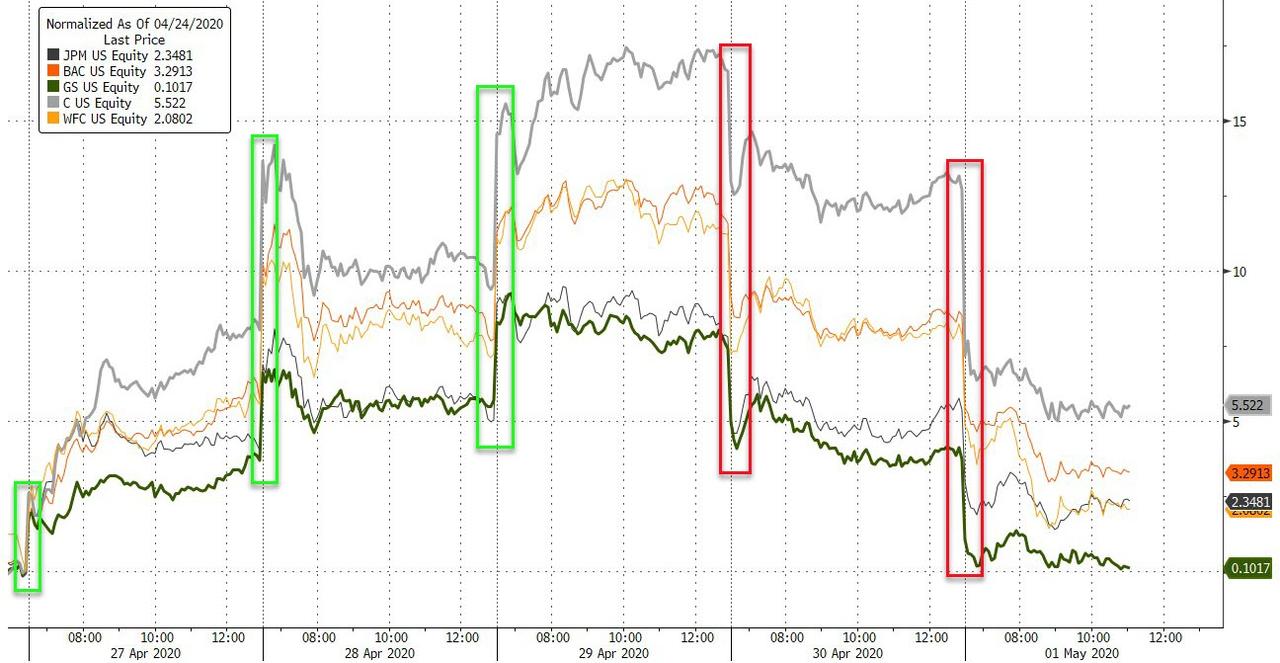
Everyone was loving bank stocks until The Fed…

Source: Bloomberg

The most virus-impacted sectors reverted back lower the last two days…

Source: Bloomberg

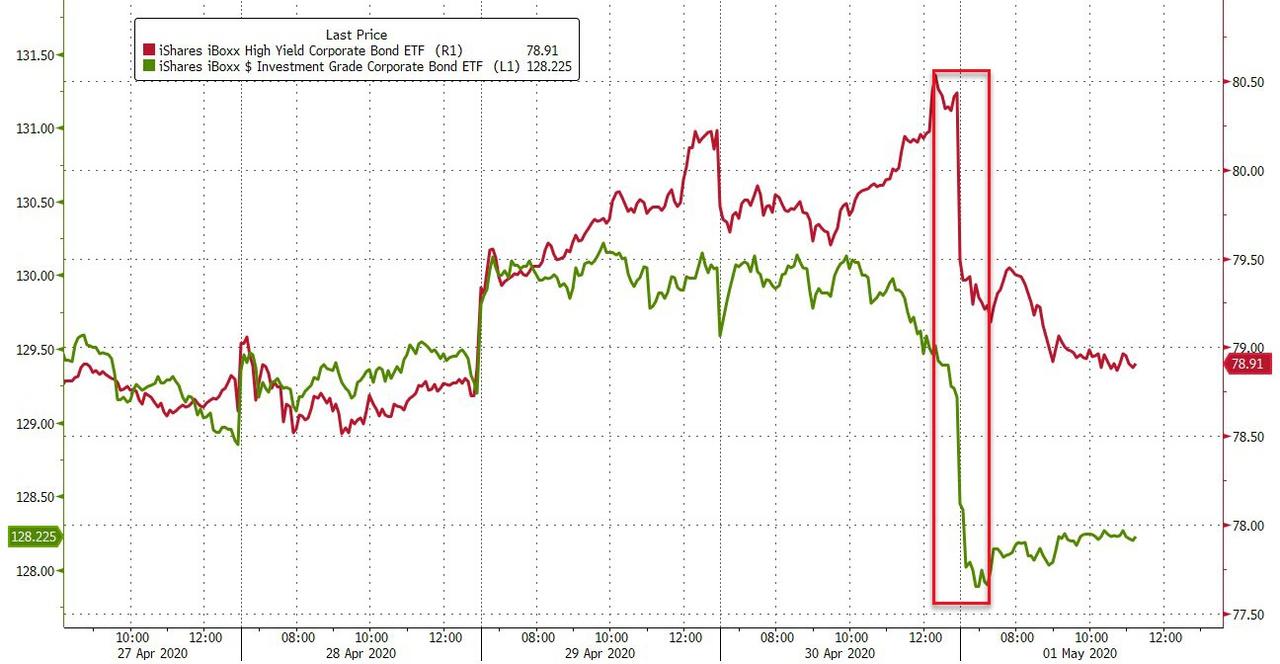
An ugly end to the week for both IG and HY credit…

Source: Bloomberg

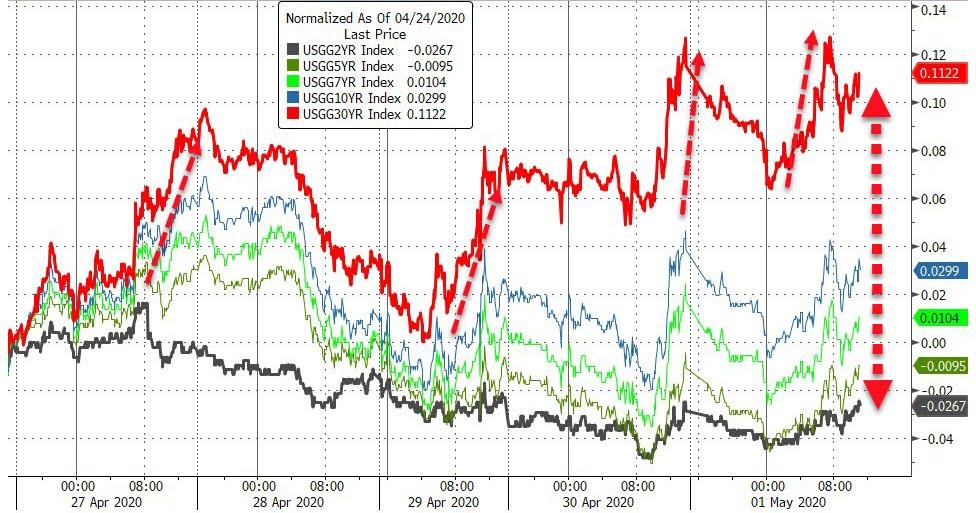
Mixed picture in Treasury-land this week with the short-end lower in yield and long-end higher (somewhat understandable after Boeing’s massive issuance)

Source: Bloomberg

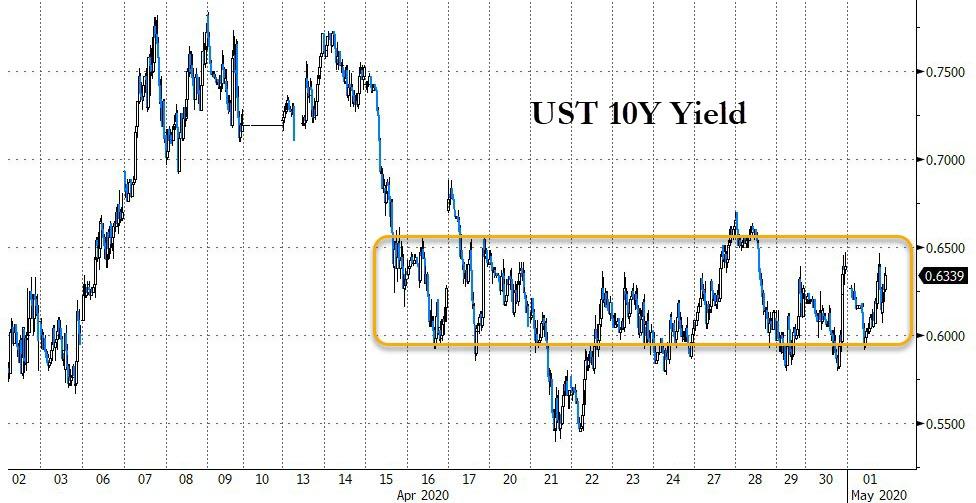
10Y remains in a tight range…

Source: Bloomberg

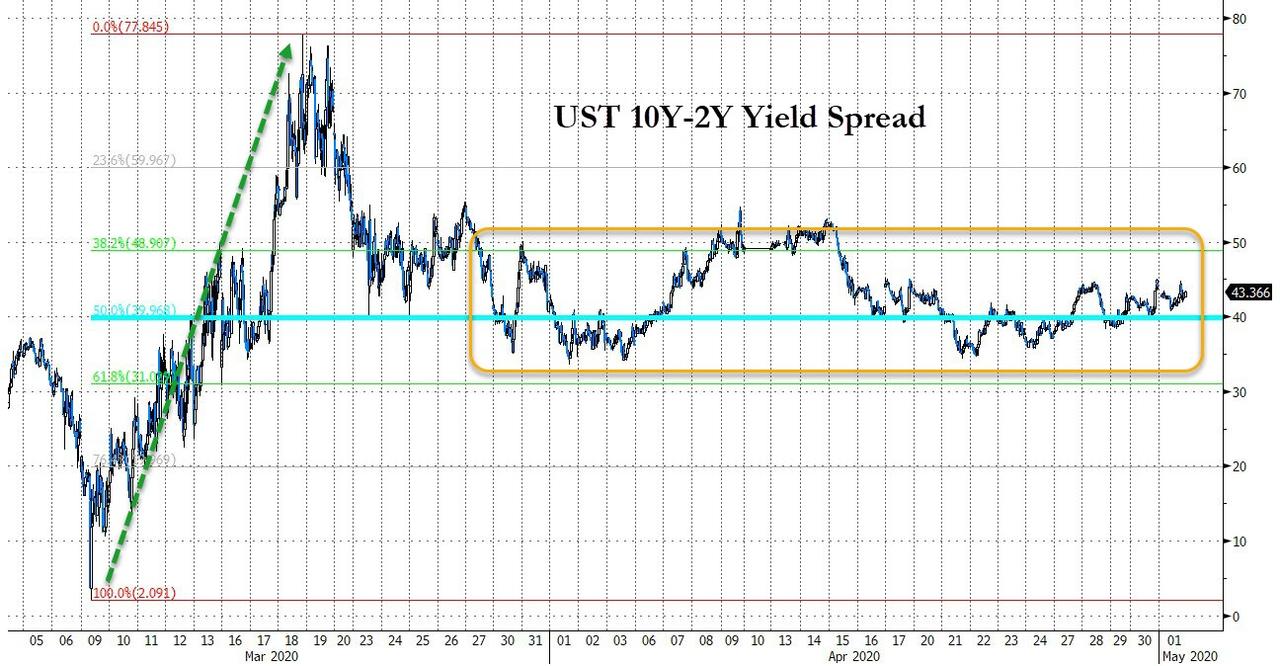
The yields curve also remains range-bound, glued to the 50% retracement of the March steepening…

Source: Bloomberg


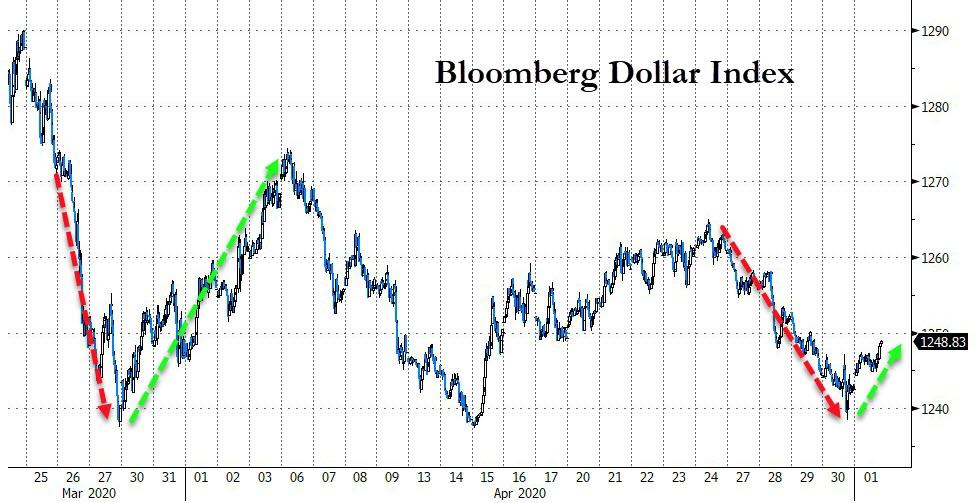
Just as we saw at the end of March, start of April, the USDollar has reversed its downtrend and rallied hard today…

Source: Bloomberg

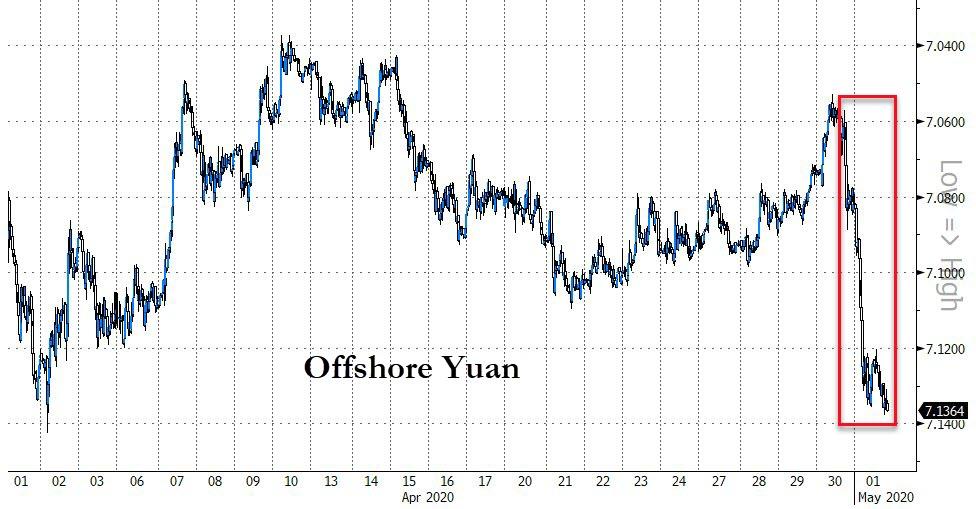
Offshore yuan was monkeyhammered today – after Trump comments on pulling capital allocations – leading to its worst week since March

Source: Bloomberg

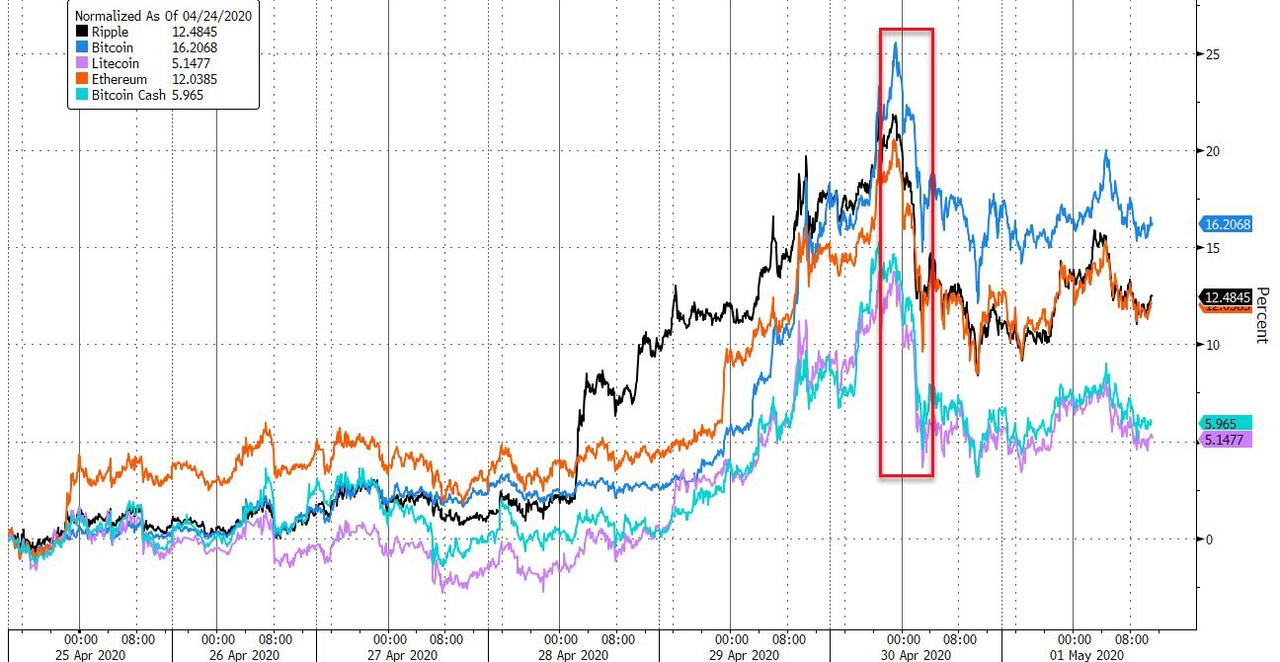
Big week for cryptos with Bitcoin leading the way…

Source: Bloomberg

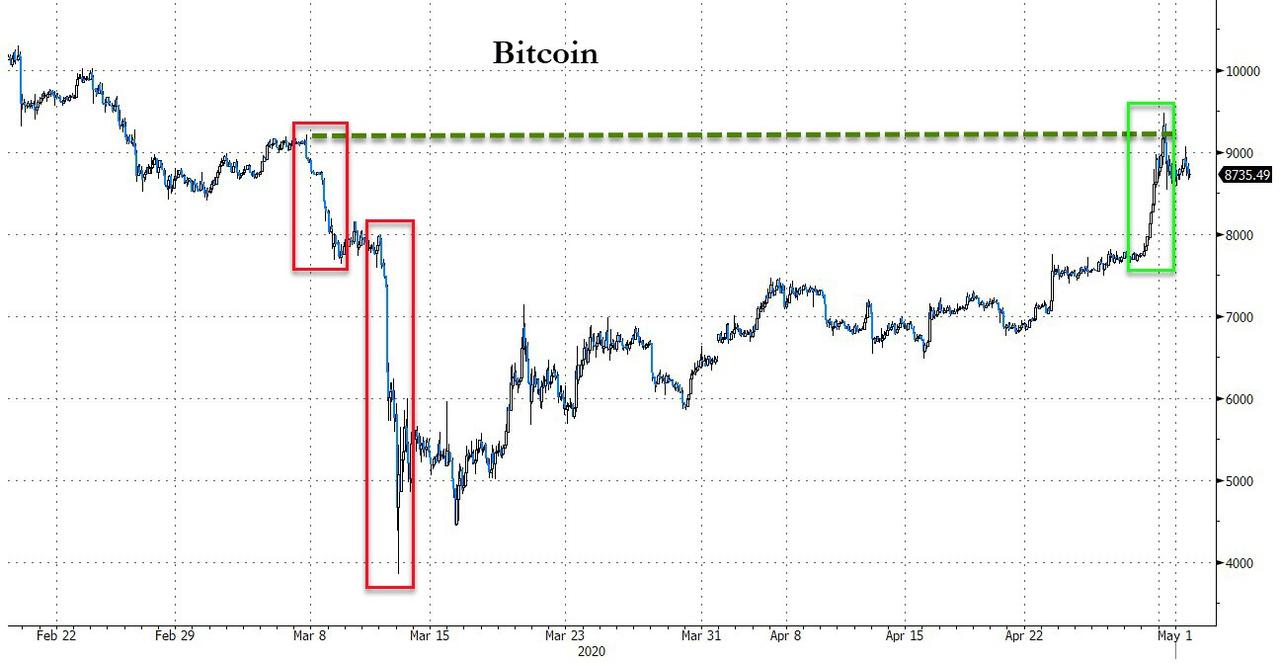
Bitcoin tested back up to $9,500 this week…

Source: Bloomberg

A big mean reversion week…

Source: Bloomberg

Spot the odd one out in commodity land…

Source: Bloomberg

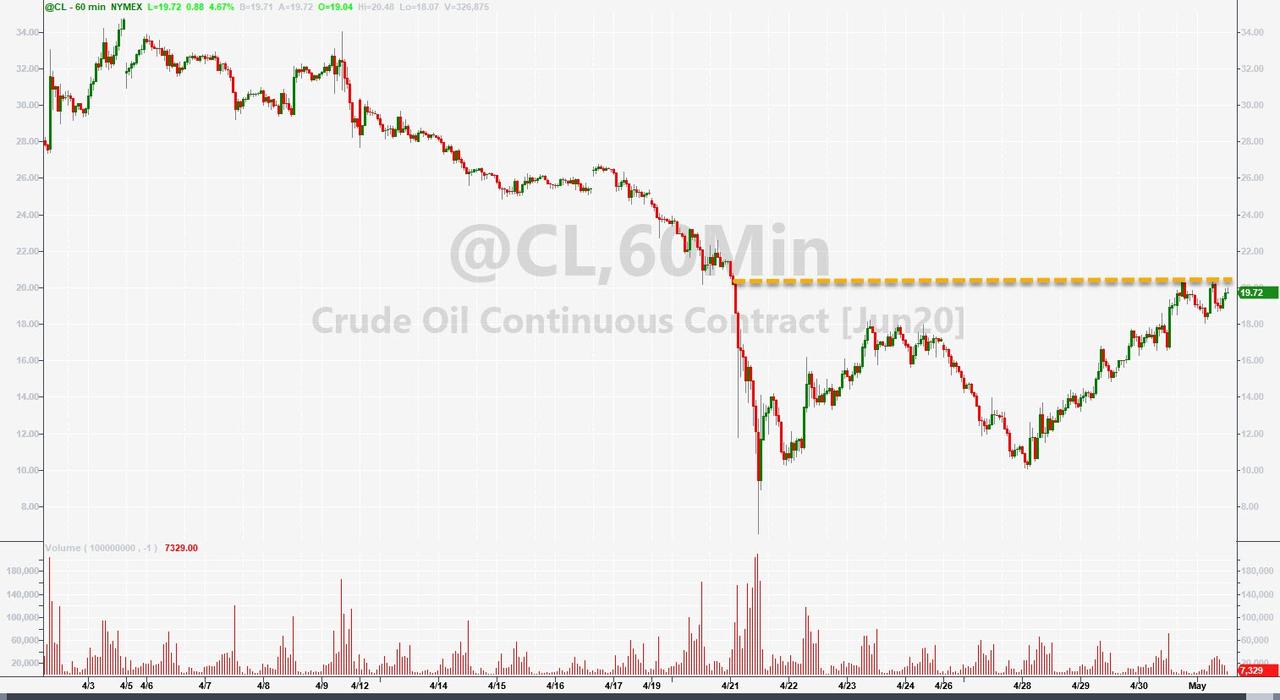
WTI Crude (June) has bounced back to its cliff-edge this week, unable to break above $20…

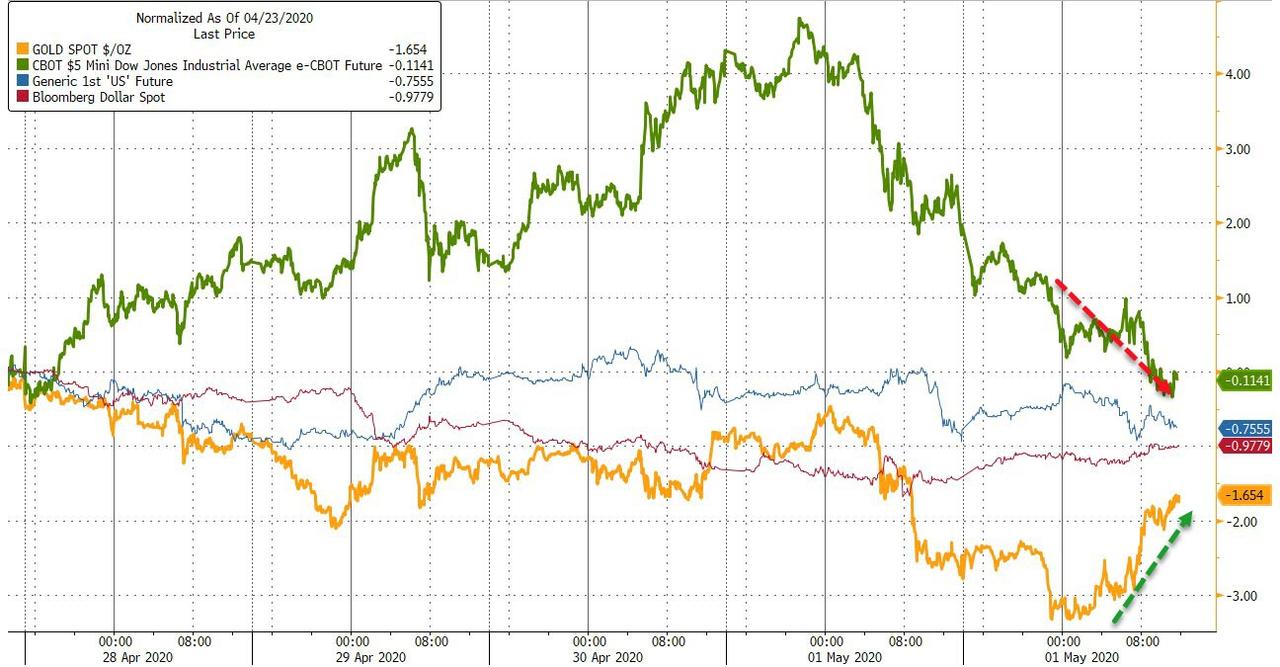
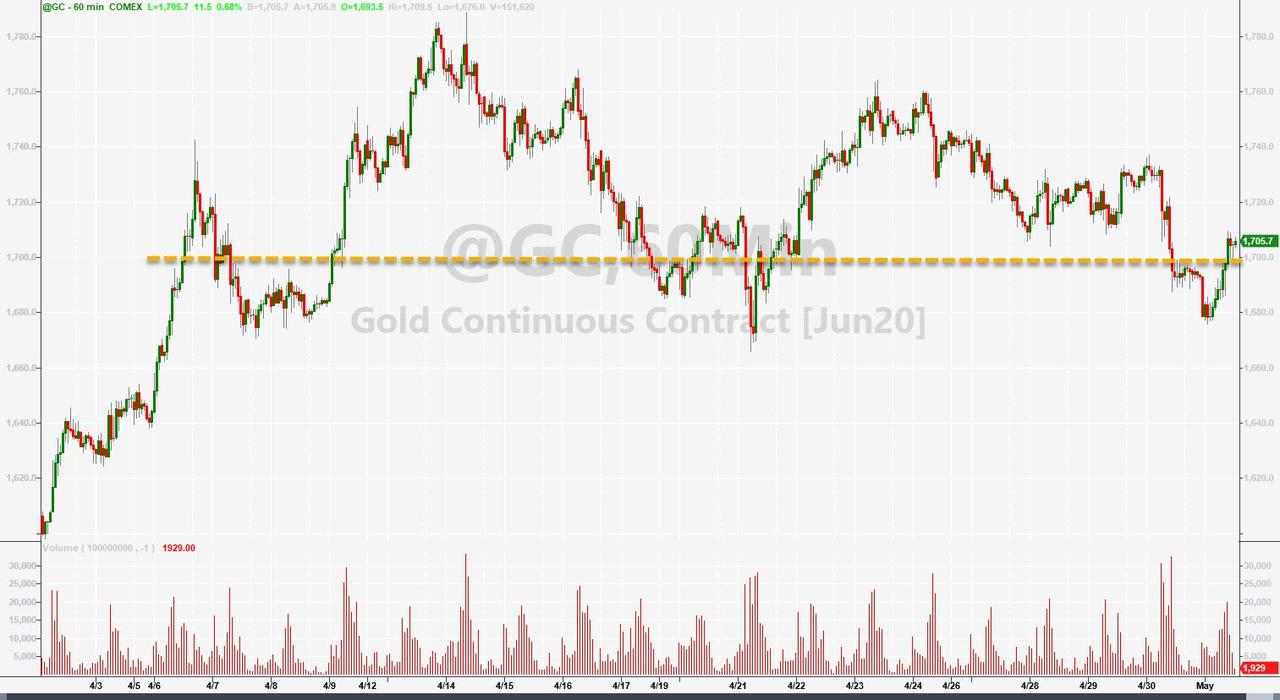
Gold was lower on the week, hovering around the $1700 (futures) level…

Similarly, Silver is strangely attracted to $15…

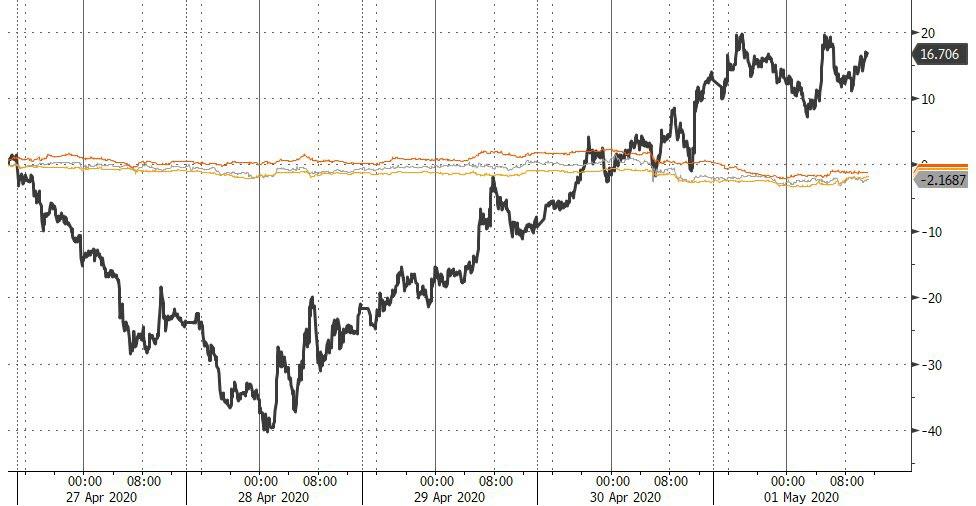
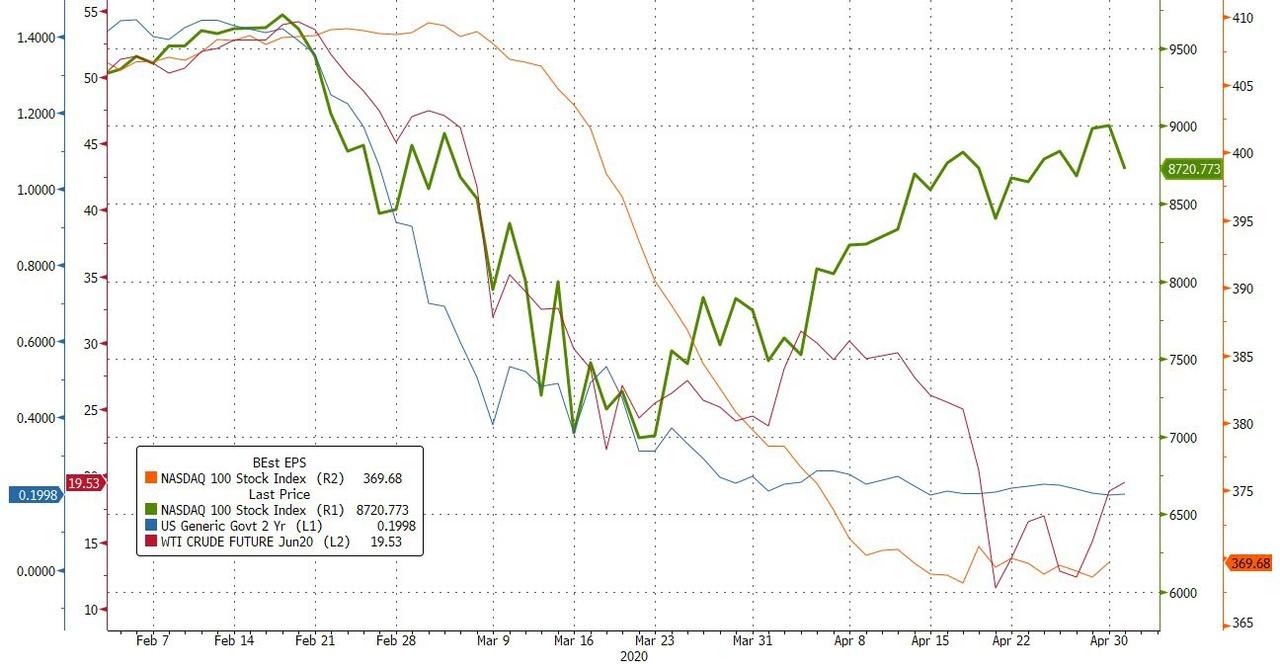
Finally, spot the odd one out…

Source: Bloomberg


Tyler Durden

Fri, 05/01/2020 – 16:01

via ZeroHedge News https://ift.tt/2WiK1Ao Tyler Durden

“I Can’t Afford Three Weeks Without Pay” – Tribune Publishing Staff Blasts CEO For Job Cuts 

“I Can’t Afford Three Weeks Without Pay” – Tribune Publishing Staff Blasts CEO For Job Cuts 

Tribune Publishing Company, the owner of Chicago Tribune, New York Daily News, The Baltimore Sun, Orlando Sentinel, South Florida’s Sun-Sentinel, and several other newspapers, has seen its full-year forecast revised lower by analysts who believe the publisher is headed for tough times in 2020 amid pandemic and recession. This has forced Tribune Publishing CEO Terry Jimenez to furlough employees and cut salaries as a move to protect shareholders. 

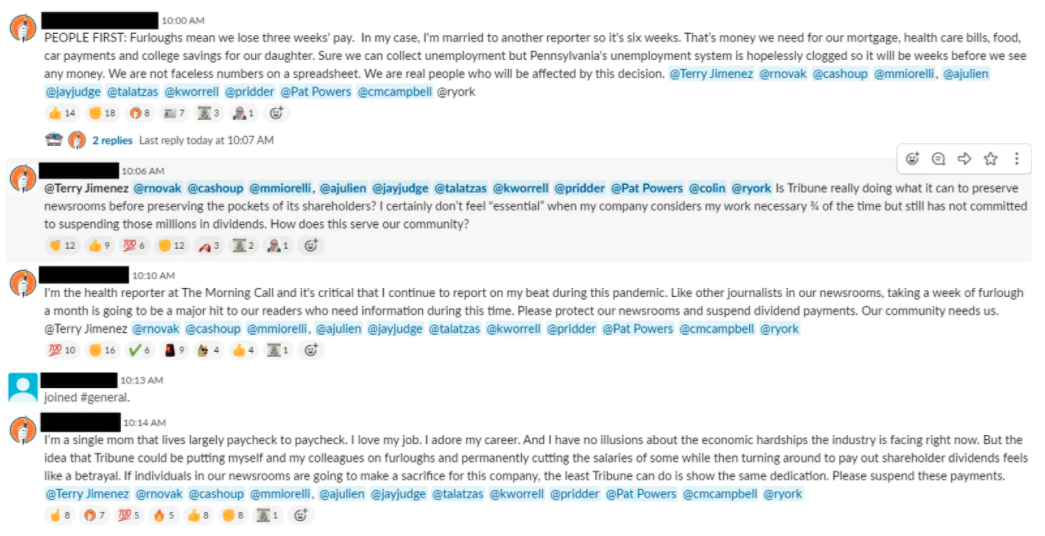
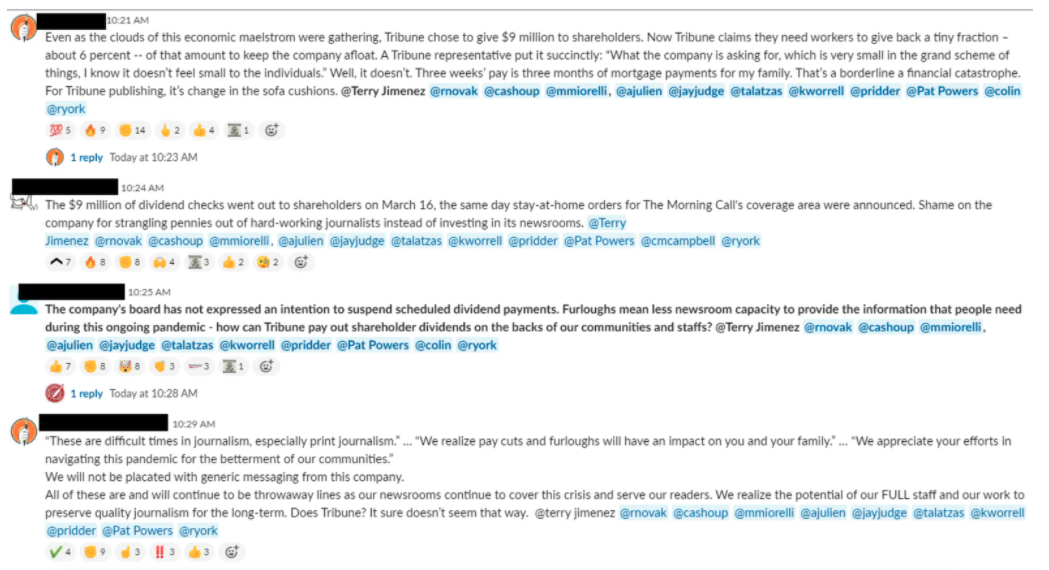
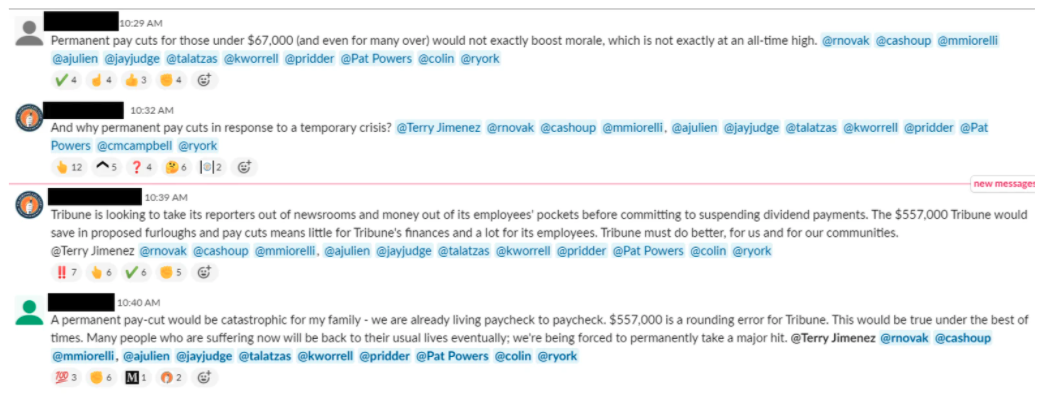
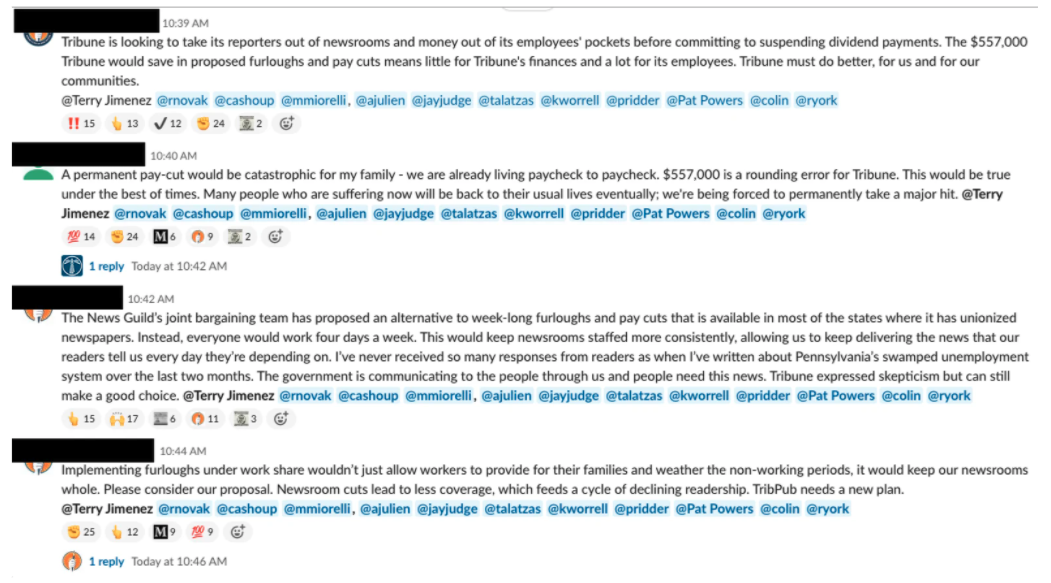
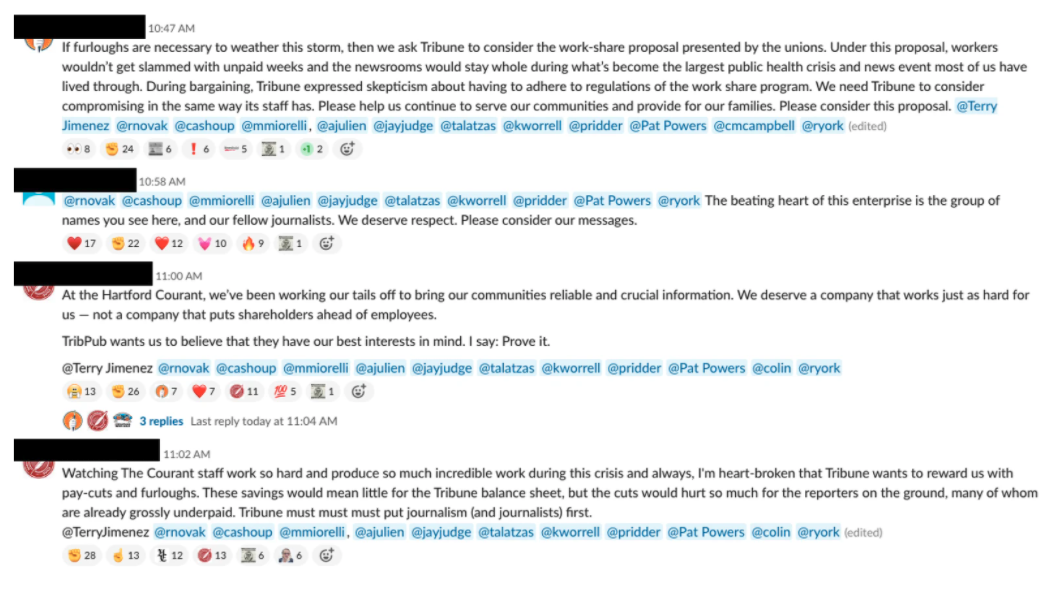
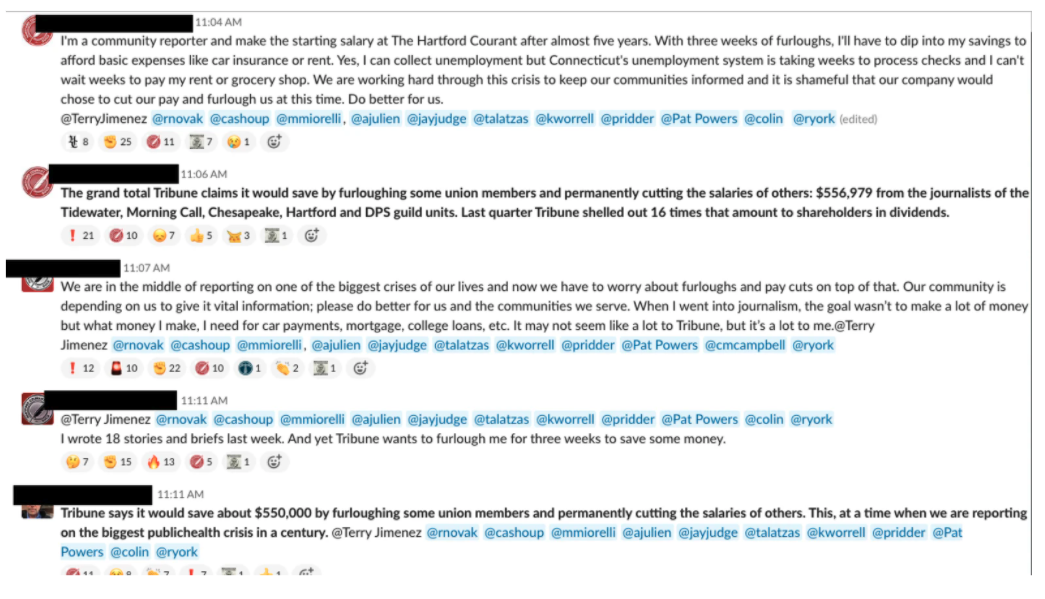
Vice News released an internal Slack conversation of more than 100 Tribune Publishing employees detailing how they overwhelmingly believe the CEO is putting shareholders’ interests over workers. The conversation is absolutely heartbreaking and provides insight into the economic hardships that many Americans are now facing as the economy collapses. Employees have pleaded with the CEO to reconsider the cuts, but his response to them has been silent. 

Tribune Publishing is backed by venture capital firm Alden Global Capital, which has a track record of stripping newspapers for cost-cutting measures. The CEO has already completed several rounds of furloughs: 

“Earlier this year, the company offered buyouts to all employees who’d been working there eight years or more. More recently, facing the same pressure every media company is facing, Tribune Publishing has been instituting rolling cuts and furloughs as a result of financial stress caused by the coronavirus pandemic. On April 9, the company announced permanent pay cuts of 2 to 10 percent for all non-union employees making more than $67,000 a year. CEO Terry Jimenez generously said he would forgo his salary—$575,000, a year per an SEC filing—for two weeks.

“On April 21, the company announced new three-week furloughs for employees making as little as $40,000 a year. Some of the Tribune newspapers are unionized; as a result, the company must negotiate with the NewsGuild in order to institute the furloughs. The Morning Call, the Hartford Courant, the Tidewater Guild (comprising three Virginia newspapers), the Chesapeake Guild (comprising the Capital Gazette and other suburban newspapers), and the company’s shared print group, called Design and Production Studio (DPS) are bargaining together. As they do so, staffers are putting pressure on their overlords by making them look like the assholes they are,” Vice reported. 

Here are the internal conversations among employees on Slack that detail how corporate greed and the CEO’s protection of shareholders over employees will ruin lives. 

“I can’t afford three weeks without pay,” wrote one staffer in an internal company-wide Slack channel with more than 2000 people in it.

“My husband was laid off and we have a daughter in college,” another wrote.

“Tribune gives $9 million on shareholder dividends, and then tells employees it’s critical that they take pay cuts and furloughs that will save them just $556,979,” another staffer wrote. “The person who made these decisions at Tribune hasn’t mastered basic math.”

Good point… 


Tyler Durden

Fri, 05/01/2020 – 15:50

via ZeroHedge News https://ift.tt/2z0IiYm Tyler Durden

Canada Bans ‘Assault Weapons’ by Executive Order

In response to a 22-victim shooting spree in Canada last month, Prime Minister Justin Trudeau has announced that he will—via executive order, with no new law required or requested—ban the ownership and sale of several guns he categorizes as “assault weapons.”

The Canadian Globe and Mail has a list of some of the specific weapons affected, and it describes the generic qualities of weapons that Trudeau intends to bar from his country. (As is usually the case with assault weapon bans, most of the characterstics are cosmetic.) According to the paper’s estimates, more than 130,000 such guns are currently owned legally in Canada.

Trudeau also intends to buy back banned weapons from their owners. That will require legislation, so the specifics aren’t in place yet. The government thinks it will cost them $250 million, though the Canadian Sporting Arms and Ammunition Association believes it will be a lot more than that. The Globe and Mail quotes anonymous officials saying some grandfathering provisions will probably allow Canadians to keep some of the weapons.

Trudeau make the familiar claim that these “weapons were designed for one purpose and one purpose only: to kill the largest number of people in the shortest amount of time.” This is almost laughably false, as the vast majority of people who own them in fact have never used them for the purpose of killing anyone, much less “the largest number of people in the shortest amount of time.”

A U.S. assault-weapon ban was in place from 1994 to 2004, though it did not try to sweep up the guns already in circulation. As The New York Times has reported, it had no noticeable positive effect on American public safety. (Yes, that includes its impact, or rather its failure to have an impact, on mass shootings.) Such weapons’ role in murder and crime is tiny, both in the U.S. (where shotguns and rifles of any kind, not just “assault weapons,” are used in only 4 percent of murders) and Canada (where the larger category of non-sawed-off rifles and shotguns were used in 2018 in only 8 percent of murders)

About 25 percent of Canadian households possess guns, with about 3 million civilians between them possessing more than 7 million weapons, according to Canada’s Department of Justice. A preponderence of the weapons are found in rural areas, and 95 percent of households who own any gun own a long gun, the larger category of which the “assault weapon” is a subset.

Bonus link: Jacob Sullum debunked the idea that “assault weapons” pose a special danger in a June 2018 feature for Reason.

from Latest – Reason.com https://ift.tt/3d9kC2C
via IFTTT
COVID-19 Modeling: How Many Coronavirus Deaths by the End of Summer?

“All models are wrong, but some are useful” is an aphorism attributed to statistician George Box. It certainly applies to people’s attempt to model the COVID-19 outbreak.

Fortunately, some of the more dire predictions of how the COVID-19 pandemic could play out—80 percent of Americans infected, with 2.2 million deaths over the next couple of years—have proven wrong so far. Now that it’s been four months since the first COVID-19 cases in Wuhan, China, were described, what do current models foresee for the immediate course of pandemic for the United States?

You may recall that on March 31, the administration’s coronavirus task force coordinator—Deborah Birx—cited unspecified modeling results that suggested that between 100,000 and 240,000 Americans could die of the disease in the coming months.

On March 26, the University of Washington’s Institute for Health Metrics and Evaluation (IHME) reported its model’s initial projections. Assuming that social distancing and lockdowns basically remained in force until May, the IHME’s central estimate was around 81,000 Americans (with a 95 percent chance that the number of deaths would range between 38,000 to 162,000) would die over the following four months.

As the IHME researchers fine-tuned their model’s statistical elements, making adjustments to account for policy changes and evolving data, their estimates for American COVID-19 deaths have fluctuated over the past month. For example, the IHME model on April 1 raised its estimates for American COVID-19 deaths to nearly 94,000 (a range of 41,000 to 177,000); on April 17, it lowered them to just over 60,000 (a range of 34,000 to 140,000). On April 1, the IHME modelers predicted that daily deaths would peak at 2,214 on April 15. In their latest report, the IHME researchers now project total U.S. COVID-19 deaths will reach 72,500 (a range of 59,000 to 114,000) by August.

As an example of the perils of epidemiological forecasting, consider the projections a Rutgers statistician published on April 25 in the journal Reliability and Statistical Learning and Its Applications. Based April 14 model calculations, the statistician predicted that “the maximum total number of deaths will be approximately 62,100 across the United States due to the Covid-19 virus.”

A team led by Dan Nicolau, a mathematician and physician at the Queensland University of Technology (QUT), has developed a model that bases its predictions on how cases, recoveries, and deaths of COVID-19 rise and fall in various countries. Through parsing such data, they claim to have identified a relationship between confirmed cases and recovered patients that predicts when the epidemic will peak and how many deaths will result from the disease in individual countries.

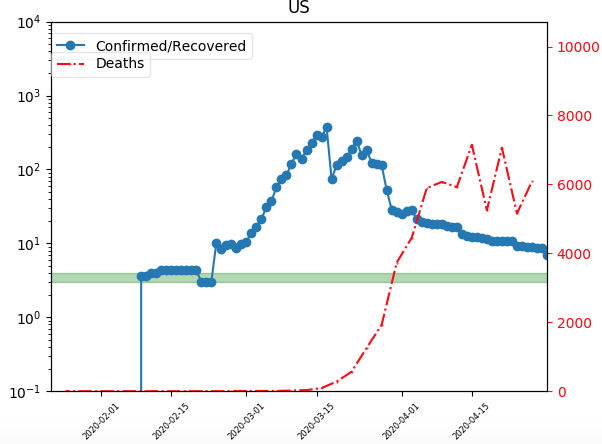
Basically, when the difference between the number of cases and number of recovered patients peaks, their model expects the number of deaths in each country to peak about 25 days later. The team’s “broad predictions for the number of fatalities” are “generally somewhat lower than most other models.” Their data and projections are available at COVIDwave.org.

These researchers suggest that when the ratio of the number of new to recovered cases reaches 2 to 5—the green band in chart below—the first pandemic wave has passed:

According to the QUT model, the U.S. is headed in the right direction but has not yet reached the resolution stage of the epidemic. In their April 14 preprint, the researchers estimated that the first wave of the epidemic would result in around 50,000 U.S. COVID-19 deaths and about 250,000 for the world. In April 24, they upped their number of projected U.S. first-wave deaths to 75,000.

The independent researcher Youyang Gu and his team have devised a COVID-19 epidemic prediction model by applying machine learning techniques to parse such data as how many people get the virus from each infected person, the length of the infectious period, and the time to recovery. This model’s projections are considerably less optimistic than the ones we get from the IHME and QUT models. The central estimate is that total U.S. COVID-19 deaths will reach 170,000 (a range of 98,000 to 293,000) by the beginning of August.

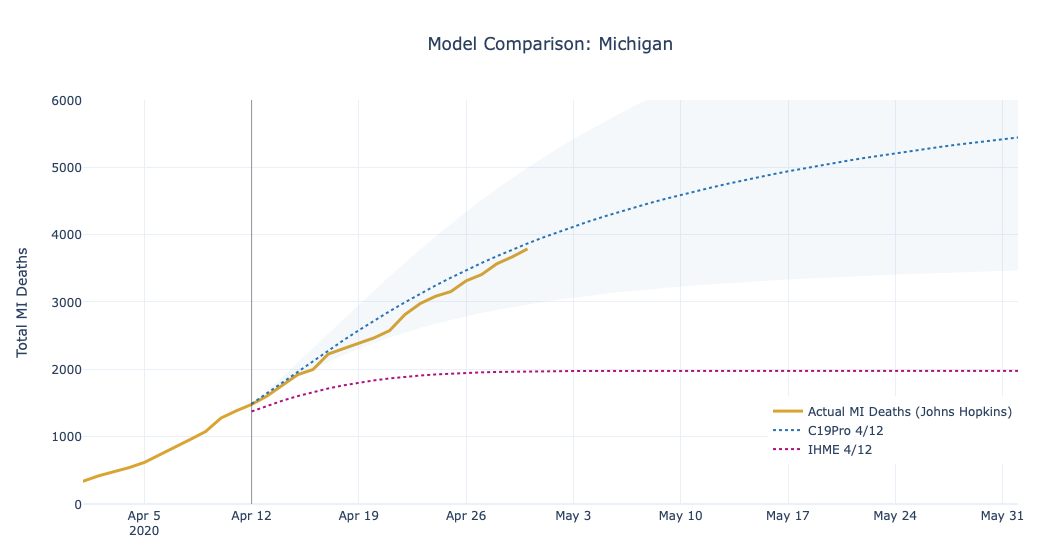
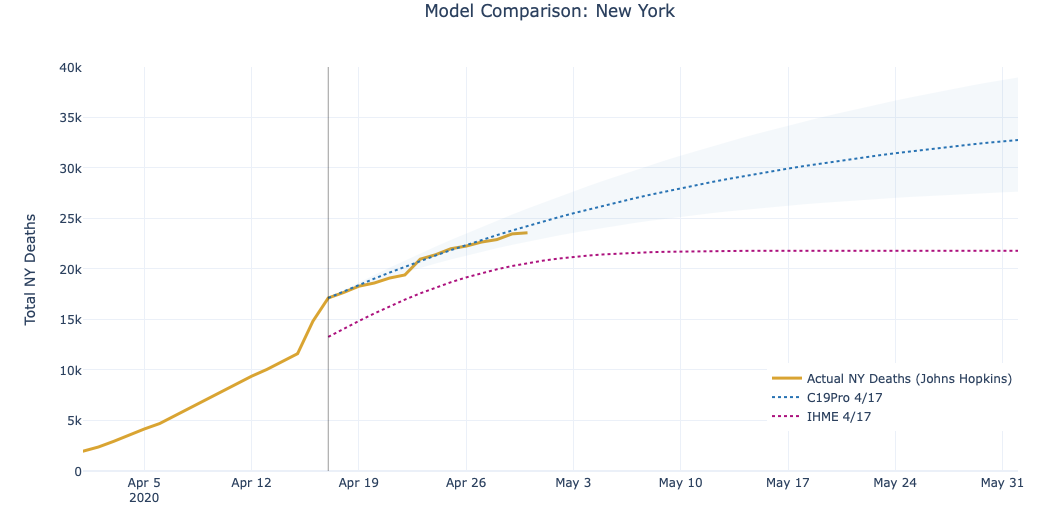
Gu and his colleagues compare their model’s projections with those made by the IHME model in early April for various states, including New York and Michigan:

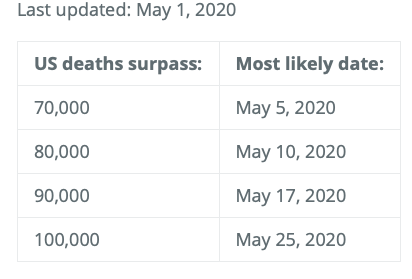
They also make some rather bold benchmark predictions for additional U.S. COVID-19 deaths per week in the coming month.

Such specific predictions make it easy for public health officials, politicians, and the public to track the model’s accuracy. The model makes specific predictions for how the disease will likely progress for each state as well.

Interestingly, Gu and his colleagues also report that their model “determined that the true mortality rate for COVID-19 in most regions in the world is less than 1%. This is again consistent with what scientists have found, despite the fact that the official mortality rate is much higher (e.g. Italy is at 13-14%).”

So let’s review the state of play among the models considered here. As of today, about 65,000 Americans have died of COVID-19. Two weeks ago, the Rutgers model predicted a maximum of 62,100 U.S. deaths by the end of the summer. The most recent IHME estimate is 72,500 (a range of 59,000 to 114,000) by August. The QUT model’s updated projection is 75,000 by August. And finally, the Gu team’s model is predicting 170,000 (a range of 98,000 to 293,000) by the beginning of August.

Yesterday, 2,097 Americans lost their lives to COVID-19. The IHME model had projected a central estimate of 1,266 deaths for that date. The central estimate for the Gu model was 2,029.

Looking further forward, the IHME model projects that U.S. COVID-19 deaths per day will have fallen to 275 (a range of 14 to 1,262) by May 15, and to 44 (a range of 0 to 220) by June 1. Gu’s model also projects falling daily COVID-19 deaths, but not at nearly as fast a rate. On May 15, it says daily deaths will be 1,456 (a range of 782 to 2,274), dropping only to 1,129 (a range of 380 to 2,103) on June 1.

These projections make significant assumptions about the effectiveness of various public health measures in determining the course of the epidemic. Change those policies, and their projections will necessarily diverge from the ones they provide now.

The upshot is that it would be comparatively good news if two weeks from now the daily U.S. COVID-19 death rate hews to the IHME’s projections and is only about a fifth of the Gu model’s central projection. By then, we will know a bit more about these models’ usefulness.

from Latest – Reason.com https://ift.tt/35lj570
via IFTTT
Seventh Circuit Rules Against Trump Administration in Major Sanctuary City Decision

Yesterday, the US Court of Appeals for the Seventh Circuit ruled against the Trump administration in an important sanctuary city case, City of Chicago v. Barr.

The ruling is in with numerous previous federal court decisions striking down the same policy, including those issued by the First, Third, and Ninth Circuits., and with an earlier Seventh Circuit.  It further isolates the anomalous February Second Circuit decision that upheld the administration’s policy.

These cases all involves the Trump Justice Department’s attempts to impose immigration-related conditions on state and local governments that receive Byrne Memorial Justice Assistance Grants intended to aid law enforcement operations.

In 2017, then-Attorney General Jeff Sessions sought to cut Byrne Memorial Justice Assistance Grant funds to state and local governments that fail to meet three conditions:

1. Prove compliance with 8 USC Section 1373, a federal law that bars cities or states from restricting communications by their employees with the Department of Homeland Security and Immigration and Customs Enforcement (ICE) about the immigration or citizenship status of individuals targeted by these federal agencies.

2. Allow DHS officials access into any detention facility to determine the immigration status of any aliens being held.

3. Give DHS 48 hours’ notice before a jail or prison releases a person when DHS has sent over a detention request, so the feds can arrange to take custody of the alien after he or she is released.

In 2018, the Justice Department added two more immigration-related conditions to this list. The current Seventh Circuit decision follows up its earlier 2018 ruling, which upheld a preliminary injunction against the original three conditions. Yesterday’s decision upholds a district court ruling making the temporary injunction permanent and also striking down the two new conditions.

With the exception of the Second Circuit, every federal court to have ruled on this issue has concluded that the imposition of these conditions is illegal because they were never authorized by Congress. Some have also struck them down based on other constitutional considerations.

The new Seventh Circuit decision reaches much the same conclusion:

The Attorney General repeatedly expresses frustration that Chicago, or any other jurisdiction, can “simultaneously accept federal law enforcement grants, yet maintain local policies that frustrate federal immigration enforcement….”

But states do not forfeit all autonomy over their own police power merely by accepting federal grants. And the Attorney General’s perception of the urgency of immigration enforcement does not corral for the executive branch the powers entrusted to the legislative branch. The executive branch has significant powers over immigration matters; the power of the purse is not one of them. This tendency to overlook the formalities of the separation of powers to address the issue of-the-day has been seen many times by the courts, and it is no more persuasive now than it was in those cases….

We conclude again today, as we did when presented with the preliminary injunction, that the Attorney General cannot pursue the policy objectives of the executive branch through the power of the purse or the arm of local law enforcement; that is not within its delegation. It is the prerogative of the legislative branch and the local governments, and the Attorney General’s assertion that Congress itself provided that authority in the language of the statutes cannot withstand scrutiny.

The decision, written by Judge Ilana Rovner, also emphasizes the broader stakes for constitutional federalism. If the executive can get away with using vaguely worded statutes (in this case, a requirement that grant recipients obey “applicable federal law”) to impose its own new conditions on state and local governments, it would enable the president to bully them on a wide range of issues:

Interpreting that language as potentially incorporating any federal law would vest the Attorney General with the power to deprive state or local governments of a wide variety of grants, based on those entities’ failure to comply with whatever federal law the Attorney General deems critical. Yet there is nothing in those statutes that even hints that Congress intended to make those grants dependent on the Attorney General’s whim as to which laws to apply, cabined only by the requirement that the laws apply generally to states or localities.

Like nearly every other court that has addressed the issue, the Seventh Circuit avoided this constitutional morass by interpreting “applicable federal law” to cover only laws that specifically apply to grant recipients. Doing otherwise, as the Second Circuit did, goes against Supreme Court precedent and creates serious constitutional problems.

While all three judges on the Seventh Circuit panel agreed that the Byrne grant conditions imposed by the Justice Department are illegal, they differed over the issue of whether the injunction against the conditions should be universal or limited to plaintiff in the cases addressed by the Court (the City of Chicago). The majority defends the use of a universal injunction, while Judge Daniel Manion’s dissent argues for a more limited one. My own view is that universal injunctions are appropriate in cases like this one where the government’s actions are ruled to be illegal for reasons that do not depend on factual circumstances that vary from case.

But I defer this issue to people with greater relevant expertise. I recognize that there is an ongoing debate over the constitutionality and wisdom of universal injunctions more generally.

It is perhaps worth noting that all three judges on the Seventh Circuit panel were appointed by Republican presidents, and that Judge Manion is known for being particularly conservative. This reflects the near-consensus among federal judges who have ruled on the issue that the Byrne grant conditions and other similar moves by the administration are illegal breaches of federalism and separation of powers. The February Second Circuit decision is a notable, but highly anomalous, exception. I criticized it in detail here.

The litigation over the Byrne Grant conditions is just one part of a broader legal battle over sanctuary jurisdictions, which also includes a number of other issues. I reviewed them in this Texas Law Review article. As I explained in that article and elsewhere, the legal struggle here has important implications for federalism that go far beyond the specific issue of sanctuary cities. If the executive can usurp the power of the purse in this way, it would have broad leverage over states and localities on a wide range of issues. Conservatives who might be happy to see Donald Trump use that power to target sanctuary cities might not be so happy to see what the next Democratic president does with it.

from Latest – Reason.com https://ift.tt/3d89of2
via IFTTT
COVID-19 Modeling: How Many Coronavirus Deaths by the End of Summer?

“All models are wrong, but some are useful” is an aphorism attributed to statistician George Box. It certainly applies to people’s attempt to model the COVID-19 outbreak.

Fortunately, some of the more dire predictions of how the COVID-19 pandemic could play out—80 percent of Americans infected, with 2.2 million deaths over the next couple of years—have proven wrong so far. Now that it’s been four months since the first COVID-19 cases in Wuhan, China, were described, what do current models foresee for the immediate course of pandemic for the United States?

You may recall that on March 31, the administration’s coronavirus task force coordinator—Deborah Birx—cited unspecified modeling results that suggested that between 100,000 and 240,000 Americans could die of the disease in the coming months.

On March 26, the University of Washington’s Institute for Health Metrics and Evaluation (IHME) reported its model’s initial projections. Assuming that social distancing and lockdowns basically remained in force until May, the IHME’s central estimate was around 81,000 Americans (with a 95 percent chance that the number of deaths would range between 38,000 to 162,000) would die over the following four months.

As the IHME researchers fine-tuned their model’s statistical elements, making adjustments to account for policy changes and evolving data, their estimates for American COVID-19 deaths have fluctuated over the past month. For example, the IHME model on April 1 raised its estimates for American COVID-19 deaths to nearly 94,000 (a range of 41,000 to 177,000); on April 17, it lowered them to just over 60,000 (a range of 34,000 to 140,000). On April 1, the IHME modelers predicted that daily deaths would peak at 2,214 on April 15. In their latest report, the IHME researchers now project total U.S. COVID-19 deaths will reach 72,500 (a range of 59,000 to 114,000) by August.

As an example of the perils of epidemiological forecasting, consider the projections a Rutgers statistician published on April 25 in the journal Reliability and Statistical Learning and Its Applications. Based April 14 model calculations, the statistician predicted that “the maximum total number of deaths will be approximately 62,100 across the United States due to the Covid-19 virus.”

A team led by Dan Nicolau, a mathematician and physician at the Queensland University of Technology (QUT), has developed a model that bases its predictions on how cases, recoveries, and deaths of COVID-19 rise and fall in various countries. Through parsing such data, they claim to have identified a relationship between confirmed cases and recovered patients that predicts when the epidemic will peak and how many deaths will result from the disease in individual countries.

Basically, when the difference between the number of cases and number of recovered patients peaks, their model expects the number of deaths in each country to peak about 25 days later. The team’s “broad predictions for the number of fatalities” are “generally somewhat lower than most other models.” Their data and projections are available at COVIDwave.org.

These researchers suggest that when the ratio of the number of new to recovered cases reaches 2 to 5—the green band in chart below—the first pandemic wave has passed:

According to the QUT model, the U.S. is headed in the right direction but has not yet reached the resolution stage of the epidemic. In their April 14 preprint, the researchers estimated that the first wave of the epidemic would result in around 50,000 U.S. COVID-19 deaths and about 250,000 for the world. In April 24, they upped their number of projected U.S. first-wave deaths to 75,000.

The independent researcher Youyang Gu and his team have devised a COVID-19 epidemic prediction model by applying machine learning techniques to parse such data as how many people get the virus from each infected person, the length of the infectious period, and the time to recovery. This model’s projections are considerably less optimistic than the ones we get from the IHME and QUT models. The central estimate is that total U.S. COVID-19 deaths will reach 170,000 (a range of 98,000 to 293,000) by the beginning of August.

Gu and his colleagues compare their model’s projections with those made by the IHME model in early April for various states, including New York and Michigan:

They also make some rather bold benchmark predictions for additional U.S. COVID-19 deaths per week in the coming month.

Such specific predictions make it easy for public health officials, politicians, and the public to track the model’s accuracy. The model makes specific predictions for how the disease will likely progress for each state as well.

Interestingly, Gu and his colleagues also report that their model “determined that the true mortality rate for COVID-19 in most regions in the world is less than 1%. This is again consistent with what scientists have found, despite the fact that the official mortality rate is much higher (e.g. Italy is at 13-14%).”

So let’s review the state of play among the models considered here. As of today, about 65,000 Americans have died of COVID-19. Two weeks ago, the Rutgers model predicted a maximum of 62,100 U.S. deaths by the end of the summer. The most recent IHME estimate is 72,500 (a range of 59,000 to 114,000) by August. The QUT model’s updated projection is 75,000 by August. And finally, the Gu team’s model is predicting 170,000 (a range of 98,000 to 293,000) by the beginning of August.

Yesterday, 2,097 Americans lost their lives to COVID-19. The IHME model had projected a central estimate of 1,266 deaths for that date. The central estimate for the Gu model was 2,029.

Looking further forward, the IHME model projects that U.S. COVID-19 deaths per day will have fallen to 275 (a range of 14 to 1,262) by May 15, and to 44 (a range of 0 to 220) by June 1. Gu’s model also projects falling daily COVID-19 deaths, but not at nearly as fast a rate. On May 15, it says daily deaths will be 1,456 (a range of 782 to 2,274), dropping only to 1,129 (a range of 380 to 2,103) on June 1.

These projections make significant assumptions about the effectiveness of various public health measures in determining the course of the epidemic. Change those policies, and their projections will necessarily diverge from the ones they provide now.

The upshot is that it would be comparatively good news if two weeks from now the daily U.S. COVID-19 death rate hews to the IHME’s projections and is only about a fifth of the Gu model’s central projection. By then, we will know a bit more about these models’ usefulness.

from Latest – Reason.com https://ift.tt/35lj570
via IFTTT
Seventh Circuit Rules Against Trump Administration in Major Sanctuary City Decision

Yesterday, the US Court of Appeals for the Seventh Circuit ruled against the Trump administration in an important sanctuary city case, City of Chicago v. Barr.

The ruling is in with numerous previous federal court decisions striking down the same policy, including those issued by the First, Third, and Ninth Circuits., and with an earlier Seventh Circuit.  It further isolates the anomalous February Second Circuit decision that upheld the administration’s policy.

These cases all involves the Trump Justice Department’s attempts to impose immigration-related conditions on state and local governments that receive Byrne Memorial Justice Assistance Grants intended to aid law enforcement operations.

In 2017, then-Attorney General Jeff Sessions sought to cut Byrne Memorial Justice Assistance Grant funds to state and local governments that fail to meet three conditions:

1. Prove compliance with 8 USC Section 1373, a federal law that bars cities or states from restricting communications by their employees with the Department of Homeland Security and Immigration and Customs Enforcement (ICE) about the immigration or citizenship status of individuals targeted by these federal agencies.

2. Allow DHS officials access into any detention facility to determine the immigration status of any aliens being held.

3. Give DHS 48 hours’ notice before a jail or prison releases a person when DHS has sent over a detention request, so the feds can arrange to take custody of the alien after he or she is released.

In 2018, the Justice Department added two more immigration-related conditions to this list. The current Seventh Circuit decision follows up its earlier 2018 ruling, which upheld a preliminary injunction against the original three conditions. Yesterday’s decision upholds a district court ruling making the temporary injunction permanent and also striking down the two new conditions.

With the exception of the Second Circuit, every federal court to have ruled on this issue has concluded that the imposition of these conditions is illegal because they were never authorized by Congress. Some have also struck them down based on other constitutional considerations.

The new Seventh Circuit decision reaches much the same conclusion:

The Attorney General repeatedly expresses frustration that Chicago, or any other jurisdiction, can “simultaneously accept federal law enforcement grants, yet maintain local policies that frustrate federal immigration enforcement….”

But states do not forfeit all autonomy over their own police power merely by accepting federal grants. And the Attorney General’s perception of the urgency of immigration enforcement does not corral for the executive branch the powers entrusted to the legislative branch. The executive branch has significant powers over immigration matters; the power of the purse is not one of them. This tendency to overlook the formalities of the separation of powers to address the issue of-the-day has been seen many times by the courts, and it is no more persuasive now than it was in those cases….

We conclude again today, as we did when presented with the preliminary injunction, that the Attorney General cannot pursue the policy objectives of the executive branch through the power of the purse or the arm of local law enforcement; that is not within its delegation. It is the prerogative of the legislative branch and the local governments, and the Attorney General’s assertion that Congress itself provided that authority in the language of the statutes cannot withstand scrutiny.

The decision, written by Judge Ilana Rovner, also emphasizes the broader stakes for constitutional federalism. If the executive can get away with using vaguely worded statutes (in this case, a requirement that grant recipients obey “applicable federal law”) to impose its own new conditions on state and local governments, it would enable the president to bully them on a wide range of issues:

Interpreting that language as potentially incorporating any federal law would vest the Attorney General with the power to deprive state or local governments of a wide variety of grants, based on those entities’ failure to comply with whatever federal law the Attorney General deems critical. Yet there is nothing in those statutes that even hints that Congress intended to make those grants dependent on the Attorney General’s whim as to which laws to apply, cabined only by the requirement that the laws apply generally to states or localities.

Like nearly every other court that has addressed the issue, the Seventh Circuit avoided this constitutional morass by interpreting “applicable federal law” to cover only laws that specifically apply to grant recipients. Doing otherwise, as the Second Circuit did, goes against Supreme Court precedent and creates serious constitutional problems.

While all three judges on the Seventh Circuit panel agreed that the Byrne grant conditions imposed by the Justice Department are illegal, they differed over the issue of whether the injunction against the conditions should be universal or limited to plaintiff in the cases addressed by the Court (the City of Chicago). The majority defends the use of a universal injunction, while Judge Daniel Manion’s dissent argues for a more limited one. My own view is that universal injunctions are appropriate in cases like this one where the government’s actions are ruled to be illegal for reasons that do not depend on factual circumstances that vary from case.

But I defer this issue to people with greater relevant expertise. I recognize that there is an ongoing debate over the constitutionality and wisdom of universal injunctions more generally.

It is perhaps worth noting that all three judges on the Seventh Circuit panel were appointed by Republican presidents, and that Judge Manion is known for being particularly conservative. This reflects the near-consensus among federal judges who have ruled on the issue that the Byrne grant conditions and other similar moves by the administration are illegal breaches of federalism and separation of powers. The February Second Circuit decision is a notable, but highly anomalous, exception. I criticized it in detail here.

The litigation over the Byrne Grant conditions is just one part of a broader legal battle over sanctuary jurisdictions, which also includes a number of other issues. I reviewed them in this Texas Law Review article. As I explained in that article and elsewhere, the legal struggle here has important implications for federalism that go far beyond the specific issue of sanctuary cities. If the executive can usurp the power of the purse in this way, it would have broad leverage over states and localities on a wide range of issues. Conservatives who might be happy to see Donald Trump use that power to target sanctuary cities might not be so happy to see what the next Democratic president does with it.

from Latest – Reason.com https://ift.tt/3d89of2
via IFTTT
Short Circuit: A Roundup of Recent Federal Court Decisions

Please enjoy the latest edition of Short Circuit, a weekly feature from the Institute for Justice.

New on the Short Circuit podcast: arresting a reporter, arresting the interstate flow of alcohol, and arresting political consultants’ speech. Click here for Apple Podcasts.

  • Once the SEC found a compliance officer responsible for not investigating a multibillion dollar Ponzi scheme, he had 60 days to appeal to the United States Court of Appeals for the District of Columbia Circuit (the federal appeals court in Washington that reviews many agency actions). But instead, representing himself, he filed his appeal with the District of Columbia Court of Appeals (the “state supreme court” of D.C.). He learned of the goof one day too late and filed in the right court on day 61. D.C. Circuit (the real one): Too bad.
  • Allegation: Homeless man doesn’t resist when Austin, Tex. officer grabs his arm. But rather than comply with the officer’s orders, the man asks the officer to stop. Without warning, the officer hits him in the head, takes him to ground, beats him further, tases him. Officer: At which point he disarmed me, tased me, and broke my hand. District court: Video shows you had him pinned down the whole time and you told other officers you broke your finger “punching the shit out of him.” Fifth Circuit: No qualified immunity.
  • Allegation: Man has bad acid trip at concert, paces around mumbling incoherently next to road. Though he is not violent, Southaven, Miss. police hog-tie him using their own personal shackles. They know he has asthma, but officers insist that he stay hogtied at hospital. His face turns from bright red to purple as he struggles to breathe. He dies. Fifth Circuit: No qualified immunity.
  • In 2017, Texas passes a law prohibiting state governmental entities from contracting with companies that boycott Israel. After a bevy of sole proprietors file a First Amendment lawsuit, district court preliminarily enjoins the law. Twelve days later, Texas amends the law—to exclude sole proprietors while retaining the law for larger companies. Which makes the sole proprietors’ case moot, says Fifth Circuit.
  • Corrections officers at Richwood, La. private prison take inmates to a part of the jail without cameras, force them to kneel while handcuffed, and pepper spray them in the face one by one when they deny being gang members. To explain the inmates’ injuries, the officers file false reports. Fifth Circuit: No reason to reconsider the lead officer’s 60-month sentence.
  • The Sixth Circuit enjoins Tennessee’s executive order prohibiting nonemergency surgical abortions, such that the procedures may be allowed for women whose pregnancies will be past the legal limit for abortion when the governor’s order ends and for women who, due to the stage of pregnancy, will need to undergo lengthier surgical abortion procedures if they wait until the executive order expires (which it did on April 30). Dissent: Courts should not rubber-stamp emergency measures, but “judges should act with care during such times, recognizing the limits of our knowledge, institutional capacity, and lawful authority.”
  • Illinois prisoner develops cataract in his left eye, but under the prison’s “one good eye” policy, the prison refuses to authorize surgery. Five years later, the prisoner is completely blind in his left eye and has a cataract in his right eye. But he’s not completely blind, so still no surgery for him. He files an emergency grievance, which is denied. Can he sue in federal court? Prison: No, he should have refiled a standard grievance. Seventh Circuit: That wasn’t a required procedure when he filed his grievance, so he exhausted everything he was required to exhaust.
  • A divided Seventh Circuit panel says that a universal injunction—that prevents the feds from conditioning receipt of certain grant money on cities’ and states’ compliance with federal immigration enforcement efforts—is necessary to ensure that Chicago (a sanctuary city) receives the same amount of funds it would have received if the conditions had never been imposed. The full panel held (for the second time) that the conditions are unconstitutional, as the attorney general imposed them without Congress’ explicit authorization. (Learn more about the universal injunction issue here.)
  • A Mississippi county contracts with an inmate transportation company to transport a pretrial detainee from Colorado back to Mississippi. Ordinarily, the drive would take around 16 hours. But the transportation company travels west from Colorado through at least a dozen other states (some more than once) to pick up and drop off other prisoners. Throughout, the prisoners remain chained in upright, seated positions, often marinating in their own waste. The trip takes eight days. And a detainee’s ensuing lawsuit against the company must proceed to trial, holds the Eighth Circuit.
  • Man pleads guilty, implicates three friends in brutal 1988 murder of a 78-year-old woman in Fordyce, Ark. All are convicted and sentenced to life in prison. After two decades pass, it comes to light that law enforcement used a prison informant to extract a confession, which they recorded. But the tape was either lost or destroyed, and defense counsel were never informed of the informant or his incentives for informing. On top of that, one of the friends claims sole responsibility for the attack. Eighth Circuit: The two friends did indeed establish that law enforcement destroyed evidence in bad faith, and they’re entitled to habeas relief. (More from the Midwest Innocence Project and local reporting.)
  • Sitting by designation, trivia whiz Judge Boggs reminds us that in the Cadaver Synod of 897, Pope Stephen VII exhumed and tried the deceased Pope Formosus. Now, however, the Ninth Circuit holds that you cannot sue the dead.
  • In 2001, a Navajo man murders a Navajo woman and her granddaughter within the territory of the sovereign Navajo Nation. As the case continues to wind through the courts, two Ninth Circuit judges write separately to comment on the unusual fact that the United States sought the death penalty “against the express wishes of the Navajo Nation, several members of the victims’ family, and the United States Attorney for the District of Arizona.”
  • Kansas law requires residents to provide documentary proof of citizenship before they may register to vote. An unconstitutional burden on the right to vote? A violation of the National Voter Registration Act? Tenth Circuit: Both. As far as the record shows, in the past 19 years only 67 noncitizens have attempted to register to vote, while tens of thousands of people have had their registration delayed or denied under the law.
  • Under Florida law, the order of candidates on the ballot is determined by the results of the last gubernatorial election, with the winning candidate’s party listed first. For the past 20 years, this has been the Republican Party. Does this unconstitutionally dilute the voting rights of Democrats? Eleventh Circuit: No need to answer that question; none of the plaintiffs alleged an injury, and they sued the wrong person. Concurrence: And this is a nonjusticiable political question. Concurrence/dissent: It’s enough to hold that no one is injured.
  • And in en banc news, the Ninth Circuit will not reconsider its decision that a California labor regulation mandating that agricultural businesses allow nonemployee union organizers onto their property is not a taking under the Fifth Amendment.

Cities and towns nationwide use their code enforcement powers to treat citizens like ATMs. Such taxation by citation continues amid the COVID-19 crisis, and it’s likely the problem will worsen in the coming months as municipalities find themselves facing budget shortfalls. And, a new IJ report finds, a wide range of state laws enable or even encourage the abuse. Titled Municipal Fines and Fees: A 50-State Survey of State Laws, the report is the first comprehensive accounting of state laws relating to municipal fines and fees. It uses 52 legal factors to rank the 50 states based on the extent to which their laws may contribute to municipal taxation by citation. The rankings offer a systematic way to diagnose possible relationships between state laws and municipal behavior—and to identify potential policy solutions. Read the report.

from Latest – Reason.com https://ift.tt/2YputgX
via IFTTT