Is This The End Of The Deep-State-Sponsored “Anything Goes, Nothing Matters” Culture?

Is This The End Of The Deep-State-Sponsored “Anything Goes, Nothing Matters” Culture?

Authored by James Howard Kunstler via Kunstler.com,

Slouching Towards Resolution

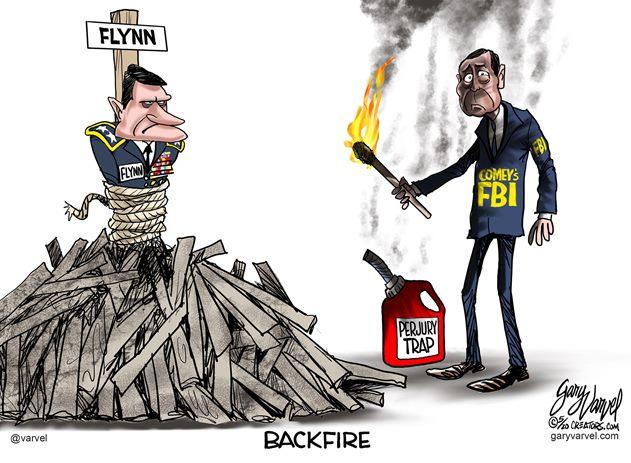
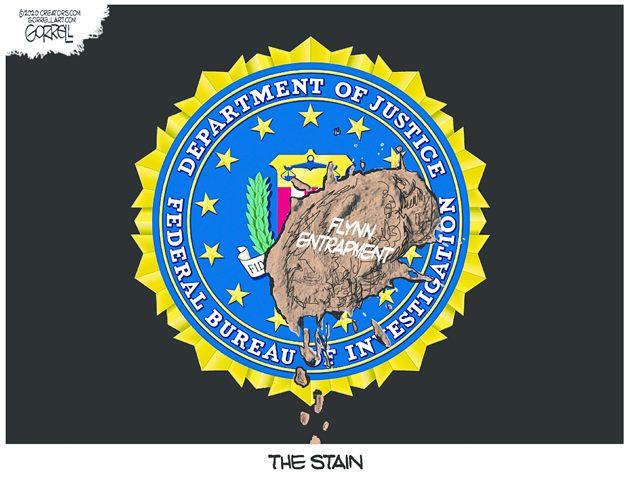
The people of this land have enough trouble in mind – what with livelihoods, careers, businesses, marriages, hopes and dreams circling the drain in the new insta-depression – but let’s hope they have just a little attention left over for the whirlwind denouement of the odious RussiaGate affair, now finally shredding the last defenses of the Deep State’s rogue Intel forces after years of deceit, treachery, and juridical depravity. The beginning of the end is at hand in the malicious prosecution of General Michael Flynn, and, as that’s revealed for the criminal plot it was, all the other threads in this vast tapestry of sedition will unravel.
Why does that even matter anymore, you may wonder?

Because so many of our current troubles are mostly due to the culture of pervasive dishonesty America retreated into to avoid the mandates and rigors of reality in the 21st century. It operated in every area of our national life from the racketeering in medicine and higher-ed, to the games we played with our national debt, to the stupendous grift of politics, the futile wars we prosecuted, the idiotic gender conflict and race hustling, and, most flamboyantly, to the lawlessness around the CIA, FBI, and Department of Justice during and after the 2016 election. This was the culture of Anything Goes and Nothing Matters. It has to be defeated if we expect to go on as a credible nation.
General Flynn had been an irritant to the Obama administration in his role as chief of the Defense Intelligence Agency. He disagreed with a lot going on around him and he said so, especially the nuclear deal that was percolating with Iran. Mr. Obama canned General Flynn in 2014. Afterward, CIA chief John Brennan and DNI James Clapper put him under surveillance and played entrapment games with him, using some of the same shady characters (Stefan Halper, Richard Dearlove) who later showed up as RussiaGate players.

In early 2016, Gen. Flynn joined the Trump campaign as a foreign affairs advisor and that summer made the mistake of leading the “Lock her up,” chant to a delirious crowd at the Republican Convention. Perhaps he knew a thing or two about the activities of the Clinton Foundation. Perhaps he also knew what Jeffrey Epstein was up to. Then Mr. Trump shocked the world and won the election. Gen. Flynn was soon appointed incoming National Security Advisor. One can imagine the anxiety crackling through a Democrat-controlled Deep State on the verge of surrendering power to its enemies. The alarm bells that went off through the vast US Intel underground must have been deafening.

In a panic, the Intel Community set in motion a suite of operations to get rid of both Flynn and Trump. On December 29, late in the transition-of-power, President Obama lit up a diplomatic flare by confiscating country retreat properties in Maryland and Long Island owned by the Russian embassy and expelling 35 embassy employees, supposedly as payback for Russia “interfering in the 2016 election.” This prompted a conversation between incoming National Security Advisor Flynn and Russian ambassador Sergey Kislyak. That cued the FBI to entrap General Flynn. The news media played along with the preposterous falsehood that high American officials should not communicate with diplomats posted to the USA. The shady gotcha interview about that with Flynn, conducted by FBI officers Peter Strzok and Joseph Pientka, has been dissected to death, so I’ll spare you that, except to say that it was carried out in obvious bad faith.

The court case over all that has dragged out for more than three years now, though anyone could see from the get-go that it was a malicious prosecution. (I said as much more than once in this blog years ago.) Presiding Judge Emmet Sullivan has overlooked flagrant misconduct by DOJ prosecutors, led by Brandon Van Grack. FBI Director Christopher Wray has concealed exculpatory evidence of FBI and DOJ misconduct that favored General Flynn for three years. General Flynn’s previous attorneys from the DC law firm of Covington and Burling ­­­­­­­­— where Mr. Obama’s Attorney General Eric Holder is a partner — represented Gen. Flynn poorly, and did so apparently on-purpose. In spite of all that, the case is unraveling thanks to the diligence of Gen. Flynn’s new attorney, Sidney Powell, who cuts through government bullshit like a samurai sword through tofu.

The case is now moving swiftly to a climax, perhaps due to William Barr appointing Missouri federal attorney Jeffrey Jensen to review the matter. Someone, perhaps new Acting Director of National Intelligence Richard Grenell, has pried bales of previously hidden documents from FBI Director Wray’s sweaty hands. They amount to clear evidence of a scheme to lawlessly railroad Gen. Flynn. If Judge Sullivan doesn’t dismiss the case in another two weeks, he will look like a fool and a scoundrel. He probably cares about his reputation. Any fair reading of this case would have this judge cite the DOJ lawyers for criminal contempt at a minimum.

The question arises: why has Attorney General Barr allowed this to go on and on. My guess is that he thinks the best course would be for Judge Sullivan to be forced by the weight of evidence to do his duty and move to dismiss the case against Gen. Flynn. After all, the objective is to restore the rule-of-law, and that includes getting the federal courts to operate honestly and fairly. If Mr. Barr took the extraordinary action of intervening, it would signify that the court could not be trusted, and that will not restore the rule-of-law. The same applies to a presidential pardon.

In the background looms federal attorney John Durham who has been at work for year looking into the matrix of suspicious conduct around all aspects of the RussiaGate hoax, the greatest scandal in US history. Mr. Barr has been accused of allowing quite a few culpable DOJ higher-ups to remain in their jobs this whole time,including FBI Director Wray, despite the shade thrown on them by the drip-drip-drip revelations of their misdeeds. I think both Mr. Barr and Mr. Trump have resisted the temptation to intervene in order to 1) steer clear of malign RussiaGate collaborators in Congress and the news media, and 2) for reasons similar to the process involving Gen. Flynn ­— to reestablish the regular wheels of justice and faith in the system.

RussiaGate and all its subsidiary mischief amounted to a seditious conspiracy by several agencies of government against the chief executive. It was explicitly an effort to overthrow a president by illegitimate means. The conspiracy extended to members of congress, who are not privileged with immunity against felony crimes, by the way.

The partial list of government officials, current or former, who may be subject to prosecution in these matters should include Barack Obama, Susan Rice, John Brennan, James Clapper, James Comey, Andrew McCabe, Rod Rosenstein, John Carlin, Mary McCord, Michael Atkinson, James Baker (DOJ), James Baker (DOD), Loretta Lynch, Sally Yates, Dana Boente, Peter Strzok, Lisa Page, Joseph Pientka, William Priestap, Bruce Ohr, Kevin Clinesmith, Robert Mueller, Andrew Weissmann, Aaron Zebley, Jeanie Rhee, David Lauffman, Senator Mark Warner, Senator Richard Burr, James Wolfe, Rep. Adam Schiff, Eric Ciaramella, Col. Alexander Vindman. Players outside government include Glenn Simpson, Nellie Ohr, Christopher Steele, Stefan Halper, Sidney Blumenthal, Cody Shearer, David Kramer. The following media figures might be named as unindicted co-conspirators: Dean Baquet, Martin Baron, Jeff Zucker, Andrew Lack, Rachel Maddow, Lawrence O’Donnell, Chris Cuomo, Joe Scarborough, David Corn, David Ignatius, and Ari Melber.

*  *  *

Note: The New York Times has not covered this week’s developments in the General Michael Flynn case. So, there is no record of this epic injustice in the newspaper-of-record. Therefore, it is no longer the newspaper-of-record.


Tyler Durden

Fri, 05/01/2020 – 15:30

via ZeroHedge News https://ift.tt/3aPJrPK Tyler Durden
Short Circuit: A Roundup of Recent Federal Court Decisions

Please enjoy the latest edition of Short Circuit, a weekly feature from the Institute for Justice.

New on the Short Circuit podcast: arresting a reporter, arresting the interstate flow of alcohol, and arresting political consultants’ speech. Click here for Apple Podcasts.

  • Once the SEC found a compliance officer responsible for not investigating a multibillion dollar Ponzi scheme, he had 60 days to appeal to the United States Court of Appeals for the District of Columbia Circuit (the federal appeals court in Washington that reviews many agency actions). But instead, representing himself, he filed his appeal with the District of Columbia Court of Appeals (the “state supreme court” of D.C.). He learned of the goof one day too late and filed in the right court on day 61. D.C. Circuit (the real one): Too bad.
  • Allegation: Homeless man doesn’t resist when Austin, Tex. officer grabs his arm. But rather than comply with the officer’s orders, the man asks the officer to stop. Without warning, the officer hits him in the head, takes him to ground, beats him further, tases him. Officer: At which point he disarmed me, tased me, and broke my hand. District court: Video shows you had him pinned down the whole time and you told other officers you broke your finger “punching the shit out of him.” Fifth Circuit: No qualified immunity.
  • Allegation: Man has bad acid trip at concert, paces around mumbling incoherently next to road. Though he is not violent, Southaven, Miss. police hog-tie him using their own personal shackles. They know he has asthma, but officers insist that he stay hogtied at hospital. His face turns from bright red to purple as he struggles to breathe. He dies. Fifth Circuit: No qualified immunity.
  • In 2017, Texas passes a law prohibiting state governmental entities from contracting with companies that boycott Israel. After a bevy of sole proprietors file a First Amendment lawsuit, district court preliminarily enjoins the law. Twelve days later, Texas amends the law—to exclude sole proprietors while retaining the law for larger companies. Which makes the sole proprietors’ case moot, says Fifth Circuit.
  • Corrections officers at Richwood, La. private prison take inmates to a part of the jail without cameras, force them to kneel while handcuffed, and pepper spray them in the face one by one when they deny being gang members. To explain the inmates’ injuries, the officers file false reports. Fifth Circuit: No reason to reconsider the lead officer’s 60-month sentence.
  • The Sixth Circuit enjoins Tennessee’s executive order prohibiting nonemergency surgical abortions, such that the procedures may be allowed for women whose pregnancies will be past the legal limit for abortion when the governor’s order ends and for women who, due to the stage of pregnancy, will need to undergo lengthier surgical abortion procedures if they wait until the executive order expires (which it did on April 30). Dissent: Courts should not rubber-stamp emergency measures, but “judges should act with care during such times, recognizing the limits of our knowledge, institutional capacity, and lawful authority.”
  • Illinois prisoner develops cataract in his left eye, but under the prison’s “one good eye” policy, the prison refuses to authorize surgery. Five years later, the prisoner is completely blind in his left eye and has a cataract in his right eye. But he’s not completely blind, so still no surgery for him. He files an emergency grievance, which is denied. Can he sue in federal court? Prison: No, he should have refiled a standard grievance. Seventh Circuit: That wasn’t a required procedure when he filed his grievance, so he exhausted everything he was required to exhaust.
  • A divided Seventh Circuit panel says that a universal injunction—that prevents the feds from conditioning receipt of certain grant money on cities’ and states’ compliance with federal immigration enforcement efforts—is necessary to ensure that Chicago (a sanctuary city) receives the same amount of funds it would have received if the conditions had never been imposed. The full panel held (for the second time) that the conditions are unconstitutional, as the attorney general imposed them without Congress’ explicit authorization. (Learn more about the universal injunction issue here.)
  • A Mississippi county contracts with an inmate transportation company to transport a pretrial detainee from Colorado back to Mississippi. Ordinarily, the drive would take around 16 hours. But the transportation company travels west from Colorado through at least a dozen other states (some more than once) to pick up and drop off other prisoners. Throughout, the prisoners remain chained in upright, seated positions, often marinating in their own waste. The trip takes eight days. And a detainee’s ensuing lawsuit against the company must proceed to trial, holds the Eighth Circuit.
  • Man pleads guilty, implicates three friends in brutal 1988 murder of a 78-year-old woman in Fordyce, Ark. All are convicted and sentenced to life in prison. After two decades pass, it comes to light that law enforcement used a prison informant to extract a confession, which they recorded. But the tape was either lost or destroyed, and defense counsel were never informed of the informant or his incentives for informing. On top of that, one of the friends claims sole responsibility for the attack. Eighth Circuit: The two friends did indeed establish that law enforcement destroyed evidence in bad faith, and they’re entitled to habeas relief. (More from the Midwest Innocence Project and local reporting.)
  • Sitting by designation, trivia whiz Judge Boggs reminds us that in the Cadaver Synod of 897, Pope Stephen VII exhumed and tried the deceased Pope Formosus. Now, however, the Ninth Circuit holds that you cannot sue the dead.
  • In 2001, a Navajo man murders a Navajo woman and her granddaughter within the territory of the sovereign Navajo Nation. As the case continues to wind through the courts, two Ninth Circuit judges write separately to comment on the unusual fact that the United States sought the death penalty “against the express wishes of the Navajo Nation, several members of the victims’ family, and the United States Attorney for the District of Arizona.”
  • Kansas law requires residents to provide documentary proof of citizenship before they may register to vote. An unconstitutional burden on the right to vote? A violation of the National Voter Registration Act? Tenth Circuit: Both. As far as the record shows, in the past 19 years only 67 noncitizens have attempted to register to vote, while tens of thousands of people have had their registration delayed or denied under the law.
  • Under Florida law, the order of candidates on the ballot is determined by the results of the last gubernatorial election, with the winning candidate’s party listed first. For the past 20 years, this has been the Republican Party. Does this unconstitutionally dilute the voting rights of Democrats? Eleventh Circuit: No need to answer that question; none of the plaintiffs alleged an injury, and they sued the wrong person. Concurrence: And this is a nonjusticiable political question. Concurrence/dissent: It’s enough to hold that no one is injured.
  • And in en banc news, the Ninth Circuit will not reconsider its decision that a California labor regulation mandating that agricultural businesses allow nonemployee union organizers onto their property is not a taking under the Fifth Amendment.

Cities and towns nationwide use their code enforcement powers to treat citizens like ATMs. Such taxation by citation continues amid the COVID-19 crisis, and it’s likely the problem will worsen in the coming months as municipalities find themselves facing budget shortfalls. And, a new IJ report finds, a wide range of state laws enable or even encourage the abuse. Titled Municipal Fines and Fees: A 50-State Survey of State Laws, the report is the first comprehensive accounting of state laws relating to municipal fines and fees. It uses 52 legal factors to rank the 50 states based on the extent to which their laws may contribute to municipal taxation by citation. The rankings offer a systematic way to diagnose possible relationships between state laws and municipal behavior—and to identify potential policy solutions. Read the report.

from Latest – Reason.com https://ift.tt/2YputgX
via IFTTT

A Woman Set Up a Little Free Pantry Without a Permit. The County Threatened Criminal Charges.

It started with a bowl of chicken noodle soup and a desire to help the community. It ended with the government threatening criminal charges.

“For 16 years, our family struggled with food and security, and a lot of people don’t understand how hard it is if they don’t struggle with that,” says Kathy Hay, who notes she is in a much better financial place now. “I’m always looking for ways to help people that are having a hard time.”

Inspired by the leftovers from a pot of chicken soup she’d made, Hay started researching ways to start a little free pantry in her Asotin County, Washington, neighborhood. In December she set one up in her backyard, replete with refrigerated food, canned goods, and produce—all available for free to those struggling to make ends meet.

Akin to little free libraries, these makeshift pantries popping up across the U.S. invite local participation, allowing passersby to donate edible goods. “The community really responded positively to it,” says Hay. “It was exciting.”

The excitement was short-lived. In February, the county health department dropped by to tell her and her husband that they needed to immediately desist operations, because Hay didn’t have a permit. If they refused, the county threatened to pursue criminal charges. 

What’s more, getting that license wouldn’t be sufficient to reboot the pantry. She would have to pay a fine. She would have to cough up an annual fee. And she would have to abide by a laundry list of regulations more appropriate for a large-scale distribution center.

Among the requirements were a slew of packaging regulations. Canned items needed to have a commercial label that traversed the full circumference of the can, for instance. Fresh foods—from apples and oranges to bread—were prohibited entirely. She would need to set up a separate collection spot where she screened every item, a rule anathema to the basic concept of a little free pantry. She would have to create, print, and distribute flyers explaining what can and cannot be donated. She would need to elevate the pantry above the ground, disqualifying her cupboard setup, though the health department “wouldn’t be specific about how high it needed to be,” she notes.

Now the Institute for Justice has filed a civil rights lawsuit on Hay’s behalf, as well as on behalf of two women who benefited from the free pantry. The suit says the county infringed on Hay’s constitutional rights when it stopped her from giving away food on her own property, and it alleges that it likewise violated the two beneficiaries’ constitutional right to accept private charity.

“The regulations that the County wants Kathy to follow actually hurt the people they are intended to protect,” says Caroline Grace Brothers, a constitutional law fellow at the Institute for Justice. “The food in Kathy’s pantry poses no more threat to its beneficiaries than the food at a roadside farm stand with an ‘honor box.’ Yet Kathy has to follow pages of regulations to share food in her own backyard, while produce stands are allowed to sell food without interference.”

It almost goes without saying that Hay’s efforts would be particularly helpful at this juncture. Washington was the first state to report a COVID-19 case. Clarkston, the working-class town where Hay lives, already sported a 20 percent poverty level before the coronavirus struck—considerably higher than the national average.

So Hay is hoping for a speedy resolution. “The ideal outcome would be for the county to let me and anybody else who would like to have a little free pantry to be able to open one up,” she says, “without being afraid that they’re going to be charged with criminal behavior.”

from Latest – Reason.com https://ift.tt/2YndlYX
via IFTTT

Past Crises Have Ratcheted Up Leviathan. The COVID-19 Pandemic Will Too.

COVID-19 has plunged the United States into a national emergency. Initial applications for unemployment insurance benefits increased from 211,000 in the first week of March to 6.6 million in the first week of April, to another 5.2 million in the second week of April, and another 4.4 million last week. Real GDP fell by hundreds of billions in the first quarter, with further—and larger—declines sure to follow.

Another emergency has sprung not so much from the disease itself as from the reactions of governments at all levels. The magnitude of these reactions, ranging from mandatory closures of “nonessential” firms to preemptive quarantines of millions of people to massive relief bills to huge bailout measures by the Fed, staggers the imagination. Governments have responded to crises in the past, but never on such a scale in such a brief time.

So far, Congress has approved a total of $2.392 trillion in coronavirus-related spending. The Fed, using different “tools,” has injected another $2.3 trillion into the economy.

Although everyone seems to agree that these measures are to be employed only in the short run, until the incidence of the disease has been reduced either by herd immunity or by new medical treatments, no one at the start put together an exit strategy from these extraordinary increases in governments’ size, scope, and power. Everything was done on a piecemeal basis from day to day, on the assumption that when an endgame came into view the governments would terminate their crisis actions.

This assumption runs counter to how crisis-borne increases in government’s size, scope, and power have played out in the past. The pattern followed since the early 20th century has been quite different. One of us (Robert Higgs) traced this pattern in his 1987 book, Crisis and Leviathan, and worked out the political logic by which such episodes tend to take place. The principal upshot is that the growth of government that attends national emergencies is not surrendered fully when the crisis ends. Instead, a ratchet effect operates whereby much of the crisis-borne growth of government becomes institutionalized in agencies and practices and, more important, in the dominant ideology of political elites and the general public.

As crisis followed crisis—World War I, the Great Depression, World War II, the multifaceted turmoil of the Johnson-Nixon years, the 9/11 attacks, the Great Recession that began in 2008—the ratchet effect ensured that government’s growth trajectory was displaced upward, time after time. The displacement was not always transparent or immediate, but precedents established in particular episodes reappeared again and again, sometimes after a lag of decades. In this way, government responses to short-run difficulties became lodged in the process by which rapid long-run growth of government became the norm.

People sometimes regretted actions taken hastily during a crisis but found that reversing them was diabolically difficult. As many observers have recognized, nothing is so permanent in government as a temporary agency or an emergency bill. Crises bring into operation new government activities and new scales of spending, taxing, and regulating; they were not intended to be permanent, yet became so by virtue of entrenched special interests and bureaucrats, often backed by congressional sponsors. Act in haste, repent at leisure.

We should be thinking seriously about where all our emergency actions will leave us in the long run. Will the quarantine of millions of people become a precedent? Will broad-scale distributions to the general population without a means test become an enduring public demand even when normal times return? Will the Fed’s exchange of trillions of dollars for rotten securities become a lasting feature of its monetary policy?

The ratchet effect operates because of incentives and constraints built into the political and economic structure. But the effect hinges on the underlying assumptions of progressivism, which became the country’s dominant ideology during the first two decades of the 20th century. To disable the ratchet effect, people must rouse themselves to think more seriously about the long-run consequences of actions taken hastily in response to national emergencies—and about whether they want to keep their remaining economic freedoms and civil liberties or be content to surrender them one crisis at a time.

from Latest – Reason.com https://ift.tt/2z0RrQR
via IFTTT

“Cash Mountain” Hits A Record $4.7 Trillion

“Cash Mountain” Hits A Record $4.7 Trillion

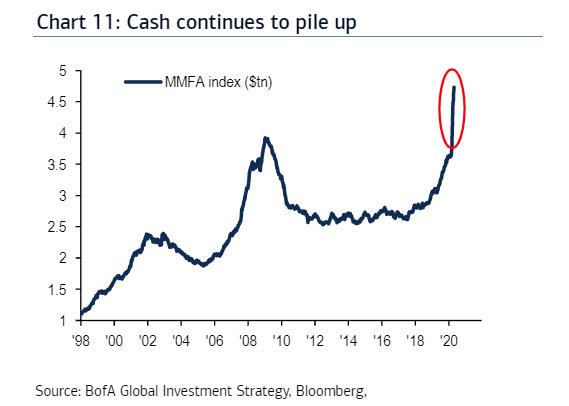
One doesn’t have to read our weekly flow reports showing that while algos and quants are busy buying stocks hand over first (because momentum) even as human and hedge funds investors continue to sell (see “Only Machines Are Buying Stocks As Humans Stay At Home“), to get a sense that virtually no carbon-based trader with an organic brain believes this rally: there is a far simpler indicator of what most investors think about the market.  We are referring of course to the amount of inert cash in money-market funds which this week rose again – despite the tremendous April stock rally – hitting a record high $4.7tn, and up an unprecedented $1.1tn past 9 weeks.

For those confused by the chart above, here is the explanation: instead of risking their capital, investors have parked a record amount of cash – far more than during the financial crisis – in inert money-equivalents which yield zero as they have zero faith in any other asset class, be it bonds or stocks.

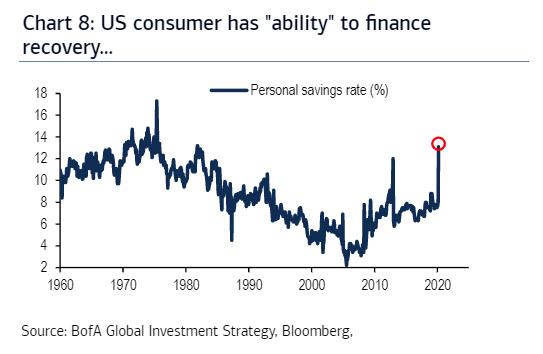
This is taking place when, as we reported on Wednesday, the US household savings rate exploded to a massive 13%, the highest in 40 years.

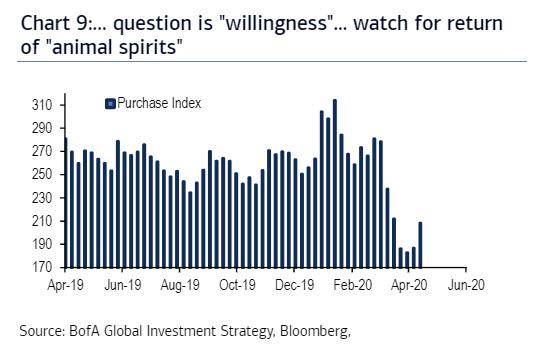
To Bank of America’s Michael Hartnett this means that the consumer has the “ability” to finance recovery, but the question is “willingness”; And, as Hartnett adds, watch US mortgage applications for purchase as key indicator consumer “animal spirits” returning;

As he further adds, “Wall St always undershoots and overshoots…most plausible reason overshoot continues is that US policy makers have stimulated more in 10 past weeks than Japan has in 30 years and US real estate/banking/consumer data turns out not to be Japanese.”

That may explain why despite the record allocation to money market funds, we continue to see aggressive allocation to bond funds which are now explicitly backstopped by the Fed, and so in addition to the $91.5bn going into cash, $10.6bn went into bonds, $0.8bn into gold; while $6.7bn came out of equities this week.

In terms of flows to know, Hartnett points out the following:

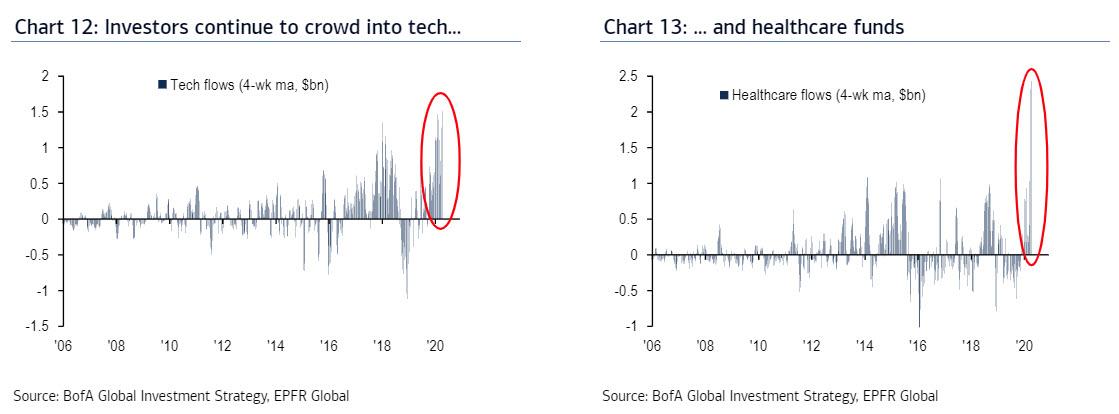
1. investors continue to crowd into tech ($2.4bn this week – Chart 12) & healthcare funds ($1.5bn – Chart 13);

2. investors continue to flee EM assets ($13bn redemptions past two weeks);

3. HY bonds (piggy-in-middle) unambiguously seeing inflows ($2.2bn).

And explaining the ongoing flood into fixed income, BofA points out the $14 trillion in Fed of global policy stimulus which has “miraculously” prevented credit event in IG, munis, energy, mortgage servicers, EM, Italy…on contrary IG has rallied back to highs despite a massive $767bn of issuance YTD; but policy bazooka yet to cause

1. US dollar to give all-clear (need DXY <98) and,

2. HY outperformance of IG, without which hard to see new highs in stocks and sustained rotation large cap growth to small cap value.


Tyler Durden

Fri, 05/01/2020 – 15:10

via ZeroHedge News https://ift.tt/2xp9fVa Tyler Durden

SoftBank’s International Arm Cuts 10% Of Employees As Coronavirus Seals WeWork’s Fate

SoftBank’s International Arm Cuts 10% Of Employees As Coronavirus Seals WeWork’s Fate

SoftBank may have succeeded in stiffing WeWork shareholders out of $3 billion, but the company recently informed shareholders that its loss for the fiscal year ended in March was even larger than it had anticipated, largely due to WeWork, though the company’s investments in Uber and a handful of other startups that failed or shut down over the last six months have also hurt.

With its debt trading deep in junk territory, the reputation of the company’s founder-chairman Masayoshi Son lies in tatters, as the coronavirus outbreak essentially sealed WeWork’s fate after a string of blowups among other SoftBank and Vision Fund portfolio companies.

In a matter of months, a man once heralded as the greatest momentum investor of a generation is just the guy who thought WeWork’s low-margin, hyper-cyclical core concept might be worth $54 billion. Even Goldman’s clients couldn’t swallow that one.

Now, SoftBank’s international arm is laying off 10% of its employees as it continues to try and cut costs after its worst run ever.

Here’s Bloomberg:

SoftBank Group International, an arm of SoftBank Group Corp. led by Marcelo Claure, has cut roughly 10% of its staff as part of a plan to operate more efficiently, according to people with knowledge of the matter.

The reductions affected about two dozen employees in cities including San Carlos, California, and Miami, according to one of the people, who asked not to be identified because they haven’t been made public. SoftBank Group International is prioritizing enabling its portfolio companies to emerge from the coronavirus pandemic in a stronger position, while continuing to make selective investments, the person said.

In addition to the job cuts, two managing partners of SoftBank’s $5 billion Latin America fund, Murtaza Ahmed and Andres Freire, voluntarily departed, one of the people said. Mike Bucy, an operating partner at the firm who had been appointed as WeWork’s chief transformation officer in November, also has left SoftBank of his own accord, the person said.

A SoftBank spokeswoman declined to comment.

SoftBank said this week it expects a wider net loss for the fiscal year ended in March, because of deeper struggles at one of its largest investments, office-sharing startup WeWork. The Japanese conglomerate expects to lose 900 billion yen ($8.4 billion), up from a previous estimate of about 750 billion yen.

Its Latin America fund has backed companies including Colombia-based delivery startup Rappi, Brazilian fitness company Gympass and Argentine financial-technology firm Uala.

For those who haven’t been following along lately, here’s a summary of what’s going on with the guidance, according to Pitchbook.

In light of steeper losses from its WeWork investment, SoftBank has again revised its annual guidance for the latest fiscal year.

The Japanese tech giant now expects a net loss of 900 billion yen (about $8.4 billion)—150 billion yen more than it announced over two weeks ago. SoftBank said its investment in WeWork, as well as its loan commitment and financial guarantee for the co-working company, was responsible for about 700 billion yen in losses.

The new guidance follows an announcement in mid-April, when SoftBank told investors it expects the value of its Vision Fund portfolio to drop 1.8 trillion yen. Earlier this month, WeWork sued SoftBank, its largest investor, for backing away from a $3 billion tender offer that SoftBank said would primarily benefit founder Adam Neumann and fellow investor Benchmark.

Many SoftBank-backed companies showed signs that they were struggling before the coronavirus pandemic; the crisis has only exacerbated those problems. In recent months, real estate tech startups Opendoor and Compass, construction tech provider Katerra and restaurant robot-maker Zume have each reportedly laid off hundreds of employees. And internet satellite company OneWeb has filed for Chapter 11 protection.

And you haven’t heard the worst part yet: It looks like there’s more pain to come as Masa Son pledges more of his personal fortune against the company’s debt, allowing him and his team to remain in control, so they can make more of the bad decisions that brought what had been a Japanese global champion to its knees.


Tyler Durden

Fri, 05/01/2020 – 14:55

via ZeroHedge News https://ift.tt/2yamABk Tyler Durden

A Woman Set Up a Little Free Pantry Without a Permit. The County Threatened Criminal Charges.

It started with a bowl of chicken noodle soup and a desire to help the community. It ended with the government threatening criminal charges.

“For 16 years, our family struggled with food and security, and a lot of people don’t understand how hard it is if they don’t struggle with that,” says Kathy Hay, who notes she is in a much better financial place now. “I’m always looking for ways to help people that are having a hard time.”

Inspired by the leftovers from a pot of chicken soup she’d made, Hay started researching ways to start a little free pantry in her Asotin County, Washington, neighborhood. In December she set one up in her backyard, replete with refrigerated food, canned goods, and produce—all available for free to those struggling to make ends meet.

Akin to little free libraries, these makeshift pantries popping up across the U.S. invite local participation, allowing passersby to donate edible goods. “The community really responded positively to it,” says Hay. “It was exciting.”

The excitement was short-lived. In February, the county health department dropped by to tell her and her husband that they needed to immediately desist operations, because Hay didn’t have a permit. If they refused, the county threatened to pursue criminal charges. 

What’s more, getting that license wouldn’t be sufficient to reboot the pantry. She would have to pay a fine. She would have to cough up an annual fee. And she would have to abide by a laundry list of regulations more appropriate for a large-scale distribution center.

Among the requirements were a slew of packaging regulations. Canned items needed to have a commercial label that traversed the full circumference of the can, for instance. Fresh foods—from apples and oranges to bread—were prohibited entirely. She would need to set up a separate collection spot where she screened every item, a rule anathema to the basic concept of a little free pantry. She would have to create, print, and distribute flyers explaining what can and cannot be donated. She would need to elevate the pantry above the ground, disqualifying her cupboard setup, though the health department “wouldn’t be specific about how high it needed to be,” she notes.

Now the Institute for Justice has filed a civil rights lawsuit on Hay’s behalf, as well as on behalf of two women who benefited from the free pantry. The suit says the county infringed on Hay’s constitutional rights when it stopped her from giving away food on her own property, and it alleges that it likewise violated the two beneficiaries’ constitutional right to accept private charity.

“The regulations that the County wants Kathy to follow actually hurt the people they are intended to protect,” says Caroline Grace Brothers, a constitutional law fellow at the Institute for Justice. “The food in Kathy’s pantry poses no more threat to its beneficiaries than the food at a roadside farm stand with an ‘honor box.’ Yet Kathy has to follow pages of regulations to share food in her own backyard, while produce stands are allowed to sell food without interference.”

It almost goes without saying that Hay’s efforts would be particularly helpful at this juncture. Washington was the first state to report a COVID-19 case. Clarkston, the working-class town where Hay lives, already sported a 20 percent poverty level before the coronavirus struck—considerably higher than the national average.

So Hay is hoping for a speedy resolution. “The ideal outcome would be for the county to let me and anybody else who would like to have a little free pantry to be able to open one up,” she says, “without being afraid that they’re going to be charged with criminal behavior.”

from Latest – Reason.com https://ift.tt/2YndlYX
via IFTTT

Past Crises Have Ratcheted Up Leviathan. The COVID-19 Pandemic Will Too.

COVID-19 has plunged the United States into a national emergency. Initial applications for unemployment insurance benefits increased from 211,000 in the first week of March to 6.6 million in the first week of April, to another 5.2 million in the second week of April, and another 4.4 million last week. Real GDP fell by hundreds of billions in the first quarter, with further—and larger—declines sure to follow.

Another emergency has sprung not so much from the disease itself as from the reactions of governments at all levels. The magnitude of these reactions, ranging from mandatory closures of “nonessential” firms to preemptive quarantines of millions of people to massive relief bills to huge bailout measures by the Fed, staggers the imagination. Governments have responded to crises in the past, but never on such a scale in such a brief time.

So far, Congress has approved a total of $2.392 trillion in coronavirus-related spending. The Fed, using different “tools,” has injected another $2.3 trillion into the economy.

Although everyone seems to agree that these measures are to be employed only in the short run, until the incidence of the disease has been reduced either by herd immunity or by new medical treatments, no one at the start put together an exit strategy from these extraordinary increases in governments’ size, scope, and power. Everything was done on a piecemeal basis from day to day, on the assumption that when an endgame came into view the governments would terminate their crisis actions.

This assumption runs counter to how crisis-borne increases in government’s size, scope, and power have played out in the past. The pattern followed since the early 20th century has been quite different. One of us (Robert Higgs) traced this pattern in his 1987 book, Crisis and Leviathan, and worked out the political logic by which such episodes tend to take place. The principal upshot is that the growth of government that attends national emergencies is not surrendered fully when the crisis ends. Instead, a ratchet effect operates whereby much of the crisis-borne growth of government becomes institutionalized in agencies and practices and, more important, in the dominant ideology of political elites and the general public.

As crisis followed crisis—World War I, the Great Depression, World War II, the multifaceted turmoil of the Johnson-Nixon years, the 9/11 attacks, the Great Recession that began in 2008—the ratchet effect ensured that government’s growth trajectory was displaced upward, time after time. The displacement was not always transparent or immediate, but precedents established in particular episodes reappeared again and again, sometimes after a lag of decades. In this way, government responses to short-run difficulties became lodged in the process by which rapid long-run growth of government became the norm.

People sometimes regretted actions taken hastily during a crisis but found that reversing them was diabolically difficult. As many observers have recognized, nothing is so permanent in government as a temporary agency or an emergency bill. Crises bring into operation new government activities and new scales of spending, taxing, and regulating; they were not intended to be permanent, yet became so by virtue of entrenched special interests and bureaucrats, often backed by congressional sponsors. Act in haste, repent at leisure.

We should be thinking seriously about where all our emergency actions will leave us in the long run. Will the quarantine of millions of people become a precedent? Will broad-scale distributions to the general population without a means test become an enduring public demand even when normal times return? Will the Fed’s exchange of trillions of dollars for rotten securities become a lasting feature of its monetary policy?

The ratchet effect operates because of incentives and constraints built into the political and economic structure. But the effect hinges on the underlying assumptions of progressivism, which became the country’s dominant ideology during the first two decades of the 20th century. To disable the ratchet effect, people must rouse themselves to think more seriously about the long-run consequences of actions taken hastily in response to national emergencies—and about whether they want to keep their remaining economic freedoms and civil liberties or be content to surrender them one crisis at a time.

from Latest – Reason.com https://ift.tt/2z0RrQR
via IFTTT

30 For 30: 30 Million Jobless Claims vs. 30% Gain in Equity Prices

30 For 30: 30 Million Jobless Claims vs. 30% Gain in Equity Prices

Submitted by Joseph Carson, Former Chief Economist of Alliance Bernstein

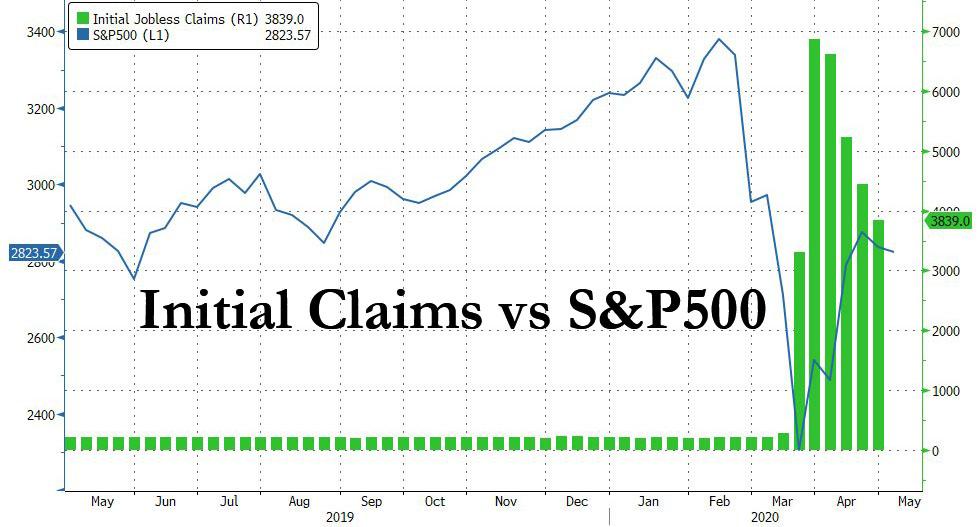
The great divide between finance and the economy rolls on. In the past 6 weeks, jobless claims have increased by 30 million, while the S&P 500 index has increased by more than 30%.

The last decade saw the greatest divide ever between finance and the economy. At the end of 2019, household holdings of equities stood 2 times the level of disposable income, an all-time high.

That divergence between finance (stock market) and the economy was fueled by easy money. To be sure, policymakers kept official rates near zero for roughly half of the 130-month economic expansion. Also, except for a brief 6-month period in early 2019, policymakers kept official rates below the core rate of inflation. Never before in any business cycle has official rates remained below the inflation rate for almost an entire growth cycle.

In 2020, the policy of easy money policy has gone to new heights. On March 23, the Federal Reserve announced plans to make unlimited purchases of financial assets to support the financial markets while also indicating they planned to utilize emergency lending powers.

Artificially evaluating finance over the economy does not guarantee a recovery, while it can also lead to financial instability at some point as asset prices become unhinged to underlying corporate profitability.

Cheap money can create the illusion of recovery, but a policy that results in more debt and inflated asset prices is not a bridge to recovery; it’s another bubble.


Tyler Durden

Fri, 05/01/2020 – 14:40

via ZeroHedge News https://ift.tt/3d7eW9v Tyler Durden

Fed Cuts Pace Of Treasury QE To Just $8 Billion Per Day

Fed Cuts Pace Of Treasury QE To Just $8 Billion Per Day

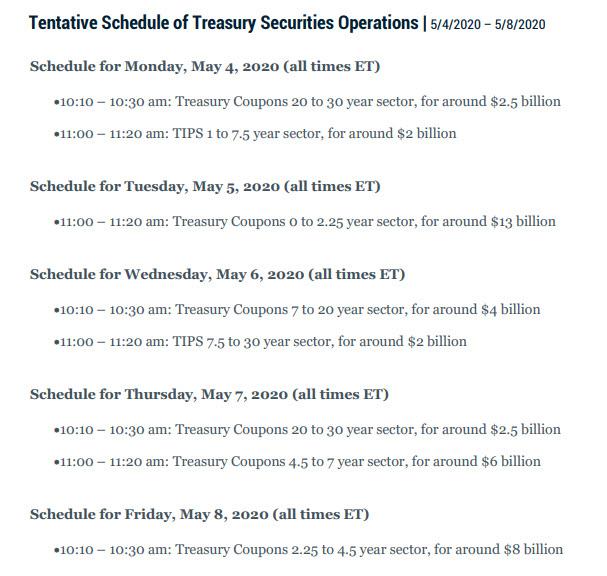
From an initial $75 billion per day when the Fed announced the launch of Unlimited QE in March, the US central bank first reduced its daily buying to $60 billion per day, then  four weeks ago announced another ‘taper’ in its bond-buying program to $50 billion per day, which was followed by a reduction to 30 billion per day, which was then  again cut in half to $15 billion per day. Then, last week the Fed again slashed its daily POMO by another 33%, to $10BN per day, and now in its latest schedule, the Fed unveiled that in the coming week it would purchase “only” $8BN per day.

Contrary to some expectations that the Fed would only announce a month POMO total, the Fed continued the practice of providing a weekly preview of its purchasing operations, which in the coming week will amount to $40BN in TSYs.

Here is the full schedule of Treasury purchases for the week ahead. Note the increasing divergence between some days of the week, such as the $4.5BN in POMO on Monday vs the $13BN on Tuesday.

Additionally, the Fed will also taper its MBS buying from $8 billion to $6 billion on average in MBS per day next week:

  • Mon: $6.16Bn from $8.213BN last Monday
  • Tue: $5.76BN from $7.68BN last Tuesday
  • Wed: $6.16BN from $8.213BN last Wednesday
  • Thur: $5.76BN from $7.68BN last Thursday
  • Fri: $6.16 from $8.213BN last Friday

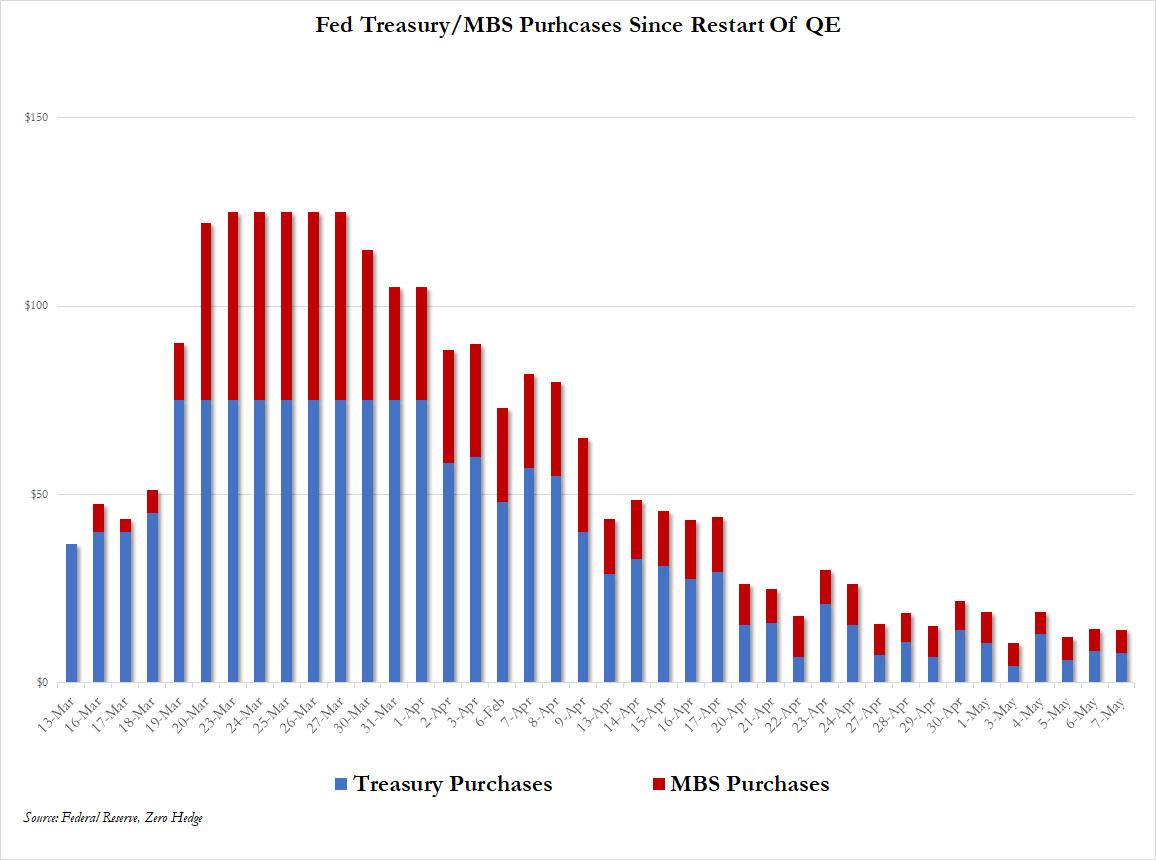
The chart below summarizes all the Fed Treasury and MBS buying completed and scheduled since the relaunch of QE on March 13:

So, in aggregate, the Fed will buy a total of $70 billion of MBS/TSYs next week, down from $90 billion but still vastly more on a weekly basis than the largest QE programs monthly totals before this crisis, if well below the $625 billion in purchases conducted in the week starting March 23, when the financial system was once again on the verge of collapse and only the Fed could bail it out… just don’t call it a bail out because nobody could have possibly anticipated an economic shock especially after banks repurchased trillions in their own stock in the past decade.

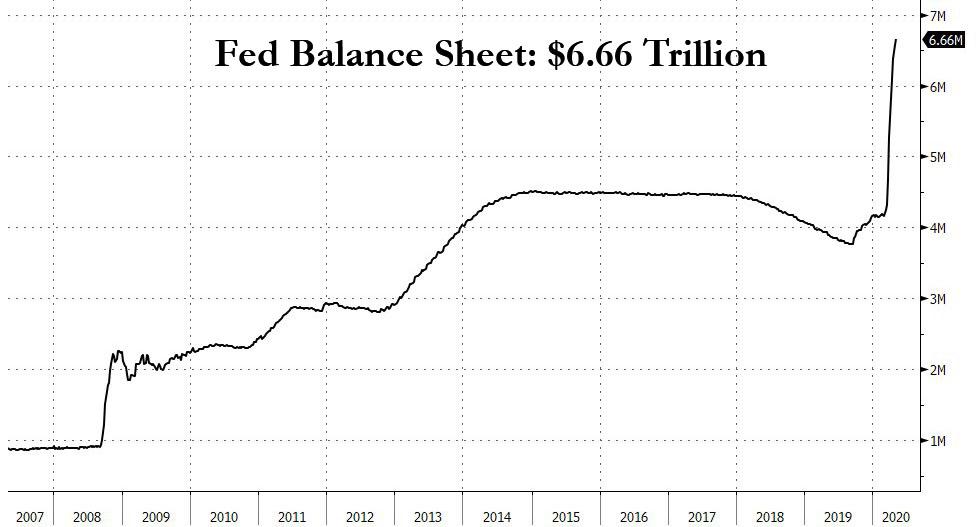
Meanwhile, as we showed last night, as of April 29, the Fed’s balance sheet was a satanically record $6.66 trillion, up $82.8 billion on the week and up $2.5 trillion from a year ago. Just staggering numbers and unprecedented attempts at dollar debasement, which however remains stubbornly strong as a result of the ongoing $12 trillion global US dollar short squeeze.

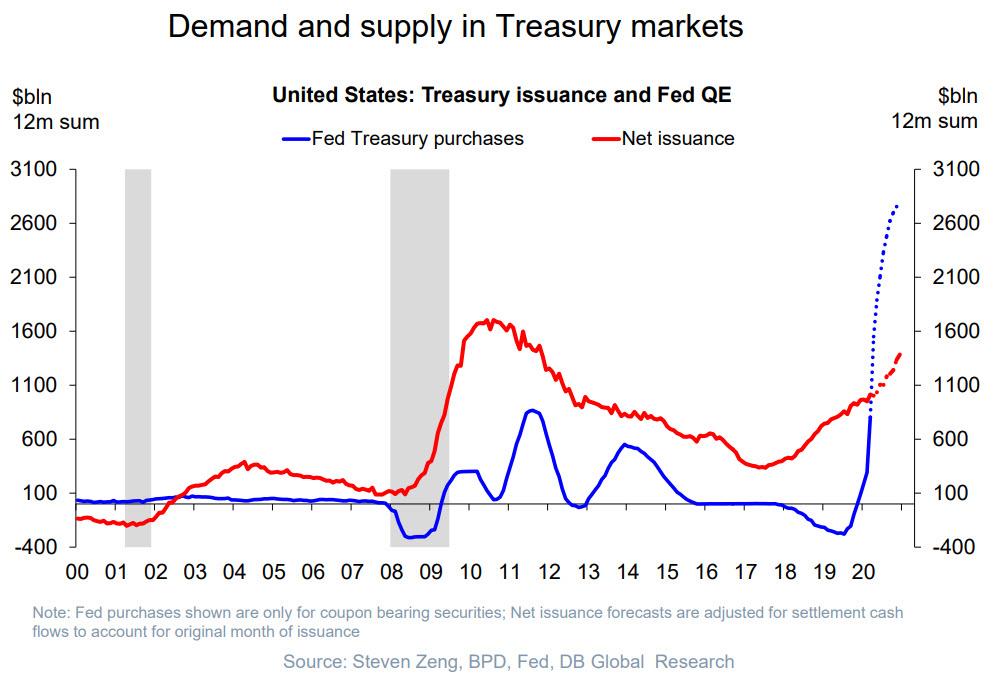
Finally, for those curious what the “helicopter money” big picture looks like, now that the Fed and Treasury are merged with the Fed stuck monetizing Treasury issuance indefinitely, here it is: as we reported last week when the Fed did QE in the years following the 2008 financial crisis monthly Treasury purchases never exceeded US Treasury net issuance, but the Fed is now on track to buy double the amount of net issuance.


Tyler Durden

Fri, 05/01/2020 – 14:23

via ZeroHedge News https://ift.tt/35kupAu Tyler Durden