What Is The NFL Telling Us About The Economy?

What Is The NFL Telling Us About The Economy?

Authored by Michael Maharrey via SchiffGold.com,

The conventional wisdom seems to be that the economy will quickly recover once governments open things up again. But recent moves by the National Football League indicate its leadership isn’t so confident.
On Wednesday, NFL Commissioner Roger Goodell announced deep cost-cutting moves for the league, including employee furloughs and pay cuts.

“It is clear that the economic effects will be deeper and longer-lasting than anyone anticipated and that their duration remains uncertain. The downturn has affected all of us, as well as our fans, our business partners, and our clubs,” Goodell wrote in the memo. “We hope that business conditions will improve and permit salaries to be returned to their current levels, although we do not know when that will be possible,” he added.

The move is telling because the NFL is in its offseason. ESPN’s broadcast of draft coverage last week garnered record ratings. The league ostensibly shouldn’t be losing money at this time.

But Goodell’s moves indicate he expects to see significant decreases in revenue moving forward.

Keep in mind, the NFL season doesn’t start until September. That’s five months away.

Goodell clearly doesn’t expect a quick economic recovery.

Granted, how quickly governments will open up remains uncertain. There is a strong possibility that NFL teams will play games in empty stadiums. But the vast majority of the NFL’s revenue comes from television and merchandise. Goodell’s proactive moves tell me he’s expecting a protractive and deep dip in league revenues.

This makes sense when you really think about it. Even if the economy was strong going into the pandemic, it will take a long time for things to restart. Over 30 million people have filed for unemployment in just six weeks. That represents about 18.6% of the US labor force. Businesses have been shut down for weeks. Many small businesses will face significant cash-flow problems. There are high hurdles to jump before the economy returns to “normal.” Goodell knows this. Thus, furloughs and pay cuts.

You don’t have to be an economist to realize that the damage done to the economy is deep and will take a significant amount of time to recover from. It will take time to rehire millions of workers. People will be hesitant to start spending money again.

Reuters recently ran an article headlined “With confidence shattered, the road to a ‘normal’ US economy looks long.” The writer points out that the 9/11 attacks shut down airlines for three days. It took three years for the industry to recover. After the housing crash, it took five years before the balance between builders and buyers was healthy enough to revive the construction industry. The damage done to the economy over the last six weeks is far deeper than the 2008 financial crisis. Just look at the data.

There’s an even more fundamental issue. The economy wasn’t normal before the pandemic.

It was a huge bubble blown up by record levels of debt facilitated by exraordinary Federal Reserve monetary policy. Coronavirus popped the bubble. In response, the US government and the Federal Reserve have quadrupled down on the policies that blew up the bubble in the first place. This is like an arsonist throwing gasoline on the fire he set while swearing he’s putting it out. The Fed has pumped trillions of dollars created out of thin air into the economy. As Peter Schiff put it, hyperinflation has gone from the worst-case scenario to the most likely scenario with this monetary policy.

Goodell isn’t likely considering where the economy was going into this crisis. He just recognizes that an economy doesn’t come to a screeching halt and then restart on a dime. He’s making the most reasonable calculation even within a mainstream framework.

And yet the markets and the vast majority of the mainstream pundits seem to think things will quickly go back to normal. The stock markets have rallied this month, for goodness sakes. Things aren’t going right back to normal. Goodell knows it. And you should know it!


Tyler Durden

Fri, 05/01/2020 – 14:10

via ZeroHedge News https://ift.tt/2VT2uEq Tyler Durden

“The Trade War Is Back”: BMO Warns The “Summer Promises To Be Unlike Any In Political Memory”

“The Trade War Is Back”: BMO Warns The “Summer Promises To Be Unlike Any In Political Memory”

Authored by Ian Lyngen, Benjamin Jeffrey and Jon Hill of BMO Capital

Elbow Bumps and Bandanas

It’s May Day and Trump’s trade war is back. Shifting away from addressing the pandemic, the White House is reportedly designing retaliatory actions against China – picking up where the issue was paused for the outbreak. It’s an election year and the efforts at laying the groundwork for The Donald’s reelection bid are clearly well underway. With only six months to go, the coronavirus has derailed the normal campaigning process and the summer promises to be a sprint unlike any in recent political memory – elbow bumps and bandanas required. At present, the White House’s attempts to block the federal government’s retirement fund from investing is Chinese equities on the basis of national security is the latest political contribution to the risk-off sentiment. It’s difficult to imagine the administration’s efforts stop there as rumblings of an uptick in tariffs are once again making the rounds.

As the political machine appears to be getting back to ‘business as usual’ attention will soon shift toward assessing the post-pandemic economic landscape. This isn’t to suggest the Covid-19 threat has been eliminated, but rather the reopenings scheduled to commence in the coming weeks will serve as the first step in getting back to the new normal. As the consumer emerges from enforced hibernation, eyes adjusting to the sun, enjoying the fresh air filtered through quality N95 protection, and strangers, friends, and acquaintances a respectful social distance away, we cannot help but ponder what will be the first post-lockdown purchases. The sales of necessities (food, health, etc.) haven’t suffered in the same manner as big ticket items and goods deemed delayable – apparel, etc. There is little doubt that pent up demand will become evident for certain purchases, however there are also lost months of spending on services which will never be realized.

The more germane question is how consumption patterns will permanently be altered as a result of the pandemic. There are plenty of dire predictions about how large venues and sporting events will never be the same; perhaps, but that is entirely different from permanently closed. Our take, for whatever it might be worth, is that there will be a period of adjustment accompanied by a modest shift in spending behavior, which eventually resolves into a ‘new’ reality which quickly becomes, well… reality. This transition will not occur overnight and it’s the redefining of the consumption landscape that has created the next meaningful unknown for 2020. As with most unknowns, the uncertainty is more paralyzing than the results themselves.

It’s Friday, and not a day too soon. The recent patterns of risk-on accompanied by higher yields ahead of the weekend appears in jeopardy this morning as global equities are under pressure. The renewed trade tensions along with guidance from Amazon and Apple have weighed on the near-term outlook and the extent to which the shift in sentiment extends will be of particular note as the weekend swiftly approaches. We maintain that with the coronavirus curve flattened and reopenings on the horizon, the balance of headline risks over the weekend have been skewed toward positive/risk-friendly, although there is little question the passage of month-end has altered the tone, at least on the margin.


Tyler Durden

Fri, 05/01/2020 – 14:04

via ZeroHedge News https://ift.tt/2WlEnNI Tyler Durden

“It’s Like Gambling, Isn’t It?”: First Time Retail Investors Piled Into Stocks During March Plunge

“It’s Like Gambling, Isn’t It?”: First Time Retail Investors Piled Into Stocks During March Plunge

Today in “buying the dip” news…

Scores of retail investors took their first shot at the stock market this past March, while equities fell more than 30% as a result of the coronavirus shockwave that hit the country. And it’s retail that has helped act as a “formidable force” to put a bid under stocks for the last month, according to Bloomberg.

In fact, E*Trade, Ameritrade and Schwab all saw record signups in the three months ending in March as a result of retail investors wanting their first taste of the market. 

Schwab opened a record 609,000 new accounts with almost half of them coming in March alone. It also saw 27 of its 30 most active trading days ever, including every session in March. Ameritrade saw net new assets of $45 billion – of which, about 60% of which came from retail clients. 

Take romance novel writer Nichole Kelleher. She urged her followers on Twitter on March 24 that: “The time to buy is NOW, people!”

She took $5,000 of her own money and spread it across names like Peloton, Fitbit (which is in the process of being acquired), Trivago, Dropbox and MFA Financial. Within 5 weeks, she was up 12%. 

She said the attraction of opening an account with Robinhood was due to the fact that it didn’t charge a fee. 

“I’m a complete noob when it comes to stocks. It’s not thousands and thousands of dollars that I invested,” she commented about the literal thousands of dollars she invested,”but it’s a start. We’ll see what happens. I hate to say it, but it’s like gambling, isn’t it?”

She is monitoring her risk by checking her portfolio daily, she says. “I would only say that I am being very conservative in the amount that I am investing because of not knowing what is next. It’s coming directly from savings, and I just want to make sure we are covered in case everything closes down.”

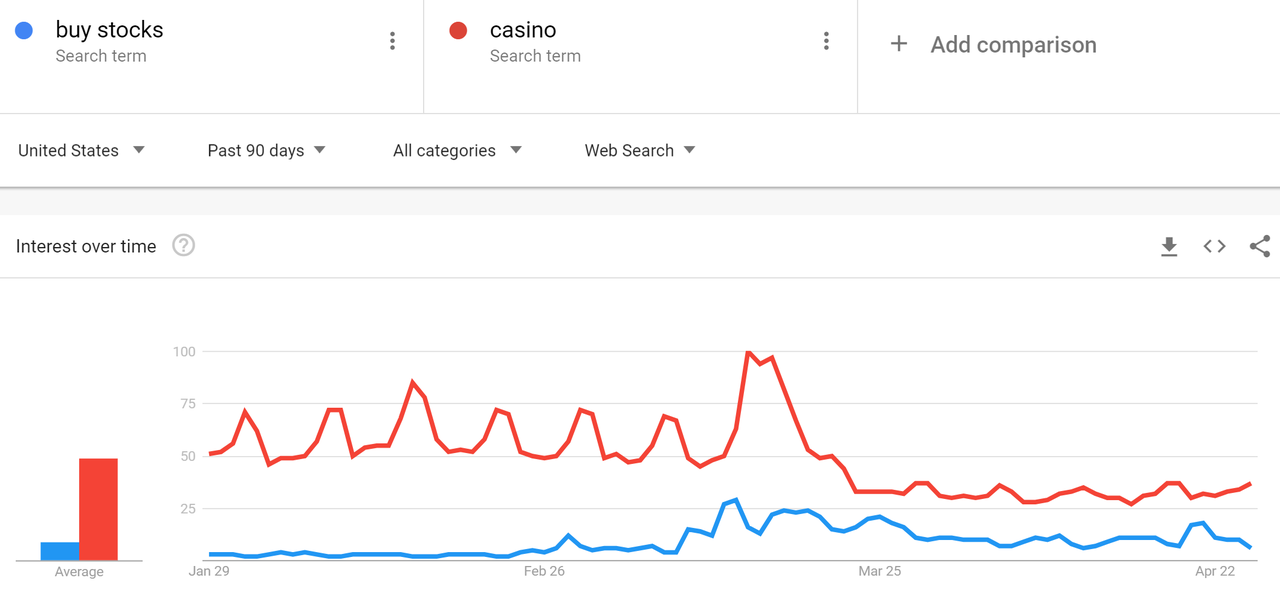
Her stock picks and inability to understand what a couple thousand dollars is aside, she’s right about one thing, though: it is like gambling. And that’s why Google Trends may show a rise in interest for stocks as casinos and sports betting sites shut down. 

One Twitter user wrote:

“I opened an E*TRADE account too. It’s like playing Fantasy Stock Market! So far I’m winning more than I started with, so no complaints as of yet.”

Retired firefighter Tommy McDougall is another great example. He bought two shares of PayPal when the stock was at $92 as his first trip down the stock market rabbit hole. PayPal trades around $123 per share as of this week.

McDougall said the E*Trade platform that he used was “very user friendly” and that he had gotten a call from an employee of the firm to make sure he was comfortable using the services after he signed up. 

He said:

“When I put money into the market, I did have the theory that we had hit rock bottom. I’ve been checking in and trying to be in tune with the stock market more than I ever have in my life.”

But obviously the excitement from “beginners luck” isn’t always a good thing. In fact, it could wind up exacerbating any further fall in stocks, should the market sour once again.

Chris Gaffney, president of world markets at TIAA said: “It’s a question of how they react to the market sell-off. If they don’t have the staying power that some of the institutional investors typically have that are more accustomed to these swings, it can create even more volatility.”

Jason Thomas, chief economist at AssetMark, agrees that retail is helping drive the market:

 “What’s happening right now is that fear has turned to greed for the retail investor. Nobody wants to be left behind. Have they been part of what has driven the market in the past month? I think so.”

Yousef Abbasi, global market strategist at INTL FCStone, concluded: “Retail investors — with more time on their hands — were watching and stepped in early, which considering the rally we have seen so far appears to be right on time. That of course can change as we are still in a tape that is very susceptible to headlines around the virus.”


Tyler Durden

Fri, 05/01/2020 – 13:55

via ZeroHedge News https://ift.tt/2VUtPX9 Tyler Durden

The Wretched Lives Up to Its Name

The Wretched. Available now on various streaming sites and on-demand channels.

It’s really still a few weeks until the official clickoff date for Summer Popcorn Television, but the studios want to get their product out before we’re all dead of the plague. So here’s a few cool things about The Wretched, produced by IFC and debuting today just about everywhere probably including on your Etch-a-Sketch.

• It has three separate production credits for a guy named Erik Porn, who’s actually a real person. And you thought your parents were swine!

• There’s another credit to an instructional video (which, even before you dazedly click on it, has more than a million YouTube views) titled How To Field Dress/Gut A Deer Fast And Easy Upside Down! that takes cinema verité to whole new levels. (“The first thing you want to do is go to the old butthole here…”)

• There is no need for me to post a bunch of dreary spoiler-alerts anywhere in this entire review because The Wretched is the most incomprehensible moving image ever seen outside the Czech art-film circuit.

How a simple teenager-meets-a-creepy-haunted-house show ever went so barbarically off-course will be studied for decades in film schools all around the world (except the Czech Republic, which knows a thing or two about this). Suffice it to say that brothers Brett and Drew T. Pierce, who wrote and directed The Wretched, are bad writers and worse directors, though a good argument could be made that they are bad directors and worse writers. I’ve seen deer-gutting videos that made more sense.

Here’s what I can say with confidence about The Wretched. It’s set in the mid-1980s and patterned (and even makes a few hat-tips to) the teen horror and sci-fi flocks of that era, including The Goonies and Fright Night. Hunkish Jean-Paul Howard (Midnight, Texas) is Ben, the new kid in town for the summer, equipped with all the usual teenage appurtenances: estranged parents, latent hostility for his dad’s new lady friend, and a propensity for breaking into neighboring homes.

This last makes him suspect something off-kilter is going on across the street, though his new girlfriend Mallory (Disney Channel vet Piper Curda) is not convinced by the subtle clues he’s picked up. Ben, speaking of the dad next door: “Why would you say you didn’t have a kid when you do?” Mallory: “Maybe he’s just a private person.”

Or maybe a really mean tree is turning everybody into pod-people, pod-deer, and pod-bunny rabbits. At least, that’s what I think was happening. Between the slurry, cryptic dialog, the murkily, underlit photography, it’s hard to guess whether Ben’s neighbors have turned supernatural or merely wandered onto the set of Last Year at Marienbad. It’s never clear what the tree’s powers exactly are, or why it’s so mad at everybody, or how you make it stop. Ben stabs it, shoots it, burns it, and throws a load of garbage on the deck of its boat. (Wait, that one may have been an adverse reaction to a small-penis joke, of which there are a plenitude in The Wretched, though none of them were told by the tree. I don’t think.) But since everything happened in India-ink darkness, I was never sure which one worked.

Or if any of them worked. The show ends, seemingly, with everybody smiling and de-pod-ified, except the ones who weren’t. The exact dimensions of Ben’s penis remain unknown. His girlfriend Mallory gives him a funny look, though, which didn’t seem positive, although even that is arguable. As Freud used to say, “What does a pod-girl really want?”

from Latest – Reason.com https://ift.tt/2KRSLIg
via IFTTT

Will Depression II Dictate Trump’s Fate?

Will Depression II Dictate Trump’s Fate?

Authored by Patrick Buchanan via Buchanan.org,

As of April 30, the coronavirus pandemic has killed 61,500 Americans in two months and induced the worst economic collapse since the Great Depression.

And if history is our guide, the economic crisis, which has produced 30 million unemployed Americans in six weeks, may prove more enduring, ruinous and historic than the still-rising and tragic death toll.

The Spanish flu of 1918-1919, the deadliest pandemic in modern history, infected an estimated 500 million people worldwide, a third of the planet’s population, and killed an estimated 20 million to 50 million victims, including 675,000 Americans.

“Adjusting for the difference in the size of the American population then and now,” writes Chronicles columnist Roger McGrath, “that number will be equivalent to two million deaths today.”

Yet, the Spanish flu did not shut America down.

As the Spanish flu hit and spread in 1918, the U.S. raised, trained and equipped an army of 4 million men, sent 2 million soldiers to France, broke Gen. Erich Ludendorff’s army, and turned the tide in favor of the Allies.

By December 1918, Doughboys were arriving in New York harbor — having sailed home from Europe’s battlefields on flu-infested transports.

As the scourge continued to take its toll, Woodrow Wilson sailed to Europe, participated for months in the Paris Peace Conference, returned, went on a national train tour to sell his Paris treaty and League of Nations, and suffered a stroke.

In September 1919, Gen. Pershing led his victorious troops in victory parades in New York City and Washington. This writer’s father, a teenager then, was in the D.C. crowd.

In the history books of the 1950s, World War I, Wilson and the Senate battle over the treaty he brought home and U.S. membership in the League of Nations loomed far larger than the Spanish flu that had killed as many U.S. soldiers as the Kaiser’s armies.

But the Great Depression, to which our current crash is now being compared, did not last for just a year like the Spanish flu.

The Depression lasted from the stock market crash in October 1929 to the eve of World War II.

Economically, it was devastating. Unemployment during the 1930s never fell below 14%. In 1937, it was back up to 17%.

At the bottom of the Depression, the stock market had lost 90% of its value, and the GDP had fallen 50%. Not until the end of FDR’s second term, in 1940, when the U.S. began to gear up for the war, did America really begin to pull out of it.

FDR’s New Deal, however, while it did not cure the Depression, was a historic political triumph for both the president and his party.

From 1930 through 1946, Democrats controlled both houses of the Congress every year, elected and reelected FDR four times and gave him a 46-state landslide in 1936, losing only Maine and Vermont.

What this suggests is that the economic devastation we have brought upon ourselves to battle the pandemic may prove more lasting and historic in its impact than the terrible losses of human life to COVID-19.

Politically, the Depression worked for the Democratic Party like no other event in history. After the Crash of 1929 under Herbert Hoover, the GOP held the House and Senate for only four of the next 50 years.

From 1932 to 1968, the GOP lost the presidency in seven of nine elections. Only Dwight Eisenhower’s two terms in the 1950s interrupted a 36-year reign of the Democratic Party in the White House.

Richard Nixon broke the Democratic dominance and took back the White House for the Republicans in 1968. But it would still take another dozen years before the GOP won control of either house of Congress.

President Trump predicts a V-shaped recovery, the greatest boom in U.S. history. But it is well to recall what happened to the GOP when it failed to deliver in the last Depression.

Just as the Civil War was the defining event of the 19th century, giving us 13 Republican presidents from Lincoln to Hoover and only two Democrats — Grover Cleveland and Wilson — how and when we emerge from this new Depression may tell us which party not only wins 2020 but also dominates the new era.

And as one sees the growing divisions along political lines, with conservatives and populists calling for the country to be opened up, and liberals and Democrats calling for continued sheltering in place, both seem to realize the stakes.

Democrats may proclaim that they are eager to see the pandemic come to a swift and early end and the economy to return quickly to the robust state it was in last February.

But the cold political interests of the Democratic Party today are what they were in Hoover’s time, to pray that the president fails, and fails badly, so that they inherit the estate.


Tyler Durden

Fri, 05/01/2020 – 13:43

via ZeroHedge News https://ift.tt/2Ss1gOy Tyler Durden

Tesla Slashes Model 3 Price In China To Qualify For (More) Government Subsidies

Tesla Slashes Model 3 Price In China To Qualify For (More) Government Subsidies

As if Tesla just being in China, operating with Chinese sweetheart loans and using Chinese benefits to obtain factory land wasn’t enough of a subsidy of its own, Tesla is now reportedly cutting the price of Model 3 sedans by 10% in order to qualify for additional subsidies.

The company started delivering vehicles from its Shanghai plant back in December and has cut its price for its Standard Range Model 3 to 271,550 yuan (USD $38,463.17), after receiving 20,250 yuan per car as EV subsidies, Reuters reported.

Meanwhile, Beijing had been up in the air about the future of EV subsidies prior to the coronavirus. In our continuing coverage of monthly Chinese auto sales, we noted that the government had taken a stance of wanting to rein in subsidies heading into late 2019.

That position appears to have softened as 2020 started and now, with the coronavirus pandemic shocking the world economy, it appears as though subsidies are already a foregone conclusion for the long term. In March, the Chinese government said all vehicles under 300,000 Yuan would qualify. We’re not surprised to see Elon Musk first up, with his hands out, at that government feeding trough. 

We’re also pretty sure that China doesn’t mind it either. After all, putting themselves in a position of leverage over Tesla seems like it could be the CCP’s ultimate goal, as we highlighted in a recent article. 

The issue was raised last Tuesday in a podcast with well known Tesla skeptic “Montana Skeptic”, who recently authored an article about Tesla potentially turning into a Chinese company that we highlighted just days ago

“When you look at the share price, do you think about things like [Elon’s] compensation package, which requires a $100 billion market cap?” Skeptic was asked by the host.

Skeptic responded: “I don’t know. It’s easy to become conspiratorial because the price is just so outrageously detached from fundamentals and because the level it’s reached appears to be conveniently close to what he needs to achieve his next compensation award. I mean, as I tell the people who read my articles, right now stay away from this.”

There are forces larger than us moving this share price. There are forces larger than us. Do I fully understand them? No. Might it be Chinese money? Sure. Might it be offshore accounts of some sort? Possible. Might there be some unseemly things going on? It’s always a possibility, too,” he continued.

Skeptic concluded: “Regardless, my innocent assumption is there are a lot of people out there including big institutional investors that still either believe in the growth story or believe that it hasn’t ended yet and that it makes sense to ride this thing with a momentum trade. And that’s what we have to deal with.”


Tyler Durden

Fri, 05/01/2020 – 13:25

via ZeroHedge News https://ift.tt/2SqjPTc Tyler Durden

The Wretched Lives Up to Its Name

The Wretched. Available now on various streaming sites and on-demand channels.

It’s really still a few weeks until the official clickoff date for Summer Popcorn Television, but the studios want to get their product out before we’re all dead of the plague. So here’s a few cool things about The Wretched, produced by IFC and debuting today just about everywhere probably including on your Etch-a-Sketch.

• It has three separate production credits for a guy named Erik Porn, who’s actually a real person. And you thought your parents were swine!

• There’s another credit to an instructional video (which, even before you dazedly click on it, has more than a million YouTube views) titled How To Field Dress/Gut A Deer Fast And Easy Upside Down! that takes cinema verité to whole new levels. (“The first thing you want to do is go to the old butthole here…”)

• There is no need for me to post a bunch of dreary spoiler-alerts anywhere in this entire review because The Wretched is the most incomprehensible moving image ever seen outside the Czech art-film circuit.

How a simple teenager-meets-a-creepy-haunted-house show ever went so barbarically off-course will be studied for decades in film schools all around the world (except the Czech Republic, which knows a thing or two about this). Suffice it to say that brothers Brett and Drew T. Pierce, who wrote and directed The Wretched, are bad writers and worse directors, though a good argument could be made that they are bad directors and worse writers. I’ve seen deer-gutting videos that made more sense.

Here’s what I can say with confidence about The Wretched. It’s set in the mid-1980s and patterned (and even makes a few hat-tips to) the teen horror and sci-fi flocks of that era, including The Goonies and Fright Night. Hunkish Jean-Paul Howard (Midnight, Texas) is Ben, the new kid in town for the summer, equipped with all the usual teenage appurtenances: estranged parents, latent hostility for his dad’s new lady friend, and a propensity for breaking into neighboring homes.

This last makes him suspect something off-kilter is going on across the street, though his new girlfriend Mallory (Disney Channel vet Piper Curda) is not convinced by the subtle clues he’s picked up. Ben, speaking of the dad next door: “Why would you say you didn’t have a kid when you do?” Mallory: “Maybe he’s just a private person.”

Or maybe a really mean tree is turning everybody into pod-people, pod-deer, and pod-bunny rabbits. At least, that’s what I think was happening. Between the slurry, cryptic dialog, the murkily, underlit photography, it’s hard to guess whether Ben’s neighbors have turned supernatural or merely wandered onto the set of Last Year at Marienbad. It’s never clear what the tree’s powers exactly are, or why it’s so mad at everybody, or how you make it stop. Ben stabs it, shoots it, burns it, and throws a load of garbage on the deck of its boat. (Wait, that one may have been an adverse reaction to a small-penis joke, of which there are a plenitude in The Wretched, though none of them were told by the tree. I don’t think.) But since everything happened in India-ink darkness, I was never sure which one worked.

Or if any of them worked. The show ends, seemingly, with everybody smiling and de-pod-ified, except the ones who weren’t. The exact dimensions of Ben’s penis remain unknown. His girlfriend Mallory gives him a funny look, though, which didn’t seem positive, although even that is arguable. As Freud used to say, “What does a pod-girl really want?”

from Latest – Reason.com https://ift.tt/2KRSLIg
via IFTTT

Will Americans Actually Use Contact Tracing Apps?

Governments around the world are touting software-based contact tracing as a novel response to a novel coronavirus. The software aims to replace manual tracing of contacts of people with suspected or confirmed infections, done laboriously by public health workers, with automated tracing based on the proximity of mobile devices.

Their promise: If you install our app, lockdowns may be lifted. “If you want to return to a more liberated economy and society, it is important that we get increased numbers of downloads,” Australian Prime Minister Scott Morrison said this week. “This is the ticket to ensuring that we can have eased restrictions.”

“For these apps to work, we will need everyone’s cooperation to install and use them,” Singapore Prime Minister Lee Hsien-loong said in a nationally televised exhortation.

In the U.S., state and federal health officials are beginning to link app installation to escaping lockdowns. “It’s certainly something we should try to figure out,” Massachusetts Gov. Charlie Baker, a Republican, said this week.

Legacy media already has been lecturing Americans on the inevitability of installation. The Atlantic‘s headline called it “Technology That Could Free America From Quarantine.” Time.com listed it under “What We Must Do to Prevent a Global COVID-19 Depression.” The New York Times promised that contact-tracing software will “speed lockdown exit.”

Different strains of contact-tracing software are emerging. All of the more prominent systems rely on a centralized server of some sort, either to perform matching of COVID-positive identifiers or to distribute lists of COVID-positive identifiers for matching locally on your device.

The U.K.’s approach gives a nod to privacy concerns, although the app has not yet been released. Public Health England describes it: “Once a member of the public installs the app, it will start logging the distance between their phone and other phones nearby that also have the app installed using Bluetooth Low Energy.” If anyone is determined to be COVID-positive, the log can be used to identify anyone in close proximity. (It probably won’t be long before police use the logs to answer questions like “Who was within Bluetooth range of the bank teller during the robbery?”)

Other approaches are more privacy-protective. The Bluetooth-based system announced by Apple and Google falls into this category. If you choose, your device will transmit random numbers called beacons that change every 10 to 20 minutes. At least daily, the companies say, participating mobile devices “will download a list of beacons that have been verified as belonging to people confirmed as positive for COVID-19 from the relevant public health authority.” Matching is done locally and many details seem to be left up to local or regional health officials. (The companies say they won’t allow the system to be mandated.)

Software-based contact tracing may work. It may not. To be effective, it will need to overcome significant hurdles, including the limitations of Bluetooth, which can transmit through walls and was never intended as a proxy for close contact. It will need to overcome the problem of limited testing, especially of people who show no symptoms. And it will do little to identify infections arising from lingering aerosols or fomites, virus particles that can remain viable on surfaces for more than a day. (The University of Cambridge’s Ross Anderson has a good writeup on the technical and social obstacles.)

The most formidable hurdle will be convincing people to trust the technology. Singapore says fewer than 20 percent of its population has installed TraceTogether since its launch on March 21. In a nation of 1.4 billion people, the Indian government’s contact tracing app, Aarogya Setu, has reached only 75 million downloads.

Many technocrats will surely succumb to the temptation to make tracing technology mandatory. Australia’s government has given mixed signals on this point. India has not: All federal employees are required to install Aarogya Setu, and it reportedly will be pre-installed on smartphones by default. Travel on some forms of public transport in India now requires installation of Aarogya Setu, and many large employers are mandating it. It doesn’t seem exactly illegal to decline, but soon it may be difficult to live a normal life unless you give in.

Americans remain obstreperous: A Reuters poll this week found that only half of smartphone users say they would enable contact tracing voluntarily. So expect calls to make it mandatory. Marketplace already is informing us that “COVID-19 tracing apps might not be optional at work” and “it’s definitely legal for your employer to require you to use a tracing app.” The regulatory enthusiasts at the Center for American Progress suggest: “As a condition of receiving a COVID-19 test in the future, individuals may be required to download the app.” Technocrats will point to a model suggesting a 60 percent adoption rate is needed.

Stewart Baker, an attorney who was previously an assistant secretary at the Department of Homeland Security, argues at Lawfare that states could force operating system vendors to install contact tracing software on your phone—and even make it unlawful for you to deactivate it. “The governors probably don’t need to ask,” Baker writes, noting that around 40 states have adopted a public health “emergency” law that sweeps in “communication devices.” In addition, he writes, “governors likely have authority to require that residents of their states activate the app.”

There are legal arguments that could be made about the scope of public health emergency law. There are constitutional arguments about the First Amendment–protected status of computer code. But more fundamentally, many governors simply haven’t proven themselves worthy of trust during the COVID-19 outbreak. Michigan’s governor banned motorized boats while allowing non-motorized ones. Kansas churches had to go to court to secure their right to remain open subject to distancing rules, even though shopping malls, libraries, restaurants, and bars were exempted. In the San Francisco Bay Area, where I live, liquor stores, marijuana shops, and summer camps have been deemed “essential” while churches, gun stores, and even 60-acre outdoor shooting ranges must remain closed.

We should not expect officials who get it wrong on the First Amendment and Second Amendment to get it right when it comes to delicate issues of security and privacy.

from Latest – Reason.com https://ift.tt/2So5iri
via IFTTT

Victims of Communism Day 2020

Bones of tortured prisoners. Kolyma Gulag, USSR.


NOTE: This post largely reprints last year’s Victims of Communism Day post, with relatively minor modifications, including the link between the repressive nature of the Chinese Communist Party regime, and its attempts to cover up coronavirus crisis, which may have resulted in its spread becoming a global pandemic.


Today is May Day. Since 2007, I have advocated using this date as an international Victims of Communism Day. I outlined the rationale for this proposal (which was not my original idea) in my very first post on the subject:

May Day began as a holiday for socialists and labor union activists, not just communists. But over time, the date was taken over by the Soviet Union and other communist regimes and used as a propaganda tool to prop up their [authority]. I suggest that we instead use it as a day to commemorate those regimes’ millions of victims. The authoritative Black Book of Communism estimates the total at 80 to 100 million dead, greater than that caused by all other twentieth century tyrannies combined. We appropriately have a Holocaust Memorial Day. It is equally appropriate to commemorate the victims of the twentieth century’s other great totalitarian tyranny. And May Day is the most fitting day to do so….

Our comparative neglect of communist crimes has serious costs. Victims of Communism Day can serve the dual purpose of appropriately commemorating the millions of victims, and diminishing the likelihood that such atrocities will recur. Just as Holocaust Memorial Day and other similar events promote awareness of the dangers of racism, anti-Semitism, and radical nationalism, so Victims of Communism Day can increase awareness of the dangers of left-wing forms of totalitarianism, and government domination of the economy and civil society.

While communism is most closely associated with Russia, where the first communist regime was established, it had equally horrendous effects in other nations around the world. The highest death toll for a communist regime was not in Russia, but in China. Mao Zedong’s Great Leap Forward was likely the biggest episode of mass murder in the entire history of the world.

November 7, 2017 was the 100th anniversary of the Bolshevik seizure of power in Russia, which led to the establishment of the first-ever communist regime. On that day, I put up a post outlining some of the lessons to be learned from a century of experience with communism.  The post explains why most of the horrors perpetrated by communist regimes were intrinsic elements of the system. For the most part, they cannot be ascribed to circumstantial factors, such as flawed individual leaders, peculiarities of Russian and Chinese culture, or the absence of democracy.

While the influence of communist ideology has declined since its mid-twentieth century peak, it is far from dead. Largely unreformed communist regimes remain in power in Cuba and North Korea. In Venezuela, the Marxist government’s socialist policies have resulted in political repression, the starvation of children, and a massive refugee crisis—the biggest in the history of the Western hemisphere. The regime continues to hold on to power by means of repression, despite growing international and domestic opposition.

In Russia, the authoritarian regime of former KGB Colonel Vladimir Putin has embarked on a wholesale whitewashing of communism’s historical record. In China, the Communist Party remains in power (albeit after having abandoned many of its previous socialist economic policies), and has recently become less tolerant of criticism of the mass murders of the Mao era (part of a more general turn towards greater repression).

The Chineseregime’s repressive policies also played a major role in its initial attempts to cover up the coronavirus crisis, which probably forestalled any chance of containing it before it became a massive pandemic. That deserves recognition, even as we should also recognize that the pandemic was made worse by the bungling of President Trump and other Western leaders.

In a 2012 post, I explained why May 1 is a better date for Victims of Communism Day than the available alternatives, such as November 7 (the anniversary of the Bolshevik seizure of power in Russia) and August 23 (the anniversary of the Nazi-Soviet Pact). I also addressed various possible objections to using May Day, including claims that the date should be reserved for the celebration of labor unions.

But, as explained in my 2013 Victims of Communism Day post, I would be happy to support a different date if it turns out to be easier to build a consensus around it. If another date is chosen, I would prefer November 7; not out of any desire to diminish the significance of communist atrocities in other nations, but because it marks the establishment of the very first communist regime. November 7 has in fact been declared Victims of Communism Memorial Day by the Virginia and Utah state legislatures, and similar resolutions have been passed by the  lower houses of the Illinois and Missouri legislatures. The president issued similar declarations in 2017 and 2018 (though he does not have the authority to make it a permanent national holiday through executive action alone). If this approach continues to spread, I would be happy to switch to November 7, even though May 1 would be still more appropriate.

But I am more than willing to endorse almost any other date that could command broad support. Unless and until that happens, however, May 1 will continue to be Victims of Communism Day at the Volokh Conspiracy.

NOTE: Much of this post is adapted from last year’s Victims of Communism Day post.

UPDATE: I have slightly revised this post to take account of recent progress towards making November 7 a day of commemoration for victims of communism. The trend is not (yet) far enough advanced to make me give up on the idea of using May 1. But if it continues, that will indeed be the best approach.

from Latest – Reason.com https://ift.tt/35odoFw
via IFTTT

Will Americans Actually Use Contact Tracing Apps?

Governments around the world are touting software-based contact tracing as a novel response to a novel coronavirus. The software aims to replace manual tracing of contacts of people with suspected or confirmed infections, done laboriously by public health workers, with automated tracing based on the proximity of mobile devices.

Their promise: If you install our app, lockdowns may be lifted. “If you want to return to a more liberated economy and society, it is important that we get increased numbers of downloads,” Australian Prime Minister Scott Morrison said this week. “This is the ticket to ensuring that we can have eased restrictions.”

“For these apps to work, we will need everyone’s cooperation to install and use them,” Singapore Prime Minister Lee Hsien-loong said in a nationally televised exhortation.

In the U.S., state and federal health officials are beginning to link app installation to escaping lockdowns. “It’s certainly something we should try to figure out,” Massachusetts Gov. Charlie Baker, a Republican, said this week.

Legacy media already has been lecturing Americans on the inevitability of installation. The Atlantic‘s headline called it “Technology That Could Free America From Quarantine.” Time.com listed it under “What We Must Do to Prevent a Global COVID-19 Depression.” The New York Times promised that contact-tracing software will “speed lockdown exit.”

Different strains of contact-tracing software are emerging. All of the more prominent systems rely on a centralized server of some sort, either to perform matching of COVID-positive identifiers or to distribute lists of COVID-positive identifiers for matching locally on your device.

The U.K.’s approach gives a nod to privacy concerns, although the app has not yet been released. Public Health England describes it: “Once a member of the public installs the app, it will start logging the distance between their phone and other phones nearby that also have the app installed using Bluetooth Low Energy.” If anyone is determined to be COVID-positive, the log can be used to identify anyone in close proximity. (It probably won’t be long before police use the logs to answer questions like “Who was within Bluetooth range of the bank teller during the robbery?”)

Other approaches are more privacy-protective. The Bluetooth-based system announced by Apple and Google falls into this category. If you choose, your device will transmit random numbers called beacons that change every 10 to 20 minutes. At least daily, the companies say, participating mobile devices “will download a list of beacons that have been verified as belonging to people confirmed as positive for COVID-19 from the relevant public health authority.” Matching is done locally and many details seem to be left up to local or regional health officials. (The companies say they won’t allow the system to be mandated.)

Software-based contact tracing may work. It may not. To be effective, it will need to overcome significant hurdles, including the limitations of Bluetooth, which can transmit through walls and was never intended as a proxy for close contact. It will need to overcome the problem of limited testing, especially of people who show no symptoms. And it will do little to identify infections arising from lingering aerosols or fomites, virus particles that can remain viable on surfaces for more than a day. (The University of Cambridge’s Ross Anderson has a good writeup on the technical and social obstacles.)

The most formidable hurdle will be convincing people to trust the technology. Singapore says fewer than 20 percent of its population has installed TraceTogether since its launch on March 21. In a nation of 1.4 billion people, the Indian government’s contact tracing app, Aarogya Setu, has reached only 75 million downloads.

Many technocrats will surely succumb to the temptation to make tracing technology mandatory. Australia’s government has given mixed signals on this point. India has not: All federal employees are required to install Aarogya Setu, and it reportedly will be pre-installed on smartphones by default. Travel on some forms of public transport in India now requires installation of Aarogya Setu, and many large employers are mandating it. It doesn’t seem exactly illegal to decline, but soon it may be difficult to live a normal life unless you give in.

Americans remain obstreperous: A Reuters poll this week found that only half of smartphone users say they would enable contact tracing voluntarily. So expect calls to make it mandatory. Marketplace already is informing us that “COVID-19 tracing apps might not be optional at work” and “it’s definitely legal for your employer to require you to use a tracing app.” The regulatory enthusiasts at the Center for American Progress suggest: “As a condition of receiving a COVID-19 test in the future, individuals may be required to download the app.” Technocrats will point to a model suggesting a 60 percent adoption rate is needed.

Stewart Baker, an attorney who was previously an assistant secretary at the Department of Homeland Security, argues at Lawfare that states could force operating system vendors to install contact tracing software on your phone—and even make it unlawful for you to deactivate it. “The governors probably don’t need to ask,” Baker writes, noting that around 40 states have adopted a public health “emergency” law that sweeps in “communication devices.” In addition, he writes, “governors likely have authority to require that residents of their states activate the app.”

There are legal arguments that could be made about the scope of public health emergency law. There are constitutional arguments about the First Amendment–protected status of computer code. But more fundamentally, many governors simply haven’t proven themselves worthy of trust during the COVID-19 outbreak. Michigan’s governor banned motorized boats while allowing non-motorized ones. Kansas churches had to go to court to secure their right to remain open subject to distancing rules, even though shopping malls, libraries, restaurants, and bars were exempted. In the San Francisco Bay Area, where I live, liquor stores, marijuana shops, and summer camps have been deemed “essential” while churches, gun stores, and even 60-acre outdoor shooting ranges must remain closed.

We should not expect officials who get it wrong on the First Amendment and Second Amendment to get it right when it comes to delicate issues of security and privacy.

from Latest – Reason.com https://ift.tt/2So5iri
via IFTTT