Victims of Communism Day 2020

Bones of tortured prisoners. Kolyma Gulag, USSR.


NOTE: This post largely reprints last year’s Victims of Communism Day post, with relatively minor modifications, including the link between the repressive nature of the Chinese Communist Party regime, and its attempts to cover up coronavirus crisis, which may have resulted in its spread becoming a global pandemic.


Today is May Day. Since 2007, I have advocated using this date as an international Victims of Communism Day. I outlined the rationale for this proposal (which was not my original idea) in my very first post on the subject:

May Day began as a holiday for socialists and labor union activists, not just communists. But over time, the date was taken over by the Soviet Union and other communist regimes and used as a propaganda tool to prop up their [authority]. I suggest that we instead use it as a day to commemorate those regimes’ millions of victims. The authoritative Black Book of Communism estimates the total at 80 to 100 million dead, greater than that caused by all other twentieth century tyrannies combined. We appropriately have a Holocaust Memorial Day. It is equally appropriate to commemorate the victims of the twentieth century’s other great totalitarian tyranny. And May Day is the most fitting day to do so….

Our comparative neglect of communist crimes has serious costs. Victims of Communism Day can serve the dual purpose of appropriately commemorating the millions of victims, and diminishing the likelihood that such atrocities will recur. Just as Holocaust Memorial Day and other similar events promote awareness of the dangers of racism, anti-Semitism, and radical nationalism, so Victims of Communism Day can increase awareness of the dangers of left-wing forms of totalitarianism, and government domination of the economy and civil society.

While communism is most closely associated with Russia, where the first communist regime was established, it had equally horrendous effects in other nations around the world. The highest death toll for a communist regime was not in Russia, but in China. Mao Zedong’s Great Leap Forward was likely the biggest episode of mass murder in the entire history of the world.

November 7, 2017 was the 100th anniversary of the Bolshevik seizure of power in Russia, which led to the establishment of the first-ever communist regime. On that day, I put up a post outlining some of the lessons to be learned from a century of experience with communism.  The post explains why most of the horrors perpetrated by communist regimes were intrinsic elements of the system. For the most part, they cannot be ascribed to circumstantial factors, such as flawed individual leaders, peculiarities of Russian and Chinese culture, or the absence of democracy.

While the influence of communist ideology has declined since its mid-twentieth century peak, it is far from dead. Largely unreformed communist regimes remain in power in Cuba and North Korea. In Venezuela, the Marxist government’s socialist policies have resulted in political repression, the starvation of children, and a massive refugee crisis—the biggest in the history of the Western hemisphere. The regime continues to hold on to power by means of repression, despite growing international and domestic opposition.

In Russia, the authoritarian regime of former KGB Colonel Vladimir Putin has embarked on a wholesale whitewashing of communism’s historical record. In China, the Communist Party remains in power (albeit after having abandoned many of its previous socialist economic policies), and has recently become less tolerant of criticism of the mass murders of the Mao era (part of a more general turn towards greater repression).

The Chineseregime’s repressive policies also played a major role in its initial attempts to cover up the coronavirus crisis, which probably forestalled any chance of containing it before it became a massive pandemic. That deserves recognition, even as we should also recognize that the pandemic was made worse by the bungling of President Trump and other Western leaders.

In a 2012 post, I explained why May 1 is a better date for Victims of Communism Day than the available alternatives, such as November 7 (the anniversary of the Bolshevik seizure of power in Russia) and August 23 (the anniversary of the Nazi-Soviet Pact). I also addressed various possible objections to using May Day, including claims that the date should be reserved for the celebration of labor unions.

But, as explained in my 2013 Victims of Communism Day post, I would be happy to support a different date if it turns out to be easier to build a consensus around it. If another date is chosen, I would prefer November 7; not out of any desire to diminish the significance of communist atrocities in other nations, but because it marks the establishment of the very first communist regime. November 7 has in fact been declared Victims of Communism Memorial Day by the Virginia and Utah state legislatures, and similar resolutions have been passed by the  lower houses of the Illinois and Missouri legislatures. The president issued similar declarations in 2017 and 2018 (though he does not have the authority to make it a permanent national holiday through executive action alone). If this approach continues to spread, I would be happy to switch to November 7, even though May 1 would be still more appropriate.

But I am more than willing to endorse almost any other date that could command broad support. Unless and until that happens, however, May 1 will continue to be Victims of Communism Day at the Volokh Conspiracy.

NOTE: Much of this post is adapted from last year’s Victims of Communism Day post.

UPDATE: I have slightly revised this post to take account of recent progress towards making November 7 a day of commemoration for victims of communism. The trend is not (yet) far enough advanced to make me give up on the idea of using May 1. But if it continues, that will indeed be the best approach.

from Latest – Reason.com https://ift.tt/35odoFw
via IFTTT
US Oil Rig Count Collapses As Wave Of Shale Well Closures Begins

US Oil Rig Count Collapses As Wave Of Shale Well Closures Begins

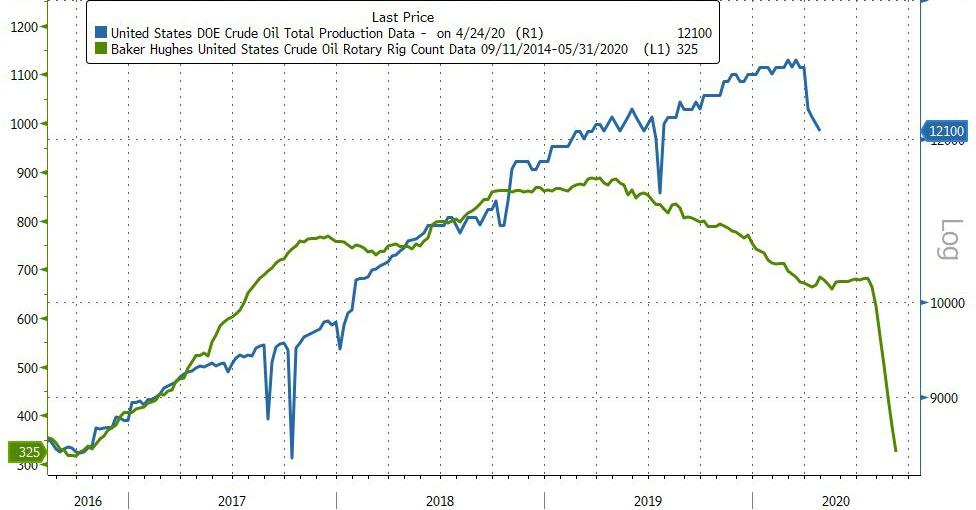
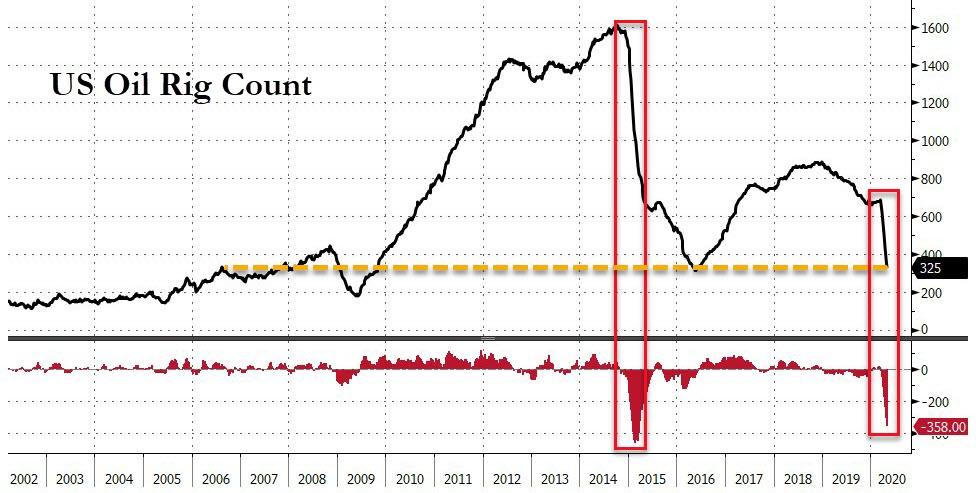
For the 7th straight week, the US oil rig count has plunged (down 53 to 325). This is the biggest drop since the 2015 collapse and the same total oil rig count first seen in 2006…

And while U.S. shale oil producers have so far held up admirably, hanging on for dear life amidst the biggest oil demand collapse in history. the rig count collapse may signal more trouble ahead as American producers continued to pump at record highs in March, even after dozens of drillers laid out blueprints to limit production. 

But, as OilPrice.com’s Alex Kimani notes,  with U.S. storage about to hit tank tops in a matter of weeks and the world deep in the throes of the biggest pandemic in modern history, the inevitable has begun to unfold: The arduous and costly process of well shut-ins.

Oil production in the country tumbled sharply to 12.2 million bpd in the third week of April, a good 900,000 bpd less than the record peak of 13.1 million bpd recorded just a month prior. That’s a 7% production cut in the space of only a few weeks and the lowest level since July.

A lot more could be on the way.

More Production Cuts

Oklahoma-based Continental Resources (NYSE:CLR), the company controlled by billionaire Harold Hamm, has ceased all its shale operations in North Dakota and shut in most wells in its Bakken oil field totaling roughly 200,000 bpd. 

The company, though, has refused to sell its contracted oil to pipelines at negative prices by declaring force majeure.

Continental has defended its stance by pointing out that the coronavirus outbreak has “…brought about conditions under which force majeure applies” while adding that selling its oil at negative prices constitutes waste.

Continental made the risky gamble of betting that economic growth would lift prices and, therefore, left itself heavily exposed to low oil prices by failing to employ the industry’s usual playbook of hedging future production with derivatives.

Continental is in good company, though.

Rystad Energy via CNBC has reported that six major U.S. shale producers will shut another 300,000 bpd of crude in May and June. That’s ~100,000 bpd more than April cuts, thus bringing the country’s total production cuts to 1.2 million bpd. The cuts will come from Continental Resources, ConocoPhillips (NYSE:COP), Cimarex Energy (NYSE:XEC), Enerplus Corporation (NYSE:ERF), Parsley Energy (NYSE:PE) and PDC Energy (NYSE:PDCE).

Continental Resources is set to slash 69,000 bpd in April and nearly 150,000 in May and June while ConocoPhillips will lower output by 125,000 bpd of oil equivalent, including 60,000 bpd of oil.

Rystad’s head of shale researchArtem Abramov, has estimated that the biggest shale fields–Permian, Eagle Ford, and Bakken–will cut a further 900,000 bpd, 250,000 bpd, and 400,000 bpd, respectively, throughout 2Q20, with shut-ins accounting for a staggering 60% in the early stages.

Expensive Shut-Ins

A well shut-in is considered a drastic action of last resort mainly because it can result in huge or even total loss of production.

That’s a big consideration in these dire times, where even oilfield values are descending into negative territory due to liabilities such as plugging wells and land remediation.

Chris Atherton, president of EnergyNet, a company that deals in oil and gas operations, undeveloped acreage and royalty interests, has told Forbes that oilfield prices have tumbled from an average price of $42,000 per net flowing barrel per day when oil prices were around $60/barrel to under $20,000 currently. Buyers started getting picky and sellers more desperate in 2019 when oil prices were still relatively high.

Things have gone to the dogs now, with a shut-in field fetching only half the price of a virtually identical field but with oil still flowing.

As Bob Bracket of Bernstein Research revealed last week, “Shut-ins are not easy decisions. When production shuts-in, problems arise. Multi-phase well flows begin to separate out, while problematic hydrates, waxes, asphaltenes form which will have serious economic implications,” citing numerous examples of fairly large wells with flows exceeding 1,000 barrels/day that could not be brought back to life after being shut-in.

That’s the main reason why even heavily indebted shale companies, including bankrupt ones like Whiting Corp. (NYSE:WLL), insist on continuing to pump at all costs.

California Resources Corp. (NYSE:CRC) is a $133.7M (market cap) company drowning in debt to the tune of more than $4 billion due by the end of 2022. The company’s average all-in cost per barrel of $35 means that it’s losing ~$20 for each barrel of crude it pumps. Yet, the company is unable to shut-in its wells because they require a continuous injection of steam to keep them alive.

Deal Mania

A shut-in well is a tough proposition for a prospective oilfield buyer, too, because it’s hard to determine how much oil can be coaxed out, especially after a lengthy layoff.

The only solace for the beleaguered oil sector is that there probably won’t be a shortage of takers when the worst is finally over.

Atherton says that his company has 40,000 registered users with access to $17 billion in cash ready to make deals. He has predicted that distressed companies will “turn into a flood of assets available” in a year or so.

The bottom hunters will certainly be waiting to pounce, the downside being that many investments in the space could turn worthless due to the swelling wave of bankruptcy.


Tyler Durden

Fri, 05/01/2020 – 13:11

via ZeroHedge News https://ift.tt/2SrmNH5 Tyler Durden

Goldman Turns Bullish On Oil, Sees Brent Rallying Back To $30 In Q3

Goldman Turns Bullish On Oil, Sees Brent Rallying Back To $30 In Q3

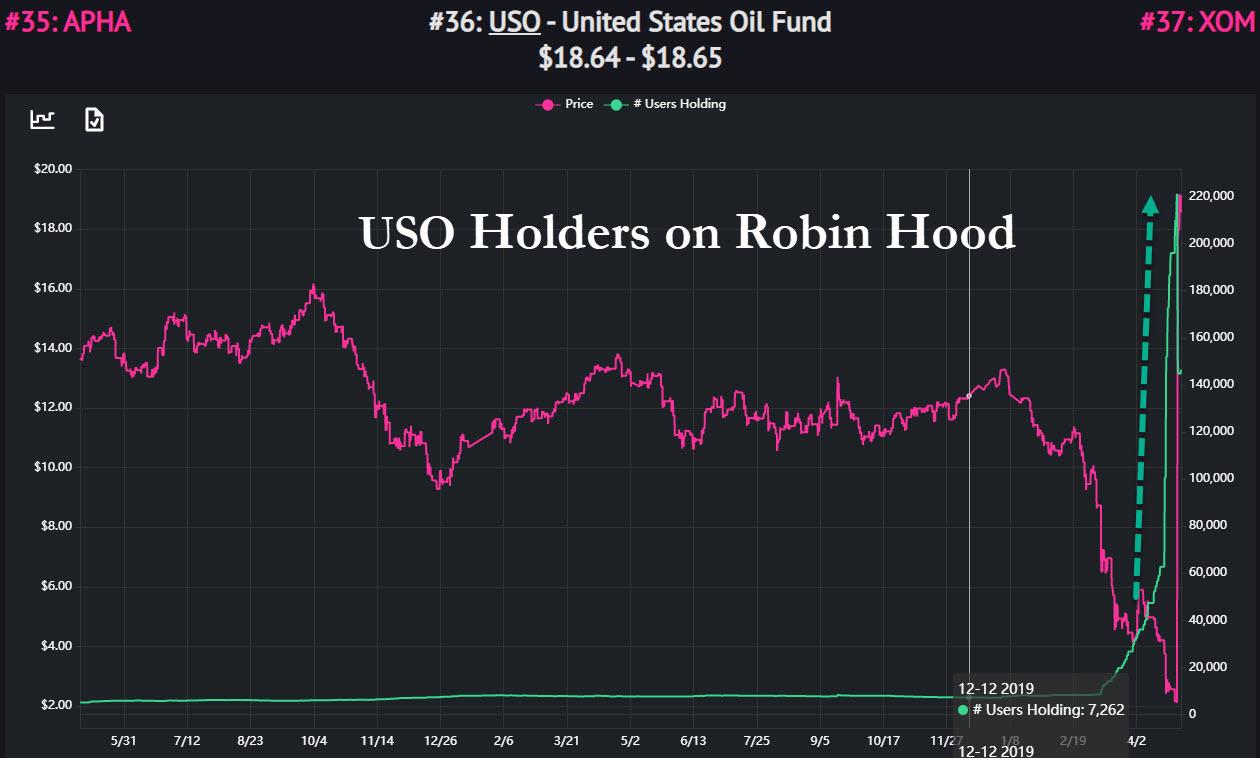
Now that the USO has been terminally crushed and all those 220,000 Robin Hood bottom-chasers have suffered catastrophic losses…

… Goldman – which several weeks ago correctly predicted that the price of landlocked oil such as WTI could turn negative – is turning bullish.

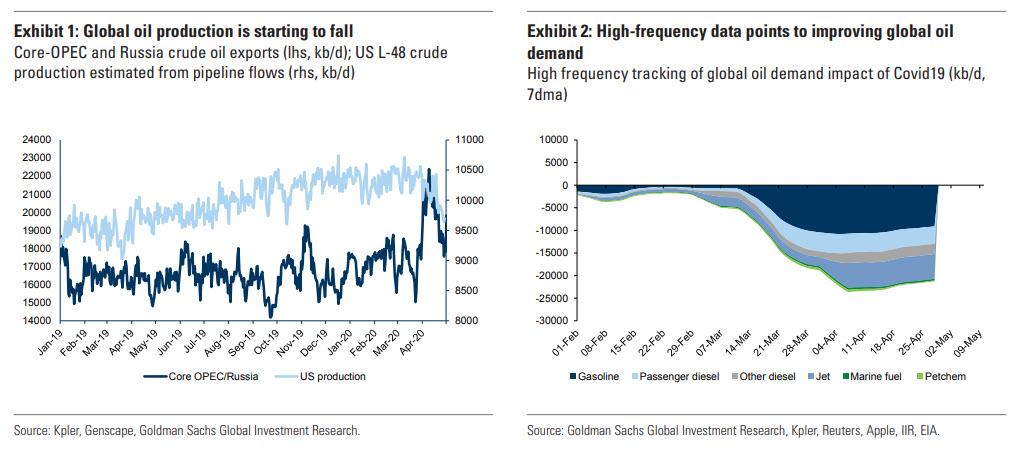
In a note from Goldman’s Damien Courvalin, the energy strategist writes that “oil fundamentals are finally showings signs of improvement, likely accelerated by the recent historic collapse in prices” as “supplies are declining quickly, with signs of demand improving even ahead of lockdown measures being eased.” And while the inflection into a deficit is still a few weeks away, “it now appears likely that the market is passing its test on storage capacity.”

Some more details from the Goldman note on the key topic of storage:

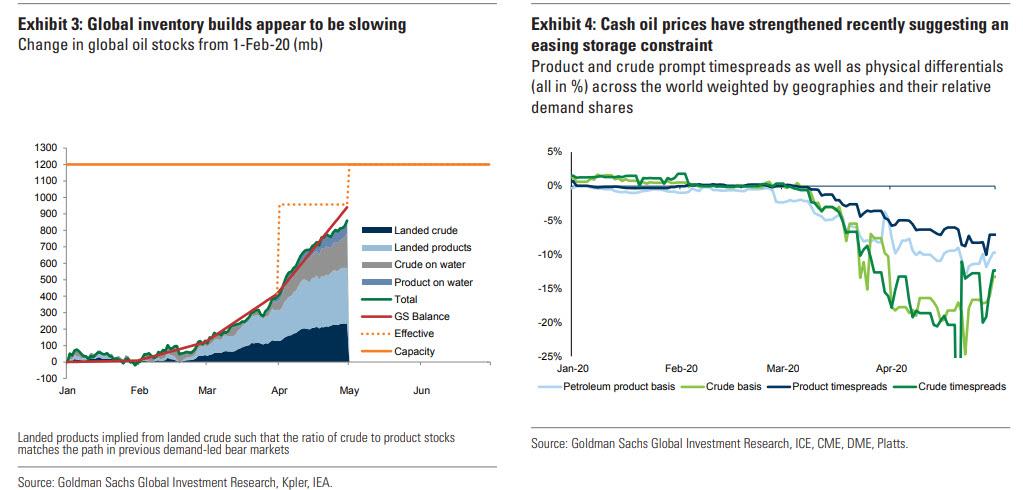
To be clear, the physical oil market is still in surplus and the inflection into a deficit is still a weeks away in our view. But, it now appears likely that the market is passing its test on storage capacity, due to improving fundamentals (inventory builds appear to be slowing), new creative forms of storage being put in place (rail cars, old pipelines, more boats) and a likely c.1 mb/d smaller May surplus than previously expected (mostly due to a faster demand rebound). As we have shown previously, physical prices typically offer the best insight in periods of extreme fundamental uncertainty, and strengthening cash assessments for US crudes suggests that production cuts are likely staving off local storage saturation. With the market rebalancing now in motion, we expect a three-stage oil price rally, from relief, to cyclical tightening, and finally structural repricing.

And so, with the market’s rebalancing now in motion, Goldman expects a three-stage oil price rally, from relief, to cyclical  tightening, and finally structural repricing. With financial crude futures markets set to trade July barrels in just a couple weeks, Goldman thinks that the recent rally can extend further in May, back to cash-cost levels ($25/bbl for WTI), albeit with still-high price volatility. It wasn’t clear if this volatility potentially includes another negative price moment this month when the prompt contract again goes negative if there is incremental supply and no storage to put it in.

That said, beyond this relief rally, Goldman cautions that the oil bull market that we forecast will take time and require patience. The key issue, as everyone saw on April 20, is that oil remains a physical asset and will therefore need to first price to clear the substantial inventory overhang through 2H20, leaving the commodity to lag the rally in related anticipatory financial assets like equities.

Looking further ahead, Goldman’s updated 2020 and 2021 global oil supply-demand balance continues to point to a record large surplus in 2Q20 of 8.6 mb/d and an unprecedented peak build in global oil inventories to its effective maximum capacity of c.1,200 mb. However, in a change from its previous dismal projections, the bank now forecasts that lower supply in 2021, due to higher decline rates, will more than offset a  more cautious demand outlook, putting the global oil market in a persistent deficit from 3Q20 onward.

With OPEC initially leaning into this deficit, we expect that the inventory overhang will normalize by the end of 2Q21. At that point, we forecast that core-OPEC and Russia production will finally exceed their 1Q20 level with a restart in shale activity also needed as the 4Q21 deficit reaches 1.2 mb/d and inventories fall well below average levels.

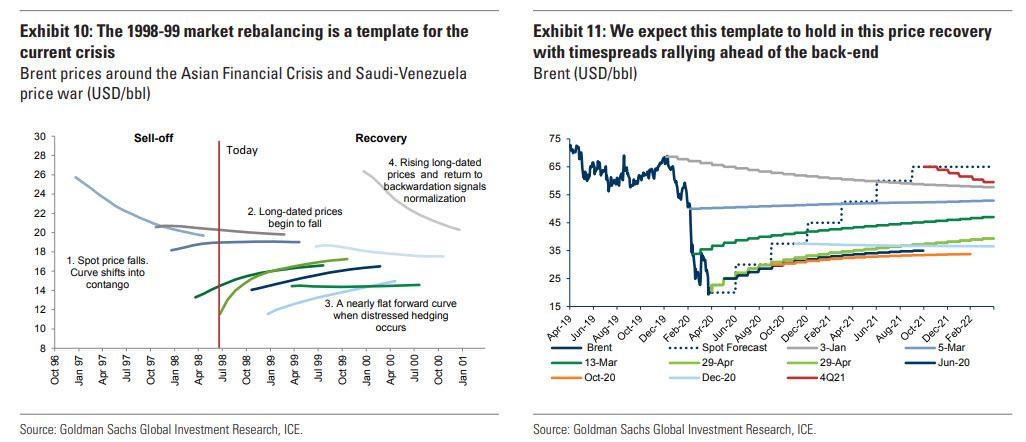
In many aspects, this fundamental path is similar (although faster and more violent) to that which occurred in 1998-99 (when an OPEC market share battle occurred as the Asian crisis hit global demand). In particular, the lasting impacts of the sharp upstream capex cuts in 2020 should finally enable OPEC to both increase production and market share in 2021 and presages a return of a necessary new investment phase in upstream capacity in coming years.

Surprisingly, while Goldman is clearly turning more bullish on oil after the “violent rebalancing”, it is are downgrading its 2H20
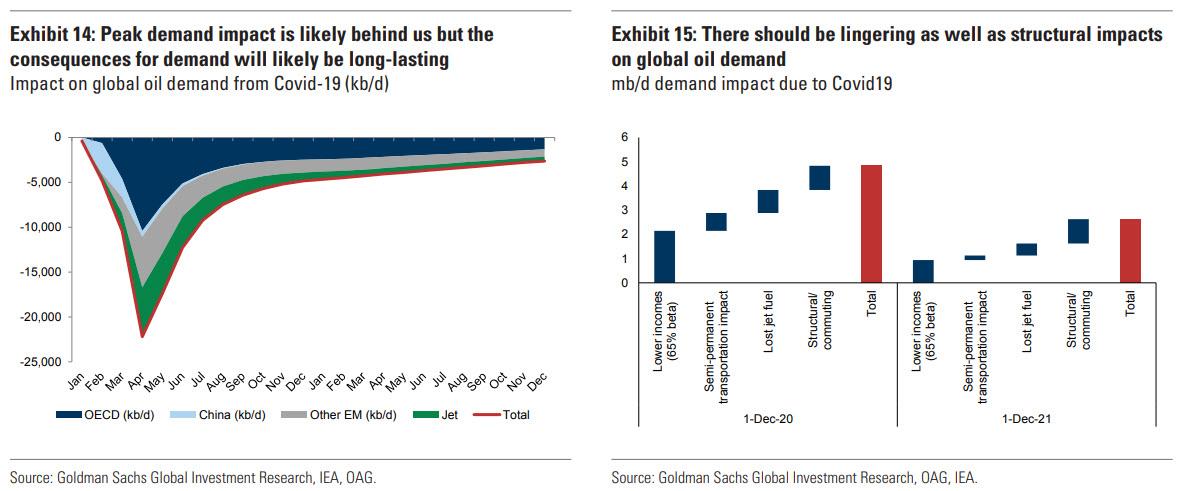
and 2021 demand forecasts despite observing a “demand restart which is surprising to the upside.” Goldman now expects 4Q20 demand to still be down 5 mb/d from pre-virus levels (with 2021 demand still 3.6 mb/d impaired). Beyond: (1) the impact of lower incomes (assuming a normal relationship between GDP and oil  demand), Courvalin now also assumes persistent demand impacts from (2) the disproportionate transportation hit (over GDP) of lingering isolation measures, (3) a
lasting impact on cruises and jet demand (consistent with SARS and 9/11 with half of jet demand also business-related), and finally (4) a permanent change in behavior such as working from home (with c.9 mb/d of oil demand for commuting). The impact of each of these four factors is -2.1/-0.75/-0.95/-1 and -0.9/-0.2/-0.5/-1 mb/d in late 2020 and 2021 respectively.

Yet while demand will demand depressed, what is more important is that supply cuts are finally kicking in:

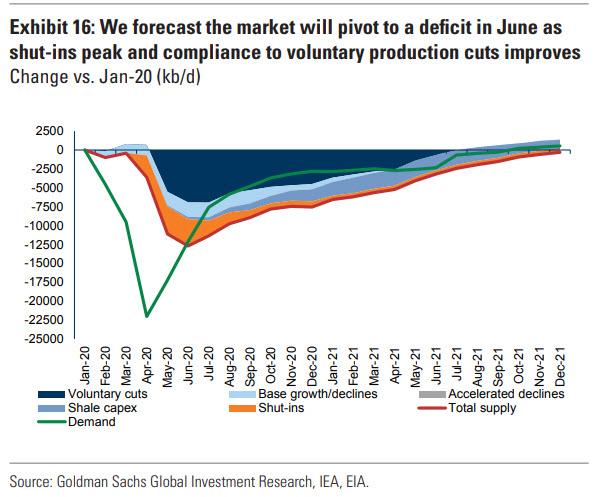
Public announcements of global production shut-ins (outside of the OPEC+ cuts) amount to c.2.2 mb/d, with the actual number likely larger given the lack of disclosure by NOCs and private producers. This suggests that the market is progressing towards our estimate of 3.5 mb/d of shut-ins required at the binding effective storage constraint in April-May. This shut-in target is 0.5 mb/d smaller than previously, given slightly higher estimated demand and storage capacity (with evidence of marginal forms of storage being created due to extremely low prices).

As expected, shut-ins are mostly occurring among inland producers (US, Canada) where storage constraints have been the greatest due to the decline in local refinery intake. Key to the market rebalancing in 2021 will be which fields remain impacted, as this would reduce global production capacity. For example, shut-in production in low pressure conventional reservoirs may be vulnerable to damage, requiring either prohibitively expensive workovers or leading to higher GORs. As we  await greater clarity on such permanent impacts, we conservatively assume that only 500 kb/d of these shut-ins is lost in 2021, with the remaining 3.5 mb/d of shut-ins unwinding mostly through 3Q20

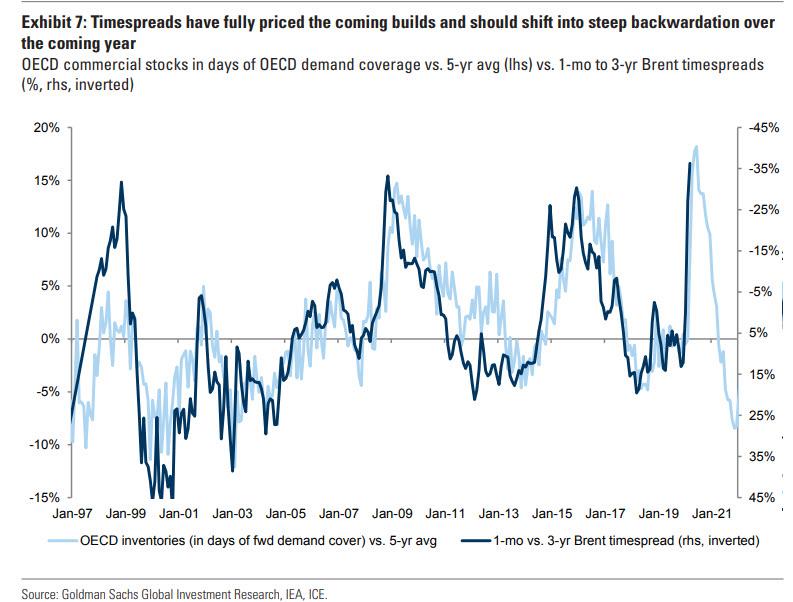
In any case, once we get to the cyclical stage of the recovery, Courvalin expects the inventory normalization process to first drive a flattening of the Brent forward curve around $30/bbl in 3Q20. As the deficit grows, this will be followed by a steady move higher in spot prices due to a steepening level of backwardation through 2Q21.

Eventually, in a world where the only cure for high oil prices are low oil prices, the higher decline rates, sticky shut-in capacity losses (then again one wonders just how “sticky” shale shutdowns are) and a much higher cost of capital for the industry will finally set the stage for both higher OPEC market share and prices, the structural consequence of the ongoing violent  rebalancing, leading Goldman to raise its 4Q21 Brent forecast to $65/bbl (from $60/bbl).

Meanwhile, to patiently trade the oil recovery, Goldman recommends entering two new trades. First, a long Dec-20 vs. Dec-21 Brent timespreads position, to capture the shift of the forward curve into backwardation.

Second, it recommends entering a long 3Q21 RBOB gasoline position which should also benefit from consumers’ preference for cars over subway, buses, and planes.


Tyler Durden

Fri, 05/01/2020 – 12:58

via ZeroHedge News https://ift.tt/2SqCheC Tyler Durden

Oregon County says “no whites allowed”

Are you ready for this week’s absurdity? Here’s our Friday roll-up of the most ridiculous stories from around the world that are threats to your liberty, your finances, and your prosperity… and on occasion, poetic justice.

“No whites allowed” safe space for employees of Oregon county

Do you know what’s been missing from the government’s response to coronavirus?

You might think– ‘more testing kits’, or ‘honest information’.

Nope. According to at least ne county in the US state of Oregon, the biggest issue right now is establishing “safe spaces” where no white people are allowed.

This is how Multnomah County, Oregon is rewarding its employees who are working during the pandemic: the county government announced that one of their departments will host “a grounding space for Black, Indigenous, and People of Color (BIPOC) employees to share, heal, connect, and get grounded in a space that is not dominated by whiteness.”

The safe-space was announced in a daily report to county employees fighting coronavirus.

When asked, a county spokesperson assured the public that it is perfectly legal to discriminate against their white employees.

She explained, “The space excludes no one. It is based on shared lived experience not identity. The same way our employee resource groups for veterans, parents, and people with a disability are based on life experience and not identity. All are welcome here.”

Except white people.

Try to wrap your mind around that double-speak.

Click here to read the full story.

Police testing “Pandemic Drones”

Connecticut police will be testing a new “pandemic drone.”

It is so named because the drone is “equipped with a specialized sensor and vision systems that can display fever/temperature, heart and respiratory rates, as well as detect people sneezing and coughing in crowds, and wherever groups of people may work or congregate.”

The company that builds the drones announced the partnership with police.

“The technology can accurately detect infectious conditions from a distance of 190 feet as well as measure social distancing for proactive public safety practices.”

If you already think the government expansion of power and surveillance has gone too far, just wait until Robocop gets involved.

Click here for the full story.

Shocking: China loves the World Health Organization

We have been talking about the World Health Organization a lot over the past couple weeks.

Now, China decided to send an extra $30 million to the World Health Organization after the US announced a temporary funding freeze due to its missteps.

A Chinese official said the gift to WHO “reflects the support and trust of the Chinese government and people for the WHO”.

Just in case you needed another reason NOT to trust the World Health Organization.

Click here for the full story.

Congressional Budget Office sees a $3.7 trillion deficit this year alone

Tax revenue is drying up from a locked-down economy, at the same time spending is massively ballooning,

Over the past years we’ve asked rhetorically: if the US runs trillion dollar deficits during the best of times, what happens during the tough times?

Now that the world has hit the tough times, and the answer to that question is no surprise:The Congressional Budget Office estimates that this year’s budget deficit will be $3.7 trillion.

That means the government will spend $3.7 trillion dollars more than they take in from taxes.

To put that number in context, $3.7 trillion constitutes almost 20% of the entire US economy.

Click here for the full story.

Source

from Sovereign Man https://ift.tt/2zP2SLP
via IFTTT

“No Place For Such Weapons In Canada” – Trudeau Announces Ban On Assault-Style Rifles 

“No Place For Such Weapons In Canada” – Trudeau Announces Ban On Assault-Style Rifles 

After one of the worst mass shootings in recent Canadian history in April (leaving 22 people dead), Justin Trudeau has made a shock announcement on Friday afternoon that his government has banned assault-style weapons, reported The Guardian.  

“These weapons were designed for one purpose and one purpose only: to kill the largest number of people in the shortest amount of time. There is no use and no place for such weapons in Canada,” said Trudeau.

Effective immediately, it is no longer permitted to buy, sell, transport, import or use military-grade assault weapons in this country.”

The mass shooting in Nova Scotia last week has been deemed the worst shooting in the country’s history and has given Trudeau the cover to “strengthen gun control.” This was one of his major campaign promises, and he has seized the opportunity in a crisis. 

The new ban is expected to prevent shootings like the one in Nova Scotia. The Royal Canadian Mounted Police believe the gunman did not have a license to purchase the weapons used in the shootings and were likely obtained illegally. 

Trudeau said there would be a two-year “amnesty period” to allow current gun owners to comply with the law. The ban covers more than 1,500 models. 

In 2015, Trudeau promised that a Liberal government would restrict gun owners from certain types of rifles, including “military-style assault weapons.” 

“As long as Canadians are losing their loved ones to gun violence, not enough has changed,” Trudeau said in September. “We know you do not need a military-grade assault weapon, one designed to kill the largest amount of people in the shortest amount of time, to take down a deer.”

Currently, Canada’s Firearms Act does not make a clear distinction between “military-style” weapons and long guns. The new law will clear that up.

According to a poll from the Angus Reid Institute, 80% of Canadians support the ban. However, there will be an uproar in the gun community that will see this latest gun grab as entirely unacceptable. And, keep in mind, the ban on assault-style weapons is coming during a virus pandemic. Is there are a larger agenda at play?


Tyler Durden

Fri, 05/01/2020 – 12:40

via ZeroHedge News https://ift.tt/2Sq1Gom Tyler Durden

Government Is On The Hook To Forgive Hundreds Of Billions In PPP Loans, Has No Idea How They’ll Do It

Government Is On The Hook To Forgive Hundreds Of Billions In PPP Loans, Has No Idea How They’ll Do It

As with any piss-broke society that functions purely by taking on massive amounts of debt via money printing to try and keep itself afloat, the next obvious step after Central Banks make “loans” by printing money, is inevitable defaults.

It looks like that’s exactly what the U.S. government is now gearing up for with regards to loans they made just weeks ago and are continuing to make. 

The administration’s Small Business Administration’s Paycheck Protection Program launched its second round on Monday, which allowed lenders to issue forgivable government guaranteed loans to small businesses affected by the coronavirus outbreak. Or, maybe just to anyone that fills out an application. We don’t really know – the oversight has been a bit shaky to say the least, thus far.

Regardless, the key element to the loan program (it’s hilarious to even call them “loans”) is the idea that the loans can be forgiven. After all, if given the choice to pay back your loan or have the government forgive it, which would you choose?

Exactly. And that’s why “smoothing the forgiveness process is critical for the program to succeed,” according to Reuters. But the program is that the government hasn’t issued any guidelines and exactly how to go about getting the loans forgiven. 

Plus, we think this will likely mean the obvious: we’ll have fraud from both people who received the loans and from those who will eventually turn back to the government to have them “forgiven”. 

Paul Merski, an executive at the Independent Community Bankers of America said: “Probably every PPP borrower expects their loan to be forgiven, but it is not that simple. There are rules and regulation to consider. So the borrower best have their information and paperwork in order.”

Ah, yes. The rock-solid compliance step of good old fashioned paperwork. 

The terms of forgiveness for the loans are relatively simple:

“…borrowers must spend 75% of the loan on payroll costs, such as salaries, tips, leave, severance pay and health insurance, within the first two months. The remaining 25% can be spent on other running costs, such as rent and utilities. Money spent on non-qualifying expenses must be repaid at an annual rate of 1% within two years.”

But trying to come up with partial forgiveness sums will be difficult, banker say. There are plenty of grey areas, including what happens when employees have to be rehired and how (inevitable) misuse of funds will be tracked and punished. 

Recall, yesterday, we reported that preliminary inquiry into loans granted under the Paycheck Protection Program (PPP) has revealed early signs of fraud among businesses seeking funds.

Chris Giamo, head of the commercial bank at TD Bank in New York said: “I do think it could become a little bit complex, because with every answer there’s another question.”

The Treasury Department hasn’t even gone as far as making one standard forgiveness form, which banks are now pushing for. And banks don’t really seem to want to even be a part of the equation.

David Pommerehn, general counsel of the Consumer Bankers Association said: “From a banking perspective, we are really acting as a middleman here. We don’t want to carry these loans on our books. We see this as potentially a bigger mess than the funding process.”

Business owners are confused, too. Josh Mason, founder of Maryland catering company Vittles Catering, said his bank warned him about eligibility for forgiveness, saying the process was “not yet clear”. 

“I have read all the guidelines, but I wouldn’t be able to say exactly how much will be forgiven and not forgiven. I think that ambiguity is going to create a little bit of a mess when all of this comes to a close,” Mason concluded.

Meanwhile…


Tyler Durden

Fri, 05/01/2020 – 12:28

via ZeroHedge News https://ift.tt/2SqbSxk Tyler Durden

Brickbats: May 2020

In Bladen County, North Carolina, the chair of the Board of Elections threatened to have anyone who recites the Pledge of Allegiance at a board meeting arrested.

The Arizona Department of Education inadvertently released the names, email addresses, and other personal information of nearly 7,000 parents whose children take part in a school voucher program. The release included the disabilities listed for children with special needs.

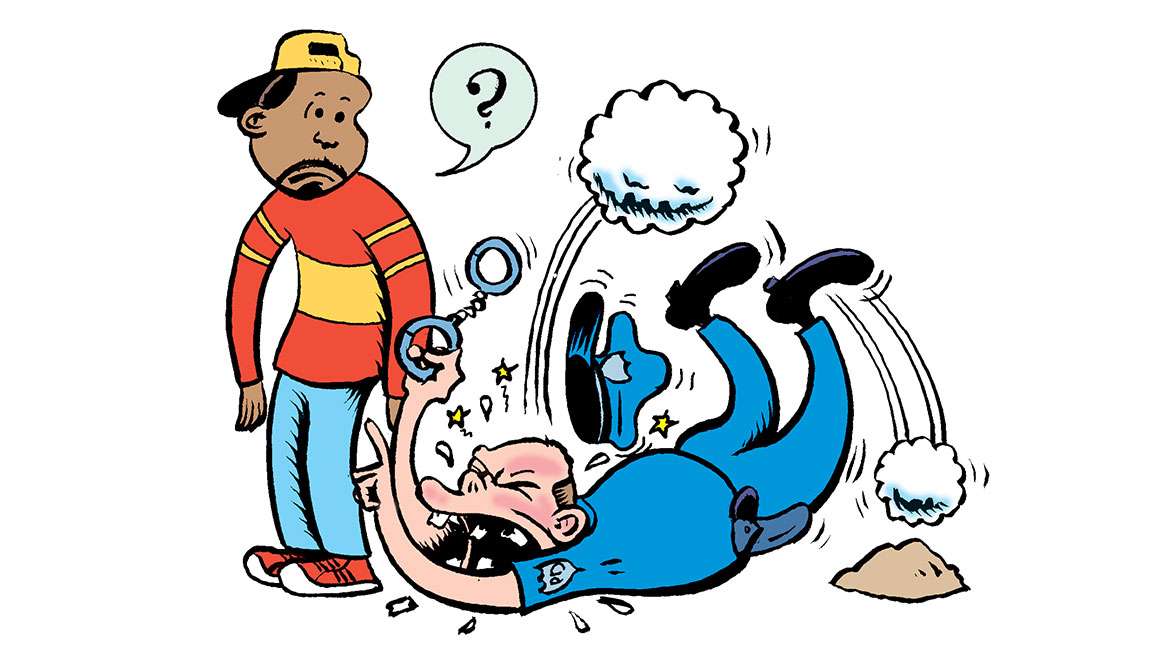
Philadelphia police officer Keith White claimed that someone he arrested on drug charges in 2018 attacked him, causing bleeding and damage to his teeth. The arrestee was charged with aggravated assault, simple assault, and reckless endangerment. Surveillance video later showed that the defendant did not in fact resist arrest, and that White sustained his injuries when he tripped and fell.

When her 5-year-old daughter was bullied on a Dallas school bus, Audrey Billings asked to see the videos. The school system told her she would have to pay $600 for each video to cover the work of redacting footage not relevant to her child. She reluctantly paid for one video, which showed students grabbing, pulling, and poking her daughter with a pencil for 14 minutes while the driver ignored the girl’s cries for help.

The Colorado State Patrol has charged a Denver sheriff’s deputy with reckless driving, driving more than 40 mph over the speed limit in a construction zone, and three counts of reckless endangerment. The deputy, James Grimes, was clocked driving more than 100 mph while transporting inmates. He was reportedly racing another driver.

When the city of Seattle put a former fire station up for sale, it advertised it as a “unique residential dwelling.” Thom Kroon paid $712,000 for the building and spent thousands more remodeling it. Three years later, he got a letter from the building inspector ordering him to stop using the structure as a residence, because its only legal use was as a fire station. The city also sued Kroon, seeking $500 for each day he used the building for anything other than its legal purpose. Only after Kroon countersued did the city drop its suit and issue a certificate of occupancy.

At Minneapolis–St. Paul International Airport, a Transportation Security Administration agent grabbed Tara Houska’s braids from behind, snapped them like reins, and said, “Giddy up.” Houska says when she complained, the agent responded: “It was just in fun, I’m sorry. Your hair is lovely.”

In Alameda County, California, Candace Steel gave birth in a jail cell, screaming in pain and calling for help. Employees ignored her for hours, responding only when they heard the cries of her newborn daughter.

from Latest – Reason.com https://ift.tt/35liFxq
via IFTTT

“They’re All High On Fed Fairy Dust…”

“They’re All High On Fed Fairy Dust…”

Authored by Michael Maharrey via SchiffGold.com,

Everybody realizes the US economy is in a bad spot. But most people still seem to believe it will bounce right back once we deal with the coronavirus.

They’re all high on Federal Reserve fairy dust.

US GDP contracted by 4.8% in the first quarter. It was the first negative GDP reading since a 1.1% decline in the first quarter of 2014 and it was the lowest level since the 8.4% plunge in Q4 of 2008.

And the worst is yet to come.

The Q1 GDP number only captures the first couple of weeks of coronavirus-inspired government lockdowns of the economy. In fact, in January Donald Trump and others were telling us that it was the best economy in the history of the world. That was also in the first quarter.

The first-quarter GDP print came in even worse than expected. Economists were projecting a contraction of 3.5 to 4%. The precipitous and rapid plunge in economic activity not only reflects the impacts of turning off the economy in the midst of coronavirus; it also reveals just how fragile the economy was before the pandemic.

Back in January, President Trump called it the greatest economy in history. Trump continued to talk up the economy during the State of the Union address, taking credit for the “strong” economic growth. At the time, Peter Schiff said nobody should be taking credit for the condition of the US economy. In fact, economic growth wasn’t much different than it was when Obama was president.

“The only difference is we had to borrow even more money to achieve the same level of fake GDP growth that we did under Obama. The reality is nobody should be taking credit for the current US economy. The question is who deserves the blame?”

Despite the hyperbolic cheerleading, the economy was riddled with debt and was already being propped up by extraordinary Federal Reserve monetary policy. We had three rate cuts in 2019. The Fed was running repo operations to stabilizing the financial markets and the central bank had already launched quantitative easing before COVID-19, even though Jerome Powell and Company refused to call it that.

The US economy was a big, fat, ugly bubble and coronavirus was the pin that popped it.

And judging by the Q1 GDP number, the air is coming out even faster than most analysts expected. In fact, recent economic data reveals a veritable house of horrors.

And yet on the same day we get this awful GDP print, stock markets rallied. The Dow Jones was up 532 points. The S&P 500 enjoyed a 2,66% gain.

That’s because the mainstream has been led into an economic fantasyland by a trail of Federal Reserve fairy dust.

According to media reports, the primary impetus behind the stock market gains was a promising new coronavirus drug. The vas majority of people out there still seem to believe that once we “solve” coronavirus, the economy will open right back up and everything will be fine. They still believe things will just snap back to normal. As I have said multiple times, things aren’t going back to normal. They weren’t normal to begin with. As Schiff put it, the best we can hope for is recovering from a depression to a recession.

The Federal Reserve was propping up the economy in January and it continues to prop up the economy today. The only difference is it’s had to add a lot more props over the last several weeks.

Trillions of them in fact.

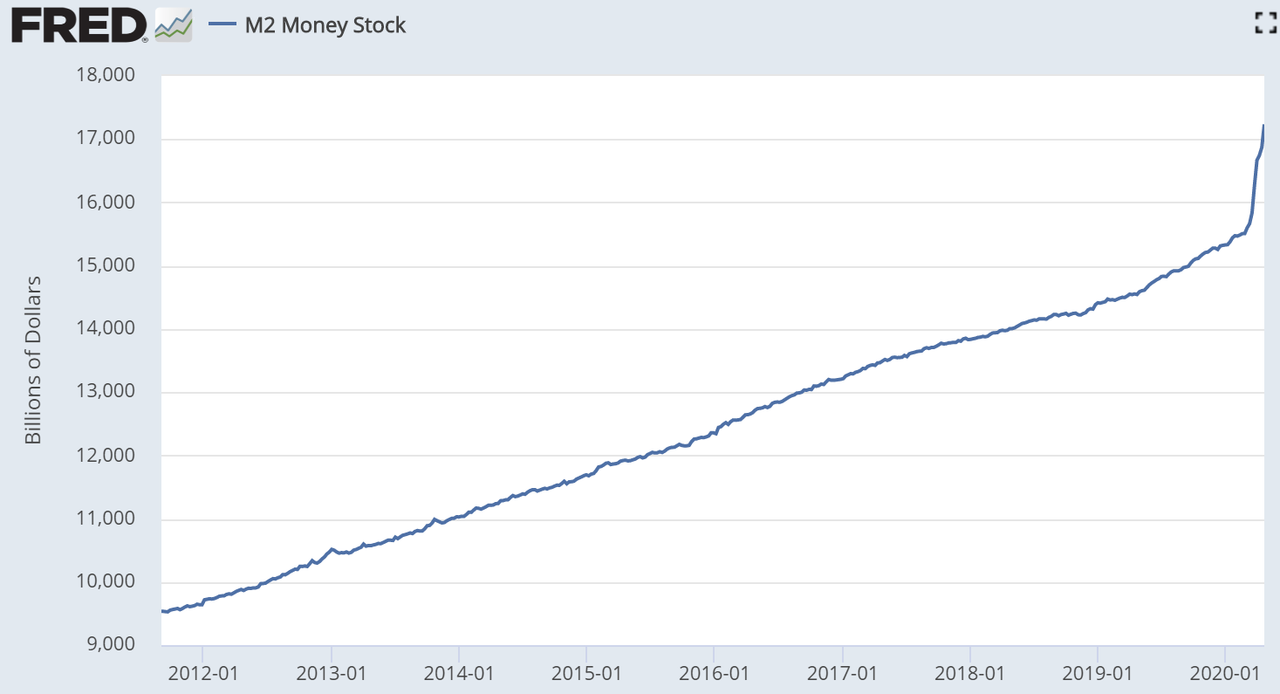
The Federal Reserve has pumped trillions of dollars of new money into the economy. Its balance sheet has swelled to nearly $6.6trillion. And during its meeting yesterday, Fed Chair Jerome Powell promised to press on with as much as necessary.

At least give Powell credit for at least realizing things are really bad right now.

We’re going to see economic data for the second quarter that’s worse than any data we’ve ever seen.”

And yet he remains clueless about how the very policies he is pushing have brought us to this place to begin with. Like most everybody else, he still thinks it’s all about the virus and that if we can just pump in enough stimulus, the central bank can see us through.

In its statement, the Fed promised it would continue to throw the kitchen sink at the US economy with no holds barred.

The Federal Reserve is committed to using its full range of tools to support the US economy in this challenging time.”

It also committed to leaving interest rates at zero percent as long as it takes.

The Committee expects to maintain this target range until it is confident that the economy has weathered recent events and is on track to achieve its maximum employment and price stability goals.”

During the post-FOMC meeting press conference, Powell refused to speculate on just how long rates might have to stay at zero. But if the great recession gives us any indication, forever might not be a bad guess. It seems incomprehensible that the Fed could ever raise rates given the levels of debt in the economy. Remember, the central bank was already cutting rates before coronavirus.

Of course, inflating the money supply by trillions of dollars has consequences of its own. Nobody seems concerned about that either. In fact, one reporter asked Powell how he would prevent a deflationary spiral even as the Fed chair directs the most inflationary monetary policy in history. In a tweet, Schiff said the question is will the Fed be able to admit its mistakes and reverse policy in time to prevent hyperinflation?

Powell also said the US government shouldn’t worry about the national debt. In fact, he encouraged more borrowing and spending to stimulate the economy.  Schiff hit the nail on the head again, tweeting, “The problem is Powell never worried about the debt.”

By-and-large, almost everybody is wandering around in this economic fantasyland high on Fed fairy dust. They’re convinced that this is a tiny economic speed bump. They don’t realize they’ve actually driven off a cliff. But at some point, the high will wear off. People will realize that the economy isn’t going to snap back to normal when Donald Trump snaps his fingers. And they’ll start to realize the fairy dust is what’s killing them.


Tyler Durden

Fri, 05/01/2020 – 12:10

via ZeroHedge News https://ift.tt/3f92XKh Tyler Durden

Illinois Governor Fumes Over ‘Reprehensible’ Question About Wife’s Bugout To $12 Million Florida Estate

Illinois Governor Fumes Over ‘Reprehensible’ Question About Wife’s Bugout To $12 Million Florida Estate

While Democrats are by and large the staunchest proponents of “stay-at-home” orders aimed at slowing the spread of the Wuhan coronavirus, the rules apparently don’t apply if you’re a governor’s wife.

During a Wednesday press conference, Illinois Gov. J.B. Pritzker (D) became visibly irritated over a question over whether his wife, M.K. Pritzker, had flaunted the state’s extended stay-at-home order – which prohibits non-essential travel, skipping skipped off to the couple’s $12 million estate in Wellington, Florida.

Patch.com reported on Monday the Illinois first lady went to their $12-million equestrian estate in Wellington, Flordia. This comes after Pritzker extended the state’s “stay-at-home” order. The Palm Beach County horse farm was purchased by a Pritzker-linked LLC the same week he won the governor’s race in 2018.

The 6.44-acre farm includes 30 stalls in the stables, an oversized riding arena, a manager’s apartment, and an owner’s lounge among its more than 27,000 square feet of buildings. –TownHall

“Where’s the First Lady?” asked a reporter. “Is she accompanied by a state security detail? Has she engaged in non-essential travel? What is your response to people who say the stay-at-home order and non-essential travel bans aren’t abided by your family?”

To which Pritzker replied: “Well, first of all, I want to say is that in politics it used to be that we kept our families out of it,” adding “My official duties have nothing to do with my family. So, I’m just not going to answer that question. It’s inappropriate and I find it reprehensible, honestly that, that a reporter wrote a story about it.”

Watch:


Tyler Durden

Fri, 05/01/2020 – 11:50

via ZeroHedge News https://ift.tt/2VRUtjh Tyler Durden

Brickbats: May 2020

In Bladen County, North Carolina, the chair of the Board of Elections threatened to have anyone who recites the Pledge of Allegiance at a board meeting arrested.

The Arizona Department of Education inadvertently released the names, email addresses, and other personal information of nearly 7,000 parents whose children take part in a school voucher program. The release included the disabilities listed for children with special needs.

Philadelphia police officer Keith White claimed that someone he arrested on drug charges in 2018 attacked him, causing bleeding and damage to his teeth. The arrestee was charged with aggravated assault, simple assault, and reckless endangerment. Surveillance video later showed that the defendant did not in fact resist arrest, and that White sustained his injuries when he tripped and fell.

When her 5-year-old daughter was bullied on a Dallas school bus, Audrey Billings asked to see the videos. The school system told her she would have to pay $600 for each video to cover the work of redacting footage not relevant to her child. She reluctantly paid for one video, which showed students grabbing, pulling, and poking her daughter with a pencil for 14 minutes while the driver ignored the girl’s cries for help.

The Colorado State Patrol has charged a Denver sheriff’s deputy with reckless driving, driving more than 40 mph over the speed limit in a construction zone, and three counts of reckless endangerment. The deputy, James Grimes, was clocked driving more than 100 mph while transporting inmates. He was reportedly racing another driver.

When the city of Seattle put a former fire station up for sale, it advertised it as a “unique residential dwelling.” Thom Kroon paid $712,000 for the building and spent thousands more remodeling it. Three years later, he got a letter from the building inspector ordering him to stop using the structure as a residence, because its only legal use was as a fire station. The city also sued Kroon, seeking $500 for each day he used the building for anything other than its legal purpose. Only after Kroon countersued did the city drop its suit and issue a certificate of occupancy.

At Minneapolis–St. Paul International Airport, a Transportation Security Administration agent grabbed Tara Houska’s braids from behind, snapped them like reins, and said, “Giddy up.” Houska says when she complained, the agent responded: “It was just in fun, I’m sorry. Your hair is lovely.”

In Alameda County, California, Candace Steel gave birth in a jail cell, screaming in pain and calling for help. Employees ignored her for hours, responding only when they heard the cries of her newborn daughter.

from Latest – Reason.com https://ift.tt/35liFxq
via IFTTT