Watch: Ted Cruz Eviscerates DHS Secretary For Still Refusing To Admit There Is A Border Crisis

Watch: Ted Cruz Eviscerates DHS Secretary For Still Refusing To Admit There Is A Border Crisis

Authored by Steve Watson via Summit News,

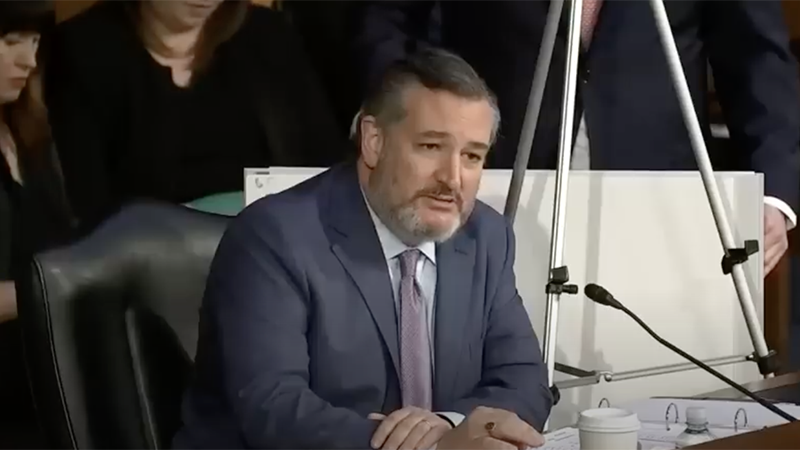
During a Senate Judiciary Committee hearing Tuesday, Senator Ted Cruz grilled Department of Homeland Security (DHS) Secretary Alejandro Mayorkas, and described his refusal to answer questions on the border crisis as “disgraceful.”

Cruz asked Mayorkas if he thinks there is currently a crisis at the border, with Mayorkas only responding that there is “a very significant challenge” and refusing to answer with a “yes” or “no.”

Cruz noted that Border Patrol Chief Raul Ortiz has repeatedly testified that there is a crisis, and asked Mayorkas to “speak with the same clarity.” 

“That’s how someone answers a question and does their job,” Cruz asserted, adding “You’re being a politician, misleading the American people.”

The Senator went on to describe how migrant deaths, child assaults and rapes have risen significantly since Mayorkas took office

“The men and women of the Border Patrol, they’ve never had a political leader undermine them,” Cruz declared, telling Mayorkas that he should resign.

They despise you, Mr. Secretary, because you’re willing to let children be raped to follow political orders. This is a crisis, it’s disgrace, and you won’t even admit this human tragedy is a crisis,” Cruz blasted.

Mayorkas called Cruz’s comments “revolting,” prompting Cruz to respond, “Your refusal to do your job is revolting.”

Watch:

Elsewhere during the hearing, Senator Josh Hawley slammed Mayorkas for assisting with and incentivising illegal entry into the U.S., noting that “It’s like a concierge service for illegal immigrants.”

“Rather than building a wall, Mr. Secretary, you have built Ticketmaster for illegal immigrants,” Hawley proclaimed.

Watch:

Related:

CBP Data: 16 Terrorists On FBI Watchlist Crossed Southern Border In February Alone

Video: Border Patrol Chief Testifies Border Is Not Secure, Wall Needed

Videos: Massive Group Of 1000 Illegals Attempts To Smash Through El Paso Border Barriers

Report: Red Cross Provides Illegals With Maps And Tips About How To Cross Border Into U.S.

Pictured: Biden Admin Hands Out Nonsensical ‘Black Resistance’ Flyers To BORDER PATROL Agents

*  *  *

Brand new merch now available! Get it at https://www.pjwshop.com/

In the age of mass Silicon Valley censorship It is crucial that we stay in touch. We need you to sign up for our free newsletter here. Support our sponsor – Turbo Force – a supercharged boost of clean energy without the comedown. Also, we urgently need your financial support here.

Tyler Durden
Wed, 03/29/2023 – 15:45

via ZeroHedge News https://ift.tt/TCGOSWK Tyler Durden

The Ruling Upholding the Gun Rights of People Subject to Restraining Orders Is Not As Crazy As You Might Think


Judge Cory Wilson

The Biden administration is asking the Supreme Court to reverse a recent decision in which an appeals court concluded that the federal ban on gun possession by people subject to domestic-violence restraining orders violates the Second Amendment. In a petition filed this month, Solicitor General Elizabeth Prelogar portrays that law as a commonsensical precaution that is “consistent with the Nation’s historical tradition of firearm regulation”—the constitutional test that the Court established last year in New York State Rifle & Pistol Association v. Bruen. But there are reasons to doubt that the “historical analogues” cited by the government are close enough and ample cause to worry about the threat that the policy it is defending poses to civil liberties.

Under 18 USC 922(g)(8), which Congress enacted in 1994, it is a felony, currently punishable by up to 15 years in prison, for someone to possess firearms when he is “subject to a court order” that restrains him from “harassing, stalking, or threatening an intimate partner” or “engaging in other conduct that would place an intimate partner in reasonable fear of bodily injury.” The provision requires that the order be issued after a hearing of which the respondent received notice. It also says the order must either include a finding that the respondent “represents a credible threat” to the intimate partner’s “physical safety” or explicitly prohibit “the use, attempted use, or threatened use of physical force” that “would reasonably be expected to cause bodily injury.”

The man at the center of this case, a Texas drug dealer named Zackey Rahimi, was convicted of violating Section 922(g)(8) in circumstances that suggest he is exactly the sort of person who should not be trusted with firearms. But his conduct allegedly included a string of violent crimes that would themselves disqualify him from owning guns. The question raised by this case is not whether someone like Rahimi should be allowed to own guns. It is whether the government violates the Second Amendment when it deprives people of the right to armed self-defense based on nothing more than a restraining order that may have been issued without any credible evidence that the respondent poses a danger to others.

When it overturned Rahimi’s conviction in February, the U.S. Court of Appeals for the 5th Circuit noted that he is “hardly a model citizen,” which is putting it mildly. In December 2019, Prelogar notes, “Rahimi and his girlfriend C.M. had an argument in a parking lot in Arlington, Texas. C.M. tried to leave, but Rahimi grabbed her wrist, knocking her to the ground. He then dragged her back to his car, picked her up, and pushed her inside, causing her to hit her head on the dashboard. Realizing that a bystander had seen him, he retrieved a gun and fired a shot. In the meantime, C.M. escaped the car and fled the scene. Rahimi later called her and threatened to shoot her if she told anyone about the assault.”

Two months after that incident, a Texas judge issued a two-year restraining order against Rahimi that met the requirements of Section 922(g)(8). Rahimi was notified of the hearing but did not attend.

In August 2020, Prelogar says, Rahimi “tried to communicate with C.M. on social media and approached her house in the middle of the night, prompting state police to arrest him for violating the order.” That November, “he threatened another woman with a gun, leading the State of Texas to charge him with aggravated assault with a deadly weapon.”

Wait. There’s more:

Rahimi then participated in a series of five shootings in December 2020 and January 2021, First, after someone who had bought drugs from him “started talking ‘trash'” on social media, he went to the man’s home and fired bullets into it using an AR-15 rifle. The next day, after colliding with another vehicle, he alighted from his car, shot at the other driver, fled, returned to the scene, fired more shots at the other car, and fled again. Three days later, Rahimi fired a gun in the air in a residential neighborhood in the presence of young children. A few weeks after that, a truck flashed its headlights at Rahimi when he sped past it on a highway; in response, Rahimi slammed his brakes, cut across the highway, followed the truck off an exit, and fired multiple shots at another car that had been traveling behind the truck. Finally, in early January, Rahimi pulled out a gun and fired multiple shots in the air after a friend’s credit card was declined at a fast-food restaurant.

The investigation prompted by those incidents resulted in state charges against Rahimi. It also resulted in his conviction under Section 922(g)(8). He appealed that conviction, arguing that the provision was inconsistent with the Second Amendment. But the 5th Circuit had already ruled, back in 2001, that Section 922(g)(8) was constitutional, and it did so again in Rahimi’s case last year, taking into account what the Supreme Court had said about the Second Amendment in the meantime.

The 5th Circuit’s decision was published on June 8, two weeks before the Supreme Court’s decision in Bruen, which concluded that New York had violated the Second Amendment by demanding that residents show “proper cause” for exercising the right to bear arms. Bruen explicitly rejected the sort of two-step analysis that the 5th Circuit had applied in assessing the constitutionality of Section 922(g)(8).

Under that approach, a court first asked whether the conduct prohibited by a gun control law was covered by the Second Amendment. If so, the court weighed the law’s purported public safety benefits against its restriction of gun rights, applying either strict or intermediate scrutiny. Bruen replaced that approach with a historical test that asks whether a challenged law is “relevantly similar” to regulations that have traditionally been seen as consistent with the original understanding of the right to keep and bear arms.

Reconsidering Rahimi’s case in light of Bruen, the 5th Circuit concluded that the government had failed to meet that test. The government cited three kinds of gun regulations: 1) laws authorizing the disarmament of “dangerous” individuals, 2) laws against “going armed” in a threatening manner, and 3) laws that required people to post a “surety” before carrying guns in public when they allegedly posed a threat to particular individuals.

“The purpose of laws disarming ‘disloyal’ or ‘unacceptable’ groups was ostensibly the preservation of political and social order, not the protection of an identified
person from the threat of ‘domestic gun abuse,'” Judge Cory T. Wilson notes in a February 2 opinion for a unanimous 5th Circuit panel that also included Judges James C. Ho and Edith H. Jones. “Thus, laws disarming ‘dangerous’ classes of people are not ‘relevantly similar’ to § 922(g)(8) such that they can serve as historical analogues.”

The 5th Circuit also thought the four colonial or state laws against “going armed” cited by the government did not bear a constitutionally relevant resemblance to Section 922(g)(8). A 1786 Virginia statute, for example, made it a crime to “go or ride armed by night or by day, in fairs or markets, or in other places, in terror of the country.” It authorized the arrest and imprisonment of any violator, who would then “forfeit his armour to the Commonwealth.”

Wilson notes that Virginia and Massachusetts “dropped forfeiture as a penalty” in 1795 and 1847, respectively, while North Carolina’s law never included such a provision. “It is unclear how long New Hampshire’s ‘going armed’ law preserved its forfeiture provision,” he says. But even assuming that it persisted longer than the others, Wilson says, “one outlier is not enough ‘to show a tradition of public carry regulation.'”

Wilson adds that the “going armed” laws “only disarmed an offender after criminal proceedings and conviction.” By contrast, Section 922(g)(8) “disarms people who have merely been civilly adjudicated to be a threat to another person” or “are simply governed by a civil order that ‘by its terms explicitly prohibits the use, attempted use, or threatened use of physical force,’ whether or not there is a ‘credible threat to the physical safety’ of anyone else.”

Wilson also notes that the “going armed” laws were aimed at “disarming those who had been adjudicated to be a threat to society generally, rather than to identified individuals.” Furthermore, Section 922(g)(8) “works to disarm not only individuals who are threats to other individuals but also every party to a domestic proceeding (think: divorce court) who, with no history of violence whatever, becomes subject to a domestic restraining order that contains boilerplate language” meeting the law’s criteria. While “going armed” statutes “were tied to violent or riotous conduct and threats to society,” Wilson writes, Section 922(g)(8) “implicates a much wider swath of conduct, not inherently dependent on any actual violence or threat.”

Wilson concedes that the surety laws more closely resemble Section 922(g)(8), since they were aimed at protecting specific complainants and required a civil proceeding rather than a criminal conviction. But those laws, he notes, allowed people to continue carrying arms in public as long as they posted a surety, and the restrictions did not apply to private possession. While “the surety laws imposed a conditional, partial restriction on the Second Amendment right,” he says, Section 922(g)(8) “works an absolute deprivation of the right, not only publicly to carry, but to possess any firearm, upon entry of a sufficient protective order.”

In a concurring opinion, Ho elaborates on the concern that Wilson mentions: that people can be subject to restraining orders that meet the federal criteria, and therefore deprived of the right to armed self-defense, even when they pose no real threat of violence to others. “Scholars and judges,” he writes, “have expressed alarm that civil protective orders are too often misused as a tactical device in divorce proceedings—and issued without any actual threat of danger.”

Such orders “can help a party in a divorce proceeding to ‘secure [favorable] rulings on critical issues such as [marital and child] support, exclusion from marital residence and property disposition,'” Ho notes. They “can also be ‘a powerful strategic tool in custody disputes.'” Because of those incentives, he says, protective orders are “a tempting target for abuse.”

Nor can judges be counted on to prevent such abuse. “Family court judges may face
enormous pressure to grant civil protective orders—and no incentive to deny them,” Ho writes. “For example, family court judges may receive mandatory training in which they’re warned about ‘the unfavorable publicity’ that could result if they deny requests for civil protective orders.” Because of that pressure, protective orders “are granted to virtually all who apply.”

Ho cites a couple of examples of questionable orders. In one case, “a family court judge granted a restraining order on the ground that the husband told his wife that he did not love her and was no longer attracted to her,” even though “there was no prior history of domestic violence.” In another case, a judge “issued a restraining order against David Letterman on the ground that his presence on television harassed the plaintiff.”

Ho adds that “the consequences of disarming citizens under § 922(g)(8) may be especially perverse considering the common practice of ‘mutual’ protective orders.” In a domestic violence dispute, he says, “a judge may see no downside in forbidding both parties from harming one another.” The result can be that “both parties are restrained even if only one is an abuser.” In such cases, Section 922(g)(8) “effectively disarms victims of domestic violence,” potentially putting them “in greater danger than before.” The provision “effectively empowers and enables abusers by guaranteeing that their victims will be unable to fight back.”

What should be done, then, with people like Rahimi, who clearly posed a threat not only to his girlfriend but also to his customers and to random members of the public? Ho thinks the answer is obvious: Such demonstrably dangerous individuals should be arrested, prosecuted, convicted, and incarcerated, which would simultaneously punish them for their crimes, keep them away from people they might harm, and prevent them from legally owning guns.

That solution may strike victims of domestic violence as naive and inadequate. Rahimi’s girlfriend, after all, said he threatened to kill her if she reported his 2019 assault on her. While that did not prevent her from seeking a restraining order, victims might be too fearful to press criminal charges or unwilling to go through the emotional ordeal that would entail.

It nevertheless seems clear that the current policy sweeps too broadly by disarming people, potentially including victims of domestic abuse, even when they have no history of violence or threats. That reality certainly seems relevant in assessing the government’s claim that people subject to restraining orders are ipso facto in the same category as “dangerous” individuals who historically have been deemed unfit to own guns.

The post The Ruling Upholding the Gun Rights of People Subject to Restraining Orders Is Not As Crazy As You Might Think appeared first on Reason.com.

from Latest https://ift.tt/x4TCnIf
via IFTTT
“Preparing for the 20th Anniversary of the Streisand Effect: Cooley v. Afroman”

A very interesting post by Paul Alan Levy (Public Citizen, Consumer Law & Policy Blog), which I reproduce with his permission:

It was almost twenty years ago that Barbra Streisand filed a lawsuit that attempted to block access to a photograph of her oceanfront estate, bringing unwanted attention to the photo and leading to her being enshrined by Techdirt’s Mike Masnick in tech/legal terminology as the progenitor of “the Streisand Effect.”

Now we have Cooley v. Foreman.

Several police officers executed a search warrant at the home of a musician named Joseph Edward Foreman, who performs under the name “Afroman.”  Outraged by what he considered rough treatment of his possessions and the lack of justification for the search, he created two songs about the raid and recorded them in music videos, consisting mainly of footage of the search, entitled “Will You Help Me Repair My Door” and “Lemon Pound Cake”  (to the tune of “Under the Boardwalk”). He also posted images on social media of the officers who conducted the search and printed Tshirts and other merchandise containing photos of the police officers and of the judge who had signed the search warrant, bitterly complaining about the officers’ conduct in searching his house and asking that the judge be voted out of office. He promoted these to his fans who, it appears, responded eagerly.

Police officers may be protected by qualified immunity against claims for damages for most of their misconduct, but they are not immune from public criticism.  In an apparent effort to create such an immunity, and represented by Cincinnati lawyer Robert Klingler, the police officers have now sued the musician and the distributors of his music, alleging a violation of the Ohio right of publicity and the common law right of privacy. In addition to highly critical comments about the police officers, the complaint alleges that an Instagram post includes vile references to the one female officer on the raid; I could not locate the original to verify that allegation. The complaint does not allege a claim for defamation, but it does allege false light.

At the time of suit, the police officers had been the subject of unwanted attention among Afroman’s fans, but the utter hubris of the lawsuit resulted in widespread coverage in the mainstream media, including the New York TimesNPR,  CBS News,  and an AP story  that has appeared widely. Many of the stories link to the videos, publicizing them further. This is, indeed, how I heard of them.

There is a serious side to this case – Ohio is, after all, the state whose right of publicity laws produced Zacchini v. Scripps-Howard, which rejected a First Amendment defense to a lawsuit complaining about a news broadcast of a “shot from the cannon” act for which the stuntman conducting the act charges. Plainly, this case is different – plaintiffs’ raid was not a commercial performance but an action of the government, and the complaint gives no reason to believe that plaintiffs’ appearance in uniforms has commercial value, as required for application of the Ohio right of publicity statute.  Moreover, several of the statutory exceptions apply, including the exceptions for “dramatic,” “historical” “audiovisual” and “musical” works, for material of political or newsworthy value, and for reporting on issues of public interest; there is also a general First Amendment exception. Indeed, many cases recognize a First Amendment right to record the police.  Broadcasting the resulting videos and still images is likewise protected.

But I also wondered whether the lawyer who filed this case, not to speak of his clients, had thought about whether the suit would simply bring even greater attention to the clients’ participation in the raid. To be sure, these plaintiffs have already taken more of a public beating than Streisand had when she filed her lawsuit, but even so I thought of the plight of James Amodio, who filed a lawsuit over mild criticism of his client in an eBay review without considering the destructive impact that the litigation would have on his client, and who ended up having to pay part of the award of sanctions for frivolous litigation.  Amodio later acknowledged that he had got in over his head; we required him to pay only a small part of the sanctions, even though his client was bankrupt and apparently could not satisfy the judgment.

I tried to raise these questions with the police officers’ lawyer but he angrily refused to engage, except to note that the public reaction to the lawsuit was hostile.

The post "Preparing for the 20th Anniversary of the Streisand Effect: Cooley v. Afroman" appeared first on Reason.com.

from Latest https://ift.tt/aPV1l4K
via IFTTT

Blue-State AGs Have A Mifepristone Lawsuit of Their Own

The Alliance for Hioppocratic Medicine’s lawsuit seeking to force the Food and Drug Administration to revoke its approval of mifepristone, a widely used abortion medication, has received significant attention. (I’ve blogged on administrative law issues in the case here and here.) Less attention has been made to a parallel lawsuit filed by Demoratic state attorneys general seeking to force the FDA to move in the opposite direction.

Politico reports:

Lawyers representing the FDA are expected in court on Tuesday to defend the agency’s authority to place certain restrictions on mifepristone, which is typically used to end a pregnancy during the first 10 weeks. The case before the U.S. District Court for the Eastern District of Washington was brought by more than a dozen Democratic state attorneys general who say the requirements around the drug, including a certification process for anyone prescribing it, place an undue burden on patients and providers. . . .

Oregon Attorney General Ellen Rosenblum is co-leading the lawsuit with Ferguson, and they are joined by the Democratic attorneys general representing Arizona, Colorado, Connecticut, Delaware, Illinois, Michigan, Nevada, New Mexico, Rhode Island and Vermont.

The pill restrictions, the group claims, are burdensome for both patients and doctors and the documentation requirements put them at risk for harassment or violence.

Interestingly enough, this lawsuit faces some of the same administrative law obstacles as does the AHM suit. As the Justice Department points out in its brief, the state AGs failed to administratively exhaust their remedies before filing suit (such as by filing a petition calling upon the FDA to alter its regulation of mifepristone). Moreover, it is not clear how the state AGs have standing to raise their claims at all. The state AGs’ claims that their states are harmed by the maintenance of restricitons on prescribing mifepristone rest on speculative claims about the effect of such restrictions.

Another problem with the state AGs’ suit is that it is ostensibly challenging the  mifepristone restrictions adopted by the FDA in January 2023, but those restrictions represented a loosening of the FDA’s restrictions on mifepristone. Accordingly, vacating the January 2023 policies would result in the reimposition of those restrictions previously in force, which would be more burdensome and thus do more harm to the interests the state AGs purport to represent.

As I understand it, this lawsuit was filed to try and blunt the impact of AHM v. FDA, either by creating a conflicting court order or nationwide injunction that would keep mifepristone on the market or merely by creating a circuit split on the question. Yet whatever the motivation of the suit, it seems to me it should founder on some of the same administrative law grounds that could frustrate the AHM case.

The post Blue-State AGs Have A Mifepristone Lawsuit of Their Own appeared first on Reason.com.

from Latest https://ift.tt/GwSI9UB
via IFTTT

America Can Have More Clean Energy or More Toad-Protecting Regulations, but Not Both


Dixie toads on the left, geothermal plant on the right

If you could power large swaths of the United States with carbon-free energy but had to sacrifice one endangered species in exchange, would you do it?

That exact choice may be fantastical, but an episode playing out near Fallon, Nevada, provides a real-world example of the tradeoffs between environmental progress and environmental protections.

Last week, the largest geothermal company in the nation threatened to sue the federal government over an endangered species decision that could derail its plans to supply Californians with emissions-free electricity. The company, Ormat, claims that the government hastily and erroneously listed the Dixie Valley toad as endangered last year. The decision halted construction of its 12-megawatt Dixie Meadows geothermal plant. (To be clear, the company does not plan to exterminate the toad; it says it can build and operate the facility in a way that will not disturb a nearby area of hot springs and wetlands that sustains the species.)

The story reveals a conflict between several of the Biden administration’s aims. It wants the country to run entirely on clean energy by 2035, yet it also aims to increase protections for rare species, conserve vast landscapes, and champion Native American rights. Each aim may be noble on its own merits. But no one can have their cake thrice and eat it too.

After spending about 15 years exploring the project’s feasibility, navigating the federal permitting process, and beginning construction, Ormat finally had the Dixie Meadows geothermal plant on pace to provide electricity by the end of 2022. In April of that year, however, the Biden administration filed an emergency endangered listing for the Dixie Valley toad. The animal exists nowhere else and had been classified as a distinct species five years earlier. In August, Ormat reached an agreement with an environmental litigator and a local tribe to pause construction while awaiting a final decision on the species. By December, instead of geothermal energy powering 12,000 Southern California homes, the feds had formally listed the toad as endangered, halting the plant indefinitely. 

Dixie Valley is more than 100 miles east of Reno along a desert route so remote and unremarkable that it’s been described as the “loneliest road in America.” It remains revered by the Paiute and Shoshone people, who still hunt in the area and wade in what they consider to be sacred healing waters of its hot springs. “We don’t have a church that’s in a building, like a Catholic church or a Mormon church or a Presbyterian church,” Leanna Hale, a resources director for the Fallon Paiute Shoshone Tribe, told The Washington Post last year. “This is our church.” The tribe has lobbied for 3 million acres in the region to be designated as a national monument.

The concern over the project at Dixie Meadows is that producing geothermal electricity there will upset a delicate landscape. Geothermal plants use wells to harness steam generated by the Earth’s heat. They also use so-called injection wells to put water back into the system, which maintains pressure and ensures steam continues to be produced. Conventional geothermal facilities are viable where a lot of heat rises to the Earth’s surface—Iceland, for instance, or the types of places that sometimes also support hot springs Native Americans cherish and rare toads dwell in. Disrupting the pressure, temperature, or other aspects of geothermal features could risk altering distinct habitat.

Concerns over the impacts of renewable-energy development are nothing new. In this case, the conflict is over a toad that scientists only recently determined was appreciably different from other western toads. Yet similar issues arise when constructing arrays of solar panels that disturb desert tortoises or farms of wind turbines that kill protected eagles. And it’s just as true of mining the materials that it would take to manufacture equipment and infrastructure to generate and transmit clean electricity to the entire nation.

One project being stymied by environmental and tribal objections in what is reportedly one of the loneliest places in America should raise questions about where future energy projects might actually be allowed. At the very least, it does not bode well for visions of a carbon-free future any time soon. Environmentalists may trumpet the need for clean energy, but too many of them don’t want it here, and they definitely don’t want it there—and probably not there either, just to be safe.

In fact, concern over geothermal energy isn’t even confined to one remote Nevada site. The Center for Biological Diversity, a high-profile environmental litigation group, brought the original lawsuit together with the Fallon tribe to block Ormat’s Dixie Meadows project. Last year, it also petitioned the federal government to protect the bleached sandhill skipper butterfly. “The butterfly is restricted to a single alkali wetland in Humboldt County, Nevada,” the group notes, and “could face extinction if the Baltazor Geothermal Development Project, proposed by developer Ormat, proceeds.”

The Center filed 266 lawsuits against the Trump administration, equal to about one legal challenge every five-and-a-half days. In the first three months of 2023, it has already sued the Biden administration 28 times, or once every three days. 

Maybe there will be other places in Nevada suitable for geothermal plants that do not attract legal challenges on endangered species grounds. Maybe other wind, solar, or—dare I say itnuclear projects will ultimately prevail over environmental NIMBY opposition. But no one can escape the reality that any choice entails tradeoffs—and that will sometimes mean making hard choices between progress and preservation.

What if there was a way to power the country with clean energy without having to sacrifice rare wildlife habitats? Technological advances that have made geothermal energy popular with some environmentalists were, funnily enough, driven by the fracking boom. Those advances might eventually make hard choices easier by lowering the costs of progress. Part of geothermal’s appeal is that, if the technology can be sufficiently developed, then it could hypothetically be deployed anywhere—even, say, beneath cities rather than on unique landscapes.

That potential will somewhat depend on federal permitting and red tape not grinding progress to a halt, and environmentalists would be wise to support reforms that “let us build.” Because even if one day geothermal plants can be sited anywhere, if we want to reap clean energy from them, then they will have to be sited somewhere.

The post America Can Have More Clean Energy or More Toad-Protecting Regulations, but Not Both appeared first on Reason.com.

from Latest https://ift.tt/AniSyqb
via IFTTT

Court Rejects Idea Theft / “Hot News” Claim by Occasional Fox Guest Against Fox

From today’s Second Circuit decision in Greer v. Fox News Media, by Judges Barrington Parker, Gerald Lynch, and Raymond Lohier:

Steven Eric Greer, proceeding pro se, appeals from a … [judgment] dismissing and denying leave to amend his claims of unfair competition, unjust enrichment, misappropriation of “hot news,” defamation, tortious interference with contractual relations and with prospective economic advantage, and intentional infliction of emotional distress against various news organizations and individuals. Greer primarily claims that the defendants used his news tips without compensating or crediting him, and that they also defamed him by “blacklisting” him from the news media industry….

“Section 301 of the Copyright Act expressly preempts a state law claim only if (i) the work at issue ‘come[s] within the subject matter of copyright’ and (ii) the right being asserted is ‘equivalent to any of the exclusive rights within the general scope of copyright.'” … [B]oth unfair competition claims “grounded solely in the copying of a plaintiff’s protected expression” and unjust enrichment claims satisfy the general scope requirement.

As to the first requirement, citing Fourth Estate Pub. Benefit Corp. v. Wall-Street.com, LLC (2019), Greer argues that his unfair competition and unjust enrichment claims are not preempted because they concern unprotectable ideas from blogs and emails, rather than reproduced portions of books, and therefore fall outside the subject matter of copyright. We disagree. The subject matter of copyright encompasses ideas expressed in “‘any tangible medium,'” including blogs and emails. And although copyright protection “does not extend to an idea,” we have explained that where “the ideas that are the subject of the claim were fixed in writing—whether or not the writing itself is at issue—the claim is within the subject matter of copyright” for purposes of preemption. So even if we assume that the “factual content” in Greer’s blogs and emails is itself “uncopyrightable,” expressing that content in a blog, email, or other tangible medium nonetheless brings it within the subject matter of federal copyright law….

We also affirm the District Court’s judgment insofar as it dismissed Greer’s misappropriation of “hot news” claim because Greer failed adequately to allege the basic elements for such a claim, namely: (1) that he gathered “time-sensitive” information, (2) that he was in “direct competition” with the defendants, and (3) that the defendants’ “free riding” on his efforts to collect information “substantially threaten[s]” the “existence or quality” of his journalism. Nat’l Basketball Ass’n v. Motorola Inc. (2d Cir. 1997).

Nor are we persuaded by Greer’s argument that the District Court erred in dismissing his defamation claim…. [Greer] identifies only one specific published statement that might qualify as defamatory. That statement, that he was a “nut,” is not defamatory because it “amount[s] to no more than name-calling or a general insult, a type of epithet not to be taken literally and not deemed injurious to reputation.” Klepetko v. Reisman (N.Y. App. Div. 2007).

Finally, we conclude that Greer has abandoned his tortious interference and intentional infliction of emotional distress claims because, even reading his appeal brief liberally, he does not contend that the District Court erred in dismissing them….

Greer’s proposed amendments [to his Complaint] fail to state a claim for breach of an implied-in-fact contract. Under New York law, “[a]n implied-in-fact contract requires such elements as consideration, mutual assent, legal capacity and legal subject matter.” In particular, “[t]he element of mutual assent … must be inferred from the facts and circumstances of each case, including such factors as the specific conduct of the parties, industry custom, and course of dealing.” Greer’s proposed amendments fail to allege that there was mutual assent between him and the defendants to compensate or credit him for his news tips. Accordingly, we conclude that the District Court did not abuse its discretion in denying Greer’s motion for leave to amend his complaint a third time.

For more on the decision below, see this post from last year. Congratulations to Steven Mintz and Terence McCormick (Mintz & Gold LLP) and Stephen Wu (Fox Corp.), who represent the defendants.

The post Court Rejects Idea Theft / "Hot News" Claim by Occasional Fox Guest Against Fox appeared first on Reason.com.

from Latest https://ift.tt/wg9WkQs
via IFTTT

Nobel Prize–Winning Economist: Democrats Are Committed ‘To Spending Other People’s Money’


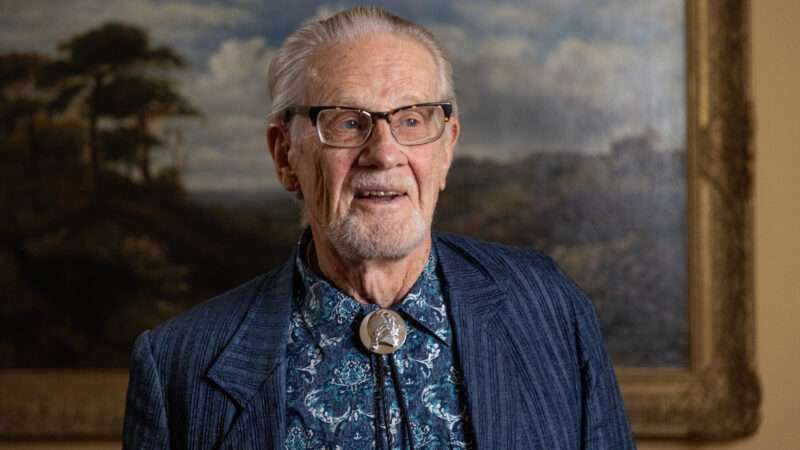
Vernon-Smith-IMG_5648

Vernon Smith received the 2002 Nobel Prize in Economic Sciences for his pioneering work in experimental economics. I caught up with the 96-year-old recently in Southern California and conducted a long interview about his life and work that will appear as a Reason podcast.

Here’s part of our conversation about President Joe Biden’s massive $6.8 trillion budget plan, the role of government spending and Federal Reserve policy in causing inflation, the bailout of Silicon Valley Bank, and why Smith believes “it’s very hard to keep Democrats [from] wanting to make the world better by spending other people’s money.”

Produced by Nick Gillespie and Justin Zuckerman; Sound editing by Ian Keyser

Credits: Evan Cantwell / UPI Photo Service/Newscom; PPS Vienna/ZUMA Press/Newscom; CNP/AdMedia/Newscom; Gripas Yuri/ABACA/Newscom; Rod Lamkey—CNP / MEGA / Newscom/RSSIL/Newscom; Ingram Publishing/Newscom; Rod Lamkey—CNP/Sipa USA/Newscom; Bastiaan Slabbers/Sipa USA/Newscom

The post Nobel Prize–Winning Economist: Democrats Are Committed 'To Spending Other People's Money' appeared first on Reason.com.

from Latest https://ift.tt/3GRDhM0
via IFTTT

Deirdre McCloskey: ‘What We Want Is a Nonslave Society’


Deirdre-McCloskey-society-non-slave

“What we want is a nonslave society, a society without masters,” the economic historian Deirdre McCloskey told me late last year at the annual Liberty Forum conference of the Atlas Network, a group founded in 1981 by British businessman Antony Fisher. The Atlas Network supports nonprofits around the globe that fight against authoritarianism and push for free markets, the rule of law, and self-determination. McCloskey was one of a half-dozen participants I spoke with, and she was explaining the end goal of classical liberalism.

Strolling through the conference, which was held in a midtown Manhattan hotel, was like attending a great music festival. People from dozens of different countries and organizations were strategizing and planning on how best to defeat new threats to freedom while keeping and expanding the political, economic, and cultural gains we’ve made over the past decades.

These are uncertain times—many human rights activists agree that “tyranny is on the rise“—and the vibe at the conference was a mix of deep anxiety and upbeat commitment to empowering individuals in developing and advanced countries alike.

What follows are short conversations I had with McCloskey—whose acclaimed body of work documents the role of property rights, markets, and pluralism in lifting living standards (and whose interview begins at the 0:17:05 mark)—and five other people, including:

  • Magatte Wade [0:02:55], a Senegalese entrepreneur who coordinates Atlas’ work in Africa;
  • Alex Gladstein [0:10:25], chief strategy officer at the Human Rights Foundation and a bitcoin evangelist who helps people use cryptocurrency to evade state monetary restrictions;
  • Mohamad Machine-Chian [0:38:35], an Iranian journalist forced into exile due to his criticism of his country’s theocratic leaders;
  • Tony Woodlief [0:45:46], the head of State Policy Network’s Center for Practical Federalism and author of I, Citizen: A Blueprint for Reclaiming American Self-Governance; and
  • Tom Palmer [0:54:30], who leads Atlas’ international programs and has almost 50 years of experience in the libertarian movement.

I talked with each of them about what they do and whether they’re optimistic about the future.

Today’s sponsors:

  • The Reason Roundtable Live in New York City! For the first time ever, Katherine Mangu-Ward, Nick Gillespie, Peter Suderman, and Matt Welch will tape live and unfiltered in New York, a city that is arguably the most hostile place in the country when it comes to taxes and regulation and arguably the most welcoming when it comes to living however the hell you want—a paradox that urban anarchists and minimal-government types can both savor and argue about. Come out on Tuesday, April 25 to the historic Village Underground. Tickets are $25 and must be purchased online.
  • The Reason Speakeasy. The Reason Speakeasy is a live, monthly, unscripted conversation with outspoken defenders of free thinking and heterodoxy. It doubles as a taping of The Reason Interview podcast. The next one is in New York City on Monday, April 3, when Nick Gillespie interviews University of San Diego philosopher Matt Zwolinski and Heterodox Academy President John Tomasi about their new book, The Individualists: Radicals, Reactionaries, and the Struggle for the Soul of LibertarianismDoors open at 6 p.m. Eastern. Tickets are $10 and include beer, wine, soft drinks, and appetizers. It’s always a great evening of camaraderie and conversation, so come on out. For more details and to buy tickets, go here.

The post Deirdre McCloskey: 'What We Want Is a Nonslave Society' appeared first on Reason.com.

from Latest https://ift.tt/I4fBnPQ
via IFTTT

FDA Will Finally Let You Get Naloxone Over the Counter


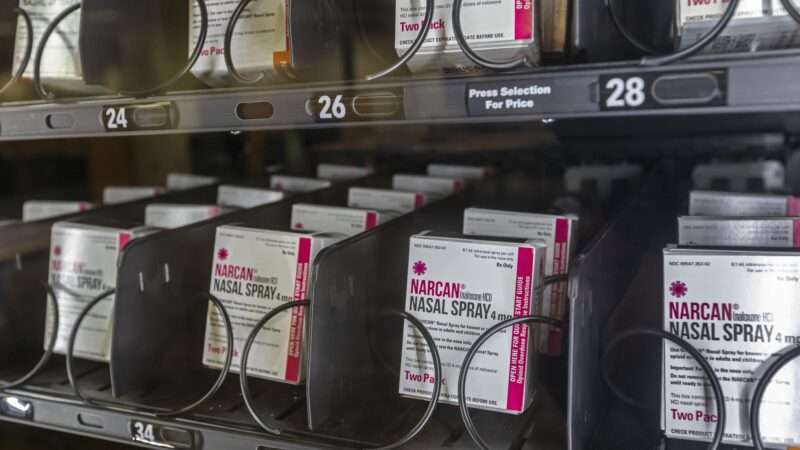
Boxes of Narcan naloxone spray behind glass in a vending machine.

In November, the Food and Drug Administration (FDA) announced that it would soon determine whether Narcan, the nasal spray form of naloxone, is safe for use without a prescription. It planned to fast-track approval within months.

On March 29, the FDA approved Narcan for sale over the counter. The decision is a welcome, but long overdue, change in drug policy.

Known as an opioid antagonist, naloxone blocks the effects of opioids by binding to the brain’s opioid receptors. This means it can actually stop and reverse the effects of an overdose, restoring consciousness and normal breathing, before the recipient dies. But the drug has no effect on people who don’t have opioids in their system, meaning it can be used safely without worrying about direct side effects. (While highly effective, it’s not a silver bullet: Naloxone works for up to 90 minutes, but opioids remain in the body longer, so naloxone could wear off while a dangerous amount of opioids is still present, requiring further doses.)

In 2021, more than 100,000 Americans died of opioid overdoses; a majority of those resulted from synthetics like fentanyl, which is significantly more potent than morphine or heroin and is often mixed into black-market products. Prior to the FDA’s decision, all 50 states and the District of Columbia had laws expanding access to naloxone, but each case still required a pharmacist as part of the transaction.

Naloxone could be a literal lifesaver for any opioid user, and any government action that increases its availability is a net positive. At the same time, it’s worth wondering why the FDA’s decision took so long and how many lives could have been saved in the process.

The FDA first approved naloxone to treat overdoses in 1971. Initially, an injectable found mostly in hospital emergency rooms, the nasal spray form was approved in 2015. While the intravenous (IV) application is faster, the nasal spray is easier to administer. According to the Centers for Disease Control and Prevention, between 1996 and 2014, people without medical training reversed at least 26,463 overdoses with naloxone.

Research shows that greater awareness and availability of naloxone results in fewer overdose deaths. In a 2017 briefing guide for first responders, the Drug Enforcement Administration (DEA) recommended that paramedics and law enforcement carry naloxone in a personal protective equipment kit.

And yet the FDA waited until now to approve it for sale without a prescription, 50 years after it was first authorized and eight years after the nasal spray. In 2018, Surgeon General Jerome Adams recommended expanding access to naloxone but stopped short of recommending it be made available without a prescription. As Cato Institute Senior Fellow Jeffrey Singer wrote in Reason at the time, Adams had the authority to “formally ask” the FDA commissioner “to order an expedited review with the goal of making naloxone available over the counter as quickly as possible,” which he did not do.

Since Narcan’s authorization in 2015, hundreds of thousands of Americans have died of opioid overdoses. Meanwhile, a bystander was present in nearly 40 percent of opioid- and stimulant-related overdose deaths. If naloxone were available to them over the counter, there’s no telling how many lives could have been saved.

The post FDA Will Finally Let You Get Naloxone Over the Counter appeared first on Reason.com.

from Latest https://ift.tt/QPGiUNa
via IFTTT

Italy’s Plan To Ban Lab-Grown Food Would Hurt Cuisine and Consumers


A gloved hand holds a petri dish of meat in front of a map of Italy

This month, Italy submitted its culinary heritage to UNESCO for designation as an “intangible cultural heritage.” The country’s bid named the cuisine’s rituals, local flavors, and presence in social life as reasons why it should be recognized and protected. In other words, Italian food is special—so special, in fact, that the Italian government is looking to outlaw products that it feels might corrupt it.

The country is looking to crack down on the “decadence” of lab-grown food. A bill approved yesterday by the Italian government would ban “the use of laboratory-produced food and animal feed as it aims to safeguard the country’s agri-food heritage, its agriculture minister told a news conference after a Cabinet meeting,” reported Reuters. If the bill passes, “Italian industry will not be allowed to produce food or feed ‘from cell cultures or tissues derived from vertebrate animals.'” Violators would face fines of up to 60,000 euros ($65,000 U.S.).

Health Minister Orazio Schillaci said the bill was “based on the precautionary principle” since there are “no scientific studies yet on the effects of synthetic foods.” Several members of Italian Prime Minister Giorgia Meloni’s populist Brothers of Italy party have voiced their support for the bill on more political grounds. Minister Francesco Lollobrigida claimed that laboratory products “do not guarantee quality, well-being and the protection of our culture, our tradition.” Augusta Montaruli, a lawmaker in Meloni’s party, said she was “proud” that Italy would be “the first nation in the world to stop this decadence.”

But it’s a move that misunderstands the evolution of cuisine generally and Italian food in particular, and one that would deny Italian consumers the opportunity to buy products that fit their preferences.

Much of Italy’s “traditional” food is relatively new, widely adopted only in the past century. Alberto Grandi, a professor of food history at the University of Parma, made many such claims in a Financial Times interview last week: Panettone only became soft and dome-shaped in the 1900s; tiramisu only appeared in cookbooks in the 1980s; the “exact modern-day match” to traditional parmesan is “Wisconsin parmesan.” Several Italian food historians, including Grandi, claim that carbonara—a mainstay Roman pasta dish made with eggs, cheese, pork, and black pepper—didn’t reach its modern form until after World War II. Though many of the specifics are contested by Italian food purists, it’s clear that the cuisine is wont to change.

On a more basic level, some of Italy’s most beloved ingredients only came to the country through cross-continental exchange. The tomato, for instance, reached Italy from the Americas in the 1500s. David Gentilcore, a professor of history and author of Pomodoro! A History of the Tomato in Italy, told The Boston Globe that most dishes that use it, like pasta al pomodoro, “are fairly recent—from the 1870s or ’80s.” Gnocchi, polenta, and torta tenerina would be impossible without the potatoes, corn, and cacao that explorers brought from the New World to the Old.

If past governments had banned any of this development in the name of culinary purity, Italian food would be far less rich today. The people who consume it would have far fewer options to suit their palettes and dietary preferences—something the Italian government may well ensure if it bans lab-grown products.

As Reason‘s Ronald Bailey has written, cultivated meat companies are using far less land and water to make their products than traditional meat production consumes, both huge environmental benefits. What’s more, animals don’t have to die for these products, which is a huge plus for consumers with ethical concerns about traditional meat production. Cultivated meat is already commercially available in Singapore and on its way to American plates. Italy would do well to follow their lead instead of closing off avenues for its cuisine to evolve and denying consumers the opportunity to buy products that fit their needs.

The post Italy's Plan To Ban Lab-Grown Food Would Hurt Cuisine and Consumers appeared first on Reason.com.

from Latest https://ift.tt/uVyUEdN
via IFTTT