Key Events This Week: CPI Revisions, ISM, And SLOOS

Key Events This Week: CPI Revisions, ISM, And SLOOS

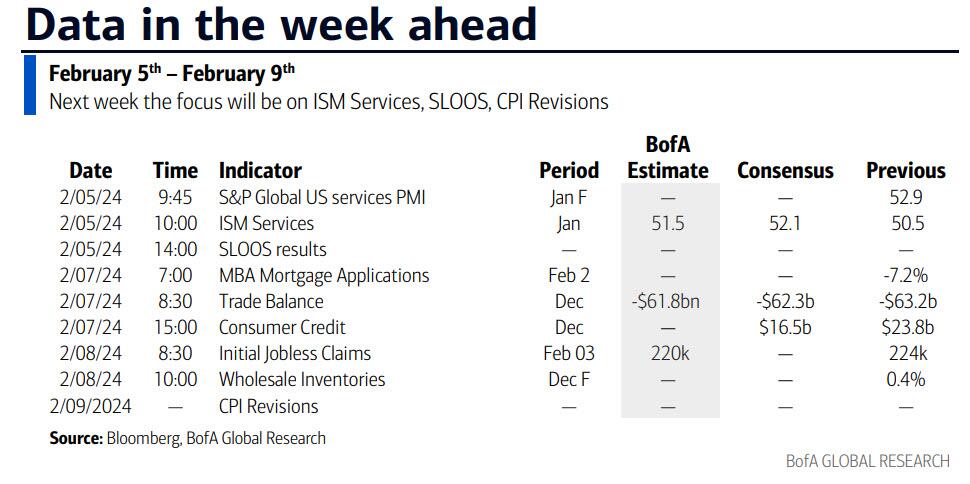
After last week’s epic central bank/payrolls/QRA/earnings juggernaut, there’s not a lot of US data this week, as is usually the case immediately post payrolls, but as DB’s Jim Reid notes, the highlight could be the annual BLS revisions to the seasonal factors for CPI on Friday. Both Waller (pre FOMC blackout) and Powell (at the FOMC) noted that these are an important landmark to get past before potential rate cuts can be better calibrated. Last year, these revisions lowered H1 inflation and increased H2 which changed the momentum profile of inflation.

Before we get there, today we get the services ISM (53.4. consensus 52.0, with the prices paid component soaring to 64.0) which negatively surprised a month ago (at 50.6 and below all estimates), with the employment series the lowest since July 2020 (down from 50.7 to 43.3). That clearly was completely at odds with payrolls on Friday, so today’s much stronger prints are a return to normalcy. Also anomalous has been the recent creep higher in initial jobless claims of late with continuous claims only having been higher for one week since November 2021. So another number to watch.

Today’s Fed Senior Loan Officer’s survey (SLOOS) should also be very important, but very tight bank lending in recent quarters hasn’t so far translated into reduced activity as it has done in the past. Reid admits that he doesn’t know why this is the case. It’s possible that excess savings or cash are still high enough in the economy that business and consumers don’t need much access to what would be very tight bank lending. This wouldn’t be able to carry on forever so the survey results today are still important to see if banks are becoming less restrictive after some improvements last quarter. You can find the other US data in the diary at the end.

Outside the US, China inflation numbers on Thursday are worth watching. Current estimates on Bloomberg suggest the CPI is expected to fall further into negative territory from -0.3% YoY in December to -0.5% YoY in January. The PPI is seen marginally edging higher but staying in negative territory (-2.6% vs -2.7% YoY in December). The Chinese CSI index closed at 5-yr lows on Friday so marching to a very different beat to the US at the moment.

In Europe, the focus will be on economic activity in Germany with indicators due including industrial production (Wednesday), factory orders (tomorrow) and the trade balance (today). There will also be industrial production (Friday) and retail sales for Italy (Wednesday) and trade balance data for France (Wednesday). From the ECB, investors will keep an eye on the consumer expectations survey (CES) on Tuesday and the economic bulletin will be due on Thursday.

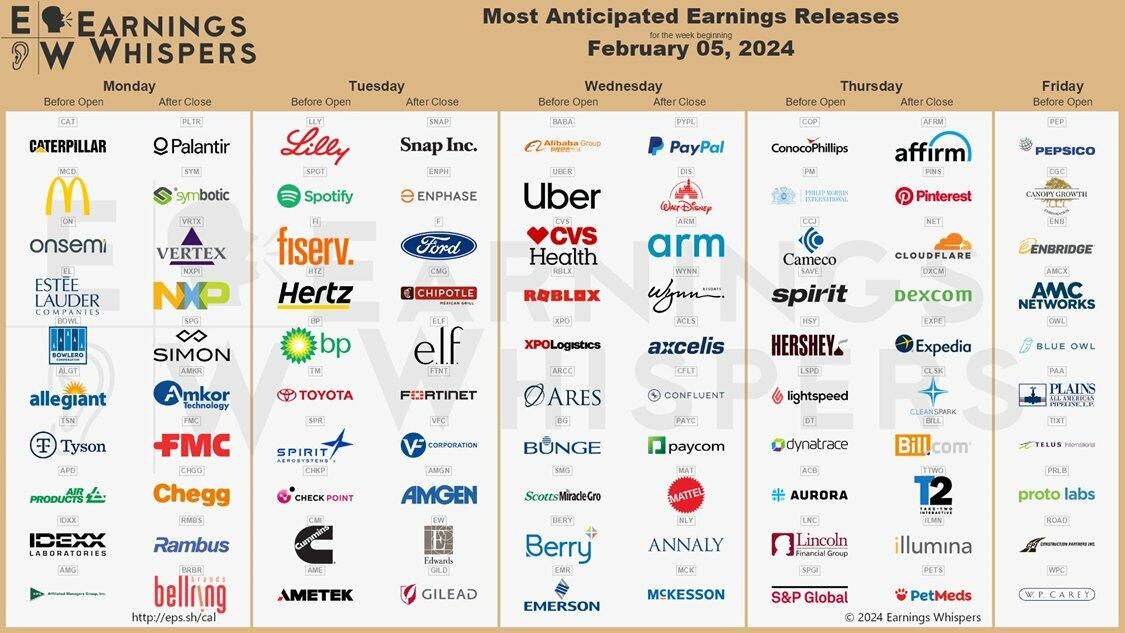
Elsewhere earnings season soldiers on but after the mega caps from last week, the main highlights this week, which we detail in the calendar at the end, are not going to move the macro needle.

Day-by-day calendar of events

Monday February 5

  • Data: US January ISM services, China January Caixin services PMI, UK January official reserves changes, new car registrations, Japan December labor cash earnings, household spending, Italy January services PMI, Germany December trade balance, Eurozone December PPI, Canada January services PMI
  • Central banks: Fed SLOOS, Fed’s Bostic speaks
  • Earnings: McDonald’s, Caterpillar, Vertex, NXP Semiconductors, Estee Lauder, Palantir Technologies
  • Other: OECD interim economic outlook

Tuesday February 6

  • Data: UK January construction PMI, Italy January manufacturing confidence, economic sentiment, consumer confidence index, Germany January construction PMI, December factory orders, Eurozone December retail sales, Canada December building permits
  • Central banks: Fed’s Mester, Kashkari and Collins speak, ECB consumer expectations survey, BoE’s asset purchase facility report, RBA decision
  • Earnings: Eli Lilly, Toyota, Linde, Amgen, BP, Gilead Sciences, Fiserv, KKR, Nintendo, Chipotle, Carrier Global, Ford, Spotify, Centene
  • Auctions: US 3-yr Note ($54bn)

Wednesday February 7

  • Data: US December trade balance, consumer credit, China January foreign reserves, Japan January bank lending, December trade balance, leading index, coincident index, current account balance, Italy December retail sales, Germany December industrial production, France Q4 private sector payrolls, December trade balance, current account balance, Canada December international merchandise trade
  • Central banks: Fed’s Harker, Kugler, Collins, Bowman and Barkin speak, BoE’s Breeden speaks
  • Earnings: Alibaba, Walt Disney, TotalEnergies, Uber, CVS, Equinor, Vinci, ARM, PayPal, McKesson, O’Reilly, Hilton, Vestas, Roblox, Orsted, Carlsberg, Pandora, Siemens Energy, Ares
  • Auctions: US 10-yr Note ($42bn)

Thursday February 8

  • Data: US December wholesale trade sales, initial jobless claims, China January CPI, PPI, UK January RICS house price balance, Japan January Economy Watchers survey, M2, M3
  • Central banks: Fed’s Barkin speaks, ECB’s economic bulletin, Wunsch, Lane speak, BoE’s Mann speaks
  • Earnings: L’Oreal, AstraZeneca, Siemens, S&P Global, ConocoPhillips, Unilever, SoftBank, Apollo, Kering, Kenvue, Hershey, AP Moller – Maersk, Take-Two Interactive, Neste, Pinterest, ArcelorMittal
  • Auctions: US 30-yr Bond ($25bn)

Friday February 9

  • Data: Italy December industrial production, France Q4 wages, Canada January jobs report
  • Central banks: ECB’s Cipellone and Nagel speak
  • Earnings: PepsiCo, Hermes, Tokyo Electron, Blue Owl

* * *

Finally, looking at just the US, the key economic data release this week is the ISM services report on Monday. There are several speaking engagements from Fed officials this week.

Monday, February 5

  • 09:45 AM S&P Global US services PMI, January final (consensus 52.9, last 52.9)
  • 10:00 AM ISM services index, January (GS 52.3, consensus 52.0, last 50.5): We estimate that the ISM services index rebounded 1.8pt to 52.3 in January. Our non-manufacturing survey tracker edged up 0.6pt to 52.8, and the collapse in the ISM services employment gauge in December is inconsistent with the strong job growth and low layoff rates in that month and in January. We also see seasonality as a positive factor this month.
  • 10:00 AM Chicago Fed President Goolsbee (FOMC non-voter) speaks: Chicago Fed President Austan Goolsbee will be interviewed on Bloomberg Television. On February 2nd, following the release of the January employment report, President Goolsbee noted that “the continued strength of the labor market, if [it] continues, would lessen my worry that the job market side of our mandate is deteriorating.” That being said, President Goolsbee stressed that a strong employment report wouldn’t necessarily lead the Fed to delay cutting the fed funds rate because strong hiring was taking place in the context of “positive supply shocks working their way through the system.” President Goolsbee also observed that the decline in weekly hours suggests that the underlying pace of wage growth “wasn’t as strong as that headline [average hourly earnings] number suggested.”
  • 02:00 PM Senior Loan Officer Opinion Survey, banks tightening C&I loans for large and middle-market firms, 2023Q4 (last 33.9)
  • 02:00 PM Atlanta Fed President Bostic (FOMC voter) speaks: Atlanta Fed President Raphael Bostic will deliver welcoming remarks at an event on the economic returns of education and training. Text is expected. On January 18th, President Bostic noted that he had “incorporated the unexpected progress on inflation and economic activity into my outlook, and thus moved up my projected time to begin normalizing the fed funds rate to the third quarter of this year from the fourth quarter.” President Bostic cautioned that “premature rate cuts could unleash a surge in demand that could initiate upward pressure on prices… [but] if we continue to see a further accumulation of downside surprises in the data, it’s possible for me to get comfortable enough to advocate for normalization sooner than the third quarter.”

Tuesday, February 6

  • There are no major economic data releases scheduled.
  • 12:00 PM Cleveland Fed President Mester (FOMC voter) speaks: Cleveland Fed President Loretta Mester will deliver a speech on the economic outlook in Columbus, Ohio. Text and Q&A are expected. On January 11th, President Mester said that “March is probably too early in my estimation for a rate decline because I think we need to see some more evidence. … I think the December CPI report just shows there is more work to do, and that work is going to take restrictive monetary policy.”
  • 01:00 PM Minneapolis Fed President Kashkari (FOMC non-voter) speaks: Minneapolis Fed President Neel Kashkari will take part in a moderated Q&A at a luncheon hosted by Greater Mankato Growth. Audience Q&A is expected.
  • 02:00 PM Boston Fed President Collins (FOMC non-voter) speaks: Boston Fed President Susan Collins will deliver opening remarks at the second day of a Fed conference on “Uneven Outcomes in the Labor Market.” Text is expected.
  • 07:00 PM Philadelphia Fed President Harker (FOMC non-voter) speaks: Philadelphia Fed President Patrick Harker will deliver a speech on the Fed’s role in the economy at the Rowan Institute for Public Policy & Citizenship in Glassboro, New Jersey. Text and Q&A are expected. On December 20th, President Harker argued that it was “important that we start to move rates down,” adding that “we don’t have to do it too fast, we’re not going to do it right away, it’s going to take some time.”

Wednesday, February 7

  • 08:30 AM Trade balance, December, (GS -$61.7bn, consensus -$62.2bn, last -$63.2bn)
  • 11:00 AM Fed Governor Kugler speaks: Fed Governor Adrianna Kugler will speak about the economic outlook at an event hosted by the Brookings Institution. Text and Q&A are expected. This will be Governor Kugler’s first speech since joining the Fed Board.
  • 11:30 AM Boston Fed President Collins (FOMC non-voter) speaks: Boston Fed President Susan Collins will speak at an event hosted by the Boston Economic Club. Text and audience Q&A are expected.
  • 12:30 PM Richmond Fed President Barkin (FOMC voter) speaks: Richmond Fed President Thomas Barkin will take part in a conversation on the economic outlook at the Economic Club of Washington, D.C. Q&A is expected. In an interview on CNN on January 22nd, President Barkin argued that the FOMC had to “focus on what’s happening on demand and whether that’s either helping your efforts to bring inflation in line or working against you, and then I think you make the call when you get to the meeting.” President Barkin did not rule out a March cut, noting that he did not “have any particular objection to normalizing rates when it’s the right time.”
  • 02:00 PM Fed Governor Bowman speaks: Fed Governor Michelle Bowman will deliver a speech on entrepreneurship and small businesses. Text is expected. On February 2nd, Governor Bowman noted that the recent progress on inflation was “encouraging,” and that her “baseline outlook is that inflation will decline further with the policy rate held at the current level.” Governor Bowman said that, as inflation came down, “it will eventually become appropriate to gradually lower our policy rate to prevent monetary policy from becoming overly restrictive.” That being said, Governor Bowman also stressed that she would “remain cautious in my approach to considering future changes in the stance of policy,” noting that “reducing our policy rate too soon could result in requiring further future policy rate increases to return inflation to 2 percent in the longer run.”

Thursday, February 8

  • 08:30 AM Initial jobless claims, week ended February 3 (GS 220k, consensus 220k, last 224k): Continuing jobless claims, week ended January 27 (GS 1,855k, consensus 1,870k, last 1,898k)
  • 08:30 AM Richmond Fed President Barkin (FOMC voter) speaks: Richmond Fed President Thomas Barkin will be interviewed on Bloomberg Television.
  • 12:05 PM Richmond Fed President Barkin (FOMC voter) speaks: Richmond Fed President Thomas Barkin will speak at the Economic Club of New York. Text and audience and media Q&A are expected.

Friday, February 9

  • 08:30 AM CPI Annual Revisions: The BLS will release updated seasonal factors that have been recalculated to reflect price movements from 2023. The annual revisions tend to cause monthly inflation readings to be revised toward the annual average. In other words, higher inflation readings for the year tend to be revised lower and lower readings tend to be revised higher. On average over the last decade, about 20% of the relative strength of a month’s initial core inflation vintage has been revised away in its first annual revision. With inflation pressures easing over 2023, monthly core CPI was 0.06pp below the annual average in the second half of 2023. As a result, if the revisions are in line with the historically average 20%, monthly core CPI inflation would be revised roughly 0.01pp higher on average in 2023H2. We expect revisions to core PCE inflation in the same direction for 2023Q4 (prior quarters are not revised until the BEA’s annual revisions later this year) but smaller in magnitude, because only some of the PCE components use the CPI seasonal factors.
  • 01:30 PM Dallas Fed President Logan (FOMC non-voter) speaks: Dallas Fed President Lorie Logan will speak at the 14th Annual Tarrant County Transportation Summit in Hurst, Texas. On January 6th, President Logan noted that if the FOMC doesn’t “maintain sufficiently tight financial conditions, there is a risk that inflation will pick back up and reverse the progress we’ve made,” and that “in light of the easing in financial conditions in recent months, we shouldn’t take the possibility of another rate increase off the table just yet.”

Source: DB, Goldman,BofA

Tyler Durden
Mon, 02/05/2024 – 11:00

via ZeroHedge News https://ift.tt/SxspJcf Tyler Durden

Seven US-Trained Fighters Killed In Drone Attack On Occupied Syrian Oil Field 

Seven US-Trained Fighters Killed In Drone Attack On Occupied Syrian Oil Field 

A key and very evident theme out of the Red Sea is that the US has lost ‘deterrence’ and perhaps never had it to begin with. Despite over a dozen waves of large-scale Western coalition attacks on Houthi positions, the Yemeni Shia rebels are vowing more attacks on commercial shipping, as we’ve reported

It is the same with Iran-aligned groups in Syria and Iraq, even after the Pentagon on Friday hit 85 targets with 120 bombs. This marked the single biggest US attack on ‘Iranian proxies’ in the region since the Gaza war began, but it didn’t take long for these very groups to strike back.

The “Islamic Resistance in Iraq” as early as Saturday announced it attacked bases that house US soldiers in Erbil; however, some local sources have disputed that the attack took place, or at least came near where Americans were housed. 

Importantly, President Biden in his statement on the Friday strikes underscored “Our response began today. It will continue at times and places of our choosing.”

This means the escalating tit-for-tat will continue to spiral, as the latest overnight attack against an American base in northeast Syria also demonstrates

Seven fighters from the Kurdish-led Syrian Democratic Forces were killed in an attack on an American base in eastern Syria overnight, a war monitor said Monday.

Seven SDF special forces “commandos” were killed and 18 others wounded in “a drone attack after midnight” on the Al-Omar oil field, the largest US-led coalition base in the country, said the Syrian Observatory for Human Rights, updating an earlier toll.

One UK-based war monitor concluded that it marked the first major “attack by pro-Iran groups against American bases after the US strikes on Syria and Iraq.”

Al-Omar has come to symbolize the years-long US military occupation of Syria’s only oil and gas rich region, which before the war was an area producing just enough energy for Syria’s domestic consumption. The Pentagon has used it as a base of operations to train its local proxy, the Kurdish-dominated SDF. 

While the Pentagon officially maintains this is still part of the ‘counter-ISIS’ mission, the reality is that it has long been a counter-Iran mission, and part of ongoing efforts to isolate and punish the Assad government. Essentially it is resource theft which seeks to deny the ‘pro-Iran axis’ access to its own natural resources. 

In the wake of this latest attack in eastern Syria, US officials have said Washington has a right to respond to the aggression. Such attacks on American outposts in this region are nothing new, but this is certainly one of the deadliest. It follows a week ago the deaths of three US Army soldiers at Tower 22 base on the Syria-Jordan border.

In the new Al-Omar attack, there doesn’t appear to have been any American casualties, or at least none which have been publicly disclosed. 

Tyler Durden
Mon, 02/05/2024 – 10:40

via ZeroHedge News https://ift.tt/2pTvPVW Tyler Durden

ISM Services Accelerates, But Prices Surge Most In 11 Years

ISM Services Accelerates, But Prices Surge Most In 11 Years

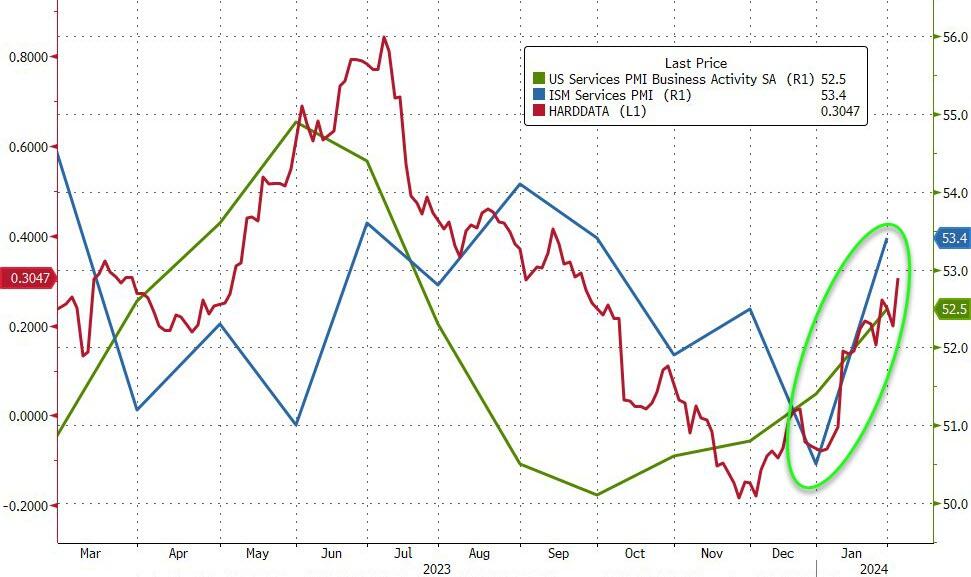
Following Manufacturing surveys’ surge in January (both S&P Global and PMI), Services surveys were both expected to rise also in January, tracking the rise in ‘hard’ data recently.

  • S&P Global’s ISM Services survey rose from 51.4 in December to 52.5 (final) in January (but declined from the 52.9 flash print for January). That is still the highest Services print since June 2023.

  • ISM’s Services survey jumped from 50.5 to 53.4, well above the 52.0 expected. This is the highest Services PMI since October.

Source: Bloomberg

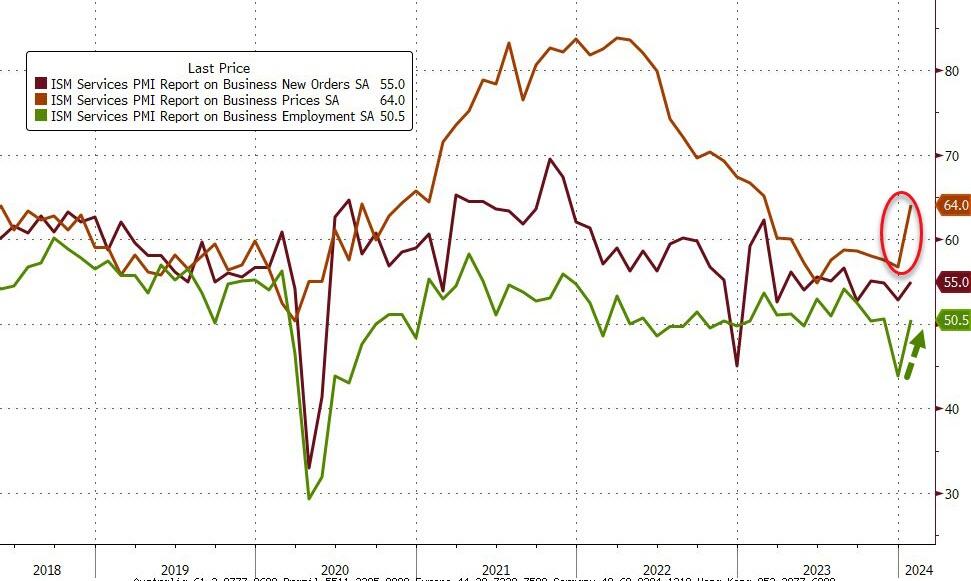
Employment rebounded strongly. New Oreders picked up, but prices exploded higher…

Source: Bloomberg

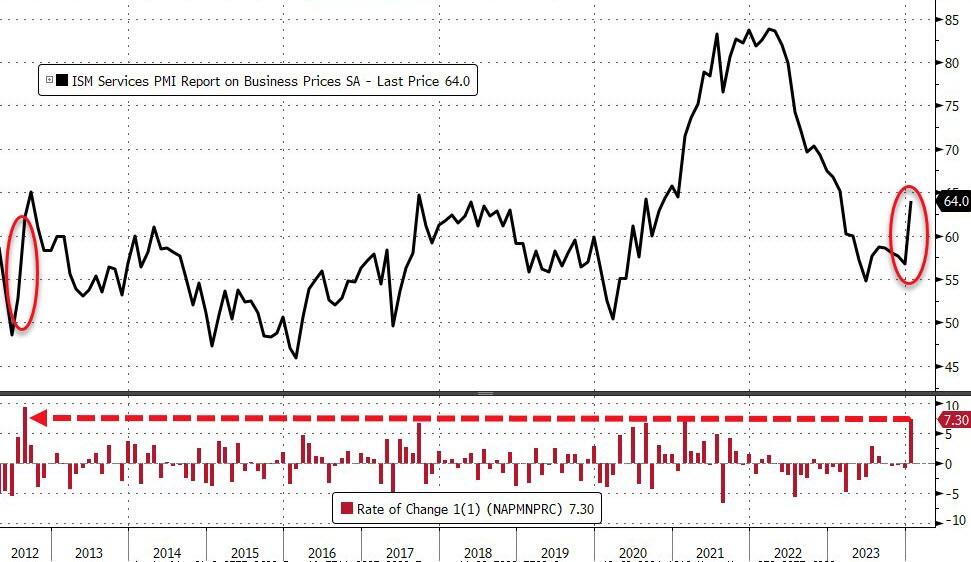
That’s the biggest MoM jump in ISM Services Prices since 2012!

Here’s why:

“Transportation impacts of the Suez Canal, due to unrest in the Red Sea and the issues at the Panama Canal are impacting both costs and schedules for the transport of global goods.” [Construction]

So that’s bad – but if you prefer to ignore it, here’s what S&P Global thinks about prices!:

“Price pressures have meanwhile shifted lower. Overall service sector input cost growth is now running at the second-lowest for over three years, helping pull selling price growth across goods and services down to a level consistent with inflation dropping materially below the Federal Reserve’s 2% target in the near future.”

So either prices are at their second lower in three years or at their highest in a year!

Chris Williamson, Chief Business Economist at S&P Global Market Intelligence, said:

The US service sector started the year in a sweet spot, with output and demand growth accelerating while price pressures cooled markedly.

The key driver of faster growth was the financial services sector, where looser financial conditions tied to expectations of lower interest rates spurred greater activity in January.

Households are also benefitting from loosened financial conditions, driving renewed growth in consumer-facing services.

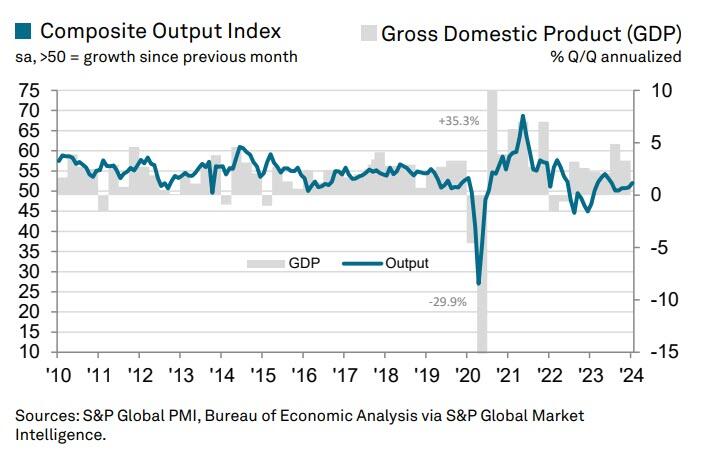
The US Composite index rose from 50.9 to 52.0 (less than the 52.3 flash print though) with Services expansion trumping Manufacturing weakness:

“The buoyancy of the service sector has outweighed a further lackluster performance in manufacturing, and is driving overall output higher at a rate broadly consistent with GDP rising at a 2% pace.

With bad weather having curbed some economic activity in January, February should see some further improvement in overall performance.

Finally, Williamson notes that “business optimism about growth prospects in the service sector has likewise jumped higher, encouraging further payroll growth, albeit the latter limited by labor shortages. “

But here’s a PMI respondent’s view:

Most companies I work with are gearing up for a tough 2024. Some may be overreacting, but there is a general sense that election years in the U.S. result in unrest, which is causing everyone to be conservative with spend.” [Professional, Scientific & Technical Services]

Stronger growth and no price pressure – not exactly a recipe for cutting rates?

Tyler Durden
Mon, 02/05/2024 – 10:09

via ZeroHedge News https://ift.tt/eSR04ip Tyler Durden

How Will The Fed React To The Supply-Driven Inflation Shock In Goods

How Will The Fed React To The Supply-Driven Inflation Shock In Goods

By Benjamin Picton, Rabobank senior market strategist

Double or Nothing?

US non-farm payrolls put the final nail in the coffin of a March rate cut on Friday by printing at almost double the consensus estimate of economists surveyed by Bloomberg. Payrolls rose by 353,000 in January versus an expected gain of 185,000, and the December figure (already a beat) was revised higher by 117,000. Even the most bullish forecaster on the survey under-clubbed the number to the tune of 53,000 jobs (more than 1 standard deviation). Average hourly earnings also beat expectations to print at 0.6% m-o-m, which took the year-on-year figure back up to 4.5%.

The payrolls numbers seemingly confirm the signal provided by an unexpectedly strong JOLTS report earlier in the week. That report saw job openings exceed market predictions by some 275,000 positions. The ISM manufacturing survey also printed stronger than expected and is now on the verge of breaking out of contractionary territory for the first time since October of 2022. That’s interesting in the context of the Services reading (due out this week), which has been steadily heading in South since hitting historic highs in the reopening boom following the Delta outbreak of 2021.

Now for the cheerful pessimism: while the reaction to the jobs report was ebullient, the Bureau of Labor Statistics has had a habit throughout 2023 of downwardly revising the stated employment gains in subsequent releases. Indeed, eleven out of twelve months in 2023 have seen initially reported employment growth figures revised lower. This means that the total level of employment growth has been nothing like the number that would have been suggested by simply summing the month-to-month changes together.

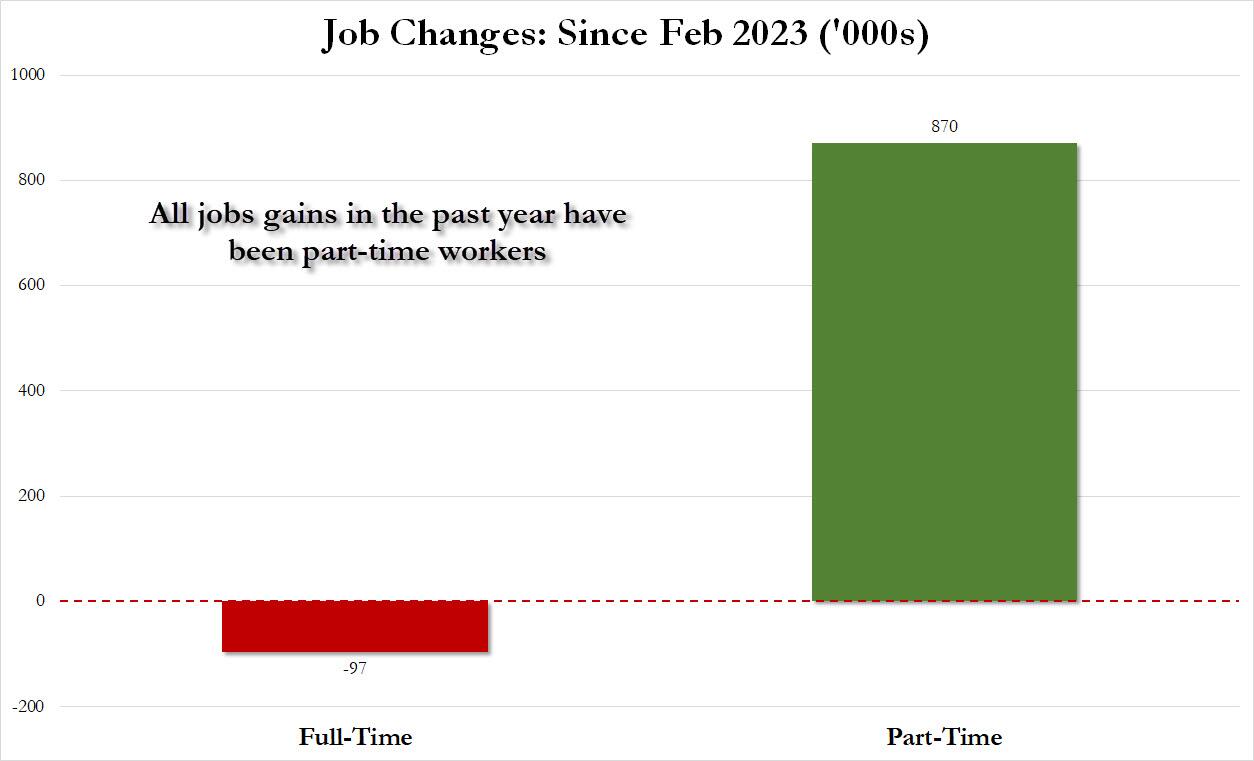
Likewise, average weekly hours worked has been trending steadily lower since early 2021 with the decline accelerating sharply at the end of last year while the number of discouraged workers has risen by more than 30% over the last 12 months. The U6 measure of underemployment continues to trend higher as growth in full-time positions is outpaced by gains in part-time work. In fact, the Household Survey reveals that full-time employment actually fell by 63,000 in the month of January, marking the fourth-straight month of declines. So, the headline figures are nothing to sniff at, but your grandfather’s labour market it ain’t.

Perhaps this should be obvious and intuitive, because the conversation we are having is about when rates get cut and by how much. Powell himself is saying that the inflation data doesn’t need to get any better, it just needs to persist for longer. In an interview with 60 Minutes over the weekend Powell re-upped his signal from last Wednesday that a March cut is all but off the table, but in the eyes of the Fed Chairman it is now very clearly a matter of when, not if, rates come down. So, will it be May, or will it be June?

Telegraphed cuts aside, Powell is conscious that upside risks to inflation remain. A resilient labour market is one risk, but it’s not the only one. House Republicans and Democrats last week came together to YOLO $78 billion of tax cuts for businesses and families onto a budget deficit already running at 6.5% of GDP. Then there’s the issue of the Middle East.

With much of the progress on inflation coming courtesy of disinflation in internationally traded goods, there is a material risk that higher freight rates and interruptions to the flow of trade see some of the progress unwound. This is especially the case following retaliatory strikes in Syria and Iraq over the weekend that keep the risk of a broader regional war that could drag in the energy complex smouldering away.

This raises many questions about how policy should respond. How would the Fed view another supply-driven inflation shock in goods? Would they maintain their long-running policy of looking through that shock (“it’s transitory!”), or are Powell’s comments from November to be taken as a policy shift that implies structurally higher rates in a world of persistent shocks? Why doesn’t the Fed “look through” helpful supply shocks like factory gate deflation in China, Japan and Germany?

As always, there are just as many questions as answers, but we rest assured that the rate cuts are coming and it only remains to see when, and how many. Powell says three cuts, markets think (almost) double. Let’s hope that there are no supply-side curveballs that turn those three cuts into nothing.

Tyler Durden
Mon, 02/05/2024 – 09:45

via ZeroHedge News https://ift.tt/D26ItpN Tyler Durden

Biden’s Fundraising Catches Up With Trump’s

Biden’s Fundraising Catches Up With Trump’s

Joe Biden‘s campaign raised more than $33 million in Q4 of 2023, bringing the president’s fundraising in the 2024 election cycle to the same level as that of Donald Trump – his likely opponent in the race for the presidency.

Trump’s campaign only brought in slightly more that $19 million in 2023’s final quarter, less than the $24.5 million the Republican’s campaign made in Q3 of that year. Trump has also spent more money, dispensing around $46.5 million since his campaign started in Q4 of 2022. Biden, whose presidential campaign started later – in Q2 of 2023 – only began major spending efforts then and hence has so far dispensed only around $34 million.

This is according to new and updated filings with the Federal Election Commission.

As Statista’s Katharina Buchholz reports, Democratic incumbent Biden had been slightly ahead of Trump in Q2 and Q3, outraising the former president $19.9 million to $17.7 million and $24.8 to $24.5 million, respectively.

Due to getting its earlier start, the Trump campaign had raised more money than Biden previous to the latest filing, but that has now changed.

Biden shifted his campaign into gear at the traditional time for presidential candidates to enter the 2024 race, which was between Q1 and Q2 of 2023. In Q4 of 2022 and Q1 of 2023, the Biden campaign had almost no money coming in, even though it had around $2 million on hand on Oct. 1, 2022 after a slightly more busy raising (and spending) period since the beginning of 2021 during which it raised around $12 million and spent around $10 million.

Considering all money that has come in to Biden’s campaign committee since he took office on Jan. 7, 2021, the total comes to $89.8 million – ahead of the $79.6 million Trump achieved since Q4 2022 by starting his full-flung campaign almost half a year early.

Infographic: Biden's Fundraising Catches Up With Trump's | Statista

You will find more infographics at Statista

Campaign committees are not the only vehicles which candidates for presidents use to raise money. While a candidate’s official campaign, with more transparency rules and contribution limits, is a good gauge of a candidate’s broad appeal to the public, other fundraising tools are Leadership PACs – PACs closely associated with a candidate but with fewer rules – and Joint Fundraising Committees, which can collect one big check from a donor and then split them up among participating candidates in order to make sticking to contribution limits easier.

In the case of Donald Trump, his leadership PAC Save America as well as super PAC Make America Great Again have become a source of funds for the former president’s legal expenses. In 2023, $50 million were used this way, according to CNN – $29 million in the last six months of the year.

Tyler Durden
Mon, 02/05/2024 – 09:25

via ZeroHedge News https://ift.tt/miCO6Nu Tyler Durden

“Society One Step Closer To Dystopia”: Vision-Pro Early-Adopters Spotted In Wild

“Society One Step Closer To Dystopia”: Vision-Pro Early-Adopters Spotted In Wild

Apple’s nearly $4,000 mixed-reality headset, Apple Vision Pro, hit store shelves on Friday, and early adopters have already been spotted in the wild. 

Let’s begin with Fox’s The Simpsons, which has successfully predicted the future once again. 

In recent days, mixed reality enthusiasts strapped on Vision Pro and attempted to integrate the headset into their daily lives.

X has countless videos of early adopters driving vehicles: 

Early Vision Pro adopters have been walking through the streets. 

And many have been doing very interesting activities while in public. 

Last year, Black Mirror creator Charlie Brooker was reminded of his show when he saw Apple’s Vision Pro presentation, saying: “It’s weird, it’s really weird. One of my instincts when I saw that was like, ‘Oh my God, that’s so Black Mirror.‘”

Tyler Durden
Mon, 02/05/2024 – 08:45

via ZeroHedge News https://ift.tt/BgYOQtL Tyler Durden

Treasuries Reckon If Fed March-Cut Isn’t Likely, Neither Is May

Treasuries Reckon If Fed March-Cut Isn’t Likely, Neither Is May

Authored by Ven Ram, Bloomberg cross-asset strategist,

Interest-rate traders have managed to shake off the extreme conviction they had before the start of the year that the Fed would cut rates as soon as March. 

Now, they are starting to ponder whether the central bank will have sufficient incentive to loosen policy in May.

While Jerome Powell reiterated his stance that a rate cut in the winter is unlikely in his much-anticipated CBS interview, anchor Scott Pelley remarked that the Fed Chair suggested the first cut could happen in the middle of the year — even though it wasn’t to be found in the transcript of the interview.

And remember the interview was conducted a day before the release of the non-farm payrolls data for January, which showed the labor market expanded at almost twice the forecast pace, while the number for December was revised considerably higher. Not to mention that average hourly earnings growth showed an unexpected acceleration to 4.5%, hardly a number that is compatible with a headline inflation target of 2%.

If the Fed is convinced that cutting rates in March is too soon, Friday’s data set is unlikely to persuade the policy committee that May is the time to do it either.

Little wonder that Treasury yields got a jolt after those numbers, but even after Monday’s follow-through increase, the correction isn’t done.

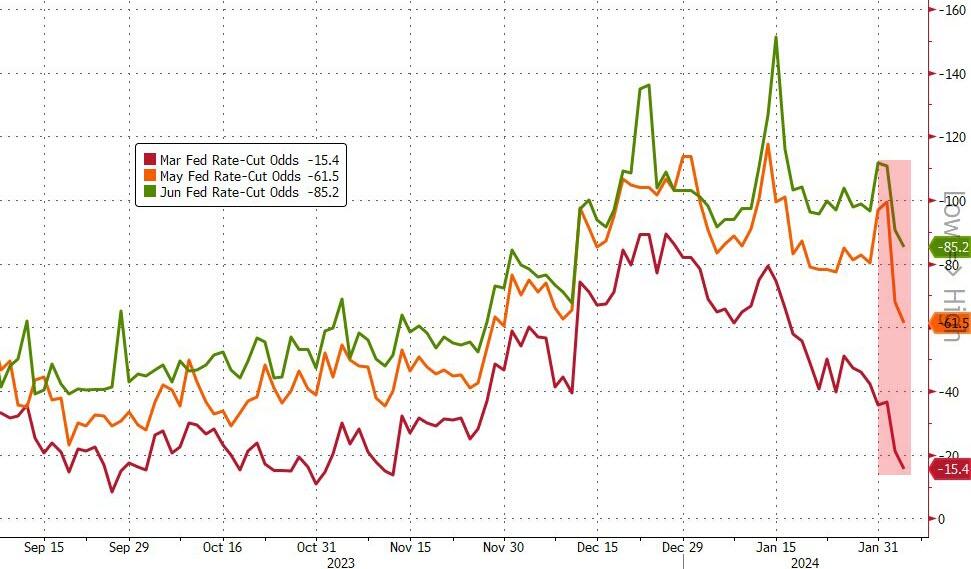
Fed fund futures, which were pricing in some 34 basis points of rate cuts by the time of the May meeting, now reckon about 20 basis points is all they can assign during that review.

It strikes me that unless the labor market goes into some kind of abrupt cataclysm, we may not get a rate cut in May, for the Fed is looking for incontrovertible evidence that the inflation genie is firmly back in the bottle. Inflation needs to be mellow for sufficiently long for the policy committee to act, and the strength of the jobs market together with earnings inflation doesn’t suggest that the smell test will have been met by then.

So it may well be that we get a rate cut in June, September and December — a trajectory that would be consistent with the Fed’s dot plot.

Tyler Durden
Mon, 02/05/2024 – 08:30

via ZeroHedge News https://ift.tt/b9yGclZ Tyler Durden

Futures Drop As Yields, Dollar Jump After Powell Repeats Rate Cuts To Come Later

Futures Drop As Yields, Dollar Jump After Powell Repeats Rate Cuts To Come Later

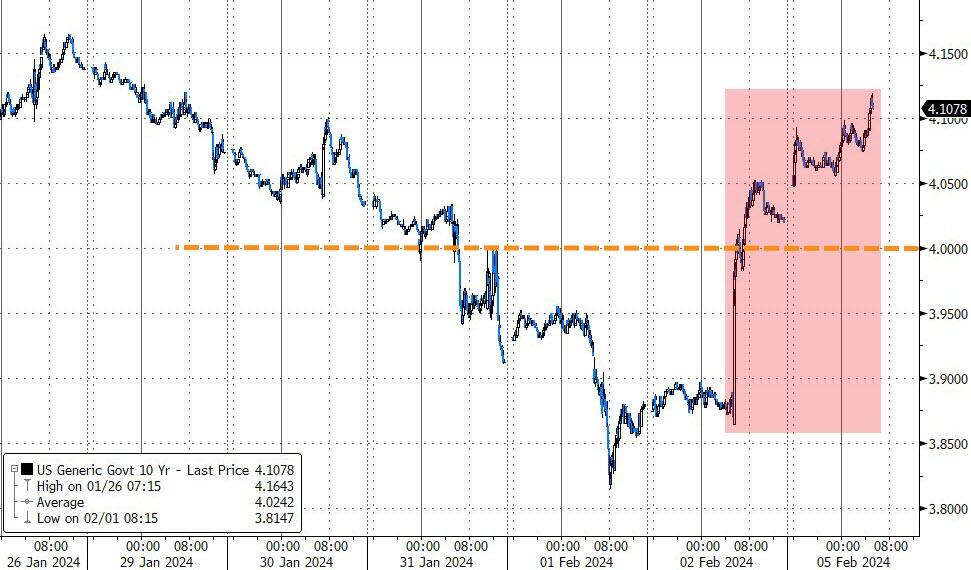
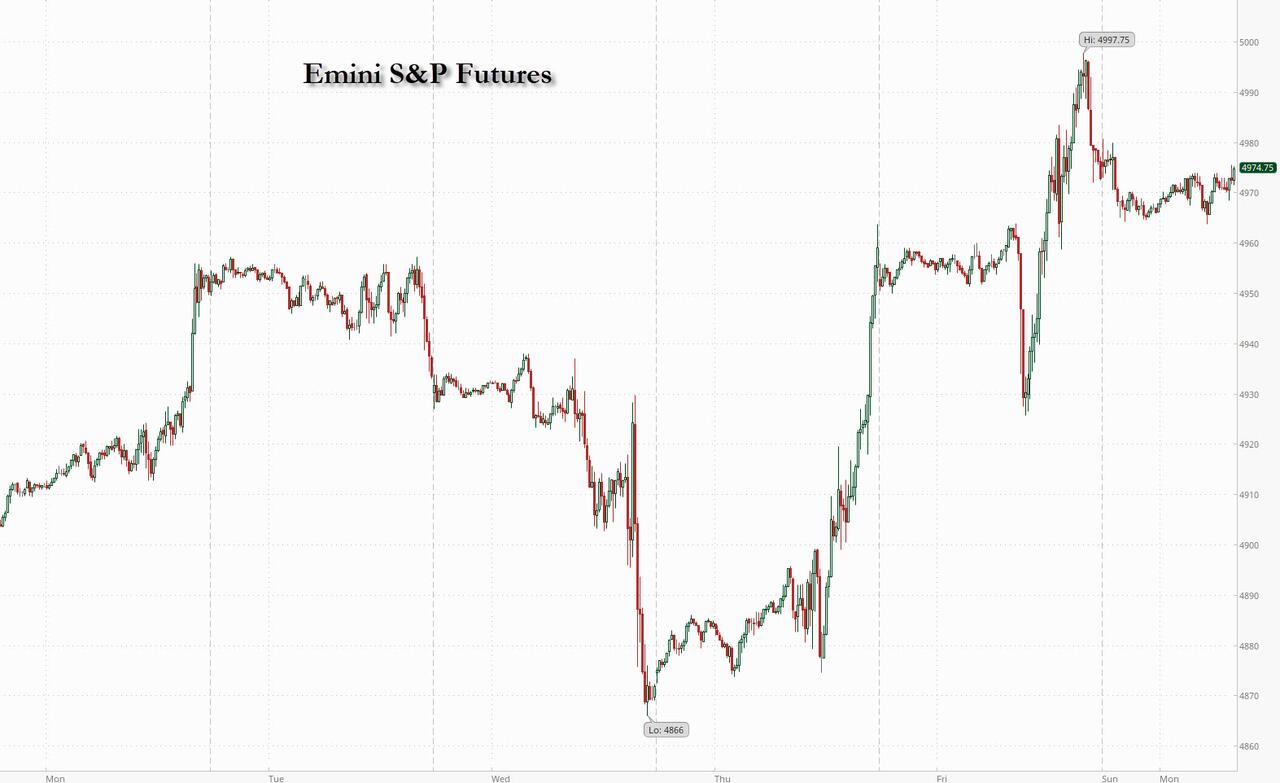
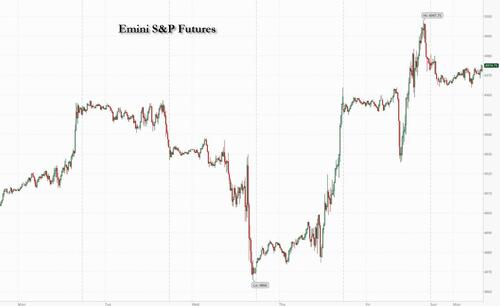
US equity futures and bonds fell while the dollar rose after Fed Chair Jerome Powell again pushed back against any hopes of lower interest rates during his 60 Minutes interview, saying it’s “not likely” the Fed would cut in March (which was to be expected after Friday’s blowout jobs number). As of 7:40am ET S&P futures dropped 0.1% after closing at an all time high on Friday when they rose as high as 4998. Meanwhile, European shares edged higher, supported by strong earnings from Italian lender UniCredit SpA while Asia closed red after a rollercoaster session in China which first plunged then saw another stabilization bid from the plunge protection team. 10-year Treasury yields climbed nine basis points to 4.11%, extending a move that started after Friday’s blockbuster jobs report as yields on debt from Australia to Germany rose. Meanwhile, the Bloomberg Dollar Index traded near a two-month high and oil and gold prices retreated, and bitcoin reversed a weekend selloff
In premarket trading, Caterpillar gained 3.2% after posting fourth-quarter profit that exceeded analysts expectations. On the other end, McDonalds dropped 2% after the fast food giant reported revenue and comparable sales for the fourth quarter that missed the average analyst estimates:

  • Revenue $6.41 billion, +8.1% y/y, estimate $6.45 billion
    • US comparable sales +4.3% vs. +10.3% y/y, estimate +4.45%
    • International operated markets comparable sales +4.4% vs. +12.6% y/y, estimate +5.03%
    • International developmental licensed markets comparable sales +0.7% vs. +16.5% y/y, estimate +5.06%

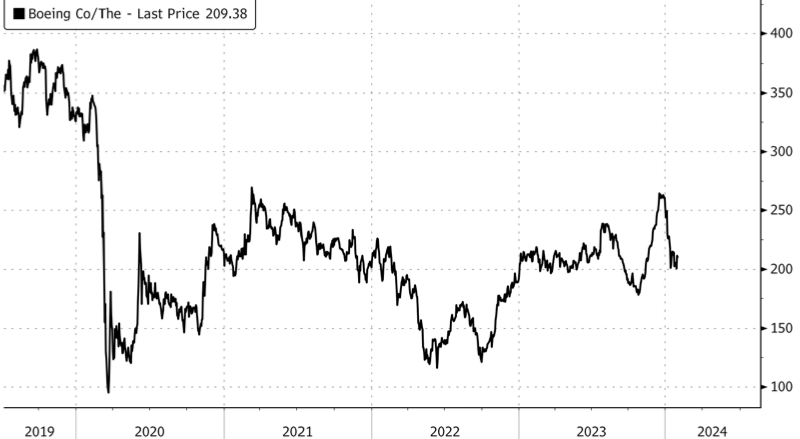
Boeing shares dropped 2.1% after the cursed company found more misdrilled holes on its 737 Max jet, which could further delay deliveries. Fuselage supplier Spirit AeroSystems was also down 3.0% as the latest manufacturing slip originated with a supplier and will require rework on about 50 undelivered 737 jets to repair the faulty rivet holes, Boeing commercial chief Stan Deal said in a note to staff. Here are some other notable premarket movers:

  • 4D Molecular Therapeutics jumps 63% after the biotech reported interim data from its phase 2 clinical trial for a treatment for wet AMD, an eye disease.
  • Air Products slides 7.9% after cutting its outlook for the year’s adjusted earnings per share.
  • Cano Health plunges 51% after the company filed for Chapter 11 bankruptcy.
  • Catalent gains 11% after a deal to be bought by Novo Holdings.
  • Caterpillar Inc. rises 4.4% as higher sales in its energy and transportation business in the 4Q helped the company post profit that topped analysts’ expectations.
  • Elanco Animal Health gains 5.2% after the company said it is selling its fish health business to Merck & Co for $1.3 billion in cash.
  • Estée Lauder soars 15% after saying it’s cutting as many as 3,000 positions as part of a restructuring plan.
  • Everbridge shares rise 18% after the company announced a deal to be acquired by Thoma Bravo.
  • Haynes International gains 3.4% after agreeing to be purchased by Spanish stainless steelmaker Acerinox SA.

In a highly anticipated interview on CBS’s 60 Minutes, Powell said that the “danger of moving too soon is that the job’s not quite done.” The comments add evidence to a view that traders have been over-eager in pricing in interest rate cuts and now need to dial back those expectations. Brom Goldman to Barclays are among those that have pushed back their predictions for the timing of the Fed’s first reduction.

There’s still a lot of uncertainty as to how quickly they cut,” said James Rossiter, head of global macro strategy at Toronto Dominion Bank. “It’s a quiet week for data, so we’ll be watching central bankers very closely.”

After March rate cut odds tumbles after last week’s FOMC, the chance of a quarter-point of easing in March fell to just 10% after Powell’s comments. Compare this to just four weeks ago, when a move by then was considered a near certainty by investors.

Investors said they’ll be paying close attention to the line up of central bank speakers this week for more clues about the direction of monetary policy. Chicago Fed President Austan Goolsbee is scheduled to speak on Bloomberg TV later today, while Cleveland Fed President Loretta Mester and Minneapolis Fed President Neel Kashkari are due to provide remarks on Tuesday.

European stocks bucked the global selling, and the Stoxx 600 rose 0.2%, near session highs, with  food and beverage and personal care sectors are the best performers while automakers underperformed. UniCredit soars as profit beat estimates, allowing the bank to boost shareholder returns, while Nordea Bank falls after reporting fourth-quarter earnings and giving new profitability goals. Here are some of the biggest movers on Monday:

  • Shares in UniCredit jump as much as 10% after the Italian lender reported earnings that beat estimates and boosted shareholder returns on 2023 profit to €8.6 billion, with analysts expecting consensus estimates to rise. Italian peers reporting later this week, including Intesa, gain.
  • Shares in Lotus Bakeries rise as much as 15% to hit a new record high, after the cake and pastry maker’s full-year results beat expectations. As annual sales hit €1 billion for the first time, analysts were impressed by the company’s ability to keep growing its volumes.
  • Shares in Renault climb as much as 4.7% as speculation about possible consolidation in the auto industry is fanned by a press report and analyst notes. The shares pared their gain after Stellantis chairman John Elkann said there’s “no plan” concerning merger operations with other competitors.
  • Shares in Jeronimo Martins jump as much as 3.2% after the retailer was upgraded to overweight from equal-weight at Barclays, which expects another year of double-digit earnings per share growth for the company.
  • Shares in National Grid rise as much as 3.4% after Jefferies upgrades its rating on the power transmission and distribution company to buy, saying it looks set to deliver “highly attractive growth” in both the UK and US.
  • Shares in Nordea fall as much as 4.9%, the most since March 2023, after the Nordic lender reported results. Analysts say the numbers fell short of expectations on profits, but it’s not likely to weigh on estimates going forward.
  • Shares in Atos fall as much as 30% as French IT company said it’s seeking a court-appointed mediator to assist in its refinancing discussion with banks. A planned €720 million ($777 million) rights issue will no longer take place. The news is seen as a blow for equity holders given the risk of significant dilution, according to Oddo.
  • Shares in Delivery Hero fall as much as 10%, extending Friday’s 23% plunge on concern about an Asian deal, even as the German food delivery company pre-released fourth-quarter results that analysts called reassuring.
  • Shares in Vodafone fall as much as 2.1% as analysts looked past the telecom firm’s third-quarter sales beat to highlight uncertainties such as revenue headwinds posed by cable television regulation in Germany and the failed merger of its Italian business.
  • Shares in Barco drop as much as 5.5% after ING cut its rating on the stock to hold from buy, citing a lack of short-term catalysts.
  • Shares in Banco Santander and Lloyds fell after a Financial Times report that Iran was able to covertly move money using accounts at the lenders. Santander told the FT it was “highly focused on sanctions compliance” while Lloyds said it complied with sanctions laws.

In Asia, Chinese stocks saw another volatile session as investors assessed the latest pledges by policymakers to stabilize the slumping equity market. The benchmark CSI 300 index swung between losses of 2.1% and gains of 1.7%. The MSCI Asia Pacific Index declined as much as 0.7%, with Tencent, Samsung and BHP among the biggest drags. Benchmarks declined more than 1% in Australia, South Korea and Singapore. Japanese equities climbed after the yen weakened. The China Securities Regulatory Commission vowed on Sunday to prevent abnormal fluctuations, though the plan was short on specifics and sparked another early liquidation in China. The CSI 300 Index slumped 4.6% in chaotic trading last week to its lowest level in five years.

“Whether or not today marks the floor to Chinese equities is yet to be seen, but it sure feels as though we’re bumping along the bottom,” said David Chao, a strategist at Invesco Asset Management in Singapore.

  • Hang Seng and Shanghai Comp were initially both pressured from early on in a continuation of the equity rout after Chinese stocks plunged to five-year lows despite the PBoC’s previously announced RRR cut taking effect, while the securities regulator pledged to stabilise the market and prevent abnormal market fluctuations although refrained from announcing specific measures. As such, Chinese markets later recovered from their lows which saw both benchmarks briefly turn positive.
  • ASX 200 was dragged lower by underperformance in the commodity-related sectors and as participants await tomorrow’s RBA decision, while Australian Services and Composite PMI data improved but remained in contraction territory.
  • Nikkei 225 was underpinned by recent currency weakness and with the biggest movers influenced by earnings.
  • Indian stocks declined, erasing all of their initial gains as Reliance Industries Ltd. and lenders retreated. The S&P BSE Sensex fell 0.5% to 71,731.42 as of 03:45 p.m. in Mumbai, while the NSE Nifty 50 Index declined 0.4% to 21,771.70. In comparison, the MSCI Asia Pacific index finished 0.2% lower. Nine of the 15 NSE sectors closed in the red, with the consumption and fast-moving consumer goods gauges leading on the way down. Out of 30 shares in the Sensex, 8 rose and 22 fell.  

In FX, the Bloomberg Dollar Spot Index rose 0.3% to its highest level since Dec. 12, while Treasuries bear-flattened, as traders moved to pricing only a 10% chance of a quarter-point Fed cut in March following Powell’s CBS interview.

  • The Norwegian krone, Swedish krona and Australian dollar led G-10 losses against the dollar on dampened risk appetite
  • USD/JPY rose as much as 0.3% to 148.82, the highest level since November; Currency pair saw a 1.3% daily gain on Friday after strong US payrolls data, the biggest daily move in three months
  • EUR/USD slumped as much as 0.4% to 1.0747, the lowest level since Dec. 11; European government bonds fell in tandem with Treasuries

In rates, treasuries bear-flattened with two-year yields climbing as much as 10bps to a one-month high of 4.46% while the 10Y rose 9bps to 4.12%  after Powell said Americans may have to wait beyond March for the central bank to cut interest rates, adding to gains seen on Friday after the blockbuster jobs report. European bonds have followed suit. Treasury auctions resume Tuesday with $54b 3-year note sale, followed by $42b 10-year and $25b 30-year on Wednesday and Thursday.

In commodities, oil prices declined, with WTI falling 0.5% to trade near $71.90 overlooking geopolitical tension after American forces launched attacks against the Houthis, following strikes on Iranian forces and militias in Syria and Iraq late last week. Spot gold falls 0.7%.

On today’s calendar, we have January S&P services PMI (9:45am), ISM services index (10am); The senior loan officer opinion survey is scheduled for release at 2pm.Federal Reserve members scheduled to speak include Goolsbee (10am) and Bostic (2pm); busy week for Fed speakers also includes Mester, Kashkari, Collins, Harker, Kugler, Barkin, Bowman and Logan.

Market Snapshot

  • S&P 500 futures down 0.3% to 4,967.50
  • STOXX Europe 600 little changed at 483.80
  • MXAP down 0.2% to 166.08
  • MXAPJ down 0.6% to 505.32
  • Nikkei up 0.5% to 36,354.16
  • Topix up 0.7% to 2,556.71
  • Hang Seng Index down 0.2% to 15,510.01
  • Shanghai Composite down 1.0% to 2,702.19
  • Sensex down 0.4% to 71,777.05
  • Australia S&P/ASX 200 down 1.0% to 7,625.85
  • Kospi down 0.9% to 2,591.31
  • German 10Y yield up 3 bps at 2.27%
  • Euro down 0.3% to $1.0761
  • Brent Futures down 0.4% to $76.99/bbl
  • Gold spot down 0.9% to $2,021.03
  • US Dollar Index up 0.25% to 104.19

Top Overnight News

  • Federal Reserve Chair Jerome Powell said Americans may have to wait beyond March for the central bank to cut interest rates as officials look for more economic data to confirm that inflation is headed down to 2%.
  • US bonds fell after Federal Reserve Chair Jerome Powell pushed back against the prospect of an interest-rate cut in March, further dashing hopes of a speedy pivot toward easier monetary policy.
  • Chinese stocks were caught in another volatile session Monday following last week’s rout, as investors assessed the latest pledges by policymakers to stabilize the slumping equity market.
  • The US vowed more strikes against Iran’s forces and its proxies in the Middle East after three straight days of punishing attacks, even as Washington insisted it won’t be pulled into a prolonged regional conflict.
  • President Joe Biden implored Nevada voters to make Republican frontrunner Donald Trump a “loser,” part of a two-day swing designed to gain an advantage in a battleground state he hopes to win again later this year.

A more detailed look at global markets courtesy of Newsquawk

Asia-Pac stocks were mostly subdued after last Friday’s red-hot jobs report and the latest comments from Fed Chair Powell who reiterated the expectation that a March cut is likely too soon. ASX 200 was dragged lower by underperformance in the commodity-related sectors and as participants await tomorrow’s RBA decision, while Australian Services and Composite PMI data improved but remained in contraction territory. Nikkei 225 was underpinned by recent currency weakness and with the biggest movers influenced by earnings. Hang Seng and Shanghai Comp were initially both pressured from early on in a continuation of the equity rout after Chinese stocks plunged to five-year lows despite the PBoC’s previously announced RRR cut taking effect, while the securities regulator pledged to stabilise the market and prevent abnormal market fluctuations although refrained from announcing specific measures. As such, Chinese markets later recovered from their lows which saw both benchmarks briefly turn positive.

Top Asian News

  • China’s securities regulator vowed to stabilise the market and prevent abnormal market fluctuations although refrained from announcing specific measures, while it will crack down on ill-intended short-selling and attract more investment by long-term capital. It was also reported that China is to step up financing support for major private projects, according to Bloomberg.
  • Indonesia Central Bank Governor Warjiyo said there should be room to cut rates, but they are waiting for the IDR to strengthen and stated that Indonesia’s economy is in an upward cycle with a peak seen in 2026.
  • Foxconn (2317 TW) January sales down 20.9% Y/Y; the outlook for the first quarter of this year is expected to decrease Y/Y

European equities are mixed, Stoxx600 (+0.1%); though the FTSE MIB outperforms, lifted by gains in UniCredit (+8.7%), post-earnings. European sectors also hold onto a mixed footing; Optimised Personal Care and Grocery is lifted by Jeronimo Martin (+2.5%) whilst Energy lags in tandem with broader weakness in the crude complex given sentiment/USD strength. US equity futures (ES -0.2%, NQ -0.2%, RTY -0.8%) hold just below the unchanged mark and within a relatively tight range; with the exception of the RTY, which significantly underperforms in a continuation of Friday’s price action.

Top European News

  • UK seeks to end the Northern Ireland impasse and unveiled a plan to reduce trade friction on goods flowing from Great Britain to Northern Ireland, according to Bloomberg.
  • Sinn Fein’s Michelle O’Neil was formally appointed as Northern Ireland’s First Minister to become the first Irish nationalist to hold the post, according to Reuters.
  • ECB’s Elderson said that they see a lot is going well for banks in the area of climate risks even if no single bank has currently met all expectations.
  • ECB’s Vujcic said patience is needed and need to ensure there aren’t any second-round effects on inflation from wages before cutting interest rates, according to Bloomberg.
  • UK ONS Labour Force Survey re-weighting: Unemployment Rate in three-months to November 3.9% (prev. estimate 4.2%).
  • German Ifo writes that the lack of orders within manufacturing is becoming an increasing burden on the domestic economy
  • OECD raises 2024 global growth forecast to 2.9% from 2.7%, holds 2025 forecast at 3%. US 2024 forecast raised to 2.1% from 1.5%, 2025 held at 1.7%. EZ 2024 forecast cut to 0.6% from 0.9%, 2025 lowered to 1.3% from 1.5%. Chinese 2024 forecast held at 4.7%, 2025 held at 4.2%. Japan 2024 growth held at 1.0%, 2025 lowered to 1% from 1.2%. UK 2024 forecast held at 0.7%, 2025 held at 1.2%. Expects Fed to cut rates in Q2, ECB in Q3; policy will remain restrictive for some time.

FX

  • The Dollar is still enjoying the spoils from the post-NFP bounce printing a 104.29 high for the session thus far; next level to the upside goes back to 104.50 ahead of a cluster of highs between 104.50-60 from mid-Nov.
  • EUR is still hampered by the USD with the pair at its lowest level since mid-Dec., 1.0750 is the trough today; 11th December low at 1.0740.
  • JPY is steady vs. the USD but near Friday’s levels with upside in USD/JPY running out of momentum at the 28th Nov. high of 148.83.
  • AUD remains the laggard of the antipodes amid cautious sentiment surrounding China. Downtrend since late Dec continues to extend with AUD/USD low today of 0.6487 the lowest since mid-Nov.
  • PBoC set USD/CNY mid-point at 7.1070 vs exp. 7.2088 (prev. 7.1006).

US Headlines

  • Fed Chair Powell said with the economy strong, they feel that they can approach the rate cut timing question carefully but repeated expectation that the March meeting is likely too soon to have confidence to start rate cuts and want more confidence before taking the very important step of starting rate cuts. Powell said they are making good progress on inflation and could move sooner if they saw labour market weakness or inflation persuasively coming down but added that more persistent inflation could mean a later move and that there is no easy, simple, obvious path, according to 60 Minutes interview. Furthermore, FT reported that Powell said the Fed expects to make three cuts this year and a CBS reporter noted that Powell suggested the first cut could occur around mid-year.
  • Fed’s Bowman (voter) said on Friday that she expects inflation to decline further with the policy rate held steady and it will eventually become appropriate to gradually cut rates if inflation continues to decline. Bowman also stated that upside risks to inflation include labour market tightness, easing financial conditions and geopolitics, while she will remain cautious on policy and watchful on data and revisions. Furthermore, she said reducing the policy rate too soon could mean more hikes will be needed in the future and she remains willing to raise the policy rate at a future meeting if needed, according to Reuters.
  • US Senate Majority Leader Schumer announced a bipartisan bill that toughens border security and grants new aid to Ukraine, Taiwan and Israel, while the national security supplemental package totals USD 118bln and includes USD 60bln in military support to Ukraine and USD 14bln in security assistance for Israel, while it includes USD 30bln to strengthen US border security, according to a Reuters source.
  • US President Biden said he strongly supports the bipartisan deal and that it is the toughest and fairest set of border reforms in decades, but added that there is more work to be done to get it over the finish line, while it was separately reported that US Senator Murphy said the bill also authorises a quarter of a million more visas which will reunite thousands of families, according to Reuters.
  • US House Majority Leader Scalise said the Senate border bill will not receive a vote in the House, while House Speaker Johnson also said if this bipartisan bill reaches the House, it will be dead upon arrival.
  • US President Biden is reportedly weighing joining Las Vegas hotel workers if they go on strike on Monday, according to the union chief.

Fixed Income

  • USTs are slumping in a continuation of the post-Payroll move with Chair Powell factoring, alongside Bowman & Goolsbee also being unwilling to commit to a specific period; voter Bowman adding that she “remains willing to raise the policy rate” if required, currently 111-07 towards session lows.
  • Bunds are unreactive to the morning’s Final Composite & Services PMIs, which were subject to modest revisions. Within them, concern over wages/prices in the service sector remain a highlight and potentially influenced action on the margin; thus far, narrow 60 tick band which is well within Friday’s 134.82-135.88 extremes.
  • Gilts are similarly pressured, with further hawkishness filtering through post-BoE as we are yet to hear from those who voted for unchanged (ex-Pill) for any insight into when to expect the first cut; currently trading towards the session trough at 98.20.

Commodities

  • Modest pressure in the crude benchmarks as the USD continues to strengthen post-NFP/Powell. Attention is still firmly on geopols. after US/UK strikes against the Houthi’s and Kirby announcing more action will follow.
  • Gold is unable to derive any benefit from geopolitical risk as the USD firms and yields lift across the board. Action which has sent XAU below its 50- & 21-DMAs of USD 2034/oz and 2029/oz respectively.
  • Base metals are pressured given the overall risk tone and USD strength with little on the docket near-term to change this narrative before the afternoon’s US data points.
  • Two Ukrainian drones hit a primary oil processing facility at the Volgograd oil refinery in southern Russia.

Geopolitics – Middle East

  • US and UK carried out strikes against 36 Houthi targets which included missile systems, launchers, air defence systems, radar and buried weapons storage facilities, while the UK government said this was not an escalation, according to Reuters. US Central Command also announced its forces conducted a strike on four anti-cruise missiles which were prepared to launch against ships in the Red Sea.
  • Yemen’s Houthi spokesperson said the continuation of US-British aggression will not achieve any goal for the aggressors and Yemen’s decision to support Gaza will not be affected by the attacks, while the spokesperson added that Yemeni military capabilities are not easily destroyed and were rebuilt during years of tough war, according to Reuters.
  • White House’s Kirby said strikes on Friday against Iran-backed groups were just the first round of action and more action will follow, according to an interview with Fox News.
  • US National Security Adviser Sullivan said there will be more steps in the US response to the drone strike in Jordan and that the US would not describe it as an open-ended military campaign but added that if the US continues to see threats and attacks, they will respond to them. Sullivan also stated that Gaza humanitarian issues will be the top priority for Secretary of State Blinken on his trip and that the ball is in Hamas’ court on the hostage proposal, according to Reuters.
  • Iraqi military spokesperson said US air strikes constitute a violation of Iraqi sovereignty and pose a threat that could lead Iraq and the region into dire consequences. It was also reported that the Iraqi PM denied the US had coordinated air strikes with the Iraq government and called those claims lies, while the Iraqi PM said 16 were killed including civilians and 25 were wounded in the US aggression against Iraq’s sovereignty. Furthermore, Iraq’s Foreign Ministry summoned the US Charge D’Affaires to Baghdad and handed a note of protest against US attacks in Iraq, according to Reuters.
  • Iran strongly condemned the US military strikes which it said were violations of the sovereignty and territorial integrity of Iraq and Syria, while it added that US attacks represent another adventurous and strategic mistake by the US that will result only in increased tension in instability in the region. Syria’s Foreign Ministry also condemned the US attack on Syrian territory and stated that the US is fuelling conflict in the region in a very dangerous way.
  • Israeli army said its warplanes bombed an operational headquarters and military infrastructure of Hezbollah in the area of the village of Yaron and they also targeted a Hezbollah observation point in the village of Maroun al-Ras in southern Lebanon, according to Al Jazeera.

Geopolitics – Other

  • Ukrainian President Zelensky said he was considering replacing several officials including state leaders and in the military.
  • G7 countries are reportedly drawing up plans to issue debt to help fund Ukraine using Russian assets as a backstop for the repayment, according to FT.
  • South Korea summoned the Russian envoy over Moscow’s comment criticising President Yoon’s remarks on North Korea.

US Event Calendar

  • 09:45: Jan. S&P Global US Services PMI, est. 52.9, prior 52.9
  • 09:45: Jan. S&P Global US Composite PMI, est. 52.4, prior 52.3
  • 10:00: Jan. ISM Services Index, est. 52.0, prior 50.6, revised 50.5
  • 14:00: Senior Loan Officer Opinion Survey on Bank Lending Practices

DB’s Jim Reid concludes the overnight wrap

Well, that was some week we just had. To very briefly front-run our own regular full weekly recap at the end, 2yr US yields rose +16.1bps on Friday (the largest since March), a March Fed cut pricing fell to 22% (from 50% a week earlier), the Magnificent Seven rose +5.45% on Friday alone with Meta adding the most amount of daily market cap ever ($197bn), this sent the S&P 500 to a fresh all-time high even though 73% of the Russell 2000 fell on Friday, while the US Regional Bank index fell -7.23% on the week. That opening para is enough to wear anyone out.

Meta’s +20.3% increase on Friday after their results was the biggest micro story on Friday but the jobs report was also a big boost to market cap weighted indices, helping them shrug off the implications for monetary policy on smaller companies, and also the renewed Regional Bank fears.

Digging into that data, January’s strong payrolls report was driven by headline (+353k vs +185k expected) and private (+317k vs+170k expected) numbers massively beating expectations, alongside 126k of upward revisions to the prior two months. In addition, average hourly earnings surprised to the upside (+0.6% vs. +0.4%) but with a two-tenths drop in hours worked (34.1 vs. 34.3) which was the one inconsistent part of the report, even if bad weather could have been an influence. Elsewhere, the unemployment rate of 3.7% (3.8% expected) was a basis point from rounding down to 3.6%.

Fed Chair Powell wouldn’t have seen these numbers before the FOMC and before his taped interview aired last night on “60 minutes” where he indicated that the March meeting is likely too soon to have confidence in starting rate cuts. He added that the Fed will likely move at a considerably slower pace than the market expects. To be fair nothing much new here, but the confirmation that he wasn’t going to use the broadcast for a big dovish turnaround has caused 2yr and 10yr treasuries to back up 4-5bps overnight, adding to Friday’s big climb. Following this interview, there are lots of Fed speakers this week to give their take on the FOMC and payrolls. See the list in the calendar at the end.

Chinese stocks have been on a wild ride this morning with the small cap CSI 1000 down -8% at one point before halving those losses as I type. The Shanghai Composite was down over -3.5% but is now closing in on flat in a very volatile session. Small caps have been sold against large caps recently as the market views intervention as helping the larger indices. Perhaps some triggers or short covering came in to support the bounce back. This vol came even after the Chinese securities regulator (CSRC) vowed to maintain market stability on Sunday.

Elsewhere in Asia, the Nikkei (+0.52%) is outperforming with even the Hang Seng now up +0.49% after opening around -1.3% lower. S&P 500 (-0.27%) & NASDAQ 100 (-0.29%) futures are drifting lower. The impact of Treasury declines on Friday and this morning can be seen across Asian bond markets as well, with 10yr yields on Australian government debt up +12.3bps to 4.10% while 10yr JGB yields are +5bps at 0.72% as we go to press.

Early morning data showed that China’s services activity expanded at a slightly slower pace in January, as the Caixin services PMI edged down to 52.7 from 52.9 in December as new orders fell.

There’s not a huge amount of US data this week, as is usually the case post payrolls, but the highlight could be the annual BLS revisions to the seasonal factors for CPI on Friday. Both Waller (pre FOMC blackout) and Powell (at the FOMC) noted that these are an important landmark to get past before potential rate cuts can be better calibrated. Last year, these revisions lowered H1 inflation and increased H2 which changed the momentum profile of inflation.

Before we get there, today sees the services ISM (consensus 52.0) which negatively surprised a month ago (at 50.6 and below all estimates), with the employment series the lowest since July 2020 (down from 50.7 to 43.3). That clearly was completely at odds with payrolls on Friday, so we’ll find out today if that was an anomaly. Also anomalous has been the recent creep higher in initial jobless claims of late with continuous claims only having been higher for one week since November 2021. So another number to watch.

Today’s Fed Senior Loan Officer’s survey (SLOOS) should be very important but very tight bank lending in recent quarters hasn’t so far translated into reduced activity as it has done in the past. We don’t know why this is the case. It’s possible that excess savings or cash are still high enough in the economy that business and consumers don’t need much access to what would be very tight bank lending. This wouldn’t be able to carry on forever so the survey results today are still important to see if banks are becoming less restrictive after some improvements last quarter. You can find the other US data in the diary at the end.

Outside the US, China inflation numbers on Thursday are worth watching. Current estimates on Bloomberg suggest the CPI is expected to fall further into negative territory from -0.3% YoY in December to -0.5% YoY in January. The PPI is seen marginally edging higher but staying in negative territory (-2.6% vs -2.7% YoY in December). The Chinese CSI index closed at 5-yr lows on Friday so marching to a very different beat to the US at the moment.

In Europe, the focus will be on economic activity in Germany with indicators due including industrial production (Wednesday), factory orders (tomorrow) and the trade balance (today). There will also be industrial production (Friday) and retail sales for Italy (Wednesday) and trade balance data for France (Wednesday). From the ECB, investors will keep an eye on the consumer expectations survey (CES) on Tuesday and the economic bulletin will be due on Thursday.

Elsewhere earnings season soldiers on but after the mega caps from last week, the main highlights this week, which we detail in the calendar at the end, are not going to move the macro needle.

Recapping last week in more detail now, the large beat in payrolls led to a sharp sell-off in US fixed income on Friday as 10yr yields rose +14.1bps. Investors responded by paring back expectations of Fed cuts in 2024, with the expected Fed rate for December rising +21.2bps on Friday, and +9.6bps over the week. The pricing of a 25bps cut by the March meeting fell to 22%, down from 50% a week earlier and a still sizeable 38% as of Thursday despite Powell’s pushback against a March cut at Wednesday’s press conference. This sent 2yr Treasury yields +16.1bps higher on Friday, their largest rise since last March. 2yr yields were up a marginal +1.6bps over the week after their earlier decline amid renewed concerns over the US regional banking sector. 10yr yields were down -11.6bps over the week to 4.02%. The dollar rallied off the prospect of a higher terminal rate, with the dollar index up +0.85% on Friday (+0.47% over the week).

Even as Treasuries sold off, the S&P 500 rallied +1.07% on Friday, and +1.38% in weekly terms. However, less than half of S&P 500 companies were actually up on Friday with gains led by tech megacaps as the Magnificent Seven index rose +5.45% (+4.87% on the week) after earnings from Meta, Amazon, and Apple the evening before. Meta posted a stunning +20.32% rise on Friday, with the $197bn rise in its market cap being the largest daily gain on record for any company. Amazon also gained a strong +7.87% on Friday. The NASDAQ rose by a more moderate +1.74% (+1.12% over the week). On the other hand, the US regional banking index slumped last week, falling -7.23% (+0.20% on Friday) after shares for the New York Community Bancorp dropped -42.03% (+5.04% Friday).

Equity markets were muted elsewhere in the world. The STOXX 600 traded flat on the week (+0.02%), whilst the German DAX and French CAC retreated -0.25% and -0.55%, respectively. In Asia, Chinese equities were very weak last week driven by property sector woes following the court decision to liquidate Evergrande. The Shanghai Comp fell -6.19% (and -1.46% on Friday), its largest weekly decline since October 2018. The CSI 300 slipped -4.63% (and -1.18% on Friday) to 5-yr lows, and the Hang Seng also retreated -2.62% (and -0.21% on Friday).

Lastly, in commodities, crude retreated after Exxon and Chevron announced their second-largest annual profits in a decade despite a fall in oil prices, alongside strong supply from the Permian Basin. This added to the bearish narrative that had begun earlier in the week after data showed that some OPEC+ members may be pumping above their agreed limits and amid reports that we could be getting closer to a cease-fire deal in Gaza. Brent crude futures retreated -7.44% (and -1.74% on Friday) to $77.33/bbl, and WTI crude fell -7.35% (and -2.09% on Friday), the worst weekly slump since October.
Tyler Durden
Mon, 02/05/2024 – 08:17

via ZeroHedge News https://ift.tt/VW7LgHC Tyler Durden

Boeing Discovers “Mis-drilled” Holes On 50 Undelivered 737 Max Jets

Boeing Discovers “Mis-drilled” Holes On 50 Undelivered 737 Max Jets

Boeing’s reputation continues to slide as a new fuselage problem was discovered on 50 undelivered 737 MAX jets, Reuters first reported. 

Stan Deal, the chief executive of Boeing’s commercial plane unit, wrote in a memo to employees on Sunday that the Renton, Washington, factory will “spend several days” to focus on “quality, including inspecting some undelivered airplanes for a potential nonconformance prior to delivery.” 

“This past Thursday, a supplier notified us of a nonconformance in some 737 fuselages. I want to thank an employee at the supplier who flagged to his manager that two holes may not have been drilled exactly to our requirements,” Deal said. 

He noted this production issue “could delay some near-term 737 deliveries” as the factory “will have to perform rework on about 50 undelivered airplanes.” 

Deal didn’t name the supplier. However, Reuters confirmed that fuselage supplier Spirit AeroSystems discovered two misdrilled holes. 

Deal stressed that “this potential condition is not an immediate flight safety issue, and all 737s can continue operating safely, adding, “While this delay in shipment will affect our production schedule, it will improve overall quality and stability.” 

The misdrilled holes disclosed yesterday are yet another problem for the 737 program. 

In August, Boeing identified a manufacturing problem in the aft pressure bulkhead on specific Max jets, which helps maintain cabin pressure. This production issue stems from Spirit AeroSystems, which builds 70% of the narrowbody jet frames. In December, a separate issue of a possible loose bolt in the rudder control system of Max jets was reported. 

Boeing shares were lower 2% in premarket trading on the news. Shares have traded sideways for several years since the two Max crashes, killing 346 people. The first crash was in 2018, and the second in 2019. 

Mounting problems for the 737 program also occurred a month after a door plug ripped off an Alaska Airlines fight over Portland. Boeing CEO David Calhoun told investors last week: “We caused the problem, and we understand that.”

We need to revisit internal communications from Boeing employees that pointed out Max jets were “designed by clowns who in turn are supervised by monkeys.” 

Tyler Durden
Mon, 02/05/2024 – 07:55

via ZeroHedge News https://ift.tt/OgdxJ47 Tyler Durden

“When Markets Move To Extreme Overvaluations, Wild Moves In Price Can Happen”

“When Markets Move To Extreme Overvaluations, Wild Moves In Price Can Happen”

By Eric Peters, CIO of One River Asset Management

Price

US money market fund assets hit a record high of $6trln this week. Gov’t debt hit record highs too. As did US equities, in general. Gold is near a record, US home prices too. In a highly financialized fiat monetary system, many drivers work to influence valuations. Cash flows, earnings, leverage, interest rates, money supply, its velocity, tax rates, optimism, pessimism, uncertainty, confidence, stability, volatility, and expectations about how all such things will change. Investors search for fair market value, but for a trader there’s no such thing, only price.

Money can be created in all sorts of ways in a fiat monetary system. This makes it hard to know how much there is at any given point in time. And while it makes sense that the more money lying around, the higher prices should be in the system. But sometimes, money changes hands slowly, and when this happens, prices can actually move lower no matter how much money is in the system. The inverse is also true. And this makes it even harder to determine the fair value of anything, because it requires you to have to anticipate the velocity of money.

There are periods during which the relationship between most or all the variables that investors use to determine fair value remain rather stable. Those are fairly boring times, and the people who profit the most engage in leveraged carry and mean-reversion types of strategies. Such periods give investors a false sense of confidence that market prices can be forecasted with great confidence using a range of inputs. As confidence turns to arrogance, the potential energy for a major market shift builds. Investors get short volatility. This dynamic never changes.

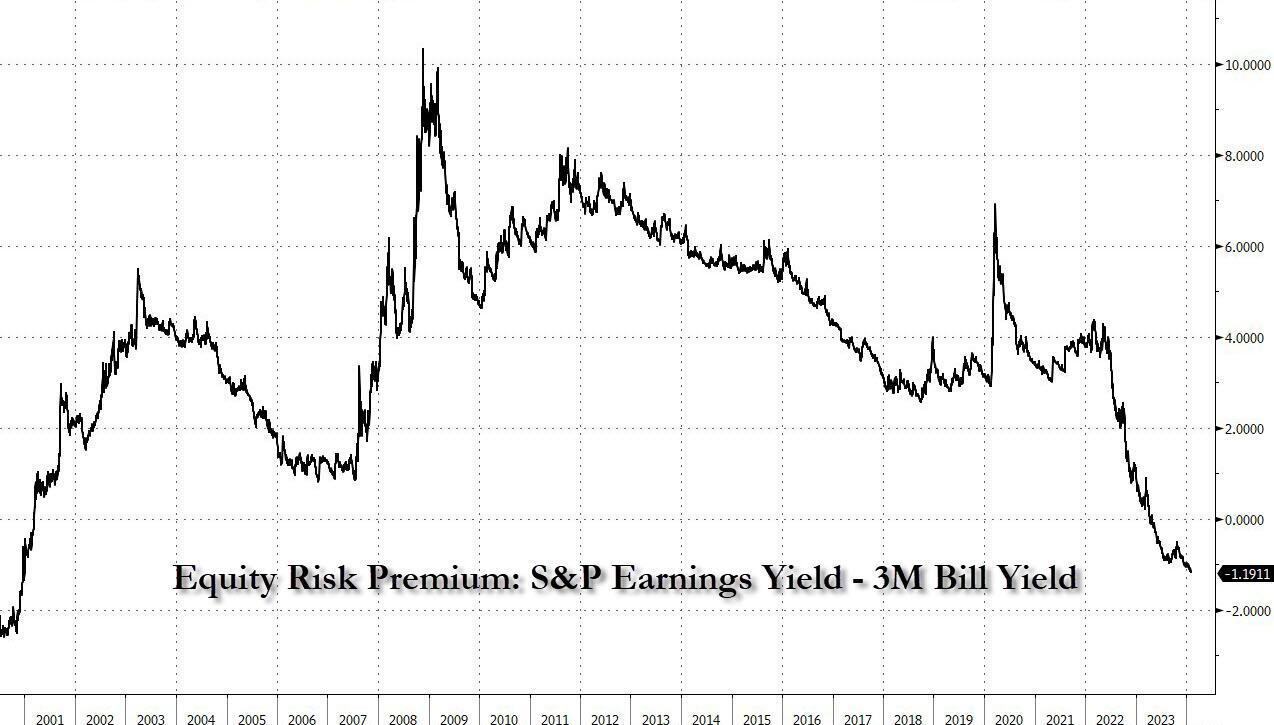
The equity risk premium (ERP) is at 23-year lows. The S&P 500 earnings yield minus 3mth T-bill yields has not been this low since 2001. So, in at least one sense, the market is above fair value. But at the height of the dotcom bubble, the ERP was lower than now. So, all this tells us is that the market is overvalued, and we should not be surprised to see it become more so. No one knows whether the dotcom ERP lows represent an absolute limit. All we know from the past is that when markets move to extreme over/under-valuations, wild moves in price can happen.

If you look at a long-term S&P 500 price-to-earnings ratio, you’ll find that it swings massively. In the early 1980s, investors paid a price of roughly 7x earnings for the S&P 500. In 2001 they paid almost 50x. In 2011 they paid around 13.5x. Now they pay around 27 or so. Wall Street has created armies of analysts to forecast corporate earnings, while relatively little effort is put into forecasting the large swings in the multiple investors are willing to pay for those earnings. Because such forecasts are harder to do; they require less math and more intuition.

For nearly 20yrs, the velocity of money declined. This prompted/allowed policy makers to create massive amounts of money without sparking inflation. No honest economist could really explain it. The Fed got ever more aggressive, searching for the limit. Then along came Covid. Velocity collapsed further, stabilized, reversed. Given that no one really knew why velocity fell, if it now rises powerfully, we’re unlikely to understand why. It won’t really matter though, all that we will need to know is that its effect on prices will dwarf any notion of value.

Tyler Durden
Mon, 02/05/2024 – 07:30

via ZeroHedge News https://ift.tt/5kAeJ6S Tyler Durden