US Intelligence Is ‘Convinced’ Major Iranian Response Against Israel Imminent
US intelligence is ‘convinced’ that Iran is readying a retaliation response against Israel for the Monday attack on the Iranian embassy complex in Syria, US officials have told CBS News, and that an attack could be imminent.
The officials say that the US “has picked up intelligence that Iran is planning a retaliatory attack that would include a swarm of Shaheed loitering drones and cruise missiles. Officials say the timing and target are unknown, but a proportional response to the Damascus attack would be to hit an Israeli diplomatic facility.”
As for possible timing they believe it will come between now and the end of Ramadan next week. Israel has already issued firm warnings that any direct attack from Iranian soil will be met with a “stronger” response, taking the conflict to the next level.
CBS reports further that “A public funeral was held in Tehran on Friday for the seven IRGC members killed in the suspected Israeli strike in Damascus, including two generals.”
One hawkish analyst from the Middle East Institute, Jason Brodsky, has noted on Friday:
There are reports Iran’s regime may be eyeing hitting an Israel diplomatic compound in a third country via drones & missiles. Israel maintains embassies in Bahrain; UAE; Jordan; Egypt; Azerbaijan; & Turkey. I would keep an eye on Jordan.
This is a scenario that Iranian and regional leaders might deem ‘proportionate’. The idea of a sovereign state intentionally attacking another country’s embassy or consulate was pretty much unheard of prior to Israel’s Monday attack.
Israel, however, has tried claim to the international community – which by and large condemned attacking embassies – that what was actually destroyed was a military building used by the Islamic Revolutionary Guard Corps (IRGC).
A handful of publications and pundits have pointed out that the Israeli attack, which killed eleven and took out a top IRGC Quds general, is in fact a declaration of war.
For example, Hamidreza Azizi of the German Institute for International and Security Affairs, immediately sought to underscore that the strikes which flattened a consulate next to the main embassy building “is viewed by some in Iran as a declaration of war by Israel against Iran.”
Israel heading into ‘unprecedented war,’ former IDF official says
The people who lead us today are acting in an unrealistic and irrational way and bring risk and disaster to the countryhttps://t.co/ZhggPmvDrI
He wrote further that “It represents a shift from previous engagements, directly hitting Iranian soil represented by its consulate in Syria—as opposed to targeting IRGC officers in Syrian sites.”
Currently, Israel is bracing for an inevitable response, and is reportedly calling up extra reserve forces. Hezbollah could also open up a bigger war front:
The leader of Lebanon’s Hezbollah movement said on Friday that Iran would inevitably retaliate after a strike — widely blamed on Israel — destroyed its consulate in Damascus this week, killing two generals. “Be certain that Iran’s response to the targeting of its Damascus consulate is inevitable,” Hassan Nasrallah said in a televised speech marking Quds (Jerusalem) Day — an annual day of pro-Palestinian rallies held by Iran and its allies.
At least so far, the daily tit-for-tat fighting along Israel’s northern border has remained contained, but perhaps just barely. Israeli leaders have warned that all of Lebanon could be bombed back to the ‘stone age’ if Hezbollah starts a full war.
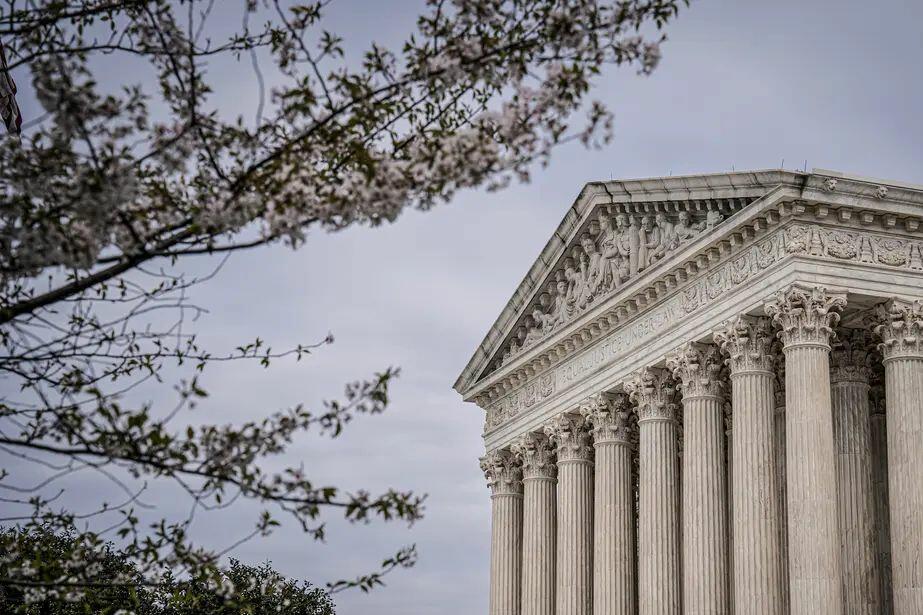
President Joe Biden issued a rare primetime threat to the Supreme Court during his State of the Union address on March 7, warning the justices that they could cause political backlash for their 2022 decision to overturn Roe v. Wade.
“With all due respect, justices, women are not without electoral or political power,” President Biden said.
In doing so, the president amplified that mounting pressure on the Supreme Court, a pressure that seems to build each week as the election nears and the queue of cases related to former President Donald Trump gets longer.
The justices are taking up two major appeals related to President Trump, who is the presumptive GOP nominee and is leading President Biden in polling matchups, including in crucial battleground states.
President Trump’s former advisors are also facing multiple charges, raising the prospect that some may request the high court’s intervention, as former White House advisor Peter Navarro did on March 15. The court’s denial made Mr. Navarro the first Trump White House adviser to end up in prison.
“This is certainly a blockbuster year for the court,” Heritage Foundation Vice President John Malcolm told The Epoch Times.
“Several of the justices, most notably the Chief Justice, have been concerned about the public’s perception of the court’s ‘legitimacy,’ so it will be interesting to see how the justices respond, especially in an important election year.”
‘High Stakes’
The combination of several Trump-related cases, the potential for landmark changes to legal precedent, the vigorous calls for reform, and the coming elections have made 2024 a year of high impact decisions for the court.
One decision has already impacted the course of the 2024 presidential campaign.
In March, the justices rejected an effort that could have resulted in millions of President Trump’s supporters not having their preferred candidate on the ballot. During oral argument, Justice Amy Coney Barrett referenced the “very high stakes” surrounding the case, which has been described as the court’s most influential election-related matter since Bush v. Gore.
Its landmark opinion in Trump v. Anderson foreclosed the possibility that states like Colorado could, under their existing authority, remove federal candidates from ballots.
The majority opinion, however, has been criticized for lacking clarity around how Congress should act. The decision emphasized the role of Congress in enforcing the 14th Amendment, while the three liberal justices and Justice Barrett favored a more limited approach that overruled state authority over federal candidates for office.
President Trump’s immunity appeal, scheduled for oral argument on April 25, could impact his Florida documents case and hush money trial, wherein he has requested a delay pending the Supreme Court’s decision on his D.C. immunity claims.
The stinging criticism that followed the court’s unanimous opinion in Trump v. Anderson indicates no matter how united the justices are, they will continue to face heavy scrutiny—especially when it comes to President Trump.
President Trump’s appeal, like Mr. Navarro’s, questions the separation of powers as well as the authority of the legislative and judiciary branches in challenging the executive.
In Trump v. Anderson, the court avoided wading into the specifics of President Trump’s alleged wrongdoing on Jan. 6 and will likely try to do the same with his immunity appeal. But their decisions in two other cases might impact the indictment in President Trump’s federal election case.
A challenge brought by Jan. 6 defendants against the DOJ’s use of an Enron-era obstruction charge in prosecutions will be heard before the high court on April 16.
In the federal election case, two of those charges were brought against President Trump. If the court rules in the defendants’ favor, as some legal experts predict, that could lessen the burden for President Trump in D.C. while also provoking scrutiny of the justices’ approach to Jan. 6.
The court’s decision in the presidential immunity appeal could similarly either upend or affirm the prosecution—likely sparking backlash from either side depending on the outcome.
Beyond Trump
Besides President Trump’s cases, the court is considering several major cases in administrative law—including potentially overturning the decades-old Chevron doctrine that gives deference to agencies in construing vague language in statutes. A reversal would significantly roll back the power of the administrative state.
In February, it considered whether the Justice Department legally restricted bump stocks. The case, Garland v. Cargill, was the second of three major gun-related cases announced for the term. Two—Cargill and Rahimi v. United States—could alter who owns guns and how they operate them. The third, NRA v. Vullo, could make it easier or more difficult for governments to pressure organizations like those promoting gun rights.
The justices also heard arguments over the constitutionality of two sweeping social media laws from Texas and Florida that, combined with similar cases this term, could dramatically change the landscape of online expression.
In striking those laws, the justices could prevent future state legislation aimed at how social media platforms moderate users’ content and the transparency they provide for censoring certain posts. If laws succeed, social media platforms could see a patchwork of rules for moderating users’ content across the United States and enjoy less discretion in how they do so.
“These are cases that touch upon separation of powers and important constitutional rights, in addition to involving ‘hot button’ issues that will have a major impact on the law now and in the future,” Mr. Malcolm told The Epoch Times.
Court’s Image
With such contentious issues before the court, it seems inevitable that the justices’ decisions will upset large swaths of the American public. The justices could also be weighing how the way they phrase rulings will impact public opinion during such a high-stakes year.
University of Michigan Law Professor Barbara McQuade previously told The Epoch Times she imagined that with Trump v. Anderson, Justice Roberts felt pressure to “maintain the credibility of the Court as an independent and apolitical institution.”
She said “a 9–0 decision would provide the country with far more confidence than would a 6–3 decision.”
Justice Barrett emphasized the importance of unanimity and language while appearing to offer a glimpse into the justices’ concerns. Her concurring opinion in Trump v. Anderson seemed to criticize her colleagues for lacking restraint in their opinion. She had joined the liberal justices in favoring a more limited approach but didn’t sign onto their concurrence, which had some strong words for the majority.
“In my judgment, this is not the time to amplify disagreement with stridency,” she wrote. “The Court has settled a politically charged issue in the volatile season of a Presidential election. Particularly in this circumstance, writings on the Court should turn the national temperature down, not up. For present purposes, our differences are far less important than our unanimity: All nine Justices agree on the outcome of this case. That is the message Americans should take home.”
Canoo CEO’s Private Jet Expenses Were Double The Company’s Revenue For 2023
As we’ve been writing over the last year, saturation and competitive pricing are starting to prompt chaos and disorder in the EV space.
EV startup Canoo is the latest to face scrutiny, after it was revealed that CEO Tony Aquila’s private jet expenses totaled $1.7 million, twice the company’s revenue for 2023.
Despite reporting a loss of $302 million last year, Canoo paid for Aquila’s lavish travel, which included either first-class airfare or use of his private jet. Aquila, who also chairs the company, owns about 14% of Canoo. In 2022, Canoo spent $1.3 million on his air travel, according to a new report from Electrek.
The company, which has yet to turn a profit, generated just $886,000 in revenue in 2023.
Canoo is focused on scaling up production of its commercial vehicles and avoiding the fate of other struggling EV startups. While it faces challenges, such as the recent need for a 1-for-23 reverse stock split to prevent delisting, Canoo received a boost with a contract from the United States Postal Service for six delivery vans.
But, amidst a sea of competition and first movers like Tesla, BYD and legacy automakers, companies like Canoo and the near-bankrupt Fisker are struggling. Ergo, the company CEO’s spending on private jets raises concerns about how the company manages its finances, particularly given its recent stock drop of up to 38% after reporting losses.
Reuters was first to report the massive cost/revenue divergence.
Canoo responded with a statement: “Had Reuters called Canoo for comment we would have told them that we raised $324 million in 2022, and $288 million in 2023 and we are currently in discussions with several entities and individuals about investing in the company this year.”
“We would have also told them that we have begun manufacturing, expect to step up our manufacturing effort this year, and have a backlog of orders. And, that we are not in the consumer market, we are in the commercial market,” the company added.
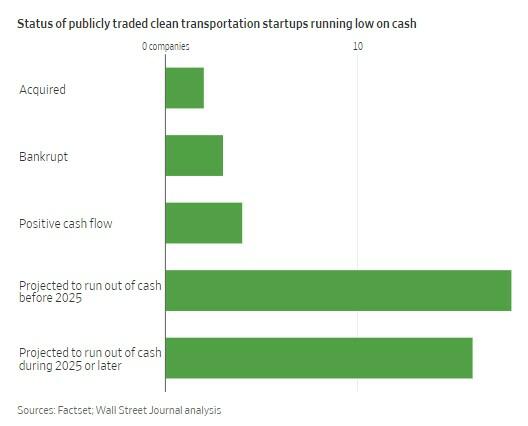
We wrote late last year that all of the Tesla-wannabe EV companies were running out of cash.
The report noted that at least 18 EV and battery startups, including high-profile names like Nikola and Fisker, face the risk of depleting their cash reserves by the end of 2024. These companies, once known for their ambitious goals to revolutionize the industry with electric trucks and SUVs, have struggled with increasing costs and manufacturing challenges.
Names like Lordstown Motors, Proterra, and Electric Last Mile Solutions have already declared bankruptcy, the report notes. Romeo Power, a battery manufacturer, and Volta, a charging company, were sold for much less than their initial public valuations. The remaining firms are reportedly focusing on cost reduction and have secured additional funding.
Gavin Baker, chief investment officer at Atreides Management, told WSJ: “It was by far the most insane bubble I have ever seen.”
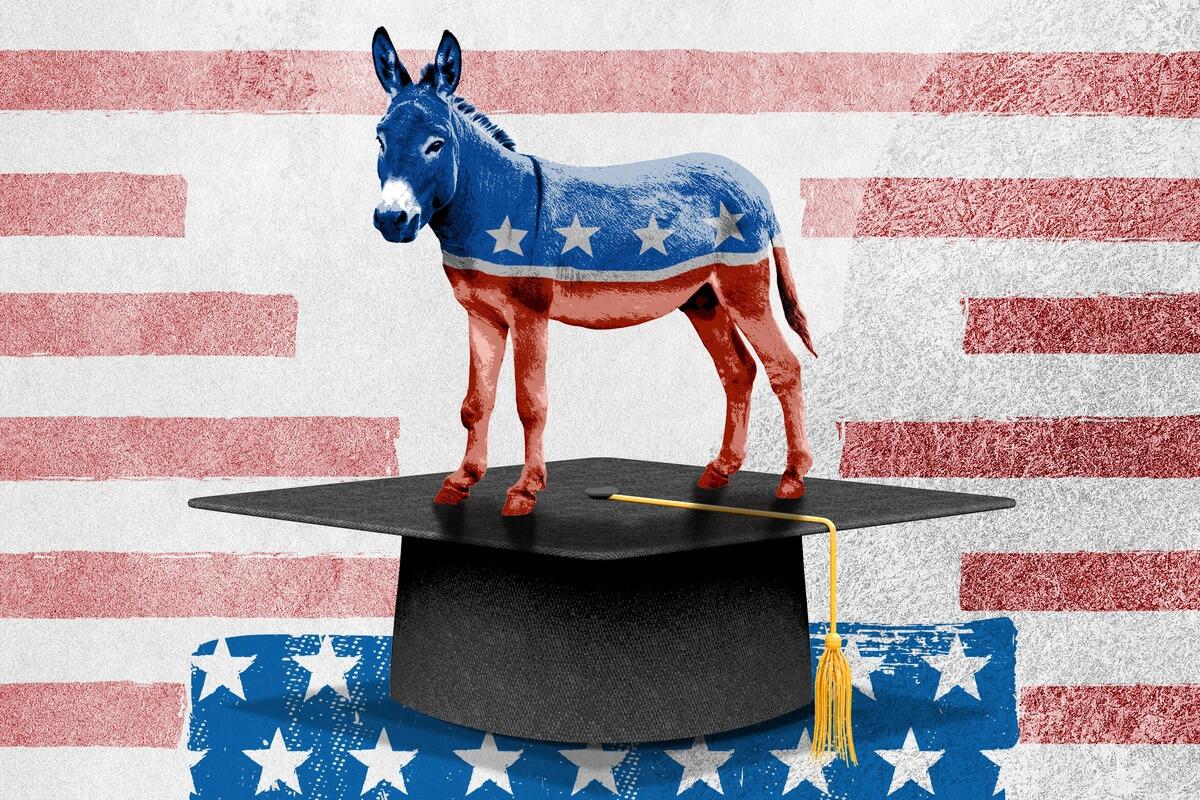
America’s students, who according to an analysis by Tufts University helped elect Biden in key swing states in 2020, could prove to be pivotal in this regard, both as targets and as foot soldiers in the party’s get-out-the-vote drives.
Meanwhile, a lawsuit currently moving through Wisconsin courts appears to provide a case study for how these campaigns translate into election wins for the Democratic Party.
In February, Vice President Kamala Harris highlighted that the government is paying college students to register voters.
“We have been doing work to promote voter participation for students. And, for example we … now allow students to get paid through Federal Work Study to register people and to be nonpartisan poll workers,” she said.
Ms. Harris said the Biden administration has been able “to charge federal agencies with doing the work that they rightly can do to inform the American people of their right to vote.”
Paying students to canvass is the latest component of an initiative originated under former President Barack Obama to increase student voting. Initially this was carried out in conjunction with private nonprofit organizations such as Civic Nation.
Founded with the support of President Obama, his wife, and Joe Biden in 2015, and led by former Obama staffers, Civic Nation now boasts a partnership with 1,700 colleges and universities and a reported budget of more than $16 million in 2020.
Its stated goal is “fighting for gender equity, social justice, and more,” and it leads the “All In Campus Democracy Challenge” that engages with university administrators to get them to sign up student voters.
All In runs school get-out-the-vote competitions in all 50 states. According to its website, it has partnered with 994 institutions and signed up more than 10 million students. As part of the “challenge,” schools agree to share student voting data.
Civic Nation receives much of its funding from a network of progressive charitable funds managed by Arabella Advisors, which oversees a network of nonprofit vehicles that finance left-wing political campaigns.
Under the Biden administration, however, the student get-out-the-vote campaign is now being run with federal funds, spearheaded by the U.S. Department of Education.
President Biden’s Executive Order 14019 compels all government agencies to take part in a nationwide effort to register voters and includes a program by the Department of Education (DOE) that pressures educational institutions to demonstrate that they have signed up students to vote.
Following the issuance of EO14019, the DOE sent schools a “Dear Colleague Letter” to “remind institutions of higher education of the federal requirements regarding voting that are tied to participation in federal student aid programs.”
The letter, according to the DOE, also clarifies when Federal Work Study dollars can be used “for nonpartisan civic engagement work.”
According to a 2022 report by Tufts University’s Center for Information and Research on Civic Learning and Engagement (CIRCLE), “youth ages 18–29 are the only age group in which a strong majority supported Democrats.”
Up until 2002, the youth vote was evenly split between the two parties, the report stated, but since that time young people have shifted sharply in favor Democrats by what is now a 28-point margin. The get-out-the-vote campaigns do not target all young voters equally, however. Instead, they focus their efforts on the most reliable Democrat voters—those who attend college.
A 2020 survey by Pew Research found that the single largest voter gap in favor of Democrats was white college-educated women, of whom 62 percent voted Democrat versus 34 percent who voted Republican. Conversely, non-college white men favored the Republican Party by a margin of 32 points, with 62 percent for Republicans and 30 percent for Democrats.
“Democrats increasingly dominate in party identification among white college graduates,” the report states. “Republicans increasingly dominate in party affiliation among white non-college voters.”
Students Vote Like Their Teachers
A 2020 report by the National Association of Scholars found that Democrat-registered professors outnumbered Republican-registered professors by a ratio of 10-to-1, a gap that has widened from 4.5-to-1 in 1999.
“Research since World War II has consistently found overwhelmingly left-oriented political attitudes and ideological self-identification among college and university faculty,” the Association states. “It has also found overwhelming support for the Democratic Party.”
The other factor that makes the college vote so attractive to Democrats is the location of college students in key swing states, where a few thousand votes can deliver a win in a tight election. For this reason it may not be coincidental that the youth turnout rate has been much higher in swing states than non-swing states.
The CIRCLE report found that among the highest states for youth voter turnout were Michigan, Minnesota, Pennsylvania, Arizona, Colorado, Maine, Nevada, and Georgia. In Michigan and Pennsylvania, for example, 36.5 percent and 31.7 percent of residents under the age of 29 voted in 2022.
This contrasts sharply with neighboring non swing states such as West Virginia (14.2 percent), Delaware (18.7 percent), New Jersey (20.6 percent), Ohio (21.6 percent), Connecticut (21.4 percent), New York (20.7 percent), and Massachusetts (18.5 percent). Oregon, a reliable blue state, bucked this trend with 35.5 percent youth turnout.
US Urges Tehran Not To Target American Bases If It Retaliates Against Israel
Iran says it conveyed a rare direct message to the Untied States in the form of a written statement, at a moment the Middle East region is on edge, bracing for possible retaliation from Iran against Israel for the Monday attack on the Iranian embassy in Damascus. Iran now says it received an immediate response from the Biden administration, which warned Tehran not to attack US facilities as part of any potential revenge operation.
Iranian presidential aide Mohammad Jamshidi said the following on Friday: “In a written message, the Islamic Republic of Iran warns US leadership not to get dragged in Netanyahu’s trap for US: Stay away so you won’t get hurt.
The official continued, “In response US asked Iran not to target American facilities.” Since Oct.7, Iranian proxies in Iraq and Syria have sent drones and missiles against US bases many dozens of times, but these attacks have waned in last couple of months.
Throughout this span, however, Iran has never directly attacked US facilities from its soil. This did happen on a large scale in the immediate wake of the January 2020 US assassination by drone of IRGC Quds Force commander Qasem Soleimani, however. That’s when Iranian ballistic missiles rained down on two Iraqi air bases housing US forces, resulting in American troop injuries at the time.
In the wake of this week’s Israeli attack on Iran’s embassy in Syria, which killed two senior IRGC commanders, the Biden administration quickly sought to distance the US from any involvement.
Deputy Pentagon Press Secretary Sabrina Singh had confirmed that US officials reached out to Tehran to convey that Washington was not responsible for the strike, which was an unprecedented attack given it was against a diplomatic facility, which is supposed to fall under the protection of the Vienna Convention on Diplomatic Relations.
“We were not notified by the Israelis about their strike or the intended target of their strike in Damascus,” Singh said earlier this week.
However, Axios reported at the same time that the Israelis notified the US merely minutes before the strike, and that this was not an effort to seek a greenlight, but just a notification of an operation already in action.
Iran has still laid blame on the US for enabling Israeli aggression by being its biggest weapons supplier. The Pentagon says this is a concern:
On Wednesday in Washington, the top U.S. Air Force commander for the Middle East, Lt. Gen. Alexus Grynkewich, said Iran’s assertion that the U.S. bears responsibility for Israeli actions could bring an end to a pause in militia attacks on U.S. forces that has lasted since early February.
He said he sees no specific threat to U.S. troops right now, but “I am concerned because of the Iranian rhetoric talking about the U.S., that there could be a risk to our forces.”
Deputy Pentagon Press Secretary @DepPentPressSec tells Al Arabiya English’s @jhaboush that the #US was not notified about #Israel’s attack or the intended target of their strike in Damascus ahead of time, which killed senior IRGC officials.
Over the past five months there have been a total of at least 150 attacks on American bases in Syria and Iraq. There’s also still an Iraqi government effort to get all US-led coalition forces expelled from the country, which has the broader support of the public.
Israelis will meanwhile continue to be on edge in the coming days, fearing some kind of large-scale ballistic missile attack out of Iran. Tel Aviv has warned the Islamic Republic not to launch any attack from its soil, saying it will be met with a stronger response and will take the conflict to the next level.
When people couldn’t afford housing during the Great Depression, they built shantytowns from scrap construction supplies and named them “Hoovervilles,” after President Herbert Hoover. Today, Americans increasingly live out of their cars because they can’t afford housing. If history is any guide, will parking lots full of Americans soon be known as “Bidenvilles”?
The problem has gotten so bad that Sedona, Arizona, recently set aside a parking lot exclusively for these homeless workers. The city is even installing toilets and showers for the new occupants.
Apparently, the City Council thought installing temporary utilities was cheaper than solving the area’s cost-of-living crisis.
And what a crisis it is.
The average home in the city sells for $930,000, while most of the housing available for rent is not apartments, but luxury homes targeted at wealthy people on vacation.
With such a shortage of middle-class housing and with starter homes essentially nonexistent, low- and even middle-income blue-collar workers have nowhere to go at night but their back seat.
Much like America’s Great Depression in the 1930s, this marks a serious regression in our national standard of living. But shantytowns were not prevalent in the 1920s (a decade that began with a depression) or the 1910s. Nor were they ubiquitous following the Panic of 1907, which set off one of the worst recessions in American history.
Indeed, Americans in the Great Depression faced such a cost-of-living crisis that many were forced to accept a standard of living below what their parents and even their grandparents had.
Fast-forward about 90 years, and countless families are in the same boat. Many young people today don’t think they’ll ever be able to achieve the American dream of homeownership that their parents and grandparents achieved. The worst inflation in 40 years, rising interest rates, and a collapse of real (inflation-adjusted) earnings mean a huge step backward financially.
That inflation has pushed up rents so much that young Americans are moving back in with their parents at rates not seen since the Great Depression because they can’t make it on their own. Sometimes, they can’t even make it with multiple roommates.
But many people cannot move back in with family, so the car it is.
The housing problem is not limited to wealthy towns in Arizona, however. It is systemic. The monthly mortgage payment on a median-price home has doubled since January 2021, and rents are at record highs. Like the Great Depression, this disaster stems from impolitic public policy.
For the past several years, the government has spent, borrowed, and created trillions of dollars it didn’t have. The predictable result of this profligacy was runaway inflation, followed by equally foreseeable interest rate increases.
The deadly combination of high prices and high interest rates has frozen the housing market and reduced homeownership affordability metrics to near-record lows. In several major metropolitan areas, it takes more than 100 percent of the median household after-tax income to afford a median-price home.
Since rents and virtually all other prices have risen so much faster than incomes over the past three years, even renting is unaffordable today, so many people have to go into debt to keep a roof over their heads. And for some, that’s a car roof.
This is the kind of story you might expect from a Third World country or somewhere behind the Iron Curtain during the Cold War, not the largest economy in the world—at least not outside of a depression like the one in the 1930s.
Hoover certainly deserved some blame for the Great Depression, but so did the progressives in Congress, who came from both parties and repeatedly voted to meddle in the economy instead of allowing it to recover from the initial downturn.
Similarly, President Joe Biden deserves blame for constantly advocating runaway government spending.
But today’s multitrillion-dollar deficits are also made possible by the big spenders in Congress, who come from both parties.
If this bipartisan prodigality of Washington continues, Bidenvilles will only become more widespread as the housing affordability crisis worsens.
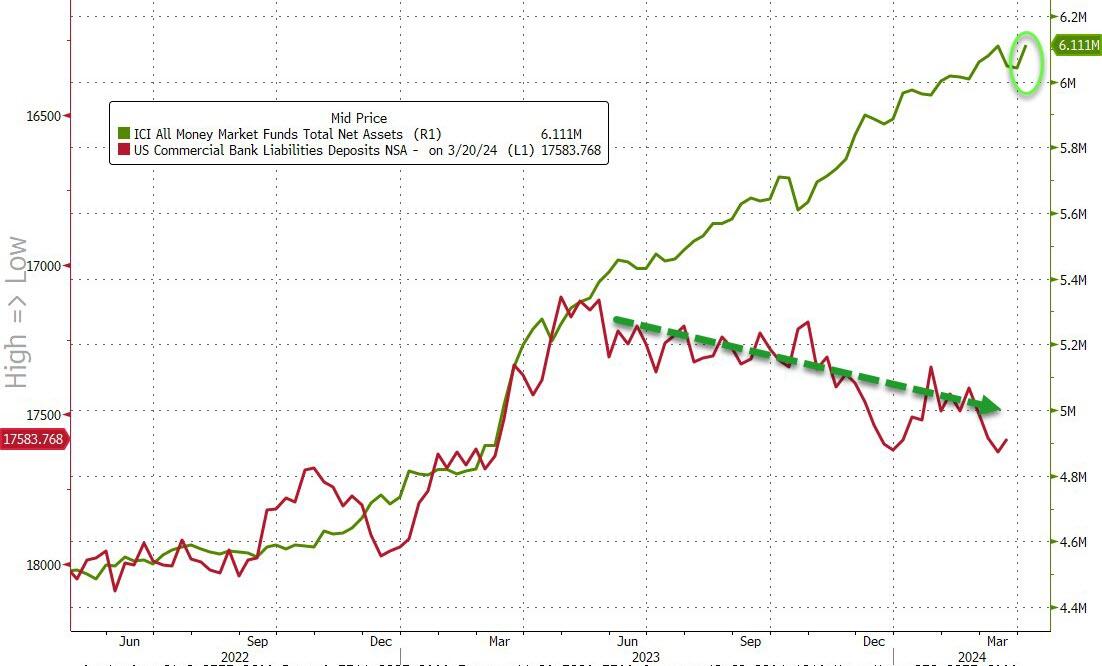
US Bank Deposits Soar Back To Pre-SVB Levels, Reserves Decouple From Stocks
Money-market fund total assets jumped over $70BN last week to a new record high above $6.11TN…
Source: Bloomberg
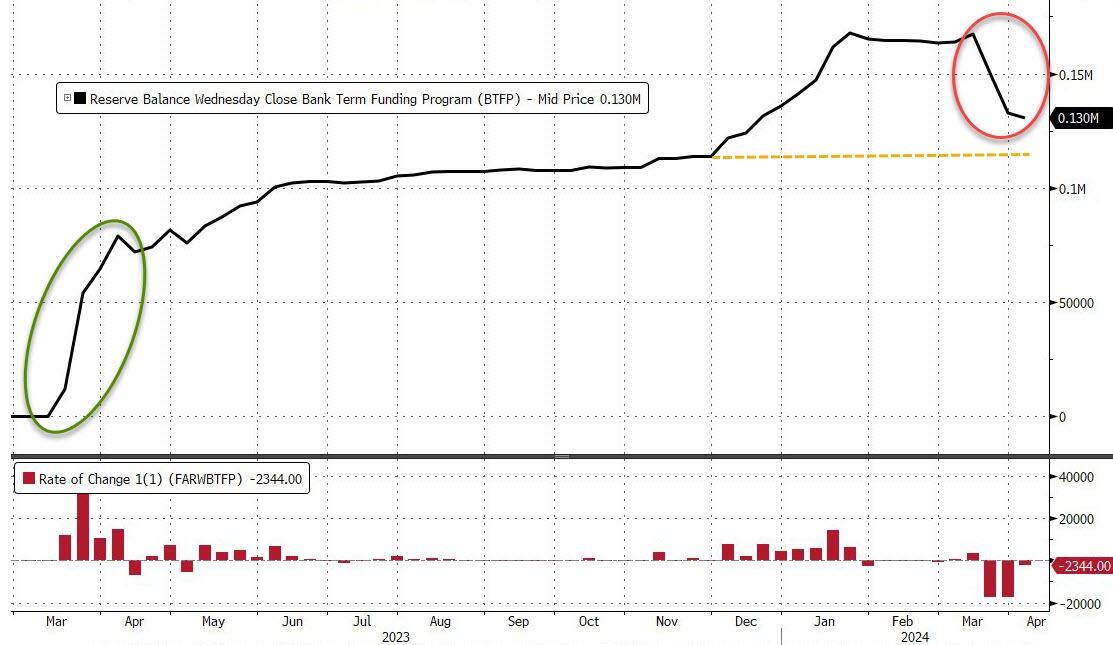
And, as the chart above shows, the broad trend for bank deposits has been positive (slow, but positive), slowly returning to pre-SVB levels. And talking of SVB, in the three weeks since the Fed’s bailout facility was terminated (remember these are 12-month term loans), the Bank Term Loan Facility has shrunk by $37BN, erasing most of the arb-driven rise in the fund – but still holding at $130BN that banks are using to fill holes in their balance sheets….
Source: Bloomberg
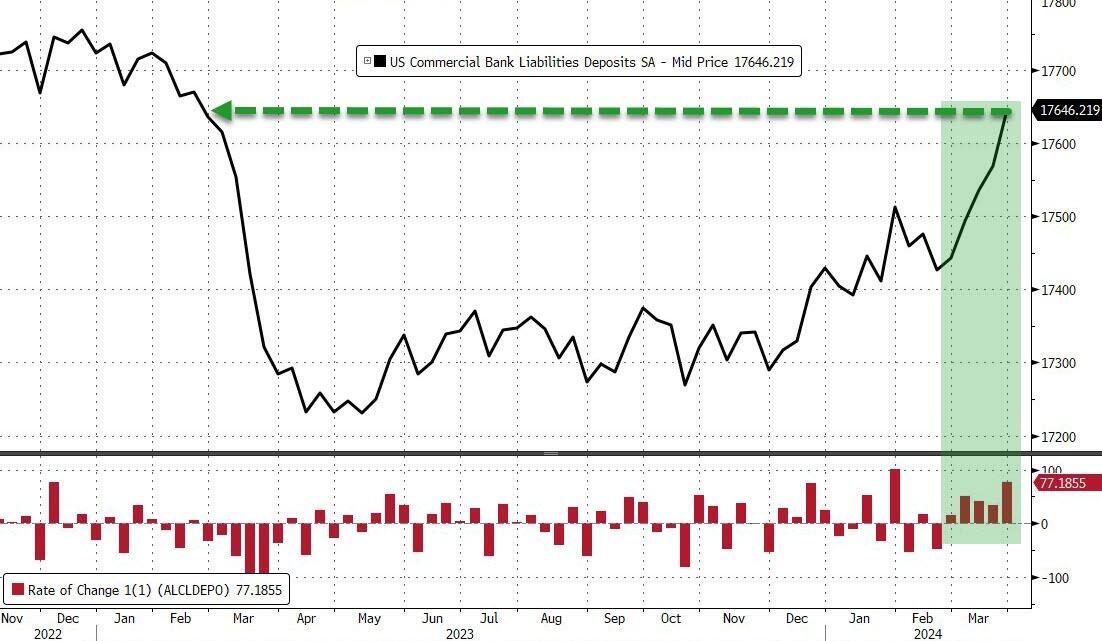
On a seasonally-adjusted basis, total bank deposits exploded higher by $77BN (the fifth straight weekly increase in deposits), back to pre-SVB levels…
Source: Bloomberg
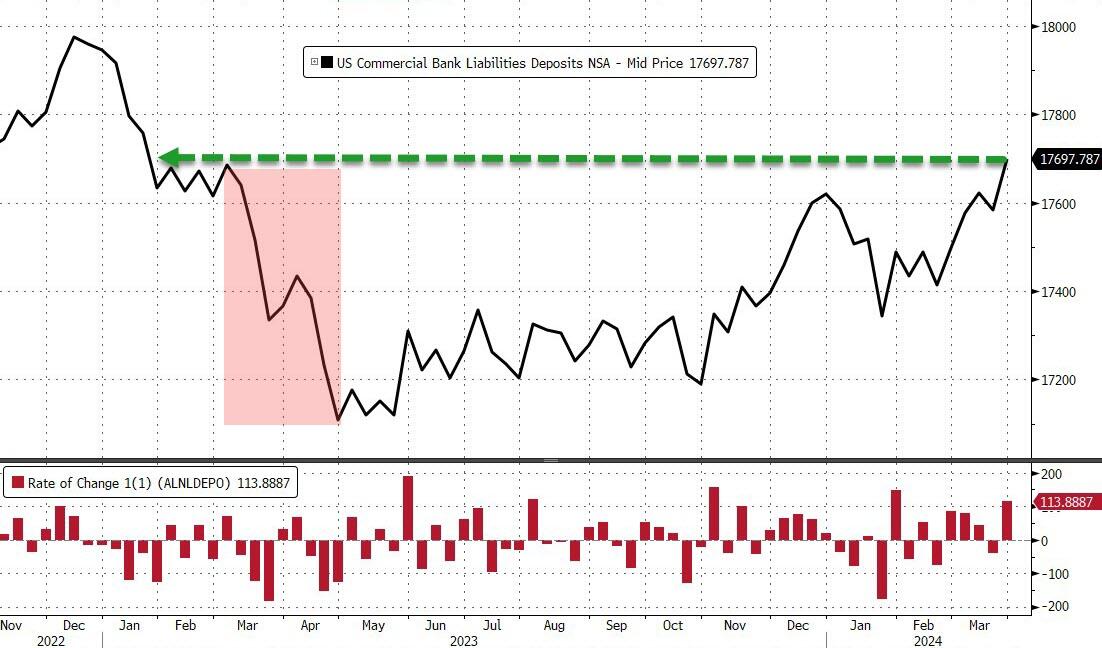
Non-seasonally-adjusted deposits were even more impressive, jumping $114BN to the highest since Jan 2023…
Source: Bloomberg
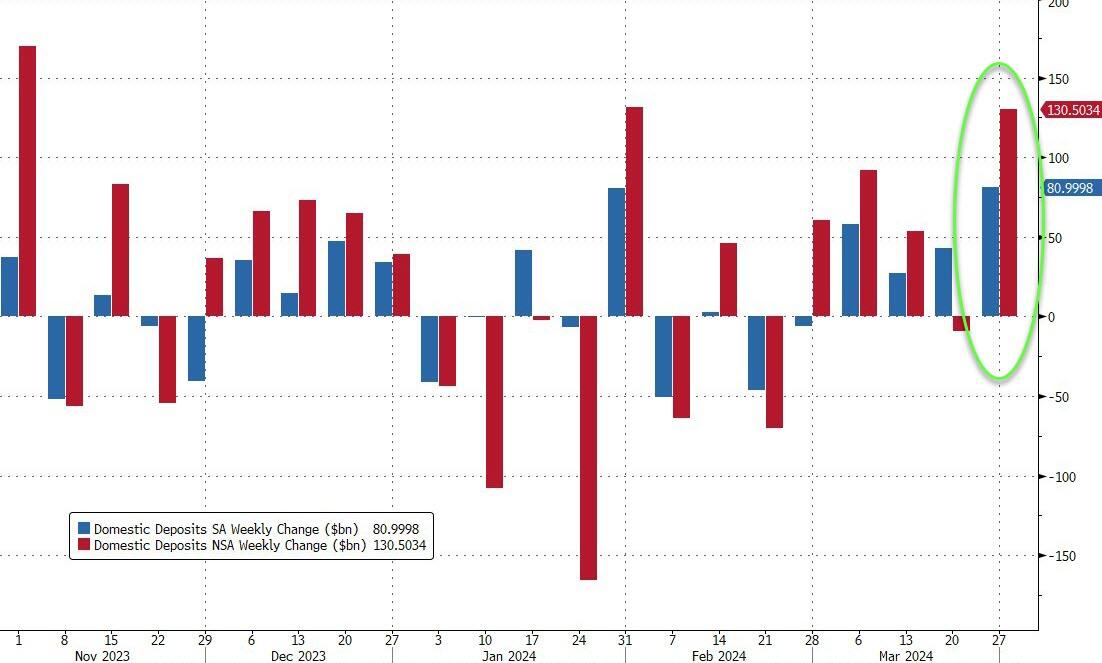
Excluding foreign deposits, domestic bank deposits rose $81BN SA (Large banks +$69BN, Small banks +$12BN); while NSA deposits rose $130BN (Large banks +$103BN, Small banks +27BN)…
Source: Bloomberg
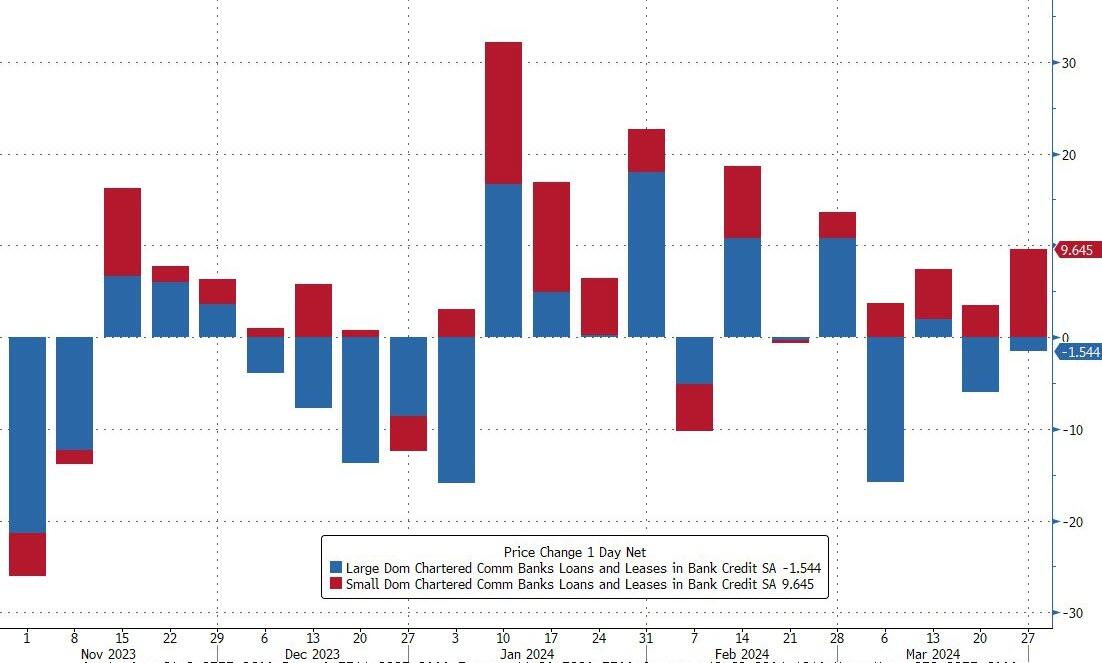
On the other side of the ledger, loan volumes rose overall but Large banks saw volumes shrink by $1.5BN (odd given the massive deposit inflow), while Small bank loan volumes rose $9.6BN…
Source: Bloomberg
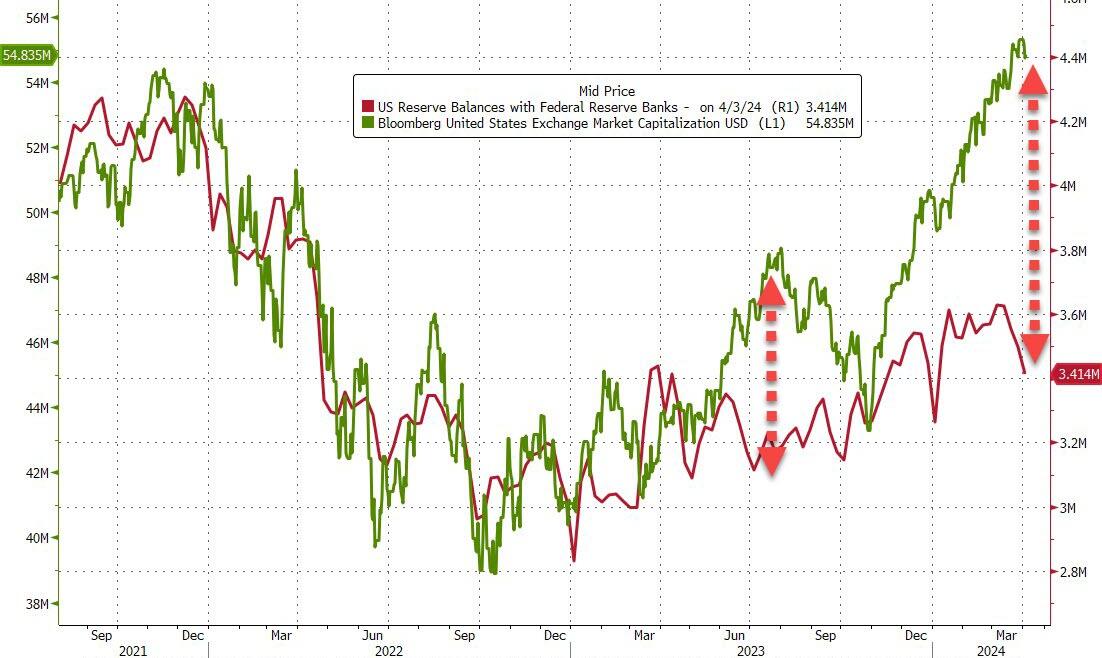
Meanwhile, bank reserves at The Fed are falling significantly, massively divergent from US equity market cap once again…
Source: Bloomberg
Which happens first? Banks start piling reserves back in or stocks falter?
“Strategic ambiguity requires strategic capabilities. Otherwise, it’s just make-believe.”
– Lee Slusher on “X”
If your situational awareness is well-tuned, you can put together a political weather report from the swirl of events that otherwise seem to confound the degenerate simps who pretend to report the news. Events are tending in the direction of self-reinforcing, ramifying chaos, and the people running the show are obviously insane as they do everything possible to hurry chaos along.
Case in point: Antony Blinken, our Secretary of State, who announced yesterday that Ukraine will get rushed into NATO ASAP. Do you understand that would mean a direct, automatic, peremptory declaration of war against Russia, requiring all of NATO — that is, their combined militaries — to go kinetic inside Ukraine and theoretically inside Russia, too, (a move that has not worked out well for anyone in all of history), because Article Five of the NATO charter states that an armed attack against one is an attack against all, and must be answered with counter-attack? Thus, you see, Mr. Blinken just announced World War Three.
You might also consider that NATO does not have the capacity to fight that war. The European members don’t have sufficient troops and equipment, or financial reserves for that matter. And there is, of course, America’s under-recruited DEI army of transsexuals and video-gamers, with equipment that has already proven inadequate on-the-ground in Ukraine, and a logistical route for delivery of all that which runs 5,000 miles across an ocean and then another continent. . . whereas our opponent (Russia) is right next door to the battlefield and churning out munitions like there is no tomorrow (which there might well not be for all concerned). Even Adolf Hitler, the last fool to attempt a conquest of Russia, wouldn’t like those odds.
And why would Russia desist from firing hypersonic missiles at Berlin, Paris, London, New York and. . . ? You get the idea. In which case the USA, backstopping NATO, would lob swarms of our nuclear missiles into Russia. . . and the whole shootin’ match ends up twenty minutes later a smoldering, civilization-ending mess. Smooth move, Tony Blinken. In political weather terms, this is like an arctic shear cutting across the northern hemisphere.
At the same time, you might notice a financial la Nina forming out over the salty sea.
Gold chugged up above $2,300-an-ounce the past ten days, a record. That’s a coded message from Reality Central.
My de-coder ring says it means the bond market is about to fall on its ass, taking the dollar down with it, which would swiftly domino into the way-overpriced equity markets, and Gawd knows what kind of maelstrom all the derivatives flotsam would get sucked into. Notice, too that Bitcoin goes up $3,000 one day and down $2,000 the next. Kind of sketchy. But that’s just my take. If you have one, I’d like to hear it. In any case, it looks like stormy financial weather which, if nothing else, is not exactly an advantageous accompaniment to a world war.
In fact, it could beat a path quickly to something like empty supermarket shelves — and you know what they say about a population being a few missed meals away from anarchy.
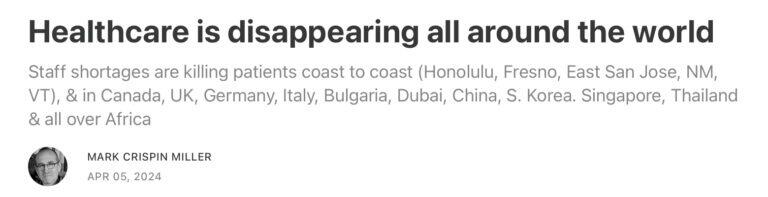
Then there’s the immense cluster of twisters moving ominously across the planet in the form of the Covid vaccination dysregulated immunity fiasco I wrote about in last Friday’s blog (This Is Not an April Fool’s Gag), as predicted by virologist Dr. Vanden Bossche. Translation: a lot of people getting sick and dying because their mRNA shots and boosters have so screwed-up their immune systems that they are sitting ducks for an emergent variant of Covid gestating in the vaxxed population. By the way, there is apparently a gross breakdown in medical services world-wide now, especially a shortage of doctors and nurses. Now you’re starting to see some serious stormy weather: a war, a financial train wreck, and a global public health disaster all at once.
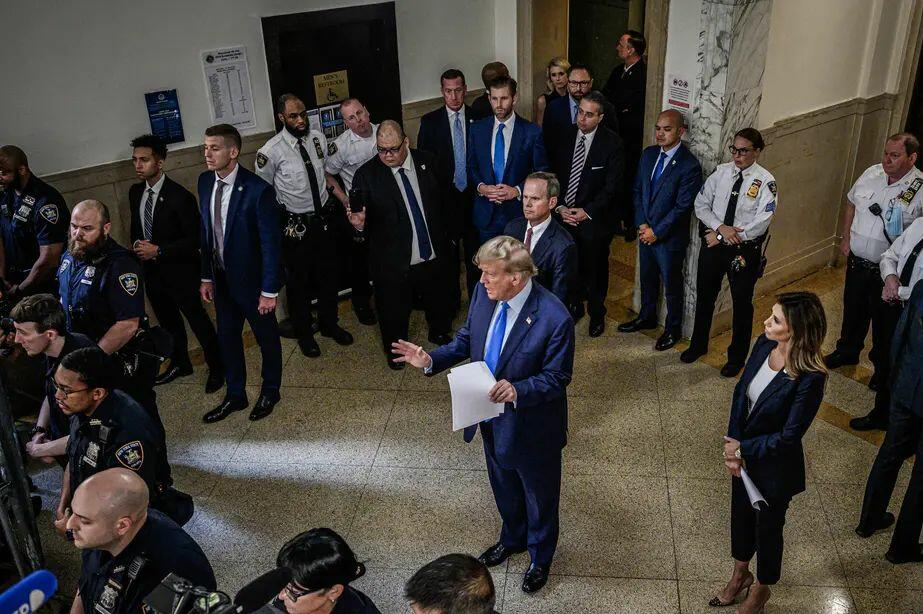
While all that is churning things up, the next round of Trump trials are set to kick off in Alvin Bragg’s New York and Fani Willis’s Fulton County (Atlanta), GA. Both cases have publicly wrecked themselves. In the New York case, you have the daughter of Judge Juan Merchan, Loren Merchan, 37, a Democratic Party consultant who has multi-million-dollar contracts with Rep. Adam Schiff, the nation’s leading RussiaGate hoaxer, and working partner of former Trump lawyer Michael Cohen, a chief witness in the matter of a hush-money payment made to porn-star Stormy Daniels (hush money, you might note, not being illegal). Any political motivation to see in that cast of characters? And that is apart from the sheer bullshit nature of the case, as packaged for Mr. Bragg by US Attorney Matthew Colangelo, who was swapped out of the Main DOJ HQ in Blobville to the office of Soros-connected DA Bragg in Manhattan specifically to engineer a political prosecution.
The Fani Willis case down south, another political prosecution by a loudmouth “Get Trump” DA, now goes forward with a compromised government attorney who has demonstrably committed enough offenses against the law to merit disbarment. Her lover and, until recently, “special prosecutor,” Nathan Wade, on top of probably perjuring himself about his financial entanglements with DA Willis, was just cited for contempt in his own divorce case (failure to pay child support). Note, too, that the idiotic substance of the case — a racketeering charge for conspiring to voice opinions about the veracity of the 2020 election — was likewise constructed by Lawfare ninjas in Washington DC (my guess, by Mary McCord, Lisa Monaco, and Norm Eisen), and mentored to Willis & Wade in a series of meetings held in the White House office of Veep Kamala Harris (with Lawfare ninjas improperly not logged-in — also my guess).
If the blob’s desired outcome, a conviction, comes to pass, and Mr. Trump is hauled off to Riker’s Island, say, to mingle with X-hundred homicidal mutts, and, say, for some reason he does not come out of there alive. . . well, say hello to an extra-especially bad set-up for civil disorder in the home of the brave — while we do World War Three, financial pandemonium, and Vaccine death. It’s a lot to take in, I know. But it’s all really right out there, and it’s all vectoring right at us. Just so you know.
Oil & Gold Soar On Week, But ‘Good Data’ Wrecks Rate-Cut Hopes, Slamming Stocks & Bonds
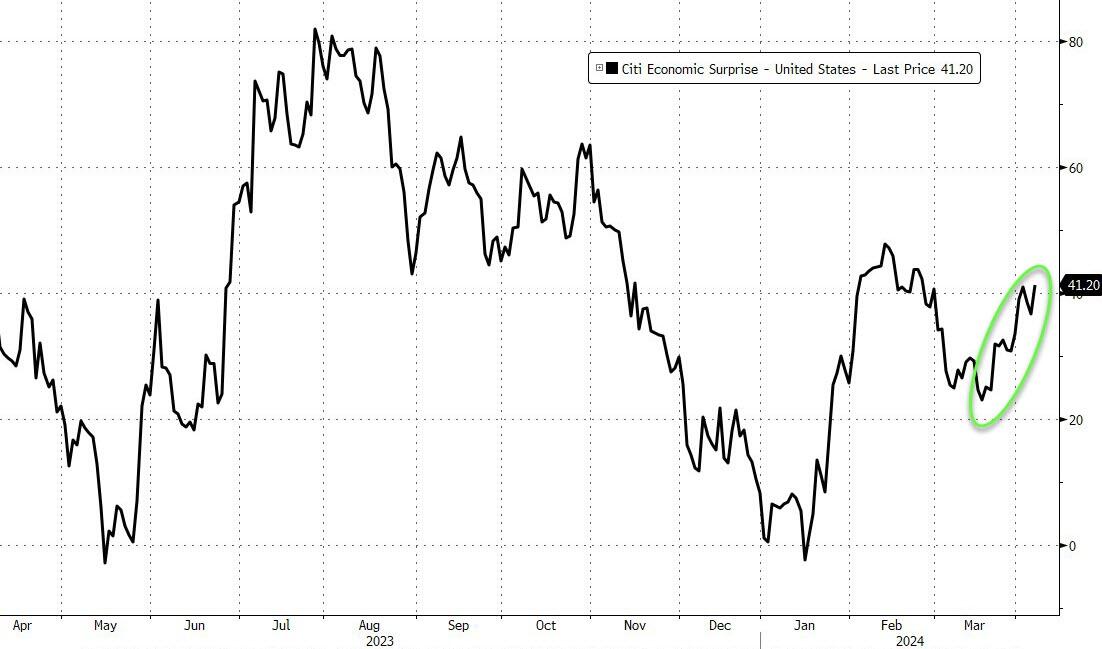
It was a ‘good’ week for macro data…
Source: Bloomberg
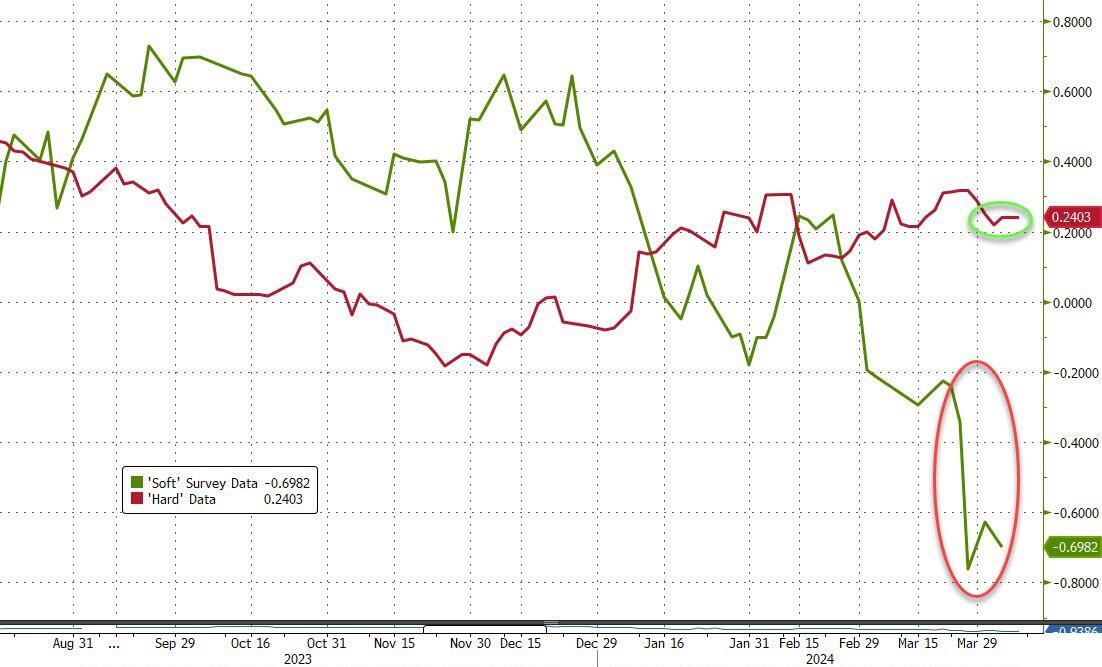
…but ‘soft’ survey data remains mired in depression as the ‘aggregate’ hard data holds strong…
Source: Bloomberg
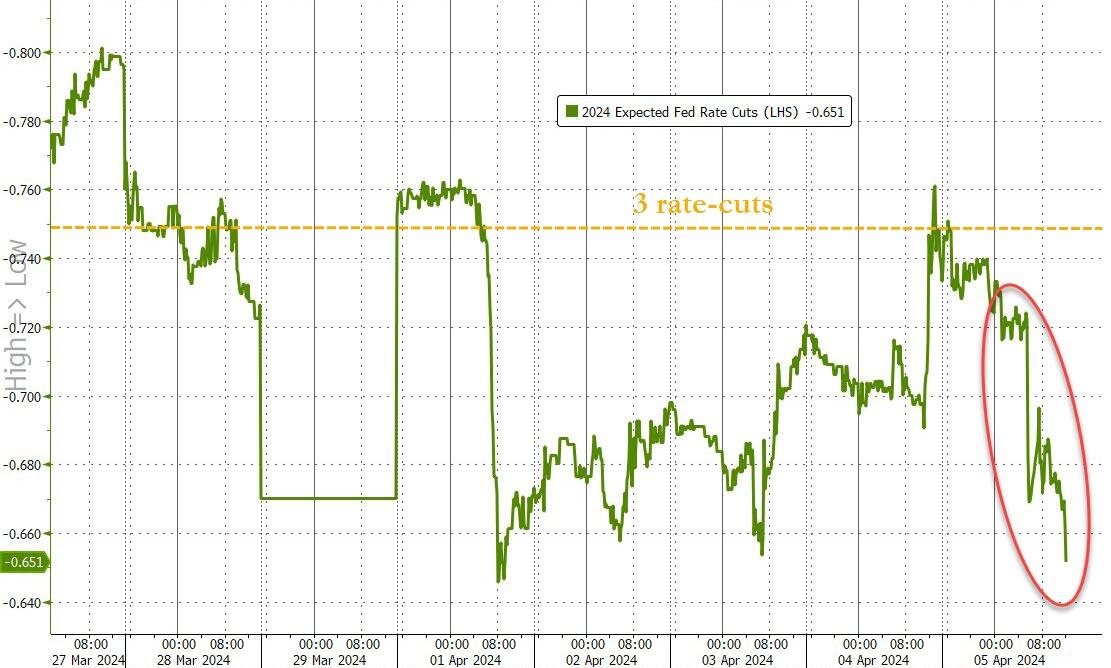
Of course, good news is bad news for the doves and rate-cut expectations for 2024 are down (particularly after today’s big payrolls headline beat) well below three cuts expected by the ‘median’ Fed dot…
Source: Bloomberg
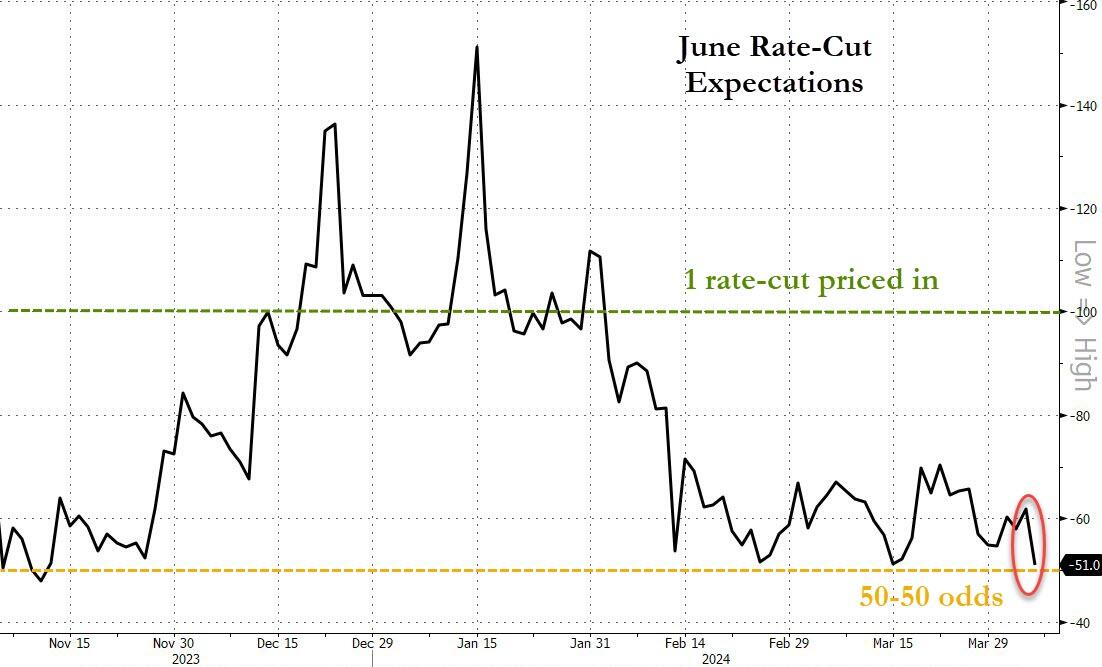
…and the odds of a cut in June have tumbled back to a coin-toss…
Source: Bloomberg
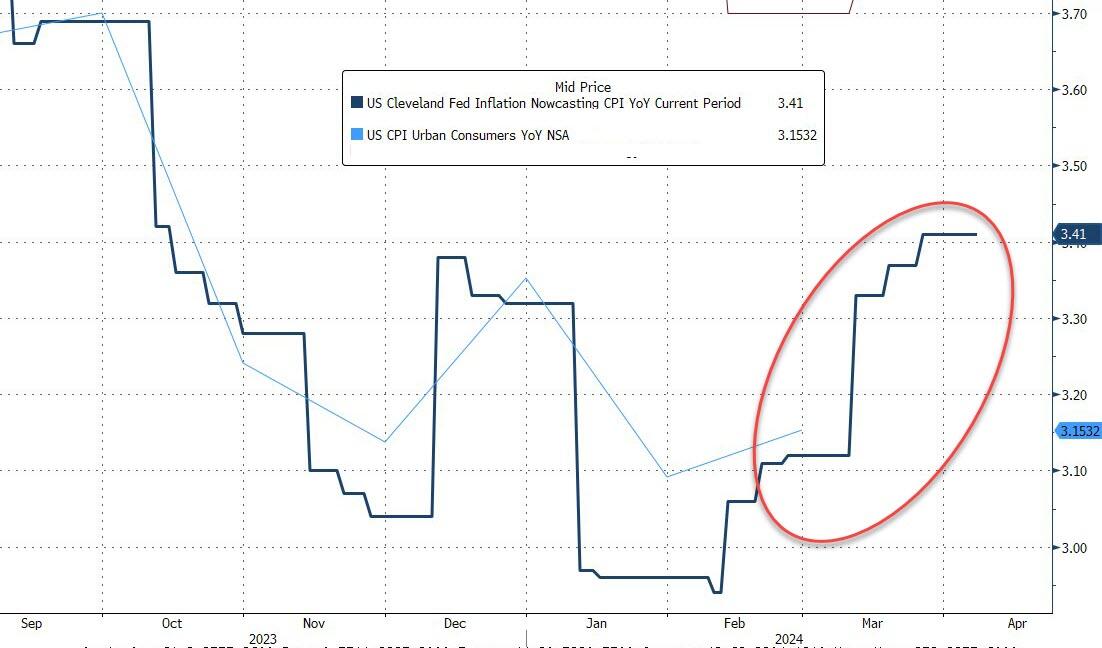
And to rub salt in the wounds of the doves, inflation expectations are back on the rise bigly…
Source: Bloomberg
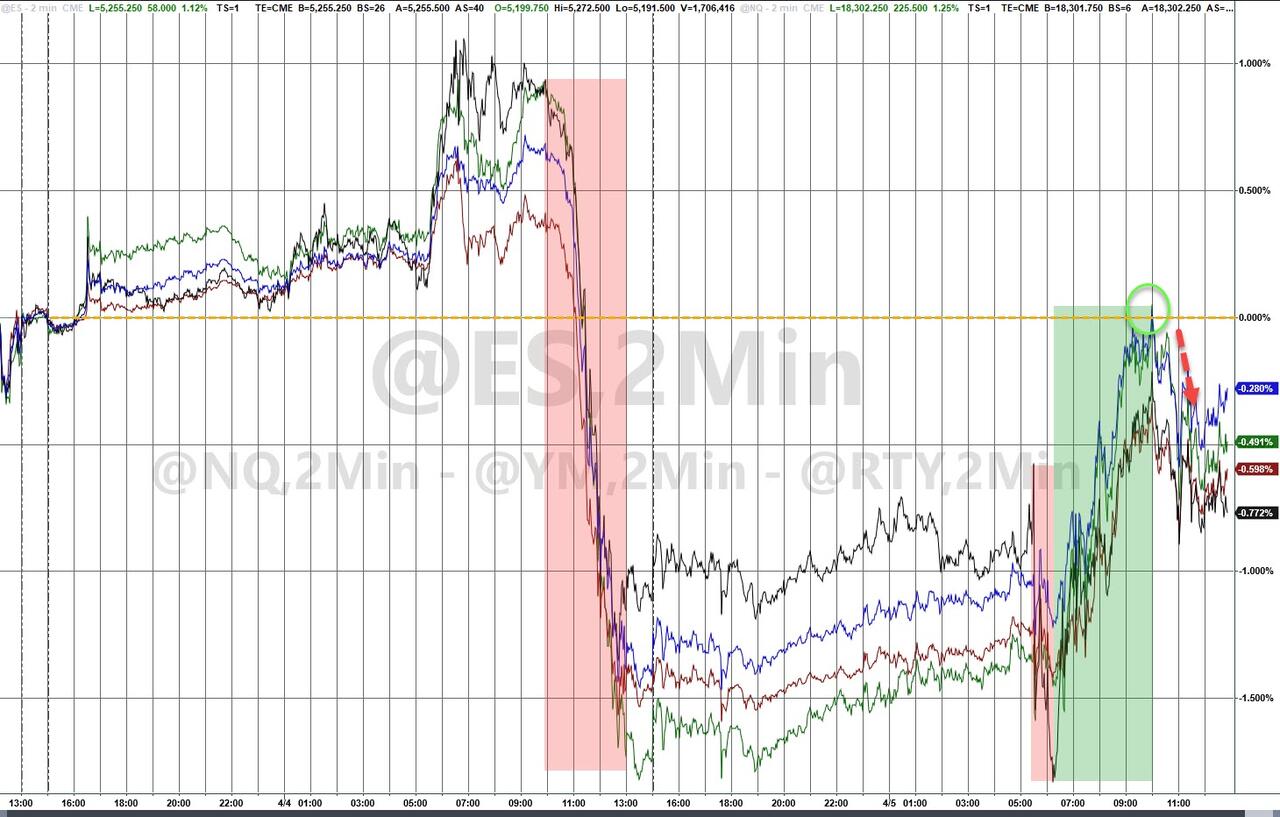
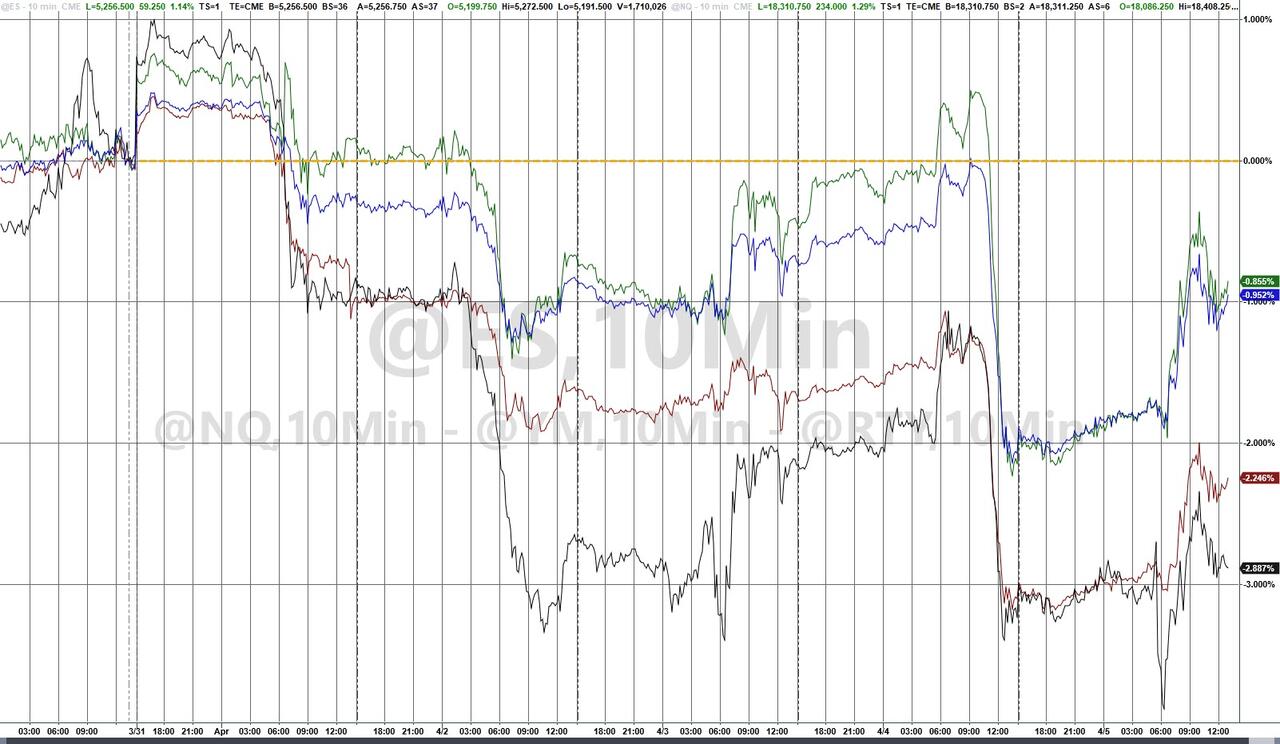
Stocks initially down-pumped on the hjobs data (good is bad) then went into their usual BTFD insanity, ramping Nasdaq to unchanged vs Wenesday’s close (erasing yesterday’s losses). However, within minutes of that FedSpeak spoiled the party again:
1310ET *FED’S BOWMAN: INFLATION PROGRESS HAS STALLED, WON’T BE COMFORTABLE CUTTING UNTIL DISINFLATION RETURNS
And stocks started back lower…
On the week, all the majors were red with Small Caps and The Dow the worst performers. This was the S&P 500’s worst week since the first week of the year…
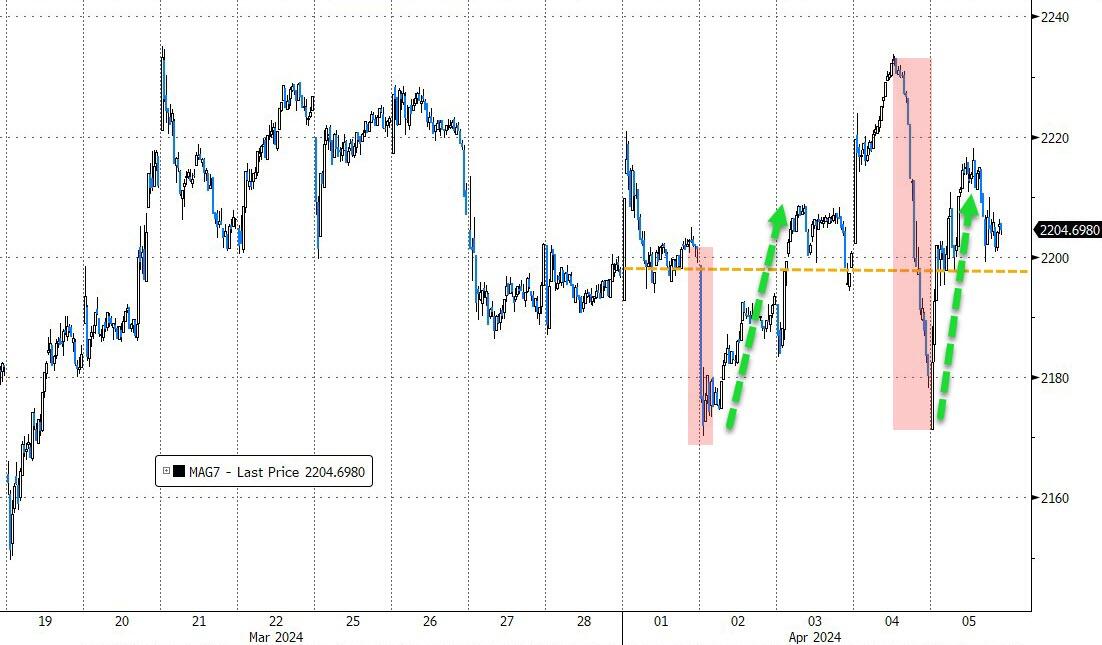
MAG7 stocks managed to eke out very modest gains as a basket on the week…
Source: Bloomberg
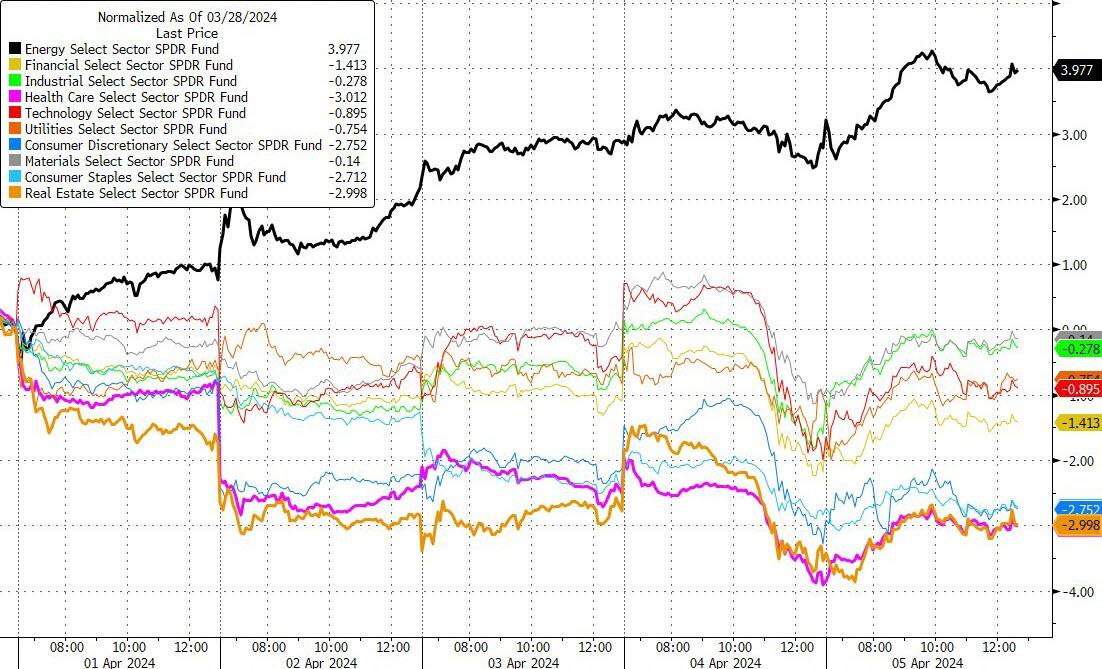
Energy stocks soared this week (to a record high) – the only sector to end green – while Healthcare and Real Estate lagged…
Source: Bloomberg
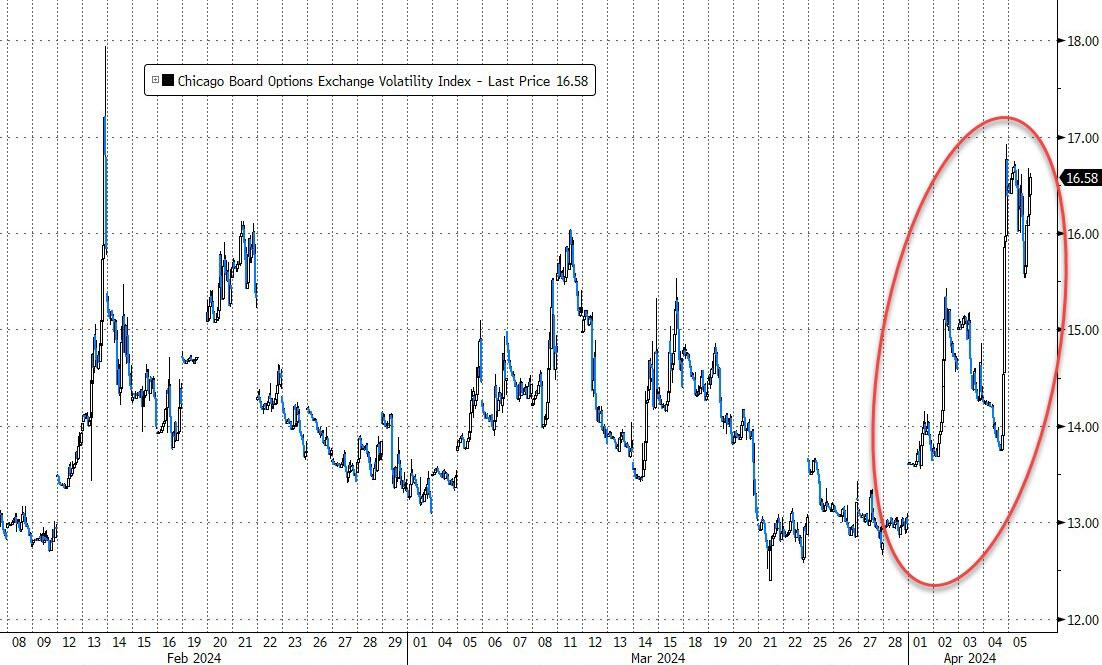
VIX saw its biggest weekly surge since August 2023…
Source: Bloomberg
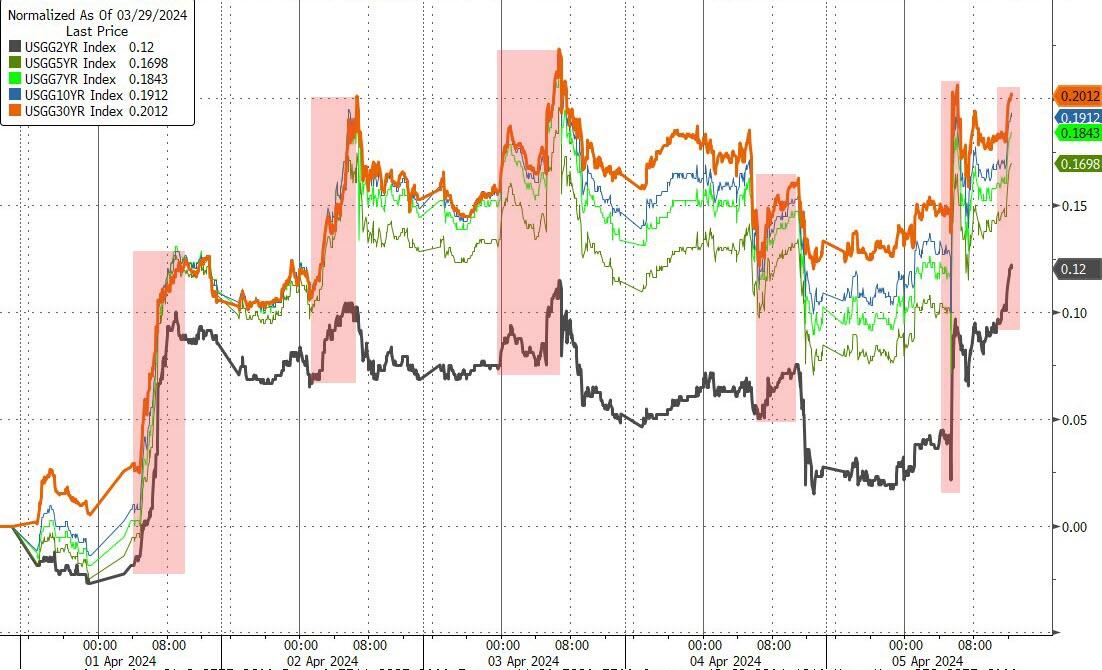
Bonds were also ugly on the week, led by the long-end…
Source: Bloomberg
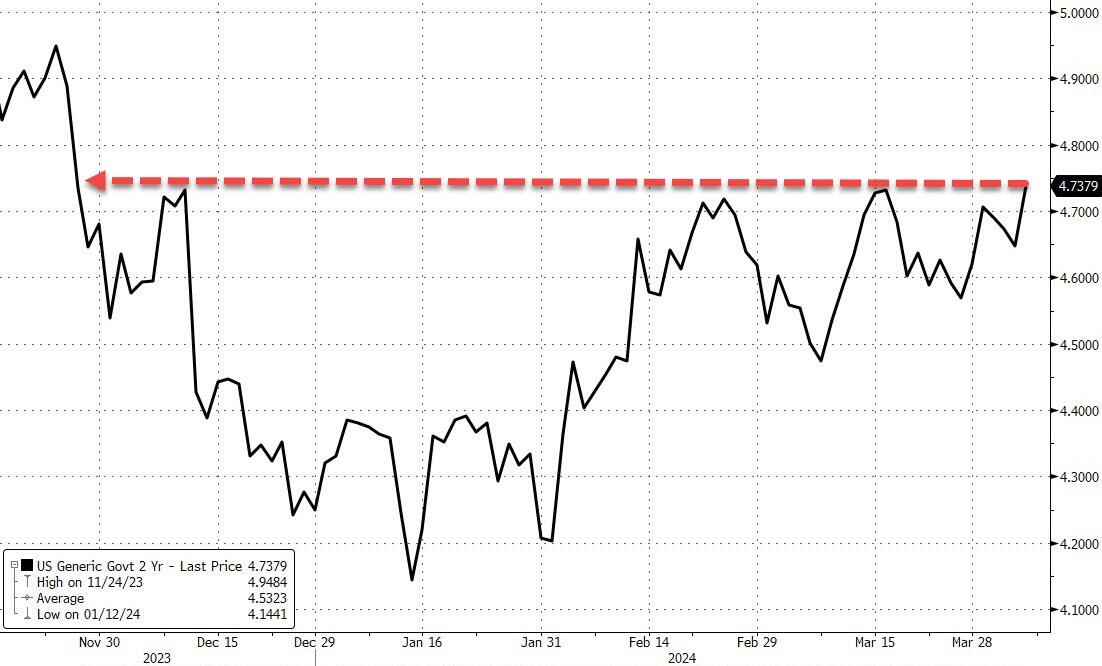
The 2Y Yield pushed up to 2024 YTD highs and closed at its highest yield since November…
Source: Bloomberg
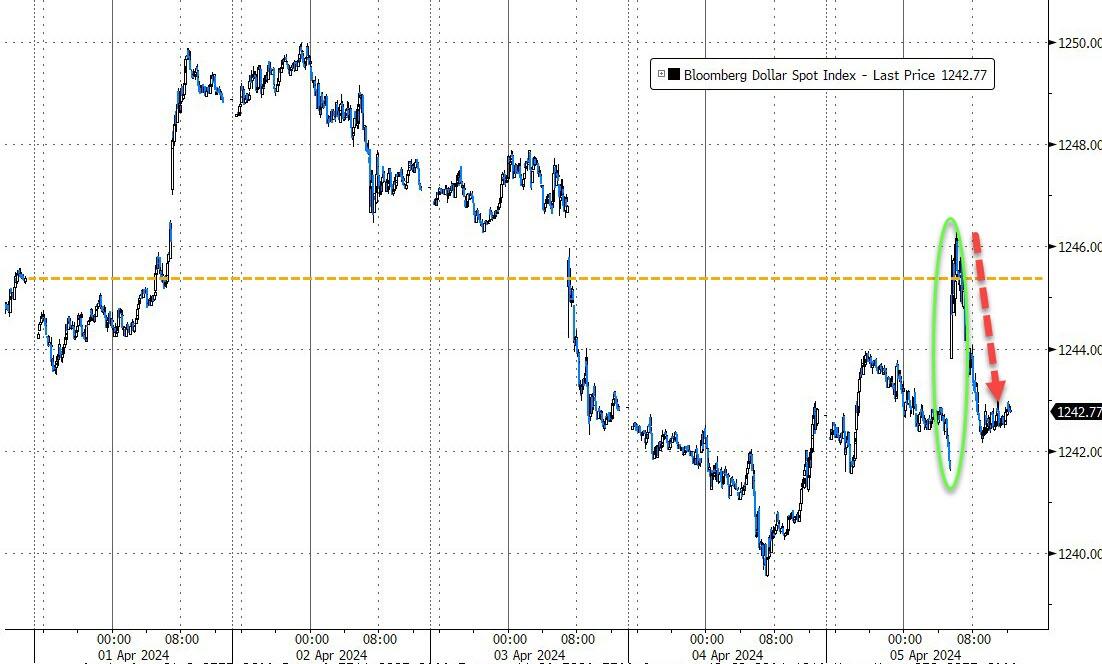
The Dollar ended a choppy week modestly lower after spiking initially today into the green…
Source: Bloomberg
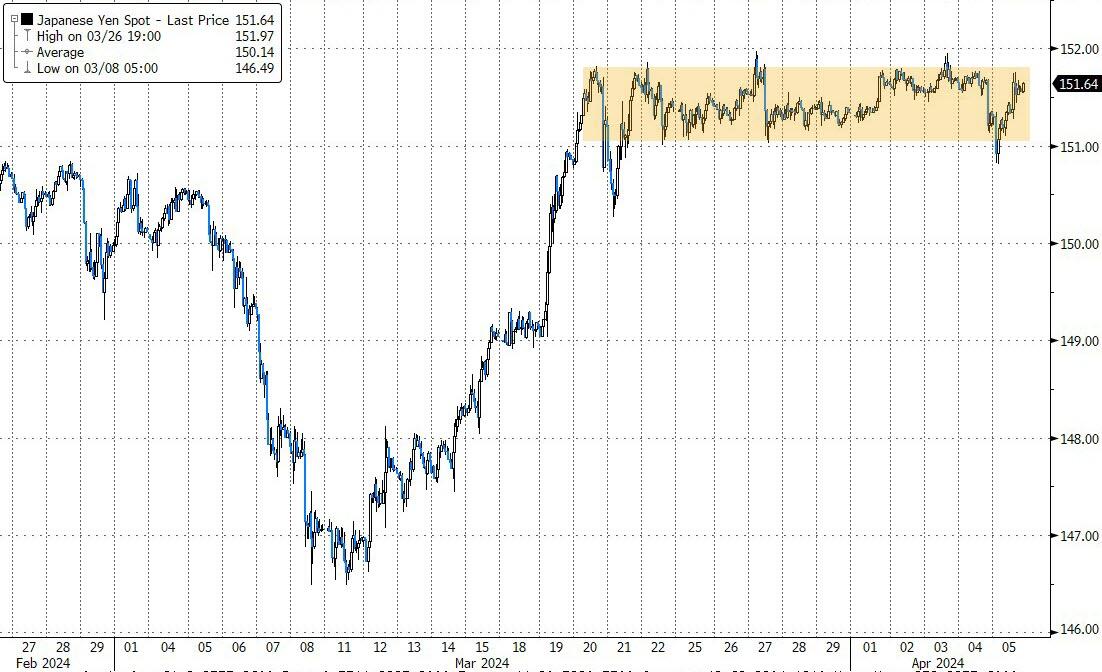
Interestingly, since The BoJ unleashed chaos in JPY-land, USDJPY has gone too sleep. @Bespoke notes that this is the smallest 13-day range for USDJPY since 1980…
Source: Bloomberg
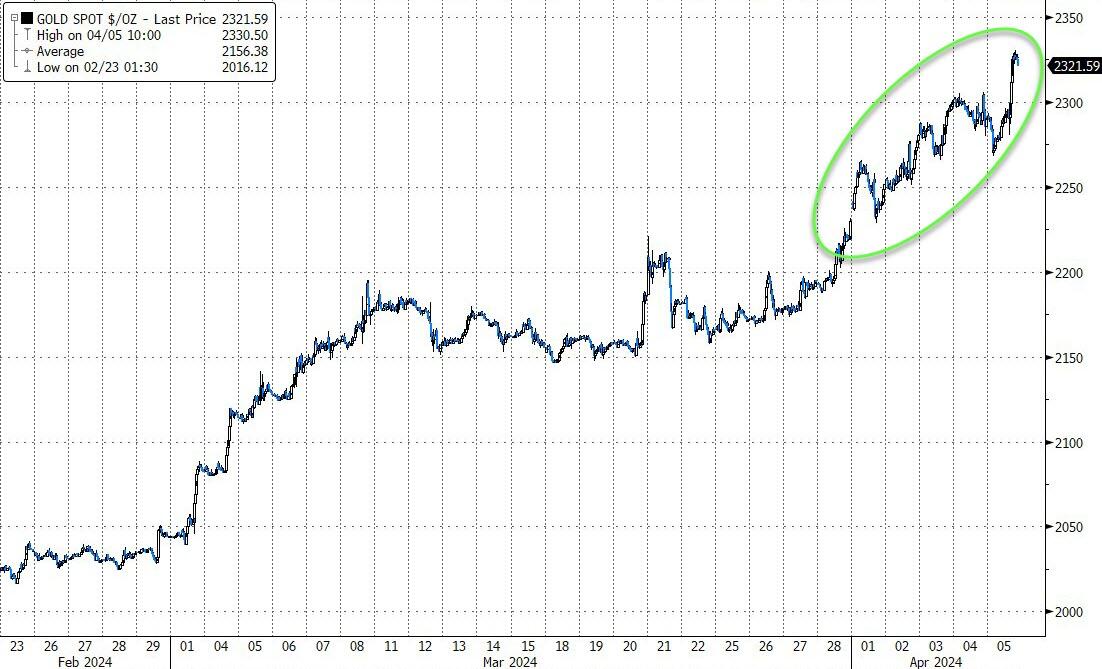
Gold had another huge week, rallying to a new record high above $2330 (spot). Gold is up 9 of the last 10 days and 6 of the last 7 weeks…
Source: Bloomberg
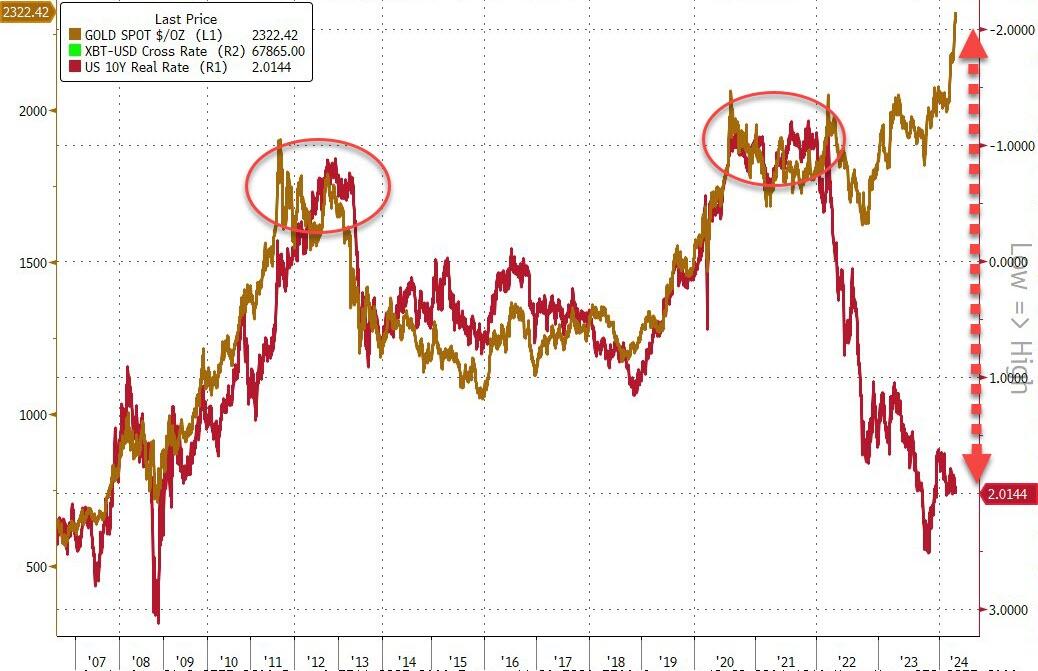
Gold is screaming that something bad is coming (inferring negative real yields – something we have only seen deep in crises)…
Source: Bloomberg
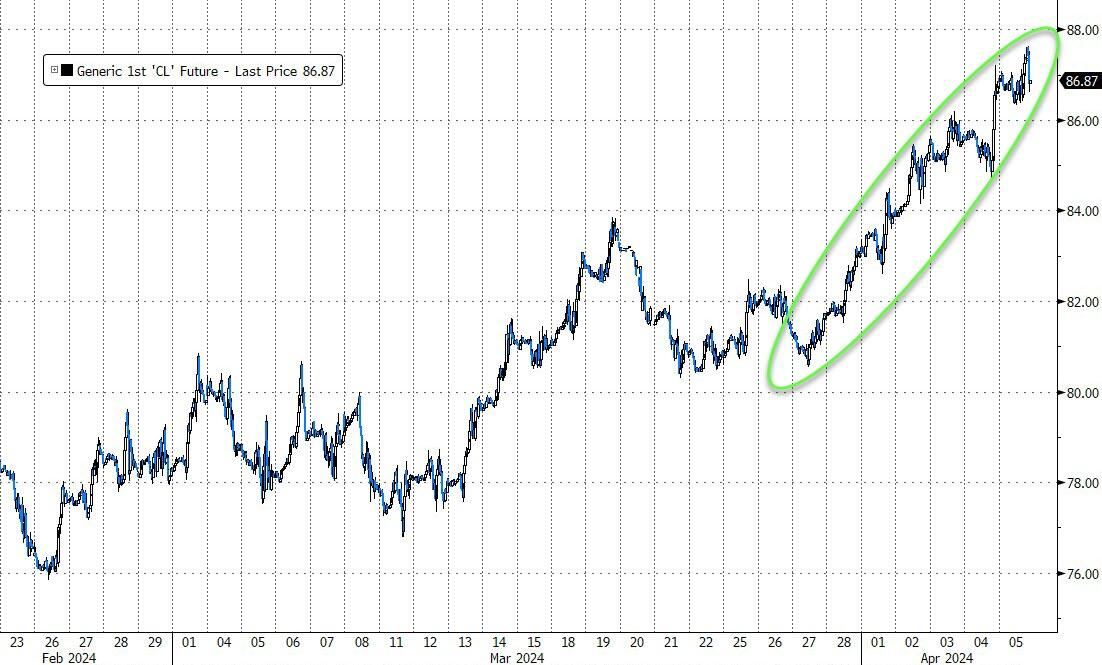
Oil prices also surged, with Brent topping $90 and WTI topping $87.50 this week, as gepolitical tensions turned the rhetoric up to ’11’…
Source: Bloomberg
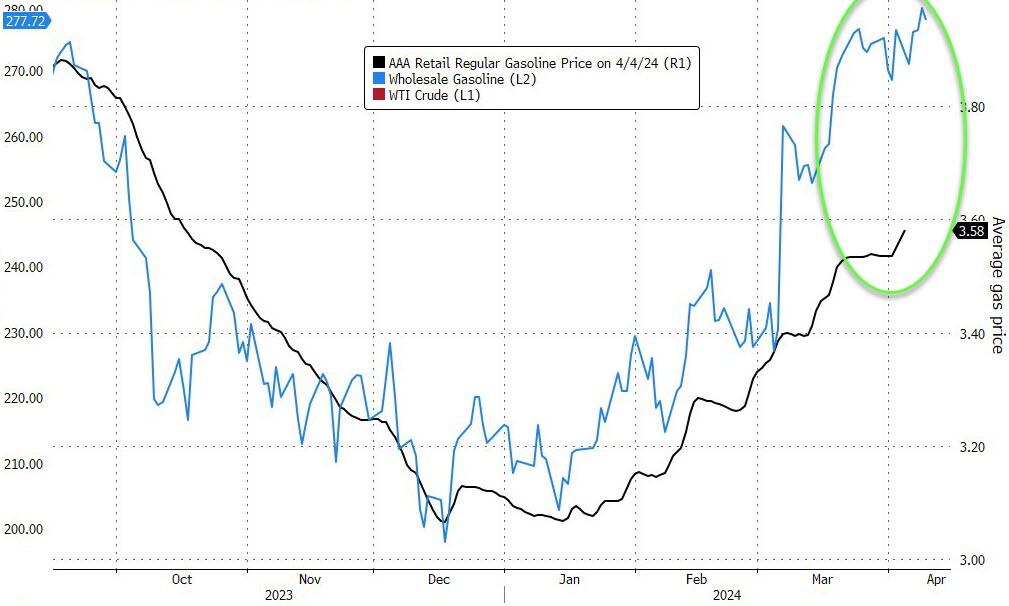
And strength in oil meant gasoline and pump prices rose too…
Source: Bloomberg
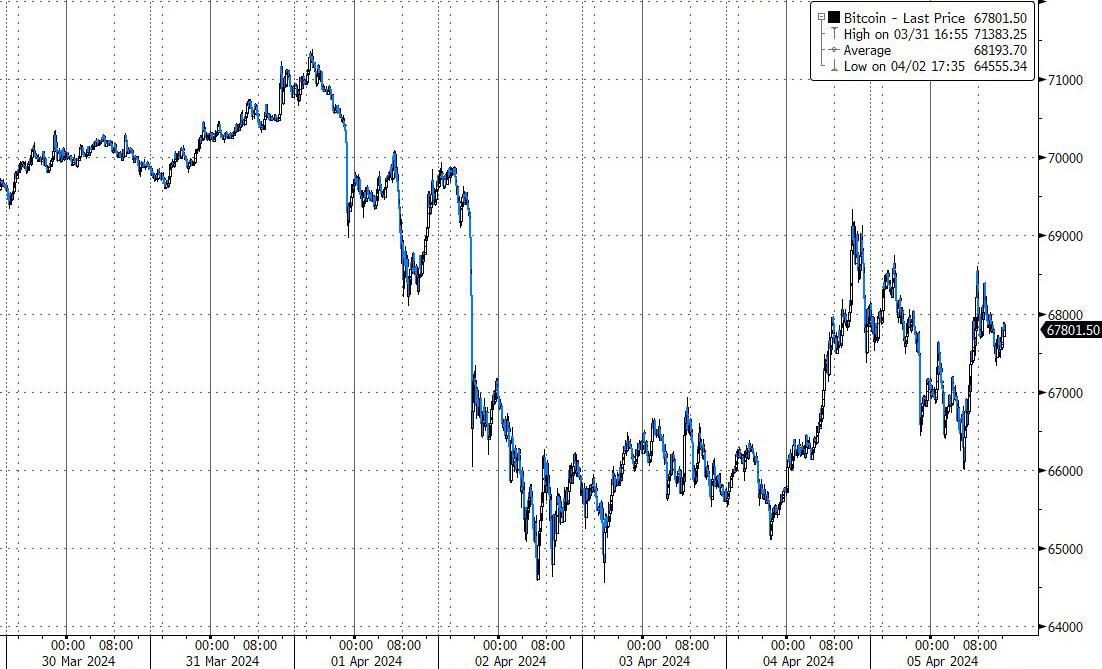
Bitcoin was down on the week, but found support at $65,000 and bounced back amid a re-ignition of net ETF inflows…
Source: Bloomberg
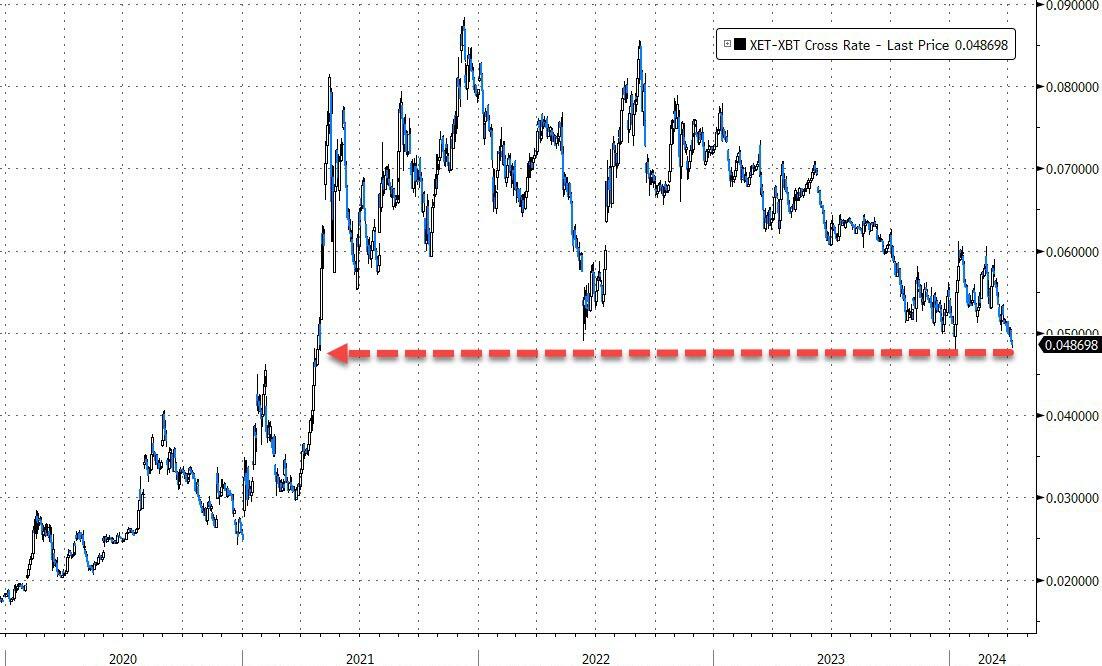
Ethereum underperformed on the week, breaking down to its weakest against bitcoin since May 2021…
Source: Bloomberg
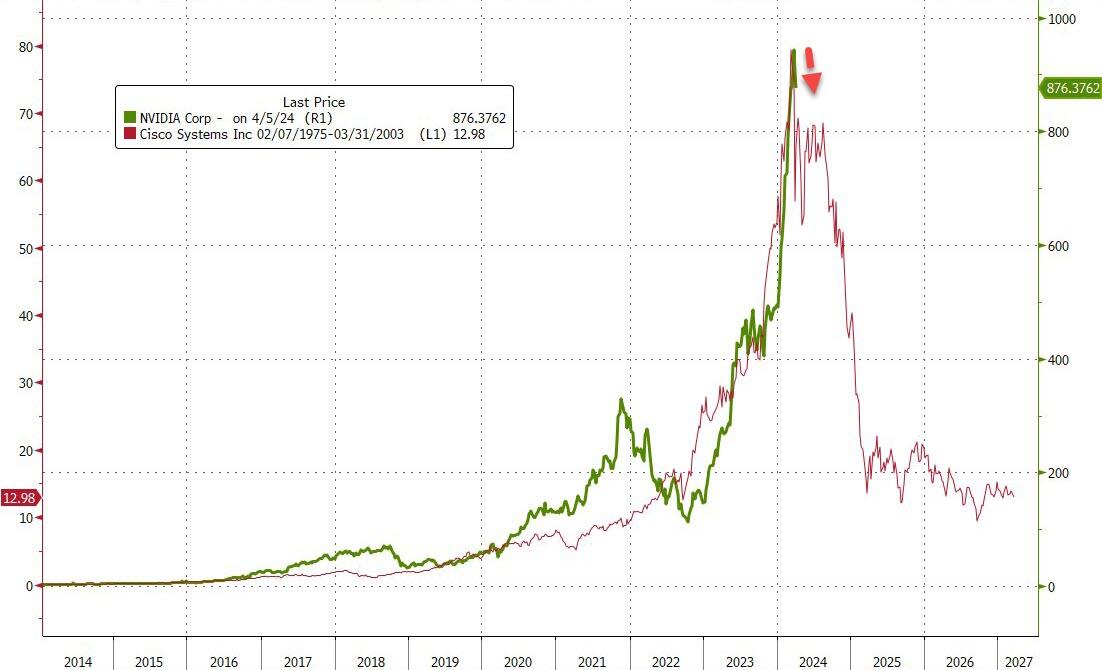
Finally, with all the macro and geopolitical headlines, everyone seems to have forgotten about the whole premise for this rally was AI and wunderstock NVDA which is down 11% from its record highs one-month ago…
Credit Card Debt Surges To New All-Time High, Just As Card APR Rates Hit Fresh Record
Just when you thought US consumers had finally learning their lesson, and had stopped buying stuff they can’t afford with money they don’t have… we got the latest consumer credit data which collapsed that particular thesis in a millisecond.
After two months ago we saw an unprecedented halt to growth in both revolving credit (i.e., credit card) growth – which rose by just $1 billion (since revised to $4 billion) – as well as non-revolving (i.e., auto and student loans) which practically actually shrunk by $1 billion – in January things were seemingly back to the American normal, as total consumer credit surged by $19.5BN, compared to the $0.9BN downward revised December print (from $1.561BN originally), driven by a powerful rebound in both credit card and auto loans. Things then continued on autopilot: moments ago the Fed reported that in February consumer credit rose by $14.125BN, roughly flat from the downward revised $17.684BN in January, driven by a powerful surge in revolving credit even as growth in non-revolving credit unexpectedly faded.
Starting at the top, revolving credit in February rose by $11.3 billion, up from an upward revised $8.6 billion…
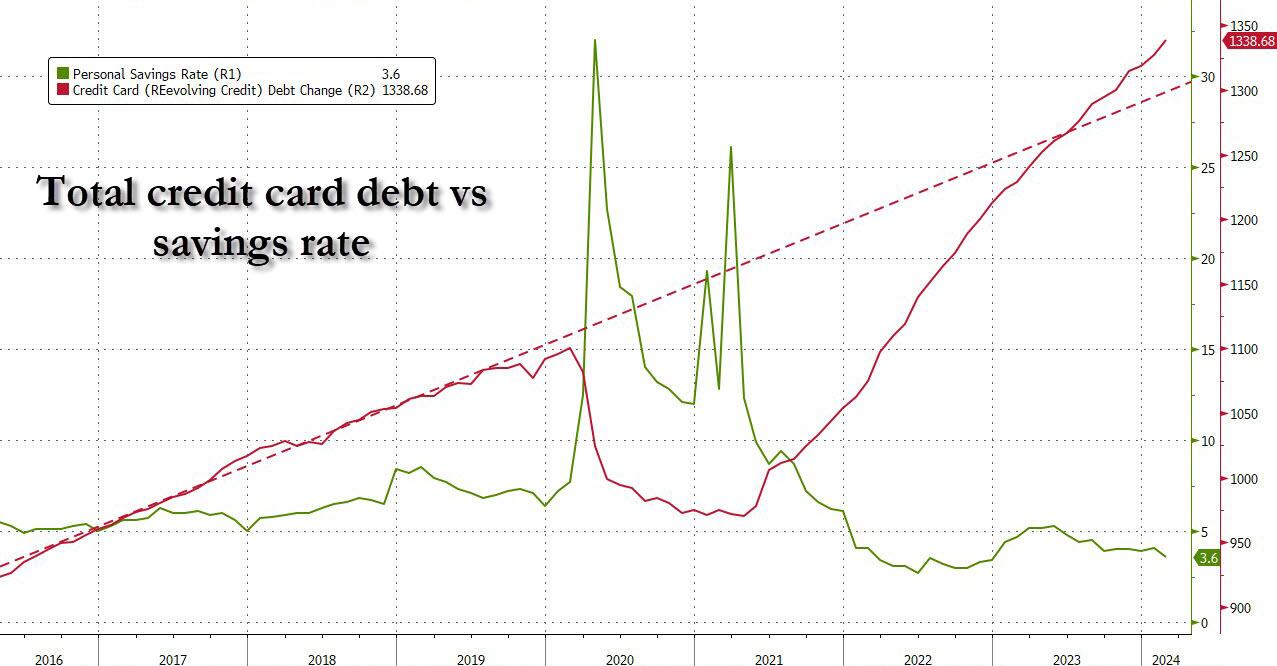
… pushing total revolving credit to a record $1.339 trillion, which as shown in the chart below means that the trendline from the pre-covid era has now been surpassed, while the savings rate is at an all time low.
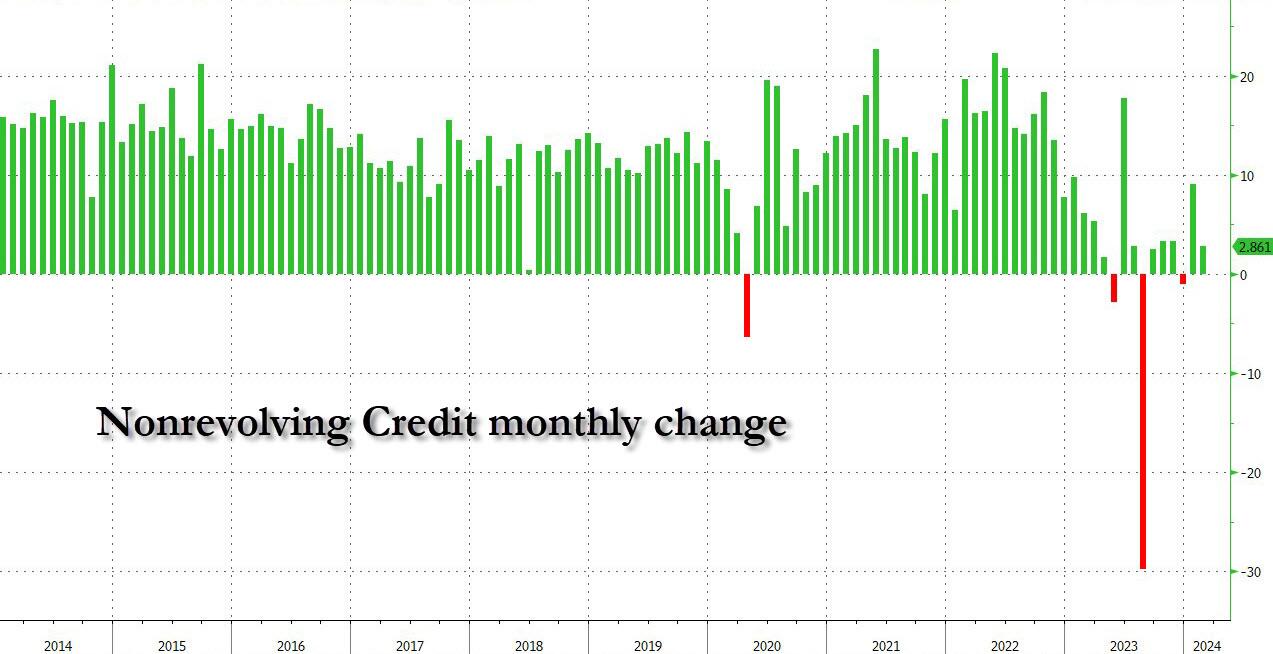
Meanwhile, on the non-revolving credit side, “number also go up“, but by much less, rising by just $2.8 billion, down from the $9.1 billion increase in January, and hitting a record high $3.712 trillion after unexpectedly declining by $1 billion in December.
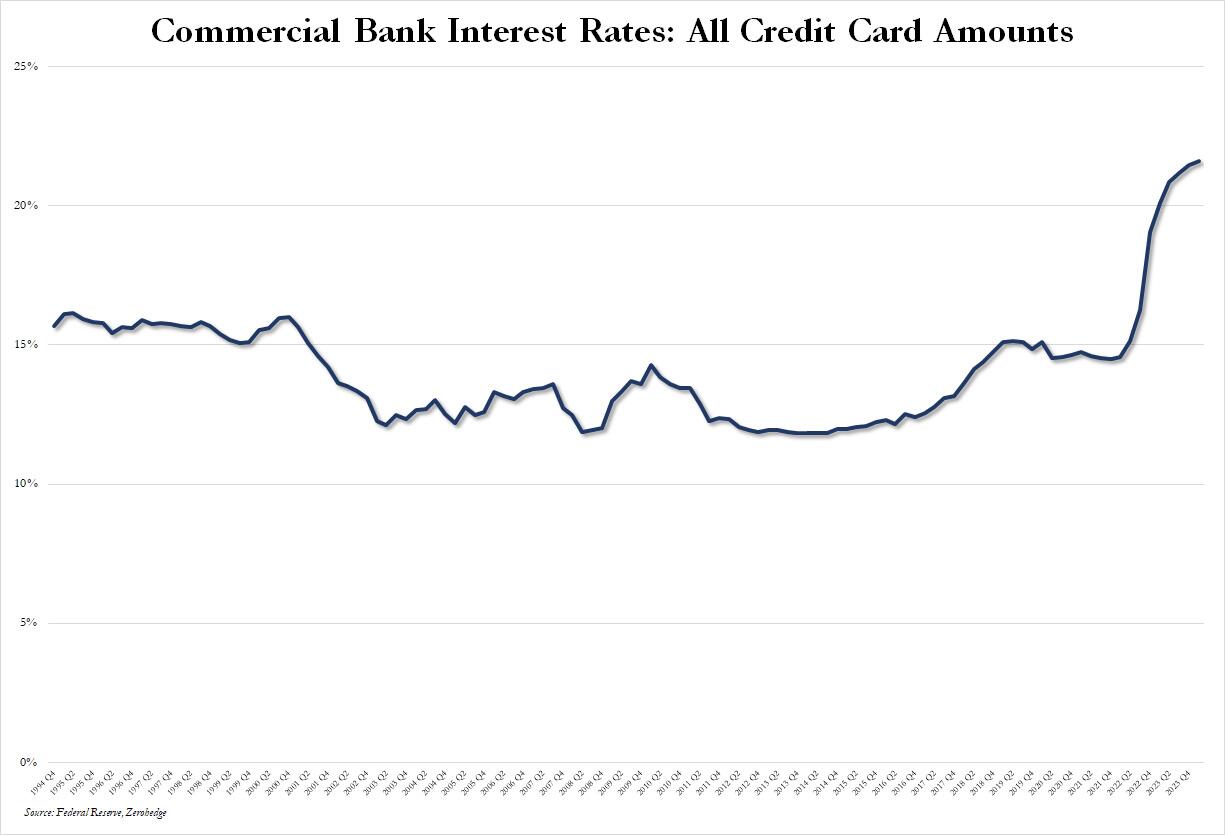
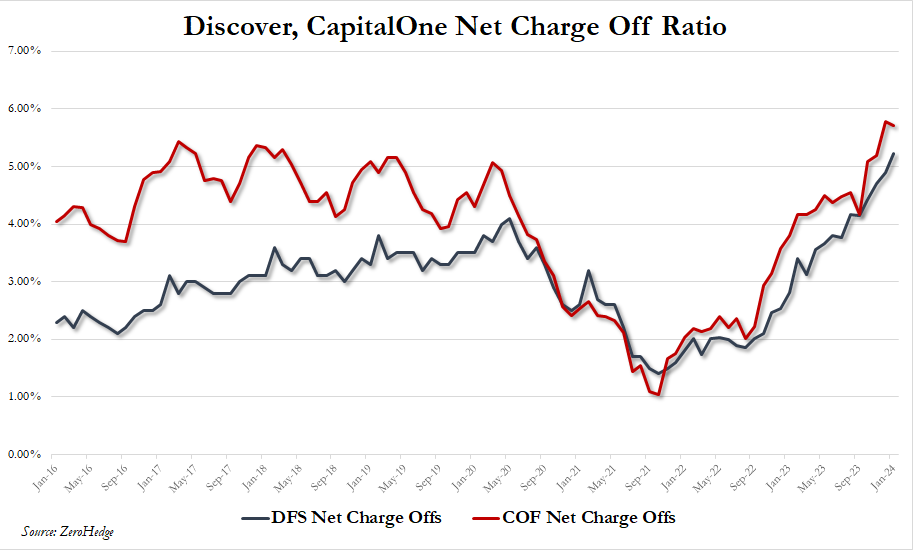
The latest acceleration in credit card debt comes as a surprise for several reasons, not least of all that according to the Fed, the average rate across all commercial banks on all credit card amounts just hit a new record high of 21.59% in Q1 ’24, despite the drop in rates observed in late 2023, which is a vivid reminder that while banks are happy to hike credit card rates, they rarely if ever cut them.
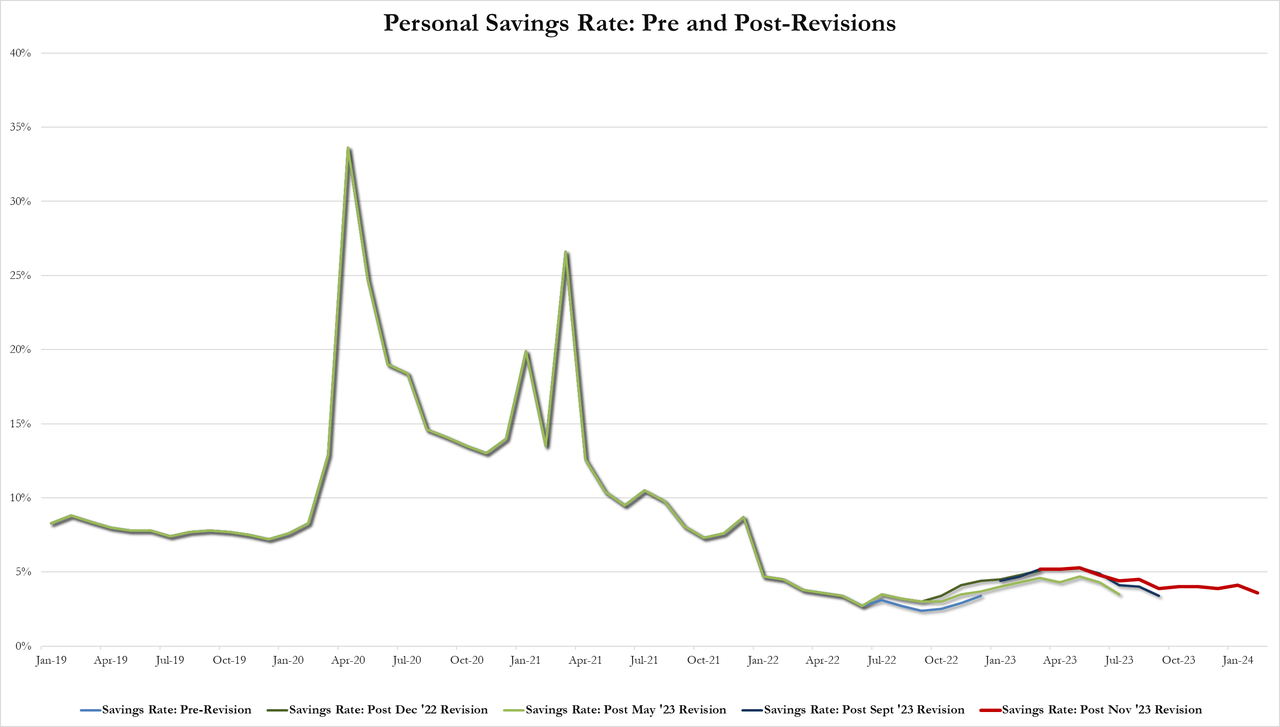
Yet with consumers ever more strapped for actual cash and equity, as the personal savings rate in the US has collapsed from over 5% to 3.6% – the lowest since 2022 – in just a few months…
… there is only so much more credit card maxing out that can take place before reality finally sets in, although with an election on the horizon – one which ensures that any credit-card fueled spending must be encouraged – don’t be surprised if the White House instructs banks to just ignore soaring delinquency and charge-off rates…