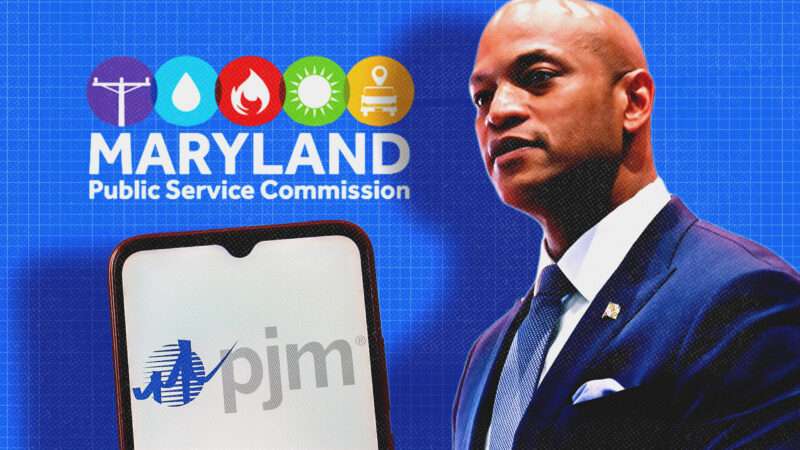
PJM Interconnection, the largest electricity grid operator in the nation, held its annual company meeting in Baltimore earlier this week. For Maryland Democratic Gov. Wes Moore, the event was an opportunity to voice grievances about rising energy costs.
“I am here to say plainly that PJM can—and must—do more for ratepayers,” Moore said, adding that PJM’s system “isn’t working.” Moore’s comments come as the price of residential electricity in the state has reached 22.4 cents per kilowatt-hour. This is 24 percent higher than the national average and 6.4 percent more than last year.
Maryland is not alone. Across the country, residential electricity prices rose by 7.4 percent from February 2025 to February 2026, the most recent month for which federal data are available. While data centers have become an easy scapegoat for rising wholesale prices, there are a range of factors behind these price hikes, including upgrades to aging grids, fluctuating natural gas prices, supply chain constraints, and growing demand that has simply outpaced supply.
As Jeffrey Shields, PJM’s senior manager of external communications, tells Reason, the operator is “working with relentless focus to accelerate the connection of new generation.” Any problems PJM faced with its interconnection process—pilloried by Moore—are a thing of the past, according to Shields.
Facing a backlog of new energy generation and storage projects, PJM closed its interconnection queue in 2022, revamping its process from first-come, first-served to what Shields calls a “cluster” approach, resulting in 811 new generation projects in its first cycle this year.
While Moore castigates PJM, he has consistently supported policies such as price caps and clean energy mandates that distort the market and increase costs for Maryland residents. This includes two bills recently signed by the governor that purport to “protect Maryland families from rising utility costs and make Maryland’s economy more business-friendly” but will likely have the opposite effect.
One of those bills, the Utility RELIEF Act, will allegedly save residents “at least $150 on their energy bills every year.” The law includes $100 million for refunds or credits to ratepayers drawn from the state’s Strategic Energy Investment Fund (SEIF). Another $100 million will go to the Maryland Energy Administration to “conduct a competitive, low-bid auction” for renewable energy projects.
Funded by “alternative compliance payments” from utilities, the SEIF has seen payments grow from $77 million in FY 2022 to $365 million by FY 2025, according to the state’s energy administration.
According to Josh Smith, a senior fellow at the Pacific Legal Foundation, actions like those spelled out in the RELIEF Act “tend to make things more expensive,” deterring suppliers from serving the market.
Another bill touted by the Moore administration, the DECADE Act, will reportedly improve Maryland’s ability to “attract, develop, and grow businesses” through a series of tax credits and carve-outs designed to counter the state’s 3 percent tech tax, which Moore signed into law last May. The bill’s major provisions—including economic development zones, film tax credits, job creation credits, and R&D credits—seem representative of a state government that believes it’s better at allocating capital than the market.
Max Gulker, managing director of technology policy at Reason Foundation, the nonprofit that publishes Reason, says Maryland’s problems require the state to consider expanding existing infrastructure and building new grids.
Easier said than done. The Piedmont Reliability Project, intended to increase the state’s transmission capacity, has faced regulatory and legal challenges from the state since it was first announced in 2024, according to local NBC affiliate WBALTV11. A decision by the state’s utility commission on the project’s viability isn’t expected until 2027.
Maryland has sought to streamline its permitting process for interconnection requests aligned with the state’s clean energy goals. Under the Next Generation Energy Act, eligible applicants can receive permits within 295 days. For a project to be eligible, its greenhouse gas emissions must be lower than those of coal or oil, and it must be capable of generating energy quickly during peak demand.
While this may appear to be a blatant example of the government picking energy winners and losers, such policies are common. As Maryland Public Service Commission Chairman Kumar Barve tells Reason, “all 50 states in the union have incentives for different kinds of energy….There’s not a single free market state in the union, not Texas, not Oklahoma, not anybody.”
And just as Maryland is not the only state to tilt the scales in favor of renewables, Moore is not the only governor to blame PJM for the price hikes from these policies.
In New Jersey—which has long subsidized renewables and, until recently, banned construction of nuclear power plants—Democratic Gov. Mikie Sherrill has frozen utility rate increases. “I’m going to crack down on PJM, get new energy hooked into the grid, and sue to prevent excessive rate hikes,” she said while on the campaign trail last year.
The post Maryland's Energy Crisis Was Created In Annapolis appeared first on Reason.com.
from Latest – Reason.com https://ift.tt/XeQOS6v
via IFTTT