What Orwell And Huxley Got Wrong And Kafka Got Right

What Orwell And Huxley Got Wrong And Kafka Got Right

Authored by Charles Hugh Smith via OfTwoMinds blog,

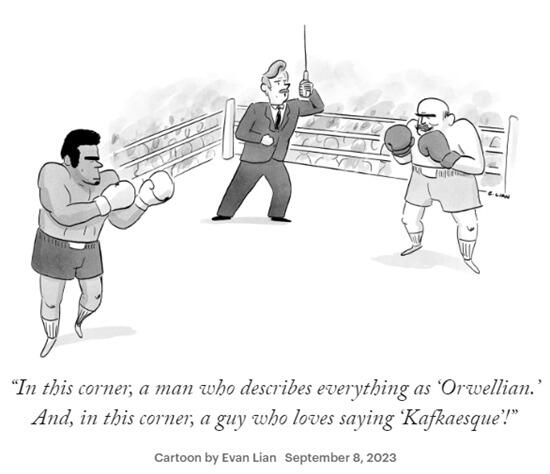
What Kafka got right is how societies can become busily dysfunctional.

For self-evident reasons, the fictional visions of Orwell and Huxley resonate as maps to the present distemper. Orwell’s account of full-spectrum technological totalitarianism maps Big Tech’s mastery of Surveillance Capitalism and governments’ full-spectrum surveillance powering the fine-grained coercion of social credit scores and related tools.

Huxley’s vision of a doped-up, med-dependent populace that loves its servitude also maps the present. Indeed, not only do we love our servitude, which manifests in our endless addictions and dependencies on everything from debt to junk food to painkillers, our servitude has been so normalized that we don’t even recognize the servitude that underpins “normal life.”

What Orwell and Huxley got wrong is the limits of these nightmarishly effective systems of control. Full-spectrum technological totalitarianism can certainly enforce compliance with the desired behaviors and expressions of consent, but it can’t force individuals to have ambition or creativity, to marry for love and children, or possess values or beliefs beyond the superficial lip-syncing of compliance.

The coercive structures of the Surveillance State and Surveillance Capitalism are intrinsically inauthentic, ersatz, hollow, demanding an entirely artificial and easily faked appearance of consent that mimics devotion to the principles and narratives being shoved down the throats of the populace.

These structures enforce what isn’t allowed and superficial compliance, but they can’t force what actually makes a society functional: the convictions, hopes and values that inspire individuals to marry, raise a family and pursue self-expression via achievement. What actually happens in societies controlled by the Surveillance State and Surveillance Capitalism is decay and decline, as young people abandon ambition, marriage and raising children by lying flat and letting it rot, expressions of young people in China that speak to youth everywhere where compliance is more important than individual liberty.

If you doubt these dynamics, please observe the dismay of authorities as their national marriage and birth rates collapse. All sorts of explanations for this collapse are offered, except the ones that count: societies that require an appearance of consent are inauthentic, hollow shells.

The same can be said of doped-up, med-dependent, entertainment-addicted societies that love their servitude. Individuals give up ambition, marriage and raising children due to soaring costs, out-of-reach financial security, and the debilitating consequences of all the Soma, meds, addictions, distractions and derangements that are accepted as “normal.”

What Kafka got right is everyone’s super-busy but nothing gets done. In Kafka’s novel The Castle, the bureaucracy toiling unseen in the Castle is bustling 24/7, but nothing actually gets done in the impoverished village below. Attempts to reach the bureaucracy by phone are futile, as calls are only picked up randomly or as pranks.

(“You’ve reached the DMV, the IRS, Xfinity, Engulf and Devour Healthcare, etc. Your call is very important to us…”)

In Kafka’s fictional world, the authority to actually get anything done is always out of reach. In The Castle, the leader who supposedly has the power to approve projects sits isolated in his office, unreachable and unapproachable, though he can be seen reading a newspaper through a peephole. Whether he actually possesses the power to approve anything is an open question with no answer.

Kafka’s world is one of cowed peasants bickering among themselves, nurturing grudges and speculating fruitlessly about the cloaked conspiracies of the authorities in the Castle. The sexual predations of the authorities and the dismal fates of they used and abandoned are described in whispers, and what work that is available is menial and poorly paid.

What Kafka got right is how societies can become busily dysfunctional, cluttered with unseen lines of authority that may not actually have the authority their official titles suggest, an inscrutably unreachable, unseen bureaucracy and an impoverished populace muddling along on gossip and rumors.
Stripped of gaslighting, fake optimism and empty exhortations to YOLO borrow and spend, that’s a fair description of our current situation. Yes, yes, everything’s wunnerful, it’s The Roaring 20s all over again (never mind how the 1920s ended), AI is gonna make corporations trillions in profits by further immiserating the populace, oops I mean “improving productivity,” and our tireless authorities are hard at work solving all our problems–don’t you hear the whirring of the “money” printing presses running 24/7?

*  *  *

Become a $3/month patron of my work via patreon.com.

Subscribe to my Substack for free

Tyler Durden
Thu, 04/04/2024 – 17:40

via ZeroHedge News https://ift.tt/9Df4uTI Tyler Durden
New York Judge ‘Mistakenly’ Describes Trump Jan. 6 Case As “Federal Insurrection Matter”

New York Judge ‘Mistakenly’ Describes Trump Jan. 6 Case As “Federal Insurrection Matter”

Authored by Catherine Yang via The Epoch Times,

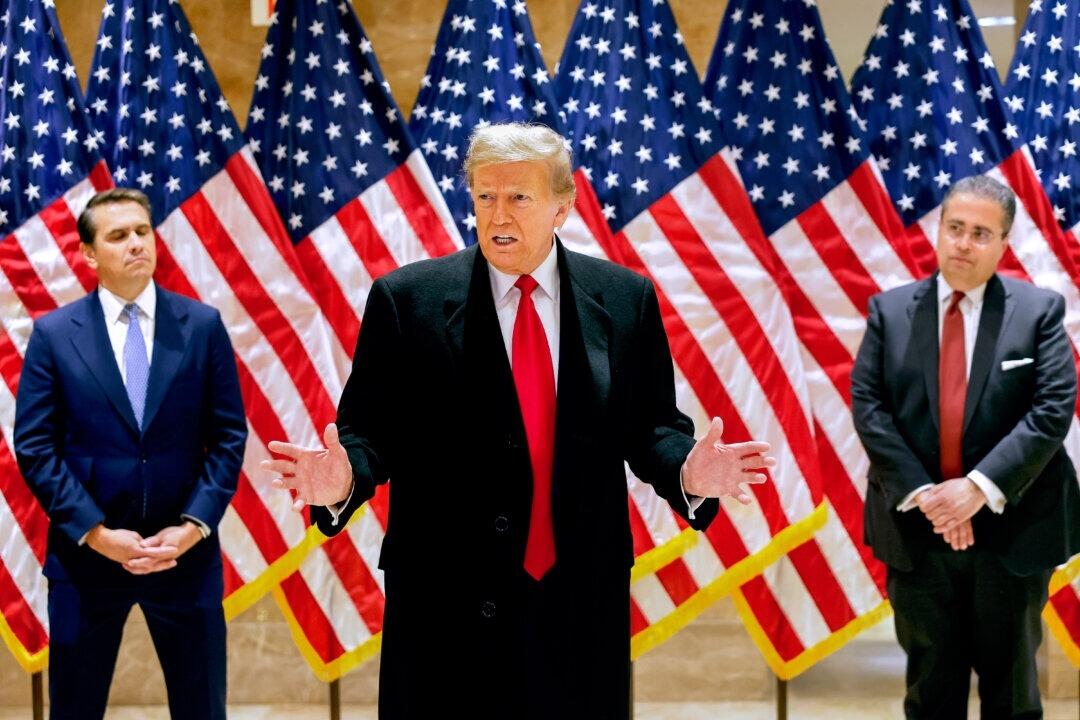
On April 3, New York Supreme Court Justice Juan Merchan denied a defense motion to adjourn the upcoming trial scheduled for April 15, and in his order, referred to former President Donald Trump’s case before the Supreme Court as the “Federal Insurrection Matter.”

“Defendant fully briefed the issue of presidential immunity in his motion to dismiss the matter of United States v. Trump, US Dist Ct, DDC 23 CR 25, (TSC) (hereinafter “Federal Insurrection Matter”) on October 5, 2023,” Justice Merchan wrote.

Justice Merchan is presiding over one of four criminal cases against President Trump. This one is a state case, where Manhattan District Attorney Alvin Bragg has charged President Trump with 34 counts of falsifying business records, alleging a scheme to influence the 2016 elections.

The other case in question charges President Trump with four counts of obstruction and conspiracy for his acts on Jan. 6, 2021, but it does not allege insurrection in the indictment.

Special counsel Jack Smith is prosecuting the case in the U.S. District Court for the District of Columbia, and trial proceedings have been stayed as President Trump pursues an appeal on grounds of presidential immunity.

Counsel for President Trump in the Manhattan case brought the federal case up recently in requesting that the trial be delayed, arguing that the presidential immunity they raised in state court will soon be under review by the U.S. Supreme Court.

On April 25, the Supreme Court will hear oral arguments on “whether and if so to what extent does a former President enjoy presidential immunity from criminal prosecution for conduct alleged to involve official acts during his tenure in office.”

The presidential immunity defense is one President Trump has raised in several of his cases, and attorneys in other cases have requested additional hearings and delays in anticipation of a Supreme Court decision.

‘Insurrection’

It is unclear why Justice Merchan would use the “insurrection” as shorthand for the federal case.

The only appearance of the word “insurrection” is in a quote in response to an attorney saying there would be “riots everywhere” if President Trump remained in office. In response, one of the unnamed co-conspirators tells him, “Well, [Deputy White House Counsel], that’s why there’s an Insurrection Act.”

Separately, critics of President Trump have colloquially referred to the events of Jan. 6, 2021, as an “insurrection,” resulting in a wave of almost 100 state-level lawsuits to disqualify him from the ballot over the past half year.

Earlier this year, the Supreme Court heard another case involving President Trump and ruled that states have no authority to disqualify a federal candidate in elections.

However, it would be unlikely that the judge confused the two cases, as President Trump did not argue presidential immunity in the ballot disqualification case, and the Supreme Court issued a ruling ending the challenges on March 4.

Renewed Recusal Request

Defense attorneys in the Manhattan case are also renewing requests that the judge step down, arguing that he has shown partisan interest.

Last August, Justice Merchan rejected an initial motion for recusal. He stated that his small-dollar donations to President Trump’s political opponents and his daughter’s employment at a marketing firm, which has received millions from those campaigning against President Trump, would not affect his ability to try the case impartially.

However, Justice Merchan recently broadened a gag order to prevent President Trump from discussing the judge’s family members. The move follows President Trump’s renewed grievances about the judge’s daughter helping to campaign for politicians such as Vice President Kamala Harris and Rep. Adam Schiff (D-Calif.).

Defense attorneys made another request that the judge recuse himself on April 1, arguing that the judge’s family has commercial interests that “are benefitted by developments in this case that harm President Trump’s penal interests.”

“The trial in this case will benefit Authentic financially by providing its clients more fodder for fundraising, Authentic will make more money by assisting with those communications, and Your Honor’s daughter will continue to earn money from these developments by virtue of her senior role at Authentic,” they wrote in a one-page pre-motion letter, recently required by the judge before a full motion is allowed to be filed.

Based on Federal Election Commission filings, the defense found that “some of those funds were paid to Authentic by entities associated with legislators and PACs that have used email and/or social media to solicit contributions specifically based on this case.”

Tyler Durden
Thu, 04/04/2024 – 17:00

via ZeroHedge News https://ift.tt/CB2mP36 Tyler Durden

MSM Trots Out ‘Bird Flu-Pocalypse’ After Texas Dairy Worker Falls Ill

MSM Trots Out ‘Bird Flu-Pocalypse’ After Texas Dairy Worker Falls Ill

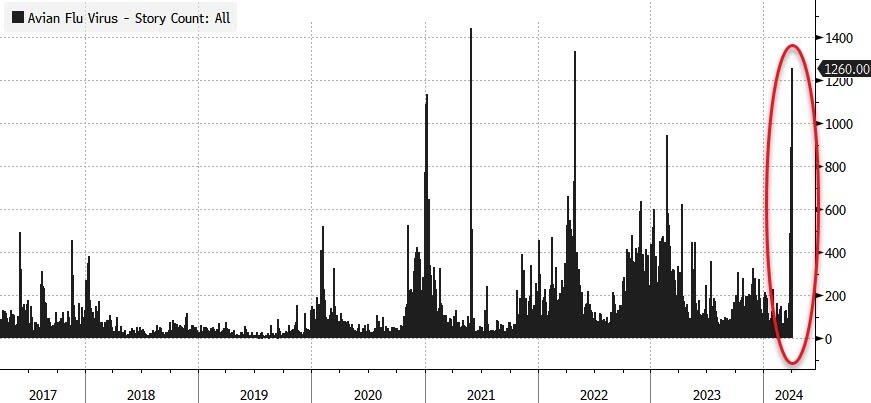
Bird flu is back in the news after a Texas dairy worker tested positive for the virus in the first documented case of bird-cow-human transmission.

So of course, a cacophony of ‘experts’ are now warning that a bird flu pandemic could be ‘100 times worse’ than COVID.’

Mentions of “Avian Flu Virus” in the news

“This virus [has been] on the top of the pandemic list for many, many years and probably decades,” said Pittsburgh bird-flu researcher Dr. Suresh Kuchipudi, during a recent panel cited by the Daily Mail.

And now we’re getting dangerously close to this virus potentially causing a pandemic,” he continued. “So therefore, in my view, I think this is a virus that has the greatest pandemic threat [that is] playing out in plain sight and globally present.”

The Mail also cites pharmaceutical vaccine consultant and BioNiagra founder John Fulton, who said during the same meeting: “This appears to be 100 times worse than COVID — or it could be if it mutates and maintains its high case fatality rate.”

Once it’s mutated to infect humans, we can only hope that the [fatality rate] drops,” he added.

Meanwhile there’s this Feigl-Ding, who rose to e-prominence during the pandemic as an extreme fear monger:

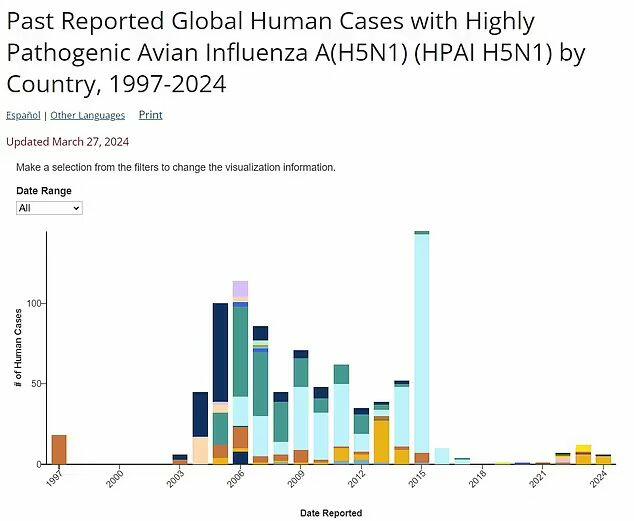
Approximately 52% of those who have contracted H5N1 since 2003 have died, according to the WHO

Via the Daily Mail

That said, according to CDC Director Mandy Cohen, “the whole  U.S. government is taking this situation very seriously,” but the virus does not pose much of a risk to the general public. That said, they did just warn not to drink raw milk.

Another voice calling for calm is David Swayne, who has worked on bird flu cases in animals for decades.

“Right now, for the cattle cases — there is no knowledge, so that’s easy for the alarm to be raised,” he told the Mail. “There is a huge lack of knowledge that we need to fill.”

“Let’s look at the facts and look at them with reason, we don’t really know that much today because of the knowledge gaps that we need to fill.”

Others such as UK-based epidemiologist Dr Francois Balloux posted to X: “‘People not professionally involved in pandemic prevention/mitigation being worried/feeling miserable now won’t make any material difference to what may hit us, except that their life would suck, far more than it should.”

Perhaps that will change in time for the 2024 election if the ‘gain-of-function’ guys have their way with it.

Tyler Durden
Thu, 04/04/2024 – 16:40

via ZeroHedge News https://ift.tt/xXmbAFI Tyler Durden
Climate Alarmists’ Bad Science

Climate Alarmists’ Bad Science

Submitted by David Barker, who has taught economics and finance at the University of Chicago and the University of Iowa and worked as an economist at the Federal Reserve Bank of New York. He runs a real-estate and finance company.

I debunked research by the Federal Reserve and top academic economists on the economics of climate change. An author of a paper I debunked then said that three professors from Stanford and Berkeley had done a much better analysis of temperature and growth in an article they published in Nature. I took up the challenge and scrutinized their article. My critique appears in the latest issue of Econ Journal Watch.

The Nature article is in the top 0.1% of academic economics publications by citations, and it has received glowing press coverage. I downloaded their data and found that, as with the other articles I debunked, the results don’t hold up under scrutiny.

The authors claim that there is an optimal average temperature of 55.5 degrees Fahrenheit for economic growth. Countries colder or warmer than that grow more slowly. The authors then use one of the most extreme Intergovernmental Panel on Climate Change estimates of warming up to the year 2100 and calculate for each country how much more or less growth that warming would cause. They then calculate the difference in world gross domestic product with warming and without.

Greenland, with an average temperature of 25 degrees, would benefit from warming. The U.S., average temperature 56, would be relatively unaffected. Niger, average temperature 83, would see lower growth from warming. Adding up all countries, the authors say warming would reduce world GDP per capita by 23%.

Every country, from St. Vincent in the Caribbean to China has the same influence on their result. Weighting by population nearly eliminates that result, and adjusting for correlated observations and dropping one or two unusual observations eliminates it completely. The observations aren’t independent, because countries clustered in regions and observations close in time have similar patterns of growth and temperature. An example of an unusual observation is Greenland in 1990. A large mine that generated 12% of Greenland’s GDP closed that year, and not because it happened to be 2 degrees cooler than normal.

Rather than uncovering a consistent relationship between growth and temperature around the world, their results are driven by relatively few countries. Dropping Greenland and a group of contiguous northern and central African countries, for example, eliminates the practical and statistical significance of their results.

The authors claim that there is no tendency for their results to diminish over time, because they find that the results for 1961-89 and 1990-2010 are similar. But changing the cutoff year to 1990 instead of 1989 changes this conclusion, because the data from 1991-2010 show no statistically significant relationship between growth and temperature. Because some countries are missing data from early years, a cutoff of 1990 would do a better job of matching the number of observations between the two periods. There is also evidence that if a result is present at all, it is completely reversed the following year.

I also produce simulated data with random numbers representing temperature and growth that are correlated by region, but with no relationship between temperature and growth. I find that the authors’ method is likely to indicate a statistically significant relationship even though the data are constructed to have no such relationship.

The authors have been invited to reply to my critique. On my previous three critiques, the commented-on authors didn’t reply.

Why do such qualified and clever economists write such bad papers, and why do top journals publish them? Economic growth, compounding year after year, can far outstrip the effects of climate. But to inflict their agenda, climate alarmists need to show that warming will reduce economic growth. They need to show that GDP growth itself is significantly reduced by higher temperatures to press for gigantic government subsidies and controls.

The law of supply and demand applies to tomatoes and also to ideas. Demand for research that bolsters arguments for bad policy leads to supply of research. Truth provides some constraints but doesn’t always prevail.

Fortunately, such publications as Econ Journal Watch give a platform to researchers who challenge reigning propaganda. More academics and independent researchers are uncovering bias, fraud and plagiarism, bringing a bit of discipline to a field greatly in need of it.

Tyler Durden
Thu, 04/04/2024 – 16:20

via ZeroHedge News https://ift.tt/HscQiY3 Tyler Durden

Bonds & Bitcoin Bid As Kashkari & Crude Slam Stocks

Bonds & Bitcoin Bid As Kashkari & Crude Slam Stocks

An armada of FedSpeak today was pretty much all in the same direction – need more time on inflation, no rush to cut (but will cut), jobs strong – with the only divergence being the degree (Gooslbee, more dovishly worried about labor market due to rising delinquencies; to Kashkari, more hawkishly questioning any need to cut rates at all given how economy is doing).

In order of their appearance:

  • *BARR: BANKS’ OFFICE COMMERCIAL REAL-ESTATE ISSUES TO TAKE TIME

  • *KUGLER: `SOME LOWERING’ OF RATES THIS YEAR LIKELY APPROPRIATE

  • *FED’S HARKER SAYS INFLATION IS STILL TOO HIGH

  • *BARKIN: FED HAS TIME TO GAIN MORE CLARITY BEFORE LOWERING RATES

  • *GOOLSBEE: WORTH STAYING ATTUNED TO DETERIORATION IN JOBS MARKET

  • *KASHKARI: QUESTION OF WHY CUT RATES IF ECONOMY REMAINS STRONG

  • *MESTER: NEED MORE PROGRESS ON HOUSING, CORE SERVICES INFLATION

Everything was going swimmingly early on. Stocks saw jobless claims data and algos greenlit the buying panic (read all about the farce that is jobless claims here).

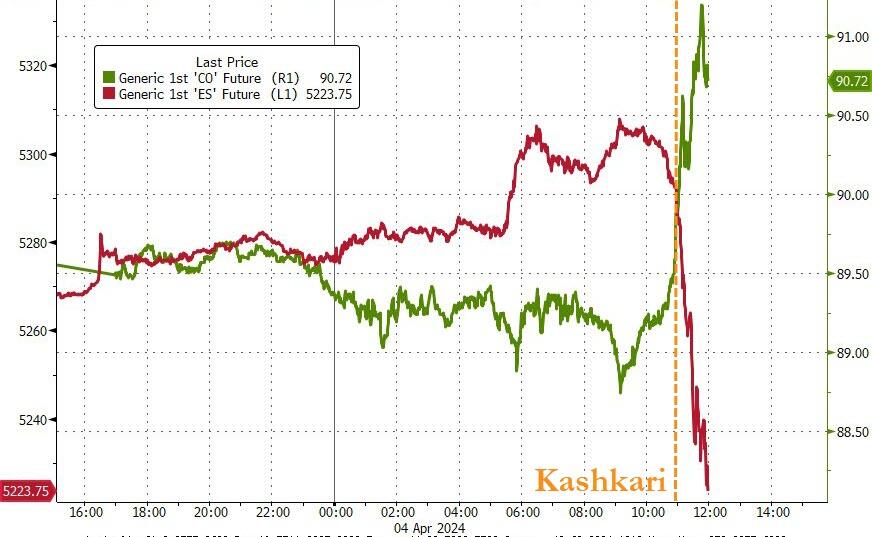
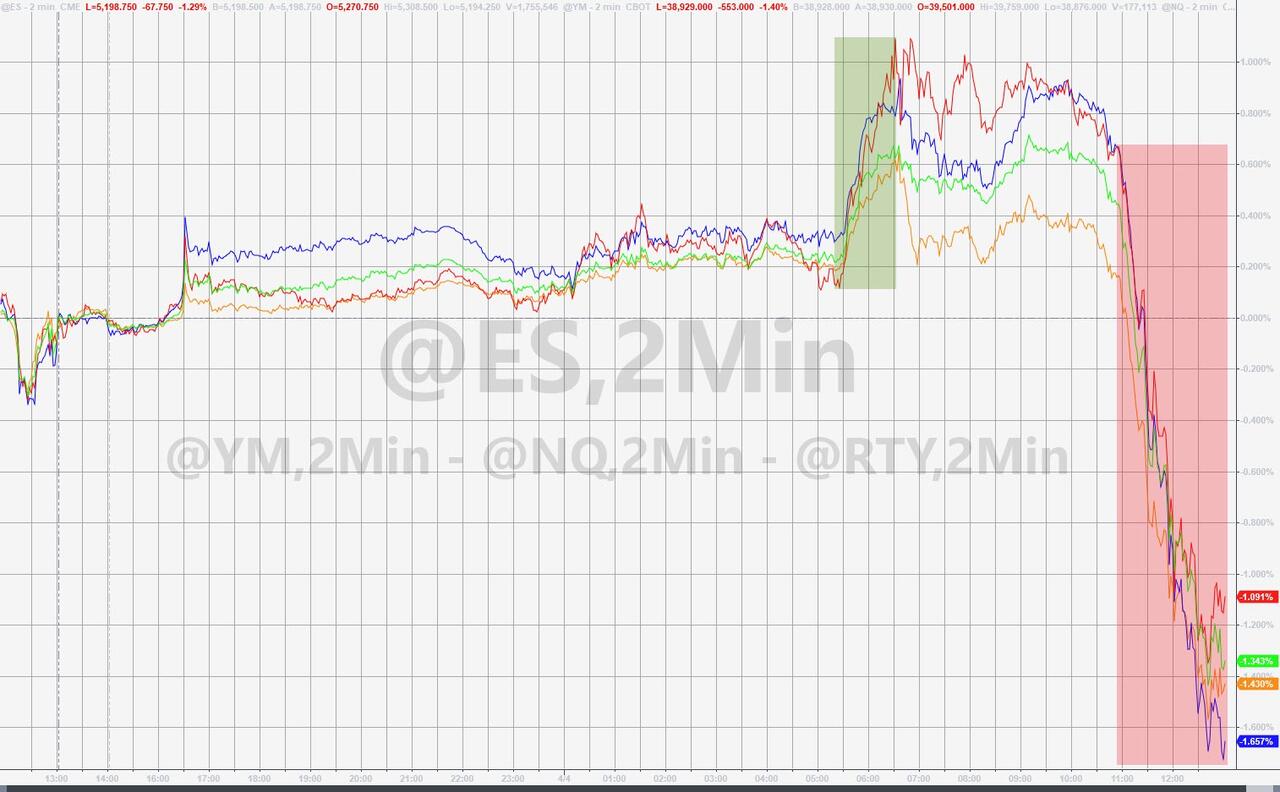
The gains survived the various Fed speakers early on until Kashkari spoke and hinted at the potential of no rate-cuts and that seemed to trigger a wave of selling in stocks.

“In March I had jotted down two rate cuts this year if inflation continues to fall back towards our 2% target,” Kashkari said in a virtual event with LinkedIn on Thursday.

“If we continue to see inflation moving sideways, then that would make me question whether we needed to do those rate cuts at all.”

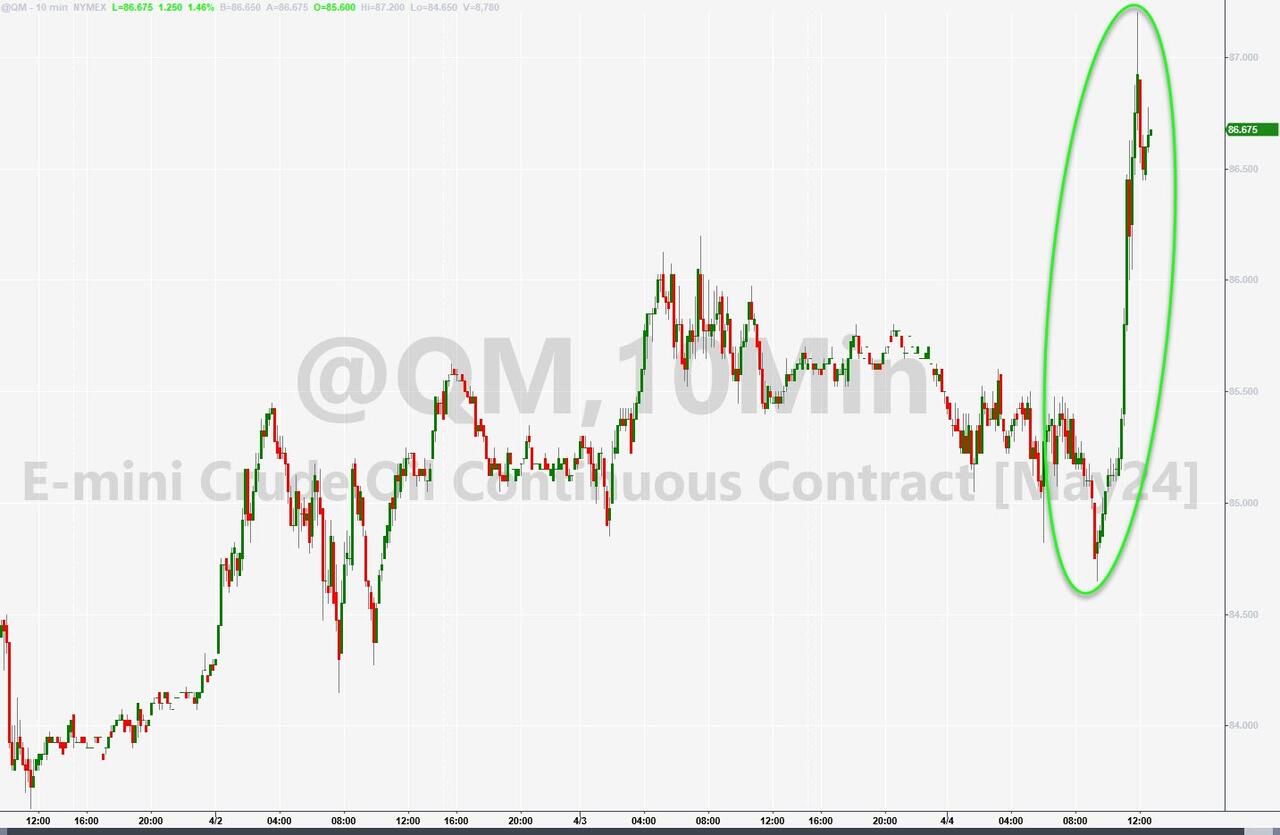
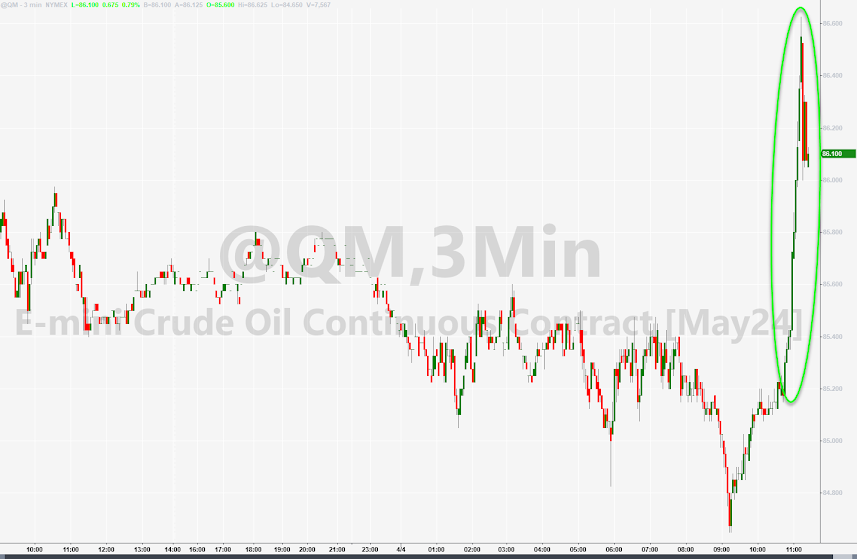
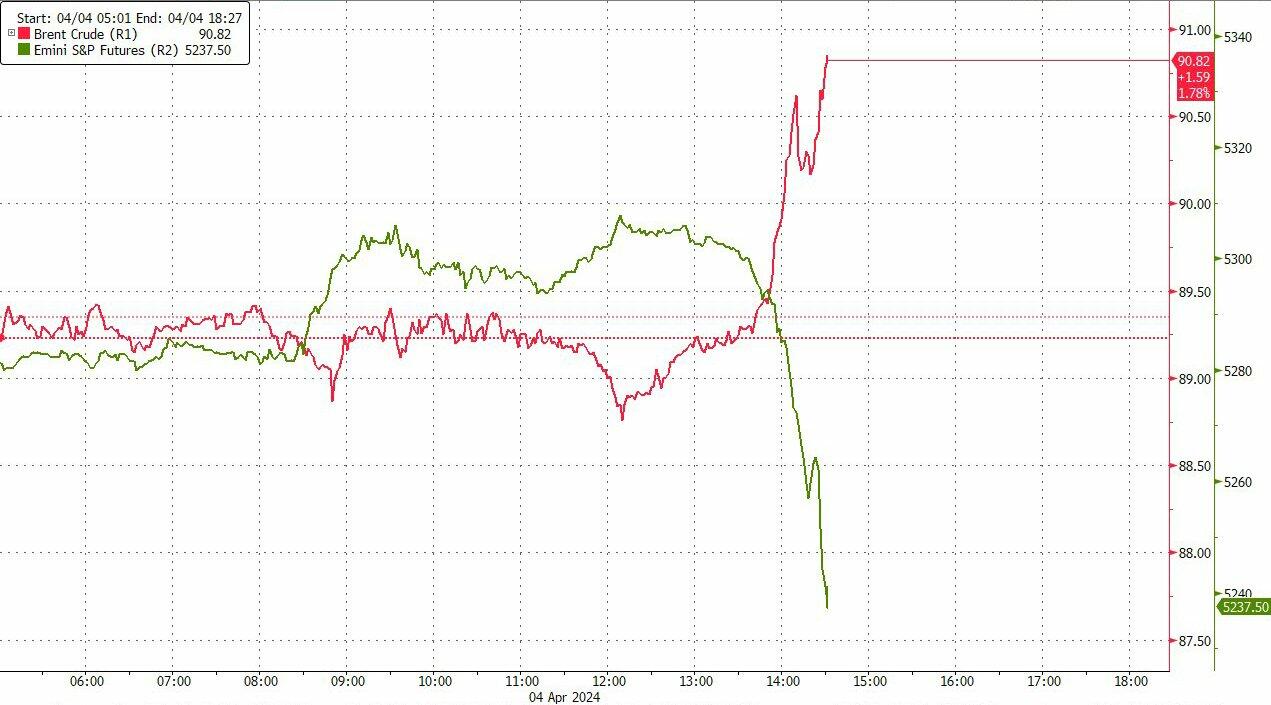
The decline in stocks also corresponded with a surge in oil prices driven by headlines around UAE cutting ties with Israel and Israel putting all of its global embassies on alert

Source: Bloomberg

WTI topped $87 intraday…

Source: Bloomberg

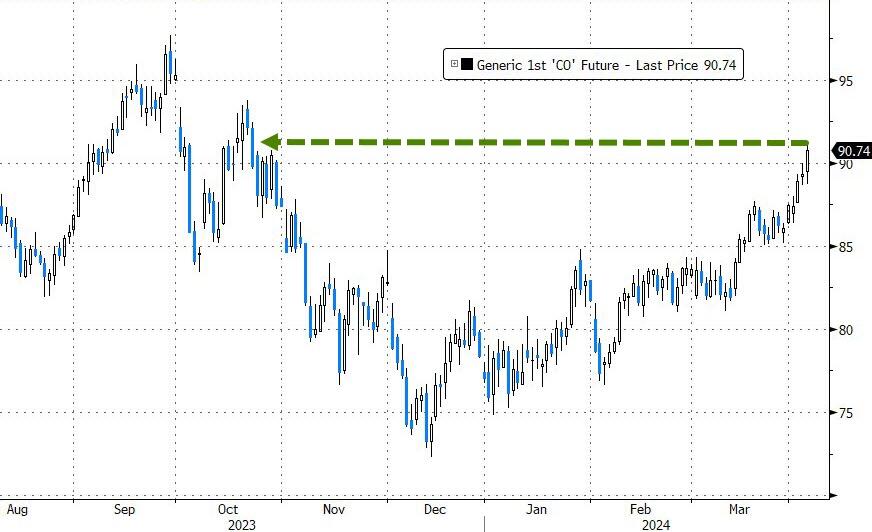
Brent also topped $91 for the first time since Oct 2023…

Source: Bloomberg

It was an ugly day overall in stocks (among the ugliest in a while) with everything sliding from gains near 1% to losses near 1.5%. Nasdaq was the laggard (but basically everything was dumped together)… Small Caps and The Dow are down over 3% on the week..

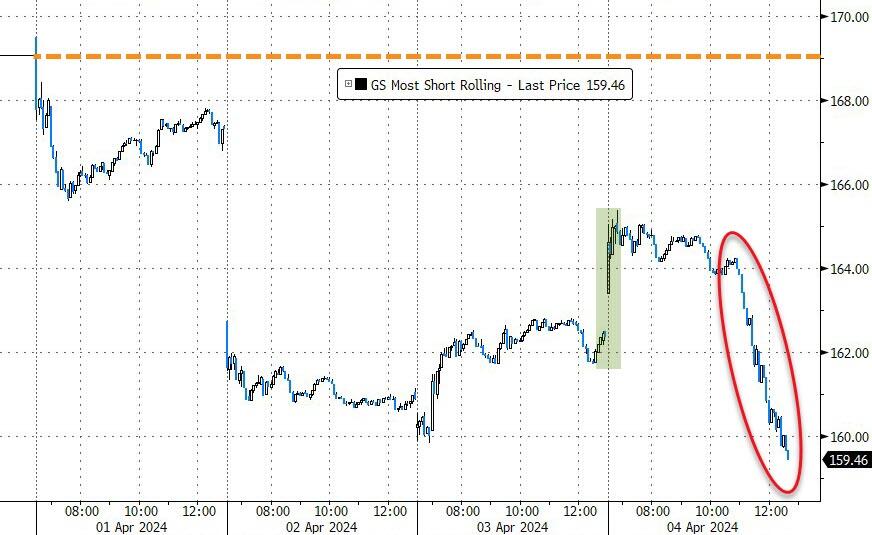
“Most Shorted” stocks were monkey-hammered…

Source: Bloomberg

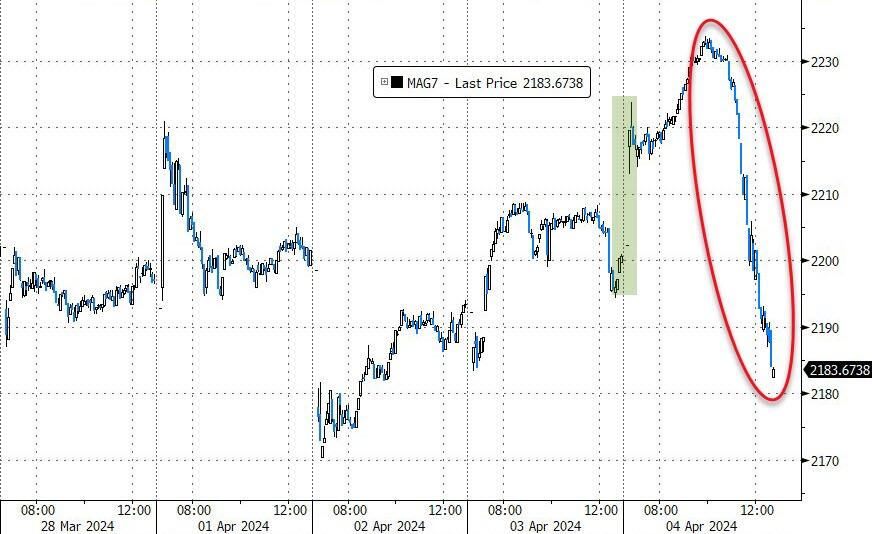
…and MAG7 stocks were pummeled after a strong open…

Source: Bloomberg

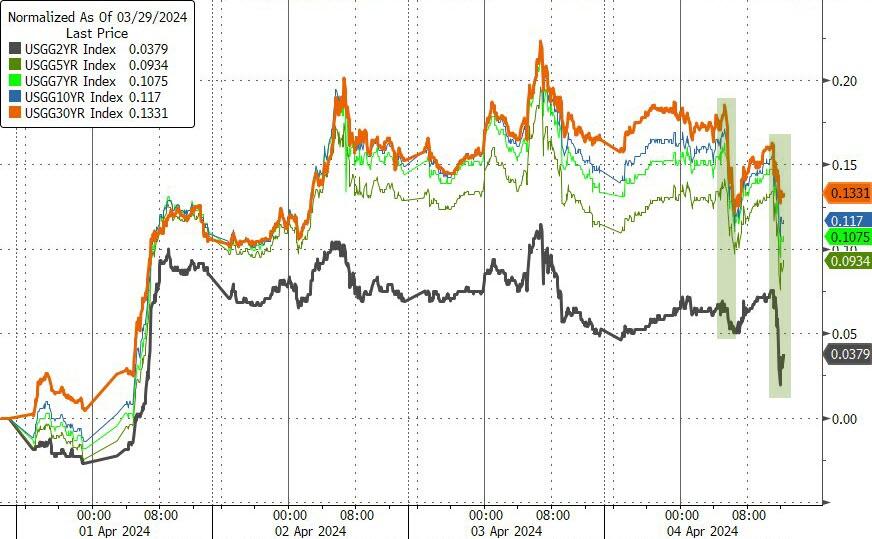
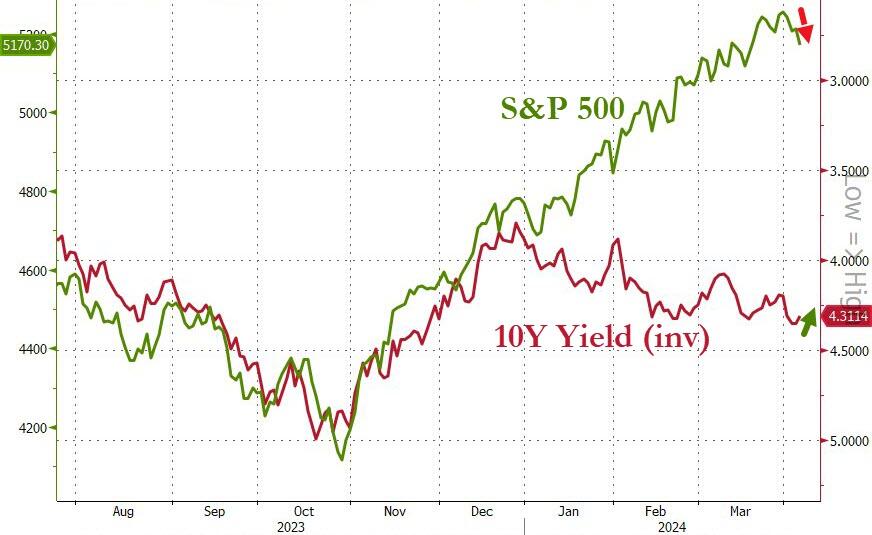
Everything fell at the same time – around the crossover of Kashkari’s comments and oil’s spike but we note that bond yields also tumbled (odd given oil’s rise – inflation – and Kashkari’s comments, hawkish)…

Source: Bloomberg

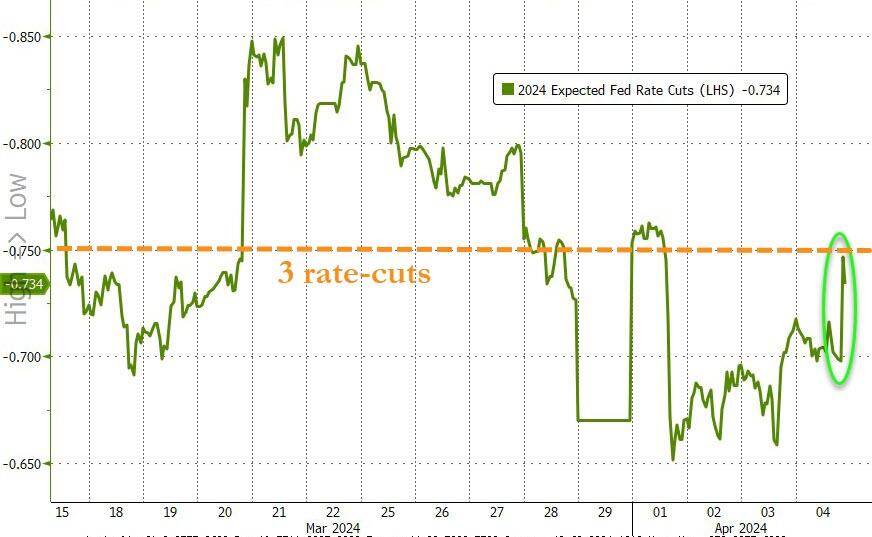
Are bonds suddenly fearful of an oil-price-spike-induced recession? Rate-cut expectations also rose (back to 3 cuts in 2024)…

Source: Bloomberg

Also suggesting this was more an oil story than a Fed story.

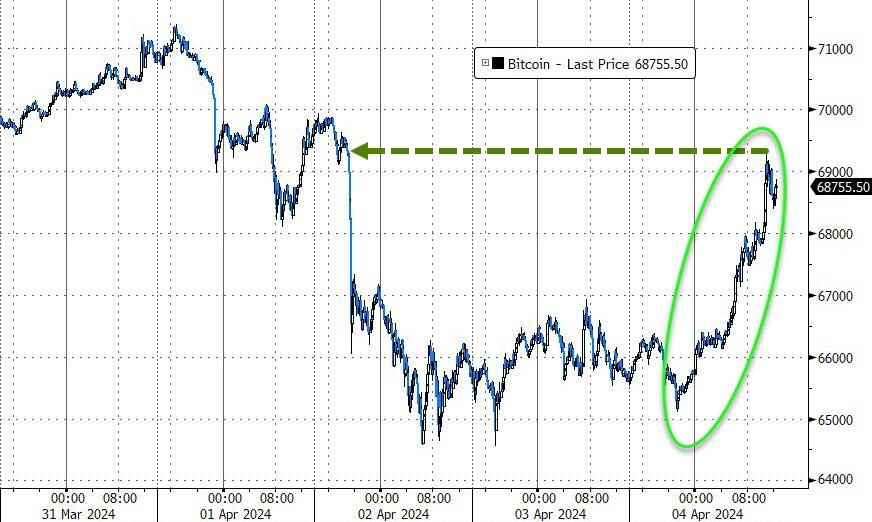
Crypto had a huge day, erasing all of Tuesday’s tumble, back above $69,000…

Source: Bloomberg

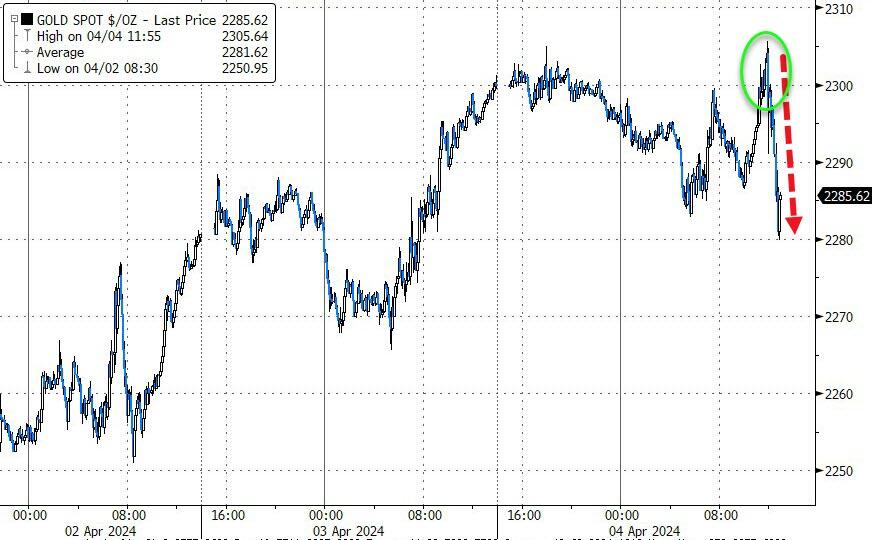
Gold hit a new record high for the sixth day in a row, above $2300 (spot) for the first time before selling off late in the day…

Source: Bloomberg

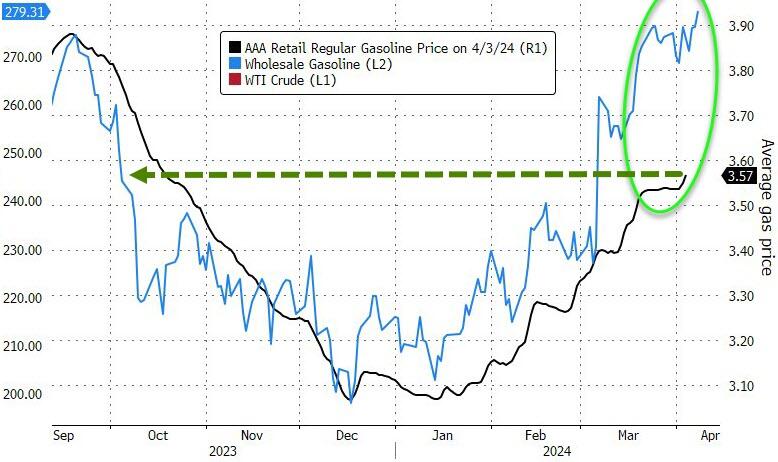
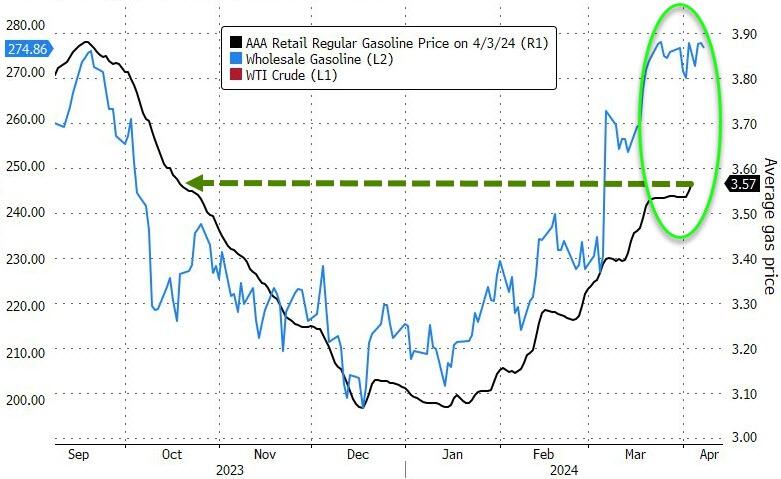
As crude soared today, so wholesale gasoline prices hit their highest level in seven months, leading pump prices ever higher…

Source: Bloomberg

Finally, which comes first? S&P 4800 or 10Y 3.5%?

Source: Bloomberg

We suspect we will see whether this mini-reversal is sustained after 0830ET tomorrow morning.

Tyler Durden
Thu, 04/04/2024 – 16:00

via ZeroHedge News https://ift.tt/Q5Mhr6N Tyler Durden

Former CNN CEO Walter Isaacson Accused Of Assaulting Student Protester

Former CNN CEO Walter Isaacson Accused Of Assaulting Student Protester

Authored by Jonathan Turley,

Various groups are demanding the resignation or firing of Walter Isaacson, former CEO of CNN and the Aspen Institute, after allegedly assaulting a Tulane student protester, Rory MacDonald during an event to foster diversity of ideas and entrepreneurship for New Orleans Entrepreneurship Week.

MacDonald is seen interrupting the event by yelling anti-Israeli and Pro-Palestinian statements.

In a video, Isaacson, 72, is sitting near the student and decides to take action by pushing the student out of the room.

MacDonald claims injuries as a result of the action and groups are calling it an assault. The university says that it is  investigating.

Tulane Students for a Democratic Society (SDS) posted a video on Instagram.

Isaacson, who is the Leonard Lauder Professor of American History and Values in the history department, can be shown gently moving MacDonald out of the seats.

However, at the door, there appeared more of a brief scuffle at the last moment before the two went out of the frame for a split second. Isaacson is then shown returning immediately.

There does not appear to be more than shoving on the video to move MacDonald out of the event.

In its Instagram post, SDS claimed that MacDonald (who identifies as a “them” as a transgender student) was injured: “Isaacson, an audience member, grabbed Rory and cursed at them, battering them and leaving them with bruises on their arms and scratches on their back.”

On local media, MacDonald is shown displaying slight scratch marks.

SDS and other groups have condemned Isaacson.

Technically, shoving can be assault under both criminal and tort law. Certainly leaving scratch marks can qualify as evidence of assault. However, the situation is more complex than some faculty member spontaneously assaulting a student. Any removal of a disruptive protester will involve some firm handling or shoving. Indeed, when a subject resists, this can become a matter of self-defense for security as force is increased. As a subject resists, security is allowed to protect itself with a commensurate level of force.

If security can physically remove a protester (including shoving an individual from a room), the question is whether an audience member can do so. A professor has no special legal status to conduct security or exclude individuals from a public event. What is clear is that this is a function best left to university security. The problem is that security often does not enforce rules against disruptive behavior.

MacDonald was disrupting the event and Isaacson was seeking to remove him. In moving to the door, there does not appear to be anything more than firmly shoving MacDonald. In the final second, there appears to be a more forceful push in the hallway as Isaacson goes back inside. Isaacson can claim that he was protecting himself by shoving away MacDonald at that last minute. He is seen speaking to the student before firmly leading him to the door. Again, the university is investigating. There is no report of a criminal complaint.

If the university is investigating this matter, it should also address why a faculty member felt compelled to perform security at the event.

We have seen universities routinely fail to expel protesters interrupting classes and events.

Universities can turn these protests into a type of “heckler’s veto” where speeches are cancelled in advance or terminated suddenly due to the disruption of protesters. The issue is not engaging in protest against such speakers, but to enter events for the purpose of preventing others from hearing such speakers. Universities create forums for the discussion of a diversity of opinions. Entering a classroom or event to prevent others from speaking is barring free speech.

This has been an issue of contention with some academics who believe that free speech includes the right to silence others.  Student newspapers have declared opposing speech to be outside of the protections of free speech.  Academics and deans have said that there is no free speech protection for offensive or “disingenuous” speech.  CUNY Law Dean Mary Lu Bilek showed how far this trend has gone. When conservative law professor Josh Blackman was stopped from speaking about “the importance of free speech,”  Bilek insisted that disrupting the speech on free speech was free speech. (Bilek later cancelled herself and resigned after she made a single analogy to acting like a “slaveholder” as a self-criticism for failing to achieve equity and reparations for black faculty and students).

Years ago, I debated NYU Professor Jeremy Waldron who is a leading voice for speech codes. Waldron insisted that shutting down speakers through heckling is a form of free speech. I disagree. It is the antithesis of free speech and the failure of schools to protect the exercise of free speech is the antithesis of higher education. In most schools, people are not allowed to disrupt events. They are escorted out of such events and told that they can protest outside of the events since others have a right to listen to opposing views. These disruptions however are often planned to continually interrupt speakers until the school authorities step in to cancel the event.

Tulane clearly failed to protect this event and that led to this “self help” action by Isaacson. If he went too far off camera, there is also a question of why he had to act at all rather than campus security removing such disruptive protesters. This will continue until university administrators have the courage to suspend or expel students denying others the right to listen and speak at events.

Absent enforcement of school rules on such disruptions, there is little hope for the open exchange of ideas and a diversity of opinions on campus. It can unleash a type of tit-for-tat pattern of retaliation as speakers are prevented from speaking on controversial subjects. Our campuses then become little more than screaming matches. The rules of most schools properly draw the line between protests and disruptions. Everyone is allowed to be heard. However, if you enter to disrupt it, you are disrupting free speech.

Tyler Durden
Thu, 04/04/2024 – 15:45

via ZeroHedge News https://ift.tt/BW41CbS Tyler Durden

Google Eyes Paid AI Search Features, Explores Subscription Model; Report

Google Eyes Paid AI Search Features, Explores Subscription Model; Report

Authored by Amaka Nwaokocha via CoinTelegraph.com,

Google is considering introducing premium features powered by generative artificial intelligence (AI) in its search engine.

The move would mark the first time a core Google product is behind a paywall. However, the free search experience with advertisements will still be available.

According to a Financial Times report on April 3, the tech giant is looking at a variety of options, including incorporating AI-powered search features to its premium subscription services, which already provide access to its new Gemini AI assistant in Gmail and Docs.

Google mainly relies on advertising for monetization. The company already offers various plans, such as the Gemini AI assistant in Gmail and Docs.

However, these subscriptions currently do not enhance the search experience. The company’s main product, Google Search, has been free since its launch in the early 2000s. However, the tech giant might be exploring different means of monetization.

The report added that Google’s traditional search engine would remain free of charge and that ads would continue to appear alongside search results even for subscribers.

With the recent competition in AI, most tech companies have tried to bring more products to the market.

Google started trialing its AI-driven search tool, combining tailored narratives with web links and advertisements. Yet integration into the primary search engine lags due to delayed feature adoption from its experimental “search generative experience.”

However, AI queries demand more computing power, which ultimately is costly compared to general queries. Therefore, it may not be profitable if Google brings its “Search Generative Experience” for free.

A spokesperson from Google said that the company has no plans for an ad-free search experience: 

“We’re not working on or considering an ad-free search experience. As we’ve done many times before, we’ll continue to build new premium capabilities and services to enhance our subscription offerings across Google.”

In February, Google added a new paid tier to its consumer subscription service that gives people access to its latest AI model, Gemini.

Users who pay for the subscription, called Google One AI Premium, can use the advanced Gemini chatbot and access the generative AI model in popular services such as Gmail and Google Docs.

Google, credited with pioneering the technology underlying the current AI surge, finds itself embroiled in competition with two prominent industry players: OpenAI, the developer of ChatGPT, and Microsoft, its supporter.

Tyler Durden
Thu, 04/04/2024 – 15:05

via ZeroHedge News https://ift.tt/jPE7zeI Tyler Durden

US Gas Price Hits Highest Level In Six Months Amid Speculation Biden Will Drain More Oil From Petroleum Reserve

US Gas Price Hits Highest Level In Six Months Amid Speculation Biden Will Drain More Oil From Petroleum Reserve

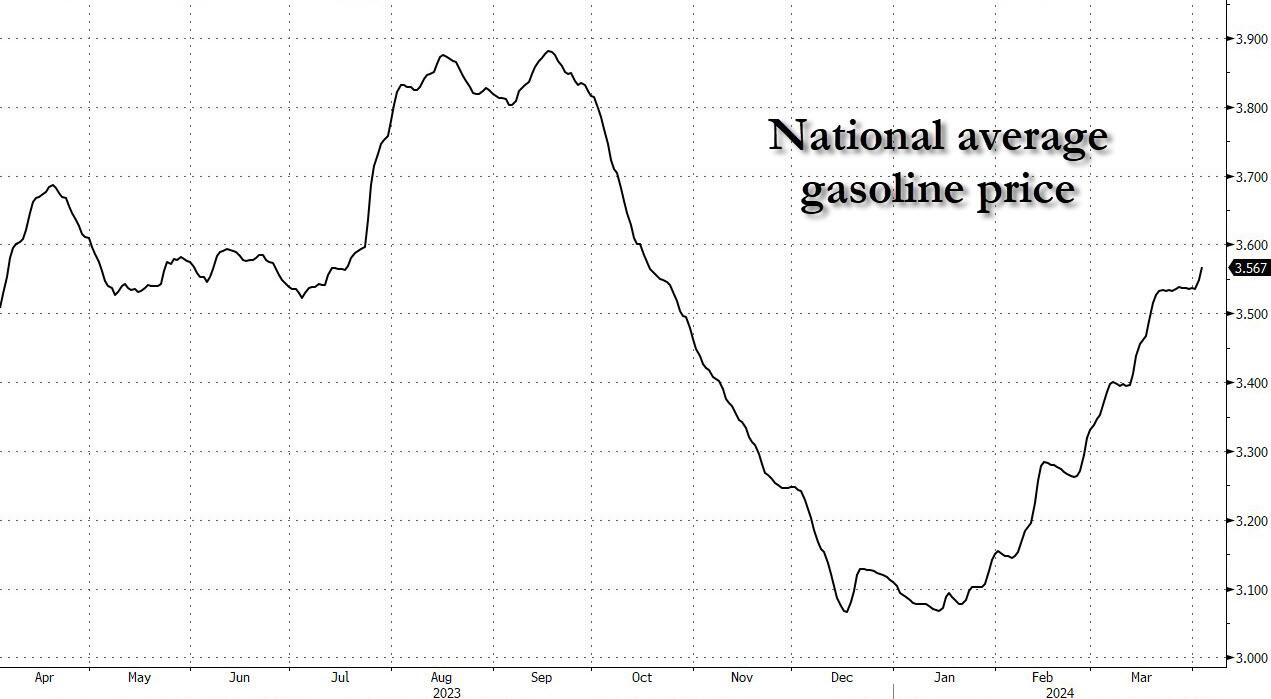
Rising seasonal demand and higher crude oil prices have resulted in the highest average U.S. gasoline prices in nearly six months, with the national average gas price hitting $3.57 per gallon, up from $3.10 at the start of the year, and higher than a year ago.

The national average hit a new multi-month high on Thursday morning, rising to $3.57 per gallon, the highest since October 14, Patrick De Haan, head of petroleum analysis at GasBuddy, noted.

The current average price of a gallon of regular gasoline is some 20 cents higher than the $3.352 average one month ago, according to data from AAA, and is 7.2 cents per gallon higher than at this time last year, De Haan added. At this time last year, the national average price was at $3.507 per gallon.

The rise in prices this week follows a week of barely changed prices.

After climbing for four straight weeks, the national average was unchanged on Monday compared to a week ago at $3.51 per gallon, GasBuddy’s De Haan wrote earlier this week.  

“While we seem to be nearing a short-term peak, one word of caution for those in the Mid-Atlantic and Northeast: you haven’t yet finished the transition to summer gasoline, so you may experience some sticker shock in a few weeks,” the analyst said.

This week, WTI Crude prices topped $85 per barrel amid signs of tightening global crude supply. Moreover, demand continued to rise with the warmer weather and the Easter weekend.

The EIA’s weekly report on Wednesday showed a draw in gasoline stocks, implying stronger demand. Gasoline inventories shed 4.3 million barrels in the week to March 29, with production averaging 10 million bpd. These figures compared with an inventory build of 1.3 million barrels for the previous week, when production stood at an average of 9.2 million barrels daily.

Meanwhile, as reported previously, JPM sees oil rising to $100 or higher if Russia fails to boost output. Such an outcome would be catastrophic for Biden in the months ahead of the presidential election, and according to JPM commodity strategist Natash Kaneva, the senile occupant of the White House could drain some more oil from the already mostly depleted SPR (which earlier this week he said he would no longer refill as oil prices had gotten too high). JPMorgan estimates the Biden administration “has the policy space to release up to 60 mn bbls of crude oil, boosting supply by 0.5 mbd per month if spread over four months.”

How Biden would spin such a clearly political move as a national emergency emergency is unclear – he may need to start another war or two – but it almost certain that he will try.

Tyler Durden
Thu, 04/04/2024 – 14:50

via ZeroHedge News https://ift.tt/LNCFGTO Tyler Durden

Oil Surges Over $90, Stocks Tumble After Israel Puts Embassies Around World On Maximum Alert

Oil Surges Over $90, Stocks Tumble After Israel Puts Embassies Around World On Maximum Alert

At this point Israel’s ties with key Gulf countries like the UAE are near breaking point, after only a few short years ago diplomatic normalization was hailed through Trump’s Abraham accords. But international and Israeli press reports are confirming the UAE has announced it is halting all coordination on humanitarian aid with Israel.

Further, as Israeli media reports: “The United Arab Emirates (UAE) has announced a suspension of diplomatic coordination with Israel in the wake of the death of seven World Central Kitchen humanitarian workers in Gaza.” Simultaneously, Israel is busy putting its embassies across the world on high security alert due to the “heightened Iranian response threat” in wake of Monday’s Israeli attack on the Iranian embassy in Damascus. All of this served to send Brent soaring in the last two hours, with Brent spiking above $90 for the first time since October….

… and sending stocks tumbling to session lows.

With Iran vowing that its retaliation is coming at any moment, Israel’s military is scrambling for readiness, with the latest measure being to pause all home leave for all combat troops.

“The IDF is at war and the issue of the deployment of forces is constantly reviewed as needed,” the Israeli military said.

President Biden is meanwhile is said to be “pissed” with PM Netanyahu over the killing of seven World Central Kitchen aid workers in Gaza, though Israel acknowledged that it was a “grave mistake”. 

So far this sounds like more mere empty words of “concern” – a talking point that’s been on repeat from the White House even as its Gaza policy continues slowly fracturing the Democratic base – but Biden is said to have pressed Bibi for “an immediate ceasefire”

The call readout further said ceasefire is needed to “protect innocent civilians” in Gaza and improve the humanitarian situation. Axios writes that Biden gave his Israeli counterpart an “ultimatum” as the US president “emphasized that the strikes on humanitarian workers and the overall humanitarian situation are unacceptable.” 

Tyler Durden
Thu, 04/04/2024 – 14:42

via ZeroHedge News https://ift.tt/RJrVAdn Tyler Durden

Janet Yellen Arrives In China For High-Stakes Economic Meetings

Janet Yellen Arrives In China For High-Stakes Economic Meetings

Authored by Dorothy Li and Frank Fang via The Epoch Times,

U.S. Treasury Secretary Janet Yellen has arrived in China for a 6-day visit, a trip she said was necessary to “advance America’s economic and national security interests.”

Ms. Yellen landed in the southern Chinese export hub of Guangzhou on Thursday afternoon. Before her arrival, she took to social media platform X to explain the objectives of her trip.

“During my time in China, I’ll focus on advancing a healthy economic relationship that provides a level playing field for American workers and firms, and furthering cooperation on shared challenges like illicit finance and climate change,” she wrote.

The Treasury Department said her trip, the second in less than a year, aims to press her Chinese counterparts on Washington’s concerns about the regime’s “unfair trade practices” and “industrial overcapacity,” which poses a threat to economies across the world.

She did not rule out the possibility that the Biden administration would impose tariffs or other trade barriers on China to protect U.S. green energy industries negatively impacted by China’s overproduction.

“We are trying to nurture an industry in, for example, solar cells, electric batteries, electric vehicles, and these are actually all areas where we think that massive investment in China is creating some overcapacity,” she said during a stopover in Alaska.

“I wouldn’t want to rule out other possible ways in which we would protect them.”

Ms. Yellen will start her mission by meeting with Wang Weizhong, the provincial governor of Guangdong, and vice premier He Lifeng, who oversees China’s economic and financial systems, on Friday, according to the schedule released by her department. She will have additional talks with the former vice premier, Liu He, who retired from China’s leadership last year but was said to remain an influence on policymaking.

Before heading to Beijing on Saturday afternoon, the Treasury’s chief will also sit down with representatives from American businesses operating in China. Ms. Yellen confronted the Chinese communist regime’s coercive measures against U.S. firms during her first visit to China as treasury secretary last July. Following that trip, her department set up two working groups with China’s financial ministry to deal with economic and financial issues.

Industrial Overcapacity

China is seeking to boost its slowing economy by pumping more cash into the manufacturing sectors at a time of weak demand at home. Western economies have become increasingly wary of a flood of cheap China-made products being dumped on the international market, especially in clean energy sectors such as solar panels and electric vehicle (EV) batteries.

Ahead of her trip, Ms. Yellen warned that Beijing’s state subsidies have resulted in “substantial overinvestment” and “excess capacity” in steel, aluminum, and other sectors, which has prompted Chinese manufacturers to sell their products overseas at low prices and forced businesses in the rest of the world to contract.

“Now, we see excess capacity building in new industries like solar, EVs, and lithium-ion batteries,” Ms. Yellen said during a visit to a solar module plant in Georgia that was shut down due to cheap Chinese imports.

“We have raised overcapacity in previous discussions with China, and I plan to make it a key issue in discussions during my next trip there,” she said. “I will press my Chinese counterparts to take necessary steps to address this issue.”

According to a renewable energy forecast report published by the International Energy Agency (IEA) in January, China nearly doubled solar panel manufacturing capabilities in 2023, creating what the agency called a “global supply gut,” while reducing its solar module prices by almost 50 percent.

“Established Chinese manufacturers (often vertically integrated companies benefiting from various public incentives) are largely responsible for module price drops. Such companies enjoy high production cost efficiencies thanks to the economies of scale they can achieve, which will remain unmatched by any other country in the medium term,” the report reads.

The European Union is moving closer to imposing tariffs on battery EVs from China. In a document released in March, the European Commission, the EU’s executive branch, said it has found “sufficient evidence” to show that Chinese authorities subsidy its EV industry. It also found massive imports of electric cars from China in a relatively short period of time, saying that the imports rose by 14 percent since it opened the probe last October compared to a year earlier.

In the United States, the Commerce Department also launched an investigation into Chinese “smart cars,” citing data security concerns. Lawmakers have called upon the Biden administration to increase tariffs on EVs originating from China. But industrial groups worry the auto tariff alone won’t be enough to address the issue, given that Chinese automakers are establishing assembly plants in third countries, like Mexico.

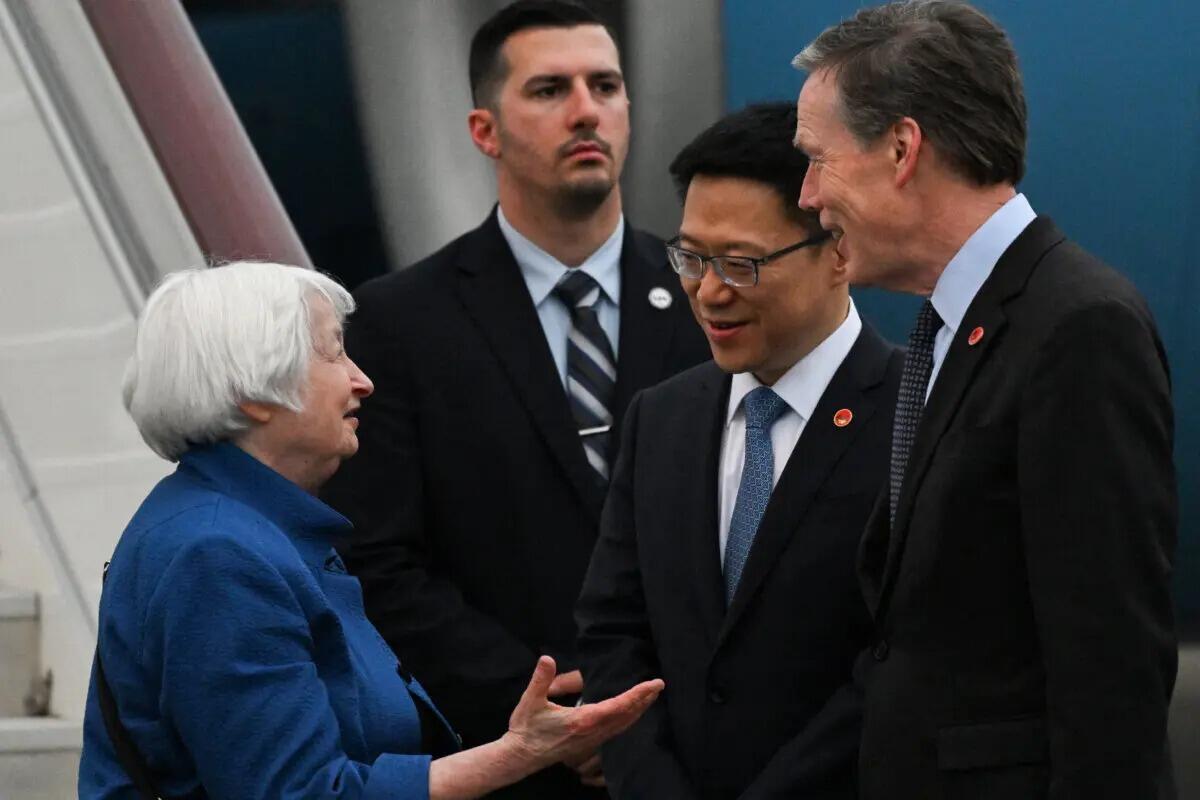
China’s Vice Minister of Finance Liao Min (2nd R) and U.S. Ambassador to China Nicholas Burns (R) receive U.S. Treasury Secretary Janet Yellen (L) upon her arrival at the Baiyun International Airport in Guangzhou, China, on April 4, 2024. (Pedro Pardo/AFP via Getty Images)

There are signs that China will not respond to Ms. Yellen’s concerns. China’s hawkish state-run outlet Global Times, called U.S. overcapacity concerns “a stray from facts” and “an ill-intended campaign to smear China,” in an article published on April 3 while quoting a Chinese researcher.

China Ties

Ms. Yellen’s trip marks the start of another round of the Biden administration’s diplomatic engagement with the Chinese communist regime ahead of the U.S. elections in November.

On April 2, President Joe Biden spoke with Chinese regime leader Xi Jinping by telephone, their first conversation since the face-to-face meetings in San Francisco last November.

A senior administration official told reporters before the call that aside from Ms. Yellen’s visit, Secretary of State Antony Blinken, who visited Beijing last July, would return to China in “the coming weeks.” Secretary of Defense Lloyd Austin is expected to have the first contact with China’s new defense minister “soon.”

Shen Yu-chung, a political professor at Taiwan’s Tunghai University, said Washington’s recent move implies the Biden administration seeks to curb risks while avoiding cutting all ties to communist China.

“In other words, the United States still considers China a competitor,” Mr. Shen told The Epoch Times on Wednesday.

“But [Ms. Yellen’s] visit does not imply that the two sides begin to reconcile.”

Mr. Shen cautioned that the U.S.-China relationship could only become more competitive, especially in the defense industry and sectors involving advanced technology, in the running-up to the U.S. presidential election.

Former President Donald Trump has already promised to impose massive tariffs if he returns to office, including a 60 percent duty on Chinese goods and a 10 percent duty on goods imported from all over the world. That is likely to pressure President Biden to adopt a tougher stance on China ahead of November’s election day.

Trade with the United States remains a key issue for the Chinese regime. “Xi Jinping appears to face great pressure regarding its economy,” said Mr. Shen.

Amid an ongoing housing crisis, Chinese authorities have struggled to revive the country’s sluggish economy as local governments are burdened with massive debts, consumers are reluctant to spend, and foreign companies pause new investments.

In 2023, foreign direct investment in China stood at $33 billion, down 82 percent from a year earlier, according to China’s official data released in February. The latest annual data was also the lowest since 1993.

In March, China set the 2024 GDP target at around 5 percent, a figure that experts have said is overly optimistic given China’s struggling economy.

Tyler Durden
Thu, 04/04/2024 – 14:25

via ZeroHedge News https://ift.tt/lGWvjSx Tyler Durden