The Single Wisest Thing You Can Do With Your Money

The Single Wisest Thing You Can Do With Your Money

Authored by Doug Casey via InternationalMan.com,

There’s a great deal more to becoming rich than buying the right investments and hoping for the best. The most important element in your strategy to win the battle for investment survival is your own psychology. You’ve heard that your attitude helps your health and your golf score; it’ll also improve your earning power.

It’s not enough to liquidate your past financial mistakes. It’s more important to liquidate counterproductive attitudes, approaches, and methods of dealing with problems. The results that someone gets in life are an indication of how sound his approach toward life is. A sound philosophy of life gives good results. People with chaotic, unproductive, unhappy lives usually don’t have anyone to blame but themselves. They rarely have a strategy for living and thus have no foundation on which to build a strategy for investing.

There’s plenty of good advice available on the subject. Marcus Aurelius’ Meditations, Ben Franklin’s autobiography, Norman Vincent Peale’s Power of Positive Thinking, Frank Bettger’s How I Raised Myself from Failure to Success in Selling, and Maxwell Maltz’s Psycho-Cybernetics are all helpful.

One of the important things about the Greater Depression is that it will give you a chance to put your philosophy of life to the test. Almost anyone can get by in good times, but the years to come will separate the real winners from losers. Many will taste the thrill of victory or the agony of defeat firsthand; they won’t need the vicarious pleasure of Saturday afternoon TV sports to experience life.

There is, of course, no guarantee that just because you’ve developed a workable strategy that you won’t still be a casualty in the battle for financial survival. There is such a thing as plain bad luck. But, as Damon Runyon said, the bread may not always go to the wise, nor the race to the swift, nor the battle to the strong—but that’s the way to bet.

Tilt the odds in your favor by developing pro-survival attitudes, and the law of large numbers will take care of the rest.

There are, of course, an almost infinite number of valid attitudes. Anything that works for you is as good as anything that works for me. But since the next step in the strategy (consolidation) deals with gathering physical goods, I don’t want to leave any false impressions.

You may be able to salt away ten bags of silver, a thousand Krugerrands, and enough food to open a restaurant chain, but that’s not nearly as important as knowing how to get them all back again if you should lose them for any reason.

That’s one thing no one can ever take away from you, and you can never lose: your attitude towards life.

Scrooge McDuck had the right attitude.

One of the most formative stories I’ve ever read was an Uncle Scrooge comic written in 1953 by Carl Barks at Walt Disney Studios.

It finds Scrooge McDuck at play in his binful of money, diving and wallowing in it, doing what he likes best. As he leaves his bin to go out for his daily routine, it turns out that his nephew, Donald Duck, has decided to play a prank on him by putting a fake newspaper on the park bench with the headline “Coins and Banknotes Now Worthless!…Congress Make Fish the New Money of the Land.”

Scrooge sees it and is stunned. All his cash is worthless. He plops against a tree thinking that he hasn’t even one little minnow with which to buy a crust of bread. By the next frame of the comic book, however, the courageous old duck has picked himself up and is ready to get back in the race, saying, “Well, there’s no cause crying over bad luck. I’ll get a job and start life all over again.”

Soon we find him down at the waterfront talking to a fisherman. He offers to paint the man’s boat for a sackful of fish. Scrooge earns his fish and takes them to a clothing store where business is bad. He trades the fish for a raincoat. Back at the waterfront, he trades the raincoat to another fisherman for two sacks of fish.

Since the fish are getting heavy to carry around, Scrooge trades the two bags to a farmer for an old horse, then trades the horse for ten sacks of fish.

By the end of the day, Scrooge has a mountain of fish: three cubic acres’ worth. As much of the new money as he had of the old. He looks at the cold, clammy fish and asks himself…how to count the new money? By the pound or by the inch? How to keep it? And how to spend it before it goes bad?

Sorrowfully he realizes that fish isn’t as nice to play with as his old money. Fish don’t feel good and they smell bad.

All of the sudden, he doesn’t want to be rich anymore. He hires a trucking fleet to take the mountain of fish to Donald, who always wanted to be rich. Donald’s house is buried under dead fish.

Donald’s joke backfired, but Scrooge proved his point: You can start from scratch if you have the right attitude and come out ahead if you play your cards right.

Scrooge didn’t have a fish to his name when he had to start over, a lot less than you’ll have if you liquidate all your unneeded possessions. They’re costing you money, and tying you down. Transform the junk you’ve accumulated into cash, which you can redeploy the way Scrooge McDuck might.

The next step in your plan is to start earning to add to your grubstake—that is, create more money. It was key to Scrooge’s second fortune, and it’s key to yours.

But it’s necessary to have the skills necessary to provide goods and services to others. Scrooge made his fish fortune by his skills at business, but there are thousands of others.

Gaining Skills

One of the most important parts of taking control of your life as a step to prospering in the years to come is to educate yourself and gain skills. That means a lot more than just logging eight years in high school and college. Going to college is one thing, but learning to make money is something else. Most people today appear to believe going to college is necessary for getting ahead. It’s not. It may actually be a hindrance.

A lot of people seem to think that simply going to college will bestow an education. In reality, all most people get is a diploma, which is very different. Eric Hoffer, the San Francisco longshoreman who never completed high school but has written such profound books as The True Believer, is an outstanding example of the difference between going to college and getting an education.

Practical, marketable skills are often better acquired in trade schools, through self-teaching efforts, and through experience working from the bottom up in a field. A lot of teachers who finished first in their class couldn’t run a successful hot dog stand and are hardly in a position to help their students learn survival skills.

It would be a tragic mistake to devote all your resources to accumulating gold, hoarding commodities, devising clever tax schemes, and speculating, to the neglect of much more basic intangibles. The government may negate a lot of your efforts through its inflation, taxes, and regulations. And even if you overcome them, market risk—a bad judgement, an unexpected development, a failed brokerage house—can wipe you out. As can fraud, theft, a fire, or a war.

And in the environment coming up, all of those things and many others like them could be greater dangers than they have been in the past. The only thing that’s permanently secure is what you carry in your head: your attitude, your knowledge, your skills.

Who knows what skills may be required in the years to come? What you’re doing now, be it teaching school, practicing law, laying brick, or selling insurance, may be in low demand. But preparing French cuisine, fixing autos, keeping books, or offering financial counsel may be in high demand. Or perhaps the other way around.

The single wisest thing you can do with your money is not buy gold. It’s to take courses and acquire knowledge in other fields, as unrelated to what you are now doing as possible. Anything related to science, and particularly, technology would seem especially suitable. Computer science, medicine, mechanics, agriculture, and electronics are all going to remain in demand.

In the TV series Star Trek, the supremely knowledgeable Mr. Spock bailed the crew out as often as anyone. It’s hard to imagine him unemployed, for that reason. More knowledge can only increase your understanding of the way the world works now, and if it stops working the way it presently does, you’ll be able to continue. It will then no longer be the end of the world if you lose your present job.

And a lot of people will.

*  *  *

Most people have no idea what really happens when an economy collapses, let alone how to prepare… How will you protect yourself during the next crisis? Legendary speculator Doug Casey’s latest report will show you exactly how. Click here to get it now.

Tyler Durden
Thu, 04/04/2024 – 21:00

via ZeroHedge News https://ift.tt/Pap2UHd Tyler Durden

Great, Now Band-Aids Pose Cancer Risk Thanks To ‘Forever Chemicals’

Great, Now Band-Aids Pose Cancer Risk Thanks To ‘Forever Chemicals’

Major medical bandages, including from brands Band-Aid and Curad, were found to contain dangerous levels of ‘forever chemicals’ linked to cancer, according to a new report.

The chemical, fluorine, was found in over two-dozen different bandages, the Daily Mail reports.

PFAS chemicals are sometimes used to make adhesives, and investigators believe they are products of the normal manufacturing process. Fluorine, which is also used to make rocket fuel, can lead to skin burns and eye damage, but it is most dangerous when inhaled.

Dr Linda Birnbaum, a toxicologist and former head of the National Toxicology Program who co-led the lab testing, said the fact that risky chemicals come in direct contact with open wounds was ‘troubling’.

Once in the bloodstream, PFAS can embed themselves in healthy tissues, where they can begin to damage the immune system, liver, kidneys and other organs.

Out of 40 bandages from 18 brands tested by an EPA-certified lab, researchers found detectable levels of fluorine in 26 of them. The testing, funded by consumer watchdog blog Mamavation and Environmental Health News, looked for PFAS chemicals in the absorbent pads and adhesive flaps of bandages sold at major retailers, including Rite Aid, Walmart, CVS and other places.

Fluorine levels above 100 parts per million were found in Band-Aid, Care Science, Curad, CVS Health, Equate, First Honey, Rite Aid brand, Solimo (Amazon brand), and Up & Up (Target) branded bandages.

“Because bandages are placed upon open wounds, it’s troubling to learn that they may be also exposing children and adults to PFAS,” said Dr. Birnbaum. “It’s obvious from the data that PFAS are not needed for wound care, so it’s important that the industry remove their presence to protect the public from PFAS and opt instead for PFAS-free materials.”

PFAS substances contain bonds between carbon and fluorine atoms, creating one very resilient chemical that can remain in the environment for years or even decades.

The chemicals are everywhere, most commonly in water and stain-repellent products, as well as nonstick cookware.

Teflon, the kitchen staple nonstick coating is made with a fluorocarbon called polytetrafluoroethylene (PTFE). -Daily Mail

 According to a report by the CDC, PFAS have been found in the blood of 97% of Americans. They’re also found in menstruation products.

In January of 2023, underwear manufacturer Thinx agreed to settle a class action lawsuit over ‘forever chemicals’ found in the crotch of their underwear for $4 million.

The Daily Mail has provided a list of bandages containing PFAS:

Band-Aid Flexible Fabric Comfortable Protection Bandages (older sample that was likely 7-8 years old and not available in stores anymore) — 188 ppm organic fluorine on absorbent pad

Band-Aid OURTONE Flexible Fabric BR45 Bandages — 262 ppm organic fluorine on absorbent pad

Band-Aid OURTONE Flexible Fabric BR55 Bandages — 250 ppm organic fluorine on absorbent pad.

Band-Aid OURTONE Flexible Fabric BR65 Bandages — 260 ppm organic fluorine on absorbent pads and 374 ppm on the sticky flaps.

Care Science Antibacterial Flexible Fabric Adhesive Bandages — 328 ppm organic fluorine on the sticky flaps

Curad Assorted Bandaids 4-Sided Seal — 140 ppm organic fluorine on the sticky flaps

CVS Health C60 Flexible Fabric Antibacterial Bandages — 201 ppm organic fluorine on absorbent pad

CVS Health C70 Flexible Fabric Sterile Bandages — 124 ppm organic fluorine on absorbent pad and 272 ppm on the sticky flaps

CVS Health C80 Flexible Fabric Antibacterial Bandages — 128 ppm organic fluorine in absorbent pad

Equate (Walmart) Flexible Fabric Bandages Antibacterial — 118 ppm organic fluorine on absorbent pad and 165 ppm on the sticky flaps.

Equate (Walmart) SKIN TONE Antibacterial Bandages Flexible Fabric (darkest shade) — 197 ppm organic fluorine on the absorbent pad and 251 ppm on the sticky flaps

Equate (Walmart) SKIN TONE Antibacterial Bandages Flexible Fabric (medium to dark shade) — 112 ppm organic fluorine on the absorbent pad

Equate (Walmart) SKIN TONE Antibacterial Bandages Flexible Fabric (medium to light shade) — 120 ppm organic fluorine on the absorbent pad

First Honey Manuka Bandages — 157 ppm organic fluorine on the sticky flaps

Rite Aid First Aid Advanced Antibacterial Fabric Adhesive Bandages — 101 ppm organic fluorine on the absorbent pad and 181 parts per million (ppm) in the sticky flaps.

Solimo (Amazon Brand) Flexible Fabric Adhesive Bandages — 104 ppm organic fluorine on the sticky flaps

UP & UP (Target) Flexible Fabric Bandages — 256 ppm organic fluorine on the absorbent pad and 253 parts per million (ppm) on the sticky flaps.

How lovely. 

Tyler Durden
Thu, 04/04/2024 – 20:40

via ZeroHedge News https://ift.tt/VjwvFbB Tyler Durden

Federal Judge Rules Millions Of NRA Members Exempt From ATF Pistol Brace Rule

Federal Judge Rules Millions Of NRA Members Exempt From ATF Pistol Brace Rule

Authored by Jack Phillips via The Epoch Times (Emphasis ours),

A federal judge has blocked the ATF from enforcing its pistol brace rule for millions of members of the National Rifle Association (NRA) as the appeals process plays out.

Justin Barrett, owner of Barrett Outdoors in Durant, Oklahoma, displays an AK pistol with a pistol stabilizing brace. On the counter next to him is a similar brace for an AR15 pistol. (Michael Clements/The Epoch Times)

It came after the NRA filed a lawsuit against the ATF, or the Bureau of Alcohol, Tobacco, Firearms and Explosives, arguing that the agency’s rule to reclassify the brace-equipped pistols as short-barreled rifles is unconstitutional.

U.S. District Judge Sam Lindsay sided with the gun rights group, arguing that the Fifth U.S. Circuit Court of Appeals already concluded that the ATF pistol-brace rule “fails the logical outgrowth test and violates” the Administrative Procedure Act (APA) and is “unlawful” under the act.

The court, therefore, sees no reason why it should not consider this argument and APA claim in ruling on Plaintiff’s Motion,” the judge added. “To not do so would be exalt form over substance, particularly since the Fifth Circuit has already determined that this claim has a substantial likelihood of succeeding on the merits.”

The judge agreed with the NRA’s arguments that its members would be substantially harmed by the ATF rule, which was finalized in January 2023.

“Compliance with the Final Rule is not discretionary, and the NRA’s members face severe penalties for their failure to comply with the Final Rule,” Judge Lindsay wrote in the ruling last week. “Accordingly, both of the final requirements for injunctive relief are satisfied because the threatened injury to the NRA’s members outweighs the threatened harm to the Defendants, and enforcement of the Final Rule under the circumstances will not disserve the public interest.”

Pistol braces were first marketed in 2012 as a way of attaching a pistol to the shooter’s forearm, stabilizing it and making it easier to use for disabled people. However, many users found that the braces could also be placed against the shoulder, like the stock on a rifle.

The disputed ATF rule classifies some guns equipped with pistol braces as short-barrel rifles, based on several factors including their size and weight and the manufacturers’ marketing materials. Short-barrel rifles are subject to special registration, longer waiting periods for purchase, and higher taxes because officials have claimed they are potentially more dangerous than handguns.

“While firearms equipped with ‘stabilizing braces’ or other rearward attachments may be submitted to ATF for a new classification determination, a majority of the existing firearms equipped with a ‘stabilizing brace’ are likely to be classified as ‘rifles’ because they are configured for shoulder fire based on the factors described in this rule,” the ATF rule says.

Because the brace-equipped firearms will have a barrel fewer than 16 inches in length, they are “likely to be classified as short-barreled rifles” that are subject to the enhanced federal regulation, it adds.

In a 2–1 ruling last year, the Fifth Circuit found that the ATF finalized the rule without giving the public a meaningful chance to comment on it. That made it invalid under the federal Administrative Procedure Act, the panel found.

The court at the time did not immediately block enforcement of the rule, instead sending the case back to a lower court judge who found that it violated the U.S. Constitution’s Second Amendment.

“[T]he Court finds that the Government Defendants’ implementation and enforcement of the Final Rule substantially threatens to inflict irreparable constitutional harm upon the [Firearms Policy Coalition] members,” Judge Reed O’Connor wrote last year. “Absent injunctive relief, the Final Rule will impair and threaten to deprive them of their fundamental right to keep and bear commonly used arms as a means of achieving the inherently lawful ends of self-defense.”

Other than NRA members, the previous Fifth Circuit ruling allowed members of the Firearms Policy Coalition, the Second Amendment Foundation, and Gun Owners of America to not face ATF enforcement regarding the braces.

In a news release last week, the NRA, which has millions of members nationwide, said that Judge Lindsay’s order represents a big win for its members. It noted that members of the group who need to use a pistol brace will be shielded from potential ATF enforcement.

This is a major victory for the NRA, its members, and all who believe in Second Amendment freedom,” NRA President Charles Cotton said in the release. “From day one, we vowed to fight back against President Biden and his rogue regulators—and to defeat this unlawful measure.”

Under the rule, if a person is caught using a pistol brace that has not been registered, the weapon can be seized by federal officials and the owner could face a fine of $10,000 or prison time of up to 10 years, according to the ATF. The agency says gun owners must either remove the brace from the pistol, register it as a short-barreled rifle, remove the barrel and attach a longer one, forfeit the firearm at a local ATF office, or destroy it.

The ATF or the Department of Justice have not yet issued a response to the ruling.

Tyler Durden
Thu, 04/04/2024 – 20:20

via ZeroHedge News https://ift.tt/tYjALpg Tyler Durden

New England Hospitals Stop Reporting Newborns With Drugs In System Because It “Disproportionately Affects Black Individuals”

New England Hospitals Stop Reporting Newborns With Drugs In System Because It “Disproportionately Affects Black Individuals”

A New England hospital system has stopped automatically filing state welfare reports when a baby is born with drugs in its system, because it “disproportionately affects black individuals.”

Put another way, the Mass General Brigham Hospital system is disproportionately failing to protect black babies from their addict parents, in what they claim is a move to address “racial and ethnic inequities” present in healthcare.

Instead of automatically reporting suspected abuse or neglect to the state based solely on whether a newborn tests positive for drugs, hospitals will now require written consent from said drug-addicts in order to conduct a test on the expectant mother or infant, in most cases, 10 Boston reports.

What’s more, the testing would only be ordered if the results could change a doctor’s medical approach to their care, Boston.com adds.

Mass General Brigham said babies born with “substance exposure” alone will no longer be immediately reported to state welfare agencies unless there are other concerns the baby is abused or neglected. People can be treated with methadone or buprenorphine for opioid use disorder, which can be prescribed during pregnancy.

The hospital said studies show that Black pregnant people are more likely to be drug tested and reported to welfare agencies than white pregnant people. -Boston.com

Perhaps that’s a function of the demographics of drug use?

The new policy, announced on Tuesday, will apply to locations in Massachusetts and New Hampshire, including obstetrics and gynecology wards at Massachusetts General Hospital, Brigham and Women’s Hospital, Newton-Wellesley Hospital, and Salem Hospital.

The change will be implemented later this month.

According to Mass General Brigham’s Senior Medical Director for Substance Use Disorder Sarah Wakeman, the new policy is “based on sound science.”

“Our new perinatal testing and reporting policy is the latest step in our efforts to address longstanding inequities in substance use disorder care and to provide compassionate, evidence-based support to families, while addressing substance use disorder as a treatable health condition,” she said.

Tyler Durden
Thu, 04/04/2024 – 20:00

via ZeroHedge News https://ift.tt/cWQ0yzs Tyler Durden

Ethereum Layer 2s To Hit $1 Trillion Market Cap By 2023; VanEck

Ethereum Layer 2s To Hit $1 Trillion Market Cap By 2023; VanEck

Authored by Jesse Coghlan via CoinTelegraph.com,

Ethereum’s layer 2 scaling networks will hit a $1 trillion market capitalization in six years and will be made up of thousands of use case-specific chains, according to analysts from investment manager VanEck.

Layer-2 blockchains are set to capitalize on Ethereum’s “primary challenge” — its “limited capacity to process, store, and compute data,” VanEck’s senior digital assets investment analyst Patrick Bush and digital assets research head Matthew Sigel said in an April 3 report.

Busha and Sigel reached their $1 trillion market cap prediction by estimating Ethereum would take up 60% of the market share across all public blockchains and then estimating the volume of assets within the Ethereum ecosystem.

There are currently 46 Ethereum L2s with $39 billion total value locked, the largest being Arbirtum with $18 billion, according to L2BEAT.

“Ethereum’s dominance in smart contracts faces a critical hurdle: scalability,” the analysts wrote.

“While the network offers unparalleled security and decentralization, transaction fees and processing times soar when usage intensifies.”

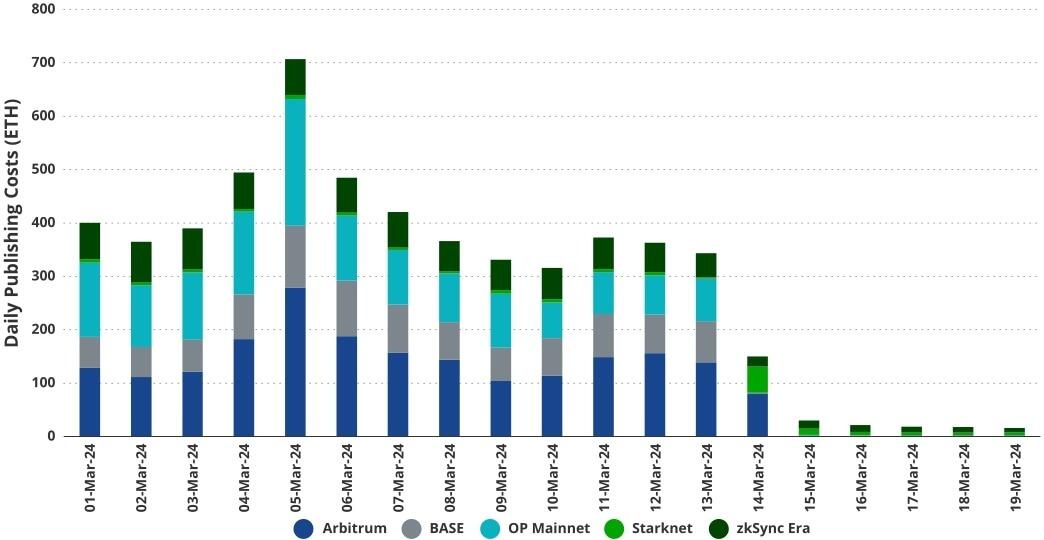
Ethereum’s development is now focused on bettering its ability to process its layer-2’s transaction data, they said — evident in its recent Dencun update which helped to lower L2 transaction fees through the specialized data-saving feature, “Blobs.”

Data publishing costs per L2 network to Ethereum in terms of Ether (ETH). Source: VanEck

The analysts said there was future potential for “substantially more” revenues to be generated on L2s over the base Ethereum network.

“We expect L2 revenues to exceed Ethereum’s because Ethereum cannot match the transaction throughput or user experience of L2s.”

The “cutthroat competition,” however, left Bush and Sigel “generally bearish” on the long-term value for a majority of L2-related tokens.

They noted the top seven Ethereum L2 tokens already have a $40 billion fully diluted valuation and “many strong projects” launching over the next 18 months will swell that to $100 billion.

“It seems a bridge too far for the crypto market to absorb even limited amounts of that supply without massive discounts,” they added.

The analysts forecasted a “future of thousands of use-case-specific” L2s with just “a few major players” part of the general-purpose L2 market.

These thousands of use-specific networks would be “segmented by sector, application, or function” with some chains built for a specific purpose, like a decentralized social media-specific L2 with accompanying apps.

The handful of general-purpose chains will be due to the network effect — where those blockchains become more valuable because there are more users, the analysts said.

“It is also clear that most roll-ups will eventually move towards the zero-knowledge framework (ZKU) due to its many advantages,” they added.

Tyler Durden
Thu, 04/04/2024 – 19:40

via ZeroHedge News https://ift.tt/LDJgBiE Tyler Durden

China Weaponizes Gallium Flows To West As US Miner Reveals New Discovery In Montana

China Weaponizes Gallium Flows To West As US Miner Reveals New Discovery In Montana

China dominates the global production of the rare earth metal gallium, a critical component in semiconductor manufacturing and advanced weapon systems used by the United States. 

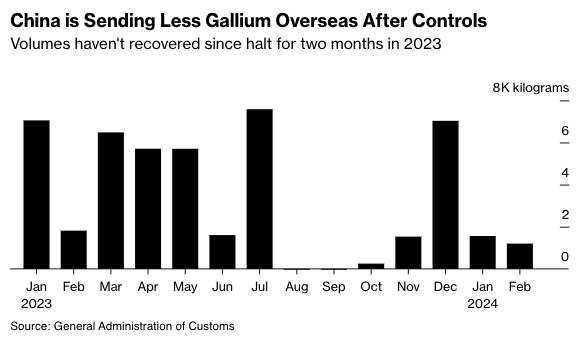
Since China restricted gallium and germanium flows to the US last summer – seen as a tit-for-tat response to the worsening US-China trade war – prices of the metal have doubled (around $575 a kilogram delivered to Rotterdam), according to Bloomberg, citing new data from commodity firm Fastmarkets. 

Source: Bloomberg

European government data shows China refines 94% of the world’s gallium, making the West entirely reliant on Chinese supply. Higher prices mean higher production costs for semiconductors, from radar systems to smartphone screens. 

China’s throttling of rare earth minerals supplies is a national security threat and could easily be weaponized against US defense and aerospace companies. 

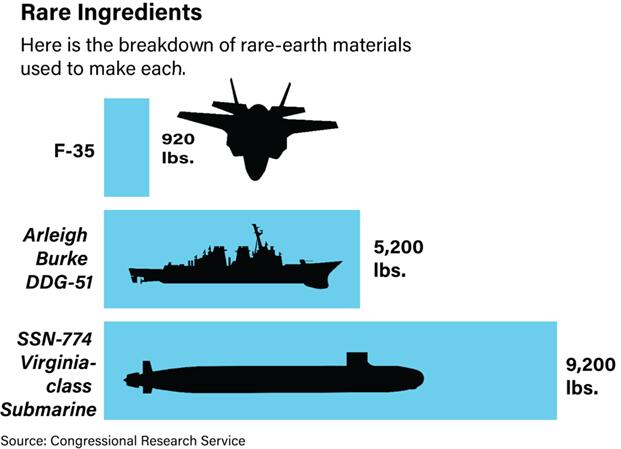
Here’s a breakdown of rare earth metals used in US defense weapons. 

Source: Bloomberg

More importantly, Beijing’s motive to limit gallium supplies could revolve around the US supplying Taiwan weapons, like Patriot missile launchers whose targeting systems heavily rely on semiconductors made with gallium. 

With China only shipping out 2,760 kilograms of gallium in the first two months of 2024, down from 8,865 kilograms a year earlier, the US must secure new supplies. 

There is good news, or at least the start of it. 

US Critical Materials announced in recent weeks that it discovered a “strategically significant” deposit of high-grade gallium on its 6,700 acres of claims in southwest Montana.

Website Mining.com said the Pentagon is preparing to dish out first-time contracts to US or Canadian companies to recover gallium in North America. 

In December 2023, US Critical Materials signed an agreement with Idaho National Laboratories to develop high-tech rare earth processing methods. 

The US must build out its domestic supply chain of mining and refining rare earth minerals to break the addiction from China. This move is crucial to prevent China from potentially disrupting supplies to US defense manufacturers and jeopardizing national security. 

Tyler Durden
Thu, 04/04/2024 – 19:20

via ZeroHedge News https://ift.tt/Lwfc0PD Tyler Durden

FedEx, UPS Adding Delivery Fees In Parts Of New York, Los Angeles, Chicago

FedEx, UPS Adding Delivery Fees In Parts Of New York, Los Angeles, Chicago

By Max Garland of Supply Chain Dive

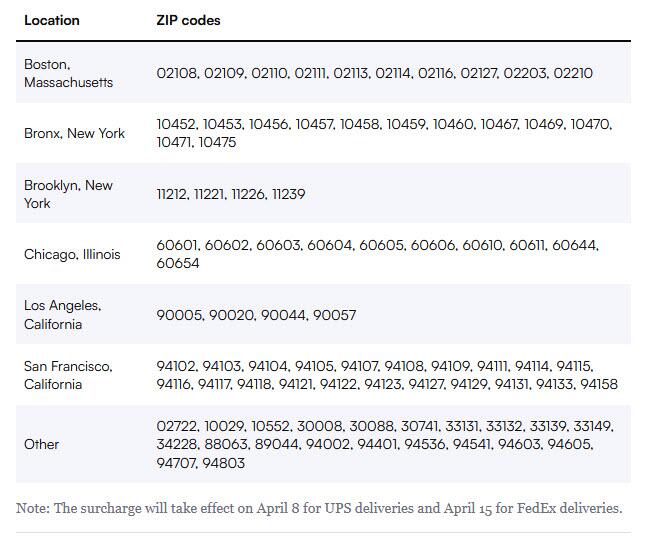
  • FedEx and UPS will add surcharges for deliveries in 82 ZIP codes this month, many of which cover parts of major urban areas, according to updates from both companies.
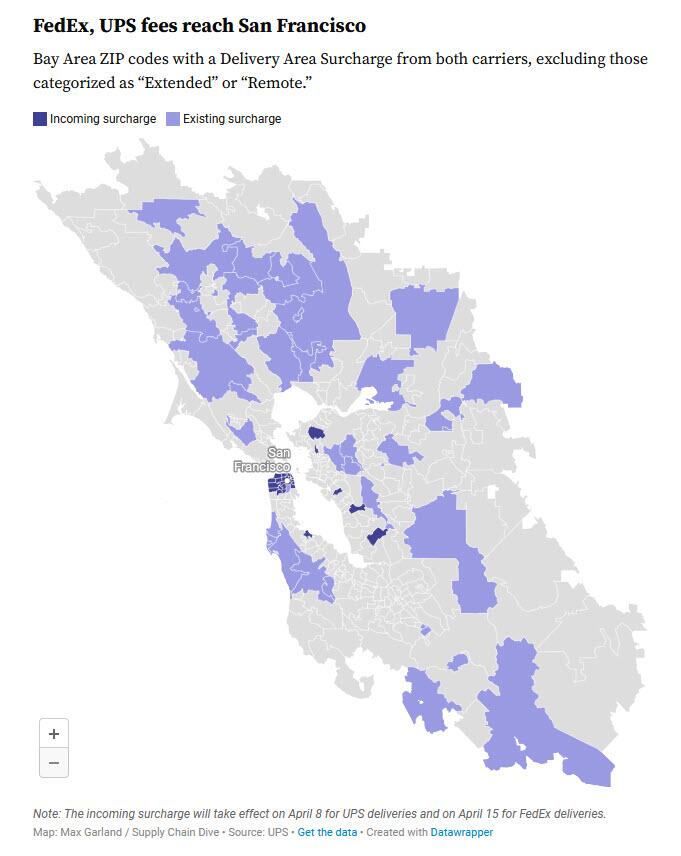
  • The delivery area surcharge, or DAS, for the new ZIP codes will take effect on April 8 for UPS and April 15 for FedEx. The additions will impact areas in Boston, Chicago, New York, Los Angeles and San Francisco.
  • The DAS ranges between $3.95 and $5.85 for FedEx and UPS, but that can climb higher in areas with ZIP codes categorized as “extended” or “remote.” The surcharge amount is influenced by the package being shipped via ground or air transportation and if it’s a commercial or residential delivery.

New ZIP codes UPS and FedEx will add a Delivery Area Surcharge in

FedEx and UPS already have a DAS in place in numerous ZIP codes across the country, but the additions will particularly sting shippers, given the dense urban areas they cover. The 82 ZIP codes impact almost 1% of the U.S. population, according to Mingshu Bates, Chief Analytics Officer at AFS Logistics.

The emphasis on urban ZIP codes is especially apparent in California’s Bay Area, with both carriers adding a DAS to ZIP codes in the heart of San Francisco.

The additional ZIP codes could help the carriers cover added expenses for serving densely populated areas, like tolls to cross bridges or tunnels. However, the delivery giants could also be using the surcharges to bolster their bottom lines in a soft demand environment, according to Shippingwise Managing Director Nicholas Fanelli.

“These surcharges are huge profit centers for carriers,” he said. “It’s not surprising when volume is down that they’re trying to find new opportunities to increase profits and increase margins.”

UPS said in an emailed statement to Supply Chain Dive that the company regularly reviews its DAS to balance evolving market dynamics with meeting customer needs. Similarly, FedEx evaluates and updates its ZIP code list “to reflect market and cost factors,” it said in a statement.

The timing of the additions, outside of FedEx and UPS’ annual rate and surcharge adjustments, complicates shippers’ ability to mitigate the impact of the fees, said Micheal McDonagh, AFS Logistics’ president of parcel.

“For a shipper, it’s not just affecting the shipments — it’s affecting the outlook and health of the financial statements,” McDonagh said. “You have not prepared for an off-cycle increase.”

However, shippers do have options to minimize the surcharge’s impact, according to Fanelli. This includes consolidating packages destined for the same address into one shipment or incentivizing customers to pick up packages at less-expensive commercial destinations. The surcharge price can also be reduced in contract negotiations.

“It’s definitely something that can be heavily discounted, especially if you have high density and high volume,” Fanelli said.

Tyler Durden
Thu, 04/04/2024 – 19:00

via ZeroHedge News https://ift.tt/ou0JdZl Tyler Durden

Dear Mr. President: A Vanilla Bean Shortage Could Be Nearing  

Dear Mr. President: A Vanilla Bean Shortage Could Be Nearing  

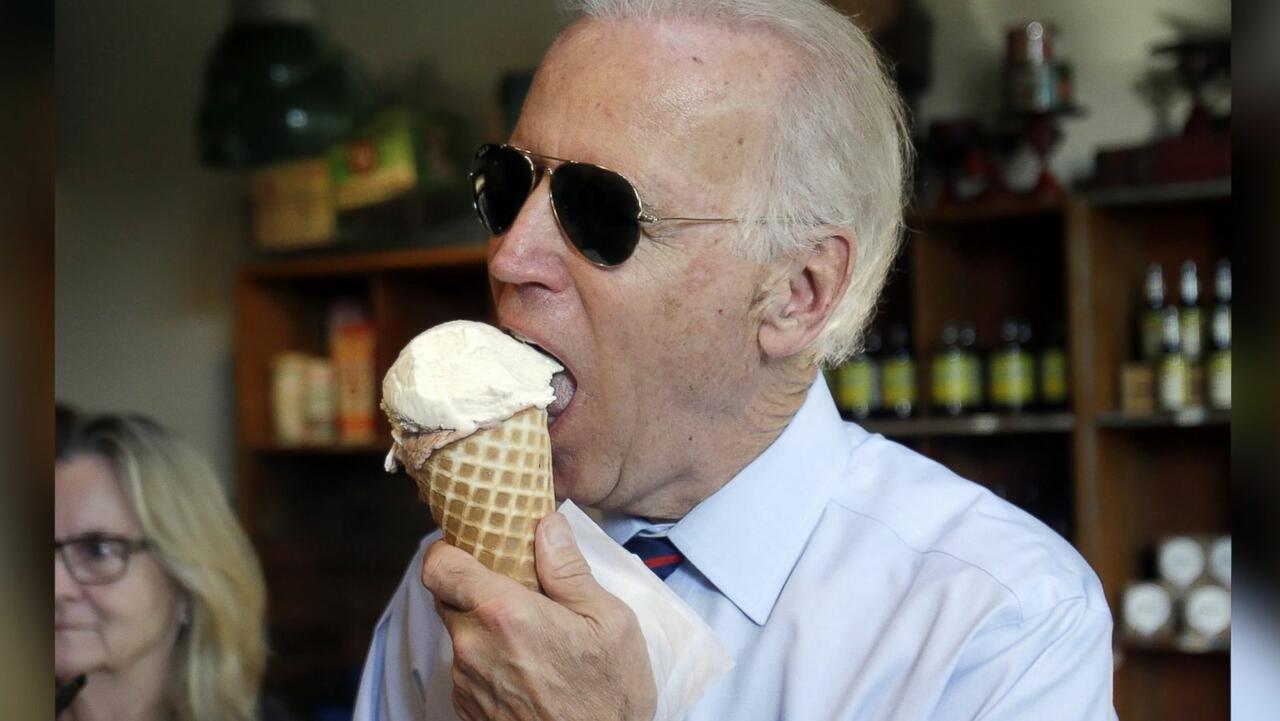
Dear Mr. President, the leading global supplier of vanilla has been battered by a cyclone, potentially leading to a shortage of vanilla ice cream. 

Bloomberg reports Madagascar’s vanilla-growing farmland has been battered by Cyclone Gamane, resulting in flooded fields and high winds that stripped vanilla pods from their vines. 

Georges Geeraerts, president of the Indian Ocean island’s union of vanilla exporters, told the media outlet that this year’s vanilla harvest could be halved. 

“On a bad year, production is about 1,500 tons compared with a range of 2,000 to 2,500 tons,” Geeraerts said. 

He noted, “A conservative estimate, ahead of more detailed analysis from the growing region, means that the output for the current harvest could be as low as 1,000 tons.”

What did you say?

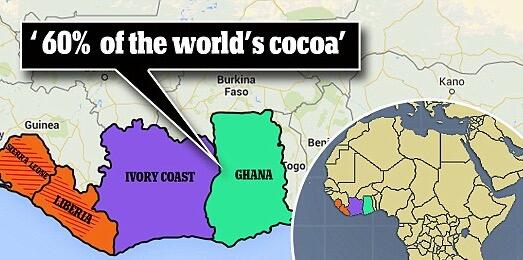
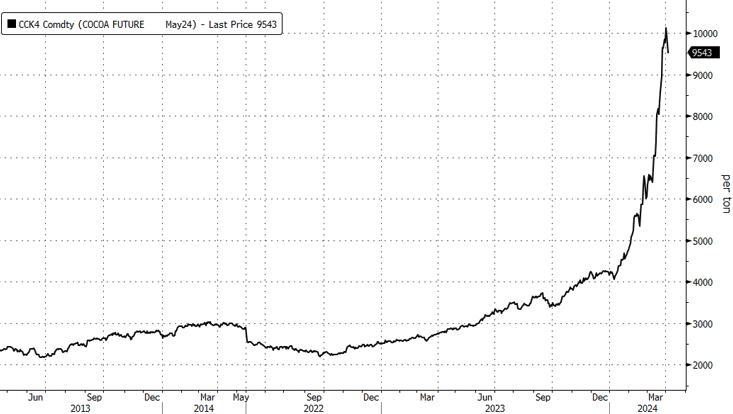
And it’s not just vanilla lovers who could soon face higher prices due to tightening supplies. On the West Coast of Africa, especially across the Ivory Coast, the world’s largest cocoa producer, drought and disease have been major catalysts for lower production, which has sent prices through the roof

In recent weeks, cocoa futures in New York jumped over the $10,000 per ton mark—the highest on record. Prices have subsided to around $9,500 and are expected to trade at these high levels amid tightening supplies. 

 What’s the plan, Mr. President?

Does the US have strategic vanilla and cocoa bean reserves? 

Tyler Durden
Thu, 04/04/2024 – 18:40

via ZeroHedge News https://ift.tt/FqS2wBJ Tyler Durden

House Freedom Caucus Members Earmarked Nearly $1 Billion From Taxpayers

House Freedom Caucus Members Earmarked Nearly $1 Billion From Taxpayers

By Adam Andrzejeski of OpenTheBooks

The House Freedom Caucus was founded in 2015. Self-styled fiscal conservatives promoted themselves as a bulwark against establishment spending that would bankrupt the nation.

It turns out that many are better at breaking their promises than stopping spending.

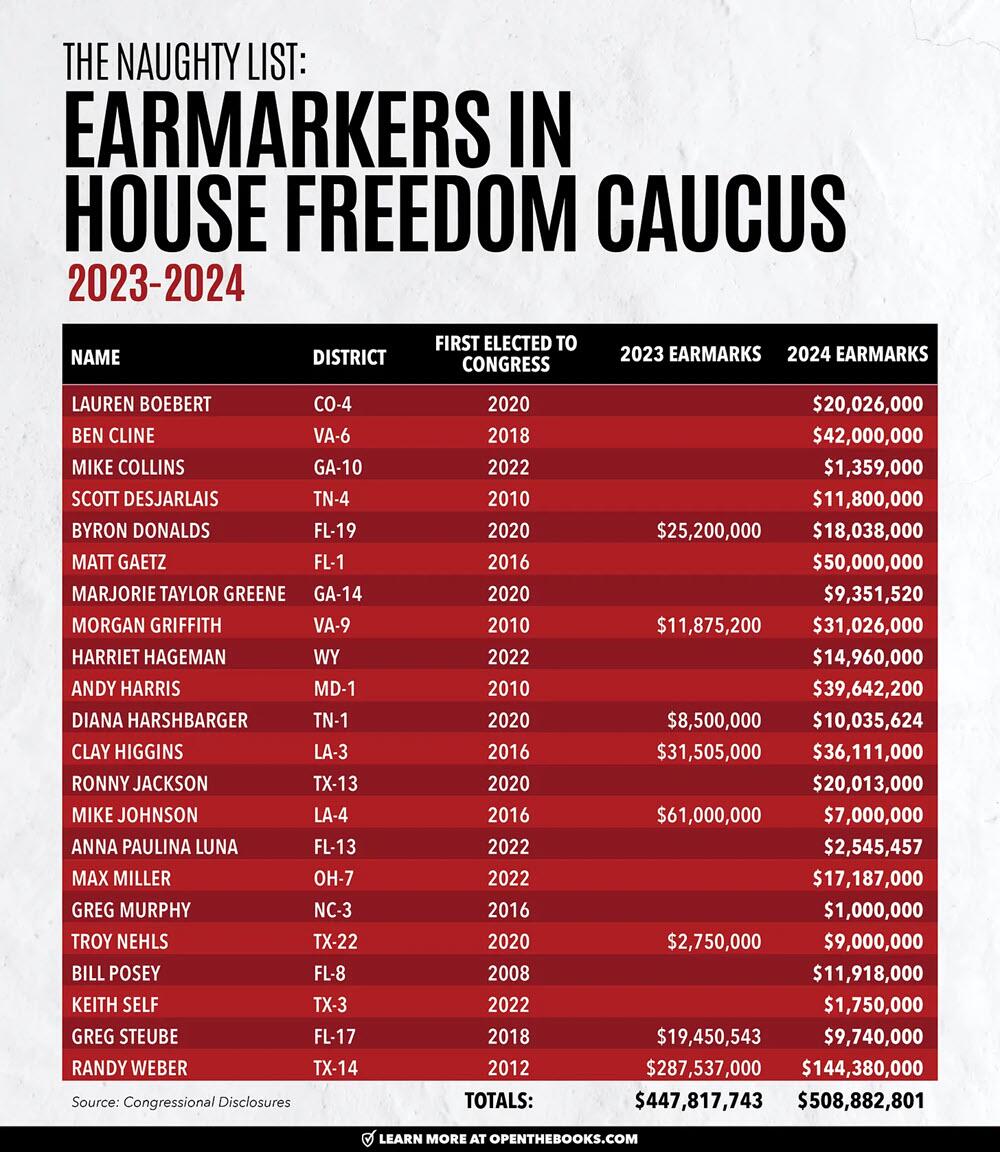
In these hyper-partisan times, we discovered 22 of the 49 Freedom Caucus members standing shoulder-to-shoulder with The Squad, whose earmarking we reported last week.

Nearly half the Caucus members are cross-dressing as fiscal conservatives – making 210 earmark requests for pet projects in their districts. Even House Speaker Mike Johnson (LA), erstwhile Freedom Caucus member, earmarked $60 million last year and $7 million in 2024.

Bulwark against profligacy? More like Fortress Spend.

Earmarking is a practice that gives individual members with clout in their caucus a ticket to goodies for the folks back home – funding pet projects that otherwise aren’t passing muster despite the seemingly infinite number of federal programs.

Incredibly, members of the conservative Freedom Caucus, the progressive Squad, and the uni-party establishment are an alliance that wasted a stunning $32 billion on earmarks since 2023.

“There is no left or right only up or down.” – Ronald Reagan

House Freedom Caucus members captured $957 million for their own districts using 210 earmarks scattered throughout the omnibus bills in 2023 and 2024. Download the line-by-line database here.

Every dime of these bipartisan earmarks drains the U.S. Treasury from the left and the right.

Our auditors at OpenTheBooks.com, an organization I founded and lead, searched out their earmarks and added up the tab.

COMPARISON VS. THE SQUAD

Recently, our auditors quantified the earmarks doled out by the eight members of The Squad, an aggressive group of democratic socialists, who earmarked $224 million on 215 pet projects since 2023. This year, it was $13.9 million for the average Squad member and $111.4 million in total.

In 2024, the individual hauls for the 22 Freedom Caucus members dwarf those of the Squad. These “freedom fighters” earmarked an average of $23.1 million each for a grand total of $508.9 million.

Those Freedom Caucus earmarks cost taxpayers $4.6 million each — more than double the member average for the rest of Congress.

With every dime borrowed against our $34 trillion national debt, this is a moral outrage.

FREEDOM CAUCUS LEADERSHIP

In January 2022, the Caucus laid out four principles for “restoring the people’s voice in Congress.” The fourth principle was to “institute a ban on earmarks.” Laudable!

Over the last two years, none in Caucus leadership except Rep. Lauren Boebert (CO) took earmarks. Boebert jumped on the earmark train in the last round of 2024 spending bills by successfully requesting $20 million.

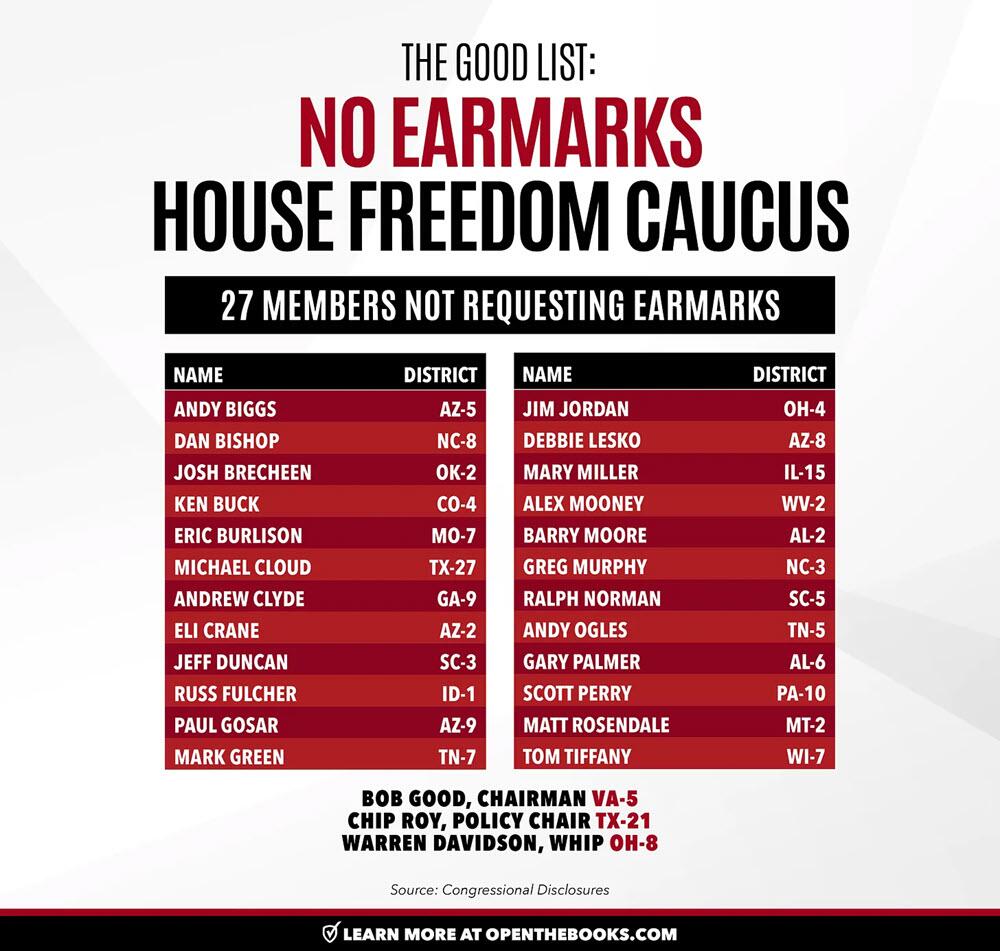
The Caucus is led by Rep. Bob Good (VA) with Chip Roy (TX) as the policy chair. Rep. Warren Davison (OH) is the Caucus whip and Boebert the communications chair. Rep. Jim Jordan (OH) was formerly in leadership and didn’t take earmarks.

Included in our numbers are former members of the Caucus and earmarkers Rep. Marjorie Taylor Greene (GA), who earmarked $9.4 million, and Rep. Randy Weber (TX), whose haul was an incredible $432 million since 2023 (see our analysis of Weber below).

Weber was just booted out of the Caucus last month for missing too many meetings, but NOT for his rampant spending!

The Caucus booted Greene for allegedly talking badly about her colleagues last summer.

Both members are included in this investigation because all their earmarks met the summer 2023 submission deadline before they were ousted from the Caucus.

THE GOOD LIST

A simple majority of the Caucus rejected earmarks – against all institutional force – and stuck to their principles and promises. These 27 members are highlighted below and should be thanked by every taxpayer for the courage of their convictions.

If the House Freedom Caucus has a future, these members will lead the way forward.

VOTING NO – BUT 22 TOOK THE DOUGH

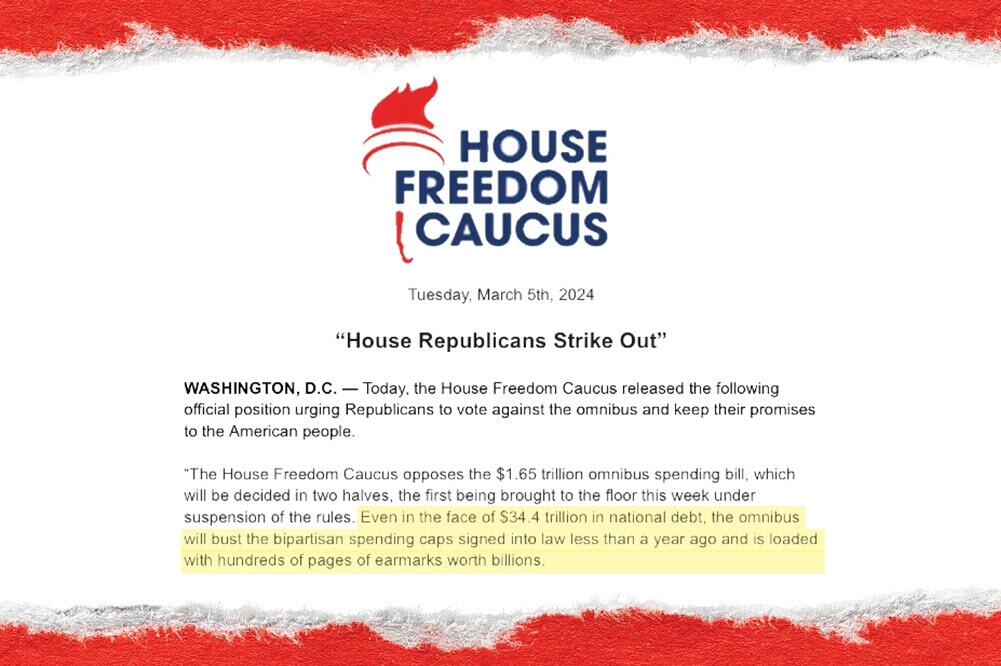
Caucus leadership opposed both of this year’s omnibus bills, urging lawmakers to vote “No” because the legislation was “loaded with hundreds of pages of earmarks,” many of which came from… their own members.  

The 22 Caucus members earmarked a stunning $510 million in the 2024 bills. Last year, (only) eight members earmarked $448 million.

Rapidly, more and more of the rank-and-file members of the Freedom Caucus are embracing pork-barrel spending through earmarks.

Download the full database here – The Freedom Caucus Member Earmarks 2023 & 2024.

NOTE: On March 6 for the first six bills, Speaker Mike Johnson and Rep. Max Miller voted “Yes.” Rep. Ronny Jackson abstained. Everyone else voted “No.”  https://clerk.house.gov/Votes/202464?Page=5

On March 22 for the next six bills, Speaker Mike Johnson and Rep. Max Miller voted “Yes.” Rep. Troy Nehls abstained. Everyone else voted “No.” https://clerk.house.gov/Votes/2024102

PET PROJECTS

Here is just a sample of the projects funded by members of the House Freedom Caucus:

  • $190,000 to test electric and magnetic shark repellent. Rep. Greg Steube (FL)
  • $500,000 for an elevator at the Birthplace of Country Music Museum. Recently, Republicans banned earmarks into museums, however, this one snuck through. Rep. Morgan Griffith (VA)
  • $505,000 for equipment at Roanoke College includes a synthetic cadaver (fake corpse) for medical students. Can’t they buy their own cadavers? Rep. Morgan Griffith (VA)
  • $1.75 million for the Rural Mental Health Coalition at Texas A&M – a totally local project to brainstorm mental health solutions – No actual mental health care is funded. Rep. Keith Self (TX)
  • $2.5 million for a Coastal Conservation Hub where Floridians can “find answers to their coastal restoration questions.” Rep. Bill Posey (FL)
  • $5 million for a Naples, Florida sewer-to-septic project phrase II. Phase I was funded locally. Gov. DeSantis vetoed $1.1 million in state money earmarked for phase II. Now, Phase II is funded by federal taxpayers for $5 million — thanks to Rep. Byron Donalds (FL).
  • $20 million for an upgrade of Baltimore Ave in Ocean City, Maryland. Construction began with a $20 million estimated cost but was delayed because new estimates showed an actual cost of $40 million. So, Andy Harris (MD) earmarked the $20 million difference. You’re paying for it.

Two members even earmarked money for their alma maters:

U.S. Army Corps of Engineers earmarks

Certain members of the Freedom Caucus argue that the federal bureaucracy is dysfunctional, so they need to hand-pick hundreds of millions of dollars into worthy earmark projects – located in their own districts.  

Forty-percent of the overall earmark dollars from Caucus members went into infrastructure projects at the U.S. Army Corps of Engineers, mostly in Texas and Louisiana: $397.3 million on 12 earmarks.

Rather than working to reform the Corps project backlog, the members are using the irregular earmark process to fund their own picks. For example, on a bi-partisan basis, Congress passed a $1.2 trillion infrastructure bill in 2022 – none of these U.S. Army Corps project amounts were included.

So, when members, like Rep. Weber, say they need earmark power for critical infrastructure projects, remember that argument opens the door for The Squad to earmark their $224 million haul. And every dime is borrowed against the national debt and green-lit though an irregular process.

Last September, Weber posted on social media that “We MUST cut the woke & weaponized spending of the federal gov & we should be reining in the out-of-control spending.” His earmarks contribute to Congressional overspending.

The problem even extends to new Speaker Mike Johnson (LA) with his $68 million in earmarks for the Army and Air Force Reserve; or Rep. Matt Gaetz (FL) with $50 million for the Navy and Air Force advanced helicopter projects.  

The U.S. military already secured a record $825 billion in this year’s spending package. If these projects are so important, why isn’t the military itself prioritizing these projects within a $825 billion budget? Why aren’t they funded on merit?

Rather than working hard for reforms at the Pentagon or at the U.S. Army Corps of Engineers, the members and now leaders just participate in the legal corruption of the system.

(Remember, financial practices at the Pentagon are so poor that the agency can’t even account for half of its assets.)

ACTION

It’s time to close the cookie jar and force Congress to do their jobs – oversight, reform and appropriation. There’s no dessert when the national debt is set to cross $35 trillion and the bottom is falling out.

Tens of thousands of regular people have signed our petition calling for a public up or down vote in the U.S. House on earmarks. It’s an election year and the American people deserve to know who is in and who is out on earmarks – the currency of corruption in Congress.

BACKGROUND

Earmarks were banned for 10 years by a bipartisan group led by the late U.S. Senator Dr. Tom Coburn and then-President Barack Obama. Three years ago, House Republicans took a secret vote and joined then-House Speaker Nancy Pelosi’s Democrats to bring earmarks back.

In 2024, the two omnibus spending bills contained 8,052 earmarks worth $15.7 billion. In 2023, the packages were stuffed with 7,510 earmarks for $16 billion.

Unfortunately, House Republicans have gone hog-wild for earmarks despite the national debt pushing $35 trillion. (Last summer, at one point in the U.S. House, the top 63 earmarkers on the FY2024 spending bills were Republicans.)

Members of Congress must disclose earmarks online, on 435 of their own Congressional websites. This makes oversight difficult.

However, our auditors at OpenTheBooks convert the public information into easy-to-use Excel databases. Then, we follow the money.

METHODOLOGY

Membership in the House Freedom Caucus is secret. Some members self-disclose and others receive campaign funding through the Caucus’ political action committee (PAC).

Just to test this secrecy, we reached out to Caucus communications staff and they confirmed:

“We don’t publish or share our membership and never have. Thanks”

When we asked, why? Here was the response:

“Just the way we have always operated”

However, in January 2023, the Pew Research Center quantified 49 members and allies of the Caucus with solid research methodologies. So, that’s the list we used for our investigation which spans 2023 and 2024.

Tyler Durden
Thu, 04/04/2024 – 18:20

via ZeroHedge News https://ift.tt/NEuLdYQ Tyler Durden

America’s Favorite Beer Brand Is… Mexican

America’s Favorite Beer Brand Is… Mexican

As Americans celebrate National Beer Day on April 7 – the anniversary of the Cullen-Harrison Act, which marked the end of Prohibition in the United States – what better way to honor this historic day than by delving deeper into the minds of U.S. beer lovers and finding out what their favorite brews are?

According to Statista Consumer Insights, Americans’ favorite beer brand is actually Mexican.

Infographic: America's Favorite Beers | Statista

You will find more infographics at Statista

As Felic Richter reports, Corona, exclusively imported, distributed and marketed by Constellation Brands in the U.S., narrowly beats Bud Light and Budweiser – the American, not the Czech one – in terms of popularity and recent consumption.

Dutch Heineken, a true global player in terms of beer, ranks fourth ahead of Blue Moon, a Belgian-style witbier brewed by Molson Coors in Colorado.

Tyler Durden
Thu, 04/04/2024 – 18:00

via ZeroHedge News https://ift.tt/GphUqdg Tyler Durden