Botswana has offered to send 20,000 elephants to Berlin, telling Germany’s left-wing government it should try living with the mammals before pushing trophy hunting bans on African countries.
Calls by Germany’s Federal Environment Minister Steffi Lemke for bans on trophy hunting have been met with stiff opposition in Botswana’s capital of Gaborone, with political leaders insisting that hunting, when done sustainably, helps to protect crops and villages from being destroyed and boosts tourism to developing countries.
Speaking to the Bild newspaper, Botswanan President Mokgweetsi Masisi said his country was suffering from an elephant plague after recent conservation efforts, and the Botswanan people are dependent on some of the animals being culled through controlled and “sustainable” hunting.
“We are paying the price for preserving these animals for the world,” Masisi told the German tabloid, explaining it was very easy for left-wing politicians like Lemke of the Green party “to sit in Berlin and have an opinion about our affairs in Botswana.”
He explained that his government had already offloaded 8,000 of the animals to nearby Angola due to their exploding population, and threatened to send 20,000 elephants to Berlin so German politicians can “live together with the animals in the way you are trying to tell us to.”
“We would like to make such an offer to the Federal Republic of Germany. We don’t take no for an answer. 20,000 wild elephants for Germany. This is not a joke,” Masisi warned.
There are now over 130,000 wild elephants living across Botswana, and the government has reserved 40 percent of the country’s landscape for protected wildlife — a move that comes at a considerable economic price.
This type of deportation of these wild animals has happened before. For example, the Namibian government transported around 150 wild elephants to Cuba by plane in 2013 and flew 22 to the United Arab Emirates in 2022.
Maxi Louis of the Nature Reserve and Conservancy Association (NACSO) in Namibia told Bild: “We have not yet transported 20,000 elephants, but we are very confident that a country like Germany in particular can carry out this elephant transport successfully.”
“The best place to hand over the elephants to Ms. Lemke is on open farmland outside of Berlin, where there are grain crops. The elephants will then have something to eat,” she added in jest.
Researchers at Princeton Plasma Physics Laboratory (PPPL) utilize liquid lithium coating in fusion reactor vessels to optimize fueling and enhance plasma stability.
Findings published in Nuclear Fusion highlight the importance of neutral particle density at the edge of plasma for maintaining stability and efficient fusion reactions.
Ongoing research aims to refine methods for sustaining fusion reactions over prolonged periods, paving the way for practical fusion energy production.
Princeton Plasma Physics Laboratory researchers found the promise of coating the inner surface of the vessel containing a fusion plasma in liquid lithium guides them toward the best practices for fueling their plasmas.
The research, which is featured in a new paper in Nuclear Fusion, includes observations, numerical simulations and analysis from their experiments inside a fusion plasma vessel called the Lithium Tokamak Experiment-Beta (LTX-β). (Please note, there is a dearth of attention grabbing media available for this post, however, the research paper at posting is not behind a paywall.)
One team at the U.S. Department of Energy’s Princeton Plasma Physics Laboratory (PPPL) has been asking themselves lately as a metaphor, “How much fuel can we add to the fire while still maintaining control?”
Now, they believe they have the answer for one particular scenario. It’s all a part of the Lab’s work to bring energy from fusion to the power grid.
Building upon recent findings showing the promise of coating the inner surface of the vessel containing a fusion plasma in liquid lithium, the researchers have determined the maximum density of uncharged, or neutral, particles at the edge of a plasma before the edge of the plasma cools off and certain instabilities become unpredictable. Knowing the maximum density for neutral particles at the edge of a fusion plasma is important because it gives the researchers a sense of how and how much to fuel the fusion reaction.
The unique environment of LTX-β
The LTX-β is one of many fusion vessels around the world that holds plasma in a donut shape using magnetic fields. Such vessels are known as tokamaks. What makes this tokamak special is that its inner walls can be coated, almost completely, in lithium. This fundamentally changes the wall behavior, as the lithium holds on to a very high percentage of the hydrogen atoms coming off the plasma. Without the lithium, far more hydrogen would bounce off the walls and back into the plasma. In early 2024, the research team reported that this low recycling environment for hydrogen keeps the very edge of the plasma hot, making the plasma more stable and providing room for a larger volume of plasma.
Richard Majeski, a managing principal research physicist at PPPL and head of LTX-β said, “We are trying to show that a lithium wall can enable a smaller fusion reactor, which will translate into a higher power density.” Ultimately, this research could translate into the cost-effective fusion power source the world needs.
With the new paper the LTX-β team has published additional findings showing the relationship between the fuel for the plasma and its stability. Specifically, the researchers found the maximum density of neutral particles at the edge of a plasma inside LTX-β before the edge starts to cool, potentially leading to stability problems. The researchers believe they can reduce the likelihood of certain instabilities by keeping the density at the edge of the plasma below their newly defined level of 1 x 10¹⁹ m-3. This is the first time such a level has been established for LTX-β, and knowing it is a big step in their mission to prove lithium is the ideal choice for an inner-wall coating in a tokamak because it guides them toward the best practices for fueling their plasmas.
In LTX-β, the fusion is fueled in two ways: using puffs of hydrogen gas from the edge and a beam of neutral particles. Researchers are refining how to use both methods in tandem to create an optimal plasma that will sustain fusion for a long time in future fusion reactors while generating enough energy to make it practical for the power grid.
Refining methods for retaining an even temperature across the plasma
Physicists often compare the temperature at its edge to its core temperature to assess how easy it will be to manage. They plot these numbers on a graph and consider the slope of the line. If the temperature at the inner core and outer edge are nearly the same, the line is almost flat, so they call that a flat temperature profile. If the temperature at the outer edge is significantly lower than the temperature at the inner core, scientists call it a peaked temperature profile.
Santanu Banerjee, a staff research physicist at PPPL and lead author on the new paper explained, “The team determined the maximum density of neutral particles beyond the edge of a plasma that still allows for a flat-edge temperature profile. Going beyond that number of neutrals at the edge definitely will drop your edge temperature, and you will end up in a peaked temperature profile.”
“That same neutral density is the threshold for instabilities known as tearing modes. Beyond that density, tearing modes tend to get destabilized, cause threats to the plasma and may stop the fusion reaction if left uncontrolled,” he added.
If the instabilities become too large, the fusion reaction will end. In order to support the power grid, researchers are figuring out the best ways to manage a fusion plasma so that the reaction is stable.
Banerjee and Majeski worked with several other researchers on the paper, including PPPL’s Dennis Boyle, Anurag Maan, Nate Ferraro, George Wilkie, Mario Podesta and Ron Bell.
Meanwhile work on the project continues. PPPL engineer Dylan Corl is optimizing the direction in which the neutral beam, which is used to heat the plasma, is injected into the tokamak. “We’re basically creating a new port for it,” Corl said. He uses a 3D model of the LTX-β, testing different beam trajectories to ensure the beam won’t hit another part of the equipment, such as tools used to measure the plasma. “Finding the best angle has been a challenge, but I believe we’ve got it now,” Corl said.
**
This is a fascinating account of one part of the effort to contain a plasma at temperatures and pressures needed for a fusion reaction. The idea of the tokamak has, for your humble writer, been a something of a bewilderment. The surface area of a donut vs say a simple sphere is well . . . And compressing the shape seems well . . . The tokamak shape seems to amplify the problems. However, your humble writer is no kind of expert in these matters.
Thus everything developed is interesting to the point of fascination. The best case is the tokamak will be a power producer someday. If now, the effort is going to turn up a whole lot of knowledge and knowhow that might enable other concepts or designs.
Fusion on earth is a long, long, long reach. We’re getting there with each grasp of new understanding and knowhow.
NATO member states have not yet decided on the structure of future assistance to Ukraine, but they have started planning for it, NATO Secretary General Jens Stoltenberg told a press conference in Brussels on Wednesday at the end of the first day of the meeting of NATO foreign ministers.
At the meeting, ministers discussed how to put assistance to Ukraine on a firmer and more permanent footing in the future.
“All Allies agree on the need to support Ukraine in this critical moment.There is a unity of purpose,” said Stoltenberg.
He stressed that “The people of Ukraine continue to defend their country with skill and bravery” and that “the Ukrainians are not running out of courage, they are running out of ammunition.”
He added that “We need to step up now to ensure our support is built to last.”
The Norwegian leader of NATO said details of the initiative would emerge in the coming weeks.
“We are now in the process of developing a more robust and enduring, institutionalised framework for support to Ukraine, that our support is less dependent on voluntary short term offers and more on long term NATO commitments,” said the secretary general.
He expressed the hope that now that allies have begun to discuss planning, a decision on the final form of assistance could be taken at the NATO summit in Washington in July.
Stoltenberg said that taking responsibility for aid to Ukraine would not make NATO a party to the Russia-Ukraine conflict.
“NATO is and will remain a defensive Alliance. And NATO is, and will remain, not a party to the conflict in Ukraine. We need to remember what this is. This is war or aggression by Russia invading another country, violating international law. And then Ukraine has the right, according to international law, to defend itself,” he said.
He also pointed out that Russia is receiving support for its war of aggression from China, North Korea, and Iran.
“As authoritarian powers increasingly align, it is important that like-minded nations around the world stand together. To defend a global order ruled by law, not by force,” Stoltenberg added.
It wants the power to decide who lives or dies and whose rights are worthy of protection.
Abortion may still be front and center in the power struggle between the Left and the Right over who has the right to decide—the government or the individual—when it comes to bodily autonomy, the right to privacy, sexual freedom, the rights of the unborn, and property interests in one’s body, but there’s so much more at play.
In the 50-plus years since the U.S. Supreme Court issued its landmark ruling in Roe v. Wade, the government has come to believe that it not only has the power to determine who is deserving of constitutional rights in the eyes of the law but it also has the authority to deny those rights to an American citizen.
This is how the abortion debate has played into the police state’s hands: by laying the groundwork for discussions about who else may or may not be deserving of rights.
Despite the Supreme Court having overturned its earlier rulings recognizing abortion as a constitutional right under the Fourteenth Amendment, the government continues to play fast and loose with the lives of the citizenry all along the spectrum of life.
Take a good, hard look at the many ways in which Americans are being denied their rights under the Constitution.
American families who have their dogs shot, their homes trashed and their children terrorized or, worse, killed by errant SWAT team raids in the middle of the night are being denied their rights under the Constitution.
School-aged children as young as 4-years-old who are leg shackled, handcuffed and strip searched for violating school zero tolerance policies by chewing a Pop Tart into the shape of a gun and playing an imaginary game of cops and robbers, or engaging in childish behavior such as crying or jumping are being denied their rights under the Constitution.
Unarmed citizens who are tasered or shot by police for daring to hesitate, stutter, move a muscle, flee or disagree in any way with a police order are being denied their rights under the Constitution.
Likewise, Americans—young and old alike—who are shot by police because they pointed a garden hoseat a police officer, reached for their registration in their glove box, relied upon a cane to steady themselves, or were seen playing with air rifles or BB guns are being denied their rights under the Constitution.
Female motorists who are unlucky enough to be pulled over for a questionable traffic infraction only to be subjected by police tocavity searches by the side of the road are being denied their rights under the Constitution.
Male pedestrians and motorists alike who are being subjected to roadside strip searches and rectal probesby police based largely on the color of their skin are being denied their rights under the Constitution.
American citizens subjected to government surveillance whereby their phone calls are being listened in on, their mail and text messages read, their movements tracked and their transactions monitored are being denied their rights under the Constitution.
Homeowners who are being fined and arrested for raising chickens in their backyard,allowing the grass in their front yards to grow too long, and holding Bible studies in their homes are being denied their rights under the Constitution.
Homeless individuals who are being harassed, arrested and run out of towns by laws that criminalize homelessness are being denied their rights under the Constitution.
These are all American citizens—endowed by their Creator with certain unalienable rights, rights that no person or government can take away from them, among these the right to life, liberty and the pursuit of happiness—and they are all being oppressed in one way or another by a government that has grown drunk on power, money and its own authority.
If the government—be it the President, Congress, the courts or any federal, state or local agent or agency—can decide that any person has no rights, then that person becomes less than a citizen, less than human, less than deserving of respect, dignity, civility and bodily integrity. He or she becomes an “it,” a faceless number that can be tallied and tracked, a quantifiable mass of cells that can be discarded without conscience, an expendable cost that can be written off without a second thought, or an animal that can be bought, sold, branded, chained, caged, bred, neutered and euthanized at will.
It’s a slippery slope that justifies all manner of violations in the name of national security, the interest of the state and the so-called greater good.
Yet those who founded this country believed that what we conceive of as our rights were given to us by God—we are created equal, according to the nation’s founding document, the Declaration of Independence—and that government cannot create, nor can it extinguish our God-given rights. To do so would be to anoint the government with god-like powers and elevate it above the citizenry.
Unfortunately, we have been dancing with this particular devil for quite some time now.
If we continue to wait for the government to restore our freedoms, respect our rights, rein in its abuses and restrain its agents from riding roughshod over our lives, our liberty and our happiness, then we will be waiting forever.
The highly politicized tug-of-war over abortion will not resolve the problem of a culture that values life based on a sliding scale. Nor will it help us navigate the moral, ethical and scientific minefields that await us as technology and humanity move ever closer to a point of singularity.
Humanity is being propelled at warp speed into a whole new frontier when it comes to privacy, bodily autonomy, and what it means to be a human being. As such, we haven’t even begun to wrap our heads around how present-day legal debates over bodily autonomy, privacy, vaccine mandates, the death penalty, and abortion play into future discussions about singularity, artificial intelligence, cloning, and the privacy rights of the individual in the face of increasingly invasive, intrusive and unavoidable government technologies.
Yet here is what I know.
Life is an inalienable right.
By allowing the government to decide who or what is deserving of rights, it shifts the entire discussion from one in which we are “endowed by our Creator with certain inalienable rights” (that of life, liberty property and the pursuit of happiness) to one in which only those favored by the government get to enjoy such rights.
If all people are created equal, then all lives should be equally worthy of protection.
A Pfizer-funded, peer-reviewed paper authored by Pfizer scientists reveals that the company’s antiviral COVID medication Paxlovid completely sucks, confirming what everyone’s known since it came out.
In a randomized phase 2-3 trial of the drug conducted between Aug. 25, 2021 through July 25, 2022, 654 out of 1,296 patients were dosed with at least one 300mg dose of Paxlovid + 100mg of protease inhibitor ritonavir vs. a placebo group. The results showed that the median time until COVID-19 symptoms ended through day 28 was 12 days in the treatment group vs. 13 days in the placebo group.
According to the authors, the result of the drug, which is also known as nirmatrelvir, “was not significant.”
“Similar results were observed in the high-risk subgroup (i.e., participants who had been vaccinated and had at least one risk factor for severe illness) and in the standard-risk subgroup (i.e., those who had no risk factors for severe illness and had never been vaccinated or had not been vaccinated within the previous 12 months),” the authors added.
And while 0.8% of the Paxlovid group suffered ‘hospitalization or death’ vs. 1.6% of placebo recipients, the authors also concluded that it was not statistically significant, however placebo recipients had longer average hospital stays and were more likely to be admitted to intensive care units.
According to the authors, “the usefulness of nirmatrelvir–ritonavir in patients who are not at high risk for severe COVID-19 has not been established.“
The trial included adults who had tested positive for COVID-19 and shown at least one symptom, had previously received the COVID-19 vaccine, and had at least one risk factor – such as being a cigarette smoker.
Pfizer had previously announced that they were halting enrollment in the trial over “a very low rate of hospitalization or death observed in the standard-risk patient population.”
As the Epoch Times notes, Dr. Vinay Prasad, an epidemiology professor at the University of California, San Francisco, who was not involved with the research, said on social media platform X that the trial showed Paxlovid “doesn’t work in vaccinated people.”
“It was embarrassing to watch the administration and many ID doctors recommend this without any credible data,” he continued – criticizing the government for spending upwards of $12 billion for Paxlovid “without much trial data.”
A previous Pfizer trial, which was run to assess Paxlovid’s efficacy and safety among the unvaccinated, found that Paxlovid shortened the time to sustained symptoms alleviation and reduced the severity of COVID-19 symptoms. The trial enrolled people with COVID-19, with symptoms, and who had a risk factor for progression to severe disease or were 60 years of age or older.
Based on the results from that trial, the U.S. Food and Drug Administration in 2023 authorized the drug for both unvaccinated and vaccinated adults with mild to moderate COVID-19 who were deemed at high risk for progression to severe COVID-19. -Epoch Times
“The benefit observed among unvaccinated high-risk persons does not extend to those at lower risk for severe COVID-19,” wrote Drs. Rajesh Gandhi and Martin Hirsch in an editorial about the new paper. That said, they also concluded that “it still appears reasonable to recommend the drug to older people and people with substantial underlying conditions.”
Chicago’s Health Department has confirmed a few cases of tuberculosis among illegal immigrants who recently arrived in the city. However, officials say there is no cause for concern for the broader population as they believe the disease is contained.
Tuberculosis, or TB, is an infectious disease caused by a bacteria that generally attacks the lungs and, in some cases, other body parts. Symptoms can include chest pain, fatigue, chills, and coughing up blood. If not treated, TB can be fatal.
Chicago Department of Public Health (CDPH) officials confirmed in a media statement a “small number” of tuberculosis cases at city-run immigrant shelters but did not state which shelters or how many people are affected.
According to a spokesperson, there is no cause for concern at this time because the disease has been contained, and the affected illegal immigrants are being treated.
“We will continue to offer treatment to individuals as necessary and take the proper precautions to eliminate spread, but we do not consider this a matter presenting a substantial threat to the public,” the spokesperson said.
“To date, CDPH has not confirmed any reports of TB that resulted from exposure to new arrivals in Chicago.”
The CDPH claims an estimated 10 to 20 percent of people from Central and South America have a latent TB infection, which is asymptomatic and general not transmissible to others, but does result in a positive test. According to the CDPH, even those with active cases will likely recover if they receive treatment.
“For those who do have active cases of TB disease, CDPH assigns a nurse case manager to each individual and performs a contact tracing investigation,” the spokesperson said.
“TB is curable with antibiotics and is not particularly infectious, typically requiring several hours or more of prolonged close contact between individuals to spread, but CDPH continues to take cases seriously in order to keep it contained.”
The CDPH says in an average year, it expects to see between 100 to 150 tuberculosis cases in Chicago residents.
Alderman Calls for Immunization Standards for Asylum Seekers
Chicago Alderman Raymond Lopez said the infections were a wake-up call for the city, and that citizens should start putting pressure on Chicago Mayor Brandon Johnson to implement American immunization standards for all asylum seekers. Chicago was also recently hit with a registered measles cases, which was reportedly the first case identified in a Chicagoan since 2019.
In an April 3 post on X, Mr. Lopez said “performative politics and hurt feelings” have led to a delayed response to an “obvious looming disaster.”
“Anyone who demanded action to protect our residents was called racist, xenophobic, and anti-immigrant by fringe politicians. And now, here we are: measles, now tuberculosis both confirmed in Chicago,” he said.
“Shame on every mouthpiece that worked so hard to keep this secret. I don’t expect apologies or an enlightened response from the performative deniers: those folks have never let facts get in the way of their narrative,” he said.
According to a March 28 report from the Centers for Disease Control and Prevention (CDC), cases of tuberculosis have jumped to their highest level in a decade. In 2023, tuberculosis case counts jumped by 1,295 from the prior year to 9,615, the agency said. This represents an increase of 16 percent and is the highest level since 2013.
The United States has one of the lowest rates of tuberculosis in the world, the CDC said. However, the uptick in cases means capacity should be strengthened in public health programs to carry out “critical disease control and prevention strategies.”
‘Cocoa Could Double From Here’ – Oil-Bull Andurand Gets Greedy On Chocolate
Oil trader Pierre Andurand suffered record losses last year in the commodities world, though the money manager has so far crushed it on the cocoa trade.
Bloomberg reports Andurand opened a “small, long position” in cocoa futures in early March. Since then, prices have soared as much as 73%. People familiar with the trade did not specify where the famed oil trader opened the position or whether he’d taken profits.
Futures in New York have jumped as high as $10,300 a ton in recent weeks, surging from the $6,000 level in early March.
Andurand emailed Bloomberg that cocoa prices “could break $20,000 later this year.” Hyperfinlating cocoa prices are caused by drought and disease, which are ravaging the world’s largest cocoa farms in West Africa.
Andurand said his analysts forecast cocoa bean production globally to be down at least 18% on the year, compared to most analysts’ expectations of 10-11%.
“This means that we will finish the year with the lowest stocks-to-grinding ratio ever, and potentially run out of inventories late in the year,” he warned.
Per Bloomberg:
The firm sees that ratio — which measures stockpiles relative to annual demand — will end the 2023-24 season around 16% in a base-case scenario. That would push the indicator below the previous record low set in the mid-1970s, when prices hit $5,000 a ton — equivalent to about $26,000 when adjusted for inflation, according to Bloomberg calculations.
Any higher cocoa prices and chocolate makers, like the US Hershey Company, will see demand destruction. Soaring cocoa prices are already weighing on the company’s stock.
This once-in-a-generation cocoa crisis will likely result in higher prices. Have the folks at r/WallStreetBets figured out about this trade?
Academia has fallen on hard times, most signified by the disgrace of Harvard. When high-paid, high-status professors are revealed as plagiarists, and then kept on with high six-figure salaries anyway, and when others are fired for opposing inhumane COVID-19 controls, one has to wonder.
Such places have only their intellectual integrity; when that falls, what are they left with other than their $51 billion endowment?
Let’s just use Harvard as a proxy for universities generally. How are they faring these days? Is the generation that is now in a position to decide to attend them—rather than develop an actual skill in a trade—and choose to give up four years and hundreds of thousands of dollars really going to take the bait?
It appears that this is seriously in doubt. The last of the last generation born in the 20th century, so-called Generation Z, has entered college and faces the decision to continue on the path or take a different route. It so happens that skills-based trades are paying huge salaries right now. That’s because there is a massive shortage of people who know how to do stuff.
This happens when you have fifty years in which millions have been trained to be one or another form of “intellectual” (or “mind worker”) even as the market for such “skills” has long been saturated.
Plus the job is awful in any case, contrary to what had long been promised. Most members of the professional managerial class of highly educated desk sitters are wholly miserable people. Most of their lives are spent following orders and fitting into the bureaucracy, with little or no creativity, much less adventure. All you get is a fancy title and some social status within some circles, and even that is changing.
As for academic jobs, truly, do you know a happy and wholly content professor or university administrator? I’ve personally never known any professional more willing to kvetch about his or her job, telling tales of amazing intrigue, perfidy, and backstabbery. One always wants to ask, “Why don’t you leave?” but we know the truth. There is nowhere to go. Academic jobs are hard to come by and extremely difficult to convert from one institution to another.
Such people have no other skills.
It’s about time that young people realize that there are other ways to pursue a career. We might finally have reached the point at which people are going their own way rather than following the prescribed path for the illusion of upward social mobility.
“Long beset by a labor crunch, the skilled trades are newly appealing to the youngest cohort of American workers, many of whom are choosing to leave the college path. Rising pay and new technologies in fields from welding to machine tooling are giving trade professions a face-lift, helping them shed the image of being dirty, low-end work. Growing skepticism about the return on a college education, the cost of which has soared in recent decades, is adding to their shine.
“Enrollment in vocational training programs is surging as overall enrollment in community colleges and four-year institutions has fallen. The number of students enrolled in vocational-focused community colleges rose 16 percent last year to its highest level since the National Student Clearinghouse began tracking such data in 2018. The ranks of students studying construction trades rose 23 percent during that time, while those in programs covering HVAC and vehicle maintenance and repair increased 7 percent.”
Plus, come on, how cool is it to be a welder? That’s amazing. Same with being an electrician, a plumber, a cook, a builder, or just about anything else where you use your hands. These days, the money is great to accompany the adventure. Actually doing things seems to be gaining traction.
For the fourth year, “median annual pay for new construction hires has eclipsed earnings for new hires in both the professional services and information sectors—such as accountants or IT maintenance workers,” the WSJ reports.
Apparently, a major factor here driving this is the pandemic lockdowns in the following sense. Lots of kids saw their parents working from home for two years during this time. Seeing them sit at the dining room table and stare at screens all day, and then interact with colleagues only through more apps and platforms, and then finding out that this is precisely what they do at work all the time, kind of drained away the romance.
Who wants to do that? Let’s just say not everyone.
Plus, it is not unknown to white males that they are not exactly in high demand in a professional workplace beset by diversity, equity, and inclusion preferences for anyone but them. No one wants to be in a profession in which you are discriminated against—and denounced and shamed relentlessly—based on factors you cannot change, such as biology.
Why not get into a field that cares nothing about your sex and race and instead judges you by your skills and character? That seems far more appealing.
The WSJ further reports: “In a survey of high school and college-age people by software company Jobber last year, 75 percent said they would be interested in vocational schools offering paid, on-the-job training. The rise of generative AI is changing the career calculus for some young people. The majority of respondents Jobber surveyed said they thought blue-collar jobs offered better job security than white-collar ones, given the growth of AI.
“Nearly 80 percent of respondents in Jobber’s survey said their parents wanted them to go to college. Professions dominated by college-educated workers generally earn more over time. Professional and business services workers, for example, make a median $78,500 compared with $69,200 in construction, according to ADP.”
The point about parents is interesting. I’ve been predicting for decades that the college bubble would pop. But it hasn’t. The reason is parents. They want the best possible path forward for kids. They might not know for sure that a college degree will guarantee a good life, but surely it can help. Plus a degree is something they “can always fall back on.”
You know the line and the intuition. It’s a Boomer-born attitude that comes from the postwar experience with the GI Bill. An entire generation was led to believe that putting newly returned soldiers into college formed the basis of postwar prosperity and put millions into the middle class.
As a result, we’ve had generations of parents who have strongly recommended college to their kids. And they have been willing to pay the big bucks to make it possible, even once it became impossible to “work your way through college.” Parents just kept paying. And then the student loan market fired up to pick up the slack from what the parents could not afford. This saddled at least two generations with six-figure debts as they started their careers.
This entire calculation is a massive error.
What it forgets is that giving up four years between the ages of 18 and 22 sitting at a desk rather than gaining valuable career experience is a massive opportunity cost that comes at the prime of life. Indeed, it sets you back. Then if you end up in a lucrative profession, you still have to take vocational training in the form of professional certifications—the start of your actual education about which no one prepared you.
That’s the major cost of college: what you otherwise would be doing during those four years that you did not do. By comparison even with the dollar expense associated with tuition and books, that’s a huge cost. The ensuing debt, meanwhile, is an egregious way to start off a life.
What exactly would pop this bubble? It would take a generation of kids who decide to defy their own parents’ wishes and pursue a genuine skill rather than waste time memorizing what professors tell them and spitting it back on tests. Is that happening finally? It seems so. Apparently, it was the lockdowns that broke the spell. Kids look at their parents’ boring lives and have decided that they want to do something more interesting.
Good. This college stuff has been the rage since the end of World War II. Despite its persistence, it makes no sense. Before World War II, the pattern for men was to develop skills as a teen, finish one’s education with high school, and start being an adult. For women, it was the same, contrary to myth. They were typically fully employed until marriage and starting a family and then left the workplace to raise a family.
There were outliers, of course, but the pattern generally held, and it worked. As for college and intellectual pursuits, they grew up with civilization itself, but higher education was for a subset of the population that felt the call toward what we used to call the “life of the mind.” It makes no sense to universalize that calling by force.
There are other ways to have a good life besides being able to hang a degree on the wall. Indeed, that piece of paper might not amount to much at all, and come at too high a price.
Views expressed in this article are opinions of the author and do not necessarily reflect the views of The Epoch Times or ZeroHedge.
Some advocates for women’s rights are speaking out against a bill passed April 2 by the California Assembly’s Health Committee due to language in the measure that calls women “birthing persons.”
At issue is Assembly Bill 2319—introduced by Democratic Assemblywoman Lori Wilson and sponsored by California Attorney General Rob Bonta—which says the Legislature recognizes “all birthing people, including nonbinary persons and persons of transgender experience.” The bill additionally mandates “implicit bias training” for existing medical professionals by June 1, 2025, and within six months for those opening new practices.
A prior bill, Assembly 241 passed in 2019, also mandated such training, but an investigation by the state’s attorney general’s office found many medical providers were not following the law.
Proponents argued the new bill is necessary to reduce black maternal and infant deaths—citing statistics that show significantly higher mortality rates for black women during birth compared to white women.
While acknowledging that mortality rates during birth for black women are a legitimate concern, opposition witnesses took exception to the language regarding transgender and non-binary individuals.
“They really pushed in the hearing that it was to fight the black maternal mortality rate,” Sophia Lorey, key opposition witness and outreach director for the California Family Council, told The Epoch Times after the hearing.
“That is a portion of the bill, but they chose not to address that they call women ‘birthing people’ and that it’s also focused on non-binary people and transgender people, so that’s what we pushed in opposition.”
She argued during the hearing that the bill is “force-feeding medical lunacy.”
“We focused on the fact that only women can give birth, and it’s illogical to say anything different, and it’s not implicit bias to believe that only women can give birth,” Ms. Lorey said.
Assemblywoman Mia Bonta, chair of the health committee and wife of Mr. Bonta, the state’s attorney general, concluded the hearing by declaring that transgender men and non-binary people can give birth, a comment opponents rejected.
“They ended the committee hearing with the chair making sure that we all knew that men can give birth,” Ms. Lorey said.
Such is not the first occasion key issues of a measure are either ignored or side-stepped during committee hearings.
Senate Bill 59, currently under consideration by the Legislature, which would put menstrual products in men’s restrooms, was handled in a similar fashion during hearings last year.
“We see this happen in multiple bills,” Ms. Lorey said.
“During hearings, they chose not to refer to that part of the bill at all, and they only talked about free menstrual products in women’s restrooms.”
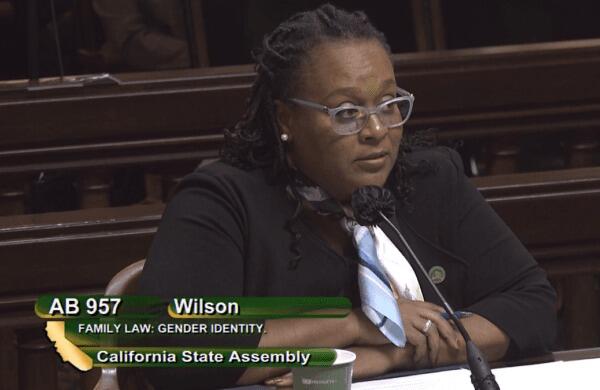
California State Assemblywoman Lori Wilson speaks to the state Assembly Judiciary Committee in Sacramento, Calif., on March 21, 2023. (California State Assembly/Screenshot via The Epoch Times)
She said the approach is deceptive and misleads the public, but given the controversial nature of the topic, she expects the trend to continue.
“This isn’t the first time they’ve done this, and it’s not going to be the last,” Ms. Lorey said. “They just tend to mention the parts of bills that make them seem like great bills, and we have to come out and let people know what the bills are really going to do.”
The section of the health code described in AB 2319 contains a $75,000 fine for a first offense if medical providers fail to comply with the implicit bias training, and subsequent instances are subject to fines of $125,000.
Opponents argued that fining medical providers for not supporting transgender agendas is unacceptable and disregards the science of sexual dimorphism in the human species.
“[Providers are fined] for simply not agreeing with their ideology that men can give birth, that’s what they’re trying to force,” Ms. Lorey said.
Another opposition witness said the choice to couch the transgender language in a bill meant to improve healthcare for black women is manipulative.
“This is how the Democrats do it,” Erin Friday, a California-based attorney and parent advocate, told The Epoch Times after the hearing.
“They have a good aspect of a bill which is designed to ensure that black women get the maternal care that they need, but then they throw in a dose of transgenderism.”
The method is a political tactic, she said.
“They do this routinely in so many bills, and they change the language,” Ms. Friday said.
“And if you don’t go along with the language, they easily call you a racist.”
Erin Friday at the California state capital building in Sacramento, Calif., on Aug. 28, 2023. (John Fredricks/The Epoch Times)
Arguing that women’s rights are jeopardized by the term “birthing persons,” she said the bill is “creating a new religion of transgenderism” and that women across the state are endangered by the measure.
“It was absolutely galling to hear them call women ‘birthing people,’” Ms. Friday said. “They’re erasing women because now we’re ‘birthing people.’”
One committee member said he was voting for the bill to protect black people, saying that he was confused by those opposing it.
“We have to protect all African Americans no matter what, and I’m not really understanding what the opposition is,” Assemblyman Reginald Jones-Sawyer said before voting in favor.
After clearing the health committee, the bill will next be heard by the Assembly’s Appropriations Committee on a date yet to be determined.
“Nuclear Should Be Part Of The Future,” PG&E CEO Says
On Wednesday, Patti Poppe, the chief executive officer of Pacific Gas & Electric, told a Stanford University forum that nuclear power should continue to be part of the state’s power generation mix as efforts to decarbonize the grid move forward.
“Nuclear should be part of the future,” Poppe said, noting that the state’s only nuclear power plant – Diablo Canyon – could be granted a license extension through the 2030s by the Nuclear Regulatory Commission.
“I expect there will be conversations, as the five-year window comes nearer and nearer, that maybe we should extend that further,” Poppe said, adding, “I think that would be a good policy, to utilize a safe, high-performing asset for the state.”
Bloomberg explained that California has moved “aggressively to transition to renewable power, but its heavy dependence on solar plants leaves it vulnerable to outages on hot summer evenings after the sun goes down.”
Electricity peak demand and energy growth rates are soaring in the Golden State (and the US as a whole) partly due to electrification trends and electric vehicles.
On Wednesday, we penned a note titled “The Next AI Trade,” underlining how AI data centers and industrial facilities will strain the US power grid.
For the states that have abandoned nuclear and fossil-fuel power in favor of unreliable wind and solar, well, there will be a historic shift back to nuclear power, as this is the only way to decarbonize grids with reliable and cheap energy.
In December, regulators said the Diablo Canyon plant, owned by Pacific Gas & Electric, could operate through 2030 instead of 2025 to prevent rolling blackouts as the state shifts toward renewable power sources.
Last month, the federal government announced that it would provide a $1.5 billion loan to restart a nuclear power plant in southwestern Michigan.
What is notable is not that the US is throwing some money at the nuclear power plant industry – since Washington sells $1 trillion in debt every 100 days, it may as well go full “Brewster’s Millions” (or rather “Trillions”) and spend it all asap; it is that this would be the first nuclear power plant to be reopened in the US, setting a precedent as atomic energy makes a triumphal comeback.
“There is more enthusiasm toward nuclear power — in Congress, in the industry and also internationally,” said Najmedin Meshkati, an engineering professor at the University of Southern California who has inspected nuclear plants around the world.
Nuclear energy is in the spotlight. Thirty-four countries, including the US, pledged to use it last month to reduce reliance on fossil fuels.