Something Broke In Markets On Thursday

Something Broke In Markets On Thursday

Authored by Mark Cudmore via Bloomberg,

This Friday is going to be a session for active short-term traders, and it will likely be unpleasant for investors.

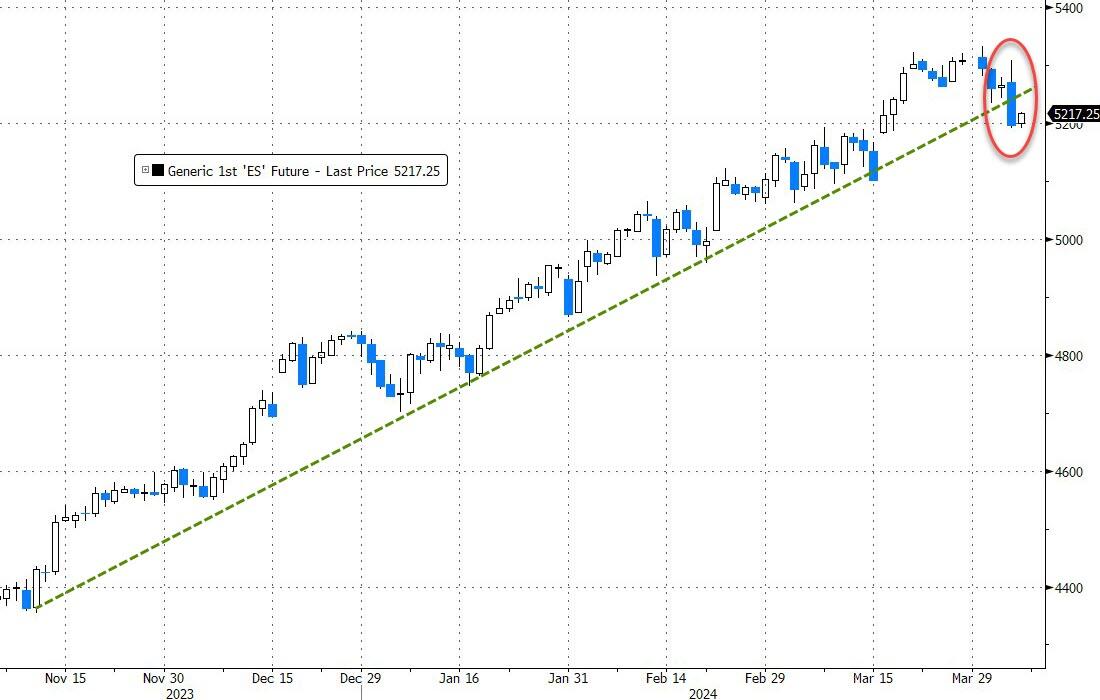
Something broke in markets on Thursday. There are a few things that worry me about the latest bout of risk aversion. This is in context that I’ve been an unrelenting stocks bull since the December Fed meeting…

But now I’m uneasy…

The Thursday selloff confused people.

Initially, many blamed the comments from Fed’s Kashkari about there potentially being no US rate cuts this year.

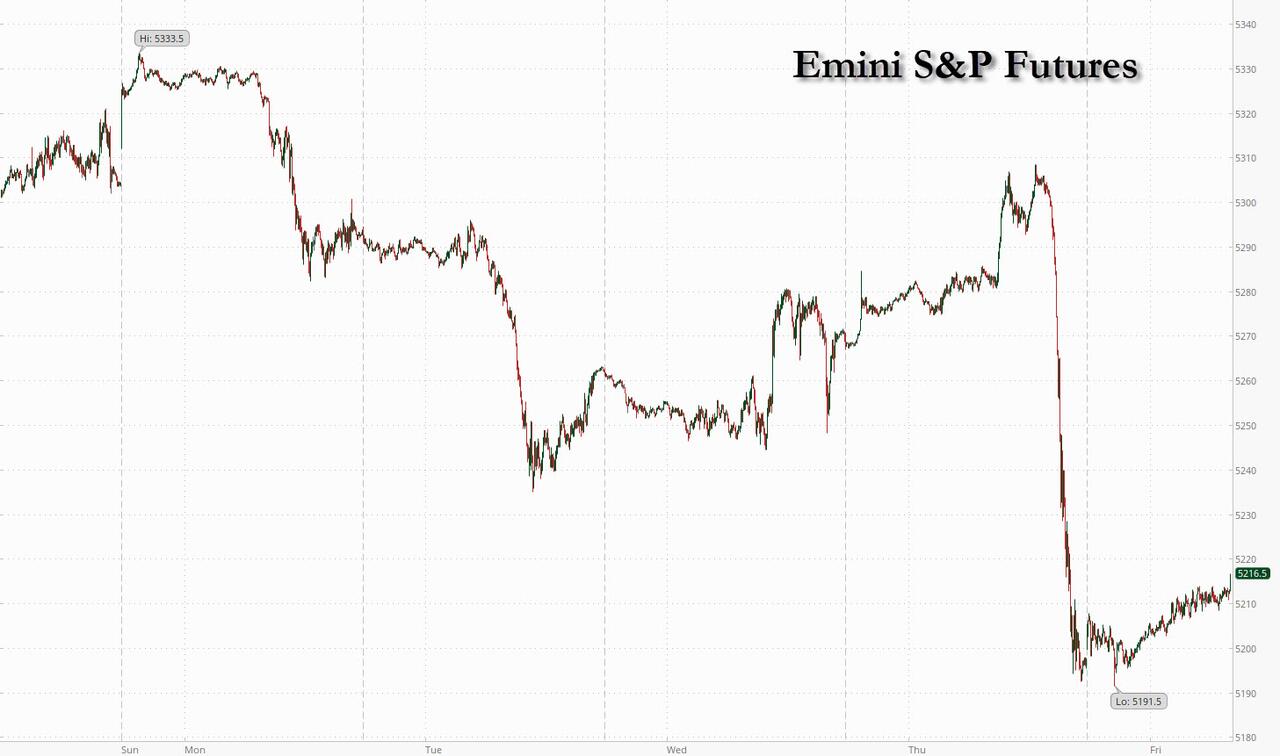
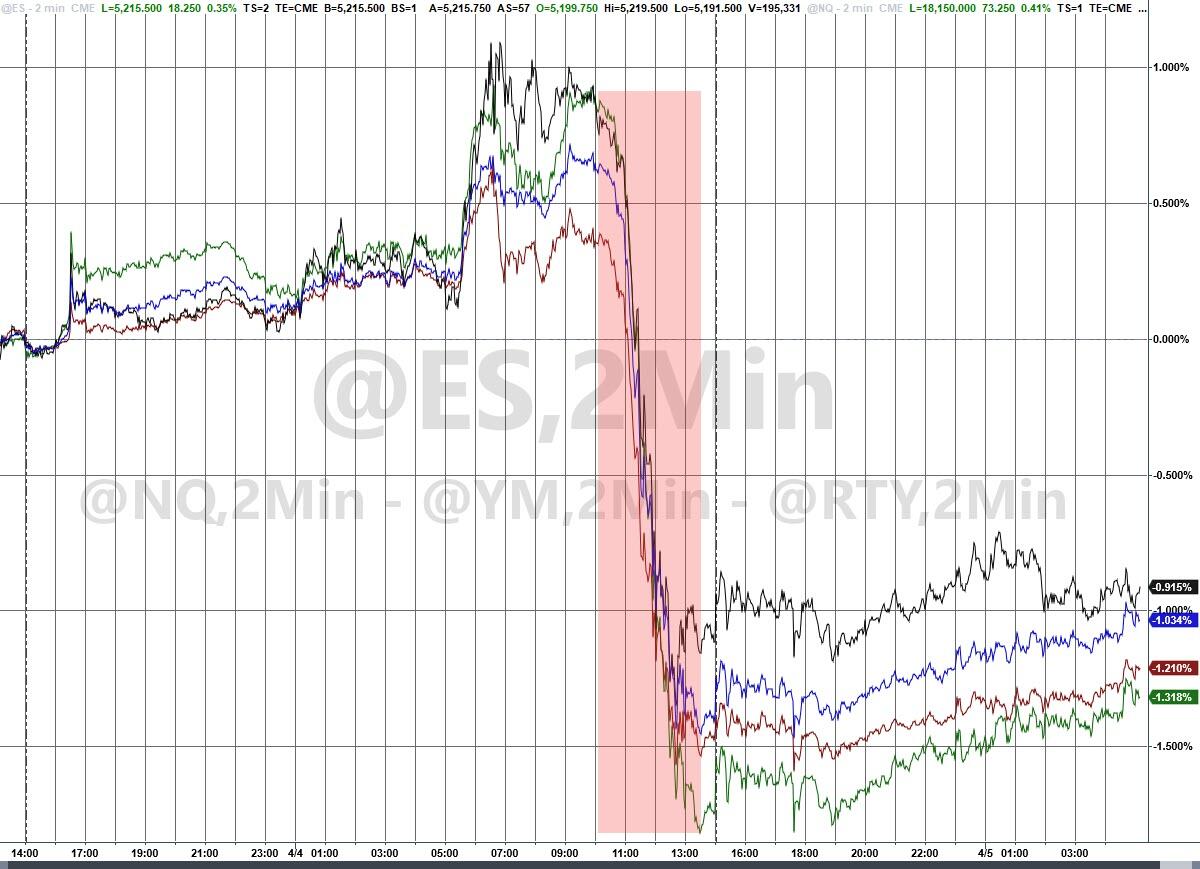
However, a quick look at a few charts shows that (a) yields fell rather than climbed, so his hawkish lines did not impact, and (b) equities started selling off before his headlines.

It’s never a good sign when people struggle to identify why stocks have a relatively large swoon.

If an asset is weak without an obvious catalyst, it suggests that it can really get destroyed if a genuine risk materializes.

For good order, the weakness in E-minis coincided with the oil price rise that in turn followed the Netanyahu headlines.

We have key US data this morning at a time of vulnerability for the market in terms of the Fed narrative.

We’ve run a long way on the idea of the Fed being dovish despite a strong US economy.

We’re getting closer to the point where we must acknowledge that either the Fed won’t be easing soon, OR the economy is in more trouble than we thought.

It means that we’re in the unusual-in-recent-times setup where a big surprise in either direction could hurt stocks today.

(For clarity and consistency, I would only see this as a multi-week consolidation/retrenchment and not some long-term bearish turning point).

Middle East tensions have escalated substantially just before the weekend, further supporting the idea of taking some risk off the table.

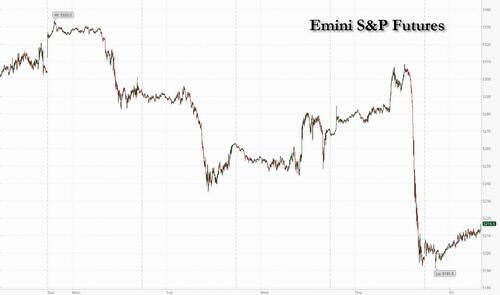
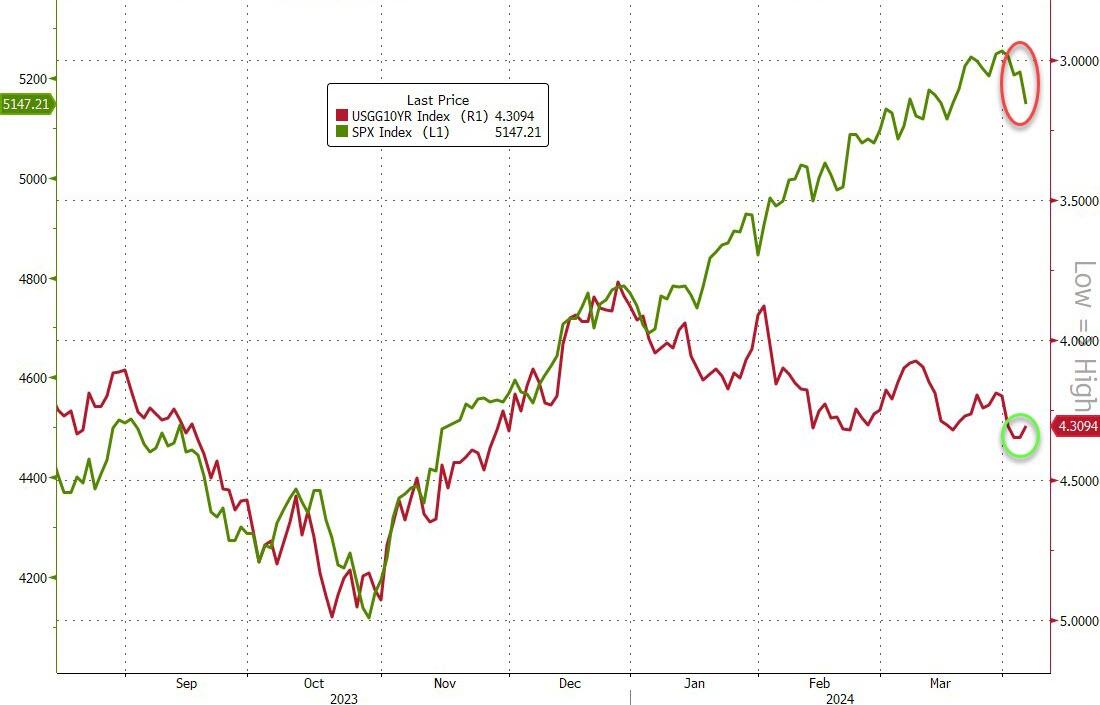
And, let’s face it, the 5-month E-minis chart below just looks horribly negative. If you’ve ridden the rally until here, this chart is your siren call to take some profits.

And if you’ve been desperate to fight these bubblicious markets, you have now been given the green light.

I remain structurally bullish for the year ahead and yet if I was back in a trading seat, I’d probably want to be tactically underweight into the weekend.

It’s that kind of contradiction that will make this Friday an unpleasant markets session for all but the most nimble of traders.

Good luck.

Tyler Durden
Fri, 04/05/2024 – 08:25

via ZeroHedge News https://ift.tt/B75k6NP Tyler Durden

Yields Are Correct To Assume Jobs Market Has Not Yet Cracked

Yields Are Correct To Assume Jobs Market Has Not Yet Cracked

Authored by Simon White, Bloomberg macro strategist,

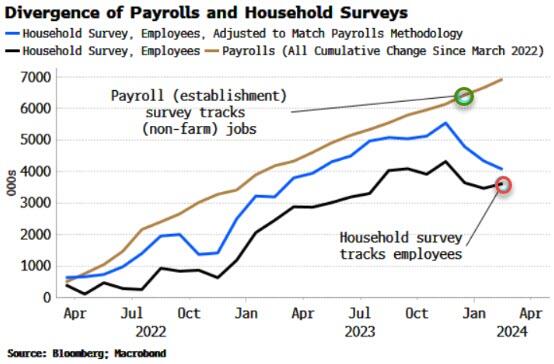
The widening gap between household employment and payrolls is causing concern the weaker message from the household survey is the more accurate. However, the reality probably lies somewhere in between, and the jobs market is not yet weak enough to justify significantly lower yields.

Jobs day has come round again and focus will be on the mounting difference between the number of jobs recorded by the household survey and the establishment survey, i.e. payrolls. The household data is looking increasingly weak, prompting speculation we are on the precipice of a jobs market that’s about to crack.

But there are reasons to think the household survey may be stronger than the data currently suggest, and also that payrolls may be weaker. Overall, that would mean the “true” state of the jobs market is somewhere in between the two surveys, i.e. this is a slowing jobs market, but not one that is going to trigger an imminent recession, nor corner the Federal Reserve into making near-term rate cuts.

1) The household survey may not be properly accounting for increased immigration. A recent Brookings paper posits that the survey may be using too a low an estimate for the civilian population. That would bias employment growth lower, and unemployment rates (both national and state) too high if the estimate of the size the workforce is too low.

2) The BLS adjusts the household data to take account of the differences between the two surveys (orange line in the chart above). This series is also showing weakness, leading to speculation that even payrolls data is inherently soft. But the very jobs taken out of the payrolls survey to make the adjustment (agriculture, the unincorporated self-employed, unpaid family workers in family-owned businesses) are among those that are predisposed to having a bias towards immigrants.

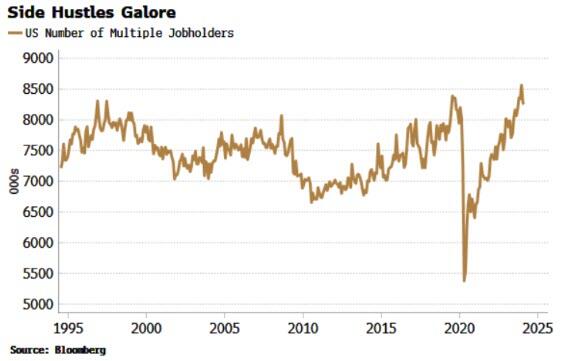
3) On the other hand, payrolls – as it tracks jobs rather than employees as with the household survey – is doing more double counting. The number of multiple job holders is at a 30-year high. Payrolls could thus fall more quickly than household employment when the labor-market decisively turns.

4) The birth-death adjustment for payrolls, to account for new and closed businesses, is making an unusually large contribution to the data, adding 2.8 million jobs since March 2022. That has happened at the same time as survey response rates have dropped notably since the pandemic. It’s conceivable the adjustment is flattering payrolls, and it will eventually be revised away.

Today’s data will shed some light (and probably some heat too), but we would need to see a decisive weakening in both surveys to justify a significant turn lower in yields.

Tyler Durden
Fri, 04/05/2024 – 08:10

via ZeroHedge News https://ift.tt/h2XYoSJ Tyler Durden

Futures Rebound As Oil Remains Above $90; All Eyes On Payrolls

Futures Rebound As Oil Remains Above $90; All Eyes On Payrolls

US futures rebounded from yesterday’s late day rout even as European stocks slumped the most in almost two months and Asian markets tumbled the most in a month, tracking Thursday’s broad market retreat as oil prices held near five-month highs above $90 and investors braced for today’s jobs report where the whisper is of a hotter than expected print. As of 7:30am, S&P futures rose 0.3% after tumbling 1.4% yesterday; even with the modest gain the index is on track for its biggest weekly decline since mid-February.  Europe’s Stoxx 600 slid more than 1%, following the previous session’s sharp retreat on Wall Street and losses in Asia earlier on Friday. US and euro-area bond yields inched higher as fears of an escalation in the Middle Eastern conflict kept Brent crude futures near $91 a barrel, fanning inflation concerns. The USD is stronger, bitcoin has resumed selling, commodities are higher led by Energy products and base metals. From a macro perspective, NFP is the focus, survey is +214k survey vs. BBG whisper +230k; both are down from the +275k prior.
In premarket trading, Mag7 and Semis are higher pre-mkt; Samsung earnings may aid the move. Here are some other notable premarket movers:

  • Altice USA shares slip 3.9% after a downgrade to underweight at Wells Fargo.
  • Cinemark shares rise 3.4% after an upgrade to overweight at Wells Fargo.
  • Krispy Kreme shares gain 5.7% trading after the doughnut chain was upgraded to overweight from neutral at Piper Sandler following last week’s announcement of a national partnership with McDonald’s.

According to JPM’s market intel desk, yesterday’s sell-off had a number of reasons offered for the move: Middle East Escalation, Oil Price Spike, No Rate Cuts, etc; and since the moves appeared to be a flight to safety, the likely answer is all of the above. We have now seen the first week of the year where the SPX has lost at least 70bps twice and is the first time since the week of Oct 23, 2023 whose close that Friday market the bottom before this current rally.

“Clearly, geopolitical risks are rising and that is on everyone’s radar right now, hence some softness in equity markets and credit spreads,” said Luke Hickmore, a portfolio manager at Abrdn Investment Management Ltd. He added that he was also focused on the upcoming US employment report for March.

Oil’s 18% surge this year, alongside gains across other crucial commodities such as copper and palm oil, raised the prospect of higher-for longer inflation. Minneapolis Federal Reserve President Neel Kashkari on Thursday flagged the possibility that rate cuts may not be needed this year at all if progress on inflation stalls.

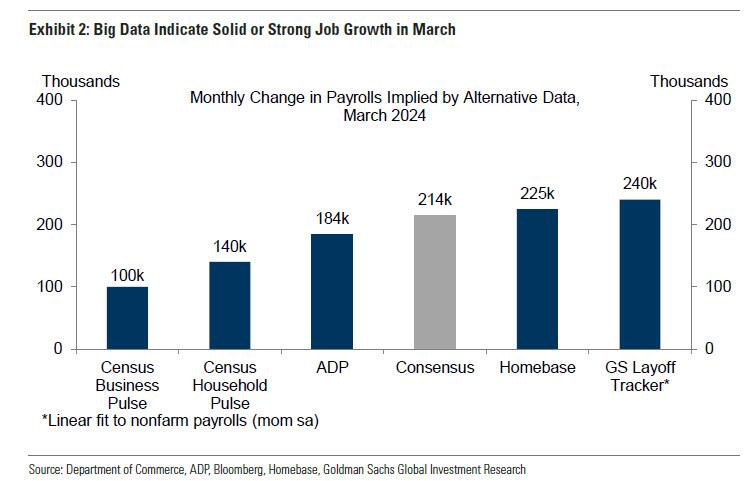
All eyes today will be on the March nonfarm payrolls report which are expected to show more than 200,000 new jobs (most of them going to illegal immigrants) added to the economy last month. A further sign of robust activity may lead the Fed to keep interest rates higher for longer. Currently, money markets are expecting fewer than three US rate cuts this year. As we discussed in our preview post, while most big data hints at a weaker than expected number…
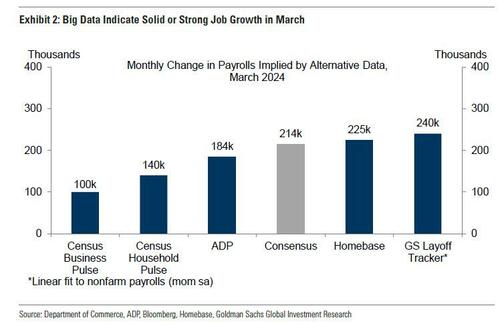
… the relentless surge in illegal immigrants may lead to another 200K+ print.
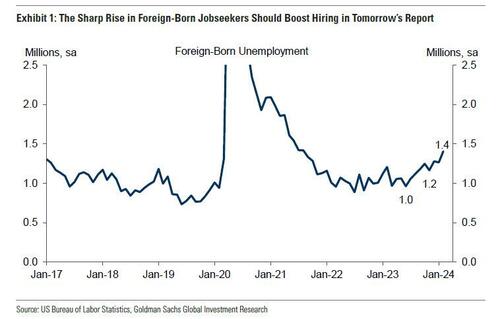
That said, a number between 150K and 250K will likely lead to some market gains while outliers in either direction will be met with selling. Here is Goldman S&P’s reaction function for the NFP number.

  • <100k S&P sells off at least 50bps
  • 100k – 150k S&P +/- 25bps
  • 150k – 200k S&P +50 – 75bps
  • 200k – 250k S&P +25 – 50bps
  • 250k – 300k  S&P +/- 25bps
  • >300k S&P also sells off at least 50bps

European stocks fall with Financial Services leading the market lower as all sectors decline while energy stocks outperform as oil rises for a fourth day on escalating tensions in the Middle East, with concerns on jet-fuel costs weighing on travel stocks.  Rising oil prices have forced a broad market retreat with bonds also slipping. FTSE 100 down 1% but outperforms peers, FTSE MIB lags with a 1.9% drop. Here are the most notable movers:

  • Shell shares rise as much as 0.8% after giving a guidance update for the first quarter which analysts said was positive overall, highlighting an improvement in volumes and better margins.
  • Marel shares gain as much as 6.4% as JBT says it expects to launch an offer for the food processing company in May. Oddo says the move indicates a potential takeover is a “done deal.”
  • Billerud shares rise as much as 3.3%, the most since March 21, after DNB reiterated its buy rating and slightly boosted its price target, citing good positioning for 2024.
  • Implenia shares gain as much as 7.4% after BURU Holding AG, owned by the Buhofer family of industrialists, bought a 13.7% stake in the Swiss group from anchor investor Max Roessler.
  • Europe’s aviation stocks slide as escalating tensions in the Middle East drive a sustained rally in oil prices, spurring worries over pressure on costs.
  • UK retailers are underperforming the broader market after a report showed wet weather prevented shoppers from rushing back to stores in March.
  • Carlsberg shares decline as much as 2.5% after being downgraded by Barclays, which warns the beer brewer faces more challenges in China that could jeopardize its long-term sales guidance.
  • Bureau Veritas shares fall as much as 3.7% after Wendel completes sale of 40.5m shares in the French goods-inspection company for total proceeds of about €1.1 billion.
  • Renk shares fall as much as 9.8%, the most on record, after Oddo downgraded the defense firm to neutral from outperform seeing a strained valuation.

Earlier in the session, Asian stocks slumped by the most in nearly four weeks, driven by the selling of technology stocks, amid concerns over US monetary policy and signs of rising risks in the Middle East.The MSCI Asia Pacific Index fell as much as 1.2%, with Toyota, Tokyo Electron and Samsung among the biggest drags. Most markets declined, led by Japan after the yen strengthened. Energy stocks outperformed as oil climbed amid tensions between Israel and Iran. Hong Kong stocks dropped after a holiday, tracking losses across the region after Minneapolis Fed chief Neel Kashkari floated the possibility of no rate reductions this year. Markets were closed in mainland China and Taiwan.

  • Nikkei 225 retreated beneath 39,000 with intraday losses of around 1,000 points amid currency strength.
  • KOSPI was dragged lower with Samsung Electronics pressured following its preliminary Q1 results in which operating EPS topped forecasts but it missed on revenue.
  • ASX 200 suffered amid weakness in tech and mining stocks, while data showed a monthly contraction in Australian exports.

In FX, the Bloomberg dollar spot index is steady. NOK outperformed G-10 FX while CHF underperforms; the yen stood out as it hit a two-week high as Bank of Japan Governor Kazuo Ueda stoked bets about an additional interest rate hike later in the year. The currency’s rise on Thursday pulled it back from levels that traders speculated would spark intervention.

In rates, Treasuries were slightly cheaper across the curve, partially unwinding the haven bid into Thursday’s US close after a flare-up of geopolitical tension between Israel and Iran. Treasury yields cheaper by 1b to 2bp across the curve, spreads within 1bp of Thursday’s close; 10-year around 4.33% is nearly 2bp higher on the day, underperforming bunds by 1.5bp while gilts lag, underperforming the rest of core Europe

In commodities, WTI trades within Thursday’s range at about $86. Brent rises to around $90. Spot gold falls roughly $4 to trade near $2,287/oz. Base metals are mixed; LME lead falls 0.6% while LME tin gains 0.5%.

Bitcoin a touch softer as markets await the NFP print and any fresh geopolitical developments to drive the macro narrative into the weekend.

Looking to the day ahead now, and the main highlight will be the US jobs report for March. Otherwise, data releases include German factory orders and French industrial production for February, along with the construction PMIs for March from the UK and Germany. From central banks, we’ll hear from the Fed’s Collins, Barkin, Logan and Bowman.
Market Snapshot

  • S&P 500 futures up 0.3% to 5,213.25
  • STOXX Europe 600 down 1.1% to 505.08
  • German 10Y yield little changed at 2.36%
  • MXAP down 0.6% to 175.33
  • MXAPJ down 0.4% to 537.38
  • Nikkei down 2.0% to 38,992.08
  • Topix down 1.1% to 2,702.62
  • Hang Seng Index little changed at 16,723.92
  • Shanghai Composite down 0.2% to 3,069.30
  • Sensex little changed at 74,281.20
  • Australia S&P/ASX 200 down 0.6% to 7,773.27
  • Kospi down 1.0% to 2,714.21
  • Euro little changed at $1.0844
  • Brent Futures up 0.1% to $90.78/bbl
  • Gold spot down 0.1% to $2,289.16
  • US Dollar Index little changed at 104.22

Top Overnight News

  • BOJ’s Ueda warns that inflation will likely accelerate from the summer toward the fall due to strong wage hikes, signaling another rate hike could arrive over the coming months. RTRS
  • The Indian central bank’s key interest rate was kept unchanged for a seventh straight policy meeting on Friday as growth in the economy is expected to remain robust while inflation stays above the 4% target. “Robust growth prospects provide the policy space to remain focused on inflation and ensure its descent to the target of 4%,” RBI Governor Shaktikanta Das said in his prepared statement. Inflation was the “elephant in the room” for the Indian economy two years ago, Das said. “The elephant has now gone out for a walk and appears to be returning to the forest. We would like the elephant to return to the forest and remain there on a durable basis.” RTRS
  • Samsung Electronics plans to more than double its total semiconductor investment in Texas to roughly $44 billion, according to people familiar with the matter, a significant breakthrough in the U.S.’s quest to make more of the world’s cutting-edge chips. WSJ
  • The EU launched investigations into two Chinese solar panel makers, the latest sign of Brussels taking steps to defend itself against Beijing’s alleged anticompetitive support for certain industries, including solar panels and autos/EVs. FT
  • Argentine President Javier Milei said he won’t touch existing trade deals with Beijing — including a gigantic $18 billion swap line — walking back his campaign pledge to curb ties with China. BBG
  • The Biden administration is drawing up plans to require goods produced in Jewish settlements in the occupied West Bank to be clearly labelled as coming from there, according to US officials, another sign of White House unhappiness with the government of Benjamin Netanyahu. The final go-ahead for the move, and its timing, have not been decided but it is intended to increase pressure on Israel over rising settler violence against Palestinians in the West Bank, and comes amid US frustration with the Jewish state’s conduct of the war in Gaza. FT
  • The Biden administration is poised to issue a proposal aimed at reducing or eliminating student loan balances for millions of borrowers, according to people familiar with the matter, marking President Biden’s second attempt at large-scale loan forgiveness. WSJ
  • The global supply of public equity is shrinking at its fastest pace in at least 25 years, as economic and geopolitical uncertainty weighs on new share sales while companies keep buying back large volumes of their own stock. Data shows that the global universe of public equities has already shrunk by a net $120bn this year, exceeding the $40bn taken out over all of last year. That puts the net figure on course for a third consecutive year of decline — a phenomenon not seen since the bank’s data series began in 1999. FT
  • We now estimate nonfarm payrolls rose by 240k in March—above consensus of +213k. Our forecast reflects a continued boost from above-normal immigration, as new entrants to the labor force are matched to open positions. Big Data measures also generally indicate a solid or strong pace of job gains, and our layoff tracker indicates that the pace of layoffs remains low. We nonetheless assume a slowdown from the February payroll gain of +275k because we believe a favorable swing in the weather boosted that report by as much as 75k. GIR
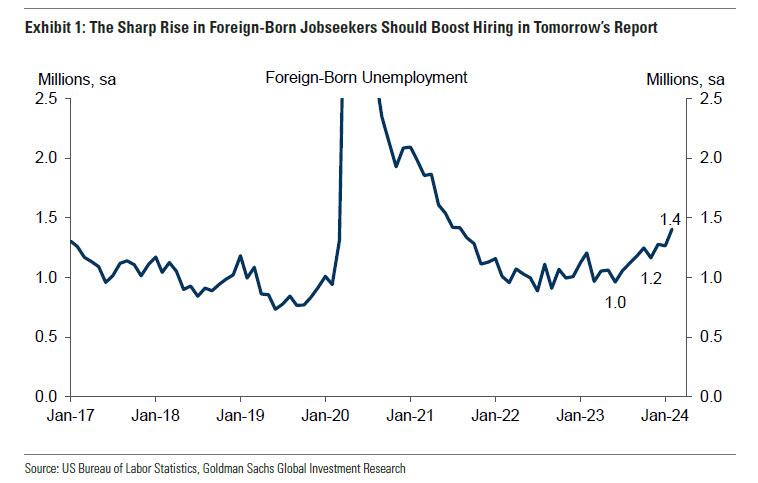
  • Net US immigration surged in 2023. Recent reports from the Congressional Budget Office and border encounter data from the Office of Homeland Security suggest that net US immigration was running above the estimate implied by the change in the foreign-born population in the household survey over the last couple of years. We estimate that net US immigration surged to roughly 2.5 million in 2023, the highest level in the last two decades. GIR

A more detailed look at global markets courtesy of Newsquawk

APAC stocks followed suit to the losses in the US amid geopolitical concerns and hawkish-leaning Fed rhetoric. ASX 200 suffered amid weakness in tech and mining stocks, while data showed a monthly contraction in Australian exports. Nikkei 225 retreated beneath 39,000 with intraday losses of around 1,000 points amid currency strength. KOSPI was dragged lower with Samsung Electronics pressured following its preliminary Q1 results in which operating EPS topped forecasts but it missed on revenue.

Top Asian news

  • US Treasury Secretary Yellen seeks healthy China ties and warned of overcapacity during China visit, according to Bloomberg.
  • US Commerce official Lago met with a Chinese official where she raised commercial and market access issues impacting US companies and workers like data flows and regulatory transparency, while she also raised ‘strong concerns’ regarding growing overcapacity in a range of Chinese industrial sectors that impact US workers and businesses, according to the Commerce Department.
  • BoJ Governor Ueda said the chance of sustainably and stably achieving the bank’s 2% inflation target is in sight and likely to keep heightening, while he added the BoJ will adjust the level of interest rates in accordance to the distance towards sustainably and stably achieving 2% inflation, according to Asahi newspaper. Ueda said whether to raise interest rates again this year will be dependant on data and if the BoJ become more convinced that trend inflation will approach 2%, that will be one reason to adjust interest rates but also stated as long as trend inflation is below 2%, it is necessary to maintain accommodative monetary conditions. Furthermore, he said if FX moves appear to have an impact on the wage-inflation cycle in a way that is hard to ignore, they could respond via monetary policy.
  • Japanese Finance Minister Suzuki said rapid FX moves are undesirable and he is closely watching FX moves with a high sense of urgency, while he reiterated it is important for currencies to move in a stable manner reflecting fundamentals and won’t rule out any options to deal with excessive FX moves.
  • RBI kept its Repurchase Rate unchanged at 6.50%, as expected, while it maintained the stance of remaining focused on the withdrawal of accommodation in which 5 out of 6 members voted in favour of the rate and policy stance. RBI Governor Das stated monetary policy must be actively disinflationary and the MPC will remain resolute in its commitment to aligning inflation to the target, while he also stated that they must ensure the descent of inflation to the target of 4% and the last mile of disinflation is challenging.

Equities lower across the board on catch-up play from the late selling seen on Wall Street given geopols/hawkish Fed rhetoric; Stoxx 600 -1.0%. Sectors in-fitting with defensives outperforming slightly given the tone and macro drivers. Stateside, futures are slightly firmer but action is more a consolidation than an uptick after the pressure seen late doors on Thursday, ES +0.3%.

Top European news

  • Hungary’s Industry Returns to Growth After More Than a Year
  • Maersk Reinstates Panama Canal Transit as Drought Subsides
  • Europe Gas Prices Jump as Mideast Tensions Rattle Energy Markets
  • Russian Governor Stabbed in Rare Attack on Official
  • Latvia Deploys Finance Tools to Fight Russian Sanctions Evasion
  • UK Retailers Slide as Decline in Shoppers Persists in March
  • Israel Debate Opens Fresh Rift in Sunak’s Fractious Cabinet

FX

  • DXY is essentially unchanged in 104.13-35 parameters as markets count down to the NFP report. Strong release could see a test of 105.00 while a softer print brings 104.00 and below into play.
  • G10 peers generally rangebound given the tepid USD action into Payrolls with specifics otherwise light as broader market focus remains on geopols into a potential risk-filled weekend.
  • GBP slightly softer despite the Construction PMI moving back into expansionary territory, EUR treading water into the data and was unaffected by the morning’s German data points.
  • USD/JPY holding at the top-end of a 150.82-151.45 bound; little move to familiar commentary from officials overnight.

Fixed Income

  • Benchmarks slightly softer as they give back some of Thursday’s risk-inspired upside which more than offset any hawkish impulses at the time from Fed speak.
  • Bunds at the session low of 132.53 with no real reaction to a handful of German data points as markets remain focused on Payrolls.
  • Gilts are pulling back a touch more than peers, with losses in excess of 30 ticks currently but holding just above Thursday’s 98.64 trough, a pullback which is largely a function of their relative outperformance on Thursday.
  • USTs a touch softer but remain towards the top-end of Thursday’s parameters; NFPs and Fed speak the highlights ahead where an above-forecast number could see a resumption of the earlier bear-steepening while a soft print could see this unwind further – geopolitical updates also a potential key factor.

Commodities

  • Modest gains across the crude complex following yesterday’s geopolitically-induced upside which led a bid into the settlement. Rhetoric this morning remains heightened, but as of yet no significant follow through to price action.
  • WTI and Brent currently firmer by around USD 0.20/bbl, towards the top-end of Thursday’s parameters.
  • Mixed trade for precious metals with slight underperformance in silver/palladium while gold is more resilient and underpinned by remarks from RBI’s Das that they are building reserves; XAU near highs of USD 2293/oz.
  • RBI Governor Das says they are building up gold reserves.
  • LME says no further deliveries of aluminium alloy brand SMI, produced by State Metals Industrial, will be accepted for LME warranting with effect from 05 July.

Geopolitics: Middle East

  • Israel told the US that if Iran launched an attack from its soil against Israel in retaliation for the killing of an Iranian General earlier this week, it would draw a strong response from Israel and take the current conflict to another level, according to Axios.
  • White House said US President Biden emphasised to Israeli PM Netanyahu that the strikes on humanitarian workers and the overall humanitarian situation are unacceptable, while Biden made it clear Israel needs to announce and implement a series of specific, concrete, and measurable steps to address, civilian harm, humanitarian suffering, and the safety of aid workers. It was also stated that US policy with respect to Gaza will be determined by its assessment of Israel’s immediate action of these steps.
  • US President Biden’s administration recently authorised the transfer of over 1k 500-pound bombs and over 1k small-diameter bombs to Israel, despite US concerns over the country’s conduct in Gaza, according to CNN sources. It was also reported that the White House said the process of US military aid to Israel was not tied to the Hamas conflict.
  • Israeli government approved opening Erez crossing into Gaza and opening of Ashdod Port to expand aid into Gaza, according to Times of Israel.
  • “IRGC commander: Any aggression against Iran will not go unanswered”, according to Sky News Arabia; “IRGC commander: Israel is in our crosshairs and knows what will happen”, via Al Arabiya.
  • Iranian official says the decision to retaliate against Israel has been made and will be implemented, via Al Arabiya.

Geopolitics: Other

  • US Secretary of State Blinken commented via X that the US and its allies are united in their commitment to Ukraine, while he added they reaffirmed at the Foreign Ministers meeting of the NATO-Ukraine Council that Ukraine’s future is in NATO.
  • Japan’s METI announced Japan will expand the export ban to Russia to include more industrial items such as lithium-ion batteries, thermostats and grinders effective April 17th.
  • Russian Foreign Ministry said Sweden’s plans to set up a NATO base on Gotland Island are provocative, according to RIA.

US Event Calendar

  • 08:30: March Change in Nonfarm Payrolls, est. 214,000, prior 275,000
    • March Change in Private Payrolls, est. 170,000, prior 223,000
    • March Change in Manufact. Payrolls, est. 3,000, prior -4,000
    • March Unemployment Rate, est. 3.8%, prior 3.9%
    • March Underemployment Rate, prior 7.3%
    • March Labor Force Participation Rate, est. 62.6%, prior 62.5%
    • March Average Hourly Earnings MoM, est. 0.3%, prior 0.1%
    • March Average Hourly Earnings YoY, est. 4.1%, prior 4.3%
    • March Average Weekly Hours All Emplo, est. 34.3, prior 34.3
  • 15:00: Feb. Consumer Credit, est. $15b, prior $19.5b

Central Bank Speakers

  • 08:30: Fed’s Collins Gives Opening Remarks
  • 09:15: Fed’s Barkin Speaks on Economic Outlook
  • 11:00: Fed’s Logan Speaks at Duke University
  • 12:30: Fed’s Bowman Speaks on Risks in Monetary Policy

DB’s Jim Reid concludes the overnight wrap

Markets took a sharp risk-off turn in the US afternoon yesterday, continuing their tough start to Q2. The main catalyst were rising tensions in the Middle East, with Brent crude oil prices closing above $90/bbl for the first time since October, which in turn added to existing fears about inflation. Moreover, there were also some hawkish remarks from Fed officials, with Minneapolis Fed President Kashkari saying that if “we continue to see inflation move sideways, then that would make me question whether we needed to do those rate cuts at all.” So there was an open acknowledgement that rate cuts might not happen in a scenario with more persistent inflation, which the latest rise in oil prices won’t help with.

All that meant the S&P 500 fell by over 2% intraday, ending the session down -1.23%. That leaves the index on course for its worst weekly performance since October, having shed -2.04% since the start of the week. And it marks a big shift from its relentless run-up since the end of October. In fact, the S&P 500 is now -0.2% beneath its level 4 weeks earlier, which makes this the biggest 4-week decline for the index since 2024 began.

The equity selloff coincided with the sharp run-up in oil prices yesterday, which came amidst the news that Israel was preparing for a possible attack by Iran. This brought fears of a broader regional conflict back into the market’s view, leading oil prices to spike by almost 3% from the day’s lows. That took Brent crude up +1.45% to $90.65/bbl, while WTI (+1.36% to $86.59/bbl) extended its year-to-date gain above 20%. And overnight there’ve been further gains for oil, with Brent crude up +0.31% to $90.93/bbl.

This backdrop weighed heavily on equities, with the S&P 500 closing -1.23%, its biggest decline since mid-February, after being up +0.8% intraday. Notably, that also helped push the VIX index of volatility up to a 5-month high of 16.35pts. The decline was a broad one, with 23 of the 24 S&P 500 industry groups lower on the day, and tech stocks slightly underperformed, with the NASDAQ down -1.40%. The Magnificent 7 (-1.06%) saw diverse moves, with Nvidia (-3.44%) and Alphabet (-2.83%) posting large declines, whereas Tesla (+1.62%) and Meta (+0.82%) both advanced.

Treasuries benefited from the risk-off turn, with 10yr yields down -3.8bps to 4.31%, while 2yr yields fell by -2.5bps. Notably, this was fully driven by real yields, with breakevens higher on the day, as the 5yr inflation swap rose to its highest level in nearly 5 months (+2.9bps to 2.54%). Fed funds futures saw sizeable volatility, with pricing of a June cut moving from 63% earlier on to as high as 80%, before settling at 74% by the close. Earlier in the day, the jobless claims data further cemented expectations of a June cut, after initial claims rose to 221k over the week ending March 30 (vs. 214k expected), their highest level since January.

Looking forward, the next focal point will be the US jobs report for March today, which will offer fresh clues as to the likelihood of future rate cuts. In recent months, nonfarm payrolls have seen a noticeable improvement, and the 3m average gain was up to +265k in February, which is its fastest since June last year. So when you combine that with the upside inflation surprises over January and February, that’s seen investors push out the likely timing of rate cuts. In terms of what to expect today, our US economists are forecasting growth in nonfarm payrolls of +200k, with the unemployment rate ticking down a tenth to 3.8%. They see the risks to their payroll forecasts as roughly balanced, but when it comes to the Fed, they think that unless there are any substantial surprises, the inflation report next week will get more attention given the Fed’s focus on the inflation outlook. For more details, see their full preview along with how to register for their webinar (link here)

Yesterday also brought several Fed speakers before the jobs report. In aggregate, they did little in aggregate to move the needle on rate cut expectations. However, there was some hawkishness from Minneapolis Fed President Kashkari, who described the January and February inflation prints as “a little bit concerning”, and as mentioned at the top, he questioned whether rate cuts would need to happen at all if inflation did move sideways. Apart from Kashkari, Cleveland Fed President Mester said she wanted “to see a couple more months data” to discern if there was enough confidence in the inflation decline to begin lowering rates. Chicago Fed President Goolsbee suggested that the higher January and February inflation readings “should not knock us off the path back to target”, though he was watchful over the still elevated housing inflation. And Richmond Fed President Barkin said that “Given a strong labor market, we have time for the clouds to clear before beginning the process of toggling rates down ”, which was similar to Chair Powell’s comment the previous day.

This negative tone has continued in Asian markets overnight, where the Nikkei (-1.93%) and the KOSPI (-1.05%) have both experienced sharp losses. Otherwise, the Hang Seng (-0.71%) saw a smaller decline as it caught up after the previous day’s holiday, whilst markets in mainland China remain closed for a second day. Meanwhile, the Japanese Yen strengthened after comments from BoJ Governor Ueda that suggested another potential rate hike later this year. In particular, he said that the “possibility of achieving the BOJ’s long-awaited target will further increase as wage hikes are reflected in higher consumer prices from summer through autumn”. That supported a further rise in front-end government bond yields, with the 2yr Japanese yield up +2.1bps to 0.20%, its highest level since 2011.

Back in Europe, markets closed before the late run-up in oil prices, so yesterday’s session had been more cheerful for investors. Bonds experienced a sizeable rally, with yields on 10yr bunds (-3.4bps), OATs (-4.1bps) and BTPs (-10.9bps) all seeing a noticeable decline. And most European equity indices posted modest gains, with STOXX 600 up +0.16%. In part, sentiment was supported by the final services and composite PMIs for March. Those saw upward revisions compared to the flash PMIs, and the Euro Area composite PMI was up to 50.3 (vs. flash 49.9), marking its first time it’s been in expansionary territory in 10 months. A similar pattern of upward revisions was evident elsewhere, with the German composite PMI at 47.7 (vs. flash 47.4), whilst France’s was at 48.3 (vs. flash 47.7). The main exception to that pattern was in the UK, where the final composite PMI was down a tenth from the flash reading to 52.8.

Elsewhere in Europe, we saw the release of the accounts of the ECB’s March meeting, which were consistent with the ECB seeing June as the baseline for the first rate cut. The accounts noted that “While it was wise to await incoming data and evidence, the case for considering rate cuts was strengthening”, and pointed out that “the Governing Council would have significantly more data and information by the June meeting, especially on wage dynamics. By contrast, the new information available in time for the April meeting would be much more limited”. For more, see our European economists’ take on the accounts here.

To the day ahead now, and the main highlight will be the US jobs report for March. Otherwise, data releases include German factory orders and French industrial production for February, along with the construction PMIs for March from the UK and Germany. From central banks, we’ll hear from the Fed’s Collins, Barkin, Logan and Bowman.
Tyler Durden
Fri, 04/05/2024 – 07:58

via ZeroHedge News https://ift.tt/ipTKzIc Tyler Durden

Baltimore Bridge Collapse: US Army Corps Of Engineers Says Channel Fully Reopen By End Of May

Baltimore Bridge Collapse: US Army Corps Of Engineers Says Channel Fully Reopen By End Of May

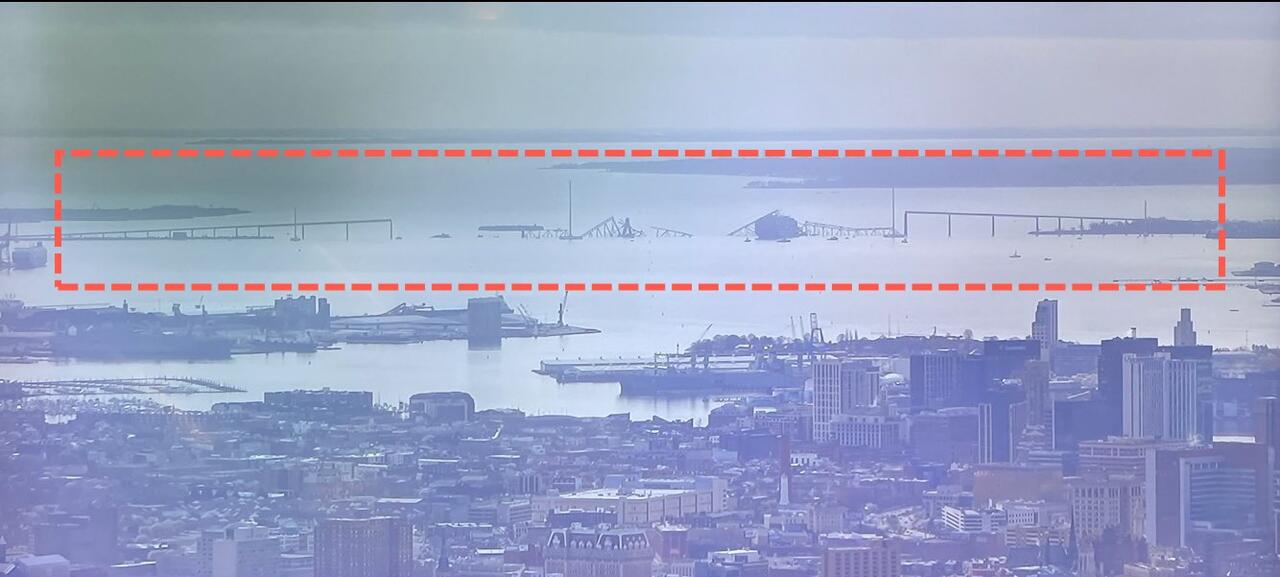
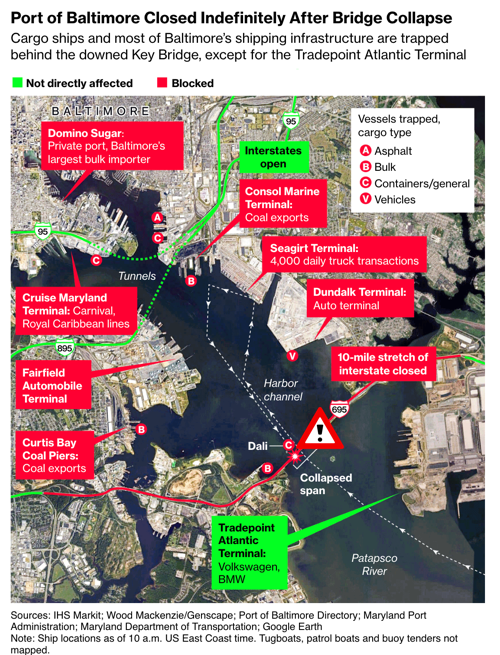
Ten days after the catastrophic collapse of the 1.6-mile-long Francis Scott Key Bridge, blocking the critical shipping channel in and out of the Port of Baltimore, resulting in the partial freeze of the harbor, the US Army Corps of Engineers (USACE) announced in a press release late Thursday night a new “timeline for the restoration for safe navigation in and out of the Port of Baltimore.” 

USACE expects the Fort McHenry Channel will be operational with a “limited access channel 280 feet wide and 35 feet deep” by the end of April. 

“This channel would support one-way traffic in and out of the Port of Baltimore for barge container service and some roll on/roll off vessels that move automobiles and farm equipment to and from the port,” the agency said. 

USACE engineers expect a much wider and permanent, 700-foot-wide by 50-foot-deep federal navigation channel by the end of May, thus restoring full access to the port. 

Source: Bloomberg 

On Sunday, Maryland Gov. Wes Moore told CNN, “We have a ship that is nearly the size of the Eiffel Tower that is now stuck within the channel that has the Key Bridge sitting on top of it.” 

“That water is so murky that salvage divers cannot see any more than 1 to 2 feet in front of them,” Moore said, adding, “The collapse of the bridge is so distinct and so severe, with metal that is so … wrought together and pancaked that it continues to make this mission extraordinarily complicated and dangerous for those who are conducting it.”

On Tuesday, USACE released 3D images of the wreckage at the bottom of the shipping channel. They said, “These 3D images show the sheer magnitude of the very difficult and challenging salvage operation ahead.” 

Captain John Konrad, CEO of Captain, pointed out the salvage operation could be more complicated than previously thought because of the risks the 984-foot Singapore-flagged container ship Dali is apparently “sitting atop a high-pressure underwater gas line.”

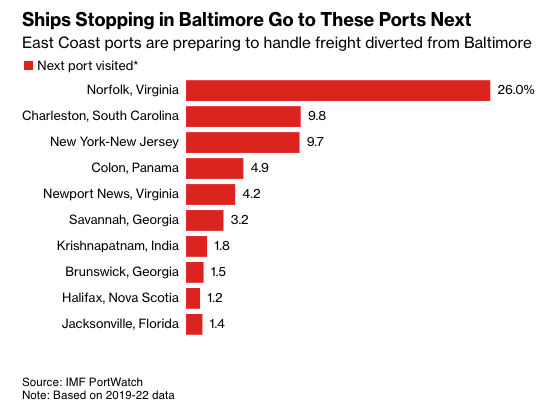
As of Monday, Bloomberg data shows dozens of bulk cargo, container, and vehicle carriers were being diverted to other US East Coast ports

According to an analysis from the International Monetary Fund’s PortWatch platform, Norfolk, New York, and Charleston, South Carolina, are the ports most likely to absorb cargo. 

Source: Bloomberg 

Meanwhile, Gov. Moore and Baltimore Mayor Brandon Scott are in a bind because Moody warned that the bridge collapse could spark negative credit risk events for the city and state.  

Even with the channel potentially reopening at full capacity by the end of May, the bridge, an important feeder to the port, and connection to the I-95 highway network for the Mid-Atlantic – could take years to rebuild. 

Should we trust the timeline? 

Tyler Durden
Fri, 04/05/2024 – 07:45

via ZeroHedge News https://ift.tt/7kn8BGK Tyler Durden

Bitcoin Vs Gold: The Debate Continues

Bitcoin Vs Gold: The Debate Continues

Authored by Douglas French via The Mises Institute,

In a few short weeks since SEC approval Inflows into Bitcoin ETF funds had reached just over $59 billion on Good Friday, according to btcetffundflow.com. Meanwhile the unloved and disrespected GLD [gold] ETF holds $54 billion, despite its thousand year pedigree. 

Gold fan and crypto disser Peter Schiff debated crypto evangelist Raoul Pal on Real Vision for nearly three hours with neither combatant giving an inch.

The calm Mr. Pal is the co-founder of Real Vision, a Goldman Sachs alum, and proudly says he is “irresponsibly long” Bitcoin and other cryptos.

The dogmatic Schiff did numerous turns on the financial talking heads circuit post ‘08 crash and is the son of famous income tax protester Irwin Schiff.

Both agree the U.S. government has borrowed its way into disaster with the only way out being to debase the currency. Pal estimates the debasement to be 15% a year and thus if your investments and income isn’t rising by that much you are falling behind. Schiff doesn’t put a percentage on the money printing or debasement but essentially agrees. What a person is to do is where they disagree. 

“People who are getting out of the dollar or the euro and buying Bitcoin have jumped out of the frying pan into the fire,” Schiff said.

“I mean, so you don’t have to reinvent the wheel if you want to get out of Fiat currencies, you can own gold, but you could also own other good inflation hedge assets, real assets.”

Making his case for Bitcoin, Pal said, “We’ve memed a trillion dollar currency into existence. We’ve memed it. It’s just human narrative. But guess what? So’s gold. So is everything that we do, including religion. Everything is a meme. So memetics rule the entire way that humans understand the world around them.” 

The word Meme was coined by the British evolutionary biologist Richard Dawkins in his 1976 book The Selfish Gene, from Greek mimēma ‘that which is imitated’, on the pattern of gene. Thus, this definition is derived; “an element of a culture or system of behavior passed from one individual to another by imitation or other non-genetic means.”

So while Schiff argued for holding gold because it is a “real” asset, Pal views gold (and everything else we presume) as just a belief. Forget the yellow metal is number 79 on The Periodic Table. Forget the U.S. dollar was once represented by 1.60 g (24.75 grains) of gold. Forget as Martin Zweig wrote in the Wall Street Journal, “Adjusted for changes in the cost of living, an ounce of gold has approximately the same purchasing power it had in ancient Rome 2,000 years ago.”

He claims gold is only valuable just because humans think it’s valuable.

Our forefathers thought it had value and that belief is passed on to us. Pal believes that Bitcoin’s 14 years of existence give it the same qualities and will not fall victim to to what the economist Joseph Schumpeter called “the perennial gale of creative destruction.”

Schiff countered that Bitcoin has a price, but has no value.

The fact a Bitcoin has gone from less than a $1 to $70,000 makes it no better than tulip bulbs in 17th century Amsterdam or Beanie Babies in the mid-1990’s. Bitcoin is merely a vehicle for speculation.

Schiff’s contention that buyers of Bitcoin are “stupid” and its price will go to zero annoyed Mr. Pal. In turn, Mr. Pal’s contention that Bitcoin is the greatest performing financial asset of all time rankled Schiff.

“Peter, it’s been around 14 years,” an exasperated Pal argued.

“We’ve gone through four cycles where it’s gone down 90% and it still is the best performing asset. So your, ‘Oh my God scenario goes down 90% [is no big deal].’ I’ve gone through three of those myself.”

The ex-hedge fund manager who retired at 36 makes 14 years sound like forever. For folks my age 14 years ago seems like yesterday. Pal’s continued emphasis on Bitcoin’s 14 year existence makes Schiff’s argument better than Schiff himself did.

“Obviously we don’t need these ETFs. That’s just the manufacturer to try to pump up demand. But yes, it’s easy to store your Bitcoin relative to gold, but the difference is when you’re storing gold, you’re storing something. And so since you have something, it takes some effort to store it,” Schiff said

“When you’re storing Bitcoin, you’re storing nothing. So what good is the fact that it’s easy to store nothing? Yes, I’ve got a very safe, secure supply of nothing and Bitcoin though, as long as people think it’s going to go up, as long as they maintain that delusion and more people want to buy it, sure, it will have a price. And if enough people don’t sell it, then some people can, right?”

Pal responded that that was the case with all investments. To which, Schiff excitedly shouted, “No it’s not. No it’s not. Gold is an actual commodity that’s used.”

Pal poo-pooed this argument claiming just a small percentage of gold is actually used. He dismissed jewelry use. Which Schiff countered with, “But they’re not wearing their Bitcoin.” Schiff mentioned gold’s use as a conductor of electricity. He might have roused Pal’s attention with “gold is utilized to mount processing chips onto motherboards” of computers. 

Launching again into attack mode Schiff said, “But eventually the story blows up. You know, people stop believing in the fairy tale. You know, you talk about all these young kids that think they’ve reinvented the wheel and think that they know more than their parents or their grandparents. You know, it’s like, look, you know, little kids believe in all sorts of things.

They believe in the tooth fairy. They believe in the Easter Bunny and Santa Claus, you know, but they don’t believe in these things for their whole lives. As they get older, they start to see the truth. And I think the same thing is going to happen with Bitcoin. People are going to grow up and they’re going to learn from the mistakes of their youth.”

At the end of the Jimmy Carter presidency the Gold Commision was approved and was formed early in the Reagan Administration. The commission was packed with anti-gold types with Ron Paul carrying the torch for the minority. Paul had Murray Rothbard ghost write the minority report with Paul and businessman Lew Lehrman signing as authors. 

In Lehrman’s new autobiography The Sum of It All, Lehrman distances himself from the report. However, he writes “It’s probably the single greatest secret in the history of modern monetary policy,” that after the report was released the Paul Volcker Fed “followed a gold price rule for quite a while. This, of all things, is where we got both the defeat of the horrible stagflation of the previous dozen years and the mega-boom of the 1980s and 1990s.”

Paul has mentioned in many speeches visiting Volcker in his office and the Fed Chair constantly wanting to know what the price of gold was doing. To that point, Lehrman writes, “the Fed’s top men set to watching the price of gold like a hawk for two decades.”

We don’t know whether Fed Chair Powell is watching the price of gold or Bitcoin. What we know is the value of the U.S. dollar continues to decline. 

The late, great Burt Blumert once told me, “Always take possession of your gold.” Still good advice.

Tyler Durden
Fri, 04/05/2024 – 07:20

via ZeroHedge News https://ift.tt/J5ivnw4 Tyler Durden

Biden DOE Slaps Energy Efficiency Regulations On Key Power Grid Components

Biden DOE Slaps Energy Efficiency Regulations On Key Power Grid Components

The Bide administration has finalized energy efficiency regulations for distribution transformers, a key component of managing the flow of electricity between power stations and consumers.

In a Thursday morning announcement, the Department of Energy said that the regulations would help accelerate the green agenda as part of the administration’s “commitment to tackling the climate crisis” (and causing more inflation).

The agency suggested that the move would save utilities and businesses over $824 million per year in electricity costs (once they come out of pocket for the ‘necessary’ upgrades).

These standards are going to make America’s power grid more resilient,” said DOE Secretary Jennifer Granholm, adding “They’ll support good-paying, high-quality manufacturing jobs, and they’ll help us deploy more affordable and reliable and clean electricity more quickly across the country.”

It’s going to provide critical, long-term certainty for domestic manufacturing and production investments – it’s going to strengthen energy and economic supply chain security,” she continued, adding “And it’ll position American producers and workers to capture an evolving and growing market.”

Granholm also emphasized that the energy efficiency standards will slash nearly 85 million metric tons of carbon dioxide, the equivalent of the combined annual emissions of 11 million U.S. homes.

Under DOE’s regulations, energy efficiency gains will be achieved with 75% of the transformers on the market being manufactured with grain-oriented electrical steel (GOES) and another 25% being manufactured with amorphous alloy, a lesser-used electric steel core material. Manufacturers will be given five years to ensure total compliance with the regulations.Fox News

The new standards are a scaled-down version of regulations first proposed by the DOE in January 2023, under which 95% of distribution transformers would have been required to be made with amorphous alloy, and manufacturers would have three years to comply. 

The original proposal has been widely criticized by power providers and utility companies which said it’s unrealistic, leading to bipartisan legislation introduced by Sens. Ted Cruz (R-TX) and Sherrod Brown (D-OH) which would require the DOE to preserve market opportunities for transformer manufacturers.

Brown said that GOES accounts for more than 95% of the domestic distribution transformer market, while amorphous steel relies on foreign materials, while there’s just one small producer in the US. Therefore, per Brown, rapidly ramping up reliance on amorphous steel could create a vulnerability in the US power grid.

“The final rule provides stability for most of the market, while affording a more gradual shift toward tighter efficiency standards for transformers used to meet larger commercial and certain electrification loads,” said  Louis Finkel, the senior vice president of government relations for the National Rural Electric Cooperative Association (NRECA).

In a press release, Cleveland-Cliffs applauded the rule, saying in a statement that “Cleveland-Cliffs and the United Auto Workers (UAW) worked collaboratively to educate the DOE on the shortcomings of the originally proposed distribution transformer rule and the danger of relying on Amorphous Metal, which is produced in very limited volumes and exclusively from imported materials.”

Tyler Durden
Fri, 04/05/2024 – 06:55

via ZeroHedge News https://ift.tt/iGYrvVs Tyler Durden

Federal Reserve Refuses To Provide Records Of Foreign Gold Holdings

Federal Reserve Refuses To Provide Records Of Foreign Gold Holdings

Authored by Ken Silva via Money Metals,

Weeks after Federal Reserve Chairman Jerome Powell evaded a sitting congressman’s questions about the central bank’s foreign gold holdings, the Fed has also declined to comply with a Freedom of Information Act request for records about such holdings.

The Federal Reserve’s lack of transparency comes amidst reports that countries are removing their gold and other assets from the U.S. in the wake of the unprecedented Western sanctions imposed on Russia over its invasion of Ukraine. According to a 2023 Invesco survey, a “substantial percentage” of central banks expressed concern about how the U.S. and its allies froze nearly half of Russia’s $650 billion gold and forex reserves.

Rep. Alex Mooney, R-W.Va., asked Powell about the matter in a December letter, only to have the Fed chair respond last month with evasive non-answers, telling him that the Federal Reserve does not own gold but holds it as a custodian for other entities—a fact that the congressman presumably already knew.

Following Powell’s evasive response, Headline USA filed a FOIA request with the Fed for records reflecting how much gold the Federal Reserve Bank of New York currently holds in its vault, as well as records reflecting the ownership stake that each of FRBNY’s central bank/government clients have in that gold. The FOIA request also sought records about the Fed’s gold holdings prior to Russia’s February 2022 invasion of Ukraine.

However, the Federal Reserve denied the FOIA request on Wednesday.

“Board staff consulted with staff at the Federal Reserve Bank of New York (‘Reserve Bank’) and have been advised that such records, if they exist, would be Reserve Bank records, and consequently, not subject to the Board’s Rules Regarding Availability of Information,” the Fed said.

The Federal Reserve said that this publication could take its request to the New York Fed. However, that institution isn’t subject to FOIA.

Headline USA is working on an appeal.

Meanwhile, sound-money advocates are blasting the Fed’s lack of transparency.

“They’re just passing the buck to the New York Fed. The FRB could obtain the data from the New York Fed if it wanted to, and then could share it with you if it wanted to. The Fed chairman has already essentially told Representative Mooney that the Fed doesn’t want to disclose the information,” said Chris Powell, secretary-treasurer of the Gold Anti-Trust Action Committee.

If only other news organizations dared to ask such relevant questions about the secret operations of the Federal Reserve System,” he said.

According to Stefan Gleason, CEO of Money Metals Exchange, a large online precious metals dealer and depository based in Idaho, “The Fed doesn’t want anyone to know that foreign governments and other central banks are yanking their gold from America’s shores because it would reveal the folly of U.S. monetary and foreign policy.”

Tyler Durden
Fri, 04/05/2024 – 06:30

via ZeroHedge News https://ift.tt/Khpg1OH Tyler Durden

Tesla Is Once Again The World’s Best-Selling EV Company

Tesla Is Once Again The World’s Best-Selling EV Company

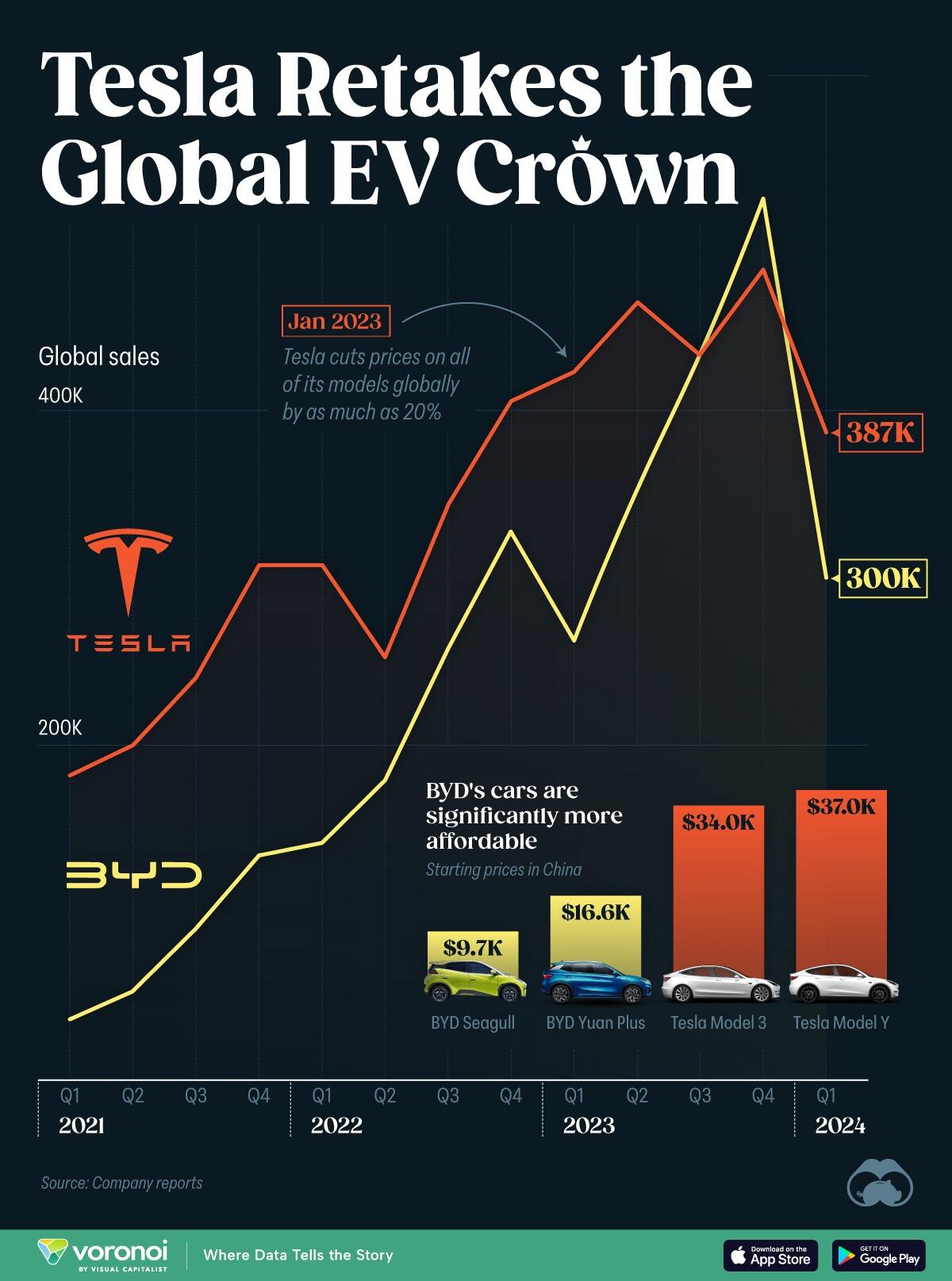
China’s BYD made waves for outselling Tesla in Q4 2023, prompting many to believe that the once dominant EV king would fall further behind in 2024.

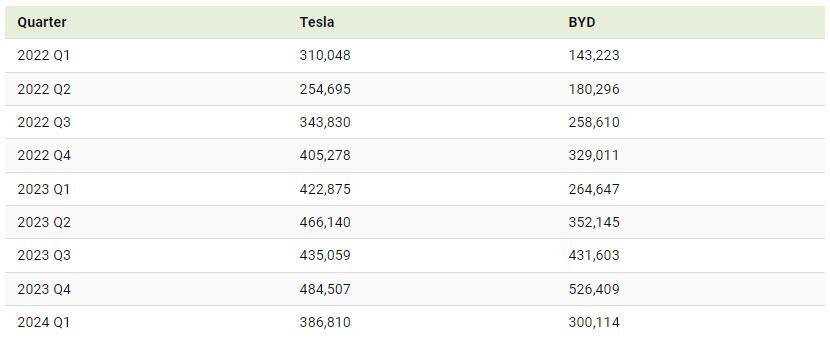
However, as Visual Capitalist’s Marcus Lu details below, figures for Q1 2024 are now out, and they reveal a dramatic 43% decline in BYD sales from the previous quarter. Meanwhile, Tesla reported a slightly less painful 20% drop in sales.

To see how this battle is playing out, we visualized the global BEV sales of both companies over the past several years.

Exact figures can be found in the table below.

The steep drops reported in Q1 2024 are the latest sign that consumer appetite for fully electric vehicles has slowed, prompting both companies to escalate their ongoing price war. In February 2024, BYD responded to Tesla’s repeated price cuts with its own round of discounts.

BYD Offers a Significantly Lower Entry Point

As shown in the above graphic, starting prices for some of BYD’s electric cars are incredibly low.

In China, the BYD Seagull now starts at 69,800 yuan ($9,700), while the Yuan Plus (BYD’s Model Y competitor) starts at 119,800 yuan ($16,000). On the other hand, Tesla’s cheapest model (RWD Model 3) costs 245,900 yuan ($34,000). It’s interesting to note that the cheapest Model 3 in the U.S. costs $38,990, according to reporting from CNN.

Learn More About Tesla

If you like seeing data visualizations on the world’s largest EV maker, check out this graphic that breaks down Tesla’s sales by model since 2016.

Tyler Durden
Fri, 04/05/2024 – 05:45

via ZeroHedge News https://ift.tt/7ulxTzX Tyler Durden

Denmark Sacks Defense Chief As Red Sea Failures Pile Up For NATO

Denmark Sacks Defense Chief As Red Sea Failures Pile Up For NATO

Via The Cradle

The Danish government fired Chief of Defense Flemming Lentfer on Wednesday after it was revealed that the top military official failed to report flaws in the HDMS Iver Huitfeldt frigate’s air defense and weapons systems that emerged during an attack last month by the Yemeni armed forces in the Red Sea.

“I have lost trust in the chief of defense,” Troels Lund Poulsen, Denmark’s Deputy Prime Minister and Minister of Defense, told reporters on Wednesday night. Poulsen reportedly learned about the failure from the Danish military outlet Olfi.

HDMS Iver Huitfeldt

“We are facing a historic and necessary strengthening of Denmark’s defense forces. This places great demands on our organization and on the military advice at a political level,” the Danish official added.

On March 9, the Iver Huitfeldt’s air defense systems failed for 30 minutes while engaging Yemeni attacks launched by Houthis in support of Gaza, according to a leaked document written by the ship’s commanding officer and reviewed by Olfi. The document also reported issues with the ship’s ammunition system, which caused half of its rounds to detonate before they hit their target.

“Our clear understanding is that the issue has been known for years without the necessary sense of urgency to resolve the problem,” the frigate’s commanding officer reported.

The Iver Huitfeldt eventually fended off the attack, shooting down four drones over the Red Sea in what – at the time – was presented as a success story.

Lentfer’s firing is the latest in a string of recent public embarrassments from NATO member states, particularly in the Red Sea, where a months-long campaign of US and UK airstrikes inside Yemen has failed to deter attacks against Israeli-linked vessels.

“We favor a diplomatic solution; we know that there is no military solution,” US Special Envoy for Yemen Timothy Lenderking said on Wednesday from Oman, candidly acknowledging the failure of what US military commanders called Washington’s largest naval battle since WWII.

Source: Ritzau Scanpix

Other recent mishaps for NATO include Germany’s use of obsolete communications systems and unsecured lines to discuss providing Ukraine with cruise missiles and Britain’s failure twice in a row to test its nuclear missiles after having two of its flagship aircraft carriers break down ahead of drills in Norway.

Tyler Durden
Fri, 04/05/2024 – 05:00

via ZeroHedge News https://ift.tt/xdDm3cJ Tyler Durden

Russia Is Struggling To Repair Refineries Due To Sanctions

Russia Is Struggling To Repair Refineries Due To Sanctions

By Tsvetana Paraskova of OilPrice.com

Due to the sanctions, Russia cannot access spare parts from Western engineering companies that have provided refinery equipment in the past, leaving Russian refiners struggling to repair damaged units, multiple industry sources in Russia have told Reuters.

Western firms including America’s UOP and Swiss ABB have supplied parts and equipment to major Russian refineries in the past. After the invasion of Ukraine, they no longer fulfill new orders from Russia, leaving local engineers scrambling to find spare parts and equipment.  

One example of such difficulty is Lukoil’s Norsi refinery in Nizhny Novgorod on the Volga River. A turbine malfunctioned there in early January and Russian engineers have struggled to have the equipment replaced since then, according to Reuters sources.  

This has left the refinery with a reduced capacity to produce gasoline.

The malfunction at the refinery compounded last month after a fire broke out at the facility following a drone attack.

Since all major Russian refineries use at least some part of Western technology, they could struggle to repair equipment and units that broke down or have been damaged by Ukrainian drone attacks, which have intensified in recent weeks and have taken an estimated 14% of Russia’s refining capacity offline.

Russia claims it can repair all damaged units within two months.

On Wednesday, Russia’s Energy Minister Nikolai Shulginov said that all damaged refineries in the country would be restarted by the beginning of June.

“Repairs are underway at the refineries. We plan to re-launch a number of refineries after repairs in April-May, possibly before the beginning of June,” Russian news agency Interfax quoted Shulginov as saying.

“All facilities that were damaged will be re-commissioned,” the minister added. 

Tyler Durden
Fri, 04/05/2024 – 04:15

via ZeroHedge News https://ift.tt/iTAJ7lm Tyler Durden