Chicago Police Called To Illegal Immigrant Shelter Hundreds Of Times In 2023, Records Show

Chicago Police Called To Illegal Immigrant Shelter Hundreds Of Times In 2023, Records Show

Authored by Samantha Flom via The Epoch Times,

Chicago police were called to an illegal immigrant shelter hundreds of times over the last year, in many cases to investigate allegations of violent crimes, records obtained through a Freedom of Information Act request show.

The documents, obtained by resident Terry Newsome and reviewed by The Epoch Times, reveal that police were dispatched to the Inn of Chicago, a hotel now serving as a shelter for illegal immigrants, more than 250 times between January 2023 and February 2024.

While many of those calls were for parking and traffic violations, a significant portion were for alleged crimes such as aggravated assault, domestic battery, child abduction, and child abuse, including sexual assault.

In one case, a 4-year-old victim reported being “inappropriately touched” multiple times by an unknown offender living in the shelter. Another heavily redacted case involved three child victims who were transported to Lurie Children’s Hospital after alleged domestic battery and prior sexual assault.

The increase in criminal activity at the Inn of Chicago has not gone unnoticed by residents of the hotel’s Streeterville neighborhood. The complaints have been numerous, prompting Ward 42 Alderman Brendan Reilly to call for the shelter’s closure.

“I have heard from hundreds of neighborhood residents voicing their concerns about the ongoing issues related to the migrant shelter operating at the Inn of Chicago,” Mr. Reilly wrote in an email to constituents in October last year.

Mr. Reilly said he and other residents had witnessed “a host of criminal activities” at the site, including narcotics sales, retail theft, and “apparent sex trafficking,” to name a few. He also said piles of trash and human excrement had accumulated in the alleys around the hotel.

“The ‘experiment’ of housing 1,500 migrants at the Inn of Chicago has been an abject failure,” he wrote. “The conditions there are deplorable and the property is not safe for the migrant families living there who are co-mingled with hundreds of single, young adult males. Not only do I worry for the health and welfare of these young migrant families, I also worry for the safety of my constituents and thousands of tourists and visitors who come to the area every day.”

That concern was shared by Mr. Newsome, who noted the hotel’s proximity to the city’s bustling commercial district along North Michigan Avenue.

“It’s only a block off the Magnificent Mile. People fly in from all over the country, or world, to go shopping,” he told The Epoch Times.

Mr. Newsome, who lives in the Chicago suburb of Downers Grove, added that the costs associated with responding to the emergency calls would only add to taxpayers’ already hefty burden of housing and feeding the thousands of illegal immigrants in the city.

“We have to pay for the police to come off their beat, we have to pay for the ambulance, we have to pay to take them to the hospital, put them through emergency [care]. That’s hidden costs that we don’t even have a clue,” he said.

The Inn of Chicago’s illegal immigrant housing contract with the city was due to expire on Dec. 31, yet it remains closed to patrons. According to the hotel’s website, it will remain “temporarily closed” until July 2024, though attempts to book anything after July 1 online produce a “This site can’t be reached” message. The hotel’s phone number produces a busy signal, and an emailed request for comment received no response.

The City of Chicago reports having taken on more than 37,000 illegal immigrants since August 2022. In total, the city has spent nearly $300 million accommodating them.

Chicago’s Democrat Mayor Brandon Johnson enacted a 60-day maximum stay policy for illegal immigrants in temporary shelters last month amid overpopulation concerns. The policy was originally slated to take effect in January, but inclement weather pushed back its rollout.

The Epoch Times has contacted the Chicago Police Department and the mayor’s office for comment.

Tyler Durden
Wed, 04/03/2024 – 19:40

via ZeroHedge News https://ift.tt/CI7TleU Tyler Durden

These Are The World’s Most-Populated Islands?

These Are The World’s Most-Populated Islands?

The word “island” tends to bring up images of remote paradise – a brisk sea breeze, waving palms, and inviting beaches, all ingredients for an idyllic life.

However, they can also be hubs for human activity, home to 730 million people, or about 9% of the world’s population.

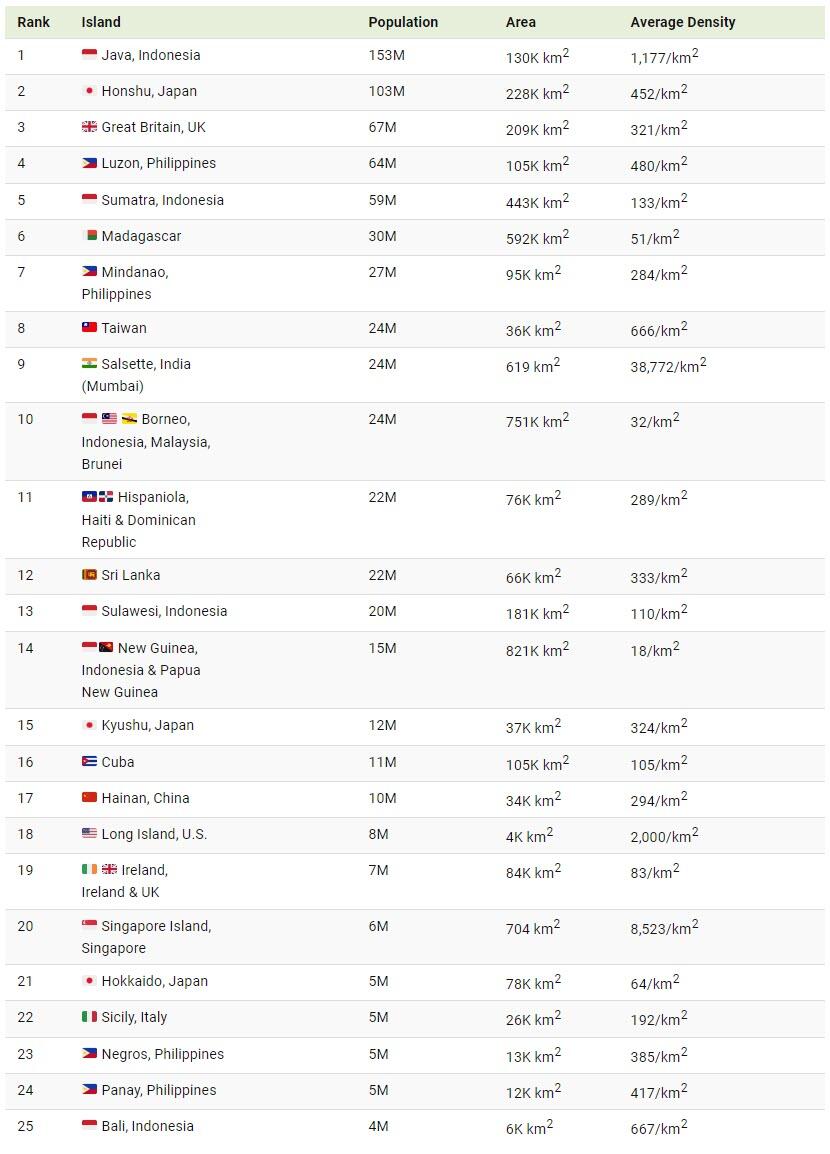
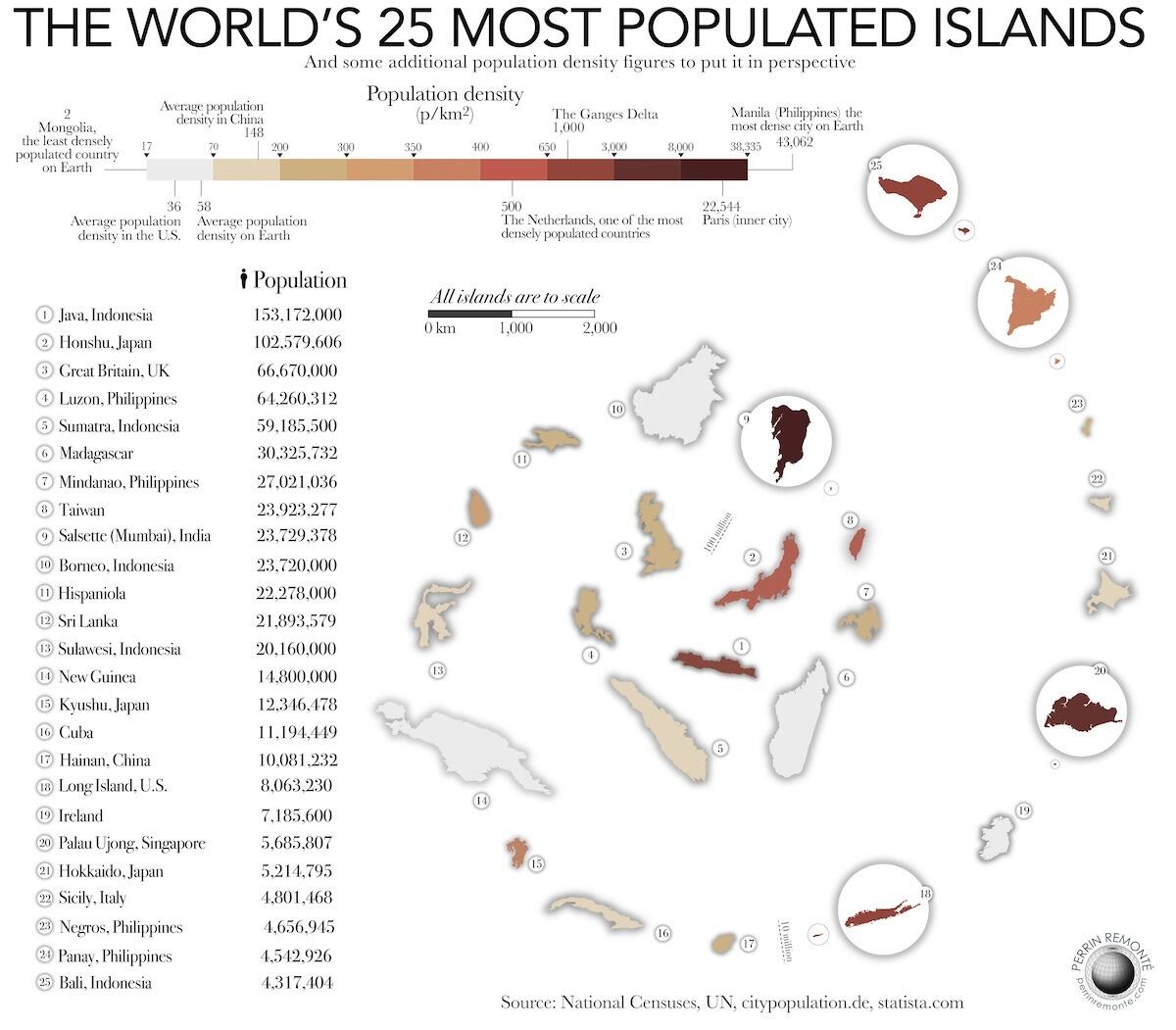
This chart, by creator Perrin Remonté, via Visual Capitalist, ranks the 25 most populated islands in the world, colored by their population density patterns, along with an overview of their size relative to each other.

Data for this graphic comes from a variety of sources listed at the end of this article.

Ranked: Top 25 Islands by Population

At the top of the list sits Java, Indonesia’s most populous island and the most populous island on Earth. Over 150 million residents inhabit the 130,000 km² landmass, resulting in a density of nearly 1,200 people/km².

Its capital, Jakarta—also the capital of Indonesia—is a vibrant metropolis teeming with skyscrapers, bustling streets, and a rich tapestry of traditions.

Even historically, the island has been the political and economic center of the region: the seat of empires and also the heart of the Indonesian independence movement.

Note: Numbers are rounded. Area source: Encyclopaedia Britannica. Population source: See bottom of the article.

Meanwhile, Japan’s Honshu Island ranks second, home to approximately 103 million people. Honshu is the largest and most populous island in Japan, housing iconic cities like Osaka, Kyoto, and Tokyo—the country’s capital, the world’s largest urban area, and one of the three biggest financial centers in Asia.

At third place, Great Britain, the largest of the British Isles, boasts of around 67 million residents, of which England alone accounts for 83% of the population.

Back in Southeast Asia, the island of Luzon, with 64 million people, is home to more than half of the Philippines’ total population.

Coming back to Indonesia, parts of Sumatra, population 59 million, are more along the lines of a postcard picture, from the lush rainforests of Bukit Lawang to the pristine shores of Lake Toba.

In total, Indonesia has six islands on this graphic, with tourist favorite Bali—consistently one of the most popular places to visit—coming in at the 25th spot.

Missing from this list is Australia, home to nearly 30 million people, which would make the top five on this list, were it not for the continent-island debate.

Most Densely Populated Islands

For Salsette Island (ranked 9th by population)—administratively known as Greater Mumbai —magnification is required as it appears as a dot on the scale for the other most populated islands in the world.

Consequently it’s one of the most densely populated islands in the world; at more than 30,000 people/km².

Singapore (ranked 20th), is similarly dense, though not quite at the scale as Mumbai: 8,500 people/km².

Other extremely populated and dense islands in the world include: Manhattan, Haizhu, Guangzhou, and Lagos Island, but none with the total population close to Singapore or Mumbai.

*  *  *

Population sources:

Creator Note: For Great Britain and the Indonesian islands, the population figures are reverse engineered from the total population of the country and the percentage share of each island, available on Statista.

Tyler Durden
Wed, 04/03/2024 – 19:20

via ZeroHedge News https://ift.tt/z9ZIaKi Tyler Durden

“Insane”: US Physicians Received Billions From Pharmaceutical And Medical Device Industry, New Research Finds

“Insane”: US Physicians Received Billions From Pharmaceutical And Medical Device Industry, New Research Finds

Authored by Megan Redshaw via The Epoch Times (emphasis ours),

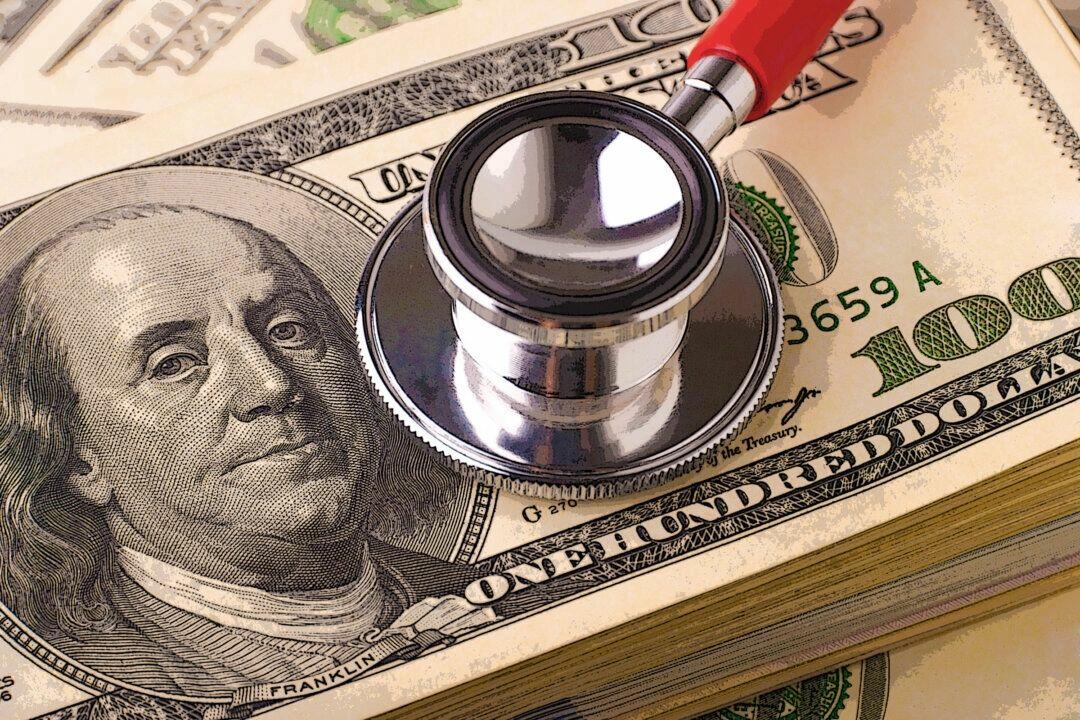
U.S. physicians received more than $12 billion in payments from the pharmaceutical and medical device industry over a 10-year period, according to a new analysis.

(ElenaR/Shutterstock)

A research letter published on March 28 in the Journal of the American Medical Association found that the industry made over 85 million payments to more than 820,300 (57 percent) of eligible physicians across 39 specialties from 2013 to 2022. Nearly 94 percent of the payments were related to one or more marketed medical products.

Researchers examined data in the Open Payments database to determine what payments were made across different specialties and the medical products associated with the largest total payments. Data only included payments received for consulting, nonconsulting (such as speaker or faculty fees), travel, food, entertainment, education, gifts, grants, charitable contributions, and honoraria.

The Open Payments database is a federal transparency program that was established in 2013 out of concern that financial relationships between physicians and the industry were unduly influencing healthcare decision-making and costs.

The analysis found that payments varied considerably between specialties and among physicians of the same specialty. For example, the mean amount paid to the top 0.1 percent of physicians ranged from $194,933 for hospitalists to $4.8 million for orthopedic surgeons, while the payments to the median physicians ranged from zero to $2,339.

Orthopedic physicians received the greatest sum of payments, $1.4 billion, followed by neurologists and psychiatrists, $1.3 billion, cardiologists, $1.3 billion, and hematologists/oncologists, $825.8 million. Nearly 55 percent of pediatricians and 63 percent of infectious disease physicians received payments from the industry, while physicians practicing preventative medicine received the least sum of payments.

From 2013–2022, pharma paid 12 billion dollars to U.S. physicians. That’s mind-boggling. Insane. That’s how silence is bought, the minds of physicians influenced, and ultimately patient care/prescribing patterns influenced,” Dr. Manni Mohyuddin, an oncologist, hematologist, and assistant professor at the Huntsman Cancer Institute, told The Epoch Times.

Dr. Mohyuddin emphasized that the average payment received was low, but some physicians received a significant amount of money and have influence over writing guidelines, chairing committees, clinical trials, influencing opinions, and more.

Top Drugs and Devices Associated With Payments

The top three drugs associated with the most payments were Xarelto ($176.3 million), Eliquis ($102.6 million), and Humira ($100.2 million).

Xarelto, jointly developed by Johnson & Johnson’s Janssen Pharmaceuticals and Bayer, is used to prevent and treat blood clots. Janssen also created the Johnson & Johnson COVID-19 vaccine, which caused rare and sometimes fatal blood clotting disorders.

Eliquis is a multibillion-dollar blood thinner manufactured by Bristol-Myers Squibb and Pfizer. The drug in 2023 was 12 percent of Pfizer’s total revenue—second only to its Comirnaty COVID-19 vaccine. Pfizer’s COVID-19 vaccine has also been linked to blood clotting disorders.

Humira is an immunosuppressive drug manufactured by AbbVie to treat arthritis, plaque psoriasis, ankylosing spondylitis, Crohn’s disease, and ulcerative colitis. Following the top three drugs are Type 2 diabetes medications Invokana, Jardiance, and Farxiga.

According to the analysis, the three medical devices associated with the most payments were daVinci Surgical System, $307.5 million, Mako SmartRobotics, $50.1 million, and CoreValve Evolut, $44.8 million.

‘Highly Targeted to Lucrative Procedures’

Our paper is a modest analysis. It does not explain the problem of financial conflicts of interest. But it is a lot of money. And it’s highly targeted to lucrative procedures,” co-author and cardiac electrophysiologist Dr. John Mandrola wrote in a post on Substack.

Dr. Mandrola believes that the strong influence of the industry can be seen in the approval of numerous medical devices by the U.S. Food and Drug Adminsitration despite “dodgy evidence.”

“Cardiology is a technical field. We use devices. Innovation requires some collaboration. Innovation has made cardiology better. But industry influence is way too strong,” he said. Dr. Mandrola believes the payments reported in their paper are not only for physician–industry collaborations, but are for marketing and goodwill, which helps establish practice patterns among physicians.

The industry is profit-driven, and if direct payments to doctors didn’t work, the industry wouldn’t spend billions doing it, he added.

Payments Can Create Conflicts of Interest

Dr. Andrew Foy, co-author and cardiologist, told The Epoch Times in an email the analysis shows a strong relationship between physicians and industry, but there are other indicators of this relationship as well. For example, it’s not uncommon for industry ads to be featured on homepages of major medical journals or for a medical conference or meeting to bombard physicians with industry advertising.

When I experience this at conferences, I feel like industry is not only welcome at these events but that the event is built around industry and its involvement,” Dr. Foy said. “There’s certainly no attempt to hide these relationships. The main reason being, at least in my opinion, is that many physicians, perhaps even the majority, believe the physician-industry collaboration is a net benefit to patients and society.”

Dr. Foy said he doesn’t necessarily share that view, but he doesn’t believe there is strong, objective evidence to support one side or the other as it relates to the overall benefits or harms of the relationship between physicians and industry.

“At this moment in time, the profession seems only interested in transparency. ‘As long as everyone is transparent, then everything is fine.’ As if someone cannot be transparent about their conflicts and highly biased at the same time,” he said.

Dr. Foy said he worries that conflicts of interest directly related to physician–industry payments may lead to overly enthusiastic recommendations or guidelines from medical organizations to use new products, even if they have not been sufficiently tested or where the evidence is not strong enough to recommend them over an old standard, or in some cases, nothing at all.

Additionally, Dr. Foy said a “major problem” with physician–industry payments is that they “have a way of tilting physicians sympathy toward industry” and the industry’s “medical advancements” which encourage physicians to more willingly adopt new products for the sake of  “industry advancement,” even if they don’t have a direct conflict of interest with that particular product.

In a way, they become cheerleaders for industry and more open to adopting new products simply due to this attachment,” Dr. Foy told The Epoch Times.

“I think what our paper does do is provide some numbers, which some may find shocking, and hopefully it renews interest in having conversations about physician-industry payments and conflicts of interest and perhaps facilitates more research,” he added.

Tyler Durden
Wed, 04/03/2024 – 19:00

via ZeroHedge News https://ift.tt/Wj0wnAy Tyler Durden

Pro-Palestine Group Attacks UK Defense Factory Producing F-35 Stealth Parts 

Pro-Palestine Group Attacks UK Defense Factory Producing F-35 Stealth Parts 

The sudden influx of unvetted migrants from around the world into Western nations poses a significant national security threat. Leftist-corporate media outlets are ignoring the mounting risks associated with unvetted migrants. However, citizen journalists on the ‘free speech’ social media platform X have outlined some of these dangers. 

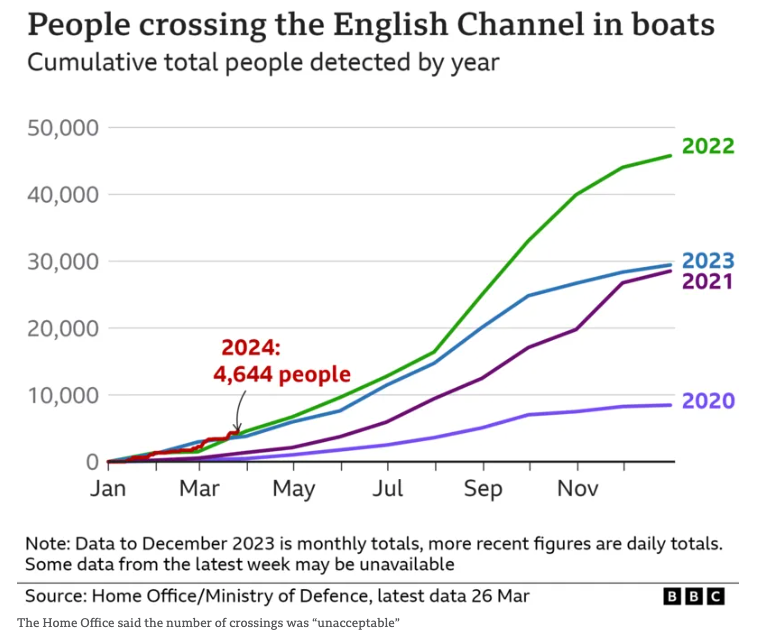
Let’s begin with the latest data from the UK that shows the number of migrants crossing the English Channel soared to a new record high for the first three months of the year, according to BBC News

The surge in migrants continues despite Prime Minister Rishi Sunak’s pledge to ‘stop’ the migrant boats – though the latest data shows the PM is not doing enough. 

Labour’s shadow immigration minister Stephen Kinnock said:

 “Despite all the evidence to the contrary, Rishi Sunak keeps on telling the British people that small boat arrivals are coming down and his promise to stop the boats remains on track.” 

Kinnock added:

 “It’s time to get a grip and restore order to the border.”

The latest evidence of national security risks emerging comes after a pro-Palestine group attacked the manufacturing facility of defense company Teledyne Technologies in the town of Baildon. 

X user “Palestine Action” said, “Actionists are reaching every corner of this weapons factory to bring it down for Palestine!”

The pro-Palestine group has called for attacks on at least one Western defense company. These firms are essential for providing technologies to enhance national security across the West. 

There is no word if the attackers were migrants/or citizens. At least one appeared foreign-looking… 

“The site produces components for missiles and F-35 fighter jets used by the Israeli military to commit genocide in Gaza,” the group said. 

Across the Atlantic, the Biden administration’s disastrous open southern borders have allowed ten million migrants from around the world into the country – many of whom are unvetted. There have already been reports of known terrorists caught by federal agencies and continued reports of at least one Iranian assassin hunting current and former senior US officials.  

The incident at the Teledyne factory won’t likely be the last attack on the West’s defense companies as the result of open southern borders allows the enemy to attack from deep within. 

The West is compromised – the chaos is only beginning.

Tyler Durden
Wed, 04/03/2024 – 18:40

via ZeroHedge News https://ift.tt/OleWFBN Tyler Durden

Judge Rejects Trump’s Request To Delay ‘Hush Money’ Case Based On Presidential Immunity

Judge Rejects Trump’s Request To Delay ‘Hush Money’ Case Based On Presidential Immunity

Authored by Catherine Yang via The Epoch Times,

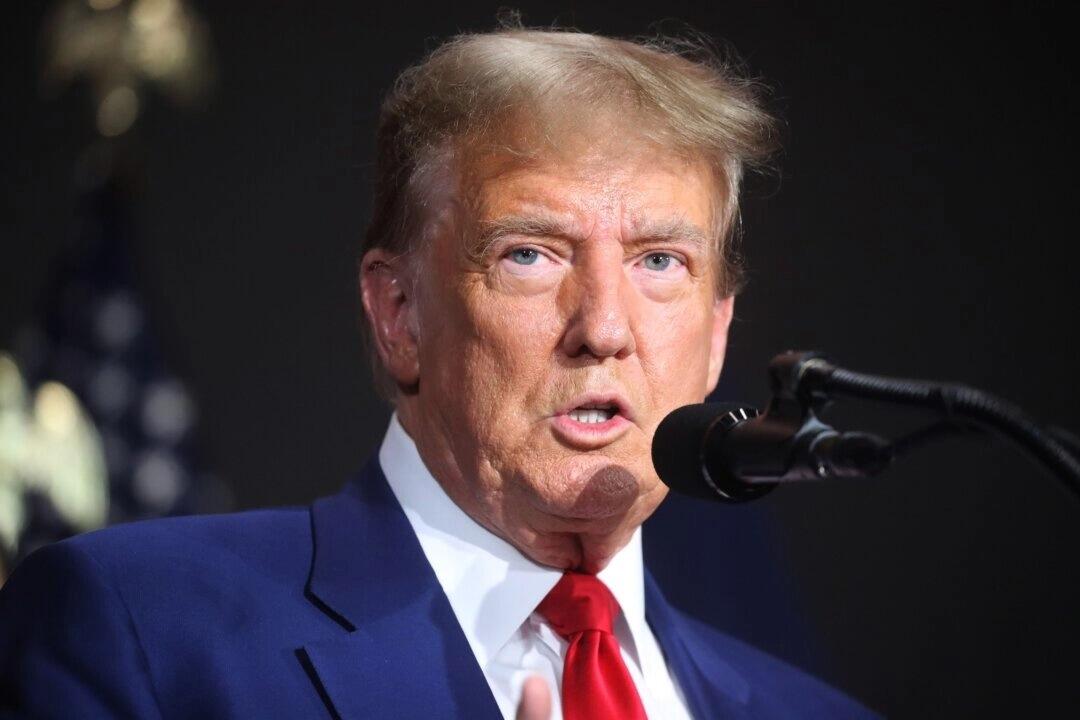
New York Supreme Court Justice Juan Merchan on April 3 denied former President Donald Trump’s latest request to delay his upcoming trial, based on a presidential immunity defense that will be heard by the U.S. Supreme Court 10 days after the Manhattan trial begins.

“Defendant’s motion is DENIED in its entirety as untimely,” the judge wrote.

“The Court declines to consider whether the doctrine of presidential immunity precludes the introduction of evidence of purported official presidential acts in a criminal proceeding.”

The defense also argued that the prosecution’s evidence related to President Trump’s official acts should be excluded based on presidential immunity, which the judge rejected.

In Manhattan, the district attorney is prosecuting President Trump on 34 counts of falsifying business records, alleging a payment scheme to kill unfavorable news stories to influence the 2016 elections.

Trial will begin with jury selection on April 15, and in recent weeks the defense has made several requests to delay the trial, citing among other things a late discovery production of more than 100,000 pages.

On March 25, the judge delayed trial until April 15 because of the late evidence produced, but has criticized the defense for “repeatedly” seeking delays in recent orders.

The defense has another motion to delay the trial still before the judge, this one arguing that the sheer publicity surrounding the case would prevent President Trump from being able to seat an impartial jury.

‘Timeliness’

The judge explained he decided against delaying the trial based on “timeliness,” describing the defense’s arguments as “excuses.”

“In reviewing the excuses proffered by the Defendant for the timing of his motion, this Court finds that they are inadequate and not convincing,” he wrote.

Justice Merchan found that the prosecutors had outlined the evidence they intended to show at trial in February, and wrote the defense should have raised the presidential immunity objections at that time, not with days to trial.

“The Defendant had ample notice that the People were in possession of, and intended to use, the various statements allegedly made by Defendant on social media, in public, and in various interviews,” the judge wrote. “He was also well aware that the defense of presidential immunity, even if unsuccessful, might be available to him.”

The judge noted that the defense had touched on presidential immunity last year in an attempt to move the case to federal court, yet did not argue it. He said the timing of the new motion “raises real questions about the sincerity and actual purpose of the motion.”

“The circumstances, viewed as a whole, test this Court’s credulity,” he wrote, finding that the defense had “myriad opportunities” to raise this defense earlier.

‘Pressure Campaign’

In arguing presidential immunity, the defense had also renewed arguments to exclude or otherwise counter evidence prosecutors intend to show regarding a “pressure campaign” they allege President Trump exerted over the star witness.

Michael Cohen, formerly a personal attorney to President Trump, had made public claims that he paid off an adult actress alleging an affair with President Trump in order to keep the story out of the news. He claimed President Trump falsified business records to pay him for these alleged bribes, and prosecutors argue that the claims and case were not brought until well after the alleged payments because of this “pressure campaign.”

The judge had rejected defense efforts to block Mr. Cohen from testifying, but the defense argued that they should be allowed to claim at trial that Mr. Cohen has never shied away from speaking about President Trump and would not have caved to the alleged “pressure.”

Presidential Immunity

Separately, special counsel Jack Smith is prosecuting President Trump on four counts of conspiracy and obstruction for his actions on Jan. 6, 2021, in the U.S. District Court for the District of Columbia.

Originally scheduled for a March trial, the case has ended up before the Supreme Court with an April 25 hearing on the defense of presidential immunity.

Last year, defense attorneys had filed a motion to dismiss the case based on presidential immunity. The motion was rejected by U.S. District Court Judge Tanya Chutkan in December, and the defense appealed the decision.

An appeals panel accepted and heard the appeal on an expedited schedule, and then issued the unusual decision that the court would not allow a stay in the event of a rehearing by the appeals court. It gave President Trump a six-day deadline to seek review from the Supreme Court.

President Trump applied for a stay from the Supreme Court, which the court dismissed, instead granting the special counsel’s request to treat the application as a request for review and scheduled an April hearing.

The arguments will be limited to applications of presidential immunity as it relates to official acts in criminal prosecutions.

Tyler Durden
Wed, 04/03/2024 – 18:20

via ZeroHedge News https://ift.tt/48gx6Nq Tyler Durden

Top US Egg Supplier “Temporarily Ceases” Operations At Texas Plant After Bird Flu Outbreak 

Top US Egg Supplier “Temporarily Ceases” Operations At Texas Plant After Bird Flu Outbreak 

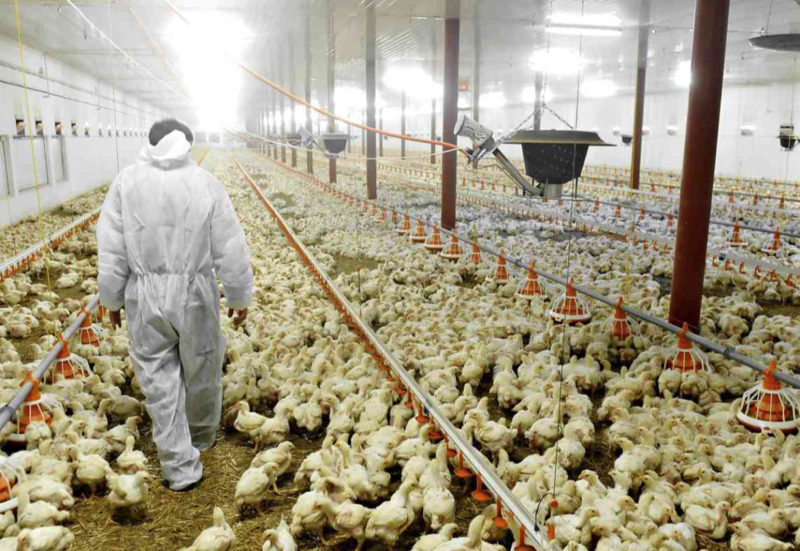
The largest egg producer in the US has temporarily halted production at one of its facilities after bird flu—also known as highly pathogenic avian influenza, or HPAI—was detected. 

Cal-Maine Foods, Inc. wrote in a press release that HPAI was detected at “one of the Company’s facilities located in Parmer County, Texas, resulting in depopulation of approximately 1.6 million laying hens and 337,000 pullets, or approximately 3.6% of the Company’s total flock.” 

“Production at the facility has temporarily ceased as the Company follows the protocols prescribed by the USDA. Cal-Maine Foods is working to secure production from other facilities to minimize disruption to its customers,” the company said. 

Bloomberg said this is the “biggest bird flu casualty” since early December when 2.6 million birds were culled at a commercial egg farm in Ohio after HPAI was found. Cal-Maine also had a Kansas farm cull 684,000 hens the same month.

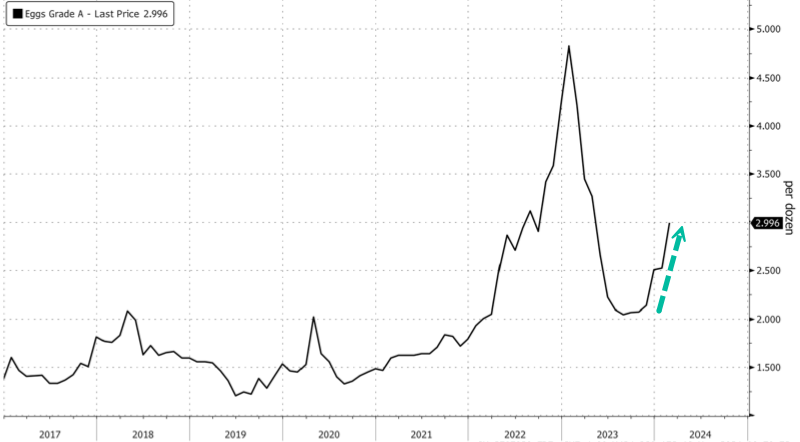
In a mid-March note, we pointed out that data from USDA showed that Grade A egg prices at the supermarket were soaring again. 

Unlink the previous HPAI outbreak in 2022. There are reports the virus is spreading in dairy cattle herds – and even infecting humans. This raises significant concerns about the potential impact on the food supply chain. 

Infected Texas dairy cattle are experiencing decreased lactation and low appetite, with older cows more likely to be severely impacted. Some herds have reported pneumonia and clinical mastitis — an inflammatory disease — the Texas Animal Health Commission said by email. Most animals seem to recover in as many as two weeks with supported care, albeit with reduced milk production levels.

Some cows may never see their milk production recover to pre-infection levels, in which case they might be culled, according to a HighGround Dairy report Monday. “The longer-term impact on supply is not entirely clear, as farmers are trying to maintain herd inventories in a time of tight cattle supplies,” it said. –Bloomberg

There have yet to be any reports that the virus has spread to beef herds, where the US cattle herd is at seven-decade lows, and supermarket prices are at record highs. 

Dave Kurzawski, an analyst at StoneX Group Inc., mentioned in a note to clients that discussions are happening about possible consumer demand risks for dairy products. He further said that significant risks are present, and the effect of the illness on consumer purchasing patterns remains uncertain. 

The US food supply chain faces yet another challenge, as mysterious fires have hit food processing plants in recent years. Additionally, billionaire activists in the WEF cult advocate for a ‘reset’ in the global food supply chain, moving from beef, dairy, and chicken towards plant-based and insect-based foods. 

Meanwhile, billionaires like Bill Gates have been quietly purchasing America’s farmland. 

Tyler Durden
Wed, 04/03/2024 – 18:00

via ZeroHedge News https://ift.tt/xGSwHe4 Tyler Durden

New Report Details Horrifying Cost Of Fauci’s Failures

New Report Details Horrifying Cost Of Fauci’s Failures

Authored by Ian Miller via The Brownstone Institute,

In the post-pandemic period of Covid, there’s now a concerted effort to comprehend and explain the damage that was caused by our capitulating to the hysterical overreaction and overreach of the ‘experts.’ There’s a long list of policy failures to examine; mask mandates were a disaster that accomplished absolute nothing of value, but instead led to tremendous harms, many of which continue today.

Children were forced into masks for years on end, millions of people still wear masks when traveling or inside stores and restaurants, permanently convinced of the deliberate falsehood that masks are effective prevention tools. Perhaps most disturbing is that healthcare workers in blue cities are often still required to mask. Some hospitals have required masking continuously since 2020, while others are now enforcing rolling mandates based on the delusions of administrators and expert authorities.

Research into the economic cost of many of our Covid policies and mandates is still ongoing, but a new, extremely detailed report on school closures has created a horrifying context for just how damaging Anthony Fauci’s advocacy was during the pandemic.

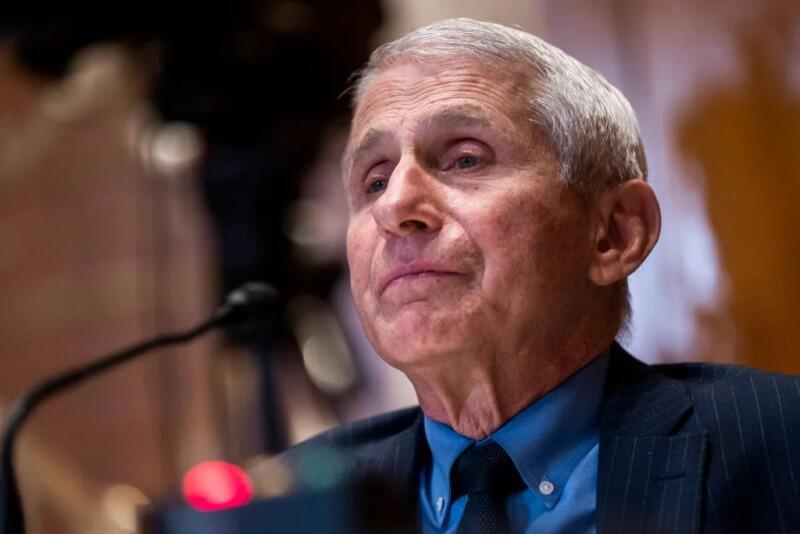
WASHINGTON, DC – MAY 17: Director of the National Institute of Allergy and Infectious Diseases Dr. Anthony Fauci testifies during the Senate Appropriations Subcommittee. (Photo by Shawn Thew-Pool/Getty Images)

All of Our Covid Policies Failed

The research begins with an obvious acknowledgment of the failures which occurred due to Covid mandates. Despite wildly different policies, there was virtually no difference in outcomes between countries.

“From the available evidence, it is difficult to identify the specific responses to the pandemic that led to better outcomes,” they write. “Countries clearly responded to the challenges in very different ways, from essentially no school closures (Sweden) to multiple years of closures (Uganda and Indonesia). Yet, simple statistics such as the length of school closures or overall health policies cannot explain much of the variance in outcomes.”

Lockdowns, mask mandates, vaccine passports…none of it mattered, nor does it explain the variance in outcomes between countries. Why? The obvious answer is that none of these policies had the slightest chance of preventing transmission of a highly infectious respiratory virus.

Instead, the likely explanation for variance in outcomes comes down to differences in accounting for Covid cases and deaths, underlying health and age demographics, or pre-existing immunity from exposure to similar coronaviruses, which was almost certainly the reason why countries in Asia performed much better than Western countries during the early part of the pandemic, but was conveniently ignored in favor of “experts” maintaining the wishful thinking that “mask culture” was responsible. 

Regardless of the explanation, the fact that there is no consistent factor to attribute better outcomes to is in itself an indictment of our Covid policies and mandates. If it’s impossible to define why a country did better or worse than another country, there should be no justification for continued restrictions. If only someone had told Fauci or his allies in the public health establishment in 2020-2021, but instead they forcefully criticized any opposition who understood the reality, such as Florida governor Ron DeSantis.

School Closures Caused Unimaginable Harms

The researchers spent most of their time attempting to assess the many harms caused by one of the pandemic’s most inexcusable policies: school closures. And the results of their estimates are jaw-dropping.

“Based on the available research on lifetime earnings associated with more skills, the average student in school during the pandemic will lose 5 to 6 percent of lifetime earnings,” they found. “Because a lower-skilled workforce leads to lower economic growth, the nation will lose some $31 trillion (in present value terms) during the twenty-first century. This aggregate economic loss is higher than the US GDP for one year and dwarfs the total economic losses from either the slowdown of the economy during the pandemic or from the 2008 recession.”

That’s not a misprint: $31 trillion. 

Teachers unions, Fauci, the CDC, and politicians have all ensured that the American economy will be decimated in the next century because they refused to admit they were wrong about all of it. As cost of living skyrockets thanks to rampant inflation, also caused by our incompetence and malicious, purposeful ignorance, children forced to learn under school closures will be irreparably set back, which will cost them hundreds of thousands if not millions of earned income throughout their lives.

It’s easy to suggest that maybe these harms may be erased or mitigated over time. The researchers addressed that too, yet they failed to provide much hope for the future.

“Finally, we provide a few observations about recovery from the learning losses. History suggests that these losses are likely to be permanent unless the schools become better than they were before the pandemic,” they conclude.

With wholly incompetent political activists like Randi Weingarten controlling schools, disgraceful DEI policies infiltrating every aspect of public education, the lack of acknowledgment from Fauci and other organizations that Covid mandates were a failure, and the complete ideological capture of the education system, it’s impossible to reasonably expect that schools will ever “become better than they were.”

The damage they caused is locked in – forever.

Once Again, Florida Provides the Alternative

Importantly, the results of school closures varied per region. In far-left states such as California, New York, New Jersey and Illinois, school closures persisted well into 2021. 

But Florida was one of the few states, and perhaps the only large one, to make reopening schools a priority, despite the objections of teachers unions and media outlets that attempted to label the governor as “DeathSantis.” 

And it’s going to pay off, relatively speaking. A figure presented in the research shows that Florida’s economic state loss in GDP is nearly equal to Pennsylvania, despite a population that’s nearly 75% bigger than Pennsylvania. And California’s estimated losses, roughly $1.3 trillion, are more than 116% higher than Florida, much larger than the population difference. Similarly, New York’s economic losses far exceed Florida’s, despite a smaller population.

DeSantis followed the actual science, listened to competent outside expert advisors, and as a result, when compared to other major states, Florida is set to massively benefit in the future. It is yet again another clear indictment of the blue states that chose to follow the Fauci blueprint into economic disaster.

And make no mistake, this is a disaster.

No Accountability for Failure

The researchers compared the learning loss train wreck to the 2008 recession, showing that the Covid response is responsible for substantially more damage than even that economic cycle. 

“The lopsided attention to the business-cycle losses from the 2008 recession and from the pandemic is startling once we see the comparable pandemic learning loss figures,” they wrote. “The economic losses from the loss of human capital are fully six times the total losses from the 2008 recession, which was labeled the largest recession since the Great Depression.”

This is staggering. Six times the total losses from the 2008 recession, already considered one of the worst in modern economic history. All because Fauci and his band of “experts” seized an opportunity to enforce their agenda of control onto a compliant society. And also because they refused to admit failure when many were desperately trying to expose them.

It’s an inexcusable, historic set of decisions with lasting consequences both in soft cultural terms and harder economic ones. A $31 trillion loss is the loss of GDP exclusively from school closures. That doesn’t even account for the loss of business income, the years-long setback in terms of new business, or the loss of GDP from adults who gave up on career plans or other pursuits out of despair or lack of opportunity.

The damage the “experts” caused is incalculable. But the attempts to calculate it has resulted in absolutely horrifying estimates. 

And not one of those responsible is willing to acknowledge it.

*  *  *

Republished from the author’s Substack

Tyler Durden
Wed, 04/03/2024 – 17:40

via ZeroHedge News https://ift.tt/47Yprn2 Tyler Durden

China’s Plunge Protection Team Bought $6.8 Billion In Stocks In The Second Half Of 2023

China’s Plunge Protection Team Bought $6.8 Billion In Stocks In The Second Half Of 2023

By John Liu and April Ma, Bloomberg Markets Live reporters and strategists

A new dataset is giving China investors a peek into stock purchases by state-backed funds, promising to offer some clarity on the role played by them in supporting the world’s second-largest equity market in times of panic.

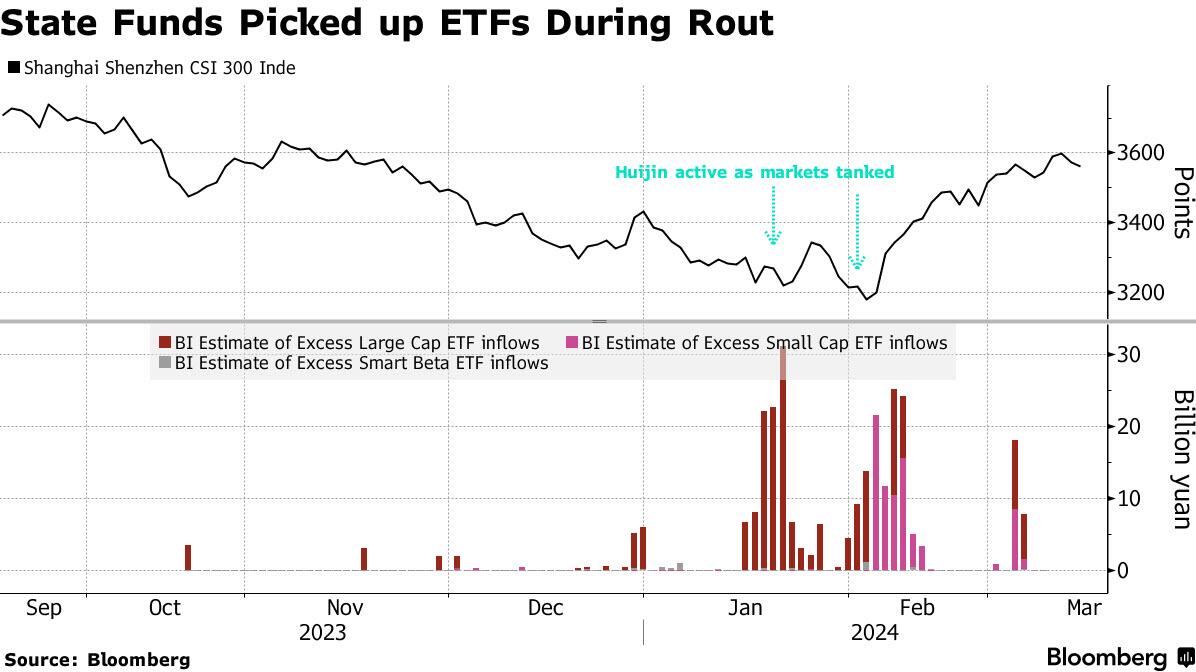
The so-called National Team bought at least 49 billion yuan ($6.8 billion) worth of onshore exchange-traded funds in the six months through Dec. 31, according to Bloomberg calculations based on the latest filings made available for the first time since state-backed funds announced the purchases last year. The amount exceeds an estimate of 28 billion yuan by Bloomberg Intelligence for such purchases.

While the data is available with a lag, it is seen giving investors a sense of Beijing’s resolve in aiding the market amid a selloff besides helping set future expectations. Analysts at Bloomberg Intelligence forecast China’s sovereign wealth funds and state insurance firms to buy about $100 billion in ETFs in 2024 after the CSI 300 Index, a benchmark of onshore equities, capped an unprecedented third straight annual loss last year.

Note: Data compiled from semi-annual and annual filings for 2023; semi annual data for China Southern Guoxin is an approximate based on listing filing

“The figure serves as a reference as to what they did to try and prop up stocks last year,” said Wu Xuan, fund manager at Borui Funds Management. It’s clear that the role of the national team is not to drive large rallies or systematically building stock positions, but to instead prevent steep plunges, he added. Hence, “plunge protection.”

Purchases by state institutions such as sovereign wealth fund Central Huijin Investment and Guoxin Investment, which were active in the early part of 2024, slowed in March as the market rebounded. The CSI 300 ended the month little changed after a 9.4% surge in February that was the biggest since November 2022.

The ETFs that saw the biggest state buying in the second half were the Huatai-Pinebridge CSI 300 ETF and China AMC SSE 50 ETF, at nearly 13 billion yuan each, based on their lowest closing price during the period. That took Huijin’s holdings in the pair to 17% and 36%, respectively.

Meanwhile, Guoxin, a unit of China Reform Holdings, also added at least 831 million yuan of the China Southern CSI Guoxin Central-SOEs Technology Lead ETF, while also appearing as the second largest top holder of the Bosera CSI Central-SOEs’ Innovation Driven ETF.

“While normally there shouldn’t be intervention in the market, we will not hesitate to act when the market is severely divorced from its fundamentals and there is volatility driven by irrationality,” China’s top securities regulator Wu Qing said last month.

Tyler Durden
Wed, 04/03/2024 – 17:20

via ZeroHedge News https://ift.tt/LOEcR1a Tyler Durden

“I Cannot Call Evacuation A Success”: New Details Emerge Of Afghanistan-Exit Chaos

“I Cannot Call Evacuation A Success”: New Details Emerge Of Afghanistan-Exit Chaos

Authored by Philip Wegmann via RealClear Wire,

New testimony from those who witnessed firsthand the confusion and chaos of the Afghanistan withdrawal further contradicts President Biden’s assertion that the hurried and violent end to the longest war in American history was an “extraordinary success.”

In a transcribed interview before the House Foreign Affairs Committee, former Foreign Service officer Samuel Aronson said the very opposite in living, harrowing color. “Let me be clear,” he told lawmakers behind closed doors, “I cannot call this evacuation a success.”

The questions and answers from Aronson, who received a State Department commendation for his heroism during the evacuation, as well as Ambassador Ross Wilson, the last U.S. diplomat to leave Afghanistan, were obtained by RealClearPolitics and have not been published previously.

Aronson recounted how American citizens, including children, were beaten by the Taliban, how U.S. passports were burned in a moment of panic when it seemed that Hamid Karzai International Airport in Kabul was about to be overrun, and how he delivered “a horrible choice” to a young Afghan mother.

Get on the airplane and never see your husband again or exit the airport and lose your only chance at freedom,” Aronson told her, recalling for lawmakers the bleak exchange that summarized the mismanagement, and at times bureaucratic incompetence, of an evacuation that Biden himself had vowed would not be “at all comparable” to how the U.S. left Vietnam.

There’s going to be no circumstance where you see people being lifted off the roof of an embassy,” Biden told reporters in July 2021 as American forces began their withdrawal. The president insisted that after two decades of U.S. support, the Afghan army was well-equipped, well-trained, and capable of prosecuting their own war. They were not.

Kabul fell to the Taliban on Aug. 15, the day the U.S. Embassy was evacuated. Emergency operations subsequently shifted to HKIA. What some call chaos followed.

Aronson recalled hotwiring buses to ferry the massive crush of humanity that descended on the airport and the sometimes impossible task of determining who should and should not be allowed inside the gates. He rejected the characterization later offered by State that the Taliban, whom the U.S. relied on at times to facilitate the departure of American citizens, was “businesslike and professional.”

The transcripts come nearly one year after the White House released a short summary of the “hotwash” review of U.S. Afghanistan policy. The administration took little responsibility for its actions, arguing instead in that document that Biden was “severely constrained” by decisions made by President Trump, specifically the U.S.-Taliban Doha agreement.  

“For all this talk of chaos, I just didn’t see it, not from my perch,” National Security Council spokesman John Kirby said as he argued back and forth with reporters when that document was released. Kirby served as Pentagon spokesman during the withdrawal and noted that flights left the airport “every 48 minutes” during the evacuation. “So I’m sorry,” he concluded, “I just won’t buy the whole argument of chaos.”

Managing the situation on the ground fell to Wilson, acting ambassador to Afghanistan. He testified that planning for a noncombatant evacuation operation (also known as an “NEO”) began in the spring of that year, and that Secretary of State Antony Blinken ordered the evacuation at his recommendation after the Taliban entered Kabul.

Wilson told lawmakers, however, that he was not directly involved in planning the operation. He also appeared unaware more than two years later that, per Department of Defense policy, he bore ultimate responsibility for the evacuation. “I believe that it was the responsibility of the chief of mission to call for an evacuation,” he testified, adding later that the operation itself would be carried out by “combatant command personnel who were not going to take orders from me.”

The generals in charge during the withdrawal have subsequently slammed the State Department for not ordering an evacuation sooner. “It is my assessment that that decision came too late,” retired Gen. Mark Milley, former Joint Chiefs chairman, said in committee earlier this month. Retired Gen. Kenneth F. McKenzie, former commander of U.S. Central Command, added that the subsequent disorder was “the direct result of delaying the initiation of the NEO for several months” until the Taliban were overrunning the country.

After the last U.S. flight left Kabul, Biden defiantly rejected any suggestion that an earlier evacuation order could have prevented more loss of life or allowed for “a more orderly” departure. Even if his administration evacuated just a month or two earlier, the president argued, “there still would have been a rush to the airport” and “a breakdown in confidence.”

There was just no easy way to end the decades-long land war, the president said, especially after the Afghan army unexpectedly folded and after his predecessor reached an agreement to pull out by May of that year. “The bottom line,” he insisted, “is there is no evacuation from the end of a war that you can run without the kinds of complexities, challenges and threats we faced. None.”

From what he saw sorting through a sea of humanity at the airport gates, Aronson testified that “it is clear to me that we should’ve started this evacuation and withdrawal sooner.” Because of the delay, he told lawmakers, those on the ground “had to really put our lives and our careers on the line, which we did.” Extending the timeline, a delay that almost certainly would have invited Taliban reprisals, would have allowed for more Afghans to escape, he added. The diplomat told lawmakers it “would have been tremendously helpful to have even five more minutes.”

His mission in Afghanistan began when a C-17 cargo plane carrying him and other officials, made a combat landing at HKAI to avoid potential groundfire. Though away on leave, Aronson had volunteered. There was no official call for help. He testified instead that he had navigated an ad-hoc, “word of mouth” network to find a way to aid in the evacuation, an effort made harder by COVID protocols and “significant resistance” from State’s Bureau of Human Resources. He did not receive any briefings or guidance before arriving in Kabul. The only preparation Aronson told lawmakers he received, “if you’d even call it that,” was during a layover in Doha, Qatar. A security officer fitted him with body armor.

While Wilson remained chief of mission, it was John Bass, who had served as U.S. ambassador to Afghanistan, who assumed responsibility for the work of day-to-day evacuations. Aronson would both be detailed to Bass as head of evacuations and do consular work screening thousands of Afghans desperate for a flight out of the country. From his limited interactions with the head of mission, he told lawmakers that Wilson “seemed overwhelmed” and that his physical health “did not seem great.”

Regardless of leadership, the system thrown into place lacked the precision that would have accompanied any kind of pre-planning, Aronson testified.

There was a lack of proper procedure. In the final days of the withdrawal, for instance, State rushed to notify Afghan allies who had worked with coalition forces that they had been approved for Special Application Visas (SIV) to resettle in the U.S. They sent the notice by email and directed SIV holders to present the document at the Kabul airport for entrance.

But the document that State forwarded had no name, serial number, or other identifying information, Aronson said. Afghans desperate to leave made thousands of copies of the notice, making it impossible to determine who had a legitimate visa and who had a forgery.

The emailed notice that had been “the sole mechanism” for confirming that an Afghan had SIV status and would therefore be allowed into the airport, he said, “became the least reliable mechanism to confirm somebody had an approved SIV.” Adding to the confusion, he told lawmakers the evacuation priority list changed “almost daily,” and that this information was seldom relayed in a timely fashion to the Marines guarding the airport gates.

There was also a lack of competent and appropriate personnel. Aronson testified that some overseas embassies tapped with reassigning staff to aid in the evacuation “may have sent their worst.” One consular officer, he recalled, weighed well over 300 pounds and was not “the right choice for such harsh, physical conditions.” Another civil service officer who he described as an otherwise “fantastically nice, competent, intelligent individual” was similarly ill-suited: The officer was deaf, a significant detriment in a combat environment.

The White House has long insisted that no amount of planning on paper, even with the proper personnel and procedures, could have accounted for the no-win scenario they inherited. Wilson backed up that sentiment, testifying that the Doha agreement, which Trump negotiated with the Taliban, and which set the initial timeline for the withdrawal, ensured that the Afghan government “lost leverage at almost every step along the way.”

There was still hope though, the ambassador told lawmakers, that the Afghan army could hold out, an optimism bolstered by faulty intelligence assessments.

The ambassador testified that, while there was no resistance within State to preparing for an evacuation in the spring and early summer, he wanted those preparations to remain classified to avoid the perception that the U.S. was “rushing for the exits.” A leak that the U.S. was planning an evacuation, he feared, could harm Afghan morale and possibly incite terror attacks amidst an ongoing civil war. “I didn’t want to set off a stampede that put at risk something that I think is intrinsically valuable, which is to have a U.S. mission,” Wilson told lawmakers.

But mayhem and stampedes followed anyway after the U.S. military footprint diminished from about 2,500 troops at the beginning of the Biden administration to about 650 troops on the eve of the evacuation. At the Kabul airport, State Department officials and 3,000 Marines later deployed to aid in the operation sorted through hundreds of thousands of Afghans, trying to determine who had a legitimate case for a ticket out of Afghanistan and who did not. In the process, some American citizens did not escape.

A “candid” retired Gen. Milley testified to that fact earlier this month, telling Congress, “I don’t know the exact number of Americans that were left behind because the starting number was never clear.”

As the evacuation was ongoing, Wilson was pressed during a CBS News interview about why more American citizens and Afghan allies hadn’t been evacuated before the fall of Kabul. He noted the series of serious warnings delivered by State to leave, saying that “never in my 40 years of working, since I began working at the State Department have I seen such strong language used.” Then the ambassador added, “People chose not to leave. That’s their business. That’s their right.”

Wilson told lawmakers he regrets “everything about that interview.” He confirmed reports that, in the confusion, the Taliban, “illiterate fighters who were now put in the role of access control,” turned away American passport holders.
Tyler Durden
Wed, 04/03/2024 – 17:00

via ZeroHedge News https://ift.tt/YGWqndV Tyler Durden

Jeff Bezos Buys His Third Mansion On Florida’s Exclusive ‘Billionaire’ Bunker Island

Jeff Bezos Buys His Third Mansion On Florida’s Exclusive ‘Billionaire’ Bunker Island

Amazon founder Jeff Bezos just bought this third massive home on Florida’s exclusive Bunker Island, according to a new report from The Daily Mail.

Florida’s Bunker Island, officially known as Indian Creek Island, stands as one of the most exclusive and affluent communities in the United States. Often referred to as the ‘Billionaire Bunker,’ it is a haven for celebrities, business moguls, and the ultra-wealthy, prized for its exceptional privacy and security.

The island is accessible only via a guarded bridge, with its own private police force ensuring round-the-clock surveillance by land, sea, and air. Residents of this enclave enjoy access to an exclusive country club, a private 18-hole golf course, and the serene backdrop of Biscayne Bay, making it a coveted address among the world’s elite.

Jeff Bezos has made a significant addition to his real estate holdings by purchasing a third mansion there for $90 million.

The purchase increases his total investment in the area to $237 million. Bezos, ranked as the world’s third-richest billionaire by Forbes, has been expanding his property portfolio, which now includes this six-bedroom home situated in the exclusive isle near Miami.

This follows his purchase of two other mansions on the island last year for a combined nearly $150 million.

The Daily Mail reported that the new mansion, spanning 12,135 square feet, neighbors homes owned by notable figures like Jeff Soffer and NFL icon Tom Brady.

Bezos, who recently got engaged to Lauren Sanchez, plans to reside in the newly purchased home while demolishing the previous two. Bezos’ expansive real estate portfolio extends beyond Florida to include properties in New York, Washington D.C., Beverly Hills, West Texas, and a private estate in Hawaii, underscoring the billionaire’s lavish lifestyle and investment in luxury properties.

Recall we wrote late last year that Bezos had, however, given up on left-wing Seattle and was moving toward more red-friendly locales. 

Bezos wrote at the time: “Seattle has been my home since 1994 when I started Amazon out of my garage. That’s my dad behind the camera in this video, touring Amazon’s first “office.” My parents have always been my biggest supporters. They recently moved back to Miami, the place we lived when I was younger (Miami Palmetto High class of ’82 — GO Panthers!) I want to be close to my parents, and Lauren and I love Miami. Also, Blue Origin’s operations are increasingly shifting to Cape Canaveral. For all that, I’m planning to return to Miami, leaving the Pacific Northwest.

I’ve lived in Seattle longer than I’ve lived anywhere else and have so many amazing memories here. As exciting as the move is, it’s an emotional decision for me. Seattle, you will always have a piece of my heart.”

As we noted last year, Bezos stated in the post he wants to be closer to his parents and Blue Origin’s new operations at Cape Canaveral, but we suspect what spurred his exodus from the progressive state, like other wealthy folks, is the move from a high-tax state to a low-tax state. Florida does not impose a state income tax, estate tax, or inheritance tax.

In contrast, Washington state has a 7pc tax on capital gains, introduced in 2022, and officials have proposed a 1pc wealth tax on residents with over $250m in assets (which would mean Bezos paying $1.6 billion a year just to live there).

Tyler Durden
Wed, 04/03/2024 – 16:40

via ZeroHedge News https://ift.tt/L9gkoZv Tyler Durden