New York’s Election Year Anti-Crime Strategy Too-Little, Too-Late, Critics Say

New York’s Election Year Anti-Crime Strategy Too-Little, Too-Late, Critics Say

Authored by Michael Washburn via The Epoch Times,

Facing a critical election year and constant evidence of the progressive rollback of tough-on-crime policies, New York Gov. Kathy Hochul and other Democrat leaders are scrambling to counter the narrative that theirs is the party of lawlessness and disorder, some experts say.
In doing so, whether they wanted to or not, these politicians and officials have taken steps toward a more traditional approach to law enforcement.

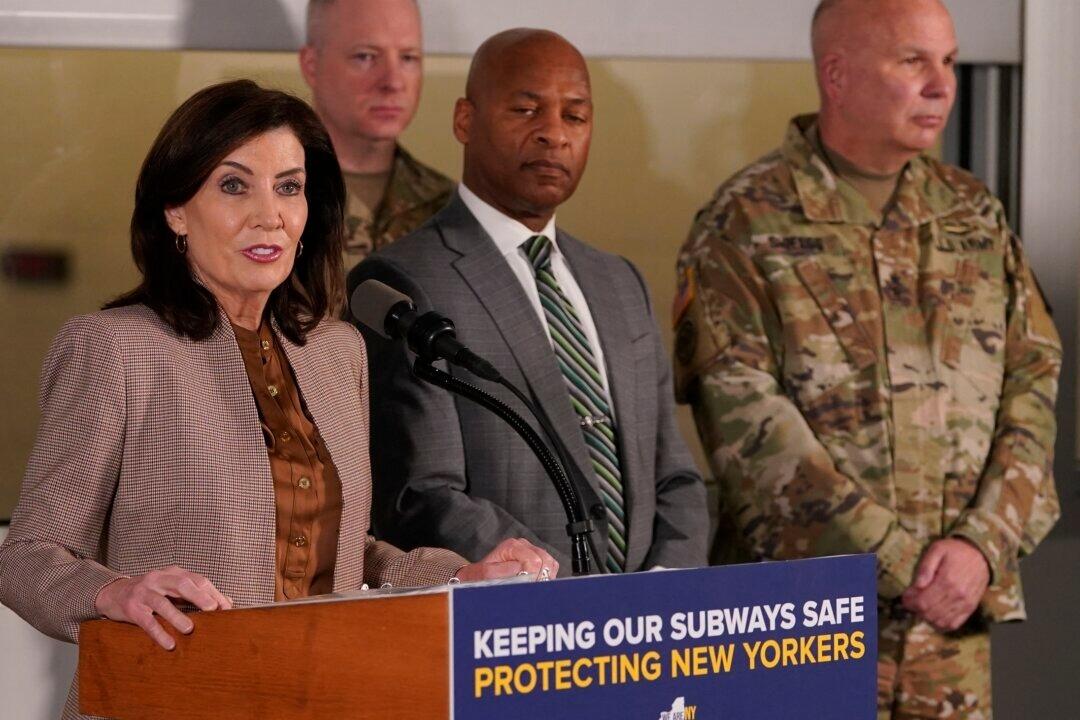
Ms. Hochul’s abrupt deployment of 700 National Guard troops—along with additional New York State Police and Metropolitan Transit Authority (MTA) officers in the subways of the nation’s largest city—is one such example, in the view of Heather Mac Donald, a fellow at the Manhattan Institute think tank.

“Gov. Hochul is belatedly reacting to the crime and disorder that have plagued New York City since the George Floyd race riots,” Ms. Mac Donald told The Epoch Times.

“Why is she reacting now? Because the November elections loom and Democrats, from the president on down, are vulnerable to the charge that they have enabled a breakdown of law and order.”

Though the beefed-up security presence may have a short-term psychological impact on some commuters and residents, experts say it is unlikely to prove effective in an environment altered since the 2020 riots and defined by bail reform, heightened sensitivity to potential litigation, and the general demoralization of the law enforcement community.

Ms. Mac Donald cited figures that give a sense of the scope of the crisis that New York faces: Homicides rose 23 percent from 2019 to 2023, and shootings went up 27 percent during the same period. Petty larceny climbed 24 percent.

All told, major felonies have increased 33 percent during this period.

In New York, the Bail Elimination Act of 2019 was enacted at the beginning of 2020. The act ended the use of monetary bail and “unnecessary pre-trial incarceration,” all to promote “equity and fairness in the criminal justice system.”

Harvey Kushner, chair of the criminal justice department at Long Island University in Brookville, New York, largely blames the increase in crime on the above-mentioned bail reform law.

“If you take a look at who commits the crime in New York and on the subways, it’s the very same people, and they’re soon released,” Mr. Kushner said.

“A lot of it is a core group of 200 to 300 individuals. These people get arrested, and then they’re let out on the street immediately,”

“So let’s call this what it is.”

On Feb. 13, a woman, later identified in media reports as Amira Hunter, walked up behind a musician playing a cello in the Herald Square subway station and, seemingly without provocation, allegedly bashed him in the back of the head with a metal water bottle.

A video captured the incident.

It shocked and outraged citizens when the same attacker, released without bail despite the violent offense, allegedly stole clothing from a Nordstrom store just days later.

Many Gothamites still do not feel safe and some are taking matters into their own hands.

On March 14, a 36-year-old man on the train assaulted a 32-year-old stranger, who then wrested away the attacker’s gun and shot him with it. A video of the incident, a microcosm of the crisis in the Big Apple, went viral.

Then, on March 25, yet another incident made headlines.

A suspect identified as 34-year-old Guy Rivera, who was out on the street despite having a record with 21 prior arrests and five years in prison, shot and killed a young NYPD detective and father, Jonathan Diller, during a traffic stop in Queens.

At a wake for Officer Diller, a family member enraged at bail reform and the governor’s perceived lenience on the issue of public safety, confronted Gov. Hochul and said: “You have blood on your hands.”

Constant attacks on the integrity and fairness of policing have emboldened lawbreakers and made many people averse to even thinking about a career in law enforcement, Ms. Mac Donald and others have told The Epoch Times.

Recent weeks and months have seen images of mob attacks by illegal immigrants on hapless visitors in Times Square and of teens rioting in Chicago in the weeks immediately following the election of left-leaning mayor Brandon Johnson in the city’s April 2023 runoff election.

A group of illegal immigrants attacks two New York Police Department officers outside a migrant shelter near Times Square in New York on Jan. 27, 2024, in a still from video. (New York Police Department)

Other Democrat-led cities such as San Francisco, Los Angeles, and Washington, have also struggled with growing homelessness and crime.

With the November 2024 election on the horizon, Democrat leaders are eager to obfuscate or hide their role in allowing crime to spiral out of hand, lest their party pay a crippling price at the polls, Ms. Mac Donald and others say.

In New York City, the result is a public show of force with few parallels in recent urban history.

Hochul’s Order

While more than a few New Yorkers have been in dangerous situations before, incidents in the subways and on the streets of their city have captured headlines with regularity.

By the middle of February, violent and seemingly unprovoked attacks in public places began to happen in quick succession, leaving the city reeling. On Feb. 12, a gang shooting at a Bronx subway station left a 35-year-old bystander dead.
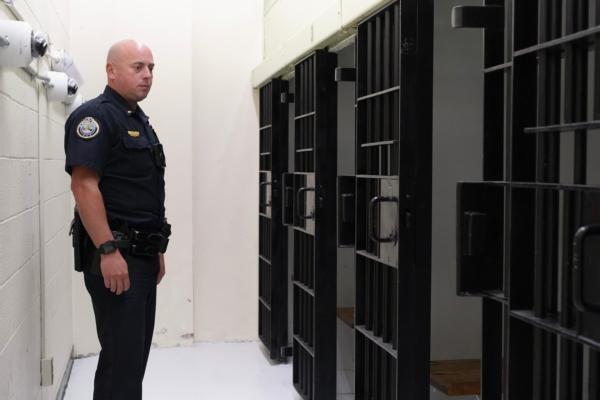
Lieutenant Jeffry Thoelen showcased jails at the Middletown Police Department to The Epoch Times on Sept. 9, 2022. He said cells were largely empty following the state bail reform. (Cara Ding/The Epoch Times)

The fact that New York’s controversial bail reform, which took effect Jan. 1, 2020, enabled a violent suspect to continue her crime spree strikes Mac Donald and others as a perfect example of what is wrong with the current system.

On Feb. 14, a homeless man physically assaulted an MTA worker who tried to wake him up on a subway platform and then attacked a bystander who intervened.

In another incident, a 16-year-old boy was left with a knife wound to the upper thigh in a Coney Island subway station.

Then, on the morning of Feb. 15, a young tourist from Brazil became a victim of random, unprovoked violence when a stranger slashed him in the neck in the Queens Plaza station.

On Feb. 17, an attacker repeatedly struck a stranger in the head with a metal pipe in a Queens subway station, placing the victim in the hospital with multiple cuts.

These incidents, and others, were the backdrop to Ms. Hochul’s March 6 announcement of a “five-point plan” to protect subway riders. Aside from the beefed-up police and National Guard presence at subways.

Ms. Hochul’s plan also calls for expanded surveillance and tighter coordination among law enforcement agencies.

Among the provisions of the plan are added personnel to conduct bag checks at crowded areas; a bill that will enable judges to ban people convicted of assaulting transit workers and riders from further use of public transportation in the city; stepped-up coordination among district attorneys, transit personnel, and police; the installation of cameras to monitor conductor cabins; and a $20 million investment in teams for intervention in cases involving mentally ill individuals.

Some observers have praised the governor’s move as a show of force wholly appropriate in a tense and fearful environment.

“As seen a few days ago [in the March 14 rush-hour incident], specific subway stations during congested times make all commuters and transit workers vulnerable to danger, criminal or not. Increased traffic demands increased awareness and teamwork,” David Carlucci, a former New York State senator and a commentator on the state’s political scene, told The Epoch Times.

“This is an all-hands-on deck scenario, and Gov. Kathy Hochul is using the tools and people at her disposal to ensure the safety of all. We cannot count on the great MTA staff to handle increasing traffic and incidents of violent crime.”

Mr. Carlucci acknowledged concerns about the militarization of the MTA as valid, but said the plan also includes mental health teams working alongside the National Guard.

“The National Guard often patrols major stations during social unrest and high traffic. No issues have arisen as a result of their presence,” Mr. Carlucci said.
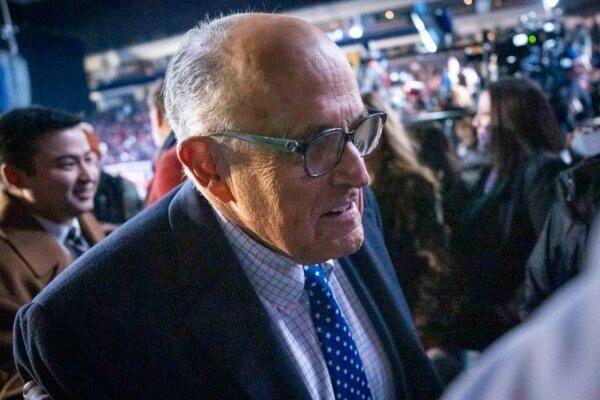
Rudy Giuliani attends Republican presidential candidate and former President Donald J. Trump’s rally in Manchester, N.H., on Jan. 20, 2024. (Madalina Vasiliu/The Epoch Times)

‘Broken Windows’ Approach

The governor’s move marks a partial return to the strategy long associated with someone many progressives now despise: former New York City Mayor Rudy Giuliani, who served from 1994 to 2001.

During those years, New York City began to make a tentative comeback from the skyrocketing crime and rampant disorder of the administration of Democrat Mayor David Dinkins, whose tenure ran from 1990 through 1993.

One of the most traumatic events in modern urban history, the Crown Heights riot of August 1991, happened on Mr. Dinkins’s watch, as did the peak of the city’s homicide rate.

In the first year of his tenure, 1990, the city saw 2,245 killings.

One year into his tenure, Mr. Dinkins had failed to make good on his promises to get crime under control.

Between 2,180 and 2,224 murders occurred in New York City in 1991.

Mr Giuliani, and his police commissioner, William Bratton, sought to reverse the trend through the policy known as “broken windows.”

The theory was that acting vigilant toward minor offenses would lead to the snaring of criminals with outstanding warrants, who had committed or would soon commit more serious crimes.

The strategy met with marked success, with fewer than 700 murders recorded in each of Mr. Giuliani’s final two years in office and serious crime down significantly in all categories.

John DeCarlo, director of the master’s program in criminal justice at the University of New Haven, the theory that researcher George Kelling developed back in the 1980s was a sound one.

“Look back to 1994, when Bratton used the theory called ‘broken windows’ to address crime in the subway, on George Kelling’s theory that serious criminal offenders were committing minor crimes in the subways.

“That seems to have held true. They had buses outside the major subway stations and they would grab fare-jumpers, take them away, and many of them had pending warrants, so they would remove them from the system,” Mr. DeCarlo told The Epoch Times.

But progressive reforms worked directly against the aggressive stance that Mr. Giuliani, and to a lesser extent, his successor Michael Bloomberg, had followed.

A federal court ruling on Aug. 12, 2013, found that the policy of “stop-and-frisk” violated the constitutional rights of New Yorkers and disproportionately affected members of racial minorities.

Safety or Waste of Money?

Some observers believe that a strategy best described as police saturation will bear fruit, for the simple logistical reason that criminals will shy away from committing illegal acts when getting caught is a near certainty.

“You can put in surveillance, and try to have a well-maintained environment. But the biggest deterrent to crime are people, whether police or the National Guard or state cops.

“The 700-odd National Guardsmen will vet those coming into the system, doing the equivalent of watching for turnstile jumpers, as the police did in 1994,” Mr. DeCarlo said.

“It worked in 1994, and the technology that criminals are using now in the subways hasn’t advanced.”

Other experts are less sanguine about Ms. Hochul’s approach.

The crackdown is too little, too late, they say, and the political factors underpinning it are blatant.

Jeffrey Fagan, a criminologist who teaches at Columbia Law School, said the governor’s approach is not only arbitrary but will reignite many of the controversies that have dogged law enforcement in the recent past.

“Subway crime is like a needle in a haystack,” Mr. Fagan told The Epoch Times. He also provided research that formed part of the basis for the federal ruling prohibiting stop-and-frisk in 2013.

“Because of the demographics of the subway-riding population in the neighborhoods that the subways go through, the specter of enormous racial disparities looms.”

Mr. Fagan said Ms. Hochul’s five-point plan is a serious misallocation of resources that won’t improve public safety in any meaningful, long-term way.

“It’s taking both the National Guard and the state troopers away from otherwise valuable duties and putting them on a search for, essentially, people in a mental health crisis,” Mr. Fagan said.

“If you ask the NYPD, this is all about fare evasion, but that’s nonsense. Quite honestly, I can’t believe anybody is taking this seriously, and the theatrics will do little for public safety and a lot of damage to the state budget.”

Undermining Law Enforcement

The bail reform law and the demonization of police departments have so undermined policing and faith in law enforcement that people are fleeing the profession, and officers on the street are barely able to do their jobs, said Mr. Kushner.

He views Ms. Hochul’s five-point plan as a political maneuver that doesn’t make sense even from the point of view of commuters’ day-to-day safety. The plan’s architects misunderstand or deliberately ignore the nature of the problem.

Mr. Kushner blames bail reform and the Democrat administration’s failure to control the southern border, and says that his many sources in the law enforcement community affirm this view.

“Interviewing law enforcement, they’re telling me that they can’t do their job, they’re being controlled, they’re being manipulated, and this goes back to the war on cops that started with the George Floyd incident,” Mr. Kushner said.
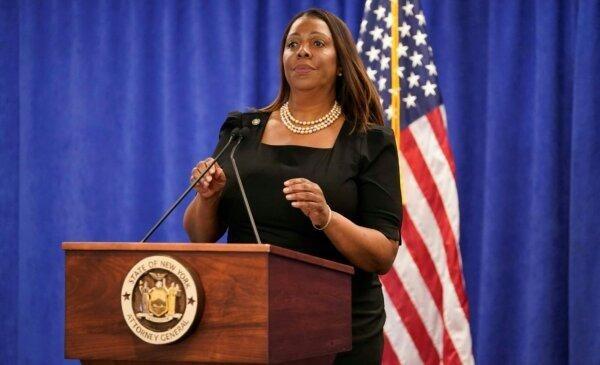
New York Attorney General Letitia James during a press conference at the Office of the Attorney General in New York on Feb. 16, 2024. (Timothy A. Clary/AFP via Getty Images)

“The other aspect is George Soros and the hiring of district attorneys. Take a look at New York Attorney General Letitia James and what she’s done to law enforcement in New York.”

Mr. Kushner said that the phenomenon of Soros-funded groups spending millions to support the campaigns of progressive district attorneys is evident in cities across the country.

As a further example, he pointed to Larry Krasner, who successfully ran for attorney general in Philadelphia in 2017 on a platform that supported the end of cash bail and lighter penalties for various crimes.

Mr. Krasner has sued the city’s police department and was himself the target of an unsuccessful impeachment campaign by the Pennsylvania House of Representatives in 2022.

The efforts of Ms. James, Mr. Krasner, and other critics of law enforcement have bred an environment where police officers cannot do their jobs and, with the deck stacked against them, have shrunken their ranks.

By way of example, Mr. Kushner noted that an exam for prospective police officers in Nassau and Suffolk Counties on his native Long Island, New York, used to draw tens of thousands of applicants.

“Now, if we get a few thousand, it’s a lot. We still see candidates, but do they want to go into traditional areas such as corrections and law enforcement? No, they’re going into different fields, such as law. There is no interest in protecting the public,” Mr. Kushner said.

Mr. Kushner said he has received inquiries from police departments in places as far-flung as Texas, Vermont, and Washington, soliciting his help in recruitment efforts amid a candidate shortfall.

He recalled a recent occasion when the U.S. Secret Service came out to Long Island as part of a recruitment effort, offering a one-day seminar, and had to cancel the evening part of the event because only five people showed up.

Ms. Mac Donald concurs with Mr. Kushner about the effects of anti-police sentiment on recruitment and morale.

She cited a Minneapolis Star Tribune report finding that people have left the city’s police department at record levels over the past three years and the number of uniformed personnel hit its lowest level in four decades in August 2023.

Ms. Mac Donald also pointed to a Police Executive Research Forum survey of 182 police agencies in 38 states and the capital, finding that 66 percent of agencies surveyed experienced a jump in resignations from 2020 to 2022.

“Michigan’s chiefs of police have announced a recruiting crisis. Pittsburgh Academy classes are down by three-quarters,” she said.

Ironically, Mr. Kushner noted, the communities that suffer the most from the depletion of police forces and the watered-down approach to policing are those that progressives, in theory, most want to uplift.

“The argument has been about racial disparities. If you don’t meet bail, you go to jail. They felt it was driven by an economic variable based on race, and that by changing these bail laws, they would have a more equitable society. But, four years into it, its implementation didn’t have the effect that they wanted,” he said.

“Take a look at different cities. Whether it’s Philadelphia, Chicago, or New York, crime there is out of control.”

Though Chicago and other cities recorded slight dips last year, these statistical variations mean little in the larger context.

Murders in Chicago declined slightly from 709 in 2022 to 617 in 2023, but the total number of crimes in all major categories rose from 66,739 to 77,523 over the same period.

In 2023, Chicago stood out as the nation’s murder capital for the 12th year in a row.

The Epoch Times has reached out to Ms. Hochul’s office for comment.

Tyler Durden
Wed, 04/03/2024 – 16:20

via ZeroHedge News https://ift.tt/bhYeSpm Tyler Durden
Gold Closes At Record High For 5th Straight Day, Dollar Dumps As Bond Bloodbath Stalls

Gold Closes At Record High For 5th Straight Day, Dollar Dumps As Bond Bloodbath Stalls

Another mixed bag of data today – something for everyone – ADP showed better job gains than expected (but wage growth soared, re-igniting inflation fears). S&P Global’s Services PMI dropped (but prices paid soared) and ISM Services PMI also dropped (notably more than expected) while Manufacturing rose yesterday.

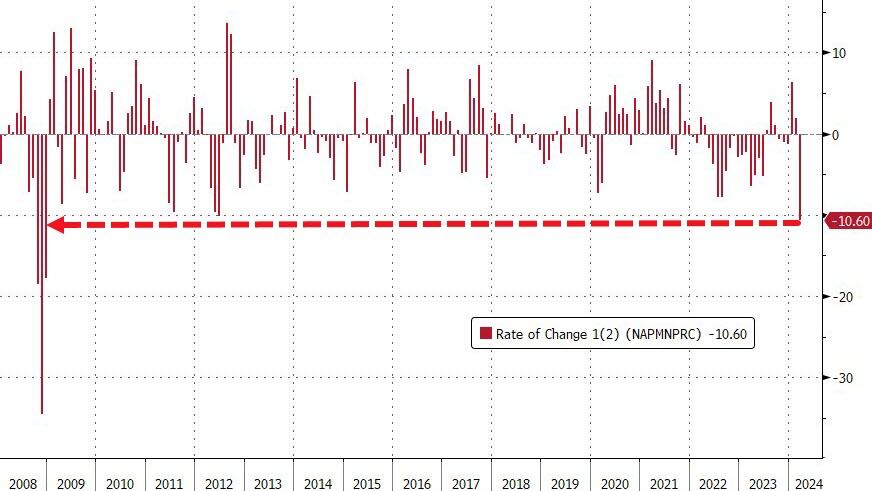
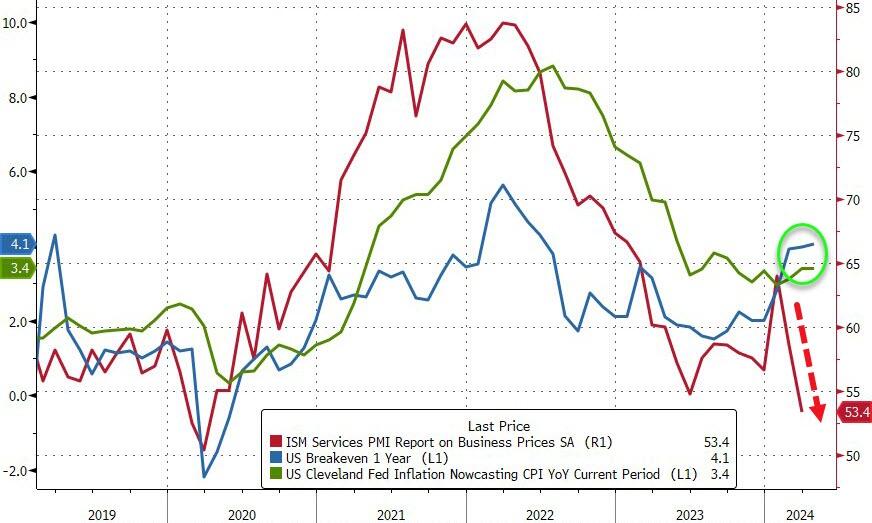
But the market only had eyes for one thing – the plunge in prices paid in ISM Services (which literally diverged from all other recent ‘prices paid’ surveys and the respondents’ comments)…

Source: Bloomberg

For context, that is the biggest two-month plunge in ISM Services Prices Paid since Dec 2008

Source: Bloomberg

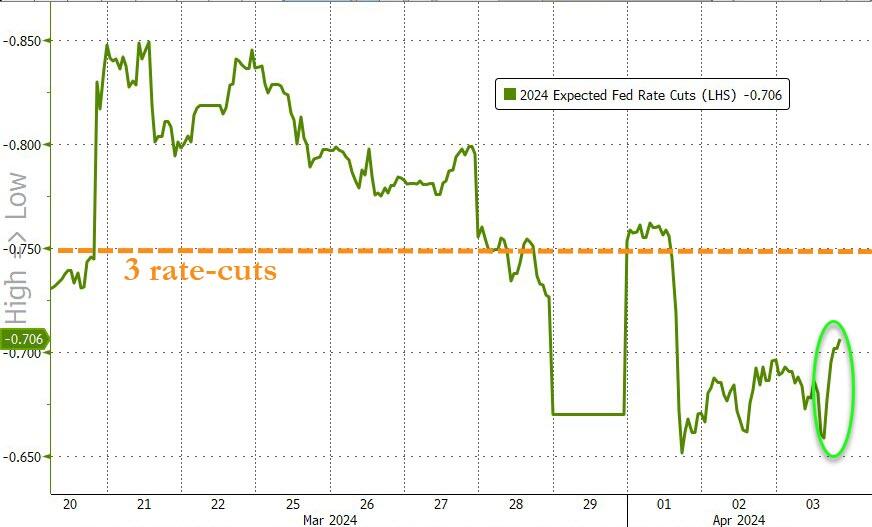
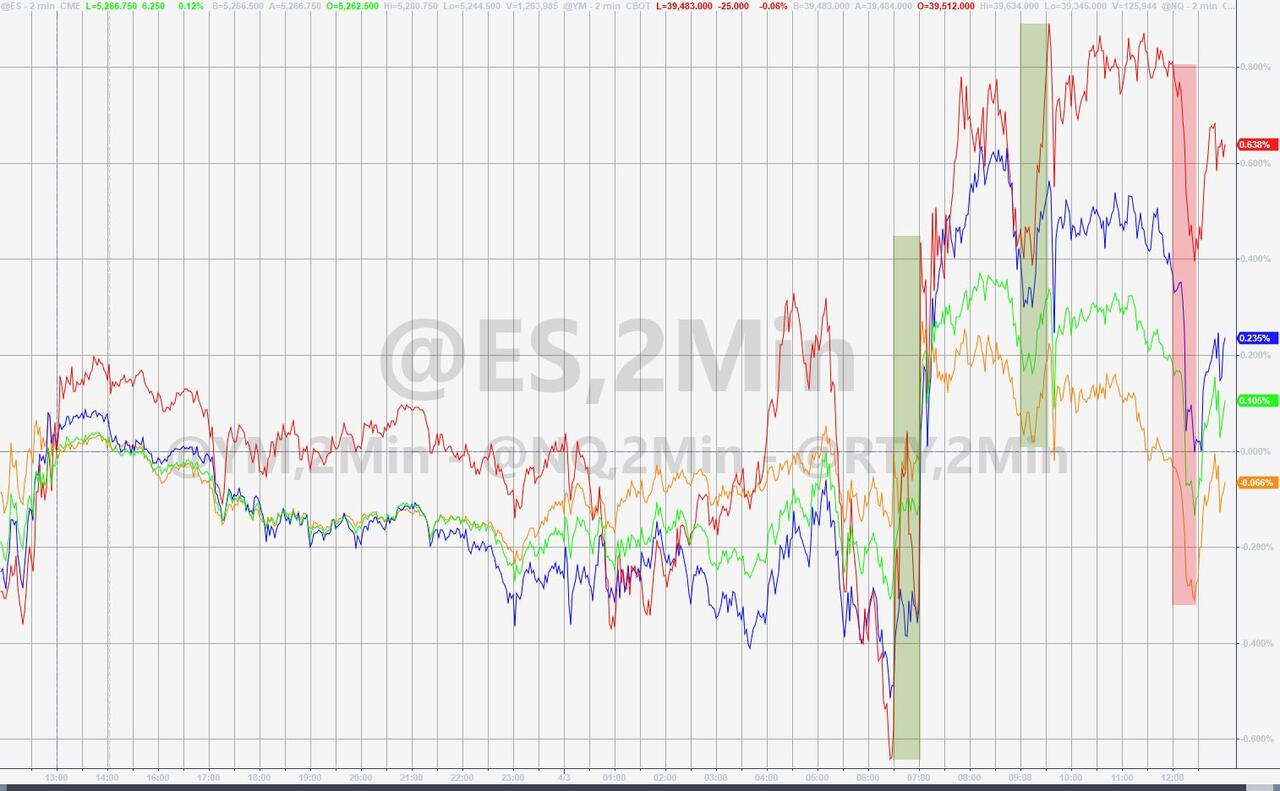
That one datapoint was all the algos needed and stocks rallied, the dollar and bond yields dropped, gold spiked to new highs, bitcoin jumped higher, and even rate-cut hopes rose immediately (but still less than 3 total rate-cuts priced in for 2024)…

Source: Bloomberg

Small Cap stocks loved the ‘dovishness’ of lower prices paid (and Powell didn’t offer much either way) and along with Nasdaq and the S&P ended the day green.

“On inflation, it is too soon to say whether the recent readings represent more than just a bump,” Mr. Powell stated.

“We do not expect that it will be appropriate to lower our policy rate until we have greater confidence that inflation is moving sustainably down toward 2 percent.”

At the same time, he said that cuts to the benchmark federal funds rate are “likely to be appropriate at some point this year” as he does not believe “inflation is reversing higher.”

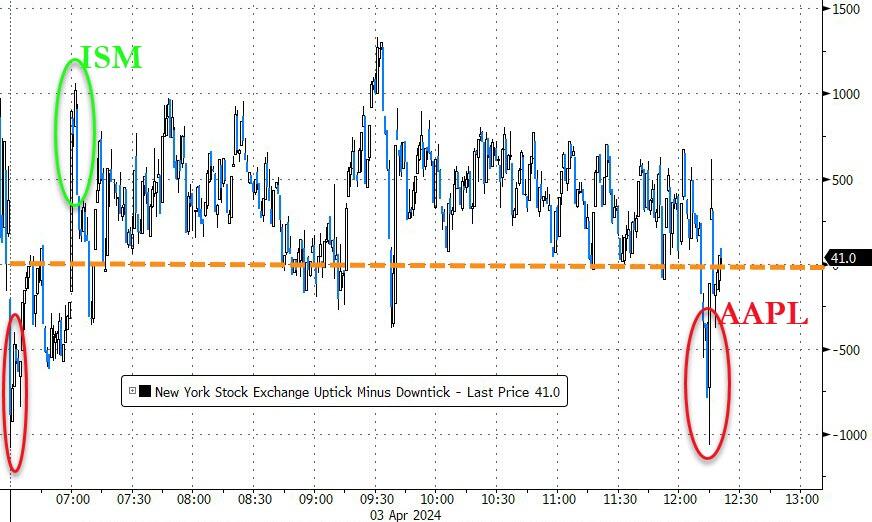
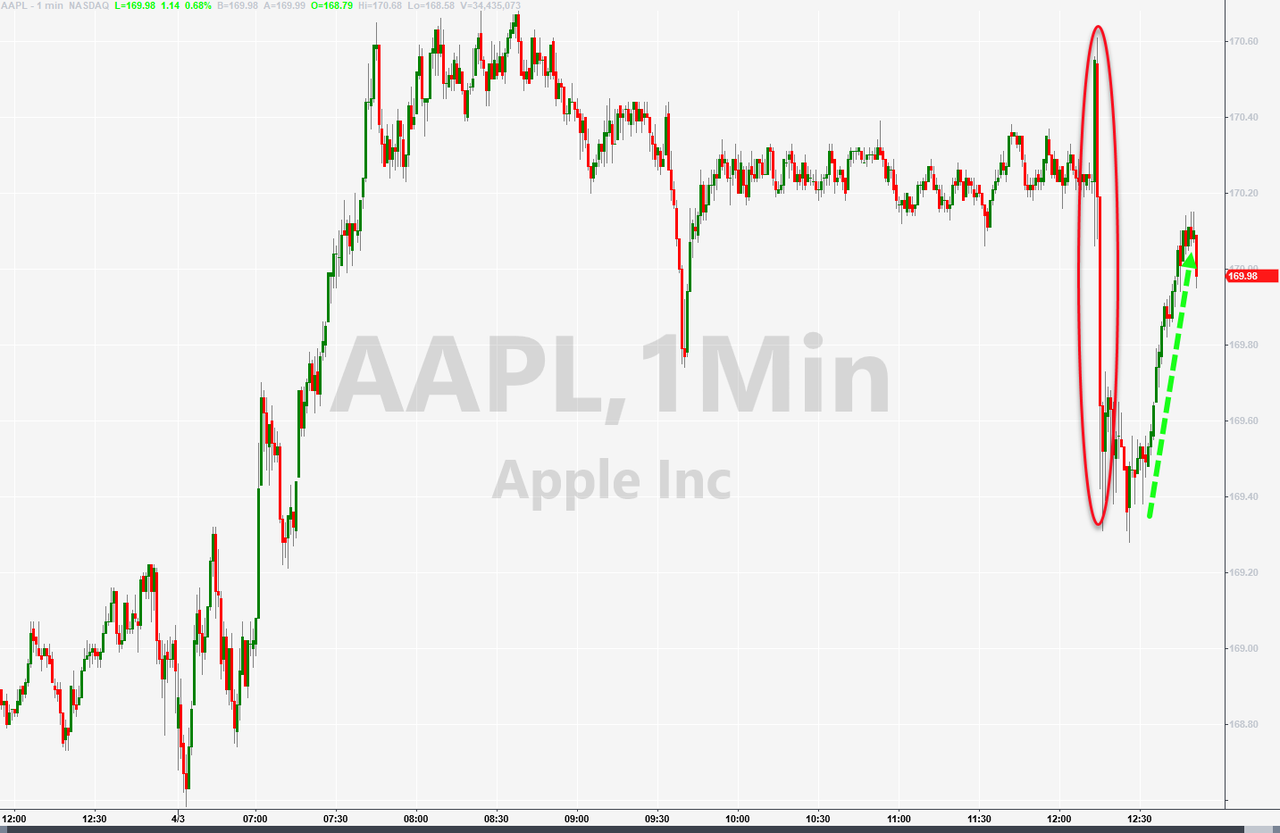
Then, at 1515ET, a huge sell program suddenly hit stocks out of nowhere…

Source: Bloomberg

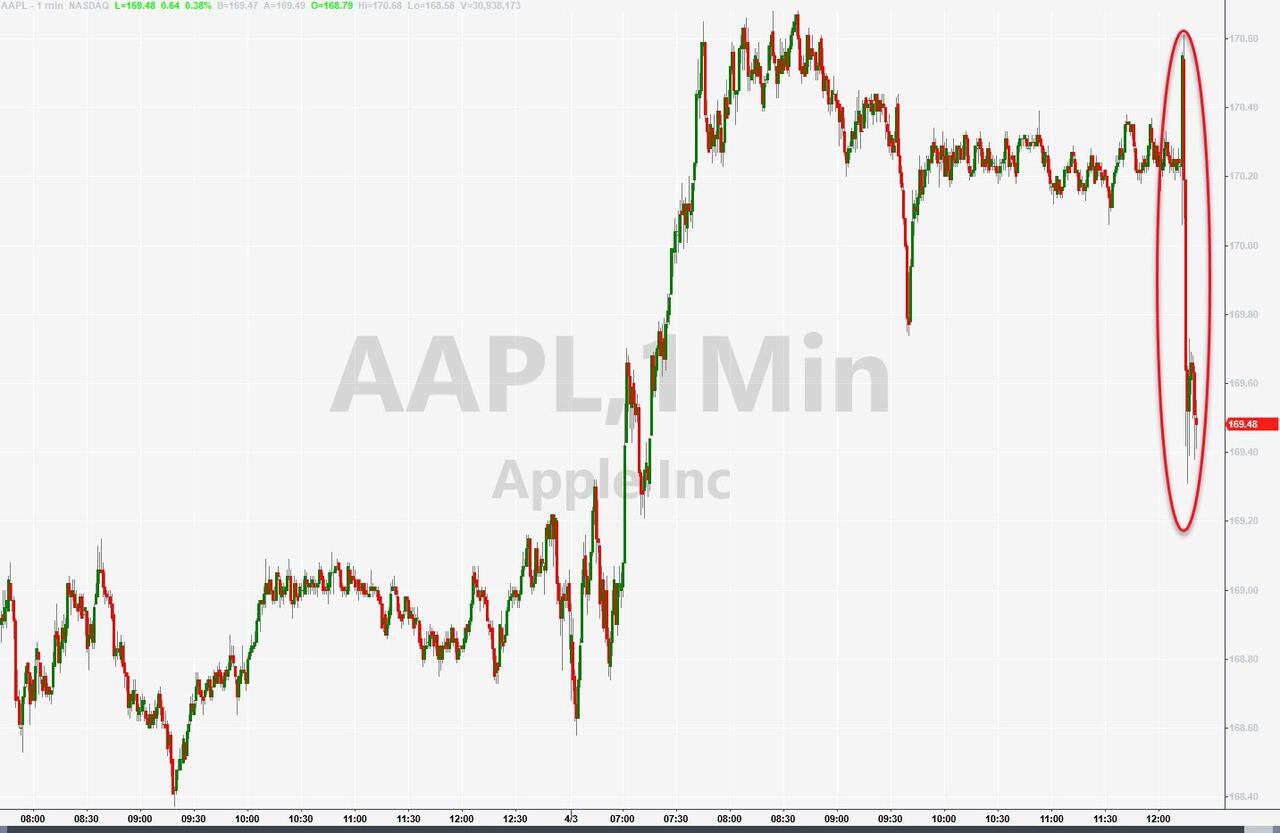
It appeared to be triggered by this HL – *APPLE EXPLORES HOME ROBOTS AS ‘NEXT BIG THING’ AFTER CAR FAILS – which sent AAPL sharply lower immediately…

We guess the trading bots don’t like competition?

And that spoiled the party overall for stonks but they bounced back from that shock. Quite a crazy day – although small moves in the bigger picture. The Dow ended red and is on target for its worst week since October…

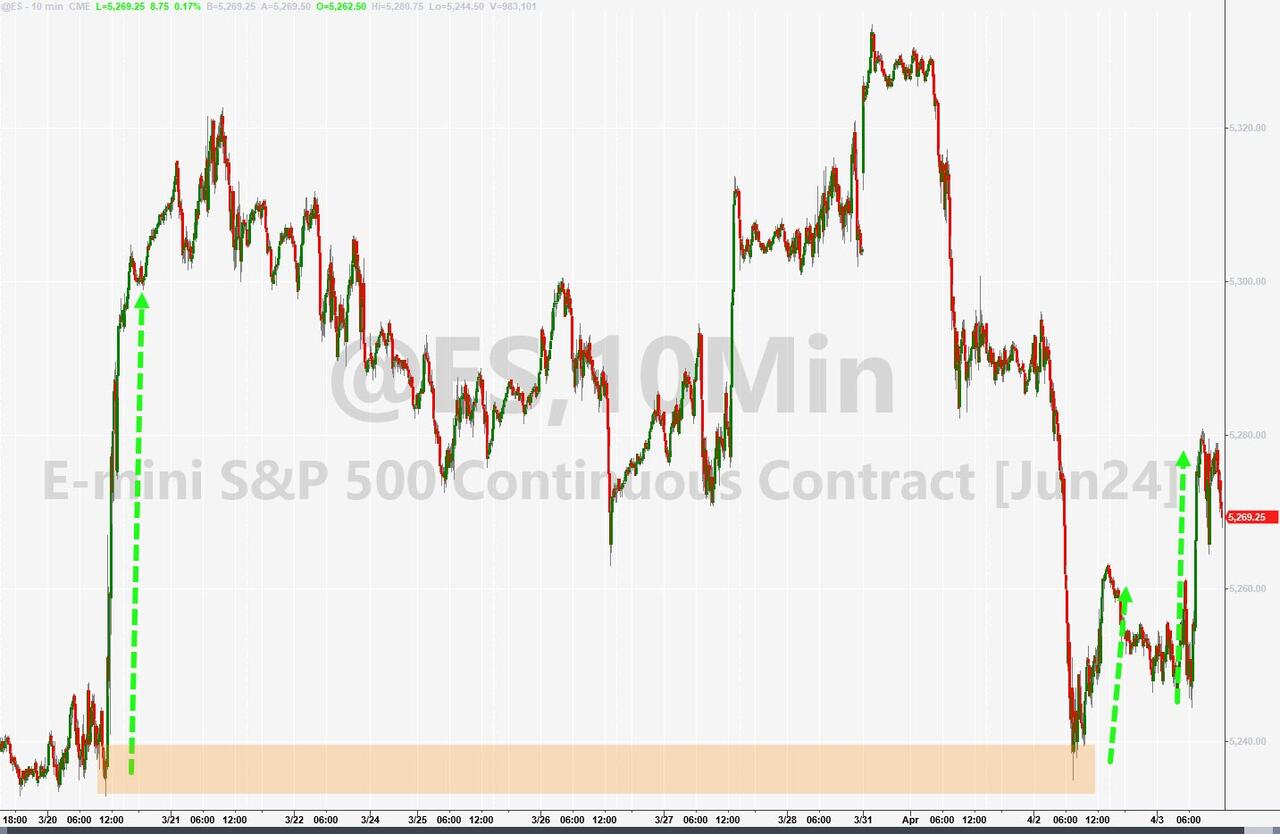
Notably, the S&P bounced perfectly at the lows from the 3/20 FOMC meeting spike…

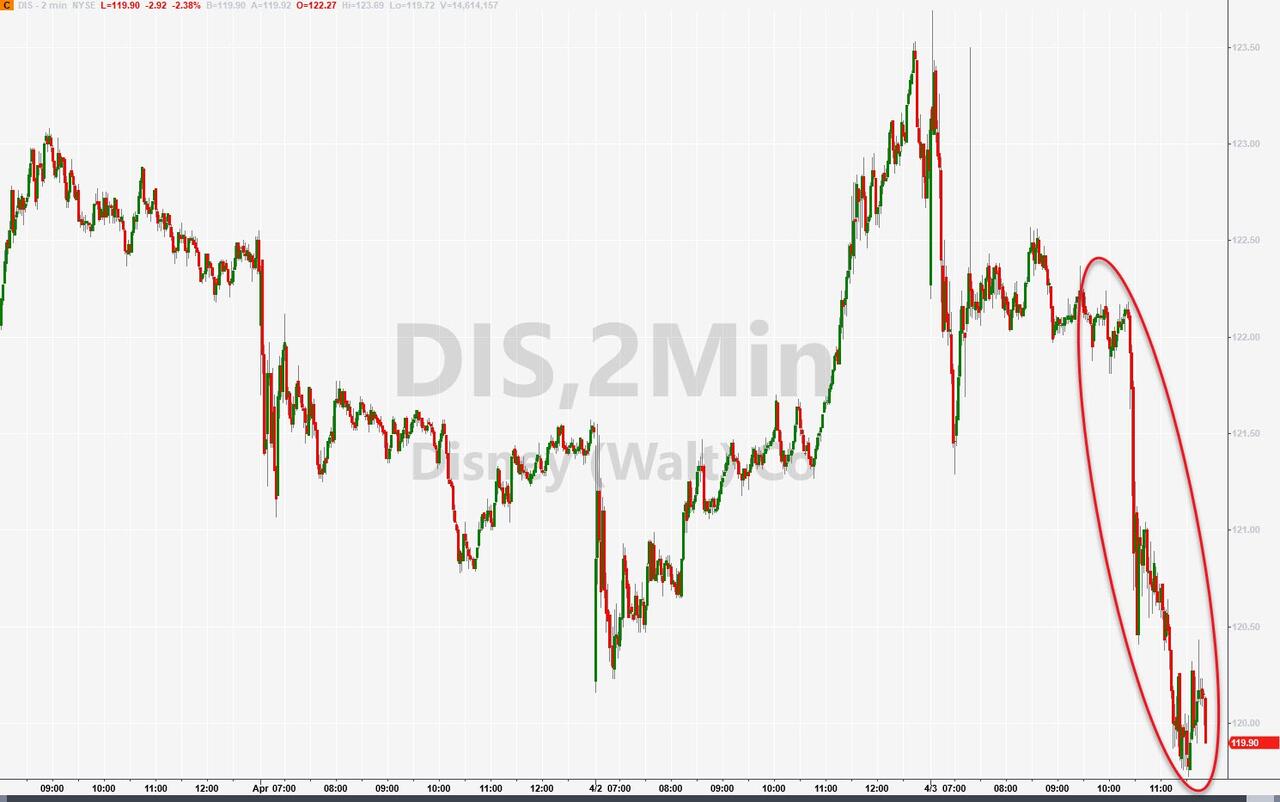
While the broad market was up today, Disney was not – after Iger won in the fight against Trian…

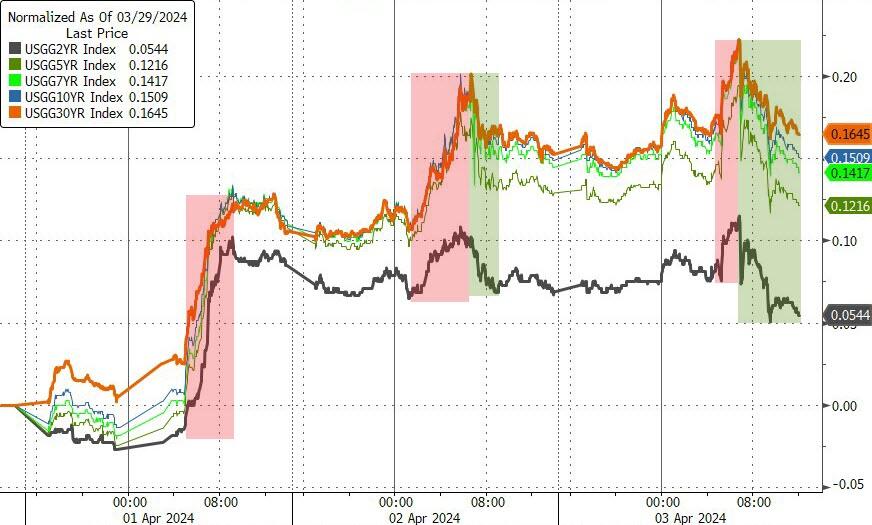
Treasury yields were higher once again overnight but the ISM prices paid data sent them back down to basically end the day unch-ish (2Y -1bp, 30Y +1bp)…

Source: Bloomberg

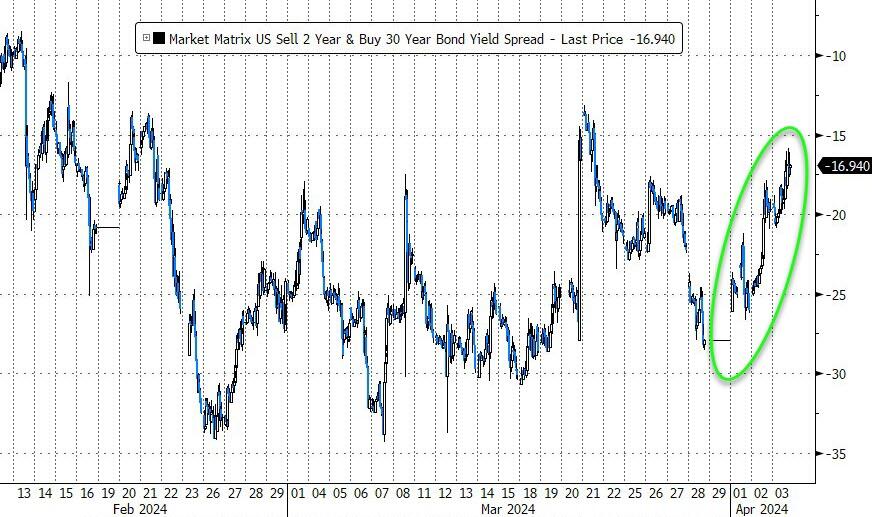
The yield curve (2s30s) continues to steepen…

Source: Bloomberg

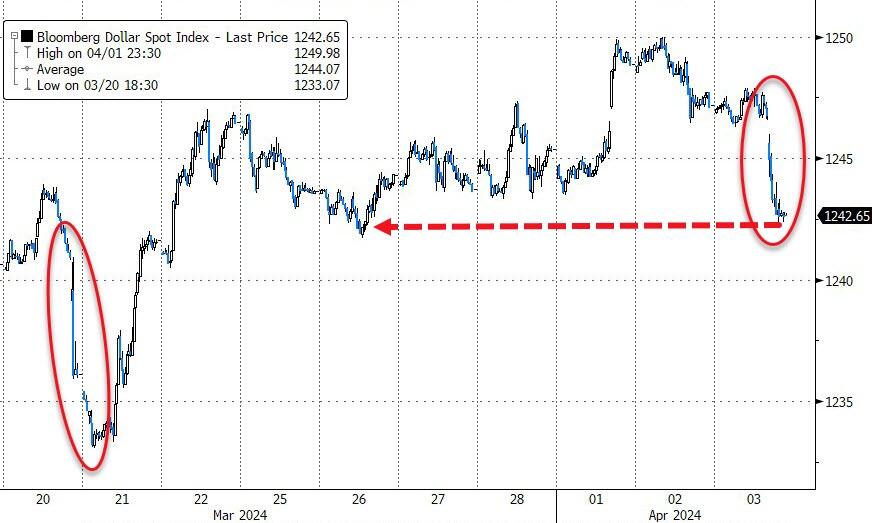
The dollar dived back to one-week lows…

Source: Bloomberg

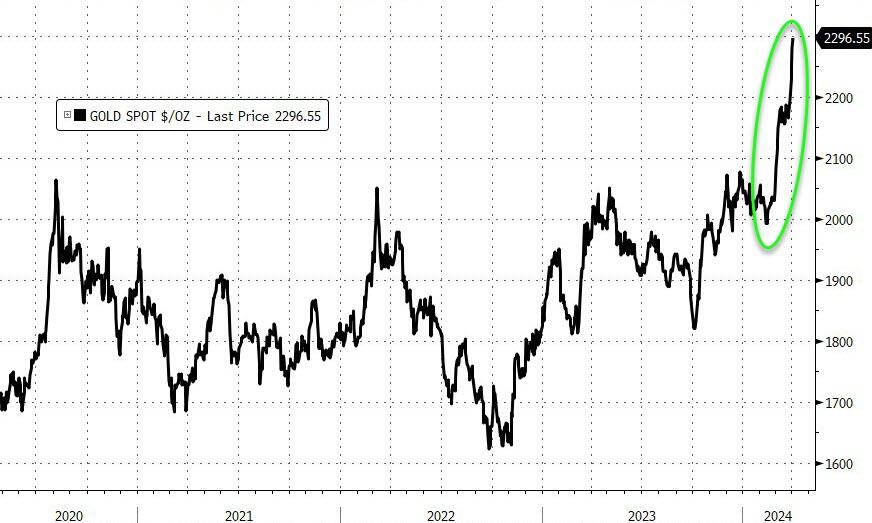
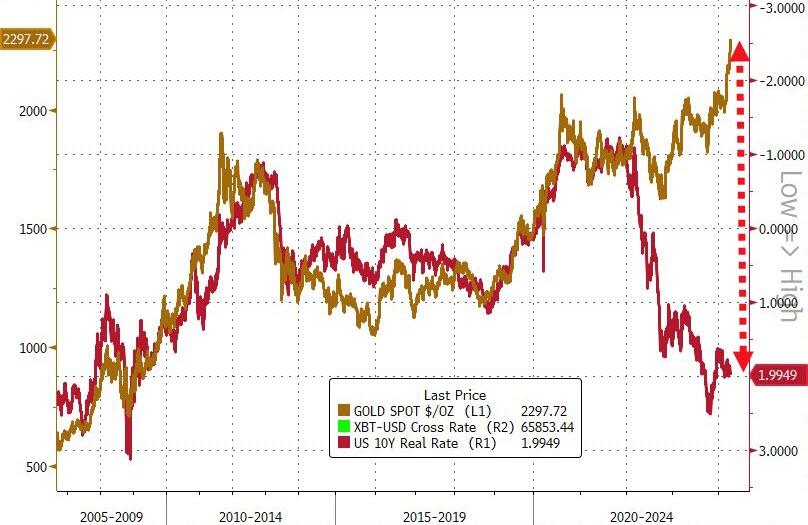
And that helped send gold to its fifth record closing high in a row, within pennies of $2300 (spot)…

Source: Bloomberg

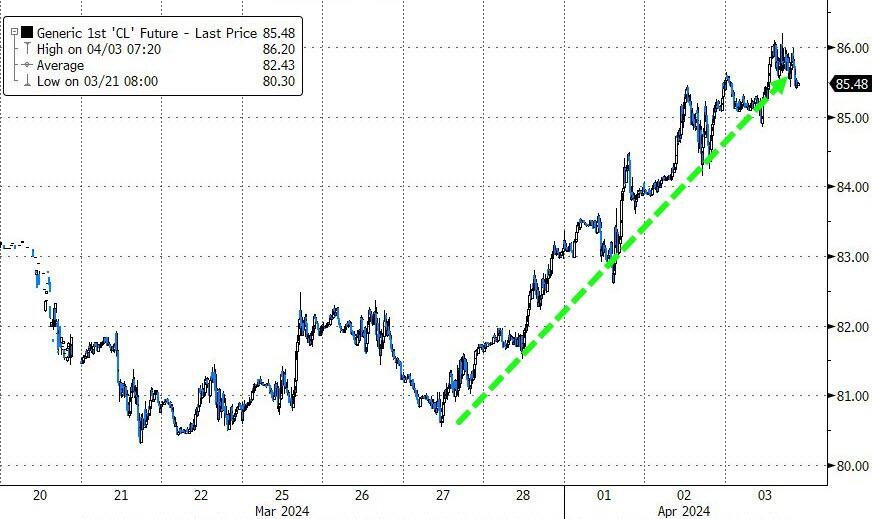
Crude prices rallied for the fifth day in a row, with WTI topping $86

Source: Bloomberg

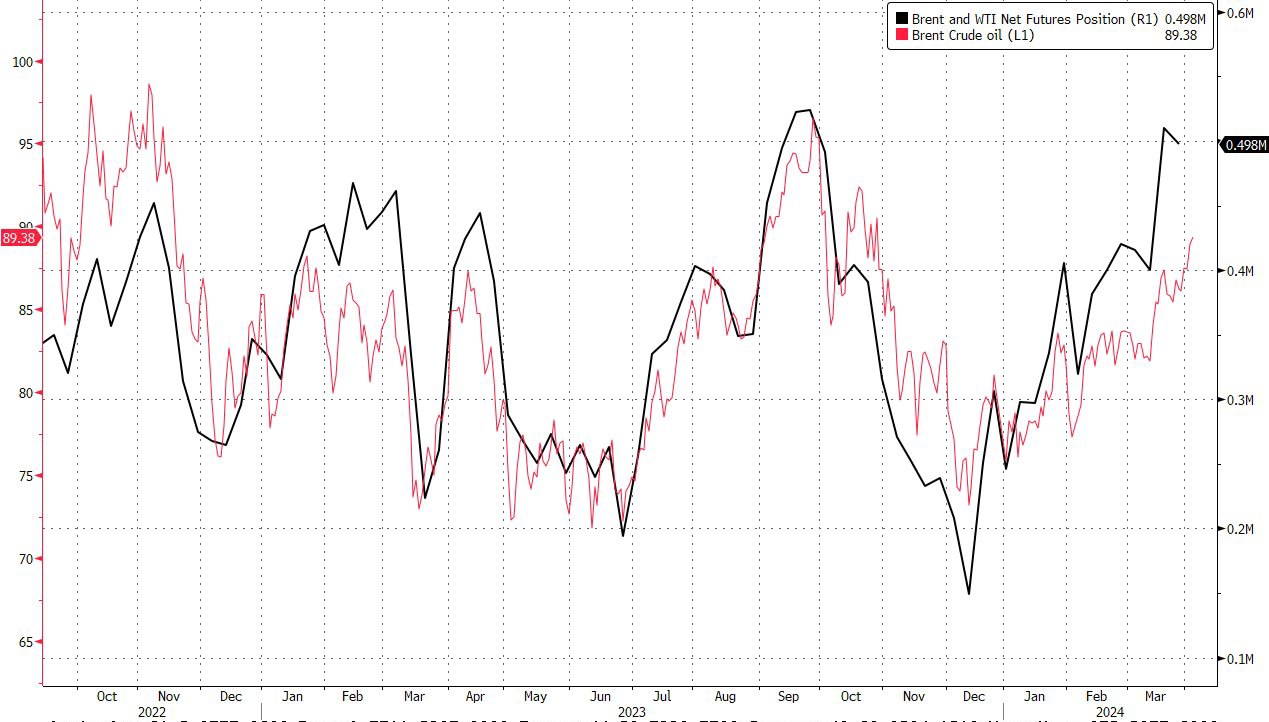
Positioning is once again very long in Brent futures…

Source: Bloomberg

Finally, as gold pushes to record-er and record-er highs (in USD terms), Real yields refuse to play along…

Source: Bloomberg

Whatever gold is worrying about… is big.

Tyler Durden
Wed, 04/03/2024 – 16:00

via ZeroHedge News https://ift.tt/6AM9K1u Tyler Durden

Apple Developing Robot As “Next Big Thing” After Dumping Electric Car Project

Apple Developing Robot As “Next Big Thing” After Dumping Electric Car Project

After shocking its fans – and everyone else – with the recent decision to give up on developing an electric car after sinking billions of dollars into the now defunct project, Apple – perhaps deciding to quietly move on beyond the neck brace also known as the Vision Pro – has set its sights on a new “next big thing”: according to Bloomberg, Tim Cook’s company – which is currently being sued by the DOJ for being a monopolist – is pushing into personal robotics, a field with the potential to become one of the company’s ever-shifting “next big things,” according to people familiar with the situation.”

According to the report, Apple’s engineers have stolen Elon Musk’s Optimus concept come up entirely on their own with the truly original and unique idea of pursuing a mobile robot that can follow users around their homes. It wasn’t clear if the code name of the robot is iOptimus. The iPhone maker also has developed an advanced table-top home device that uses robotics to move a display around. We hope this won’t be called the iEchoShow.

Having been accused – accurately – by pretty much everyone that it hasn’t come up with an original idea since Steve Jobs died (sorry, but buybacks and moar buybacks doesn’t count), Apple is under growing pressure to find new sources of revenue, and while this effort is in its early stages – and it’s unclear if the products will ultimately be released – it seems that we now have a race on for the first company to release the real-world version of the T-800.

Apple scrapped its long-running electric vehicle project in February, and a push into mixed-reality goggles is expected to take years to become a major moneymaker, if ever.

With robotics, Apple could gain a bigger foothold in consumers’ homes and capitalize on advances in artificial intelligence. But it’s not yet clear what approach it might take; it is also not clear if Apple can catch up to other companies that have a substantial lead over it, like Tesla and Microsoft. Though the robotic smart display is much further along than the mobile bot, it has been added and removed from the company’s product road map over the years, according to the Bloomberg report.

Some more details:

The robotics work is happening within Apple’s hardware engineering division and its AI and machine-learning group, which is run by John Giannandrea. Matt Costello and Brian Lynch — two executives focused on home products — have overseen the hardware development. Still, Apple hasn’t committed to either project as a company, and the work is still considered to be in the early research phase. A spokeswoman declined to comment.

Before the car project was canceled, Apple told its top executives that the company’s future revolved around three areas: automotive, the home and mixed reality. But now the car isn’t happening and Apple has already released its first mixed-reality product, the Vision Pro headset, to – well – very mixed reviews.

So the focus has shifted to other future opportunities, including how Apple can better compete in the smart home market.

Ironically, after the report that Apple’s was betting its future on robots, the robots that trade stonks were not too happy, and sent AAPL stock tumbling, only to rebound as yet another group of robots rushed to BTFD.


Tyler Durden
Wed, 04/03/2024 – 15:53

via ZeroHedge News https://ift.tt/HAb9tJB Tyler Durden

Saturdays Only For “People Of Color” At UC Berkeley Farm; Report

Saturdays Only For “People Of Color” At UC Berkeley Farm; Report

Authored by Micaiah Bilger via The College Fix,

Federal complaint accuses university of racial discrimination…

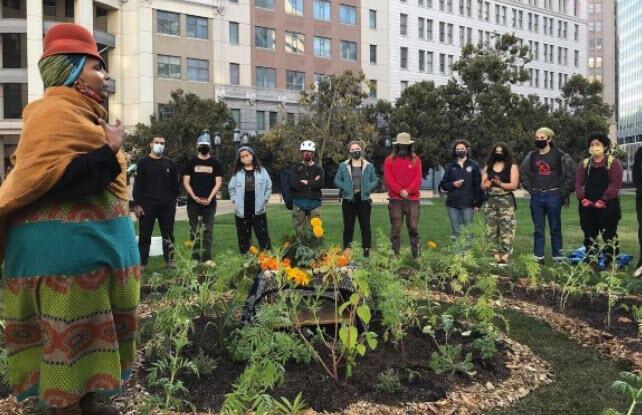
A community farm run by the University of California at Berkeley only allows “people of color” to participate on Saturdays, according to a new federal complaint.

The report to the Department of Education accuses the Gill Tract Community Farm of racial discrimination in violation of Title VI.

Run by the public university, the farm is a research, education, and extension project “focused on ecological farming and food justice,” according to its website. It welcomes the public to harvest food if they “help with weeding, planting, and watering.”

However, the Mountain States Legal Foundation, which filed the complaint last week, said the program discriminates against white people.

“Saturdays are exclusively BIPOC,” a farm manager wrote in a series of text messages cited in the complaint. “Exceptions have only been made for events that are BIPOC-centered and with plenty of advance notice and planning.”

The manager also advocated for “upholding boundaries around that safe and sacred space,” according to the complaint.

University spokesperson Dan Mogulof told the New York Post he was unaware of the allegations. After reviewing the complaint, Mogulof said the university takes such matters “extremely seriously” and will investigate the situation.

“The anonymous texts attached to the complaint have no specific information about time or place. And, as you can see, the Gill Tract’s website and calendar make no mention whatsoever of any program or activity of the sort described in the complaint,” Mogulof said.

“Having said that … I will contact the appropriate people on campus in an effort to determine what the facts are,” he told the Post.

The complaint asks the university to publish a statement reminding the public that everyone is welcome at the farm. It also asks the university to require training for individuals who run the farm.

“While the farm purports to be a welcoming place, the staff running the farm seem to think that racial segregation should make a comeback,” Mountain States Legal Foundation stated on its website.

“… But neither the Constitution nor federal law permit public institutions like UC Berkeley to engage in racial segregation.”

Other universities also have incorporated racial issues into their agricultural programs in recent years.

In 2021, the University of Michigan hired a full-time diversity, equity, and inclusion manager for its Matthaei Botanical Gardens & Nichols Arboretum, The College Fix reported. The gardens also held workshops about “confronting racism.”

Meanwhile, San Diego State University spent a quarter of a million dollars to build a racial healing garden in 2019. Campus sources later told The Fix no one uses it.

And Cornell University’s agricultural program sponsored a “safer science” webinar in 2021 about “identity prejudice” and “safe fieldwork strategies for at-risk individuals.”

Some universities also employ DEI administrators in their agricultural programs.

Tyler Durden
Wed, 04/03/2024 – 15:25

via ZeroHedge News https://ift.tt/aSGRV4t Tyler Durden

Biden Halts Attempts To Refill SPR As Oil Price Soars

Biden Halts Attempts To Refill SPR As Oil Price Soars

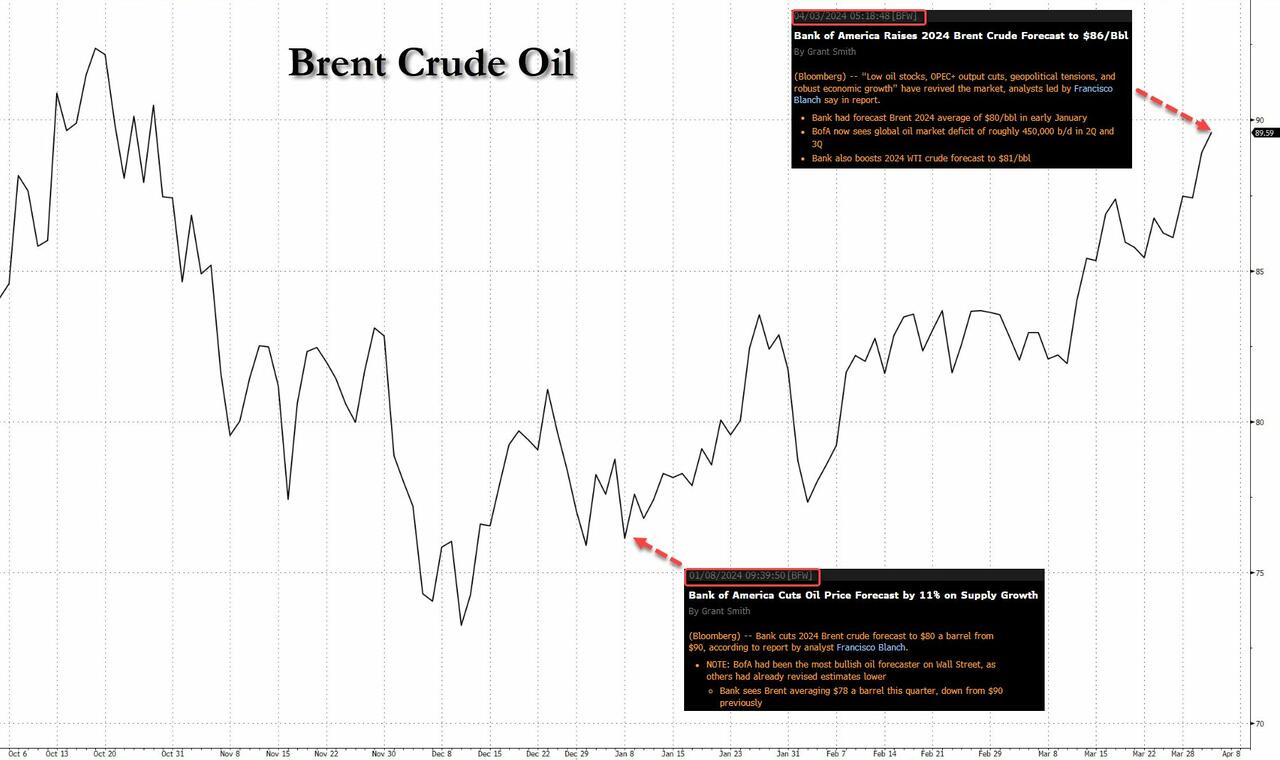
More than a year ago, we laughed at the thought that the Biden admin would actually follow through with its promise to refill the Strategic Petroleum Reserve when oil fell below $80, which in turn prompted area idiots to really rub it in our face when WTI tumbled as low as $73.

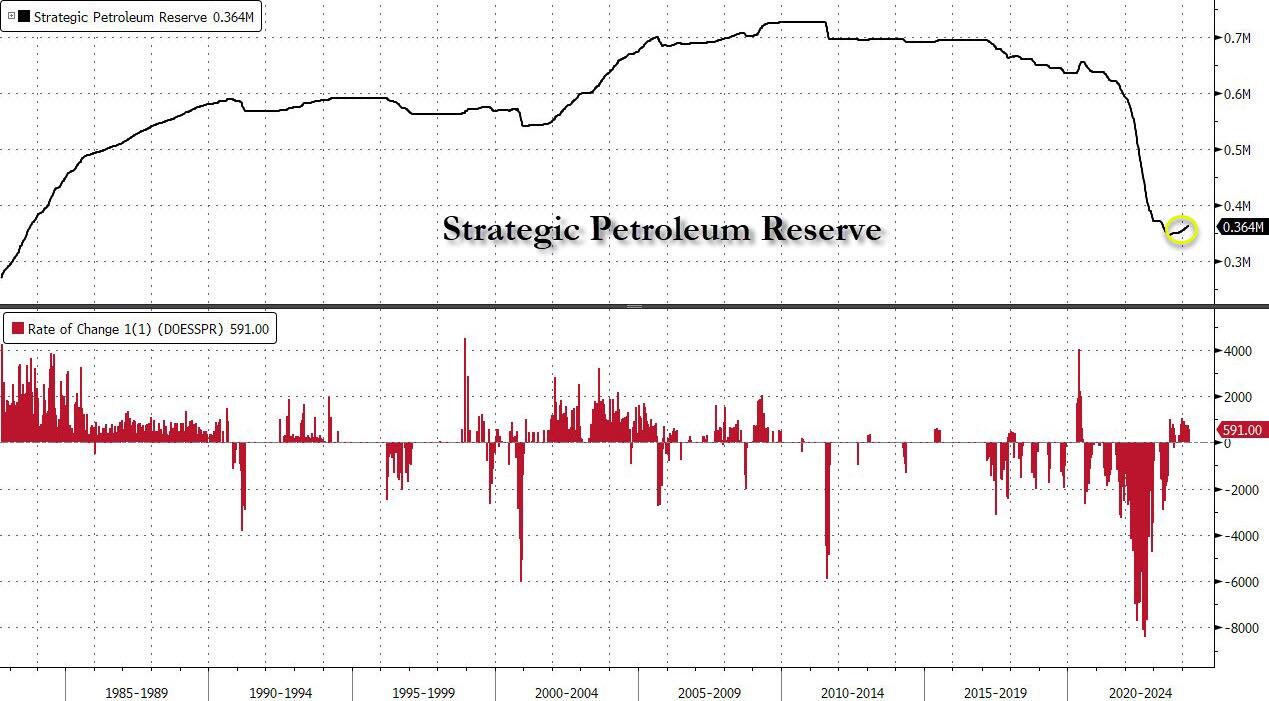
In retrospect we were, of course, right (and area idiots will continue failing upward until finally someone gives them the old rugpull) because even though WTI did indeed spend a few months below $80 before exploding back up again, this is how much oil the Biden admin purchased to refill the SPR after it intentionally drained it in 2022 to limit the surge in gas prices. Can’t see it? It’s highlighted in the yellow circle (yeah, no wonder you can’t see it).

And now that WTI is back to $86 and the Biden admin has completely missed its window to add some more oil to the SPR besides the token several hundred barrels here and there, the Biden administration has capitulated and today announced it won’t move forward with its latest plans to buy oil for the Strategic Petroleum Reserve amid rising prices.

According to Bloomberg, Biden’s Energy Department said it was “keeping the taxpayer’s interest at the forefront” in its decision not to purchase as many as 3 million barrels of oil for a Strategic Petroleum Reserve site in Louisiana. The plan for the barrels to be delivered in August and September had been announced in mid-March. It has now been canceled meaning that the already dismal rate of SPR refill will now flatline for the foreseeable future, at least until the NBER admits the US is in a recession.

“We will not award the current solicitations for the Bayou Choctaw SPR site and will solicit available capacity as market conditions allow,” the department said. “We will continue to monitor market dynamics.”

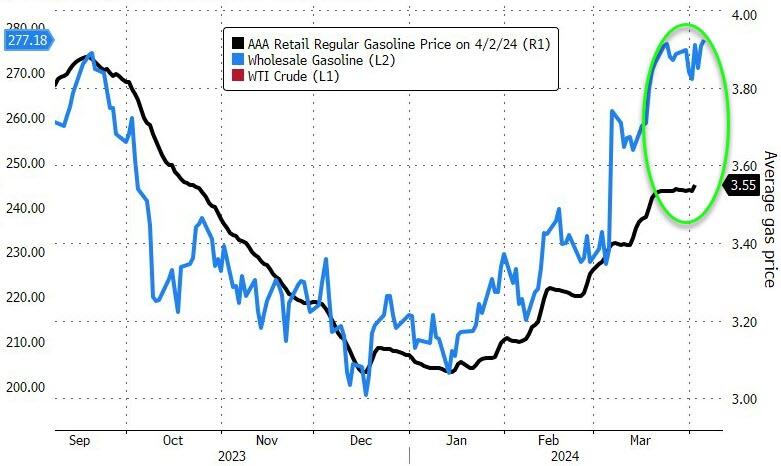
The capitulation follows a surge in crude prices, with WTI on Tuesday rising above $86 a barrel for the first time since October. The Biden administration has a target to buy oil at $79 or lower to refill the reserve, though spent an average of about $81 a barrel in its latest purchase of 2.8 million barrels late last month.

The Energy Department has been slowly refilling the emergency oil supply after it reached a 40-year-low following the administration’s unprecedented drawdown of a record 180 million barrels in the wake of Russia’s invasion of Ukraine. It currently holds about 363 million barrels, according to Energy Department data, down from almost 600 million at the start of 2022.

And just like that anyone hoping that Biden would add more than a few drops to the SPR can stop holding their breath: “Domestic crude prices are likely to remain too high for the remainder of the year for DOE to resume its refilling program,” said Bob McNally, president of consultant Rapidan Energy Group and a former adviser to President George W. Bush.

“If pump prices keep rising, the Biden administration will shift gears and reconsider SPR releases, though we current do not think they are imminent.”

Of course, Wall Street which is always wrong about everything, urged its clients to sell oil at the lows and turned bullish, well, now.

Ironically, Biden’s White House handlers didn’t listen to either the right, or the wrong call. And now they have $100 oil to deal with and the elections are 7 months away: good luck explaining the coming decision to drain another 60 million barrels in SPR oil in the next few weeks as a “national emergency” although we are certain they will try.

Tyler Durden
Wed, 04/03/2024 – 15:05

via ZeroHedge News https://ift.tt/z0p9I83 Tyler Durden

Peter Schiff: Gold Is Telling Us The Fed Is Wrong

Peter Schiff: Gold Is Telling Us The Fed Is Wrong

Via SchiffGold.com,

This week Peter returned from vacation, and he was just in time for a surge in the price of gold. He discusses the factors contributing to gold’s record prices, the similarities between today and the 1970s, and data pointing to future inflation in America.

Peter starts this episode by noting how gold’s recent rise hasn’t received much coverage from the mainstream financial press:

“$30 on a Sunday night— that’s very rare to see that kind of move. But what’s even more rare is that there was no news. It’s not like something happened. Nobody dropped the bomb anywhere, right? It just went up. And that was on top of the near $40 rise that gold had on Friday before the holiday weekend. … Very rare to have that kind of move. But also very rare was the complete lack of attention that the gold rally has been getting.”

The media’s silence on gold serves larger financial interests in America that benefit from a weak economy and dollar:

Another reason that CNBC and other financial analysts don’t want to talk about gold is because of the message that gold is sending. … Gold is not just some commodity. It is a commodity, but it’s a special commodity. … Gold is special because of the monetary properties and the monetary role that gold plays. If anything can be said to be the canary in the coal mine, it’s gold.

What is gold telling people, if they’re smart enough to listen? What gold is screaming is that what the Fed is contemplating is a mistake, that cutting interest rates whenever these cuts begin is the wrong policy.

Even widely respected Fed Chairman Alan Greenspan has acknowledged the signaling power of gold’s price, but Jerome Powell and the current Fed are ignoring the signs of a weak economy:

The Fed says they’re data dependent. Well, why are they ignoring all of this data that says everything they’re saying about inflation is BS? Powell keeps saying, ‘yes, we’re confident we think inflation is going to go back down to 2%.’ Why? Why should it do that? What gives him this confidence? Just because he’s raised interest rates up to 5.25%? Big deal! That’s not a high rate of interest, especially when you have a big inflation problem.”

Any student of history can recognize the political parallels between the inflation of the 1970s and now:

“We had the Vietnam War, which was expensive. We had the war on poverty, which was also expensive. Interestingly, we’ve lost both of those wars. … Poverty won, but we spent a lot of money on both of those wars. Then we also had the space race. … So the government was running these big deficits. … Where did the government get all the money to pay for all this stuff? Well, it borrowed it, right? They ran deficits, and they printed a lot of money. And so naturally, the consequence was inflation, rising prices.”

Peter sees a weakening dollar as the main recent driver behind gold’s price. If the dollar depreciates against other foreign currencies, gold could take off:

I still believe that soon we’re going to see the dollar crack against other fiat currencies. And when that happens, you’re going to see a much more spectacular rise in the price of gold. If you think about what’s already happened, we’ve seen this big jump in gold prices without a weak dollar relative to other fiat currencies. Imagine how much stronger gold would be if the dollar were also falling in relation to the euro or the Australian dollar, Canadian dollar, emerging market currencies, the yen.”

Apparently foreign central banks can see what Powell can’t, and they’re stockpiling gold because of it:

Foreign central banks realize that we don’t care [about inflation]. They’re holding all these dollars, and they see that we’re about to create more of them. We’re going to cut rates in the face of mounting evidence that they’re ignoring that inflation is going to be moving in the opposite direction. They claim that they want it down at 2%. All the evidence shows that it’s headed higher and their response is ‘we’re going to cut rates.’ And so foreign central banks want to get out.“

With its price at record highs and foreign central banks clamoring for the yellow metal, gold is strengthening as a hedge against terrible monetary policy. If Peter is right about future price action, now is the perfect time for investors to add to their precious metal holdings.

Tyler Durden
Wed, 04/03/2024 – 14:45

via ZeroHedge News https://ift.tt/eu0TnEa Tyler Durden

Watch: Chaos As Anti-Netanyahu Protesters Storm Israel’s Knesset

Watch: Chaos As Anti-Netanyahu Protesters Storm Israel’s Knesset

Chaos broke out at Israel’s parliament the Knesset amid an ongoing multi-day protest led by hostage victims’ families which is being staged just outside. For the first time, on Wednesday demonstrators overwhelmed the Knesset while it was in session, and smeared glass panels of the guest gallery with yellow paint.

They shouted: “Do not go on summer recess at our expense,” and “There will be no recess until the last captive is returned” while security fought to get the group under control. Watch below:

The whole ordeal did cause a disruption in a plenary session of lawmakers, until police were able to clear the building of all demonstrators. The protests, which have included people camping in tents across from Israel’s parliament and other government buildings, even the prime minister’s private residence, are entering their fifth day.

The families have demanded the Netanyahu government make a deal with Hamas to free the remaining captives. They have also accused Netanyahu and his allies of seeking to prolong the war in order to ensure his own political survival. 

These demonstrations have escalated of late, as detailed in Israeli media reports:

The protest later turned chaotic, as demonstrators broke through security barriers and arrived at the entrance to Prime Minister Netanyahu’s private residence. The violence outside the premier’s home, including a burning torch thrown at a mounted police officer, prompted an unusual visit by the head of the Shin Bet Internal Security Agency to the Netanyahu house. He called the protest out of bounds and said it was part of a worrying trend of violent protest.

Shin Bet security agency chief Ronen Bar has warned against “dangerous” escalation of the protest. “The violent discourse online and some of the scenes we saw [last night] in Jerusalem go beyond acceptable protest, harm the ability to maintain public order, could lead to violent clashes with law enforcement, disrupt their ability to carry out their work and even cause harm to individuals under protection,” he warned.

He emphasized, “there is a clear line between legitimate protest and violent and illegal protest. This is a worrying trend that could lead to dangerous places which we must not come to.”

Israel’s official count for the number of people still being held hostage in the Gaza Strip remains at 134 mostly Israeli citizens as well as some foreigners, which includes possibly deceased victims. Amid stalled truce negotiations in Qatar, the Israeli newspaper Haaretz recently revealed that Israeli officials believe only 60 to 70 Israeli hostages in Gaza are still alive.

“According to the IDF, a total of 134 hostages and bodies are being held in Gaza,” Haaretz wrote Thursday. “Thirty-six of the people were confirmed by the army as killed – some on October 7, when their bodies were taken into the Strip. Of the 98 living hostages, 10 are foreigners (eight Thais, one Nepalese national, and one man with Mexican and French citizenship),” the report said.

Tyler Durden
Wed, 04/03/2024 – 14:25

via ZeroHedge News https://ift.tt/Z2cSJV1 Tyler Durden

Bitcoin Redundancy Realizations

Bitcoin Redundancy Realizations

Submitted by QTR’s Fringe Finance

When I think about the key concepts that I’ve learned about Bitcoin over the last month or two, there wasn’t one that pushed me over the line to be a believer more than the function of the network’s redundancy.

I mean, sure, almost everybody that knows me knows that ideologically, I’m a huge proponent of Austrian economics and an enormous gold bull, so obviously, that’s a great foundation to come from if you want to start learning about, and then believing in, Bitcoin.

But a lot of my uncertainty about Bitcoin over the last few years was a result of not understanding what it was or how it worked with definitive clarity. Those who watched my interview last month with Peter McCormack know that in the first half hour, I was challenging him to give me a one-sentence description of what you’re buying when you buy Bitcoin. I am still thirsty to be able to simplify the concepts of Bitcoin, thereby making it more digestible not only for myself to understand and explain, but for others.

For the record, if I had to answer that question now, I would simply describe buying Bitcoin as exchanging one currency for another. The price represents the exchange rate. I know there is more to it than this, including the potential for more adoption and a broader technological use for the network, among other things, but to simplify it, I’d just say it is the world’s first digital currency, accessible worldwide, and the price is its exchange rate. It’s a digital unicode for money.

And you don’t really need to know the down and dirty details of how it works, only that it does work, and that, as it grows, it becomes more secure. For those unfamiliar with how the proof of work security works, here’s an easy analogy that computer nerds will get mad about because its not accurate enough. Think of a four digit combination lock you use to lock up your bike in the city. Now, imagine if every time you used the lock, one digit was added to the lock and the combination reset to a new number. The last user gives you the 4 digit code to unlock the bike lock so you can use it. After your use, instead of having four digit lock with 1000 possible answers, you now have an all new, five digit combination, with 10x as many possible combinations. You give that combination to the next user so they can use it. Now, multiply that transaction by all of the times someone has used your lock, and you’ll see very quickly that whatever the combination is today, its very long — and nobody is going to be able to guess it. And, as more people use it, the lock becomes even more secure.

Now, imagine you have 20,000 people all using that same lock to lock up their bikes, non-stop for 13 years.

Understanding bitcoin’s security is one of the simple and profound realizations that I had that offered me permission to start to believe in it. I’ve said in an article I wrote earlier this year that Bitcoin is the digital manifestation of the phrase “there’s safety in numbers.”


🔥 50% OFF SUBSCRIPTIONS FOR LIFE: If you are not yet a subscriber, you can take 50% off for life by using this link: GET 50% OFF


But there isn’t just safety, there’s also strength and power. Once this concept becomes understood in the context of how Bitcoin’s network operates, and you look at a chart of nodes or hash rate, it simply becomes very difficult to suggest that the network is going to fail in some way – at least anytime soon.

For me, it was the understanding that 20,000 nodes globally in dozens of countries, countless jurisdictions, run by all different types of people with all different types of lifestyles, are constantly running a system of checks and balances to ensure the integrity of the network. I like the idea that if somebody goes to try to change the code, the nodes will puke it back out at them. I like the idea that there is a robust amount of computing power necessary to consistently verify the blockchain, much to the chagrin of climate alarmists like Elizabeth Warren. And finally, I love the idea that, as it grows, it becomes exponentially more difficult to stop.

I went to take a shower about an hour before I wrote this article and had a series of interactions that inspired me to think about redundancy as a concept.

First, I had just come back from traveling and had put away my travel toiletries bag. That bag is a duplicate copy of everything that I have at home: nail clippers, scissors, shampoo, first aid kit, deodorant, and other items. I chose to make a second duplicate bag for my travels so that I don’t have to pack and unpack my starting lineup of toiletries all the time; I only have to move my whole travel bag from one place to another. At the same time, my travel bag also serves as a backup for all the items that I have at home if something runs out before I can go to the store. My travel bag represents redundancy for my toiletries.

I got into the shower and noticed I had run out of soap. I reached out to a box of soap that I keep near the shower — but that was empty, so I went into the closet and opened up a new box. I keep lots of extras of the things that I use all the time because I don’t ever want to run out. The first box represents redundancy, and the second one in my closet represented an extra step of redundancy. It was an Irish Spring network consisting of three nodes — the shower, the first box, and the closet.

After I got dressed, I went to go put on my favorite winter hat, which I was able to do even though I had just dropped the same winter hat off at the laundromat. I bought several of these hats specifically so I could have one to use while one was in the laundry. This is winter hat redundancy.

I was wearing a T-shirt today that I have at least 12 duplicates of because it is the only T-shirt that fits me the way I like. Several T-shirts were in the laundry, but I still had several clean ones because of the fact that I had bought extra. This is T-shirt redundancy.

Then I walked out to make myself a coffee and realized that my Nespresso pod holder on the counter was empty. So, I reached into the closet, grabbed another box, opened it up, and refilled it. I keep the closet stocked with extras in case the pod holder runs out. This is Nespresso redundancy.

Finally, I walked out to a restaurant after my shower and walked past a giant set of Generac generators next to my neighbor’s house. I thought to myself: those are placed to create power redundancy in case the electricity goes out. There’s power safety in generator redundancy for my neighbor.

This may seem like a series of totally trivial and meaningless statements, but for the last 20 years, since I’ve been living on my own, I have always tried to keep extras of all the things that I use on hand at all times. If I find something that I like, I buy several of them if I can. I have multiple backups for nearly every single product that I use daily at the house.

If you go to your linen closet right now, do you have one towel or a half dozen? You’ve likely got some towel redundancy.

So today it just made sense to me why I liked the idea of Bitcoin’s redundancy so much. I loved the idea of the safety net of having 20,000 nodes spread out all over the world. This is what gave me the confidence to arrive at the idea that the network and Bitcoin are going to work if the people want it to work. As more developers and miners come online and adoption grows further, the network is going to go from “extremely secure” to “ironclad”. When additional nation-states get involved, they will see to it that the computing power necessary to secure the network is ready and available. I haven’t been following Bitcoin closely long enough to know whether or not we have truly reached the escape velocity in terms of the network securing itself for the foreseeable future, but it feels like we have already passed it.

I’ve only been diligent in my research about Bitcoin for a couple months, but it seems the analogies and real-world examples that help understand it further are occurring all day every day.

And so, forgive me if I’m pontificating about things that many of you already understand, or if I’m repeating myself. We’ll just chalk it up to the safety of redundancy.

QTR’s Disclaimer: I am an idiot and often get things wrong and lose money. I may own or transact in any names mentioned in this piece at any time without warning. I didn’t double check any numbers or figures in this piece and am generally lazy with my research. Contributor posts and aggregated posts have not been fact checked and are the opinions of their authors. Contributor posts and curated content are posted either with the author’s permission or under a Creative Commons license. This is not a recommendation or solicitation to buy or sell any stocks or securities, just my opinions. I often lose money on positions I trade/invest in. Sometimes I just lose money by misplacing it. I’m generally irresponsible. I may add any name mentioned in this article and sell any name mentioned in this piece at any time, without further warning. These positions can change immediately as soon as I publish this, with or without notice. You are on your own. Do not make decisions based on my blog. Do your research elsewhere. I exist on the fringe. The publisher does not guarantee the accuracy or completeness of the information provided in this page. These are not the opinions of any of my employers, partners, or associates. I did my best to be honest about my disclosures but can’t guarantee I am right; I write these posts after a couple beers sometimes. Also, I just straight up get shit wrong a lot. I mention it numerous times because it’s that important that you know.

Tyler Durden
Wed, 04/03/2024 – 14:05

via ZeroHedge News https://ift.tt/VMQwCEf Tyler Durden

Trudeau Admits That Canada Is Being Overwhelmed By Mass Immigration

Trudeau Admits That Canada Is Being Overwhelmed By Mass Immigration

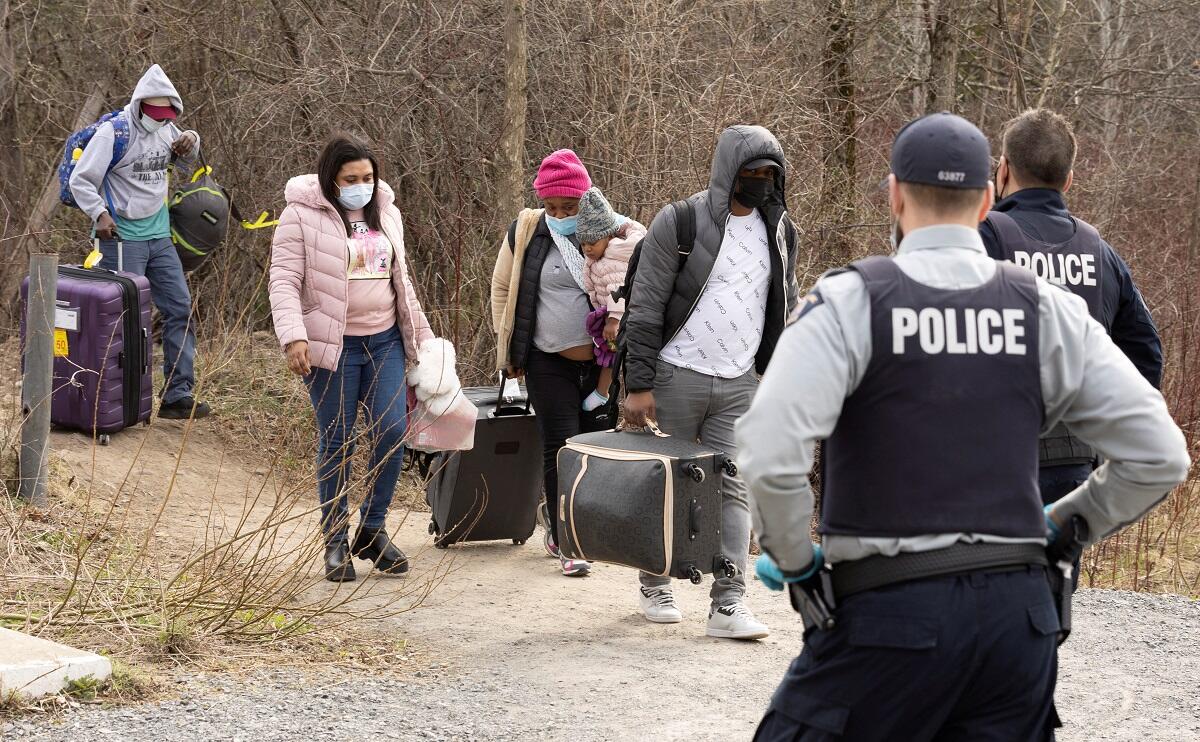
In a rare admission that all is not well in the socialist paradise of the north, Canada’s Prime Minister Justin Trudeau stated this week that the country has seen a ‘massive spike in temporary immigrants’ which is ‘far beyond what Canada can absorb.’  The nation’s percentage of temporary migrants (illegals using asylum loopholes to dodge proper immigration standards) has jumped from 2% of the total population in 2017 to over 7.5% of the total population in 2024.

In 2023 Canada marked its most rapid population growth in 66 years, with migrants making up over 97% of all new residents.  Only 2% came from a natural increase. 

Though Trudeau continues his attempt to virtue signal by praising the general concept of mass immigration and lies about the supposed benefits that illegal immigrants bring to the economy, reality cannot be denied.  It is proven time and time again that illegals represent a net drain on any economy they come into contact with – If they truly add value, then why don’t they add value to the economies in their home countries?

The legal population of Canada is realizing this fact and is becoming increasingly hostile to Trudeau’s open borders policies.  Trudeau’s national approval rating fell to all time lows of 30% in December 2023 and has hovered near that marker ever since.  This may be why he has suddenly chosen (reluctantly) to acknowledge the immigration problem.

The use of the term “temporary immigrants” is obviously political spin.  The goal of the majority of migrants is to stay in Canada permanently, otherwise, the problem would be greatly reduced.  Immigration Minister Marc Miller said on March 21 Ottawa would set targets for temporary residents allowed into Canada to ensure “sustainable” growth in the number of temporary residents entering the nation. Over the next three years, Miller said the goal is to reduce the amount of temporary residents to five percent of Canada’s population.

Canada is not only dealing with the runoff from the flood of illegal migrants hitting the US in the past few years under Joe Biden, it has also seen a direct influx of migrants from Islamic countries overseas.  Toronto’s Muslim population, for example, recently hit 7.7% of the city’s total citizenry.  But going beyond the issue of incompatible cultures is the ever present economic crisis.  Canada’s population is 38 million people, around the same size as the population of California.  It does not take more than a few million migrants siphoning welfare benefits and subsidies from the system to cause chaos. 

Canada’s poverty rate has been climbing the past year and is expected to jump again this spring along with inflation.  Keep in mind that large population influxes can create more demand for goods which also drives up prices.  The nation’s CPI has fallen (for now), but the central bank is likely to keep interest rates high in tandem with the Federal Reserve, which is not planning to cut in the near term as any reduction in rates invites a resurgence in inflation right before the 2024 elections.

Home rental costs are also crushing legal Canadian residents.  The average price for a two-bedroom apartment or house is now $2193 per month.  Limited housing availability in Canada combined with the sharp rise in migrants is leading to disaster.  

Both Joe Biden and Justin Trudeau face considerable backlash for their far-left immigration policies.  Illegal immigration and open borders have become two of the top issues cited by citizens of either country in national polls.  Biden faces a reelection campaign in 2024 and Trudeau faces reelection campaigns in 2025.  At this time, neither leader has the approval numbers to realistically keep office (without some form of chicanery), and this has largely been due to their continuing refusal to stop mass immigration.       

Tyler Durden
Wed, 04/03/2024 – 13:45

via ZeroHedge News https://ift.tt/e2hPlaX Tyler Durden

Trump Leads Biden In 6 Of 7 Swings States, Pennsylvania Is Key

Trump Leads Biden In 6 Of 7 Swings States, Pennsylvania Is Key

Authored by Mike Shedlock via MishTalk.com,

Polls have narrowed but Trump is still in the sweet spot. An electoral map shows Pennsylvania is directly on the roadmap to the White House.

A Wall Street Journal poll Shows Trump Leads Biden in Six of Seven Swing States

The poll of the election’s main battlegrounds shows Trump holding leads of between 2 and 8 percentage points in six states—Pennsylvania, Michigan, Arizona, Georgia, Nevada and North Carolina—on a test ballot that includes third-party and independent candidates. Trump holds similar leads when voters are asked to choose only between him and Biden.

The one outlier is Wisconsin, where Biden leads by 3 points on the multiple-candidate ballot, and where the two candidates are tied in a head-to-head matchup.

In another challenge for Biden, the survey found signs that he has yet to consolidate the winning coalition that backed him in 2020. Across the seven states, Biden is winning 68% of Black voters, as well as 48% of Hispanic voters and 50% of voters under age 30 on the two-candidate ballot.

Those support levels are almost identical to the backing Biden had in the Journal’s February poll of the national voter pool and are far weaker than what he won in 2020. Nationwide, Biden that year carried 91% of Black voters, 63% of Hispanic voters and 61% of voters under age 30, as recorded by AP VoteCast, a large poll of the electorate that year.

Third-party and independent candidates represent an unpredictable element in the election, drawing 15% across all of the swing states. That includes 11% who back Kennedy, whose support rises as high as 15% in Nevada and 13% in Arizona. An additional 10% are undecided across all seven states.

The up-for-grabs voters are also disproportionately young and from racial and ethnic minority groups—one reason that Biden appears to be underperforming his 2020 support levels among those groups.

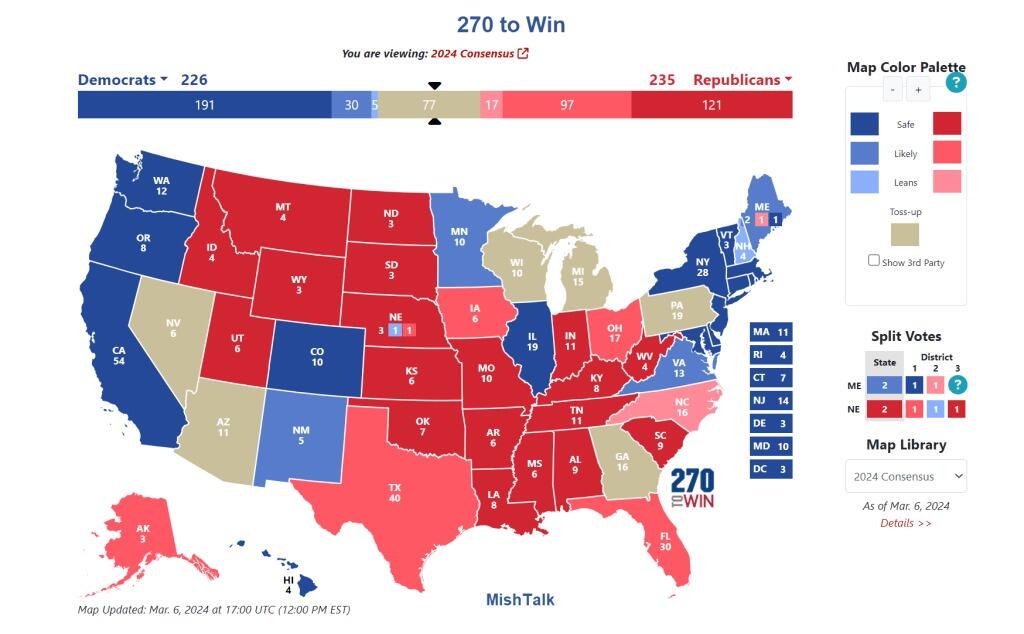
270-to-Win

The website 270-to-Win has North Carolina in the Trump column and so do I. It would be very difficult for Trump to win without NC.

Pennsylvania is Key

If Trump won Pennsylvania and Georgia, that would put him at 270. Some interesting possibilities could lead to a 269-269 tie.

If Trump wins Pennsylvania and Michigan and the rest of the tossups go to Biden, we would have a 269-269 tie.

We could also get a tie if Trump won Pennsylvania and Arizona, and pulled off an upset in New Hampshire.

270-to-Win Explains Ties

If neither candidate gets a majority of the 538 electoral votes, the election for President is decided in the House of Representatives, with each state delegation having one vote. A majority of states (26) is needed to win. Senators would elect the Vice-President, with each Senator having a vote. A majority of Senators (51) is needed to win.

State House delegations can cast their vote for president from among the three candidates receiving the most electoral votes, while Senators are limited to the top two candidates in their vote for Vice-President.

It is important to note that an apparent tie when all the states are called does not mean that there is actually a tie. The Electors meet on December 17, 2024 (the first Tuesday after the second Wednesday in December) to cast their votes. Only about half the states have laws requiring their Electors to vote for the popular vote winner.

It is possible that an Elector could cast his or her vote for another person. We saw that in the 2016 election, when seven Electors were ‘faithless’.

As of late September, 2023, Republicans hold a 26-22 edge in House delegations. Two states, Minnesota and North Carolina, are evenly split.

However, it is the members of Congress elected in November, 2024, and seated in January, 2025 that would take on this responsibility.

As is sits now, Republicans hold 26 states so Trump would be president. The Senate could conceivably pick Biden as VP.

Imagine that.

I expect Republicans will win the Senate. So ponder the reverse: Democrats win a majority of state delegations but Republicans win the Senate. Biden is president and Trump is Biden’s VP.

Also ponder a 269-269 tie in which an elector does not vote as designated. In 2016, seven didn’t.

If that were to happen again, it would take a preliminary 277 for a majority. That means Trump would need Pennsylvania, Georgia, and at least one more state.

Yikes. This can easily get very messy constitutionally.

Does anyone sense we need a change?

Tyler Durden
Wed, 04/03/2024 – 13:25

via ZeroHedge News https://ift.tt/phOneYZ Tyler Durden