US Needs Ukraine As Anti-Russian Buffer Territory: Kremlin

US Needs Ukraine As Anti-Russian Buffer Territory: Kremlin

A top Kremlin official has accused the United States and its NATO partners of seeking to turn Ukraine into essentially a huge DMZ buffer zone to separate Russia from Europe.

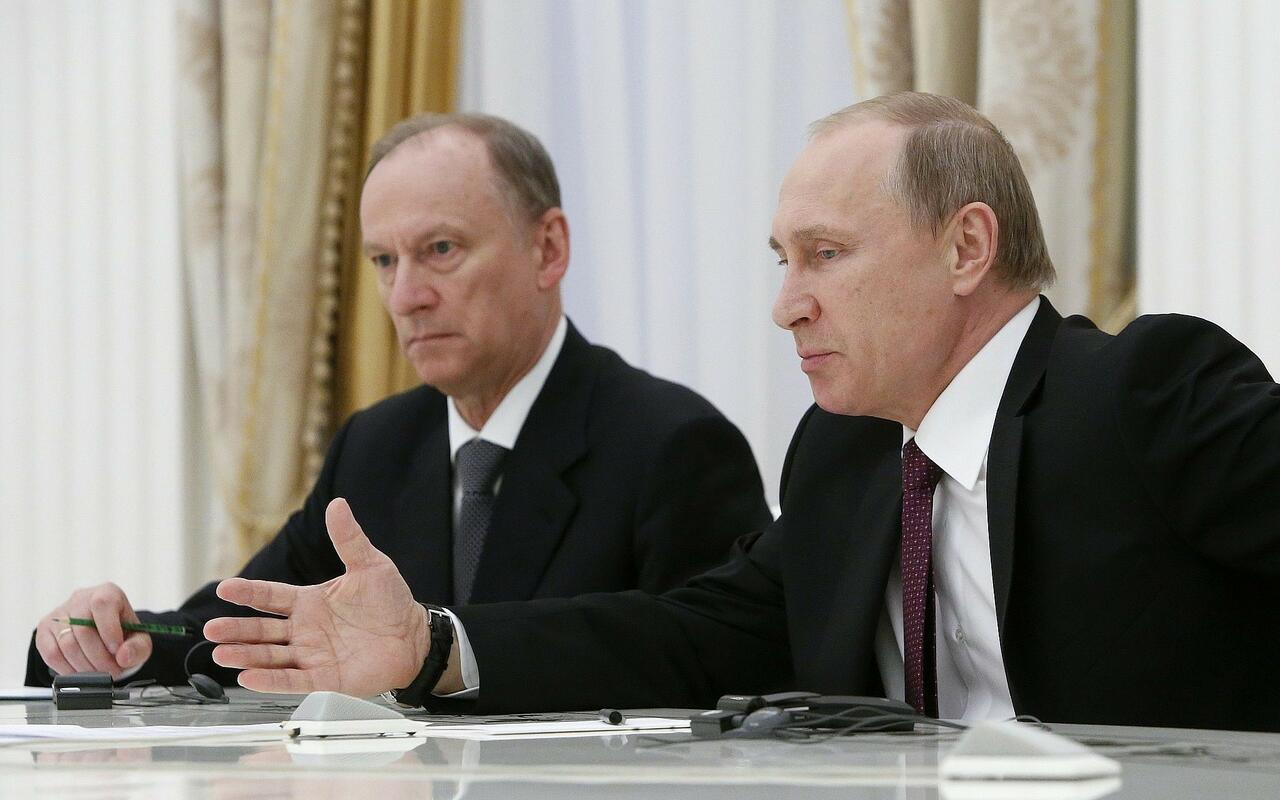
Russian Security Council Secretary Nikolay Patrushev said in a state media interview Tuesday that the goal of demilitarizing Ukraine is still high on the agenda for the country’s special military operation. He emphasized fulfilling this aim is crucial as the US needs Ukraine as “anti-Russian territory”.

Russian President Vladimir Putin, right, flanked by Security Council Secretary Nikolai Patrushev, via AP

“The United States and NATO nurture plans to keep Ukraine or at least part of it as anti-Russian territory wholly controlled by them [and] focused on serving the interests of the North Atlantic bloc,” Patrushev said.

He further charged that the North Atlantic military alliance “is de-facto a party to the Ukraine conflict.” NATO “makes collective decisions on new deliveries of weapons with higher technical and longer-range capabilities.”

Patrushev further described that NATO “trains mercenaries and saboteurs for anti-Russian operations” — an accusation which comes at a moment the Kremlin is probing potential Ukraine or US links to the March 22 Crocus City Hall terror attack which left at least 140 dead and hundreds wounded and injured.

Additionally, almost daily cross-border drone attacks continue out of Ukraine, targeting chiefly energy infrastructure but also civilian settlements and busy city areas.

“In this situation, the goals of demilitarizing Ukraine are high on the agenda,” the high level Russian security official stressed. He said in the interview that Ukraine’s militarization by the West started in earnest following the coup events of February 2014. But he also noted NATO expansion in eastern Europe has been heavy since especially 2004.

“NATO has been holding drills on Ukrainian soil since 1995 and Kiev has granted the military alliance free access to its territory since 2004. Ukraine’s intensified militarization began following the state coup in February 2014,” Patrushev said, as translated in TASS.

Meanwhile, by all appearances Russia is busy preparing to continue pursuing the ‘demilitarization’ of Ukraine, with the defense ministry having announced Wednesday that over 100,000 citizens have newly signed up to fight as contract soldiers.

“Over the past week and a half, recruitment points have seen a significant increase in the number of people interested in signing contracts with the Russian Defense Ministry in order to take part in the special military operation,” the ministry said.

Tyler Durden
Wed, 04/03/2024 – 13:05

via ZeroHedge News https://ift.tt/L4aczlI Tyler Durden

Why Saudi Arabia’s futuristic city is a sign of major inflation to come

Did you hear about the new streamlined tourist visa to Saudi Arabia? I’m sure you’re standing in line for it already.

No? Me neither.

I was actually stationed in Saudi Arabia for a while when I was in the Army… and, the most unique ‘tourist’ attraction, at least for non-Muslims, is a place we used to call “Chop Chop Square” where they would do the public beheadings and dismemberments of convicted criminals.

Aside from that, Saudi has virtually nothing to offer tourists. At least for now.

But over the past few years the government has set itself on a path to building massive futuristic cities and giant resorts in an effort to bring tourists and diversify its economy– including a recently streamlined visa process.

But to me, this screams of desperation… because it means that Saudi Arabia’s oil industry is in serious trouble.

As recently as just a century ago, what we know as ‘Saudi Arabia’ today was just a bunch of nomadic tribes roaming the desert who were constantly at war with one another.

Then one day a tribal leader named Abdulaziz Ibn Saud rose to power, a bit like Genghis Khan, and conquered everyone else. And in 1932, he declared himself sole ruler of the newly established Kingdom of Saudi Arabia.

Initially he wasn’t King of much at all; Saudi Arabia was mostly just a desert backwater in the early 1930s.

But things began to change quickly when a major oil discovery was made in early March of 1938. And over the years, Saudi Arabia’s prominence in the world grew dramatically.

By 1970, Saudi Arabia had overtaken the United States as the world’s #1 oil producer, with daily output more than tripling over the course of that decade to roughly 10 million barrels per day.

Ever since then there has been almost a Homeric mythology that Saudi Arabia has a sort of inexhaustible ocean of oil, and they could just turn on a spigot and fill up millions of barrels.

But that’s simply not true.

In fact, more than 40 years later, Saudi Arabia today produces less oil today than they did in 1980. And there has long been speculation that Saudi oil reserves might actually be running low.

Not long ago, in fact, the Saudi government announced that they would make investments in their oil infrastructure to increase their maximum production capacity to 13 million barrels per day… but nothing further.

In other words, they set a hard ceiling for how much oil they were capable of producing, essentially shattering the mythology of their infinite oil capacity.

Then, just two months ago, they reversed their plans, and announced that their maximum drilling capacity would be 12 million barrels, and not 13 million.

Both of these should have been taken as obvious indicators that Saudi Arabia’s oil reserves are well past their peak… and that they know it.

But there is perhaps no greater indicator than the Saudi government’s desperate attempt to give  its economy a gigantic sexy makeover.

For example, Saudi Arabia is building a ski resort in the desert mountains… where it occasionally dips below freezing in the winter. Then there’s Neom, the futuristic megapolis planned for the coast of the Red Sea featuring flying cabs and an artificial moon.

Then there’s The Line, a city stretching for 170 kilometers across the desert. And of course there’s the Red Sea Project, a luxurious resort the size of Belgium.

The more Saudi Arabia launches these sorts of projects, the more obvious it becomes that they are running out of oil and are desperately trying to diversify their economy while they still have time.

The fact that Saudi Arabia even started selling off small pieces of its state-owned oil company, Saudi Aramco, back in late 2019 is another indicator.

They could have IPO’d in 1988… or 2005… or any other time. But they didn’t. It seems like they know they’re in decline, and they’re trying to monetize the mythology of their oil reserves while they still can.

Now, Saudi Arabia isn’t going to run out of oil anytime soon; rather, the larger point is that supply and demand fundamentals will likely lead to much higher oil prices in the future.

And this is very inflationary.

Oil is the most important energy commodity in the world, and so its price influences the price of just about everything. If oil price spike, then it’s not just the price of gasoline that goes up.

The cost of operating data centers with racks of servers and GPUs will increase. Food costs will increase. Manufacturing costs will increase. Virtually everything will increase in price.

Energy prices, like just about all prices, are ultimately about supply and demand. And the demand side is pretty easy to see— it will most likely continue increasing as emerging economies and global population grow.

Yes, there may be a time off in the future where oil is no longer necessary. But that’s still a long way out. Because guess what critical commodity you need to produce solar panels and wind turbines? Oil.

Meanwhile, on the supply side, it’s clear that one of the world’s biggest oil producers is in decline. At a minimum, they won’t be able to increase production commensurate with the increase in demand. And they’ve flat out admitted to that.

Meanwhile, another of the world’s biggest oil producers, the United States, is going out of its way to obstruct oil companies.

They create special taxes to penalize them. They refuse to follow the law and auction off concessions. They never miss an opportunity to demonize them.

Even in the financial industry, bankers and investors deprive the industry of the funds necessary for exploration. Hedge funds have taken over the Boards of major oil companies and forced them into inefficient green energy projects.

The United Nations hosts entire summits about phasing out oil production.

And let’s not forget about the fanatics who vandalize art museums and glitter bomb public sporting events to demand that the world “just stop” producing oil.

So, we have rising demand coupled with policies that restrict supply. The end result, predictably, has been rising oil prices, which are now hovering around $85-$90.

This is one of the reasons why the inflation numbers remain high; again, expensive energy impacts core inflation.

I write a lot about why we think the future is inflationary, and a lot of it has to do with the tidal wave of debt and government spending.

But that’s just one source of inflation. Higher energy prices are another.

Like the debt problem, however, the energy problem is also solvable. There’s plenty of oil in the world– the issue is just misguided policy. There are also other technologies (like nuclear) which can provide abundant, cheap, clean energy.

There doesn’t seem to be much appetite among the environmental fanatics who enjoy complaining, but not actually solving any problems.

Now, one way to offset this oil cost inflation is to own shares of the oil companies themselves; and right now, several of them that are very cheap since it’s apparently not socially acceptable to own them.

In our investment research newsletter the 4th Pillar, we highlighted a highly profitable oil producer that is practically debt-free, and trading at a very attractive Price/Earnings ratio of just 3.4.

The company was able to turn a strong profit when oil prices were low, and they’re positioned to do extremely well as oil prices go higher.

Of course, no one can be happy about the prospect of future inflation.

But there are solutions. And if you understand what’s likely coming, you can take steps now to reduce the impact or even potentially benefit from inflation.

Source

from Schiff Sovereign https://ift.tt/62K8ynZ
via IFTTT
What Will The Fed Do When Trump Wins And Slams China With 60% Tariffs

What Will The Fed Do When Trump Wins And Slams China With 60% Tariffs

By Michael Every of Rabobank

Have you got the energy?

Yesterday, Bloomberg noted ‘Fears of 5% Yields Are Back, Thanks to Oil’s Surge’. We are over a quarter into a year in which we were promised rapid, wall-to-wall rate cuts, but so far only the Swiss have proved punctual: now we are threatened with higher long yields to boot?

Yes, the Fed’s Daly underlined she still sees 3 cuts this year, even if “a projection is not a promise,” and the same tone has been struck by almost all central banks. Yet Mester raised her long-run Fed Funds forecast from a “long-time” view of 2.5% to 3.0% (and ruled out cutting in May, which the market wasn’t thinking about as odds of a June cut start to fall back).

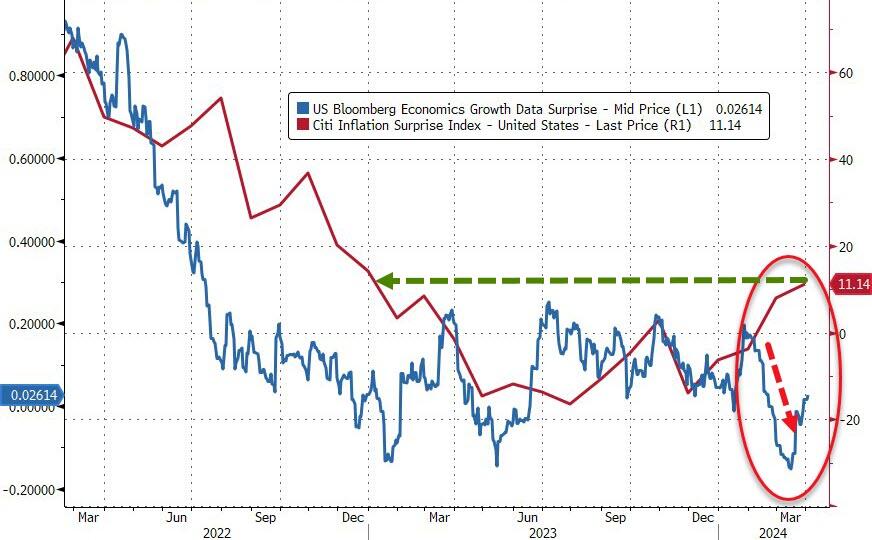
In the US, we have persistently strong labour market data (for all the questions over it); sticky core CPI trending higher, not lower; PPI doing the same; and financial conditions that say ‘buy all the things’; and now ISM manufacturing back above 50, with new orders and prices paid not backing goods deflation. Let’s see what the services ISM employment index says today.

European and UK data are less ebullient, even if stocks aren’t, but today’s Eurozone CPI data will underline both goods deflation and services inflation far above the 2% CPI target level. How will the latter come down absent an economic downturn more dramatic than one requiring just a few rate cuts, which themselves should logically push it back up again?

Now back to Bloomberg’s “5%” headline as Brent sits at $89 this morning, the highest level since last October: is it really all about energy at the end of the day? There’s a scientific and philosophical case to be made that it is, even if it fuels resistance from everyone paid to look at everything but energy. However, it’s complicated. The Financial Times underlines that solar panels are now so cheap they are being used as fences in Europe… because the cost of labor has gone through the roof, so installing panels them there is uneconomic. In short, you have cheap energy *and* high inflation.

  • You don’t need to be an energy expert to see a cyclical manufacturing upturn would mean energy demand moves higher, while supply is being deliberately limited by OPEC+.

  • You don’t need to be a Middle-East expert to see geopolitical risks are high: and as that region sadly often proves, things can still get much worse.

  • You don’t need to be a Russia-Ukraine expert to see geopolitical risks are high: and, as we predicted, Ukraine has continued to use drone attacks against Russian oil refineries. The latest took out Russia’s third-largest facility 800km away in Tatarstan. While Russia says it doesn’t need to reduce diesel exports for now, how many more refineries need to be struck before that happens? Because, logistically and logically, refineries are going to keep being struck.

  • You don’t need to be a China expert to see the read-between-the-lines-out of the latest telephone call between Xi and Biden was focused on Taiwan, which is another geopolitical flashpoint (and a physical one given the earthquake and tsunami warning we just saw there). And is there is a link between that Xi-Biden call and US Treasury Secretary Yellen suddenly announcing she will be in China from April 4-9? Perhaps she’s just looking for more ‘shrooms?

Have you got the energy to keep tracking what you should be tracking in order to track what you think you should be tracking?

Next to Godleyness

Meanwhile, Bloomberg echoes our Fed Watcher Philip Marey in saying a 60% Trump China tariff and a 10% universal tariff could reduce US GDP by 0.5% and push the PCE deflator to 3.7% by end-2025. That should wake a few people in markets up.

Yet their static neoclassical model doesn’t consider Trump might also cut taxes on production to zero and introduce a federal sales tax, which could imply a very different dynamic outcome. Combined, that combination could theoretically shift the US economy away from imported consumption towards domestic production; and even if the US household consumption share of GDP goes down, GDP itself could go up by more as we see a domestic productive investment boom, so US consumers are still better off overall. In short, that would be inflationary growth for the US, and deflationary no-growth for exporters to it.

In short, these Godley balance-sheet ramifications matter as much as energy for markets. However, traditional economic analysis does not consider this approach, so keeps ending up in an unGodley mess that is now pushing us to conflated structural inflection points as the global system breaks down.

What’s the Fed supposed to do, if these Trump tariffs and tax cuts happen? And do other central banks celebrate their neoclassical deflation ‘win’? I don’t think so.

QE and negative rates were a first, doomed-to-fail response to our global problems, as Kalecki had said they would be in 1943. Now we may see the next logical step, flagged here in 2015: reflation behind trade barriers, with all the concomitant volatility and geopolitical tensions.

Indeed, please read ‘Car dealers will decide America’s future: The nation’s gentry could finish Trump’s revolution’. It underlines how the US political economy might work from the grassroots up to link back to the themes most only look at in silos: populism, trade imbalances, EVs/green, US-China relations, asset prices, and the US dollar’s role in our current and any new global paradigm.

If you thought QE moved markets, wait and see what happens if and when structural global imbalances built up over decades start to unwind. The best way to keep clean hands through that mess is to stand close to Godleyness.

Tyler Durden
Wed, 04/03/2024 – 12:05

via ZeroHedge News https://ift.tt/IgWm52p Tyler Durden

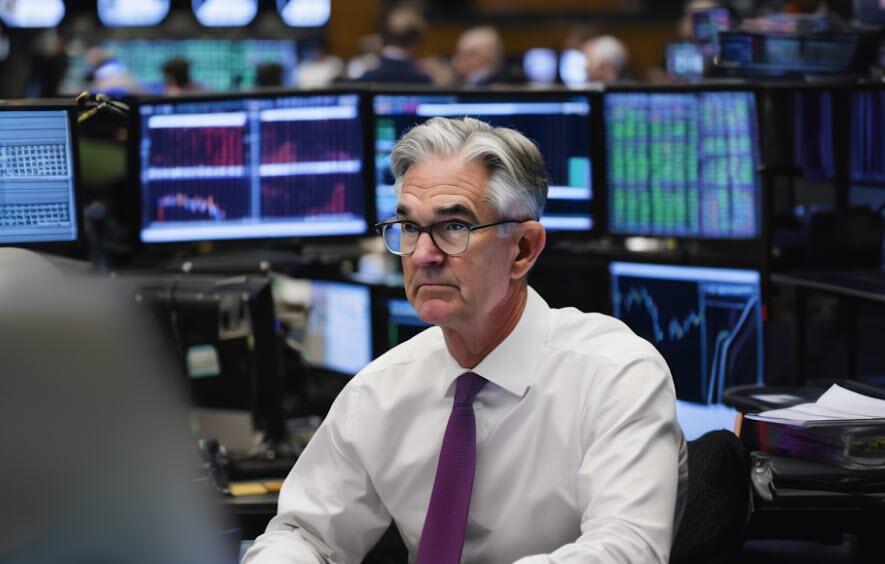
Watch Live: Fed Chair Powell Speaks On The Economic Outlook

Watch Live: Fed Chair Powell Speaks On The Economic Outlook

Fed Chair Powell is likely to hammer home the message that rate-cuts are coming but not just yet in a keynote address at Stanford University this afternoon. His remarks follow an endless parade of his peers also jawboning market expectations down (successfully) to the point where the market is now more hawkish than The Fed’s latest dots.

Fed’s Bostic was the latest to speak; reiterating his view this morning that more time is needed to confirm the disinflationary path and that he expects only one rate-cut this year.

“I think it will be appropriate for us to start moving down at the end of this year, the fourth quarter,” Bostic said in an interview with CNBC.

“If that trajectory slows down in terms of inflation, then we’re going to have to be more patient than I think many have expected.”

Additionally, on the anniversary of SVB and the regional banking crisis, Fed Governor Michelle Bowman warned that the central bank should weigh whether discount-window borrowing capacity should be recognized in reviews of lenders’ liquidity resources.

Last week Powell said there is no rush to ease monetary policy.

He is likely “to remain consistent,” AmeriVet’s Gregory Faranello says in a note. “Perhaps he gets more granular.”

Faranello expects the chairman to “stick to the notion on monetary policy that ‘at some point this year’ it will be appropriate to begin lowering rates.”

Treasury yields are rising ahead of the speech and rate-cut odds fading.

The Fed could risk losing its credibility if it cuts interest rates too soon.

“Jerome Powell said very early on he is a student of what happened in the seventies,” according to Eric Veiel, chief investment officer and head of global investments at T. Rowe Price Group Inc.

“If they go ahead and start cutting now, I think they are in danger of making the same mistake.”

So Powell has lots of potential points to make today, but as many expect, he will carefully walk the tight-rope between being too positive about the economy, overly worried about inflation re-igniting, and avoiding the appearance of politicization – cutting rates in an economy that (based on aggregate data) is firing on all cylinders… with  inflation expectations surging…

Watch Powell speak here (due to start at 1210ET)

Tyler Durden
Wed, 04/03/2024 – 11:50

via ZeroHedge News https://ift.tt/qiaWoMJ Tyler Durden

Jack Smith Slams Federal Judges’ “Fundmentally Flawed Legal Premise” In Trump Case, Warns Of Consequences

Jack Smith Slams Federal Judges’ “Fundmentally Flawed Legal Premise” In Trump Case, Warns Of Consequences

Authored by Zachary Steiber via The Epoch Times,

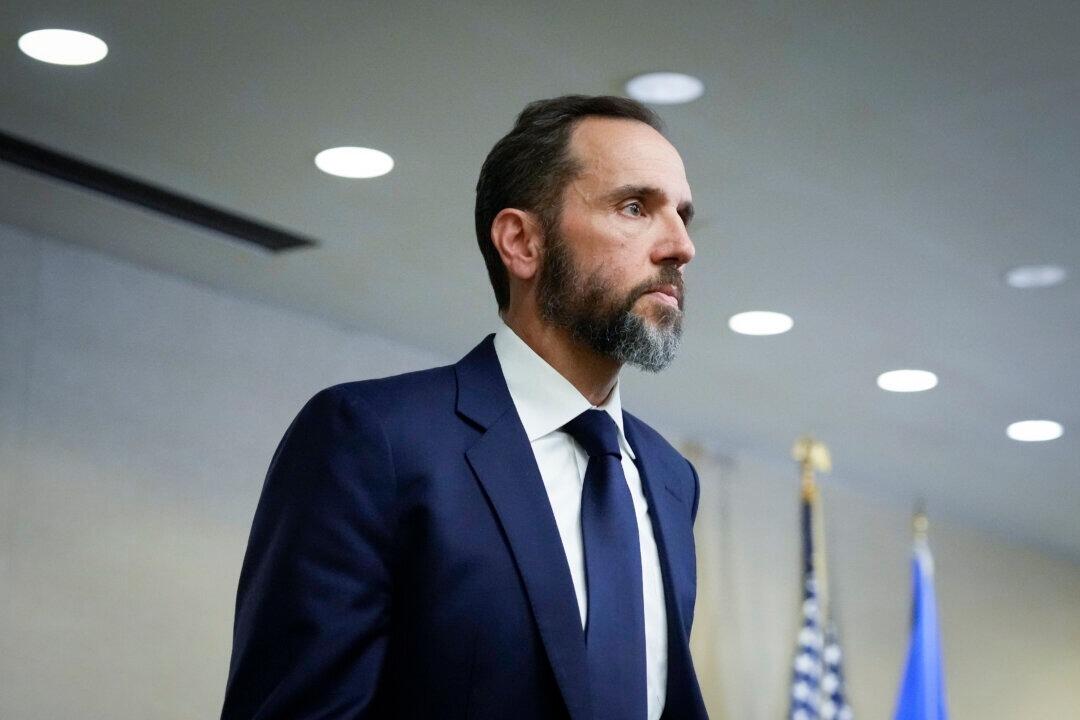
The federal judge overseeing former President Donald Trump’s classified documents case in Florida needs to clarify recent instructions to parties so the government can seek a higher court ruling, special prosecutor Jack Smith said late April 2.

In March, U.S. District Judge Aileen Cannon, who was appointed by President Trump, ordered prosecutors and the defendant’s lawyers to file proposals for jury instructions.

The parties must offer “alternative draft text” that assumes two “competing scenarios” are “a correct formulation of the law to be issued to the jury,” she wrote.

The scenarios are former presidents being able to retain personal records under the Presidential Records Act (PRA), and presidents being able to designate records as personal.

But both scenarios rest on a “fundamentally flawed legal premise,” Mr. Smith and his team wrote in the new filing.

The distinction in the PRA between personal and presidential records is irrelevant because President Trump has been charged under the Espionage Act, prosecutors said.

“Based on the current record, the PRA should not play any role at trial at all,” they wrote, urging Judge Cannon to “decide whether the unstated legal premise underlying the recent order does, in the Court’s view, represent ‘a correct formulation of the law.’”

If Judge Cannon wrongly decides that it does, the filing states, then the government may seek intervention from a higher court.

They cited a ruling by an appeals court in a separate case that concluded, “the adoption of a clearly erroneous jury instruction that entails a high probability of failure of a prosecution—a failure the government could not then seek to remedy by appeal or otherwise—constitutes the kind of extraordinary situation in which we are empowered to issue the writ of mandamus.”

A writ of mandamus is an order to a lower court.

“The question of whether the PRA has an impact on the element of unauthorized possession … does not turn on any evidentiary issue, and it cannot be deferred,” prosecutors said. “It is purely a question of law that must be decided promptly. If the court were to defer a decision on that fundamental legal question it would inject substantial delay into the trial and, worse, prevent the government from seeking review before jeopardy attaches.”

President Trump, charged with 32 counts of violating the Espionage Act for retaining what the government described as national defense documents and other sensitive materials after his presidency, has stated that under the PRA, he could designate even classified records as personal and retain them upon leaving office.

“There is no basis for the special counsel’s office, this court, or a jury to second-guess President Trump’s document-specific PRA categorizations,” his lawyers wrote in a separate filing on April 2.

Proposed jury instructions from President Trump said that to establish unauthorized possession of the records in question, “the government must prove beyond a reasonable doubt that the document you are considering is a ‘presidential record’ and not a ‘personal record.’”

“Before the end of President Trump’s term in office on January 20, 2021, President Trump had exclusive authority under the Presidential Records Act to, himself or in working with his staff, categorize records as either ‘presidential records’ or ’personal records,’ and he was authorized to possess both types of records,” the proposed instructions state.

In proposed instructions from prosecutors, jurors would be told that possession of classified records is unauthorized if a person “does not hold a security clearance or the individual does not have a need to know the information.”

“I instruct you, however, that, as to a former president, even if he lacks a security clearance, lacks a need to know classified information, and stores information outside of a secure facility, he is authorized to do so if the classified information is contained within a ‘personal record,’ as that term is defined by the Presidential Records Act (PRA), a statute that establishes the public ownership of presidential records and ensures the preservation of presidential records for public access after the termination of a president’s term in office,” the instructions state.

“Therefore, to determine whether the defendant had ‘unauthorized possession’ of the documents charged in Counts 1-32, you must determine whether each document was a ‘presidential record’ or a ‘personal record’ within the meaning of the PRA.”

Prosecutors said they were offering the draft instructions to comply with Judge Cannon’s order even as they protested against the premise.

Tyler Durden
Wed, 04/03/2024 – 11:30

via ZeroHedge News https://ift.tt/W7EGF20 Tyler Durden

Billionaire Steve Cohen Sees “Four-Day Work-Week” Coming… & More Golf (& QE)

Billionaire Steve Cohen Sees “Four-Day Work-Week” Coming… & More Golf (& QE)

In one of his rare public appearances, billionaire hedge fund manager (and New York Mets owner) Steve Cohen told CNBC’s Andrew Ross Sorkin this morning that he expects more and more businesses to move to a four-day work-week in the coming years.

“My belief is that a four-day work week is coming,” Cohen, the founder of Point72 Asset Management said in his first-ever interview on CNBC.

“That fits into a theme of more leisure for people.”

Cohen points to a number of factors driving this shift, including the advent of artificial intelligence, and the fact that – post-COVID – more companies allowing hybrid working means “that people are not as productive on Fridays.”

And this thesis supports his major investments in the golf industry.

Specifically, Bloomberg reports that Cohen is part of a consortium that recently invested up to $3 billion in an entity being formed by the PGA Tour and Saudi Arabia’s Public Investment Fund.

The deal, with fellow billionaires including Marc Lasry and Milwaukee Brewers owner Mark Attanasio, is in a new commercial entity that is set to boost prize money for players.

Cohen is also a team owner in a new simulator-based golf league funded by Tiger Woods and Rory McIlroy.

Ironically, Cohen said he’d keep his own traders and portfolio managers working five days a week.

“Taking off Friday when you have a portfolio – that would be a problem,” he said.

So no golf for the PMs.

Cohen may well be right – as all the social narratives are shifting this way – and as Goldman Sachs assuredly explained:

Applying our estimated global labor productivity boost to countries in our coverage implies that widespread AI adoption could eventually drive a 7% or almost $7tn increase in annual global GDP over a 10-year period. Although the size of AI’s impact will ultimately depend on its capability and adoption timeline—and uncertainty around both of these factors is sufficiently high that we are not incorporating our findings into our baseline economic forecasts at this time—our estimates highlight the enormous economic potential of generative AI if it delivers on its promise.

True: there is “enormous economic potential” … as long as the world survives the revolution that will follow the layoffs of 300 million people.

But the consequences of such a seismic shift in America’s way of life would have serious consequences.

Not the least of which is a need for UBI (Universal Basic Income) handouts to fill the pockets of those ‘less productive’ (read soon to be unemployed) people so they can buy their iPhones (and play golf?) and not burn-the-system down in a revolution.

UBI, of course, is playing right into the hands of the Cloward-Pivens chaos-creators, forcing more and more of the population to become entirely dependent on a benevolent government (as long as you vote the ‘right’ way)… and to fund that spiraling government debt, The Fed will need to ‘enable’ trillions in QE every year.

More debt >> More QE >> more inflation >> weaker dollar >> lower standard of living >> higher UBI >> more debt…

Buy gold and bitcoin.

Tyler Durden
Wed, 04/03/2024 – 11:10

via ZeroHedge News https://ift.tt/1vRMs9T Tyler Durden

Inflation-Risk Latecomers Pile Into Silver

Inflation-Risk Latecomers Pile Into Silver

Authored by Simon White, Bloomberg macro strategist,

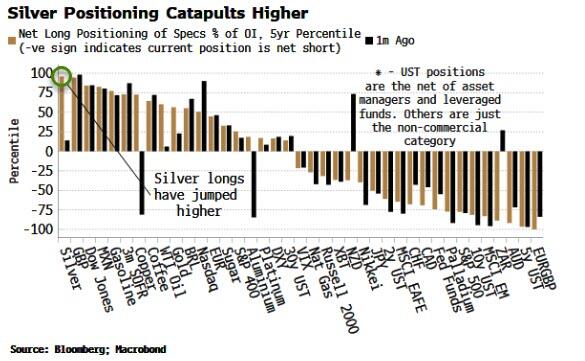
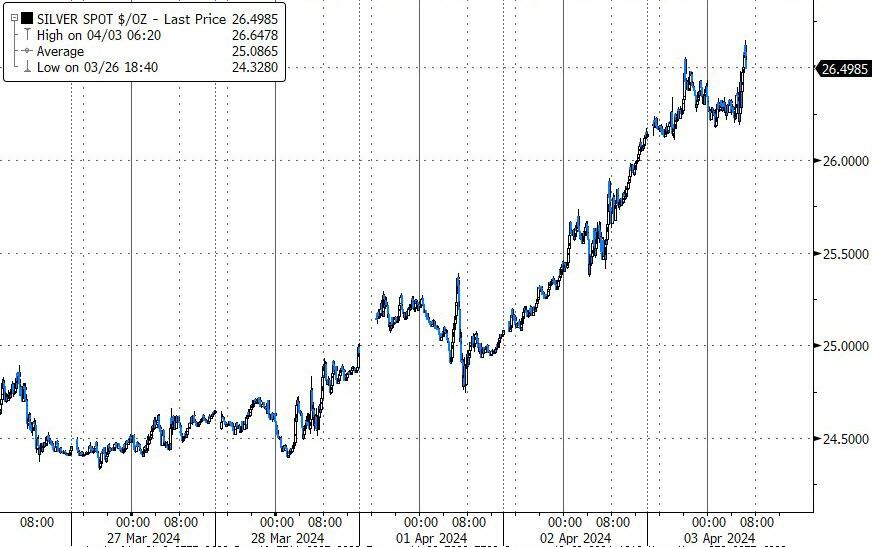
As gold makes new highs, speculators’ net longs in silver are jumping higher.

Inflation and global growth risks – as well as demand from China – are helping to drive gold to new all-time highs. For those late to the trade, silver is serving as the next best thing.

Silver remains well off the highs it reached in 1980 (the Hunt brothers’ infamous corner) and in 2011, and it is very cheap in comparison to gold.

That probably explains the surge higher in speculator net longs in silver, according to the Commitment of Traders data.

Silver positioning, from being nearly flat a month ago, is now near five-year highs, and longer on a percentile basis than any other major bond, equity or commodity future.

Silver is notoriously volatile, and if speculators are correct in their view, the gains could be rapid and large.

It’s up today over 9% in the last few days, topping its recent high of ~$26.

Tyler Durden
Wed, 04/03/2024 – 10:50

via ZeroHedge News https://ift.tt/L7QPJEh Tyler Durden

WTI Dips After Surprise Crude Inventory Build

WTI Dips After Surprise Crude Inventory Build

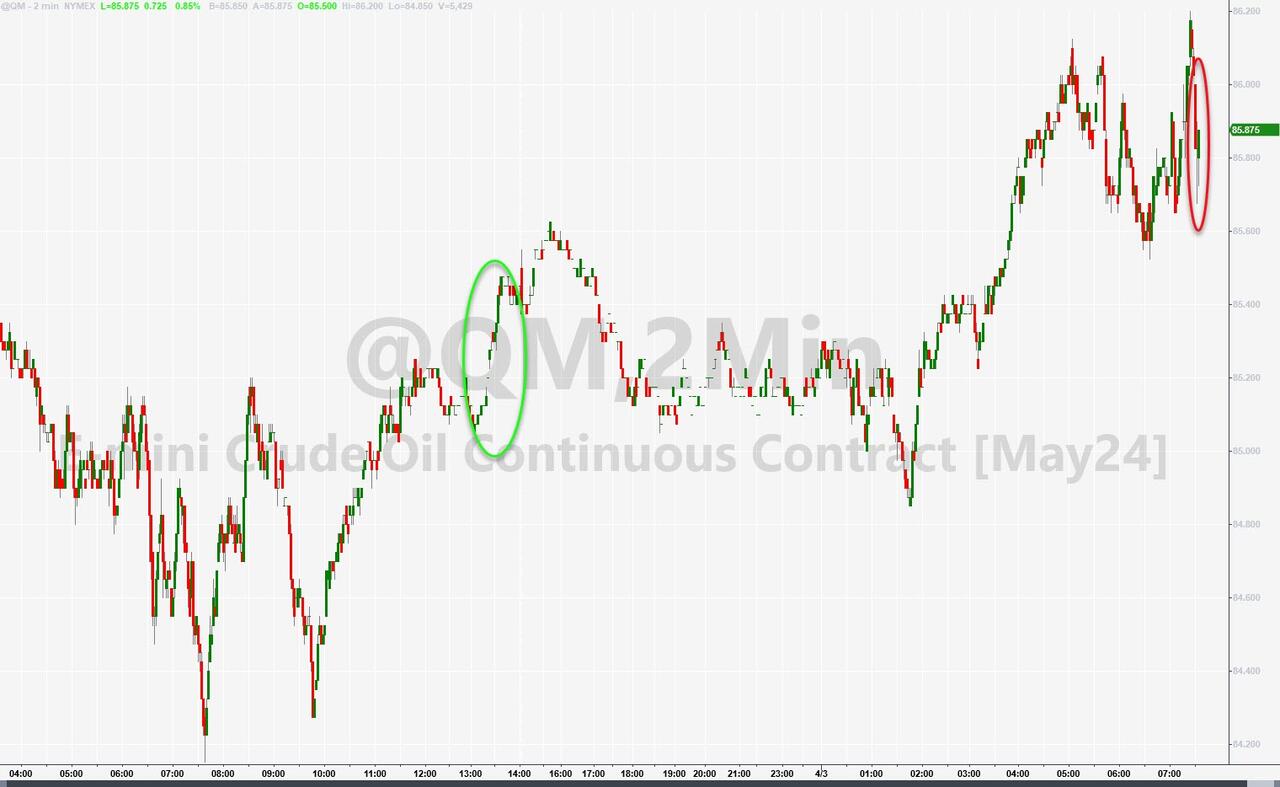
Oil prices are extending gains to new cycle highs (WTI $86) ahead of the official inventory data (after API reported across the board draws).

The move followed reports that OPEC+ chose to stick with oil supply cuts for the first half of the year, keeping global markets tight and potentially sending prices higher.

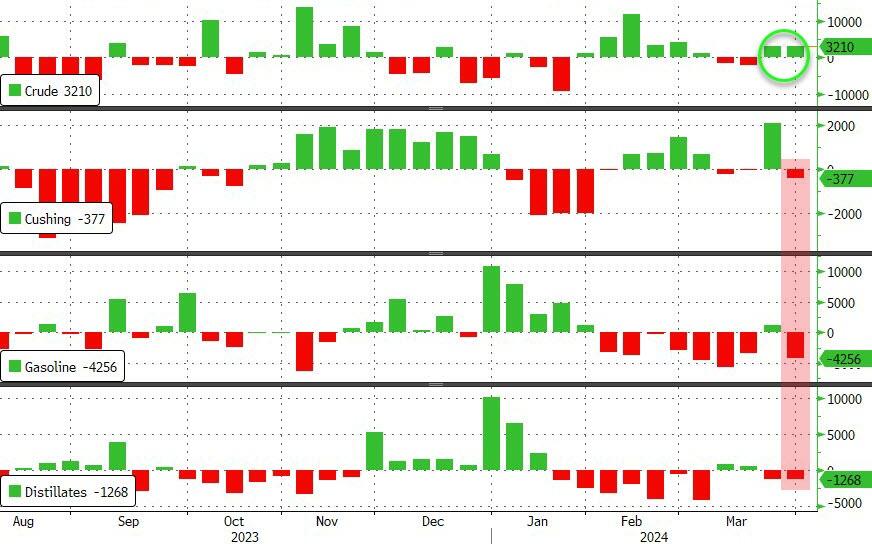
API

  • Crude -2.29mm

  • Cushing -751k

  • Gasoline -1.46mm

  • Distillates -2.55mm

DOE

  • Crude +3.21mm

  • Cushing -377k

  • Gasoline -4.26mm

  • Distillates -1.27mm

The official data surprised with a crude inventory build (API draw) but product draws continued…

Source: Bloomberg

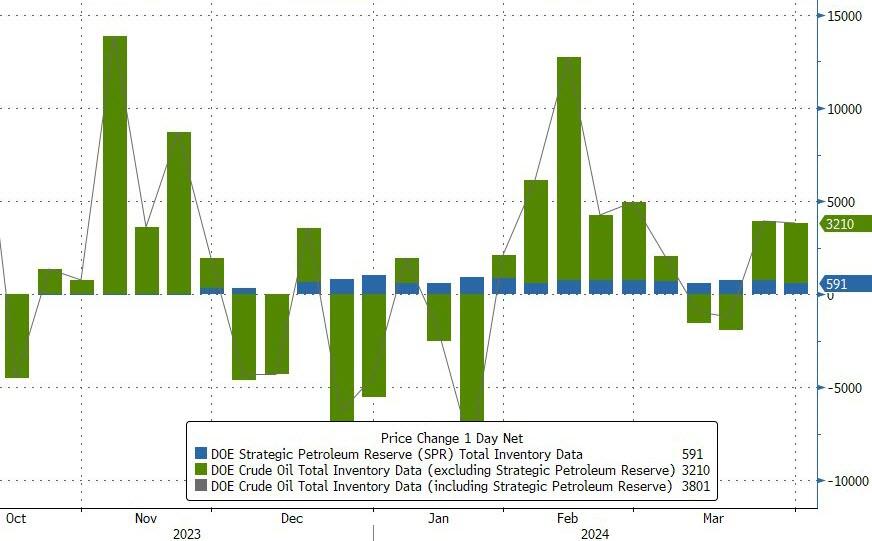
The Biden administration added 591k barrels to the SPR last week, but that might be it for a while as the Biden admin has now canceled new purchases (for taxpayers’ own good)…

Source: Bloomberg

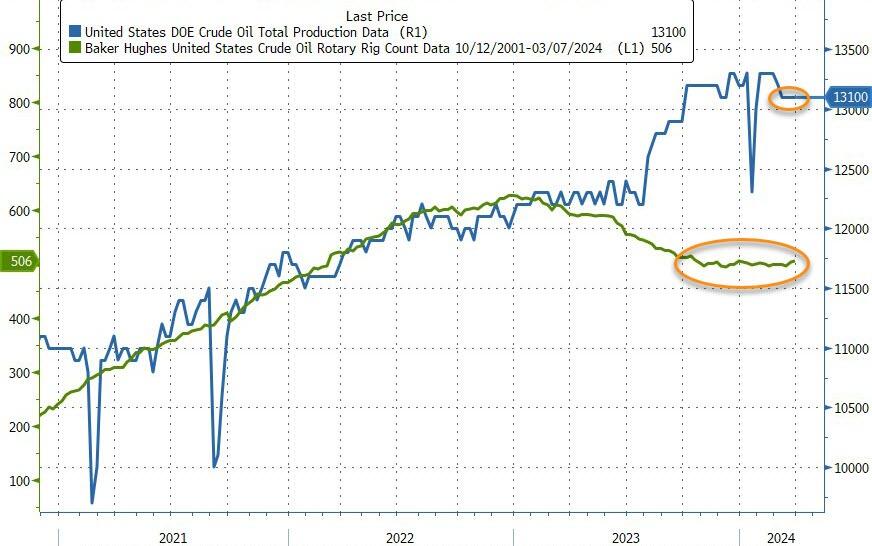
US crude production remained just off record highs…

Source: Bloomberg

WTI was trading at cycle high above $86 ahead of the official data and slide back below on the surprise build…

The market’s strength has also been reflected throughout the oil market curve.

“An escalation in tension in the Middle East has coincided with firmer oil fundamentals,” said Warren Patterson, head of commodities strategy for ING Groep NV.

“The market is tightening thanks to OPEC+ supply cuts, which is evident with the strength we have seen in timespreads.”

The US benchmark’s prompt spread has widened near $1 in backwardation, compared with as low as 54 cents three sessions ago. Meanwhile, the oil options market has flipped to a call skew, underscoring the magnitude of bullish sentiment for crude.

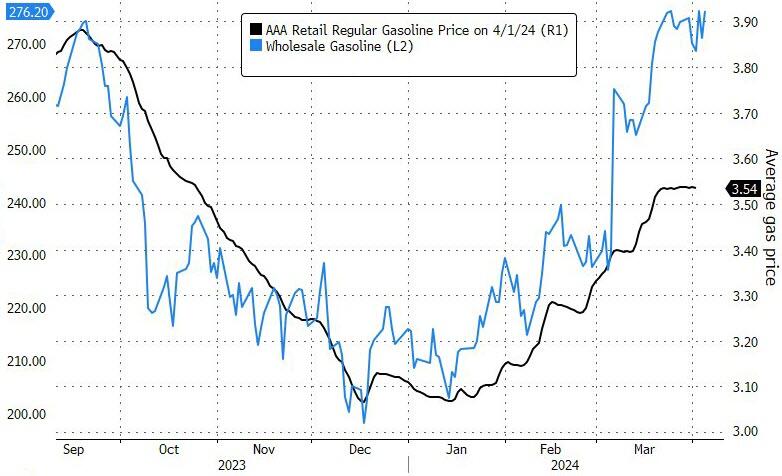
Meanwhile, pump prices remain near six-month highs as wholesale prices put increasing pressure to the upside…

Not good for Powell’s or Biden’s hopes.

Tyler Durden
Wed, 04/03/2024 – 10:40

via ZeroHedge News https://ift.tt/hpRd9xq Tyler Durden

Disney Reportedly Has Votes To Defeat Peltz’s Trian In Proxy Fight; Musk Throws Support Behind Activist Investor 

Disney Reportedly Has Votes To Defeat Peltz’s Trian In Proxy Fight; Musk Throws Support Behind Activist Investor 

Walt Disney Co. and Chief Executive Officer Bob Iger are set to defeat Nelson Peltz’s Trian Fund Management in a multi-month proxy battle, Bloomberg reports, citing people with knowledge of the matter. 

Enough votes had been cast as of Tuesday evening, including ones from Vanguard Group, BlackRock Inc., T. Rowe Price, Norges Bank Investment Management, ValueAct Capital Management, and retail investors to prevent Trian’s Peltz and former Disney chief financial officer Jay Rasulo from joining the company’s board. 

Trian had pushed for changes to management and strategy at the DEI-driven entertainment company to improve years of terrible performance. Just last year, the company suffered a series of movie flops, as one South Park episode explained very accurately that the woke mind virus is destroying the company’s media content.  

Peltz has said, “Disney is stupid because I’m not trying to fire [chief executive] Bob Iger; I want to help him.” He added, “We don’t fire CEOs.”

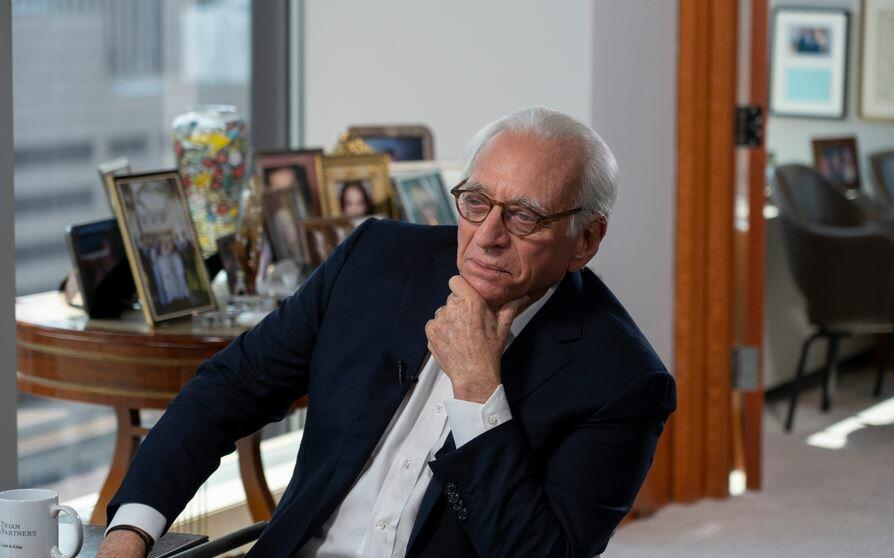
Nelson PeltzPhotographer: Calla Kessler/Bloomberg

The shareholder vote, slated for Wednesday, is the latest test for Iger, who returned to the helm in November 2022 to save the sinking ship.

Peltz has gained support from a group of current and former directors of major corporations, including Mondelez International Inc., Procter & Gamble Co., and Janus Henderson Group Plc. On Wednesday, the activist even won the support of Elon Musk. 

“Nelson Peltz should definitely be on the Disney board! He would help reform the company, improve the quality of product and generally serve in the best interests of shareholders, as he has done at many other companies. This would significantly improve Disney’s share price.” 

Musk continued, “While I don’t own any Disney shares today, I would definitely buy their shares if Nelson were elected to the board. His track record is excellent.” 

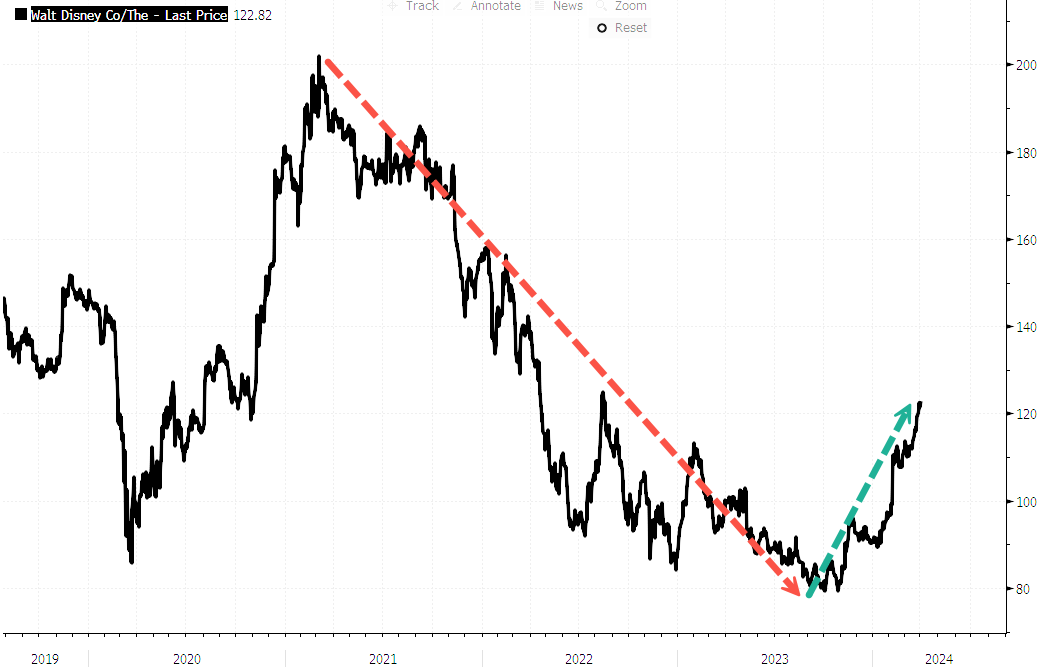
Disney shares have imploded since peaking above $200 in early 2021, recently bottoming around $80. 

In recent months, shares jumped more than 50% to $122 amid the proxy battle. 

Tyler Durden
Wed, 04/03/2024 – 10:15

via ZeroHedge News https://ift.tt/aF6JMkj Tyler Durden

WTF Is Going On With Services PMI Prices-Paid?

WTF Is Going On With Services PMI Prices-Paid?

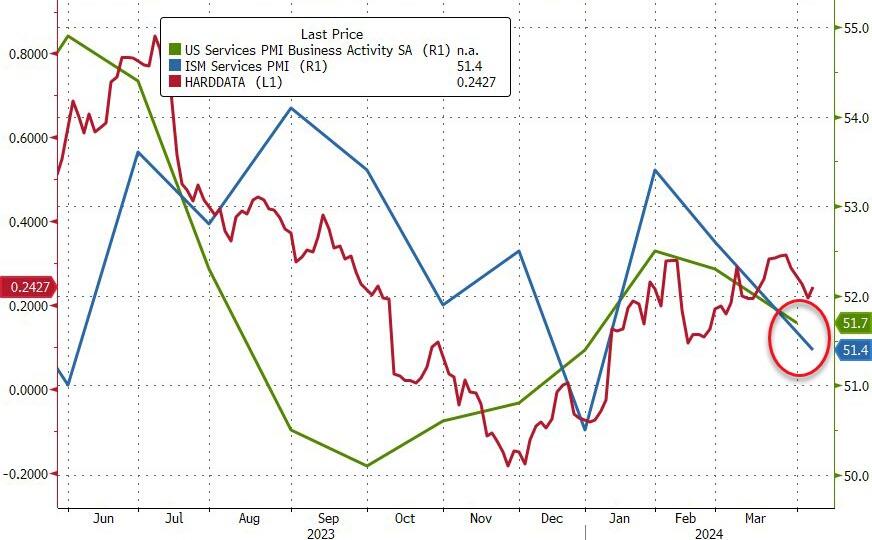
Following the mixed picture on Manufacturing PMIs (ISM up, S&P Global down), but strong impulse in prices in both surveys; today’s Services PMIs offered no more clarity at all…

  • S&P Global’s Services PMI printed 51.7 final for March (flat to the flash print) but down from February’s 52.3 – that is the lowest Services print since December
  • ISM’s Services PMI disappointed, printing 51.4 in March from 52.6 in February (and below 52.8 exp).

So both weak at the headline level (which fits with recent weakness in ‘soft’ survey data).

Source: Bloomberg

Chris Williamson, Chief Business Economist at S&P Global Market Intelligence, said:

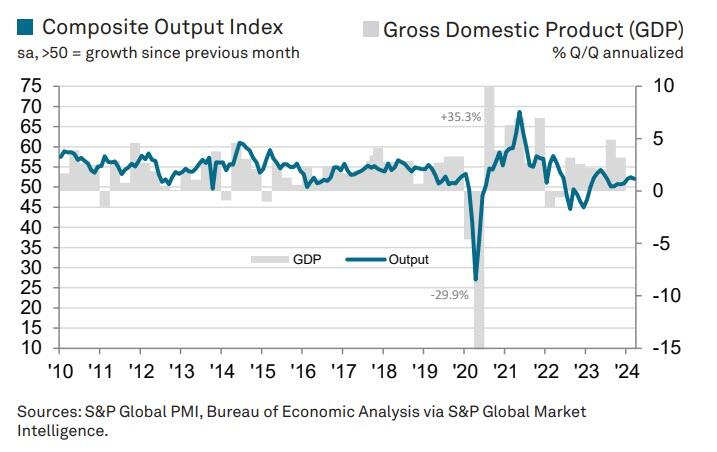
The US service sector reported a further rise in business activity in March, adding to signs that the economy enjoyed robust growth in the first quarter. Combined with an acceleration of growth in the manufacturing sector, the latest services PMI data point to GDP having risen at an approximate 2% annualized rate in the first three months of the year.

“Confidence in the outlook for the coming year has also lifted higher, which should help to sustain solid growth into the second quarter.

But there is a major problem looming for Powell and his pals…

The sustained upturn is being accompanied by renewed upward price pressures, however, with wage growth in particular driving costs higher.

Rising raw material and fuel prices are also adding to cost burdens, which is in turn driving average selling prices for goods and services higher at a rate not seen since July of last year.

Both manufacturers and services providers alike are seeing intensifying cost and selling price inflation rates, which is likely to feed through to higher consumer price inflation in the near term.

That surge in prices fits with a resurgent trajectory for wage growth (from ADP) but, as always, the data is there to baffle you with bullshit.

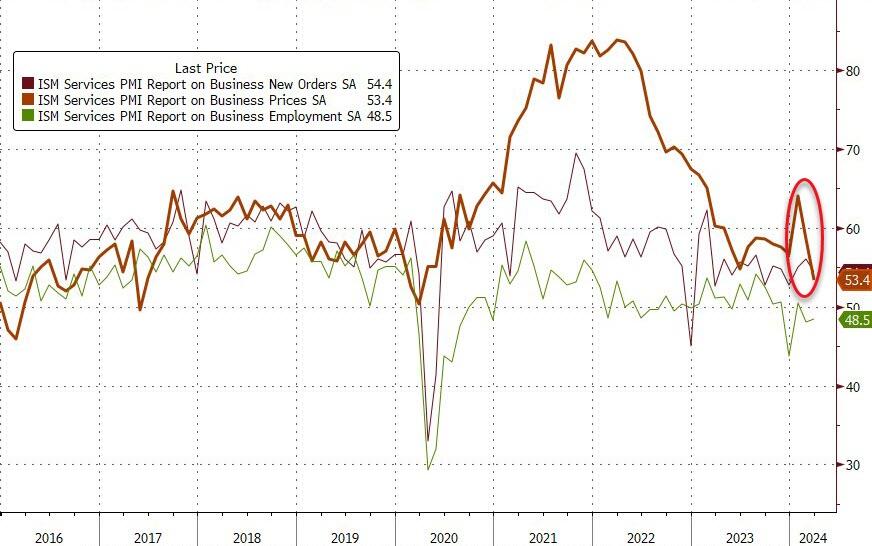
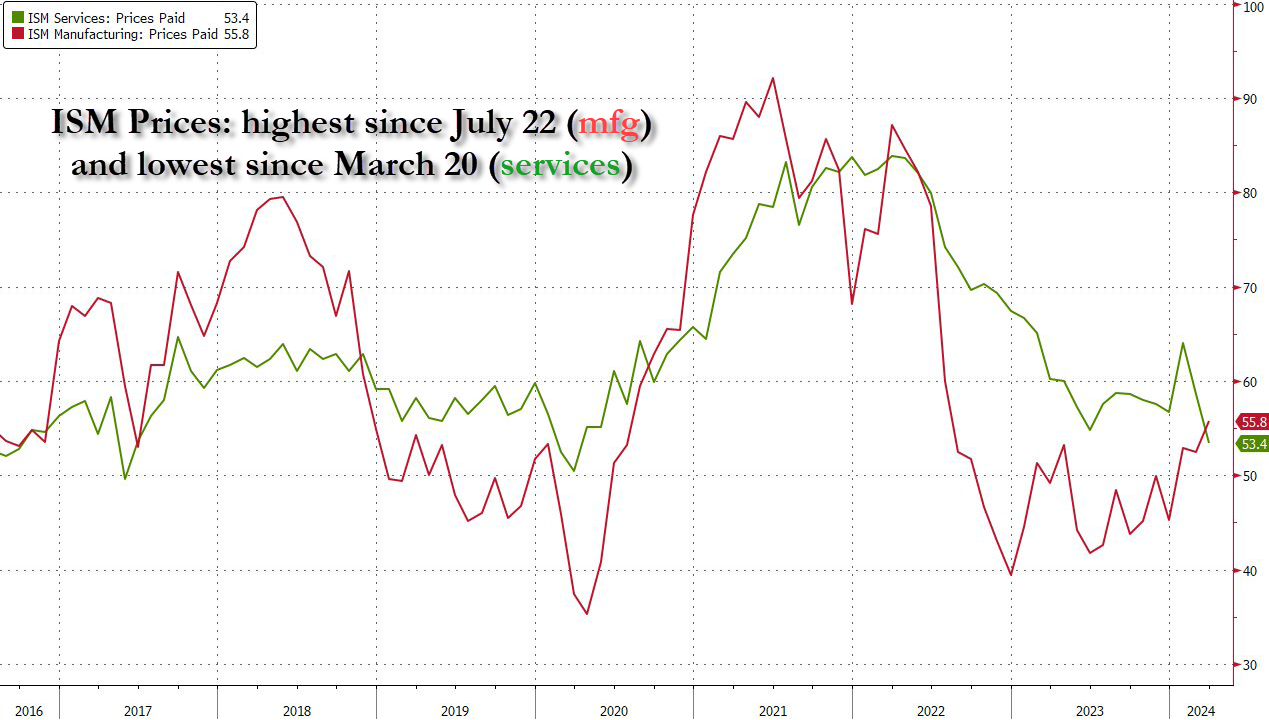
The ISM Service Prices Paid print plunged to 53.4… the lowest since March 2020…

So, take your pick: either Services prices are rising at the fastest pace since July (S&P Global)… or they are rising at the slowest pace since March 2020 (ISM).

Does this sound like prices are plunging?

Continued inflationary pressure across multiple clinical device categories as contracts expire or are renewed.” [Health Care & Social Assistance]

“Public opinion on the value of higher education compared to the cost is having an impact on our enrollment.” [Educational Services]

Oh and if Prices are plunging, why are barely any of the components down in price?

And then there’s manufacturing prices (which ISM sees rising)…

What a fucking joke!

Tyler Durden
Wed, 04/03/2024 – 10:09

via ZeroHedge News https://ift.tt/s8Ez9wg Tyler Durden