Japan’s Lost Decades: Are We On The Same Path

Japan’s Lost Decades: Are We On The Same Path

Authored by Michael Lebowitz via RealInvestmentAdvice.com,

Back in 1989, Japan was taking over the world. The country’s economy had grown 6.7% in 1988. Sony had just bought Columbia Pictures, one of the largest Hollywood studios, for $3.45 billion. Japanese property company Mitsubishi Estate took control of Rockefeller Center in New York City that October. When land prices peaked in Tokyo, Japan’s Imperial Palace grounds were more valuable than all the land in Florida. – WSJ

At its height, in 1989, real estate in Tokyo sold for as much as $139,000 a square foot—more than 350 times as much as choice property in Manhattan. – Vanity Fair

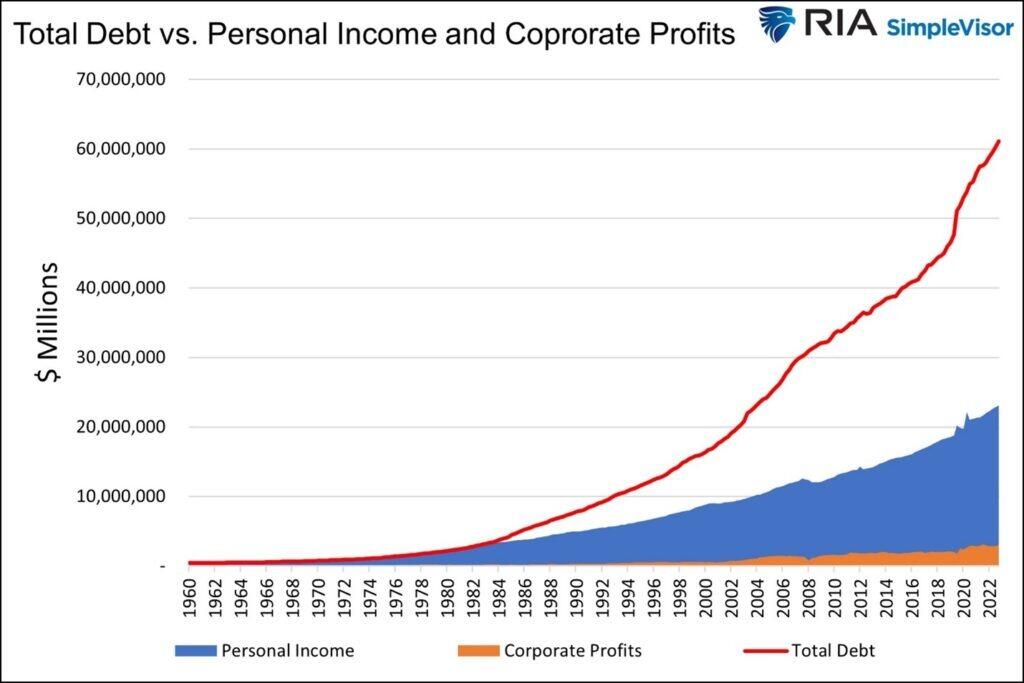
Some say the U.S. economy and financial markets are in epic bubbles. Undoubtedly, our increasing dependence on debt to fund economic expansion and years of prior debt is unsustainable without central bank intervention in markets. Furthermore, there are hints of irrational exuberance in the stock, credit, and crypto markets. While we are in a bubble of sorts, our current situation pales compared to Japan’s bubble and subsequent lost decades.

Japan’s situation then and ours now are in no way an apples-to-apples comparison. However, there are similarities. Accordingly, the lessons Japan learned and the price they continue to pay for extreme leverage and irrational exuberance are worth understanding in hopes we can take steps today and avoid Japan’s lost decades.  

Japan’s Twin Bubbles

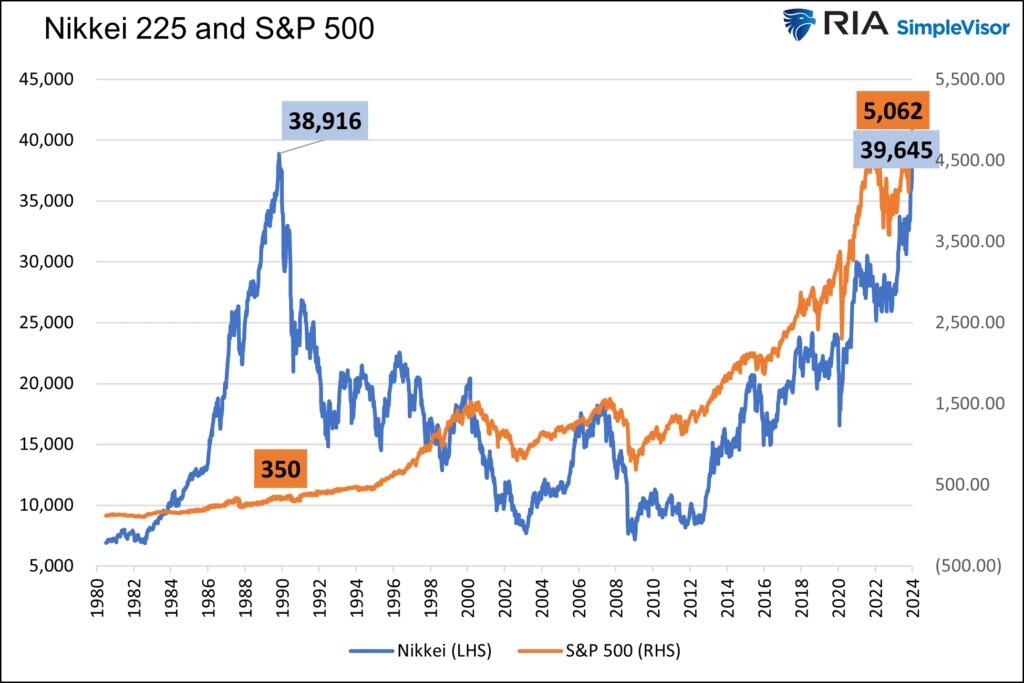
In the first week of January 1990, Japan’s Nikkei 225 stock market index peaked at 38,916. As shown below, the Nikkei index surged 488% in just ten years preceding that record high. At the time, its P/E ratio stood near 60. Today, thirty-five years later, the Nikkei has finally set a new record high. Over the same period (1990 to current), the S&P 500 has risen by 1350%!

It wasn’t just the stock market that was in a bubble in the late 1980s. Real estate values, bolstered by extreme leverage, were skyrocketing. At the time, it was estimated that the total property market in Japan was worth four times the United States’ property value. That is unbelievable, considering the U.S. has about 26 times more acreage. The real estate valuation stats in the opening quotes further highlight the mind-boggling valuations.

Out Of The Rubble And Into The Bubble

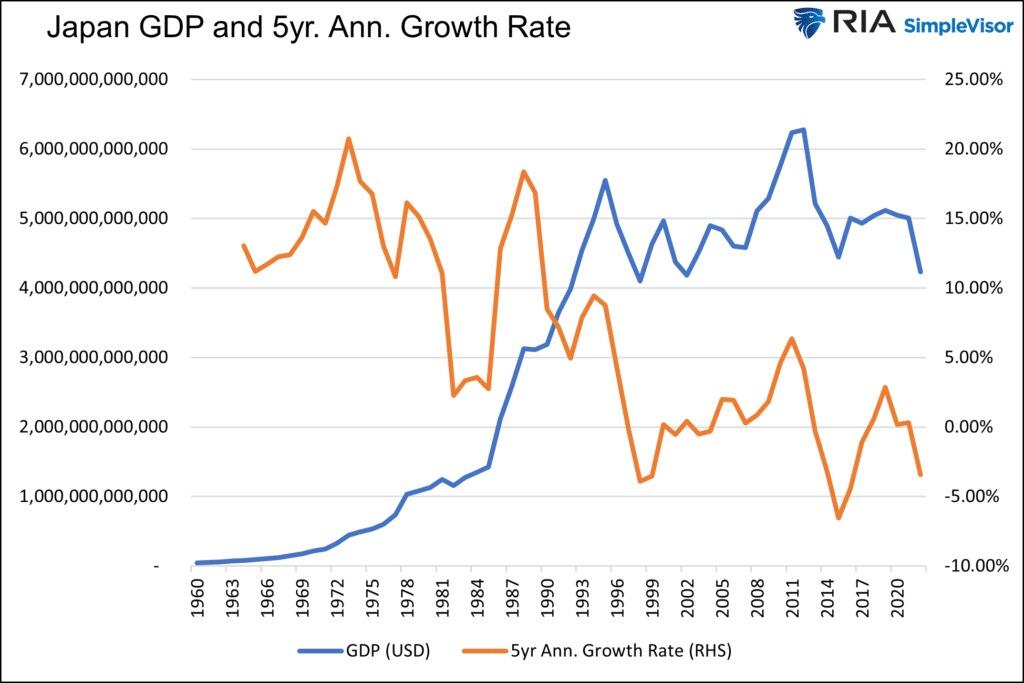
After rebuilding from the devastation of World War II, Japan embarked on an economic boom. It quickly became one of the world’s leading economic and financial powerhouses. In 1970, Japan’s GDP was $217 billion. By 1990, it had grown to $3.19 trillion, an astonishing 14.4% annual growth rate. In context, economists have marveled at China’s single-digit growth rate since 2000.

Their massive economic gains came to a complete halt in the mid-1990s, marking the beginning of “Japan’s Lost Decades.”

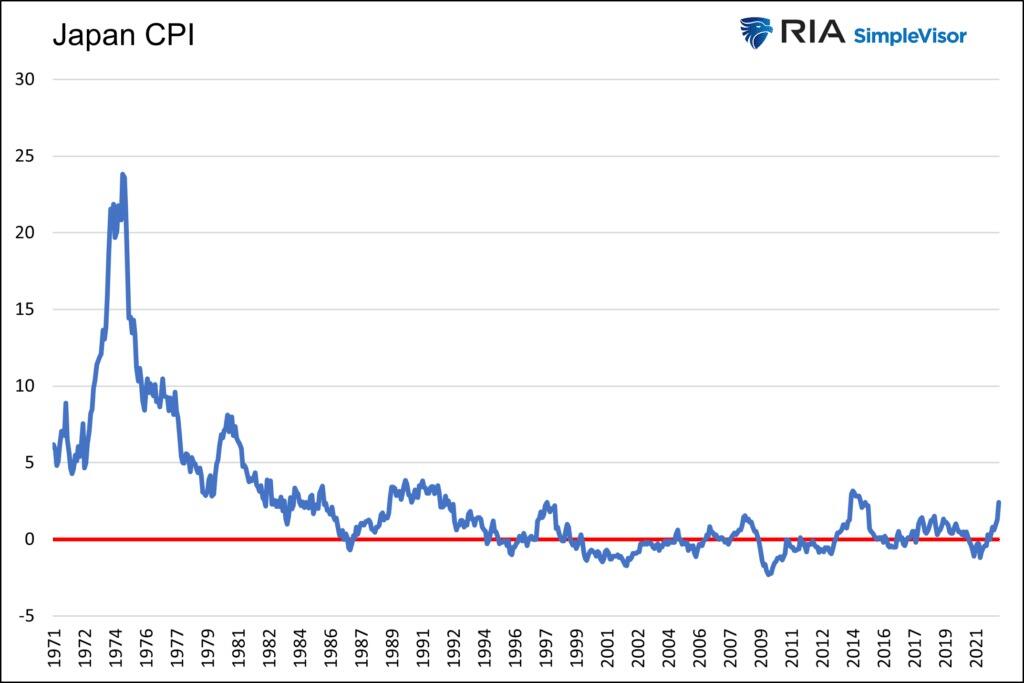
Since then, Japan has been plagued by economic stagnation and deflation. The first graph below shows Japan’s GDP has shrunk since 1995. Similarly, prices have been flat over the same period, with numerous bouts of deflation.

The Long Road To Recovery

There are many factors contributing to Japan’s lost decades.

At the bubble’s apex, in December 1989, the government and Bank of Japan (BOJ) implemented policies to prick its asset bubbles. Hindering the banking system’s ability to create new debt and refinance old debt put a pin in the stock and real estate bubbles. The banking system was in grave danger, with asset values falling precipitously and the loans backing said assets lacking sufficient collateral.

For better or worse, the government supported the banks to prevent catastrophic failures. Japan likely avoided a banking crisis and economic depression on par or possibly worse than our own experience in the 1930s. Unfortunately, the banks became zombies. They could not write off bad loans; thus, their ability to create new loans or refinance maturing loans was severely limited. Japan effectively avoided a massive depression but ended up with decades of economic stagnation. Pick your poison!

Lingering Demographic Effects

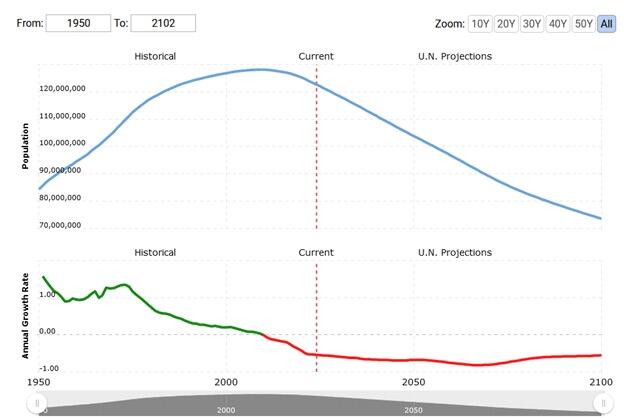
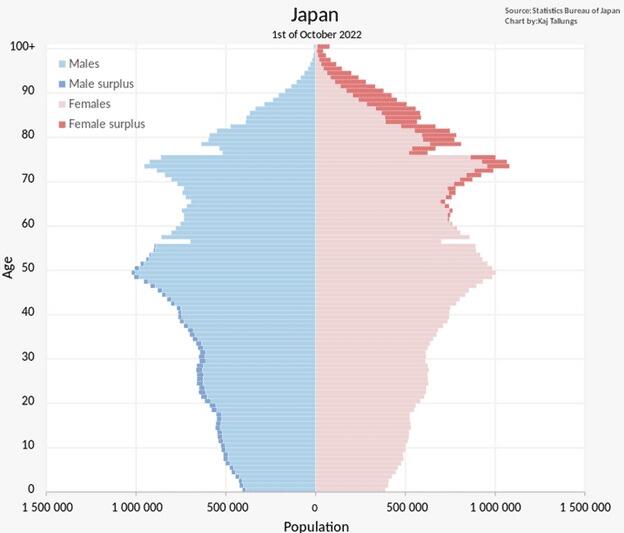
Further accentuating Japan’s lost decades of economic woe is its declining and aging population. The first graph below, courtesy of Macro Trends, shows that Japan’s population growth peaked in 2009 and has declined since. Further concerning, the second graph shows that a large percentage of their population is over 50 and supported by a shrinking base of younger people.

One significant consequence of Japan’s prolonged economic stagnation was its impact on the labor market and demographic landscape. High unemployment rates, particularly among the youth, and stagnant wages became the norm. The result was poor sentiment, which led to declines in personal consumption and confidence. Consequently, the desire to have children declined broadly across their population.

Many adult children continue to live with their parents and refuse to work or get married and start families.

Making demographic matters worse, Japan has strict immigration laws. Its net immigration rate is .74 per 1,000 people compared to 3 per 1,000 for the U.S. Given its low net migration rate, Japan has been unable to offset its negative birth/death rate with foreigners.

The BOJ

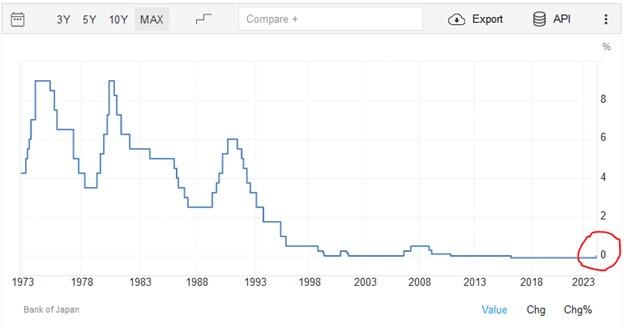
The Bank of Japan (BOJ) has done everything it can to support the economy and banks. The graph below from Trading Economics shows that its key lending interest rate has been near zero for over 20 years. They recently raised their lending rate to 0-.10%. If you squint, you might see the rate increase highlighted with the red circle.

Furthermore, they have heavily relied on asset purchases (QE). The World Bank estimates that the BOJ’s assets are a stunning 89% of Japan’s GDP. That is nearly triple that of the Fed. Furthermore, the BOJ owns approximately 60% of the stock ETF market and is the top shareholder of over one-fifth of the Nikkei 225 companies. They also hold over half of the nation’s Treasury securities.

They claim they are trying to normalize policy. However, with the yen trading at 20-year lows and depreciating versus the dollar, the BOJ will have to prove its claim via higher rates and less QE. Is Japan’s banking system and economy able to handle such a normalization?

Summary

Japan made critical mistakes in the 1970s, fostering one of the largest financial bubbles in history. It can also be criticized for its handling of the bubbles’ fallout.

Their struggle to regain economic and monetary policy normalcy highlights how the bubble still dramatically impacts the nation.

It’s not too late for America to manage her finances better. Unfortunately, most politicians want to get re-elected and will not do what is best for America. Continuing down our path will eventually lead to Japan circa 1989. But do not mistake our situation with that of Japan forty years ago.

Tyler Durden
Wed, 04/03/2024 – 09:50

via ZeroHedge News https://ift.tt/cRq1oJP Tyler Durden

Office Tower Vacancy Rate Hits Record High As Zombie Buildings Litter Skylines of Cities

Office Tower Vacancy Rate Hits Record High As Zombie Buildings Litter Skylines of Cities

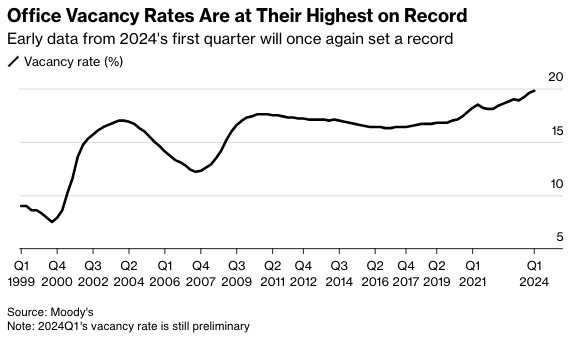
There are more dormant office towers in the United States than at any point since 1979, according to a new report from Moody’s Analytics, which began tracking office leasing vacancies that year. 

The rising supply of office space is due to a combination of surging remote and hybrid work that forces companies to reduce corporate footprints. Also, companies are exiting imploding progressive cities and high-taxed blue states for red ones while downsizing space. 

In the report, office tower vacancies rose to a record 19.8%, up from 19.6% in the fourth quarter of 2023. 

Source: Bloomberg

Even with the increase, there is an eerily calm across the commercial real estate sector. This comes as the Federal Reserve’s interest rate hiking cycle is higher for longer, indicating that the pain train is nearing (perhaps after the presidential election). 

“The office stress isn’t quite done yet,” Thomas LaSalvia, Moody’s head of commercial real estate economics and one of the authors of the report, told Bloomberg in an interview. He noted recent positive economic indicators stave off a “perfect storm in the office sector.” 

“There are spots of light and there are spots of extreme darkness,” LaSalvia said, adding, “This is part of a longer-term evolution where we are seeing obsolete buildings in obsolete neighborhoods.”

The high office vacancy rate continues to be terrible news for landlords and developers eager to fill their buildings, and the Fed’s hiking cycle has made refinancing very challenging. 

Last month, Goldman’s Vinay Viswanathan penned a note explaining how “office mortgages are living on borrowed time.” 

Viswanathan said there have been no major fireworks in CRE tower debt because the debt is being “extended and modified rather than refinanced,” which “mitigates a default wave and a sharp pick-up in losses on CRE loan portfolios.”

Tyler Durden
Wed, 04/03/2024 – 09:30

via ZeroHedge News https://ift.tt/qsUumdz Tyler Durden

Bond Longs Throw In Towel As Upturn Becomes Undeniable

Bond Longs Throw In Towel As Upturn Becomes Undeniable

Authored by Simon White, Bloomberg macro strategist,

Positioning in US Treasuries is becoming less long as the risk of persistently higher yields increases from a cyclically strong US and global economy.

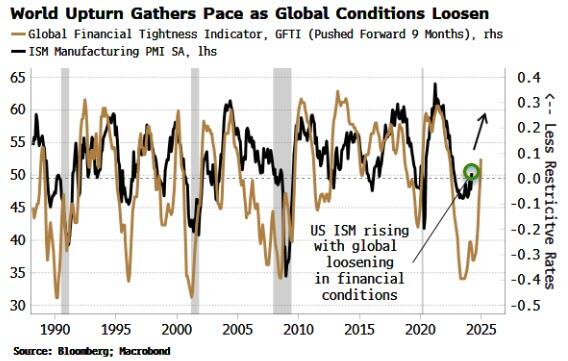
Leading data have been vindicated in projecting a US and global cyclical upturn that coincident data are now unequivocally confirming. Monday’s release of the March ISM showed the index is back into expansion territory, matching the message from the manufacturing PMI.

The US manufacturing ISM is not only the best cyclical barometer of US growth, it is also the best single gauge of global growth given the sector’s outsized importance to the world economy.

The new orders-to-inventory ratio is a very good short-term leading indicator for the ISM and has been turning up for several months. But even before that, there were strong signs from longer-leading data that the slip in the ISM was likely to be short lived. The chart below shows that the Global Financial Tightness Indicator (GFTI) – essentially a diffusion of global central bank rates – had started rising strongly last summer as global policy began to become less tight.

As the chart shows, the GFTI leads the ISM by around nine months, and anticipates the ISM’s upturn has more to go.

Bond investors might be getting the message that recession risk, as a consequence, is very low, and that inflation risk may be higher than they initially thought.

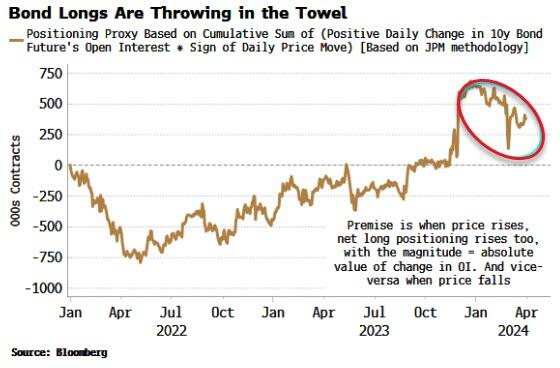
That would explain the continued reduction in UST longs, based on futures data.

The chart below looks at a positioning proxy for USTs based on 10-year bond futures, and shows that the sharp rise in long positioning at the start of the year when a hard landing was perceived as more likely (even though by then, leading data was clear-cut one was not imminent), is being steadily reduced.

(This proxy, whose methodology is explained in the chart, circumvents the distortion to Commitment of Traders data from the basis trade, i.e. trading the cash bond versus the future.)

Ten-year yields have been rising steadily all year, with the recent move being driven by real yields, inferring the market sees this as primarily a growth story for now.

Payrolls due Friday may challenge this, as there are some signs of slowing in the jobs market.

However, it’s unlikely to be enough to derail the burgeoning positive US and global growth story, and the concomitant rise in inflation risks.

Tyler Durden
Wed, 04/03/2024 – 09:10

via ZeroHedge News https://ift.tt/qhcZug9 Tyler Durden

Anthony Blinken’s Jet Suffers “Mechanical Issue” At Paris Airport

Anthony Blinken’s Jet Suffers “Mechanical Issue” At Paris Airport

US Secretary of State Anthony Blinken’s aircraft experienced a “mechanical issue” at an airport in Paris on Wednesday, forcing the US delegation to drive to Brussels for a NATO meeting (probably the ‘greenest’ mode of transportation for the DS climate warriors). This is the second time Blinken’s plane has been grounded in months due to critical malfunctions. 

The State Department spokesperson did not mention the type of aircraft. However, if we had to guess, the plane is not an Airbus. 

In mid-January, Blinken’s modified Boeing Co. 737 suffered an ‘oxygen leak,’ making the aircraft unsafe to fly and forcing the top US diplomat to board another jet to ferry him, his aids, and the press pool from Davos to Washington. 

If Blinken’s jet is, in fact, a Boeing, this is seriously not the year for the troubled planemaker. It has been struck with a DEI curse amid production line snafus, leading to near-catastrophic mid-air disasters. 

Let’s also hope Blinken and his team are not flying United Airlines back Stateside, as the carrier has had a series of mishaps on its Boeing jets.

Tyler Durden
Wed, 04/03/2024 – 08:50

via ZeroHedge News https://ift.tt/yX4QtLO Tyler Durden

Trump Declares November 5th “Christian Visibility Day”

Trump Declares November 5th “Christian Visibility Day”

Authored by Steve Watson via Modernity.news,

During a fiery speech in Wisconsin Tuesday, Donald Trump declared that November 5th, election day, is going to be “Christian Visibility Day.”

Trump was referring to the fact that this past weekend, Joe Biden proclaimed Easter Sunday to be ‘Transgender Day of Visibility’.

Speaking to a crowd of thousands in Green Bay, Trump boomed “We’re going to win the White House, and we are going to save our country. We’re going to save our country.”

He continued, “What the hell was Biden thinking when he declared Easter Sunday to be trans visibility day? Such total disrespect to Christians.”

“November 5 is going to be called something else; you know it’s gonna be called? Christian Visibility Day,” Trump continued, adding “when Christians turn out in numbers that nobody has ever seen before. Let’s call it Christian Visibility Day.”

Watch:

The full speech is below:

Meanwhile, a new Wall Street Journal poll has found that Trump is leading Biden in six out of seven swing states:

*  *  *

Your support is crucial in helping us defeat mass censorship. Please consider donating via Locals or check out our unique merch. Follow us on X @ModernityNews.

Tyler Durden
Wed, 04/03/2024 – 08:30

via ZeroHedge News https://ift.tt/4VWLa8l Tyler Durden

ADP Employment Report Shows Wage-Growth Explode Higher In March

ADP Employment Report Shows Wage-Growth Explode Higher In March

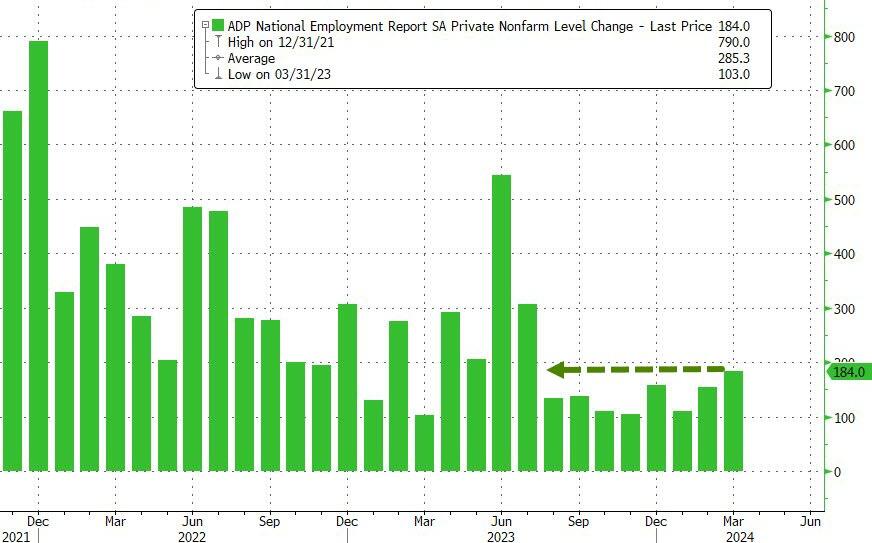
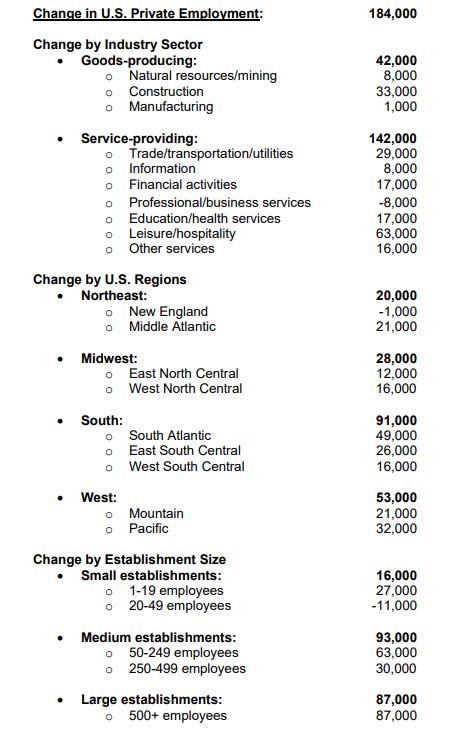
Expectations were for a small increase in jobs added MoM in today’s ADP Employment Report, but instead we saw a sizable jump from +155k to +184k jobs added in March – the highest since July…

Source: Bloomberg

Almost all cohorts were positive…

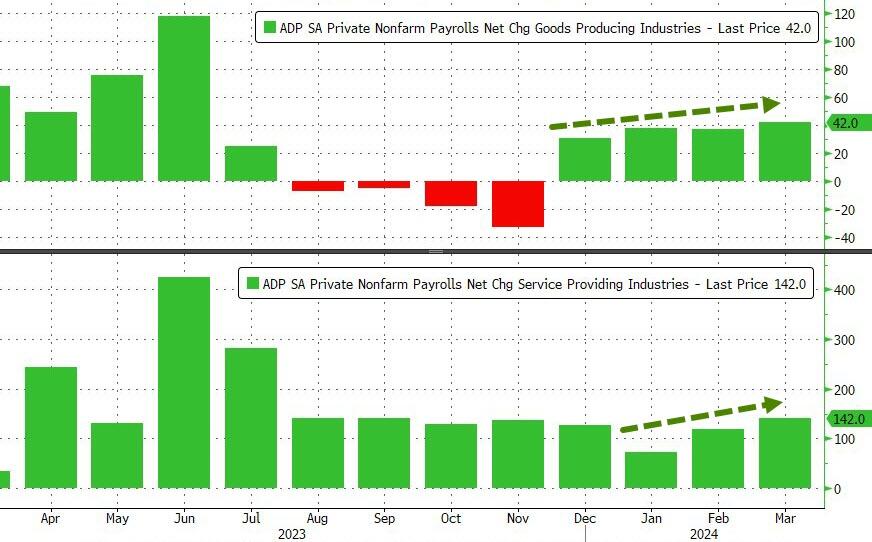
Job gains in Services once again dominated Goods-Producing firms, but both saw increases in March…

“March was surprising not just for the pay gains, but the sectors that recorded them,” said Nela Richardson Chief Economist, ADP.

“The three biggest increases for job-changers were in construction, financial services, and manufacturing. Inflation has been cooling, but our data shows pay is heating up in both goods and services.”

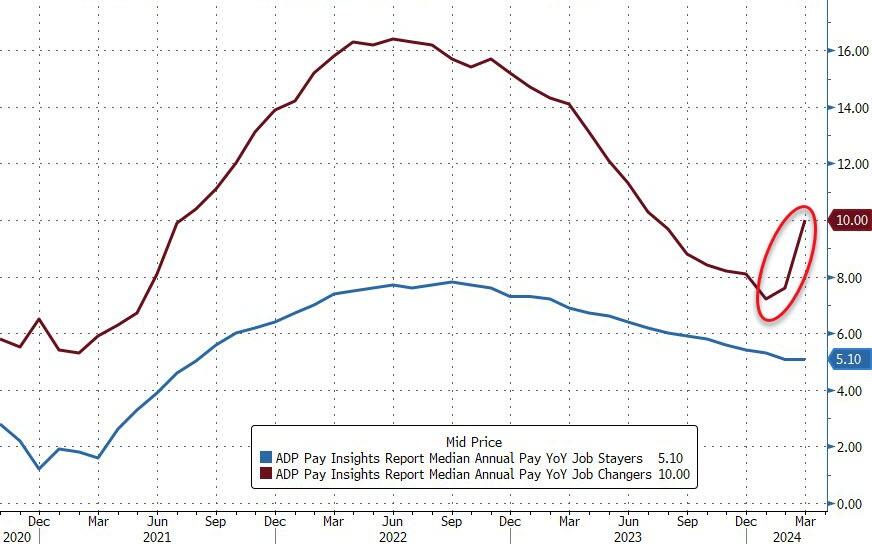
But most problematically for the inflation picture, Job-Changers saw wage growth jump dramatically to +10.0% YoY…

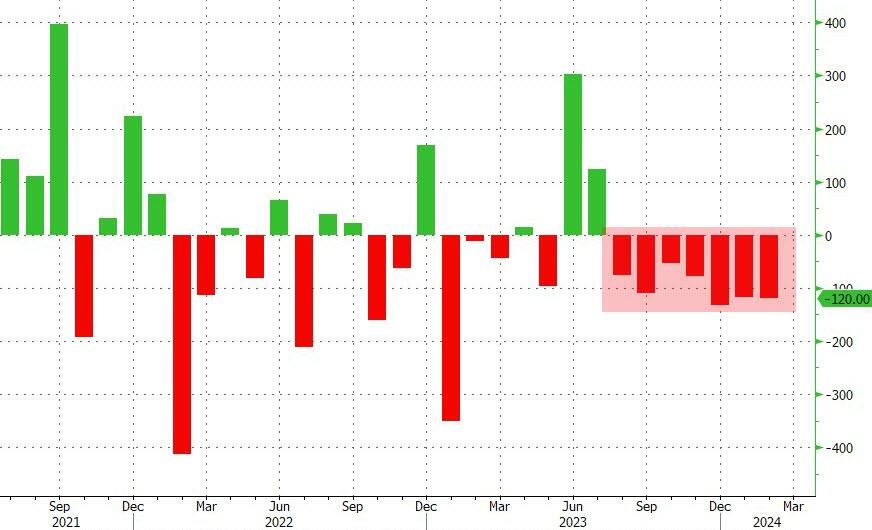
Finally, we note that ADP has under-estimated BLS’s version of the truth for the last seven months…and it’s getting worse.

Source: Bloomberg

So, with this kind of labor market, can The Fed maintain the illusion of rate-cuts at some point this year? What will Powell say today?

Tyler Durden
Wed, 04/03/2024 – 08:23

via ZeroHedge News https://ift.tt/GMfSNlI Tyler Durden

Futures Drop As Rates Continue Rising With Brent Back To $90

Futures Drop As Rates Continue Rising With Brent Back To $90

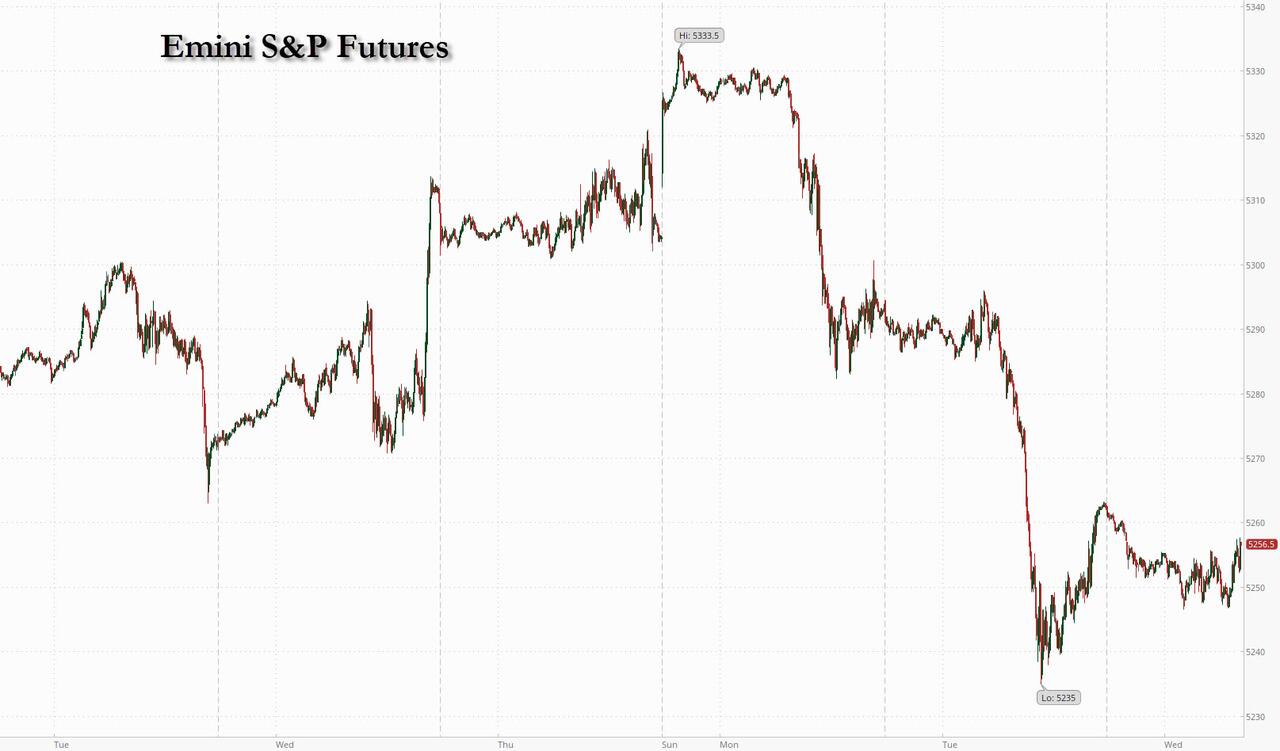
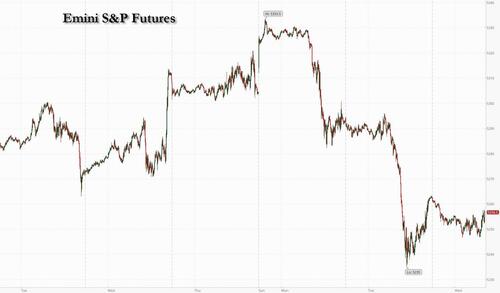
US futures are down small with Tech underperforming and small-caps flat, as rates held at 4 month highs, and Brent is about to rise above $90. As of 8:00am, both S&P and Nasdaq futures are down -0.2%, with yields higher pre-market ahead of Powell’s 12.10pm ET speech; despite his dovish rhetoric at the Mar 20 Fed Meeting press conference investors are nervous of a hawkish pivot according to JPM. This comes amid a surge a commodity prices and a spike in geopolitical tensions; pre-market all 3 commodity complexes are higher with gold the notable laggard despite USD being flat (although gold lagging these days means it hasn’t hit a new all time high in the past 15 minutes). Today’s macro focus is on ADP (has not been predictive of the brutally manipulated NFP print), ISM Services and 2x Fedspeakers, including Powell.
In premarket trading, Mag7 and Semis are under pressure with Intel tumbling over 5% after the chipmaker said losses have deepened at its factory business and the unit may not reach a break-even point for several years. Here are some other notable premarket movers:

  • Ally Financial shares fall 2.6% in thin premarket trading after JPMorgan cut its recommendation to underweight from neutral. The broker also revisited its ratings on other consumer finance companies, downgrading Guild Holdings and Essent Group, while raising Navient.
  • Dave & Buster’s shares rise 7.1% after the restaurant chain reported fourth-quarter Ebitda that was ahead of consensus estimates. The company also announced an additional $100 million share-buyback program.
  • Vanda Pharmaceuticals shares rise 23% after the biopharmaceutical company said it got FDA approval for Fanapt (iloperidone) tablets for treating manic or mixed episodes associated with bipolar I disorder in adults.
  • Wolfspeed shares fall 2.2% as Wells Fargo Securities cut the recommendation on the semiconductor device company to equal-weight from overweight.

Global stocks are suddenly struggling to extend the previous quarter’s strong gains, with MSCI’s all-country index down for a third straight day, and Wall Street also heading for a weaker open, with contracts on the S&P Global index down 0.2% as 10-year Treasury yields crept higher again, rising to about 4.37%, up more than 15 basis points from last week’s close, after traders pared expectations for the timing and scope of US rate cuts this year and as commodity prices soared. The dollar held near seven-week highs against a basket of Group-of-Ten currencies.

The spotlight now is on Fed Chair Jerome Powell, who last week said the central bank is awaiting more evidence that inflation is in check and who speaks again today at 12:10pm ET. A strong monthly US jobs print on Friday, coming on top of a robust reading on US manufacturing, could further dent policy-easing expectations.  

“Given the risk that payrolls data may affirm a higher-for-longer outlook for Fed rates, it is not surprising that risk appetite has taken a step back,” said Jane Foley, head of FX strategy at Rabobank in London.

Swap traders currently price less than three Fed rate cuts in 2024, with a high chance that policy easing is delayed beyond June. Pacific Investment Management Co. is among the asset managers that are positioning for the Fed to deliver fewer cuts than other major central banks. That’s despite comments Tuesday from San Francisco President Mary Daly and the Cleveland Fed’s Loretta Mester, who threw their weight behind three cuts this year.

Rising commodity prices, meanwhile, are fanning inflation expectations, with Brent crude futures holding above $89 a barrel. Copper advanced for a third day, while palm oil is at the highest since November 2022, raising the risk of higher global food inflation. Adding to the concerns, Taiwan’s strongest earthquake in 25 years cast uncertainty over chip production, as the world’s largest chipmaker, Taiwan Semiconductor, evacuated factory areas. Shares in the firm slipped 1.3%.

In Europe, the Stoxx 600 equity index held flat and bond yields slipped after a below-forecast inflation print. That cemented expectations that the European Central Bank will kick off its policy-easing campaign in June, possibly ahead of the Federal Reserve. European markets rebounded as bonds caught a bid following yesterday’s global rates selloff after the latest Euro area CPI data came in cooler than expected. Baskets tied to a recovery/reflation scenario continue to perform well. Rising Yields/Value are leading, Momentum/Quality are lagging; Cyclicals over Defensives. UKX -0.4%, SX5E +0.5%, SXXP +0.1%, DAX +0.3%.

Earlier in the session, Asian equities declined, driven by losses in technology stocks, amid speculation that major global central banks will keep interest rates higher for longer. The MSCI Asia Pacific Index fell as much as 0.8%, to a two-week low, with virtually all markets in the red. Chip-related stocks were among the biggest drags on the region after Intel posted widening foundry losses and TSMC evacuated production lines following Taiwan’s biggest earthquake in 25 years. EV makers led a gauge of tech stocks lower in Hong Kong after Tesla missed expectations for deliveries.

“I think people are just mindful of what happens with rates, especially with the Fed,” Catherine Yeung, investment director at Fidelity International, told Bloomberg TV. “Investors are treading water and looking for opportunity,” she said.

Asian equities have struggled in the first week of the new quarter, with Japan and China failing to build on recent gains. Pessimism returned following Tuesday’s strong rally in Hong Kong, as a recent slew of upbeat Chinese economic data failed to provide further momentum. The yuan slid to a four-month low against the dollar in onshore trading Tuesday.

  • Hang Seng and Shanghai Comp. conformed to the downbeat mood across the region amid tech weakness and mixed US-China headlines with the US asking South Korea to toughen controls on semiconductor technology exports to China. However, the losses in the mainland were cushioned after an improvement in Caixin Services PMI data and Biden-Xi phone talks.
  • Nikkei 225 briefly dipped beneath 39,500 with index heavyweight Fast Retailing among the worst hit after lower Uniqlo same-store sales, while Japan also issued a tsunami warning after a powerful earthquake struck Taiwan.
  • TAIEX was pressured after Taiwan’s most powerful earthquake in 25 years which collapsed at least 26 buildings.
  • ASX 200 was led lower by tech and real estate as the rate-sensitive sectors suffered from firmer yields.

In FX, the Bloomberg Dollar Spot Index is little changed in another quiet session for FX. The onshore yuan fell toward the weak end of its allowed trading band.

In rates, treasuries fell and kept US equity futures subdued as investors awaited another batch of economic data and a flurry of Fed speakers later today including Powell. US 10-year yields rise 2bps to 4.37%, close to Tuesday’s year-to-date high of 4.40%. ISM services will be closely watched after the manufacturing gauge topped estimates on Monday. Fed Chair Powell is also due to deliver remarks on the economic outlook.  Bunds rise as data showed euro-area inflation slowed more than expected in March. European stocks inch higher.

In commodities, oil prices advance, with WTI rising 0.3% to trade near $85.40 and Brent just shy of $90. Spot gold falls 0.3%.

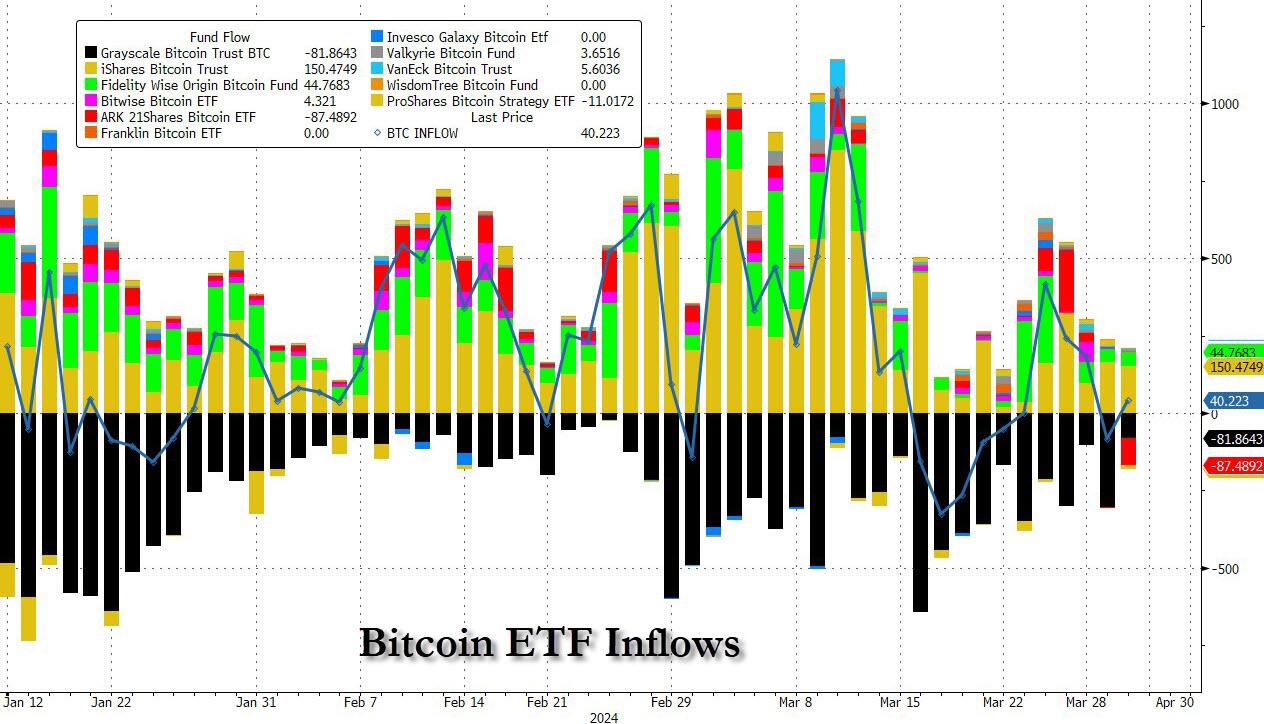
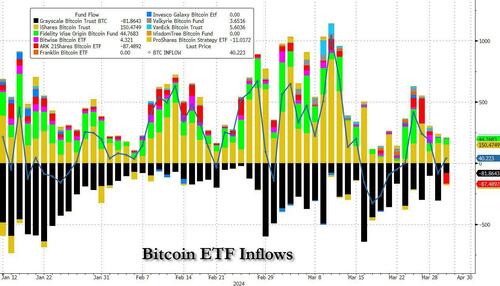
The Bitcoin sell-off from the prior day has cooled, with the coin now holding around USD 66.5k after the latest ETF flows data showed a reversal to yesterday’s GBTC-driven outflow.
Looking to the day ahead now, data releases in the US include the ADP’s report of private payrolls for March, and the ISM services index for March. Otherwise from central banks, we’ll hear from Fed Chair Powell, along with the Fed’s Bowman, Goolsbee, Barr and Kugler, as well as the ECB’s De Cos.
Market Snapshot

  • S&P 500 futures down 0.2% to 5,251.00
  • STOXX Europe 600 little changed at 508.19
  • MXAP down 0.8% to 175.21
  • MXAPJ down 0.9% to 536.40
  • Nikkei down 1.0% to 39,451.85
  • Topix down 0.3% to 2,706.51
  • Hang Seng Index down 1.2% to 16,725.10
  • Shanghai Composite down 0.2% to 3,069.30
  • Sensex up 0.1% to 73,999.33
  • Australia S&P/ASX 200 down 1.3% to 7,782.54
  • Kospi down 1.7% to 2,706.97
  • German 10Y yield little changed at 2.40%
  • Euro little changed at $1.0775
  • Brent Futures down 0.1% to $88.82/bbl
  • Gold spot down 0.4% to $2,270.51
  • US Dollar Index little changed at 104.76

Top Overnight News

  • Taiwan was hit by its strongest earthquake in 25 years, leveling dozens of buildings on the eastern side of the island. At least nine people died, Taiwan’s emergency service said. TSMC halted some chipmaking and evacuated plants. BBG
  • Nato is drawing up plans to secure a five-year military aid package of up to $100bn, in an attempt to shield Ukraine from “winds of political change” that could usher in a second Trump presidency. FT
  • In meetings in Guangzhou and Beijing, Yellen is expected to tell her Chinese counterparts to stop relying on exports to prop up their underperforming economy and instead boost their own consumer market. The warning from Yellen is a sign that the Biden administration is moving toward raising Trump-era tariffs on some Chinese products, including electric vehicles. Such a move could reignite tensions between the world’s two largest economies, which have tried to stabilize relations in recent months. WSJ
  • Eurozone CPI for Mar falls a bit short of expectations, coming in at +2.4% on the headline (down from +2.6% in Feb and below the Street’s +2.5% forecast) and +2.9% core (down from +3.1% in Feb and below the Street’s +3% forecast). BBG
  • Joe Biden rebuked Israel for not doing enough to protect civilians and aid workers in Gaza, some of his sternest criticism yet of the country’s conduct. The remarks echo reprimands from the UK and Australia as Israel’s global isolation grows. BBG
  • Auto sales in the US Mar came in at an annualized rate of 15.5M last month, down from 15.8M in Feb and below the consensus forecast of 15.9M, while average sales prices tumbled 3.6% Y/Y (the largest recorded decline in the month of March) and discounts surged by ~66%. Marketwatch
  • The rally in crude prompted the US to cancel plans to buy up to 3 million barrels for its strategic reserve. Separately, US stockpiles fell by 2.3 million barrels last week, the API is said to have reported, and OPEC+ may today affirm its current supply curbs. BBG
  • Loretta Mester, president of the Cleveland Federal Reserve and a voting member of the Federal Open Market Committee, revealed in a speech on Tuesday that she had raised her estimate of the longer-run federal funds rate from 2.5% to 3%. FT
  • Disney secured enough votes before today’s shareholder meeting to defeat a challenge against its board by Nelson Peltz’s Trian, Reuters reported. BBG

A more detailed look at global markets courtesy of Newsquawk

APAC stocks followed suit to losses in the US where treasuries bear-steepened and oil prices ramped up. ASX 200 was led lower by tech and real estate as the rate-sensitive sectors suffered from firmer yields. Nikkei 225 briefly dipped beneath 39,500 with index heavyweight Fast Retailing among the worst hit after lower Uniqlo same-store sales, while Japan also issued a tsunami warning after a powerful earthquake struck Taiwan. TAIEX was pressured after Taiwan’s most powerful earthquake in 25 years which collapsed at least 26 buildings. Hang Seng and Shanghai Comp. conformed to the downbeat mood across the region amid tech weakness and mixed US-China headlines with the US asking South Korea to toughen controls on semiconductor technology exports to China. However, the losses in the mainland were cushioned after an improvement in Caixin Services PMI data and Biden-Xi phone talks.

Top Asian News

  • US Treasury Secretary Yellen is to travel to China on April 3rd-9th to continue economic dialogue with top Chinese officials and is to meet with Vice Premier He Lifeng, the Guangdong province Governor and US business executives in Guangzhou. Furthermore, Yellen is to meet with PBoC’s Governor Pan Gongsheng and former Vice President Liu He on April 8th, while she is to underscore global economic consequences of Chinese industrial overcapacity in meetings with Chinese officials.
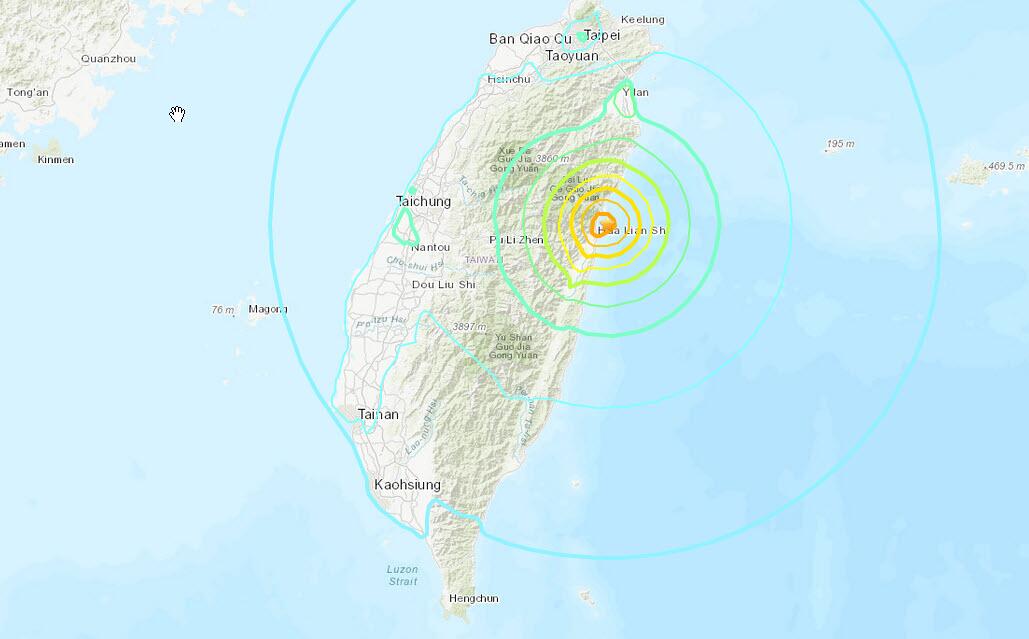
  • A strong earthquake was felt in Taipei and parts of the city experienced a power outage, while the Taiwan Central Weather Administration said the earthquake registered a 7.2 magnitude and was Taiwan’s most powerful earthquake in 25 years. Taipei city government said it had not yet received any reports of major damage following the earthquake and it was later reported that Taipei’s MRT resumed operations although there were reports of collapsed buildings in the city of Hualien with people reportedly trapped in the buildings, while Taiwan announced the earthquake caused 26 buildings to collapse.
  • Japan issued an evacuation advisory for Okinawa coastal areas and a tsunami warning after the initial announcement of a preliminary magnitude 7.5 earthquake off southwestern Japan but later revised the Taiwan earthquake magnitude up to 7.7 and lifted the tsunami warnings.
  • China March prelim car sales +7% Y/Y (vs -21% in Feb).
  • Foxonn (2354 TT) says Co. shut down some of its production lines in Taiwan for inspection following the earthquake; currently normal production operations have gradually resumed; no damage to manufacturing equipment.

European bourses, Stoxx600 (+0.2%), were mostly but modestly firmer at the open, and trade remained directionless up until the EZ CPI; following the print, stocks trudged higher. European sectors hold a negative tilt, though with no overarching theme or bias. Banks and Tech take the top spots, whilst Real Estate continues to be hampered by the yield environment. US Equity Futures (ES -0.2%, NQ -0.2%, RTY -0.3%) are all marginally lower continuing the downside seen in the prior session. Intel (-4.6%) suffers pre-market after reporting its Foundry had an op. loss for 2023 at USD 7bln.

Top European news

  • ECB’s Holzmann says he has no in-principle objection to a June rate cut, but wants to see more supportive data. Holzmann added that cutting out-of-sync with the Fed would diminish the impact of easing, whilst also noting that a 3.0% deposit rate could prove too tight over the longer-term, given weak EZ productivity.
  • Italian Finance Minister Giorgetti says the EU is to open a deficit infringement procedure against Italy and several other countries. Adds, Italy is already in line with the EU requirements to cut deficit below 3% of GDP over time
  • German VDMA says Engineering Orders (Feb) -10% Y/Y (Domestic -11%, Foreign -10%); Engineering Orders (Dec-Feb) -8% Y/Y (Domestic -11, Foreign -7%)
  • Barclays raises Eurostoxx600 target to 540 (prev. target 510, current 508); upgrades Europe to overweight.
  • Norwegian Parliament received a bomb threat, according to local reports; debate continues in Norway’s parliament despite bomb threat

FX

  • USD on net steady vs. peers after failing to hold above the 105 mark, within a tight 104.84-70 range; topped out at 105.10 yesterday.
  • EUR is contained vs. the USD as post-CPI downside proved to be fleeting. The data may accelerate calls for a move next week but June still firmly the base case. EUR/USD holding above yesterday’s 1.0724 low.
  • USD/JPY remains in consolidation mode around recent highs as recent Fed repricing provides support. Upside targets include the YTD high at 151.97 and the psych 152 mark, above which, there is clean air.
  • Antipodeans are both a touch softer vs. the USD after yesterday’s session of gains. AUD able to hold onto a 0.65 handle and above yesterday’s 0.6482 low.
  • PBoC set USD/CNY mid-point at 7.0949 vs exp. 7.2282 (prev. 7.0957).
  • Chile Central Bank cut its benchmark interest rate by 75bps to 6.50%, as expected, with the decision unanimous. Chile Central Bank said the board will continue cutting rates, while the size and timing of rates will consider the trajectory of inflation and the macroeconomic scenario.

Fixed Income

  • USTs were contained during APAC trade as participants took a slight breather from Tuesday’s pronounced bear-steepening, though overnight Fed speak was on the hawkish side of things. Modest pressure emerged in the European morning, USTs down to a 109-18 base before Tuesday’s 109-14+ trough.
  • Bunds were initially contained, in-fitting with USTs, before experiencing modest upside on Holzmann’s remarks which had an uncharacteristic dovish-tilt. A dovish but fleeting reaction was seen following the cooler than expected EZ HICP print. Currently near session peaks around 132.50.
  • BTPs were dented after Economy Minister Giorgetti announced that the EU is likely to begin deficit infringement procedures against the nation and others, sending BTPs down from 117.90 to 117.50 where they currently reside.

Commodities

  • Horizontal trade in the crude complex overnight and in early European hours ahead of the OPEC+ JMMC at 12:00BST, although no recommendations are expected. Brent holds around USD 88.20/bbl.
  • Mixed trade for precious metals with some potential profit-taking (ahead of US ADP and a slew of Fed speakers) in the yellow metal after hitting a fresh ATH this morning at USD 2,288.43/oz; XAU has pulled back towards the bottom of a USD 2,269.27-2,288.82/oz intraday range.
  • Flat/mixed picture across base metals amid quiet newsflow and with the complex taking a breather after yesterday’s data-induced rally.
  • US Energy Inventory Data (bbls): Crude -2.3mln (exp. -1.5mln), Gasoline -1.5mln (exp. -0.8mln), Distillate -2.5mln (exp. -0.6mln), Cushing -0.8mln.
  • Mexico’s Pemex requested trading unit PMI to cancel up to 436k bpd of Mexican crude exports in April which would increase the availability of crude for domestic use including for a new refinery, according to a document cited by Reuters.
  • US President Biden is reportedly open to ending LNG export pause for Ukraine aid, according to Reuters.
  • Russian Deputy PM Novak said gasoline and diesel fuel stocks remain high in Russia.
  • Kazahkstan’s Kashagan oil field operator says output was fully restored on April 2 after brief stoppage on April 1.
  • Indian oil secretary says higher oil prices are a cause of concern; oil prices reflect geopolitical premium; firms will take appropriate decision on fuel prices if global oil prices stay high for more than a month.
  • Spot premiums for US Mars crude exports to Asia reportedly jump after Mexico cuts supply, according to Reuters sources.
  • Some Japanese aluminium buyers agree April-June premium at USD 148/ton, +64% from prev. quarter.
  • BofA research increases 2024 Brent and WTI crude forecasts to USD 86 and USD 81/bbl respectively; sees prices peaking at around USD 95/bbl in the summer
  • OPEC’s JMMC will meet at 12:00BST on April 3rd, according to Energy Intel’s Bakr.

Geopolitics: Middle East

  • US President Biden criticised Israel for failing to adequately protect civilians and is pushing for an immediate ceasefire as part of a hostage deal, while Biden said he is outraged over the deaths of World Central Kitchen staff in Gaza, according to Bloomberg and AFP.
  • Deep divisions between the US and Israel over an operation in Rafah were evident in a virtual meeting between senior officials, according to three sources cited by Axios. Furthermore, the parties agreed there will be separate virtual meetings of four expert working groups in the next 10 days that will focus on different aspects of a possible Rafah operation.

Geopolitics: Other

  • NATO Foreign Ministers will meet on Wednesday to discuss how to put military support for Ukraine on long-term footing including a proposal for a EUR 100bln five-year military fund, according to Reuters.
  • North Korea said it successfully test-fired a new mid- to long-range hypersonic missile, while its leader Kim said they completely turned all missiles to solid fuel with warhead control and capable of nuclear weaponisation, according to Yonhap.
  • UK FCDO said North Korea’s ballistic missile launch on April 2nd is a breach of multiple UN Security Council resolutions and the UK urges North Korea to refrain from further provocations, return to dialogue and take credible steps towards denuclearisation.
  • Philippine National Security Council spokesperson said the commitment to maintain the grounded warship in Second Thomas Shoal will always be there and any attempt by China to interfere with resupply missions will be met by the Philippines in a fashion that protects its troops, while the spokesperson added that resupply missions to Second Thomas Shoal will never stop.

US Event Calendar

  • 07:00: March MBA Mortgage Applications, prior -0.7%
  • 08:15: March ADP Employment Change, est. 150,000, prior 140,000
  • 09:45: March S&P Global US Services PMI, est. 51.7, prior 51.7
    • March ISM Services Prices Paid, est. 58.4, prior 58.6
    • March ISM Services Employment, est. 49.0, prior 48.0
    • March ISM Services New Orders, est. 55.5, prior 56.1
    • March ISM Services Index, est. 52.8, prior 52.6

Central Bank Speakers

  • 08:30: Fed’s Bostic Speaks on CNBC
  • 09:45: Fed’s Bowman Speaks on Bank Liquidity, Fed
  • 12:00: Fed’s Goolsbee Gives Opening Remarks
  • 12:10: Fed’s Powell Speaks on Economic Outlook
  • 13:10: Fed’s Barr Speaks on Community Reinvestment Act
  • 16:30: Fed’s Kugler Speaks on Economic, Monetary Policy Outlook

DB’s Jim Reid concludes the overnight wrap

Markets continued their rocky start to Q2 yesterday, with bonds and equities both selling off for a second day running. That’s been driven by a succession of hawkish developments, which have led to growing questions about how soon the Fed will be cutting rates, particularly given the resilience of both growth and inflation. All eyes will now be on Fed Chair Powell’s remarks today, but in the meantime, the 10yr Treasury yield was up another +4.0bps yesterday to 4.35%, marking its highest level since November. And equities also struggled in response, with the S&P 500 (-0.72%) posting its worst daily performance in 4 weeks.

These moves have come on the back of several headlines in recent days, which have seen investors price out the number of rate cuts likely to happen this year. On Friday, we had the latest PCE inflation print for February, which is the measure the Fed officially targets. And even though the monthly print was broadly as the consensus expected, it still meant that core PCE over the previous 3 months was running at an annualised rate of 3.5%. Then on Monday, the ISM manufacturing was back in expansionary territory for the first time since October 2022, whilst the prices paid indicator was the highest since July 2022. Yesterday, that was then followed up by a fresh rise in oil prices, which saw Brent Crude close at nearly $89/bbl, its highest since October, and Bloomberg’s Commodity Spot Index (+0.79%) also hit a 4-month high. And with all that happening, there’ve been clear signs that investors are raising their inflation expectations as well. For instance, 5yr US inflation swaps were up another +2.5bps yesterday to 2.53%, closing at their highest level since November.

This backdrop has led to a significant selloff for sovereign bonds around the world, with a sharp rise in yields. In the US, it saw the 10yr Treasury yield rise +3.9bps to 4.35%, which built on its +10.9bps move the previous day. And 30yr yields were up +4.7bps to 4.50%, with both reaching their highest levels since November. Meanwhile in Europe, there were even bigger moves as they caught up from the previous day’s holiday. For example, yields on 10yr bunds (+10.0bps), OATs (+11.1bps), BTPs (+12.5bps) all saw significant rises. And here in the UK, 10yr gilts (+15.1bps) saw the biggest rise in yields after multiple data releases came in stronger than expected. That included mortgage approvals, which were up to a 17-month high in February of 60.4k (vs. 56.5k expected). Moreover, the final UK manufacturing PMI for March was revised up to 50.3 (vs. flash 49.9), which is the first in expansionary territory since July 2022.

The main exception to that bond selloff came at the front-end of the US Treasury curve, where the 2yr yield was down -1.6bps to 4.69%. That came as market pricing for a June cut moved up slightly relative to Monday, with futures now pricing in a 66% chance of a cut by June. In part, that followed fairly balanced remarks from Fed speakers. San Francisco Fed President Daly said that three cuts this year was “a very reasonable baseline” but that as of now “growth is going strong, so there’s really no urgency to adjust the rate”. Cleveland Fed President Mester also said she still saw three cuts in 2024 but that “it’s a close call” whether fewer cuts would be needed, and noting earlier that “At this point, I think the bigger risk would be to begin reducing the funds rate too early.”

Today, we’ll hear from Fed Chair Powell who’s giving a speech on the economic outlook, so the focus will be on whether he offers any new commentary about the timing of potential rate cuts. We’ve also got the ISM services index today, along with the jobs report on Friday, so there’s still plenty of data this week that will shape the market narrative.

For equities, the concern about rates staying higher for longer led to a sizeable selloff, with the major indices losing ground on both sides of the Atlantic. That meant the S&P 500 (-0.72%) saw its worst daily performance in 4 weeks, and the STOXX 600 (-0.80%) saw its worst performance in 7 weeks. The decline was a broad-based one, with almost 80% of the S&P 500 losing ground on the day. Small caps underperformed for the second session in a row, with the Russell 2000 down -1.80%. But losses among US tech stocks were also a factor, and the Magnificent 7 (-0.90%) fell to a two-week low. That came as Tesla fell -4.90% after it reported lower-than-expected sales, with its first year-on-year decline in vehicle deliveries since 2020.

That negative tone has continued overnight, with all the major indices in Asia moving lower this morning. That includes the Nikkei (-0.64%), the KOSPI (-1.19%), the Hang Seng (-0.74%), the CSI 300 (-0.28%) and the Shanghai Comp (-0.24%). And over in the US, futures on the S&P 500 (-0.17%) are pointing towards further losses today. Alongside that, Taiwan has been hit by an earthquake overnight of 7.4 magnitude, the strongest there in 25 years. Separately on the PMIs, the final composite PMI in Japan was up to a 6-month high of 51.7 in March, whilst the Caixin composite PMI from China was up to a 10-month high of 52.7.

Whilst there was a lot of focus on the hawkish narrative yesterday, we did get a downside inflation surprise from Germany yesterday, which follows other downside surprises from Europe over recent days. The release showed CPI was down to +2.3% using the EU-harmonised measure (vs. +2.4% expected), and using the national definition, it was down to its lowest since May 2021, at +2.2%. So adding some encouraging signs ahead of the Euro Area March inflation print this morning. Alongside that, we also got some positive news from the final Euro Area manufacturing PMI, which was revised up four-tenths from the flash reading to 46.1.

Finally in the US, there were several data prints for February out yesterday, including the JOLTS report of job openings. That showed openings were at 8.756m (vs. 8.73m expected), which was basically in line with the downwardly-revised 8.748m in January. Indeed, it was the smallest monthly change in job openings since the pandemic. Elsewhere, the report showed that the quits rate of those voluntarily leaving their job was stable at 2.2%, where it’s been since November.

To the day ahead now, and data releases from the Euro Area include the flash CPI print for March, along with the unemployment rate for February. Meanwhile in the US, there’s the ADP’s report of private payrolls for March, and the ISM services index for March. Otherwise from central banks, we’ll hear from Fed Chair Powell, along with the Fed’s Bowman, Goolsbee, Barr and Kugler, as well as the ECB’s De Cos.
Tyler Durden
Wed, 04/03/2024 – 08:17

via ZeroHedge News https://ift.tt/4rPio5D Tyler Durden

TSMC Shutters Some Chipmaking Plants As Quake Rocks Island Nation

TSMC Shutters Some Chipmaking Plants As Quake Rocks Island Nation

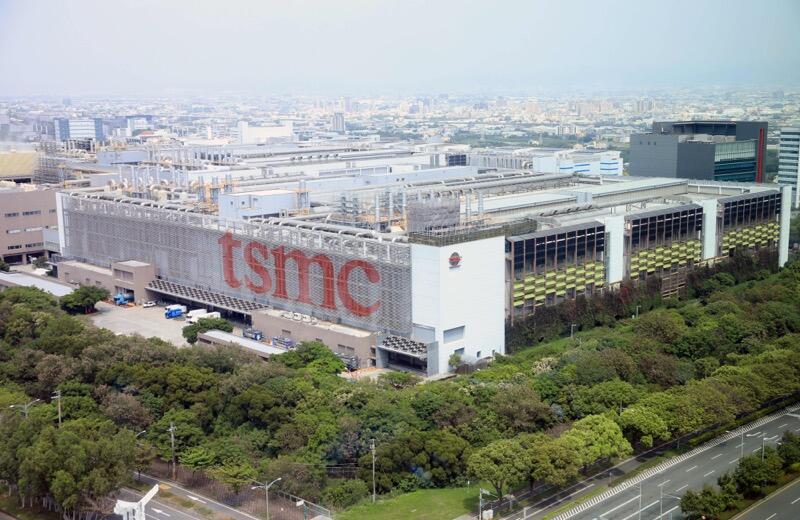
Taiwan Semiconductor Manufacturing Co., the leading contract chipmaker for Apple Inc. and Nvidia Corp., shuttered some of its chipmaking capacity and evacuated plants after the biggest earthquake in 25 years rocked the island nation, just east of mainland China. 

Taiwan plays a significant role in manufacturing advanced chips for artificial intelligence, smartphones, computers, and electric vehicles. The country is estimated to produce 80% to 90% of the highest-end chips. 

As the news of a 7.4-magnitude quake off Taiwan’s east coast disrupts chipmaking, the implications for the global tech supply chain, including potential future disruptions like a war with China, are causing significant concern among Wall Street analysts. 

Bloomberg reports that some of TSMC’s “staff were beginning to return to evacuated sites, though it stressed it was examining impact.” 

However, Barclays analysts warned that any production halts could threaten the production process of advanced chips that require uninterrupted seclusion in a vacuum for weeks. 

“Some of the high-end chips need 24/7 seamless operations in a vacuum state for a few weeks,” analysts Bum Ki Son and Brian Tan.

The analysts continued, “Operation halts in Taiwan’s northern industrial areas could mean some high-end chips in production may be spoiled.”

Whether it’s a natural disaster or a geopolitical event like a Chinese invasion, Peter Kleinhans, director of the technology and geopolitics project at Berlin-based think tank Stiftung Neue Verantwortung, has warned that Taiwan, as the potential most critical single point of failure in the global semiconductor supply chain, cannot be overlooked. And this is why the Biden administration is attempting to rebuild America’s chip manufacturing base. 

Besides TSMC, local rival United Microelectronics Corp. also halted chip production at some plants and evacuated certain facilities. 

In markets, Taiwanese stocks followed regional peers lower but absent a significant selloff following the quake. Shares of TSMC on the Taiwan Stock Exchange closed down 1.27%. In the US, shares of Nvidia in New York are down around 1% in premarket trading. 


Tyler Durden
Wed, 04/03/2024 – 07:45

via ZeroHedge News https://ift.tt/JAVQrEX Tyler Durden

Rickards: Ukraine’s Starting To Get Dangerous

Rickards: Ukraine’s Starting To Get Dangerous

Authored by James Rickards via DailyReckoning.com,

A lot of people seem to have forgotten about the war in Ukraine. That’s a mistake.

Russia is slowly but steadily defeating Ukraine, which is becoming increasingly obvious to everyone except the most anti-Russian diehards.

That’s leading to desperation in elite Western circles determined to stop Russia one way or the other. In their minds, they simply can’t let Putin win. They think that if Putin wins in Ukraine, he’ll next move on to the Baltic states, Poland and elsewhere.

You know the West is getting desperate based on recent threats by France’s Emmanuel Macron to send troops to Ukraine.

The vice president of the Russia Duma, Pyotr Tolstoy (descendant of the great Russian writer Leo Tolstoy), warned that French troops would be priority targets for Russian forces if they entered Ukraine.

Even though France would send troops independent of NATO, that puts us on a very dangerous path that ultimately leads to direct conflict between NATO and Russia. And that path ends in nuclear war ultimately.

Tolstoy added that it would take “just two minutes to nuke Paris.” It’s not hard to envision how quickly things could escalate if France decided to send troops to Ukraine.

More Escalation

Meanwhile, NATO is preparing to send F-16s to Ukraine. Airfields in Ukraine are highly vulnerable to Russian attack, especially since Ukraine’s air defenses are heavily depleted at this point and the Russian air force is becoming increasingly active in Ukraine.

But if NATO allows the F-16s to be based on its own airbases, Putin has warned that these airfields would become a “legitimate target” if strikes against Russian forces were launched from them.

By the way, Russia has hypersonic missiles that NATO has no practical ability to shoot down, so these attacks would likely be successful. Of course, NATO would have to retaliate in kind. You can imagine where all this could lead.

We’re already well along the escalation ladder. And the higher you go, the more face you stand to lose if you back down. I warned about that from the outset of the war.

But the entire notion that Russia poses some existential threat to NATO or Europe is absurd.

Putin Has Nothing to Gain and Everything to Lose

First off, the theory that Putin will invade other countries if he wins in Ukraine is nonsense. The Russian army lacks the men and materiel to occupy Ukraine while simultaneously invading other countries.

This isn’t the Soviet Union with its massive tank armies poised to roll over Western Europe. And Soviet communism is long dead, so there’s no ideological basis for Russia to invade Europe. These days Russia is a conservative, Orthodox Christian nation.

But more importantly, Putin has absolutely no incentive to invade any of these nations, which are NATO members. What do they have that he wants?

All it would do is trigger Article 5 of the NATO Charter, which stipulates that an attack on one member is an attack on all, inviting a massive NATO response. At that point, you’re on the fast track to nuclear war.

Putin is fully aware of that.

Fearmongers like to point to what Putin once said in a speech:

“Whoever doesn’t miss the Soviet Union doesn’t have a heart.”

They take that as proof that he wants to recreate the Soviet Union. But they conveniently omit what he said next:

“Whoever wants it back doesn’t have a brain.”

Whatever you think of Putin, he definitely has a brain. He has no intention to restore the Soviet Union.

It’s Not Just About Intentions

But like any great power, Russia has interests, and Ukraine has always been a vital strategic interest to Russia.

And Russia is not going to tolerate Ukraine joining a NATO alliance that’s hostile to Russia. Critics say Ukraine is a free and independent nation that can join NATO if it wants. Russia has no say in the matter, even though Ukraine borders Russia.

Well, I guess they never heard of the Monroe Doctrine. The U.S. basically declared the entire Western hemisphere its own domain. But a great power like Russia can’t have a say in its own backyard?

Critics also say that the idea of NATO invading Russia is ridiculous. That’s just Russian paranoia. And that’s true, NATO isn’t going to actually invade Russia. But it’s not just intentions that count in the world of geopolitics. It’s also capabilities.

As Bismarck once noted: “What matters in politics is capabilities, not intentions. Intentions change, capabilities remain.”

Given Russia’s long history of being invaded, it’s not hard to imagine why it might seem a bit paranoid of exterior threats.

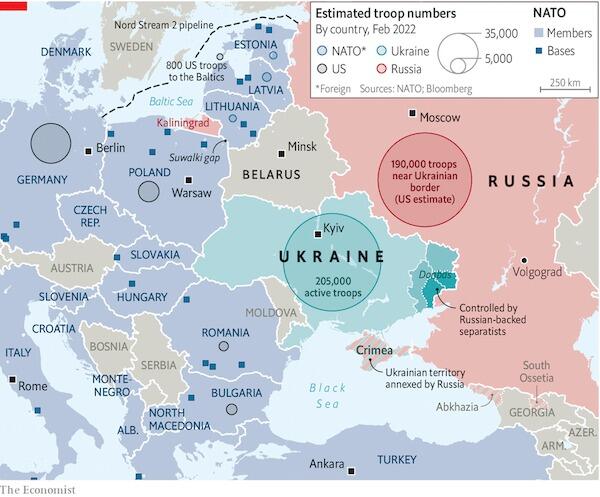
If you look at a map, parts of Ukraine are actually east of Moscow.

Source: The Economist

Will the U.S. Keep the War Going?

Of course, Ukraine can’t continue fighting without U.S. assistance. The Biden White House wants $60 billion of new money to give to Ukraine to fight the war. This is on top of several hundred billion already provided.

This was proposed last summer but has stalled in the Senate and House of Representatives ever since. The House passed a separate bill to aid Israel last fall, but the Senate refused to take it up because they want to tie that aid to money for Ukraine.

The Senate passed a bill that would provide aid for Ukraine, Israel and Taiwan in one package combined with some money for phony border security.

That bill was so unpopular it could not even make it out of the Senate. Then the House insisted on passing regular appropriations before considering Ukraine.

That process was completed on March 23, but now Congress is on a two-week Easter recess so nothing further will happen until mid-April. No one has even answered the most important question, which is what would Ukraine do with the money.

They can’t buy badly needed 155mm artillery shells because the Western arsenals are bare and factories are not geared to make more than a handful. It will take years to expand that manufacturing capacity.

You can walk into a store with a wallet full of $100 bills, but if the shelves are empty, it doesn’t do you any good. The products simply aren’t there.

Meanwhile, wonder weapons from the West such as tanks, cruise missiles, armored personnel carriers, HIMARS precision-guided artillery and anti-missile batteries have all been destroyed, disabled or shot down by Russia.

The war in Ukraine hasn’t been good advertising for Western weapons.

Fallout

To repeat what I said earlier, Ukraine is losing the war badly. Russia is advancing on the southern and eastern fronts in Ukraine.

Still, the pressure on House Speaker Mike Johnson to do something remains. The Republican warmongers in the Senate like Lindsey Graham and Joni Ernst won’t let up. Many Republicans in the House such as Chip Roy and Marjorie Taylor Greene are opposed to Johnson on this.

Incredibly, Johnson may respond to the pressure with a solution worse than an outright appropriation. He may get behind efforts to steal $300 billion in Russian central bank assets held in the form of U.S. Treasury securities.

That would destroy confidence in the U.S. dollar, U.S. Treasury securities and the U.S. rule of law. Russia would quickly recover the loss by seizing $300 billion or more of Western assets still in Russia. No one in Congress seems to understand any of this.

If they follow through, the economic fallout would be bad enough. But if this war doesn’t stop soon, we could ultimately be looking at nuclear fallout.

Tyler Durden
Wed, 04/03/2024 – 07:20

via ZeroHedge News https://ift.tt/3Wywudz Tyler Durden

“Backlash Is Real”: DEI Exodus Gains Steam Across Corporate America

“Backlash Is Real”: DEI Exodus Gains Steam Across Corporate America

Have we reached peak DEI stupidity? 

Yes, we are well past the peak. As we explained in early March, “Both the DEI and ESG gravy trains on Wall Street are finally coming to an unceremonious end.” 

The unraveling of “diversity, equity, and inclusion” initiatives was seen on the state level, as Red states rushed to ban DEI programs in 2023. Google, Facebook, and other tech companies slashed DEI staff by late last year. Early this year, universities began rolling back diversity programs, while Harvard President Claudine Gay was demoted. 

DEI was doomed to fail, and corporations have been quickly scrambling to abandon mindless and profitless diversity programs with Marxist roots. The latest earnings call data shows that “DEI” mentions have collapsed from their peak in 2021, according to Axios, citing data from AlphaSense. 

In January, Johnny Taylor, president of the Society for Human Resource Management, told Axios that corporate executives are fed up with DEI. 

“The backlash is real. And I mean, in ways that I’ve actually never seen it before,” Taylor said, adding, “CEOs are literally putting the brakes on this DE&I work that was running strong” since George Floyd’s murder in early 2020. 

Kevin Clayton, senior vice president and head of social impact and equity for the Cleveland Cavaliers, said the chief diversity officer role was all the rage across corporate America after Floyd’s murder. He said companies filled these positions “out of gilt,” and hiring wasn’t the best. 

Boeing has figured out this the hard way… 

Axios noted, “Some businesses are cutting back funding, trimming DEI staff — and even considering pulling back on things like employee resource groups comprised of workers of various races, ethnicities or interests.” 

The pushback on DEI is finding momentum across corporations and universities. Subha Barry, former head of diversity at Merrill Lynch, told Bloomberg last month: “We’re past the peak.”

“The seemingly small changes — lawyerly tweaks, executives call them — are starting to add up to something big: the end of a watershed era for diversity in the U.S. workplace, and the start of a new, uncertain one,” per Bloomberg.

If it’s DEI or ESG, the blowback phase is well underway. Companies are running away from these diverse and green programs because, simply, they don’t make money. 

Tyler Durden
Wed, 04/03/2024 – 06:55

via ZeroHedge News https://ift.tt/prJ5n1G Tyler Durden