The Increasing Prevalence Of Autism

The Increasing Prevalence Of Autism

According to the Centers for Disease Control and Prevention (CDC), the prevalence of autism among U.S. children has risen significantly in recent years.

As Statista’s Felix Richter reports, while 6.7 in 1,000 children were diagnosed with autism spectrum disorder (ASD) in 2000, that number had risen to 27.6 in 1,000 children by 2020.

This means that currently 1 in 36 children in the U.S. get diagnosed with ASD, up from 1 in 150 children 20 years ago.

Infographic: The Rising Prevalence of Autism | Statista

You will find more infographics at Statista

The reasons for this increase in prevalence are not fully understood and likely complex.

Some possible factors that have been proposed include better awareness and screening for autism, changes in diagnostic criteria and environmental or genetic factors.

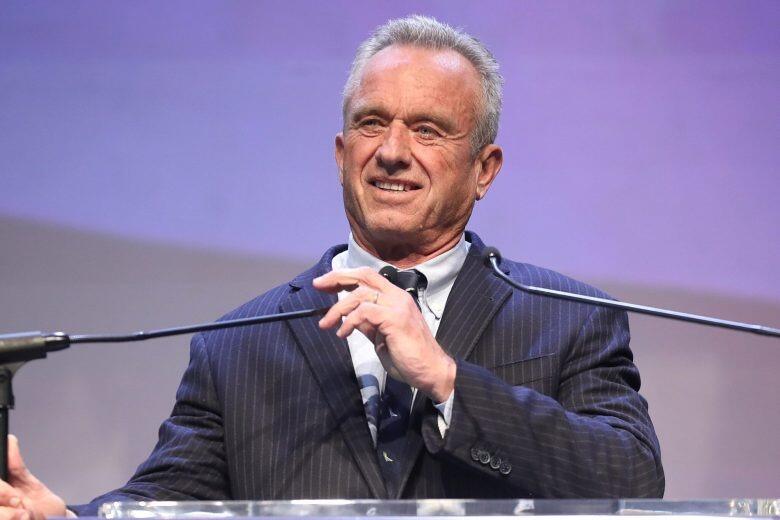
…ask RFK Jr what he thinks!

Regardless of the reasons, this rise in the number of children with autism highlights the importance of early identification and intervention to help children with ASD reach their full potential.

In recent years, major progress has been made in increasing awareness and acceptance of autism. Thanks to that progress, many people are now aware that autism spectrum disorders are a very diverse group of conditions, that go far beyond the often-stereotypical depictions of autism in film and television. According to the World Health Organization, autism spectrum disorders are “characterized by some degree of difficulty with social interaction and communication. Other characteristics are atypical patterns of activities and behaviours, such as difficulty with transition from one activity to another, a focus on details and unusual reactions to sensations.”

This year’s World Autism Awareness Day, celebrated today, April 2, gives autistic people from all around the world the chance to share their perspective on how different societies are dealing with autism spectrum disorder. “Moving from Surviving to Thriving: Autistic individuals share regional perspectives” is the motto of this year’s observance, organized by the United Nations Department of Global Communications in collaboration with the Institute of Neurodiversity (ION), an organization established and run by neurodivergent people for neurodivergent people and allies.

Tyler Durden
Tue, 04/02/2024 – 22:40

via ZeroHedge News https://ift.tt/alARGuF Tyler Durden

White House Does Not Mention ‘Transgender Day Of Visibility’ on Spanish-Language Accounts

White House Does Not Mention ‘Transgender Day Of Visibility’ on Spanish-Language Accounts

Authored by Eric Lendrum via American Greatness,

In yet another display of selective pandering and political hypocrisy, the Biden Administration notably did not make any mention of “Transgender Day of Visibility” on its Spanish-language social media accounts, instead only referring to it on the normal English-language accounts.

As reported by the Daily Caller, the “Transgender Day of Visibility” was announced by the Biden White House to be on the same day as Easter Sunday, March 31st, a move that sparked widespread backlash and ridicule. While the White House’s X and Facebook accounts posted about it on Sunday, the Spanish-language versions, “La Casa Blanca,” made no such mentions of the new holiday.

However, both the English- and Spanish-language accounts did make posts commemorating Easter itself.

When White House spokesman Andrew Bates was asked about the discrepancy, he dodged the question completely and instead tried to turn it back around on conservative media.

That’s the case with most tweets from the English language account,” said Bates.

“We’re grateful that FOX agrees with President Biden about recognizing Transgender Day of Visibility, having previously tweeted, ‘Trans Day of Visibility is dedicated to celebrating transgender people. To all the transgender men, women and non-binary folx, we see you and stand with you.’”

“As a Christian who celebrates Easter with family, President Biden stands for bringing people together and upholding the dignity and freedoms of every American,” Bates said in a later statement.

“Sadly, it’s unsurprising politicians are seeking to divide and weaken our country with cruel, hateful and dishonest rhetoric. President Biden will never abuse his faith for political purposes or for profit.”

The “Transgender Day of Visibility” is one of over 50 pro-LGBTQ commemorative days now recognized by the Biden Administration and multiple far-left groups.

Tyler Durden
Tue, 04/02/2024 – 22:20

via ZeroHedge News https://ift.tt/UkBcvRY Tyler Durden

White Gold: Mapping US Lithium Mines

White Gold: Mapping US Lithium Mines

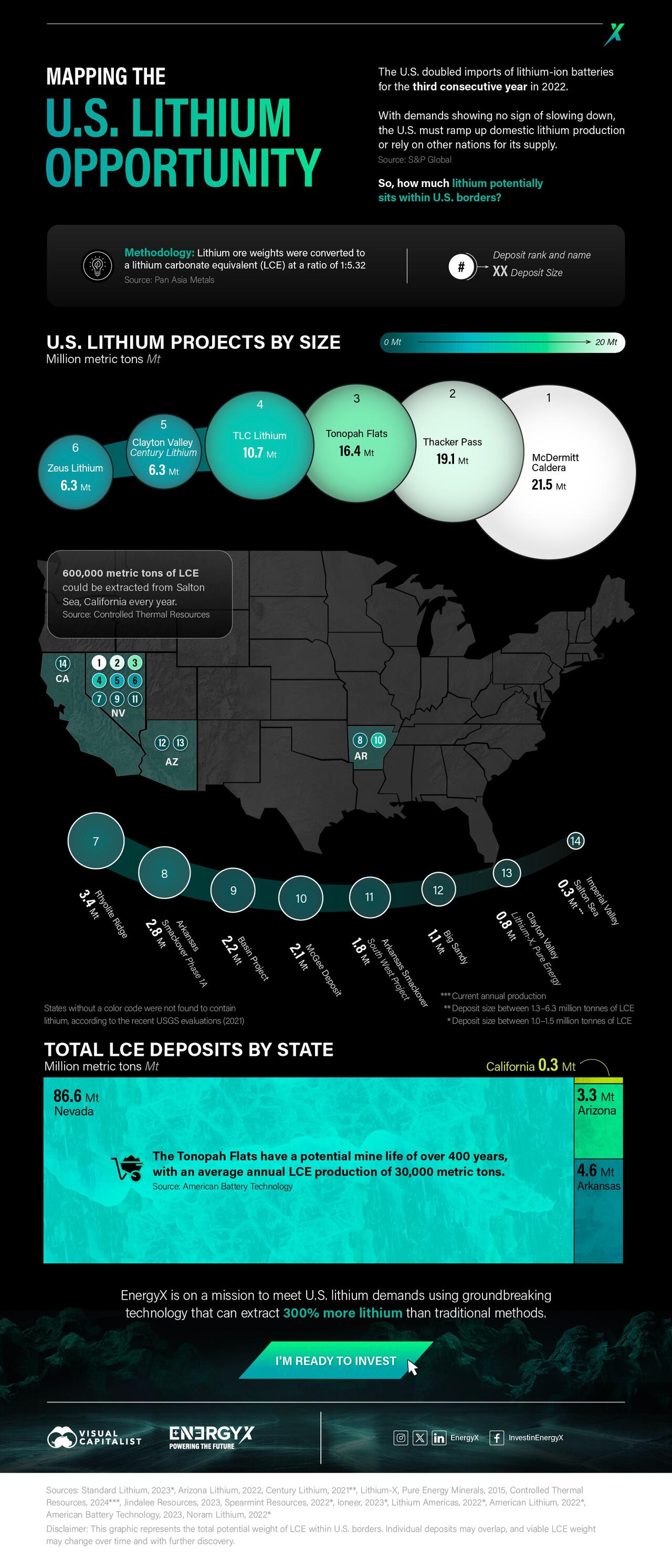
The U.S. doubled imports of lithium-ion batteries for the third consecutive year in 2022, and with EV demand growing yearly, U.S. lithium mines must ramp up production or rely on other nations for their supply of refined lithium.

To determine if the domestic U.S. lithium opportunity can meet demand, Visual Capitalist partnered with EnergyX to determine how much lithium sits within U.S. borders. 

U.S. Lithium Projects

The most crucial measure of a lithium mine’s potential is the quantity that can be extracted from the source.

For each lithium resource, the potential volume of lithium carbonate equivalent (LCE) was calculated with a ratio of one metric ton of lithium producing 5.32 metric tons of LCE. Cumulatively, existing U.S. lithium projects contain 94.8 million metric tons of LCE.


U.S. Lithium Opportunities, By State


U.S. lithium projects mainly exist in western states, with comparatively minor opportunities in central or eastern states.

Currently, the U.S. is sitting on a wealth of lithium that it is underutilizing. For context, in 2022, the U.S. only produced about 5,000 metric tons of LCE and imported a projected 19,000 metric tons of LCE, showing that the demand for the mineral is healthy.  

The Next Gold Rush?

U.S. lithium companies have the opportunity to become global leaders in lithium production and accelerate the transition to sustainable energy sources. This is particularly important as the demand for lithium is increasing every year.

EnergyX is on a mission to meet U.S. lithium demands using groundbreaking technology that can extract 300% more lithium from a source than traditional methods.

Tyler Durden
Tue, 04/02/2024 – 21:20

via ZeroHedge News https://ift.tt/EAx9YDu Tyler Durden

Multiple Buildings Collapse After Taiwan Shaken By Pair Of Powerful Earthquakes, Tsunami Warning Issued

Multiple Buildings Collapse After Taiwan Shaken By Pair Of Powerful Earthquakes, Tsunami Warning Issued

A powerful earthquake with a magnitude of 7.4 followed by a smaller quake with a magnitude of 6.5 struck off Taiwan’s eastern coast Wednesday, according to the US Geological Survey, prompting tsunami warnings in southern Japan.

The first quake, with a magnitude of 7.4, struck at 7:58pm ET (7:58am local time) and had an epicenter located about 18 kilometers (11 miles) south of the city of Hualien and shook buildings in the capital Taipei.

The second quake, with a magnitude of 6.5, hit 13 minutes later at 8:11pm ET, and was lcoated at almost the exact same spot as the first one: its epicenter was about 11 kilometers northeast of Hualien City.

Tsunami waves are possible along the Taiwan coast, the Pacific Tsunami warning center said. A tsunami warning was also issued for southwestern Japan’s Okinawa prefecture after the region was rocked by the quake.

Local residents were urged to evacuate from an expected tsunami of as high as 3 meters, according to the Japan Meteorological Agency.

Unconfirmed clips posted on X showed landslides in the aftermath of the strong quake.

Others reported that multiple buildings had collapsed in Taiwan in the aftermath of the quake.

Developing

Tyler Durden
Tue, 04/02/2024 – 21:00

via ZeroHedge News https://ift.tt/cWvbA9q Tyler Durden

The Weaponization Of The Secret Service Has Put Bobby Kennedy’s Life At Risk

The Weaponization Of The Secret Service Has Put Bobby Kennedy’s Life At Risk

Authored by Blake Fleetwood via ScheerPost.com,

Fifty years ago last summer, I met Robert F. Kennedy Jr.

We were in a small group climbing on skis to a spectacular 14,000-foot pass in the snow-covered Chilean Andes. The light, fluffy, bottomless power is about eight feet deep on top of another eight feet of packed winter snow.

We suddenly hear bullets ricocheting off a rock five feet away. The shots sound like someone quickly snapping his fingers. We look down the mountain; five Chilean Alpine troopers are spraying machine gun fire from their hips across a broad swath of the sloop.

Bobby, about 15 feet in front of me, falls into the snow. I think he has been shot, and we are all goners. The shots keep cracking as the rest of us dive for cover into the deep snow. After 20 minutes of hunkering, we peer down the mountain to the stormtroopers. Bobby, the youngest of the group at 19, takes the lead as he stands waving a white handkerchief on top of a ski pole. 

The troopers stop firing and motion for us to come down. Bobby goes up to the leader and starts talking to him. The gunman explains that there is going to be a change in the government, and they want to make sure that no one gets away. After inspecting our gear, they tell us to go on our way. 

The army troopers, under the command of  General Augusto Pinochet, were supported with weapons and bullets supplied by the CIA. The army, with Henry Kissinger’s help and millions of U.S. dollars, was in the throes of staging a coup that, in a few weeks, would murder the democratically elected President of Chile, Salvador Allende, as well as more than 5,000 other innocent civilians. 

This incident helped form Kennedy’s antipathy toward forever wars and other U.S. Empire-building adventures.

We have remained foxhole friends ever since. The same courage Bobby Kennedy showed on top of that mountain pass 50 years ago when facing machine gun-toting thugs he is showing today in his long-shot 2024 presidential campaign.

This is why I am so fearful about Robert F. Kennedy Jr. being shot at again. 

The Kennedy campaign made its fifth formal request for Secret Service protection in March, citing a 67-page report of repeated death threats, nutjob letters, two heavily armed intruders to a campaign event, an invader in Kennedy’s Cape Cod house, and another man who invaded Kennedy’s home twice in one day when Kennedy and his wife, Cheryl Hines, were at home. 

President Biden’s decision to deny Secret Service protection to Kennedy seems to be based on political considerations and weaponizes the Secret Service by making it necessary for Kennedy to raise and spend millions of dollars each month for security. 

Kennedy appears to fit neatly into the law governing Secret Service protection for presidential candidates. 

Biden could be helped by forcing Kennedy to continue to pay huge sums for private protection to protect himself, his family, and his supporters. Security costs the campaign 30 cents out of each dollar raised. 

Biden’s motive is not based on historical precedent, the threats and dangers Kennedy faces,  existing laws, or the slightest compassion for a political family that has suffered so grievously.

If the worst happens, Joe Biden will be accountable. Historically, a president can order Secret Service protection for a candidate on his own, as could the Homeland Security secretary, currently Alejandro Mayorkas, after consultation with the Congressional Advisory Committee — the leaders of the Senate and House of Representatives. For a comparison, lesser-known Republican presidential candidate Herman Cain was provided protection a year before the 2012 election by then-head of Homeland Security, Janet Napolitano.

The law states that the president and the secretary of Homeland Security have “broad discretion” in granting protection, and they have repeatedly done so, politics aside. 

Secret Service records recently revealed the agency’s conclusions that Kennedy is at “elevated risk for adverse attention,” and after reviewing credible armed threats against Kennedy, the agency assembled a group of eight teams ready to step in quickly after they get the go-ahead. But they never got it.

The threat to Kennedy is particularly acute because of his controversial politics and his family history—his father, RFK, Sr., a U.S. senator and presidential candidate, and his uncle, John F., a U.S. president, were both assassinated. RFK Jr. has provoked and challenged some of the most powerful forces in our country, especially concerning the military-industrial complex, the CIA, and endless foreign wars that so enrich defense contractors.

The perils to Kennedy arise not only because of his name but also because of the mainstream media’s relentless demonization of him. 

Kennedy’s wife, Cheryl Hines, the lead actress in the popular TV series Curb Your Enthusiasm, accused Biden of “playing politics” with her and RFK Jr.’s safety.

“Yesterday, an intruder climbed the fence at my home and was arrested,” Kennedy tweeted a few months ago. “After being released from police custody later in the day, he immediately returned to my home and was arrested again.”

In September, a heavily armed man impersonating a U.S. marshal and the CIA, with loaded concealed firearms and an accomplice, was arrested after infiltrating a private event. 

No wonder Hines is scared and worried. The Kennedy name is a lightning rod, a bright target for disturbed and demented individuals.  

Judicial Watch, a conservative foundation, filed a Freedom of Information request and lawsuit to determine why Kennedy’s multiple requests for Secret Service protection were not answered. Finally, they obtained a trove of previously hidden emails. 

“These documents confirm the bureaucratic and political runaround the Biden administration went through to ultimately deny Robert F. Kennedy Jr. the requested Secret Service protection,” said Tom Fitton, president of Judicial Watch. “The Biden administration’s refusal to provide Secret Service protection to Mr. Kennedy is dangerous and vindictive.”

According to the reports, higher-ups ordered the Secret Service not to talk to Kennedy’s private security.

Seventy percent of voters do not want Biden or Trump. According to a January 9, 2024, Gallup poll, Kennedy’s favorability rating of 52% is higher than Biden’s (41%) and Trump’s (42%). According to an earlier Gallup poll, 63% of U.S. adults think that the major parties do “such a poor job” of representing the American people that “a third major party is needed.” This is a 7% increase from a year ago.

Biden’s choice to deny Kennedy protection reflects insecurity, fearing Kennedy’s popularity and radical, transformative message have the potential to endanger his reelection. He might also worry that Secret Service protection will elevate Kennedy’s stature and give him a certain presidential aura as a credible contender among the media and voters. 

For 55 years, every presidential administration has granted early protection to major candidates who requested it. The Biden administration is the sole outlier.

If another Kennedy is killed while campaigning for president, it will be a long-lasting, traumatic stain on the American psyche that will scar the soul of our democracy for decades to come. Unfortunately, we live in violent, polarized times. The United States has surpassed 400 mass shootings in 2023, a record-breaking year in gun violence.

The perils to any Kennedy running for office are self-evident. An assassination attempt would dredge up memories of 1968 when Robert F. Kennedy Sr. and Martin Luther King Jr. were shot and killed, and George Wallace was gunned down and paralyzed, taking him out of the presidential race.

The puzzling thing is that Biden has spent decades transfixed by the Kennedy mystique, tracing his interest in politics to John F. Kennedy. He was a long-time friend of JFK’s brother, Sen. Ted Kennedy, and has a bust of Sen. Robert F. Kennedy exhibited prominently in the Oval Office. Biden employs four members of the Kennedy family as ambassadors and special assistants. In fact, he admired RFK Sr. so much that he lifted some lines from one of his speeches without attribution in 1988. Perhaps Biden imagines himself as the Irish Catholic reincarnation of the Kennedys. Is it now possible that Biden resents Robert Kennedy Jr. for taking away that long-held dream? 

President Biden, normally a compassionate man, knows that the Kennedy family has paid an unendurable, heartbreaking price for decades of enlightened public service. What  would Biden ever say to Ethel Kennedy, Bobby’s mother, if he were assassinated? Her husband and her brother-in-law were brutally murdered while serving their country. Two of her sons are already dead, perhaps from lingering trauma suffered from coping from their father’s so public assassination.

What would Biden say to Cheryl Hines? What can he say to Kennedy’s six children and to any bystanders who might get shot and killed as collateral damage? In Ecuador recently, a presidential candidate was assassinated, and nine bystanders were injured. 

The Biden administration has used various pretexts to justify its denial of protection for RFK Jr. The Advisory Committee that green lights  who gets Secret Service protection noted in its last rejection that federal protection should only be granted one year before the election. But now, seven months before the election, nothing has changed.

Serious presidential candidates have routinely received early government protection. Senator Ted Kennedy received government protection in September 1979, 414 days before the November 1980 election. He was running against sitting president Jimmy Carter, who hated Ted Kennedy and deeply resented his attacks on him. But to his credit, considering the tragic Kennedy history, Carter knew it was his obligation and duty to protect Ted Kennedy and not weaponize the Secret Service. 

Other examples of early Secret Service protection:

  • Sen. Barack Obama received protection 18 months, 551 days, before election day 2012, at the request of Sen. Dick Durbin.

  • Donald Trump and Ben Carson got protection in November 2015, a year before the election.

  • Herman Cain got protection almost a year before the 2012 election.

  • Sens. John Kerry and John Edwards each received protection in February 2004, nine months before the election.

  • Bob Dole was offered protection in March 1996, eight months before the election.

  • Pat Buchanan got protection in February 1996, nine months, 250 days, before the election.

  • Bill Clinton received protection in February 1992 after the New Hampshire primary, eight months before the general election.

  • Pat Robertson got it in December 1987, about 11 months before the election, before any of the 1988 primaries.

  • Jesse Jackson got protection in November, a year before the 1988 election.

  • Walter Mondale got protection nine months before the 1984 election.

  • Rick Santorum, Newt Gingrich and Mitt Romney all received protection in February and March 2012, about 10 months before Election Day

  • Sen. Walter Mondale got protection in January 1984, 10 months before the election.

  • Ronald Reagan got protection in January 1980, 10 months before the election.

To repeat: It is less than seven months before the Presidential election in November, and Kennedy still has not gotten the protection he and his family need and deserve. Nikki Haley, asked for Secret Service protection early this month because of increasing threats to her and her family. The Secret Service agreed to her request, even though she is no longer in the race.

Republican Sen. Ted Cruz is outraged at the treatment that RFK Jr. has gotten, asking, “How do you address the fact that previous major presidential candidates, such as Donald Trump, Dr. Ben Carlson, Barack Obama, and Senator Ted Kennedy, received Secret Service protection well over 120 days before the general election?” He also said, “I ask you to act swiftly to provide this major presidential candidate the protection that his exceptional circumstances so clearly warrant.”

Biden’s indefensible inhumane decision must be reversed before it is too late. 

Tyler Durden
Tue, 04/02/2024 – 21:00

via ZeroHedge News https://ift.tt/Bji1Ded Tyler Durden

Bring Back Gold!

Bring Back Gold!

Authored by Llewellyn Rockwell via LewRockwell.com,

In these days of rampant inflation, it’s imperative that we return to the gold standard – and the real thing too.

By this I mean the classical gold standard, not the so-called “gold exchange” standard, and with no fractional reserve banking, just as the great Murray Rothbard wanted. In what follows, I’ll discuss some of the economic issues below, but it’s important to realize that it’s a moral issue as well.

I spoke about the difference between the classical gold standard and the fake gold standard. This might seem a technical issue, but it’s one of vital importance. Joe Salerno, the leading contemporary Austrian School authority on monetary economics and Academic Vice President of the Mises Institute, explains:

“The historical embodiment of monetary freedom is the gold standard. The era of its greatest flourishing was not coincidentally the 19th century, the century in which classical liberal ideology reigned, a century of unprecedented material progress and peaceful relations between nations. Unfortunately, the monetary freedom represented by the gold standard, along with many other freedoms of the classical liberal era, was brought to a calamitous end by World War I.

Also, and not so coincidentally, this was the “War to Make the World Safe for Mass Democracy,” a political system which we have all learned by now is the great enemy of freedom in all its social and economic manifestations.

Now, it is true that the gold standard did not disappear overnight, but limped along in weakened form into the early 1930s. But this was not the pre-1914 classical gold standard, in which the actions of private citizens operating on free markets ultimately controlled the supply and value of money and governments had very little influence.

Under this monetary system, if people in one nation demanded more money to carry out more transactions or because they were more uncertain of the future, they would export more goods and financial assets to the rest of the world, while importing less. As a result, additional gold would flow in through a surplus in the balance of payments increasing the nation’s money supply.

Sometimes, private banks tried to inflate the money supply by issuing additional bank notes and deposits, called “fiduciary media,” promising to pay gold but unbacked by gold reserves. They lent these notes and deposits to either businesses or the government. However, as soon as the borrowers spent these additional fractional-reserve notes and deposits, domestic incomes and prices would begin to rise.

As a result, foreigners would reduce their purchases of the nation’s exports, and domestic residents would increase their spending on the relatively cheap foreign imports. Gold would flow out of the coffers of the nation’s banks to finance the resulting trade deficit, as the excess paper notes and checks were returned to their issuers for redemption in gold.

To check this outflow of gold reserves, which made their depositors very nervous, the banks would contract the supply of fiduciary media bringing about a monetary deflation and an ensuing depression.

Temporarily chastened by the experience, banks would refrain from again expanding credit for a while. If the Treasury tried to issue convertible notes only partially backed by gold, as it occasionally did, it too would face these consequences and be forced to restrain its note issue within narrow bounds.

Thus, governments and commercial banks under the gold standard did not have much influence over the money supply in the long run. The only sizable inflations that occurred during the 19th century did so during wartime when almost all belligerent nations would “go off the gold standard.” They did so in order to conceal the staggering costs of war from their citizens by printing money rather than raising taxes to pay for it.

For example, Great Britain experienced a substantial inflation at the beginning of the 19th century during the period of the Napoleonic Wars, when it had suspended the convertibility of the British pound into gold. Likewise, the United States and the Confederate States of America both suffered a devastating hyperinflation during the War for Southern Independence, because both sides issued inconvertible Treasury notes to finance budget deficits. It is because politicians and their privileged banks were unable to tamper with and inflate a gold money that prices in the United States and in Great Britain at the close of the 19th century were roughly the same as they were at the beginning of the century.

Within weeks of the outbreak of World War I, all belligerent nations departed from the gold standard. Needless to say by the war’s end the paper fiat currencies of all these nations were in the throes of inflations of varying degrees of severity, with the German hyperinflation that culminated in 1923 being the worst. To put their currencies back in order and to restore the public’s confidence in them, one country after another reinstituted the gold standard during the 1920s.

Unfortunately, the new gold standard of the 1920s was fundamentally different from the classical gold standard. For one thing, under this latter version, gold coin was not used in daily transactions. In Great Britain, for example, the Bank of England would only redeem pounds in large and expensive bars of gold bullion. But gold bullion was mainly useful for financing international trade transactions.

Other countries such as Germany and the smaller countries of Central and Eastern Europe used gold-convertible foreign currencies such as the US dollar or the pound sterling as reserves for their own domestic currencies. This was called the gold-exchange standard.

While the US dollar was technically redeemable in honest-to-goodness gold coin, banks no longer held reserves in gold coin but in Federal Reserve notes. All gold reserves were centralized, by law, in the hands of the Fed and banks were encouraged to use Fed notes to cash checks and pay for checking and savings deposit withdrawals. This meant that very little gold coin circulated among the public in the 1920s, and residents of all nations came increasingly to view the paper IOUs of their central banks as the ultimate embodiment of the dollar, franc, pound, etc.

This state of affairs gave governments and their central banks much greater leeway for manipulating their national money supplies. The Bank of England, for example, could expand the amount of paper claims to gold pounds through the banking system without fearing a run on its gold reserves for two reasons.

Foreign countries on the gold exchange standard would be willing to pile up the paper pounds that flowed out of Great Britain through its balance of payments deficit and not demand immediate conversion into gold. In fact by issuing their own currency to tourists and exporters in exchange for the increasing quantities of inflated paper pounds, foreign central banks were in effect inflating their own money supplies in lock-step with the Bank of England. This drove up prices in their own countries to the inflated level attained by British prices and put an end to the British deficits.

In effect, this system enabled countries such as Great Britain and the United States to export monetary inflation abroad and to run “a deficit without tears” — that is, a balance-of-payments deficit that does not involve a loss of gold.

But even if gold reserves were to drain out of the vaults of the Bank of England or the Fed to foreign nations, British and US citizens would be disinclined, either by law or by custom, to put further pressure on their respective central banks to stop inflating by threatening bank runs to rid themselves of their depreciating notes and retrieve their rightful property left with the banks for safekeeping.

Unfortunately, contemporary economists and economic historians do not grasp the fundamental difference between the hard-money classical gold standard of the 19th century and the inflationary phony gold standard of the 1920s.” See here.

Many people think that even if 100% reserve banking is desirable as an ideal, it would never work in practice. How could banks stay in business if they couldn’t lend their checking deposits? Doesn’t the supply of money need to expand as the economy grows? Murray Rothbard demolishes these objections with characteristic force:

“Certain standard objections have been raised against 100 percent banking and against 100 percent gold currency in particular. One generally accepted argument against any form of 100 percent banking I find particularly and strikingly curious: that under 100 percent reserves, banks would not be able to continue profitably in business. I see no reason why banks should not be able to charge their customers for their services, as do all other useful businesses. This argument points to the supposedly enormous benefits of banking; if these benefits were really so powerful, then surely the consumers would be willing to pay a service charge for them, just as they pay for traveler’s checks now. If they were not willing to pay the costs of the banking business as they pay the costs of all other industries useful to them, then that would demonstrate the advantages of banking to have been highly overrated. At any rate, there is no reason why banking should not take its chance in the free market with every other industry.

The major objection against 100 percent gold is that this would allegedly leave the economy with an inadequate money supply. Some economists advocate a secular increase of the supply of money in accordance with some criterion: population growth, growth of volume of trade, and the like; others wish the money supply to be adjusted to provide a stable and fixed price level. In both cases, of course, the adjusting and manipulating could only be done by government. These economists have not fully absorbed the great monetary lesson of classical economics: that the supply of money essentially does not matter. Money performs its function by being a medium of exchange; any change in its supply, therefore, will simply adjust itself in the purchasing power of the money unit, that is, in the amount of other goods that money will be able to buy. An increase in the supply of money means merely that more units of money are doing the social work of exchange and therefore that the purchasing power of each unit will decline. Because of this adjustment, money, in contrast to all other useful commodities employed in production or consumption, does not confer a social benefit when its supply increases. The only reason that increased gold mining is useful, in fact, is that the large supply of gold will satisfy more of the non–monetary uses of the gold commodity.

There is therefore never any need for a larger supply of money (aside from the non-monetary uses of gold or silver). An increased supply of money can only benefit one set of people at the expense of another set, and, as we have seen, that is precisely what happens when government or the banks inflate the money supply. And that is precisely what my proposed reform is designed to eliminate. There can, incidentally, never be an actual monetary “shortage,” since the very fact that the market has established and continues to use gold or silver as a monetary commodity shows that enough of it exists to be useful as a medium of exchange.

The number of people, the volume of trade, and all other alleged criteria are therefore merely arbitrary and irrelevant with respect to the supply of money. And as for the ideal of the stable price level, apart from the grave flaws of deciding on a proper index, there are two points that are generally overlooked. In the first place, the very ideal of a stable price level is open to challenge. Hoarding, as we have indicated, is always attacked; and yet it is the freely expressed and desired action on the market. People often wish to increase the real value of their cash balances, or to raise the purchasing power of each dollar. There are many reasons why they might wish to do so. Why should they not have this right, as they have other rights on the free market? And yet only by their “hoarding” taking effect through lower prices can they bring about this result. Only by demanding more cash balances and thus lowering prices can the dollars assume a higher real value. I see no reason why government manipulators should be able to deprive the consuming public of this right.

Second, if people really had an overwhelming desire for a stable price level, they would negotiate all their contracts in some agreed-upon price index. The fact that such a voluntary “tabular standard” has rarely been adopted is an apt enough commentary on those stable-price-level enthusiasts who would impose their ambitions by government coercion.

Money, it is often said, should function as a yardstick, and therefore its value should be stabilized and fixed. Not its value, however, but its weight should be eternally fixed, as are all other weights. Its value, like all other values, should be left to the judgment, estimation and ultimate decision of every individual consumer.” See here.

If we want a true gold standard, can we get back to it? Of course we can. The inflationary monetary policy we have today is the key to the financial elites control over us. Without it brain-dead Biden and his gang of neocon controllers couldn’t function. We must prevail, and we can prevail. As I said in 2002,

“The power to create money is the most ominous power ever bestowed on any human being. This power is rightly criminalized when it is exercised by private individuals, and even today, everyone knows why counterfeiting is wrong and knavish. Far fewer are aware of the role of the federal government, the Fed, and the fiat dollar in making possible the largest counterfeiting operation in human history, which is called the world dollar standard. Fewer still understand the connection between this officially sanctioned criminality and the business cycle, the rise and collapse of the stock market, and the continued erosion of the value of the dollar.

In fact, I would venture to guess that a sizeable percentage of even educated adults would be astounded to discover that the Federal Reserve does more than manage the nation’s money accounts, that, in fact, its main activity consists in actually creating money that distorts production and creates inflation and the business cycle. In fact, I would go further to suggest that many educated adults believe that gold continues to serve as the ultimate backing of our monetary system, and would be astonished to discover that our money is backed by nothing but more of itself.

We have our work cut out for us, to be sure, mainly at the educational level. We must continue to state the obvious at every opportunity, that the fiat system is exactly what it is, a system of paper money backed by nothing of real value. We must continue to point out that because of this, our economic system is not depression proof, but rather highly vulnerable to complete meltdown. We must continue to draw attention to the only long-term solution: a complete separation of money and state based on the commodity that the market has always chosen as money, namely, gold.

This takes us back to our original question: is the gold standard history? Is it so preposterously unrealistic to advocate it that we might as well move to on other things? It won’t surprise you that my answer is no. If there is one thing that a long-term view of politics teaches, it is that only the long-term really matters.

There will come a time when the current money and banking system, living off credit created by a fiat money system, will be stretched beyond the limit. When it happens, attitudes will turn on a dime. No advocate of the gold standard looks forward to the crisis nor to the human suffering that will come with it. We do, however, look forward to the reassertion of economic law in the field of money and banking. When it becomes incredibly obvious that something drastic must replace the current system, new attention will be paid to the voices that have long cast aspersions on the current system and called for a restoration of sound money.

Must a crisis lead to monetary reforms that we will like? Not necessarily, and, for that matter, a crisis is not a necessary precursor to radical reform. As Mises himself used to emphasize, political history has no predetermined course. Everything depends on the ideas that people hold about fundamental issues of human freedom and the place of government. Under the right conditions, I have no doubt that a gold standard can be completely restored, no matter how unfavorable the current environment appears towards its restoration.

What is essential for us today is to continue the research, the writing, the advocacy for sound money, for a dollar that is as good as gold, for a monetary system that is separate from the state. It is a beautiful vision indeed, one in which the people and not the government and its connected interest groups maintain control of their money and its safe keeping.

What has been true for hundreds of years remains true today. The clearest path to the restoration of economic health is the free market undergirded by a sound monetary system. The clearest path toward economic destruction is for us to stop working toward what is right and true.” See here.

Let’s do everything we can to end the Fed and restore the real gold standard!

Tyler Durden
Tue, 04/02/2024 – 20:20

via ZeroHedge News https://ift.tt/cK5ImDT Tyler Durden

Chinese Illegal Immigrant Arrested After Sneaking Onto Marine Corps Base, Refusing To Leave

Chinese Illegal Immigrant Arrested After Sneaking Onto Marine Corps Base, Refusing To Leave

A Chinese national illegally in the United States was arrested last week after sneaking onto a Marine Corps base in California and refusing to leave, according to an official from US Customs and Border Protection (CBP).

In a March 29 post on X, Sector Chief Patrol Agent Gregory Bovino confirmed that agents were called out to the Marine Corps Air Ground Combat Center in Twentynine Palms, California after the Chinese national entered the facility without authorization.

Subject was confirmed to be in the country illegally,” Bovino wrote, noting that the purpose of the incursion was still under investigation.

That said, the Epoch Times has learned on background from CBP sources that the Chiense national tried to enter the base without authorization, and he was later transported to a nearby CBP station for further processing.

Twentynine Palms is the largest Marine Corps base in the country.

The breach comes amid numerous instances of Chinese nationals infiltrating US military bases over a span of several years.

For instance, two Chinese nationals were arrested for illegally entering and taking photos at a U.S. Navy base in Florida in 2020, and a recent report by The Wall Street Journal estimates that there have been more than 100 similar incidents over the past few years.

The head of the Border Patrol union recently warned about a sharp rise in the number of military-aged Chinese men crossing the U.S.–Mexico border illegally, which dovetails with CBP data. –Epoch Times

According to the report, there’s been an ‘exceptionally high’ increase in the number of Chinese nationals – ‘particularly military-aged men,’ who have illegally crossed the US-Mexico border.

Starting in February 2023, the number of single Chinese adults encountered by CBP began to rise. In February of this year, CBP agents encountered 5,455 single Chinese adults who had entered illegally – over twice the number of any other February on record.

According to the Associated Press, Chinese people were the fourth most common nationality crossing the Darién Gap between Colombia and Panama en route to the United States, after Venezuelans, Ecuadorians, and Haitians.

Gordon Chang, a senior fellow at the Gatestone Institute and author of “The Coming Collapse of China,” wrote in a recent op-ed in The Epoch Times that of the Chinese migrants making the dangerous trek north from points in Central and South America, “almost all are desperate, seeking a better life for themselves and their children.”

Some, however, are coming to commit acts of sabotage,” he said.

Mr. Chang explained that many Chinese nationals fly to Ecuador, which allows them to enter visa-free. Then, they travel to the southern edge of the Darién Gap, a 66-mile stretch of jungle that separates Colombia and Panama, typically crossing on foot. Once they get to the north side, they continue their journey to the United States, often by bus, according to the China expert.

Some migrants are almost certainly members of China’s People’s Liberation Army (PLA),” Mr. Chang wrote. -Epoch Times

 What’s more, “These military-linked migrants, despite their affiliations, have been released into America.”

Tyler Durden
Tue, 04/02/2024 – 20:00

via ZeroHedge News https://ift.tt/BMzFZYx Tyler Durden

Another Outlandish Overreach By The CDC

Another Outlandish Overreach By The CDC

Authored by Jeffrey A. Tucker via The Epoch Times (emphasis ours),

Easter weekend was lovely in every way.

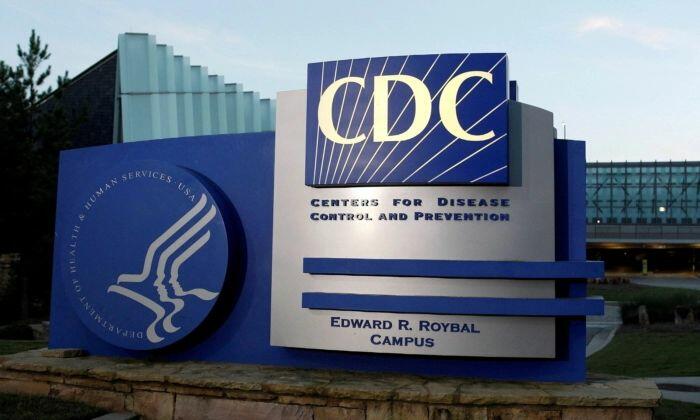
And yet I could not stop thinking about the strange manner in which the Centers for Disease Control and Prevention (CDC) has had such an outsized role in the ruination of American rights and liberties. This agency is supposed to be tracking infectious disease and finding ways out. This mandate became the leverage to allow them to impose nationwide mask mandates, a rental moratorium, a shutdown of the cruise industry, and otherwise send the whole country into fits of hysterics for two years and more.

So it occurred to make an inquiry into how the CDC handles questions of election processes. This is rather important in a democracy. This is how we select our leaders and the central way in which we can claim that the people have some influence over the regime that rules us. It is because of elections that we can claim to be better than ancient despotisms or medieval feudalism. We rule ourselves through the vote. That’s the whole idea.

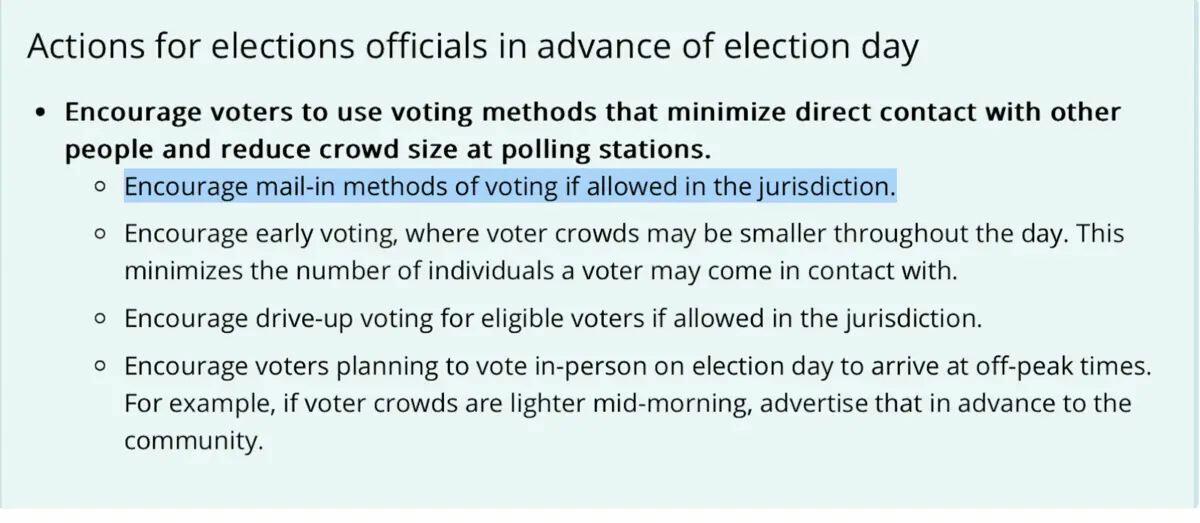
As it turns out, the CDC had quite a large role in guiding election processes. Not that you can find the evidence on their website now. Nope, it’s all been scrubbed. However, if you look at the Wayback Machine, you can find an interesting little point. The CDC strongly recommended mail-in, absentee, and early voting as a means of disease control.

The theory was that people gathering in a polling place would be a super-spreader event. What science did they cite to demonstrate this? None at all. So far as I know, and I’ve looked far and wide, there is not a single study anywhere that purports to show some relationship between disease spread and in-person voting. The CDC just made that up… for whatever reason.

The day was March 12, 2020. This was the same day that President Trump went on national television in the evening to announce that there would be no more travel from the United States to Europe, the UK, and, later, Australia and New Zealand. He further said that all Americans living abroad needed to come home right away or be stuck.

That was a pretty shocking announcement. Nothing like this had ever happened in American history, not even this broadly in wartime. It seemed to come out of nowhere, our rights to travel suddenly deleted.

It seems that President Trump was following the advice of his scientific advisors who later turned out to be snake oil salesmen. Indeed, he seemed extremely uncomfortable making this announcement, almost like he knew that it was weird and probably unwarranted. Strange night.

As it turns out, earlier that day, the CDC decided that the whole country really ought to be voting by mail. They went into the website and edited the page that very day and produced the following checklist.

You can see for yourself at the Archive link. So far, the CDC has not proven itself powerful enough to scrub also its bread crumbs from the archive source, not yet in any case. The time might come. If they succeed, their role in creating the biggest voting scandal in a hundred years might never have been known by future generations.

There is simply no way that the CDC could not have known about the uncertainties and vagaries created by absentee ballots. They are banned by half the countries in the world for that reason. Those that do allow them govern them very strictly. You have to request a ballot. They are sent to your home. You have to provide extensive identity verification. You have to have a darn good excuse. It’s only for hardship cases and never the norm.

It was the CDC that decided to throw all that in the trash. Who even cares about the whole history of democracy, because, after all, there is a virus floating around! It’s amazing that this happened. But just as amazing is the idea of throwing out property rights, which they also did. But there it is.

To be sure, they could not actually force this result. But they sure could grant some scientific heft behind the idea. It also helped that only 10 days later, the U.S. Congress voted $2 trillion in payments to the states, a portion of which was to implement CDC recommendations. Most states were happy to do so, again, with full knowledge that this strategy would yield results that were sketchy at best.

As it turns out, of course, it was the mail-in ballots that might have made the difference in the election, or seemed to in any case. Everything got so much mixed up that it’s hard to say. And it’s not like people did not have warning signs of trouble. The primary season of that spring and summer yielded a slew of controversies about what was and was not true. There were more than enough controversies swirling about by the time of the general election.

The crucial point here is that the CDC massively overstepped the bounds of its mandate by intervening in the processes by which Americans select its leaders, strongly pushing a method that was a known source of fraud. Nor has the CDC ever been held to account for this, not to my knowledge in any case.

They were sued over the rent moratorium and the evil nationwide mask mandate. They lost both cases. But there has been no litigation against the CDC for disrupting the whole system by which we regulate elections. One might suppose that if an executive agency were to do something like this, they would have needed some permission from somebody. Surely such a gigantic change would and should require more than a low-level employee with logins to change a website text.

Speaking of which, who actually did this and why? Aren’t these interesting questions? Why is no one asking them? Where are the investigations? Where is the outrage?

Views expressed in this article are opinions of the author and do not necessarily reflect the views of The Epoch Times or ZeroHedge.

Tyler Durden
Tue, 04/02/2024 – 19:40

via ZeroHedge News https://ift.tt/3AktOi4 Tyler Durden

Attempted Suicide Rates More Than Double After Gender-Reassignment Surgery: Study

Attempted Suicide Rates More Than Double After Gender-Reassignment Surgery: Study

Rates of attempted suicide who identified as transgender more than doubled after receiving a vaginoplasty (surgically turning one’s dick into a vagina), according to a peer-reviewed study published in The Journal of Urology.

(Teeradej/Shutterstock)

The study looked at rates of psychiatric emergencies both before and after gender-altering surgery among 869 males who went under the knife, and 357 females who underwent phalloplasty (turning one’s vagina into a dick) in California between 2012 and 2018.

While researchers found that rates of ‘psychiatric emergencies’ were high both before and after gender-altering surgery, suicide attempts were markedly higher among those who received vaginoplasties, the Epoch Times reports.

“In fact, our observed rate of suicide attempts in the phalloplasty group is actually similar to the general population, while the vaginoplasty group’s rate is more than double that of the general population,” wrote the author of the study.

Among the 869 patients who underwent vaginoplasty, 38 patients attempted suicide—with nine attempts before surgery, 25 after surgery, and four attempts before and after surgery. Researchers found a 1.5 percent overall risk of suicide before vaginoplasty and a 3.3 percent risk of suicide after the procedure. Almost 3 percent of those who attempted suicide after undergoing vaginoplasty did not present with a risk of suicide prior to surgery.

Among the 357 biologically female patients who underwent phalloplasty, there were six suicide attempts with a 0.8 percent risk of suicide before and after surgery. -Epoch Times

Aside from suicide attempts, the study found that the proportion of those who experienced an emergency room and inpatient psychiatric encounter was similar between the two groups – with 22.2% of vaginoplasty and 20.7% of phalloplasty groups experiencing at least one psychiatric encounter.

According to the study, 33.9% of biological males undergoing vaginopasty would experience a post-surgery psychiatric encounter vs. 26.5% for biological women who underwent phalloplasty, if an episode had occurred before surgery.

That’s a lot.

As the Epoch Times notes further:

Suicide Rate 19-Fold Higher

In an interview with The Epoch Times, Dr. Alfonso Oliva, a board-certified plastic and reconstructive surgeon, said research into the psychiatric outcomes and long-term follow-up of those who have sex-reassignment surgery is lacking, but an important paper is worth mentioning. In a 2011 paper published in PLOS ONE, researchers found that people who underwent sex reassignment surgery had substantially higher rates of overall mortality, suicidal behavior, and psychiatric morbidity compared with the general population.

It’s hard to refute this paper because it’s a longitudinal study,” Dr. Oliva said. “In Sweden, everyone is in a database, and through diagnosis codes, they’re able to follow what happens to every citizen in terms of their medical history. They waited more than 10 years after people had surgery and found that death by suicide had an adjusted hazard ratio of 19.1.”

You can “quibble” about emergency room encounters, but this study shows that for patients who had transgender surgery, their suicide rate after 10 years was 19-fold higher than the general population, Dr. Oliva said. Additionally, the study excluded people with psychiatric illnesses, so these are individuals thought to have no psychiatric illness outside of dysphoria. 

Surgical Procedures

A phalloplasty is a multistep process undertaken by a biological female who wants to transition to a male, where a penis is created using tissues from the genitals and forearm or thigh. The external genitals, such as the labia or outer labia, are used to create a scrotum, and testicular implants are inserted months later along with an implant that will cause erections.

Vaginoplasty is the most commonly performed gender-reassignment surgery for those with gender dysphoria, with more than 3,000 procedures performed annually. According to Johns Hopkins Medicine, vaginoplasty is a surgical procedure that involves removing the penis, testicles, and scrotum to create a vulva and functional vagina. Surgeons typically create a vaginal canal using the skin surrounding the existing penis and scrotum or by using a skin graft from the abdomen or thigh.

A penial inversion is the most commonly performed procedure where the skin is removed from the penis and inverted to form a pouch that is inserted into the vaginal cavity created between the urethra and the rectum. Surgeons then partially remove, shorten, and reposition the urethra and create a labia majora, labia minora, and clitoris.

Another surgical method involves using a robotic system that enables surgeons to reach into the body through a small incision in the belly button to create a vaginal canal. The type of vaginoplasty performed varies among patients. For example, younger patients who have never experienced puberty may have insufficient penile skin to do a standard penile inversion.

“When you take a child who’s about to undergo puberty—and they suggest giving puberty blockers to stop puberty at age 10 to 11 1/2—and when you do that for little boys, they aren’t able to get tissue from the penis and scrotum, so creating a vagina is very difficult,” Dr. Oliva told The Epoch Times. “You have to use tissue from other areas of the body, such as the peritoneum or the colon. Some researchers in Brazil are actually looking into using tilapia fish,” he added.

After a vaginoplasty is performed, the recovery process is extensive and vaginal dilation must be performed at varying intervals throughout the patient’s life.

Vaginoplasty Associated With Serious Risks

In addition to an increased risk of suicide, vaginoplasty is associated with numerous physical complications, including wound separation, vaginal stenosis, hematoma, rectovaginal fistulas, granulation tissue, bleeding, infection, skin or clitoral necrosis, suture line dehiscence (when the surgical incision opens), urinary retention or vaginal prolapse.

According to a 2021 paper in the International Brazilian Journal of Urology, a rectovaginal fistula is the “most devastating complication” of a vaginoplasty that can occur “despite careful technique” and without obvious injury to the rectum.

A rectovaginal fistula is an abnormal connection between the rectum and vagina that can cause fecal incontinence, hygiene issues, vaginal or anal irritation, and potentially life-threatening abscesses and fistula recurrence.

A 2021 review in Andrology found that rates of complications following penile inversion vaginoplasty ranged from 20 to 70 percent, with most of the complications occurring during the first four months following the procedure.

In a 2018 Clinical Anatomy review and meta-analysis, researchers reviewed 125 articles to assess neovaginal complications following surgery. After selecting 13 studies that included 1,684 patients, they found a complication rate of 32 percent, with a reoperation rate of 22 percent for non-esthetic reasons.

“For cosmetic surgery, if the complication rate was more than 2 percent to 3 percent, you wouldn’t have any patients,” Dr. Oliva told The Epoch Times. “These are very high percentage rates that we just accept.”

Dr. Oliva said complications with these surgical procedures are very high and he thinks this is why suicide rates are so high.

People think this is going to solve the problem and it doesn’t,” he said.

A June 2018 paper on postoperative outcomes of 117 patients who underwent vaginoplasty published in the Journal of the American Society of Plastic Surgeons found that 26 percent of patients experienced granulation tissue, 20 percent had intravaginal scarring, and 20 percent experienced prolonged pain.

In a 2017 paper published in The Journal of Urology, researchers followed patients who underwent penile inversion vaginoplasty. Of 330 patients, 95 (29 percent), presented with postoperative complications. Three of those patients developed a rectoneovaginal fistula, and 30 patients required a second operation.

Story continues below advertisement

In a 2016 study published in Urology, researchers retrospectively reviewed clinical records of 69 patients who underwent vaginoplasty from January 2005 to January 2015. Although complications during surgery were not reported, 22 percent of patients experienced major postoperative complications.

“We’ve been transitioning adults in the United States since 2007, but where’s the data from gender identity clinics? Why is nothing published in the United States about long-term function? Why do we have nothing published on sexual function? We should be able to follow that and should be studying it and we’re not,” Dr. Oliva told The Epoch Times. 

*  *  *

Tyler Durden
Tue, 04/02/2024 – 19:20

via ZeroHedge News https://ift.tt/aWei958 Tyler Durden

Biden Administration Acknowledges “Challenge” With New Truck Emissions Rule

Biden Administration Acknowledges “Challenge” With New Truck Emissions Rule

By John Gallagher of FreightWaves,

The Biden administration acknowledged that its aggressive push to decarbonize trucking will be costly — but that the federal government will be here to help.

“The overarching challenge is aligning the market-driven desire from fleets to adopt zero-emission freight vehicles with the resources required to make it successful, and right now, they cost more,” said Gabe Klein, executive director of the U.S. Joint Office of Energy and Transportation.

Speaking to NPR before the release on Friday of the U.S. Environmental Protection Agency’s new phase-three truck emissions rule, Klein said that “cost parity” has yet to be reached that would make electric trucks as affordable. A new Class 8 diesel truck costs roughly $180,000 compared with up to $400,000 for a battery-electric truck, according to estimates.

“That’s why the federal government is providing subsidies, to bring it down closer to cost parity,” he said. “I will also say the charging infrastructure is of course a limiting factor. So we need to make sure everybody has access, not just the big fleets and companies.”

EPA’s “Greenhouse Gas Emissions Standards for Heavy-Duty Vehicles – Phase 3” final rule, which applies to model years 2027 through 2032, avoids 1 billion tons of greenhouse gas emissions — equivalent to the emissions from more than 13 million tanker trucks’ worth of gasoline, according to the agency. EPA also estimated $13 billion in annualized public health benefits.

“In finalizing these emissions standards for heavy-duty vehicles like trucks and buses, EPA is significantly cutting pollution from the hardest working vehicles on the road,” commented EPA Administrator Michael Regan. “Building on our recently finalized rule for light- and medium-duty vehicles, EPA’s strong and durable vehicle standards respond to the urgency of the climate crisis by making deep cuts in emissions from the transportation sector.”

Timelines loosened

According to the rule’s preamble, the new standards for heavy-duty trucks include less stringent standards for all vehicle categories in model years (MY) 2027, 2028, 2029 and 2030 than had been originally proposed last year.

In addition, while emissions standards for sleeper cabs in the final rule begin in MY2030 as proposed, they are less stringent for that year and for MY2031. However, they are equivalent in stringency to what EPA had proposed for MY2032, the preamble notes.

While placating environmental groups, much of the trucking firmly opposes the rule despite adjustments made to the final rule.

“The post-2030 targets remain entirely unachievable given the current state of zero-emission technology, the lack of charging infrastructure and restrictions on the power grid,” commented American Trucking Associations President and CEO Chris Spear.

He stressed that while the final rule includes lower zero-emission vehicle rates for the initial model years, rates in the later years will drive battery-electric and hydrogen investment and limit other potential zero-emission options.

“While we are disappointed with today’s rule, we will continue to work with EPA to address its shortcomings and advance emission-reduction targets and timelines that are both realistic and durable,” Spear said.

Owner-Operator Independent Drivers Association President Todd Spencer called the new rules “unworkable” requirements.

“This administration appears more focused on placating extreme environmental activists who have never been inside a truck than the small business truckers who ensure that Americans have food in their grocery stores and clothes on their backs,” Spencer said.

Daimler throws in support

But not all companies involved in heavy-duty trucking opposed the rule, particularly companies that have been investing heavily in zero-emission technologies, like vehicle manufacturer Daimler Truck North America (DTNA). The company had lobbied EPA for less aggressive timelines when the rule was proposed.

“We thank the agency for addressing industry concern about the challenges of the early years of the rule and we remain committed to upholding the spirit of this regulation,” commented DTNA vice president Sean Waters.

“Ultimately, the successful transition of the commercial vehicle industry is dependent on the availability of reliable zero-emission charging and refueling infrastructure and the ability to conduct business at a reasonable cost of ownership,” he added.

Charging availability and cost was questioned by much of the trucking industry, which commissioned a recent study estimating the cost to install charging infrastructure at $1 trillion.

Incentives needed

The Biden administration’s Klein pushed back on cost concerns, however, pointing to incentives provided at the federal level.

“We’ve already invested $253 million through the Department of Transportation — that’s charging and fueling infrastructure grants — just recently,” he said.

“But there’s also a great deal of private sector funding. And really the goal here is to supplement the private sector, not to supplant their funding.” 

Tyler Durden
Tue, 04/02/2024 – 19:00

via ZeroHedge News https://ift.tt/Z4iCO2A Tyler Durden