Biden Looks To Prevent Future President From Ending Ukraine War With 10-Year Agreement

Biden Looks To Prevent Future President From Ending Ukraine War With 10-Year Agreement

Soon on the heels of President Biden last week signing into law a $61 billion aid package for Ukraine’s defense, President Volodymyr Zelensky on Sunday indicated that he’s working with Washington on a bilateral security agreement which would last ten years.

“We are already working on a specific text,” Zelensky said in his nightly video address. “Our goal is to make this agreement the strongest of all.”

Ukrainian Presidential Press Office via AP

“We are discussing the specific foundations of our security and cooperation. We are also working on fixing specific levels of support for this year and the next 10 years.”

He indicated it will likely include agreements on long-term support centering on military hardware and joint arms production, as well as continuing reconstruction aid. “The agreement should be truly exemplary and reflect the strength of American leadership,” Zelensky added.

But ultimately a key purpose in locking such a long-term deal in would be to keep it immune from potential interference by a future Trump administration.

Below is what The Wall Street Journal spelled out last year:

The goal is to make sure Ukraine will be strong enough in the future to deter Russia from attacking it again. More immediately, Ukraine’s Western allies hope to discourage the Kremlin from thinking it can wait out the Biden administration for a potentially more sympathetic successor in the White House

Western officials are looking for ways to lock in pledges of support and limit future governments’ abilities to backtrack, amid fears in European capitals that Donald Trump, if he recaptures the White House, would seek to scale back aid. Trump has a wide lead in early polling in the Republican presidential primary field, but soundly lost the 2020 election to President Biden and has been indicted in four criminal cases in state and federal courts. 

We and others have previously underscored that NATO and G7 countries are desperately trying to “Trump-proof” future aid to Ukraine and the effort to counter Russia.

As for its first new weapons package in the wake of the $61 billion being authorized, the Biden administration has announced new arms packages totaling $7 billion. The US has vowed to rush the weapons to Kiev, given that by all indicators its forces are not doing well on the frontlines.

“We are still waiting for the supplies promised to Ukraine – we expect exactly the volume and content of supplies that can change the situation on the battlefield in the interests of Ukraine,” Zelensky had said over the weekend. “And it is important that every agreement we have reached is implemented – everything that will yield practical results on the battlefield and boost the morale of everyone on the frontline. In a conversation with Mr. Jeffries, I emphasized the need for Patriot systems, they are needed as soon as possible.”

But all of this means the war will be prolonged, and this puts negotiations much further away on the horizon, despite what are now daily acknowledgements of Ukraine forces being beaten back. Currently the governments of Greece and Spain are being pressured by EU and NATO leadership to hand over what few Patriot systems they possess to Kiev. The rationale is that they don’t need them as urgently as Ukraine does.

Tyler Durden
Mon, 04/29/2024 – 10:00

via ZeroHedge News https://ift.tt/ioTq6k5 Tyler Durden
Intervention Or Not, Yen Bears Will Stay Confident

Intervention Or Not, Yen Bears Will Stay Confident

By Vassilis Karamanis, Bloomberg Markets Live reporter and FX strategist

Unless Japanese authorities show their hand with conviction when it comes to intervening in the spot market, the yen is bound to stay under pressure over the medium-term.

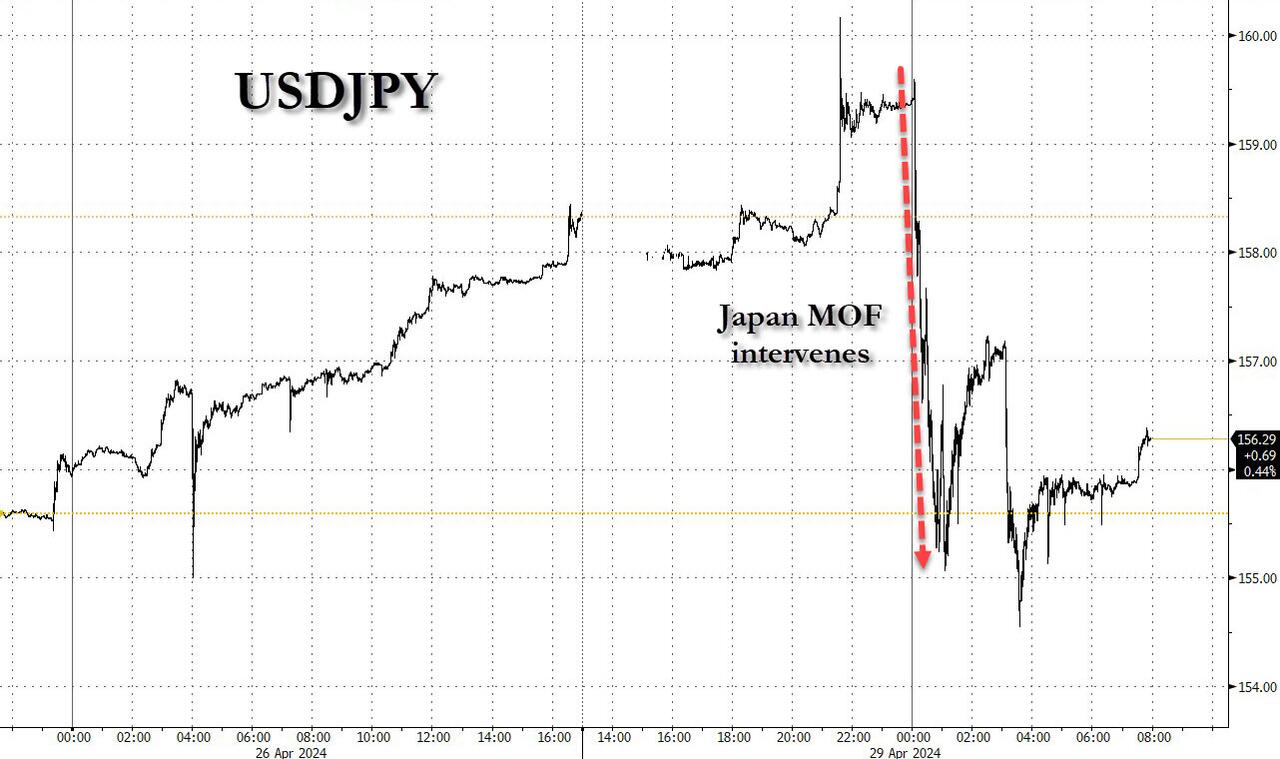
The currency’s sharp rally this morning certainly looks like an intervention — it’s not often that we get a 500-pip move seemingly out of nowhere. But thin liquidity due to a public holiday in Japan that forced algorithmic trading to take over as trailing stops were triggered could be what’s driven the market. The fact that traders aren’t sure this is an official hand supporting the yen is telling. Masato Kanda, the nation’s top currency official, said no comment when asked about the moves.

The market has been testing Japanese authorities’ patience — or determination — when it comes to yen weakness for some time now. And it will keep on doing so for as long as intervention threats are seen as a clumsily-played bluff.

The yen kept breaching through one big level after the other on Friday against the dollar and everyone’s question was whether we would finally have official yen buying before a long weekend in Japan. The answer was an emphatic no.

Did price action Friday actually give Japanese authorities the green light to intervene in the spot market?

The yen fell by the most since October on an intraday basis, for a two standard-deviation move; one-week realized volatility touched a one-month high

It was down 3.5% on a ten-day basis; Kanda said that a 4% move over two weeks doesn’t reflect fundamentals and is unusual
Over one month, the dollar was up by around seven big figures against the Japanese currency; Kanda has said that a 10-yen move over such a time period is considered rapid.

So in nominal terms, we could argue it was justified that no intervention took place, given a simple rates-check during a Japan holiday could actually do the trick. But in real terms, no one would blame Japanese authorities if they went beyond their official guidelines to step in the spot market. It’s not just about the 350-pip day range that took place. It’s the starting point that also matters. Fresh 34-year lows were hit Thursday.

Traders could see lack of official yen buying as an attempt to find excuses in order to stay pat. After all, a weaker currency in theory accelerates inflationary dynamics that will eventually support the Bank of Japan as to signal a more-aggressive-than priced in tightening bias — which could really be a game changing moment for the currency, especially if at the same time the Federal Reserve will indeed be close to easing its own policy.

And as long as credibility comes to the question, the more confident traders will be to re-add dollar longs in case the Ministry of Finance does decide to intervene. There was some speculation during the weekend that Japan is waiting for the Fed meeting and the release of the next US jobs report due this week before deciding to press the button. To me, it doesn’t matter so much if this is credible thinking, but the mere fact traders are discussing it shows the ball is moving away from officials’ court.

It’s not easy going against a central bank. In poker terms, policymakers always start the game with a pair of aces. But the flop did no favors to them and their raise on the turn looks miscalculated. Maybe the upcoming river will see traders winning this hand despite Monday’s retreat for the dollar that at the time of writing has no official confirmation it was down to spot intervention.

Tyler Durden
Mon, 04/29/2024 – 09:45

via ZeroHedge News https://ift.tt/oTDOkiZ Tyler Durden

“Much Milder Than Feared”: Philips Shares Soar 43% After US Sleep Apnea Settlement

“Much Milder Than Feared”: Philips Shares Soar 43% After US Sleep Apnea Settlement

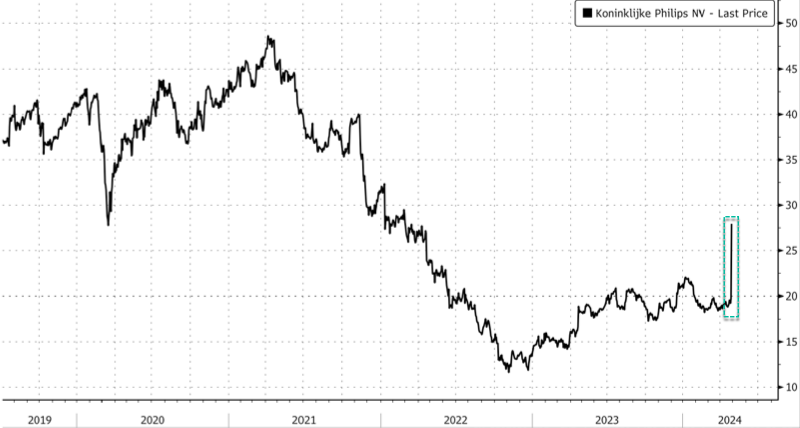
Shares of Royal Philips on Euronext Amersterdam surged as much as 43% Monday, the most on record after a lower-than-expected settlement in the US linked to faulty Respironics ventilators for sleep apnea.

The Dutch medical equipment manufacturer recalled the therapy devices due to concerns that the noise-canceling foam inside them was disintegrating, which patients inhaled. 

Some Wall Street analysts predicted the company would have to spend as much as $4.5 billion to $10 billion to cover the medical monitoring class-action lawsuit and individual personal injury claims in the US. However, the company only had to set aside $1.1 billion. 

Barclays analysts wrote in a note that this earlier-than-expected settlement “removes an overhang many have worried would linger for years.” 

Faulty sleep therapy devices have weighed on Philips’s shares since April 2021, tumbling as much as 76% from 48 euros a share to $11.6 in October 2022. Despite today’s 43% surge, shares are still down 40% from the highs recorded in 2021. 

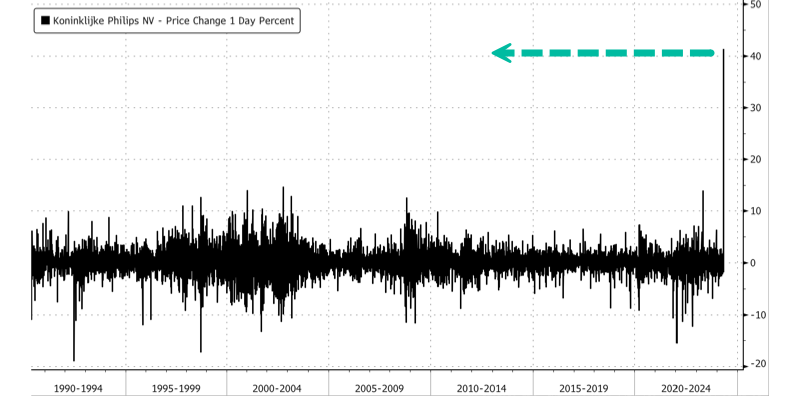
Today’s 43% jump is the largest daily percentage gain ever – beating out the 14.6% gain in 2002. 

The vicious upswing will likely squeeze bears. Data from S&P Global Market Intelligence shows shares out on loan, or an indication of short interest, represented about 4.9% of the company’s float as of Thursday. 

Here’s how Wall Street responded to the news (list courtesy of Bloomberg): 

Barclays (overweight)

  • The $1.1b settlement compares with buyside expectations of $2b-$4b, with “worst case fears” of $10b, analyst Hassan Al- Wakeel writes in a note
  • The earlier-than-expected settlement also “removes an overhang many have worried would linger for years”

Bernstein (market perform)

  • The settlement amount is less than expected, while the timing is “sooner than thought,” analyst Lisa Bedell Clive writes in a note
  • Bernstein had been working on the assumption that there was a 35% chance of a €3.8b personal injury settlement, and a 35% chance of a €766m medical monitoring lawsuit
  • The settlement “removes another overhang on the stock”

Jefferies (underperform)

  • The unexpected $1.1 billion settlement is “much milder than feared,” marking the “end of litigation uncertainty,” analyst Julien Dormois writes in a note
  • The 1Q results beat expectations, though order growth fell again

Morgan Stanley (equal weight)

  • The settlement figure is below expectations and should be well received, analyst Robert Davies writes in a note
  • There’s scope for FY earnings estimates to be increased by low-single-digits
  • Morgan Stanley sees questions being raised about the “softness” around the diagnostics & treatment performance, as well as the timeline around a resolution on the consent decree

Philips CEO Roy Jakobs joined Bloomberg TV after the settlement news. He said, “The settlement covers all the claims in the US, even the ones that would come in still over the next six months.” 


Tyler Durden
Mon, 04/29/2024 – 09:25

via ZeroHedge News https://ift.tt/tB2TmC1 Tyler Durden

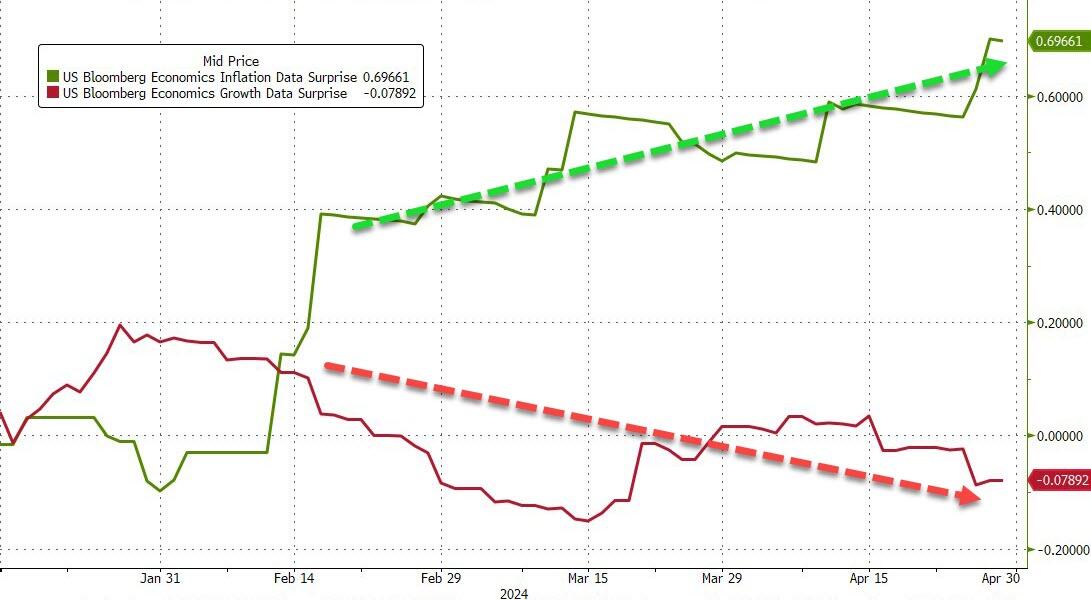
Weaker Growth And Higher Inflation… Why Consensus Was Wrong

Weaker Growth And Higher Inflation… Why Consensus Was Wrong

Authored by Daniel Lacalle,

The weak GDP figure for the first quarter came with a double negative. Poor consumer spending and exports, plus a rise in core inflation, The US administration’s enormous fiscal stimulus, underscores the importance of considering the weaker-than-expected data.

A deceleration in consumer spending, a decline in the personal savings ratio to 3.6%, and poor exports added to a set of figures for investment that were also negative when we looked at the details.

The gross domestic product is much weaker than the headlines suggest. If we look at consumption, both durable and non-durable goods were flat or down, while the only item that increased modestly was the services factor. Residential and intellectual property boosted investment, while equipment remained weak in the past two quarters. The slump in export growth coincided with a significant increase in imports, which weakened the trade deficit. Government spending continues to rise, albeit at a slower pace, and becomes the main factor to disguise what is evidently a concerning level of growth for a leading economy with enormous potential.

It is precisely because of the unnecessary increase in government spending, designed to bloat GDP and provide a false sense of strength in the economy, that inflation remains elevated and rising in a three- and six-month period.

Rising public debt has bloated the economy and left it at a disappointing level compared to its potential, as evidenced by higher inflation and weaker growth.

When the Fed’s preferred inflation measure rises to 2.8% in March from a year ago and the core PCE deflator rises to 3.1%, there is no strong economy. The propaganda repeatedly claims that the fight against inflation is over, but inflation has accelerated on a quarterly and half-year basis.

It is important to understand why these figures are negative. The average American household is poorer. Rising inflation and declining savings, non-existent real wage growth, employment-to-population, and the labor force participation rates remain below 2019 levels, and bloating GDP with an unacceptable deficit means higher taxes, lower growth, and weaker real wages in the future.

We must remember that Biden’s economic plan started with a full-blown recovery in place. This administration did not suffer the consequences of the COVID-19 lockdowns. By the time the Biden administration arrived, America was already creating almost 250,000 jobs a month.

Biden should have picked the fruits of a fast-recovering economy that is almost energy independent and therefore should not have suffered the impact of the war on Ukraine while enjoying the tail winds of the largest fiscal and monetary stimulus.

The multiplier effect of the chain of implemented government programs may have inflated GDP, but gross domestic income (GDI) presented a significantly different picture. The GDI revealed a stagnant economy with persistent inflation.

The government’s wasteful spending of newly printed money is adding gasoline to inflationary pressures, a result of careless fiscal policy and massive deficit spending. When the government prints more money than the private sector needs, inflation occurs, and the purchasing power of that money decreases.

The evidence from the past four years indicates that if the government had abandoned its spending and tax hike plans, the United States economy would have recovered better and with higher productivity growth. Despite the recovery, tax revenues fell short of expectations and spending rose to create what is now a completely unacceptable deficit.

Many economists argue that the economy is growing, and that inflation is a secondary problem. Not for the average American. Citizens are poorer in absolute and relative terms.

Consensus was wrong about the expected multiplier effect of government spending on growth and also about inflation because market participants decided to ignore monetary aggregates and the reality of unproductive spending.

Can the United States government boast this level of growth? One could argue that delivering $1.6 trillion of GDP with a $2 trillion increase in debt is not a success. This isn’t growing; it’s getting fatter. This negative situation has not improved since 2024. Every 100 days, the U.S. national debt rises by $1 trillion. Therefore, this means more taxes, less growth, and weaker real wages in the future. We can conclude that the United States’ public finances would be stronger, and the economy would be more productive if the gigantic public spending packages and tax hikes had not been implemented.

The United States administration needs to focus more on the productive sector and less on increasing the size of the bureaucratic machine. Even if the rise in mandatory spending is offset by cuts in discretionary spending, it will still be difficult to reduce debt. Therefore, prioritizing is key. Taxes are already high enough, and there is plenty of evidence that shows how the recent increase in the tax wedge for businesses and families has made the economy weaker.

The government needs to understand that it is the cause of inflation. Only the government can make all prices rise in unison and continue to increase, and it achieves this by diluting the purchasing power of the currency and issuing more than demanded.

The next two quarters are going to be key to understanding the extent of the damage caused by reckless fiscal spending.

The US government has sabotaged the Federal Reserve’s modestly hawkish policy. The public deficit has added up to $2 trillion of newly created money per year, only to deliver less economic growth and cancel out the now insignificant $1.6 trillion decline in the Fed’s balance sheet. Whether there are rate hikes or not, the Fed cannot achieve price stability if the Treasury ignores all warning signs and adds more debt.

Since 2018, the United States has added roughly $7 trillion of GDP, while the government has increased debt by $12 trillion. Implementing fiscal stimulus by increasing expenditures and raising taxes is clearly ineffective.

Markets ignore the Fed’s hawkish messages because they see insane public debt and unsustainable deficit spending, and participants know that monetary destruction will resume regardless of persistent inflation.

There is plenty of time to correct the inflation and low growth problems. There is only one measure that will help: cut spending. Everything else has failed.

Tyler Durden
Mon, 04/29/2024 – 09:05

via ZeroHedge News https://ift.tt/XoUPQAB Tyler Durden

Who Has Savings In This Economy?

Who Has Savings In This Economy?

Two full years of inflation have taken their toll on American households. In 2023, the country’s collective credit card debt crossed $1 trillion for the first time. So who is managing to save money in the current economic environment?

Visual Capitalist’s Pallavi Rao visualizes the percentage of respondents to the statement “I have money leftover at the end of the month” categorized by age and education qualifications. Data is sourced from a National Endowment for Financial Education (NEFE) report, published last month.

The survey for NEFE was conducted from January 12-14, 2024, by the National Opinion Research Center at the University of Chicago. It involved 1,222 adults aged 18+ and aimed to be representative of the U.S. population.

Older Americans Save More Than Their Younger Counterparts

General trends from this dataset indicate that as respondents get older, a higher percentage of them are able to save.

Note: Percentages are rounded and may not sum to 100.

Perhaps not surprisingly, those aged 60+ are the age group with the highest percentage saying they have leftover money at the end of the month. This age group spent the most time making peak earnings in their careers, are more likely to have investments, and are more likely to have paid off major expenses like a mortgage or raising a family.

The Impact of Higher Education on Earnings and Savings

Based on this survey, higher education dramatically improves one’s ability to save. Shown in the table below, those with a bachelor’s degree or higher are three times more likely to have leftover money than those without a high school diploma.

Note: Percentages are rounded and may not sum to 100.

As the Bureau of Labor Statistics notes, earnings improve with every level of education completed.

For example, those with a high school diploma made 25% more than those without in 2022. And as the qualifications increase, the effects keep stacking.

Meanwhile, a Federal Reserve study also found that those with more education tended to make financial decisions that contributed to building wealth, of which the first step is to save.

Tyler Durden
Mon, 04/29/2024 – 06:55

via ZeroHedge News https://ift.tt/U3pPm0a Tyler Durden

EU Begins ‘Tank Of Future’ Development After Russia Annihilates Leopard 2 Tanks In Ukraine

EU Begins ‘Tank Of Future’ Development After Russia Annihilates Leopard 2 Tanks In Ukraine

German Defense Minister Boris Pistorius and his French counterpart, Sebastien Lecornu, announced Friday the two countries will produce the next-generation battle tank to replace Germany’s Leopard 2 tank that will land on modern battlefields in the late 2030s or early 2040s. 

“It’s not about making a Leopard 3 or 4; it’s about designing something brand new,” German defense minister Pistorius said, as quoted by Euronews

Pistorius said the next-gen main battle tanks will be equipped with artificial intelligence and will not require “human pilots.” 

French defense ministry Lecornu said KNDS, Rheinmetall, Thales, and other defense manufacturers will begin work on the ‘tank of the future’—formally known as the Main Ground Combat System (MGCS). 

Developing a next-generation tank comes as there have been countless reports that Russian armed forces have destroyed Leopard 2 tanks operated by the Ukranian Army. 

And this… 

Germany and France are also pushing to build the next-generation fighter jet, called the Future Combat Air System, which is set to enter service in 2040, along with integrated drone fleets. 

The trend is that a world emerging into a multi-polar state has sparked a surge in military spending worldwide. 

A new Stockholm International Peace Research Institute report detailed how global military expenditures hit a record high of $2.44 trillion in 2023. 

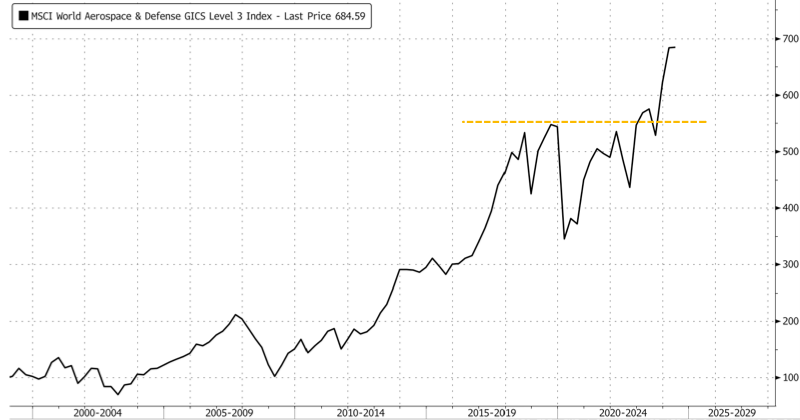
We’ve diligently noted that the defense sector is in a bull market: 

Global defense stocks, tacked by MSCI, have surged to record highs. 

The chaos in the world is not going away. Everything is up for grabs. 

Tyler Durden
Mon, 04/29/2024 – 05:45

via ZeroHedge News https://ift.tt/ctaAB59 Tyler Durden

A Compound Discovered On Easter Island Extends Life, Combats Alzheimer’s

A Compound Discovered On Easter Island Extends Life, Combats Alzheimer’s

Authored by Flora Zhao via The Epoch Times (emphasis ours),

Scientists are still uncovering the secrets of a compound discovered 50 years ago on Easter Island. Produced by bacteria there, rapamycin appears to be a powerful life-extender and may be a transformative treatment for age-related diseases.

(Illustration by The Epoch Times)

In 2009, the National Institute on Aging Interventions Testing Program (ITP) published a groundbreaking study indicating that rapamycin extended the lifespan of mice by 9 percent to 14 percent. Experiments conducted by various research institutions worldwide have further corroborated these findings or have found the compound to have significantly greater life-extending effects.

The drug also exhibits rejuvenating effects. For example, it can stimulate hair regrowth and prevent hair loss in a short period. It reduces proteins related to aging in the skin and increases collagen. The drug has even shown positive effects in treating age-related diseases such as Alzheimer’s disease, as well as diabetes and heart and muscle conditions.

While the drug label for rapamycin currently does not claim to “extend human life,” some people with a strong desire for longevity have already sought this medication from their doctors and take it regularly in small doses.

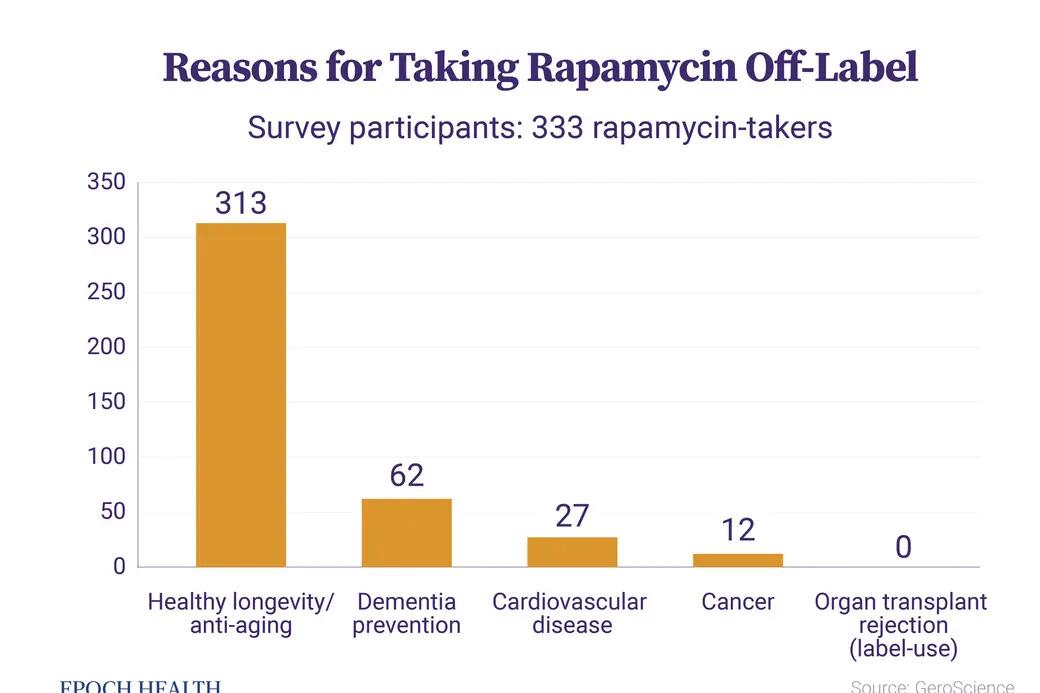
A study published in 2023 in GeroScience employed a questionnaire to survey 333 adults taking rapamycin off-label, most under the supervision of a physician. The vast majority (95 percent) reported taking rapamycin for “healthy longevity/anti-aging” reasons, almost 19 percent for preventing dementia, and a few for “cardiovascular disease” or “cancer.” However, no one reported taking the drug for its original approved use: prevention of organ transplant rejection.

Easter Island’s Hidden Treasure

Rapamycin was not made in a laboratory. It is not a synthetic molecule. It is actually from nature,” Dr. Robert Lufkin, adjunct clinical professor at the University of Southern California Keck School of Medicine, told The Epoch Times.

In December 1964, upon hearing about the Chilean government’s plans to build an international airport on Easter Island, a team of 40 people led by Canadian scientists arrived on the island and stayed for three months. Their objective was to explore the island’s population and natural environment before it became exposed to the outside world.

During this period, they observed that the local indigenous people—who walked barefoot—never contracted tetanus, leading the researchers to suspect that some substance in the soil provided protection. Subsequently, in the laboratory, scientists found just that. This substance was a metabolite of Streptomyces hygroscopicus that possessed antibacterial properties.

Rapamycin was extracted from soil collected on Easter Island. Easter Island is called Rapa Nui in the native Polynesian language. (Pablo Cozzaglio/AFP via Getty Images)

This substance starves fungi and things around them and prevents the organisms from growing, Arlan Richardson, professor of biochemistry and physiology at the University of Oklahoma Health Sciences Center, told The Epoch Times.

In the local indigenous language, Easter Island is called Rapa Nui. Therefore, the substance discovered in the island’s soil was named “rapamycin.”

Early Uses

In addition to rapamycin’s antibacterial properties, scientists observed that it could also inhibit the growth of animal cells. Rapamycin’s specific target is a cellular protein essential to living organisms called TOR, which acts as a “switch” for cell growth.

“It (TOR) is arguably one of the most important biological molecules ever known,” said Dr. Lufkin, as it fundamentally affects metabolism. It is worth mentioning that TOR derives its name directly from rapamycin. TOR stands for “target of rapamycin,” while mTOR, used in many studies, stands for the “mechanistic target of rapamycin.”

Illustration of the immunosuppressant drug rapamycin (red), also known as sirolimus. It is an inhibitor of mTOR (blue). (Juan Gaertner/Science Photo Library/Getty Images)

TOR essentially does one thing: It senses the presence of nutrients. When nutrients are available, TOR signals for cell growth. Conversely, when nutrients are scarce, cells stop growing and initiate repair. “And both of those modes are healthy and necessary for life,” explained Dr. Lufkin.

Rapamycin was initially used as an immunosuppressant. Higher doses of rapamycin (3 milligrams per day) were found to reduce the activity of immune cells, thereby suppressing the immune system’s rejection of foreign organs. In 1999, the U.S. Food and Drug Administration (FDA) approved rapamycin for kidney transplant patients.

Due to its ability to inhibit cell growth, rapamycin was later used as an anti-cancer drug. In 2007, the rapamycin analog temsirolimus was first approved for treating kidney cancer. Dr. Lufkin noted that rapamycin is effective against multiple types of cancer, with the FDA having approved rapamycin for use as a primary or adjunct therapy for eight types.

There is a connection between the immunosuppressive and anti-cancer effects of rapamycin. “It appears to have a positive effect on cancer control in patients who have transplants—for example, heart transplants,” said Dr. Lufkin. Due to immune suppression, “the most common cause of death after the transplant is not organ rejection, but it is actually a cancer.”

Mayo Clinic researchers conducted a controlled trial, tracking over 500 heart transplant recipients for 10 years. They found that patients using rapamycin for anti-rejection had a 66 percent lower risk of developing malignant tumors than those using another anti-rejection medication (calcineurin inhibitor).

Rapamycin’s Longevity Effects

Rapamycin’s primary action is to inhibit mTOR, which can induce a fasting-like state in cells, triggering autophagy. This mechanism may contribute to its effects on longevity.

In simple terms, autophagy is the process by which cells recycle and remove their own waste and foreign materials, conserving energy for survival.

Mr. Richardson explained that mTOR sends growth signals to cells, which are crucial for children and young animals, aiding in bone growth, brain maturation, and other developmental processes. However, this signaling pathway may adversely affect older adults and mature animals. With age, mTOR can become overactive due to disease or oxidative stress—similar to constantly pressing the gas pedal while driving a car. This renders cells hyperfunctional, contributing to age-related diseases and even cancer.

Read more here…

Tyler Durden
Mon, 04/29/2024 – 05:00

via ZeroHedge News https://ift.tt/1HwMY7r Tyler Durden

‘Environmental Pollutant’ – How A Key Climate Agenda Tool Harms Endangered Species

‘Environmental Pollutant’ – How A Key Climate Agenda Tool Harms Endangered Species

Authored by Donna Anderson via The Epoch Times (emphasis ours),

As the Biden administration expands its offshore wind projects as part of its goal to reach a carbon-free energy system, whales and other marine life may become collateral damage, according to new research.

(Illustration by The Epoch Times, Shutterstock, Getty Images)

Two independent studies measuring ocean wind turbine construction noise found that the sound emitted by vessels mapping the seafloor was significantly louder than estimated, and that noise protection for whales and other sea creatures during wind turbine pile driving doesn’t work.

Intense noise causes hearing loss in whales, other marine mammals, turtles, and fish, compromising their ability to navigate, avoid danger, detect predators, and find prey, according to scientific studies.

Robert Rand, an acoustics consultant with 44 years of experience, took underwater readings of the sonar survey vessel Miss Emma McCall off the coast of New Jersey. He also recorded acoustic readings of pile driving for Vineyards Wind 1, an offshore wind farm project under construction 15 miles south of Martha’s Vineyard.

In his pile-driving report, published March 28, Mr. Rand found that even the most advanced sound-dampening technologies didn’t adequately control harmful noise. The pounding was just as loud as seismic air gun arrays used for oil and gas exploration, long known to cause injury, hearing loss, and behavioral changes in fish and marine mammals.

Furthermore, the noise made by the construction vessel itself, which is not monitored, was almost as loud as the pile driving. Mr. Rand found that the standard formula used by the National Marine Fisheries Service to calculate how noise, over a period of time, affects a mammal’s hearing, significantly underestimates the sound levels experienced by dolphins and whales.

“These are real data,” Mr. Rand, who testified at a Congressional field hearing on January 20, told The Epoch Times. “I measured it. This is not a computer model. This is not a political press release. These are data.”

Many environmentalists fear that noise related to ocean wind farm construction is contributing to “unusual mortality events” affecting whales. From 2016 through April this year, 220 humpback whales have died, according to data collected by the National Oceanic and Atmospheric Administration (NOAA).

“Elevated humpback whale mortalities have occurred along the Atlantic coast from Maine through Florida,” since 2016, the NOAA states.

The NOAA also reported an “unusual mortality event” for North Atlantic right whales, in which 126 have died since 2017.

“The numbers have been decreasing, especially since 2017, when offshore operations really swung into gear,” Mr. Rand said.

From my experience in noise control, that’s not a coincidence. Noise is an environmental pollutant. In human terms, it’s measured in life years lost.”

The North Atlantic Right Whale Consortium estimates 350 North Atlantic right whales exist in the world’s oceans today.

Pile-Driving Noise

On Nov. 2, 2023, Mr. Rand went out on a 29-foot sport fishing boat to the Vineyard Wind 1 construction site.

The completed wind farm project will comprise 62 wind turbines in the Atlantic Ocean, spaced one nautical mile apart. The project is estimated to provide power to more than 400,000 homes and businesses.

Giant wind turbine blades for the Vineyard Winds project are stacked on large racks in the harbor, in New Bedford, Mass., on July 11, 2023. At left is the Palmer Island Lighthouse. (Charles Krupa/AP Photo)

The offshore wind farm is owned by Copenhagen Infrastructure Partners of Denmark and Avangrid Renewables, part of the Spanish company, Iberdrola.

At the construction site in November 2023, Mr. Rand said an 874-foot crane ship called the Orion was using a massive hammer to pound a monopile foundation for a wind turbine into the seabed.

The monopile is a steel pipe 31 feet in diameter, 279 feet long, and weighs 1,895 tons, according to the manufacturer, EEW Special Pipe Constructions.

Vineyard Wind 1 implemented two sets of noise controls. The first is a “hydro sound damper,” which Mr. Rand said, is a vertical net in the water around the monopile that’s covered with foam or rubber blocks and balls.

The second is a “double bubble” curtain. These are two weighted hoses lying on the seafloor in concentric circles around the monopile. The radius is roughly 492 to 656 feet.

The hoses have holes in them, and compressed air from a support vessel is forced through the hoses, causing bubbles to rise to the surface. The bubbles are supposed to mitigate the sound pressure created by the pile driving.

“These are advanced techniques,” Mr. Rand said. “They aren’t used anywhere else.”

Unfortunately, the noise mitigation techniques don’t work, he said.

Mr. Rand dropped a research-grade, omnidirectional hydrophone into the water at six locations, starting at 4.10 nautical miles from the pile driving and moving closer to 0.57 nautical miles.

Analyzing the data, Mr. Rand found that even with sophisticated noise mitigation in place, the pile driving is as loud as multiple seismic air guns.

“People have been protesting and the government has been rigorously regulating seismic air gun arrays for years, if not decades, because of their sonic intensity and hazard for endangered species—for whales and other marine species,” Mr. Rand said.

This pile driving is as loud as an array of air guns.

Read more here…

Tyler Durden
Mon, 04/29/2024 – 03:30

via ZeroHedge News https://ift.tt/CV2XOMh Tyler Durden

Who’s In Favor Of A Potential TikTok Ban?

Who’s In Favor Of A Potential TikTok Ban?

As part of a larger national security and foreign aid package, President Joe Biden on Wednesday signed into law legislation that forces TikTok parent ByteDance to divest the U.S. arm of its popular social media platform within 270 days or be banned from operating in the United States. The “Protecting Americans from Foreign Adversary Controlled Applications Act” seeks to cut any ties between TikTok, its current parent company and the Chinese government, which allegedly abuses the platform to “surveil and influence the American public” in a way that poses a threat to national security.

As Statista’s Felix Richter reports, compared to an earlier standalone bill that had passed the House in March but then failed to gain traction in the Senate, the newly passed bill extends the time given to ByteDance from 180 to 270 days, with the possibility of a 90-day extension if the president finds that significant progress towards a “qualified divesture” has been made. This means that TikTok’s Chinese owner now has until after the U.S. presidential election to find a suitable buyer, turning the question of whether or not TikTok should be divested or banned into a potential election issue.

Sure enough, former president Donald Trump told young voters to remember that “crooked Joe Biden is responsible for banning TikTok,” when they vote in November, omitting the fact that he tried to ban TikTok himself during his time in office.

And while Trump was right in his view that young Americans would be more likely to oppose legislation against TikTok, he ignored the fact that the vast majority of Republican voters is in favor of a potential ban. According to a recent YouGov/The Economist survey, two thirds of Republicans strongly or somewhat approve the forced divesture/potential ban of TikTok versus just 20 percent who oppose such legislation. Democratic voters are almost evenly split on the issue, with 40 percent of respondents in favor of legislative action against TikTok and its parent company.

Looking at different age groups, the trend is clear: the younger the respondents the more likely they are to oppose a potential TikTok ban, which is easily explained by the fact that young people are much more likely to be TikTok users.

Infographic: Who's in Favor of a Potential TikTok Ban? | Statista

You will find more infographics at Statista

So what happens next?

If ByteDance fails to find a suitable buyer within the given timeframe, it would be unlawful for app stores and web hosting companies to distribute the app in the United States.

Finding a buyer will be hard though, as any company with an interest and deep-enough pockets to acquire a platform of TikTok’s stature will almost certainly face intense scrutiny from the FTC for antitrust reasons.

It’s also unlikely that ByteDance will go down without a fight.

“Rest assured, we aren’t going anywhere,” TikTok CEO Shou Chew said in a video posted on Wednesday, claiming that the ultimate goal of the legislation is to ban TikTok, not sell it.

“We are confident and we will keep fighting for your rights in the courts,” he said, addressing the platform’s 170 million U.S. users directly.

Tyler Durden
Mon, 04/29/2024 – 02:45

via ZeroHedge News https://ift.tt/i1uB3CT Tyler Durden

Ukraine’s Top Five Challenges Are Unsolvable

Ukraine’s Top Five Challenges Are Unsolvable

Authored by Andrew Korybko via Substack,

It’s beginning to dawn on most Westerners that the US’ long-delayed aid to Ukraine isn’t all that it was hyped up to be and will only at most temporarily slow down the pace of Russia’s increasingly rapid advances. The conflict’s tempo has gradually intensified as Russia exploited Ukraine’s disastrous counteroffensive to regain the military-strategic initiative. Ukraine’s problems are immense and multifaceted, but they’re all connected one way or another to the five following factors:

1. Russia’s Military-Industrial Complex Continues Outproducing NATO’s

Russia won the “race of logistics”/“war of attrition” with NATO long ago and that’s why it continued gaining ground over the past 18 months. The sanctions failed to bankrupt the Kremlin, required resources for production remain readily available, and sabotage had no impact on the assembly lines. Not only has NATO been unable to stop Russia’s military-industrial complex, but it couldn’t ramp up its own during this time either, thus creating an unbridgeable gap that weakens Ukraine more by the week.

2. Ukraine Is Struggling To Replenish Its Depleted Military Ranks

NATO’s loss in the abovementioned military-industrial competition with Russia, the consequent failure of Ukraine’s counteroffensive, and Russia’s subsequent on-the-ground gains combined to scare Ukrainian men away from joining the armed forces and helping to replenish their depleted ranks. Without enough soldiers, Ukraine can’t confidently hold off Russia’s advances, thus risking an impending collapse along the front. At the end of the day, it’s just a numbers game, and Ukraine’s continue trending downward.

3. Less Equipment & Troops Mean More Difficulty Building New Defenses

The pace with which Russia has recently gained ground in Donbass is stressing Ukraine’s existing defensive lines like never before, thus compelling it to build newer ones further behind the front lines. Although Zelensky demanded this be done late last year, little progress has been made due to the lack of equipment and troops for holding off the Russian advance while simultaneously accomplishing this task. The breakthrough that the Ukrainian Intelligence Committee warned about is now more likely than ever.

4. Political Instability Is Still A Damocles’ Sword Hanging Over Ukraine

The Committee also warned in their same message from February that political unrest might explode next month around the time that Zelensky’s term expires on 21 May. They of course claimed that Russia would be behind it, which he also preconditioned his partners to falsely believe late last year, but this would actually be a genuine response to growing problems. Authoritarianism, corruption, forcible conscription, serious economic troubles, and the lack of a realistic endgame all enrage Ukrainians.

5. Ukraine Continues Thinking That It Knows Better Than The US

The Washington Post’s twopart post-mortem report on last summer’s failed counteroffensive revealed that one of the reasons why it flopped was because Ukraine refused to listen to the US’ advice. This problem is attributable to Zelensky and most recently took the form of him ordering his forces to attack Russian energy infrastructure in defiance of the US at the expense of more tactically significant targets. It’s actually the US’ own fault, though, since their media convinced him that he was a “god among men”.

*  *  *

These unsolvable challenges have converged to create a full-fledged crisis for Ukraine that Commander-in-Chief Syrsky is unable to resolve, which is why he candidly informed Ukraine’s partners that “the difficult operational and strategic situation…has a tendency to get worse.” Unless Ukraine agrees to demilitarize the regions still under its control east of the Dnieper and turn them into a buffer zone, the front might collapse by summertime, which could either lead to capitulation or a NATO intervention.

Tyler Durden
Mon, 04/29/2024 – 02:00

via ZeroHedge News https://ift.tt/eBO17An Tyler Durden