US Space Force General Says China’s Military Developing Space Assets At “Breathtaking Speed”

US Space Force General Says China’s Military Developing Space Assets At “Breathtaking Speed”

Authored by Frank Fang via The Epoch Times,

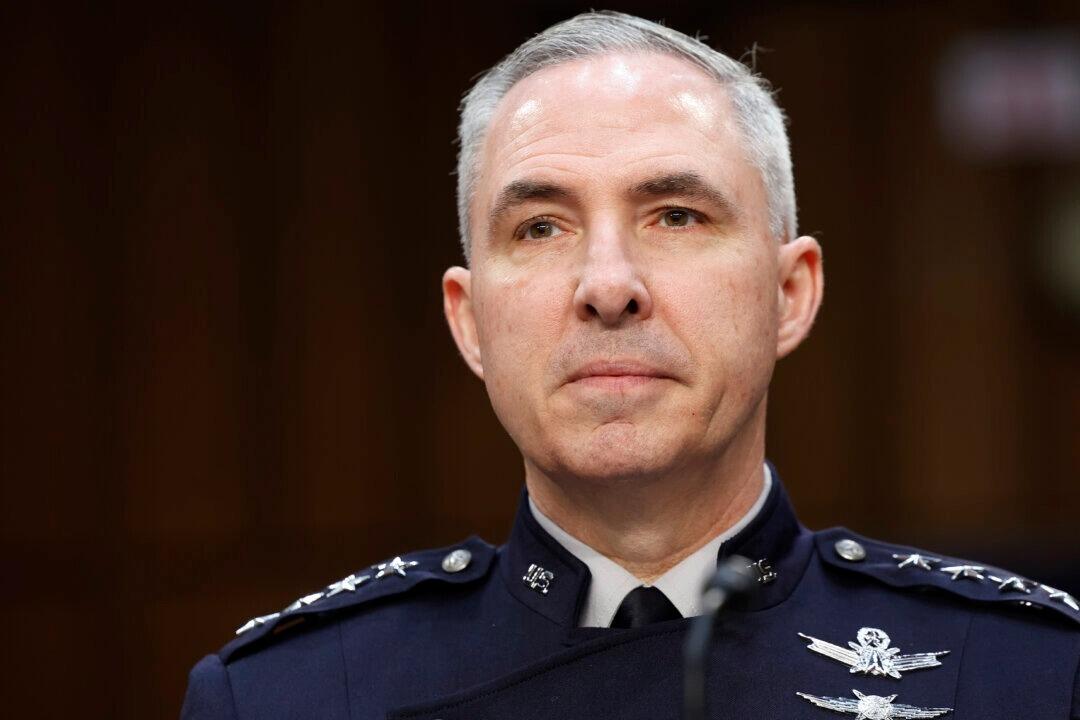
Gen. Stephen Whiting, commander of U.S. Space Command, recently warned about China’s “breathtakingly fast” development of space military capabilities, following his trips to South Korea and Japan.

“We are seriously focused at U.S. Space Command on our pacing challenge, which is the People’s Republic of China,” Gen. Whiting told reporters during a call from Japan on April 24.

“The People’s Republic of China is moving at breathtaking speed in space, and they are rapidly developing a range of counter-space weapons to hold at risk our space capabilities,” he added.

“They’re also using space to make their terrestrial forces—their army, their navy, their marine corps, their air force—more precise, more lethal, and more far-ranging.”

Gen. Whiting was on his first Indo-Pacific trip after becoming the head of U.S. Space Command in January, succeeding Army Gen. James Dickinson. During his trip, he met with top military leaders from South Korea and Japan, including Adm. Kim Myung-Soo, chairman of South Korea’s Joint Chiefs of Staff, and Japanese Defense Minister Minoru Kihara.
One particular concern was the number of Chinese satellites in orbit, Gen. Whiting said.

“Over the last six years, they have tripled the number of intelligent surveillance and reconnaissance satellites on orbit, and they have used their space capabilities to improve the lethality, the precision, and the range of their terrestrial forces,” he said.

“And so that obviously is a cause for concern and something that we are watching a very, very closely.”

China’s satellite fleet stood at 359 systems as of January, according to his prepared remarks for a hearing of the Senate Armed Service Committee in February. He also noted that Beijing is developing hypersonic glide vehicles along with other advanced space weaponry to “overcome U.S. traditional missile warning and ballistic missile defense systems.”

China’s ambitions with regard to the Moon are also among Space Command’s concerns.

“We’ve seen the announcements of China’s ambitions to go to the Moon. And those appear to be exploratory and scientific on the surface, but the Chinese aren’t very transparent with what they do in space,” he said.

“And so we hope there’s not a military component to that, but we would certainly welcome more transparency.”

A U.S. military report published in January warned that China and Russia are putting up dual-use satellites in space while hiding their military applications. One example is a Chinese satellite equipped with a giant robotic arm, which could be used to grapple other satellites in the future.

China is aiming to put its astronauts on the moon by 2030. Pakistan, South Africa, Belarus, and Nicaragua are among a group of nations that have signed up for a planned moon base led by China and Russia. The moon project is officially known as the International Lunar Research Station.

Gen. Whiting said he visited Japan’s Space Operations Group and emphasized the importance of the two nations working together in space.

“Their focus on space domain awareness along with ours to keep track of those threats in space that we see—and many of those are emanating from China—has put an impetus on us developing improved space domain awareness capability,” he said.

Japan is working to bring on board a deep-space radar, Gen. Whiting said, adding that the radar will benefit both nations once it archives initial operational capability.

“We expect that will provide both of our countries an enhanced understanding of what China is doing in space,” he said.

Japan and the United States are also partners in launching new satellites that will be used to conduct space domain awareness missions, according to Gen. Whiting.

In November last year, the United States, Japan, and South Korea agreed on a mechanism to share missile warning data to better track North Korea’s missile launches. The mechanism went into effect in December.

“We need to continue the excellent work in the trilateral agreement between the United States, the Republic of Korea, and Japan to share missile warning information so that that all three countries fully understand anytime North Korea launches a missile where that missile is headed, and we can provide warning to our national leadership, to our military forces, and to our populations,” Gen. Whiting said.

Tyler Durden
Mon, 04/29/2024 – 00:05

via ZeroHedge News https://ift.tt/rKNfTAJ Tyler Durden
Relentless Chinese Bond Rally Hints at Yuan Challenge Ahead

Relentless Chinese Bond Rally Hints at Yuan Challenge Ahead

By Charlie Zhu and Helen Sun, Bloomberg Markets Live reporters and strategists

Three things we learned last week:

1. China’s bond rally seems unstoppable amid a shortage of quality assets for investments. From government bonds to corporate debentures, traders keep hunting for yields in all maturities.

  • After pushing the yield on 30-year sovereign debt to the lowest since 2005, investors flocked to the notes issued by local government financing vehicles, once deemed as the riskiest instrument in Asia. That helped to drive LGFV companies’ borrowing costs to record lows.

  • In light of a decline in mortgage loans, long-term sovereign bonds become a good alternative for banks as long-term assets and provides support to the bond rally until the trend changes, said Becky Liu, head of Greater China macro strategy at Standard Chartered Plc.

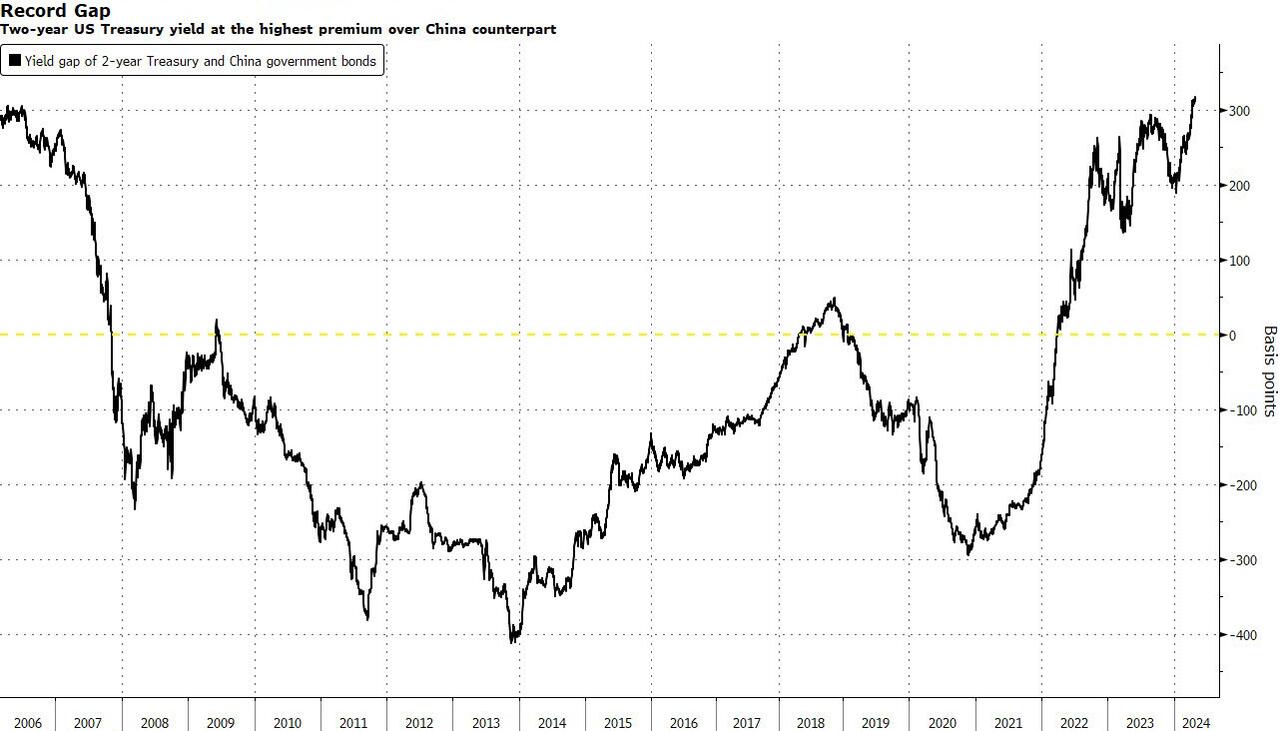
  • As the central bank warned the market again about the potential risks in long-term bonds and pointed to signs of stabilizing economic growth, funds rotated out of the back-end of the curve. The yield on two-year sovereign notes slid to the lowest level since mid-2020. That widened its gap with US Treasury to about 317 basis points, the biggest ever.

2. Market speculation about a devaluation of the yuan emerged. To investors onshore, this is an unlikely scenario given the authorities’ emphasis on maintaining stability, but some offshore traders see signs that the pressure is building.

  • In addition to the record interest rate gap, China’s stockpiling of commodities including gold and copper has prompted conjecture that policymakers may weaken the yuan in a one-off move.

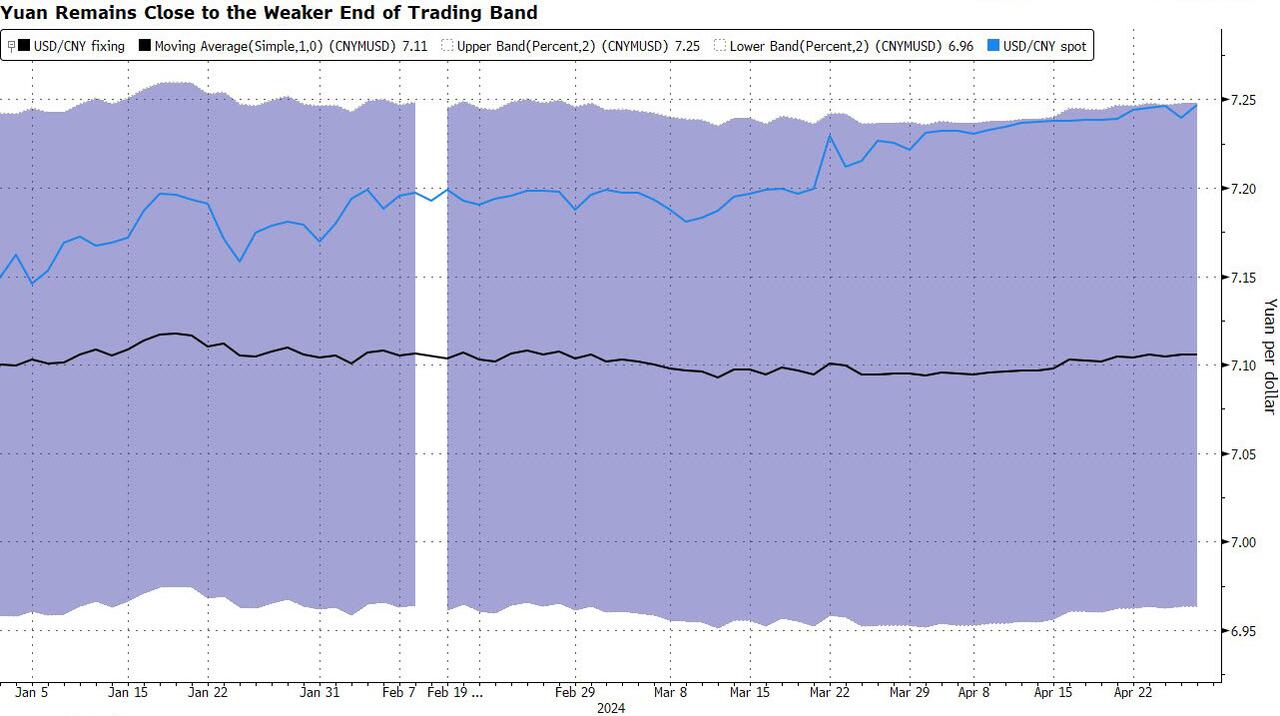
  • The central bank has been using the daily reference rate to limit the depreciation of the yuan, effectively making it one of the best-performing emerging-market currencies this month. However, the steady fixing kept the spot exchange rate remain close to the 2% daily limit on the weaker side, spurring concerns over the sustainability of the strategy.

3. The US decision on TikTok may bring headwinds to stabilizing relations between Beijing and Washington. President Joe Biden has signed a bill forcing TikTok to find a new owner within a year or face a ban. The move, designed to cut off China’s access to the video app used by 170 million Americans, raised concerns that US firms with large exposure to China’s market, including Apple Inc. and Tesla Inc., may be retaliation targets.

  • While China’s response was rather restrained compared with last year, Foreign Minister Wang Yi warned his US counterpart Antony Blinken Friday that “negative factors” were rising between the world’s biggest economies.

Tyler Durden
Sun, 04/28/2024 – 23:40

via ZeroHedge News https://ift.tt/mogywlh Tyler Durden

‘FX Vigilantes’ Strike – Yen Suddenly Crashes To April 1990 Lows Against The Dollar

‘FX Vigilantes’ Strike – Yen Suddenly Crashes To April 1990 Lows Against The Dollar

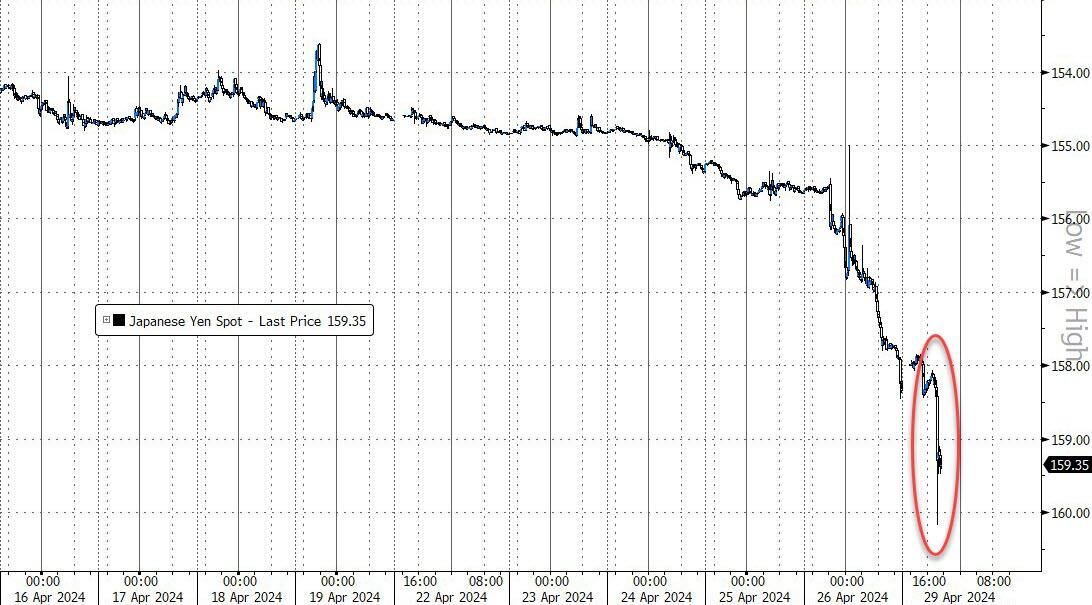
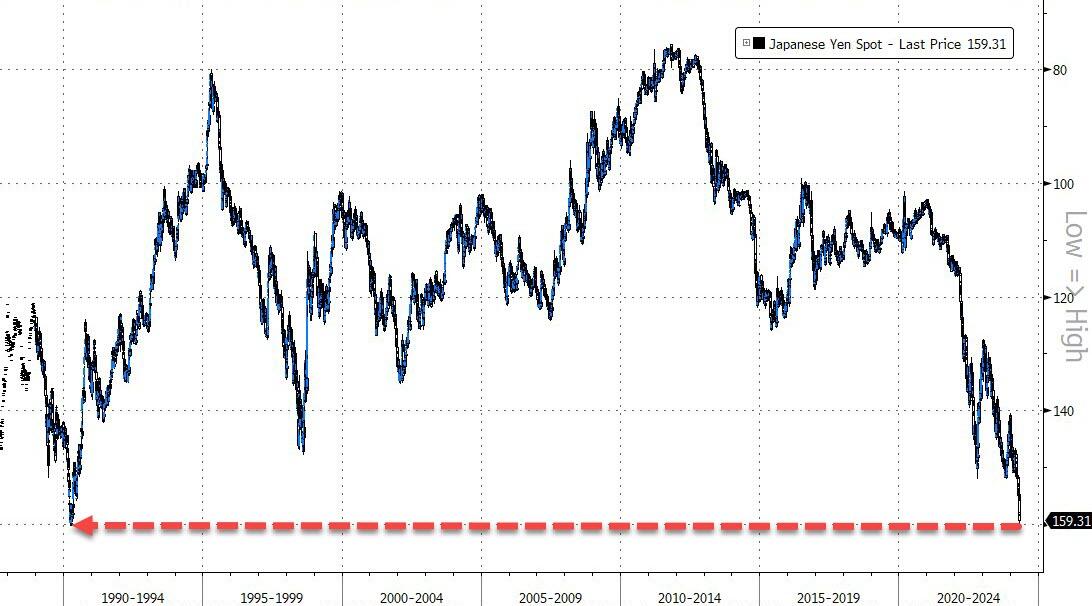
The yen crashed in early Asia trading, tumbling to match is exact lows from April 1990 in what is being blamed on a ‘fat finger’ trade or multiple barrier-option trades being triggered, by sources that have literally no idea.

The plunge extended Friday’s big drop which followed BoJ Governor Ueda’s apparent lack of interest in doing anything about the yen’s decline, claiming it had ‘no impact’ on the currency’s inflation picture.

“Currency rates is not a target of monetary policy to directly control,” he said.

“But currency volatility could be an important factor in impacting the economy and prices. If the impact on underlying inflation becomes too big to ignore, it may be a reason to adjust monetary policy.”

In fact, policymakers have repeatedly warned that depreciation won’t be tolerated if it goes too far too fast.

Finance Minister Shunichi Suzuki reiterated after the BoJ meeting that the government will respond appropriately to foreign exchange moves.

Potential triggers for interventions are public holidays in Japan on Monday and Friday next week, which bring the risk of volatility amid thin trading.

“Should the yen fall further from here, like after the BOJ decision in September 2022, the possibility of intervention will increase,” said Hirofumi Suzuki, chief currency strategist at Sumitomo Mitsui Banking Corp.

“It is not the level but it’s the speed that will trigger the action.”

Well currency volatility is what he has now…

Source: Bloomberg

The sudden drop pushed USDJPY perfectly to its April 1990 highs to the tick…

Source: Bloomberg

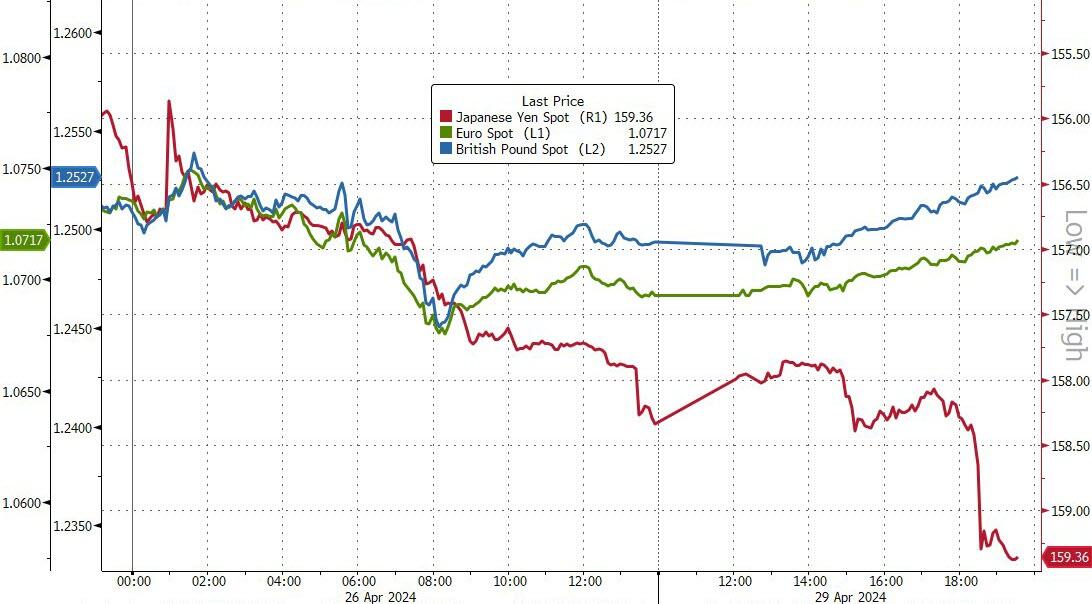
The currency pain was all focused in the Japanese market as EUR and GBP strengthened against the USD…

Source: Bloomberg

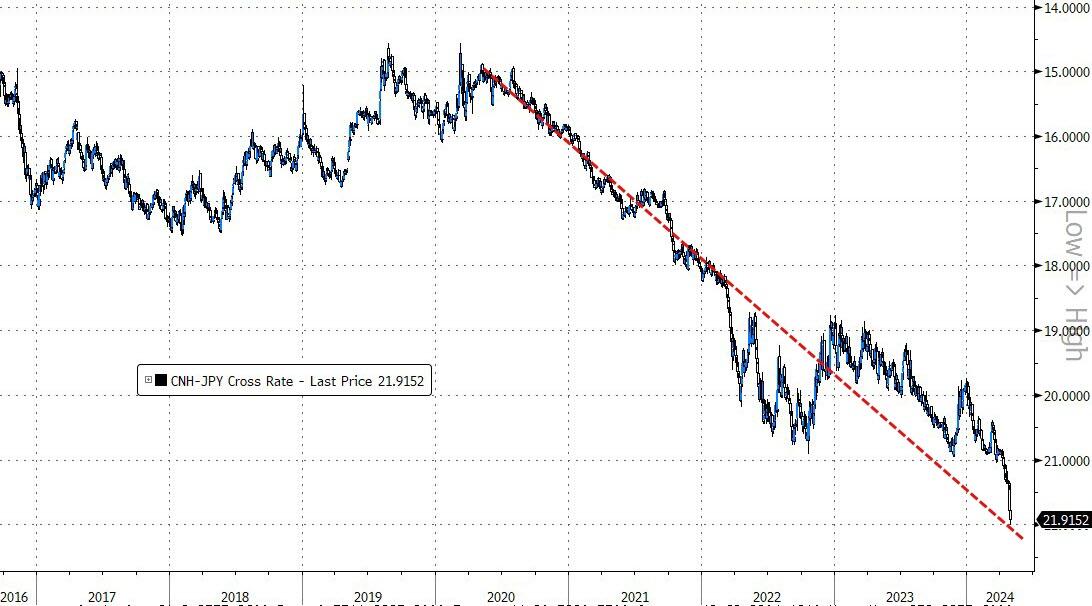
Perhaps even more notably, the yen puked relative to the Chinese yuan, hitting 22 for the first time since 1992 and putting further pressure on Beijing to potentially do something…

Source: Bloomberg

The question is, of course, what will Japan’s MoF/BoJ do now – if anything as their recent excuses about ‘velocity’ or some such spin are now out of the window after a 6-handle standalone surge in their currency in a few short days (when the rest of the world’s currencies are not).

“Authorities may say they don’t target levels per se, but they do pay close attention to the trend and the rate of change and current levels suggest they have to act soon or risk facing a credibility crisis,” said Chris Weston, head of research at Pepperstone Group Ltd.

“The FX market is almost taking them on like the bond vigilantes of old.”

Specifically as SocGen’s FX strategist Kit Juckes noted on Friday, the yen’s decline is becoming disorderly, which points to a final, potentially sharp, decline before it finds a floor.

However, as we detailed last week, the problem with intervention is that once the genie is out of the bottle… it’s hard to put it back in.

In other words, the onus should be on the BOJ to step in with a much more hawkish move than the market expects.

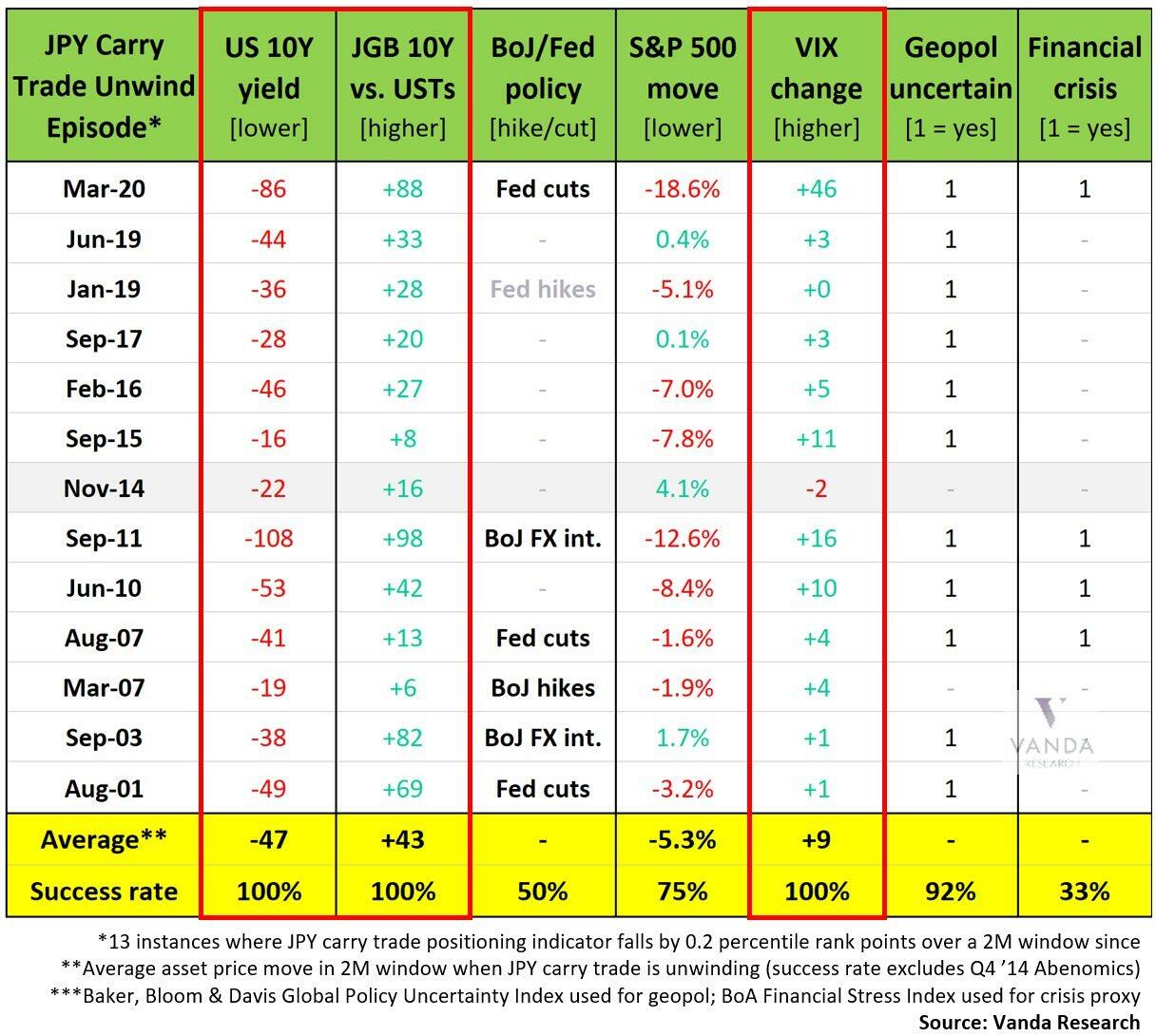
As Viraj Patel from Vanda Research goes on to note that “we’re at a stage where MoF/BoJ have no choice but to intervene. The best way would be for BoJ to hike 25bps this week. It’s not about the macro anymore (BoJ should’ve normalized policy faster last year).”

Instead, what is going on is that Japan’s disastrous handling of its currency has evolved into a game between speculators and officials: Specs are short yen for good fundamental reasons (carry). At this stage, a “surprise” hike to send a signal to markets that they are concerned about ongoing FX weakness (and don’t test us) would be less costly to the economy vs. a further devaluation in the yen. It also adds an additional level of uncertainty to the BoJ/MoF reaction function – which speculators (long carry trades) don’t like.

Meanwhile, FX intervention – which unfortunately looks to be the MoF/BoJ’s preferred route based on recent history – is not even a short-term fix anymore. USD/JPY dips would be quickly bought into based on recent market chatter. A hike goes a bit further towards solving the root cause of yen weakness – even it’s only a marginally better option.

However, not everyone is convinced intervention is imminent.

In a note late last week, Deutsche Bank says the currency’s decline is warranted and finally marks the day where the market realizes that Japan is following a policy of benign neglect for the yen.

We have long argued that FX intervention is not credible and the toning down of verbal jawboning from the finance minister overnight is on balance a positive from a credibility perspective. The possibility of intervention can’t be ruled out if the market turns disorderly, but it is also notable that Governor Ueda played down the importance of the yen in his press conference today as well as signalling no urgency to hike rates. We would frame the ongoing yen collapse around the following points.

  1. Yen weakness is simply not that bad for Japan. The tourism sector is booming, profit margins on the Nikkei are soaring and exporter competitiveness is increasing. True, the cost of imported items is going up. But growth is fine, the government is helping offset some of the cost via subsidies and core inflation is not accelerating. Most importantly, the Japanese are huge foreign asset owners via Japan’s positive net international investment position. Yen weakness therefore leads to huge capital gains on foreign bonds and equities, most easily summarized in the observation that the government pension fund (GPIF) has roughly made more profits over the last two years than the last twenty years combined.

  2. There simply isn’t an inflation problem. Japan’s core CPI is around 2% and has been decelerating in recent months. The Tokyo CPI overnight was 1.7% excluding one-off effects. To be sure, inflation may well accelerate again helped by FX weakness and high wage growth. But the starting point of inflation is entirely different to the post-COVID hiking cycles of the Fed and ECB. By extension, the inflation pain is far less and the urgency to hike far less too. No where is this more obvious than the fact that Japanese consumer confidence are close to their cycle highs.

  3. Negative real rates are great. There is a huge attraction to running negative real rates for the consolidated government balance sheet. As we demonstrated last year, it creates fiscal space via a $20 trillion carry trade while also generating asset gains for Japan’s wealthy voting base. This encourages the persistent domestic capital outflows we have been highlighting as a key driver of yen weakness over the last year and that have pushed Japan’s broad basic balance to being one of the weakest in the world. It is not speculators that are weakening the yen but the Japanese themselves.

The bottom line, Deutscxhe concludes, is that for the JPY to turn stronger the Japanese need to unwind their carry trade. But for this to make sense the Bank of Japan needs to engineer an expedited hiking cycle similar to the post-COVID experiences of other central banks. Time will tell if the BoJ is moving too slow and generating a policy mistake. A shift in BoJ inflation forecasts to well above 2% over their forecast horizon would be the clearest signal of a shift in reaction function. But this isn’t happening now.

The Japanese are enjoying the ride.

Finally, it goes without saying that the only true circuit-breaker for yen weakness is lower US yields/weak US macro, which is unlikely until the election if, as so many now speculate, there has been a directive by the Biden admin to make the economy look as good as possible ahead of the elections, even if that means manipulating the data to a grotesque degree.

One added complexity for MoF/BoJ is that their two options for tackling yen weakness indirectly adds upward pressure to global rates/yields. They’re caught between a rock and a hard place… and speculators know (enjoy) this.

And finally there is China: the longer BOJ/MoF does nothing to curb the collapse of the yen, a move which is seen a pumping up the country’s exporting base at the expense of other mercantilist nations such as China, the higher the probability Beijing will retaliate against Tokyo by devaluing its own currency. At which point all hell will break loose.

But, one way or another, as Goldman noted, it’s crunch time for USDJPY.

Tyler Durden
Sun, 04/28/2024 – 23:15

via ZeroHedge News https://ift.tt/H1MbIXq Tyler Durden

Stablecoin Volumes Are Tracking A Record $15 Trillion On Ethereum Alone

Stablecoin Volumes Are Tracking A Record $15 Trillion On Ethereum Alone

By Marcel Kasumovich, Deputy CIO of Coinbase Asset Management

Crypto sparked a renaissance in real-time payments. Sleepy you say? Time for a wake-up call – payment solutions are at the cutting edge of crypto’s integration into the mainstream, and it has plenty of competition.

“You’re probably used to crypto transactions, expecting me to bring out another guest for an eight-minute commentary while we wait for confirmation. But that’s old crypto. Are you ready for the new crypto world? Watch very closely…don’t blink…and that’s it,” John Collison exclaimed while illustrating a transaction on crypto rails with Stripe, a leading payment network that he co-founded. It was a seamless user experience, unlike the company’s initial foray into bitcoin in 2014.

Both PayPal and Stripe are now harnessing the power of stablecoins into their familiar user interfaces. This strategic move effortlessly brings users onto the blockchain – point, click, and it’s done. It’s the new trend, too. Traditional companies are bringing users onchain. There’s the crypto we see in noisy headlines and those working quietly to monetize the technology, like PayPal and Stripe. And they combine for a staggering 62% share of online payment software processing.

Digital payments may not seem like the exciting promise of the future. Yet, they are at the cutting edge. Digital payments are taking a rising share of a rapidly growing market as the world moves away from cash. Global payments are measured in the hundreds of trillions, and the digital payment market has risen from a modest $10 billion in 2017 to a projected $200 billion in 2030. We all live it, and the bulk of the transactions are small value, a coffee here, a donut there.

The process is so seamless that we seldom pause to consider how it actually works. Poorly, as it happens. Users expect to be able to pay whenever it’s convenient. Settling your restaurant bill, you don’t care that it’s outside of banking hours. You just want a simple form of payment – and that’s not cash. During the time between you tapping your card and accounts being settled, a middleman provides credit to make sure it all clears. And it’s expensive at 2.3% of transaction value.

One man’s profit margin is another’s invitation to disrupt. The typical narrative of disruption involves a wildly successful company losing its innovation edge, and missing market inflection points. Polaroid made the first instant camera in 1948 and dominated markets from floppy disks to film. Revenue peaked in 1991 and the company was unable to pivot to the new digital era, declaring bankruptcy ten years later. Learning from such histories, companies are now more adaptive.

We see this clearly in payments. Efficiency is precisely what brought PayPal and Stripe back to crypto. Transaction speeds have improved exponentially, now clocking at milliseconds, and costs have plunged to fractions of a cent. It helps that crypto tech fails fast – revealing resilience and weakness quickly. For instance, the resilience of USDC is now supporting its entry into the mainstream while Bored Apes Yacht Club weakness persists, down 90% off previous cycle highs.

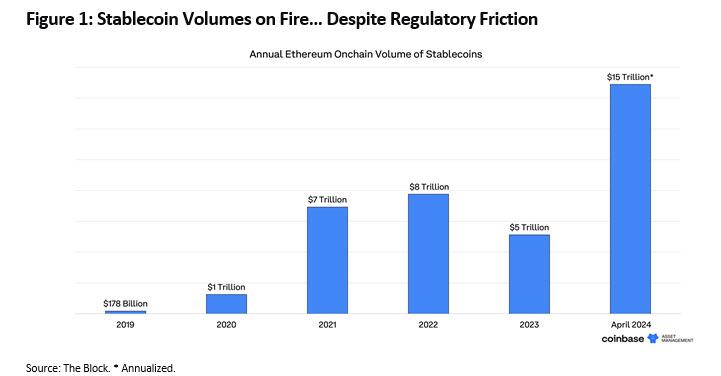
Why now? Why not! Stablecoins are demonstrating their prowess as payment tools. Transaction volumes are tracking new highs this month, running at ~$15 trillion annualized on Ethereum alone (Figure 1). The efficiency gain is clear – instant and final settlements mean that your late-night coffee and donut purchases bypass the need for credit intermediaries. The middleman is dead, although living vibrantly through tools like Stripe that deliver users a familiar experience.

Users don’t care that it’s crypto. They want a great experience. Businesses don’t care, either. They are optimizing operating efficiency for profit. As crypto matures, so too does its value proposition. Crypto is the protagonist of real time payments and like any great innovation, it fosters competition. What’s unique with payments is that the competition comes from both private and government organizations, with regulatory stagnation working in favor of both.

Look beyond regions traditionally seen as leaders in innovation. The United States remains a beacon of creative talent behind innovation. But users are moving slowly, lagging in fintech adoption. After all, US users are accustomed to fees, don’t mind the service, and paying for points on expensive intermediation is a pastime. Real-time settlement systems adopted, like FedNow, are for business applications, not for consumers. It’s new players like India at the cutting edge.

The Unified Payment Interface (UPI), India’s real-time payment solution, was developed by the central bank in 2016. It integrates peer-to-peer real-time payments, directly competing with crypto technologies. Last year, UPI integrated 522 commercial banks covering 300 million active users and 117 billion transactions. Different from developed regions, intermediaries were not disrupted as these are largely new users. Cash was disrupted at the expense of the central bank.

Payments stand at the cutting edge of crypto’s future. User experience is paramount. Integrating into the regulatory mainstream will accelerate users onchain, just as service providers did for the internet. Crypto unlocked the real-time settlement innovation, but will face competition. It is a world that argues for being chain-agnostic. The data between Ethereum, Bitcoin and UPI will integrate to the highest of standards and security. That’s the road to making onchain the new online.

Tyler Durden
Sun, 04/28/2024 – 22:40

via ZeroHedge News https://ift.tt/lIEDyNA Tyler Durden

Justice Thomas Raises Scrutiny On Special Counsel Jack Smith’s Appointment In Trump Hearing

Justice Thomas Raises Scrutiny On Special Counsel Jack Smith’s Appointment In Trump Hearing

Authored by Naveen Athrappully via The Epoch Times,

U.S. Supreme Court Justice Clarence Thomas has asked former President Donald Trump’s lawyers about whether they challenged special counsel Jack Smith’s authority to bring charges against the president.

On April 25, the U.S. Supreme Court heard oral arguments in a case about President Trump being immune from prosecution for official acts carried out during his presidency. During the hearing, Justice Thomas asked John Sauer, the attorney who represented Trump in court, “Did you, in this litigation, challenge the appointment of special counsel?” Mr. Smith was appointed to the case by Attorney General Merrick Garland.

Mr. Sauer said that Trump attorneys have not raised such concerns “directly” in the current case at the Supreme Court. However, “it points to a very important issue here, because one of [the prosecution’s] arguments is, of course, that we should have this presumption of regularity,” Sauer stated.

“That runs into the reality that we have here an extraordinary prosecutorial power being exercised by someone who was never nominated by the president or confirmed by the Senate at any time. … We hadn’t raised it yet in this case when this case went up on appeal.”

Mr. Sauer said he agrees with the “analysis provided by Attorney General [Edwin] Meese and Attorney General [Michael B.] Mukasey,” referring to the amicus brief the two former attorneys general submitted to the Supreme Court on March 19.

In it, the two attorneys general noted that irrespective of what one thinks about the immunity issue, Mr. Smith “does not have authority to conduct the underlying prosecution.”

“Those actions can be taken only by persons properly appointed as federal officers to properly created federal offices. Smith wields tremendous power, and effectively answers to no one,” they wrote.

“However, neither Smith nor the position of special counsel under which he purportedly acts meets those criteria. And that is a serious problem for the rule of law, whatever one may think of the conduct at issue in Smith’s prosecution.”

Attorney General Garland appointed Mr. Smith as Special Counsel of the U.S. Department of Justice (DOJ) citing several statutes.

However, none of these statutes even “remotely authorized the appointment by the Attorney General of a private citizen or government employee to receive extraordinary criminal law enforcement power under the title of Special Counsel.”

The two attorneys general added there are times when the appointment of a special counsel would be appropriate and that the U.S. Constitution allows for such appointments.

However, “the Attorney General cannot appoint someone never confirmed by the Senate, as a substitute United States Attorney under the title ‘special counsel,’” they added.

“Smith’s appointment was thus unlawful, as are all actions flowing from it, including his prosecution of former President Trump.”

The Case Against Trump

The U.S. Supreme Court is hearing President Trump’s immunity case as part of Mr. Smith’s indictment of the former president alleging an attempt to subvert the transfer of presidential power following the 2020 election. President Trump is charged with four criminal counts in the case.

President Trump had requested the lower courts to back his claims of presidential immunity as the actions were undertaken while he was serving as president.

After the lower courts refused to grant the request, the 45th president appealed to the U.S. Supreme Court, contending that his actions as president are covered by presidential immunity.

The Supreme Court agreed to consider the following question—“Whether and, if so, to what extent does a former president enjoy presidential immunity from criminal prosecution for conduct alleged to involve official acts during his tenure in office.”

In court, Mr. Sauer warned the justices against giving a judgment that undermines presidential immunity, noting that an American president would no longer be able to carry out his job properly if he was unsure whether his actions would trigger prosecution years after leaving office.

“The implications of the court’s decision here extend far beyond the facts of this case,” he said. “For 234 years of American history, no president was ever prosecuted for his official acts. The framers of our Constitution viewed an energetic executive as essential to securing liberty.”

“If a president can be charged, put on trial, and imprisoned for his most controversial decisions as soon as he leaves office, that looming threat will distort the president’s decision-making precisely when bold and fearless action is most needed.”

Moreover, a lack of presidential immunity will denote that every president becomes a potential candidate for extortion by political rivals while still in office, Mr. Sauer added.

“Prosecuting the president for his official acts is an innovation with no foothold in history or tradition, and is incompatible with our constitutional structure,” he said.

The Supreme Court Justices appeared skeptical about President Trump’s claims that he has the right to absolute immunity for his actions as president. However, the justices also appeared to be open to accepting that presidents have some level of immunity.

The court could decide to remand the case back to the Washington district court, with instructions for differentiating between official and private acts of a president so that additional fact-finding proceedings can be done.

Such a move would delay the former president’s trial in Washington and potentially proceedings related to three other cases as well. This gives President Trump a strategic win as he attempts to hold off cases until after the elections.

Tyler Durden
Sun, 04/28/2024 – 22:10

via ZeroHedge News https://ift.tt/m7GHCOS Tyler Durden

“What Is The Sound Of One Hand Clapping” Asks BOJ Head Ueda As The Yen Collapses

“What Is The Sound Of One Hand Clapping” Asks BOJ Head Ueda As The Yen Collapses

By Eric Peters, CIO of One River Asset Management

“What is the sound of one hand clapping,” asked Kazuo Ueda, sitting alone in seiza. The dollar had just crossed above 158 to the yen, a level not seen in 34-years, back when he joined the University of Tokyo as professor of economics.

“What is the sound of one hand clapping,” asked Ueda, letting the question drift gently across his mind. It is one of the great Zen koans, a question without answer, a tool to help us achieve satori, awakening.

After its utter destruction in the war, Japan had become an economic wonder. By 1989 its Nikkei 225 equity index had surged to 38,915, the yen followed, and the governor’s palace was estimated to be worth as much as California.

“What is the sound of one hand clapping,” asked Ueda, desperate to tap into the power of being fully present, but unable to calm his mind. From that wild 1989 market peak, it all came crashing down. Had policy makers and politicians allowed a short depression, the nation would have experienced something profoundly different from its lost deflationary decades.

“What would have happened,” asked Ueda, instantly angry his attention had drifted from the koan. It had been one year since he became Bank of Japan Governor. He had restored simplicity to policy, returning interest rates to positive from negative, letting go of yield curve control. He accomplished this without compromising government finances, which are so vulnerable after decades of the stunningly large deficit spending required to maintain economic and social stability, that even a modest interest rate rise would prove catastrophic.

“What is the sound of one hand clapping,” whispered Ueda.

In his year at the helm, the Nikkei 225 had surged to finally reclaim the 1989 highs, driven in part by the collapsing yen, which showed no signs of stabilizing in the absence of material interest rate hikes. And this, of course, risks devastating Japan’s government finances.

“What is the sound of one hand clapping.”

Tyler Durden
Sun, 04/28/2024 – 21:00

via ZeroHedge News https://ift.tt/RLSdxcq Tyler Durden

Joe Biden’s Brother Embroiled In High-Ranking Qatari Scheme To “Provide Wealth Of Introductions” Through “My Family”: Politico

Joe Biden’s Brother Embroiled In High-Ranking Qatari Scheme To “Provide Wealth Of Introductions” Through “My Family”: Politico

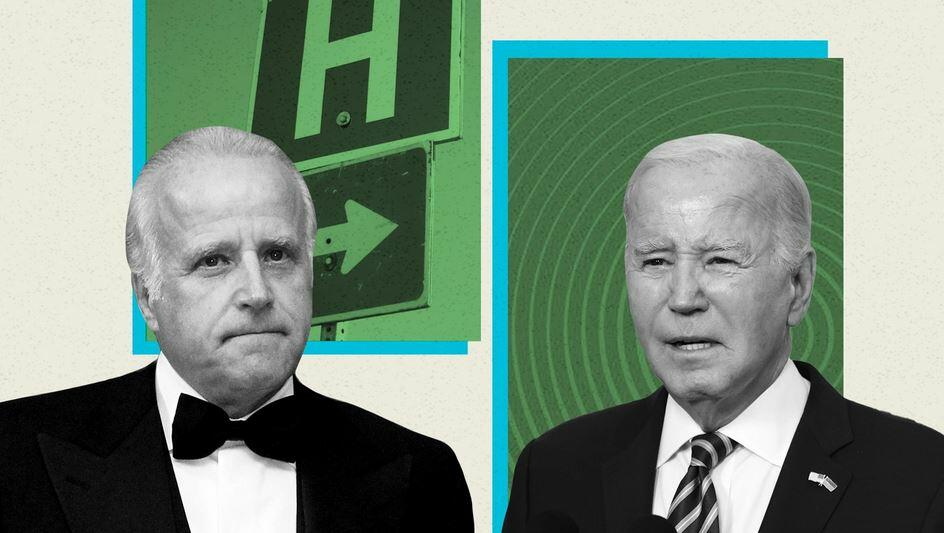
Qatar has had a lot of fingers in a lot of pies. While we knew about the EU’s ‘Qatargate,’ investments with the Kushner family, and of course Sen. Bob Menendez advancing Qatar’s interests, Politico reports that the Biden family’s ties to Qatar “would constitute some of the closest known financial links between a relative of President Joe Biden and a foreign government,” if courtroom testimony about Jim Biden’s foreign fundraising efforts is substantiated.

POLITICO illustration/Photos by AP, Getty Images, iStock

In June 2017, Qatar’s neighbors – led by Saudi Arabia, banded together and cut diplomatic ties with the country, citing its alleged support for terrorism. As a result, the country was thrown into a sustained crisis.

To dig themselves out, Qatari rulers began showering well-connected Westerners with gifts and financial benefits, according to Politico, “sometimes in the form of investment funding.”

Around this time, Jim Biden was trying to raise $30 million for embattled hospital chain Americore – teaming up with Florida businessman Amer Rustom, CEO of the Platinum Group, who boasted of his ties to officials in the Middle East, as well as fund manager Michael Lewitt. Together, the three sought investment funding from various Middle Eastern sources for Americore and other ventures – “which came to focus largely on Qatar,” according to a former Americore executive who spoke on condition of anonymity.

According to public records obtained by the outlet, Jim Biden leveraged ties to his older brother and “sought workarounds to restrictions on international money movements,” including one discussion about trying to move money across a Middle Eastern border in the form of gold bars that may or may not have happened.

My family could provide a wealth of introductions and business opportunities at the highest levels that I believe would be worthy of the interest of His Excellency,” Jim Biden and Rustom wrote in a draft letter to an official at the Qatari sovereign wealth fund, the Qatar Investment Authority. “On behalf of the Biden family, I welcome your interest here,” the draft continues.

Transactions related to the efforts are central to a recently-settled fraud case brought by the SEC, and are under fresh scrutiny as part of a federal criminal investigation in South Florida.

Jim Biden suggested to congressional investigators in February that his fundraising efforts stalled for lack of viable projects to back. But the previously unreported testimony by fund manager Michael Lewitt about the ownership of the two companies — the Platinum Group USA and Obermeyer Engineering Consulting — indicates that Jim Biden forged closer ties to Qatar’s government than previously understood. -Politico

In February of this year, Jim Biden told impeachment inquiry investigators that roughly $600,000 in payments from Americore were for his role in arranging a series of bridge loans – of which $200,000 was transferred to Joe Biden in March 2018 for what the White House claims is a repayment of an unrelated loan between brothers.

In a March 10, 2018 draft presentation emailed from Jim Biden’s wife, Sara Biden, to a Platinum Group executive, Julie Lander, Americore touted Jim as “Brother and Campaign Finance Chair of former Vice President Joe Biden.”

One month later, Lander emailed Jim Biden about the fundraising efforts – referencing an apparent meeting with a high-ranking Qatari official.

Through a spokesperson, Jim Biden’s lawyer, Paul Fishman (left), said “Jim Biden is not being investigated by federal law enforcement in Florida or Pennsylvania.” | Anna Moneymaker/Getty Images

“I am following up from the meeting we had with the Minister,” wrote Lander. “Your approach with him was flawless. He requested more information on Americore.”

In the previously unreported email, Lander suggested a potential request of $200 million and asked Jim Biden to provide more information on the potential benefits to Qatar of an investment deal.

Lander’s email came five days after a large delegation of Qatari officials and business leaders visited Miami. It is not clear which minister Lander, who did not respond to requests for comments, was referring to. -Politico

“Snags”

Despite Lander’s upbeat email to Jim Biden, fundraising efforts hit a ‘series of snags,’ according to Politico‘s anonymous former Americore source, who said that they were facing restrictions on moving investment funds across borders, and that the former executive “recalled discussion at one point of trying to move money across a Middle Eastern border in the form of gold bars, but said they were not aware of any action taken on the idea.”

In order to solve their problem, Jim Biden explored working with payment processing company “Billerfy,” described as an “open network for global payments,” for which Jim Biden could be their “chief global banking emissary” – until Americore’s outside counsel, Christopher Anderson, shot it down. 

With progress in Qatar slowing in mid-May of 2018 during the Islamic holy month of Ramadan, tensions grew between Jim Biden and his comrades – with Jim Biden venting to Americore CEO Grant White in a May 17 email that he had “agreed to go to Qatar, Saudi Arabia and China (at my own expense).”

A week later, Jim Biden complained to Rustom over the unsecured funds – writing that “The $30 million was committed to over two months ago and we made moves predicated on that available line of credit,” adding “Things have happened in the interim that are completely understandable, but the fact remains that the $5 million at this point in time is critical in order to get by for the big picture.”

Then in late June, Lewitt emailed Jim Biden and White about trying to move money from Dubai to Qatar, referencing an unspecified “blockage” that was hindering the process.

“Amer would like me to join Jim for the presentation to the Finance Minister in Doha so as soon as we have the date I will plan my travel,” the email concluded.

The former Americore executive said that Jim Biden and Lewitt traveled to Qatar in mid-2018 as part of the fundraising efforts, but it is not clear whether any meeting between Jim Biden and Qatar’s then-finance minister, Ali Sharif Al Emadi, took place.

Al Emadi left his post in 2021 after Qatar’s attorney general ordered him arrested on suspicion of corruption. In January, Reuters reported that he was convicted on charges that included laundering more than $5 billion and sentenced to 20 years in prison. -Politico

Efforts to secure funding continued into August of 2018, as Jim Biden continued to work with Lewitt and Rustom to secure financing from the Qatar Investment Authority for other health care ventures, according to filings in a since-settled federal court case in Tennessee in which the three were named as co-defendants.

As they continued to work together, Jim Biden’s financial ties to Lewitt deepened – with Lewitt’s investment fund, Third Friday, paying Jim Biden’s company, Lion Hall Groujp, $225,000 over the course of 2019. While Biden testified that this was a forgiven loan, Lewitt disputed it – telling Politico that Jim Biden’s debt was assumed by an unnamed third party.

At the end of the day, Qatar and everyone else balked at the deal.

“We weren’t able to show the financial bona fides of any one particular project,” said Jim Biden during his impeachment inquiry interview. “We got pretty far down the road on several hotel complexes, but they never came to fruition.”

Meanwhile, in 2022, investors in Third Friday sued Lewitt, accusing him of embezzlement through Americore to Jim Biden and others. Lewitt has denied wrongdoing in the ongoing case, while Jim Biden has not been named a defendant.

Lastly, the partners are now locked in a bitter legal dispute. During the course of Americore’s bankruptcy litigation, documents produced by Lewitt included an agreement between his fund and a Delaware company, Obermeyer Engineering Consulting – which calls for Obermeyer to purchase Third Friday’s loans to Americore, along with a 35% stake in the hospital chain, for $30 million.

The agreement includes a signature from Azzam Rustom as Obermeyer’s “authorized signatory,” which Amer Rustom – Obermayer’s ‘manager,’ contested – saying it the signature was faked.

Lewitt said during testimony that Amer Rustom ‘verbally authorized’ him to fake his signature on the disputed documents.

Towards the end of the hearing Lewitt was asked why, if the agreements he produced were valid, the Rustoms were contesting them.

Lewitt testified that the Rustoms owned both Obermeyer and the Platinum Group with “members of the Qatari government.” He speculated that the brothers had not cleared the agreements with the Qatari officials, whom he did not name. “I don’t think they expected these to become public,” he testified, “and I think they were trying to cover themselves.” -Politico

According to the judge in the case, “Where there’s smoke, there’s fire,” adding “and this is a black haze right now.”

Tyler Durden
Sun, 04/28/2024 – 20:25

via ZeroHedge News https://ift.tt/EfM3YDb Tyler Durden

A Chipotle Double Steak Bowl Is Now $39 In California

A Chipotle Double Steak Bowl Is Now $39 In California

By Mish Shedlock of MishTalk

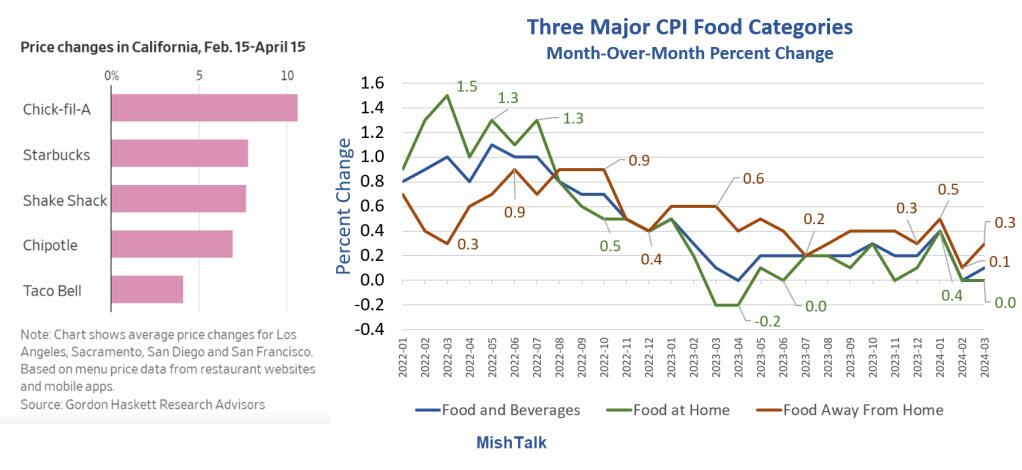
Food away from home has risen at least 0.3 percent for 34 out of the last 36 months

CPI data from the BLS, California Fast Food Prices Gordon Haskett

Sticker Shock in California

Higher state minimum wage went into effect April 1; chains say burritos and burgers are getting more expensive in response.

The Wall Street Journal reports California Fast-Food Chains Are Now Serving Sticker Shock

Since September, when California moved to require large fast-food chains to bump up their minimum hourly pay to $20 in April, fast-food and fast-casual restaurants in California have increased prices by 10% overall, outpacing all other states, the firm found in an analysis of thousands of restaurants across 70 large chains.

Prices at Chick-fil-A, Domino’s, McDonald’s (MCD) Burger King (BKC), Pizza Hut (YUM), Jack in the Box (JACK ) and other fast-food chains have increased since September, the firm found. Chipotle (CMG) said in an investor call Wednesday that prices at its nearly 500 California restaurants climbed 6% to 7% during the first week of April compared with last year, playing out across its menu.

“The state isn’t making it easy,” Chipotle Chief Executive Brian Niccol said in an interview.

In Los Angeles on a recent April afternoon, Seth Amitin, a 39-year-old therapist, said his usual $16 meal that he picks up weekly at the Chick-fil-A in Hollywood, Calif., now costs $20. The price for a spicy chicken sandwich at that location had gone up to $7.09 from $6.29, or 13%, since mid-February, according to research by Gordon Haskett Research Advisors. Chick-fil-A’s prices increased 10.6% on average in California during that time period, Gordon Haskett found.

California restaurants already had some of the highest fast-food prices in the country, according to market-research firm Revenue Management Solutions. Every month since October, California fast-food and fast-casual restaurants have raised prices across a greater percentage of their menus compared with restaurants in the rest of the country, Datassential found. 

Auto and Home, Insurance & Maintenance Costs Soaring and People Are Angry

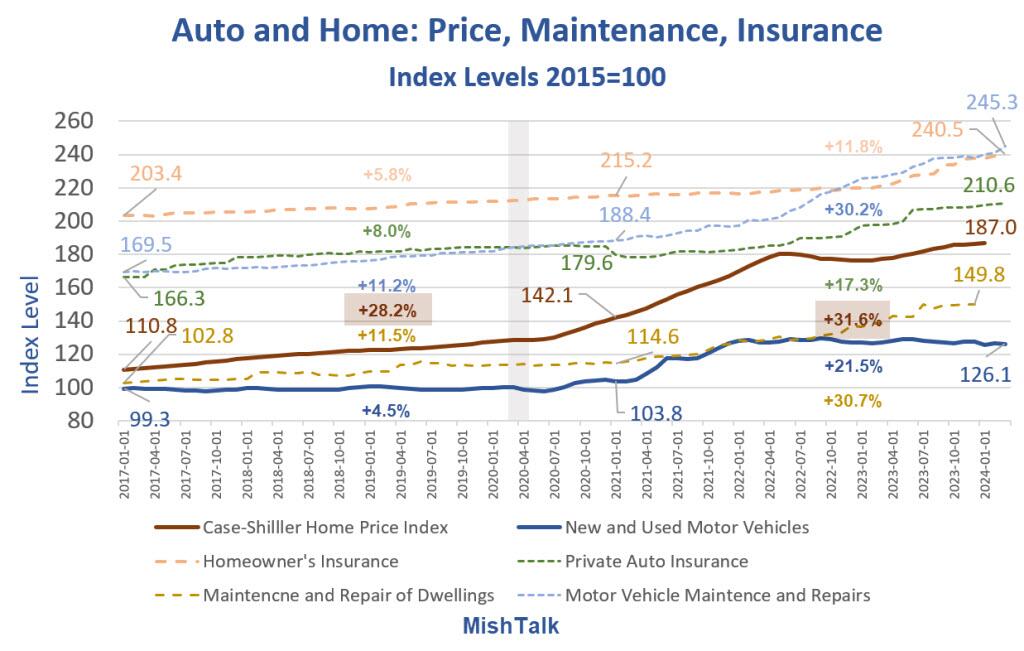
Insurance, repairs, and maintenance costs are up for both homes and autos.

On April 19, I noted Auto and Home, Insurance & Maintenance Costs Soaring and People Are Angry

Some homeowners are skipping home insurance. What’s going on and who is to blame?

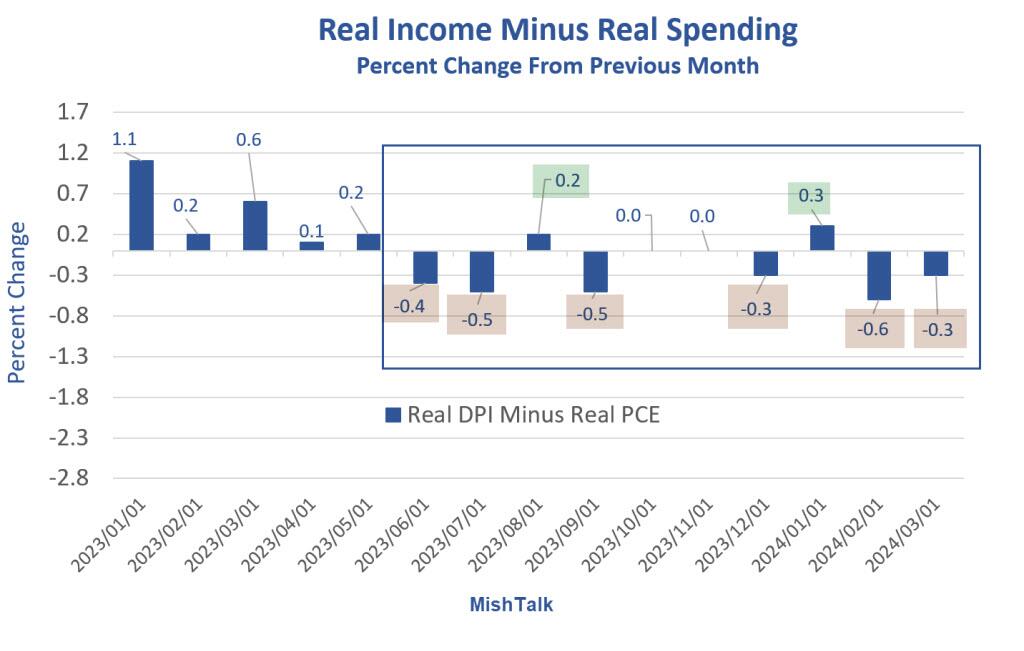
Growth in Spending Exceeds Growth in Income for Most of the Last 10 Months

A deeper dive into personal income and outlays for March shows significant signs of consumer stress to maintain standards of living.

For discussion, please see Growth in Spending Exceeds Growth in Income for Most of the Last 10 Months

Would you believe …

On April 20, I noted Truflation Claims Inflation is 2.06 Percent

Would you believe believe year-over year inflation is barely over two percent? That’s the Truflation claim as of April 17, 2024.

Some otherwise bright people on Twitter whom I follow actually believe that Trufltion nonsense. Click on the above link for details.

Tyler Durden
Sun, 04/28/2024 – 19:50

via ZeroHedge News https://ift.tt/u8HGpqJ Tyler Durden

Is 10% The New 1%

Is 10% The New 1%

By Peter Tchir of Academy Securities

I’ve been thinking a lot about one of the first lessons I was taught as a junior trader. We were warned that when something happens, say a piece of economic data comes out, and the market doesn’t respond as you expected, to cut positions and be very careful. It is a sign that “something” is wrong in how you are thinking.

On Friday, Treasuries rallied strongly on data that didn’t seem that great for rates. But the reality is (or so I believe) that Thursday’s sell-off was overdone, the “whisper” number was much worse than what came out, there are no longer term Treasury auctions, and the month-end index “extension” is usually good for bonds. So that doesn’t bother me much. What bothers me is that we had:

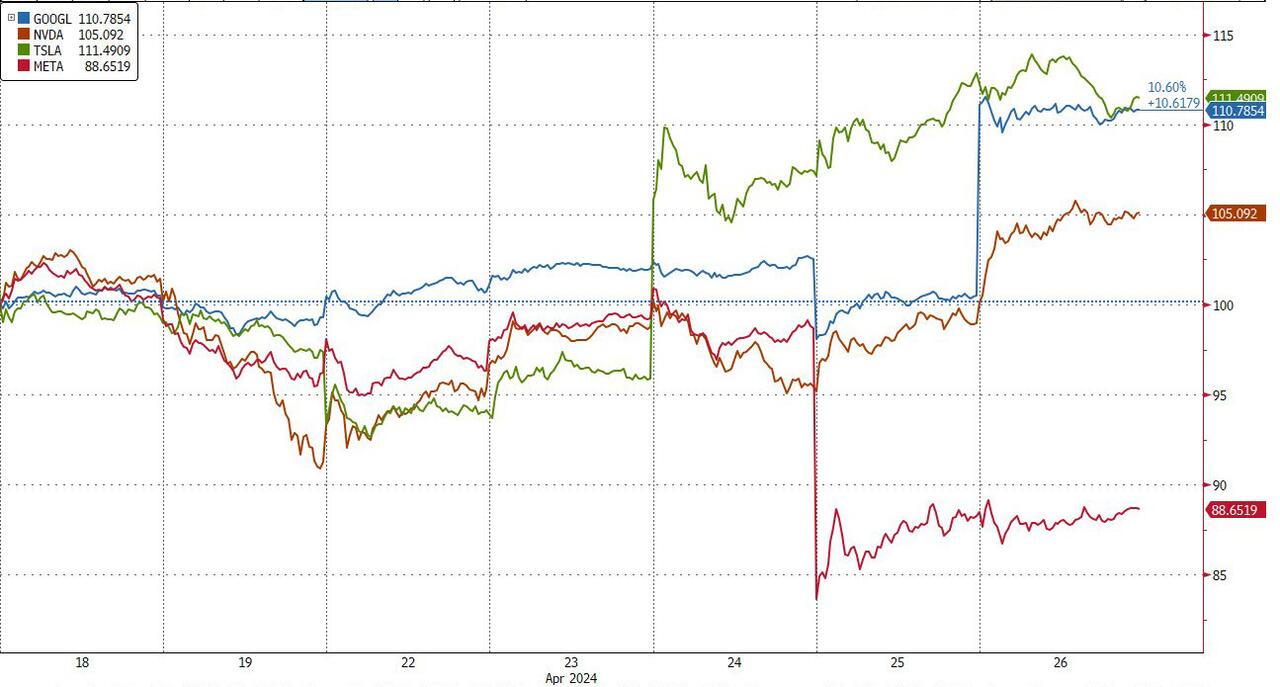
  • NVDA, a $2.2 trillion market cap company, drop 10% last Friday.

  • TSLA, a $500 billion market cap company, rise 10% on Wednesday.

  • META, a $1.1 trillion market cap company, drop 10% on Thursday.

  • GOOG, a $2.1 trillion market cap company, rise 10% on Friday.

Four “megacap” companies moved around 10% (or more) in a day!

I understand small cap companies do that. I understand that periodically something happens that is highly unusual – M&A, a scientific breakthrough, FDA approval, fraud, or something so unusual (but so profound) that a well-followed company gaps by that much. This was “just” earnings. Maybe I’m being overly dramatic? Maybe I haven’t adjusted my thought process to how large companies really are (probably part of the issue)? In any case it feels completely strange (even unnatural) for such large companies to move so much in a single session (let alone seeing it occur 4 times in 6 days)!

I am willing to believe that this is just my perception, and maybe it is more common than I perceive, but it is so different than how I’ve been thinking, that I have to respect it. As a “macro” strategist, I think about broad indices. Normally that is quite “macro,” but when some of the largest components of these indices (and associated ETFs) move so much more than I tend to think they can, then I need to question if it is still macro.

I can hear my first boss telling me that it is time to cut, sit back with less risk on the table, and think about what is going on. Maybe it is nothing. Maybe it is the new norm? Maybe 10% is the new 1%? Maybe moves close to 10% have always happened with market leaders and I just failed to notice that? I find it hard to believe, but knowing the T-Report audience, someone will likely send me a chart showing how common it is and that I need to “get over it.”

But I don’t think in terms of megacaps moving like that. To me, it reduces the macro, and is highly relevant as we have some other megacaps reporting this week. Should I assume 10% in either direction is a valid range? MSFT, for example, followed a more “normal” pattern. Some wild swings post-earnings in the after-market and pre-market. Stops getting triggered. Options at play. Digesting the first headlines, reading the details, listening to the call. All things that have conditioned me to see reasonably large moves in after-hours sometimes continuing into the next day of trading, typically ending with a meaningful change, but not a 10% change – especially for megacaps.

If this T-Report sounds like a broken record fixating on something that maybe isn’t important, I apologize, but it is bothering me a lot.

China

For the past 3 months, the CSI 300 (one measure of Chinese stocks) is up 8.5% versus 3.5% for the S&P 500 and 2% for the Nasdaq Composite.

One could look at this and say that:

  • The Chinese economy has turned the corner, helping stocks.

  • If China is doing better, it should help the global economy and sales into China, which should be good for all markets.

I remain firmly in the camp that:

  • Investors were too pessimistic on the Chinese market and positioning was too underweight or short. The unwind of structured notes sold to retail (that had leverage) was happening, but that has slowed.

  • It hasn’t taken much on the economic side to help the stock market (and there are some direct intervention techniques being used to help the stock market, without doing much for the economy). Less about the market.

  • Some of this is also linked to the performance of Chinese companies. Some are selling more products (Huawei phones in China, for example).

Since I think:

  • The reasons for the Chinese market rise have little to do with the economy (and I have recommended to clients to cut exposure here to FXI/KWEB).

  • The Threat of Made By China 2025 is real, so any rebound in China is not going to benefit global companies as much as it would have in prior years.

I have to caution against betting on global stocks because of what we are seeing in China.

Geopolitics

The pressure from global leaders calling on Israel to be cautious is mounting.

Iran, assuming they had hoped for a modicum of success with their 300+ missile and drone strike, is unlikely to do anything while they figure out why their attack was such a failure. See my base case in Should I Stay or Should I Go.

It would be a surprise if a geopolitical event caused problems for the markets this week, but then that is often the case. It is interesting that last weekend’s question of “Should I Stay or Should I Go” is as relevant as before, with some new factors added to the mix.

Bottom Line

Rates.

I am most comfortable with my view on rates.

  • We will get some “soft” data and Powell won’t be hawkish enough to convince the market that we are only going to get 1 cut (basically what is currently priced in). I do not see how we get to 0 and think that we could see the case for 2 to 3 (what the dots had, depending on whether you use median or average). Buy 2s at 5% (or 4.98% as the case may be).

  • While I expect fears of the deficit, supply, etc. to push us higher at some point, I like owning 10s above 4.6% and think that 4.45% is a reasonable near-term target. As mentioned earlier, there are a number of factors that could take us there as early as this week.

Equities

Since I’m bullish on Treasuries, should I in theory be bullish on equities? Maybe, but that correlation has been weak to nonexistent of late. We’ve addressed this in Changing Times Impacting Signals and Correlations and Rorschach Test. I’m hesitant to be bearish stocks, but bullish on Treasuries. More importantly, I’m reluctant to be too committed in any direction until I can make better sense of these large, single day moves for megacaps. When something is bothering me and I should have a better idea of what is going on (but I don’t), then it is prudent to be cautious.

So, I will remain bearish on equities and expect us to break the lows set on April 19th. It briefly looked like that was possible as recently as Thursday morning, but it seems less realistic now as the S&P gained 2.7% and the Nasdaq rallied 4.2%. I just cannot be too aggressive on this because I could easily see some additional 10% moves, which I’ve never really accounted for. Those moves could go in either direction.

The one thing that does make some sense about 10% moves is that if we really are on the cusp of a viable revolution in technology, the entire market seems cheap. But, if the cost/benefit ratio is not great right now (less than revolutionary improvements at rapidly rising prices), then we could move down rapidly. So maybe 10% moves, even in megacaps, is normal when we are at an inflection point in technology and potential valuations? That is plausible, though I’m not sure how to incorporate that into my framework, other than moving more and more into options to express long and short bets.

Credit.

Yawn. Not a lot of room to tighten. Can widen a bit more, but primarily as a function of stocks going down than any obvious change in fundamentals. With supply likely slowing, relative to cash earmarked for new issues, I’m biased to be mildly bullish credit spreads, even while moderately bearish equities.

May the stocks you own all go up 10% every day. I don’t completely understand it, but cannot ignore it, and might as well hope people benefit!

Tyler Durden
Sun, 04/28/2024 – 18:05

via ZeroHedge News https://ift.tt/LciHWxC Tyler Durden

The Struggle For The Soul Of The GOP

The Struggle For The Soul Of The GOP

Authored by Kevin Roberts via The Epoch Times,

The Republican establishment doesn’t know it yet, but last weekend was a watershed moment for their party.

On April 20, House Republican leadership facilitated passage of a foreign-aid package that sends roughly $60 billion to Ukraine, $26 billion to Israel and Gaza, $8 billion to Taiwan, and exactly zero dollars to the southern border. The bill has since passed the Democrat-led Senate and was signed by President Joe Biden.

The vote will be remembered for the choice Republican leadership made to brazenly reject its own voters in favor of the “uniparty” in Washington, DC.

In a move that can only be described as “McConnell-esque,” House Republican leadership teamed up with Democrats to overrule the position of their own conference, their voters, and the will of the American people. Democrats on the House Rules Committee made an unprecedented move by crossing the party line and overruling Republican opposition in committee, signaling an end to the typically Democrat versus Republican battle and the beginning of the conservative versus “uniparty” war.

The disconnect between the Swamp and small-town America could not be more profound. How can a political party be so tone-deaf to the plight of the everyday American suffering under inflation, crime, and societal rot? How can a Republican-led House prioritize the borders of another country over our own border, even as American citizens are killed by illegal immigrants? How can so-called fiscally responsible Republicans sign off on what is now $174 billion in direct Ukraine aid with a national debt of $34 trillion, more than $250,000 for every American household? And how can House Speaker Mike Johnson, who had pledged repeatedly that no foreign-aid legislation would advance without first securing the border, so quickly be steamrolled by the Establishment?

In their desire to send billions of dollars to a conflict that our commander-in-chief has still, to this day, offered no plan for winning, the GOP’s leadership not only spurned their party’s own supporters but overlooked an opportunity to appeal to independent Americans frustrated by both political parties.

According to recent polling that The Heritage Foundation conducted with RMG Research, an overwhelming three out of four swing voters opposed sending any additional aid to Ukraine without also allocating funds for our own border. A majority (56 percent) of swing voters in key battleground states thought that the $113 billion the United States had already committed to Ukraine was too much.

The entire Heritage enterprise fought for over a year and half on this issue. Heritage Action engaged our millions of grassroots members to voice their concerns to their representatives. Scholars at The Heritage Foundation presented a national security alternative package that included limited military aid to Ukraine but made border security the central focus. In an unprecedented move, we even issued a “key vote” on our legislative scorecard against Speaker Johnson’s convoluted rule, which was a gimmick that lowered the threshold to a simple majority (not a supermajority under suspension) and provided political cover for members to vote against individual pieces without jeopardizing the package.

Powerful interests were aligned against us, however, and we lost on the day. Though we lost this battle, all signs indicate that we are winning the war for the soul of the GOP. A majority (112) of Republicans voted against Ukraine aid on April 20. Younger and newer members are particularly fed up with leadership’s conciliatory approach and manipulative tactics that have led us to this point. The average age of the Senate Republicans who voted “nay” is 59, while the average age of those who voted “yea” is 66. The average “nay” vote has been in office since just 2016, while the average “yea” vote has been in Washington since 2010. The same dynamic was true with the recent $1.2 trillion omnibus spending bill.

This generational shift can be ignored by the “uniparty,” but it’s not going away. Newer, younger representatives want a choice, not an echo, and increasingly they’re adopting a populist form of conservatism that champions “government of the people, by the people, and for the people” above all else. In other words, they want a GOP that puts America first, something a government in any healthy republic would do. They want a GOP that acknowledges the reality that America is a nation in decline but is not yet too late to save.

As Ronald Reagan said in his 1980 address accepting the presidential nomination at the Republican National Convention, “For those who have abandoned hope, we’ll restore hope and we’ll welcome them into a great national crusade to make America great again!”

And that brings us to the importance of this year’s election.

In 2016, despite staunch opposition from the GOP leadership, Donald Trump rejected the Washington consensus and initiated a generational realignment in American politics. If the conservative movement leans into the politics and policies President Trump made successful, the American people will again have the opportunity this fall to accelerate a new consensus in Washington, DC. This is why I remain optimistic about the future of our great nation.

The GOP establishment’s actions this past week portend the end of the GOP establishment, not its survival. Conservatives will win the soul of the GOP and with it the hearts of the American people.

Views expressed in this article are opinions of the author and do not necessarily reflect the views of The Epoch Times or ZeroHedge.

Tyler Durden
Sun, 04/28/2024 – 17:30

via ZeroHedge News https://ift.tt/aynhQ9P Tyler Durden