‘Person Of Interest’ In NYC Assassination Being Questioned By Police In PA

‘Person Of Interest’ In NYC Assassination Being Questioned By Police In PA

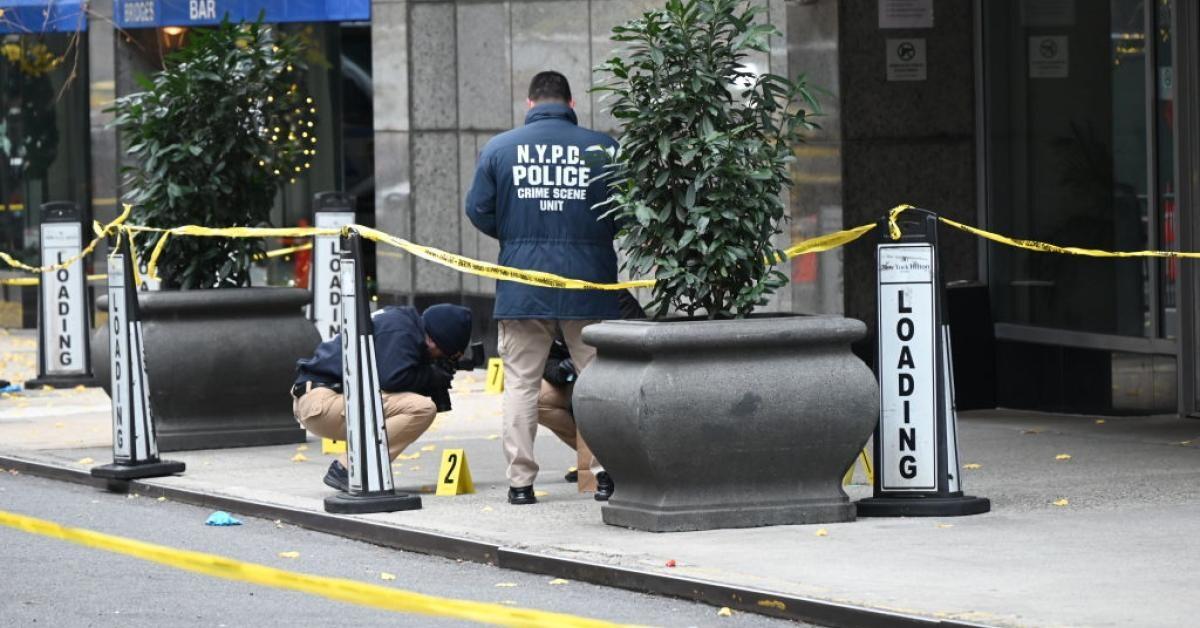
A man in Pennsylvania is being questioned in connection to the murder of UnitedHealthcare CEO Brian Thompson in New York City, police sources tell CBS News New York.

A source close to the investigation said that a person of interest was being questioned about the murder after Pennsylvania authorities took him into custody on an unrelated incident in Altoona (busted possibly trying to use a fake ID in a McDonald’s, law enforcement sources said).

The person was carrying a firearm similar to the one used in Thompson’s murder, the source said.

The NYPost reports that the man allegedly had a manifesto on him when he was taken into custody by cops in Altoona, Pa.

He also had a gun, silencer, four fake IDs and other items ‘consistent’ with what authorities were looking for in the case, sources said.

The NYPD was on its way to Altoona late Monday morning, sources said.

Developing…

Tyler Durden
Mon, 12/09/2024 – 12:05

via ZeroHedge News https://ift.tt/TcvzYpy Tyler Durden

US Officials Discuss Merits Of Removing $10M Bounty On HTS Leader

US Officials Discuss Merits Of Removing $10M Bounty On HTS Leader

Via Middle East Eye

US officials have discussed the merits of removing a $10 million bounty on Hay’at Tahrir al-Sham (HTS) leader Abu Mohammad al-Jolani, whose rebel group swept into Damascus and toppled the government of Bashar al-Assad on Sunday, a senior Arab official briefed by the Americans told Middle East Eye.

Ahmed al-Sharaa, commonly known as Jolani, has been designated as a terrorist by the United States since 2013, whilst his organization, HTS, was proscribed by the Trump administration in 2018 when a $10m bounty was placed on his head. For years, HTS lobbied to be delisted, but its pleas largely fell on deaf years with the group relegated to governing just a sliver of northwest Syria. 

Hay’at Tahrir al-Sham (HTS) leader Abu Mohammad al-Jolani overlooking Damascus in a new photo released by his group.

But the lightning blitz by the ‘rebels’, which saw Assad’s iron-grip rule end in spectacular fashion on Sunday, has since forced Washington to rethink how it engages with the former al-Qaeda affiliate.

The senior Arab official, who requested anonymity due to sensitivities surrounding the talks, told MEE that the discussions had divided officials in the Biden administration. Meanwhile, when asked about the discussions, one Trump transition official disparaged the Biden administration.

Jolani, 42, gave a rousing victory speech in Damascus’ iconic Umayyad Mosque on Sunday and is widely expected to play a key role in Syria’s transition after 54 years of Assad family rule.

“Today, Syria is being purified,” Jolani told a crowd of supporters in Damascus, adding that “this victory is born from the people who have languished in prison, and the mujahideen (fighters) broke their chains“.

He said that under Assad, Syria had become a place for “Iranian ambitions, where sectarianism was rife,” in reference to Assad’s allies Iran and its Lebanese proxy Hezbollah.

‘Saying the right things now’

Speaking several hours after the fall of Damascus, US President Joe Biden called the rebel takeover a “fundamental act of justice,” but cautioned it was “a moment of risk and uncertainty” for the Middle East.

“We will remain vigilant,” Biden said. “Make no mistake, some of the rebel groups that took down Assad have their own grim record of terrorism and human rights abuses,” adding that the groups are “saying the right things now.”

“But as they take on greater responsibility, we will assess not just their words, but their actions,” Biden said. Later, a senior Biden administration official, when asked about contact with HTS leaders, said Washington was in contact with Syrian groups of all kinds.

The official, who was not authorized to publicly discuss the situation and spoke on condition of anonymity, also said the US was focused on ensuring chemical weapons in Assad’s military arsenal were secured.

Meanwhile, the New York Times reported that US intelligence agencies were in the process of evaluating Jolani, who it said had launched a “charm offensive” aimed at allaying concerns over his past affiliations.

Jolani was born to a family originally from the occupied Golan Heights and fought in the Iraq insurgency and served five years in an American-run prison in Iraq, before returning to Syria as the emissary of Islamic State founder Abu Bakr al-Baghdadi. 

“A charm offensive might mean that people are turning over a new leaf and they think differently than they used to so you should hear them out. On the other hand, you should be cautious because charm offensives can sometimes be misleading,” the US official said.

“We have to think about it. We have to watch their behavior and we need to do some indirect messaging and see what comes of that,” the official added. But, US President-elect Donald Trump, who will be entering office in just five weeks, has left few doubts where he stood on the conflict, saying Washington “should have nothing to do with it [Syria].” 

In a social media post on Saturday, Trump wrote that Assad “lost” because “Russia and Iran are in a weakened state right now, one because of Ukraine and a bad economy, the other because of Israel and its fighting success”. 

Trump used Assad’s fall as an opportunity to call for an end to the war in Ukraine, without mentioning the Syrian opposition or the US’ Syrian allies. 

Jordan lobbies for Syrian Free Army

Assad’s ouster has seen Nato-ally Turkey cement its status as the main outside power in Syria at the expense of a bruised and battered Iran and Russia. But the US holds vast amounts of territory in Syria via its allies, who joined a race to replace the Assad regime as its soldiers abandoned villages and cities en masse. 

The US backs rebels operating out of the al-Tanf desert outpost on the tri-border area of Jordan, Iraq and Syria. The Syrian Free Army (SFA) went on the offensive as Assad’s regime collapsed taking control of the city of Palmyra.

The SFA works closely with the US and its financing is mainly run out of Jordan. The SFA also enjoys close ties to Jordanian intelligence. A former Arab security official told MEE that Jordan’s King Abdullah II met with senior US officials in Washington DC last week and lobbied for continued support for the Syrian Free Army.

However, maintaining stability in post-Assad Syria will be key for Jordan as it looks to send back hundreds of thousands of refugees and ensure a power vacuum does not lead to more captagon crossing its border, the former official said. 

In northeastern Syria, the US has roughly 900 troops embedded with the Kurdish-led Syrian Democratic Forces (SDF). Arab tribes linked to the SDF swept across the Euphrates River on Friday to take a wide swath of strategic towns, including Deir Ezzor and al-Bukamal. The latter is Syria’s strategic border crossing with Iraq. 

The US’s support for the SDF is a sore point in its ties to Turkey, which views the SDF as an extension of the outlawed Kurdistan Workers’ Party (PKK). The PKK has waged a decades-long guerrilla war in southern Turkey and is labelled a terrorist organization by the US and the European Union. 

Turkey’s concerns about the PKK led it to launch an invasion of Syria in 2016, with the aim of depriving Kurdish fighters of a quasi-state along its border. Two more military forays followed in 2018 and 2019. 

The SDF is already being squeezed in the north with Turkish backed rebels called the Syrian National Army entering the strategic city of Manbij. According to Reuters, the Turkish backed fighters already control 80 percent of the territory around the city centre. 

During Syria’s more than decade long war, the US slapped sanctions on Assad’s government, enabled Israel to launch strikes on Iran inside Syria, and backed oppositions groups that hold sway over around one-third of the country.

Tyler Durden
Mon, 12/09/2024 – 11:45

via ZeroHedge News https://ift.tt/VeZ4idD Tyler Durden

Illegal Aliens Already Self-Deporting In Anticipation Of Second Trump Presidency

Illegal Aliens Already Self-Deporting In Anticipation Of Second Trump Presidency

Authored by Eric Lendrum via American Greatness,

With less than two months before President-elect Donald Trump returns to the White House, a number of illegal aliens attempting to enter the United States are already abandoning their attempts to cross the border and are returning to their home countries.

As reported by Fox News, up to 100 illegal aliens in Mexico have requested “voluntary return” to their countries of origin, according to Mexican officials.

The illegals in question are either paying the costs of return out of their own pocket, or seeking state funds to do so.

Many of the illegals specifically cited Trump’s impending return to office and his plans to crack down on immigration as their reasons for changing their minds.

President-elect Trump has vowed to eliminate a government-approved app called “CBP One,” which has allowed illegals to digitally apply for, and be swiftly granted, asylum without ever appearing in an immigration court, thus fast-tracking amnesty on a massive scale. He also pledged to re-implement the “Remain in Mexico” policy, a successful immigration policy from his first term that forced illegals to stay in Mexico while their applications for asylum or citizenship were processed.

“I cry every day and ask God to take me back, I don’t want to be here anymore… this is horrible,” said one illegal.

“I am traumatized. If I don’t get the appointment, I will go back,” said another illegal.

In addition to cracking down on the illegals themselves, the second Trump Administration also plans to take the fight directly to the cartels that have facilitated mass smuggling of illegals for profit.

“They have killed more Americans than every terrorist organization in the world and Trump is committed to calling them terrorist organizations and using the full might of the United States Special Operations to take them out,” said Tom Homan, the incoming Border Czar for the second Trump Administration.

Tyler Durden
Mon, 12/09/2024 – 11:25

via ZeroHedge News https://ift.tt/a1XvMnr Tyler Durden

‘A Sweet Deal’? Mondelez Reportedly Mulls Hershey Takeover To Expand Junk Food Empire

‘A Sweet Deal’? Mondelez Reportedly Mulls Hershey Takeover To Expand Junk Food Empire

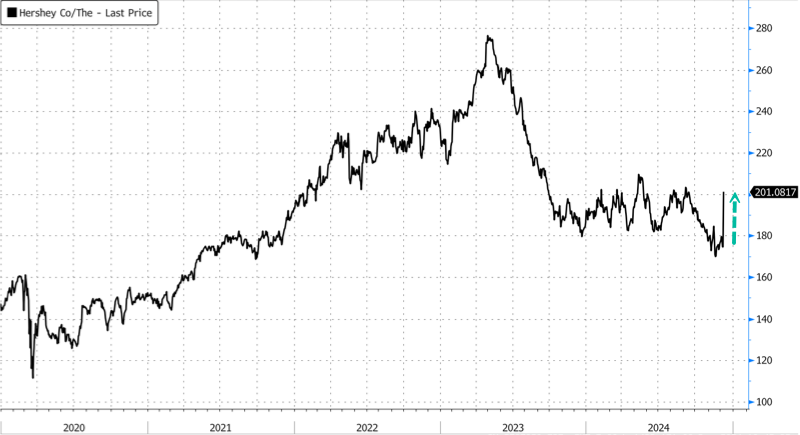
Hershey Co. shares surged the most in years after a Bloomberg report revealed that Mondelez International has mulled over a potential takeover of the chocolate maker for the second time in nearly a decade

According to the people familiar with the situation who asked not to be identified, the Chicago-based Ritz crackers and Oreo cookies maker made a preliminary approach about a possible combination” of Pennsylvania-based Hershey. They said deliberations are in the early stages

Bloomberg data shows Hershey’s market value, including debt, was approximately $46 billion. Mondelez’s buyout proposal was not detailed in the report. 

Even if Mondelez offered Hershey a sweet deal, it would require the support of Hershey Trust, which holds 80% of the Class B voting stock. Bloomberg noted, “The trust has slowly been selling some of its Hershey Co. shares in an effort to diversify its holdings.”

In 2016, Mondelez approached Hershey about purchasing the company but walked away from the table after the trust rejected its $23 billion bid. 

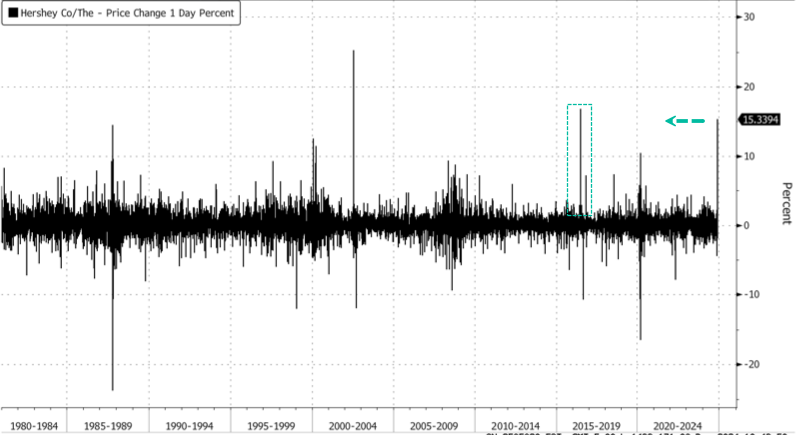
Shares in Hershey spiked as much as 19% for their biggest intraday gain since the 25% spike on July 25, 2002.

Shares are up 15% around 1045 ET, at about the same level on June 30, 2016, when Mondelez made the first buyout attempt.

“The packaged-food industry has been grappling with declining volumes, slowing growth and a weakening global consumer. Companies are looking to innovation and new markets to bolster sales as shoppers start to push back on price hikes and become more health-conscious — a trend that could lead to consolidation,” Bloomberg noted. 

One can only imagine what might happen to junk food industry when Robert F. Kennedy Jr. leads the Department of Health and Human Services next year. We cited a Goldman note on Sunday that provided readers with insight into the ‘RFK Jr. Effect‘ pressuring healthcare companies lower. 

Tyler Durden
Mon, 12/09/2024 – 11:10

via ZeroHedge News https://ift.tt/KgAndQu Tyler Durden

Key Events This Week: CPI, PPI And ECB

Key Events This Week: CPI, PPI And ECB

With less than three full weeks left until the end of the year, we are rapidly running out of key macro events, although Wednesday’s US CPI will be a key determinant if the Fed cuts later this month, and whether it will be forced to hike in 2025.

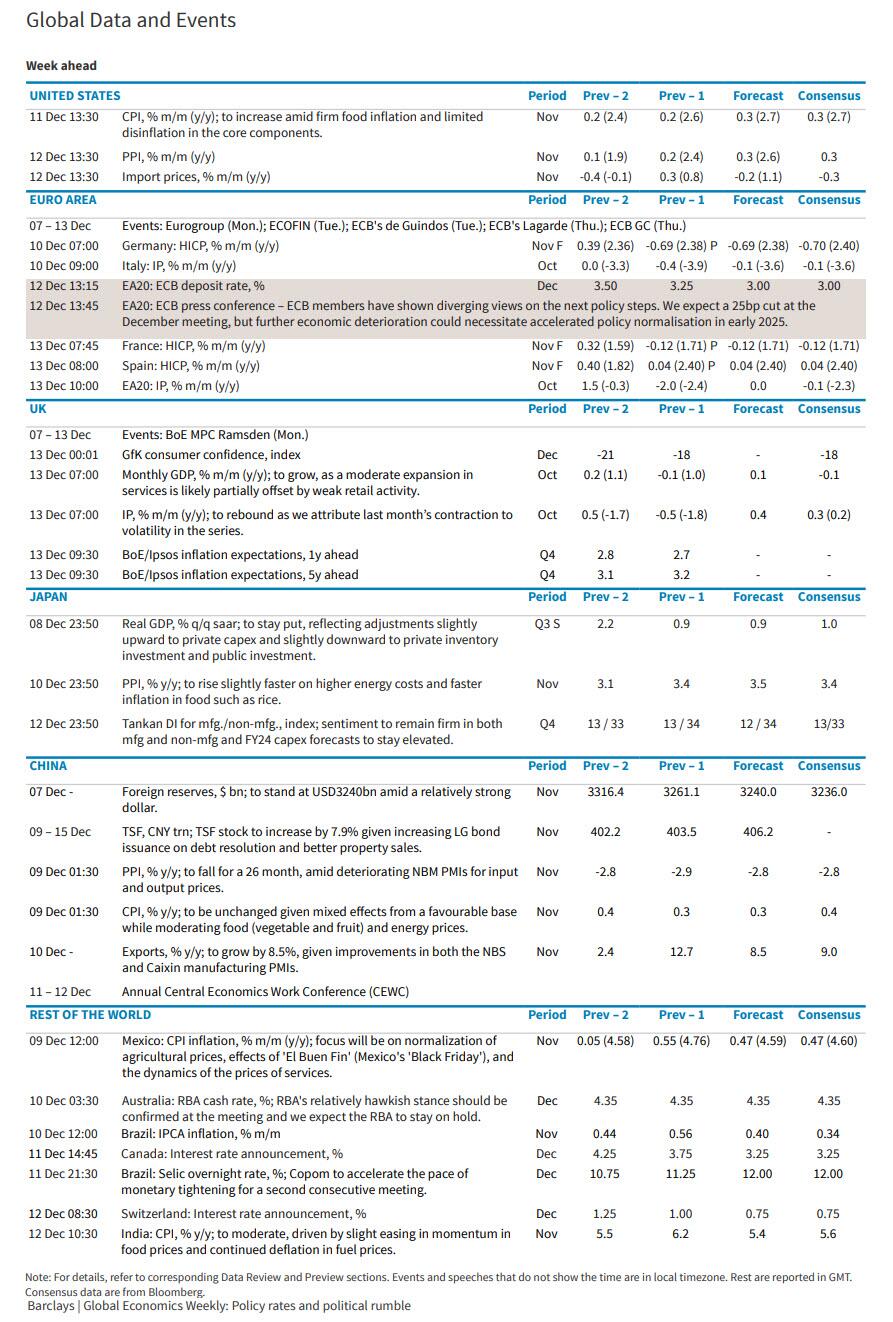
After Friday’s mixed payrolls report, the odds of a December cut went up from around 70% to 85% at the close. So the CPI will be the main event of the week according to DB’s Jim Reid. The ECB meeting the following day will also be a key event with markets pricing in a small chance of a 50bps cut but with 25bps nailed on. Elsewhere the key events of note will be the RBA decision (hold expected), China trade data and Danish and Norwegian CPI tomorrow, the BoC decision on Wednesday (possible consecutive 50bps cut), the Brazilian rate decision (75bps hike to 12% expected), alongside a 10yr UST auction, US PPI, the SNB decision and a 30yr UST auction on Thursday, and the BoJ Tankan quarterly survey on Friday ahead of an “in the balance” BoJ meeting on December 19th where the market is expecting a 36% probability of a hike. See the full week ahead at the end as usual but now we’ll preview the US CPI and the ECB decision in more detail.

For US CPI on Wednesday, DB’s economists expect headline CPI growth to pick up to +0.30% (+0.24% in October), in line with the median forecast on Bloomberg, and see core printing at +0.27% (+0.28%) also in line with consensus. The headline YoY rate will therefore likely move up one-tenth to 2.7%, with core staying at 3.3%. The PPI report will follow on Thursday and our economics team forecast the headline to grow by +0.3% MoM (+0.2%). As ever the components that feed into core PCE will be the main thing to watch.

For the ECB, DB expects a 25bp cut to 3.00% in December. This will be the fourth cut since the start of the easing cycle, making it 100bp of cuts so far in this cycle. The team expect the December ECB press conference to emphasize uncertainty and the Governing Council to reach a compromise on communications that creates more policy optionality. There is considerable uncertainty going forward, not least around the timing, extent and impact of US tariffs, and as such the Governing Council is likely to want to keep its policy options wide open in 2025.

Elsewhere, it’s been a weekend full of interesting news with Syrian President Assad’s reign collapsing as rebel forces ousted him. With Russia and Iran historically backing the Assad government but being distracted by other conflicts on their own doorstep, the rebel forces have taken their opportunity. While many countries will be happy to see the current regime fall, the big question mark is what happens next. The rebels have been led by HTS, who spun out of al-Qaeda in 2016, so there will remain question marks about the succession. The situation probably isn’t market moving at the moment (Crude up 0.4% overnight) but has longer-term implications for a lot of the current geopolitical hotspots dominating the world at the moment.

Meanwhile Trump spoke to NBC’s “Meet the Press” yesterday and said he had no plans to replace Powell as Fed Chair and said “tariffs are going to make our country rich. Tariffs are going to help us pay off $35 trillion in debt”. The trade comments didn’t have a lot of extra substance beyond that so hard to get too much from it at the moment.

Courtesy of DB, here is a day-by-day calendar of events

Monday December 9

  • Data: US October wholesale trade sales, November NY Fed 1-yr inflation expectations, China November CPI, PPI, Japan November Economy Watchers survey, M2, M3, October trade balance and current account (Tokyo time), November bank lending (Tokyo time)
  • Central banks: BoE’s Ramsden speaks
  • Earnings: Oracle

Tuesday December 10

  • Data: US November NFIB small business optimism, China November trade balance, Japan November machine tool orders, PPI, Italy October industrial production, Sweden October GDP indicator, Denmark and Norway November CPI
  • Central banks: RBA decision
  • Auctions: US 3-yr Notes ($58bn)

Wednesday December 11

  • Data: US November CPI, federal budget balance
  • Central banks: BoC decision
  • Earnings: Adobe, Inditex
  • Auctions: US 10-yr Notes (reopening, $39bn)

Thursday December 12

  • Data: US November PPI, Q3 household change in net worth, initial jobless claims, Japan BoJ’s Tankan survey (GMT time), UK November RICS house price balance, Germany October current account balance, Italy Q3 unemployment rate, Canada October building permits, Australia November labour force
  • Central banks: ECB decision, SNB decision
  • Earnings: Broadcom, Costco
  • Auctions: US 30-yr Bonds (reopening, $22bn)

Friday December 13

  • Data: US November import and export price index, UK December GfK consumer confidence, October monthly GDP, Japan October capacity utilisation, Germany October trade balance, November wholesale price index, Canada October manufacturing sales, Q3 capacity utilisation rate
  • Central banks: ECB’s Holzmann speaks, BoE inflation attitudes survey, Bundesbank’s semi-annual forecasts

Finally, looking at just the US, Goldman writes that the key economic data release this week is the CPI report on Wednesday. Fed officials are not expected to comment on monetary policy this week, reflecting the blackout period ahead of the December FOMC meeting.

Monday, December 9

  • 10:00 AM Wholesale inventories, October final (consensus +0.2%, last +0.2%)

Tuesday, December 10

  • 06:00 AM NFIB small business optimism, November (consensus 94.5, 93.7)
  • 08:30 AM Nonfarm productivity, Q3 final (GS +2.2%, consensus +2.2%, last +2.2%): Unit labor costs, Q3 final (GS +0.9%, consensus +1.2%, last +1.9%)

Wednesday, December 11

  • 08:30 AM CPI (MoM), November (GS +0.28%, consensus +0.3%, last +0.2%); Core CPI (MoM), November (GS +0.28%, consensus +0.3%, last +0.3%); CPI (YoY), November (GS +2.70%, consensus +2.7%, last +2.6%); Core CPI (YoY), November (GS +3.27%, consensus +3.3%, last +3.3%): We estimate a 0.28% increase in November core CPI (month-over-month SA), which would leave the year-over-year rate unchanged on a rounded basis at 3.3%. Our forecast reflects an increase in used car prices (+2.0%) reflecting a rebound in auction prices, another increase in airfares (+1.0%) reflecting strong pricing trends, and a rebound in the car insurance category (+0.5%) based on continued—albeit decelerating—increases in premiums in our online dataset. We expect the shelter components to slow on net (OER +0.33% vs. +0.40% in October; primary rent +0.28% vs. +0.28% in October). We forecast a 0.5% increase in the apparel component (vs. -1.5% in October) and a 0.1% increase in the household furnishings and operations component (vs. -0.1%) reflecting weaker readings in the prior month and mixed data on holiday discounting. We expect seasonal distortions to weigh on the communications category (GS forecast -0.5%). We estimate a 0.28% rise in headline CPI, reflecting higher food (+0.25%) and energy (+0.3%) prices. Our forecast is consistent with a 0.20% increase in core PCE in November. We will update our core PCE forecast after the CPI is released and again after the PPI is released.

Thursday, December 12

  • 08:30 AM PPI final demand, November (GS +0.2%, consensus +0.3%, last +0.2%); PPI ex-food and energy, November (GS +0.2%, consensus +0.2%, last +0.3%); PPI ex-food, energy, and trade, November (GS +0.2%, consensus +0.3%, last +0.3%)
  • 08:30 AM Initial jobless claims, week ended December 7 (GS 235k, consensus 220k, last 224k): Continuing jobless claims, week ended November 30 (last 1,871k): We expect initial jobless claims to increase by 11k to 235k in the week ended December 7th, reflecting difficulties with seasonal adjustment around the holidays.

Friday, December 13

  • 08:30 AM Import price index, November (consensus -0.2%, last +0.3%): Export price index, November (consensus -0.2%, last +0.8%)

Source: DB, Goldman, Barclays

Tyler Durden
Mon, 12/09/2024 – 11:01

via ZeroHedge News https://ift.tt/ZubA7Qc Tyler Durden

Nvidia Shares Drop Amid Chinese Probe Into “Suspected Anti-Monopoly Law Violation”

Nvidia Shares Drop Amid Chinese Probe Into “Suspected Anti-Monopoly Law Violation”

A week after the Biden administration’s new restrictions on China’s semiconductor industry triggered another tit-for-tat round with Beijing, China has launched an investigation into Nvidia for alleged anti-monopoly violations. 

According to a report from China Central Television, the State Administration for Market Regulation opened an investigation on Monday to determine whether Nvidia’s recent purchase of Israeli chip designer Mellanox Technologies violated anti-monopoly laws.

CCTV wrote in the report:

Recently, due to NVIDIA’s suspected violation of the Anti-Monopoly Law of the People’s Republic of China and the “Announcement of the State Administration for Market Regulation on the Anti-Monopoly Review Decision of Approving NVIDIA’s Acquisition of Equity in Mellanox Technologies Co., Ltd. with Additional Restrictive Conditions” (Announcement of the State Administration for Market Regulation [2020] No. 16), the State Administration for Market Regulation has initiated an investigation into NVIDIA in accordance with the law.

In 2019, Beijing approved Nvidia’s $6.9 billion acquisition of Mellanox on the condition that Nvidia does not discriminate against Chinese companies. This meant that the Israeli computer networking equipment maker would have to provide details about upcoming products to rivals within three months of making them available to Nvidia.

The investigation into Nvidia comes after Beijing fired a warning shot at the US early last week by banning the export of gallium, germanium, antimony, and other critical minerals with potential military applications. This tit-for-tat response followed the Biden administration’s broader restrictions on AI chip shipments to China. 

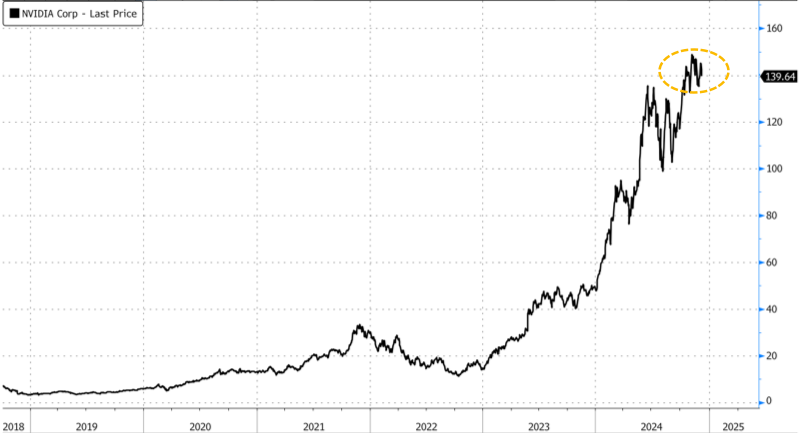
In markets, Nvidia shares in New York fell 2% in the early cash session. Shares have soared 180% this year. 

Earlier this year, Bloomberg revealed that the US Justice Department was investigating whether Nvidia violated antitrust laws. The department expressed concerns that the chipmaker made it more difficult for customers to switch to other suppliers. 

In July, Benoit Coeure, the head of France’s antitrust agency, stated that Nvidia could “one day” face antitrust charges, while the European Union launched an early-stage probe in 2023 to investigate potential anticompetitive abuses in the AI chip market.

Tyler Durden
Mon, 12/09/2024 – 10:40

via ZeroHedge News https://ift.tt/BRYAKCu Tyler Durden

After Volatility Collapse, Gold Breaks Out As China Resumes Bullion-Buying

After Volatility Collapse, Gold Breaks Out As China Resumes Bullion-Buying

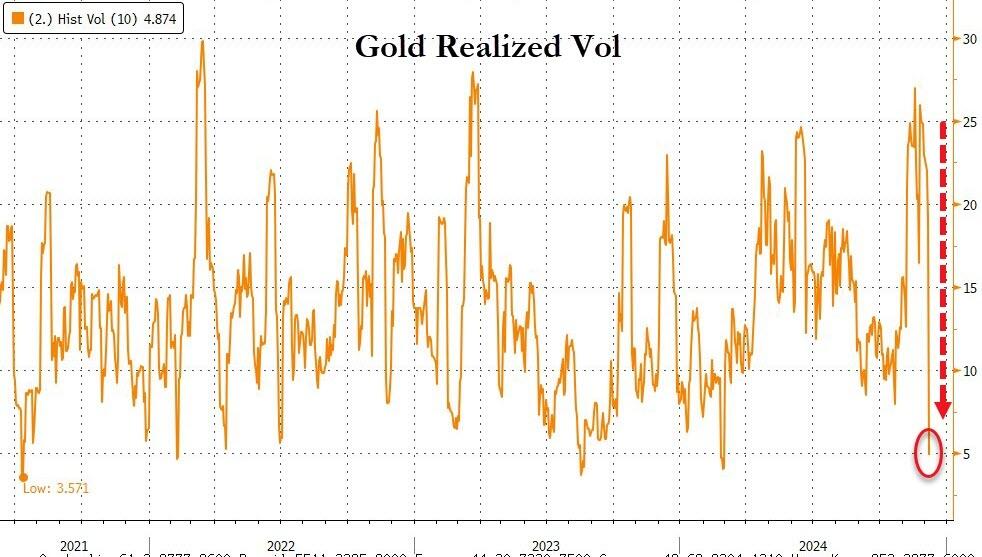
The last ten days or so have seen an almost unprecedented collapse in gold’s realized volatility…

Source: Bloomberg

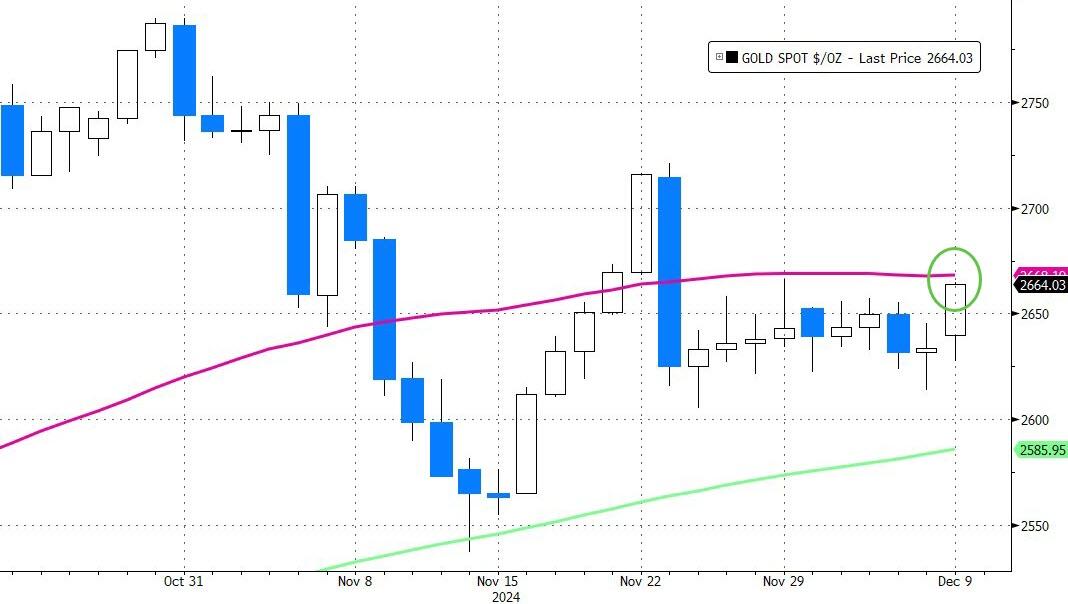
…as the price of the precious metal hovered just below its crucial technical 50-day moving-average level…

Source: Bloomberg

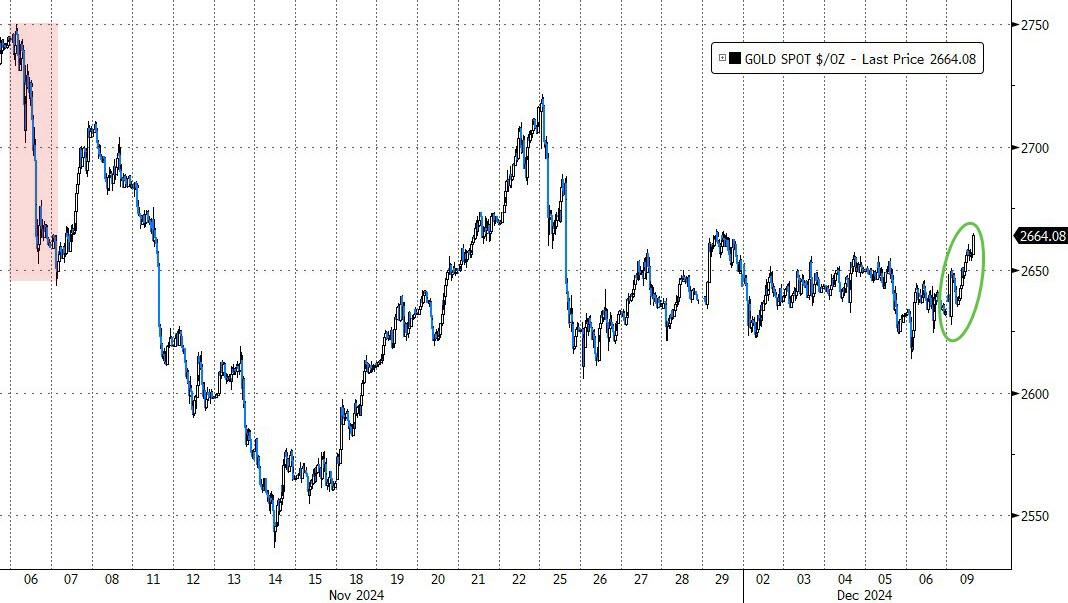
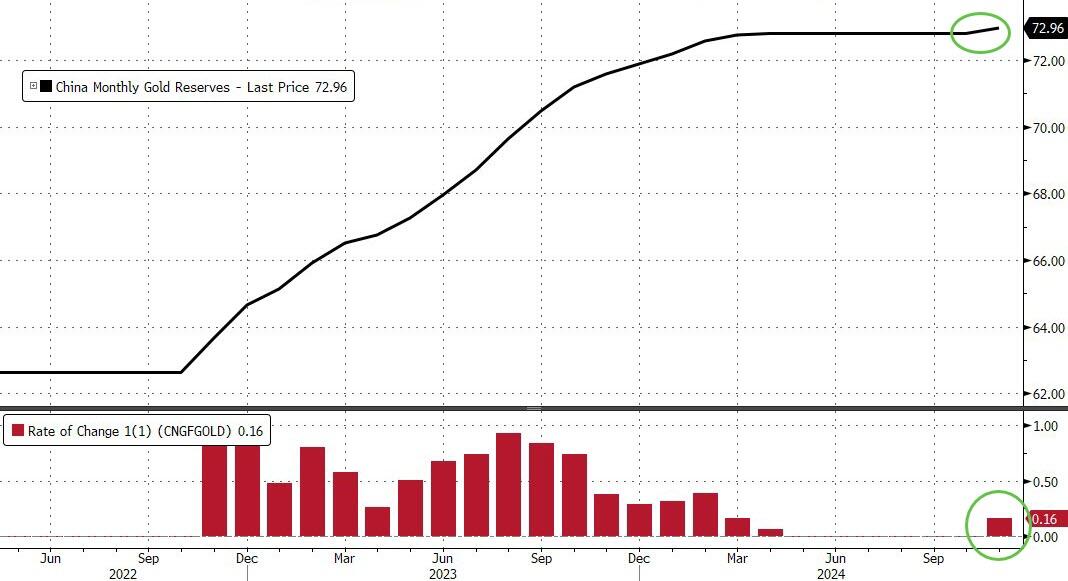
As we posted on X, this created a coiled spring like tension in the markets, that may have just been broken by news from Beijing as Reuters reports that China resumed gold purchases in November after a six-month pause (which ended an 18-mnth buying streak) and also launched (another) major stimulus effort.

“Falling U.S. interest rates and ongoing solid demand from central banks are supporting the gold price. (It) Was definitely good to see again purchases by the Chinese central bank last month, but other central banks have been also buying large quantities,” said UBS analyst Giovanni Staunovo.

That prompted a jump in the barbarous relic this morning…

Source: Bloomberg

Robust central bank buying, monetary policy easing and geopolitical tensions have driven gold to multiple record highs this year, setting the metal on track for its best year since 2010 with a over 28% increase so far.

“The decision to increase gold holdings, particularly following Trump’s recent election victory, reflects the PBOC’s proactive approach to safeguarding economic stability amid evolving global conditions,” OCBC analysts said in a note.

Zero-yielding bullion thrives in a low interest rate environment and is considered a hedge against political and economic uncertainty.

Adding to political uncertainty in the Middle East, Syrian rebels seized Damascus, forcing President Bashar al-Assad to flee to Russia, ending 13 years of civil war and over 50 years of Assad family rule.

Tyler Durden
Mon, 12/09/2024 – 10:20

via ZeroHedge News https://ift.tt/Tu9OjY6 Tyler Durden

Jake Tapper And CNN Lose Major Motions In Defamation Case By Navy Veteran

Jake Tapper And CNN Lose Major Motions In Defamation Case By Navy Veteran

Authored by Jonathan Turley,

We previously discussed the defamation lawsuit brought by Navy veteran Zachary Young against CNN and anchor Jake Tapper. Young has been doing well in court and last week he won on additional major issues against CNN. In a pair of orders, the jury will be allowed to award punitive damages and his experts would be allowed to be heard by the jury on the damages in the case. It also found that the Navy veteran was not a public figure and thus is not subject to the higher standard of proof associated with that status.

The punitive damages decision is particularly interesting legally. It could prove financially onerous for the struggling network, which has plunging ratings and has reduced staff.

The court found that CNN’s “retraction” was insufficient to remove punitive damages from the table. In my torts class, we discuss retraction statutes and the requirements of time and clarity. I specifically discussed the CNN case.

The report at the heart of the case aired on a Nov. 11, 2021 segment on CNN’s “The Lead with Jake Tapper” and was shared on social media and (a different version) on CNN’s website. In the segment, Tapper tells his audience ominously how CNN correspondent Alex Marquardt discovered “Afghans trying to get out of the country face a black market full of promises, demands of exorbitant fees, and no guarantee of safety or success.”

Marquardt piled on in the segment, claiming that “desperate Afghans are being exploited” and need to pay “exorbitant, often impossible amounts” to flee the country. He then named Young and his company as an example of that startling claim.

The damages in the case could be massive but Young was facing the higher New York Times v. Sullivan standard of “actual malice,” requiring a showing of knowing falsehood or a reckless disregard of the truth. Judge Roberts previously found that “Young sufficiently proffered evidence of actual malice, express malice, and a level of conduct outrageous enough to open the door for him to seek punitive damages.”

The evidence included messages from Marquardt that he wanted to “nail this Zachary Young mfucker” and thought the story would be Young’s “funeral.” After promising to “nail” Young, CNN editor Matthew Philips responded: “gonna hold you to that cowboy!” Likewise, CNN senior editor Fuzz Hogan described Young as “a shit.”

As is often done by media, CNN allegedly gave Young only two hours to respond before the story ran. It is a typical ploy of the press to claim that they waited for a response while giving the target the smallest possible window.

In this case, Young was able to respond in the short time and Marquardt messaged a colleague, “fucking Young just texted.”

That record supports a showing of actual malice. However, CNN wanted to avoid punitive damages with a claim of retraction. Under Florida’s Section §770.02(1), a publication seeking this protection must publish a “full and fair correction, apology or retraction.” While the statute does not define “full and fair” it does specify that the retraction shall be “published in the same editions or corresponding issues of the newspaper or periodical” where the original article appeared and ‘in as conspicuous place and type’ as the original, or for a broadcast “at a comparable time.”

In this case, Jake Tapper made the following statement on March 25, 2022:

“And before we go, a correction. In November, we ran a story about Afghans desperate to pay high sums beyond the reach of average Afghans. The story included a lead-in and banner throughout the story that referenced a black market. The use of the term black market in the story was in error. The story included reporting on Zachary Young, a private operator who had been contacted by family members of Afghans trying to flee the country. We didn’t mean to suggest that Mr. Young participated in the black market. We regret the error and to Mr. Young, we apologize.”

However, the court noted:

“The retraction/correction was not made during the other television shows in which the Segment aired. No retraction, correction or apology was posted on any online article or with any social media posting. Defendant’s representatives referred to the statement made on the Jake Tapper show as a correction rather than a retraction.”

Not only did the court find that insufficient, but it menacingly added, “the Court finds that there is an issue of material fact as to whether Defendant published a full and fair retraction as required by §770.02 for the televised segment and no retraction for the social media and online article postings, which could be additional evidence of actual malice.”

This is relatively new ground for the Florida courts and will undoubtedly be appealed in time. For now, punitive damages will remain an option for the jury. The message to news organizations is that minimizing retractions can produce a critical loss of the coverage of the common statutory provisions protecting the media.

It is also worth noting that Young was found to be a private individual and not a “public figure.” After the Supreme Court handed down New York Times v. Sullivan, it extended the actual malice standard from public officials to public figures. In Gertz v. Robert Welch, Inc., 418 U.S. 323, 345 (1974), the Court wrote:

“Hypothetically, it may be possible for someone to become a public figure through no purposeful action of his own, but the instances of truly involuntary public figures must be exceedingly rare. For the most part those who attain this status have assumed roles of especial prominence in the affairs of society. Some occupy positions of such persuasive power and influence that they are deemed public figures for all purposes. More commonly, those classed as public figures have thrust themselves to the forefront of particular public controversies in order to influence the resolution of the issues involved. In either event, they invite attention and comment.”

The Supreme Court has held that public figure status applies when  someone “thrust[s] himself into the vortex of [the] public issue [and] engage[s] the public’s attention in an attempt to influence its outcome.” A limited-purpose public figure status applies if someone voluntarily “draw[s] attention to himself” or allows himself to become part of a controversy “as a fulcrum to create public discussion.” Wolston v. Reader’s Digest Association, 443 U.S. 157, 168 (1979).

In creating this higher burden, the Court sought to create “breathing space” for the media by articulating that standard for both public officials and public figures. Public figures are viewed as having an enhanced ability to defend themselves and engaging in “self-help” in the face of criticism. The Court also viewed these figures as thrusting themselves into the public eye, voluntarily assuming the risk of heightened criticism. I have previously written about the continuing questions over the inclusion of public figures with public officials in tort actions.

However, the court found that Young did not trip this wire.

“Young’s limited posts do not constitute him thrusting himself ‘to the forefront’ of the Afghanistan evacuation ‘controversy.’ In total, Plaintiffs worked for four companies and evacuated 22 people from Afghanistan. Per Defendant’s Segment, ‘[t]here [were] fewer than Page 13 of 34100 American citizens in Afghanistan who [were] ready to leave’ and ‘countless Afghans, including thousands who worked for or aided the US . . . who are frantically trying to leave.’ While Young was clearly trying to advertise his services, it can hardly be said that he played a sufficiently central role or was at the forefront in being able to influence the resolution of all those unable to escape Afghanistan. He was not going to get all these thousands of people out, nor was he ever intending to as he (according to his posts and testimony) was only assisting those with sponsors. He also was not going to convince the Taliban to let these folks leave the country. As such, Plaintiffs do not meet the test for this second suggested controversy to be labeled as limited public figures.”

The court also ruled that Young would be allowed to keep his economic damages expert witness, Richard Bolko, a ruling that, in conjunction with the punitive damages matter, could spell real trouble for CNN.

*  *  *

Jonathan Turley is the Shapiro professor of public interest law at George Washington University and the author of “The Indispensable Right: Free Speech in an Age of Rage.”

Tyler Durden
Mon, 12/09/2024 – 10:00

via ZeroHedge News https://ift.tt/suOFTWk Tyler Durden

Here We Go Again: China Vows More Massive Stimulus, Embraces “Moderately Loose” Monetary Policy

Here We Go Again: China Vows More Massive Stimulus, Embraces “Moderately Loose” Monetary Policy

It’s desperation time in China again.

Two months after Beijing vowed it would unleash a fiscal bazooka, sending Chinese stocks soaring, only to see the entire move reverse as the market was promptly disappointed by yet another empty promise by the world’s second largest economy, on Monday China’s top leaders signaled another round of bold economic support next year using their most direct language on stimulus in years, as Beijing braces for a trade war when Donald Trump takes office.

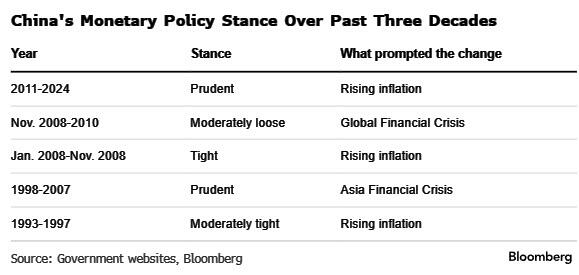
President Xi Jinping’s decision-making Politburo vowed to embrace a “moderately loose” monetary policy in 2025, signaling more rate cuts ahead and shifting from a “prudent” strategy that’s held for 14 years, and reverting to the policy stance that defined the post-GFC world until 2010.
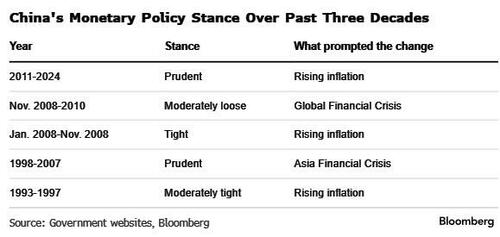
As Bloomberg reports, the 24-man body also vowed “more proactive” fiscal policy at its monthly huddle, according to the official Xinhua News Agency, raising expectations for Beijing to widen the fiscal deficit from 3% at the annual parliamentary session in March. That would open the door to more central government borrowing to shore up the faltering economy.

Still, China’s leaders ticked off nearly every major problem plaguing the economy, with direct pledges to “stabilize” the stock market as well as the property sector fighting a years long slump. In a first, cadres touted “extraordinary” measures for counter-cyclical policy adjustment, language analysts said could hint at greater bond issuance or a stabilization fund to support the stock market. Among the various (laughable) promises were the following”

  • China’s monetary policy to be moderately loose next year
  • Fiscal policy to be more proactive
  • To enrich and improve policy toolbox
  • To boost consumption and investment efficiency
  • To step up extraordinary counter-cyclical adjustments
  • To deepen high-level opening up
  • To effectively prevent, resolve risks in key areas
  • To stabilize foreign trade and investments
  • To implement more proactive macro policies
  • To expand domestic demands in all aspects
  • To enhance party’s leadership on economic work
  • To lift investment returns
  • To firmly prevent systemic risks
  • To promote urban-rural integrated developments

Policymakers also elevated the importance of boosting consumption, making that the top goal of the meeting potentially a sign the work conference will make domestic demand the priority for 2025. Xi’s push for manufacturing to propel the economy has seen the US and European Union complain China is flooding their markets with cheap goods and prompted calls for Beijing to get its own consumers spending.

Of course, getting all these tasks completed would cost trillions (in dollars) in new debt, which is why gold has resumed its surge higher. And just like in September when Beijing unleashed its latest promise to start a new Golden Age for China, the gusher of superlatives flooded in: the Politburo’s December meeting “sent the most aggressive stimulus tone in a decade,” Morgan Stanley economists including Robin Xing wrote in a research note, adding that “while the tone is very positive, implementation remains uncertain.” 

“The wording in this politburo meeting statement is unprecedented,” said Zhaopeng Xing, senior China strategist at ANZ Bank China Co Ltd. “We think the commentary points to strong fiscal expansion, big rate cut and asset buying. The policy tone shows strong confidence.”

Of course, this won’t be the first time China has vowed to stimulate… or the second, or the third. And, sure enough, after an initial burst higher, the euphoria quickly fizzled and China-linked stocks in the US dipped after bursting higher. Meanwhile, the offshore yuan erased losses to trade modestly stronger on bets China’s economy will recover due to monetary and fiscal stimulus. Regional currencies also got a boost from the Monday readout, with Australian dollar rising 0.3% and New Zealand’s currency trimming losses. That said the moves were far more muted than the eruption observed in late September when the world was convinced a true bazooka was coming only to be left with a big bag of nothing.

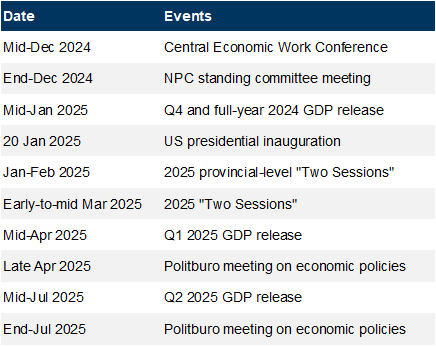
While Politburo readouts never reveal new numerical economic targets, the vaguely worded statements give important clues on future policy. The December conclave sets the agenda for the larger Central Economic Work Conference that crafts priorities, such as the annual growth goal. That meeting is set to begin Wednesday.

Other highlights of the Politburo meeting included:

  • Signaled 2024 growth target of “around 5%” will be hit by saying full-year goals will be met “smoothly”
  • Reaffirmed the overall principle of “using progress to promote stability”
  • Pledged to continue push for technology innovation and the construction of a modern supply chain
  • Vowed to implement economic reforms, including some “iconic” measures
  • Repeated a pledge to open up the economy, stabilize foreign investors and trade
  • Vowed to strengthen political supervision as part of Xi’s signature anti-corruption drive, suggesting party cadres will face more close scrutiny of their loyalty to China’s top leader.

“The wording in this Politburo meeting statement is unprecedented,” said Zhaopeng Xing, senior strategist at Australia & New Zealand Banking Group. “The policy tone shows strong confidence against Trump’s threats,” he noted, referencing the US president-elect’s vow to impose a 60% tariff on Chinese exports that would decimate bilateral trade.

Perhaps the most notable change was Beijing’s decision to adopt a “moderately loose” monetary policy; the last time China did that was in the Global Financial Crisis as part of a bazooka stimulus package to prop up the economy. That’s something Beijing has vowed to avoid repeating, with officials providing just enough support to hit this year’s growth goal of around 5% without loading up debt.

The Politburo readout, however, sent markets a message Xi is feeling a new urgency. It’s a reminder “top leaders’ view on economic conditions has shifted substantially compared to last quarter,” said Martin Rasmussen, senior strategist at macro research firm Exante Data. And yet, for all the talk, Beijing has yet to follow through with any tangible action which is why the market continues to ignore every and all such promise from Beijing.

After second quarter growth fell short, policymakers started rolling out stimulus in late September. Economists widely expect another cut to the amount of cash banks have to keep in reserve before the year is out, while a rate adjustment is more likely to fall in the first quarter of 2025. According to ANZ Bank’s Xing, the message points to a big rate cuts: “We think it points to strong fiscal expansion, big rate cut and asset buying,” Xing said adding that “special LGBs will be used to buy homes and stock stability funds may be introduced. The policy tone shows strong confidence against Trump threats.”

“The statement looks to manage market expectation. Any disappointing number at the late March NPC will hit the market.”

As well as rising trade tensions, China is battling its longest streak of deflation this century. That problem was on display earlier Monday in data showing producer prices falling in November for a 26th straight month. Consumer prices also rose at their slowest pace in five months, hovering around zero. Falling prices have undercut the economy’s 4.8% growth so far this year, eating into corporate profits and pushing companies to cut investment as well as wages. While the People’s Bank of China has slashed interest rates and offered more cash for banks several times, authorities have found it hard to spur greater borrowing.

The Politburo promised to “forcefully lift consumption” and drive domestic demand “in all aspects,” without directly mentioning the problem of deflation. That could indicate more rounds of the cash-for-clunkers program that’s operated as a consumption voucher, encouraging people to buy new electronics at a discount in exchange for their old products.

China’s Premier Li Qiang vowed to deploy “every means possible” to boost consumption at a meeting on Monday with heads of major international economic organizations in Beijing, including the International Monetary Fund, which has long called on China to expand domestic demand.

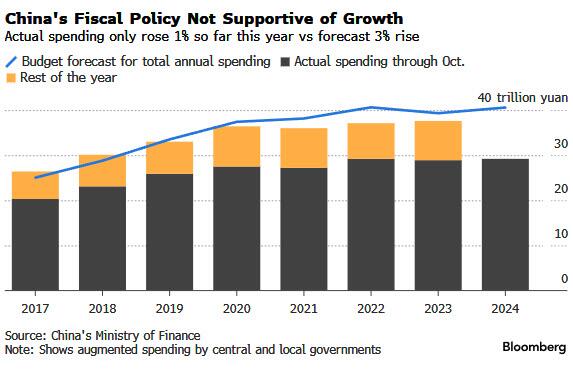
While the latest language on fiscal policy doesn’t mark a fundamental shift from the “pro-active” adopted in 2008, the addition of the word “more” signals government spending will be dialed up. A state media commentary Friday said Beijing had ample room to raise its budget deficit next year.
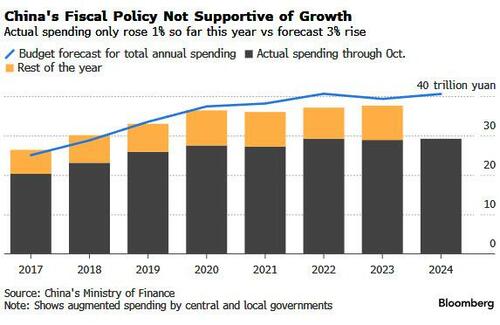
Fiscal spending is widely regarded as the most important element in any stimulus package, since private demand from households and companies has dwindled. While government spending has been weak this year, in November the Finance Ministry launched a $1.4 trillion rescue program for indebted local governments to free up regional officials to boost growth.

The specifics of the government’s budget, including the fiscal deficit and the amount of bonds it plans to issue, will likely only be revealed in March during the annual legislative session. But the Politburo readout will likely raise expectations for those targets.
“The Politburo statement is very positive,” He Wei, China economist at Gavekal Dragonomics. “It has everything that people wanted.”  

Looking ahead, following the December Politburo meeting, the annual CEWC will be held mid-week, during which top policymakers will communicate the government’s growth target and budget for 2025 to local governments. Local governments in turn will announce their own 2025 growth and investment targets in their local “Two Sessions” (in January-February), although no national targets will be officially announced until next March’s “Two Sessions”.
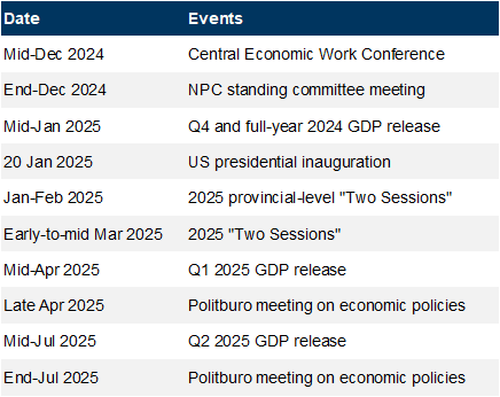
Today’s meeting adds conviction to Goldman’s view that fiscal easing will do the heavy lifting to stabilize growth, “but the composition of this easing will likely differ substantially from past cycles, with more focus on consumption, high-tech manufacturing, and risk containment rather than traditional infrastructure and property investment” according to  Goldman China anlyst Lisheng Wang. He adds that during his recent marketing trips in China, onshore investors broadly expect the growth target for 2025 to remain unchanged from this year at “around 5%” to rebuild confidence, and the official fiscal deficit to be much higher than in 2024. For policy stimulus next year, the bank expects policymakers to expand the augmented fiscal deficit meaningfully (by 1.8pp of GDP in our estimation), cut policy rates considerably (by 40bp), and step up easing measures for the property sector (see our expectations for 2025 budget numbers from our 2025 outlook).

More in the full Goldman note available to pro subs.
Tyler Durden
Mon, 12/09/2024 – 09:40

via ZeroHedge News https://ift.tt/NUEzXj1 Tyler Durden

Russia Comments On Fate Of Its Military Bases In Syria

Russia Comments On Fate Of Its Military Bases In Syria

Over the weekend of fast-moving, politically cataclysmic events in Syria which saw Bashar al-Assad flee the country and the US-designated terror organization Hayat Tahrir al-Sham take over Damascus and the whole country, the future fate of Russia’s military bases on the coast was an open question.

Some unverified videos purported to show the Russians move large military hardware inside Syria, but it was anything but clear whether the two key bases of Khmeimim and Tartus would keep Russian troops and assets stationed there.

Kremlin spokesman Dmitry Peskov has addressed the speculation and rumors. For now it appears the Russian military still oversees these bases, and they are not currently under direct threat. Peskov said their future presence will depend on the new leaders of Syria.

Khmeimim Air Base in Syria, via Wiki Commons

“Currently, we are witnessing a period of transformation and extreme instability,” Peskov told a press briefing Monday. He described events in Syria as a surprise to Russia and to the world. “It will take time before we can engage in serious conversations with those who hold power,” he added.

Russian troops have been in Syria going back decades, into Soviet times, and Tartus has been home to the Russian navy’s only Mediterranean port. In 2017, an agreement was inked between Moscow and Damascus for Russian troops to stay at the two bases for about another half-century. Those plans are obviously now up in the air.

Russian media is reporting that the armed groups now in charge of Syria have assured the safety of the Russian bases and personnel

According to reports, the Syrian armed opposition has approached the two key Russian military bases. A local source told TASS news agency that they are not currently under threat. “Opposition forces have neither invaded nor do they plan to encroach upon the territory of Russian military installations, which are operating normally,” the source said.

The militant groups that overthrew former President Bashar Assad’s government in Syria have assured the safety of Russia’s military installations and diplomatic missions within the country, a source from the Kremlin told TASS on Sunday.

Whether this pledge of safety is authentic or actually enforceable is another question. The Russian military is without doubt on high alert in Syria. It now has no local state institution with which it can partner or coordinate. Over years of the prior conflict, the base was attacked by small drones on several occasions, triggering anti-air defensive measures.

The Kremlin has also on Monday confirmed Russian President Vladimir Putin personally approved Bashar Assad’s asylum and that of his family.

Peskov said however that no meetings between the two are scheduled or expected. “There is nothing to say regarding Assad’s whereabouts,” he said. “Such decisions cannot be made without the head of state; it is his decision,” the spokesman described in reference to Putin.

Many Syrians who for many years of grinding war were fiercely loyal to Assad and his government are currently angry that he fled the capital, and that his forces folded so fast. Some feel that all the sacrifices made as the country endured Western and Gulf sponsored proxy war since 2011 have become futile or in vain.

Tyler Durden
Mon, 12/09/2024 – 09:00

via ZeroHedge News https://ift.tt/6YUSmjg Tyler Durden