After Manslaughter Dismissal, Jury In Daniel Penny Trial Returns To Consider Lesser Count

After Manslaughter Dismissal, Jury In Daniel Penny Trial Returns To Consider Lesser Count

Authored by Michael Washburn via The Epoch Times,

Jurors will return to a lower Manhattan courthouse on Dec. 9 to consider the charge of criminally negligent homicide against Daniel Penny, following the dismissal of the other charge he faced, second-degree manslaughter, on Dec. 6.

Both charges stemmed from a May 1, 2023, incident in which Penny put Jordan Neely into a chokehold after Neely came onto an uptown F train at Manhattan’s Second Avenue station and began shouting and threatening passengers.

Neely did not survive, and Penny’s trial has turned on questions about the causes of his death and whether Penny’s actions were justified.

The case has drawn national and international attention, with some viewing Penny as a hero who put his own life on the line to protect men, women, and children on the subway, and others branding him a vigilante who applied too much force.

Last week, jurors began their deliberations on Dec. 3 and continued through to Dec. 6, making several requests to Judge Maxwell Wiley for a second chance to review key pieces of evidence and testimony first presented to the jury in November.

The length of the deliberations, and the repeated requests to see evidence again, led to speculation that the jury might be having trouble achieving unanimity about Penny’s guilt and that things could even be headed for a mistrial.

Shortly after 11 a.m. on Dec. 6, the judge announced that he had received a note from the jury, stating: “At this time, we are unable to come to a unanimous vote on Count One, manslaughter in the second degree.”

This led to a discussion in which the judge told Penny’s defense counsel and the prosecutors that his official recognition that the jury was deadlocked on the first charge was required before the jury could give up discussing it and move on to the second count.

“I still have to decide that a unanimous agreement is impossible on Count One before they can render a verdict on Count Two,” he said.

The judge then asked the lawyers on both sides how they felt about the situation.

Prosecutor Dafna Yoran was not against continued deliberations, but Penny’s counsel tried to persuade the judge not to issue an Allen order directing the jury to press ahead and continue to try to reach unanimity.

But the judge issued the order anyway and had the jury come back into the courtroom.

Once they were seated, the judge reminded them that it is not supposed to be easy to achieve unanimity in criminal cases, but stressed that he had faith in their ability to reach a decision based on the evidence and the law.

The judge also explicitly directed the jury not to make a decision based on personal feelings of like or dislike for one or other party in the trial.

However, late on the afternoon of Dec. 6, the status of the deliberations had not changed.

The jury still could not come to a unanimous decision on the second-degree manslaughter charge.

The judge agreed to dismiss that charge, leaving the jury to consider the charge of criminally negligent homicide when it resumes deliberations on Dec. 9.

Tyler Durden
Mon, 12/09/2024 – 08:40

via ZeroHedge News https://ift.tt/eJiOLGB Tyler Durden

Futures Flat As Geopolitical Tensions Offset Latest China Stimulus Vows

Futures Flat As Geopolitical Tensions Offset Latest China Stimulus Vows

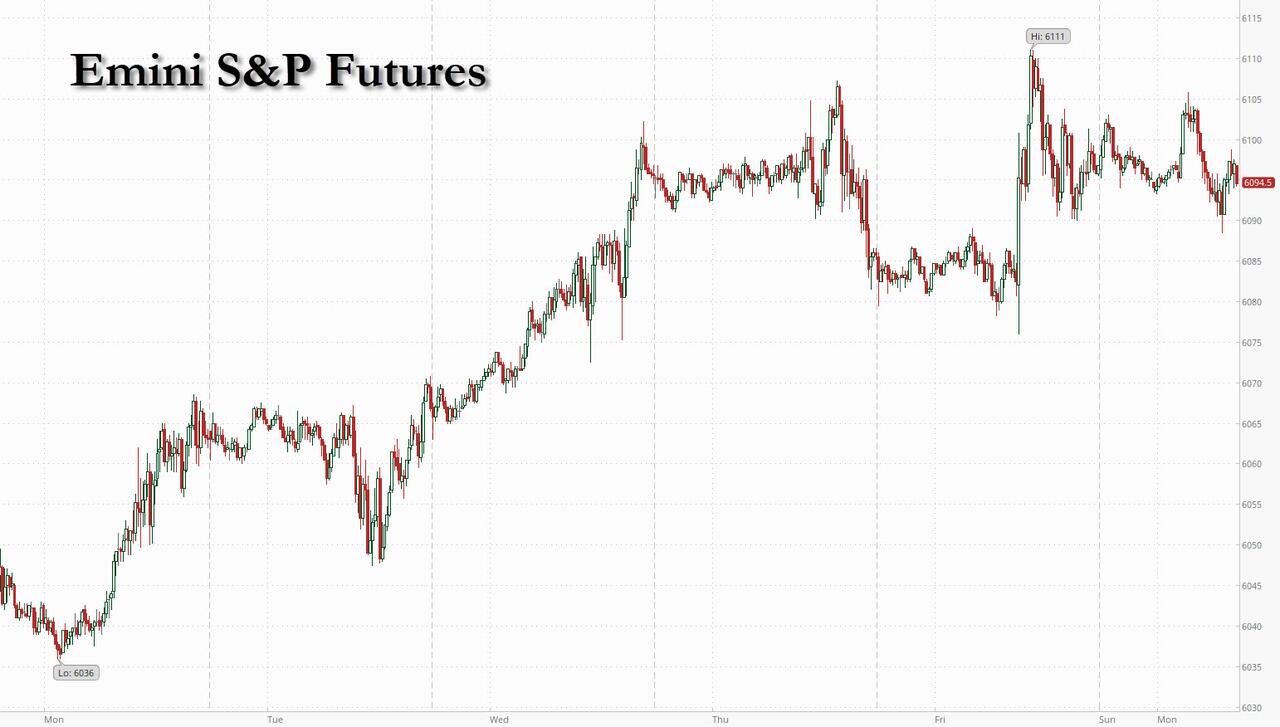
S&P futures are flat after hitting a fresh record highs on Friday and ceding brief gains sparked by China’s monetary-policy shift, as investors focused on an upsurge in geopolitical risk and the outlook for interest-rate cuts in the US and other major economies. As of 8:00am, S&P futures dipped 0.1% and Nasdaq 100 futs were down 0.2% after rising earlier following China’s announcement that authorities will embrace a “moderately loose” strategy next year. More steps on the fiscal side could be unveiled at Wednesday’s Central Economic Work Conference. While Beijing’s pledge boosted Asian markets and supported US-listed Chinese shares in premarket trading, gains elsewhere were short-lived with South Korean stocks plunging as the political crisis deepened. Pre-mkt, Mag7 is mixed while bond yields are flat to up 2bps. the Bloomberg dollar index is flat even as the yen tumbles as hopes that the BOJ will hike in December once again crumble. Commodities are stronger, led by energy and base metals, as moves are being driven by the positive stimulus news from China. As the Fed enters its blackout window, the key macro data points are CPI/PPI, though it would take a tail-risk type of print to move the Fed away from cutting next. 
US premarket gainers included Apollo Global (APO) and  Workday (WDAY) as the stocks are set to replace Qorvo and Amentum in the S&P 500 Index. Apollo +6%, Workday +9%. Super Micro Computer gained 8% after the embattled server maker said Nasdaq had granted the firm more time to become compliant with listing rules. To the downside, Nvidia slipped premarket on news of a probe in China over suspicions the the AI chipmaker broke anti-monopoly laws. Here are the other notable premarket movers:

  • Alibaba (BABA) rises 6% along with other Chinese stocks listed in the US after the country’s top leaders provided a sign of further stimulus ahead. Baidu (BIDU) +5%, PDD (PDD) +8%
  • Arcellx (ACLX) rises 6% after the drug developer gave data from a mid-stage trial of its experimental therapy for a form of blood cancer, which Baird says appears to support “best-in-class” efficacy for the drug.
  • BioAge Labs (BIOA) sinks 69% following news late Friday that the clinical-stage biopharmaceutical company is halting a Phase-2 trial evaluating its azelaprag drug for the treatment of obesity.
  • Interpublic (IPG) jumps 13% after the Wall Street Journal reported that Omnicom is in advanced talks to buy the advertising and marketing company.
  • Macy’s (M) rises 2% after the Wall Street Journal reported that activist investor Barington Capital has built a position in the department-store operator and plans to push for changes, including the establishment of a separate real estate unit.
  • Nvidia (NVDA) slips 1% as China has opened a probe into the company over suspicions that the US chipmaker has broken anti-monopoly laws.
  • Reddit (RDDT) rises 5% after a Morgan Stanley analyst admits he missed the boat on the company’s huge post-initial public offering gains. Yet he feels there’s still time to jump aboard.

In a desperate attempt to once again jawbone the markets higher, China’s top leaders doubled down on what they did in September, and signaled bolder economic support next year using their most direct language on stimulus in years, as Beijing braces for a trade war when Donald Trump takes office. President Xi Jinping’s decision-making Politburo vowed to embrace a “moderately loose” monetary policy in 2025, signaling more rate cuts ahead and shifting from a “prudent” strategy that’s held for 14 years, although following the huge disappointment that was the September fiscal stimulus “bazooka”, traders quickly took profit on the meager gains demanding deeds not words.

“The somewhat looser monetary policy stance by the Politburo is welcome news, though it won’t materially change the situation for the Chinese economy,” said Joachim Klement, head of strategy, economics and ESG at Panmure Liberum. “What is needed is substantially more fiscal stimulus that is supported by a looser monetary policy.”

Elsewhere, crude oil as well as gold prices rose after the toppling of Bashar al-Assad’s regime in Syria unsettled an already restive Middle East. South Korea also risks prolonged political impasse, with opposition lawmakers pushing for another impeachment vote on President Yoon Suk Yeol. That saw Korean markets extending declines, sparking fresh selling in crypto, while the won fell about 1% against the dollar.

Amid the geopolitical turmoil, investors will turn their attention to this week’s central bank meetings. The ECB meeting for the first time since the collapse of governments in Paris and Berlin, is expected to cut interest rates, as are the Bank of Canada and the Swiss National Bank. Australia’s central bank will likely keep rates on hold. US inflation data will be another key event, potentially determining whether the Federal Reserve eases policy again at its Dec. 18 meeting. While the November jobs report indicated on Friday that the labor market is cooling enough to allow a rate cut, the inflation print could heighten uncertainty, should it show price pressures accelerating last month by more than the 0.3% forecast in a survey.

“Inflation remains too high regardless, which has been limiting the central bank’s ability to loosen monetary policy,” Daniela Sabin Hathorn, a senior market analyst at Capital.com. told clients in a note. “The current odds show an 87% chance of a 25-bps cut next week, but this could quickly change if the CPI data does not come in as expected.”

European stocks and US equity futures also initially rallied on the China news but have now retreated from the day’s highs though sectors exposed to China, including miners and consumer products, advanced. Among individual stock movers, Turkish construction-related stocks such as Oyak Cimento Fabrikalari AS and Cimsa Cimento Sanayi VE surged as investors bet the companies will play a role in Syria’s reconstruction. Here are the biggest movers Monday:

  • Europe’s basic resources sector leads gains in the Stoxx 600 benchmark rising as much as 2.9% as copper and iron rise as China’s top leadership announced they would embrace a “moderately loose” monetary policy next year, the first shift in stance since 2011
  • BASF gains as much as 3.7%, the most in a month, following an upgrade to buy from hold at Warburg which says “not all is doom and gloom” for the German chemicals firm
  • Banco BPM rises as much as 3.9% in Milan trading after Credit Agricole raised its stake in Italy’s third-largest bank, a move aimed at defending its interests in the country
  • CompuGroup shares jump as much as 31%, to €21.64, after CVC made a voluntary public takeover offer for the German software company at €22 per share
  • Pharming gains as much as 10%, the most since October 2023 after Jefferies initiated buy citing that the current valuation as failing to reflect potential from two rare disease drugs
  • HelloFresh shares drop as much as 8.2%, a move that Jefferies analyst Giles Thorne describes as “unjust” after a report that the US Labor Department is investigating allegations concerning the use of child labor at a cooking and packaging facility in Illinois
  • DocMorris shares fall nearly 5% after Zuercher Kantonalbank cut its recommendation on the Swiss pharmaceutical products retailer to market perform from outperform, citing a liquidity shortage
  • European defense shares fall after Ukrainian President Volodymyr Zelenskiy described talks with US President-elect Donald Trump and French President Emmanuel Macron as “good and productive” in a social media post

Earlier in the session, Asian equities advanced as stocks in Hong Kong staged a late rally after Beijing pledged to support growth. Shares in South Korea continued to drop amid a deepening political crisis. The MSCI Asia Pacific Index rose as much as 0.4%, after trading in a narrow range earlier in the day. TSMC and Alibaba were among the biggest boosts to the regional gauge. Chinese stocks listed in Hong Kong rebounded in the final hour of trading after the nation’s top leaders vowed to ease monetary policy and expand fiscal spending. The Hang Seng China Enterprises Index reversed a small drop to end the day 3.1% higher, it’s biggest gain since Oct. 18. The Politburo said it will embrace a “moderately loose” strategy for monetary policy in 2025, marking its first major shift in stance since 2011, and also pledged to “stabilize property and stock markets.” “The wording in this politburo meeting statement is unprecedented,” said Zhaopeng Xing, senior China strategist at ANZ Bank China Co Ltd. “We think the commentary points to strong fiscal expansion, big rate cut and asset buying. The policy tone shows strong confidence.”

Meanwhile, Korea’s benchmark Kospi dropped more than 2% amid the risk of a prolonged stalemate after Saturday’s impeachment motion against President Yoon Suk Yeol failed. The ongoing drama has complicated the government’s efforts to reform corporate governance and eradicate the perennial undervaluation of the nation’s equities.

In FX, the Bloomberg dollar spot index is down. JPY and CHF are the weakest performers in G-10 FX, AUD and NZD outperform. The offshore yuan and commodities climbed after China’s top leaders announced they plan to loosen monetary policy and expand fiscal spending next year.

In rates, Treasuries are narrowly mixed with the yield curve steeper, unwinding a portion of Friday’s rally sparked by November jobs data. Long-end yields are ~2bp cheaper on the day, with 2s10s, 5s30s spreads steeper by 1bp-2bp near session wides. 10-year is around 4.165%, lagging bunds and gilts in the sector by 1.5bp and 3bp.

In commodities, oil gained as the market weighed the fallout from the toppling of the Syrian government, which dealt a blow to longtime backers Russia and Iran. WTI trades within Friday’s range, adding 1.4% to near $68.12. Spot gold rises roughly $24 to trade near $2,657/oz. Spot silver gains 1.5% near $31.

Bitcoin dropped below the 100k mark, to a current session trough of USD 98,274, following a rout in Korean shares as Korean momentum traders liquidated positions to fund stock margin calls. Since Donald Trump became president-elect, nearly USD 10bln has flowed into US ETFs that invest directly in Bitcoin (BTC), Bloomberg reports. This surge in investment is driven by optimism that Trump’s crypto-friendly policies will fuel market growth. The funds now total approximately USD 113bln, BBG added.

Looking at today’s calendar, US economic data calendar includes October wholesale inventories (10am) and November New York Fed 1-year inflation expectations (11am). Fed officials are in self-imposed quiet period ahead of their Dec. 18 Fed policy announcement. This week’s risk events include CPI and PPI reports and coupon auctions beginning Tuesday.

Market Snapshot

S&P 500 futures little changed at 6,098.00
Brent Futures up 1.0% to $71.85/bbl
Gold spot up 0.8% to $2,653.38
US Dollar Index down 0.13% to 105.91

Top Overnight News

  • Trump announces Michael Needham will serve as Counsellor of the Department of State, and Christopher Landau to serve as Deputy Secretary of State, via Truth Social.
  • Trump aides reportedly contacted Google (GOOG), Meta (META), and Snap (SNAP) over online drug sales, according to The Information.
  • Donald Trump told NBC that he has no plans to replace Jerome Powell as Fed chair. He also said he had an exchange with Xi Jinping in recent days, without elaborating. BBG
  • China will adopt an “appropriately loose” monetary policy next year, the first easing of its stance in some 14 years, alongside a more proactive fiscal policy to spur
  • economic growth. RTRS
  • Chinese state media said the country has room to increase its borrowing and fiscal deficit in 2025 as investors closely watch to see whether Beijing would use its fiscal firepower to increase stimulus in its key economic meeting next week. BBG
  • China’s CPI for Nov fell short of expectations at +0.2% Y/Y (down from +0.3% in Oct and below the consensus of +0.4%) while the PPI deflation eased modestly to -2.5% (vs. -2.9% in Oct and a bit better than the -2.8% consensus). BBG
  • South Korea banned President Yoon Suk Yeol from leaving the country as the political crisis deepened. The won fell and the Kospi closed lower, shedding more than 5% since the botched martial law declaration. BBG
  • Israel moves to occupy a buffer zone in Syria and launches air strikes against chemical weapons depots as the government looks to reduce the risk of fallout from the Assad downfall. WSJ
  • US strikes Islamic State targets in Syria and is monitoring Assad weapons stockpiles to prevent them from falling into the wrong hands. Axios
  • Interpublic shares jumped premarket after the WSJ reported Omnicom is in advanced talks to buy the advertising and marketing firm. BBG
  • APO (Apollo) and WDAY (Workday) will join the S&P 500 prior to the open of trading on Mon 12/23. BBG

A more detailed look at global markets courtesy of Newsquawk


Top Asian News


European bourses began the session entirely in the green, with sentiment in the region lifted following the readout from the Chinese Politburo meeting. On that, it noted that China’s fiscal policy is to be more proactive next year and that monetary policy is to be moderately loose. Since, some indices have given back initial gains and slipped into negative territory to display a mixed picture in Europe. European sectors began the European session with a strong positive bias, given the risk-on sentiment vs a current mixed picture. Unsurprisingly, the China-exposed sectors top the pile following the Chinese Politburo meeting; Consumer Products topped the pile, followed closely by Basic Resources. Real Estate is found at the foot of the pile. US equity futures are mixed vs with the initial readout from the Chinese Politburo meeting sparking some modest upside in the price action; upside which has since faded.

Top European News

  • Fitch affirmed Hungary at “BBB”, revised outlook to “Stable” from “Negative”

FX

  • USD is showing a mixed performance vs. peers (weaker vs. cyclicals, stronger vs. havens). US President-elect Trump over the weekend said he has no plans to remove Powell and said he cannot guarantee Americans will not pay more as a result of tariffs. DXY briefly breached Friday’s high at 106.15 before fading upside and slipping back onto a 105 handle.
  • EUR is incrementally firmer against the USD and off worst levels. Focus for the Eurozone this week is on events in Frankfurt with the ECB set to pull the trigger on a 25bps cut. After struggling to hold above 1.06 post-NFP, EUR/USD remains stuck on a 1.05 handle, just above the 1.0550 mark.
  • JPY, along with CHF is lagging across the majors as news out of China has triggered a pick-up in sentiment and subsequently weighed on havens. For Japan specifically, focus overnight was on an upward revision to Q3 GDP. USD/JPY is back on a 150 handle with the pair now showing a great deal of direction over the past few sessions.
  • GBP is slightly firmer in what has been a catalyst-thin session for the Pound thus far. As such, it is possible that the USD leg of the equation will do the heavy lifting for the pair. Cable has gained a firmer footing on a 1.27 handle.
  • Antipodeans are both at the top of the G10 leaderboard following positive commentary out of China in which the Politburo noted that fiscal policy is to be more proactive next year, whilst monetary policy is to be moderately loose. AUD/USD has reclaimed the 0.64 mark but is below Friday’s 0.6455 high. RBA is expected to deliver an unchanged decision on Tuesday.
  • PBoC set USD/CNY mid-point at 7.1870 vs exp. 7.2627 (prev. 7.1848)

Fixed Income

  • Mar’25 UST contract is a touch lower after pulling back from highs after positive commentary from the Chinese Politburo which noted that fiscal policy is to be more proactive next year, whilst monetary policy is to be moderately loose; first shift in monetary policy since 2011. The main focus this week will be on US CPI on Wednesday. Mar’25 UST is currently tucked within Friday’s 110.28+ to 111.20+ range.
  • European paper is a touch higher but off best levels following updates out of China. For the Eurozone this week, focus will largely be on the ECB’s rate decision which is expected to see the GC deliver a 25bps rate cut with policymakers refraining from publicly backing a 50bps move ahead of the meeting. Bunds are currently holding above the 136 mark and within Friday’s 135.94-136.52 range, with the corresponding 10yr yield back above 2.1%.
  • Gilts are marginally higher after moving sideways for the past few sessions. As has been the case for the past several sessions, fresh UK drivers have been lacking. BoE’s Ramsden is due later today. As it stands, the Mar’25 Gilt contract has met resistance at 96.00 with the corresponding 10yr yield holding above 4.25%.
  • Amundi tactically downgrades core European Fixed Income to Neutral.

Commodities

  • WTI and Brent began the European session on a slightly firmer footing, with the complex lifted amid geopolitical uncertainty in the Middle Eastern region after Syrian fighters toppled the Assad regime. Just ahead of the European cash open, the Chinese Politburo meeting sparked considerable upside in the oil complex, with Brent’Jan 25 rising to a session peak of USD 72.15/bbl.
  • In a similar vein to the above, spot gold began the European session on a firmer footing with sentiment lifted amid the geopolitical uncertainty in the Middle Eastern region. Alongside this, Reuters reported that the PBoC resumed gold purchases in November after a six-month hiatus. Upside was also seen following the Politburo release. XAU currently sits at the upper end of a USD 2,627.62-2,651.22/oz range, and just shy of its 50 DMA at 2,667.96/oz.
  • Base metals were mixed overnight, with copper initially benefiting from the better-than-feared Chinese PPI figures; thereafter the red-metal moved lower in tandem with a pick-up in the Dollar. After that, metals jumped to session highs following the Chinese Politburo meeting.
  • Saudi Arabia set January Arab Light crude OSP to Asia at +USD 0.90 vs Oman/Dubai average (prev. +USD 1.70); NW Europe at -USD 1.25 vs ICE Brent (prev. -0.15); United States at +USD 3.80 vs ASCI (prev. +USD 3.80), according to Reuters.
  • Polish pipeline operator Pern said it has restored proper operation of first branch of Western Druzhba pipeline after incident on December 1st, according to Reuters.
  • PBoC resumed gold purchases in November after a six-month hiatus, according to Reuters.

Geopolitics: Middle East

  • Israel says it struck suspected chemical weapons sites and long-range rockets in Syria in order to prevent them from falling into the hands of hostile actors, according to Guy Elster.
  • Syrian rebel fighters captured the capital Damascus and toppled Bashar al-Assad’s regime.
  • Syria’s ousted President Bashar al Assad has arrived in Moscow, according Russian state media. Kremlin sources suggested a deal has been done to ensure the safety of Russian military bases in Syria, according to Reuters.
  • Israeli ground forces advanced beyond the demilitarized zone on the Israel-Syria border over the weekend, “marking their first overt entry into Syrian territory since the 1973 October War”, according to Israeli officials cited by NYT
  • IDF called Syria ‘fourth front’, according to Sky News Arabia.
  • Israeli military was instructed to seize the buffer zone and control points in order to ensure the protection of all Israeli communities in the Golan Heights, according to Israeli Defense Minister Katz.
  • Israeli official said that in the coming days, Israel might capture more areas inside Syria, and further deepen the attacks against strategic targets in Syria, to prevent weapons from falling into the hands of the rebels, according to Kann’s Stein.
  • Israel’s Channel 13 said “The Israeli army is considering continuing the incursion into Syrian territory to expand the buffer zone in the Golan., according to Sky News Arabia.
  • Israel’s Channel 13 said “Israeli intelligence is monitoring what is happening in Iran for fear that the collapse of the axis loyal to it will push it to develop nuclear weapons”, according to Sky News Arabia.
  • “US administration officials fear that Assad’s fall will increase pressure on Iran’s Supreme Leader Ali Khamenei to give the green light to produce a nuclear bomb.”, according to Kann News.
  • Israeli PM Netanyahu said the fall of Assad was a direct result of blows dealt to Hezbollah and Iran by Israel, and added that Israel will not allow any hostile force to establish itself on its borders, according to Reuters.
  • Hezbollah pulled all forces out of Syria on Saturday, according to Lebanese security sources cited by Reuters.
  • US encouraged Iraq to not get drawn into Syrian unrest, according to a Senior US official cited by Reuters, and US has been in discussions with Turkish officials and US focus is “a new Syria”. Senior US official does not see role for US troops on the ground addressing chemical weapons in Syria.
  • US Central Command said its forces conducted dozens of airstrikes on Islamic State camps in central Syria on Sunday, and struck over 75 Islamic State targets in central Syria, according to Reuters.
  • US President Biden said the US will support Syria’s neighbours through period of transition, and will speak with leaders in region in coming days and send administration officials, according to Reuters.
  • US-backed Syrian Kurdish forces said they are still fighting Turkish-backed forces in Syria’s Manbij, according to Reuters.
  • Iran said it will monitor developments in Syria and the region closely, and will adopt appropriate approaches and positions, according to a Foreign Ministry statement, adding that the long-standing and friendly relations between the Iranian and Syrian nations are expected to continue.
  • “Iranian Foreign Minister: Conflicts are expected to spread not only to Iraq but to the entire region”, according to Sky News Arabia.
  • President-elect Trump’s Middle East envoy met Israel and Qatar PMs to broker a ceasefire, according to the FT.

Geopolitics: Other

  • US president-elect Trump said there should be an immediate ceasefire and negotiations in Ukraine this is time for Russia’s Putin to act, and China can help, via Truth Social.
  • US president-elect Trump, French President Macron and Ukrainian President Zelenskyy had “very good conversation” over the weekend, according to a source close to Macron cited by Reuters.
  • Taiwan’s Defence Ministry said on Sunday China has almost doubled the number of warships around Taiwan in the past 24 hours, ahead of what is suspected to be a new round of war games, according to Reuters.
  • Taiwan Defence Ministry said it instructed troops to closely monitor situation, maintain high alert on Chinese PLA drills; have raised alert level on Taiwan’s outlying islands; activated combat readiness drills to carry out at strategic locations, according to Reuters.
  • Chinese military and coast guard boats have entered waters around Taiwan and the Western Pacific to carry out missions, according to Reuters.
  • Taiwan Coast Guard said seven Chinese Coast Guard ships began conducting “grey-zone harassment’ against Taiwan from early Monday, according to Reuters.
  • China currently has almost 90 navy and coast ships in the waters near Taiwan, Southern Japanese islands, East and South China Seas, according to Reuters.

US Event Calendar

  • 10:00: Oct. Wholesale Trade Sales MoM, prior 0.3%
  • 10:00: Oct. Wholesale Inventories MoM, est. 0.2%, prior 0.2%
  • 11:00: Nov. NY Fed 1-Yr Inflation Expectations, prior 2.87%

Central Bank speakers

  • Dec. 7-Dec. 19: Fed’s External Communications Blackout

DB’s Jim Reid concludes the overnight wrap

This morning we published a new chart book, “Curveballs for 2025” which looks at potential realistic positive and negative curveballs that could change the direction of travel for the global economy and markets in 2025. So far this has been a decade of surprises and we have to consider what 2025’s out of consensus surprise will be. In 2020 the pandemic meant the year-ahead outlooks were redundant by the end of Q1, in 2021 a surge in inflation surprised virtually everyone, in 2022 markets were caught off guard by the most aggressive rate-hiking cycle since the 1980s, in 2023, the consensus wrongly expected a US recession and in 2024, no-one expected an S&P 500 return that could hit 30% YTD in the days ahead. So as we look forward to 2025, it’s safe to say that the most surprising thing would actually be a lack of surprises.

Tech and AI could surprise in both directions in 2025 and maybe the answer will come today when I see if I’ve won the school Xmas Fayre “guess how many sweets are in this big glass jar” competition from Saturday. I took a photo of the jar and uploaded it to ChatGPT and asked it to tell me. ChatGPT gave me a range and I plumped for the middle of it. For me this will decide whether AI is hype or the biggest innovation since the wheel!

A further surprise for 2025 would be a hike from the Fed and events like Wednesday’s US CPI will be a key determinant even if the near-term implication will be whether the Fed cut next week or not. After Friday’s mixed payrolls report that went up from around 70% to 85% at the close. So that’s the main event of the week. The ECB meeting the following day will also be a key event with markets pricing in a small chance of a 50bps cut but with 25bps nailed on. Elsewhere the key events of note will be the RBA decision (hold expected), China trade data and Danish and Norwegian CPI tomorrow, the BoC decision on Wednesday (possible consecutive 50bps cut), the Brazilian rate decision (75bps hike to 12% expected), alongside a 10yr UST auction, US PPI, the SNB decision and a 30yr UST auction on Thursday, and the BoJ Tankan quarterly survey on Friday ahead of an “in the balance” BoJ meeting on December 19th where the market is expecting a 36% probability of a hike. See the full week ahead at the end as usual but now we’ll preview the US CPI and the ECB decision in more detail.

For US CPI on Wednesday, our US economists expect headline CPI growth to pick up to +0.30% (+0.24% in October), in line with the median forecast on Bloomberg, and see core printing at +0.27% (+0.28%) also in line with consensus. The headline YoY rate will therefore likely move up two-tenths to 2.8%, with core staying at 3.3%. The PPI report will follow on Thursday and our economics team forecast the headline to grow by +0.3% MoM (+0.2%). As ever the components that feed into core PCE will be the main thing to watch.

For the ECB, DB expect a 25bp cut to 3.00% in December. This will be the fourth cut since the start of the easing cycle, making it 100bp of cuts so far in this cycle. See Mark Wall’s preview here. The team expect the December ECB press conference to emphasize uncertainty and the Governing Council to reach a compromise on communications that creates more policy optionality. There is considerable uncertainty going forward, not least around the timing, extent and impact of US tariffs, and as such the Governing Council is likely to want to keep its policy options wide open in 2025.

It’s been a weekend full of interesting news with Syrian President Assad’s reign collapsing as rebel forces ousted him. With Russia and Iran historically backing the Assad government but being distracted by other conflicts on their own doorstep, the rebel forces have taken their opportunity. While many countries will be happy to see the current regime fall, the big question mark is what happens next. The rebels have been led by HTS, who spun out of al-Qaeda in 2016, so there will remain question marks about the succession. The situation probably isn’t market moving at the moment (Crude up 0.4% overnight) but has longer-term implications for a lot of the current geopolitical hotspots dominating the world at the moment.

Meanwhile Mr Trump spoke to NBC’s “Meet the Press” yesterday and said he had no plans to replace Powell as Fed Chair and said “tariffs are going to make our country rich. Tariffs are going to help us pay off $35 trillion in debt”. The trade comments didn’t have a lot of extra substance beyond that so hard to get too much from it at the moment.

Asian equity markets are soft this morning amid continued political upheaval in South Korea and a seemingly slow demand recovery in China. As I check my screens, the KOSPI (-2.54%) is rapidly losing steam and leading losses in the region after gaining ground initially as opposition lawmakers indicated that they would push for another impeachment vote on President Yoon after the first one failed. Elsewhere, the Hang Seng (-0.57%), and the Shanghai Composite (-0.36%) are also losing ground. S&P 500 (-0.07%) and NASDAQ 100 (-0.05%) futures are trading just below flat.

Coming back to China, consumer prices cooled to +0.2% y/y in November (v/s +0.4% expected), its lowest in 5 months and down from a +0.3% increase in October. At the same time, factory gate inflation shrank -2.5% y/y in November but higher than the Bloomberg forecast of a -2.8% decline and against a -2.9% contraction in the previous month. The reading marked over two years of consistent declines in PPI though. Elsewhere, Japan’s GDP grew at an annualised pace of +1.2% in Q3 (v/s +1.0% expected), thus keeping alive market expectations for an interest rate hike next week from the BOJ.

Looking back at last week now, risk assets put in another strong performance, with the S&P 500 up +0.96% (+0.25% Friday) to yet another new record. Indeed, it was a third consecutive weekly advance for the index, and it means that it’s now up +27.68% on a YTD basis, not far off the +29.6% gain in 2013 that marks the strongest annual performance of the 21st century so far. That strength was echoed across global equities, with the STOXX 600 also up for a third consecutive week with a +2.00% gain (+0.18% Friday), whilst Japan’s Nikkei was up +2.31% (-0.77% Friday).

The week ended with a mixed US jobs report for November on Friday, where the headline gain for nonfarm payrolls was broadly as expected at +227k (vs. 220k consensus). Moreover, there were positive revisions to the previous couple of months, so October was revised up from +12k to +36k. That said, there were also some more negative features in the report, with the unemployment rate ticking up to 4.246% (vs. 4.1% expected), so it was just shy of being rounded up to 4.3% again. Indeed, it’s worth noting that the recent July peak in the unemployment rate (that helped trigger the summer market turmoil) was 4.253%, so only 0.07bps above what we saw on Friday.

From a market perspective, investors welcomed the report as it still kept the door open to a December rate cut. For instance, futures dialled up the probability of a cut to 85% by the close on Friday, having been around 70% just before the jobs report came out. And in turn, that proved supportive for US Treasuries, and the 2yr Treasury yield fell -4.7bps last week (-4.0bps Friday) to 4.104%. Meanwhile, the 10yr yield fell by a smaller -1.6bps (-2.3bps Friday).

Over in Europe, there were significant developments in France given the political turmoil that led to a vote of no confidence in the government. However, whilst the Franco-German 10yr spread initially hit its widest since 2012 last Monday, it then continued to fall over the rest of the week. So overall, it tightened -3.8bps last week (-1.0bps Friday) to 77bps. Moreover, other countries in Europe saw a larger tightening, with the Italian 10yr spread over bunds down -12.6bps last week to 108.5bps, whilst the Spanish spread tightened -5.3bps to 65bps. In part, that was because yields on 10yr bunds themselves rose +2.0bps (+0.3bps Friday) to 2.11%.

Tyler Durden
Mon, 12/09/2024 – 08:26

via ZeroHedge News https://ift.tt/3TH8aN6 Tyler Durden

Senators Introduce Bill To Cap Supreme Court Terms At 18 Years

Senators Introduce Bill To Cap Supreme Court Terms At 18 Years

Authored by Matthew Vadum via The EPoch Times,

Two senators introduced a proposed amendment to the U.S. Constitution that would impose term limits for members of the Supreme Court.

The Supreme Court unanimously adopted a code of conduct in November 2023 governing the justices’ behavior.

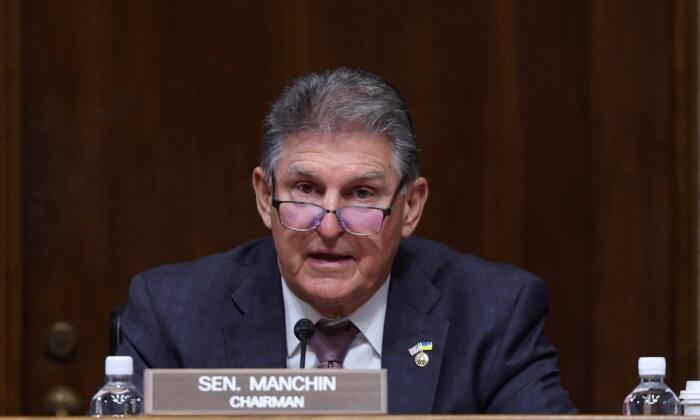
The new resolution, introduced on Dec. 5 by Sens. Peter Welch (D-Vt.) and Joe Manchin (I-W.Va.), would limit newly appointed justices to 18 years on the bench, and lead to a new opening roughly every two years. To become effective, a constitutional amendment has to be passed by a two-thirds majority of both houses of Congress and ratified by three-quarters of the states.

According to a summary provided by Welch, the amendment would not change the number of sitting justices, currently set at nine by law, and would establish a transition period to ensure vacancies occur at regular intervals.

Taking action to restore public trust in our nation’s most powerful Court is as urgent as it is necessary. Setting term limits for Supreme Court Justices will cut down on political gamesmanship, and is a commonsense reform supported by a majority of Americans,” Welch said in a joint statement issued with Manchin on Dec. 7.

“I’m proud to lead this effort with Senator Manchin, which will restore Americans’ faith in our judicial system.”

During the transition period, 18-year terms will start every two years, without regard to when a sitting justice steps down. When a sitting justice retires, the incoming justice will complete what remains of the next upcoming 18-year term.

Manchin, a former Democrat whose term in the Senate ends when the new Congress convenes on Jan. 3, 2025, said the current lifetime appointment structure is broken and “fuels polarizing confirmation battles and political posturing that has eroded public confidence in the highest court in our land.”

“Our amendment maintains that there shall never be more than nine justices and would gradually create regular vacancies on the court, allowing the president to appoint a new justice every two years with the advice and consent of the United States Senate,” he said.

Other measures are pending in Congress that would limit the tenure of Supreme Court justices.

Sen. Sheldon Whitehouse (D-R.I.), who chairs a Senate subcommittee overseeing federal courts, introduced a bill that would limit justices’ tenure to 18 years. Reps. Don Beyer (D-Va.) and Ro Khanna (D-Calif.) filed a similar bill in the House.

Rep. Hank Johnson (D-Ga.) introduced legislation that would force out justices after 18 years of regular active service, at which point they would assume senior status, a kind of semi-retirement for federal judges, and continue to draw a federal paycheck for life. Superannuated justices are already allowed to serve on lower courts by a 1937 law that allows justices to sit “by designation” on those courts.

Sen. Lindsey Graham (R-S.C.), ranking member on the Senate Judiciary Committee, said in the summer that he opposes Supreme Court reform proposals, including term limits for justices, that are backed by Democrat lawmakers and President Joe Biden.

“They want to pack the court. They want … to undercut the conservative court,” Graham said during a July 28 interview on CBS’s “Face The Nation.”

“They have no desire to make the court better. They’re just trying to make it more liberal.”

The Epoch Times reached out to the Supreme Court for comment but did not receive a reply by publication time.

Tyler Durden
Mon, 12/09/2024 – 08:10

via ZeroHedge News https://ift.tt/jf8hO2r Tyler Durden

Huge Small Biz Break: Judge Suspends Enforcement Of FinCEN Reporting Requirement

Huge Small Biz Break: Judge Suspends Enforcement Of FinCEN Reporting Requirement

Just a few weeks before a poorly-publicized Jan. 1 deadline, a judge has issued a nationwide injunction barring the enforcement of a controversial mandate that would compel tens of millions of small and large businesses to file beneficial ownership reports with an obscure federal agency. The ruling doesn’t kill the requirement altogether, but it does bar the Treasury Department from enforcing it until lawsuits challenging the requirement’s constitutionality are fully resolved. 

“There are now CTA cases pending in the Fourth, Fifth, Ninth, and Eleventh Circuits,” notes attorney and Forbes contributor Kelly Phillips Erb, posting as @taxgirl on X. “It’s looking more like it could end up at the Supreme Court.” There’s also the possibility that the next Trump administration — either unilaterally or via cooperation with Congress — could find a way to kill or at least narrow the requirement. 

The rule imposed by the Corporate Transparency Act (CTA) swept the vast majority of “legal entities created to do business in the United States” into a new bureaucratic net, directing them to dump information about themselves and their “beneficial owners” into a federal database managed by the Financial Crimes Enforcement Network (FinCEN) — which most Main Street businesses and single-member LLC’s have probably never even heard of. Those who failed to comply faced severe penalties, ranging from civil fines of up to $591 a day to criminal consequences of up to $250,000 and a five-year prison term.    

Even single-member LLCs operated from the comfort of one’s couch were targeted by the Corporate Transparency Act (via Pexels)

Advertised by the Feds as necessary to crack down on criminals’ use of shell companies, it’s the kind of heavy-handed bureaucratic burden that incoming president Donald Trump and his sidekicks at his nascent “Department of Government Efficiency” — Elon Musk and Vivek Ramaswamy — have promised to eradicate. Indeed, FinCEN itself estimated that compliance would cost $22.7 billion in the first year alone, and then $5.6 billion in subsequent years into perpetuity. 

The rule sought to put the ownership information of more than 32 million entities in a US Treasury database. It’s fair to say that a huge proportion of them had no idea that a deadline backed by harsh penalties was rapidly approaching — and still don’t. In August, FinCEN said fewer than 4 million had complied with the requirement. The CTA exempts 23 categories of entities from the reporting requirement — most of them are various types of financial institutions

Writing at at Forbes, attorney Matthew F. Erskine explains District Judge Amos Mazzant’s rationale for siding with the multiple plaintiffs in the case, which include the National Federation of Independent Business (NFIB), Texas Top Cop Shop and the Libertarian Party of Mississippi:  

Judge Mazzant’s opinion strongly rebuked the CTA for overstepping constitutional boundaries. He noted that corporate regulation has traditionally fallen within the states’ jurisdiction. By mandating federal oversight of corporate ownership, the CTA disrupts the balance of power foundational to the U.S. federalist system.

The Treasury Department quickly announced that it will appeal the ruling, with a spokeswoman claiming that the CTA “plays a vital role in protecting the U.S. financial system…We continue to believe—consistent with the conclusions of other federal courts—that the CTA is constitutional.” Not all courts feel that way: Earlier this year, an Alabama judge imposed an injunction that only applied to NFIB members, finding that the Constitution provides no basis for a law requiring the collection of ownership information

After the Texas judge issued his 80-page ruling on Tuesday, FinCEN posted an alert to its website informing business owners that “reporting companies are not currently required to file their beneficial ownership information with FinCEN and will not be subject to liability if they fail to do so while the preliminary injunction remains in effect.” In the meantime, entities are free to voluntarily submit the reports if they want to. A post pinned to the agency’s X account it “may take 20 minutes or less” — which is hardly encouraging. 

With the enforcement of beneficial ownership reporting halted by injunction, small business owners may have extra time to catch up on some reading over the balance of the year (Andrea Piacquadio via Pexels

“This ruling is a huge victory for small businesses nationwide, and just in time” said Beth Milito, Executive Director of NFIB’s Small Business Legal Center. “Many Main Street small businesses…were a mere four weeks away from the deadline to file their information in accordance with the CTA. The BOI [Beneficial Ownership Information] reporting requirements are a harmful invasion of small business owners’ privacy and a misuse of their valuable time.”

There’s more to privacy concerns than just putting the names of beneficial owners in front of the Feds’ eyes: FinCEN has already demonstrated an inability to keep its reports secure from leaks. In 2020, Buzzfeed published a report drawing on more than 2,000 leaked “suspicious activity reports” that had been filed with the agency. 

At her 2023 swearing in, FinCEN director Andrea Gacki was champing at the bit to impose a heavy burden on US businesses

Erskine is hopeful that the case — Texas Top Cop Shop v Garland —  could help bolster federalism: “Judge Mazzant reaffirmed that the Constitution’s constraints on federal power remain relevant even in addressing modern challenges. This case could set a precedent for courts to scrutinize federal initiatives that intrude into areas historically managed by states.”

Let’s hope so.

Tyler Durden
Mon, 12/09/2024 – 07:45

via ZeroHedge News https://ift.tt/Lokxapt Tyler Durden

Boston City Councilor Tania Fernandes Anderson Arrested By FBI For Wire Fraud And Theft

Boston City Councilor Tania Fernandes Anderson Arrested By FBI For Wire Fraud And Theft

Boston City Councilor Tania Fernandes Anderson was arrested on Friday by the FBI on public corruption charges, according to Fox News.

She is facing five wire fraud charges and one theft charge related to federal program funds, according to the U.S. Attorney’s Office in Massachusetts. 

Prosecutors allege that in late 2022, she hired a relative and arranged for them to receive inflated pay, most of which they were instructed to kick back to her.

The Fox News report said that federal authorities arrested Fernandes Anderson at her Dorchester home, prompting Boston Mayor Michelle Wu to call for her resignation. Wu said: “Like any member of the community, Councilor Fernandes Anderson has the right to a fair legal process.”

“But the serious nature of these charges undermines the public trust and will prevent her from effectively serving the city. I urge Councilor Fernandes Anderson to resign,” she added.

A filing of the charges read: “From in or about early to mid-2023, Fernandes Anderson was facing personal financial difficulty, which included missing monthly rent and car payments, an impending $5,000 civil penalty from the Ethics Commission, and incurring bank overdraft fees, which resulted in Fernandes Anderson maintaining low daily bank balances.”

Photo: Fox News

“On or about June 9, 2023, at approximately 4:11 p.m., Staff Member A texted Fernandes Anderson, “Bathroom” to let Fernandes Anderson know that Staff Member A was waiting in the bathroom to hand the $7,000 cash to Fernandes Anderson,” it continues.

“Within seconds, Fernandes Anderson texted Staff Member A, “Ready” to confirm that Fernandes Anderson was ready to accept the $7,000 cash kickback from Staff Member A.”

“Shortly following these texts, Staff Member A handed Fernandes Anderson approximately $7,000 in cash at a bathroom in City Hall,” the filing reads.

Special Agent in Charge Jodi Cohen commented: “Her behavior, as alleged in today’s indictment, is a slap in the face to the hardworking taxpayers in the city of Boston who have every right to expect that the city’s funds are in good and honest hands.”

“This case illustrates how the FBI, and our partners, are working hard every day to battle public corruption and the corrosive damage it does to people’s faith in government,” she continued.

In 2022, Fernandes Anderson hired two immediate family members to her staff, violating city rules, and was fined $5,000 by the Ethics Commission after firing them. Last month, the state’s Campaign Finance Office flagged her campaign for exceeding contribution limits and delayed deposit filings, according to WCVB.

Tyler Durden
Mon, 12/09/2024 – 06:55

via ZeroHedge News https://ift.tt/S7kMQqh Tyler Durden

California AG Asks Residents To Report State Agencies That Assist Immigration Authorities

California AG Asks Residents To Report State Agencies That Assist Immigration Authorities

Authored by Travis Gillmore via The Epoch Times (emphasis ours),

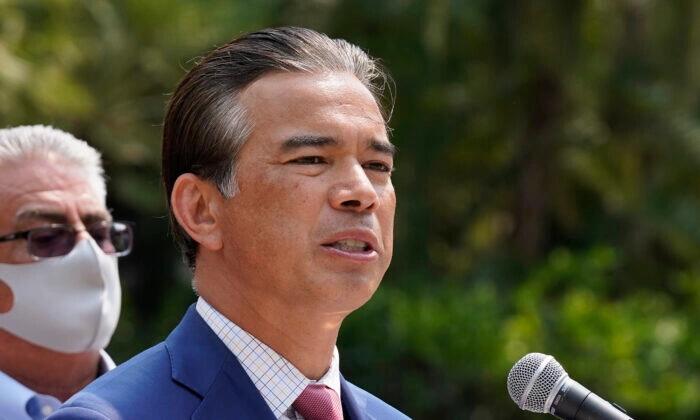
State Attorney General Rob Bonta requested Dec. 4 that Californians report to his office any violations of state laws that limit state institutions, agencies, and local law enforcement’s ability to cooperate with federal immigration enforcement actions.

California Attorney General Rob Bonta speaks at a news conference in Sacramento, Calif., on Aug. 17, 2021. Rich Pedroncelli/AP Photo

Senate Bill 54—passed in 2017 and known as the California Values Act—blocks state and local agencies from using resources to assist immigration enforcement by arresting, detaining, detecting, interrogating, or investigating individuals suspected of entering the country illegally.

The appeal came in an announcement that courts, health care facilities, libraries, and other public institutions in California were advised to craft policies meant to make it more difficult for federal law enforcement authorities to deport illegal immigrants.

Such advisement is in response to comments made by President-elect Donald Trump during his campaign and after the election that deportations will be a prime component of his national security policies, according to the attorney general, and updates guidance first issued in 2018 during Trump’s first term.

We will not allow safe spaces like libraries, hospitals, and courthouses to be co-opted and commandeered for [Trump’s] inhumane immigration agenda,” Bonta said in a statement. “My office will continue to use the full force of the law and every tool at our disposal to protect the rights of California’s immigrants, and we need staff at these critical locations to do the same.”

He said fear of immigration enforcement could harm the 1.8 million—as calculated by the nonpartisan Pew Research Center—illegal immigrants residing in California.

We cannot let the Trump deportation machine create a culture of fear and mistrust that prevents immigrants from accessing vital public services,” Bonta said.

State courts, public schools, and publicly funded health care facilities are required by law to follow the order and craft policies in line with the attorney general’s guidelines. All other institutions are encouraged to comply.

According to the guidance, cooperation between federal immigration officers and state institutions is problematic because it “diverts state resources, blurs lines of accountability, and threatens trust between immigrant communities and state and local agencies that provide critical public services.”

Courts are advised to create policies that limit support for federal immigration actions by prohibiting Immigration and Customs Enforcement agents from entering certain areas of facilities unless they present court warrants.

Customs agency warrants can be ignored, according to the attorney general’s guidance, because they do not carry the authority of a court warrant, and state law prohibits local agencies from consenting to immigration officers’ search requests.

The use of pseudonyms is also suggested to shield victims, witnesses, and other individuals from potential enforcement action.

Additionally, courts are prompted to minimize in-person appearances and to consider not penalizing individuals who fail to appear due to fear of immigration authorities.

All institutions are advised to prohibit the disclosure of information that could reveal an individual’s illegal immigrant status.

Policies should defer requests from federal authorities to legal counsel or administrators, and all instances should be documented, according to the guidelines.

Staff should receive training about how to respond to immigration enforcement requests and should direct individuals who access services to privacy rights information, according to the attorney general’s orders.

Trump’s choice for border czar, Tom Homan, recently warned state officials against interfering with the federal government.

“I’m sending a message to those people who said they’re going to get in our way … don’t cross that line,” Homan said during a press conference at the border with Texas Gov. Greg Abbott on Nov. 26. “It is a felony to knowingly harbor an illegal alien from an immigration authority. Don’t test us.”

Tom Homan, tapped to be President-elect Donald Trump’s border czar, addressed Operation Lone Star members at the Texas border on Nov. 26. Darlene McCormick Sanchez/The Epoch Times

He said plans are underway to deport millions of illegal immigrants.

Let me be clear. There is going to be a mass deportation because we just finished a mass illegal immigration crisis,” Homan said. “If you let them stay, you’ll never fix the border. This is a nation of laws, and we’re going to enforce those laws.”

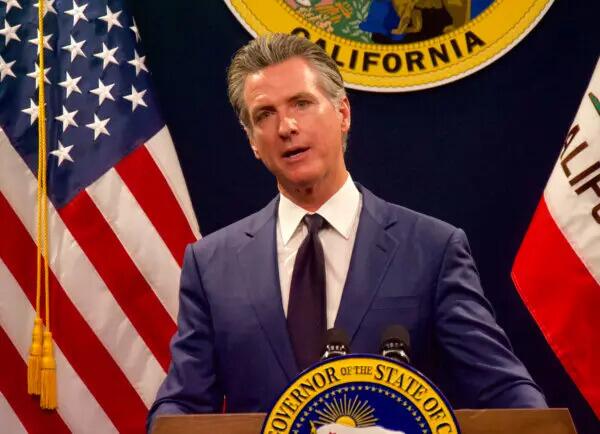
California Gov. Gavin Newsom said during a Dec. 5 press conference at the border in San Diego County that the state does not interfere with the federal government using its own resources to enforce federal laws and cooperates “in many cases.”

He expressed concern about possible widespread deportations because about half of farmworkers in California entered the country illegally, according to the governor.

Gov. Gavin Newsom announces billions of dollars in spending cuts during his May budget revision press conference at the Capitol on May 10. Travis Gillmore/The Epoch Times

“The impacts of mass deportation on the cost of food in this state and this nation are off the charts,” Newsom said. “This is serious business.”

The president-elect’s transition team said his wide margin of victory is evidence the American people want him to prioritize his agenda of securing the border and bolstering public safety.

“President Trump will marshal every federal and state power necessary to institute the largest deportation operation of illegal criminals, drug dealers, and human traffickers in American history while simultaneously lowering costs for families,” Karoline Leavitt, Trump-Vance transition spokesperson, told The Epoch Times by email on Nov. 27.

“The American people reelected President Trump by a resounding margin giving him a mandate to implement the promises he made on the campaign trail, like deporting migrant criminals and restoring our economic greatness. He will deliver.”

Tyler Durden
Mon, 12/09/2024 – 06:30

via ZeroHedge News https://ift.tt/rTCFIdv Tyler Durden

Hedge Fund CIO: “Every Institution Must Now Recognize That Trading, Settlement, Custody And Risk Will Shift To Blockchain Rails”

Hedge Fund CIO: “Every Institution Must Now Recognize That Trading, Settlement, Custody And Risk Will Shift To Blockchain Rails”

By Eric Peters, CIO of One River Asset Management

People who make the most money are builders. Creating something new out of nothing, zero-to-one, is the hardest thing there is to do. So, society rewards those who do it best. There are all sorts of builders of course. And the most highly compensated are those who build things that no one has ever dreamt of, or perhaps not ever thought possible. Things which the builder had to imagine would someday be in high demand if only it could be brought to market. Henry Ford dreamt of a Model T. Steve Jobs imagined an iPhone. Musk aspires to Mars.

Investors make less than builders because investing is easier, and moving money provides less value to society. There are all sorts of investors. Naturally, the highest paid are builders of investment firms. Griffin. Schwartzman. Dalio. Buffet’s extreme wealth is an outlier, but he’s been building Berkshire since 1965, compounding longer than any living entrepreneur. Investors generally make money like builders do. Some invest in outcomes no one thought possible. Most buy things they imagine will soon be in high demand.

The West confiscated $300bln of Russian assets in the days following its Feb 2022 Ukraine invasion. It didn’t take a wild imagination to picture a world where every sovereign nation that had stored its national wealth in assets controlled by western nations would seek an alternative. Gold seemed a good bet. But Powell started his historic rate hike cycle in March of 2022, which pushed the gold price down 20% – investing may be easier than building, but that doesn’t mean it’s easy. Buyers prevailed in time, and gold is now 25% higher than pre-invasion.

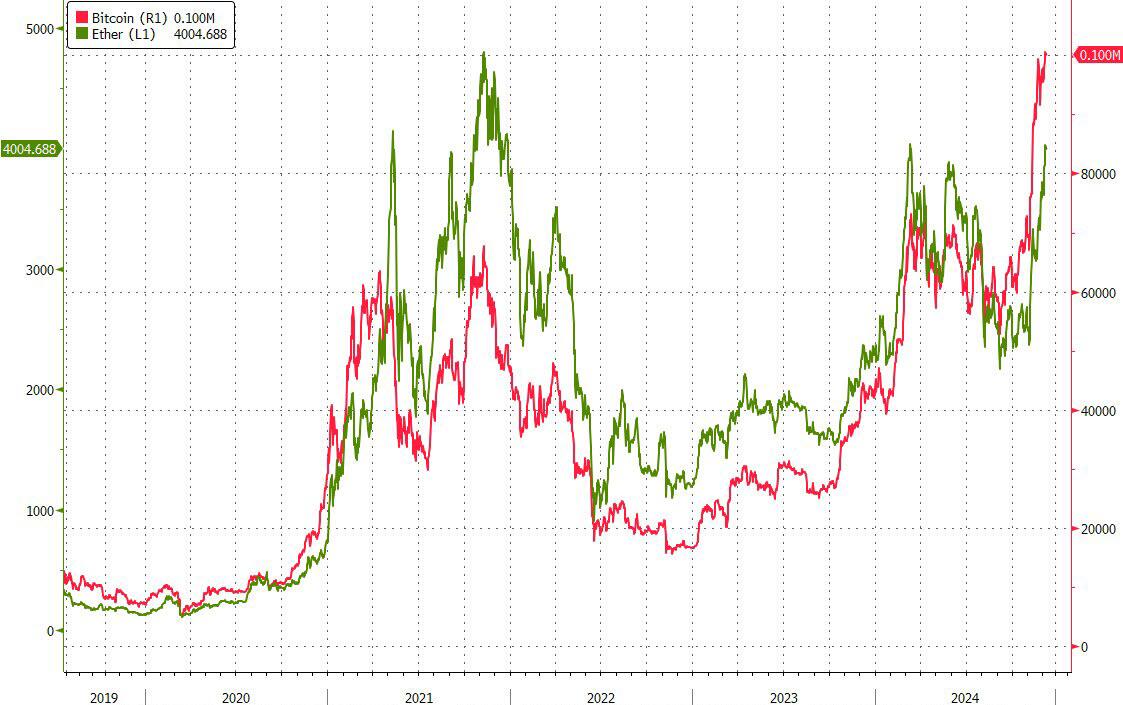
Investors could have bought Bitcoin instead of gold. Its price fell from $40k pre-invasion to $16k at the FTX lows and now trades $100k. Someone is clearly buying. And like many reflexive bull markets, higher prices create more positives. Bitcoin has quite clearly come to be recognized as an alternative to gold and has deepened what is now the most secure network ever built by humans. Ethereum performance has improved by orders of magnitude, growing faster, cheaper, more secure, versatile. Through the vicious cycle, crypto builders kept building.

The election marked a shift in US policy away from outward hostility toward the crypto industry. It took little imagination to picture a world where countless uninvested individuals and institutions would finally recognize the asset class and include it in their portfolios. Markets repriced accordingly. But it is also not so hard to imagine other profoundly different futures which as recently as five weeks ago most investors barely considered. This new future will unfold with these technologies now able to really scale. And this curve will steepen.

Every major global financial institution must now recognize that its entire trading, settlement, custody and risk infrastructure will likely shift to blockchain rails in the decade to come. Every bank, broker, custodian, exchange, asset manager, and payments provider must imagine a future where its business will be rebuilt on a new platform. They’ll either do it themselves, find an infrastructure partner, or lose to a competitor. It’s not hard to imagine a world where demand for crypto builders and infrastructure providers/partners will be extraordinary.

Tyler Durden
Mon, 12/09/2024 – 05:45

via ZeroHedge News https://ift.tt/qW2AxHB Tyler Durden

The Average Age Of Cars Keeps Rising But People Can’t Afford Maintenance

The Average Age Of Cars Keeps Rising But People Can’t Afford Maintenance

By Mish Shedlock of MishTalk

The good news is cars last longer, assuming you take care of them. But eventually, maintenance gets expensive.

Average Age of Cars Keeps Rising

The Wall Street Journal reports Americans’ Cars Keep Getting Older—and Creakier

There have never been as many on the road—around 290 million light vehicles—and they have never been so old. One reason for that is good news: They are better made. Getting the odometer past 100,000 miles has gone from being noteworthy to normal. Thirty years ago the average passenger car was about 8.4 years old and today that is 13.6 years.

Less good: Pinched by inflation, higher interest rates and supply-chain woes, Americans just haven’t been buying as many new vehicles lately. The four-year rolling average of annualized sales is about 15.5 million, according to the Bureau of Economic Analysis. On the eve of the Covid-19 pandemic it was 17.7 million.

In late May, shares of tire chain Monro plunged 12% when it said that adjusted same-store sales had dropped sharply during its 2024 fiscal year. Management explained that the poor results were “primarily driven by a strained low-to-middle income consumer that traded down to tires at opening price points” amid a glut of cheap, off-brand imports. Customer spending on services like brakes and shocks fell even more.

Then in September shares of Genuine Parts, owner of Napa auto-supply stores, crashed by more than a fifth—their biggest-ever one-day drop in decades on the stock market—following disappointing third-quarter results. Sales to commercial buyers were decent, but those to retail customers fell significantly. Chief Executive William Stengel told investors that this was “driven by continued cautious end consumer who’s deferring certain service and maintenance-related purchases.”

And just weeks ago Valvoline, which provides quick, affordable oil changes, sounded a cautious tone, helping to send its shares down by nearly 9%. One might have expected more business to come its way when consumers are cost-conscious, but the knock-on effect of weak sales elsewhere hit them too. CEO Lori Flees later wrote in an email that “we are seeing some of those providers (such as tire service centers) promote discounted oil changes to drive traffic, as consumers are deferring or trading down those providers’ core service.”

There is evidence from dollar stores and food companies of penny-pinching by lower-income households too, but choosing a no-name tire is different than switching to store-brand mac and cheese—it could be penny wise, pound foolish. For example, one national discount tire chain offers an “Entry” level tire, with no brand name specified, that would fit a Ford Explorer for $149.99. Its warranty is good for just 40,000 miles. A Goodyear tire fitting the same vehicle costs $254 but has a warranty for 60,000 miles, plus other quality and safety advantages.

How Will Trump Address This?

Taxing imports from Mexico could add 25 percent to car parts and even more on tires from Asia. The same applies to underwear, motorcycles, and toys.

Cheap tires are no bargain. But they are better than tires with no tread at all.

Regardless, the car you are driving will eventually go. At some point maintenance and repairs cost much more than a car is worth.

A Lose-Lose Proposition

In response to my article Trump’s Proposed Tariffs Are a Tax on Consumers, Primarily the Poor I received sever reader comments that are worth discussing.

One of my readers commented: “So it’s OK for other countries to put tariffs on us, but not ok for us to put tariffs on them? Got it.”

For starters I never proposed I agreed with tariffs other countries place on the US. So right off the bat it’s a silly comment.

Moreover, the logic translates to “But mom, Susie did it too.”
To which my mom would reply: “If Susie jumped off a bridge, would you do it too?”

The fact is, China’s export subsidies are a direct benefit to US consumers at the expense of Chinese consumers.

Chinese taxpayers are subsidizing US consumers and we complain. Trump and Biden effectively say “I insist we pay more.”

Should Anyone Care Whether Underwear Is Produced in the US or China?

On November 22, I asked Should Anyone Care Whether Underwear Is Produced in the US or China?

This ridiculous-looking question gets to the heart of tariff discussions.

Trump makes no distinction between strategic items and underwear. To him, exports are good and imports are bad.

Meanwhile ….

China Halts Rare Exports Used by US Technology Companies and the Military

On December 3, I commented China Halts Rare Exports Used by US Technology Companies and the Military

This is China’s advance salvo at Trump tariffs. It comes one day after the Biden administration expanded curbs on the sale of advanced American technology to China.

The US is not focused on the the real trade war that looms. We are too busy focused on underwear and tires.

Might I suggest we address strategic items instead of underwear?


Tyler Durden
Mon, 12/09/2024 – 05:00

via ZeroHedge News https://ift.tt/7MFsb8P Tyler Durden

These Are The Most Dangerous American Holidays For Drivers

These Are The Most Dangerous American Holidays For Drivers

Thanksgiving and Independence Day are the most dangerous holidays for drivers in the United States.

Due to fatigue, impaired, distracted or careless driving, traffic fatalities spike during holiday breaks every year. Many of the deaths happening on America’s roads are preventable, according to the National Safety Council.

The organization analyzed data from the National Highway Traffic Safety Administration, to find that 493 people died in traffic each Thanksgiving between 1995 and 2022 on average, with the holiday period defined as lasting from Wednesday night through Sunday.

The Independence Day holiday period saw an average of 451 traffic fatalities during the same time, with the period varying in length depending on the weekday July 4 falls on.

As Statista’s Katharina Buchholz shows in the chart below, drunk driving is a major contributor to holiday season traffic deaths.

Infographic: The American Holidays Most Dangerous for Drivers | Statista

You will find more infographics at Statista

On average, between 36 percent (Thanksgiving) and 42 percent (New Year’s) of holiday traffic fatalities involved alcohol-impaired driving, compared to 31 percent throughout the year.

Besides designating a sober driver or arranging alternative transportation for the holidays, the National Safety Council proposes practicing defensive driving, buckling up, avoiding distractions and being wary of fatigue as the roads fill up once more ahead of the holiday season.

Tyler Durden
Mon, 12/09/2024 – 04:15

via ZeroHedge News https://ift.tt/4i9DTYB Tyler Durden

Majority Of NATO Nations Show Sharp Uptick In Military Spending

Majority Of NATO Nations Show Sharp Uptick In Military Spending

Authored by Chris Summers via The Epoch Times (emphasis ours),

U.S. President-elect Donald Trump has frequently lambasted other NATO countries for failing to fulfill their financial obligations toward the military alliance. But when he returns to the White House in January, he could find a lot less resistance.

European nations’ appetite for greater defense spending has been sharpened by the war in Ukraine and by Russian President Vladimir Putin’s continual saber-rattling.

Illustration by The Epoch Times

EU Commission President Ursula von der Leyen said on Nov. 28 that the NATO bloc needs a “massive” defense spending boost—the latest of many European political heavyweights to do so.

But how much exactly has each county been they been contributing? How do the contributions compare historically? How much are members spending on the Ukraine war? And how much more might they be willing to spend?

What Are NATO’s Current Targets?

In 2014, NATO set a target that all members should be spending 2 percent of their GDP by 2024.

In July 2023, at a summit in the Lithuanian capital Vilnius, NATO members signed a communiqué which restated the 2 percent minimum, but added, “We commit to invest at least 20% of our defence budgets on major equipment, including related research and development.”

Official NATO figures for 2023, published in March this year showed only 10 of the United States’ 31 NATO allies had met the 2 percent GDP spending target. But in just one year, according to provisional NATO estimates for 2024, published in June, that number has now risen to 23 out of the 31.

So who is hitting the target and who are the laggards?

Poland—the NATO country closest to Ukraine—spent 4.1 percent of its GDP on defense (up from 1.8 percent in 2014).

That is more than the United States, which this year is spending an estimated 2.7 percent of its GDP on defense.

NATO says U.S. defense expenditure is approximately two-thirds of the alliance’s overall spending.

Greece—who has traditionally been a big spender because of the possibility of conflict with neighboring Turkey—is spending 3 percent of GDP, and the Baltic countries, for obvious reasons, forked out a similar amount.

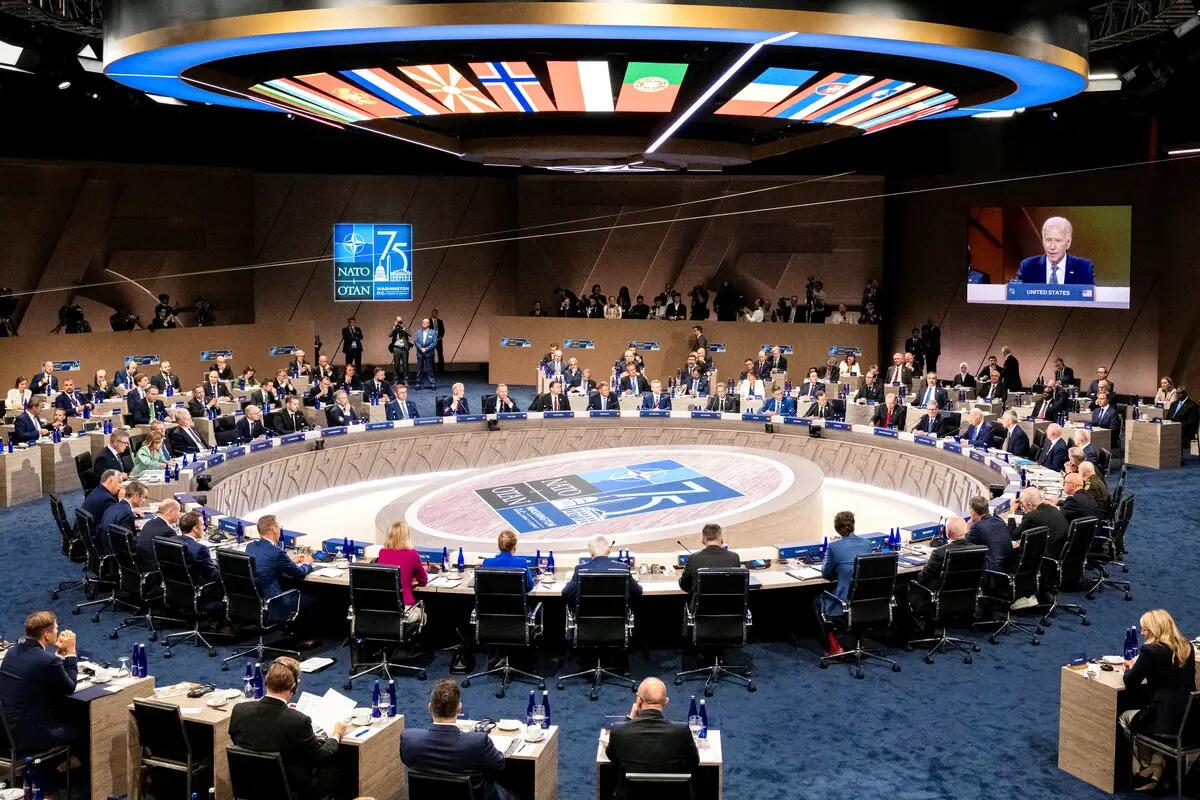
President Joe Biden speaks during NATO’s 75th anniversary summit at the Walter E. Washington Convention Center in Washington on July 10, 2024. Roberto Schmidt/AFP via Getty Images

Romania, which neighbors Ukraine, contributes 2.25 percent of its GDP, up from 1.6 percent in the space of only 12 months.

Last week, an independent candidate who has criticized NATO and the European Union, Calin Georgescu, won the first round of the Romanian presidential election.

Britain exceeds the 2 percent barrier but after becoming prime minister in July, Keir Starmer declined to say when his Labour government would hit its own target of 2.5 percent.

France came in just above the target, at 2.06 percent.

Germany, whose political and military muscle could be significant, has broken through the barrier this year and now spends 2.12 percent

Turkey, which is now on 2.09 percent, has also hit the target in the last 12 months.

The Turkish military not only garrisons the northern part of Cyprus, which it has occupied since 1974, but has also been involved in the Syria conflict, which is bubbling up again.

In recent days terrorist group Hayat Tahrir al-Sham seized the city of Aleppo in northern Syria.

Among of the lowest spenders in NATO are the Canadians, who spend 1.37 percent.

On Nov. 25, Prime Minister Justin Trudeau said Canada was on a “clear path” to reaching the defense spending target of 2 percent of GDP by 2032, which is eight years beyond the target date set by NATO.

At the bottom of the list is Spain, which spends 1.28 percent of their GDP on defense.

Spain only joined NATO in 1982, and its defense spending was far higher before it joined, especially prior to the death of the dictator and former general, Francisco Franco, in 1975.

By comparison, Ukraine is currently spending 37 percent of its GDP on defense in 2024, while Israel will have spent far more than the 4.5 percent it reported in 2023.

How Has Spending Changed?

NATO was formed in 1948, three years after the United States, Britain, and the Soviet Union defeated Nazi Germany and the empire of Japan.

The United States had initially stayed out of the Second World War—which was triggered by German expansionism and aggression—but was drawn in after Japan attacked Pearl Harbor.

The British Empire, which had just granted independence to India and Pakistan, was in a terrible state financially, as was France, while Germany was in ruins and still years away from the industrial miracle which would make it Europe’s richest nation.

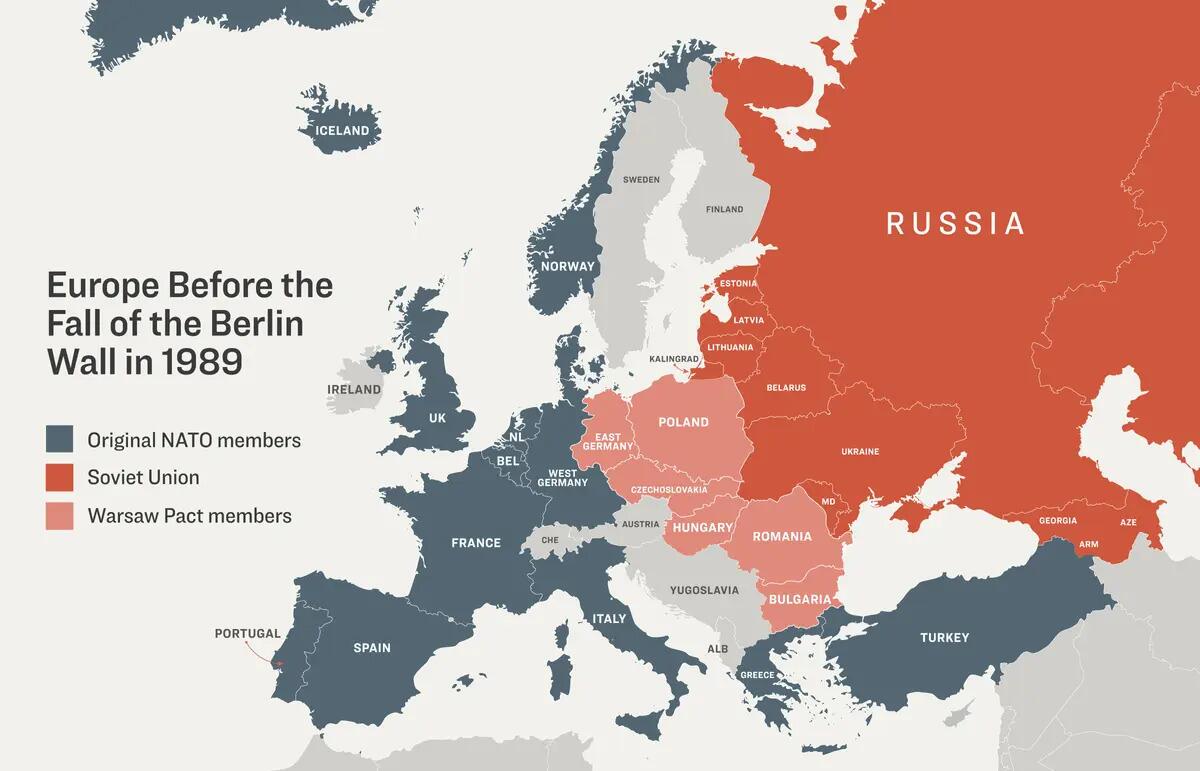
In 1955 the Soviet Union created the Warsaw Pact—an alliance of communist countries in Eastern Europe—which was set up in response to the creation of NATO.

A map shows Europe during the Cold War in 1989. Illustration by The Epoch Times

Defense spending stayed relatively high during the Cold War but, according to a table in an academic paper by Jarosław Wołkonowski, a Polish-Lithuanian historian, it fell gradually depending on individual countries’ commitments.

Canada—which was involved in the Korean War—spent 7.37 percent in 1953, but this fell to 2.15 in 1970.

France spent 5.89 percent in 1962—at the tail-end of the colonial war in Algeria—falling to 3.77 in 1980.

Britain spent 7.66 percent in 1956—the year of the Suez Crisis—and was still spending 4.46 percent in 1981, when it was involved in the conflict in Northern Ireland.

When the Soviet Union collapsed in 1991, global defense spending fell, reaching its nadir—$1,144 billion—in 1996, down by one-third from the $1,730 billion spent in 1988.

Germany was unified, and thousands of U.S. troops were withdrawn from Europe.

But in 2000, President Vladimir Putin came to power and Russia, boosted by exports of oil, gas and minerals, became an economic power again and increasingly sought to flex its political and military muscle.

Since then a graph in a NATO press release tells the story in stark detail.

Read the rest here…

Tyler Durden
Mon, 12/09/2024 – 03:30

via ZeroHedge News https://ift.tt/vecoW2M Tyler Durden