Netanyahu Says Israeli Forces Secured Buffer Zone In Golan Heights After Syria’s Assad Toppled

Netanyahu Says Israeli Forces Secured Buffer Zone In Golan Heights After Syria’s Assad Toppled

By Jack Phillips of the Epoch Times

Israeli Prime Minister Benjamin Netanyahu said that Israel’s military has taken over a buffer zone in the Golan Heights that was established decades ago, after Syrian opposition fighters ended the rule of President Bashar al-Assad’s decades-long reign.

In a statement released by video on Sunday morning, Netanyahu said that the agreement, hashed out in 1974 by Israel and former leader Hafez al-Assad’s regime, “collapsed” on Saturday night because the “Syrian army abandoned its positions.”

The reason Israel seized the territory is because “we have to take action against possible threats” caused by the power vacuum left by the Assad regime’s collapse, he said.

“We gave the Israeli army the order to take over these positions to ensure that no hostile force embeds itself right next to the border of Israel,” the prime minister added. “This is a temporary defensive position until a suitable arrangement is found.”

Netanyahu said Assad’s downfall is a “historic day” for the region, adding that the the new situation in Syria “offers great opportunity but also is fraught with significant dangers.”

His announcement was delivered in Golan Heights.

Syria’s collapse, he also said, is the result of Israeli action against Iran and the Hezbollah terrorist group, which had been allied with both Iran and Assad for years. Iran and several groups loyal to Tehran had long used military bases in Syria, while Israel at times carried out air strikes against those positions over the years.

“It set off a chain reaction of all those who want to free themselves from this tyranny and its oppression,” Netanyahu said.

Israel is extending “a hand of peace to all those beyond our border in Syria: to the Druze, to the Kurds, to the Christians, and to the Muslims who want to live in peace with Israel,” Netanyahu said. “We’re going to follow events very carefully. If we can establish neighborly relations and peaceful relations with the new forces emerging in Syria, that’s our desire.”

“But if we do not, we will do whatever it takes to defend the State of Israel and the border of Israel.”

Assad has not released a statement on his government’s collapse, and it’s not clear where he currently is. Russian officials have said that he departed Syria before opposition fighters took over the country, seizing the capital of Damascus on Sunday morning.

On Sunday, rebel groups and militias cooperating with terrorist group Hay’at Tahrir al-Sham, said they had entered the capital with no sign of army deployments. Thousands of people in cars and on foot congregated at a main square in Damascus waving and chanting, witnesses said.

Leading rebel commander Abu Mohammed al-Golani, an individual who is currently listed by the U.S. State Department as a terrorist who carried out “multiple terrorist attacks throughout Syria” over the years, said there is no room for turning back.

“The future is ours,” he said in a statement read on Syria’s state TV after his forces took over Damascus.

Underscoring the major changes, Iran’s embassy was stormed by Syrian rebels, Iran’s English-language Press TV reported.

Iran’s foreign ministry said Syria’s fate is the sole responsibility of the Syrian people and should be pursued without foreign imposition or destructive intervention.

Continue reading at the Epoch Times

Tyler Durden
Mon, 12/09/2024 – 02:00

via ZeroHedge News https://ift.tt/hN5QjdR Tyler Durden

Escobar: The Syria Tragedy & The New Omni-War

Escobar: The Syria Tragedy & The New Omni-War

Authored by Pepe Escobar,

Until recently, a serious geopolitical working hypothesis was that West Asia and Ukraine were two vectors of the standard Hegemon modus operandi, which is to incite and unleash Forever Wars. Now both wars are united in an Omni-War.

A coalition of Straussian neo-cons in the US, hardcore revisionist Zionists in Tel Aviv and Ukrainian neo-nazi shades of grey is now betting on a Final Confrontation – with several overtones ranging from expanding lebensraum to provoking the Apocalypse.

What stands in their way is essentially two of the top BRICS: Russia and Iran.

China, self-protected by their collective lofty dream of “community of a shared future for mankind”, warily watches on the sidelines, as they know that at the end of the road, the true “existential” war by the Hegemon will be against them.

Meanwhile, Russia and Iran need to mobilize for Totalen Krieg. Because that’s what the enemy is launching.

Undermining BRICS and the INSTC

The total destabilisation of Syria, with heavy CIA-MI6 input, now proceeding in real time, is a carefully engineered gambit to undermine BRICS and beyond.

It proceeds in parallel to Pashinyan removing Armenia from the CSTO – based on a US promise to support Yerevan in a possible new clash with Baku; India being encouraged to ramp up a weapons race with Pakistan; and across-the-board intimidation of Iran.

So this is also a war to destabilize the International North South Transportation Corridor (INSTC), of which the three major protagonists are BRICS members Russia, Iran and India.

As it stands, the INSTC is totally geopolitical risk-free. As a top BRICS corridor-in-the-making, it carries the potential to become even more effective than several of China’s cross-Heartland corridors of the Belt and Road Initiative (BRI).

The INSTC would be a key lifeline for a great deal of the global economy in case of a direct confrontation between the US/Israel combo and Iran – with the possible shutdown of the Strait of Hormuz leading to the collapse of a multi-quadrillion pile of financial derivatives, economically imploding the collective West.

Turkiye under Erdogan, as usual, is playing a double game. Rhetorically, Ankara stands by a genocide-free and sovereign Palestine. In practice, the Turkiye supports and funds a motley crew of Greater Idlibistan jihadis – trained by Ukrainian Neo-nazis in drone warfare and with weapons financed by Qatar – who have just marched on and conquered Aleppo, Hama, and possibly beyond.

If this army of mercenaries were real followers of Islam, they would be marching in defense of Palestine.

At the same time, the real picture inside the corridors of power in Tehran is extremely murky. There are factions favoring getting closer to the West, which clearly would have ramifications for the Axis of Resistance’s ability to fight Tel Aviv.

On Lebanon, Syria never wavered. History explains why: from the point of view of Damascus, Lebanon historically remains a governorate, so Damascus is responsible for the security of Beirut.

And that’s one of Tel Aviv’s key motives to propel the current Salafi-jihadi offensive on Syria – after smashing virtually every communication corridor between Syria and Lebanon. What Tel Aviv could not accomplish on the ground – a victory over Hezbollah in southern Lebanon – has been replaced by isolating Hezbollah from the Axis of Resistance.

When in Doubt, Re-Read Xenophon

Wars in West Asia are a complex mix of national, sectarian, tribal and religious vectors. In a sense, they are endless wars; controllable to an extent, but then back again.

The Russian strategy in Syria seemed to be very precise. As it was impossible to normalize a completely fragmented nation, Moscow opted to free the Syria that really matters – the capital, the most important cities, and the Eastern Mediterranean coast – from the Salafi-jihadi mobs.

The problem is that freezing the war in 2020, with direct implication by Russia, Iran and (reluctantly) Turkiye, did not solve the “moderate rebel” problem. Now they’re back – in full force, supported by a vast Rent-a-Jihadi mob, with NATOstan Intel behind them.

Some things never change.

2012. Jake Sullivan, then an aide to Hillary Clinton: “AQ [al-Qaeda*] is on our side in Syria.”

2021. James Jeffrey, special envoy to Syria under Trump (2018-2020): “HTS [Hayat Tahrir al-Sham*] is an asset to the US’s strategy in Idlib.”

There could not be better timing for the revival of the HTS “asset”. HTS if filling an enormous void; beware when that happens in West Asia. Russia is fully concentrated on Ukraine. Hezbollah suffered heavily from Tel Aviv’s bombings and serial killing. Tehran is fully concentrated on how to deal with Trump 2.0.

History always teaches us. Syria is now a West Asian Anabasis. Xenophon – a soldier and writer – tell us how, in the 4th century B.C., an “expedition” (“anabasis”, in Ancient Greek) of 10,000 Greek mercenaries were engaged by Cyrus the Younger against his brother Artaxerxes II, King of Persia, from Armenia to the Black Sea. The expedition miserably failed – and the painful return journey was endless.

2,400 years later, we see governments, armies and mercenaries still plunging into the endless West Asia wars – and extracting themselves now is even more insoluble.

Syria now is tired, attritted, with the SAA becoming complacent with the long freeze of the war since 2020. All that coupled with the vicious starvation siege unleashed by the US Caesar Act, and the impossibility to start rebuilding the nation with the help of at least 8 million citizens who fled the endless war.

Over these past 4 years, problems piled up. There were endless breaches of the Astana process and Israel bombed Syria almost daily with impunity.

China was basically immobile. Beijing simply did not invest in the rebuilding of Syria.

Perspective is sobering. Even Russia – which is a de facto Resistance icon in itself, even if not formally part of the West Asian Axis of Resistance – has taken nearly three years of hard slog in its fight with Ukraine.

Only a cohesive, consolidated Axis of Resistance – after getting rid of countless 5thcolumnists working inside – would have a chance against being picked off one by one by the same consolidated enemy, over and over again.

Sometimes it feels like the BRICS – particularly China – haven’t learned anything from Bandung in 1955, and how the Non-Alignment Movement (NAM) was neutralized.

You can’t beat a pitiless hegemonic hydra with flower power.

Tyler Durden
Sun, 12/08/2024 – 23:20

via ZeroHedge News https://ift.tt/mBlfvYe Tyler Durden

Rand Paul Warns Musk & Ramaswamy About The Swamp’s Upcoming DOGE Dodge

Rand Paul Warns Musk & Ramaswamy About The Swamp’s Upcoming DOGE Dodge

Sen. Rand Paul (R-KY) warned Department of Department of Government Efficiency (DOGE) co-heads Elon Musk and Vivek Ramaswamy that Senate Republicans are moving to allow the Department of Defense, which has failed seven audits in a row, to exceed its spending limits. The Kentucky Republican highlighted the issue this week on Fox News’s ‘The Ingraham Angle.’

LAURA INGRAHAM: I know you have been constantly focused on this, and you have been with Vivek this week. What ideas have you given him because he is looking to you for ideas, other than, of course, as we were saying, getting the federal workers.

SEN. RAND PAUL: One of my favorite examples of federal workers not showing up is from a few years ago. We had an assistant to the head of the EPA, and he told his boss that he also worked for the CIA. He said he would be gone for six months at a time. Finally, during a government shutdown, someone said, “Hey, Mr. Smith, we understand this guy works for you. We haven’t seen him in six months.” They replied, “Who?” They had never heard of the guy.

The man completely made up a story about working for the CIA, and for nearly a decade, millions of dollars were paid to him while he didn’t show up. He’d be lounging around saying, “I’m on a secret mission to the Middle East, can’t talk.” That kind of stuff runs rampant throughout government.

People say you can’t balance a budget by making people go back to work, but you certainly can start. When Elon Musk told Twitter employees to go back to work, a third of them quit—they weren’t used to working. Then, when he told them they’d have to do overtime, another third quit. You can get rid of a lot of people, and that saves a lot of money.

There are many rules that protect federal workers, but some of these need to change, and we need to outsource certain things. I had it out with the Postmaster General the other day. Two years ago, the Postal Service lost $6.5 billion. Last year, they lost $9.5 billion. The only way to fix this is to implement better rules that require accountability. You can’t keep hiring more government employees. You have to make them nongovernmental employees.

LAURA INGRAHAM: How difficult is that process? Everybody knows that Elon Musk and Vivek Ramaswamy are both brilliant individuals. They are extremely capable—obviously, Elon is the richest person in the world. Washington, however, is its own beast. As smart as they are, getting stuff done will be a challenge. A lot will rest with you in Congress.

SEN. RAND PAUL: One of the big things Elon did with SpaceX to reduce costs was to move away from cost-plus contracts to competitive contracts. I think that can be done by the executive branch. They can lay off people, downsize, and switch to competitive contracts. Is that going to balance the budget? Not alone.

I’m for getting rid of all this waste. When the federal and state governments cut welfare, aid, and food stamps, the states need to take on more responsibility. Because the Federal Reserve and our debt are financing the federal portion, states will have to become more fiscally responsible. They’ll either need to raise taxes to fund benefits or be more conservative about who qualifies.

To be clear, I’m for looking at entitlements, waste—everything—because it’s such an enormous problem. If you put the military off the table and entitlements off the table, you’re left with only 16% of the budget. Even if you eliminate that, you don’t get anywhere close to balancing the budget. So, while I’m for eliminating waste, I’m also for reviewing all spending.

LAURA INGRAHAM: The Pentagon, which I mentioned, has so much waste and so many duplicative initiatives inside the Defense Department. They fail the audits year after year. Have you been on top of this? Republicans, frankly, have been rubber-stamping the Pentagon budget for decades. That has to change.

SEN. RAND PAUL: It’s worse than that, Laura. Right now, the first budget reconciliation that the Republicans are proposing is to bust the Pentagon caps. We have military spending caps, but spending is still going upwards. All the old guardrails in the Senate—you know who they are—are going to bust the military caps with their first budget reconciliation. Same as the first budget.

Tyler Durden
Sun, 12/08/2024 – 22:45

via ZeroHedge News https://ift.tt/WrIJl52 Tyler Durden

Your Ultimate Guide To Gift-Giving Etiquette

Your Ultimate Guide To Gift-Giving Etiquette

Authored by Randy Tatano via The Epoch Times (emphasis ours),

It’s the most wonderful time of the year—unless you have no idea what to buy someone, you receive an absolute disaster of a gift, or someone gives you a present when you haven’t bought them anything.

Don’t let the stress of gift-giving undermine the true spirit of the holidays. CSA-Printstock/Getty Images

Fear not, for there is help for those who find the whole concept of shopping and gift exchanging stressful. We asked three experts in etiquette (yes, that still exists) to help take the anxiety out of the process.

Finding the Elusive Perfect Gift

Your rich aunt doesn’t need anything, your best friend never wants anything, and you have no idea what your favorite coworker does for fun. You’re clueless as to what to buy these people. Turns out, you simply need to put on your thinking cap or ask a question or two.

It’s just about paying attention to the people in your life, being really thoughtful, and thinking from their shoes,” said Jennifer L. Scott, bestselling author of the “Madame Chic” series on etiquette and manners. “What would they really like to receive?”

If there’s someone on your gift list you don’t know that well, talk to someone close to that person to get some ideas.

It’s such a great strategy to ask people who know them better than you do. The people closer to them will be able to help you,” Scott said.

Diane Gottsman, who runs The Protocol School of Texas, suggests even asking the recipients themselves.

“There’s absolutely nothing wrong within your own family or within your own friend group saying, ‘Hey, listen, what do you need? What would you like? What would light up your life?’” she said. ”You have to think about each person if you really want to do it right. You’re fine-tuning it for that individual.”

Bethany Friske, founder of Doors of Success School of Etiquette, agrees that being thoughtful requires what the word implies: some thought. Know enough about the person on your list.

“You want to be aware of the person’s personality and not give them something that they would never, ever use just because it’s something that you like,” she said. If you don’t know someone well, she recommends against giving a gift that is super personal, such as jewelry or home decor.

I love to give something that the person didn’t know they needed or wouldn’t spend on themselves, yet I know the person well enough [to know] that they would love it—filling a need that they didn’t know they had,” she added. For example, her mother had a Christmas figurine set from her own mother, from the 1950s, with a broken piece. Her sister found and gifted her a replacement. “My mom was overjoyed and completely blessed by the thought of this gift!”

Friske also suggests keeping a record of your gifts so you don’t end up giving someone the same present twice, especially if someone’s been on your gift list for years. She keeps a gift-giving journal.

“You can go back and find out what you gave to the person, and even how much you spent,” she said.

And if all else fails, cash or gift cards get Gottsman’s stamp of approval. But again, she suggests putting some thought into it to make it look like an actual present.

“It’s the presentation that counts,” she said. Don’t just stick it in a plain envelope; put it in a pretty card or a beautifully wrapped box.

Cash is king, because when you give a beautiful holiday card to someone and insert cash, that gives them the freedom to buy whatever they would like,” she added. Just make sure any gift cards are for stores or restaurants the recipient actually likes.

Scott says cash is a great gift for young people: “Cash gifts for older children are always appreciated.”

For younger kids, she adds that classic toys that will last a long time are always a good idea.

“I think it’s nice for children to give them timeless, high-quality things, rather than toys that are going to break down,” she said. A little girl who receives a beautiful dollhouse might keep it forever as a reminder of her best childhood memories, and eventually might pass it down to her own daughter.

Remember that a beautiful package is often the one that’s opened first, so make sure your gifts stand out. Thankfully, someone figured out that most guys can’t do a decent job wrapping a box or tying a pretty bow. So whoever came up with the idea of the colorful gift bag, every man thanks you.

Professional Gifts Should Be Professional

If you have coworkers or clients on your Christmas list, remember, it’s business. Gottman says you shouldn’t get too personal with gifts, like perfume or a massage.

You want to keep it professional,“ she said. ”Maybe tickets to a theater, or to a game that you know they like. Something generic, but nice. Something thoughtful.”

Scott suggests if you have a lot of coworkers, you might want to give them all the same thing. “Generic but nice” works here, too.

“It doesn’t necessarily have to be a big ticket item,” she said. “Maybe bake cookies for all of them and wrap them up in pretty packages. Homemade cookies—who wouldn’t want to receive that?”

Significant Gifts for Your Significant Other

Your current significant other might be your soulmate—or might not. Too early to tell? You want a gift that’s thoughtful without possibly scaring the other person away. Gottsman suggests something “lighthearted and kind,” such as a dinner at that person’s favorite restaurant.

Read the rest here…

Tyler Durden
Sun, 12/08/2024 – 22:10

via ZeroHedge News https://ift.tt/xzTjwpU Tyler Durden

The Neocons Have Created A Vacuum So Big Not Even Trump Would Want To Fill It

The Neocons Have Created A Vacuum So Big Not Even Trump Would Want To Fill It

By Eric Peters, CIO of One River Asset Management

Something weird happened in South Korea. No one really cared, nor understood. It might have been an attempted coup, led by the incumbent President, which isn’t how such things tend to roll.

“I am deeply sorry and sincerely apologize to the citizens who must have been greatly shocked,” said Yoon in a national address, following his perplexing own goal. Clown show.

The French government fell apart. Circus Incognitus.

German politics is not really any more stable.

The UK is a mess too.

Although perhaps not quite as Cirque du Soleil as Syria, where some group of Sunni rebels may finally overthrow Assad. The dictator cannot stand without aggressive support from both the Ayatollah who has his own domestic issues, and Putin who is rather preoccupied with taking ground in Ukraine ahead of January 20th.

What comes next, no one knows. Especially not the Neocons, who juggled one too many bad guys in recent decades and lost the support of America’s voters for at least a generation.

Which leaves a vacuum so big that not even Trump would want to fill it.

Bitcoin topped $100,000. The price is determined by buyers and sellers in humanity’s first truly 24x7x365 global market. No central bank or government stands behind the asset, which has grown to have a $2trln market cap.

Bitcoin is just code of course, and as such was utterly unaware of this week’s acrobatics. It simply runs, uninterrupted, uncaring, unconcerned about anything.

Which in an increasingly unstable world, on the precipice of a historic economic and geopolitical reordering, is a large part of its appeal.

Trump nominated a new SEC Chairman. And added a new Crypto/AI Tsar, with a mission to bring sensible market-friendly regulation to these emerging industries. Providing America’s dominant entrepreneurs with the clarity needed to build yet another generation of innovative and disruptive businesses.

Tyler Durden
Sun, 12/08/2024 – 21:00

via ZeroHedge News https://ift.tt/YJMsGU5 Tyler Durden

Watch: Firearms Collector Believes UnitedHealthcare CEO’s Killer Didn’t Use Welrod Pistol

Watch: Firearms Collector Believes UnitedHealthcare CEO’s Killer Didn’t Use Welrod Pistol

There has been a lot of speculation that the gunman who murdered UnitedHealthcare CEO Brian Thompson outside a Midtown Manhattan Hilton hotel last week was a professional killer who used a British bolt-action, magazine-fed suppressed pistol known as a “Welrod,” or possibly a modern-day Welrod-variant known as the Brügger & Thomet (B&T) VP9 pistol.

Firearms expert David Katz, a former DEA firearms instructor who is now the CEO of Global Security, told Fox News that the killer might have used Welrod and/or a “modernized version of a World War II pistol.” 

Welrod

“The operation that he does with his hands is consistent with the operation of that weapon,” Katz said, noting that he “immediately moved to rack the slide manually with his left hand” after he fired.

B&T VP9

Multiple law enforcement sources also told Fox News that they believe the killer used a Welrod pistol. 

“I’d bet my pension that this is the weapon that was used on the United CEO. It’s very, very quiet and requires manual cycling after each round is fired. Top choice by pros for up-close, quiet work,” the source said.

However, firearms collector and expert Texas Gun Vault shared his opinion on the firearm used in the murder of the CEO, stating that he does not believe it was a Welrod or any variant thereof. 

“Well based off the footage that we saw of the assassination … the assassin kept his right hand on the pistol grip and manipulated the gun with his left. So that’s not the typical way that you would run a Welrod,” the gun collector and expert said around the 10:30 minute mark

He said the “way the gun looks in profile … does not look like a Welrod … and I know lot of people were hoping and wishing it was because it’s a cool design and it’s the gun if he was some type of super secret assassin or something of that nature,” adding, “Unfortunately, I don’t think that’s the case and the actual answer is much more mundane: What do I think it was. I believe it was a typical semi-automatic pistol with a silencer.”

To save readers time, we started the video at the 10:30 mark.

Listen for about five minutes as the gun collector provides insightful commentary on what he believes the firearm used and explains how those unspent 9mm bullets with messages ended up at the crime scene.

Tyler Durden
Sun, 12/08/2024 – 20:25

via ZeroHedge News https://ift.tt/nwymrOR Tyler Durden

2025 – Do Economic Indicators Support Bullish Outlooks?

2025 – Do Economic Indicators Support Bullish Outlooks?

Authored by Lance Roberts via RealInvestmentAdvice.com,

Everybody Is Very Bullish

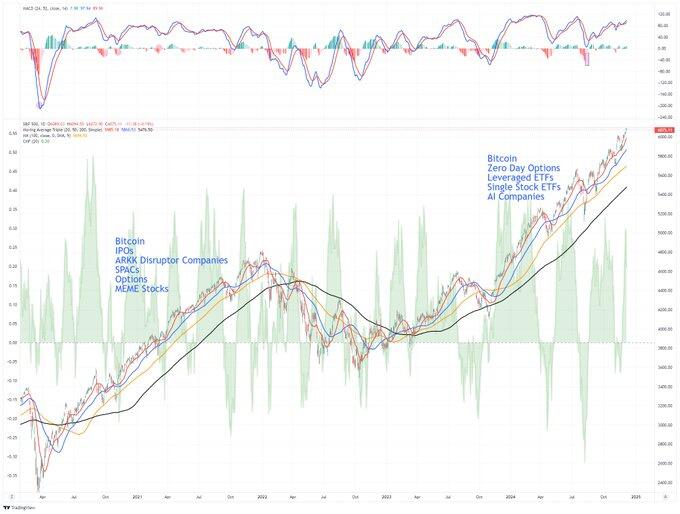
Last week, we discussed how speculation and leverage have returned in earnest to the market as investors rush to take on increasing levels of risk. With markets rising steadily all year, it is unsurprising to witness investors lulled into an elevated sense of complacency. Stocks, bitcoin, leveraged investments, and meme stocks are all surging higher, which is certainly reminiscent of the “madness” we witnessed following the Covid lockdowns. I posted the following chart on “X” Friday morning for reference.

Of course, speculation and sentiment drive markets higher, and investors currently have little concern about a correction. Markets are overbought and detached from short-term moving averages. Furthermore, one of the near-term risks to more bullish investors is the combination of high stock valuations and the necessity of portfolio rebalancing, which could impact market stability. Using 2023 data, it is estimated that mutual funds in the United States hold approximately $19.6 trillion in assets, while exchange-traded funds (ETFs) manage about $8.1 trillion, suggesting a substantial number of portfolios containing combinations of stocks and bonds.

Portfolio Rebalancing Risk

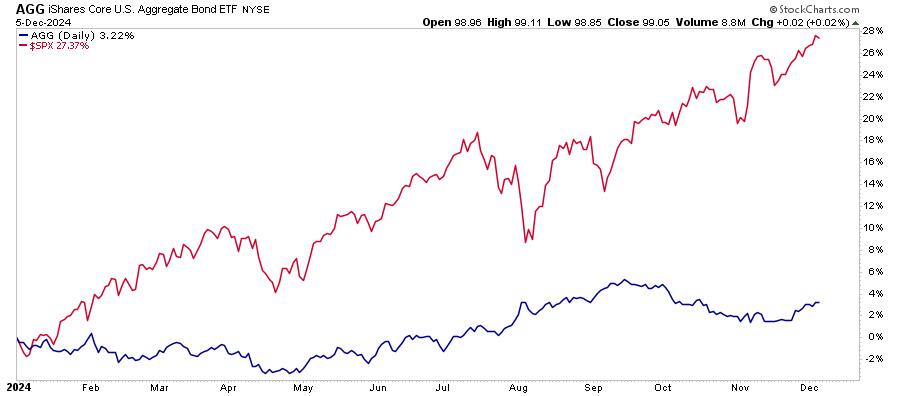
With the year-end approaching, portfolio managers need to rebalance their holdings due to tax considerations, distributions, and annual reporting. For example, as of this writing, the S&P 500 is currently up about 28% year-to-date, while investment-grade bonds (as measured by iShares US Aggregate Bond ETF (AGG) are up 3.2%. That differential in performance would cause a 60/40 stock/bond allocation to shift to a 65/35 allocation. To rebalance that portfolio back to 60/40, portfolio managers must reduce equity exposure by 5% and increase bond exposure by 5%.
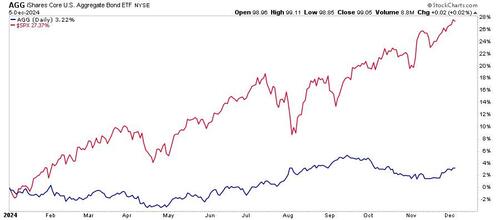
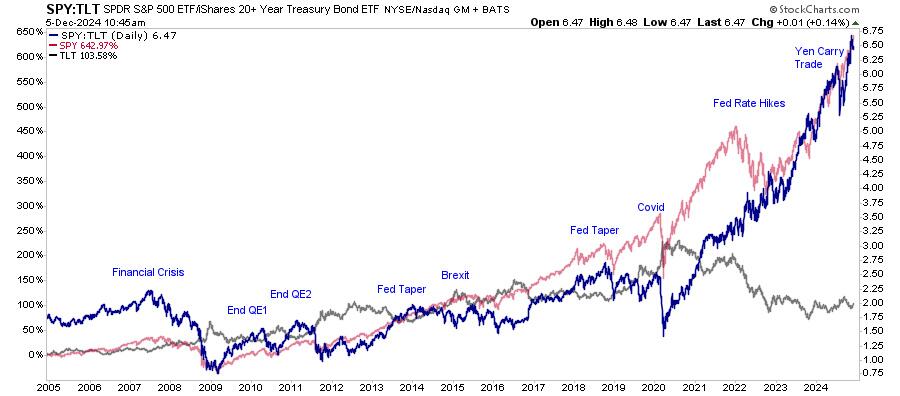
Depending on the magnitude of the rebalancing process, it could exert downward pressure on risk assets, leading to a short-term market correction or consolidation. Some of that rebalancing has already been in process, but we suspect there is more to go, particularly given the rather extreme reading of the stock-to-bond ratio.
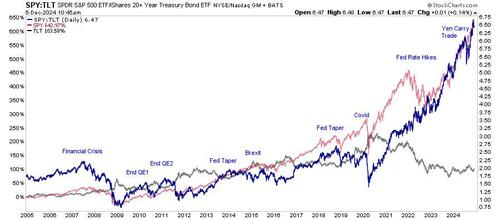
Historically, the stock/bond ratio remained range bound between roughly 1:1 to 2.5:1. Today, that ratio has skyrocketed since the flood of liquidity following the pandemic as money chased risk assets over safety. At a ratio of 6.5:1, we suspect that, at some point, a reversion will take place. In the short term, given the outsized performance of stocks versus bonds in 2024, there is likely an unappreciated risk that portfolio rebalancing by managers could add a layer of selling pressure over the next couple of weeks.

However, repeating what we wrote last week, we expect any correction to be short-lived.

“If you are underweight equities, consider minor pullbacks and consolidations to add exposure as needed to bring portfolios to target weights. Pullbacks will likely be shallow, but being ready to deploy capital will be beneficial. Once we pass the inauguration, we can assess what policies will likely be enacted and adjust portfolios accordingly.”

While there is no reason to be bearish, this does not mean you should abandon risk management. Such is particularly the case as we head into 2025, which could suggest a less optimistic outcome.

2025 Earnings Forecasts Are Very Bullish

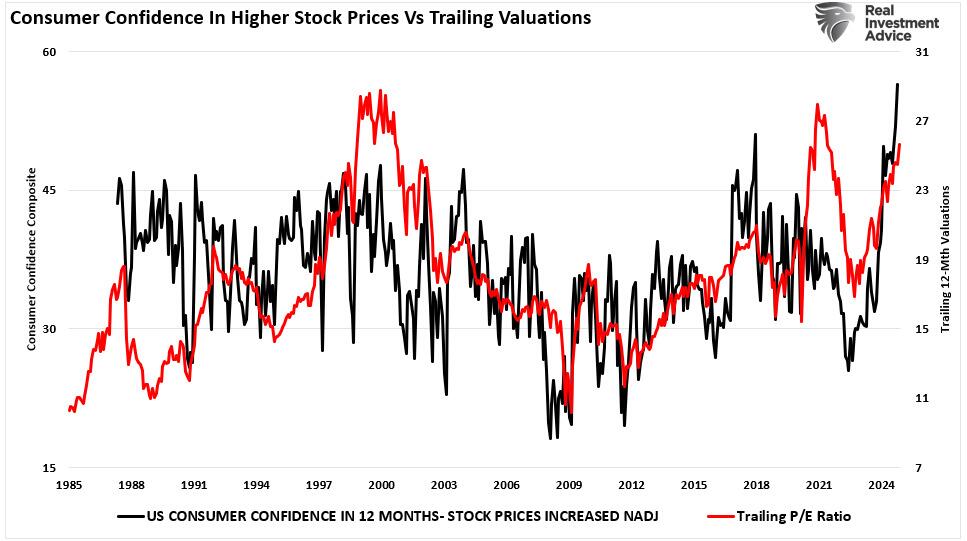
Last week, we discussed the surge in speculation and leverage in the market. As discussed in that article, even though valuations are elevated, such is because sentiment drives valuations in the short term. As we head into 2025, Wall Street is very optimistic about earnings growth, leading investors to pay up for higher valuations. Such is also the case with consumers whose confidence in higher stock prices over the next 12 months has surged to record levels.
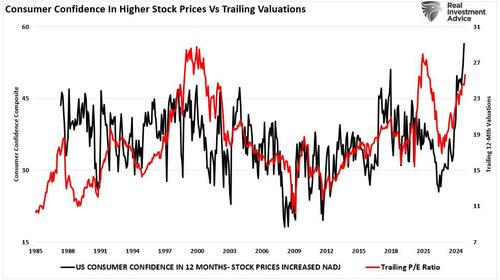
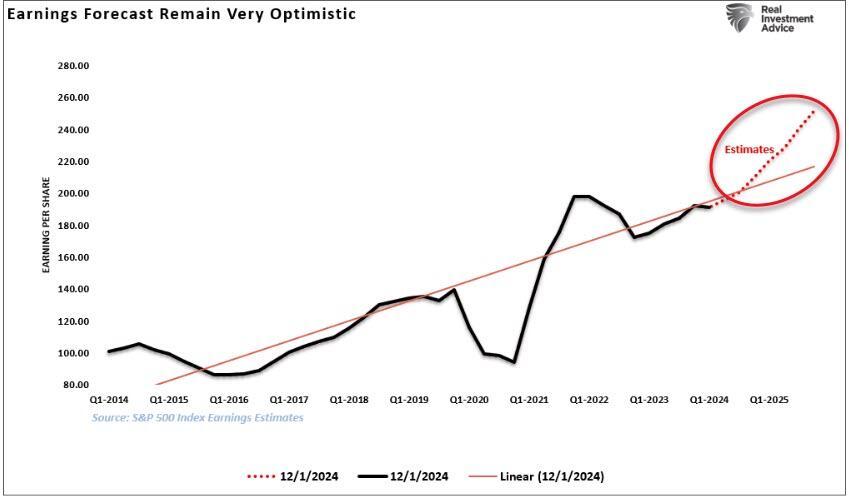
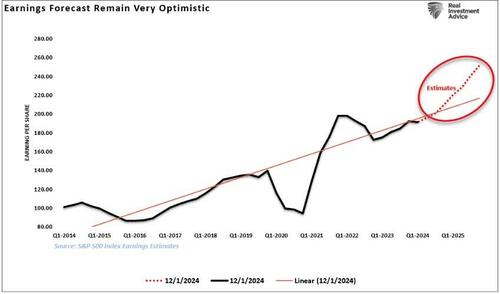
According to S&P Global, earnings are expected to grow by 19.87% in 2025 from $209.83 to $251.53 per share. As discussed, such is well above the long-term earnings growth trend from 1900 to the present. Still, such exuberance is unsurprising during strongly trending bull markets in an attempt to justify higher valuations. The problem is that such exuberant forecasts rarely come to fruition. For example, in March 2023, S&P Global predicted that 2024 earnings would grow by 13% for the year. In reality, earnings grew by just 9% despite the market rising nearly 28%.

As shown, current estimates are well elevated above the running linear trend line from 2014, while actual earnings growth remains close to it. This suggests that we will likely see a decline in estimates for 2025 to roughly $225/share, equating to earnings growth of roughly 7%. Of course, the linear trend of earnings growth is a function of economic growth and an important consideration for investors betting on elevated returns in the New Year.
Earnings Can’t Outgrow The Economy

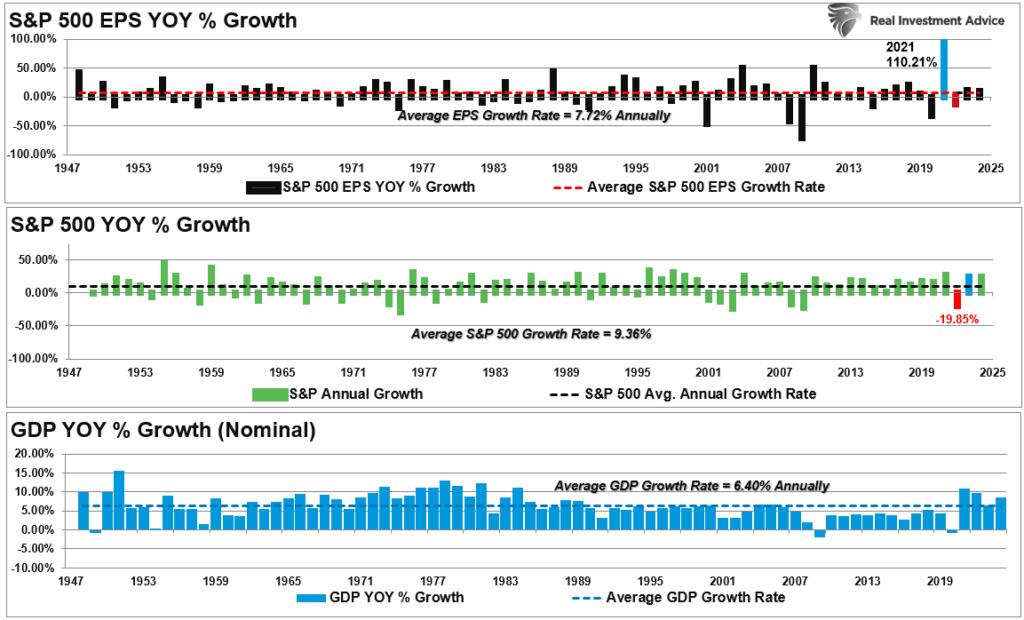
Crucially, earnings cannot outgrow the economy over the long term as earnings are derived from economic activity. Given that GDP measures the total value of goods and services produced within a country, it is a reliable gauge of overall activity. A growing GDP indicates increased economic activity, typically driving higher corporate earnings due to increased consumer spending and business investment. Conversely, a contracting GDP suggests an economic slowdown, often dampening corporate profits.

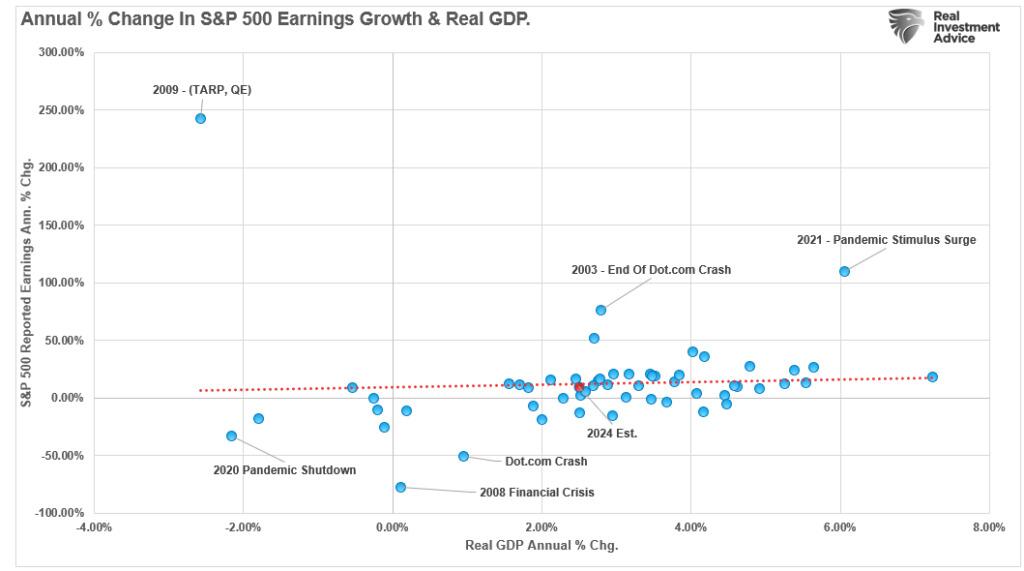
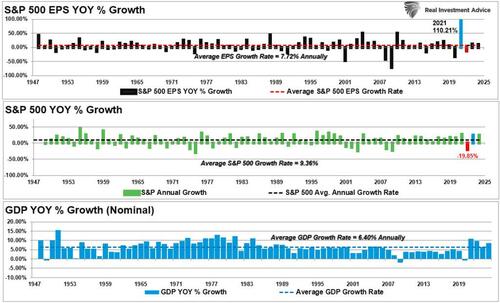
The data supports this concept. Historically, GDP growth has closely correlated with corporate earnings growth. Data from the Federal Reserve shows that, since 1948, a 1% increase in real GDP growth has translated to roughly a 6% increase in S&P 500 earnings on average. This relationship underscores why GDP is a cornerstone for assessing earnings trends. We can also see this visually.

“Since 1947, earnings per share have grown at 7.7% annually, while the economy expanded by 6.40% annually. That close relationship in growth rates should be logical, particularly given the significant role that consumer spending has in the GDP equation.” – Market Forecasts Are Very Bullish
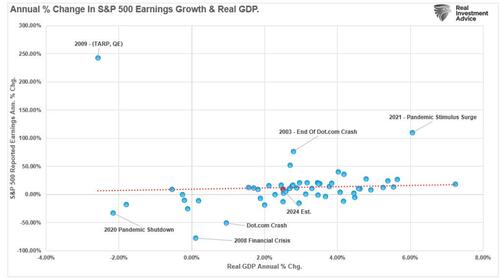
A better way to visualize this data is to look at the correlation between the annual change in earnings growth and inflation-adjusted GDP. There are periods when earnings deviate from underlying economic activity. However, those periods are due to pre- or post-recession earnings fluctuations. Currently, economic and earnings growth are very close to the long-term correlation.
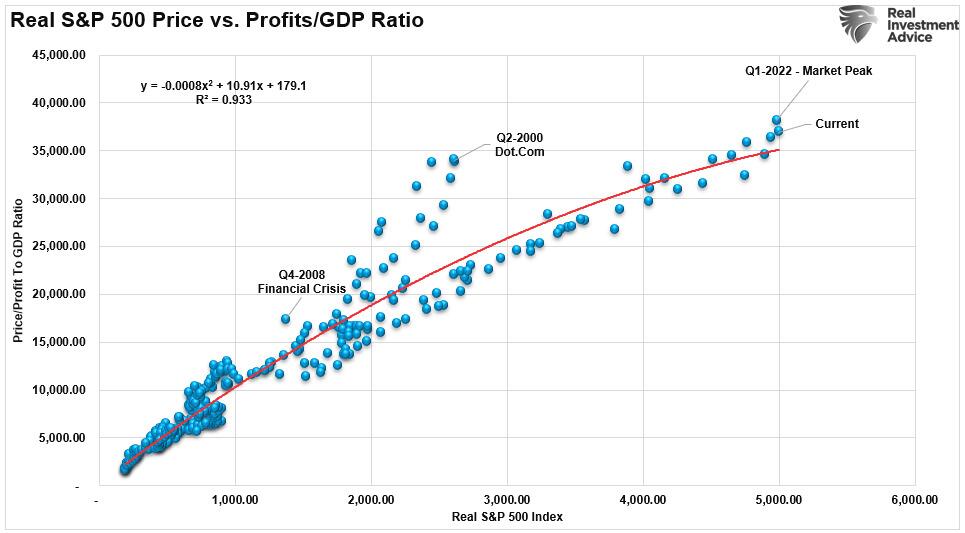
However, as we discussed previously, there is also a high correlation between the market and the corporate profits to GDP ratio. As is the case currently, markets can detach from underlying economic realities due to momentum and psychology for brief periods. However, those deviations are unsustainable in the long term, and corporate profitability, as discussed, is derived from underlying economic activity.

I will write an article soon covering the importance of a handful of economic indicators on earnings. However, I want to discuss two today: the ISM Manufacturing Index and the Chicago Fed National Activity Index.

ISM Manufacturing Index

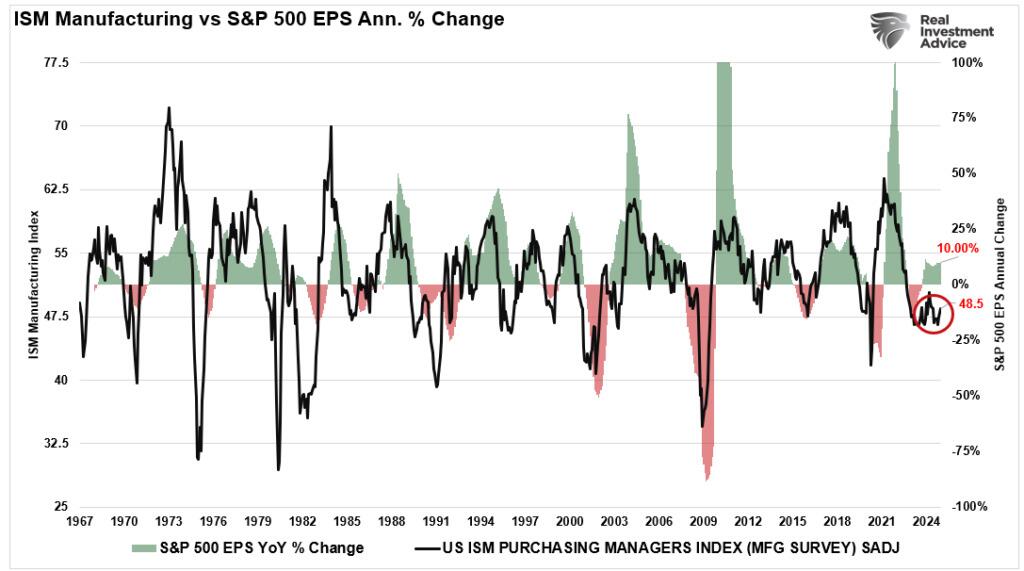
The ISM Manufacturing Index is a widely followed leading indicator of economic activity in the manufacturing sector. It surveys purchasing managers on critical metrics like new orders, production levels, and employment.

  • A reading above 50 signals expansion, which tends to support earnings growth.
  • A reading below 50 suggests contraction, often foreshadowing economic weakness and declining corporate profits.

As of late 2024, the ISM Manufacturing Index has been consistently below 50, marking a manufacturing recession. This data aligns with declining new orders and softer demand, raising concerns about corporate earnings resilience in 2025. However, while manufacturing only accounts for about 20% of U.S. GDP, it has an outsized influence that extends across supply chains, amplifying the impact on broader economic activity.
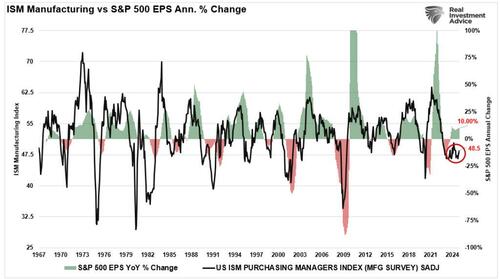
Corporate earnings growth, which correlates with economic indicators like the ISM Manufacturing index, suggests some caution about the more optimistic 2025 Wall Street estimates. However, even if we include the services side of the index, which comprises the bulk of economic growth, and weigh it accordingly, we see that the stock market has far outpaced underlying economic activity. Historically, such outsized returns have not been sustainable as earnings growth fails to meet expectations.

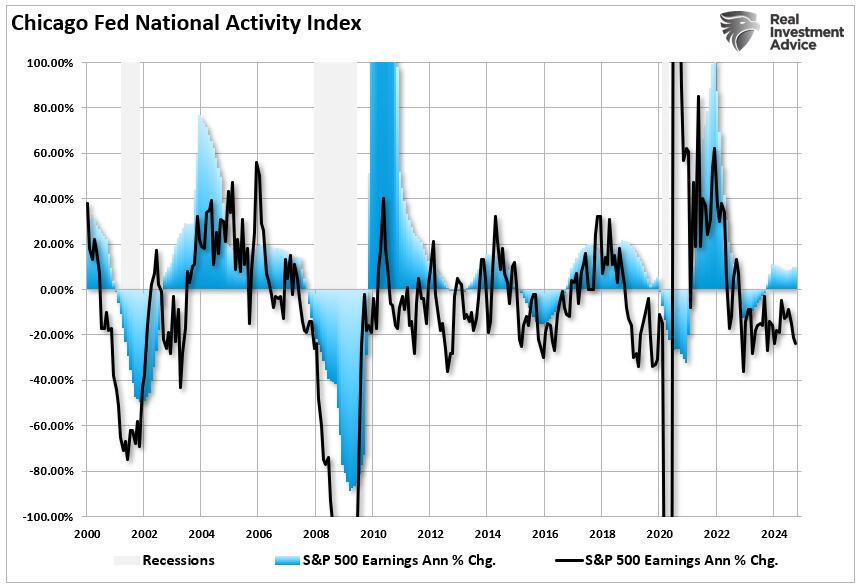
However, one of the better economic indicators to pay attention to is the Chicago Fed National Activity Index, which is a broad measure of the economy but does not receive much attention.

Chicago Fed National Activity Index (CFNAI)

The CFNAI aggregates 85 monthly economic indicators from four categories:

  1. Production and income.
  2. Employment, unemployment, and hours worked.
  3. Personal consumption and housing.
  4. Sales, orders, and inventories.

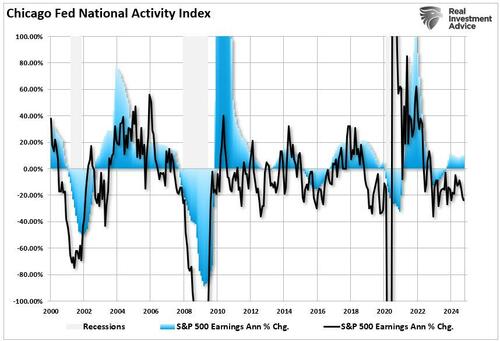
A CFNAI reading above zero indicates above-trend economic growth, while below zero suggests below-trend growth. In October 2024, the CFNAI registered at -0.15, reflecting subdued economic activity. Prolonged readings in negative territory often signal a rising risk of recession. Notably, the employment measure suggests that the annual rate of change in employment will continue to decline, industrial production will slow, and personal consumption will moderate lower.
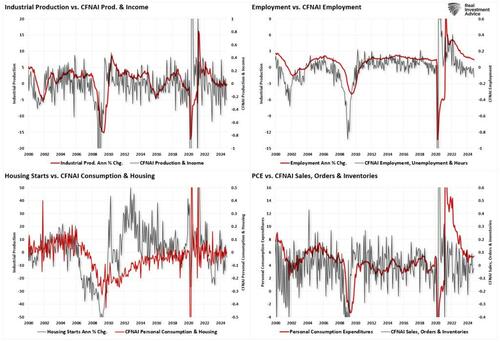
The CFNAI’s broad scope provides a nuanced view of how various economic forces combine to affect corporate earnings. With production and employment metrics deteriorating, the outlook for robust earnings in 2025 appears increasingly strained. As shown, a high but volatile historical correlation exists between the CFNAI and corporate earnings.
Risks In 2025

Still, investors should note that analysts’ outlook for 2025 is exceptionally optimistic compared to what is likely to be the actual outcome. This is because, as discussed in “Market Forecasts Are Very Bullish,” there are numerous headwinds facing markets next year.

“The problem with current forward estimates is that several factors must exist to sustain historically high earnings growth and record corporate profitability.”

  1. Economic growth must remain more robust than the average 20-year growth rate.

  2. Wage and labor growth must reverse (weaken) to sustain historically elevated profit margins.

  3. Both interest rates and inflation need to decline to support consumer spending.

  4. Trump’s planned tariffs will increase costs on some products and may not be fully offset by replacement and substitution.

  5. Reductions in Government spending, debt issuance, and the deficit subtract from corporate profitability (Kalecki Profit Equation).

  6. Slower economic growth in China, Europe, and Japan reduces demand for U.S. exports, slowing economic growth.

  7. The Federal Reserve maintaining higher interest rates and continuing to reduce its balance sheet will reduce market liquidity.

You get the idea. While analysts are currently very optimistic about economic and earnings growth going into 2025, there are risks to those forecasts. Such is particularly true when examining current economic data’s relative strength and trend. Subdued manufacturing activity, slowing GDP growth, and cautious consumer behavior all point to an economic environment less supportive of aggressive earnings growth. As such, investors must carefully navigate the disconnect between high Wall Street expectations and softening economic conditions.

If these headwinds persist, corporate earnings may grow slower or contract slightly compared to Wall Street’s current projections. For investors, this scenario could mean lower returns from equities, particularly in high-growth sectors more sensitive to earnings disappointments.

How We Are Trading It

Heading into year-end, there is little need to be overly cautious. The bullish trend remains intact, corporate buybacks continue, and investment managers must be “fully dressed” by New Year’s Eve for annual reporting.

However, even with the market in a seasonally strong period of the year, there is always the possibility of something “going wrong.” As such, continue to follow the rules as needed to maintain a manageable level of volatility.

  1. Tighten up stop-loss levels to current support levels for each position.
  2. Hedge portfolios against major market declines.
  3. Take profits in positions that have been big winners
  4. Sell laggards and losers
  5. Raise cash and rebalance portfolios to target weightings.

Notice, nothing in there says “sell everything and go to cash.”

The trick to navigating markets in 2025 is not trying to “time” the market to sell exactly at the top. That is impossible. Successful long-term management is understanding when “enough is enough” and being willing to take profits and protect your gains. For many stocks currently, that is the situation we are in.


Tyler Durden
Sun, 12/08/2024 – 19:50

via ZeroHedge News https://ift.tt/ZITLBzF Tyler Durden

Lead In Gasoline May Have Caused Over 150 Million Excess Cases Of Mental Health Disorders, New Study Shows

Lead In Gasoline May Have Caused Over 150 Million Excess Cases Of Mental Health Disorders, New Study Shows

A new study reported on this week says that lead in gasoline could be tied to “over 150 million excess cases of mental health disorders”, including anxiety, depression and ADHD, according to NBC News.

A new study estimates that childhood exposure to leaded gasoline caused 151 million excess psychiatric disorders in the U.S. over the past 75 years. Despite its ban in 1996, lead’s lingering impact on mental health was traced through childhood blood lead levels from 1940 to 2015.

Lead was added to gasoline to enhance engine performance, but its use surged post-WWII until catalytic converters, required in the 1970s, highlighted its drawbacks. Despite early awareness of its dangers, federal efforts to reduce lead exposure lagged for years.

The NBC News report says that researchers from Duke, Florida State, and the Medical University of South Carolina found that lead exposure reduced impulse control and increased neuroticism, with the strongest effects in those born between 1966 and 1986.

Generation Xers born from 1966 to 1970, during peak leaded gasoline use, faced the highest burden of lead-related mental health issues.

Aaron Reuben, a co-author of the study and a postdoctoral scholar in neuropsychology at Duke and the Medical University of South Carolina, commented: “Studies like ours today add more evidence that removing lead from our environment and not putting it there in the first place has more benefits than we previously understood.”

He said of the new research that it “doesn’t create new information about whether lead causes harm, nor do we say this is a study that proves causation — we’re really just taking existing evidence and applying it to the whole U.S. population.”

“We’re not at all concerned that we have in any way overestimated the harm,” he continued. 

“We don’t often get to see a lot of studies that look at environmental, or toxin-related, potential associated risks with the development of elevated rates of mental health problems in populations. The research shed some light on the profound and lasting impact of environmental factors,” added Dr. Lisa Fortuna, chair of the American Psychiatric Association’s Council on Children, Adolescents and Their Families.

“It does not mean that people are, I would say, stuck with a mental illness. It doesn’t mean that they’re necessarily going to have a higher risk. It’s really an issue of, ‘Here’s what’s happened at a population level.’”

A previous study by Reuben and colleagues found that leaded gasoline exposure lowered the IQ of about half the U.S. population, costing 824 million IQ points. The new research highlights that those born around 1940 and 2015 had the lowest lead exposure and related mental illnesses, NBC reported.

Although banned in gasoline, lead persists in sources like old paint, outdated water lines, some imported toys, and soil. The CDC states there is no safe level of lead exposure, which is particularly harmful to children under 6, affecting brain development, learning, and the nervous and reproductive systems.

Tyler Durden
Sun, 12/08/2024 – 19:15

via ZeroHedge News https://ift.tt/cvOpTGu Tyler Durden

US Bombs 75 ISIS Targets Across Syria After Assad Overthrown

US Bombs 75 ISIS Targets Across Syria After Assad Overthrown

US Central Command (CENTCOM) announced Sunday that US forces have conducted multiple dozens of major airstrikes targeting ISIS camps and their terror camps across central Syria. 

CENTCOM stated on X, “The strikes against the ISIS leaders, operatives, and camps were conducted as part of the ongoing mission to disrupt, degrade, and defeat ISIS, in order to prevent the terrorist group from conducting external operations and to ensure that ISIS does not seek to take advantage of the current situation to reconstitute in central Syria.”

B-52 Stratofortress, file image

“The operation struck over 75 targets using multiple U.S. Air Force assets, including B-52s, F-15s, and A-10s.”

“Battle damage assessments are underway, and there are no indications of civilian casualties,” CENTCOM continued.

Especially given the presence of B-52s in the operation, this was clearly a large-scale op. But it begs an important question: Washington chooses now to very belatedly go after ISIS?

One wonders why they weren’t targeted in the past, whether months ago or years ago. There hasn’t been a US operation of this scale going back perhaps a half-decade at least.

A theory? Perhaps now that it’s ‘mission accomplished’ with the Assad government overthrown, and with Damascus in the hands of Hayat Tahrir al-Sham jihadists, ISIS is no longer needed to ‘pressure’ Assad and Russian forces. The Pentagon is now much belatedly dealing with the Daesh terrorists.

Recall the Obama era in Syria and the West-Gulf allies fueling the rise of ISIS with tons and tons of weaponry passed around to the Islamist insurgents which made up the mainstay of anti-Assad ‘opposition’…

On Sunday President Joe Biden finally addressed the rapidly moving events in Syria, and with Assad having fled to Moscow, where he was given asylum. “At long last, the Assad regime has fallen,” Biden said. “This regime brutalized, tortured and killed literally hundreds of thousands of innocent Syrians.” And more:

At the same time, it’s “also a moment of risk and uncertainty,” Biden added, saying that the U.S. would “support Syria’s neighbors, including Jordan, Lebanon, Iraq, and Israel, should any threat arise.”

“This is a moment of considerable risk and uncertainty,” Biden said. “But I also believe this is the best opportunity in generations for Syrians to forge their own future free of opposition.”

The day prior, a White House national security statement sought to emphasize that the United States “has nothing to do with this offensive, which is led by Hay’at Tahir al-Sham (HTS), a designated terrorist organization.”

Biden in the Sunday address at one point alluded to the obvious on the minds of many, and as Syrian Christians flee toward the coast:

Meanwhile, over in Turkey…

Currently, reports of looting have emerged from the Syrian capital, but there is a certain ‘fog of war’ along with many uncertainties. It’s also anything but certain what Syria will look like a week from now, months from now, or years from now.

Tyler Durden
Sun, 12/08/2024 – 16:55

via ZeroHedge News https://ift.tt/v4Id26a Tyler Durden

California Reaffirms An Open Arms Invitation To Illegal Immigrants

California Reaffirms An Open Arms Invitation To Illegal Immigrants

Authored by Mike Shedlock via MishTalk.com,

Protests based on the “California Values ​​Act” which limits state cooperation with federal immigration authorities are underway…

Hundreds of people demonstrated around the California Capitol on Monday to urge the Legislature to try to stop Trump’s mass deportation plans. They carried banners that said “Not one cent for mass deportation” and “MAGA out of California.”

Deportation Resistance

Gateway Hispanic reports States Resist Trump’s Mass Deportation Plans: California, New York, Maryland and Colorado Push Back

In response to former President Donald Trump’s mass deportation plans, states like California and New York have been vocal in their opposition, asserting their authority to protect immigrant communities from federal enforcement.

California has long been at the forefront of this resistance. Under Senator Alex Padilla and Governor Gavin Newsom, the state has emphasized its commitment to shielding immigrants, particularly through Senate Bill 54, the “California Values ​​Act,” which limits state and local cooperation with federal immigration authorities.

Federal Clash

The conflict has raised significant questions about the balance of power between federal and state governments. Trump’s mass deportation agenda, which seeks to ramp up enforcement, clashes with the policies of these states that prioritize immigrant welfare. California and New York argue that they should have the discretion to create policies that reflect their values ​​of inclusion and protection for all residents, including undocumented immigrants.

California and New York can argue all they want, but Federal law trumps state law on this issue.

Eagle Pass, Texas Revisited

On January 12, 2024, I discussed Texas National Guard Seizes Eagle Pass Park to Stop Illegal Immigration

Over the objection of the Eagle Pass mayor, governor Abbott seized a public park that borders the Rio Grande river.

Governor Abbott placed 29 miles of razor wire only to have the Biden administration remove the wire.

On January 22, I commented Texas Showdown, Supreme Court Lets Feds Cut Abbott’s Razor Wire

In a 5-4 ruling, the Supreme Court sided with the Biden Administration. Federal authorities will cut the razor wire and open the illegal immigration floodgates.

But in an appeals ruling on November 28, a US appeals court ruled Texas has right to build razor wire along border at Eagle Pass.

This seems more than a bit bizarre that an appeals court apparently overrules the Supreme Court.

But it appears Texas tried again with a new angle based on safeguarding property as opposed to setting immigration policy.

CBS Austin reports U.S. appeals court rules Texas has right to build razor wire along border at Eagle Pass.

In its official ruling, the court says Texas is entitled to a preliminary injunction because the state is seeking only to safeguard its property — not “regulate” Border Patrol.

The ruling also affirms Texas’ right to build wired fences for immigration enforcement.

Be Careful of What You Wish

The first part of the ruling above is narrow and seems correct. The second paragraph screams nonsense.

More accurately, it was nonsense when the Federal government disagreed.

Immigration policy belongs at the federal level. We do not want California, Illinois, or New York setting their own immigration policies. I thought so under Biden, and I do so now. Unlike others, I am consistent.

Texas has no more right to set immigration policy than California. However, Texas should be able to safeguard its property.

The distinction is important.

Of course, I was blasted by hypocrites who wanted Texas to set immigration policy but now don’t want California to do the same.

The Texas Tribune comments:

“It was shocking to me that the federal government would go out of their way to cut razor wire to allow illegals to cross when we’re just trying to protect our own land,” Paxton said during a Wednesday evening appearance on Newsmax. “This wasn’t their land. This was our land, our private property. It had nothing due to the federal government. So this is a good win for Texas, a good win for the country, that this court recognized our ability to protect our land.”

A spokesperson for the U.S. Department of Homeland Security did not immediately respond to a request for comment.

Should I Just Kiss My Illegal Immigrant Husband Goodbye?

That’s the question the Wall Street Journal asks today in its post Migrants Prepare for Mass Deportation

Immigrants without legal status or in mixed-status families are avoiding going out in public, scrambling to apply for asylum and attending legal workshops ahead of Donald Trump’s return to power, fearful they will be swept up in the president-elect’s promised mass-deportation campaign.

“There is a lot of fear, a lot of concern,” said Lizeth Chacón, director of Workers Defense Project, in Texas. “There’s so much our community needs to plan for.”

Yvonne Sanchez, a stay-at-home mother in the Milwaukee suburbs, has started taking steps to prepare her five children should authorities arrest her husband, who is a Mexican immigrant in the country illegally and the family’s sole breadwinner.

Her husband has worked in the U.S. for nearly three decades, since he was 16 years old. Although Sanchez is a U.S. citizen, and the couple has been married for 13 years, she can’t sponsor her husband for a green card—which would grant him permanent U.S. residency—because he crossed into the country illegally. That would make him particularly vulnerable in a mass-deportation effort.

Sanchez wondered recently, “should I just kiss my husband goodbye? How far is this going to go?”

“I’m advising folks, make sure your affairs are in order,” said Lily Axelrod, an immigration attorney in Memphis, Tenn. “If you have kids, make sure their guardianship and custody situations are in order if, in the worst-case scenario, you are detained.”

Roughly 860,000 immigrants are living in the U.S. with a form of deportation protection called Temporary Protected Status, granted to people whose countries are deemed too dangerous to return to. Trump has vowed not to renew those protections—granted to people from countries including Venezuela, Haiti and Honduras. The first set of protections, which covers 239,000 migrants from El Salvador who have lived in the U.S. since 2001, is due to expire in March.

Hundreds of thousands more have entered the country under the Biden administration with explicit permission, granted a form of temporary status called humanitarian parole. Trump has promised to take their protections away, too.

Kateryna Kyrylova came to the U.S. under Biden’s humanitarian program after fleeing the Russian siege of her home city of Mariupol, Ukraine, where a bomb killed her grandmother, her only living relative, and another leveled her apartment building. After searching in an online forum, Kyrylova found a retired military couple in San Antonio, willing to financially sponsor her.

“I understand that he wants this illegal immigration to stop—it’s a huge problem for the country,” Kyrylova said. “I just want him to give me a chance to stay and live my life.”

Things That Make Sense

  • Deporting everyone on the ICE list charged with violent crimes regardless of other circumstances

  • Deporting recent arrivals with no job and no sponsorship

  • Deporting Venezuelan gang members

Things That Make No Sense

  • Deporting spouses of US citizens

  • Deporting parents of US citizens

  • Deporting people who have been here for years, are employed, and are leading productive lives

  • Deporting people, especially Afghans who risked their lives aiding the US for years in holding off the Taliban and who would immediately be killed upon return

  • Deporting people without understanding the economic impacts

Deport Them All Foolishness

Deport them all is both economically stupid and morally unjust.

People who propose such policies are economic illiterates. Most of them just parrot whatever Trump says without question.

But, if Trump wants to unleash a massive round of inflation by creating work shortages, all he has to do is listen to alleged mandates “deport them all”.

October 1: What Would Trump’s Mass Deportation of Immigrants Cost?

The Middle Ground

We need sensible immigration policy. Mass deportation of 10 to 15 million immigrants (or even 6 million) is not sensible.

It’s a dirty, not-so-secret, fact that red state and blue state alike depend on migrant labor for crops and construction projects.

However, an open border is not the answer either. We can do without the crime and shelter costs that uncontrolled immigration bring. Flying Haitians (or anyone else) here is beyond ridiculous and begging for problems.

I suggest we deport criminals, have a reasonable amnesty program for hard working immigrants who have been here for years, and mostly close the border using the military if necessary.

Future immigration should be based on our genuine needs.

October 18: How Difficult Would it Be For Trump to Deport Millions of Immigrants?

Trump’s Pledge

“As soon as I take the oath of office, I will terminate every open border policy of the Biden administration and begin the largest deportation operation in American history.”

Trumpian Bravado vs Reality

Fortunately, despite his harsh rhetoric, Trump seems to understand some of the economic arguments.

On November 11, the Wall Street Journal commented on Trump’s Mass Deportation Promise

He has a mandate on the border and to deport criminals. But more than that could get ugly fast.

In short order, Mr. Trump will move to reinstate the border policies of his first term, such as Remain in Mexico, which seemed to work. Under that deal, migrants claiming asylum in the U.S. were sent back to Mexico while their cases were pending, which might take months or more. The idea was to break the incentives to game the system. Given the backlog of asylum cases, letting migrants into the U.S. while they wait is an enticement to come.

The political rub may be Mr. Trump’s campaign promise to conduct “the largest deportation operation in the history of our country.” How it goes depends on what Mr. Trump means. Speaking Monday on Fox News, Mr. Homan said the priority will be “public-safety threats and national-security threats,” as well as migrants who “had due process” and “their federal judge said ‘you must go home,’ and they didn’t.”

Good to hear, and add what Mr. Homan told “60 Minutes” last month. “It’s not going to be a mass sweep of neighborhoods,” he said. “It’s not going to be building concentration camps. I’ve read it all. It’s ridiculous.”

Instead he said Mr. Trump’s plan would involve “targeted arrests,” and eventually “worksite enforcement operations.” If officers making an arrest also find an undocumented grandma in the house, will they detain her? “It depends,” Mr. Homan said. “Let the judge decide.”

Some of Mr. Trump’s advisers, including Mr. Miller, have talked about mass deportation in sweeping terms. But enforcement priorities are up to the President, and Mr. Trump has suggested he isn’t interested in illegal grandmothers.

When he visited the Journal recently, we asked about aliens who have been here for years, who might have U.S. citizen spouses and children. His response was that he wanted to help them.

“We have a lot of good people in this country, and we have to do something about it,” Mr. Trump said. “This has been going on for a long time. It’s a complicated subject.” He declined to specify whom he’d deport: “I don’t want to go too much into clarification, because the nicer I become, the more people that come over illegally.” Yet after stringent talk about deterrence, he ended with nuance: “There are some human questions that get in the way of being perfect, and we have to have the heart, too.”

Trump “We Have to Have the Heart, Too”

I 100 percent endorse that statement vs “deport them all” economic foolishness.

At the same time, I reject statements from California, Illinois, New York, and Colorado governors who think they can override federal law.

There is an easy middle ground that makes economic and moral sense.

Mish Five-Point Proposal

  1. Seal the border

  2. Reinstitute remain in Mexico

  3. Deport the criminals, gang members, and those on ICE lists, defining criminal as something other than being here illegally

  4. Help those who risk their lives assisting US policy in places like Afghanistan

  5. Work out a sensible policy on case-by-case immigration

The New Home for Hispanics is the Republican Party

My proposal is based in part on  The Dignity Act , a bipartisan bill sponsored Rep. Maria Elvira Salazar (R-Florida).

For discussion, please see The New Home for Hispanics is the Republican Party

Click above to see an interview of Florida rep. Maria Salazar on Hispanics, Trump, and deportations.

Tyler Durden
Sun, 12/08/2024 – 16:20

via ZeroHedge News https://ift.tt/9fbZvjR Tyler Durden