Ukraine Vows To Reject Any Alternative To NATO Membership

Ukraine Vows To Reject Any Alternative To NATO Membership

A new Ukrainian government statement has made clear the country will reject any alternative to NATO membership if it is proposed as part of a peace plan with Moscow.

Reports of President-elect Trump’s peace plan say it hinges on security guarantees while indefinitely postponing Ukraine joining NATO (for at least 20 years). This is precisely what the Zelensky government is now very vocally pushing back against.

A Tuesday statement from the Foreign Ministry asserts, “Having the bitter experience of the Budapest Memorandum behind us, we will not settle for any alternatives, surrogates, or substitutes for Ukraine’s full membership in NATO.”

Source: EFE/EPA

The statement continued by calling upon “the U.S. and Great Britain, which signed the Budapest Memorandum,… France and China, which joined it and all the states participating in the Treaty on the Non-Proliferation of Nuclear Weapons” to immediately back Ukraine’s efforts to joint NATO. 

It further suggested that anything less is to fall in line with Russia’s ‘blackmail’. The Budapest Memorandum of 1994 saw Ukraine give up its Soviet-era nuclear weapons arsenal, and in return Moscow provided security guarantees and recognized borders.

The hard-hitting Ukrainian government statement further stressed, “We are convinced that the only real security guarantee for Ukraine, as well as a deterrent factor for further Russian aggression against Ukraine and other states, is only Ukraine’s full membership in NATO.”

Ukraine has representation at a Tuesday through Wednesday meeting of foreign ministers in Brussels. Zelensky has been pushing allies hard to not back down on allowing full NATO membership. He’s even tried to argue that the alliance’s Article 5 self-defense pact doesn’t necessary have to apply to parts of Ukraine occupied by the Russians.

But NATO leaders appear cold to the idea, given the risk of nuclear-armed confrontation with Russia, and given Ukraine’s military is clearly losing the war in the east. NATO chief Rutte has also rejected Zelensky’s plea:

NATO Secretary-General Mark Rutte on Tuesday sidestepped questions about Ukraine’s possible membership in the military alliance, saying that the priority now must be to strengthen the country’s hand in any future peace talks with Russia by sending it more weapons.

Rutte’s remarks, ahead of a meeting of NATO foreign ministers, came days after Ukrainian President Volodymyr Zelenskyy said that extending alliance membership to territory now under Kyiv’s control could end “the hot stage” of the almost 3-year war in Ukraine, where Russian forces are pressing deeper into their western neighbor.

“The front is not moving eastwards. It is slowly moving westwards,” Rutte said. “So we have to make sure that Ukraine gets into a position of strength, and then it should be for the Ukrainian government to decide on the next steps, in terms of opening peace talks and how to conduct them.”

Kiev is also urgently pushing for more anti-air defense weapons systems from partners. This after Russia has stepped up attacks on the country’s energy infrastructure.

“We are talking about an emergency delivery of at least 20 additional Hawk, NASAMS or IRIS-T systems,” Ukrainian Foreign Minister Andrey Sibiga said Tuesday in Brussels, as quoted by RBK Ukraine. “This will help us avoid blackouts. We understand that the Russians are trying to undercut our generation capacity.”

Tyler Durden
Tue, 12/03/2024 – 23:00

via ZeroHedge News https://ift.tt/ds0lI8N Tyler Durden

House Oversight Report Supports Chinese Lab-Leak Theory For COVID-19 Origin

House Oversight Report Supports Chinese Lab-Leak Theory For COVID-19 Origin

Authored by Aldgra Fredly via The Epoch Times (emphasis ours),

A Republican-led oversight subcommittee has concluded that the COVID-19 virus likely originated from a laboratory in Wuhan, China, following a two-year investigation into the pandemic.

The House Oversight Select Subcommittee on the Coronavirus Pandemic released a 520-page report on Dec. 2, detailing the findings of the subcommittee’s investigation.

Laboratory technicians wearing personal protective equipment work on samples to be tested for COVID-19 at the Fire Eye laboratory, a COVID-19 testing facility, in Wuhan in Hubei Province, China, on Aug. 4, 2021. STR/AFP via Getty Images

The report found that the U.S. National Institutes of Health funded gain-of-function research at the Wuhan Institute of Virology (WIV), and that EcoHealth Alliance Inc. used U.S. taxpayer dollars to facilitate this research at the lab.

It also found that the Chinese communist regime, agencies within the U.S. government, and some members of the international scientific community sought to cover up facts concerning the origins of the pandemic.

The committee said that COVID-19 possesses biological characteristics not found in nature and that data indicates that all COVID-19 cases stemmed from a single introduction into humans, unlike previous pandemics, where there were more spillover events.

By nearly all measures of science, if there was evidence of a natural origin it would have already surfaced,” the oversight subcommittee said in a statement.

The report said that the Wuhan Institute of Virology has a history of conducting “gain-of-function” research under low biosafety precautions.

Several researchers from the Wuhan Institute of Virology fell sick with a COVID-like virus months before the first case of the outbreak was allegedly detected at a wet market, according to the report.

The report said that in January 2021, the U.S. State Department published an unclassified fact sheet that stated: “The U.S. government has reason to believe that several researchers inside the WIV became sick in autumn 2019, before the first identified case of the outbreak, with symptoms consistent with both COVID-19 and common seasonal illness.”

Citing the fact sheet, the report stated that the Wuhan Institute of Virology “has a published record of conducting ‘gain-of-function’ research to engineer chimeric viruses.”

The report said the June 2023 ODNI assessment supported this conclusion and went further, stating, “Scientists at the WIV have created chimeras, or combinations of SARS-like coronaviruses through genetic engineering, attempted to clone other unrelated viruses, and used reverse genetic cloning techniques on SARS-like coronaviruses.” The June 2023 ODNI Assessment said that some of the “WIV’s genetic engineering projects on coronaviruses involved techniques that could make it difficult to detect intentional changes.”

Among those interviewed during the panel’s investigation was Anthony Fauci, former director of the National Institute of Allergy and Infectious Diseases (NIAID), who stepped down from his role in December 2022.

The report stated that Fauci had “prompted” a research study titled “The Proximal Origin of SARS-CoV-2”—which dismissed the idea that the virus was laboratory constructed—to “disprove” the lab leak theory.

Fauci testified at a June hearing that he did not suppress the lab leak theory and did not view it as inherently a conspiracy theory but said that “some distortions on that particular subject are,” according to the report.

Security personnel keep watch outside the Wuhan Institute of Virology in Wuhan, Hubei Province, China, on Feb. 3, 2021. Thomas Peter/Reuters

“Although Dr. Fauci believed the lab-leak theory to be a conspiracy theory at the start of the pandemic, it now appears that his position is that he does have an open mind about the origin of the virus—so long as it does not implicate EcoHealth Alliance, and by extension himself and NIAID,” it stated, citing Fauci’s memoir published just weeks after the hearing. “Understandably, as he signed off on the EcoHealth Alliance grant.”

In a May 2021 Senate hearing, Fauci said his agency did not provide funds for “gain of function” research into coronaviruses at the Wuhan Institute of Virology.

The NIH has not ever and does not now fund gain-of-function research in the Wuhan Institute of Virology,” Fauci told the hearing.

The report also stated that Taiwan notified the World Health Organization (WHO) on Dec. 31, 2019, about “atypical pneumonia cases” reported in Wuhan and asked the agency to investigate, but the WHO ignored the warnings.

The WHO response to the COVID-19 pandemic was “an abject failure because it caved to pressure from the Chinese Communist Party and placed China’s political interests ahead of its international duties,” the subcommittee said.

In a statement accompanying the report, Rep. Brad Wenstrup (R-Ohio), chairman of the committee, said, “The COVID-19 pandemic highlighted a distrust in leadership. Trust is earned. Accountability, transparency, honesty, and integrity will regain this trust.

A study published in the journal Risk Analysis on March 15 found a high probability that the COVID-19 virus had an unnatural origin. Although the study did not prove the origin of the COVID-19 virus, its authors said that “the possibility of a laboratory origin cannot be easily dismissed.”

The Epoch Times reached out to Anthony Fauci, NIAID, EcoHealth Alliance Inc., and the WHO for comment but did not receive a response by publication time.

Naveen Athrappully contributed to this report.

Tyler Durden
Tue, 12/03/2024 – 22:35

via ZeroHedge News https://ift.tt/UoNuK7v Tyler Durden

US Won’t ‘Cry’ About The Pressure Syria Is Facing From Al-Qaeda-Linked Fighters: Sullivan

US Won’t ‘Cry’ About The Pressure Syria Is Facing From Al-Qaeda-Linked Fighters: Sullivan

Authored by Dave DeCamp via AntiWar.com, 

National Security Advisor Jake Sullivan said on Sunday that the US will not “cry” over the pressure the Syrian government and its allies are facing from an offensive on Aleppo led by Hayat Tahrir al-Sham (HTS), an offshoot of al-Qaeda.

Sullivan acknowledged that HTS was “a terrorist organization designated by the United States” and said the US has “real concerns about the designs and objectives of that organization.”

Commander of designated terror organization Hayat Tahrir al-Sham (HTS) Abu Mohammad al-Jolani. Source: Enab Baladi

But he added, “At the same time, of course, we don’t cry over the fact that the Assad government, backed by Russia, Iran and Hezbollah, are facing certain kinds of pressure.”

HTS captured Aleppo following a surprise offensive that was launched last Wednesday, which came after Israel stepped up airstrikes on Syria.

US officials have not been shy in the past about their preference for HTS and its leader, Abu Mohammad al-Julani, over other factions in Syria. James Jeffrey, an American diplomat who served as a special envoy to Syria under the Trump administration from 2018-2020, said in a 2021 interview that HTS was “an asset” to the US’s strategy in Idlib, a northwestern Syrian province that’s been under HTS control since 2017.

“They are the least bad option of the various options on Idlib, and Idlib is one of the most important places in Syria, which is one of the most important places right now in the Middle East,” Jeffrey said.

Julani was formerly the leader of al-Nusra Front, which was the al-Qaeda affiliate in Syria. In 2016, Julani publicly announced he was splitting with al-Qaeda and changed his group’s name to Jabhat Fatah al-Sham, which merged with other Islamist groups to form HTS in 2017.

Julani’s rebranding campaign was part of an effort to gain more support from the West. Jeffrey said he was in regular contact with Julani and HTS while he was working as the US envoy to Syria. Jeffrey said a typical message from al-Julani was like this, “This is what we’re doing. These are our goals. We’re not a threat to you.”

Jeffrey said he responded to Julani by saying, “I couldn’t agree more. … Keep me informed as often as possible.”

Al-Qaeda and other extremist groups always made up a significant portion of the opposition to Assad after the war broke out in 2011. In 2012, Jake Sullivan, who worked as an aide to then-Secretary of State Hilary Clinton at the time, told his boss in an email released by WikiLeaks that “AQ (al-Qaeda) is on our side in Syria.”

Tyler Durden
Tue, 12/03/2024 – 22:10

via ZeroHedge News https://ift.tt/dgzu5np Tyler Durden

Uranium Mining Revival Portends Nuclear Renaissance In Texas & Beyond

Uranium Mining Revival Portends Nuclear Renaissance In Texas & Beyond

Authored by Dylan Baddour via Inside Climate News (emphasis ours),

In the old ranchlands of South Texas, dormant uranium mines are coming back online. A collection of new ones hope to start production soon, extracting radioactive fuel from the region’s shallow aquifers. Many more may follow.

These mines are the leading edge of what government and industry leaders in Texas hope will be a nuclear renaissance, as America’s latent nuclear sector begins to stir again.  

Texas is currently developing a host of high-tech industries that require enormous amounts of electricity, from crypto-currency mines and artificial intelligence to hydrogen production and seawater desalination. Now, powerful interests in the state are pushing to power it with next-generation nuclear reactors. 

“We can make Texas the nuclear capital of the world,” said Reed Clay, president of the Texas Nuclear Alliance, former chief operating officer for Texas Gov. Greg Abbott’s office and former senior counsel to the Texas Office of Attorney General. “There’s a huge opportunity.”

Clay owns a lobbying firm with heavyweight clients that include SpaceX, Dow Chemical and the Texas Blockchain Council, among many others. He launched the Texas Nuclear Association in 2022 and formed the Texas Nuclear Caucus during the 2023 state legislative session to advance bills supportive of the nuclear industry. 

The efforts come amid a national resurgence of interest in nuclear power, which can provide large amounts of energy without the carbon emissions that warm the planet. And it can do so with reliable consistency that wind and solar power generation lack. But it carries a small risk of catastrophic failure and requires uranium from mines that can threaten rural aquifers. 

In South Texas, groundwater management officials have fought for almost 15 years against a planned uranium mine. Administrative law judges have ruled in their favor twice, finding potential for groundwater contamination. But in both cases those judges were overruled by the state’s main environmental regulator, the Texas Commission on Environmental Quality.

Now local leaders fear mining at the site appears poised to begin soon as momentum gathers behind America’s nuclear resurgence. 

In October, Google announced the purchase of six small nuclear reactors to power its data centers by 2035. Amazon did the same shortly thereafter, and Microsoft has said it will pay to restart the Three Mile Island plant in Pennsylvania to power its facilities. Last month, President Joe Biden announced a goal to triple U.S. nuclear capacity by 2050. American companies are racing to license and manufacture new models of nuclear reactors.

It’s kind of an unprecedented time in nuclear,” said James Walker, a nuclear physicist and co-founder of New York-based NANO Nuclear Energy Inc., a startup developing small-scale “microreactors” for commercial deployment around 2031. 
The industry’s re-emergence stems from two main causes, he said: towering tech industry energy demands and the war in Ukraine.

Previously, the U.S. relied on enriched uranium from decommissioned Russian weapons to fuel its existing power plants and military vessels. When war interrupted that supply in 2022, American authorities urgently began to rekindle domestic uranium mining and enrichment. 

The Department of Energy at the moment is trying to build back a lot of the infrastructure that atrophied,” Walker said. “A lot of those uranium deposits in Texas have become very economical, which means a lot of investment will go back into those sites.”

In May, the White House created a working group to develop guidelines for deployment of new nuclear power projects. In June, the Department of Energy announced $900 million in funding for small, next-generation reactors. And in September, it announced a $1.5 billion loan to restart a nuclear power plant in Michigan, which it called “a first of a kind effort.”

“There’s an urgent desire to find zero-carbon energy sources that aren’t intermittent like renewables,” said Colin Leyden, Texas state director of the Environmental Defense Fund. “There aren’t a lot of options, and nuclear is one.”

Wind and solar will remain the cheapest energy sources, Leyden said, and a buildout of nuclear power would likely accelerate the retirement of coal plants.

The U.S. hasn’t built a nuclear reactor in 30 years, spooked by a handful of disasters. In contrast, China has grown its nuclear power generation capacity almost 900 percent in the last 20 years, according to the World Nuclear Association, and currently has 30 reactors under construction.

Last year, Abbott ordered the state’s Public Utility Commission to produce a report “outlining how Texas will become the national leader in using advanced nuclear energy.” According to the report, which was issued in November, new nuclear reactors would most likely be built in ports and industrial complexes to power large industrial operations and enable further expansion. 

“The Ports and their associated industries, like Liquified Natural Gas (LNG), carbon capture facilities, hydrogen facilities and cruise terminals, need additional generation sources,” the report said. Advanced nuclear reactors “offer Texas’ Ports a unique opportunity to enable continued growth.”

In the Permian Basin, the report said, reactors could power oil production as well as purification of oilfield wastewater “for useful purposes.” Or they could power clusters of data centers in Central and North Texas. 

Already, Dow Chemical has announced plans to install four small reactors at its Seadrift plastics and chemical plant on a rural stretch of the middle Texas coast, which it calls the first grid-scale nuclear reactor for an industrial site in North America.   

I think the vast majority of these nuclear power plants are going to be for things like industrial use,” said Cyrus Reed, a longtime environmental lobbyist in the Texas Capitol and conservation director for the state’s Sierra Club chapter. “A lot of large industries have corporate goals of being low carbon or no carbon, so this could fill in a niche for them.” 

The PUC report made seven recommendations for the creation of public entities, programs and funds to support the development of a Texas nuclear industry. During next year’s state legislative session, legislators in the Nuclear Caucus will seek to make them law. 

It’s going to be a great opportunity for energy investment in Texas,” said Stephen Perkins, Texas-based chief operating officer of the American Conservation Coalition, a conservative environmental policy group. “We’re really going to be pushing hard for [state legislators] to take that seriously.”

However, Texas won’t likely see its first new commercial reactor come online for at least five years. Before a buildout of power plants, there will be a boom at the uranium mines, as the U.S. seeks to reestablish domestic production and enrichment of uranium for nuclear fuel. 

Texas Uranium 

Ted Long, a former commissioner of Goliad County, can see the power lines of an inactive uranium mine from his porch on an old family ranch in the rolling golden savannah of South Texas. For years the mine has been idle, waiting for depressed uranium markets to pick up.  

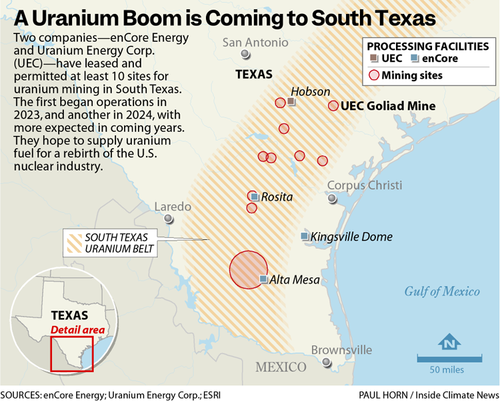
There, an international mining company called Uranium Energy Corp. plans to mine 420 acres of the Evangeline Aquifer between depths of 45 and 404 feet, according to permitting documents. Long, a dealer of engine lubricants, gets his water from a well 120 feet deep that was drilled in 1993. He lives with his wife on property that’s been in her family since her great-grandfather emigrated from Germany. 

“I’m worried for groundwater on this whole Gulf Coast,” Long said. “This isn’t the only place they’re wanting to do this.”

As a public official, Long fought the neighboring mine for years. But he found the process of engaging with Texas’ environmental regulator, the Texas Commission on Environmental Quality, to be time-consuming, expensive and ultimately fruitless. Eventually, he concluded there was no point.

“There’s nothing I can do,” he said. “I guess I’ll have to look for some kind of system to clean the water up.”

The Goliad mine is the smallest of five sites in South Texas held by UEC, which is based in Corpus Christi. Another company, enCore Energy, started uranium production at two South Texas sites in 2023 and 2024, and hopes to bring four more online by 2027. 

Uranium mining goes back decades in South Texas, but lately it’s been dormant. Between the 1970s and the 1990s, a cluster of open pit mines harvested shallow uranium deposits at the surface. Many of those sites left a legacy of aquifer pollution. 

TCEQ records show active cases of groundwater contaminated with uranium, radium, arsenic and other pollutants from defunct uranium mines and tailing impoundment sites in Live Oak County at ExxonMobil’s Ray Point site, and in Karnes County at Conoco-Phillips Co.’s Conquista Project and at Rio Grande Resources’ Panna Maria Uranium Recovery Facility.

All known shallow deposits of uranium in Texas have been mined. The deeper deposits aren’t accessed by traditional surface mining, but rather a process called in-situ mining, in which solvents are pumped underground into uranium-bearing aquifer formations. Adjacent wells suck back up the resulting slurry, from which uranium dust will be extracted. 

Industry describes in-situ mining as safer and more environmentally friendly than surface mining. But some South Texas water managers and landowners are concerned. 

We’re talking about mining at the same elevation as people get their groundwater,” said Terrell Graham, a board member of the Goliad County Groundwater Conservation District, which has been fighting a proposed uranium mine for almost 15 years. “There isn’t another source of water for these residents.” 

“It Was Rigged, a Setup”

On two occasions, the district has participated in lengthy hearings and won favorable rulings in Texas’ administrative courts supporting concerns over the safety of the permits. But both times, political appointees at the TCEQ rejected judges’ recommendations and issued the permits anyway. 

“We’ve won two administrative proceedings,” Graham said. “It’s very expensive, and to have the TCEQ commissioners just overturn the decision seems nonsensical.” 

The first time was in 2010. UEC was seeking initial permits for the Goliad mine, and the groundwater conservation district filed a technical challenge claiming that permits risked contamination of nearby aquifers. 

The district hired lawyers and geological experts for a three-day hearing on the permit in Austin. Afterwards, an administrative law judge agreed with some of the district’s concerns. In a 147-page opinion issued September 2010, an administrative law judge recommended further geological testing to determine whether certain underground faults could transmit fluids from the mining site into nearby drinking water sources. 

If the Commission determines that such remand is not feasible or desirable then the ALJ recommends that the Mine Application and the PAA-1 Application be denied,” the opinion said. 

But the commissioners declined the judge’s recommendation. In an order issued March 2011, they determined that the proposed permits “impose terms and conditions reasonably necessary to protect fresh water from pollution.” 

“The Commission determines that no remand is necessary,” the order said. 

The TCEQ issued UEC’s permits, valid for 10 years. But by that time, a collapse in uranium prices had brought the sector to a standstill, so mining never commenced. 

In 2021, the permits came up for renewal, and locals filed challenges again. But again, the same thing happened. 

A nearby landowner named David Michaelsen organized a group of neighbors to hire a lawyer and challenge UEC’s permit to inject the radioactive waste product from its mine more than half a mile underground for permanent disposal. 

“It’s not like I’m against industry or anything, but I don’t think this is a very safe spot,” said Michaelsen, former chief engineer at the Port of Corpus Christi, a heavy industrial hub on the South Texas Coast. He bought his 56 acres in Goliad County in 2018 to build an upscale ranch house and retire with his wife. 

In hearings before an administrative law judge, he presented evidence showing that nearby faults and old oil well shafts posed a risk for the injected waste to travel into potable groundwater layers near the surface. 

In a 103-page opinion issued April 2024, an administrative law judge agreed with many of Michaelsen’s challenges, including that “site-specific evidence here shows the potential for fluid movement from the injection zone.”

“The draft permit does not comply with applicable statutory and regulatory requirements,” wrote the administrative law judge, Katerina DeAngelo, a former assistant attorney general of Texas in the environmental protection division. She recommended “closer inspection of the local geology, more precise calculations of the [cone of influence], and a better assessment of the faults.”

Michaelsen thought he had won. But when the TCEQ commissioners took up the question several months later, again they rejected all of the judge’s findings. 

In a 19-page order issued in September, the commission concluded that “faults within 2.5 miles of its proposed disposal wells are not sufficiently transmissive or vertically extensive to allow migration of hazardous constituents out of the injection zone.” The old nearby oil wells, the commission found, “are likely adequately plugged and will not provide a pathway for fluid movement.” 

“UEC demonstrated the proposed disposal wells will prevent movement of fluids that would result in pollution” of an underground source of drinking water, said the order granting the injection disposal permits. 

“I felt like it was rigged, a setup,” said Michaelsen, holding his four-inch-thick binder of research and records from the case. “It was a canned decision.”

Another set of permit renewals remains before the Goliad mine can begin operation, and local authorities are fighting it, too. In August, the Goliad County Commissioners Court passed a resolution against uranium mining in the county. The groundwater district is seeking to challenge the permits again in administrative court. And in November, the district sued TCEQ in Travis County District Court seeking to reverse the agency’s permit approvals. 

Because of the lawsuit, a TCEQ spokesperson declined to answer questions about the Goliad County mine site, saying the agency doesn’t comment on pending litigation. 

A final set of permits remains to be renewed before the mine can begin production. However, after years of frustrations, district leaders aren’t optimistic about their ability to influence the decision. 

Only about 40 residences immediately surround the site of the Goliad mine, according to Art Dohmann, vice president of the Goliad County Groundwater Conservation District. Only they might be affected in the near term. But Dohmann, who has served on the groundwater district board for 23 years, worries that the uranium, radium and arsenic churned up in the mining process will drift from the site as years go by. 

The groundwater moves. It’s a slow rate, but once that arsenic is liberated, it’s there forever,” Dohmann said. “In a generation, it’s going to affect the downstream areas.

UEC did not respond to a request for comment. 

Currently, the TCEQ is evaluating possibilities for expanding and incentivizing further uranium production in Texas. It’s following instruction given last year, when lawmakers with the Nuclear Caucus added an item to TCEQ’s bi-annual budget ordering a study of uranium resources to be produced for state lawmakers by December 2024, ahead of next year’s legislative session.  

According to the budget item, “The report must include recommendations for legislative or regulatory changes and potential economic incentive programs to support the uranium mining industry in this state.”

Tyler Durden
Tue, 12/03/2024 – 21:45

via ZeroHedge News https://ift.tt/bXA34Mt Tyler Durden

“Very Unique” Russian Attack Submarine Spotted In South China Sea

“Very Unique” Russian Attack Submarine Spotted In South China Sea

The Philippine military deployed a navy ship and air force planes to shadow a Russian submarine, which passed through the South China Sea off the country’s western coast last week, a security official told AFP. One official said the navy was surprised to see the vessel because it was a “very unique submarine.”

The Russian UFA 490 submarine identified itself about 80  miles from the Philippines coast in response to a navy two-way radio inquiry, saying it was en route home to Russia’s eastern city of Vladivostok after joining an exercise with the Malaysian navy, Jonathan Malaya, assistant director-general of the National Security Council, said.

The submarine, like other foreign ships, has the right of “innocent passage” in the country’s exclusive economic zone but it still sparked concern when it was spotted on Thursday about 80 nautical miles off the Philippine province of Mindoro, Malaya said.

Roy Vincent Trinidad, spokesman for the navy in the South China Sea, said the incident is “not alarming.”

“But we were surprised because this is a very unique submarine,” he told AFP. The 74-metre (243-foot) long vessel is armed with a missile system that has a range of 12,000 kilometers (7,450 miles), according to Russia’s state-run TASS news agency.

The submarine was sighted after it surfaced due to weather-related conditions, Malaya said.

According to the Naval Technology website, Kilo-class submarines are considered to be “one of the quietest diesel submarines in the world.” With a crew of 52, the Kilo is designed for anti-submarine warfare and anti-surface-ship warfare, and for general reconnaissance and patrol missions. It first entered service with the Soviet Union in the 1980s.

The Kilo-class submarines can also detect other submarines at a range “three to four times greater than it can be detected itself.”

Exported widely in several continents, nine countries operate the 65 Kilo-class subs currently in service, GMA News reports. Among these are China and Vietnam. According to the US Naval Institute, Kilo-class submarines have six 21-inch bow torpedo tubes that can launch torpedoes or naval mines. It can carry a maximum of 18 torpedoes or 24 naval mines.

The 2,300-ton warship was designed by the Soviet Union in the 1970s and the initial design progressed to Project 636 called the Improved Kilo or Kilo II submarine in 1990.

The US Naval Institute also said many Kilo-class submarines can launch the Kalibr family of missiles from their torpedo tubes for long-range land attack (3M-14) or antiship (3M-54) operations.

Kilo-class subs have a hull-mounted sonar suite, an underwater sensor capability that can be used in a wide range of operational missions.

According to the USNI, Russia’s Improved Kilo II–class submarines first conducted long-range attacks against Islamic State targets in Syria in 2015. It has also been used to attack Ukraine since the 2022 war.

According to the National Security Council, the Russian attack sub (UFA 490) was seen traveling on the surface 80 nautical miles west off the Occidental Mindoro coast on November 28 and eventually left in the afternoon.

* * *

“All of that is very concerning,” President Ferdinand Marcos Jr. told reporters when asked about the submarine. “Any intrusion into the West Philippine Sea, of our EEZ, of our baselines is very worrisome. So, yes, it’s just another one.”

Marcos used the Philippine name for the South China Sea, where his country plus Vietnam, Malaysia, Indonesia and other coastal states have faced an increasingly aggressive China, which claims the busy waterway virtually in its entirety.

An alarming spike in territorial confrontations, particularly between Chinese and Philippine coast guard and naval forces, starting last year has prompted closer surveillance by the United States and other Western governments of the key global trade route.

The Philippines coast guard said Monday that a Chinese military helicopter flew close to fishing boats manned by Filipinos in a “dangerous act of harassment” last week at Iroquois Reef, a disputed fishing area in the South China Sea.

Two Philippine coast guard patrol ships have been deployed to the area to protect Filipino fishermen, coast guard spokesperson Commodore Jay Tarriela said. There was no immediate comment from Chinese officials.

As “60 Minutes” reported recently, tensions have escalated precariously in the waters off the western coast of the Philippines where an international tribunal ruled the Philippines has exclusive economic rights. But China claims almost all of the South China Sea, one of the world’s most vital waterways through which more than $3 trillion in goods flow each year.

Meanwhile, China and Russia have expanded military and defense ties since Moscow ordered troops into Ukraine nearly three years ago, and joint exercises involving the Russian and Chinese militaries have ramped up recently.  Last week, South Korea’s military said it scrambled fighter jets as five Chinese and six Russian military planes flew through its air defense zone.

In September, the U.S. military moved about 130 soldiers along with mobile rocket launchers to a desolate island in the Aleutian chain of western Alaska amid a recent increase in Russian military planes and vessels approaching American territory. Eight Russian military planes and four navy vessels, including two submarines, had recently come close to Alaska as Russia and China conducted joint military drills.

Tyler Durden
Tue, 12/03/2024 – 21:20

via ZeroHedge News https://ift.tt/IEluFdy Tyler Durden

Second Democrat Judge Reverses Decision To Create Judicial Vacancy After Trump Victory

Second Democrat Judge Reverses Decision To Create Judicial Vacancy After Trump Victory

Authored by Matthew Vadum via The Epoch Times (emphasis ours),

A second Democrat-appointed federal judge has rescinded a decision to create a new judicial vacancy in the wake of President-elect Donald Trump’s election victory.

Sen. Thom Tillis (R-N.C.) answers a journalist’s question during a press conference at the U.S. Embassy in Budapest, Hungary, on Feb. 18, 2024. Attila Kisbenedek/AFP via Getty Images

The move by U.S. District Judge Max Cogburn of North Carolina was made as time is running out for President Joe Biden to nominate new judges and get them confirmed by the Senate before Democrats lose their majority in that chamber when the new Congress convenes on Jan. 3, 2025. Biden leaves office on Jan. 20.

Cogburn’s name disappeared from an official list of expected judicial vacancies on Nov. 30 after appearing on the list the month before.

Cogburn said in 2022 that he planned to take on senior status, a kind of semi-retirement for long-serving federal judges that creates a vacancy that a president can fill, subject to Senate confirmation. Judges with senior status continue to receive full pay but typically have a reduced workload.

U.S. District Judge Max Cogburn of North Carolina

After Cogburn’s 2022 announcement, Biden failed to nominate anyone to succeed the judge. Under Senate customs, home state senators may block a judicial nominee. Both of North Carolina’s senators—Thom Tillis and Ted Budd—are Republicans. The senators and the White House failed to agree on a replacement for Cogburn.

After senators reached a deal to advance some of Biden’s remaining judicial nominees before he leaves office, Tillis said on Nov. 21 that judges should not back out of a commitment to assume senior status.

I expect that the judges who submitted their retirements will not play partisan politics with a presidential transition and a bipartisan Senate deal by going back on their word to retire,” Tillis said.

Before Cogburn changed his mind about taking senior status, U.S. District Judge Algenon Marbley of Ohio told the White House after Trump’s election victory on Nov. 5 that he planned to withdraw his bid for senior status. Marbley was appointed by President Bill Clinton, a Democrat, in 1997.

Ohio’s senators, Democrat Sherrod Brown and Republican JD Vance, who is the vice president-elect, reportedly could not agree with Biden on a replacement for Marbley.

Marbley’s name was on the same list of expected judicial vacancies in October but did not appear in the November update.

On Nov. 19, Trump urged Senate Republicans to not confirm Biden’s remaining judicial nominees before Trump is sworn in next month.

“The Democrats are trying to stack the courts with radical left judges on their way out the door,” Trump wrote on Truth Social. “Republican senators need to show up and hold the line—no more judges confirmed before Inauguration Day!”

The Epoch Times reached out to Cogburn’s office for comment but did not receive a reply by publication time.

Reuters contributed to this report.

Tyler Durden
Tue, 12/03/2024 – 20:55

via ZeroHedge News https://ift.tt/0yWNksZ Tyler Durden

Watch: US A-10 ‘Warthog’ Filmed Engaged In Attacks Over Eastern Syria

Watch: US A-10 ‘Warthog’ Filmed Engaged In Attacks Over Eastern Syria

A US Air Force A-10C “Warthog” Thunderbolt II Close-Air Support Aircraft has been filmed flying low and doing strafing runs over eastern Syria as fighting has broken out there in the wake of the fall of Aleppo to Hayat Tahrir al-Sham (HTS) jihadists.

It appears that US-backed “Syrian Democratic Forces” (SDF) are clashing with pro-Syrian forces, including possibly the Syrian Army and allied militias, some of which have been pouring across the border from Iraq.

US Central Command (CENTCOM) has yet to confirm anything, but one independent geopolitical news source writes, “US Air Force (USAF) A-10 Warthog combat jets were purportedly deployed in Syria to conduct airstrikes against Iran-linked militias that entered Syria to fight the rebels that have launched a fresh offensive against Bashar al-Assad regime.” A Pentagon official has said that at least one airstrike took place “in self defense”. 

And Fox News Pentagon correspondent Lucas Thomlinson has posted the below footage from Deir Ezzor…

The original source, an analyst who closely watches eastern Syria, wrote: “U.S. airstrikes target positions of Iran-backed militias in Deir Ezzor, eastern Syria.”

The Pentagon is perhaps reluctant to comment, also just ahead of the new Trump administration taking office in January, given the fact that it’s waging a war in Syria – including the deployment of warplanes – with no Congressional debate or approval whatsoever.

We detailed earlier that on Monday a Syrian army officer told Reuters that Iraqi militia forces crossing the border are “fresh reinforcements being sent to aid our comrades on the frontlines in the north.”

More footage (unverified) reportedly from along the Euphrates River in the Deir Ezzor area:

Many of the fighters have been identified as belonging to the Kataib Hezbollah and Fatemiyoun groups. The US has long been in an internecine conflict with Kataib Hezbollah in Iraq, with over the years periodic rocket fire even targeting the US Embassy in Baghdad, as well as various bases which host remaining American troops.

These forces have been fully aware that the Pentagon could attack their convoys at any moment, and so have reportedly been crossing the border in small groups and using concealed roads.

“At least 300 fighters, primarily from the Badr and Nujabaa groups, crossed late on Sunday using a dirt road to avoid the official border crossing, two Iraqi security sources said, adding that they were there to defend a Shi’ite shrine,” Reuters reports. Clearly the Pentagon is now getting more deeply involved in the current regional fighting, after having occupied oil and gas areas of northeast Syria for years.

Tyler Durden
Tue, 12/03/2024 – 20:30

via ZeroHedge News https://ift.tt/1WvxzXc Tyler Durden

Why It’s Time To Abolish The Department Of Education

Why It’s Time To Abolish The Department Of Education

Authored by Lane Johnson via The Mises Institute,

Ryan McMaken makes a convincing case on Mises Wire for abolishing the Department of Homeland Security (DHS). But DHS is not the only executive branch cabinet department that has been occasionally mentioned as a candidate for elimination. 

Aside from the US cabinet departments of State, Treasury, and Defense that date back to the earliest years of the nation, the names of other departments—Agriculture, Commerce, Education, Energy, Health and Human Services, Homeland Security, Housing and Urban Development, Interior, Labor, Transportation, and Veterans Affairs—do not typically roll off the tips of Americans’ tongues.

Many of these departments and agencies could easily be considered candidates for elimination or consolidation.

One embarrassingly unforgettable example of a proposed cabinet department abolition was former Texas governor (and Secretary of Energy in the Trump administration) Rick Perry’s fiasco during a Republican primary presidential debate in 2012. Asked which cabinet departments he would eliminate if he were elected president, he spent 53 seconds (a lifetime in a debate) trying to remember the third of three federal agencies that he would abolish, before admitting failure and saying “Sorry, oops.” One of the other Republican candidates in the debate—Mitt Romney—helpfully suggested that perhaps Perry was thinking of the Energy Department, but the point had been lost and Perry soon withdrew from the primary race.

Education’s Checkered Past and Current Critics

The US Department of Education (ED) was created in late 1979 during the Carter administration. He had run for president in 1976, advocating a stand-alone education department after the National Education Association (NEA) had offered to endorse a candidate who would support a new department. NEA by that time had transformed from a professional association to a labor union, and was flexing its political muscles.

Until 1979, federal education functions were either independent agencies or housed in the Department of Health, Education, and Welfare (HEW), which itself had been created in the early years of Dwight Eisenhower’s first presidential term. These various educational functions included the Office of Education, National Center for Education Statistics, and several other entities. But the federal government’s involvement in education was at that time minor and benign compared to its expansion in more recent years.

There are plenty of critics who advocate eliminating ED. Many Americans have long believed that education should not be a federal responsibility, and that it was always left to the states for funding, administrative, and curricular choices. The US Constitution nowhere refers to any federal activity in either K-12 or postsecondary education. Even Franklin Delano Roosevelt—well known as a governmental interventionist president—is not remembered as ever having advocated any federal role in education.

The December 2024 edition of Reason Magazine, published by the libertarian Reason Foundation, in its cover story entitled “Abolish Everything” includes a short article entitled “Abolish the Department of Education,” asserting that, not only must the entire department be eliminated, but all of its unconstitutional programs as well.

Douglas Holtz-Eakin, former Director of the Congressional Budget Office (CBO) and currently president of the non-profit think tank American Action Forum, states in his recent November 15 column that ED’s “…$250 billion budget is essentially a large financial funnel passing dollars to states for activities such as…financial assistance to schools with a high percentage of low-income students and special education programs for children and youth with disabilities. Oh, yes, and federal student loans.”

The Heritage Foundation’s Project 2025—with which Donald Trump disavowed any affiliation during the 2024 presidential campaign—has stated that neither the Department of Education nor its constituent programs have any constitutional business existing.

ED’s Recent Scandals: FAFSA, Title IX, and Student Loans

During the Biden administration, ED has been a high-profile cabinet department under its inept Secretary Miguel Cardona since early 2021, with three newsworthy scandals under his leadership having received much headline coverage.

The FAFSA Scandal: 

The “Free Application for Federal Student Aid” (FAFSA) mess leads this list of ED’s dirty laundry because of the large number of college students, their parents, and institutions adversely affected by ED’s efforts to revamp the online application form after Congress required this in 2020.

Richard Cordray—controversial former director of the Consumer Financial Protection Bureau and then chief operating officer for ED’s Office of Federal Student Aid—left ED in June 2024 after many problems with the 2023-24 FAFSA form’s financial aid calculations that left students with delayed college admissions and without financial aid (grants, scholarships, work-study programs, and loans) for which they otherwise would have been eligible. Collegiate institutions have blamed the FAFSA fiasco for reduced student matriculation levels in the 2024-25 academic year.

ED was late in posting its academic year 2024-25 FAFSA, then recently announced that the 2025-26 FAFSA form will be released in December 2024, but that multiple beta tests are being made to identify and resolve system errors that could derail the FAFSA process for students and institutions. ED further announces that participation in the beta release is by invitation only.

New Title IX Regulations and Lawsuits:

Title IX of the 1972 amendments to the 1965 Higher Education Act prohibits sex-based discrimination in any school or educational program that receives federal funding. Violations include gender discrimination, sexual harassment, sexual violence, retaliation, and a hostile environment. Title IX has also been implicated in denying students (typically male) due process when accused of such violations.

In 2020 Betsy DeVos—ED Secretary in Trump’s first administration—announced new Title IX due process regulatory protections for those accused of campus sexual harassment or assault, ending Obama-era guidance that had denied due process to the accused.

Then, in 2024, the Biden administration announced another new era for higher ed institutions’ handling of sexual harassment and assault cases, in particular expanding protections for LGBTQ+ and pregnant students. Before these new regulations could take effect, however, 26 states objected to expanded LGBTQ+ rights, and challenged the regulations in court, leading to temporary injunctions that prevent ED from enforcing those regulations. In Congress, House Republicans argued that the regulatory changes undermine Title IX’s protections for “cisgender” women and girls.

Injunctions against the new Title IX regulations remain in place, leaving the Biden administration to make its case before the Supreme Court to allow parts of the new rule to take effect while litigation continues, portending that the Court will ultimately have to settle the questions raised in the states’ lawsuits.

ED has quite obviously entered the cultural wars in its efforts to regulate the administration of Title IX on campuses. Most likely, these regulations will ebb and flow with every succeeding presidential administration, as they have from Obama through Trump, Biden, and now Trump again.

Last But Not Least—Student Loan “Forgiveness”:

Federal student loan repayments were suspended during the pandemic, then officially resumed in September 2023. Following that, the Biden administration loan forgiveness project has taken so many twists and turns that it’s difficult to keep up with the billions of loans already written off, number of students affected, those still promised loan relief, and the ultimate costs to the federal budget deficit.

Hoping to gain votes from student borrowers, the administration first attempted to forgive loans under the Higher Education Relief Opportunities for Students Act (HEROES Act), which, in July 2023, the Supreme Court struck down in Biden v. Nebraska. But some subsequent attempts at forgiveness have succeeded for certain groups of students. The Biden administration has now approved nearly $138 billion in student debt cancellation for almost 3.9 million borrowers through more than twenty executive orders. And some further cancellation promises remain pending.

ED’s Questionable, Murky Future

Given ED’s inept management and the three headline-grabbing scandals, what is likely to become of the Department? Though Trump clearly wishes to abolish ED—and his supporters would surely approve—it’s unlikely that he will be able to shut it down. Doing so would require a Senate supermajority of 60 votes to repeal the original 1979 legislation that established ED. Republicans will control the upper chamber of Congress but only hold 53 seats, while Democrats and Independents make up the other 47. Senate Republicans are also highly unlikely to abolish the filibuster, which would be required to pass legislation with fewer than 60 votes.

Eliminating ED could also send shock waves throughout the nation by impacting student loan plans and impounding funds that were congressionally appropriated for K-12 school districts that depend most on federal grants. It could also hurt students in low-income schools and those in special education programs.

One can be sure that the proposed Musk-Ramaswamy Department of Government Efficiency (DOGE) will discuss the possibility of abolishing ED, but one can also make an educated guess that any proposal will fail to take effect within Trump’s upcoming administration. Yet, if enough scandals continue to plague this benighted department, perhaps over the longer run some downsizing—and ultimately elimination—may be possible.

Tyler Durden
Tue, 12/03/2024 – 20:05

via ZeroHedge News https://ift.tt/4Lzqtvx Tyler Durden

Universities Have A 2025 Rendezvous With Reality

Universities Have A 2025 Rendezvous With Reality

Authored by Victor Davis Hanson via American Greatness,

Public confidence in universities has sharply declined due to rising costs, administrative bloat, ideological bias, student debt issues, and discrimination concerns…

Universities have suffered a cataclysmic decline in public approval and support.

A Gallup poll taken this year found that only 36 percent of Americans polled either expressed “a great deal” or “quite a lot” of confidence in higher education – once the agreed-on touchstone to upward mobility.

Gifting to most universities has been down for two consecutive years.

There is zero intellectual diversity on most university campuses.

Speakers with conservative viewpoints are often either disinvited or shouted down—and worse.

The federally guaranteed student loan program is in shambles.

Some $1.7 trillion in outstanding loans were taken out by half of all college students.

Nearly a fifth are now not being paid back.

Marriage, child-rearing, and home ownership are all delayed by some 40 million indebted graduates, who can take decades to pay loans back.

The Biden administration demagogued the issue by illegally granting rolling student loan amnesties to win votes just before both the midterm and general elections. That proposed debt relief would be covered by taxpayers, over half of whom never went to college.

The expansion of student loan debt roughly correlates with universities raising their annual costs higher than the rate of inflation—largely due to administrative bloat.

Although the Supreme Court recently struck down the practice of using race and gender to adjudicate applications and hiring, universities are already seeking ways to circumvent the ruling.

Asian- and white-Americans for decades have been systematically, overtly, and supposedly with justification, discriminated against by ignoring or not requiring test scores and downplaying grade point averages.

Stanford University may be representative of these crises.

In the 2020 election, 94% of Stanford faculty voted for the Biden-Harris ticket. Four years later, some 96% of all Stanford-affiliated donations went to Democrats during the 2024 election season.

Former Stanford law professors Joseph Bankman and Barbara Fried – parents of mega-Democratic donor and now imprisoned Sam Bankman-Fried, and recipients of millions in gifts from their felonious son—were reportedly heavily involved in either bundling large left-wing campaign donations or offering legal advice to their son’s bankrupt and Ponzi-like business.

In 2023, a federal judge was shouted down at Stanford Law School, his lecture aborted and then hijacked – by a Stanford DEI administrator!

Former Trump health advisor and Hoover Institution scholar Scott Atlas in 2020 was censured by the Stanford faculty.

Yet subsequent events supported Atlas’s prescient warning that a complete lockdown of the country and the shutdown of K-12 schools would not only not retard the COVID epidemic but would cause far greater economic, social, cultural, and health damage than the virus itself.

Two recent attempts to lift that censure failed – in part because some faculty claimed that to do so would empower the Trump reelection bid!

In contrast, Stanford Professor Jeff Hancock, who founded the “Stanford Social Media Lab,” boasts he researches “how people use deception with technology.” Yet when liberal Minnesota officials wanted such “experts” to support their new law banning “deep fake” technology at election time, they called in the expert deception-detector Hancock.

However, the references Hancock provided to prove his support for the law allegedly never existed.

In fact, the lawyers who challenged his online expertise argued his sources apparently were invented by artificial intelligence software like ChatGPT.

Who will police the deception police?

Last academic year, anti-Israel Stanford students with impunity violated university rules and camped out for months in the free speech area, shouting and disrupting passersby.

A small group of students occupied and trashed the president’s office and another vandalized historic campus architecture.

After October 7, a Stanford lecturer was suspended for singling out and targeting Jewish students in his classroom.

A Stanford faculty committee on anti-Semitism recently concluded, “The most existential problem at Stanford is the emergence of a general atmosphere in which Jewish and Israeli members of the Stanford community are denied dignity and respect based on their Jewish identities, denied treatment and protection afforded to other minority groups, and afforded equal respect and inclusion only if they denounce Israel in various ways and forms.”

Can out-of-control universities reform?

The incoming Trump administration has floated a variety of tough-love remedies.

They include predicating hundreds of billions of dollars in federal grants on campuses’ adherence to the Bill of Rights, taxing the income on universities’ multibillion-dollar endowments, and removing the federal government from the student loan business.

Recently, there have been a few hopeful signs that campuses are aware of the need to change.

At Stanford, a new president was hired, widely respected for his singular commitment to disinterested education and freedom of expression.

The SAT entrance exam is returning to many campuses and is still appreciated as crucial to most universities’ applications.

A number of partisan elite college presidents have resigned in disgrace.

So, hope springs eternal, even if it may be too little, too late.

Tyler Durden
Tue, 12/03/2024 – 19:15

via ZeroHedge News https://ift.tt/8j10Ndk Tyler Durden

Majority Supports Social Media Ban For Children

Majority Supports Social Media Ban For Children

Australia has passed a social media ban for teenagers and children under the age of 16, which will apply to companies including Instagram, X and TikTok.

The measure is intended to reduce the “social harm” done to young Australians and is set to come into force from late 2025. Tech giants will be up against fines of up to A$49.6 million ($32.5 million) if they do not adhere to the rules.

As Statista’s Anna Fleck reports, the new law was approved on Thursday, with support from a majority of the general public.

However, the blanket ban has sparked backlash from several child rights groups who warn that it could cut off access to vital support, particularly for children from migrant, LGBTQIA+ and other minority backgrounds.

Critics argue it could also push children towards less regulated areas of the internet.

The new legislation is the strictest of its kind on a national level and comes as other countries grapple with how best to regulate technology in a rapidly-evolving world.

Data from an Ipsos survey fielded earlier this year shows that it’s not just Australians who support a full ban of social media for children and young teens.

As the following chart shows, two thirds of respondents across the 30 countries surveyed said the same…

Infographic: Majority Supports Social Media Ban For Children | Statista

You will find more infographics at Statista

In France, an even higher share of adults (80 percent) held the view that children under the age of 14 should not be allowed social media either inside or outside of school.

This belief was far less common in Germany (40 percent), which was the only nation where a majority did not support the ban.

Sentiments on smartphone use differed by generation.

Where 36 percent of Gen Z said they would support a ban on smartphones in schools, the figure was far higher among older generations (66 percent of Boomers, 58 percent of Gen X and 53 percent of Millennials.)

Tyler Durden
Tue, 12/03/2024 – 18:50

via ZeroHedge News https://ift.tt/1jVR9oe Tyler Durden