ADP Employment Disappoints, US Manufacturing Sees Biggest Job Losses Since June 2023
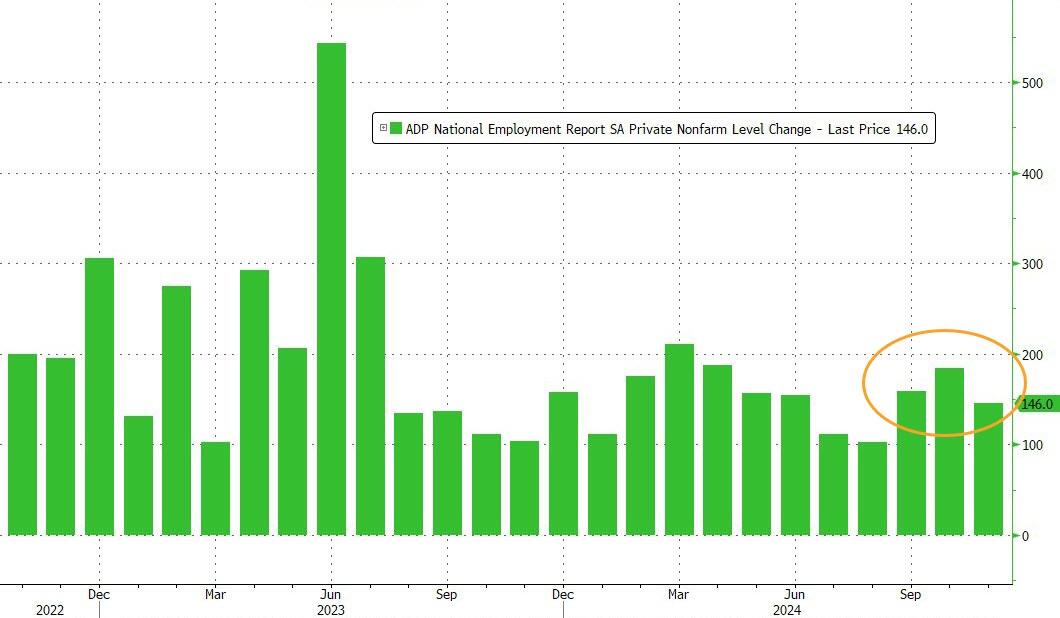
After surging 233k higher in October (biggest jump since July 2023), expectations were for a slowdown in job additions in November to +150k. The reality was a double whammy of pain with October’s surge revised down to just +184k and November’s print missing expectations at +146k…
Source: Bloomberg
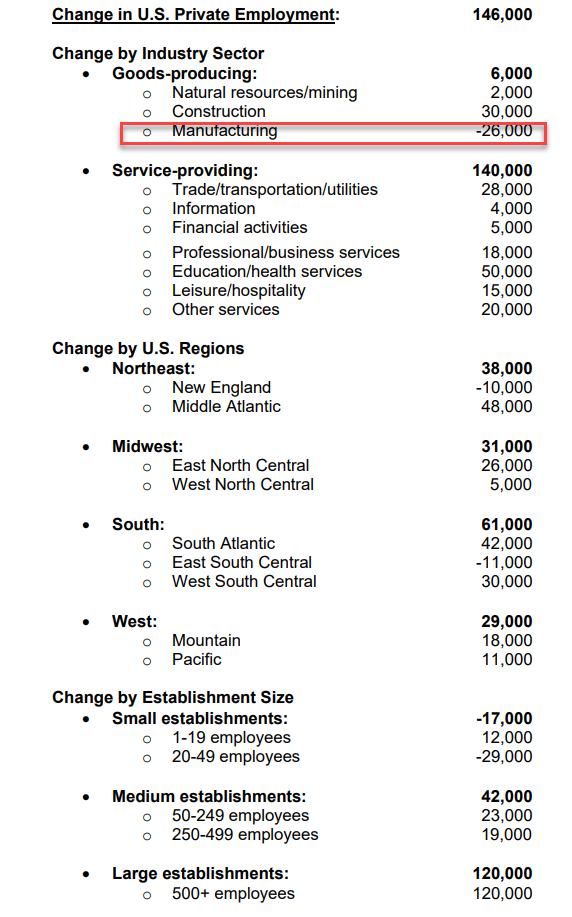
“While overall growth for the month was healthy, industry performance was mixed,” said Nela Richardson, Chief Economist, ADP.
“Manufacturing was the weakest we’ve seen since spring. Financial services and leisure and hospitality were also soft.”
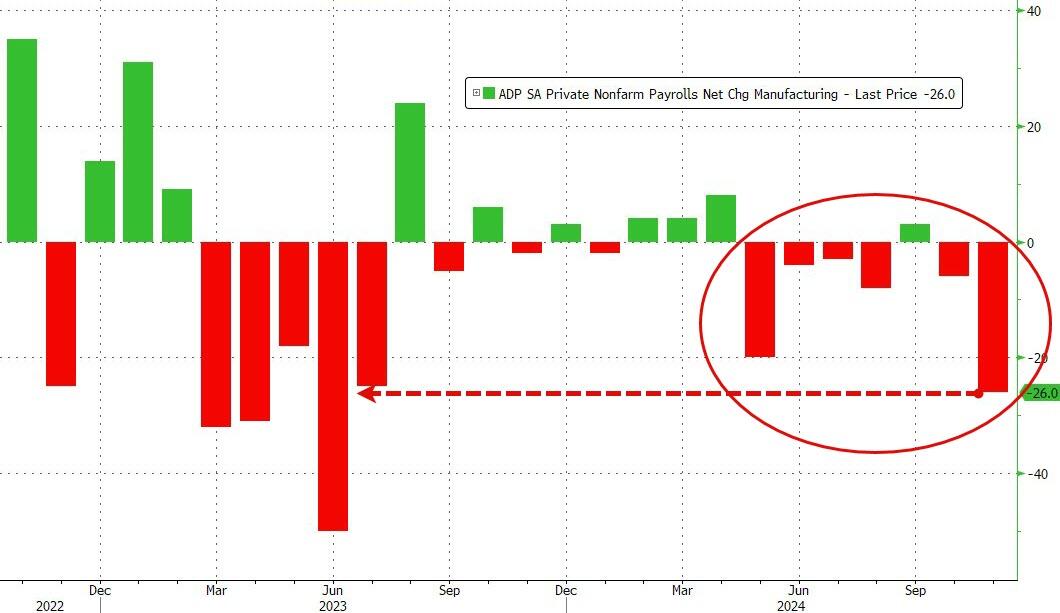
That was the biggest manufacturing job loss since June 2023…
Source: Bloomberg
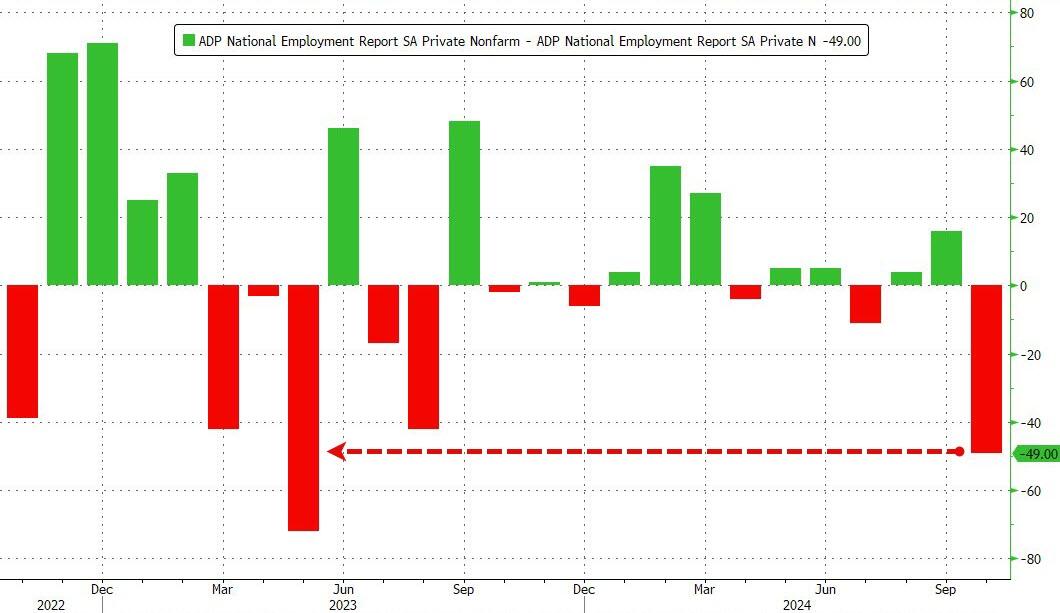
October’s revision was the largest to the downside since May 2023…
Source: Bloomberg
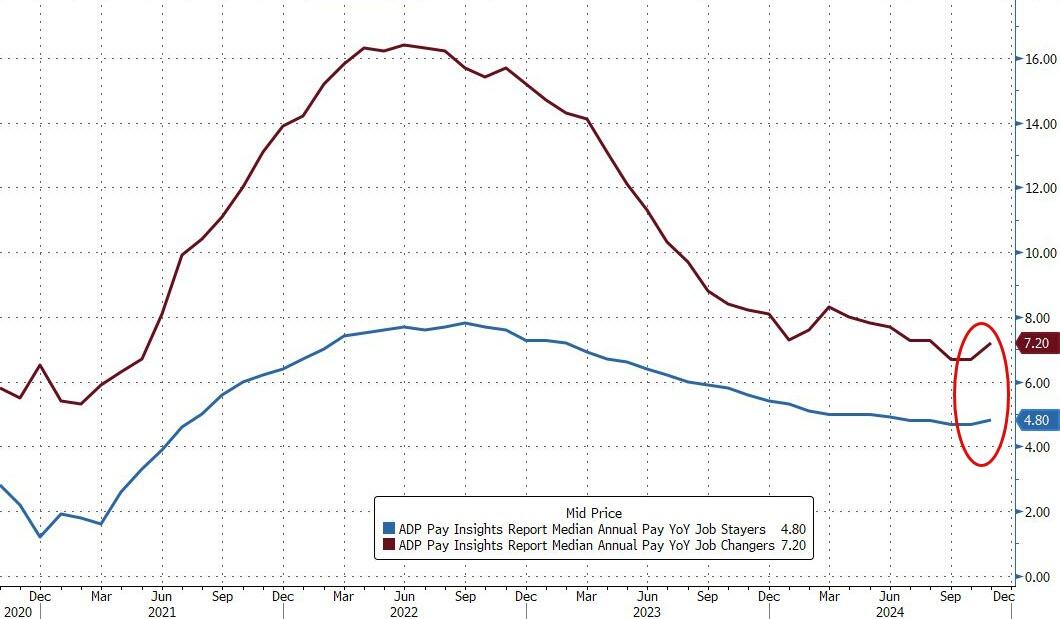
Worse still, wage growth starting to rise again (after unions scored huge wage increases).
Job-changer wage growth rose to 7.20% YoY from 6.70%, highest since August.
Job-stayer wage growth 4.80%, highest since June; year-over-year pay gains for job-stayers edged up for the first time in 25 months
Source: Bloomberg
…of course, all that matters is Friday’s made-up data for The Fed’s decision next week.
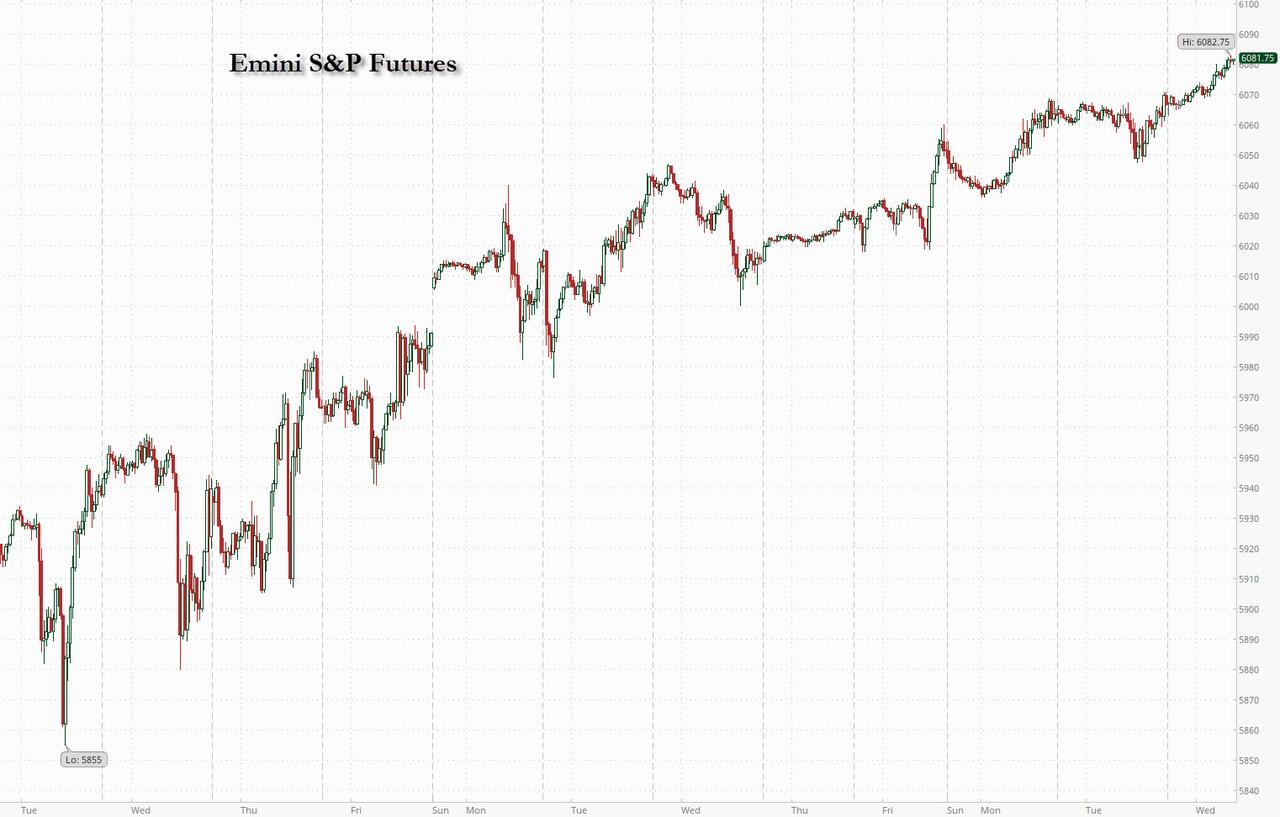
Futures Rise To Fresh Record High Ahead Of Powell Speech, French Government Collapse
Futures are higher following yesterday’s geopolitical events in France and S. Korea – which ironically highlight the stable exceptionalism of the US and its markets. As of 8:00am ET, S&P futures are 0.3% higher, and on pace for a 56th record high in 2024, after closing at the 55th yesterday; Nasdaq futures surge 0.6% boosted by positive earnings from CRM (+13.4% pre-mkt) and MRVL (+13.1% pre-mkt). All of Mag7 are also higher pre-mkt with Semis seeing a bid. The yield curve is twisting steeper with 10Y yield +4bps to 4.26%; the USD is reacting positively and is also higher. The commodity complex is under pressure with crude the outperformer while gold dips. Today’s macro data focus is on Mortgage Applications, ADP and ISM-Services. Fed chair Powell speaks at the Dealbook conference at 1:45pm ET. Shortly after 10am ET, France will hold a no confidence vote that is expected to topple the government of PM Michel Barnier and plunge France into an even deeper crisis.
In premarket trading, Salesforce jumped 12% to a record high after the software company reported fiscal third-quarter results that beat expectations on a number of key metrics. Dollar Tree gained 3% as sales improved in the third quarter, a sign the discounter is making headway in fending off competition and drawing in more shoppers. Foot Locker plunged 15% after the company cut its full-year sales and profit forecasts, citing more discounts and a pullback in consumer spending. Here are some other premarket movers:
General Motors (GM) slid after the carmaker said it will incur more than $5 billion in charges and writedowns tied to its troubled operations in China as the automaker tries to salvage its once-profitable business in the world’s largest car market.
Intuitive Machines (LUNR) sinks 18% as an offering of about 9.52m shares prices at $10.50 each.
Marvell Technology (MRVL) jumps 13% after the chipmaker delivered better-than-expected results and an upbeat earnings forecast, citing demand for artificial intelligence computing.
Novavax (NVAX) rises 2% after the biotech firm signed a pact to sell its manufacturing facility in Bohumil, Czech Republic to Novo Nordisk for $200 million.
Okta (OKTA) jumps 14% after the cloud-software provider posted raised its full-year forecast.
Pure Storage (PSTG) soars 23% after the cloud storage provider’s posted quarterly revenue that beat estimates and announced a big design win.
Royal Bank of Canada beat estimates after setting aside less money than expected for potentially bad loans.
Traders were focused on French markets which are relatively stable for now ahead of Wednesday’s no-confidence vote around 4pm CET that threatens to topple the government. South Korea’s won rebounded after President Yoon Suk Yeol rescinded his shock declaration of martial law.
“Our base case expectation is that the government will lose the vote,” Rabobank strategists wrote in a client note. They say French bonds can weaken further and recommend selling the debt against buying Spanish and Italian peers.
Attention will then turn to Powell’s speech at the Dealbook conference in NY around 1:45pm ET, as well as the latest US Manufacturing PMI and ISM services data in the build-up to Friday’s crucial US jobs report. Fed Bank of San Francisco President Mary Daly said a December rate reduction isn’t certain, but remains on the table.
“The Fed has been quite clear up until now in their signaling, so if they were going to pause Powell might give some signals because they won’t want to surprise the market,” said Guy Miller, chief strategist at Zurich Insurance. “But I do think they will cut by 25 basis points this month.”
The surge in US stocks that has driven the S&P 500 index 27% higher this year shows few signs of fading, according to strategists at Barclays, powered by the election of Donald Trump and a positive economic backdrop. “It is hard to see an end to US exceptionalism any time soon, which we think remains the playbook into 2025,” the team lead by Emmanuel Cau wrote in a research note.
In France, the CAC 40 stocks index rose, marginally outperforming Europe’s regional Stoxx 600 gauge which gained 0.3%, while the yield premium on French bonds over their German equivalents was steady ahead of an upcoming no-confidence vote that could lead to the collapse of the French government. The German DAX climbs to a record high. Sweden’s Hexagon made the biggest leap in the Stoxx 600 index after it nominated former ABB’s former CEO as vice chair. Meanwhile, Signify slipped on a double-downgrade from Barclays on revenue and margins pressure. Here are the biggest movers Wednesday:
Hexagon gains as much as 7.5% after the Swedish industrial technology group’s nomination committee proposed Bjorn Rosengren as the new vice chairman, to be voted on at a May 5 AGM
BE Semiconductor gains as much as 5.8% after being upgraded to buy BofA, which said demand for the chip equipment maker’s tools has probably reached a trough and is poised to recover
Campari shares gain as much as 5.5%, the biggest intraday advance since Sept. 26, after the Italian beverage maker named Simon Hunt its new chief executive officer
Spirax Group shares rise as much as 2.8% after being upgraded to overweight by Barclays, which argues that the selloff in the industrial engineering group has gone too far
Legal & General shares advance as much as 4.3% after the British insurer said that part of the capital not deployed this year would be returned to shareholders
Victrex rises as much as 5% following an upgrade to buy from hold at Jefferies, which says the specialty chemicals company offers an attractive recovery opportunity from cyclical lows
Coca-Cola HBC shares rise as much as 2.8% after analysts at BNP Paribas Exane upgraded the bottling company. Meanwhile, Deutsche Bank hiked its price target
Learning Technologies jumps as much as 7.1% after the e-learning company said it had reached agreement on a recommended acquisition by General Atlantic
Signify shares fall as much as 6.8% after Barclays analysts double-downgraded the Dutch light manufacturer citing pressure on revenue, margins and cash flow next year mostly due to China
Orange shares decline as much as 2.8% after Morgan Stanley downgraded the telecom operator to equal-weight, saying the French firm’s home market is set to see declining Ebitda growth
Maersk shares fall as much as 4% as JP Morgan slashes its price target to a Street-low, while Morgan Stanley becomes the 10th bank to give the shipping firm a sell-equivalent rating
Carlsberg drops as much as 3% after Nordea downgrades the stock to sell and BNP Paribas Exane lowers its rating on the brewer to neutral
The stability in French assets before Wednesday’s vote came as no surprise to Nannette Hechler-Fayd’herbe, EMEA chief investment officer at Lombard Odier. “This is not a crisis of the style we had during 2012 and 2013 with the European debt crisis,” she said on Bloomberg Television. “France has a current account deficit that is tiny when you think about it, which means it has the ability to recycle and fund the government debt internally. That is its strength on which markets can take solace and build on.”
Earlier in the session, Asian stocks fell, poised to snap a three-day advance as a brief imposition of martial law in South Korea overnight spurred risk-off sentiment. The MSCI Asia Pacific Index dropped as much as 0.6% and was on course to snap its longest win streak since September. Financial firms Sumitomo Mitsui and Mitsubishi UFJ were among its biggest drags. South Korea’s Kospi ended the day down 1.4% after President Yoon Suk Yeol briefly declared martial law amid a political tussle, before rescinding it just hours later. Investors are assessing what’s next for South Korea after the opposition Democratic Party said it will pursue charges of treason and impeachment against Yoon for declaring martial law illegally. The Bank of Korea said it will increase short-term liquidity and take “active” steps in currency markets as needed to ensure stability.
“There’s certainly some lingering uncertainty — but the quick response from Korean authorities means that impact on the region could remain limited,” said Charu Chanana, chief investment strategist at Saxo Markets.
Outside of Korea, key gauges also declined in Japan and Australia, while Chinese shares were mixed. Indonesia stocks led gains around the region, while Singapore stocks advanced toward a record high.
In FX, the Bloomberg Dollar Spot Index rose 0.1% while the Aussie dollar slumped after 3Q GDP missed estimates. The yen falls 0.9% to 151 per dollar. The South Korean won climbs 1% versus the dollar while BOK Governor Rhee Chang-yong dismissed cutting rates due to political developments.
In rates, treasuries cheaper across a steeper yield curve — an extension of Tuesday’s price action — ahead of a heavy US economic data slate and an appearance by Fed Chair Powell during the session. US yields are up 1bp-3bp across maturities with 2s10s, 5s30s curves steeper by 1.7bp and 1bp on the day, exceeding Tuesday’s highs; 10-year at 4.26% is ~4bp cheaper on the day with bunds and gilts keeping pace. European markets are also in focus, with Estoxx 50 climbing ahead of a no-confidence vote that could lead to the collapse of the French government. Gilts fell after deriving only brief support from comments by BOE Governor Bailey who said they expect to deliver four 25-bp interest-rate cuts next year. Treasuries and bunds also decline.
In commodities, oil steadied after the biggest advance in more than two weeks. WTI rose 0.6% to $70.40 a barrel. Spot gold falls $3 to $2,641/oz. Bitcoin rises toward $97,000.
Looking at the US economic data calendar we get the November ADP employment change (8:15am), November final S&P Global US services PMI (9:45am), and November ISM services index and October factory orders (10am). • Fed speaker slate includes Musalem (8:45am), Barkin (9am), Powell (1:40pm) and Daly (6pm); Beige Book release at 2pm
Market Snapshot
S&P 500 futures up 0.2% to 6,076.25
STOXX Europe 600 up 0.2% to 516.73
MXAP down 0.5% to 186.65
MXAPJ down 0.1% to 585.41
Nikkei little changed at 39,276.39
Topix down 0.5% to 2,740.60
Hang Seng Index little changed at 19,742.46
Shanghai Composite down 0.4% to 3,364.65
Sensex up 0.2% to 80,978.30
Australia S&P/ASX 200 down 0.4% to 8,462.60
Kospi down 1.4% to 2,464.00
German 10Y yield little changed at 2.08%
Euro down 0.1% to $1.0497
Brent Futures up 0.3% to $73.82/bbl
Gold spot down 0.1% to $2,641.53
US Dollar Index up 0.17% to 106.54
Top Overnight News
South Korea’s opposition submitted an impeachment motion against President Yoon Suk Yeol after he briefly imposed martial law, sparking calls for his resignation. Local stocks closed lower, while the won erased most of its overnight loss. BBG
South Korea’s central bank said it would boost short-term liquidity and take steps to stabilize the currency as needed, but Governor Rhee Chang-yong said it is unlikely the central bank will cut interest rates. BBG
China auto sales surged in November, likely on the back of price cuts and government stimulus initiatives. Retail vehicle sales grew to 2.4 million in November, up 18% compared with last year. BBG
French stocks gained and bond spreads narrowed as President Emmanuel Macron urged lawmakers to reject a no-confidence vote that would topple the government. He said he won’t resign before his term ends. Voting is due to start after 4 p.m. local time. BBG
The BOE has scope to reduce rates at least four times in 2025 if its UK economy outlook bears out, Governor Andrew Bailey said and the FT reported. Inflation has fallen faster than expected a year ago, he said. FT
Final GOP majority in the House will be 220-215 after the last race in California was officially called, but the split will be 217-215 in the opening months of the Trump administration (as Trump is taking two House Republicans into his cabinet and Gaetz resigned). NYT
Robert Lighthizer, the former U.S. trade chief, is unlikely to rejoin the Trump administration in an official capacity. Lighthizer could still be selected by Trump for a formal advisory role in the administration, though his hopes of landing a high-level cabinet job have slipped away. WSJ
President-elect Donald Trump is considering Florida Gov. Ron DeSantis as a possible replacement for Pete Hegseth, his pick to run the Pentagon as Secretary of Defense. WSJ
Advisers to Donald Trump publicly and privately are floating proposals to end the Ukraine war that would cede large parts of the country to Russia and taking NATO membership for Ukraine off the table. Reuters
US Speaker Mike Johnson anticipates the stopgap funding bill will expire in late March 2025. A final decision is expected in the coming days, according to PunchBowl News.
A more detailed look at global markets courtesy of Newsquawk
APAC stocks were mostly subdued with underperformance in South Korea following the martial law declaration and backtrack. ASX 200 was led lower by underperformance in real estate, defensives and financials, while Australian GDP data disappointed. Nikkei 225 swung between gains and losses with price action indecisive amid the lack of Japan-specific catalysts. KOSPI underperformed following South Korean President Yoon’s martial law declaration and subsequent backtracking which has led to calls from within the party to step down and an effort by opposition parties to impeach him for treason. Hang Seng and Shanghai Comp lacked conviction after somewhat mixed PMI data in which Chinese Caixin S ervices PMI missed forecasts but Caixin Composite PMI accelerated, while trade frictions also lingered after China’s MOFCOM banned the export of “dual-use items” relating to gallium, germanium, antimony and super-hard materials to the US.
Top Asian News
South Korean ruling party leaders urged President Yoon to resign from the party and the ruling party leader saw the need to oust the defence chief and suggested that Yoon be kicked out of the party although ruling party lawmakers had various views and were undecided on Yoon’s departure from the party. Furthermore, the main opposition party announced it would seek to impeach President Yoon and it was also reported that South Korea’s Cabinet offered mass resignation.
BoK said it will increase short-term liquidity measures starting Wednesday and will loosen collateral policies in the repo operation to ease any bond market jitters, while it will deploy various measures to stabilise FX as needed and will make any special loans available to inject funds into the market if required.
South Korea’s regulator said it is ready to deploy the KRW 10tln stock market stabilisation fund anytime, according to Yonhap.
South Korean main labour union group called for a general strike until South Korean President Yoon resigns, according to AFP.
South Korea’s metal workers’ union said it will launch a full strike from December 11th unless President Yoon steps down, according to Yonhap.
BoK Governor Rhee suggests more rate cuts are unlikely respite the turmoil; adds “political certainty may have actually increased”; not changing economic outlook, via Bloomberg TV.
South Korea’s Defence Minister offers to resign, according to Yonhap.
European bourses began the session mostly in positive territory, and continued to climb higher as the morning progressed. Today’s Final PMI metrics across Europe were mixed, and ultimately had little impact on price action. European sectors hold a slight positive vs initially opening almost entirely in the green. Autos, Retail and Tech take the top spots – seemingly beneficiaries of the risk-on mood seen in Europe today. Healthcare bottoms the sector list, weighed on by AstraZeneca after it received a PT cut at HSBC. US equity futures are trading on a firmer footing, taking impetus from a mostly positive session in Europe; the NQ is the marginal outperformer so far. ASM International (ASM NA) announces outcome of prelim assessment new export regulations; based on a prelim assessment newly issued US export controls are largely in line with previous assumptions. EU to crack down on Asian online retailers, such as Shein and Temu, according to the FT. Potential charges aim to slow surge of goods sold on sites such as Temu and Shein that evade custom duties and checks. The bloc’s safety authorities have detected a growing number of dangerous and counterfeit goods, many of which are dispatched direct to consumers.
Top European News
BoE’s Bailey said he sees four 25bps BoE rate cuts in 2025, according to the FT. He welcomes recent inflation developments, and added the MPC has emphasised gradual outlook for rates, and the disinflation process is well embedded but there is further to travel. He noted inflation impact of higher trade tariffs are not straightforward at all.
ECB’s Holzmann said a 25bps rate cut is conceivable in December and not more, while he added nothing is decided on the next rate move and it will depend on data available at the December meeting. Furthermore, he stated that US President-elect Trump is casting a shadow over inflation in Europe and will probably drive up the inflation forecast.
ECB policymaker and Bundesbank President Nagel said the German economy faces a weak outlook and 2025 is likely to be another year of weak growth, while he also called for a softer debt brake to ramp up investment, according to FT.
ECB’s Rehn said he sees more grounds for the ECB to cut rates in December, sees policy easing continuing in the coming months.
ECB’s Vujcic said a December rate decision will not be difficult, small steps on rates are better amid uncertainty, other ECB officials broadly agree on rates, via Politico.
FX
DXY a touch higher with the USD showing greater performance vs. JPY and the antipodeans. Recent Fed commentary has continued to talk up the possibility of a rate cut on 18th December. Markets will be looking for greater clarity from Fed Chair Powell later in the session; but before that, traders will look out for US ADP and ISM services.
EUR is slightly softer vs. the USD ahead of today’s French no confidence vote on PM Barnier’s government; a motion Barnier is expected to lose. Lagarde is due to speak at 13:30GMT but is unlikely to sway the 25bps vs. 50bps debate. EUR/USD has continued to pivot around the 1.05 mark and currently sits within yesterday’s 1.0480-1.0535.
JPY on the backfoot vs. the USD with USD/JPY continuing to chop around the 150 mark with prices consolidating after the recent declines in USD/JPY.
GBP has been knocked lower in recent trade following dovish remarks from BoE Governor Bailey who stated that he sees four 25bps rate cuts in 2025; Note, market pricing ahead of his comments looked for three 25bps rate cuts next year. Cable slipped further onto a 1.26 handle, tripping below Tuesday’s low at 1.2637.
AUD is the laggard across the majors following soft domestic Q3 GDP data overnight which has seen money markets fully price an RBA rate cut for the April 2025 meeting. NZD/USD is lower but to a lesser extent; session low at 0.5832.
PBoC set USD/CNY mid-point at 7.1934 vs exp. 7.2821 (prev. 7.1996)
Fixed Income
The US curve is modestly bear-steepening after yesterday’s Waller induced bull-steepening. Commentary from Fed officials since from the likes of Daly has done little to talk up the odds of a pause later this month. Today sees US ADP, ISM Services ahead of Chair Powell at 18:45 GMT. Mar’25 UST has broken below Tuesday’s low and is eyeing the WTD trough at 110.23.
Bunds/OATs are trading on the backfoot as traders await today’s no confidence vote in French PM Barnier; a motion Barnier is expected to lose. DE/FR spread has narrowed to just below 85bps having peaked just shy of 89bps on Monday. Today’s German 2034 Bund auction passed without issue.
Gilts have seen a pick-up in recent trade (but are ultimately softer on the session) following dovish remarks from BoE Governor Bailey who stated that he sees four 25bps rate cuts in 2025. Note, market pricing ahead of his comments looked for three 25bps rate cuts next year. Mar’25 Gilts rose from 95.82 to 96.06 within a few minutes to then stabilise around 96.00 ahead of a 2031 auction, which was fairly weak; the results sparked some fleeting pressure in Gilt prices.
UK sells GBP 4bln 4.0% 2031 Gilt: b/c 2.91x (prev. 3.42x), average yield 4.155% (prev. 3.988%), tail 0.8bps (prev. 0.2bps)
WTI and Brent are relatively flat and within a tight range ahead of Thursday’s OPEC+ meeting slated for tomorrow at 11:30 GMT. Recent geopolitical developments include reports that “Israeli forces opened fire on Lebanese army forces during their inspection of the port of Naqoura”. A WSJ article reported that Saudi Arabia is aiming to keep oil prices elevated rather than chase market share; news which fuelled some marginal upside in the complex, which ultimately proved fleeting. Brent Feb trades in a USD 73.54-74.17/bbl.
Precious metals are generally subdued intraday against the backdrop of a slightly firmer Dollar, whilst major newsflow for the yellow metal remains sparse in the run-up US ISM Services PMI, Fed Chair Powell, and then Friday’s US Jobs data. Spot gold resides in a tight USD 2,636.73-2,651.45/oz parameter.
Mostly subdued trade across base metals amid a slightly firmer Dollar, but despite a mildly firmer risk tone elsewhere. 3M LME copper trades in a narrow USD 9,076.50-9,133.50/t range.
OPEC+ meeting to take place tomorrow at 12:30 Vienna (11:30 GMT), according to Energy Intel.
Saudi Arabia reportedly aims to keep oil prices elevated rather than chase market share, according to WSJ; Saudi reportedly averse to a price war with US shale. “Delegate noted that Angola already quit the cartel, and speculated that other countries could soon follow as a result of the policy”.
Geopolitics: Middle East
“Israeli forces opened fire on Lebanese army forces during their inspection of the port of Naqoura”, according to Al Arabiya
The Israel-Hezbollah ceasefire agreement “will endure and not collapse despite all the shocks it has experienced since its announcement”, according to a government source via Lebanese newspaper cited by Israeli journalist. “According to him, nothing has changed since reaching the agreement in terms of the political reality and the reality on the ground that led to its formulation. “The agreement was not forged so that it would collapse within a few days.”
Syrian army announced the entry of the largest military convoy to the countryside of Hama to support the forces deployed on the fronts, according to Al Arabiya.
Iran’s Deputy Foreign Minister of Political Affairs yesterday warned of possible NPT withdrawal if UN ‘snapback’ mechanism triggered, via IRNA citing a top lawmaker.
Geopolitics: Ukraine
Russian defence units were reportedly engaged in repelling a Ukrainian drone attack on Russia’s Novorossiisk, while the report added that the Black Sea port of Novorossiisk is one of Russia’s most important oil export gateways.
Geopolitics: Other
US and South Korea postponed planned defence talks and joint military exercises that were scheduled this week.
China’s Coast Guard said four Philippine Coast Guard ships attempted to enter China’s territorial waters around Scarborough Shoal and the ships dangerously approached China’s normal law enforcement patrol vessels, while it stated that China exercised control over the Philippine ships in accordance with the law. However, Philippine’s Coast Guard said Philippine vessels encountered aggressive actions from several Chinese Coast Guard vessels and the Chinese Coast Guard fired a water cannon against Philippine vessels, as well as “intentionally sideswiped” a Philippine vessel on the starboard side.
US Event Calendar
07:00: Nov. MBA Mortgage Applications, prior 6.3%
08:15: Nov. ADP Employment Change, est. 150,000, prior 233,000
09:45: Nov. S&P Global US Services PMI, est. 57.0, prior 57.0
10:00: Oct. Durable Goods Orders, est. 0.2%, prior 0.2%
Oct. Durables Less Transportation, est. 0.1%, prior 0.1%
Oct. Cap Goods Ship Nondef Ex Air, prior 0.2%
Oct. Cap Goods Orders Nondef Ex Air, est. -0.2%, prior -0.2%
10:00: Oct. Factory Orders Ex Trans, prior 0.1%
Oct. Factory Orders, est. 0.2%, prior -0.5%
10:00: Nov. ISM Services Index, est. 55.7, prior 56.0
14:00: Federal Reserve Releases Beige Book
Central Bank Speakers
08:45: Fed’s Musalem Speaks on US Economy, Policy
13:45: Fed’s Powell Speaks in Moderated Discussion
14:00: Federal Reserve Releases Beige Book
DB’s Jim Reid concludes the overnight wrap
The last 24 hours have been very unusual in the world of DM governments and the next 24 hours are going to be equally unprecedented. South Korean President Yoon Suk Yeol declared martial law in an astonishing move yesterday afternoon European time (late Korean time) and then later reversed the decision after a vote against it by the National Assembly in the early hours their time. Now today the French government could see the first successful no-confidence votes since 1962.
As soon as we saw the announcement in South Korea, the Won plunged -2.67% against the US Dollar at the lows, but more than halved those losses after a parliamentary vote rejected the move with 190 out of 300 lawmakers managing to return to parliament to all vote against the motion. The opposition controls 170 seats so this was always a move that was unlikely to get ratified. President Yoon has since lifted martial law but the opposition are now demanding the President immediately resign or face impeachment. In fact as I press send, impeachment proceedings have begun. The Won has now recovered most of its losses from yesterday and is just over half a percent below level prior to the drama.
This morning the KOSPI is -1.39% lower having been as low as -2.3% earlier. Samsung (South Korea’s biggest company) is trading -1.49% lower after tumbling as much as -3% initially this morning after yesterday seeing its depositary receipts in London fall by nearly -7.5% at the lows before also paring this back after the parliamentary vote to close down -3.7%. The turn in Korean assets yesterday was also helped by the Finance Ministry saying that it planned to “deploy all possible market-stabilizing measures,” including “unlimited liquidity” just as the parliamentary vote was convened. This morning there have been more specifics with South Korea’s financial regulator indicating that it stands ready to activate 10 trillion won ($7.07 billion) in a stock market stabilisation fund to reduce market volatility. So for now we have a much calmer situation, but given how important South Korea is to the global supply chain this remains a story to keep on our radar.
One story that is unlikely to evade our radar is the one in France. The no confidence debate is set to kick off at 4pm local time today (3pm London), and voting will happen around three hours later. But since Marine Le Pen announced on Monday that her party would vote to bring down the government, it would now require someone to shift position unexpectedly in order for Barnier to win. So the general sense is that this vote could be successful. If so, there isn’t an obvious route forward on what happens next, as even though President Macron has to propose a new PM (which could be Barnier again), we know from Barnier’s own appointment that this is a completely fractured National Assembly where it’s proven impossible so far for a majority to coalesce. Moreover, the French Constitution means they have to wait a year from the last legislative election before another vote can take place, so that isn’t an immediate option either.
Last night President Macron tried to strike an optimistic tone, saying the National Rally choosing to vote for the no-confidence measure, “would be a vote of unbearable cynicism” and did not think they could side with the far-left flank. He also noted that he would not resign as President until his full term has ended in 2027, even as the left has called for him to step down.
From a market point of view, the Franco-German 10yr spread did tighten a bit yesterday, coming down -3.1bps to 85.0bps.
However, they’re still very high by the standards of the last decade, only just coming off their Monday level which was the widest since 2012. Moreover, French equities continued to underperform, with the CAC 40 (+0.26%) lagging behind the STOXX 600 (+0.37%) once again. And banks experienced further declines, with Société Générale (-0.68%), BNP Paribas (-0.29%) and Crédit Agricole (-0.40%) all losing ground.
Away from all the political developments, markets were fairly steady overall, with investors looking forward to the US jobs report on Friday as the next catalyst. Nevertheless, there was a clear intra-day selloff for US Treasuries, after the latest JOLTS report showed a tighter labour market than expected. For instance, the number of job openings rose more than expected to 7.744m in October (vs. 7.519m expected). In addition, the quits rate of those voluntarily leaving their jobs rose to 2.1%, the highest since May. So that added to investors’ confidence that the labour market was holding up.
After Fed Governor Waller indicated on Monday that he was leaning toward supporting a rate cut this month, there was a bit extra attention on speakers yesterday. Overall, the dovish bent continued, albeit less enthusiastically. Federal Reserve Bank of San Francisco President Daly noted that further cuts were coming, saying “Whether it’ll be in December or some time later, that’s a question we’ll have a chance to debate and discuss in our next meeting, but the point is we have to keep policy moving down to accommodate the economy.” This echoed Chicago Fed President Goolsbee’s sentiment that interest rates will “come down a fair amount from where they are now”. Additionally, Fed Governor Kugler said the economy was in a “good position” and that price pressures were on a “sustainable path” toward the Fed’s 2% target. The one semi-hawkish note was from President Daly, who noted that the neutral rate has likely moved up “closer to 3%” now.
With that data in hand and Fed speakers a bit more equivocal, futures slightly dialled back the likelihood that the Fed would cut rates in two weeks’ time, with the probability falling from 76% to 70% by the close. 2yr yields were largely unchanged by the close, at 4.179%, whilst the 10yr yield was up +3.5bps to 4.225% and off the pre-JOLTS/South-Korea-Martial-Law lows for the session of 4.17%. Meanwhile in Europe, 10yr bund yields ended the session up +2.0bps at 2.05%, whilst those on 10yr gilts (+3.1bps) moved up to 4.24%.
For equities, it was a subdued day in the US with the S&P 500 (+0.05%) seeing little movement, with the index just making yet another record high. Tech stocks saw a slight outperformance, with the Magnificent 7 (+0.86%) and the NASDAQ (+0.40%) both inching up to record highs of their own. But small-caps struggled, with the Russell 2000 (-0.73%) falling back. Over in Europe however, the story was one of more consistent positivity, with the STOXX 600 (+0.37%) advancing for a 4th consecutive session, including outperformances from Spain’s IBEX 35 (+1.18%) and Italy’s FTSE MIB (+1.03%).
Coming back to Asia, equity markets are recovering after a weak open following the political drama in South Korea. The Nikkei (+0.27%) and Hang Seng (+0.27%) have now moved higher even as the S&P/ASX 200 (-0.38%), the CSI (-0.21%) and the Shanghai Composite (-0.07%) remain lower. S&P 500 (+0.13%) and NASDAQ 100 (+0.37%) futures are higher.
Early morning data showed that 3Q24 GDP for Australia missed on the downside, coming in at +0.3% QoQ, below the +0.5% figure that had been forecast. It followed growth of just +0.2% QoQ in the previous three quarters. Following the release, the Aussie (-0.72%) is losing ground trading at 0.6439 against the dollar. Elsewhere, China’s services sector delivered a surprise slowdown as the Caixin/S&P Global services PMI fell to 51.5 (v/s 52.4 expected) from 52.0 in October. The downbeat data aligns with the official PMI released on Saturday, which showed non-manufacturing activity weakened to 50.0.
To the day ahead, and data releases from the US include the ISM services for November, the ADP’s report of private payrolls for November, as well as the final November services and composite PMIs from around the world. From central banks, we’ll hear from the Fed Chair Powell, the Fed’s Musalem, Barkin and Daly, ECB President Lagarde, and the ECB’s Cipollone, Makhlouf and Nagel, along with BoE Governor Bailey. Separately, the Fed will release their Beige Book.
If for no other reason than that it will elicit fear in the hearts of autocracy-phobics, I propose that Donald Trump’s second-term Cabinet be known as “The Wild Bunch.”
The name is best known as the title of Sam Peckinpah’s classic 1969 western featuring a colorful cast of aging outlaws – William Holden, Ernest Borgnine, Edmond O’Brien, Warren Oates, and Ben Johnson – who give it their all as they battle bounty hunters, the Mexican Federal Army, and the passage of time in order to make their mark while they still have a chance.
Substitute the legacy media and special interests for the bounty hunters and Mexican army, and that about sums up the desperate last-chance mission of the ragtag band Trump has put together to carry out his mandate of meaningful change in a government grown fat and corrupt for the past half-century.
We don’t need to belabor the point. Trump’s appointees aren’t outlaws, but they certainly have the federales worried – the so-called administrative state, the people who have been wearing badges and making the rules. Because this Wild Bunch looks like they mean business. If they get approved, they will be kicking ass and taking names.
It’s a far cry from Trump’s first Cabinet, which he appointed with the permission of the administrative state. The outsider president didn’t know enough yet – or have enough power – to buck the system. He went with consensus choices who, at best, might talk about change but would be hesitant to effect it. Half of them shot Trump in the back; most of the rest were disloyal to his face, along with the congressional power brokers who put up roadblocks to every meaningful reform.
It’s not hard to think of Trump as Pike Bishop, the William Holden character in “The Wild Bunch” who leads what’s left of his gang out of a disastrous gunfight at the beginning of the movie and then plans his next move. At one point, Pike tells his trusted lieutenant, “This is our last go-around, Dutch. This time, we do it right.”
That’s where Trump is now, at age 78, sensing the insufficiency of his first term and wanting to make a real difference the second time around. This time, we do it right.
The president-elect has wasted no time in assembling his team of rabble-rousers. You can break the mayhem down into four discrete buckets – justice, health, national security, and economic overhaul – and it looks like, if he gets his way, Trump’s second term could be historic. Throw in the government reinvention project spearheaded by rogue entrepreneurs Elon Musk and Vivek Ramaswamy and you are well on your way to the second American revolution. No wonder the political establishment will stop at nothing to crush Trump and his appointees before they can begin the reforms they promised.
The old guard may have celebrated when they took down the proposed appointment of Rep. Matt Gaetz as attorney general, but they won nothing. Trump’s replacement nominee, former Florida attorney general Pam Bondi, will work just as hard as Gaetz to shake up the Department of Justice. As one of Trump’s attorneys in his first impeachment trial, she has intimate knowledge of how the Deep State can aim the full force of the federal bureaucracy on an individual to destroy him or her.
It’s no accident that the Trump transition team has declined FBI background checks on his nominees and appointees. Remember, this is the same FBI that entrapped Trump’s national security adviser Michael Flynn in the early days of his first administration. Not to mention the FBI that let President Trump be impeached for questioning Joe Biden’s role in Ukrainian corruption, even though the agency was in possession of Hunter Biden’s laptop that would have vindicated Trump if it had been released.
You can bet that Bondi, assisted by Trump’s criminal lawyer Todd Blanche in the role of deputy attorney general, will remove any Justice Department employees who pursue charges against anyone for political purposes. Those days are over.
But that’s just the beginning, and although the Justice Department overhaul may bring the most significant changes immediately, the appointment of Robert F. Kennedy Jr. as secretary of Health and Human Services could result in long-term changes of even greater impact.
Anyone who has noticed the prevalence of advertising for wonder drugs on cable news probably can understand the concern that Big Pharma has an outsized impact on the health narrative being told in mainstream media. Multiply that concern by a dozen when you measure the influence that drug companies have not just on Congress and health regulatory agencies but on the medical industry itself.
Bobby Kennedy has no fear of Big Pharma or the scientific establishment and he is willing to demand accountability for the kinds of policy decisions that led to our disastrous COVID policies four years ago. Is he right about everything? No, but he asks the right questions – questions that until now no one in power has dared to raise.
What about national security? There are problems everywhere, none bigger than China, which has been the missing link in U.S. foreign policy for the past four years. Does President Biden even have a China policy? You would be hard-pressed to find it, unless it is appeasement. No response to the flow of fentanyl into the U.S. No response to the cold war with the Philippines or the creation of Chinese naval bases in the South China Sea. No response to the increasing pressure tactics employed against our crucial trading partner, Taiwan. No response to China cracking down on human rights and free speech in Hong Kong. No response to China’s creation of a spy base in Cuba in violation of the Monroe Doctrine. No response to China’s predatory trade practices using slave labor.
You can expect the silence from the State Department to end when Sen. Marco Rubio is approved by the Senate as the new secretary of state. China is on notice, but other hot spots around the globe will also be addressed by Trump’s national security team, which includes former Rep. Tulsi Gabbard as director of national intelligence and Rep. Michael Waltz as national security adviser. Trump promised to negotiate a settlement to the frightful war in Ukraine, and by appointing Gen. Keith Kellogg as special envoy to Ukraine and Russia, Trump is signaling that the killing has to end.
National security and the economy overlap in at least two crucial areas – illegal immigration and Trump’s plan to use tariffs as a tool to tame our allies and confound our adversaries. Treasury Secretary-designate Scott Bessent has made it clear that he will work with Trump to use tariffs to reshape the global economy and lessen the national debt.
That will be a key ingredient as Trump’s national security team works to deport the millions of illegals who have developed a dangerous symbiosis with the labor economy. Trump knows we can’t merely overlook the lawbreakers without surrendering our moral superiority, but the trick will be to find economic resources to make whole the industries like agriculture that will need to reinvent themselves with a legal work force.
In the first Trump administration, the response to Trump’s plans for massive change was “Why?” But now the response is “Why not?” As Trump asked black voters in 2016, “What do you have to lose?” Now that question is being posed to the entire nation, which has been sleepwalking toward the abyss for too long. If we don’t solve illegal immigration, the national debt, and the corporate stranglehold on our regulatory agencies and Defense Department, then there won’t be anything left to lose. That’s why nearly 60% of Americans support Trump’s transition, despite the fear-mongering of Rachel Maddow, the New York Times, and Biden’s White House.
In one last parallel between the cinematic “Wild Bunch” and Trump’s political variation, it is worth noting that Trump and his team know exactly what they are getting into. The Deep State isn’t going to take kindly to the president turning off the spigot of easy money for lobbyists, Big Pharma, and the military-industrial complex. But don’t expect Trump to back down.
In a crucial scene in the film, as the outlaws plot their revenge, Ernest Borgnine warns William Holden that “They’ll be waitin’ for us.”
Holden responds: “I wouldn’t have it any other way.” Neither would Trump or any of the 77 million deplorables who joined his gang on Nov. 5.
Frank Miele, the retired editor of the Daily Inter Lake in Kalispell, Mont., is a columnist for RealClearPolitics. His book “The Media Matrix: What If Everything You Know Is Fake” is available from his Amazon author page. Visit him at HeartlandDiaryUSA.com or follow him on Facebook @HeartlandDiaryUSA and on X/Gettr @HeartlandDiary.
VC Head Reveals “Most Important Graph Ever Conceived”
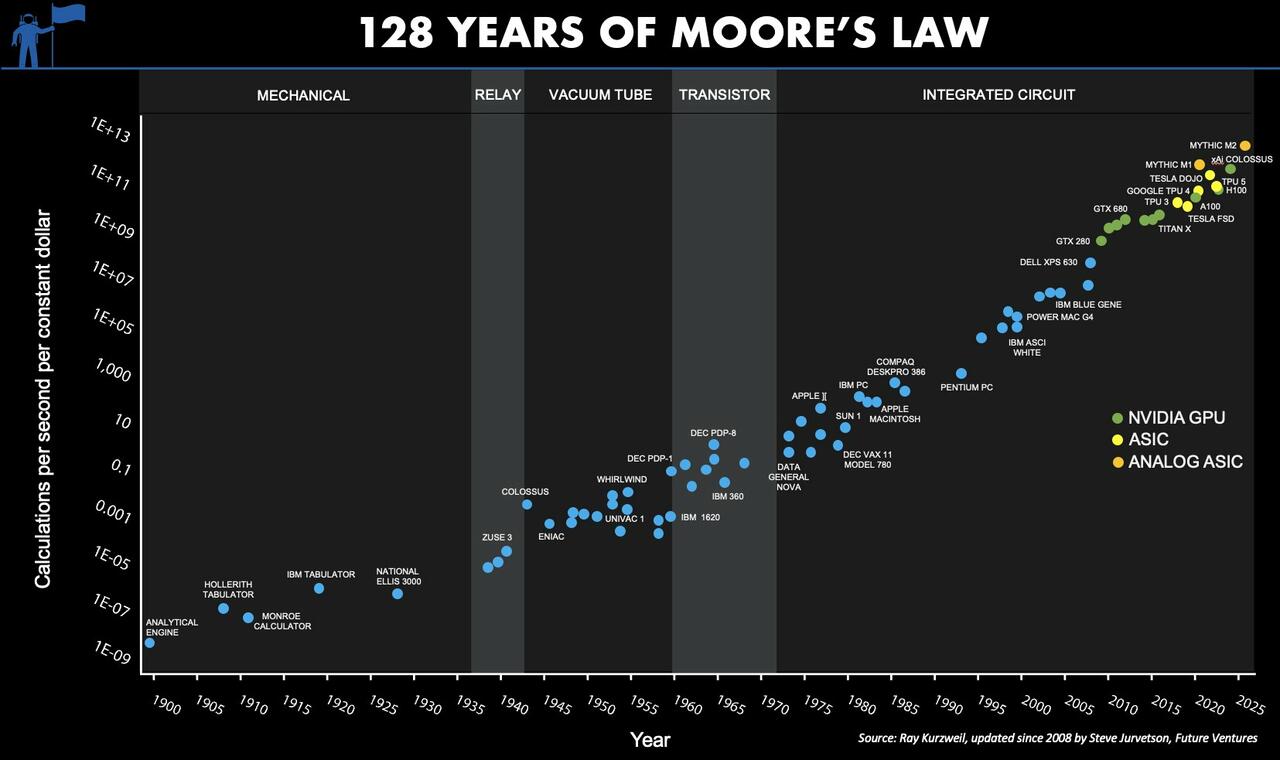
American businessman and venture capitalist Stephen Jurvetson laid out over a century of Moore’s Law on computational power advancements in a post on X.
Jurvetson, the founder of Future Ventures who funded Skype, SpaceX, Tesla, Zoox, Boring Company, and other startups, color-coded the transition from mechanical to relay to vacuum tube to transistor and finally to integrated circuits.
He pointed out that “Moore’s Law has transitioned most recently from the GPU (green dots) to the ASIC (yellow and orange dots), and the NVIDIA Hopper architecture itself is a transitionary species—from GPU to ASIC, with 8-bit performance optimized for AI models, the majority of new compute cycles.”
He made forecasts about chip advancements:
Custom ASIC chips and future analog in-memory compute technologies offer even closer biomimicry of the human brain, further advancing AI capabilities.
Moore’s Law is expected to persist for at least another 20 years, enabling continued cost reductions in computational power and storage.
Jurvetson emphasized, “I would go further and assert that this is the most important graph ever conceived.”
He added: “Every industry on our planet is going to become an information business.”
. . .
The Moore’s Law Update
NOTE: this is a semi-log graph, so a straight line is an exponential; each y-axis tick is 100x. This graph covers a 1,000,000,000,000,000,000,000x improvement in computation/$. Pause to let that sink in.
Humanity’s capacity to compute has compounded for as long as we can measure it, exogenous to the economy, and starting long before Intel co-founder Gordon Moore noticed a refraction of the longer-term trend in the belly of the fledgling semiconductor industry in 1965.
I have color coded it to show the transition among the integrated circuit architectures. You can see how the mantle of Moore’s Law has transitioned most recently from the GPU (green dots) to the ASIC (yellow and orange dots), and the NVIDIA Hopper architecture itself is a transitionary species — from GPU to ASIC, with 8-bit performance optimized for AI models, the majority of new compute cycles.
There are thousands of invisible dots below the line, the frontier of humanity’s capacity to compute (e.g., everything from Intel in the past 15 years). The computational frontier has shifted across many technology substrates over the past 128 years. Intel ceded leadership to NVIDIA 15 years ago, and further handoffs are inevitable.
Why the transition within the integrated circuit era? Intel lost to NVIDIA for neural networks because the fine-grained parallel compute architecture of a GPU maps better to the needs of deep learning. There is a poetic beauty to the computational similarity of a processor optimized for graphics processing and the computational needs of a sensory cortex, as commonly seen in the neural networks of 2014. A custom ASIC chip optimized for neural networks extends that trend to its inevitable future in the digital domain. Further advances are possible with analog in-memory compute, an even closer biomimicry of the human cortex. The best business planning assumption is that Moore’s Law, as depicted here, will continue for the next 20 years as it has for the past 128. (Note: the top right dot for Mythic is a prediction for 2026 showing the effect of a simple process shrink from an ancient 40nm process node)
—-
For those unfamiliar with this chart, here is a more detailed description:
Moore’s Law is both a prediction and an abstraction. It is commonly reported as a doubling of transistor density every 18 months. But this is not something the co-founder of Intel, Gordon Moore, has ever said. It is a nice blending of his two predictions; in 1965, he predicted an annual doubling of transistor counts in the most cost effective chip and revised it in 1975 to every 24 months. With a little hand waving, most reports attribute 18 months to Moore’s Law, but there is quite a bit of variability. The popular perception of Moore’s Law is that computer chips are compounding in their complexity at near constant per unit cost. This is one of the many abstractions of Moore’s Law, and it relates to the compounding of transistor density in two dimensions. Others relate to speed (the signals have less distance to travel) and computational power (speed x density).
Unless you work for a chip company and focus on fab-yield optimization, you do not care about transistor counts. Integrated circuit customers do not buy transistors. Consumers of technology purchase computational speed and data storage density. When recast in these terms, Moore’s Law is no longer a transistor-centric metric, and this abstraction allows for longer-term analysis.
What Moore observed in the belly of the early IC industry was a derivative metric, a refracted signal, from a longer-term trend, a trend that begs various philosophical questions and predicts mind-bending AI futures.
In the modern era of accelerating change in the tech industry, it is hard to find even five-year trends with any predictive value, let alone trends that span the centuries.
I would go further and assert that this is the most important graph ever conceived. A large and growing set of industries depends on continued exponential cost declines in computational power and storage density. Moore’s Law drives electronics, communications and computers and has become a primary driver in drug discovery, biotech and bioinformatics, medical imaging and diagnostics. As Moore’s Law crosses critical thresholds, a formerly lab science of trial and error experimentation becomes a simulation science, and the pace of progress accelerates dramatically, creating opportunities for new entrants in new industries. Consider the autonomous software stack for Tesla and SpaceX and the impact that is having on the automotive and aerospace sectors.
Every industry on our planet is going to become an information business. Consider agriculture. If you ask a farmer in 20 years’ time about how they compete, it will depend on how they use information — from satellite imagery driving robotic field optimization to the code in their seeds. It will have nothing to do with workmanship or labor. That will eventually percolate through every industry as IT innervates the economy.
Non-linear shifts in the marketplace are also essential for entrepreneurship and meaningful change. Technology’s exponential pace of progress has been the primary juggernaut of perpetual market disruption, spawning wave after wave of opportunities for new companies. Without disruption, entrepreneurs would not exist.
Moore’s Law is not just exogenous to the economy; it is why we have economic growth and an accelerating pace of progress. At Future Ventures, we see that in the growing diversity and global impact of the entrepreneurial ideas that we see each year — from automobiles and aerospace to energy and chemicals.
We live in interesting times, at the cusp of the frontiers of the unknown and breathtaking advances. But, it should always feel that way, engendering a perpetual sense of future shock.
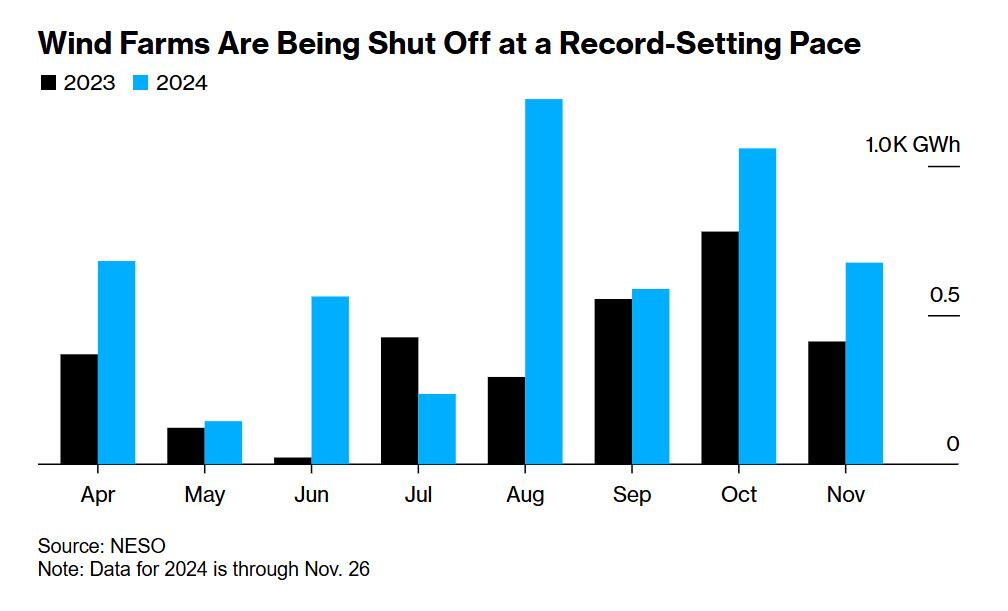
Burgeoning capacity and blustery weather should have driven huge growth in output in 2024. But the grid can’t cope, forcing the operator to pay wind farms to turn off, a cost ultimately borne by consumers. It’s a situation that puts at risk plans to decarbonize the network by 2030 and makes it harder to cut bills.
Crucial to the net zero grid target is a massive build-out of renewable power, particularly from wind. Britain has boosted its offshore fleet by 50% in the past five years and is set to double it in the next five, Bloomberg data show.
But the grid hasn’t expanded at the same pace. As a result, the operator is increasingly paying wind farms, particularly those in Scotland, not to run. So far this year, the UK has spent more than £1 billion ($1.3 billion) in “congestion costs” to turn off plants that can’t deliver electricity because of grid constraints, and switch on others.
Last month for example, when Storm Bert swept across the UK, some of its newest and biggest wind parks were still. Scotland’s £3 billion Seagreen project, owned by SSE Plc and TotalEnergies SE, was shut off. SSE’s Viking development on the Shetland Islands was also closed.
Wind vs Gas
UK generators usually sell output in advance on the wholesale market. But those transactions don’t take into account the physical limitations of balancing supply and demand in real time. To keep the lights on, the operator steps in, paying some plants to turn off and others that are closer to demand centers to fire up.
Often, this means shutting off a far-flung wind farm and starting up a gas-fed plant that’s closer to a city.
Absurd Setup
“It’s absurd that Britain pays Scottish wind farms to turn off when it’s windy, while simultaneously paying gas-power stations in the south to turn on,” said Clem Cowton, director of external affairs at supplier Octopus Energy Group.
I don’t believe we need an energy director to diagnose the complete absurdity of this arrangement.
Which of These Headlines Are Real?
Southern Wife Arrested for Failing to Serve Drinks in Mason Jars
UK Pays Wind Farms $1.3 Billion to Shut Down When It’s Windy
FBI Warns Kash Appointment Could Jeopardize Efforts to Not Release Epstein List
Trump Renews Relations with Castro Regime
It is sometimes very difficult to distinguish between real and fake headlines.
In the above list, only number 2 is real. The others are from the Babylon Bee.
Wind Losses Are Huge
General Electric (GE): GE’s offshore wind business expects to lose about $1 billion in 2023 and 2024. This is due to a number of challenges, including:
Inflation
High interest rates
Supply chain bottlenecks
Rising costs for components
Siemens: Lost nearly $1 billion on wind last year
Vestas: Saw an operating profit decline of 369%
Increased costs: Commodity prices, including for steel and copper, have increased, as well as construction and operating costs
Regulatory process: The regulatory process takes about six years, while other countries are building projects at a faster pace
Lawsuits and disinformation: Lawsuits from advocacy groups and disinformation campaigns from astroturfing groups have slowed development
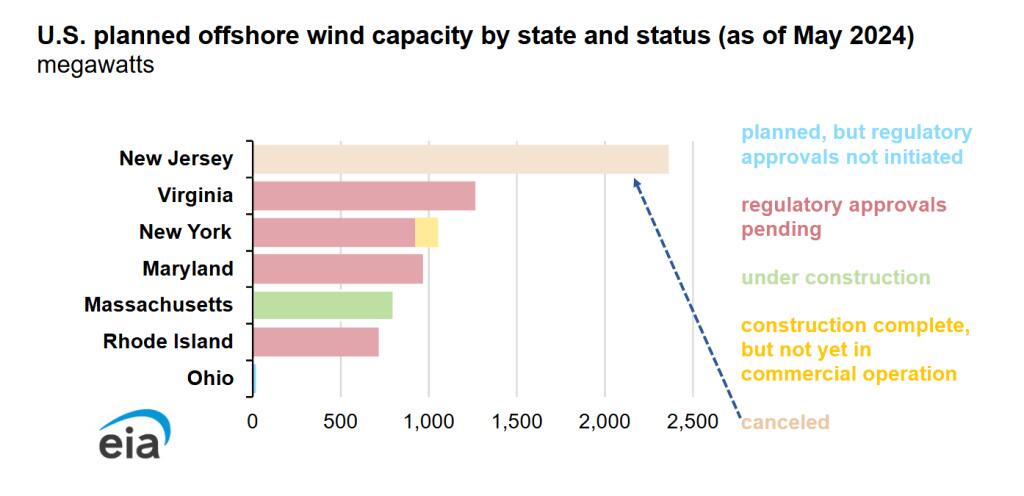
The amount of offshore wind generating capacity that is under construction or planned in the United States is in flux after two projects in New Jersey were canceled last year. Of the 7,200 megawatts (MW) of capacity reported in May in EIA’s latest Preliminary Monthly Electric Generator Inventory, projects totaling about 2,400 MW have been canceled since last December while others totaling 4,800 MW remain active in various stages of development.
Cancelled Projects
In late 2023, developer Orsted canceled the 2,400-MW Ocean Wind 1 and 2 projects in New Jersey, citing rising interest rates, high inflation, and supply chain delays.
In January, Orsted withdrew from commitments to the Maryland Public Service Commission to build the Skipjack 1 and 2 projects, totaling 966 MW, but is still continuing with advanced development and permitting.
Late last year, the developer of the 20-MW Icebreaker Wind project on the Ohio coast of Lake Erie halted the project amid rising costs and loss of funding.
Another significant hurdle for offshore wind development in the U.S. involves a century-old law known as the Jones Act.
The Jones Act requires vessels carrying cargo between U.S. points to be U.S.-built, U.S.-operated and U.S.-owned. It was written to boost the shipping industry after World War I. However, there are only three offshore wind turbine installation vessels in the world that are large enough for the turbines proposed for U.S. projects, and none are compliant with the Jones Act.
That means wind turbine components must be transported by smaller barges from U.S. ports and then installed by a foreign installation vessel waiting offshore, which raises the cost and likelihood of delays.
Trump failed to kill the Jones Act in his first term. Will he do so now?
Because of the Jones Act, the US has the highest shipping costs in the world.
Dear DOGE, please look into this. It’s a high-priority item for reasons other than turbines.
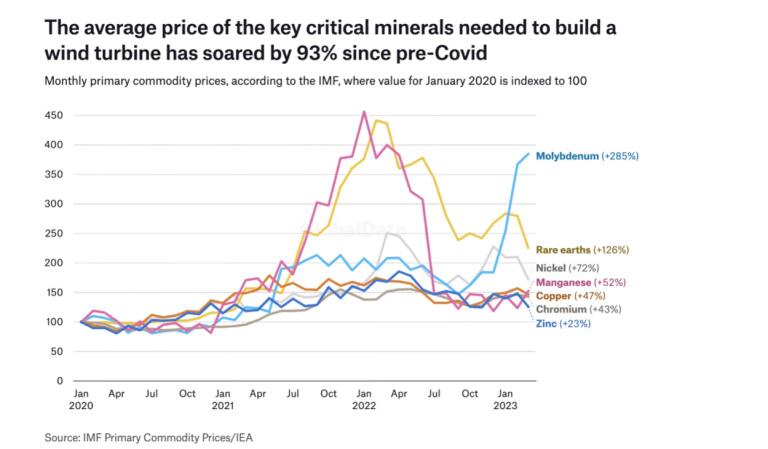
Wind Turbine Average Price of Key Critical Materials
Bloomberg: “As the price of construction climbs, developers are rapidly revising their plans — at great cost.“
Material costs have risen, labor costs have risen, the cost of money has shot up, and opposition to projects has risen.
Cancellations show these projects, at least the offshore ones, are hugely unprofitable even with big subsidies.
Has anyone truly factored in the mineral costs, concrete needed, and environmental impacts on birds and marine life, especially whales?
Mish Economic Rule
Except in cases of genuine national security interest, if a project cannot post a profit without subsidies, then it is not economical and should not be undertaken.
Wind turbines are not a national security item. Thus, developers should proceed at their own risk, not US taxpayer risk.
Dear DOGE request #2. Please cancel all subsidies.
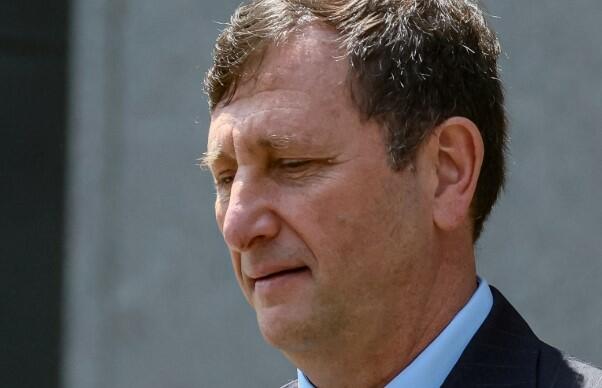
Celsius Founder Alex Mashinsky Pleads Guilty To Multi-Billion Dollar Fraud Scheme
Yet another crypto giant has fallen unceremoniously – this time it’s Alex Mashinsky, founder and CEO of Celsius who has “pled guilty to one count of commodities fraud and one count of securities fraud, which combined carry a maximum sentence of 30 years in prison.”
According to a DOJ Southern District of New York press release out Monday, Mashinsky misled Celsius customers about the company’s profitability and the security of their investments, while secretly manipulating the price of the company’s proprietary token, CEL, for personal gain.
As part of his guilty plea, Mashinsky agreed to forfeit over $48 million in proceeds from the schemes.
Celsius, once marketed as a safe alternative to banks with catchy slogans like “Unbank Yourself,” promised high returns on crypto deposits through programs like “Earn” and “Custody.”
However, Mashinsky and his team engaged in deceptive practices, including misrepresenting the company’s financial health and using customer funds to inflate CEL’s price. These actions created the illusion of profitability and stability while leaving ordinary investors vulnerable to significant losses.
By 2021, Celsius claimed to manage $25 billion in assets, primarily from retail investors, before filing for bankruptcy in 2022.
Central to the fraud was Mashinsky’s orchestration of a scheme to artificially inflate CEL’s price, including using customer deposits to buy CEL tokens in the open market, the release said. This price manipulation enabled Mashinsky to sell his personal holdings of CEL for a substantial profit, totaling approximately $48 million, while misrepresenting these activities to customers.
As the company faced financial collapse, Mashinsky continued to falsely reassure investors of Celsius’s liquidity, even as he withdrew millions of his own assets from the platform, the DOJ said.
And among other things, the DOJ says that Mashinsky “misrepresented, among other things, the safety of Celsius’s yield-generating activities“.
The fallout from Celsius’s collapse was devastating for its customers, with over $4.7 billion in crypto assets locked up when the company halted withdrawals in June 2022.
Celsius subsequently filed for bankruptcy, leaving many retail investors unable to access their funds.
U.S. Attorney Damian Williams said: “Alexander Mashinsky orchestrated one of the biggest frauds in the crypto industry. He lured ordinary, retail crypto investors into investing billions of dollars in Celsius with false promises that their investments were low-risk.”
“Using catchy slogans like ‘Unbank Yourself,’ Mashinsky promised that Celsius would keep customers’ crypto as safe as money in a bank, but that, unlike a bank, Celsius returned most of the profits from its business back to users,” Williams said.
He continued: “In reality, Celsius was never profitable. To disguise the flaws in his business model, Mashinsky put investors’ money into riskier and riskier bets, and secretly used customer money to prop up the price of CEL token. Mashinsky made tens of millions of dollars selling his own CEL at artificially high prices, while his customers were left holding the bag when the company went bankrupt. Today’s convictions reflect this Office’s commitment to holding fraudsters like Mashinsky accountable for their crimes.”
Back in 2021, in a now-famous debate with Peter Schiff, Mashinsky was called out to his face about his firm’s inability to generate yield on bitcoin out of thin air.
The absolute worst and most irresponsible of all of the arguments from Mashinsky came when he suggested to viewers of the debate – many of whom likely lack financial sophistication – that both bitcoin and gold pay a yield.
Of course, what he meant was that they pay a yield on his Celsius platform, but he failed to qualify his statements to make that clear. Neither asset pays a yield in general and Mashinsky knows that.
QTR also documented on Zero Hedge when Celsius first paused withdrawls back in June 2022.
Mashinsky had previously blamed short sellers for the plunge in Celsius, which should have been the tell.
“The CEO of crypto lending and staking platform Celsius Alex Mashinsky believes ‘the Sharks of Wall Street’ can smell blood in the water and are causing instability at several crypto projects. Mashinsky attributes recent Celsius (CEL) price falls, the brief Tether (USDT) depegging and collapse of Terra (LUNA) — at least in part — to short sellers on Wall Street,” Cointelegraph wrote in 2022.
“This is not a coincidence. This is somebody who decided, ‘You know what? I’m going to take down all of Celsius,’” he said during the event.
Germany’s CO2 tax is set to increase from the current 45 euros a tonne to 55 euros at the turn of 2025… This will drive up heating and energy costs for consumers and businesses.
The hefty rise means the tax on CO2 will almost double in just 2 years. In 2023, the carbon tax was 30 euros a tonne.
But it doesn’t stop there, reports Blackout News. The CO2 tax gets taxed by the value added tax, which is currently 19 percent.
“Households and businesses that rely on petrol, diesel, heating oil or natural gas are facing growing financial challenges, writes Blackout News.
“A liter of petrol will be 4.3 cents more expensive due to the CO2 tax, diesel will rise by 4.7 cents per liter. Heating costs will also rise dramatically. A kilowatt hour of gas will become a further 0.21 cents more expensive, which means a total increase of 1.21 cents compared to the time before the CO2 tax. Heating oil costs 17.5 cents more per liter – an increase that affects many households.”
The sharp increases will certainly bode ill for the current SPD-Greens-FDP coalition government – which undergoes a vote of no confidence later this month in Parliament.
A no-confidence vote will lead to the dissolution of parliament and thus a new election within 60 days of the vote.
The pain at the gas pumps and from higher utility bills will make the current coalition government partners even more unpopular. But whether a new government led by Friedrich Merz (CDU) will change anything remains highly doubtful. Only the opposition AfD party has staunchly opposed the CO2 tax. Currently Merz’s CDU party is well ahead in the polls.
65 euros per tonne in 2026
The CO2 tax is set to rise to 65 euros a tonne in 2026, making the energy cost gap between Germany and other countries potentially unsustainable. Already there’s a growing dissatisfaction among German citizens and businesses as energy prices skyrocket into the stratosphere. Meanwhile the Trump administration as signaled a strong interest in making energy affordable again in USA.
“More than 18 billion euros flowed into the coffers, including 10.7 billion euros from national emissions trading for heat and transport. Compared to 2022, revenue in this area increased by 67 percent. Revenue from European emissions trading also increased by 12% to €7.7 billion.”
Visualizing Global Rare Earth Metals Production Over The Past 30 Years
Rare earth metals are a set of 17 chemically similar elements which are integral for modern technologies.
From neodymium, used in powerful magnets that can withstand extreme temperatures, to beryllium, which is used to manufacture lightweight materials for fighter jets, these elements have a variety of crucial technological uses.
While rare earth metals are not particularly rare, they are seldom found in pure form and are often mixed with other minerals, making them costly to mine.
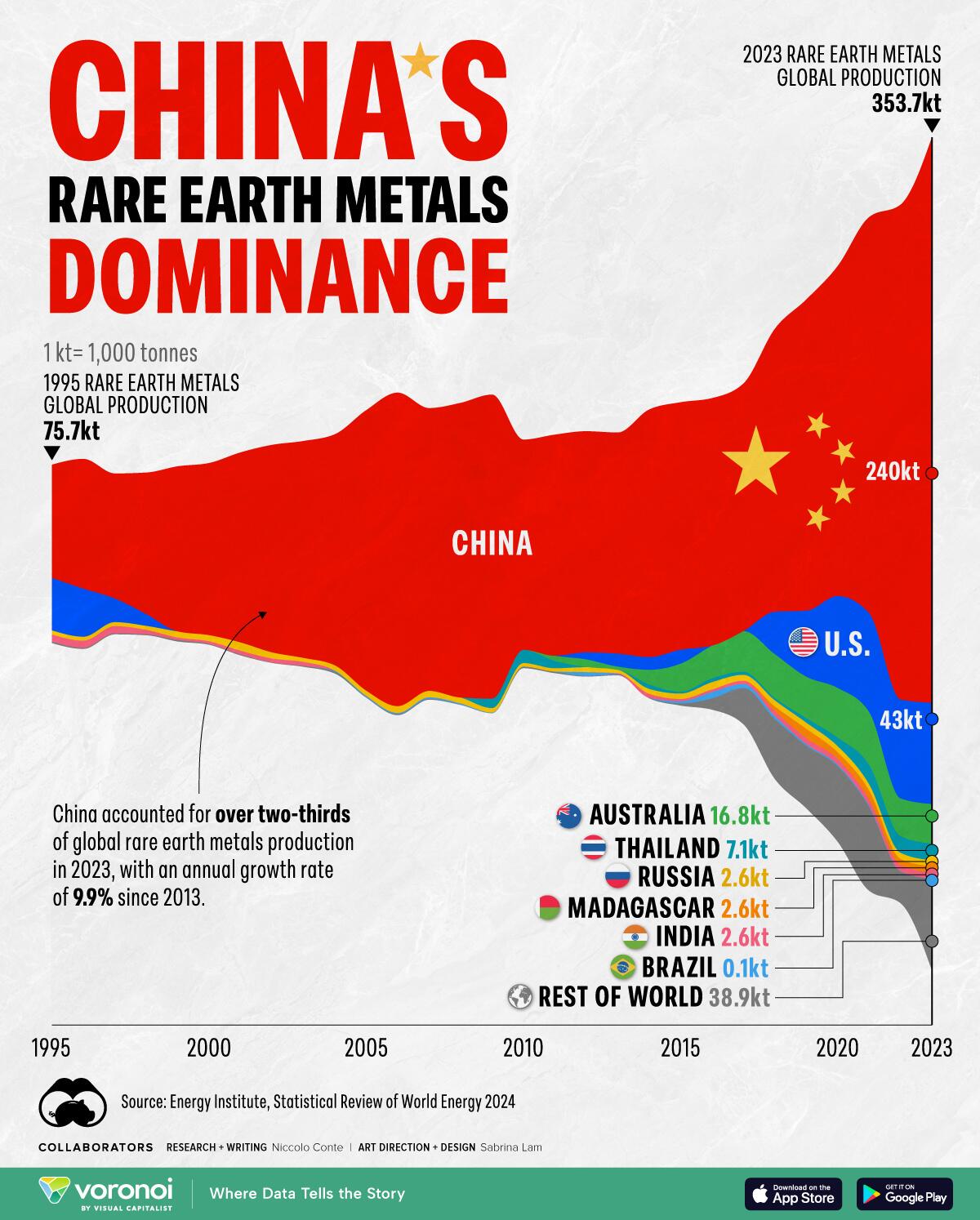
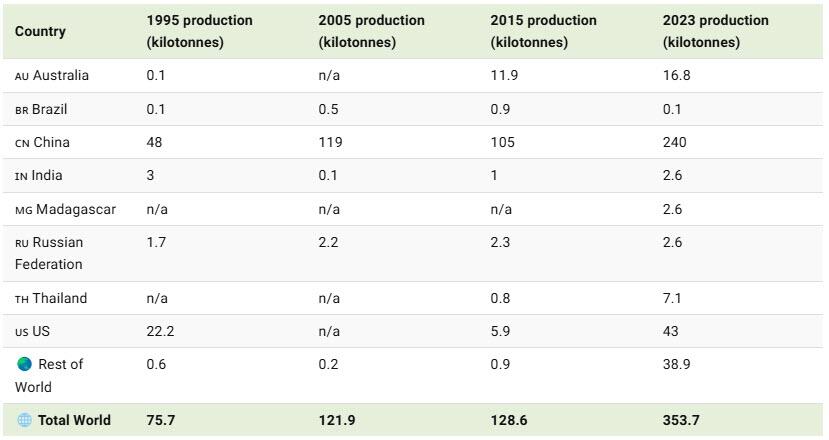
This graphic, via Visual Capitalist’s Kayla Zhu, visualizes rare earth metals production (in kilotonnes) of the eight leading countries from 1995 to 2023, using figures from the Energy Institute’s Statistical Review of World Energy 2024 report.
China Is Dominating Rare Earth Metals Production
Global rare earth metals production has surged the past three decades, increasing from 75.7 kilotonnes in 1995 to over 350 kilotonnes in 2023, reflecting growing demand for these metals in high-tech applications.
China has been and still is the undisputed leader in the rare earth metals industry, accounting for over two-thirds of global production as of 2023.
The United States has made a big comeback in rare earth metals production, particularly from 2017 onwards. U.S. production jumped from 15.4 kilotonnes in 2017 to 43 kilotonnes in 2023, reflecting efforts to strengthen the domestic supply chain and reduce reliance on China.
Separating and processing rare earth metals is an integral step in the supply chain, and China has a near monopoly on this process. The country currently processes 90% of all rare earth metals and 99.9% of heavy rare earth metals, meaning it is importing metals from other countries and processing them.
In December 2023, China banned the export of rare earth metal extraction and separation technology, hoping to reinforce its dominant position when it comes to the global critical minerals supply chain.
Meanwhile, the U.S. has been ramping up efforts to bolster both domestic rare earth metals production and processing capabilities, awarding millions in defense contracts to companies like Lynas Earths and MP Materials to build their own separation and processing facilities.
To learn more about which critical minerals the U.S. depends on China for the most, check out this graphic that visualizes China’s share of U.S. imports by metal.
President-elect Donald Trump has threatened to slap a 100 percent tariff on the economies of BRICS nations if they try to abandon the U.S. dollar as the chief international reserve currency, prompting speculation among economic observers.
“The idea that the BRICS countries are trying to move away from the dollar while we stand by and watch is over,” Trump wrote in a Nov. 30 Truth Social post.
BRICS—a nine-nation alliance of Brazil, China, Egypt, Ethiopia, India, Iran, Russia, South Africa, and the United Arab Emirates—has been at the forefront of the de-dollarization initiative in recent years.
The global campaign to shift away from the greenback generated significant momentum following Moscow’s invasion of Ukraine.
Officials from these countries have been employing measures to reduce their reliance on the buck.
In addition to engaging in bilateral trade settled in local currencies, there has been years-long speculation that the bloc would establish a new reserve currency to rival the dollar.
If the BRICS nations followed through on using a basket of currencies—tossing the ruble, yuan, rupee, and real into a big bowl and creating one uniform currency—it would not affect the dollar, economist Peter St Onge said.
Internal BRICS trade accounts for a little more than 1 percent of global trade, and the group’s share of worldwide reserves is approximately 5 percent.
By comparison, according to data from the International Monetary Fund (IMF), the U.S. dollar still represents approximately 60 percent of foreign exchange reserves. The next closest is the euro, accounting for fewer than one-fifth of global reserves.
Additionally, the Banker for International Settlements’ 2022 Triennial Central Bank Survey showed that the U.S. dollar accounted for 88 percent of global transactions, a figure that has stayed about the same for the past two decades.
“A basket of basket cases does not stand a snowball chance of replacing the dollar, at least outside trade between BRICS countries, say, between China and Russia,” Onge said in a video posted to X in October.
“With those numbers, a basket of BRICS will barely make a dent in the dollar.”
Still, Trump has been vocal about employing the tariff weapon to halt the formation of a rival to the U.S. dollar.
“We require a commitment from these countries that they will neither create a new BRICS currency, nor back any other currency to replace the mighty U.S. dollar or, they will face 100 percent tariffs, and should expect to say goodbye to selling into the wonderful U.S. economy,” the president-elect recently wrote.
“They can go find another ’sucker!’”
While he does not believe BRICS will successfully replace the U.S. dollar in worldwide trade, Trump stated that any country that attempts to “should wave goodbye to America.”
This is not the first time Trump has weighed in on imposing tariffs on anti-dollar nations.
In October, speaking at the Economic Club of Chicago with Bloomberg, Trump warned that the United States could slip into “Third World status” if it loses reserve dominance.
“We have to have that. We cannot lose it,” Trump said. “You’ll go to Third World status in this country because you take a look at the way things are running.”
He also pledged to implement a 100 percent levy on any country considering moving away from the dollar.
“If a country tells me, ‘Sir, we like you very much, but we’re going to no longer adhere to being in the reserve currency. We’re not going to salute the dollar anymore,’ I’ll say, ‘That’s OK, and you’re going to pay a 100 percent tariff on everything you sell into the United States, and we love your product. I hope you sell a lot of it into the United States, but you’re going to pay 100 percent tariff,’” Trump said.
“He will then follow it up by saying, ‘Sir, it would be an honor to stay with the reserve currency.’”
At a September campaign rally, Trump told the crowd that many countries are exiting the dollar.
“They’re not going to leave the dollar with me,” he said.
While there have been signals that the group would start a reserve currency, officials have appeared to veer away from this goal, said Michael Wan, a senior currency analyst at MUFG Research.
“While BRICS has at times talked about creating a new unified BRICS currency, the latest summit in Kazan in October did not put an emphasis on creating a new currency,” Wan stated in a Dec. 2 note.
“It’s unclear how 100 percent tariffs on a group of countries that make up 37 percent of global GDP would happen in practice, but serves as a possible preview of tariff diplomacy under Trump 2.0.”
Other countries have expressed interest in becoming official BRICS members.
Views on the Anti-Dollar Crusade
Despite the BRICS expansion and the formation of BRICS-Plus—an extension of the formal partnership of other emerging economies—the U.S. dollar hegemony has remained intact.
Its dominance in the world economy has strengthened amid the Federal Reserve’s 2 1/2-year tighter monetary policy, robust growth prospects, and geopolitical tensions.
The U.S. Treasury market has also attracted immense foreign investment, with global holdings hitting a record high of nearly $8.7 trillion in September.
The U.S. dollar index, a gauge of the buck against a weighted basket of currencies, has surged 5 percent this year, even as the Federal Reserve started its new easing cycle in September.
Other currencies belonging to BRICS members have weakened considerably against the dollar.
The Indian rupee plunged to an all-time low against the dollar on Dec. 2 after new data revealed a sharp economic slowdown in the world’s fifth-largest economy.
India’s GDP growth rate eased to a lower-than-expected 5.4 percent in the third quarter, down from 6.7 percent in the second quarter.
The Russian ruble continues to sink, trading at less than a penny to the U.S. dollar. The ruble’s descent has been fueled by falling crude oil prices and the lasting effects of U.S.-led Western sanctions.
The Chinese yuan has slumped more than 2 percent against the buck this year. A Reuters poll of market watchers suggests China’s economy will grow by 4.8 percent in 2024, falling short of the government’s target.
Beijing’s economic growth rate could cool to 4.5 percent in 2025.
Still, BRICS members appear optimistic that their long-term de-dollarization strategy will work.
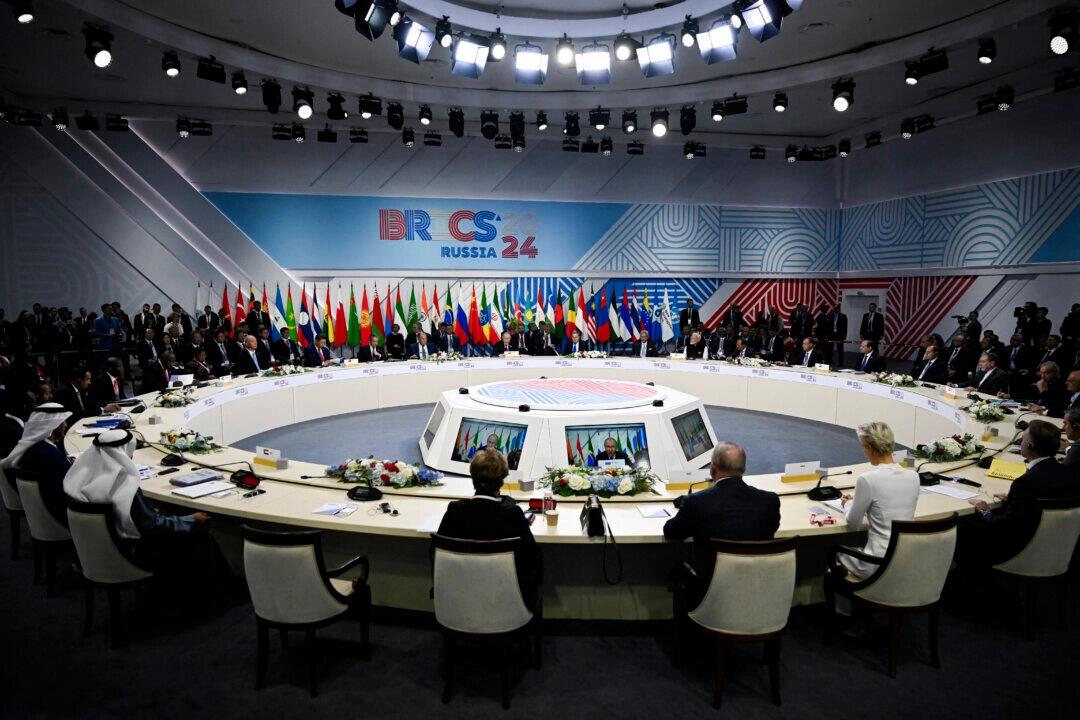
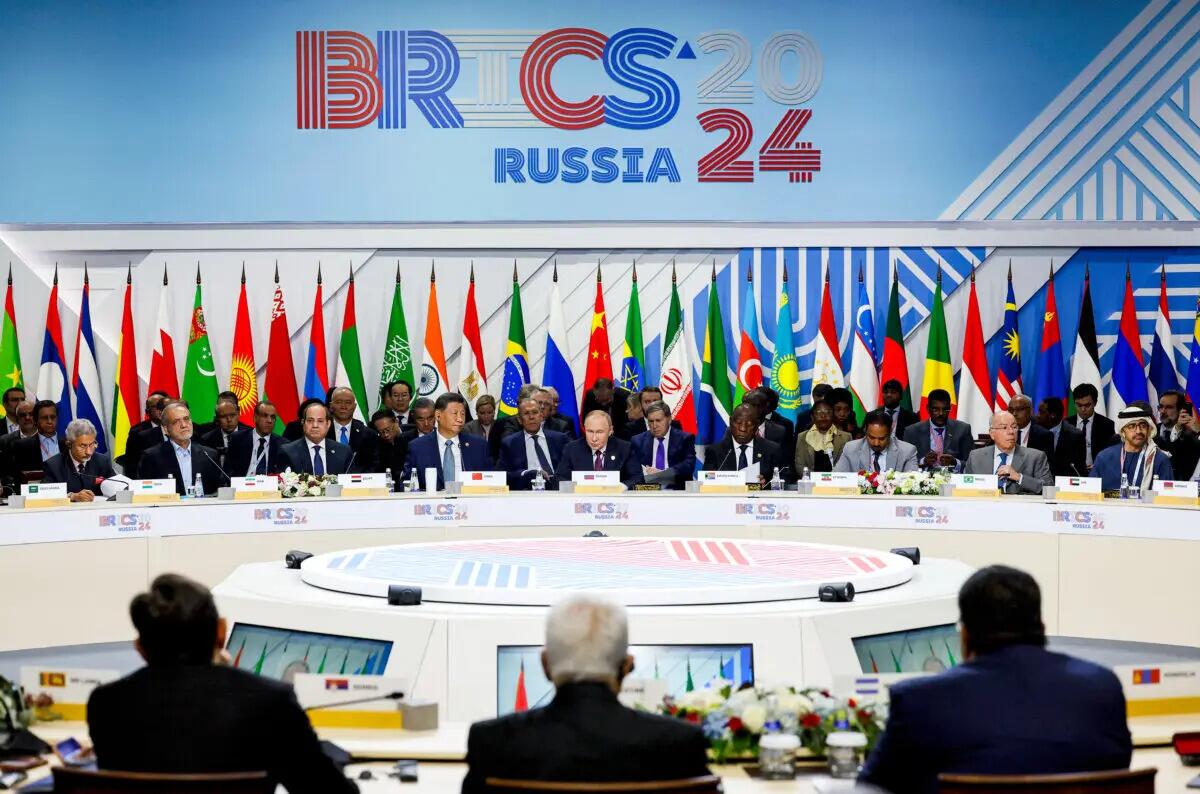
At last month’s annual BRICS summit in the Russian city of Kazan, the group continued to lay the anti-dollar groundwork.
Leaders and representatives reiterated their pledge to bolster economic ties and increase the representation of their national currencies in trade and financial transactions.
The organization’s newest development is the proposal for a BRICS-based grain exchange with the institution’s New Development Work, which could play a hefty role in the worldwide agricultural market.
“A number of BRICS countries are among the world’s largest producers of grain, vegetables, and oilseeds. We propose opening a BRICS grain exchange,” Russian President Vladimir Putin said at the yearly retreat.
“This would facilitate predictable price indicators for products and raw materials, taking into account their special role in ensuring food security.”
Brazil controls 60 percent of all soybean exports, Russia is the world’s largest wheat exporter, and India maintains 40 percent of the international rice trade, including 65 percent of basmati rice shipments.
At the same time, there are mixed views about the BRICS nations dethroning the king dollar.
According to Dmitry Dolgin, chief economist at ING, BRICS enjoys substantial influence in global exchange reserves and the fuel trade.
However, because gold is the main rival to the dollar, the precious metal is underrepresented in the members’ central banks.
Ultimately, Dolgin says, the U.S. dollar is not facing “immediate danger” in areas such as capital markets and international banking.
“The role of BRICS is still low, helping the dollar retain its strong footing,” he stated in a note.
Economists at Capital Economics said BRICS faces “significant practical challenges” in launching a currency.
“It wouldn’t in any case solve any of the challenges they would face in trying to move away from the dollar,” they wrote in a note. “Whether or not the BRICS make an explicit pledge, a BRICS currency is not a viable challenger to the dollar.”
A noticeable trend among the group is the rise of the Chinese yuan’s share for international payments. SWIFT data show that the Chinese yuan’s share has increased to around 3 percent, up from about 1 percent before the pandemic.
While knocking the dollar off the global currency mountain “is out of the question for the foreseeable future,” Bastian von Beschwitz, the Federal Reserve’s research chief of global financial markets, says the yuan’s growth is a trend to monitor in the coming years.
The Fed researcher cited growing usage, government support efforts, and consequences emanating from Western sanctions on Russia as potential reasons for the yuan’s expansion.
“Over the last 10 years, the international role of the renminbi has increased notably from a very low starting point. Despite this increase, its international usage still lags behind even those of the British pound and Japanese yen,” von Beschwitz stated in an August paper.
“Going forward, it will be interesting to see if the renminbi usage in trade continues to increase and whether that increased usage ultimately leads to a larger fraction of FX reserves being held in renminbi.”
The renminbi is the official name of China’s currency, while the yuan is the currency’s basic unit of measure.
Trump has been wielding the tariff weapon in the weeks before he returns to the White House. He recently threatened to impose a 25 percent tariff on Canada and Mexico. The president-elect also said he would hit China with a 10 percent levy in addition to the current crop of tariffs. The aim, Trump says, is to push these countries to improve border security and halt the drug trade.
Russia shot back after Trump’s latest threats, warning the measure would backfire on the United States.
Kremlin spokesman Dmitry Peskov told reporters that the dollar’s appeal is diminishing and that more countries are diversifying their foreign economic and trade activities.
“If the United States uses force, as they say, economic force, to compel countries to use the dollar it will further strengthen the trend of switching to national currencies,” Peskov said.
“The dollar is beginning to lose its appeal as a reserve currency for a number of countries.”
If US security was represented as a great dam holding back a historic flood, today it would be a Chinese built Temu dam held together with paper mache and ramen noodles, ready to snap in half and kill a million people downstream. In 2024 there is no security: The public simply operates on blind faith that no one will take advantage of the vast weaknesses built into the system and government officials hide any risks associated with their policies.
But what are the sources of the danger headed our way? Why is 2025 becoming more and more prominent as an inception date for an attack?
Donald Trump’s election win, his impending return to the White House and his promise to close the border and deport millions of illegals could be the cleansing tsunami that America needs, but it could also inversely trigger a host of foreign attacks, domestic attacks as well as false flag events.
Here are the reasons why the next year is ripe for a large scale event…
Open Borders Have Created Threat Saturation
“Homeland Security” is a misnomer; the current head of DHS, Alejandro Mayorkas, openly admitted to a room full of border patrol agents this year that over 85% of illegal immigrants apprehended at the southern border are released into the country. Mayorkas originally claimed the release rate was 70% in an interview with FOX News, only to raise that number to 85% when agents pressed him during the private meeting.
Reports indicate that at least 400,000 known criminals have crossed the border illegally during Joe Biden’s presidency, and 13,000 of those immigrants were convicted murderers. What we don’t know, however, is how many terror suspects and foreign agents have also entered the US in the past four years.
The DHS releases limited data. Migrants that get a hit on the terror watch list are held and cataloged, of course, but with wide open borders and the Biden White House running interference there’s no way to know how many slipped through.
The political left argues that “no terror attacks have happened on Biden’s watch”, but these are the same people that originally denied the existence of Venezuelan gangs taking over apartment complexes in multiple cities across the country. The saturation of illegal migrants will inevitably lead to a terror event in America, it’s only a matter of time. Why? Because now they are under threat of being removed en masse.
Whatever their original plans, the reality of mass deportation puts these people on a time table and some may act out violently in response. Many will feel entitled to stay in the US despite their criminal entry.
It may not happen on Biden’s watch, but his administration will have been the catalyst that made deportations necessary and the resulting attacks possible.
Geopolitical Tensions And Open Borders Don’t Mix
I believe an attack is inevitable in 2025 primarily because of the geopolitical brush fires being ignited across the globe right now. There is also always the looming danger of false flag events designed by covert actors trying to trick the public into placing blame on the wrong culprit.
The war in Ukraine and the expanding wars in the Middle East involving Israel (and the resurgence in Syria) are dependent on US support and possibly future military involvement on the ground. It’s fair to say that without US involvement, all of these wars would end rather quickly. One can debate the ethical necessity of America engaging in proxy conflicts or the need for the US to protect certain allies and assets, but a lot of foreign elements view the US as the root cause of their pain.
They also know the easiest way to attack the US is through the doorway that the current establishment has left wide open on the southern border.
The US has been hit with a mass immigration storm while also embroiled in at least two regional proxy wars that have the potential to expand into world wars. Why wouldn’t Russia, China, or multiple nations in the Middle East use that weakness to their advantage? Even more disturbing, the globalists that want the US to send troops to defend Ukraine or Israel could also perpetrate an attack that falsely leads back to Russia or Iran.
I continue to argue that America has no reason to be involved in the majority of foreign entanglements and that we should stay out of these conflicts entirely. But we are where we are. There are malicious people within our own government that want to force Americans into war, and there are foreign actors that hate us because of the actions of these same elites. The dominoes have already been set in motion and guess where that leaves us?
Conservatives Inherit Disaster While Leftists Go Weather Underground
The conservative sweep on election day means we inherit all the messes that Joe Biden and his handlers created – Economic, political, social, and geopolitical. There will also be considerable motivation for establishment elites to create chaos from thin air while conservatives hold governmental power, and this presents a third domestic threat which will definitely arise in the wake of a Trump presidency: Leftist activists.
The goal of the progressive establishment when it comes to attacking conservatives is to create so much instability and fear that conservatives feel compelled to set aside their principles and the constitution in order to restore order. In this way the left hopes to “prove” that conservatives are the “fascists” they often accuse us of being.
For the past several years conservatives have also been labeled “domestic terrorists” bent on civil war, but it’s actually the progressive left that engages in the majority of civil unrest and violence in the name of political expediency.
The first time leftists were enraged by a political loss and took to the streets to riot, most conservatives and even the Trump administration erred on the side of constitutional flexibility. The problem is, leftists have a habit of exploiting free speech rights as a springboard for mob intimidation. Also, most of the riots took place in Democrat controlled states and cities where local officials defended the violence and tried to block any intervention.
Some people argue that leftists are no longer motivated to engage in this kind of unrest and the lack of chaos after Trump’s election win is proof. I beg to differ. First, leftists are not a hardy bunch and they tend to wait for warmer weather before going out to cause disruption. Second, Trump isn’t even in office yet. Just wait until the mass deportations start and then you’ll see all kinds of riots.
The political left believes that mob violence and looting is a form of free speech and “reparations” for perceived injustices. They feel completely justified in their behavior and that makes them exceedingly dangerous. If you see the mass burning of random neighborhoods as an “ends justify the means” situation, then you can probably convince yourself that any crime is acceptable.
This trend of terrorism as activism is likely to evolve beyond simple mobs in the next round. In other words, under a new Trump Administration we should expect smaller Weather Underground-like groups among progressive activists; groups that will engage in terror attacks. The two assassination attempts against Trump this year support this hypothesis.
To summarize, there are four distinct instigators of political violence all active going into 2025:
Organized criminal gangs crossing the border as migrants.
Foreign agents and terrorists slipping into the US using mass immigration as a cover.
Leftist activists radicalized to believe they are righteous in their violence.
Establishment elites and covert agencies creating false flag events.
The types of attacks we face comprise a wide spectrum and I fear that conservatives may very well throw support behind a martial law scenario should the situation break out the way I think it will. Infrastructure attacks would be the most devastating (and would not require a high level of effort or sophistication); a lot of people may see military intervention as the best option.
I would argue that this is exactly what the establishment wants. They want the liberty movement to abandon our foundations in the name of security – They want us to take shortcuts that lead us down an authoritarian path. If we are to increase the safety of the American populace it’s going to take years of work to fix the mess that progressives have left behind. No shortcuts like martial law.
We’ll have to close the borders tight (The one place where a national guard or military presence makes sense). We’ll have to deport millions of illegal migrants already in the country. We’ll have to reduce our presence in global proxy wars. We’ll have to secure communities through localized efforts (militias).
Most importantly, should violence break out, community participation in defense is paramount. The locals need to be prepared for grid down, for rioting, for random attacks. It’s the general public that needs to be ready. Regular civilians are the people that will be there the moment disaster strikes and they must be empowered to take action.
When a terror attack takes minutes to achieve, regular people who are there when it occurs have seconds to respond. Until we can repair the damage done to our national security over the past four years, the public is the first and most important line of defense.
* * *
One survival food company, Prepper All-Naturals, has proactively dropped prices to allow Americans to stock up ahead of projected hikes in beef prices. Their 25-year shelf life steaks currently come at a 25% discount with promo code “invest25”.