Southwest Airlines Agrees To End DEI Employment Practices In Response To Lawsuit

Southwest Airlines Agrees To End DEI Employment Practices In Response To Lawsuit

Authored by Matt McGregor via The Epoch Times,

Southwest Airlines dropped its diversity, equity, and inclusion (DEI) requirements on Monday, according to a constitutional rights legal firm that sued the airline company over what it alleged to be “unlawful discriminatory employment practices.”

America First Legal (AFL) issued a statement on Tuesday in which it shared a letter from the U.S. Department of Labor’s Office of Federal Contract Compliance Programs (OFCCP) confirming the airline company “acknowledged and agreed to end its illegal race and sex-based discrimination in all hiring and promotional processes, including all unlawful DEI quotas, benchmarks, or preferences.”

The OFCCP said in the letter that it held an “informal compliance conference” with Southwest Airlines to address the allegations AFL made in a complaint filed in January.

The OFCCP reported to AFL in the letter that Southwest “understands that OFCCP regulations do not permit quotas, preferences, or set asides” and agrees that placement goals regulations “are not to be interpreted as a ceiling or floor for the employment of particular groups of persons, but rather should serve as a benchmark against which Southwest Airlines Co. measures the representation of persons within its workforce.” 

In the complaint, AFL alleged that Southwest Airlines, United Airlines, and American Airlines are in breach of federal contract because they violated Executive Order 11246.

According to the order, federal contractors that secure more than $10,000 in yearly government business are prohibited from engaging in employment decisions that discriminate against employers because of their race or gender.

AFL said that since 2007, Southwest Airlines has received more than $330 million in federal government contracts.

“The American people should not have money taken out of their paychecks to facilitate facially discriminatory actions by federal contractors,” said AFL attorney Gene Hamilton earlier this year.

“But that’s precisely what happens when federal contractors embrace policies that—as they openly admit on their websites and in other public materials—discriminate against Americans based on immutable characteristics.”

Southwest Airlines, United Airlines, American Airlines, and the OFCCP didn’t respond to The Epoch Times’ request for comment by publication time.

Tyler Durden
Wed, 12/04/2024 – 14:25

via ZeroHedge News https://ift.tt/GRPNKD1 Tyler Durden

The Minimum Salary Needed For Financial Success, By US Generation

The Minimum Salary Needed For Financial Success, By US Generation

“Money is a terrible master but an excellent servant.”

– P.T. Barnum

How much money does it take to be considered financially successful in the United States?

Visual Capitalist’s Bruno Venditti highlights a recent survey by Empower, conducted on September 13–14, 2024, asked 2,203 U.S. adults to define financial success in terms of annual salary and overall net worth.

The Numbers Behind Financial Success

The survey revealed that the average American believes a yearly salary of just over $270,000 is enough to achieve financial success. However, generational perspectives vary widely:

  • Gen Z (born 1997–2012) feels they need nearly $600,000 annually to reach financial success.

  • Boomers (born before 1964) estimate they can achieve success with salaries just under $100,000 a year.


The average salary in the U.S. is $63,795, according to the latest data from the Social Security Administration.


Interestingly, from a net worth perspective, Gen Z believes a $9.5 million net worth is indicative of financial success—a figure that is nine times the average net worth in the country.

Out of Reach for Many

According to the survey, 47% of Americans believe they’ll never achieve the level of financial success they desire. Only 37% of respondents consider themselves financially successful right now, with men (42%) being more likely than women (33%) to feel this way.

In addition, just 50% of Americans believe they are or will be better off financially than their parents.

If you enjoyed this post, make sure to check this graphic illustrates the shifts in global wealth distribution between 2000 and 2023.

Tyler Durden
Wed, 12/04/2024 – 14:05

via ZeroHedge News https://ift.tt/ArJiZSf Tyler Durden

The Dollar And Oil Foresee A Santa Rally For Bonds

The Dollar And Oil Foresee A Santa Rally For Bonds

Via RealInvestmentAdvice.com,

Bond yields are primarily driven by macroeconomic factors such as inflation and economic growth.

Given their impact on inflation and the economy, the U.S. dollar and oil prices are frequently well correlated with bond yields.

Therefore, bond traders often take their cue from the dollar and oil markets.

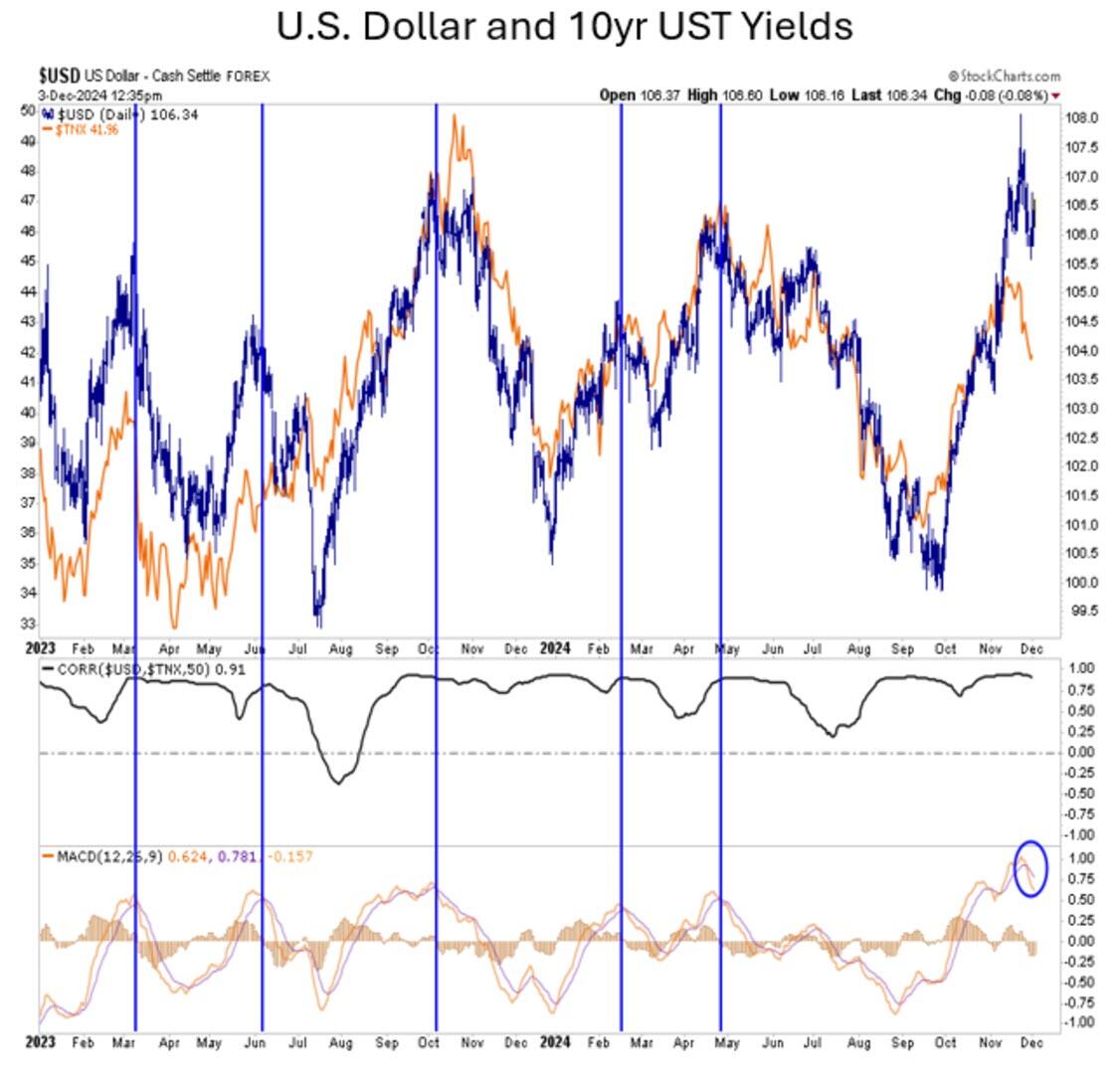
The dollar (blue), as graphed below, has been on a tear since early October.

As is typical, bond yields (orange) closely followed the dollar higher.

The graph below the dollar/yield shows the correlation between .75 and 1.00 over the period.

The dollar is now at the upper end of a two-year range, and its MACD sends a strong sell signal. The blue vertical lines show the prior periods when similar sell signals were triggered.

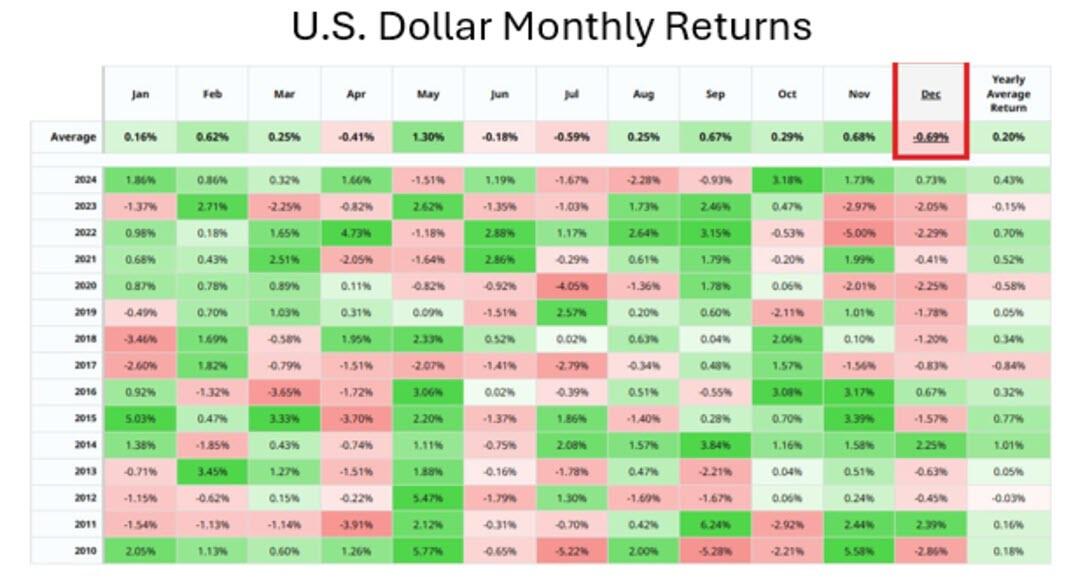
The technical sell signal for the dollar, thus a buy signal for bond prices (lower yields), aligns with the table below, which shows that the dollar has traded down in the last seven December’s.

Moreover, since 2010, December has been the worst month for the dollar.

The final graph below highlights the strong correlation between crude oil and bond yields.

In this case, crude oil trades at the lower end of its two-year range. However, bond yields have yet to “catch down” to oil prices.

Assuming the correlation holds up, which is not necessarily a given, bond yields could revisit September’s lows.

Tyler Durden
Wed, 12/04/2024 – 13:45

via ZeroHedge News https://ift.tt/A6Wwn2U Tyler Durden

Total Grid Collapse Strikes Cuba (Again) 

Total Grid Collapse Strikes Cuba (Again) 

Cuba’s national power grid collapsed shortly after 0200 local time on Wednesday, plunging 11 million people into darkness. 

Total blackout. Well done, Communists—can’t even keep the power on.

The Energy and Mines Ministry said the 330-megawatt capacity CTE Antonio Guiteras power plant suffered a failure earlier this morning but did not provide details. 

“At 2:08 this morning, the Electrical System, SEN, was disconnected when the Antonio Guiteras thermoelectric plant went out due to the automatic tripping. The restoration process is underway,” the ministry wrote on X

This is the second failure at the Antonio Guiteras power plant in months. In mid-October, the plant, located about 62 miles east of Havana, suffered a similar failure. Then, weeks later, a hurricane knocked out power across the country. 

When power fails, so does the internet…


Bloomberg noted, “The cash-strapped, communist-run nation is mired in its worst economic crisis since the fall of the Soviet Union,” adding, “A full 10% of the population has fled the country since 2020, and the government is bracing for renewed political pressure from the US as Donald Trump prepares to return to the White House.” 

Let’s all be glad the Communists have not taken over the US. 

Tyler Durden
Wed, 12/04/2024 – 12:05

via ZeroHedge News https://ift.tt/7Job0GB Tyler Durden

Roger Ver Moves To Dismiss US Tax Evasion Charges As “Unconstitutional”

Roger Ver Moves To Dismiss US Tax Evasion Charges As “Unconstitutional”

Authored by Tom Mitchelhill via CoinTelegraph.com,

Roger Ver — also known as Bitcoin Jesus — urged a United States judge to dismiss a case alleging he committed tax evasion when selling millions of dollars in Bitcoin, claiming the case is unconstitutional.

In a Dec. 3 filing to a California federal court, Ver argued that the Internal Revenue Service’s (IRS) exit tax for those who renounce their US citizenship with more than $2 million in assets is unconstitutional and “inscrutably vague.”

“The ‘exit tax’ at issue violates both the Apportionment Clause and the Due Process Clause of the Constitution […] the charges also rely on provisions of the U.S. tax laws that were, at all relevant times, inscrutably vague as to their application to digital assets of the kind that underlie the charges,” Ver’s lawyers argued. 

The IRS’ exit tax aims to ensure that US citizens pay all required taxes before renouncing their citizenship and withdrawing from the country’s tax system.

Lawyers for Ver claim that the case against him is unconstitutional. Source: CourtListener

Ver also claimed prosecutors had “unlawfully” interrogated one of his lawyers and ignored crucial documents, which he said showed he had no intent to file a fraudulent tax return. 

On April 30, the US Attorney’s Office in Los Angeles arrested Ver in Spain and charged him with tax evasion and fraud, alleging he dodged more than $48 million in taxes by failing to report capital gains on the sale of “tens of thousands” of Bitcoin for $240 million in cash.

Ver claimed there were several impediments to submitting an appropriate exit tax request, including a lack of liquid markets for Bitcoin at the time. Still, the US government remained adamant that Ver filed a fraudulent and false exit tax after renouncing his US citizenship for a Japanese one in 2014.

Ver has been charged with mail fraud, tax evasion and filing false tax returns. He faces a maximum sentence of 30 years in federal prison if found guilty on all counts. 

Ver was one of the earliest advocates of Bitcoin, buying it in droves in 2011 when it was under $1 and acting as an evangelist for digital assets. In 2017, he emerged as a major Bitcoin Cash (BCH) proponent after the Bitcoin network underwent a hard fork. 

Ver was later embroiled in a 2022 scandal with CoinFlex, which claimed that he owed the platform $47 million in USD Coin.

In 2002 and 2003, he spent 10 months in federal prison in the US for selling explosives on eBay.

The US Department of Justice did not immediately respond to a request for comment.

Tyler Durden
Wed, 12/04/2024 – 11:45

via ZeroHedge News https://ift.tt/6VE5S2F Tyler Durden

Live: Supreme Court Justice Ketanji Jackson Compares Child Sex Changes To Interracial Marriage In Tennessee Trans Case

Live: Supreme Court Justice Ketanji Jackson Compares Child Sex Changes To Interracial Marriage In Tennessee Trans Case

The U.S. Supreme Court on Wednesday heard oral arguments in a pivotal case challenging Tennessee’s 2023 law banning gender-affirming medical treatments for transgender minors. The case, brought by the Biden administration on behalf of families of trans youth, has brought the question of transgender youth and the role of state regulation of medical procedures into sharp focus.

At the heart of the case is Tennessee’s 2023 prohibition on prescribing hormone therapies – such as puberty blockers and hormone replacement therapy – to transgender individuals under 18. While the law does not extend to surgical interventions, which are rarely performed on minors, it represents a significant restriction on gender-affirming care. While the Biden administration is leading the charge, the law is being challenged by three transgender teenagers, their families, and the American Civil Liberties Union (ACLU), who argue that the legislation violates constitutional rights.

Listen:

Who could have seen this coming?

Oh…

As Truth in Media notes further; Chase Strangio, a notable figure as the first openly transgender lawyer to argue before the Supreme Court, articulated the case’s essence. “The government of Tennessee is displacing the decision-making of loving parents,” Strangio argued, emphasizing that such care is supported by numerous medical associations, including the American Medical Association and the American Academy of Pediatrics, for its benefits in alleviating gender dysphoria.

The state, however, defends its position, with Sen. Jack Johnson, who sponsored the bill, asserting that the legislation is akin to other age-based restrictions like tattoos or alcohol consumption, aimed at protecting minors from irreversible decisions. Tennessee’s argument hinges on the notion that the law regulates medical practices rather than discriminates based on sex or gender identity.

This case arrives at the Supreme Court amid a broader wave of legislation across the U.S., where more than two dozen states have similar restrictions. The outcome could set a precedent not only for transgender youth but potentially for all minors seeking medical care that involves hormone treatments or puberty blockers for any condition.

The courtroom was packed on Wednesday, with observers from various advocacy groups and parents of transgender children present, highlighting the personal stakes involved. For families like that of LW, a transgender teen from Tennessee, the law has forced them to undertake long journeys out of state to continue her medical treatment, illustrating the practical implications of such bans.

The Supreme Court’s decision, expected by summer, could either affirm the rights of transgender youth to access gender-affirming care or uphold state authority to regulate medical treatments for minors. This ruling might also influence future cases regarding transgender rights, especially in states with pending or active litigation against similar bans.

Tyler Durden
Wed, 12/04/2024 – 11:25

via ZeroHedge News https://ift.tt/FzHx1Tc Tyler Durden

Russian Ship Fires Warning Shots At German Military Helicopter In Baltic Sea

Russian Ship Fires Warning Shots At German Military Helicopter In Baltic Sea

In a rare dangerous incident and close-call, European media reports have described that the crew of a Russian ship ‘fired’ upon a Germany army helicopter which was monitoring the vessel’s movements in the Baltic Sea.

“German Foreign Minister Annalena Baerbock announced increased surveillance in the Baltic Sea after a Russian ship fired at a Bundeswehr helicopter during a mission,” EuroNews writes.

The Bundeswehr helicopter was confirmed to have been on a reconnaissance mission at an unclear date and time, but the Russian ship – described in The Daily Mail as a warship – fired signaling ammunition in an apparent effort to warn the aircraft off.

Illustrative: Getty Images

Baerbock disclosed the incident for the first time on the sidelines of a NATO foreign minister’s meeting in Brussels, but gave few other details.

“Signal ammunition is used for warning shots rather than attack, but this sort of incident is a sign of how close NATO and Russia are getting to facing each other directly,” Daily Mail concludes.

Currently there’s a lot of Western monitoring of the Baltic Sea after several communications cables which link Finland, Sweden, Germany, and Lithuania were severed in a suspected sabotage incident.

Allegations and focus have remained on the Chinese vessel Yi Peng 3 which was observed in the area at the time of the suspected sabotage. It’s believed to have intentionally dragged its anchor to damage the underwater cables. The Swedish government has demanded answers of Beijing. 

Tensions have been soaring of late between Berlin and Moscow, given Baerbock on Tuesday also told NATO allies that all options are on the table regarding the Ukraine war, presumably even the potential for deploying Western troops there.

Russian state media has picked up on her hinting at this scenario:

She suggested that a potential peace deal could include security guarantees for Kiev, such as the prospect of NATO membership and continued military support from the West, as well as an international peacekeeping mission.

Asked about what military role Germany could play in such a deal, Baerbock was quoted by the Frankfurter Allgemeine Zeitung (FAZ) as saying that “only we as Europeans can protect peace together,” suggesting that EU countries, including Germany, could send their soldiers to Ukraine.

The Kremlin is unlikely to ever accept a deal which puts NATO ‘peacekeeping’ forces even closer on its doorstep. Thus Russian officials are deeply suspicious of any talk of peacekeeping troops.

With the Russian army on the offensive, making continual and steady gains in the Donbas, Putin is not going to be in the mood to concede much if and when direct negotiations finally happen.

Tyler Durden
Wed, 12/04/2024 – 11:10

via ZeroHedge News https://ift.tt/C9nViRJ Tyler Durden

Enemies Of The State

Enemies Of The State

By Benjamin Picton, Senior Macro Strategist at Rabobank

Just when you thought that politics in 2024 couldn’t get any crazier, the President of South Korea declares martial law. President Yoon Suk Yeol made the declaration yesterday, justifying it as necessary to “eliminate anti-state forces” who he accused of sympathizing with North Korea. The declaration was opposed unanimously by the South Korean National Assembly in a bipartisan 190-0 vote (the balance of the 300 members were not present) as videos circulated on social media of the military surrounding the Assembly building. The Wall Street Journal reports that members had to resort to scaling fences to evade armed guards and attend the vote.

Martial law was in effect for approximately six hours before President Yoon lifted it around 4am Wednesday following the vote. The Associated Press reports that an opposition party lawmaker claimed CCTV footage showed troops moving in a way that suggested they intended to arrest the leader of the main opposition party, the Speaker of the National Assembly and even the parliamentary leader of Yoon’s own party before martial law was lifted. It now appears likely that President Yoon will be impeached and fail to see out the remainder of his 5-year term due to expire in 2027.

The USD rallied almost 3% against the Korean Won before retracing substantially as the political crisis subsided. Ultimately USDKRW closed 1.6% higher on the day. Spot gold was up smalls while the Bloomberg Dollar Spot Index lost 0.08% and US 10-year Treasury yields lifted 3.5bps to 4.225%, thereby prompting a slight bear-steepening of the Treasury curve as 2-year yields remained unchanged at 4.18%.

Long-end yields may have been encouraged higher by a much stronger than expected JOLTS report yesterday. That report showed 7,744,000 job openings in October compared to a (downwardly-revised) figure of 7,372,000 in September and a consensus estimate on the Bloomberg survey of 7,519,000. Meanwhile, the San Francisco Fed’s Mary Daly said that a rate cut this month “isn’t certain” but that “in order to keep the economy in a good place we have to continue to recalibrate policy”. Chicago Fed President Austan Goolsbee was a little more explicit, saying that he expected interest rates to “come down a fair amount from where they are now” in the months ahead. All-in-all, the signal from Fed speakers this week seems to be that the December FOMC decision will hinge on the results of the payrolls report due out on Friday.

The active Brent crude future rose 2.53% to $73.65/bbl yesterday as news circulated that OPEC+ is close to an agreement to delay production cuts due to expire in January by another three months. The alliance of oil producing nations is due to finalize plans for extensions to the 180,000 bbl/day cuts at an online meeting on Thursday. If passed, this would mark the third extension to agreed production cuts as producers seek to support global prices in the face of slowing demand from China (the world’s top energy importer) and burgeoning supplies out of the United States. Compliance with agreed cuts has also been a major problem for the alliance, with a number of members thought to have been “cheating” by producing more than their agreed numbers.

Breaking international solidarity to pursue economic self-interest is certainly the current Zeitgeist. President Trump posted on Truth Social yesterday that he is “totally against” the acquisition of US Steel by Japan’s Nippon Steel. Trump said that a series of tax incentives and tariffs would instead make US steel “Strong and Great Again, and it will happen FAST!” Japan is, of course, an important defence partner of the United States.

Meanwhile, China has just announced that it is imposing export bans on Gallium, Germanium and Antimony to the United States. All three minerals are used in the production of semiconductors and have other applications in technology, metallurgy, photovoltaic cells and fibreoptics. Reuters reports that China accounts for more than 98% of the world’s supply of Gallium and almost 60% of refined Germanium. A White House spokesperson said that the new restrictions highlight the importance of de-risking supply chains and finding alternative suppliers to China, but that would presumably require diplomacy and cooperation between the United States and her allies. What will be the carrots and sticks offered to encourage new production and supply of critical minerals?

Finally, Bloomberg is this morning reporting that German Foreign Minister Annalena Baerbock has floated the possibility of NATO membership for Ukraine as part of a peace deal that could also include ceding some occupied Ukrainian territory to Russia. Ukrainian membership of NATO is likely to remain a red line for Russia considering that NATO encirclement is one of Russia’s major grievances that Vladimir Putin has used to justify his war, but it is interesting that the once unthinkable ceding of land is now being discussed openly by senior European leaders.

This is starting to sound reminiscent of the Concert of Europe realpolitik that prevailed during the 19th century. With Donald Trump set to regain the keys to 1600 Pennsylvania Avenue next month, the ability to strike a deal that safeguards vital national interests while maintaining a balance of power on the continent will be all the more important

Tyler Durden
Wed, 12/04/2024 – 10:50

via ZeroHedge News https://ift.tt/A2TqHSj Tyler Durden

WTI Holds Gains After Big Surprise Crude Draw

WTI Holds Gains After Big Surprise Crude Draw

Oil prices were limping lower this morning (after yesterday’s surge) after the weak ISM Services print as traders await this week’s OPEC+ decision.

API

  • Crude +1.23mm

  • Cushing +112k

  • Gasoline +4.62mm

  • Distillates +1.01mm

DOE

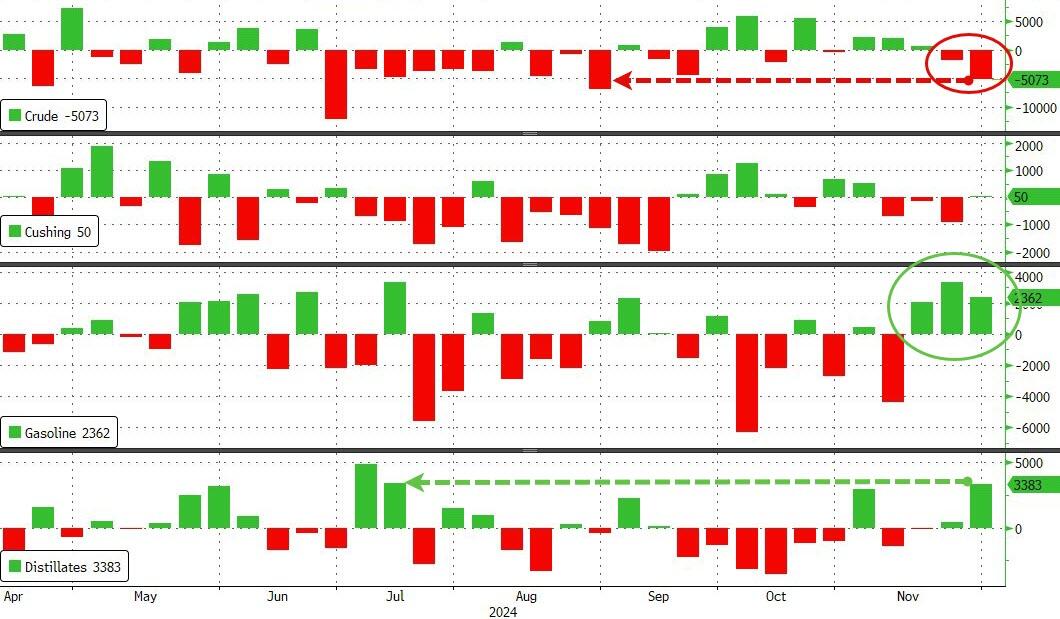
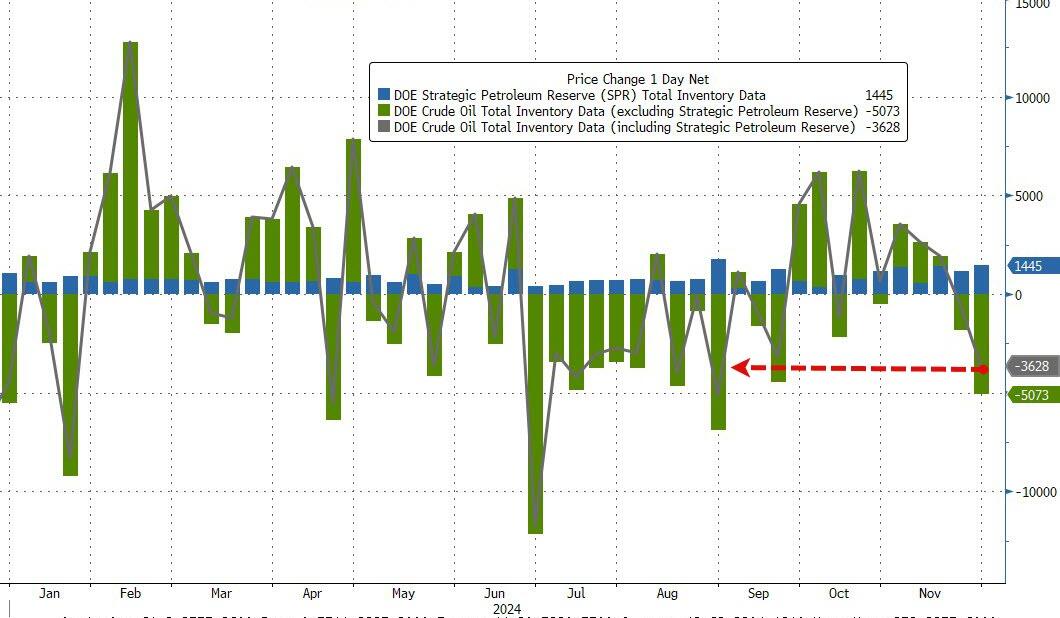
  • Crude -5.07mm – biggest draw since August

  • Cushing +50k

  • Gasoline +2.36mm

  • Distillates +3.38mm – biggest build since July

Completely the opposite of API’s reported small build, the official data showed a large crude draw last week, but products saw large builds…

Source: Bloomberg

Even with the large addition to the SPR – total crude stocks still drew down by the most since August…

Source: Bloomberg

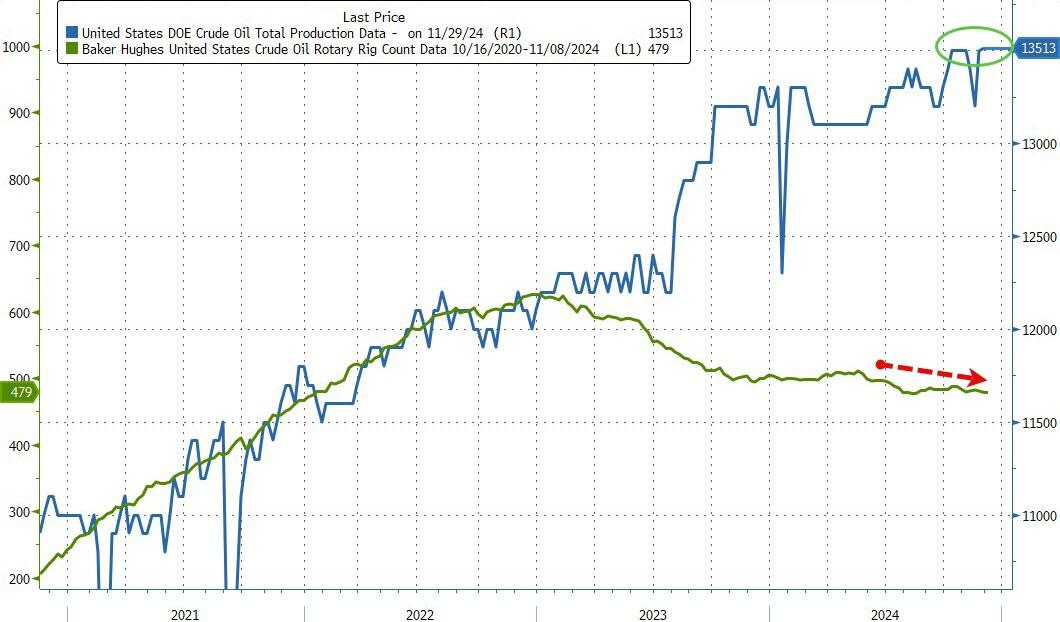
US Crude production held at 13.5mm b/d – a record high…

Source: Bloomberg

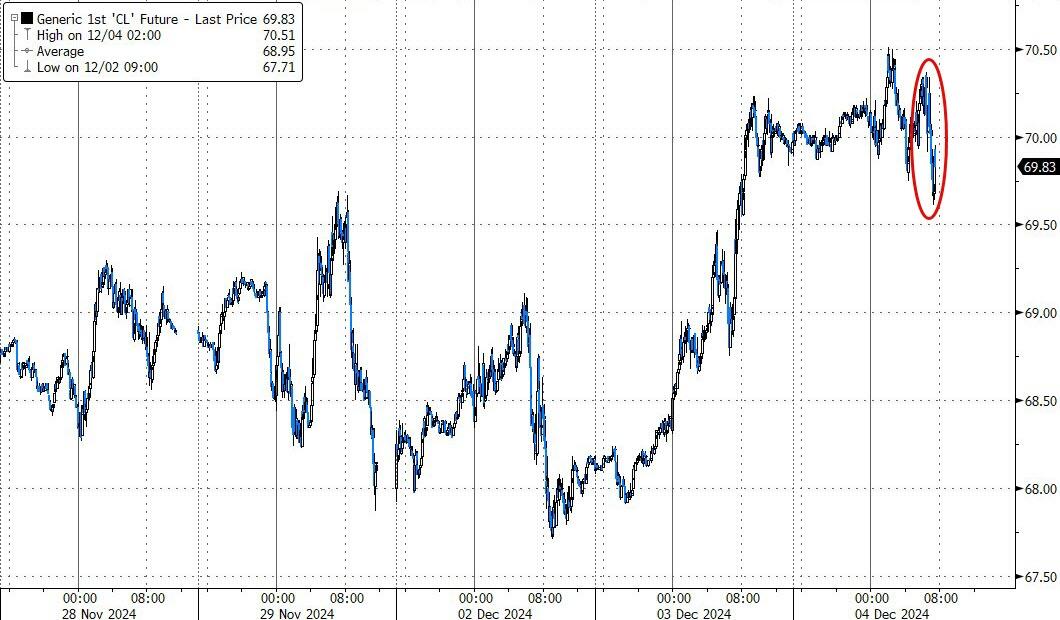
Algorithmic traders have been dumping bearish positions after futures surpassed both the $70-a-barrel psychological level and the 50-day moving average, which have provided resistance for previous rallies, said Dennis Kissler, senior vice president for trading at BOK Financial Securities.

WTI Is holding right around that $70 level…

As Bloomberg’s Grant Smith reports, even before OPEC+ ministers start tomorrow’s meeting on oil production, traders are looking beyond it.

For the past week, the cartel led by Saudi Arabia and Russia has been holding preliminary talks to once again delay plans for reviving halted barrels.

The group is firming up an agreement — to be finalized at Thursday’s gathering — that would push back a sequence of monthly hikes from January until the second quarter.

Unfortunately for the alliance, crude traders already assumed the pause was unavoidable and have priced it in. Benchmark Brent futures have barely budged in the week since OPEC+ began negotiations, hovering around $74 a barrel.

That could be complacency: The Saudis have a habit of springing bullish surprises to deter short sellers.

Nonetheless, investors are looking past the decision, focusing on oil-market conditions in early 2025 — and those don’t augur well for prices.

Global demand growth is cooling as top consumer China falters, while supplies from the US, Guyana and Canada are booming, according to the International Energy Agency.

A hefty surplus looms, even if OPEC+ doesn’t add a single barrel next year.

Tyler Durden
Wed, 12/04/2024 – 10:41

via ZeroHedge News https://ift.tt/tNQbVSe Tyler Durden

Foot Locker Plunges On “Softened” Sneaker Demand 

Foot Locker Plunges On “Softened” Sneaker Demand 

Low- to mid-income consumers, feeling the brunt of sticky inflation, elevated prices, and high interest rates, have dialed back their demand for fancy sneakers. As a result, shoe retailer chain Foot Locker slashed its full-year guidance after reporting dismal third-quarter earnings. 

Foot Locker’s third-quarter results missed the Bloomberg Consensus expectations on the top and bottom lines. The company blamed “softened” consumer trends and a high “promotional environment” across the marketplace.

Here’s a snapshot of the third quarter (courtesy of Bloomberg):

  • Comparable sales +2.4%, estimate +2.76%
  • Adjusted EPS 33c vs. 30c y/y, estimate 41c
  • Loss per share 34c vs. EPS 30c y/y
  • Sales $1.96 billion, -1.4% y/y, estimate $2.02 billion
  • Total location count 2,450, -6% y/y, estimate 2,448
  • Foot Locker US stores 691, -6.6% y/y, estimate 691.86
  • Kids Foot Locker stores 376, -4.1% y/y, estimate 377.38
  • Champs Sports stores 390, -18% y/y, estimate 384.63
  • Gross margin +230 bps

Consumer spending trends softened following the peak Back-to-School period in August, and the promotional environment was more elevated than anticipated,” CEO Mary Dillon wrote in a press release, adding, “We saw a meaningful and positive acceleration over the key Thanksgiving week period, especially in stores.” 

Dillon continued: “Despite that strong performance, we are taking a more cautious view and are lowering our full-year sales and earnings outlook due to a more promotional environment and softer consumer demand outside of key selling periods.”

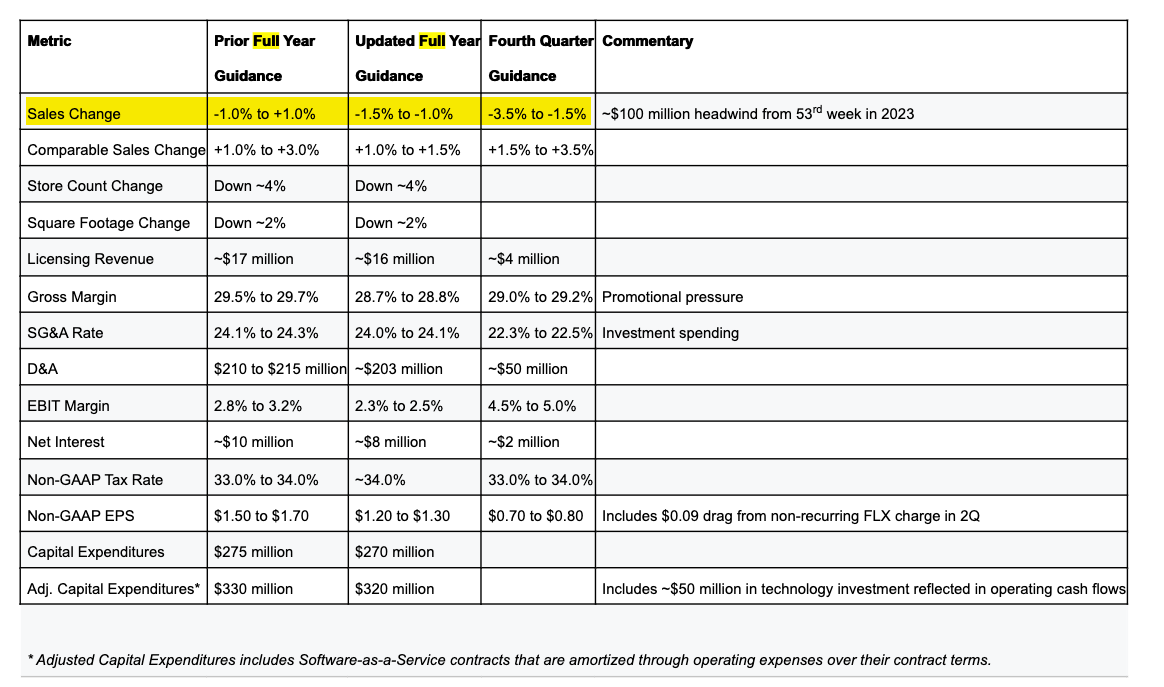
For the full year, Foot Locker now forecasts sales to dip between 1% and 1.5%, compared to previous guidance of down 1% to up 1%.

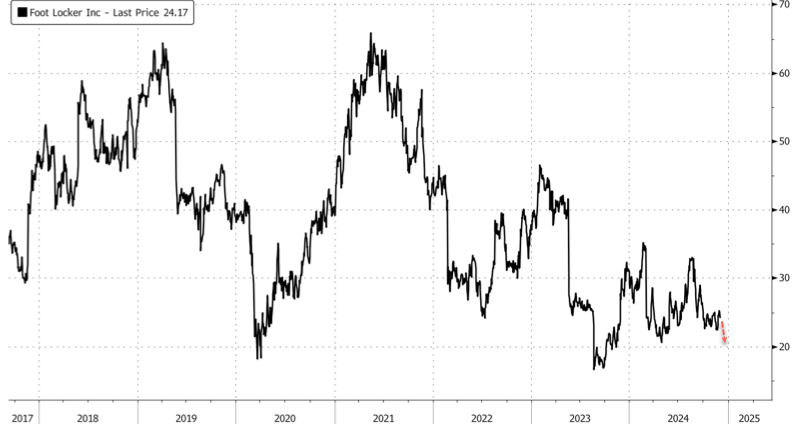
Foot Locker shares plunged 14% in premarket trading. As of Tuesday’s close, they were down 22% on the year.

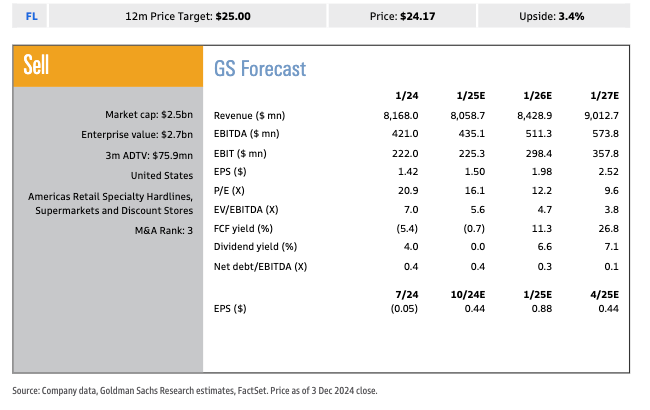
Goldman’s Kate McShane has a “Sell” rating on Foot Locker with a “12-month price target of $25 based on our downside/base/upside case relative P/E multiples of 45%/50%/55.” 

McShane noted some upside risks:

  • Event driven risk has increased: Given the change in vendor mix, the high cash balance, low debt levels, and recent decline in share price, FL could be a potential M&A or LBO candidate.

  • FL’s portfolio of brands remains strong: Despite the declining allocation of key Nike product, FL continues to have a portfolio of popular brands in its stores and online channels, including Nike, adidas, Reebok, Puma, and others. Moreover, FL has historically had higher levels of sneaker releases and innovation than other sneaker-selling retailers. These key strengths could support FL over the longer term.

  • New share repurchase authorization: FL’s board approved a significant $1.2bn share repurchase package. If FL repurchases shares at a faster rate than the market expects, it could drive upside to the stock.

Foot Locker’s customer base primarily consists of low-income consumers, offering a glimpse into discretionary spending trends. The dismal earnings and downshift in full-year outlook reveal that the bottom tier of consumers remains under significant financial strain due to elevated inflation, high interest rates, mounting credit card debt, and depleted personal savings. The ongoing inflation storm battering low-tier consumers results from an inflationary fallout from backfiring “Bidenomics.” 

Tyler Durden
Wed, 12/04/2024 – 08:35

via ZeroHedge News https://ift.tt/Zm5zcQR Tyler Durden