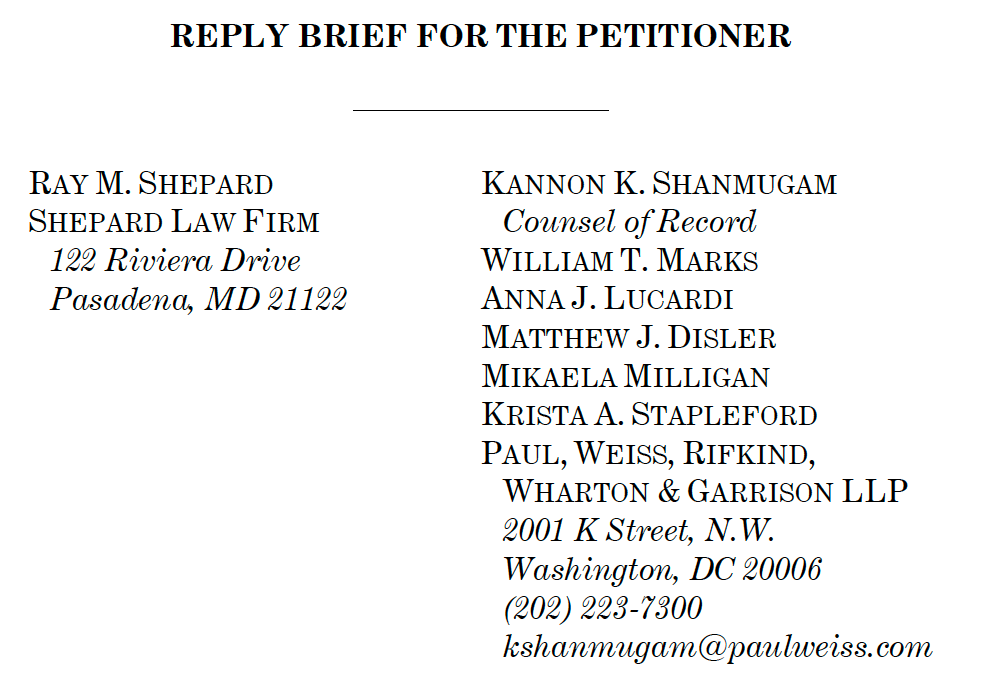
Whenever a new petition is granted, I always check the counsel of record. I keep a running tally of how many cases leading members of the bar argue. When the Court granted cert in T.M. v. University of Maryland Medical System Corporation, I took note. The Counsel of Record for the Petitioner was Kannon Shanmugam of Paul Weiss. This was (likely) a pro bono case, as T.M. sued the hospital system for medical malpractice. The Counsel of Record for the Respondent was Lisa Blatt of Williams & Connolly. I remember looking forward to seeing Shanmugam and Blatt argue. These two are titans of the Supreme Court bar.
Except it wasn’t meant to be. For reasons that are not clear, Elizabeth Prelogar of Cooley LLP argued the case today. Prelogar’s name was not on the Petitioner’s opening brief or the reply brief.
Shanmugam is still listed as counsel of record, but Prelogar’s name now appears on the docket page.
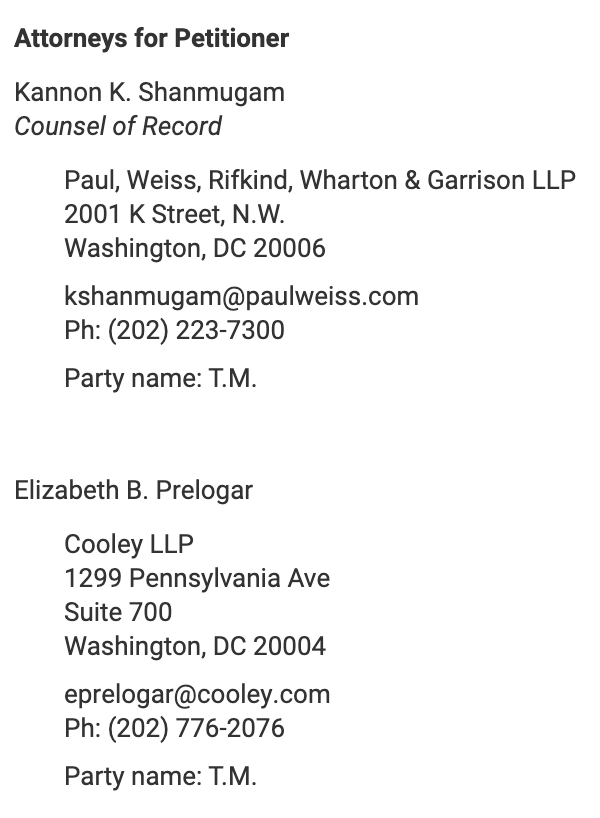
It is common enough for a veteran SCOTUS litigator to give a case to a fellow partner or an associate, to give them experience at the high court. It also happens that when two big SCOTUS firms are on a case, there is some process to decide which firm gets to argue. Sometimes the client chooses. When there is more than one client, it can get messy. When all else fails, a coin toss can resolve the conflict. But I can’t recall a situation like this: where a veteran SCOTUS litigator in a pro bono case files all of the cert-stage and merit-stage briefs, and then hands the case off to a SCOTUS litigator at another firm. Indeed, the fact that this case is pro bono is significant. There was only one client, who is a person, rather than a institution. I don’t think there was a General Counsel department advising T.M. about who would be the best attorney to argue the case. Here, Shanmugam was on the cert petition, so he has had the case for some time.
For whatever it is worth, this is Prelogar’s first Supreme Court argument since returning to private practice. She has had cert denials in Stroble v. Oklahoma Tax Commission and Tuopeh v. South Dakota and Little v. Llano County.
Why did Prelogar swoop in at the last minute? I don’t know. Perhaps there is a conflict? I checked the docket, and Shanmugan is on the brief for next week’s case of Cisco Systems v. Doe, though Chris Michel at Quinn Emanuel is counsel of record. Mere mortals may have trouble arguing two SCOTUS cases back to back, but Shanmugam has super advocacy skills. In 2024, he argued a case in February and another case in March. In 2021, he argued a case on November 10 and on November 30. In 2020, he argued a case on November 3 and on December 8 and on January 19. In 2018, he argued a case on October 29 and on November 7. And even if it was too much for Shanmugam to argue back-to-back, certainly there is someone else at Paul Weiss who could have picked up the case. There must be more to the story.
The change in counsel may affect the outcome of the case. There are often problems when an attorney argues a case, but did not brief it. I think this may have happened today.
The petition did not ask for the Court to overrule the Rooker-Feldman doctrine.Yet, as Justice Alito pointed out, Prelogar seems to want to overrule Rooker-Feldman.
JUSTICE ALITO: Reading between the lines, I take your –your real position to be that Rooker-Feldman ought to be overruled, and maybe there are members of the Court who would like to do that, but that’s not before us here, right?
MS. PRELOGAR: Our primary argument is that it’s not necessary to overrule it. It just shouldn’t be vastly expanded
Alito joked that alternatively, Prelogar would limit the case to the parties:
JUSTICE ALITO: But, if we’re going to limit it, it has to be limited on some rational basis. And I don’t really see a rational basis for drawing a distinction between a case where the –the state court proceeding has concluded and a case where the state court proceeding is –is ongoing. I mean, in Rooker, the individual’s name began with an R. And in Feldman, the individual’s name began with an F. So, here, the individual’s name begins with a T. I mean, can we say, well, we’re not going to go any further than Rooker and Feldman, so this case doesn’t qualify?
Well, yeah. Prelogar didn’t write that brief. But Solicitor General did argue Dobbs. Maybe there was some disagreement in strategy, but by this late juncture, the briefs are in the can.
Prelogar told Justice Gorsuch that Rooker-Feldman was “egregiously wrong” and could be overruled:
JUSTICE GORSUCH: The last one and then I’m done. Give me your best shot for overruling Rooker-Feldman. I know it’s in your brief. I know you don’t want to talk about it primarily, but I want to hear –
MS. PRELOGAR: Sure. So –
JUSTICE GORSUCH: –sing –sing -sing a few bars for me.
MS. PRELOGAR: –we think that Rooker-Feldman is egregiously wrong. It’s out of sync with modern precedent about how the Court articulates jurisdictional rules. District courts are supposed to exercise the jurisdiction that Congress gives them, and the Court doesn’t have a free-floating judge-made power to take away jurisdiction where it exists.
Lisa Blatt scoffed at the notion that the Court would overrule Rooker-Feldman, especially where the Petitioner did not preserve that issue.
JUSTICE JACKSON: Could you speak to Ms. Prelogar’s suggestion that we should as a backup consider revisiting Rooker-Feldman?
MS. BLATT: This is not Dobbs. This is not Roe versus Wade. The words “egregiously wrong” don’t even appear in their brief. Rooker-Feldman is obviously not egregiously wrong.
Justice Alito even referenced the disconnect, pointing to Shanmugam’s cert petition:
JUSTICE ALITO: The petition in this case was filed by a very experienced and sophisticated advocate. A second question could have been added, should Rooker-Feldman be overruled? It wasn’t overruled. When have we reached out to overrule a decision when we haven’t even been asked to do it by counsel at the outset?
The Court doesn’t overrule a precedent unless a party squarely preserves the issue.
Blatt had fun with this response. She said that if she knew Rooker was on the chopping block, she would have recruited some state amici to argue against that position. But no states have even briefed the issue.
MS. BLATT: Well, I know the state -the states haven’t been –I mean, it’s –I’m sitting here telling you about how hard it is to get a state amici. You’ve got to go through a long process and give them sufficient time. So, if we had known that Rooker was on the table, we might have written a different note telling the states to apply because the other side wants to overrule a case that protects the jurisdiction of their state highest court. So you don’t even have any state in front of you here to —so, no, you’re not going to overrule Rooker. I mean, sorry, I don’t think you’re going to do that.
(Laughter.)
MS. BLATT: Not in an April case. Not happening.
(Laughter.)
JUSTICE ALITO: Don’t –don’t dare my colleagues.
(Laughter.)
MS. BLATT: Okay. I’m sorry. A little too much. I’m all yours.
Very funny. No, the Court is not overruling a precedent in an April case where no party raised the argument.
What an unexpected, and unusual argument.
The post Elizabeth Prelogar's Unexpected and Unusual Argument appeared first on Reason.com.
from Latest – Reason.com https://ift.tt/fi2lDvb
via IFTTT