Caterpillar Shares Fall On Recalibration To “Slightly Lower” Revenue Outlook

Caterpillar Shares Fall On Recalibration To “Slightly Lower” Revenue Outlook

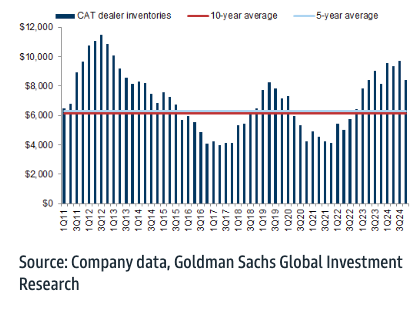
Caterpillar reported adjusted fourth-quarter earnings per share that exceeded the Bloomberg Consensus. However, the Texas-based company warned that 2025 revenue is forecasted to be “slightly lower” as demand concerns for heavy equipment weighed on shares in premarket trading. There are also destock headwinds and elevated inventories impacting dealers. 

Here’s a snapshot of the fourth quarter results (courtesy of Bloomberg): 

 Adjusted EPS $5.14 vs. $5.23 y/y, estimate $5.05 (Bloomberg Consensus)

  • EPS $5.78 vs. $5.28 y/y

Revenue $16.22 billion, -5% y/y, estimate $16.72 billion

  • Financial segment revenue $883 million, +6% y/y, estimate $858.3 million
  • Machinery, Energy & Transportation segment revenue $15.33 billion, -5.6% y/y, estimate $15.76 billion
  • Adjusted operating income $2.96 billion, estimate $3.15 billion
  • Machinery, Energy & Transportation segment operating income $2.94 billion, -5.4% y/y, estimate $3.11 billion
  • Financial Products segment operating income $137 million, -27% y/y, estimate $199 million

R&D expenses $519 million, -6.3% y/y, estimate $538.1 million

Investor focus was not necessarily on fourth-quarter earnings. Instead, Caterpillar’s 2025 outlook, disclosed in a presentation, comes at a time when China’s recovery remains fragile, and President Donald Trump is potentially escalating tariff wars with top trading partners. 

Goldman’s Jerry Revich, Clay Williams, and others told clients, “The key debate on CAT this morning is whether the 2025 margin outlook marks a cycle trough following CAT 4Q results that revealed positives from (i) sharply higher destocking ($700 mn) and (ii) orders (1.08x book-to-bill), but (iii) 2025E margin targets that are ~200 bps below FactSet consensus and (iv) 4Q EBIT miss (though we view this as less material within the context of destocking progress).” 

We expect the stock to be down on the recalibration to 2025 estimates, but with destock headwinds peaking, strong bookings, and solid cost control amid production cuts, we see potential for multiple expansion post earnings,” the analysts continued. 

Here are their key takeaways from the quarter:

  1. 4Q EBIT was 6% below our and consensus estimates due to a 5% sales shortfall amid sharply higher destock. 4.5% of the sales shortfall was driven by dealer inventory destocking.

  2. We believe management outlook comments imply 2025E EPS of ~$19. CAT guided to margins at the high end of its framework, which assuming a 2% sales decline would imply a margin target of ~19% vs. GSe and consensus of 20-21% and 2024 margins of 21.6%.

  3. Dealer inventories of machines were destocked by an additional $700 mn vs. guidance. Total dealer inventories destocked by -$1,300 mn compared to our estimate of a -$780 mn decrease and a normal seasonal decrease of -$225 mn. (iv) Orders of $16.6 bn were up 6% yoy, 8% ahead of our estimate, and represented a book-to-bill of 1.08x.

  4. Retail sales were +8% above our estimates in Construction. Construction Industries were -3% yoy vs. GSe -11%. Resources retail sales were down -3% yoy vs. GSe of -12%. Energy & Transportation retail sales were up +2% vs. GSe of +9%.

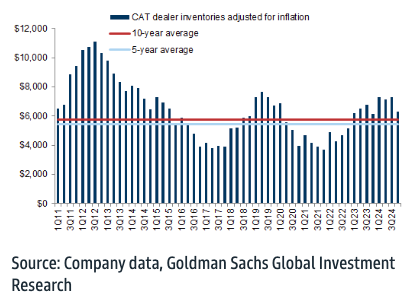
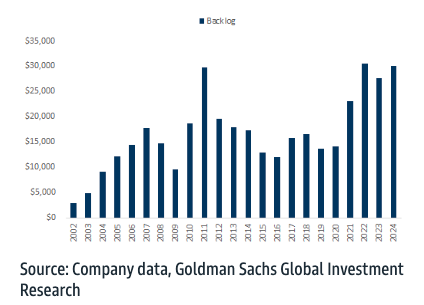
The analysts provided additional insight into inventories, backlog, and order growth via a chart pack

CAT dealer inventories

CAT dealer inventories (inflation-adjusted)
CAT backlog
CAT consolidated orders (% chg yoy)

The analysts maintained their “Buy” rating and a 12-month price target of $442, based on their 26x mid-cycle EPS estimate of $17.00.
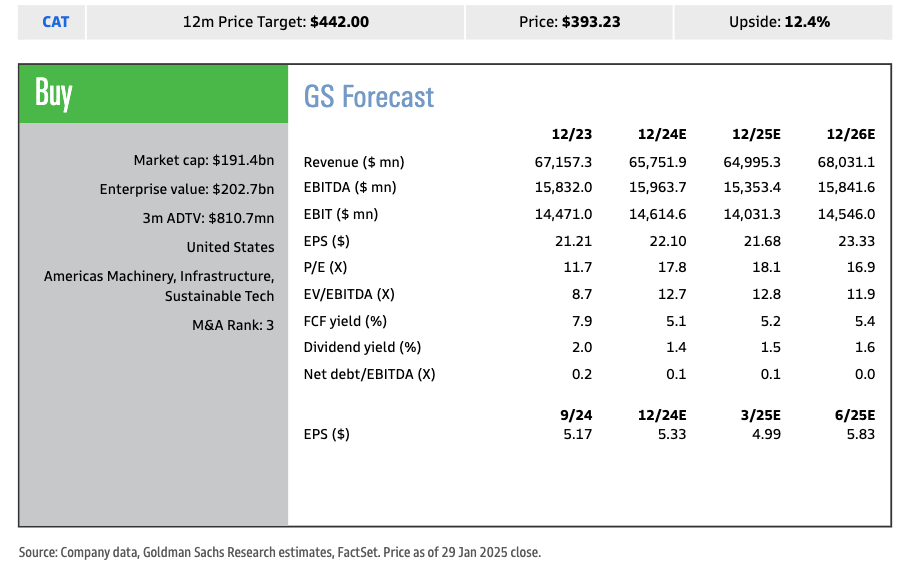
CAT shares are 5% lower in premarket trading in New York. Resistance has been building along the $ 400 handle, which has been rejected numerous times since October. 
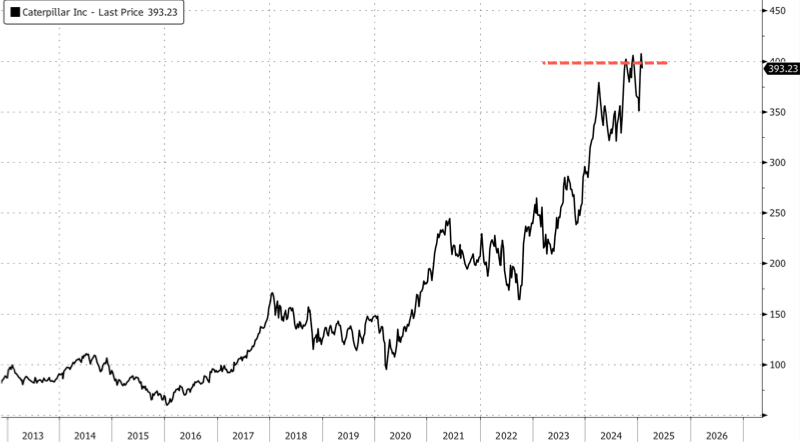
Caterpillar is considered a bellwether for global economic growth because it supplies articulated trucks, backhoe loaders, dozers, engines, excavators, motor graders, skid steer loaders, and wheel loaders to the construction, mining, and energy industries worldwide. The economic headwinds across China and Europe have led to elevated inventories at dealers. 

Tyler Durden
Thu, 01/30/2025 – 09:35

via ZeroHedge News https://ift.tt/7kFGL3o Tyler Durden
Q4 GDP Growth Comes In Unexpectedly Light Despite Red Hot Personal Spending Beating Estimates By A Record

Q4 GDP Growth Comes In Unexpectedly Light Despite Red Hot Personal Spending Beating Estimates By A Record

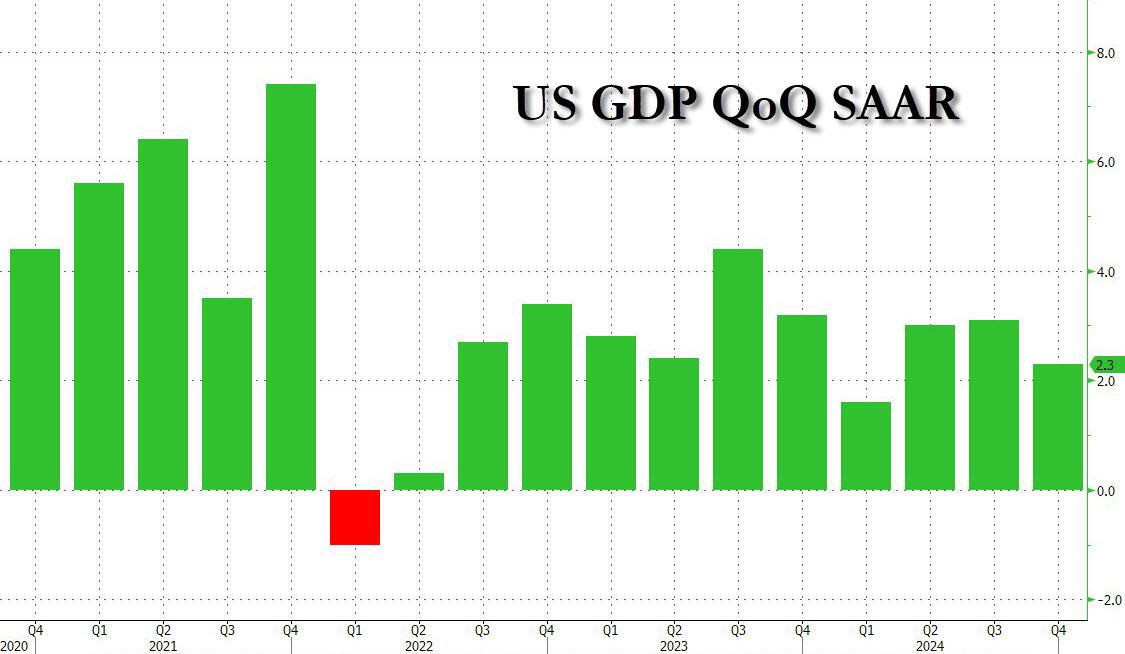
US growth in the last quarter of 2024 slowed down more than expected, with the BEA reporting that Real gross domestic product increased at an annual rate of 2.3% in the fourth quarter of 2024, below the 2.6% estimate and down from 3.1% in Q3. This left the 2024 Q4/Q4 growth rate at 2.5%, as step down from the 3.2% rate seen in 2023.

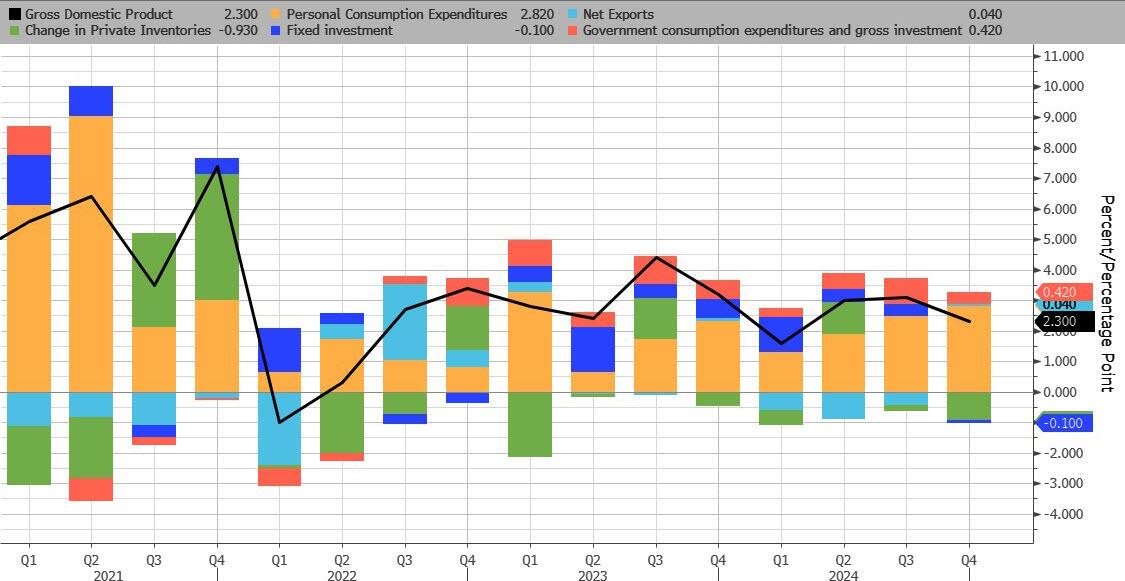
Compositionally, the headline was held back by volatile components with inventories dragging 0.9pp off overall growth. Consumer spending was extremely, almost unbelievably, strong again up 4.2% (saar) in the quarter but business fixed investment was weaker down 2.2%(saar).

Here is the full breakdown:

  • Personal Spending contributed more than 100% of the bottom line GDP print, or a whopping 2.82% of the 2.25% print
  • Fixed Investment subtracted -0.1% from the bottom line GDP print
  • The change in private inventories subtracted 0.93% from the bottom line GDP print
  • Net trade, or exports less imports, was virtually flat at -0.04%, an improvement from the -0.43% net trade detraction in Q3
  • Government, as usual, “added” to growth boosting the bottom line GDP by 0.42%, this was the 10th consecutive quarter when government – i.e., federal debt – directly boosted US growth.

And visually:

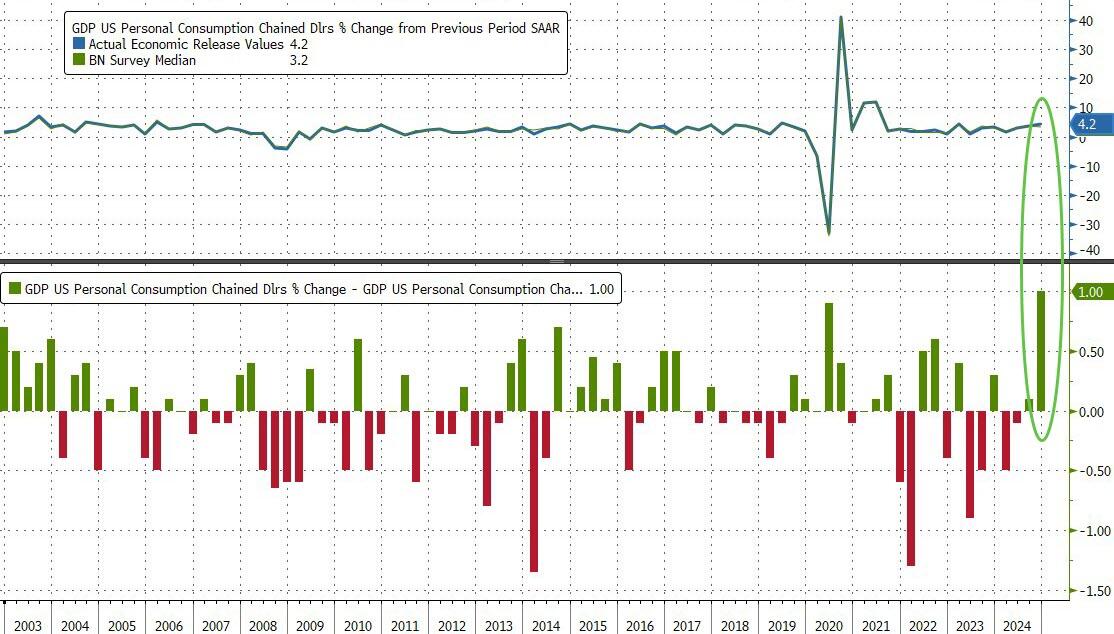
What is notable about the GDP print is that while virtually every other aspect of the US economy shrank, with the exception of government but that is about to hit a sharp U-turn under Trump/DOGE – it was all about consumer spending, which not only comprises about 70% of US GDP growth on average, but which advanced at a 4.2% pace — the first time since late 2021 that outlays have exceeded 3% in consecutive quarters. The acceleration was led by a pickup in motor vehicle sales, something one wouldn’t know by looking at the stock price of various car makers.

As shown in the chart below, the 4.2% personal consumption print was the biggest beat to consensus expectations (of 3.2%) on record!

Elsewhere, nonresidential fixed investment declined an annualized 2.2%, the first decline in more than three years. Business spending on equipment decreased an annualized 7.8%, reflecting the impact of a machine workers’ strike at aircraft maker Boeing. Outlays for structures declined for a second straight quarter.

Government spending rose an annualized 2.5% following a strong third- quarter advance that was led by defense expenditures. Growth in federal spending is at risk as President Donald Trump’s agenda takes aim at programs he’s pledged to eliminate.

Other parts of the economy’s fourth-quarter report card didn’t score as well. Inventories were the largest drag, subtracting nearly a full percentage point from growth — the most since early 2023.

The outlook for the economy this year is one of more moderate growth. The latest Bloomberg month survey shows GDP growth will cool to 2.2% on average, with economists anticipating only a few Fed interest-rate cuts. At the same time, the roll-out of Trump policies add an element of uncertainty.

At the same time, released alongside today’s GDP, headline PCE prices rose 2.3% (saar) over the fourth quarter, relative to 1.5% in Q3. The core PCE price index was up 2.5% (saar) in Q4, marking only the second quarterly acceleration since late 2022. The monthly December release of personal income and spending including PCE prices will be released tomorrow.

Bottom line: the US economy is now all about credit at either the individual level or the federal level – that’s the only place growth can be found.

The GDP figures capped another solid year for the world’s largest economy driven entirely by record debt, which helped defy expectations for a marked slowdown as consumers hung tough in the face of persistent inflation and high borrowing costs. That helps explain why the Federal Reserve is taking a more measured approach to future interest-rate cuts.

US stock index futures remained higher while Treasuries pared gains and the dollar was little changed.

Tyler Durden
Thu, 01/30/2025 – 09:18

via ZeroHedge News https://ift.tt/AjocRMK Tyler Durden

Swatch Profit Sinks 75% On China Weakness, Leaving Luxury Bulls Disappointed

Swatch Profit Sinks 75% On China Weakness, Leaving Luxury Bulls Disappointed

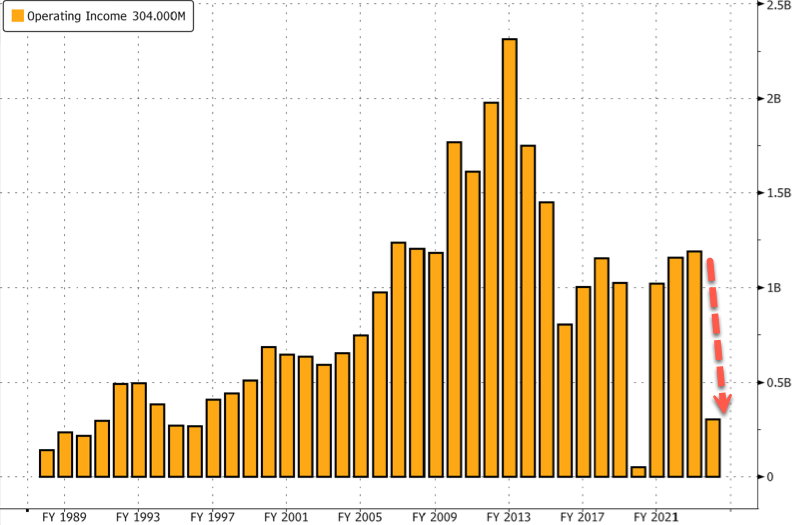
Swatch Group AG, whose brands include Omega, Blancpain, and jeweler Harry Winston, reported operating profits plunged by 75% to 304 million Swiss francs in the full year of 2024, missing the Bloomberg Consensus estimate of 557.5 million Swiss francs. 

The Swiss watchmaker reported net sales last year that tumbled 12% to 6.735 billion Swiss francs, while net profit dropped to 219 million Swiss francs from 890 million Swiss francs a year earlier. 

Here’s a snapshot of the 2024 earnings results (courtesy of Bloomberg):

Operating profit CHF304 million, -74% y/y, estimate CHF557.5 million (Bloomberg Consensus)

  • Watches & Jewelry operating profit CHF410 million, estimate CHF635.1 million
  • Electronic Systems operating profit CHF12 million, estimate CHF14.9 million

Operating margin 4.5% vs. 15.1% y/y, estimate 8.19%

  • Watches & Jewelry operating margin 6.4%, estimate 9.44%
  • Electronic Systems operating margin 3.6%, estimate 4.07%

Net sales CHF6.74 billion, estimate CHF6.99 billion

  • Watches & Jewelry net sales CHF6.42 billion, estimate CHF6.73 billion
  • Electronic Systems net sales CHF330 million, estimate CHF326 million

Sales at constant exchange rates -12.2%, estimate -9.57%

Net income CHF219 million, estimate CHF383.3 million

“Record sales and market share gains in the USA, Japan, India and the Middle East, with the strongest growth for the Omega, Longines and Tissot brands,” the watchmaker said. 

However, the downturn in luxury continued in China. It noted, “Persistently difficult market situation and weak demand for consumer goods overall in China (including Hong Kong SAR and Macau SAR).” 

Swatch’s 2025 outlook indicates that watch demand in China—which accounts for 30% of its sales—will likely remain “rather restrained“: 

2025 promises positive momentum worldwide. The Group’s extensive industrial basis, as well as its strong brand presence, with many exciting new products across all price segments, mean that a positive performance in 2025 can be expected. Demand in China will continue to be rather restrained. The expectation is that the habits and behaviour of Chinese consumers will continue to change, which will open up plenty of new opportunities for the strongly positioned brands. For 2025, Swatch Group expects substantial improvements with respect to sales, operating result and cash flow.

Commenting on the earnings report, Goldman’s Louise Singlehurst, Ben Rada Martin, and others told clients that their initial take is: “A difficult backdrop drives lower operating margin progression. Expect a return to growth in 2025.”

Singlehurst comments on Swatch’s FY’25 Outlook:

Into December Swatch Group saw double digit growth in December across Omega and Tissot brands, with prestige segment brands below those of last year – with the key strength in exit geographies as US/Canada/UK/Netherlands/Belgium growing +20% YoY. Looking forward, Swatch sees positive worldwide momentum in 2025 (while expecting China demand to be rather restrained). Given this backdrop Swatch expects to drive a positive performance across sales / operating result / cash flow.

And the analysts’ view:

We believe the FY24 Operating miss (-3% Sales, -39% EBIT) shows the difficulty of Swatch’s category and geographic exposure (Now 27% Greater China exposure which declined -30% YoY). We do believe stronger December exit momentum and 2025 outlook is a partial offset, however believe focus will remain on aligning supply with demand and the return to long run levels of profitability.

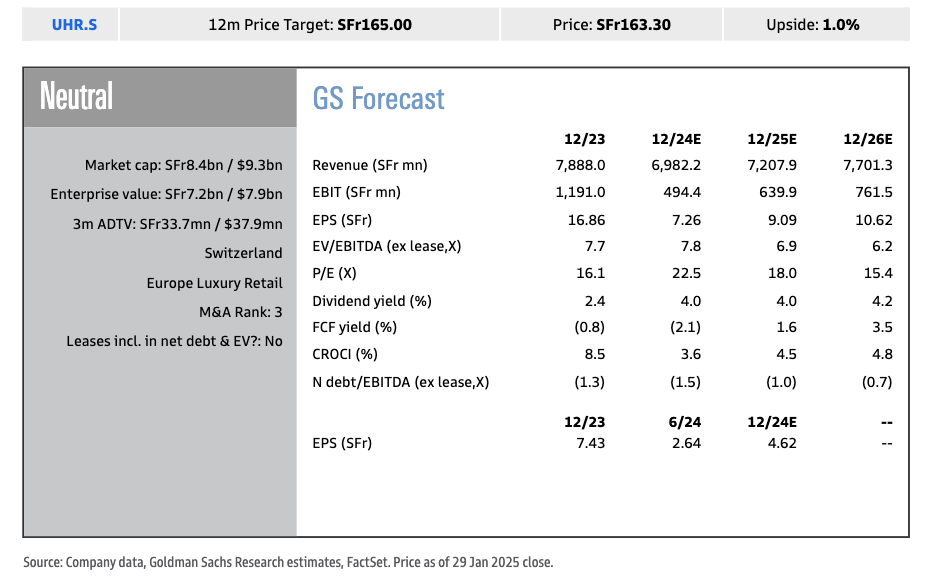
Swatch is “Neutral” rated by GS with a 12-month price target of 165 Swiss francs. 

Here’s what other analysts on Wall Street are saying (courtesy of Bloomberg):

Stifel (hold)

  • Swatch saw a weaker-than-expected performance in the second half of 2024 due to weakness in Greater China, says analyst Rogerio Fujimori, adding that the pressure on profitability is significant

  • While the company expects a positive sales development in local currency, this should be capped by expectations for demand in China to remain restrained in 2025

RBC Capital Markets (underperform)

  • Swatch’s earnings are “materially weaker than expected,” says analyst Piral Dadhania, adding that they will be received poorly by the market given some luxury peers have posted significant beats

  • Sees “fairly material” downgrades to 2025 consensus earnings given the magnitude of the miss

Kepler Cheuvreux (reduce)

  • Jon Cox notes sales watch unit operating margin improved in 4Q, December, but it still sees China constrained in 2025

  • Results were worse than expected

Vontobel (hold)

  • Jean-Philippe Bertschy says this is a year to forget with 14% sales decrease in watches and jewelry in 2H

  • Notes this is the second consecutive year with negative free cash outflow leading to CHF0.9 bln net cash reduction in two years

  • FY24 results were well below expectations, leading to a dividend cut of more than 30%

  • Adds that investors’ mistrust of the Swatch Group remains high and that some of them are likely to sell out

Jefferies (underperform)

  • Frederick Wild says the scale of the 2H results miss will come as a shock today

  • Notes comments on ‘restrained’ demand in China

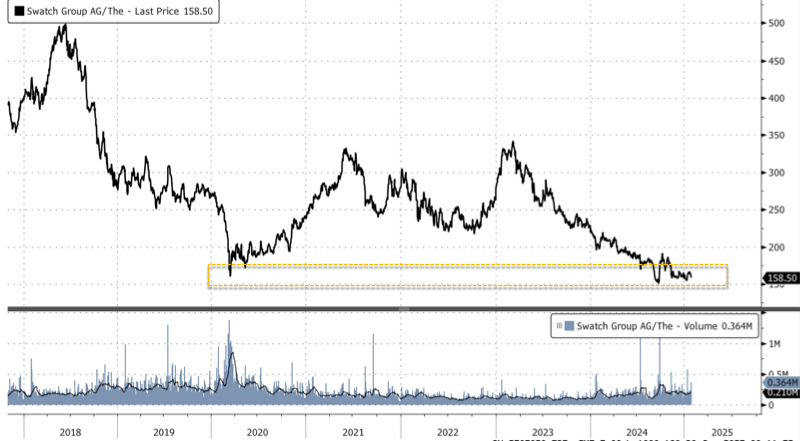
Swatch shares in Europe are down about 5% on the session, hovering around Covid lows. Bloomberg data shows shares are one of the most shorted in Europe, down about 55% since their peak in early 2023. 

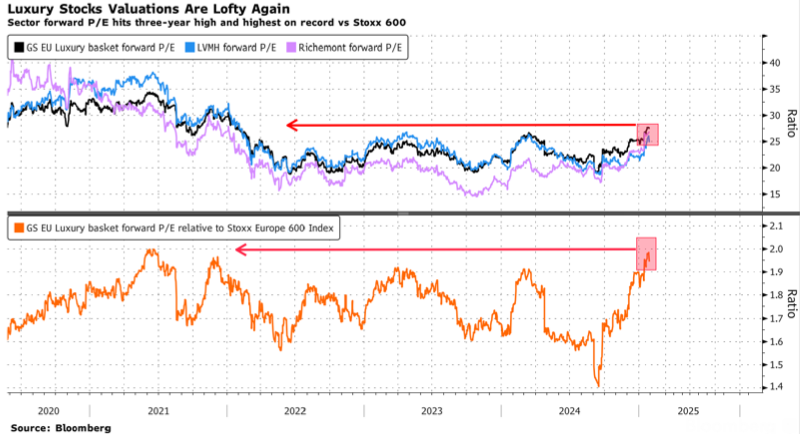
Mixed earnings from LVMH Moët Hennessy Louis Vuitton SE suggest the luxury recovery will be gradual and far from rapid

“LVMH has not yet experienced a major inflection point in demand in any of its key geographies, as seen by most peers who have already reported,” Citi analyst Thomas Chauvet told clients on Wednesday. 

JPMorgan strategists led by Mislav Matejk said, “A year ago, the brief bright spell was fueled by the expectations of manufacturing recovery and the China stimulus, views not too dissimilar to the current situation, but it failed to last.” 

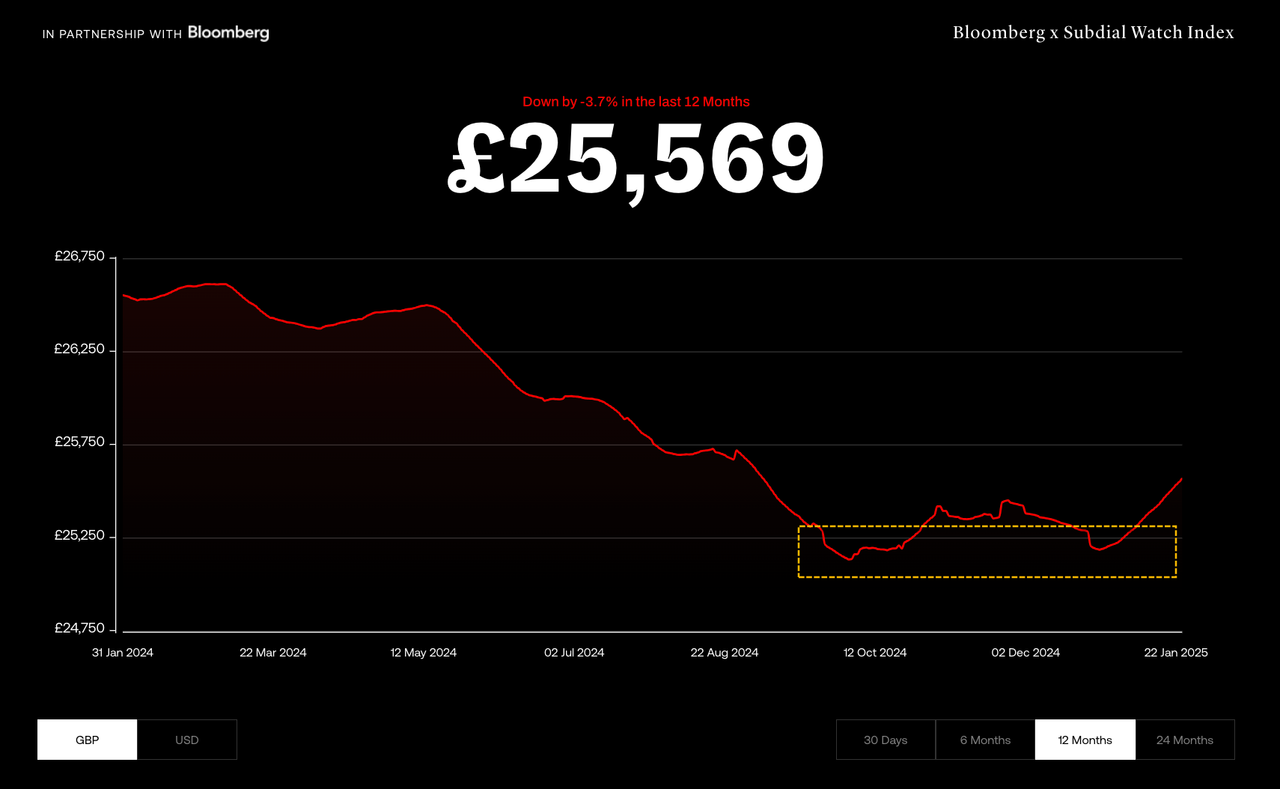
Meanwhile, the Bloomberg Subdial Watch Index, which tracks prices for the 50 most-traded watches by value on the secondary market, has slowed its multi-year descent in recent months.

The big takeaway is that continued weak demand from Chinese consumers will weigh on any luxury recovery in 2025. 

Tyler Durden
Thu, 01/30/2025 – 09:05

via ZeroHedge News https://ift.tt/x7cuQ41 Tyler Durden

American Students’ Reading Scores Decline, Show Little Improvement In Math

American Students’ Reading Scores Decline, Show Little Improvement In Math

Authored by Naveen Athrappully via The Epoch Times,

American students are performing poorly in reading and math skills, failing to regain lost ground during the COVID-19 pandemic, according to 2024 National Assessment of Educational Progress (NAEP) tests administered to fourth graders and eighth graders.

“The most notable challenges evident in the 2024 data are in reading comprehension. Reading scores dropped in both fourth and eighth grades since 2022, continuing declines first reported in 2019, before the pandemic,” said a Jan. 29 statement from the National Center for Education Statistics (NCES), which administers the tests.

As for math scores, fourth grade students registered a two-point gain from 2022. However, this fails to plug the five-point decline in math scores from 2019 to 2022. Eighth grade scores “showed no significant change.”

NAEP, also known as The Nation’s Report Card, measures student achievement, depicting the “state of our K-12 education system and what our children are learning.”

“Overall, student achievement has not returned to pre-pandemic performance,” NCES Commissioner Peggy G. Carr said in the statement. “Where there are signs of recovery, they are mostly in math and largely driven by higher-performing students. Lower-performing students are struggling, especially in reading.”

The NAEP has three achievement levels, the lowest being NAEP Basic. In the 2024 test, a larger percentage of students were found to have scored below the NAEP Basic level in reading skills.

Among fourth graders, 40 percent scored below NAEP Basic in 2024, as did 33 percent of eighth graders. Both grades performed worse than in 2022.

“NAEP has reported declines in reading achievement consistently since 2019, and the continued declines since the pandemic suggest we’re facing complex challenges that cannot be fully explained by the impact of COVID-19,” said NCES Associate Commissioner Daniel McGrath.

Fourth grade reading scores dropped from 2022 for Asian and white students.

Among eighth grade students, reading scores fell by five points for Hispanics and one point for whites.

In math, fourth grade and eighth grade scores remained lower than in 2019. In terms of race, average math scores improved for black, Hispanic, and white students in fourth grade.

Global Competitiveness

Following the release of the NAEP report, House Education and Workforce Committee Chairman Tim Walberg (R-Mich.) blamed liberal, progressive policies for the students’ poor performance.

“When we fail our children, we fail our nation’s future. Today’s NAEP scores continue the concerning trend of declining performance nationwide,“ he said. ”This is clearly a reflection of the education bureaucracy continuing to focus on woke policies rather than helping students learn and grow.

“I’m thankful we have an administration that is looking to reverse course, and I look forward to helping reform our education system to better serve our youth.”

The dismal performance of American students comes in the context of an increasingly competitive globalized world, with other nations possibly outperforming the United States in technology and finance.

A Dec. 16, 2024, analysis by the nonprofit newsroom The Hechinger Report examined results from the 2023 Trends in International Mathematics and Science Study.

U.S. eighth graders ranked 22nd out of 44 countries and sub-national regions. The United States had an average score of 488, far below Singapore and Taiwan, which scored above 600. Fifteen nations had scores between 500 and 600.

The advantage for the United States was in numbers. For instance, 360,000 American eighth grade students were in the top 10 percent of the most advanced level. This was far higher than 33,000 eighth graders in Singapore, which has a far lower overall population than the United States.

Meanwhile, there is a growing focus on charter schools that offer a different curriculum and operate independently of government regulations compared with public schools. A November 2023 report found that students from charter schools had better test scores than their public counterparts.

“We find that charter schools are quite a bit more cost-effective, so for every dollar in, they provide much better test scores, and they have a higher ROI [return on investment],” Josh McGee, one of the researchers of the report, told The Epoch Times.

“For each year of education, students will learn more and make more by going to charter schools rather than traditional public schools.”

Tyler Durden
Thu, 01/30/2025 – 08:45

via ZeroHedge News https://ift.tt/D5TL9MB Tyler Durden

Initial Jobless Claims Tumble Back Near Multi-Decade Lows

Initial Jobless Claims Tumble Back Near Multi-Decade Lows

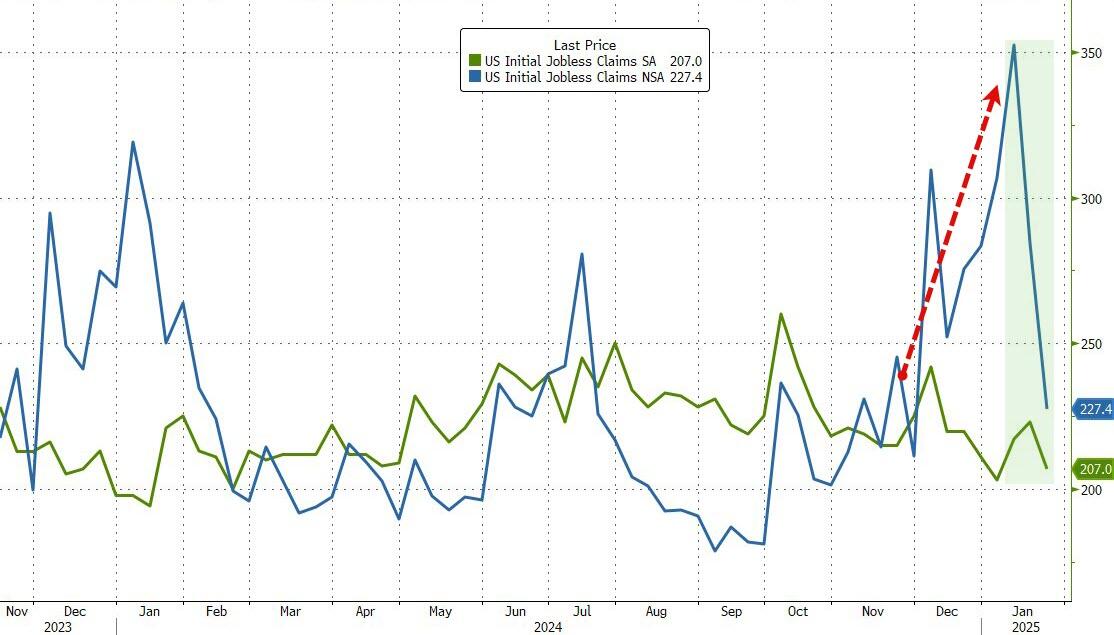
Initial jobless claims continue to show no signs of labor market weakness whatsoever, tumbling from 225k to 207k last week. Unadjusted claims have reversed all of the holiday season surge…

Source: Bloomberg

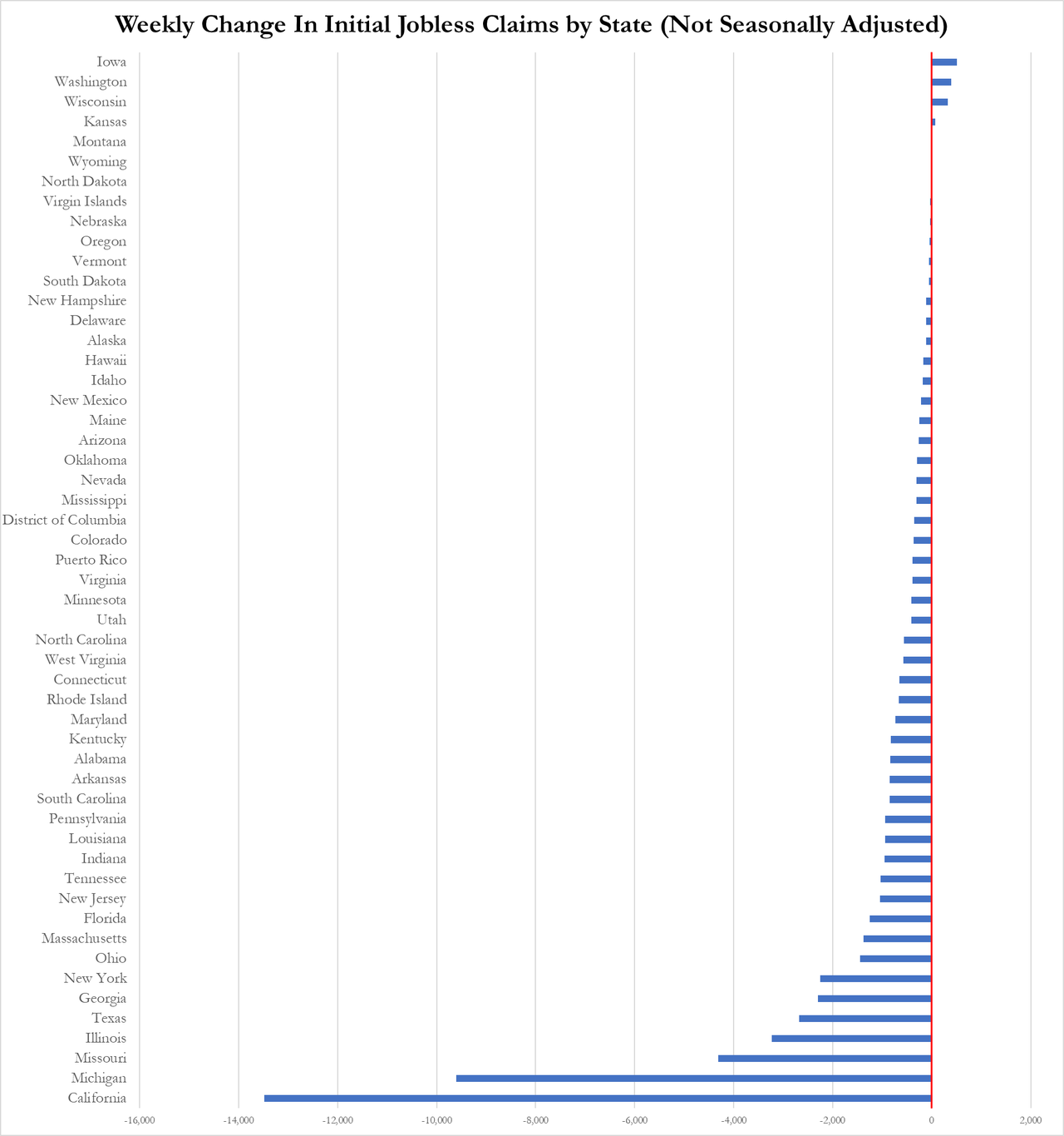
California was the source of the largest decline in initial claims once again…

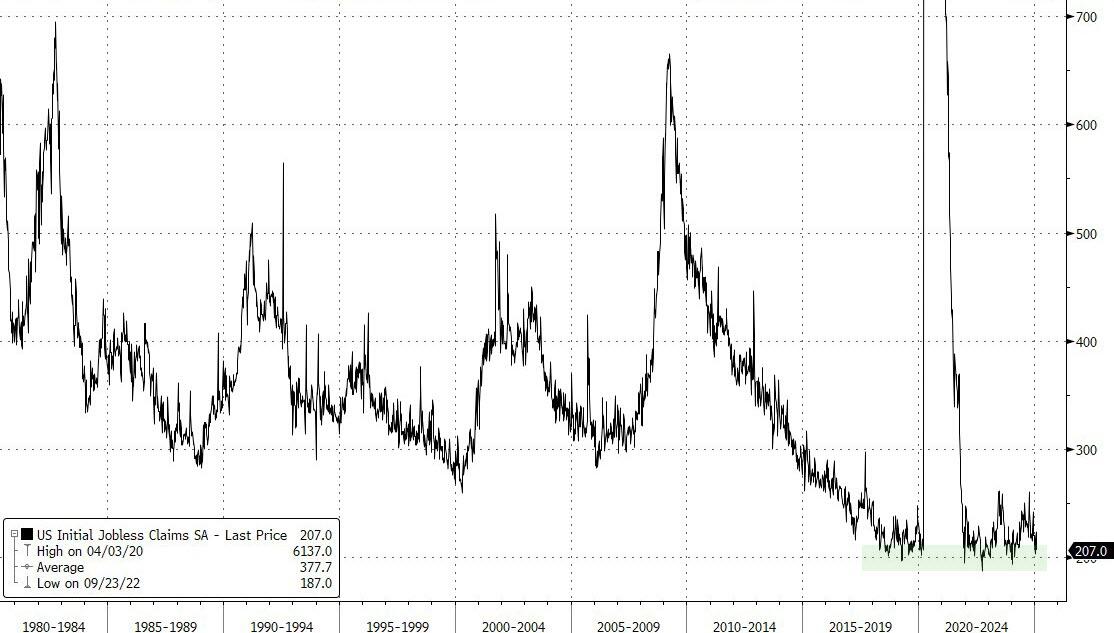
Initial claims continue to hover near multi-decade lows…

Source: Bloomberg

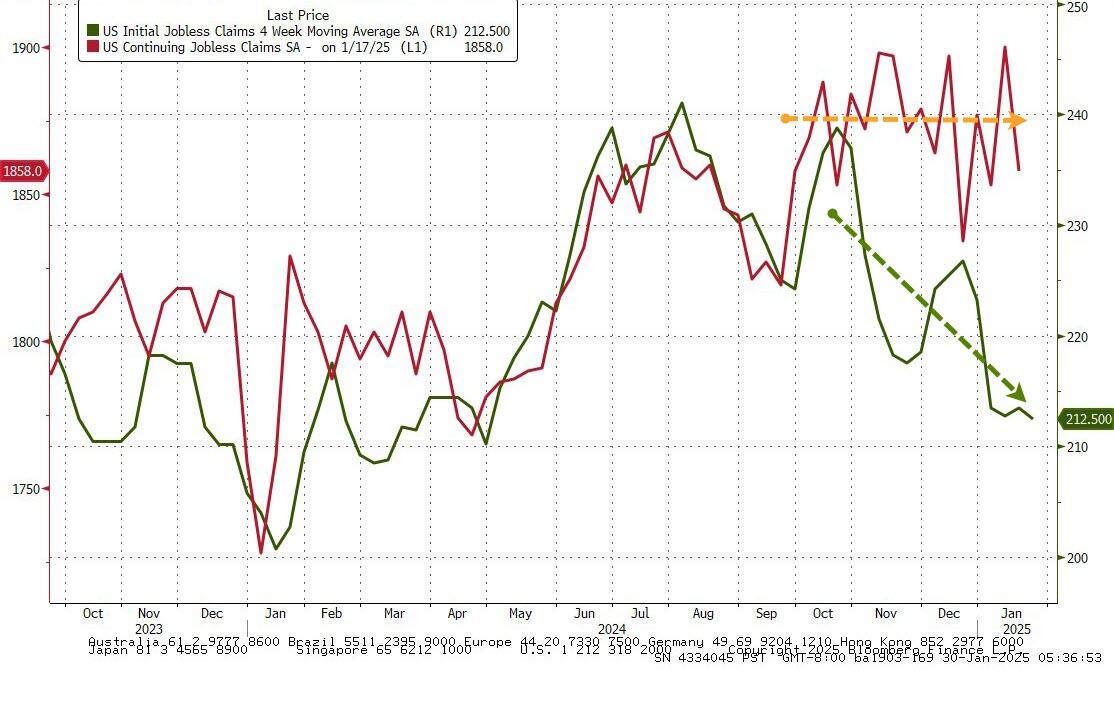
Continuing claims fell last week but remain in a tight range around 1.9 million Americans…

Source: Bloomberg

This data just confirms Powell’s comments yesterday on the strength of the labor market and offers doves nothing in the way of hope for rate cuts being pulled forward.

Tyler Durden
Thu, 01/30/2025 – 08:39

via ZeroHedge News https://ift.tt/12gSBtZ Tyler Durden

ECB Preview And Cheat Sheet: How To Trade The 5th Rate Cut

ECB Preview And Cheat Sheet: How To Trade The 5th Rate Cut

Summary

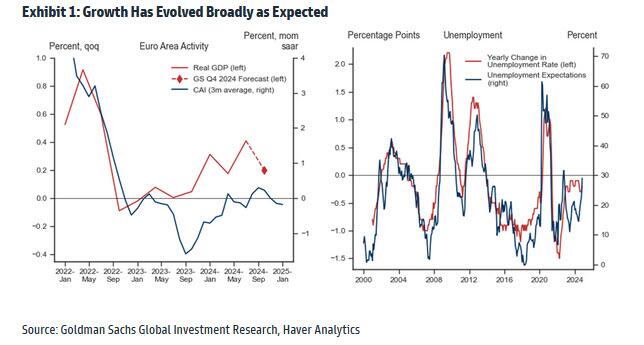
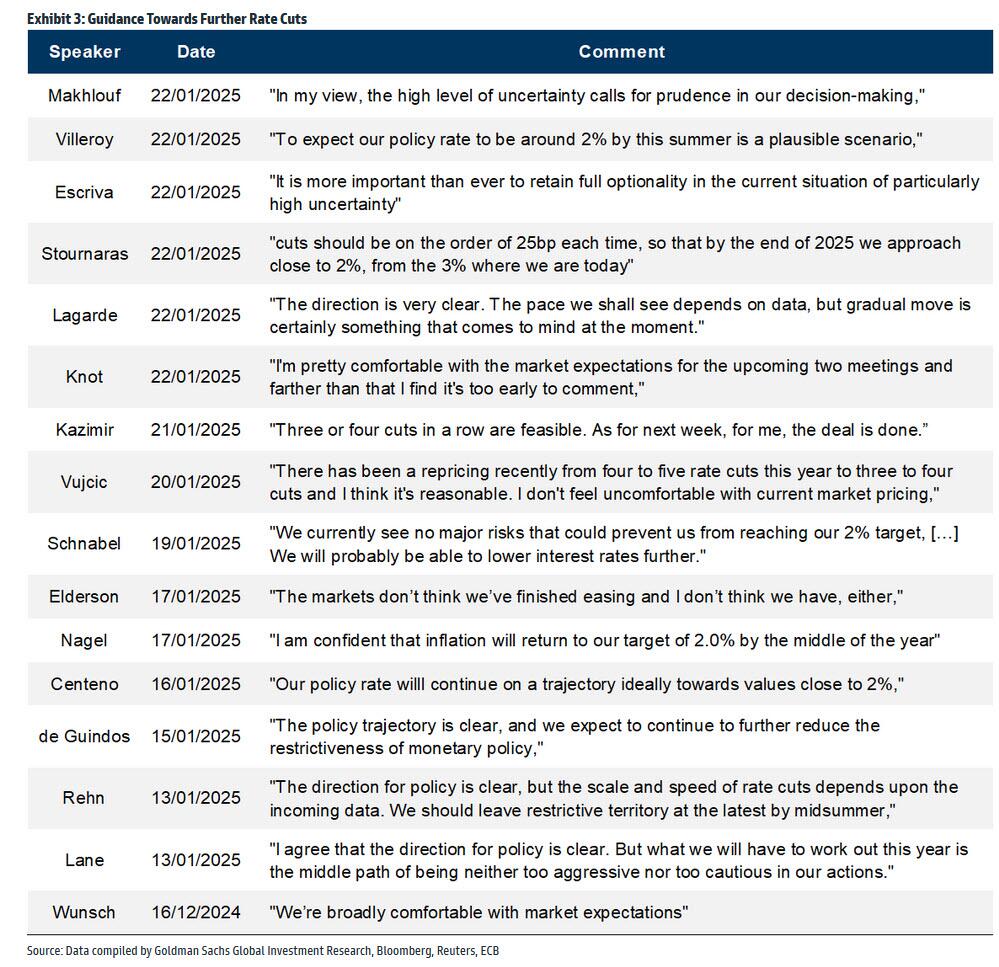
  • The ECB Governing Council is widely expected to cut policy rates by a further 25bp at its January 30 meeting, the fifth consecutive rate cut since the ECB started its easing cycle June 2024. The incoming indicators have been broadly in line with the December staff projections, pointing to subdued growth and ongoing disinflation. ECB officials have guided towards further policy rate cuts, arguing this week that the direction for policy is “very clear.”
  • Goldman expects a steady message at today’s meeting without any changes to the key policy language; the bank expects Lagarde will strike a similar tone to her comments in Davos earlier this week, with much of the Q&A focused on the potential economic implications of the Trump policy agenda.
  • A further 25bp cut at the March meeting is highly likely, while the subsequent rhythm and depth of cuts depends on the data. We maintain our forecast for sequential cuts to 1.75% in July, given our forecast for subdued growth.

The incoming activity indicators have been broadly in line with the December staff projections. While there is downside risk to the staff’s 0.2% Q4 GDP growth number after Germany’s unexpectedly weak GDP release, the early indications for the Q4 GDP composition look firmer and the PMIs have recovered somewhat. The unemployment rate remained at its all-time low of 6.3% in November, but some forward-looking employment indicators have deteriorated (including the unemployment expectations component in the European Commission survey). Consistent with this, recent ECB commentary has noted that the incoming activity data remains weak but in line with the staff’s forecast.

Some more details on what to expect courtesy of Newsquawk

OVERVIEW:

The ECB is unanimously expected to deliver another 25bps cut to the Deposit Rate – the fifth in a row – despite a recent uptick in inflation given concerns around the growth outlook and the view that policy is still currently restrictive. Focus will be on any hints over future easing plans. However, policymakers will likely retain a meeting-by-meeting and data-dependent approach. Looking beyond the upcoming meeting, markets see an additional 66bps (i.e. excluding this week’s 25bps cut) of loosening by year-end with the terminal rate seen at around 2%.

PRIOR MEETING:

As expected, the ECB delivered a 25bps cut to the deposit rate, taking it to 3.0%. The main takeaway from the policy statement was the Governing Council s decision to drop the reference to ‘keep policy rates sufficiently restrictive for as long as necessary”. Elsewhere, the ECB stated it will continue to follow a data-dependent and meeting-by-meeting approach. The accompanying macro projections saw a reduction in the HICP forecasts for 2024 and 2025 with the 2026 forecast held below target at 1 9%, whilst growth forecasts were cut across the horizon At the follow-up press conference. Lagarde was careful to note that the GC is not yet declaring victory on inflation, whilst later adding that risks to inflation are two-sided. With regard to the policy decision. Lagarde noted that all members agreed with the policy proposal. Adding that a 50bps move was discussed, however, this failed to gain any traction. The President stated that whilst not pre-committing to a specific policy path, the direction of travel is clear. Lagarde also refused to engage in discussions of where the GC sees the neutral rate, stating that it was not discussed at the meeting.

RECENT ECONOMIC DEVELOPMENTS:

The economic backdrop to the upcoming meeting has seen an expected uptick in headline Y/Y inflation to 2.4% from 2.2%, core Y/Y hold steady at 2.7% and services inflation nudge higher to 4.0% from 3.9%. The 5y5yr inflation forward has picked up from around 2% at the time of the prior meeting to current levels of circa 2.08% (has been as high as 2.1489%). At this stage, policymakers have looked through the uptick in inflation and continue to expect a return to target in 2025. Greater concern remains on the growth outlook. However, on a mildly encouraging footing, flash PMI data for January saw the Composite metric move back into expansionary territory. The accompanying report noted ‘The private sector is back in cautious growth mode after two months of shrinking’ Note, that Q4 GDP data is not available until the morning of the announcement. In the labour market, the unemployment rate remains at the historic low of 6.3%.

RECENT COMMUNICATIONS:

In an interview at Davos. President Lagarde remarked that she is confident that inflation will return to target over the course of the year, whilst the growth outlook is subject to downside risks. On the trade front, she remarked that it was her expectation that there would be no immediate tariffs from the US and expects the US to be more selective when it comes to tariffs. Chief Economist Lane has stated that the ECB needs to work out a middle path where it is not too aggressive or too cautious in its actions. The influential Schnabel of Germany has noted that the ECB is “getting closer and closer to the point where we need to take a closer look at whether and how much further we can cut interest rates.” Her German counterpart Nagel has stressed that the Bank should not rush things when it comes to policy normalization. At the most hawkish end of the spectrum, Austria’s Holzmann has stated that a cut at the upcoming meeting is not a foregone conclusion. At the dovish end of the spectrum. Greece’s Stournaras is of the view that “cuts should be on the order of 25bp each time, so that by the end of 2025 we approach close to 2%, from the 3% where we are today”. Elsewhere on the rate path. France’s Villeroy suggests that “to expect our policy rate to be around 2% by this summer is a plausible scenario “.

RATES:

Expectations are for the ECB to deliver a 25bps cut in the Deposit Rate to 2.75%, according to all analysts surveyed by Reuters; markets assign a 91% chance of such an outcome on the basis that policy is still viewed as being restrictive and the recent uptick in inflation is seen as temporary. Looking beyond the upcoming meeting, markets see an additional 66bps of loosening by year-end with the terminal rate seen at around 2%; a level that some desks view as neutral. A further deterioration in the growth outlook and a moderation in inflation could see pricing slip closer to 1 50-1.75%. ING posits that such levels could also come to fruition in the event of a more dovish Fed.

HOW TO TRADE THE CUT:

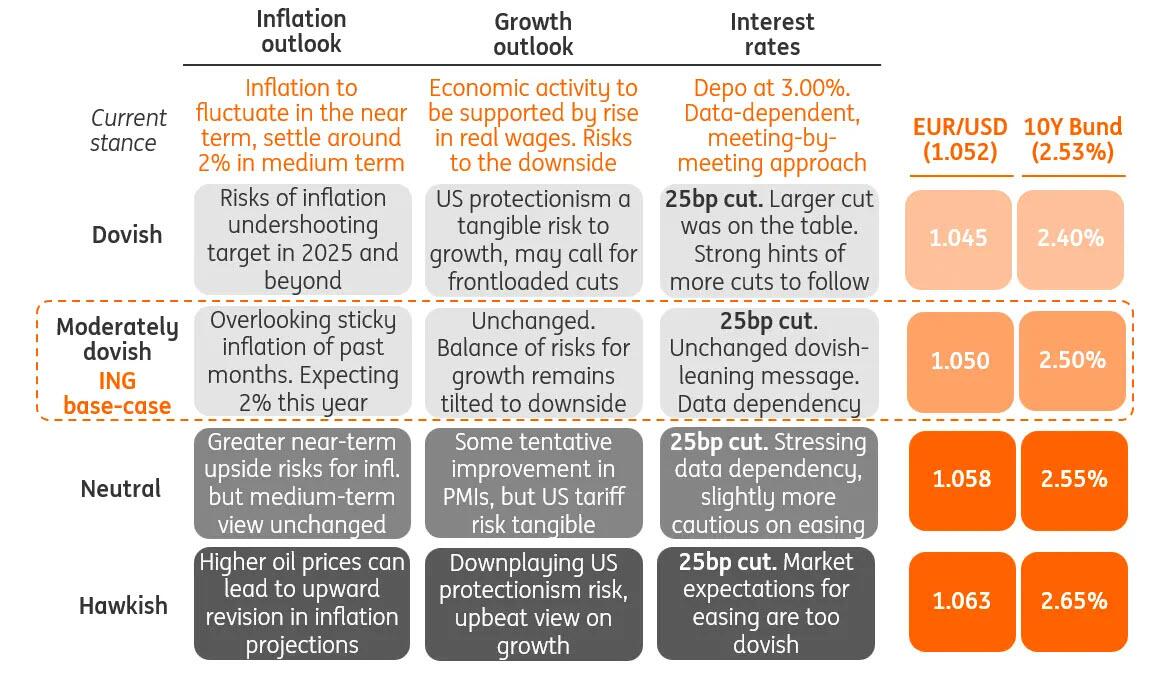
As usual, the folks at ING Economics have published a matrix on how to trade the ECB decision. The bank’s baseline is that a reiteration of the broadly dovish message can pave the way for lower eurozone rates. While the ECB remains a negative for the euro, the dollar correction might have a bit more to run

Tyler Durden
Thu, 01/30/2025 – 07:40

via ZeroHedge News https://ift.tt/bUDIy8f Tyler Durden

Stop The Nonsense And Confirm Tulsi Gabbard

Stop The Nonsense And Confirm Tulsi Gabbard

Authored by Charlie Kirk via RealClearPolitics,

Conservatives of all stripes have enjoyed the first week of Donald Trump’s presidency. The events of the past week have made it very clear that President Trump has come in well-prepared and is laser-focused on fulfilling the many promises that won him the election. Whether it’s securing the border, breaking the DEI cartel, or ending DOJ lawfare, the president is executing his agenda with unprecedented energy and aggression.

In the long term, though, securing the president’s promises can’t be done with executive orders alone. Success will come down to the president picking appointees who can carry out his will. 

President Trump chose Tulsi Gabbard as his director of national intelligence for a very clear reason. Ever since he entered the political scene 10 years ago, Trump has faced not just opposition but outright sabotage and deceit from the so-called “intelligence community” of Washington, D.C. They spied on his campaign and gave life to the ridiculous smear that he was a Russian agent. Analysts deliberately withheld information from the president, then leaked about what they were doing to the press. And of course, during the 2020 election, the intelligence apparatus pressured America’s tech companies to engage in widespread censorship while a network of “former intelligence officials” lied through their teeth to denounce the Hunter Biden laptop story as “Russian disinformation.”

The American intelligence world is arrogant, wayward, and in dire need of reform. That is precisely why President Trump chose former Rep. Tulsi Gabbard, a longtime critic of these agencies, to be his director of national intelligence.

Gabbard is indisputably qualified. She is a veteran of the Iraq War, the worst of the wars that the intel agencies blundered us into. She spent eight years in Congress and served stints on the homeland security, armed services, and foreign affairs committees, all of them relevant to the job. She has authentic bipartisan credentials: She represented the Democrats in Congress, is the choice of a MAGA president, and has the personal endorsement of Meghan McCain (a Republican with whom I have no shortage of differences).

So what do her opponents bring against her? It’s simple: They lie. Every attack on Tulsi Gabbard is a smear concocted by those desperate to prevent the change voters demanded in November. 

Some bad actors in D.C., and even within the Republican Party, think they can rerun the game plan of 2017 when people thought the Donald Trump moment was a fluke that would soon be over. And I mean “rerun” literally because one of the top smears against Gabbard is the same one brought against Trump eight years ago: the wild claim that Tulsi Gabbard is a “Russian asset.” Just like the attack on Trump, this smear was popularized by Hillary Clinton, and just like the attack on Trump, it’s based wholly on Gabbard’s refusal to endorse the failed groupthink consensus of Washington. Gabbard supported military aid to Ukraine prior to the country’s invasion in 2022. She called Putin a U.S. adversary. But none of that matters because this attack was never about the truth. It’s about smearing Gabbard for opposing regime change, forever wars, and a blank check for the D.C. cabal.

The same rules apply to the wild claim that Gabbard is an “Assad sympathizer” in league with the fallen dictator of Syria. The allegation is utterly ridiculous. Gabbard’s 2017 trip was cleared by House Ethics beforehand, and she did a debriefing with America’s ambassador to Lebanon afterward. Members of Congress are free to meet with foreign leaders, especially if those leaders are the ones Americans are supposed to spend billions of dollars fighting, directly or indirectly. This is why President Trump has sought direct diplomacy with Vladimir Putin and even North Korea’s Kim Jong-Un.

With nothing else to argue, Gabbard’s critics have to fall back on the complaint that she didn’t believe Assad actually used chemical weapons during his fight to hold onto power. It’s another lie – Gabbard has been saying she believes Assad used chemical weapons for more than five years. But truthfully, it wouldn’t even matter if she thought otherwise. Unlike nearly all of Washington’s war hawks, Gabbard has direct experience fighting in a misbegotten war sold with bad intelligence. Unlike most of Washington, Gabbard learned the lesson that spectacular claims about weapons of mass destruction should be backed with proof, not ridiculous threats against anyone showing skepticism.

Other attacks are even more pathetic. There’s the Hail Mary that she is “soft on Iran” when her track record makes it clear she simply shares the president’s goal of avoiding another fruitless war in the Gulf. Attacks on Gabbard’s Hindu religious beliefs are so puerile they don’t even merit a reply.

Gabbard brings to the table exactly what President Trump needs in a DNI: an independent thinker who isn’t shackled to decades of Beltway consensus and who has learned to be skeptical. This isn’t just what President Trump wants, though. It’s what the American public voted for in 2024 – and the election was not a squeaker. 

Republicans who hold office right now hold it thanks to voters who expect them to help Trump keep his promises. If those same Republicans instead scuttle one of the president’s essential appointments on the basis of establishment smears, then I have a simple promise: They will face a primary challenge. I, and many others, will do whatever it takes to see them replaced. Republicans can either participate in the president’s reform agenda or they can be trampled by it. 

It’s up to them. Any questions?

Charlie Kirk is founder and CEO of Turning Point USA, Turning Point Action, and host of the top-ranked podcast and nationally syndicated radio program, “The Charlie Kirk Show.”

Tyler Durden
Thu, 01/30/2025 – 07:20

via ZeroHedge News https://ift.tt/zASFMo7 Tyler Durden

Inflation Storm Leaves Americans More Reliant On Food Banks

Inflation Storm Leaves Americans More Reliant On Food Banks

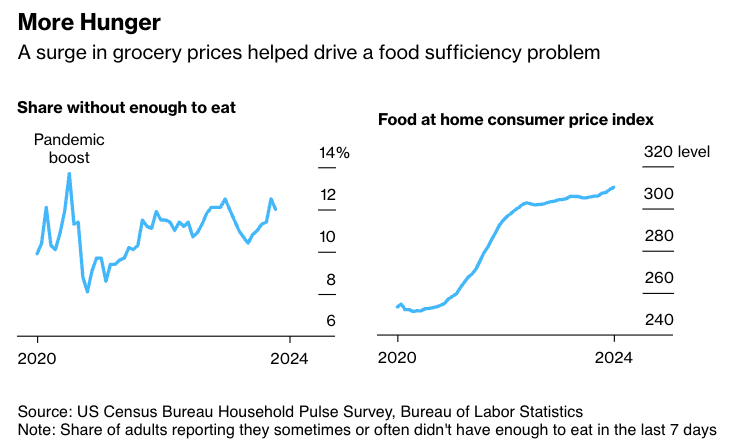
Emily Engelhard, Vice President of Research at Feeding America, told Bloomberg that elevated and persistent inflation ushered in a “new era of food insecurity,” emphasizing that “this is no longer an unemployment issue.” 

Feeding America, the largest charity working to end hunger in the US, has a nationwide network of more than 200 food banks that feed more than 46 million people through food pantries, soup kitchens, shelters, and other community-based agencies.

“Everyone sees prices getting high — for food, clothes, everything,” Kersstin Eshak told Bloomberg, who recently visited a food bank in Loudoun County, Virginia. She said the inflation nightmare over the last several years depleted her pocketbook.  

America’s cost-of-living crisis mostly erupted during the Biden-Harris regime’s first term. 

Source: Bloomberg

Ethan Amos, the head of the Flagstaff Family Food Center in Arizona, said his food bank broke records in 2022 by serving an average of 28,000 meals per month. That figure has now surged to a staggering 40,000 meals per month, driven by the inflationary pressures unleashed during the Biden-Harris administration’s disastrous “Bidenomics.

Believe it or not, Washington, DC, has a hunger crisis. The largest food bank in the area, Capital Area Food Bank, distributed 64 million meals last year—five million more than the previous year. Data from the food bank shows that food insecurity has risen most sharply among households earning $100,000–$150,000.

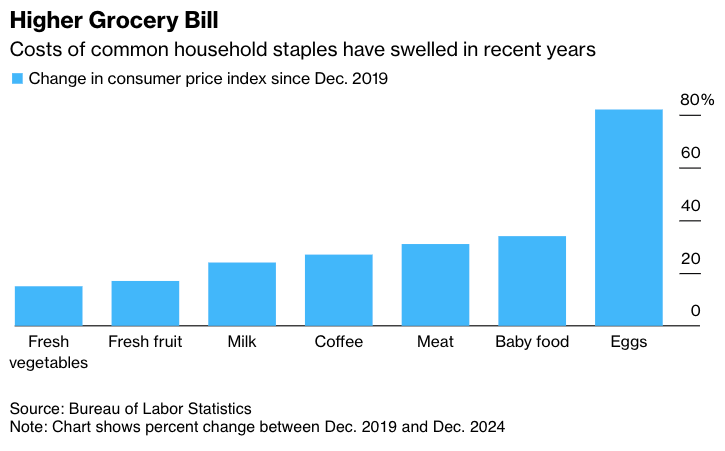
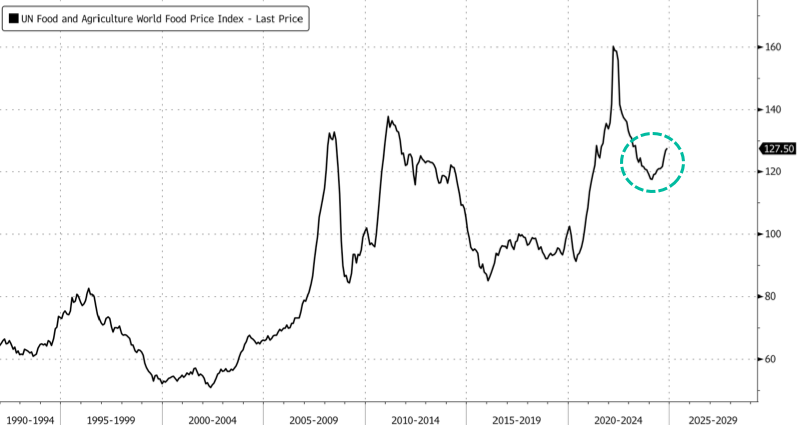
In the past five years, supermarket food prices have jumped 28%—roughly matching the increase seen in the 15 years before the onset of Covid. While wages have also increased, inflation eroded much of those gains. Low- and mid-tier consumers have been most battered in the multi-year inflation storm

“Everything has gone up,” said Norma Rivera, a working single mother of two, during an interview at the Food For Others food pantry in Fairfax, Virginia, adding, “Fifty dollars is nothing” in the grocery store, she said.

Source: Bloomberg

Last week, consumer services company Bankrate released a new report finding that most Americans could not afford a $1,000 emergency expense. 

More bad news for consumers…

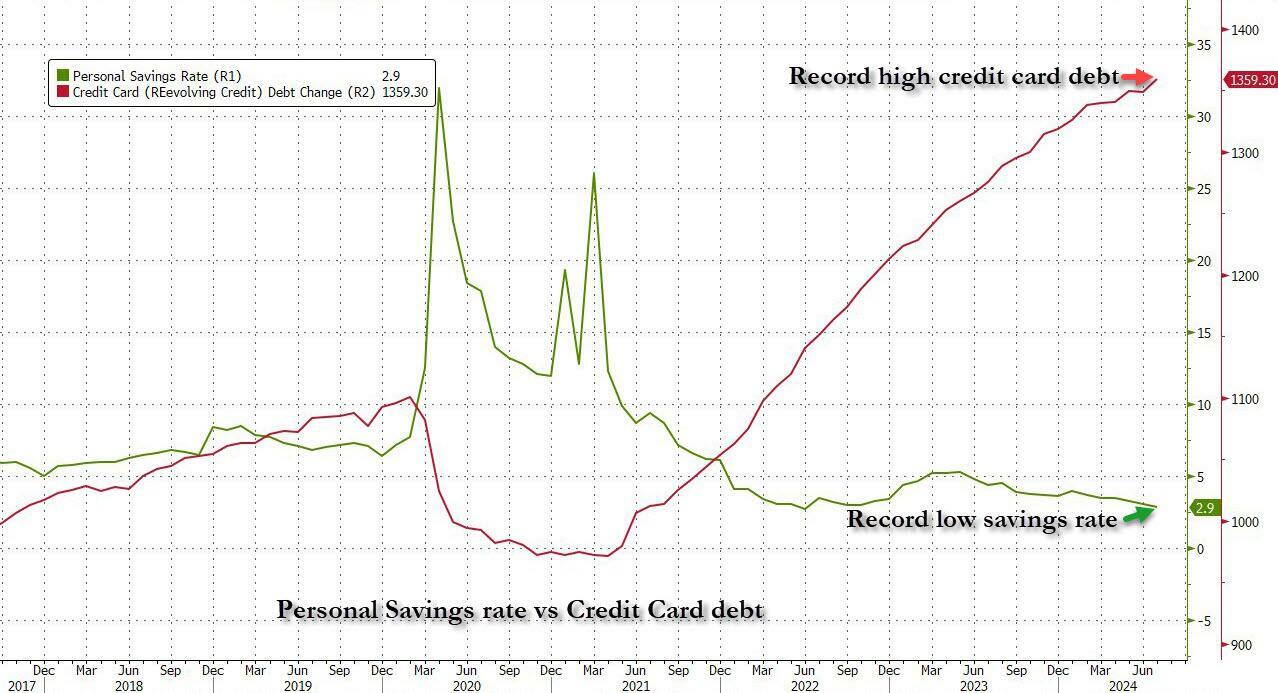
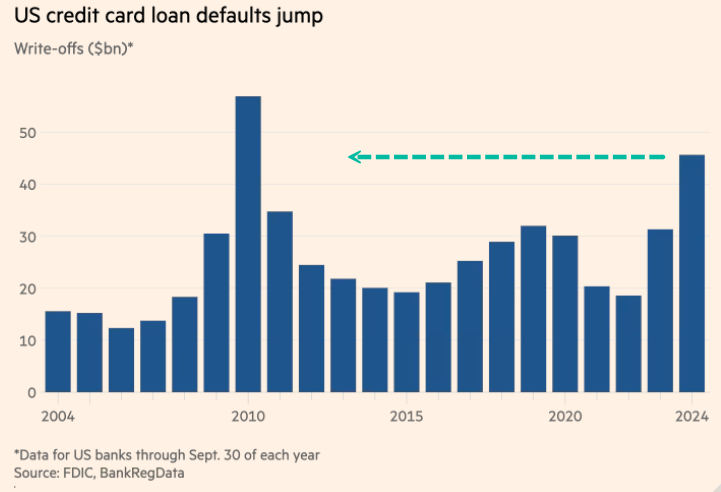
Many consumers have maxed-out credit cards and depleted personal savings

Party ending?

Source: Financial Times 

“Increasingly, those who are food insecure are middle income and more highly educated,” Radha Muthiah, CEO of Capital Area Food Bank, said, adding, “We don’t suffer from people not being employed.”

Just wait until all those woke federal workers in the Mid-Atlantic find themselves jobless in the era of gov’t efficiency. 

Also, for those who can still afford to shop, the inflation storm has transformed much of the nation into Walmart shoppers.

To combat Biden Harris’ inflation storm, Trump signed an executive order early last week titled: Delivering Emergency Price Relief for American Families …

Tyler Durden
Thu, 01/30/2025 – 06:55

via ZeroHedge News https://ift.tt/iqFhAlY Tyler Durden

Trump’s Executive Orders Are Key To DOGE’s Success

Trump’s Executive Orders Are Key To DOGE’s Success

Authored by Ryan Silverstein via RealClearPolitics,

President Trump has just been sworn in, but his administration has already taken steps to promote a robust and efficient administrative state. By implementing four executive orders aimed at expanding the scope of Schedule F and reforming the federal hiring system, Trump can expediently implement the Department of Government Efficiency’s rulemaking and budget recommendations.

The Department of Government Efficiency (DOGE) is a temporary advisory committee tasked with implementing Trump’s “18-month DOGE agenda” of maximizing efficiency and productivity in the federal government. Because DOGE cannot execute its efficiency agenda, the president is responsible for implementing DOGE’s recommendations. DOGE will likely recommend numerous administrative rule changes and budget cuts to reduce the federal bureaucracy’s size, which means that Trump needs bureaucrats who will faithfully implement the recommendations and leeway to fire those who try to stall the department’s progress or who DOGE’s report finds are wasteful. President Trump set himself up to enforce DOGE’s recommendations by enacting four executive orders.

The first executive order is a hiring freeze on executive branch employees until the Office of Management and Budget develops a plan to reduce the size of the federal workforce. This is sound policy as the administration needs to determine what positions benefit the American people and which positions are wasteful, inefficient, and needlessly cost taxpayers money.

Furthermore, the administration needs to implement a new hiring process for federal bureaucrats. Former President Biden’s Diversity, Equity, and Inclusion (DEI) initiatives fostered a federal bureaucracy devoted to serving woke ideology instead of the public. Trump issued an order implementing reforms for the hiring process that prioritize hiring highly skilled individuals who are “committed to improving the efficiency of the Federal government, passionate about the ideals of our American republic, and committed to upholding the rule of law and the United States Constitution.”

This executive order also ends DEI hiring and is intended to lower hiring times across the executive branch. These two executive orders overhaul the hiring process for civil servants, which should result in skilled bureaucrats who will faithfully execute DOGE’s recommendations. In turn, this order will make the federal bureaucracy more efficient and responsive for the American people.

Trump doesn’t just need competent bureaucrats to enact DOGE’s recommendations – he also needs leeway to remove inefficient employees and career civil servants who may work to slow down the implementation of DOGE. Beyond federal employee hiring, he enacted two executive orders enhancing his removal power over the civil service.

First, Trump signed an order resuscitating and expanding the scope of Schedule F. In his first administration, Schedule F was a job classification that removed civil service protections from policy-making positions within the executive department and allowed for streamlined hiring and firing of those positions. Biden never implemented Schedule F, instead repealing Trump’s executive order that implemented the Schedule. Trump revived Schedule F on his first day, so it should be fully implemented by the time DOGE releases initial recommendations.

Moreover, Trump expanded Schedule F’s scope to include all “policy/career” positions, allowing DOGE to fully examine the civil service. The order also requires all bureaucrats to implement the administration’s policies faithfully, deeming it a fireable offense if they refuse.

In addition to this order, Trump signed a second order eliminating removal protections for Career Senior Executive Service (SES) officials and requiring them to adopt performance plans. SES officials oversee vast bureaucracies in 75 federal agencies responsible for making rules that impact millions of Americans. Previously, they were not subject to at-will removal from the president and could only be fired with cause. The president’s executive order removes these protections and subjects SES officials to the same removal requirements lesser bureaucrats are subject to – increasing presidential control over the civil service.

These changes are a lawful exercise of executive power and will allow quick implementation of DOGE’s recommendations. The U.S. Constitution solely vests the president with the executive power – meaning all bureaucrats subject to these executive orders exercise power at the president’s behest. Further, the Supreme Court approved this level of executive control in Myers v. U.S. and Humphrey’s Executor v. U.S., where they held that purely executive officers are subject to presidential removal without good cause. Therefore, courts will likely uphold Schedule F’s revival, increasing executive power over removal.

Schedule F and SES reform will allow Trump to enact DOGE’s policies in two ways. First, his orders allow him to fire bureaucrats which DOGE and department heads deem wasteful or inefficient. Second, these reforms empower Trump and his surrogates to remove civil servants from top to bottom who are intentionally stalling DOGE’s implementation.

These executive orders are essential to DOGE’s success. Enacting these orders will create a proficient, highly skilled, merit-based civil service that efficiently implements DOGE’s recommendations. The result will be a civil service that effectively serves the American people.

Ryan Silverstein is a J.D. candidate at Villanova University and a fellow with Villanova’s McCullen Center for Law, Religion and Public Policy. His work has previously appeared in the New York Daily News, Post & Courier, and the Las Vegas Review-Journal.

Tyler Durden
Thu, 01/30/2025 – 06:30

via ZeroHedge News https://ift.tt/aTmfZDy Tyler Durden

The US Dominates The World University Ranking

The US Dominates The World University Ranking

The UK’s Oxford University was named the world’s best university in the latest global ranking released by Times Higher Education last week.

While the UK features quite heavily at the upper end of the list, as Statista’s Katharina Buchholz reports, it’s the United States that utterly dominates it. 23 of the 50 best universities in the world are located in the country, according to the ranking, while 7 are in the United Kingdom, also including the University of Cambridge and the Imperial College of London.

Infographic: The U.S. Dominates the World University Ranking | Statista

You will find more infographics at Statista

China has four entries in the top 50, including Beijing’s Tsinghua and Peking universities as well as Shanghai’s Fudan University and Hangzhou’s Zhejiang University.

Three institutions out of the top 50 are found in Canada and Germany, respectively, while two each hail from Switzerland, Singapore and Hong Kong.

The top 50 also included one school each from France, Japan, Belgium, Australia and Sweden.

The ranking is based on five indicators (teaching, research environment, research quality, international outlook and industry). Reducing to the first 30 ranks, the U.S. has an incredible 17 universities inside the top 30 – compared to the UK’s five and China’s two.

Tyler Durden
Thu, 01/30/2025 – 05:45

via ZeroHedge News https://ift.tt/GzwHdW7 Tyler Durden