Former NASDAQ-Listed Exec Sentenced To Life In Prison Over Murder-For-Hire Plot

Former NASDAQ-Listed Exec Sentenced To Life In Prison Over Murder-For-Hire Plot

The First Assistant U.S. Attorney for Vermont announced that on November 24, 2025, Chief Judge Christina Reiss sentenced Serhat Gumrukcu, 43, of Los Angeles—formerly the “scientific founder”, “inventor” and largest shareholder of publicly listed Enochian Biosciences, which eventually became Renovaro—to life in prison for the January 6, 2018, murder-for-hire of Gregory Davis in Barnet, Vermont.

Gumrukcu was first brought to the attention of market participants by former short seller Hindenburg Research back in 2022 who called his company a $600 million Nasdaq-listed scam “based on a lifetime of lies”. 

A jury convicted him in April 2025 of murder-for-hire, conspiracy to commit murder-for-hire, and conspiracy to commit wire fraud, according to the DOJ

Gumrukcu had formerly been praised by Enochian (then Renovaro) CEO Mark Dybul – who once worked under Anthony Fauci at the National Institute of Health – with Dybul writing in November 2019 that he was “one of those rare geniuses that is not bound by scientific discipline or dogma”. Hindenburg then accused Dybul of turning a “blind eye to outrageous fraud” perpetrated by Gumrukcu in a stunning follow up report after the “inventor’s” death. 

The Department of Justice press release says that his co-conspirators were sentenced in September 2025: Berk Eratay received 110 months of imprisonment followed by three years of supervised release; Aron Ethridge received 140 months followed by five years of supervised release; and Jerry Banks received 200 months followed by five years of supervised release.

According to prosecutors, Gumrukcu ordered Davis’s killing because Davis threatened legal action over a failed oil-commodities deal that was also the basis of Gumrukcu’s wire-fraud conviction. Gumrukcu also feared that Davis would interfere with a biotech merger involving his claimed HIV “cure.”

Evidence showed that Eratay enlisted Ethridge, who then hired Banks. On January 6, 2018, Banks posed as a Deputy U.S. Marshal and abducted Davis from his Vermont home; Davis’s body was found the next day nearby. Communications, financial records, and location data documented the dispute between Gumrukcu and Davis and tied Gumrukcu, Eratay, Ethridge, and Banks to the crime.

At sentencing, Melissa Davis, the victim’s widow, thanked investigators and prosecutors. She praised the Vermont State Police “for every call, every update,” the FBI for its “coordination across state lines” and “relentless pursuit of truth,” and the prosecution team whose “strength, commitment, and unwavering pursuit of justice…will stay with me for the rest of my life.”

She said she often felt proud in court, “knowing God had appointed each of you to pursue justice for Gregg,” and also expressed gratitude to her victim advocate, the U.S. Marshals Service, and Chief Judge Reiss.

A supposed mind-reading magician turned biomedical entrepreneur, Gumrukcu mingled with Hollywood elites and earned millions through unconventional medical ventures. But during his five-week trial in Burlington, he faced a far different spotlight—three days on the witness stand, denying involvement in the 2018 murder-for-hire of former business partner Gregory Davis.

Though he claimed innocence, Gumrukcu admitted under oath to lying to authorities and said he’d told “so many lies” in past deals he couldn’t remember them all. He acknowledged buying a fake medical degree from Russia, calling it “cheating,” and described his younger self as “arrogant,” advocating unorthodox treatments like leeches and mistletoe.

As part of their investigation into Enochian and Gumrukcu, Hindenburg Research ordered the very same degree to prove that it was fake back in 2022. 

Prosecutors argued Gumrukcu had Davis killed to prevent him from exposing fraud tied to a failed oil deal—one that could have derailed a lucrative biomedical contract with Enochian BioSciences.

“Gregg Davis was a problem for the defendant,” said prosecutor Paul Van de Graaf. “It was the defendant who paid for the murder.”

Van de Graaf outlined how Gumrukcu financed the $200,000 plot, with testimony from three co-conspirators, including former assistant Berk Eratay. Eratay claimed Gumrukcu told him he wanted to “get rid of a problem,” prompting Eratay to enlist others, including hitman Jerry Banks. Banks testified he posed as a U.S. marshal, kidnapped Davis, and executed him in rural Vermont.

Defense attorney Ethan Balogh argued it was Eratay who “ran the op,” not Gumrukcu. He said the funds were meant for a cryptocurrency project and portrayed Davis as untrustworthy. Balogh accused the three key witnesses—who took plea deals to avoid life sentences—of lying to save themselves: “These men were all going to die in the cage.”

Prosecutors countered that none of them had a reason to kill Davis—except Gumrukcu. As Van de Graaf said, even “peaceful” men can outsource their violence.

As Hindenburg noted in a subsequent report, the story of Gumrukcu’s rise and fall, up to awaiting trial was chronicled in a podcast produced by Amazon’s Wondery (SpotifyApple).

Tyler Durden
Sun, 11/30/2025 – 21:35

via ZeroHedge News https://ift.tt/UDK172J Tyler Durden

Escape Velocity: Why America’s 1963 Poverty Math Is Broken

Escape Velocity: Why America’s 1963 Poverty Math Is Broken

Authored by Peter Earle via the American Institute for Economic Research (AIER),

In a recent analysis gone viral, financial blogger Michael W. Green traced how modern American families can earn anywhere from $40,000 to $100,000 and still fall further behind. The argument is devastatingly simple: the mathematical parameters defining “poverty” are built upon a benchmark drawn in 1963, multiplied by three, and only lightly adjusted for inflation. Everything else—childcare, healthcare, housing, transportation, and the structural design of the welfare state—has transformed beyond recognition. The result is a system in which the official poverty line tells us less about deprivation than it does about starvation. And once you trace the math, the inescapable metaphor emerges: America’s working households require escape velocity to break free from the gravitational well of modern costs of living.

In physics, escape velocity is the minimum energy needed to break free from a body’s gravitational pull. Below that threshold, every burst of energy merely bends the trajectory and drops the object back into orbit. The same dynamic now governs mobility in the United States.

Using conservative assumptions, a bare-bones “participation budget,” the minimal cost necessary for a household to work, raise children, and avoid freefall, is roughly between $136,000 to $150,000. That figure doesn’t represent luxurious living; it’s the updated application of Mollie Orshansky’s original method, which assumed food was one-third of a household’s budget. Today, food is closer to 5 to 7 percent, and the real multipliers reside in the unavoidable costs of existing in a post-industrial service economy. The system still uses the original 1963 architecture, so the “poverty line” is measured as if housing, childcare, and healthcare still operated like they did during the Kennedy administration.

Below this new-era threshold, income gains are eaten by benefit cliffs: the loss of Medicaid, SNAP, childcare subsidies, and at that same point a sudden, full exposure to market prices in sectors that the United States has spent decades distorting through subsidies, mandates, and regulatory sclerosis. A family can leap from $45,000 to $65,000 and end up poorer, because the system confiscates more than 100 percent of that incremental income. From that perspective, it’s not irrational to stay put rather than aggressively seek higher earnings that will only bring more hardship and deprivation.

Using the 1963 poverty line today is like measuring the distance from Earth to the moon with a yardstick whose markings have been sandblasted away. It ensures two outcomes.

First, because the benchmark is too low, benefits are means-tested too early.

The ladder gets sawed off halfway up. The poor face marginal tax rates that would make a hedge fund blanch, and the working poor find that one extra dollar of income can trigger thousands of dollars in lost benefits. The mathematics are inherently punitive, punishing upward mobility and the productive instincts that animate it.

Second, persistent inflation, especially in non-discretionary categories, reshapes the spending basket faster than the poverty formula can adjust.

This is not purely the result of supply-and-demand fundamentals. It is a direct consequence of decades of monetary expansion, financial repression, interest-rate suppression, and regulatory barriers that choke off the supply in housing, healthcare, education, and childcare. When the Federal Reserve aims to stabilize macroeconomic aggregates, it also inadvertently distorts the production of essential goods that determine whether a family can remain afloat. Price levels matter for survival even if economic science has come to prefer analyzing rates of change.

A similar mismatch between past prices and present reality—the real versus nominal divide—haunts the financial system. The $10,000 reporting requirement for bank transfers was created in the early 1970s, when $10,000 represented a down payment on a house. Today it represents two or three months’ rent in many cities—or a single dental emergency. Inflation has quietly turned an anti-money-laundering threshold into a mass-surveillance dragnet for normal people performing normal transactions. That same inflation, coupled with outdated benchmarks, now pushes American families into poverty by statistical invisibility and brutally repels attempts at upward mobility.

When escape velocity is $140–$150k, and the effective marginal tax rate is 80–120 percent, buying scratch-off tickets ceases to be obviously irrational. One needs a tremendous economic leap of roughly $100,000 a year to continue living without disruption. In a nonlinear system with cliffs and arbitrary phase changes, a low-probability high-payout gamble can be mathematically defensible. Tilting at heavy-tailed payoffs is not illogical; it is a response to a payoff structure policymakers engineered.

A likely response, politically, is to suggest simply lifting eligibility all the way up to the true cost-of-living threshold. But indexing benefits to the real cost of American life would balloon federal outlays by trillions. Extending Medicaid, SNAP, housing subsidies, and childcare credits to households making $140,000 would produce deficit dynamics that would make the 2020–2021 stimulus era look mild and restrained. The welfare state is already actuarially fragile; expanding it to cover half the U.S. population would collapse it.

On the other hand, three somewhat simple reforms could help restore a sane poverty escape velocity:

  • Use a modern participation-budget approach, not a 1963 grocery multiple. If there is to be a social safety net, it should be driven by means testing which phases out smoothly, not falls off cliffs.

  • Deregulate housing, healthcare, childcare, and education: the sectors where supply is most strangled by regulation. Deregulation—particularly zoning, certificate of need lawslicensing, and insurance mandates—would create downward price pressure far more powerful than subsidies.

  • The Federal Reserve’s century-long experiment with cheap money has inflated asset prices, destroyed purchasing power, raised the cost of entry into middle-class life, and widened the gap between wages and participation requirements. A quick fix could be rendered by shifting from discretion to a rules-based monetary regime (whether Taylor-style, commodity-linked, or another transparent, market-tested anchor) to stabilize prices and reduce the boom-bust cycles that erode household stability.

America’s primary poverty crisis is not moral failure, laziness, or poor financial literacy. It is math. A system built on 1963 assumptions cannot function in a 2025 reality.

Until the parameters shift, which is to say until lawmakers acknowledge the true cost of participation, that escape velocity will remain impossibly out of reach for tens of millions. The tragedy is not that people are failing; it is that the system is calibrated for a world that has not existed in over three generations.

There is no reform, no genuine improvement in the condition of the poor, no revival in the living standards of consumers—or of any American who works—without monetary reform beginning at the very top, with the Federal Reserve.

Views expressed in this article are opinions of the author and do not necessarily reflect the views of ZeroHedge.

Tyler Durden
Sun, 11/30/2025 – 21:00

via ZeroHedge News https://ift.tt/hiXCx5S Tyler Durden

China Factory Activity Contracts In Longest Stretch On Record As Economy Sinks

China Factory Activity Contracts In Longest Stretch On Record As Economy Sinks

China’s factory activity staged a slight improvement in November, but once again printed below the median estimate and extended its streak of declines to a record as the country’s economic slowdown deepens. 

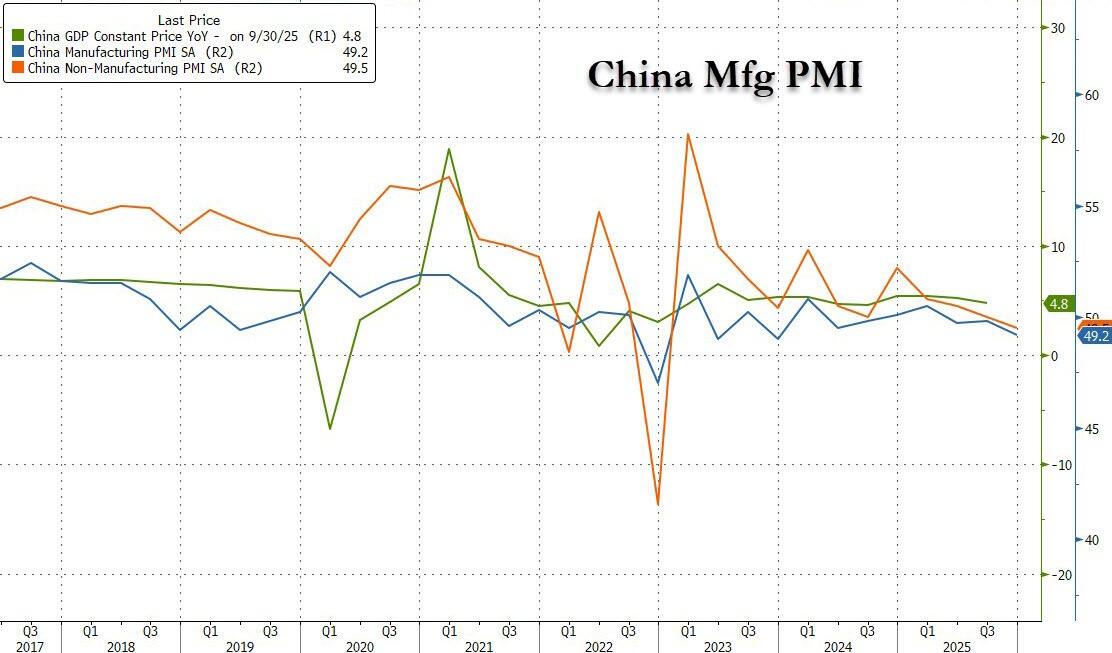
The official manufacturing PMI rose to 49.2 from 49.0 in October but remained below the 50 mark that separates growth and contraction for an eighth month. The median estimate of economists surveyed by Bloomberg was 49.4.

Adding insult to injury, the official non-manufacturing PMI fell to 49.5 from 50.1, below the 50.0 consensus forecast, and dropping into contraction for the first time since the economy reopened in 2023l it was driven by weakness in the real estate and residential services sectors. 

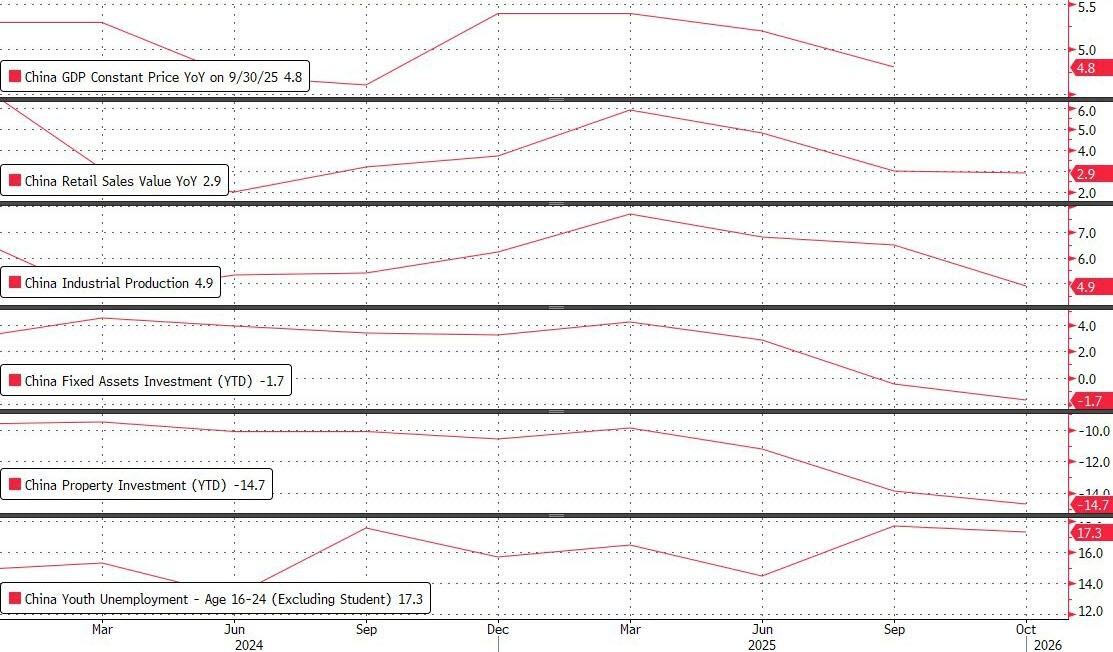
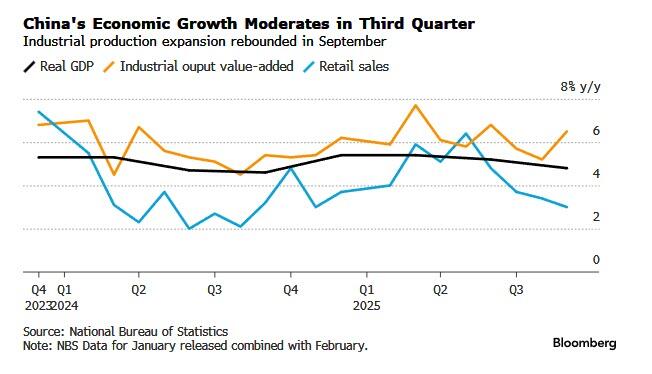
The readings offer a preliminary glimpse of how the world’s second-biggest economy fared in November, after months of global trade turbulence and an unprecedented decline in investment. They suggest that GDP extended its decline and is now well below the 4.8% level Beijing pretends China is growing at. So far this quarter, industrial production had its smallest gain since the start of the year…

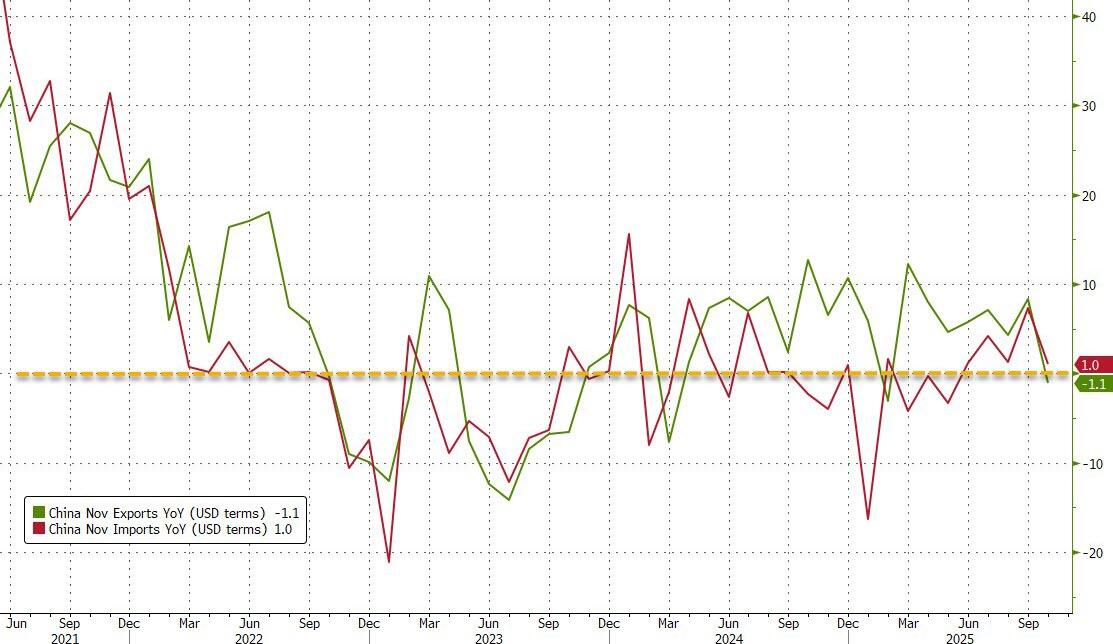
… while exports unexpectedly contracted, as global demand failed to offset the slump in shipments to the US. 

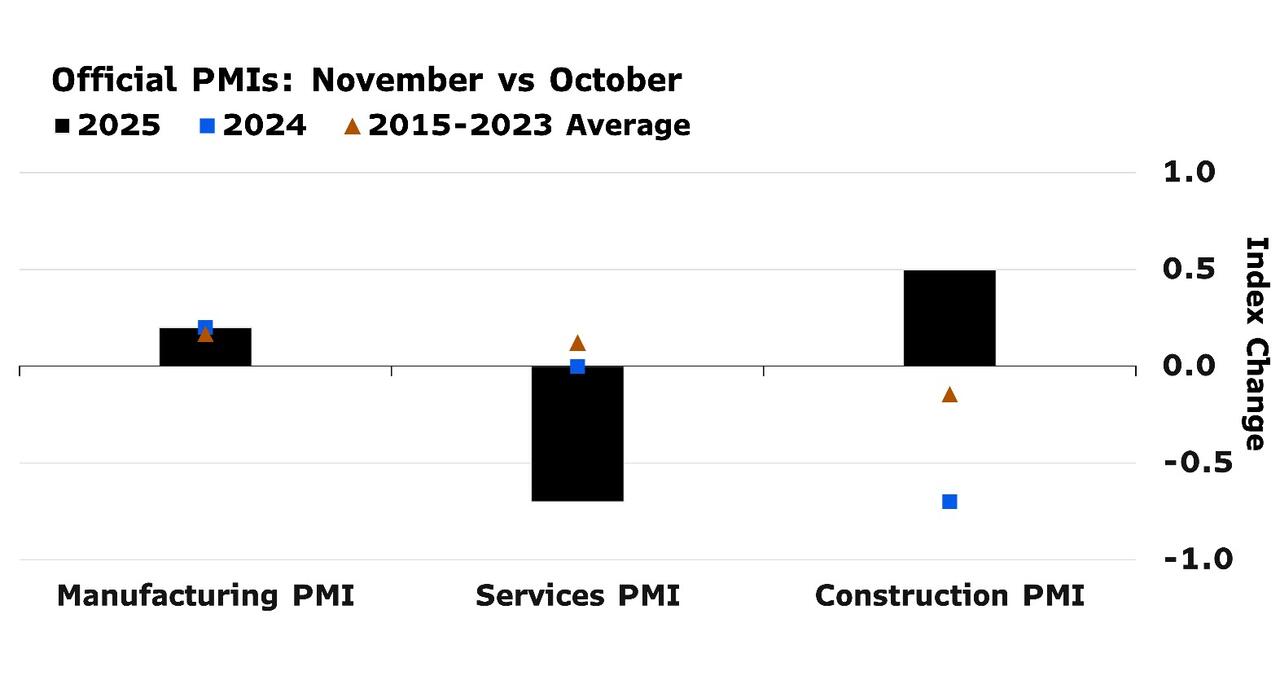
According to Bloomberg Economics, the November PMI pointed to continuing broad economic weakness and hinted at a further down-drift in consumption. Services dropped sharply into contraction, a stark contrast to the flat reading in 2024 after the long October holiday. Manufacturing and construction also remained in contraction, despite a modest seasonal rebound.

The good news is that tensions with the US eased modestly after a temporary truce last month following a meeting in South Korea between Presidents Donald Trump and Xi Jinping. Even so, key details of the deal, including questions over Chinese shipments of rare earths, are still being negotiated, underscoring the fragility of the agreement. In fact, as reported here previously, there is still no actual rare earths agreement.

Meanwhile, a diplomatic spat with Japan in recent weeks has added to trade uncertainty, as China contemplates economic countermeasures.

Beyond geopolitical risks, weak domestic demand is still casting a pall over the outlook for Chinese factories. Growth in retail sales slowed for the fifth straight month in October, the longest such streak since the country shuttered shops because of the Covid pandemic more than four years ago.

As Bloomberg notes, the recent downswing in the economy doesn’t mean that additional stimulus measures are on the table. Chinese policymakers are in no rush to act now that their annual growth target of around 5% for this year looks to be within reach. Meanwhile, China’s credit growth – previously the envy of the western world – has slowed to a trickle as the demand simply isn’t there, as Beijing is scared to making China’s massive debt bubble even bigger. 

China already injected additional stimulus worth 1 trillion yuan ($141 billion) since late September, including unused bond quota for provinces to expand investment and repay arrears owed to companies, as well as new funding for policy banks to spur investment. That, however, has not been enough, as we reported recently in “China Prepares New Property Stimulus Package As Housing Crisis Enters Year Six.”

Looking at the next five years, Beijing has made clear it plans to keep tech and manufacturing as the top priorities even as it pledged to “significantly” boost the share of consumption in its economy. Net exports contributed nearly a third of China’s growth this year.

China’s economic growth decelerated last quarter to the slowest pace in a year. Analysts see a further slowdown, forecasting the weakest this quarter since the final three months of 2022, when the nation was nearing the end of its Covid Zero lockdowns.

Tyler Durden
Sun, 11/30/2025 – 20:25

via ZeroHedge News https://ift.tt/ZPf5TOV Tyler Durden

OPEC+ Confirms Plan To Pause Output Hikes In Q1

OPEC+ Confirms Plan To Pause Output Hikes In Q1

OPEC+ agreed to pause production hikes and leave oil output levels unchanged for the first quarter of 2026 at its meetings on Sunday as the group slows down its push to regain market share amid fears of a looming supply glut.

Eight OPEC+ members have paused oil output hikes for the first quarter of 2026 after releasing some 2.9 million barrels per day into the market since April 2025, and Sunday’s meeting reaffirmed that decision, OPEC said in a statement.

OPEC+ still has about 3.24 million bpd of output cuts in place, representing around 3% of global demand. The Sunday meetings did not alter those. These comprise a 2 million bpd oil output cut by most members which is in place until the end of 2026, and the remaining 1.24 million bpd of a 1.65 million bpd reduction that the eight members started to return to the market in October.

Additionally, Reuters reports that the OPEC+ group had approved a mechanism to assess members’ maximum production capacity to be used for setting output baselines from 2027, against which members’ output targets are set. The assessment will be done between January and September 2026, sources said after the meetings, in time for 2027 output quotas to be decided.

One company will assess capacity of 19 of the 22 OPEC+ members, the sources said. Capacity in countries that are under sanctions will be assessed either by a separate company or by using an average of their oil output figures for August through October 2026.

Among the OPEC+ members, Russia, Iran and Venezuela are under Western sanctions.

“The message from the group was clear: stability outweighs ambition at a time when the market outlook is deteriorating rapidly,” said Jorge Leon, a former OPEC official who now works as head of geopolitical analysis at Rystad Energy. 

The meeting of OPEC+ came during a fresh U.S. effort to broker a peace deal between Russia and Ukraine, which could add to oil supply if sanctions on Russia are eased. If the peace deal fails, Russia could see its supply curbed further by sanctions. Alternatively, a peace deal could unleash millions of “clean” barrels on markets that have been locked out since 2022. 

OPEC+ has been discussing the production capacity and quotas issue for years and it has proved difficult because some members such as the United Arab Emirates have increased capacity and want higher quotas.

Other members such as African countries have seen declines in production capacity but are resisting quota cuts. Angola quit the group in 2024 over a disagreement about its production quotas.

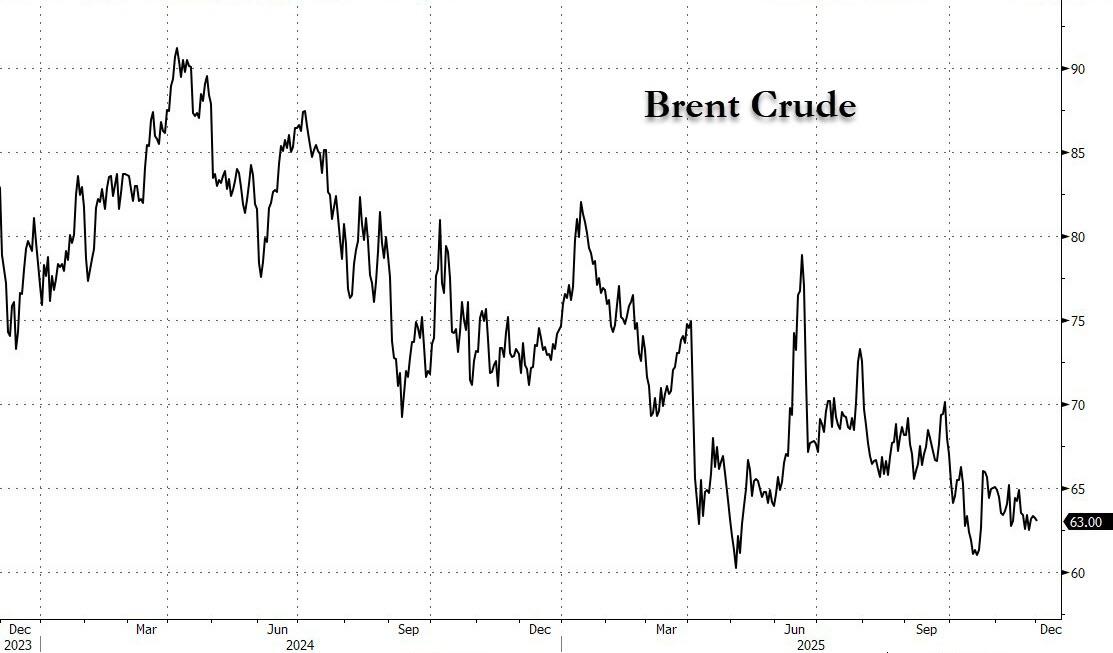
Brent crude closed on Friday near $63 a barrel, down 15% this year; it has been in a mostly straight decline since the 2nd quarter of 2024.

Tyler Durden
Sun, 11/30/2025 – 20:11

via ZeroHedge News https://ift.tt/Xmbkec4 Tyler Durden

Tariff Revenue Surges To Record High Of $31.4 Billion In October

Tariff Revenue Surges To Record High Of $31.4 Billion In October

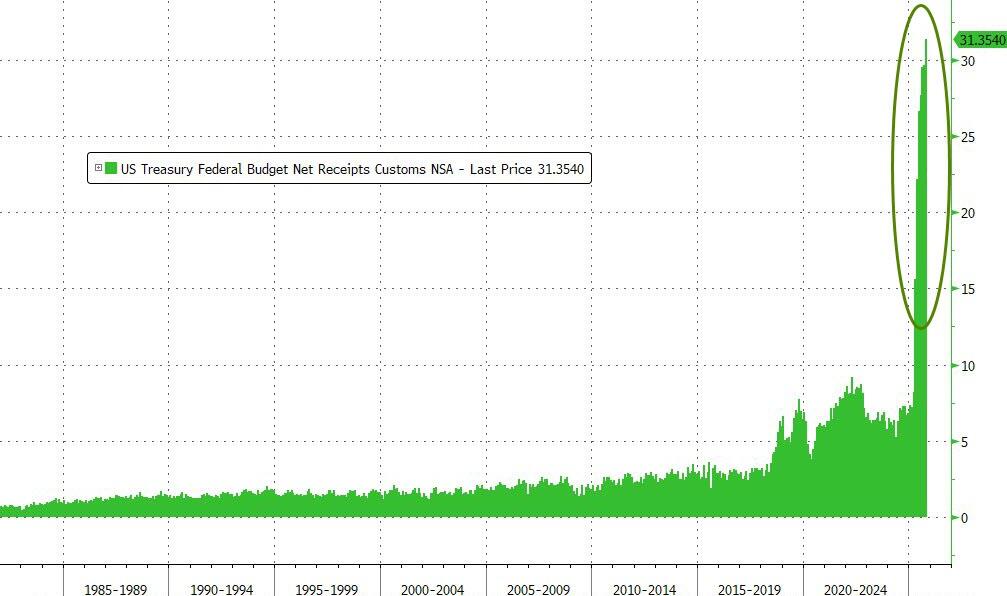
Tariff revenues surged to $31.4 billion in October, setting a new monthly record as the Trump administration’s trade policies continue to remake U.S. trade flows and reshape the federal government’s balance sheet, according to newly released Treasury Department data.

The Monthly Treasury Statement for October, published on Nov. 25, shows net customs duties totaling $31.4 billion, surpassing all prior monthly readings and marking the strongest single-month tariff haul since the modern reporting era began. Treasury records show gross customs receipts of roughly $33.1 billion, offset by about $1.7 billion in refunds, resulting in the $31.4 billion net figure.

The record inflow points to the profound fiscal impact of President Donald Trump’s tariff policies, which imposed a 10 percent baseline levy on most imports beginning earlier this year and included a series of reciprocal and country-specific duties that pushed some tariff rates as high as 40 percent.

As Tom Ozimek details below for The Epoch Times, the October tariff income surge appears to reflect a deeper structural shift, with tariffs shifting from a marginal revenue source to one of the most rapidly expanding components of federal receipts. The month’s $31.4 billion haul surpassed the previous record of $29.7 billion set in September and came in more than four times higher than the $7.3 billion collected in October 2024.

Trump, speaking during a Thanksgiving call with U.S. service members on Nov. 27, said the revenue boom could soon allow the United States to dramatically reduce—or even eliminate—federal income taxes for many Americans.

“We’re taking in hundreds of billions of dollars like we’ve never done before,” Trump said, adding that a portion of the money could be returned to Americans in the form of a dividend, while the rest would contribute to debt reduction.

“Over the next couple of years, I think we’ll substantially be cutting and maybe cutting out completely … income tax.”

The remarks echoed Trump’s earlier statements, including an April social media post in which he suggested that Americans earning under $200,000 might see their income taxes sharply reduced or eliminated once the tariff program reached full effect.

Trump reiterated that theme on Nov. 24, writing on Truth Social that tariff revenues would skyrocket as foreign buyers exhaust stockpiles of pre-tariff goods.

Independent models show the magnitude of the shift. The Penn Wharton Budget Model, drawing on Treasury data, estimates the United States has collected more than $320 billion in customs and excise duties so far this year, compared with roughly $171 billion at the same point in 2024.

The Tax Policy Center estimates Trump’s tariff actions have lifted the average U.S. tariff rate to 17.6 percent, with tariff revenue expected to total $2.3 trillion between 2026 and 2035.

It projects the tariffs will add about $256 billion to federal receipts next year, though it cautions that its estimates remain “highly uncertain” given the complexity of stacking rules and the unpredictable impact of foreign countermeasures.

Court Challenge Looms

The Trump administration’s tariff policies face a pivotal legal test at the U.S. Supreme Court. Justices heard arguments on Nov. 5 in a case challenging the president’s use of the International Emergency Economic Powers Act (IEEPA) to impose broad, across-the-board duties.

Neal Katyal, a former acting U.S. solicitor general representing business groups opposed to the tariffs, argued in court that the duties amount to taxes beyond what Congress authorized. Solicitor General D. John Sauer countered that tariffs remain regulatory tools squarely within presidential authority under IEEPA.

A ruling against the administration could upend major portions of the tariff program. Trump has urged the high court to rule quickly, calling the matter “urgent and time sensitive.”

U.S. Trade Representative Jamieson Greer told Fox Business he expects a decision before year-end.

Tyler Durden
Sun, 11/30/2025 – 19:15

via ZeroHedge News https://ift.tt/gknG17i Tyler Durden