Brickbat: Do Not Ask


Medical record | ID 174056692 ©  Tero Vesalainen | Dreamstime.com

People with learning disabilities in the United Kingdom are being given “do not resuscitate” (DNR) orders in their medical records without the knowledge or consent of their families, despite National Health Service guidance requiring case-by-case decisions. Families told ITV News that hospitals routinely place DNRs on the records of their disabled relatives simply because of their disability, with no conversation about what the patient or their loved ones would actually want. One woman said her non-verbal sister has had a DNR added to her record between 15 and 20 times without explanation. Another family discovered a DNR only after requesting their sister’s medical file following her death. The order cited “learning disability” as a reason not to attempt resuscitation. Health Secretary Wes Streeting called the practice “repugnant and immoral.” 


The post Brickbat: Do Not Ask appeared first on Reason.com.

from Latest – Reason.com https://ift.tt/OcbNvZJ
via IFTTT

“Made For Germany” Is History: Covestro Caught In The Waves Of The Sell-Off

“Made For Germany” Is History: Covestro Caught In The Waves Of The Sell-Off

Submitted By Thomas Kolbe

Abu Dhabi’s state-owned energy giant ADNOC has acquired nearly all shares of German chemical powerhouse Covestro. Germany is gradually losing its strategic position in critical industrial sectors. The sell-off is accelerating.

Remember the big media spectacle “MADE FOR GERMANY” this past July? Chancellor Friedrich Merz staged a meeting with 61 corporate CEOs, proudly announcing supposed future investments of €631 billion.

Even then, given the ongoing capital flight from Germany, it was clear that the event was mainly a media stunt – a sad attempt to distract the public from the real state of the German industrial base.

Sell-Off Accelerates 

Since that day, Germany’s industrial sell-off has not slowed – it has accelerated. Companies have already made their judgment: suffocating regulations, exploding compliance costs in the name of climate policy, and an administratively hostile environment have turned investments into a risk.

In short: industrial production is being systematically and willfully strangled by lawmakers.

Last week, German chemical giant Covestro grabbed the headlines. This time, it was Abu Dhabi’s ADNOC on a bargain hunt – Black Friday has become a daily routine.
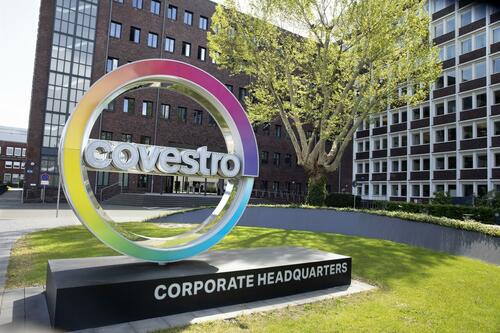
At around €62 per share, for a total transaction value of €15 billion, ADNOC increased its stake to over 95% – effectively taking control of company policy.

Loss of Capital and Know-How 

Capital gains will no longer flow to Germany but to Abu Dhabi. Strategic decisions about investment and location policy are now made by owners abroad.

This is especially critical for a company of clear strategic importance: Covestro’s high-performance plastics and polyurethanes are essential for Germany’s key industries – from automotive and machinery to construction and electrical engineering. Covestro is a central element of the industrial value chain, whose stability largely determines the future of the entire German industrial base.

About 40% of the 15,000 employees still work in Germany, many at the Leverkusen headquarters. But even Covestro has not escaped the general decline. Germany’s chemical industry now operates at just 71% capacity – a drop of more than 20% from the record year of 2018 – a sector now navigating increasingly rough waters.

Covestro has reported negative net earnings in recent years, while operating profit (EBIT) fell by more than 50% from 2023 to 2024, down to €87 million. Pressure from international competitors, high energy costs, and increasingly complex Brussels regulations have pushed the company to the limits of its competitiveness.

A Broader Trend 

The trend of selling off Germany’s industrial crown jewels began with the sale of Augsburg-based robotics and automation specialist KUKA in 2016. At the time, China’s Midea Group acquired a majority stake for €4.6 billion.

Even then, the same spectacle played out: the new investor publicly promised jobs and location guarantees, but quickly shifted to a mode where strategic decisions were tied exclusively to return expectations and location quality.

There is simply no place for sentimental traditionalism or patriotic rhetoric in this world. Global industry moves forward – and no one outside Europe shares the passion for risky green policy experiments.

Dramatic Consequences 

Covestro and KUKA are just two prominent examples of a secular trend. Year after year, Germany loses net direct investment. Last year alone, €64.5 billion flowed out – capital that is being invested elsewhere in new production capacity. Note: this is a net figure, which is expected to be even higher this year.

Germany’s economy is bleeding, while political leaders respond with half-hearted industrial subsidies – like the so-called “industrial electricity price” – and ever-new regulations. Many companies are likely to exit in anticipation of the cost tsunami from the CO₂ certificate market starting in 2027.

The U.S. Factor 

Above all, the United States beckons as an alternative production base. The Trump administration has made it clear that it will use every lever – including tariff pressure – to advance reindustrialization. This includes deregulation of the energy sector, an end to costly renewable experiments, and an industrial policy that welcomes investors rather than driving them away.

Add to that promises from Arab states like Abu Dhabi and Saudi Arabia to invest trillions in U.S. production – concrete proof of Washington’s seriousness. “Made for USA” will become a major political and economic mantra in the years to come. The U.S. economy is currently growing at over 4%, accelerating global capital shifts.

The list of German companies moving to the U.S. is growing. Hamburg-based metal producer Aurubis, automotive groups Stellantis, and supplier Bosch are among firms planning to strengthen the North American economy with billions in investments.

No One Sacrifices the Green God 

It would be too simplistic to blame this trend solely on U.S. trade policy. Long before Trump returned to the White House, it was clear that industrial production in Germany – and across the EU – had become unprofitable. As long as national policy enforces the Green Deal and its “green transformation,” nothing will change.

No one dares to sacrifice the Green God – the destructive CO₂ narrative driving economic collapse.

Half-hearted protests by Mittelstand associations, such as the Family Entrepreneurs, calling for broader political discourse including the Alternative for Germany – and their sharp political and media pushback – show that Germany still does not recognize the seriousness of the situation.

With each major corporation relocating abroad, the backbone of the German economy – the deeply integrated Mittelstand – is weakened. Even the public sector hiring half a million people cannot mask the fact that industry has cut hundreds of thousands of jobs and will continue to lose value in the coming years.

Celebrating the reintroduction of an EV subsidy as a major industrial policy step is, at its core, nothing more than a declaration of bankruptcy of eco-socialist policies that have propelled the country into a spiral of poverty.

Tyler Durden
Mon, 12/01/2025 – 03:30

via ZeroHedge News https://ift.tt/caV0JyG Tyler Durden

The Dutch Are The Most Likely To ‘Borrow’ Their Neighbor’s WiFi

The Dutch Are The Most Likely To ‘Borrow’ Their Neighbor’s WiFi

According to data collected by Statista Consumer Insights, 16 percent of Dutch online respondents said that they mainly access their internet at home via their neighbor or landlord’s wireless connection.

As Statista’s Anna Fleck shows in the chart below, this is double the rate of people in neighboring Germany and France.

Infographic: The People Most Likely to

You will find more infographics at Statista

According to the survey, only 41 percent of respondents in the Netherlands had access to broadband and 19 percent had a mobile connection via smartphone or tablet in 2025.

The United States and the United Kingdom had far lower rates of adults using their neighbors’ WiFi, at four percent and three percent, respectively.

The U.S. also had a relatively low share of people with broadband, at 37 percent, while the UK’s was higher at 63 percent.

While the reasons for this discrepancy are not fully clear from the data alone, it’s interesting to note that breaking into an encrypted WiFi is not a criminal offense in the Netherlands, even though it is in other countries.

Breaking into a computer, however, is.

Tyler Durden
Mon, 12/01/2025 – 02:45

via ZeroHedge News https://ift.tt/waUtnez Tyler Durden

Over €325 Million In Fraudulent Welfare Benefits Support Illicit Gang Networks In Sweden; Report

Over €325 Million In Fraudulent Welfare Benefits Support Illicit Gang Networks In Sweden; Report

Authored by Thomas Brooke via Remix News,

A Swedish government review has found that thousands of people linked to gangs in Sweden have been drawing income from the country’s benefits system for years, creating what authorities describe as a reliable, legal-looking revenue stream for criminal networks.

According to findings prepared under the state’s organized crime framework, about 4,000 individuals known to police for gang affiliation have been receiving sickness benefits, sick pay, or job-seeker support. Combined payments across the group are estimated at 3.6 billion kronor (€327.5 million) over time, enough to provide what officials call a “white” income even when illicit earnings fluctuate.

It effectively means that law-abiding Swedish taxpayers are inadvertently subsidizing criminal gangs through the benefit system, providing them with a safety net income that enables them to continue operating.

Nils Öberg, head of the Social Insurance Agency, said the material reinforces the pattern authorities have been tracking. Speaking to TV4, he said the welfare system has become part of the business model: an official income on paper, and criminal income off it.

Samnytt notes that the report shows a marked overrepresentation of people with a migration background in the cohort examined. This applies to both those born abroad and those born in Sweden to two foreign-born parents.

Investigators highlight the contradiction between benefits requiring reduced work ability and the documented activity of some recipients. Case studies in the report refer to individuals formally certified as unfit for work while running gangs, traveling abroad, or coordinating violent offenses. One man listed on medical grounds after an accident was recorded visiting gyms and participating in gang operations. Another, diagnosed with limited work ability, is reported to have led a large criminal network while accumulating more than 30 convictions.

Maintenance support is also cited as a hidden revenue channel. Since many gang figures report little or no legal income, the state covers child maintenance on their behalf. In 2024, more than 3,600 such individuals were classified as unable to pay, resulting in payouts of around 118 million kronor (€10.7 million).

The review also tracked corporate links. One in three businesses that filed sickness claims on behalf of gang-connected employees are run or previously run by people with criminal links. More than four in five show clear connections to gang networks. The personal assistance sector in particular was flagged as an area with heavy infiltration, both among staff and among owners.

Social Insurance Minister Anna Tenje, as cited by Sydsvenskan, said that the situation was “astonishing” and insisted that public funds are meant for people who genuinely need them. She argued that weakening the financial lifeline to criminal networks is essential if the government wants to reduce gang influence.

Speaking to TV4, Labor Minister Johan Britz described those involved as “welfare pirates,” adding that taxpayers were effectively financing criminal lifestyles under the guise of social support.

Police estimate that around 67,500 people in Sweden have some form of gang association, of whom roughly 17,500 are considered actively involved. National Police Commissioner Petra Lundh said there is no clear indication of improvement or deterioration and warned that recruitment remains steady.

The authors of the review state that existing law was designed for honest applicants rather than organized exploitation and suggest that stronger information-sharing powers and more robust verification are required. The government says new data-access legislation will come into effect in December, with further reforms planned later in the parliamentary term.

Officials say the next step is to reassess benefit cases flagged in the review and halt payments where fraud is suspected. The agency involved says it will broaden investigations, but ministers have offered no timeline on when changes will take full effect.

Read more here…

Tyler Durden
Mon, 12/01/2025 – 02:00

via ZeroHedge News https://ift.tt/GXtE3bW Tyler Durden

Alcohol Consumption In The US By The Numbers

Alcohol Consumption In The US By The Numbers

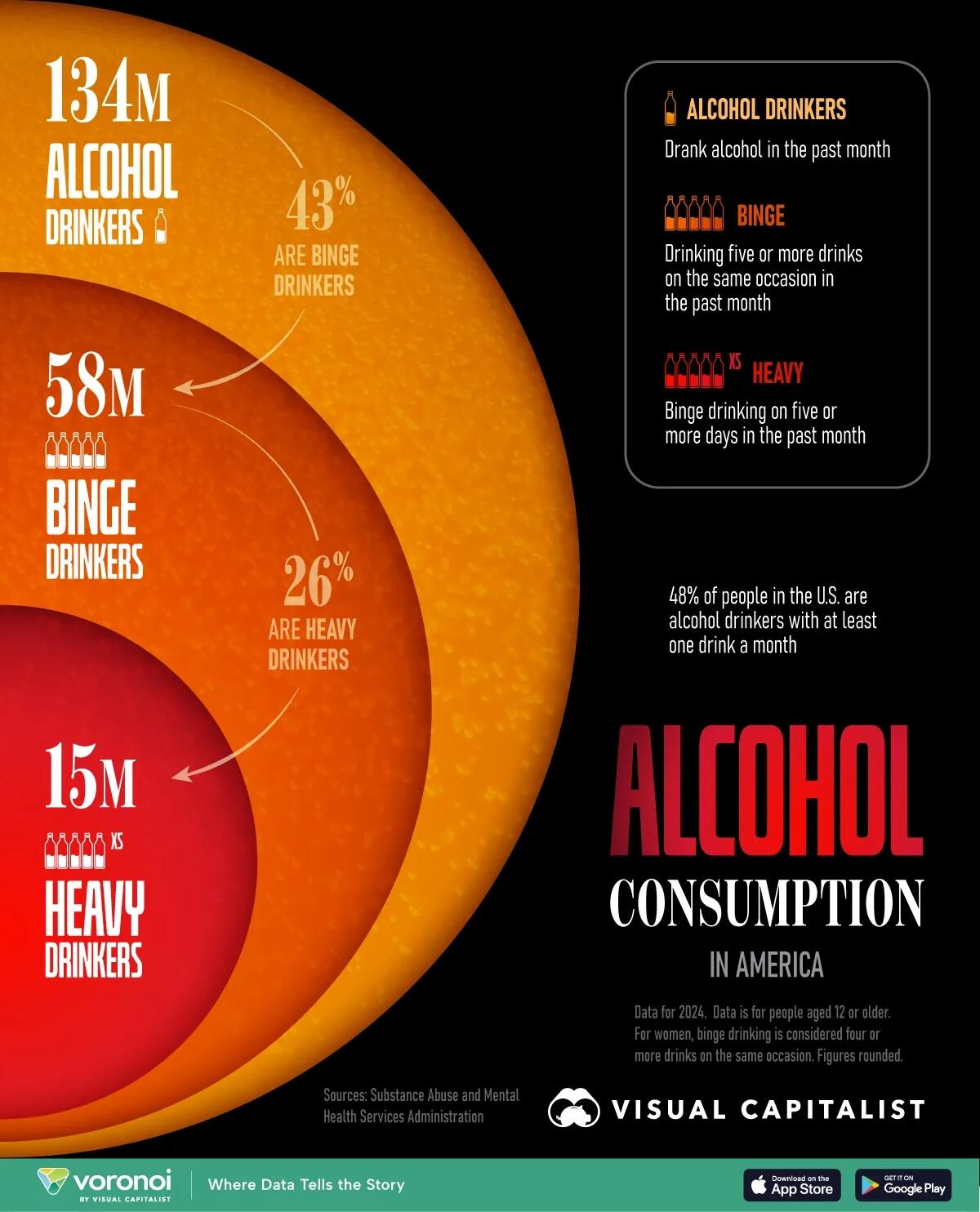
In the U.S., alcohol consumption remains widespread, with nearly half the population aged 12 or older reporting that they consumed alcohol within the past month.

This visualization, via Visual Capitalist’s Niccolo Conte, explores the scale of drinking behavior across America, including how many people drink, binge drink, or engage in heavier levels of alcohol use, using data from the Substance Abuse and Mental Health Services Administration as of 2024.

How Many Americans Drink Alcohol Regularly?

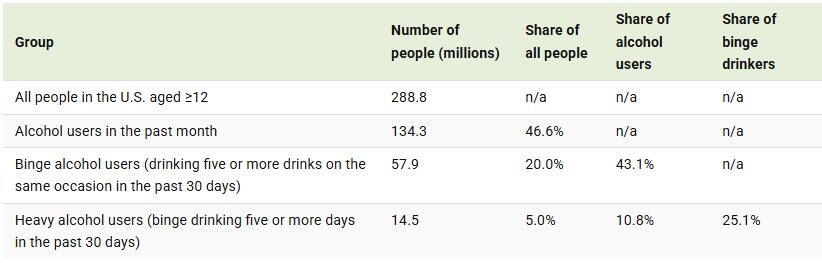
Out of the 288.8 million Americans aged 12 or older, 134 million (46.5%) reported drinking alcohol at least once in the past 30 days.

The data table below shows the number of regular alcohol drinkers in the U.S., along with binge drinkers and heavy drinkers.


Binge drinkers are defined as those who consumed five or more drinks (four for women) on one occasion, and heavy drinkers are those who engaged in binge drinking at least five times in the past 30 days.


Despite alcohol drinkers making up nearly half of the U.S. population of those aged 12 or older, the share in 2024 (46.5%) has declined slightly since 2022 when it was 48.7%.

The Number of Binge and Heavy Drinkers in the U.S.

Of the 134.3 million alcohol drinkers in the U.S., 57.9 million people engaged in binge drinking, which represents 20.1% of the total population and 43.1% of all alcohol users.

This reveals a significant overlap between casual use and occasional high-risk consumption, highlighting how binge drinking behavior is deeply embedded within the broader drinking population.

Heavy alcohol users—those who binge drink on at least five days in the past month—number 14.5 million in America. This represents 5% of the total population above 12 years old and 10.8% of alcohol users.

While this group is much smaller than the broader categories of alcohol and binge drinkers, heavy drinkers make up one quarter of all binge drinkers, and account for one in every 10 regular alcohol drinkers in the country.

To learn more about alcohol consumption in the U.S., check out this graphic which breaks down which U.S. states drink the most beer.

Tyler Durden
Sun, 11/30/2025 – 22:45

via ZeroHedge News https://ift.tt/wPgJhRx Tyler Durden

Putin Might Soon Clinch A Large-Scale Labor Migration Deal With Modi

Putin Might Soon Clinch A Large-Scale Labor Migration Deal With Modi

Authored by Andrew Korybko via Substack,

Putin will visit India late next week to meet with Modi for their annual summit, the first time that the Russian leader will travel to India since the special operation began, his last one being in December 2021.

Aleksei Zakharov, a Fellow at India’s esteemed Observer Research Foundation, published a detailed article about how “Key Policy Outcomes Expected at the India-Russia Summit”.

It’s an excellent read, but it omits mention of their large-scale labor migration talks, which might lead to a deal next week.

Air Marshal Anil Chopra (Retired), the former Director-General of the Center for Air Power Studies in New Delhi, published an intriguing piece about this at RT in early November.

He noted how both countries representatives “discussed potential collaboration on social and labor issues”, contextualizing their conversation by adding that Russia “plans to recruit up to 1 million foreign workers – including from India. The Russian Labor Ministry estimates the shortfall could expand to 3.1 million workers by 2030.”

He makes a lot of compelling arguments about how India could help resolve this dimension of “Russia’s demography problem”, but what’s left out is how its labor migrants pose less of a security risk than Russia’s traditional ones from Central Asia. Conor Gallagher touched upon this in early November in his extensively detailed analysis about the US’ evolving strategy towards that region. From this point here near the end for the next several paragraphs, he describes Russia’s new approach towards migration.

Not only is Russia “getting rid of 700,000-plus migrants, mostly Central Asians, a process which was jumpstarted by the terrorist attack on Crocus City Hall in outer Moscow in March 2024”, but “the Concept of State Migration Policy for 2026-2030…focuses not on increasing the population through Central Asian citizens, but on strengthening control, digitalization, and the task of attracting only those migrants who share the ‘traditional spiritual and moral values’ of Russian society.”

Putin spoke about the security threats posed by “the migration factor” in early November during a meeting with the Council on Interethnic Relations where they discussed ways to fine-tune the State Interethnic Policy, the updated version of which was then approved by month’s end. It’s not declared, but the innuendo is that Central Asian Muslims are at a greater risk of radicalism and being manipulated by foreign forces than other labor migrants such as Indians (both Muslims and especially Hindus).

It’s within this economic-security context that Russia is exploring a large-scale migrant labor deal with India that might be clinched during the Putin-Modi Summit. To be clear, recent policy changes won’t lead to Indians playing a role in “population replacement”, only in labor replacement since most likely won’t be offered a path to residency and then citizenship. The sole purpose is for Indians to meet Russia’s labor shortage in lieu of Central Asian Muslims in exchange for profitable remittance opportunities.

Indians are among the most Russian-friendly people in the world as proven by credible surveys, and unlike Central Asian Muslims, they harbor no historical grievances (whether objectively existing or subjectively perceived) that could be manipulated by foreign forces to weaponize them against Russia.

Their society is also proudly secular and this makes them much less likely to be radicalized into terrorists.

It therefore wouldn’t be surprising if Putin clinches a large-scale labor migration deal with Modi.

Tyler Durden
Sun, 11/30/2025 – 22:10

via ZeroHedge News https://ift.tt/H4quTxs Tyler Durden