As Money Gets Tighter, More People Are Selling Gold and Silver

As Money Gets Tighter, More People Are Selling Gold and Silver

Authored by Allan Stein via The Epoch Times,

For years, Jakob stacked silver coins and bullion, building his treasure and waiting for the perfect moment to let it go, if that moment ever came.

With prices in late 2025 rapidly rising, money running low, and the holidays approaching, he decided to sell them on Nov. 18 at the spot market price of $50.13 per ounce.

He received more than $1,400 from a coin dealer in Phoenix. Enough to cover this year’s gifts.

“I wasn’t really wanting to sell, but everything is expensive,” Jakob, who didn’t want his last name used, told The Epoch Times.

“Christmas kind of made the decision for me,” he said. “I’ve got little kids. They’ve been wanting to go to Disneyland.”

As economic conditions worsen for many Americans, more precious metals investors are selling assets to take advantage of higher prices and bolster their finances, according to several coin and bullion dealers and customers who spoke with The Epoch Times.

For many, the need for cash is immediate, with essentials like groceries and electricity bills taking priority over holding onto their investments.

A coin and bullion dealer in Navajo County, Arizona, said that three out of every four transactions were people selling their silver and gold.

Many of these sellers were having a hard time making ends meet, he said, and asked not to use his company’s name.

The dealer said one woman, who looked in pain, needed money for dental care. Another woman, a single mother, needed cash to buy food.

At least two married couples sold their gold wedding rings for quick money to buy basic items.

Southwest Coin & Bullion, a gold and silver buyer in Phoenix, on Nov. 18, 2025. Allan Stein/The Epoch Times

“It’s a hard time,” the dealer told The Epoch Times.

“One customer flat out said, ‘I don’t want to sell right now, but I have to.’ He had a car repair, and [needed] Christmas money.”

The man received $2,200 for his collection of 1-ounce silver rounds.

“They aren’t all desperate,” the dealer noted. “The thing is, for the last two years, I’ve had more sellers than buyers, significantly more sellers than buyers, especially the last year,” due to rising prices.

“October was my best month. A lot of that was larger purchases, people who were on the fence or were thinking about it. It’s the price. People buy on the fear of missing out.”

The dealer explained that selling gold and silver when prices are rising quickly seems “counterintuitive” because it often makes more sense to buy and hold as prices climb.

He added that, as the saying goes, the goal in precious metals trading is to buy low and sell high.

A worker polishes gold bullion bars at the ABC Refinery in Sydney, Australia, on Aug. 5, 2020. David Gray/AFP via Getty Images

But that stable high is nowhere in sight, he said.

“Seriously, maybe one in 10 are taking a profit; the vast majority are selling out of need,” he said. “Most people who buy gold and silver buy it to sit on it as savings or insurance.”

“And with that being said, the majority of people are selling out of need, not out of  wanting to take a profit.”

Gold and Silver

On Nov. 28, gold’s per-ounce value closed at $4,220.40 in U.S. dollars, and by 1 p.m. Eastern Time, silver hit a record high of $56.38 per troy ounce, precious metals analyst kitco.com reported.

Patrick McKeever, a precious metals dealer at Southwest Coin & Bullion in Phoenix, said the gold and silver markets remain highly volatile and unpredictable, as prices continue to rise with no clear end in sight.

He said that as the dollar drops in value and inflation goes up, more people are choosing to buy for the long term or sell to take advantage of higher prices in the short term.

“I think it’s just high demand,” McKeever told The Epoch Times.

“There’s several different entities buying up precious metals. You have the world governments, China, Russia, and the big banks aren’t hiding the fact that they’re buying as much as they can get,” he said.

McKeever pointed out that although precious metals are sometimes dismissed as outdated or poor investments, history shows their remarkable ability to retain value amid the rise and fall of currencies.

“Finding that top right now, I don’t think anybody knows,“ he said. ”All we see is the price continuing to go up, demand continuing to stay solid.”

At current prices, McKeever said he’s more “bullish” on gold than silver, the latter being an industrial metal. 

Regardless, he sees both as valuable hedges against inflation and financial hardship, and uncertainty.

The United States Gold Bullion Depository, also known as Fort Knox in Kentucky in 2009. Michael Vadon/CC BY-SA 2.0

“They’re just a good safety net, so if you have the ability to hold them—yep,” McKeever said. 

According to a 2023 Gallup study, the proportion of people who viewed gold as one of the best long-term investments rose from 15 percent in 2022 to 26 percent a year later.

Cash Shortfall

In the meantime, a 2025 survey by the online gold buyer Cash for Gold USA found that seven out of 10 Americans are selling jewelry to pay for basic needs.

“Despite gold prices increasing by nearly 45 percent over the past year, significantly more Americans have been selling gold to serve as a household lifeline rather than the precious metal’s record high prices,” the company revealed.

More than half of the people surveyed in June said that they sold gold for quick cash to cover money problems.

The survey included 1,002 people who had sold items such as gold, diamonds, jewelry, coins, and watches to Cash for Gold USA.

Although 50.5 percent sold items to get money, 68.4 percent said the cash was used for household essentials. Most of it went toward paying bills (52.6 percent) and buying groceries (15.9 percent).

The survey found that besides helping with money problems, people sold their metals because they had items they did not use, or had forgotten about (45.4 percent), or because they got them from someone else (13.8 percent).

Nearly 70 percent of people in the survey used the money to make their finances better now or in the future, including paying off debts (13.4 percent) or purchasing a home (3.2 percent).

‍“We were shocked by the responses,” said Barry Schneider, co-founder of Cash for Gold USA, in a statement.

Mikah Snowden, a sales representative at Galina Fine Jewelers in Cottonwood, Ariz., works behind the showcase on March 20, 2023. Allan Stein/The Epoch Times

“We expected more people to tell us it was the record-high prices of gold driving their decision to sell, which have increased by around $1,000 per ounce over the past year. Gold has been selling for more than $3,300 an ounce.”

The study reported other reasons for selling. About 10.8 percent sold because of divorce or separation, 5.4 percent due to job loss or reduced hours, and 3.6 percent because of medical bills.

Most sellers spent their money on basic needs. Only 9 percent used the money for a vacation, 4 percent for new jewelry, and just 2 percent for electronics. Fewer than one in six used their money on luxury items.

“This is not the gold rush of 1849, but this survey suggests to us that those employed in America face financial hardships, despite holding down jobs,” Schneider said.

Gabe Wright, co-owner of Coin Heaven in Cottonwood, Ariz., holds gold and silver coins, two of the hottest-selling items on March 20, 2023. Allan Stein/The Epoch Times

The Epoch Times contacted major bullion dealers, such as SD Bullion and Battalion Metals, but did not get a response to its request for comment.

On Nov. 18, Levi from Phoenix visited a busy downtown bullion shop with 124 quarters from around 1964, the last year American coins were made with 90 percent silver.

Levi told The Epoch Times he spent years collecting coins, saving them as an investment since he was young.

He decided to sell because he needed the money and ended up making more than $1,000.

“I’ve just been collecting them over time. I’ve been finding them at gas stations, things like that. I still have more,” Levi said.

Tyler Durden
Mon, 12/01/2025 – 07:20

via ZeroHedge News https://ift.tt/YZPyRxg Tyler Durden

Showing Plaintiffs’ House in an Ad for Netflix Real Estate Reality Show Isn’t Actionable Invasion of Privacy,

Here are the factual allegations, as set forth in last week’s long opinion by Justice Mark Hanasono, joined by Justice Anne Egerton, in Dinho v. Netflix, Inc.:

Plaintiffs’ home is on a ridgeline in the Hollywood Hills. The property is guarded by a private gate and the home is not visible from any nearby street. The closest publicly accessible vantage point from which the home can be seen is 1,034 feet away….

Netflix began using a photo of plaintiffs’ home in an advertisement for Buying Beverly Hills, one of its reality shows which depicts the operations of a real estate firm. The photo was taken by nonparty Ashwin Rao. Rao published the photo on Shutterstock.com (Shutterstock), “a website that allows any person with [I]nternet access to license photographs to the public for specific uses.” Netflix hired Williams Creative Agency (WC+A) to produce the advertisement, and WC+A licensed the photo from Shutterstock for use in the advertisement.

Rao allegedly took the photo without [plaintiff] Dihno’s knowledge or consent using a drone or other specialized photography equipment. The photo depicted interior and exterior details of the home not visible from any public location, including the “room layout” and the entrances and exits….

Netflix published the advertisement on its own website and on several other websites. Netflix did so without plaintiffs’ knowledge or permission. Both Netflix and WC+A knew that the home was not associated with or depicted in Buying Beverly Hills….

[P]eople began to visit plaintiffs’ home “on a daily basis” asking to see it and claiming they learned it was for sale through the Buying Beverly Hills advertisement. One woman rang the doorbell, demanded to enter the home, and refused to leave. Dihno called the police and the woman was arrested. Other people attempted to open plaintiffs’ front gate and climb over their fence. [Plaintiffs] would only answer the doorbell for friends or relatives who provided advanced notice of their visit. In addition, [Plaintiffs] received calls “more than once daily” from real estate agents who sought to represent the family in selling the home.

Note that the ad apparently didn’t include the address of the home, or the names of the owners. More from the allegations:

Plaintiffs’ mental health and their reputations suffered. They had negative interactions with their neighbors, including one who “alienate[d]” them and another who “angrily confronted” them because the advertisement increased the number of unwanted visitors to the formerly quiet street. Plaintiffs did not feel safe in their home, could not sleep, and received medical treatment for insomnia and stress disorders. Out of fear for their own safety, plaintiffs spent approximately $20,000 on security measures. …

Plaintiffs sued, but the Court of Appeal ruled against them. In particular, it rejected plaintiffs’ claim that defendants were responsible for invading plaintiffs privacy on an “intrusion upon seclusion” theory. The court concluded that, whether or not Rao had committed the tort in photographing the house, Netflix wasn’t responsible for that, partly because plaintiffs didn’t allege “that Netflix had full knowledge of Rao’s conduct” and therefore couldn’t be said to have “Rao’s conduct.” Nor could the ad be faulted for being “an ‘extension’ of Rao’s intrusion”: “the tort of intrusion,” unlike the disclosure, false light, and appropriation torts, “does not create liability for publications.”

And Netflix also wasn’t liable for third parties’ intrusions:

In support of this argument, plaintiffs rely on Vescovo v. New Way Enterprises, Ltd. (Cal. App. 1976). There, the defendant published a woman’s address in a classified advertisement, accompanied by lewd language suggesting that the woman wished to engage in sex acts. More than 100 people trespassed at the property thereafter. The appellate court concluded that the woman’s minor child could state a claim for “the physical intrusion by various unsavory characters on her own solitude in her own home” based on allegations that the “defendants published the advertisement ‘with intent and design to injure, disgrace and aggrieve'” the child….. [But] Vescovo was published nearly 50 years ago, and some 22 years before Shulman v. Group W Productions, Inc. (1998), our Supreme Court’s leading case on common law intrusion. As Shulman and its progeny now instruct, to establish an intrusion claim, plaintiffs must allege that “defendants ‘intentionally intrude[d]'” upon their seclusion….

[And whether or not Vescovo survives Shulman,] Vescovo is distinguishable…. Unlike in Vescovo, the advertisement in this case depicted only the exterior of plaintiffs’ house, not their address or any other personal information; and the advertisement did not encourage third parties to visit plaintiffs’ home. And while the complaint alleges that Netflix intentionally published the advertisement with knowledge that it might harm plaintiffs, it does not allege that Netflix intended for third parties to harass plaintiffs….

Justice Egerton also added her views rejecting “appellants’ proposal to expand—in my view, in a sweeping and unwarranted way—the intentional tort of intrusion”:

[A]ppellants contend they “should have some right under the law to limit Netflix’s exploitation of their home, life, and privacy.” Appellants’ claim that Netflix “exploit[ed]” “their home” sounds suspiciously like a proposed right of publicity for houses. For good reason, there is no such tort. As for the alleged “exploitation” of appellants’ “life,” the photograph at issue did not depict any of the appellants. It is simply a picture of a house. The advertisement did not mention appellants nor did it say anything negative about them….

Appellants’ proposed expansion of liability for an intentional tort—they pray for compensatory damages of five million dollars in their privacy count, and for punitive as well as compensatory damages in three other causes of action—is breathtaking in its scope. Let’s say the Los Angeles Times decides to do a piece on “five houses in Los Angeles that look like they came out of a fairy tale.” You know—with those cute, curving brown roofs. People read the piece and think, “Wow, I’d like to see that.” They drive by, or walk by, the houses. Maybe some even knock and ask to come inside. Let’s say lots of people do that. Let’s say the “publisher” of the piece is not the Los Angeles Times but an influencer on Instagram who’s interested in architecture.

Can the owners or residents of those homes sue for intrusion? One can imagine myriad other examples….

Justice Lee Smalley Edmon dissented on these matters:

[A]t least a few cases have recognized claims for intrusion where defendants published information about the plaintiffs that caused third parties to intrude into their private spaces. The first such case was Kerby v. Hal Roach Studios, Inc. (Cal. App. 1942). The defendant in that case was a movie producer, and the plaintiff was an actress. To create interest in one of its movies, the defendant sent copies of a letter, which appeared to have been handwritten and signed by the plaintiff, to 1,000 men in Los Angeles. The letter said the plaintiff was ” ‘in the mood for fun'” and invited the recipients to meet her “‘in front of Warners Downtown Theatre at 7th and Hill on Thursday'” for ” ‘an evening you won’t forget.'” Although the letters did not include the plaintiff’s address or phone number, the plaintiff alleged that both were listed in a public phone directory, and thus the letter resulted in a large number of phone calls and a visit to her home, including one call that led the plaintiff to fear being shot….

[The] Court of Appeal [allowed the case to go forward]: “‘The right of privacy has been defined as the right to live one’s life in seclusion, without being subjected to unwarranted and undesired publicity. In short it is the right to be let alone.’ … Here the plaintiff was, without her consent, plucked from her regular routine of life and thrust before the world, or at least 1,000 of its persons, as the author of a letter not written by her and of a nature to at least cast doubt on her moral character, and this was done in a manner to call down on her a train of highly undesirable consequences. This constituted as strong an invasion of the right of privacy as any of those described in the cases.” The Court of Appeal reached a similar conclusion in Vescovo ….

Significantly, neither Kerby nor Vescovo concerned allegations that the defendants themselves physically intruded into the plaintiffs’ homes or ratified intrusions by third parties. Instead, the essence of the claimed intrusions in those cases was the defendants’ publication of information that created interest in the plaintiffs and led to foreseeable physical intrusions by third parties that significantly disturbed the plaintiffs’ solitude. Under those circumstances, the courts found the plaintiffs had adequately alleged claims for intrusion. The present case is analogous….

I do not agree [that Vescovo is inconsistent with Shulman]. While it is true that Shulman requires an intentional intrusion by the defendant, it does not limit “intrusion” to a physical intrusion by a defendant. To the contrary, Shulman says that to state a claim for intrusion, a plaintiff must demonstrate that the defendant “‘intentionally intrude[d], physically or otherwise, upon the solitude or seclusion of another,’ that is, into a place or conversation private to” the plaintiff….

The majority also suggests that the present case is distinguishable from Vescovo because there the defendant published the plaintiffs’ address and was alleged to have intended to “injure, disgrace and aggrieve” the plaintiffs, while here Netflix did not publish plaintiffs’ address and is not alleged to have intended harassment by third parties. A specific intent to cause harm—as opposed to the intent to intrude—is not an element of a cause of action for intrusion, and thus I do not find this distinction material. Nor do I consider it relevant that Netflix did not publish plaintiffs’ address. The plaintiff’s address was not published in Kerby, but third parties nonetheless were able determine where the plaintiff lived because her name and address were listed in the telephone directory….

The dissent also added, perhaps in response to the concurrence, “Importantly, the photograph of plaintiffs’ house was published in connection with an advertisement, not a news story.  The present case thus does not raise the constitutional issues present in many privacy cases.” The concurrence, on the other hand, reasoned, “Finally, that the photograph appeared in an advertisement does not strip it of constitutional protection.  New York Times Co. v. Sullivan (1964)—the seminal First Amendment case—involved an advertisement.” (Note that the Sullivan ad was a political ad, not a commercial ad for a TV show, as was the case here.)

The majority and dissent also disagreed on whether plaintiffs had adequately stated a claim for private nuisance, but I omit that for space reasons; I also omit the discussion of the false light claim, the negligent and intentional infliction of emotional distress claims, and a couple of statutory claims. You can read more about them in the full opinion.

Mark R. Yohalem and Madelyn Y. Chen (Wilson Sonsini Goodrich & Rosati) and Jonathan Segal, Rachel R. Goldberg, and Samantha Lachman (Davis Wright Tremaine) represent Netflix.

The post Showing Plaintiffs' House in an Ad for Netflix Real Estate Reality Show Isn't Actionable Invasion of Privacy, appeared first on Reason.com.

from Latest – Reason.com https://ift.tt/9MHzNRX
via IFTTT

The ‘Free’ World Is Coming for Your Private Messages


Someone holds a phone with Signal and WhatsApp | ID <a href="https://www.dreamstime.com/vilnius-lithuania-january-signal-app-cross-platform-encrypted-messaging-service-developed-signal-foundation-signal-image207308888">207308888</a> | <a href="https://www.dreamstime.com/photos-images/encrypted-messaging.html">Encrypted Messaging</a> ©  <a href="https://www.dreamstime.com/micheleursi_info">Michele Ursi</a> | <a href="https://www.dreamstime.com/stock-photos">Dreamstime.com</a>

As I write, European Union (E.U.) officials are debating the details of a proposal to either require or pressure tech companies to scan all private messages for child sexual abuse material. Dubbed “chat control,” the scheme inevitably entails mass surveillance of private communications—targeting one sort of content for the moment, though it’s difficult to see how that would long remain limited in any way. It’s an illustration of the continuing decline in online liberty documented in a new report from Freedom House.

No Right to Private Messages?

As the E.U.’s discussion over chat control heated up over the summer, Danish Minister of Justice Peter Hummelgaard, a proponent of surveillance, commented, “We must break with the totally erroneous perception that it is everyone’s civil liberty to communicate on encrypted messaging services.”

Since Hummelgaard’s Orwellian comments, which would have necessitated government backdoors into all encryption used by the public, the E.U. has backed off a bit from mandating such access. Current proposals would make private companies liable for the content of their customers’ communications, leaving them to choose how to mitigate their legal liability—with scanning messages a likely choice.

“Chat Control is not dead,” privacy activist and former member of the European Parliament Patrick Breyer commented, “it is just being privatized.”

More accurately, private companies are likely going to be jawboned—strong-armed—into doing the government’s dirty work. And there’s a lot of dirty government work to go around on today’s internet.

“Suppression of mass protests, deepening censorship, and threats to free speech fueled the 15th consecutive year of decline in global internet freedom,” the U.S.-based Freedom House notes in its report, Freedom on the Net 2025, released November 13.

It’s unsurprising that countries already recognized as authoritarian are continuing repressive practices. Nobody expects China or Iran to suddenly develop a taste for protecting online dissent and respecting privacy of communications. More disturbingly though, as seen in the European debate over chat control, nominally free countries are becoming increasingly intrusive when it comes to the digital world.

Online Authoritarianism in the ‘Free’ World

“In a concerning sign, half of the 18 countries with an internet freedom status of Free suffered score declines during the coverage period, while only two received improvements,” according to the report. “People in Georgia experienced the most significant decline among these countries, followed by Germany and the United States.”

Georgia made the list by forcing private organizations and media operations that receive foreign funding to register with the government. The government also imposed “criminal penalties of up to 45 days in prison for insulting public officials.”

As the report notes, Germany’s government has infamously “pursued criminal prosecutions against people who made memes about politicians, invoking laws against insult and hate speech.” Such censorship continues even after the replacement of the previous thin-skinned traffic light coalition of the Social Democratic Party (SDP), the Free Democratic Party (FDP), and the Greens by a grand coalition of the Christian Democratic Union (CDU), its ally the Christian Social Union (CSU), and the SDP.  That suggests there’s little appetite among the country’s political class for leaving people alone.

In the U.S., “the administration of President Donald Trump,” the report says, “detained several foreign nationals for one to two months after revoking their visas over nonviolent online expression” and that the government “threatened or carried out politicized investigations into civil society organizations and media and technology companies, often focusing on their content moderation, editorial decision-making, or forms of speech that are protected by the US Constitution’s First Amendment.” It should have also included the pressure brought by the previous Biden administration on social media companies to suppress criticism of administration policies and stories inconvenient to the powers that be.

Some countries did register improvements in online freedom. But “of the 72 countries assessed in Freedom on the Net 2025, conditions deteriorated in 28, while 17 countries registered overall gains.” And, as mentioned above, half of the countries ranked as “free” lost ground over the assessed period, while only two improved. Consequences for those targeted for suppression could be severe.

“People in at least 57 of the 72 countries covered by Freedom on the Net 2025 were arrested or imprisoned for online expression on social, political, or religious topics during the coverage period—a record high.”

Politicians Want to Regain Lost Control

It’s interesting to speculate on why government officials around the world seem so intent on suppressing online speech and monitoring digital communications, but the most likely explanation, to my mind, is the democratization of communications brought about by the internet. People can share ideas—good, bad, or flat-out nuts—with one another without the permission or assistance of governments or established media companies which long dominated mass communication.

“Whereas establishment institutions once exercised an informational monopoly, managing media and mainstream discourse to protect elite interests and perspectives, social media makes such narrative control impossible,” Dan Williams, an academic philosopher from the United Kingdom, wrote this week.

Williams builds on arguments advanced by former CIA analyst Martin Gurri, the author of The Revolt of the Public and the Crisis of Authority in the New Millennium (2014). Gurri believes “technology has categorically reversed the balance of power between the public and the elites who manage the great hierarchical institutions of the industrial age—government, political parties, and the media.”

Surveillance and censorship are ways to try to reassert that lost control. By monitoring people’s private communications and punishing them for their online statements, government officials, even in countries that once prided themselves on open debate, try to regain power over ideas expressed by the public and the esteem (or lack thereof) in which people regard officialdom.

That’s not going to happen. Politicians can’t regain status and respect by pushing for mass surveillance and muzzling their critics. They can erode norms around privacy and free speech to punish dissenters. But they undermine their own standing even as they lash out and further alienate the public.

The post The 'Free' World Is Coming for Your Private Messages appeared first on Reason.com.

from Latest – Reason.com https://ift.tt/YR6ICfw
via IFTTT

6,000 Airbus A320 Jets Receive Critical Update After “Intense Solar Radiation” Exposure

6,000 Airbus A320 Jets Receive Critical Update After “Intense Solar Radiation” Exposure

Airbus announced early Monday that nearly all A320-family commercial jets have received a critical software update after “intense solar radiation” last month triggered a glitch that could affect flight controls.

Out of a total number of around 6,000 aircraft potentially impacted, the vast majority have now received the necessary modifications,” Airbus wrote in a press release, adding, “We are working with our airline customers to support the modification of less than 100 remaining aircraft to ensure they can be returned to service.” 

Last Friday, Airbus released an Alert Operators Transmission to all airlines operating the narrow-body jet about an urgent software update, warning the fix could cause “operational disruptions to passengers and customers.” 

The planemaker said the corrupted flight-control data was caused by “intense solar radiation.”

At cruising altitude, jets are exposed to 100 to 300 times more solar radiation than at ground level, and a solar storm can amplify that exposure enough to disrupt avionics processors, including corrupting memory or causing logic errors.  

Latest space weather events:

Airbus’ warning is an unusual confirmation of space weather risk to the modern economy…

… something we’ve warned about for years. 

Tyler Durden
Mon, 12/01/2025 – 06:55

via ZeroHedge News https://ift.tt/vYpCwro Tyler Durden

Our Obsession With Statistical Significance Is Ruining Science


A woman drinking tea with Guinness and a normal curve | Illustration: Eddie Marshall | Midjourney | Marilyn Gould | Dreamstime.com

A century ago, two oddly domestic puzzles helped set the rules for what modern science treats as “real”: a Guinness brewer charged with quality control and a British lady insisting she can taste whether milk or tea was poured first.

Those stories sound quaint, but the machinery they inspired now decides which findings get published, promoted, and believed—and which get waved away as “not significant.” Instead of recognizing the limitations of statistical significance, fields including economics and medicine ossified around it, with dire consequences for science. In the 21st century, an obsession with statistical significance led to overprescription of both antidepressant drugs and a headache remedy with lethal side effects. There was another path we could have taken.

Sir Ronald Fisher succeeded 100 years ago in making statistical significance central to scientific investigation. Some scientists have argued for decades that blindly following his approach has led the scientific method down the wrong path. Today, statistical significance has brought many branches of science to a crisis of false-positive findings and bias.

At the beginning of the 20th century, the young science of statistics was blooming. One of the key innovations at this time was small-sample statistics—a toolkit for working with data that contain only a small number of observations. That method was championed by the great data scientist William S. Gosset. His ideas were largely ignored in favor of Fisher’s, and our ability to reach accurate and useful conclusions from data was harmed. It’s time to revive Gosset’s approach to experimentation and estimation.

Fisher’s approach, “statistical significance,” is a simple method for drawing conclusions from data. Researchers gather data to test a hypothesis. They compute the p-value under the null hypothesis—that’s the probability of observing their data if the effect they are testing is absent. They compare that p-value to a cutoff, usually 0.05. If the p-value is below the cutoff—in other words, the data we observe are unlikely under the null hypothesis—then the effect is present.

Fisher pioneered many statistical tools still in use today. But writing in the early 20th century, when science was carried out with fountain pens and slide rules, he could not have anticipated how those tools would be misused in an era of big data and limitless computing power.

Fisher was able to attend Cambridge only by virtue of winning a scholarship in mathematics. In 1919 he was offered a job as a statistician at the Rothamsted Agricultural Experiment Station, the oldest scientific research farm in England. At Rothamsted, then at University College London and Cambridge, Fisher grew into an awesomely productive polymath. He invented p-values, significance testing, maximum likelihood estimation, analysis of variance, and even linkage analysis in genetics. The Simply Statistics blog estimates that if every paper that used a Fisherian tool cited him by 2012 he would have amassed over 6 million citations, making him the most influential scientist ever.

In 1925 Fisher published his first textbook, Statistical Methods for Research Workers, which defined the field of statistics for much of the 20th century. Before its publication, a researcher who wished to draw conclusions from data would make use of a large-sample formula such as the normal distribution. Discovered a hundred years earlier by Carl Friedrich Gauss, the normal distribution is the standard “bell curve” formula for an entire population of observations around a central mean. Fisher’s textbook provided tools to analyze more limited samples of data.

How Beer Led to a Breakthrough

The most important small-sample formula in Statistical Methods was discovered by a correspondent of Fisher’s, William Sealy Gosset, who studied mathematics and chemistry at Oxford. Instead of staying in academia, Gosset moved to Dublin to work for Guinness.

Guinness was expanding rapidly and shipping its product worldwide. By 1900 it was the largest beer maker in the world, producing over a million gallons of stout porter each year. At such scale, it no longer made sense to test each batch by taste and feel. Guinness set up an experimental lab within its giant brewery in St. James’s Gate, Dublin, to systematically improve quality and yield, and staffed it with talented young university graduates. Gosset and his colleagues were among the first industrial data scientists.

Gosset’s interest in small-sample statistics flowed from his everyday work. Beer takes three ingredients: yeast, hops, and grain. The grain in Guinness is malted barley. To prepare the barley, you steep it in water, allow it to germinate, and then dry and roast it, which malts the starch into sugar that the yeast can digest. The amount of sugar in a batch of malt affects the taste of the beer, its shelf life, and its alcohol content, and was measured at that time in “degrees saccharine.”

Guinness had established that 133 degrees saccharine per barrel was the ideal level, and was willing to tolerate a margin of error of 0.5 degrees on either side. The brewer could take spoonfuls from a barrel of malt, test each spoonful, then take the average. But how accurate would that average be—should he take five spoonfuls or 10? Gosset verified that small-sample estimates are more spread out than a normal distribution, because you might draw a spoonful that is unusually high or unusually low in sugar, and in a small sample such outliers will have outsize influence.

Gosset was unable to mathematically solve the distribution of a small sample. Impressively, he wrote out a formula based solely on his intuition. To check his work, Gosset made use of a set of physical measurements taken by the British police from 3,000 prisoners. He wrote each prisoner’s height and finger length on a card, then shuffled the cards and divided them into groups of four. The averages of the four-card samples had a distribution that matched closely with his formula.

That formula was immediately useful in his job of industrial quality control. Guinness now had an exact formula for the number of samples that would yield a desired level of accuracy. Guinness scientists were allowed to publish their work in academic journals on two conditions: The paper must not mention Guinness or any beer-related topics, and it must use a pseudonym. Under the name “Student”—he kept his laboratory notes in a notebook whose cover read “The Student’s Science Notebook”—Gosset published his small-sample formula in 1908.

The height of plants and prisoners, the degrees saccharine of a batch of malt, the test scores of college applicants, and many other real-world examples are approximately normally distributed. Thus, knowing the distribution of a small sample drawn from such a population would be useful in many areas of science. Ronald Fisher, then a Cambridge undergraduate, recognized the potential of Student’s distribution, and in 1912 he mathematically proved the formula that Gosset had guessed.

Gosset’s formula was a product of his work at Guinness. But the formal proof was all Fisher, as was the organization of Statistical Methods for Research Workers. One of the reasons Fisher’s textbook was so influential was an innovative feature: It included a set of statistical tables. The researcher could pick the distribution that corresponded to their data and look up the p-value in the corresponding table.

Gosset was unimpressed with this emphasis on p-values. In a 1937 letter, talking about a comparison of crop yields at different farm stations, he wrote that “the important thing in such is to have a low real error, not to have a ‘significant’ result at a particular station. The latter seems to me to be nearly valueless in itself.” Gosset was not interested in statistical significance, and he had no null hypothesis to test. His interest was in accurately measuring the yield. The economists Aaron Edlin and Michael Love call this philosophy “estimation culture.”

The Flaws in Fisher

In his 1936 textbook, The Design of Experiments, Fisher formally laid the foundation of significance testing. On page 6, Fisher describes an acquaintance, a British lady who claims that she can distinguish by taste whether the milk or the tea was poured first. Fisher is skeptical. He proposes having the lady drink eight cups of tea, four milk-first and four tea-first, in random order, and try to guess which was which. How, he asks, should we evaluate the data from this experiment?

Fisher advised calculating the probability of observing your data under the null hypothesis that the lady has no tea-tasting ability. If she is picking at random, she might get all eight cups of tea correct by chance, but the probability of that happening is one in 72—a p-value of 0.014. Fisher then proposes that a p-value under 5 percent is “statistically significant,” while a p-value greater than 5 percent is not.

The Fisherian approach flows from the specifics of the tea-tasting example. The binary, yes-or-no approach arises because the fundamental question is “Does the lady have tea-tasting ability, or does she not?” We are not trying to estimate how much tea-tasting ability she has. This feature of the tea-tasting experiment—the binary yes-or-no question—is critical to the Fisherian approach. Without it, statistical significance is unhelpful at best, actively misleading at worst.

The original sin of statistical significance is that it sets up an artificial yes-or-no dichotomy in how we learn from data. Fisher himself would agree that his 0.05 threshold for significance is arbitrary. But this arbitrary cutoff leads us to discard useful information. Imagine you run an expensive randomized trial of a new drug and find that it miraculously cures patients of pancreatic cancer—but only in a few rare cases, so that p = 0.06 and the result is statistically insignificant. Hopefully, we would not toss the project. Put differently, experiments do not exist merely to test the null hypothesis. Their purpose is to advance human knowledge, such as finding cancer cures.

Many important scientific experiments are completely outside of the Fisherian statistical significance model. For one sterling example, 16 years before the publication of The Design of Experiments, Robert Millikan and his graduate student, Harvey Fletcher, performed their oil-drop experiment at the University of Chicago. Millikan and Fletcher set up a mechanism that sprayed droplets of oil past an X-ray tube and then between two metal plates wired with an electric current.

As the droplets passed the X-ray tube, they became ionized—that is, they absorbed one or more extra electrons and gained a negative charge. By gently varying the voltage between the metal plates, Millikan and Fletcher could see when the oil drops floated in midair, precisely balancing the electrical force with the pull of gravity. That level of electrical current, plus the weight of the average oil drop, let them estimate the charge of the electron.

The oil-drop experiment was such a tour de force that Millikan received the Nobel Prize in physics just 14 years later, in 1923—two years before the publication of The Design of Experiments. But what null hypothesis were they testing? Nobody thought that the charge of an electron might be zero. Instead, the oil-drop experiment is a towering example of estimation culture: an experiment to measure the world we live in.

How Statistical Significance Causes Publication Bias

Significance culture versus estimation culture might seem like a minor technical debate. If you’re not a tenure-track academic, you may find it hard to believe how much one’s career depends on getting “significant” publishable results. In my own field of economics, Isaiah Andrews and Maximilian Kasy estimated that a statistically significant result is 30 times more likely to be published than a nonsignificant result. In the prestigious American Economic Review in 1983, the economist Ed Leamer wrote, “This is a sad and decidedly unscientific state of affairs…hardly anyone takes anyone else’s data analysis seriously. Like elaborately plumed birds who have long since lost the ability to procreate but not the desire, we preen and strut and display our [p]-values.”

We might imagine that medical studies are held to a higher standard. But in a 2008 study in the New England Journal of Medicine, researchers gathered data from 74 preregistered studies of antidepressant medications. Of the 38 studies that found a statistically and medically positive result, 37 were ultimately published. Of the 36 that found negative or insignificant results, 33 were either not published or published in a way the researchers considered misleading.

If a doctor relied on the published literature, then, they would see 94 percent of studies yielding a positive outcome. In reality, only 51 percent of studies found a positive outcome—no better than a coin flip.

Individual findings are also distorted by significance culture. Vioxx is a nonsteroidal anti-inflammatory drug (or NSAID) similar to aspirin. In the year 2000, a clinical trial funded by its producer—the pharmaceutical firm Merck—reported that the difference between the treated and control groups in the rate of cardiac complications “did not reach statistical significance.”

But heart issues were quite rare in their patient population. One patient out of 2,772 in the control group had cardiac complications. In the treated group, five patients out of 2,785 had cardiac complications. The risk of the deadly side effect was five times higher among treated patients. But because one and five out of 2,800 are both very low numbers, the p-value of the difference is above 0.05. As a result, it was reported and marketed as having no significant difference.

Less than a year later, Merck pulled Vioxx from the market; follow-up studies had found the NSAID led to an increased risk of heart attack and stroke. In the meantime, millions of prescriptions were handed out.

Statistical significance had a doubly malign effect on the Vioxx study. First, it caused the researchers, editors, and reviewers to ignore the higher rate of cardiac complications because the difference was not statistically significant. Second, and more insidiously, statistical significance meant that they did not think about the relative costs and benefits. We already have aspirin, Tylenol, Advil, and other NSAID drugs, so the contribution to human well-being of Vioxx’s ability to alleviate aches and pains was always going to be modest. By contrast, an increase in the risk of cardiac complications is deadly serious. But statistical significance does not consider the importance of the outcome; all that matters is the p-value.

The false-positive problem is getting worse, not better, in the world of big data. As we run more and more studies, we sieve down to smaller and less important effects. At the same time, we increase our sample sizes and run more and more significance tests. As a result, the flood of nonsense findings is rising over time—as predicted in a 2005 PLoS Medicine article by John Ioannidis titled “Why Most Published Research Findings Are False.”

Can “Estimation Culture” Improve Practical Science?

Gosset disliked statistical significance. He was interested in estimating useful quantities in the real world, quantifying his confidence around that estimate, and adding up the costs and benefits involved. His 1908 Biometrika paper on the small-sample formula states that “any series of experiments is only of value in so far as it enables us to form a judgment as to the statistical constants of the population.” That’s estimation culture.

Could we shift the norms and practices of entire fields (social science and medicine, for starters) toward estimation culture? More than 100 years later, we can still look to industry for inspiration. In recent years, there’s been a flood of quantitative researchers into software and marketing jobs analyzing the oceans of data collected by companies such as Google and Microsoft.

A 2025 Information Research Studies paper examined over 16,000 statistical tests run by e-commerce data scientists. The researchers found no evidence of p-hacking or selective publication. Unlike academics, data scientists in industry don’t need to publish or perish, so they have no incentive to distort their findings; they are paid for accuracy. Just like their forebear at the Guinness brewery, they naturally cleave to estimation culture.

Academics and journalists should do likewise. Start with the estimate itself and our confidence in that estimate. Put the number in context, evaluate its relevance and plausibility, and try to add up the potential costs and benefits on each side. Finally, recognize that the scientific record in many fields presents a severely distorted picture. When reading the academic literature—to say nothing of the media coverage—keep in mind that we see all the positive and significant findings, and far fewer of the negative or insignificant findings.

There is a better way, and it was there in the Guinness brewery with William Gosset 100 years ago. It starts with dethroning statistical significance, moving away from all-or-none frequentist thinking and toward estimation culture.

The post Our Obsession With Statistical Significance Is Ruining Science appeared first on Reason.com.

from Latest – Reason.com https://ift.tt/4XifhMD
via IFTTT

Visualizing The $19 Trillion Global Cost Of Conflict

Visualizing The $19 Trillion Global Cost Of Conflict

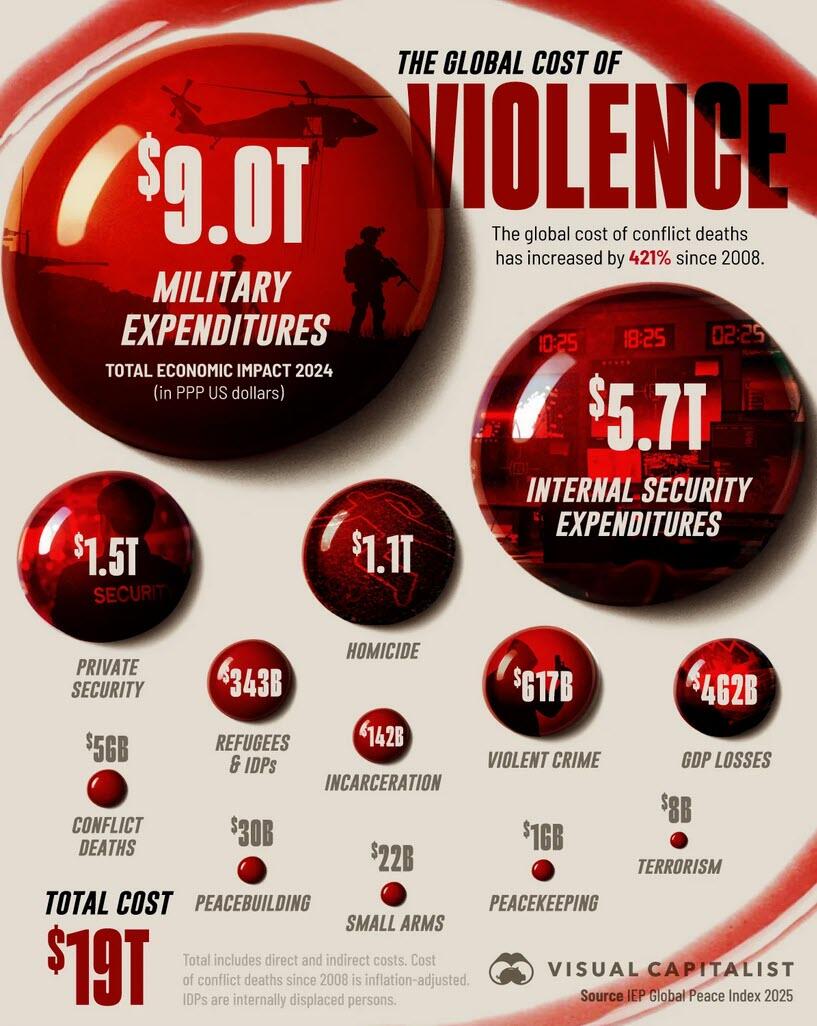
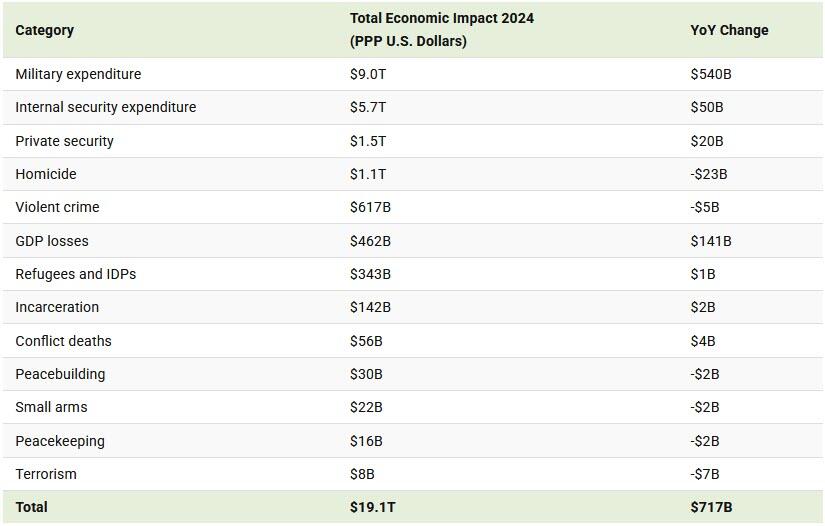
Last year, the economic impact of violence reached $19.1 trillion, or $717 billion higher than the previous year.

This came as conflict deaths hit 25-year highs, and wars continued in the Ukraine and Gaza. In response to heightened geopolitical tensions, European nations have injected billions into defense spending. Even Japan plans to double its defense spending to 2% of GDP.

This graphic, via Visual Capitalist’s Dorothy Neufeld, shows the global cost of conflict in 2024, based on analysis from the Institute for Economic and Peace.

Breaking Down the Cost of Conflict

Below, we show the economic impact of violence worldwide, with figures including direct and indirect costs:

In 2024, military spending grew by $540 billion to reach $9 trillion.

Overall, 84 countries increased spending on military as a share of GDP, with Norway, Denmark, and Bangladesh seeing the greatest jumps. U.S. military spending totaled $949 billion, while China followed at $450 billion, in international dollars.

As the second-highest cost, internal security expenditure hit $5.7 trillion. This includes costs associated with policing and the judicial system.

Meanwhile, GDP losses causes by conflict surged 44% in 2024 to reach $462 billion. Compared to 2008, GDP losses have more than quadrupled, while the cost of conflict deaths has followed a similar trend.

Adding to this, the cost of refugees and internally displaced persons (IDPs) had an economic toll of $343 billion. Today, 122 million people globally are forcibly displaced, more than doubling from 2008.

To learn more about this topic, check out this graphic on Europe’s biggest armies.

Tyler Durden
Mon, 12/01/2025 – 05:45

via ZeroHedge News https://ift.tt/bnHqJSu Tyler Durden

‘Surgical Removal Of An Organ’: Ukrainian Recruiter Arrested For Allegedly Beating Conscript’s Genitals In Heinous Attack

‘Surgical Removal Of An Organ’: Ukrainian Recruiter Arrested For Allegedly Beating Conscript’s Genitals In Heinous Attack

Via Remix News,

After a forced conscript was beaten in his groin area to the point that he lost an “organ” following emergency surgery, Ukrainian authorities have moved to arrest the recruitment center head.

The staff of the Ukrainian State Bureau of Investigation (DBR) arrested the head of one of the district recruitment and military service preparation centers (TCK) in the Ivano-Frankivsk Oblast.

The recruiter is accused of brutally beating a conscripted man for refusing to perform a fluorographic examination during the medical aptitude test (VLK), reported by the General Prosecutor’s Office of Ukraine and the DBR, based on the announcements of Ukrainian news outlet Pravda.ua.

The DBR investigated complaints from citizens and parliamentarians that beatings, torture, and demands for money had taken place in a TCK operation in Transcarpathia. Notably, neighboring Hungary has alleged that recruits from the Transcarpathia region are targeted for recruitment at an especially high rate due to them being ethnic Hungarians.

“Investigators uncovered numerous abuses of power committed by a senior officer at the center,” the DBR communication was quoted by the source.

Based on the investigation, it was revealed that the man was sent to the hospital for a VLK examination together with other citizens.

When he refused the examination, the lieutenant colonel deliberately inflicted at least five blows against the victim, targeting the groin area.

As a result, the victim suffered serious physical injuries that required the “surgical removal of an organ.”

The officer was charged with abuse of power during martial law, with serious consequences. On the motion of the prosecutors, the court ordered an arrest without the possibility of bail. Based on the source, it was also revealed that the possible involvement of other persons, including police officers, in the case is currently being investigated.

This beating is likely just the tip of the iceberg, though. As already reported by Remix News, a Hungarian citizen and entrepreneur, József Sebestyén, died in July in the Beregsász hospital after Ukrainian recruiters severely beat him with iron bars in a forest, with the incident also caught on film.

Prime Minister Viktor Orbán has forcefully condemned forced conscription in Ukraine after the beating death. Speaking on Kossuth Radio, Orbán linked the tragic incident directly to the ongoing war, asserting that a country where such events occur due to forced conscription is unfit for European Union membership.

“A country where this could happen cannot be a member of the EU,” said Orbán.

“We are talking about a Hungarian-Ukrainian dual citizen. This entitles us to avoid using cautious language. They beat a Hungarian citizen to death, that’s the situation. And this is a case that we need to investigate, as this cannot happen,” Orbán stated, emphasizing the gravity of the situation. 

He highlighted that while the front lines might seem distant to many Hungarians, “the war is taking place in our neighboring country. The threat is directly here.”

A video post on this topic from Remix News was immediately flagged by X and censored, meaning that EU censors may be jumping on this report due to its sensitive nature.

For years, videos of Ukrainian recruits being dragged off the streets and beaten have been circulating, making the arrest of one of these recruiters quite out of the ordinary.

Read more here…

Tyler Durden
Mon, 12/01/2025 – 05:00

via ZeroHedge News https://ift.tt/GNvJ4gL Tyler Durden

Future Of Fertility Chronically Overestimated

Future Of Fertility Chronically Overestimated

The newly released OECD Pensions at a Glance report shows how fertility projections have been wrong again and again over the years, grossly underestimating how much fertility would decline each time.

As fertility rates and pension funds are intrinsically tied, this can cause problems down the line, when incoming payments from workers to pension funds are smaller than expected and payouts to current pensioners exceed them.

As Statista’s Katharina Buchholz shows in the following data, the lifetime births per woman in OECD countries sank from 2.2 in 1980 to 1.9 in 1994.

Infographic: Future of Fertility Chronically Overestimated | Statista

You will find more infographics at Statista

At the time, demographers estimated that the rate would recover up to around 2.1 by the middle of the upcoming century.

By 2002, births rates had declined to 1.66, yet a recovery to 1.85 by 2047 was once again expected.

By 2012, there was actually a slight recovery back up to 1.75 births per women, prompting demographers to expect the number of births to rise to an average of 1.8 per woman by 2050.

Yet, birth rates started to fall again to below 1.5 by 2024, the latest year on record.

Still, the tale of recovering fertility has not been eliminated, as birth numbers are currently projected to rise again, albeit only slightly, to 1.52 by 2050 and 1.54 by 2070.

Many scientists now see the official UN demographic forecasts as conservative estimates and believe that the world population will actually shrink significantly faster than they project.

 A 2020 study published in The Lancet actually calculates that contrary to what UN figures say the world population will have shrunk by 2100 and could potentially already be significantly lower than it is today.

While population growth has been studied at length and models in this field tend to be more reliable, less work has been done on the newer topic of population decline, making calculations more unreliable.

Tyler Durden
Mon, 12/01/2025 – 04:15

via ZeroHedge News https://ift.tt/EFABmyJ Tyler Durden

Brickbat: Do Not Ask


Medical record | ID 174056692 ©  Tero Vesalainen | Dreamstime.com

People with learning disabilities in the United Kingdom are being given “do not resuscitate” (DNR) orders in their medical records without the knowledge or consent of their families, despite National Health Service guidance requiring case-by-case decisions. Families told ITV News that hospitals routinely place DNRs on the records of their disabled relatives simply because of their disability, with no conversation about what the patient or their loved ones would actually want. One woman said her non-verbal sister has had a DNR added to her record between 15 and 20 times without explanation. Another family discovered a DNR only after requesting their sister’s medical file following her death. The order cited “learning disability” as a reason not to attempt resuscitation. Health Secretary Wes Streeting called the practice “repugnant and immoral.” 


The post Brickbat: Do Not Ask appeared first on Reason.com.

from Latest – Reason.com https://ift.tt/OcbNvZJ
via IFTTT