Moscow Paper Claims Ukrainian Drones Hit Russia-Linked Oil Tanker Off West Africa

Moscow Paper Claims Ukrainian Drones Hit Russia-Linked Oil Tanker Off West Africa

All eyes are on Russia this week as talks center on a potential Ukraine peace deal that shifts to Moscow. U.S. Special Envoy Steve Witkoff is en route today and expected to meet with President Vladimir Putin to discuss a Washington-backed, 19-point framework aimed at ending the war. 

As Witkoff and Putin discuss a potential peace deal today, pressure on Russia’s shadow tanker fleet appears to be intensifying and broadening

Ukrainian drones struck two tankers in the Black Sea last week, and now the Russian business daily Kommersant reports that Ukrainian drones off the West Coast of Africa hit another tanker carrying Russian oil

“The M/T MERSIN tanker, carrying Russian oil, was attacked by Ukrainian drones off the coast of Senegal, Deniz Haber reported on November 30,” Kommersant wrote in a report. 

Alarming signs that the battlefield is widening far beyond Eastern Europe. 

Ukraine and its Western allies have spent the past several years targeting Russia’s oil and gas infrastructure with kamikaze aircraft and naval drones in an effort to pressure Moscow’s finances. This campaign, accompanied by sanctions, has yet to collapse Russia financially.

However, the Senegal attack only suggests that Ukraine is stopping at nothing to disrupt Russia’s shadow fleet of tankers that fuel profits for Moscow, and in return, fund the war in Ukraine. 

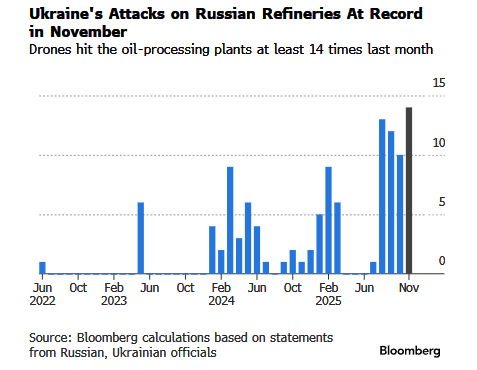
Notice that Ukraine’s attacks on Russian oil and gas infrastructure jumped to a record last month. The timing comes just as Trump is attempting to bring an end to the nearly four-year war.

The expanding battlefield is a major warning sign.


Tyler Durden
Mon, 12/01/2025 – 08:35

via ZeroHedge News https://ift.tt/D2udlny Tyler Durden

Stocks Slides After Bitcoin Tumbles On Hawkish BOJ Fears

Stocks Slides After Bitcoin Tumbles On Hawkish BOJ Fears

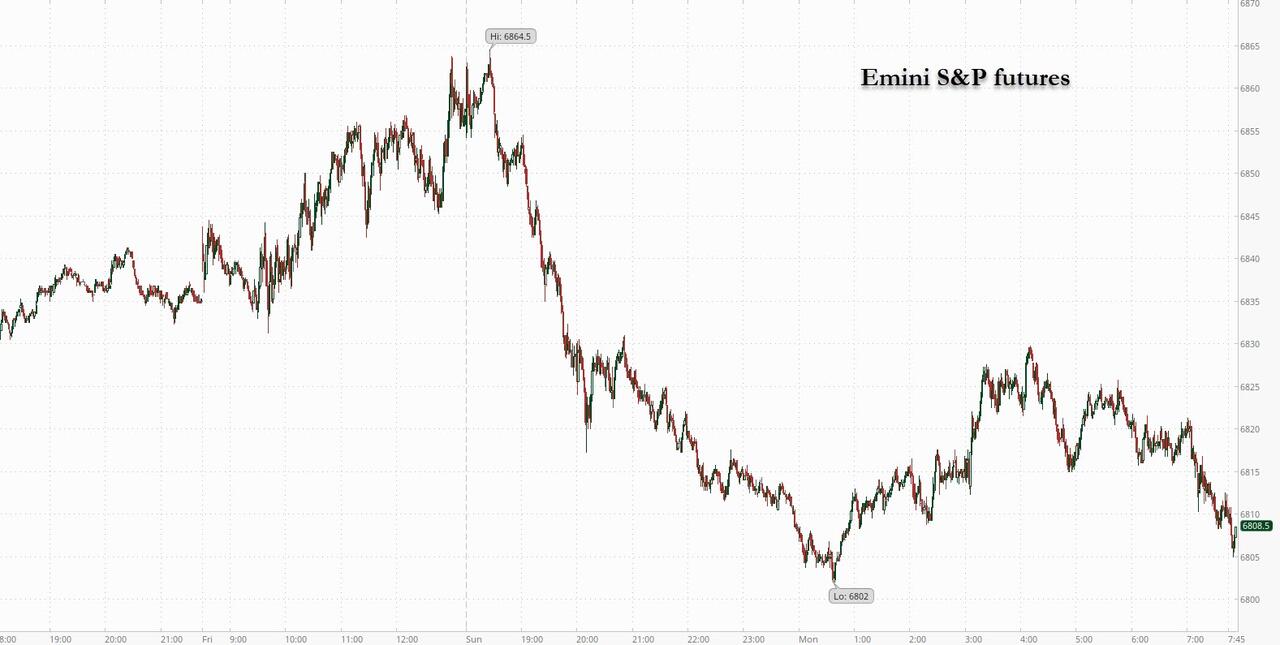
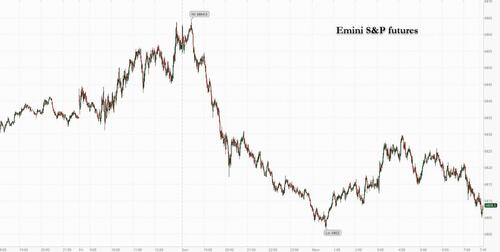
After a torrid meltup last week to end the month of November on a euphoria, if extremely illiquid note, futures are once again sinking as we start the final month of the year, in a swoon that was again catalyzed by a plunge in bitcoin which appears to have been spooked by hawkish overnight comments by the BOJ which continues to bluster that it may hike rates one day… soon… for real this time. As of 8:00am S&P futures were 0.7% lower while Nasdaq 100 contracts were -1.0%. Bond yields are 1-4bp higher. Bitcoin slid below $86,000, dragging the entire space and pulling crypto-linked stocks into the red. The Magnificent Seven also declined in premarket trading, with Tesla, Meta and Nvidia each falling more than 1%. Global bond yields are all higher this morning: Japan yields are 3-7bp higher led by the 7yr amid hawkish hint from the BoJ. OPEC+ countries agreed to maintain group-wide oil output quotas (i.e., pausing oil output hike) for 2026 yesterday, given the YTD decline in oil; Oil +1.7% since last Friday’s close. Trump said on Sunday that he has decided on his pick for the next Federal Reserve chair after making clear he expects his nominee to deliver interest-rate cuts. The US economic calendar includes November final S&P Global US manufacturing PMI (9:45am) and November ISM manufacturing (10am).
In premarket trading, Mag 7 stocks are all lower (Tesla -1.2%, Meta -1.4%, Nvidia -1.9%, Microsoft -0.6%, Amazon -0.4%, Alphabet -0.9%, Apple -0.6%). 

  • Crypto-exposed stocks slip following a drop in Bitcoin prices. Shares of Coinbase (COIN) are down 4%.
  • Silver miners including Coeur Mining (CDE) rise as the precious metal extends Friday’s rally on tight supply. Coeur is up 3%.
  • Vaccine makers are falling in early trading Monday as William Blair flags reports of a memo from a top FDA official,
  • Vinay Prasad, that links Covid-19 vaccines in younger people to deaths associated with myocarditis. Shares of Moderna (MRNA) are down 4%.
  • Barrick Mining (B) rises 4% after saying it is exploring an initial public offering of its North American gold assets as the Canadian mining company grapples with operational issues and cost blowouts.
  • Canadian Solar (CSIQ) rallies 13% on news that the solar panel manufacturer is transferring the assets of its Chinese unit to Canadian ownership to safeguard sales into the US as Washington steps up scrutiny of imports from the Asian nation.
  • Coupang (CPNG) falls 5% as the e-commerce firm faces an investigation by South Korean authorities over a data breach that affected about 33.7 million customer accounts.
  • Leggett & Platt (LEG) shares are up 8% after Somnigroup International proposed an all-stock buyout.

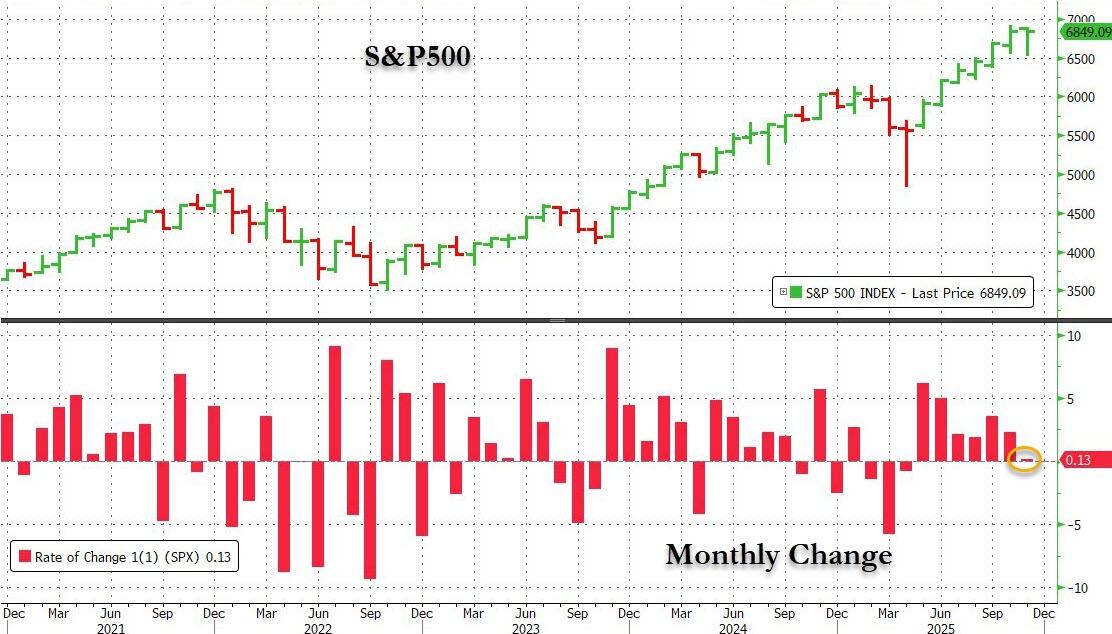
Thanks to a powerful ramp on Friday, November marked the seventh straight month of gains for the S&P 500, the longest streak since 2021 as the monthly closed just barely in the green, rising 0.17%. It wasn’t enough for the Nasdaq 100 however, which was hampered by concerns about stretched AI valuations, and fell 1.6% in the month.
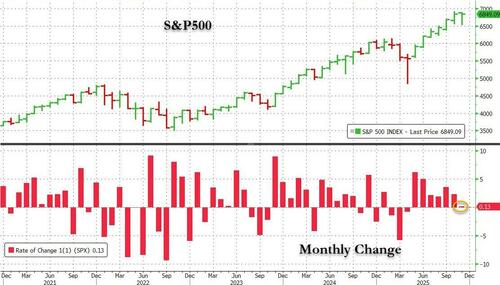
But so much for November, and December has seen a stark shift in sentiment with Monday’s risk-off mood most evident in crypto, with Bitcoin tumbling below $86,000 before paring the drop.

Sentiment was hammered early after Japan’s two-year bond yield rose to its highest level since 2008 when Governor Kazuo Ueda offered his clearest hint yet that the BOJ may be nearing an interest-rate hike (of course he has been doing this for months and every time the market falls for it). Traders raised the odds of a BOJ rate hike in December to about 80% after Ueda told business leaders that the central bank “will consider the pros and cons of raising the policy interest rate and make decisions as appropriate.” Any hike would be an adjustment in the degree of easing, with the real interest rate still at a very low level, he said. The move weighed on global bonds, lifting the rate on 10-year US Treasuries by three basis points to 4.04%. The yen led gains among major currencies against the dollar.

“The market is still hesitating a bit ahead of the upcoming macro data, and before the Christmas rally people typically expect,” said Andrea Tueni, head of sales trading at Saxo Banque France. “The drop in Bitcoin is weighing on sentiment and so are the comments from the BOJ.”

Given Japan’s role as a major source of global liquidity, any shift toward policy normalization will have implications for carry trades.

“It’s a structural change in global markets that investors need to adapt to,” said Alexandre Baradez, chief market analyst at IG in Paris.

The month opened with traders focused on a slate of economic indicators due before the Federal Reserve’s next policy meeting, following the S&P 500’s seventh consecutive monthly advance in November.  Meanwhile, gold continued its advance, and copper rose to a new record high on fears the global market is heading for a supply crunch. Attention is also turning to the central bank’s leadership, after President Trump said he has decided on a successor to Chair Jerome Powell.

This week’s data include ISM Manufacturing for November, due today, and a much-delayed inflation number for September, set to be released on Friday. A preliminary reading of consumer confidence in December is also due that day. That datapoint will be key given it’s a post-government shutdown reading on the health of the economy.
Markets are now signaling a December rate cut in December is nailed on. And Trump said Sunday he has made his mind up about who will be Fed’s next chairman. Trump’s chief economic adviser Kevin Hassett is seen as the likely choice, people familiar said last week. Hassett signaled markets were ready for the announcement of a new Fed chair. People familiar with the matter last week said that Hassett was seen as the likely choice to succeed Powell. Speaking on CBS’ Face the Nation on Sunday, he declined to address whether he considers himself the front-runner.

“December could prove more challenging than many expected, especially for those who thought last month’s 5% dip was the long-awaited correction,” said Ipek Ozkardeskaya, a senior analyst at Swissquote. “With Fed funds futures pricing nearly a 90% chance of a 25bp cut, there isn’t much room left for additional dovish fuel.”

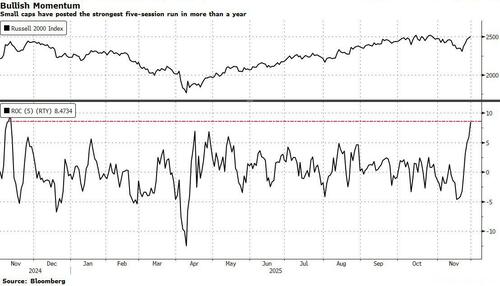
It’s not all gloom: traders are placing bullish bets on small-cap stocks in anticipation of lower rates. The Russell 2000 Index jumped 8.5% in the five trading days through Friday, making up the bulk of its gains this year. 
In strategy, RBC’s Lori Calvasina said the S&P 500 should reach 7,750 over the next 12 months, based on sentiment, valuation, the economic outlook and monetary policy. Calvasina’s forecast, which implies a 14% rally for the benchmark, joins a chorus of strategists with bullish calls for 2026. 

In Europe, the Stoxx 600 falls 0.4%, led by industrial, real estate and financial services. A drop for shares of Airbus also drags on the gauge after weekend news of a software glitch for its A320 jets. Industrial goods and services and real estate are the biggest fallers while the mining sector is rising as copper advanced to a record high. Here are some of the biggest movers on Monday:

  • Airbus shares fall as much as 3.1% after the company had to attend to a solftware glitch.
  • ASML shares rise as much as 3.1% after the company was added to JPMorgan’s Analyst Focus list and is its top pick in the wider semis sector, in which semiconductor capital equipment is viewed as the most attractive segment.
  • European mining shares are among the best-performing sectors in the Stoxx 600 benchmark as copper advanced to a record high on the London Metal Exchange on fears the global market is heading for a supply crunch. Silver traded near a record.
  • Reckitt Benckiser shares rise as much as 2.1%, the most in over a month, after Barclays upgraded the consumer goods company to overweight from equal-weight.
  • European defense stocks fall after reports of progress in Ukraine-Russia talks over the weekend.
  • Melrose Industries shares fall as much as 4.2% after news that CFO Matthew Gregory will retire from his position in 2026.

Earlier in the session, Asian stocks traded in a narrow range on December’s first trading day as investors braced for a data-heavy week, while gains in China helped offset regional weakness. The MSCI Asia Pacific Index was down 0.3% as of 4:50 p.m. Hong Kong time, led lower by tech shares, after earlier oscillating between gains and losses. Advances in Hong Kong and mainland China’s markets briefly lifted the region’s benchmark before losses in Japan, Taiwan and Australia pulled it lower. In Japan, Bank of Japan Governor Kazuo Ueda hinted that the central bank might lift interest rates at its next meeting this month, sending the Topix 1.2% lower. Meanwhile, market gains in China defied weaker-than-expected factory and manufacturing data, highlighting ongoing strains in the nation’s economic recovery.

In FX, the yen is leading gains against the greenback, rising 1% and taking USD/JPY below the 155-handle. The hint of a December interest-rate hike by Bank of Japan Governor Ueda played a role and also helped push Japanese 2-year yields to the highest since 2008. The yen is also likely benefiting from haven demand as broader risk sentiment struggles to recover after an abrupt turn lower during Asian trading hours.

In rates, treasuries fall, pushing US 10-year yields up 3 bps to 4.04%. European government bonds also decline.

In commodities, WTI crude futures rise 1.8% to near $59.60 a barrel as a key pipeline linking Kazakh fields to Russia’s Black Sea coast halted loading. Spot gold climbs $20 to $4257. Bitcoin also tumbled 6%, back below $86,000 after momentum ignition also sparked a rout and Korean momentum kamikazes joined in during Asian hours.

The US economic calendar includes November final S&P Global US manufacturing PMI (9:45am) and November ISM manufacturing (10am). While the Fed enters its pre-meeting blackout period, Powell and Governor Michelle Bowman are scheduled to speak, though they are barred from commenting on the economic outlook or policy. Fed officials will also receive a dated print of their preferred inflation gauge this week ahead of their final policy meeting of the year. Other data due include ADP private employment figures for November.

Market Snapshot

  • S&P 500 mini -0.5%
  • Nasdaq 100 mini -0.6%
  • Russell 2000 mini -0.7%
  • Stoxx Europe 600 -0.3%
  • DAX -0.9%
  • CAC 40 -0.4%
  • 10-year Treasury yield +3 basis points at 4.04%
  • VIX +1.6 points at 17.95
  • Bloomberg Dollar Index -0.1% at 1216.62
  • euro +0.2% at $1.1623
  • WTI crude +1.8% at $59.62/barrel

Top Overnight News

  • President Trump said Sunday he’s decided who he’ll nominate to be the next Federal Reserve chair, but he wouldn’t be drawn on whether the pick is National Economic Council director Kevin Hassett. White House Economic Adviser Hassett said he will be happy to serve if US President Trump picks him as Fed chair.
  • Trump said on Friday he is cancelling all executive orders signed by former President Biden using autopen and stated that any document signed by Biden with autopen, which was approximately 92% of them, is hereby terminated and of no further force or effect. Furthermore, Trump stated that Biden was not involved in the autopen process and if he says he was, he will be brought up on charges of perjury.
  • US and Ukrainian negotiators said they held productive talks on a potential peace framework but have yet to reach a breakthrough. Steve Witkoff is due to meet Vladimir Putin in Russia tomorrow. BBG
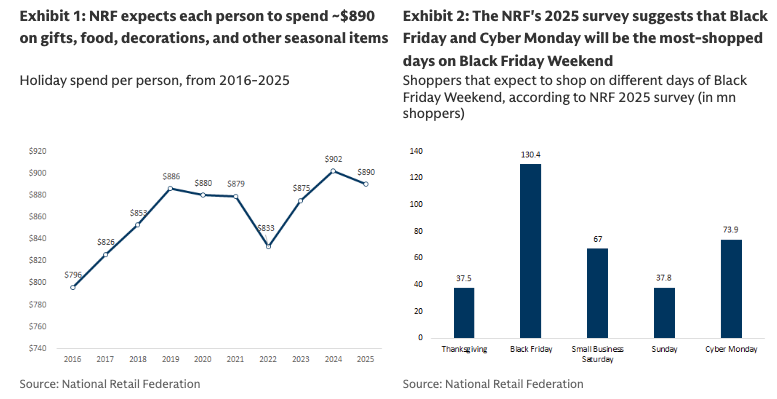
  • Black Friday sales climbed 4.1%, Mastercard said, surpassing last year’s growth, a sign US consumers are continuing to spend despite persistent economic concerns. But Adobe Analytics expects growth in Cyber Monday sales to ease from last year. BBG
  • The State Department announced a pause on visa issuances for Afghan passport holders, and the US immigration service said it will halt all asylum decisions, while the US Citizenship and Immigration Services Director said USCIS halted all asylum decisions until they can ensure that every migrant is vetted and screened to the maximum degree.
  • For years it has seemed no sticker price was too high for American car buyers. Even as average new car prices approached $50,000 this year, dealers fretted more over depleted inventories than losing customers to sticker shock. Those days may be ending as increasingly stretched consumers are starting to draw the line on what they will pay for a new car, according to dealers, analysts and industry data. WSJ
  • Trump downplayed his social media post saying Venezuelan airspace should be considered closed. The president confirmed he recently held a phone call with his counterpart Nicolas Maduro, but declined to say how it went. BBG
  • Swiss voters overwhelmingly rejected the proposal for a 50% inheritance tax for the super-rich: FT.
  • A private gauge of China’s manufacturing sector showed Chinese factories cut back on activity in November, reflecting weaker growth momentum. China RatingDog manufacturing PMI for Nov came in below expectations at 49.9 (vs. the Street 50.5 and down from 50.6 in Oct). WSJ
  • Micron will invest $9.6 billion to build a plant in western Japan to make memory chips for AI applications. Nikkei
  • The BoJ will thoroughly discuss the possibility of an interest-rate increase at its coming meeting, Gov. Kazuo Ueda said, stoking hopes that it will resume monetary tightening this year. Now that Tokyo’s trade agreement with the Trump administration has reduced external risks, the BOJ governor said the central bank will pay special attention to the outlook for wage increases in Japan next year. WSJ
  • Copper rallied to a new record on fears the global market is heading for a supply crunch. Silver extended gains. BBG
  • South African President Ramaphosa dismissed US President Trump’s threat to exclude the country from next year’s G20 summit and reaffirmed South Africa’s status as a founding member of the group: Reuters.

Macro

  • China’s manufacturing activity contracted in November, according to official and private surveys, as stronger demand overseas after a trade truce with the US failed to reverse a deepening slowdown in the economy.
  • Trump said Sunday that people shouldn’t read much into a social media post where he said Venezuelan airspace should be considered closed.
  • Russian President Putin signed an order to allow visa-free entry into the country for Chinese citizens as ties between the two nations continue to deepen.

Trade/Tariffs

  • China was reported on Friday to have banned imports of pigs, wild boars and related products from Spain’s Barcelona province, according to a China Customs document. In relevant news, Mexico’s Agriculture Ministry also suspended pork product imports from Spain due to a swine fever outbreak.

A more detailed look at global markets courtesy of Newsquawk

APAC stocks began the new month mixed, with participants cautious as they digested the weak Chinese PMI data. ASX 200 was dragged lower by weakness in healthcare, telecoms, financials and tech, while sentiment was also not helped by disappointing Chinese PMI data and weaker-than-expected Australian Gross Company Profits and Business Inventories. Nikkei 225 slipped beneath the 50k level amid a firmer currency and risks of a BoJ rate hike in December, while there were hawkish-leaning comments from BoJ Governor Ueda, who said that they will consider the pros and cons of raising rates at the December meeting. Hang Seng and Shanghai Comp were kept afloat despite the discouraging Chinese PMI data, in which the headline official Manufacturing PMI continued to show a decline in factory activity at 49.2 (exp. 49.2) and Non-Manufacturing disappointed with a surprise contraction at 49.5 (exp. 50.0), while RatingDog Manufacturing PMI missed estimates at 49.9 (Exp. 50.5).

Top Asian News

  • BoJ Governor Ueda is to deliver a speech at the Japan Business Federation on December 25th, according to the central bank.
  • BoJ Governor Ueda said if their projection of economic activity and prices materialise, the BoJ will continue to raise the policy interest rate in accordance with improvements in economy and prices, while he added that even if the policy interest rate is raised, accommodative financial conditions will be maintained and the likelihood of their baseline scenario for economic activity and prices being realised is gradually increasing. Ueda also commented that at the December meeting, the BoJ will examine and discuss economic activity and prices at home and abroad, as well as market developments, based on various data, and consider the pros and cons of raising rates. Furthermore, he said it is important for FX to move stably reflecting fundamentals and that a weak yen works to push up consumer inflation, while they must be mindful that FX moves affect inflation expectations and underlying inflation in guiding policy.
  • Japanese Finance Minister Katayama said it is “clear” that volatile swings in the FX market and the rapid weakening of the yen aren’t based on fundamentals.
  • China’s financial regulator guides banks and insurers to fully provide financial support services related to the Hong Kong fire and said insurance institutions should promptly handle claims and other procedures for disaster-affected customers, while it added that banks should strengthen financial credit support and actively assist in disaster reconstruction.
  • Indonesia said at least 303 people died in three provinces after severe rains caused floods and landslides.
  • Vanke has reportedly requested 12-months to pay its bonds under the extension plan, Bloomberg reports.

European bourses (STOXX 600 -0.3%) are on the backfoot, following a cautious mood seen in APAC trade. The AEX (U/C) bucks the trend, with ASML (+1%) keeping the index afloat after positive analyst commentary. European sectors are mixed. Basic Resources leads, given the strength in underlying metals prices whilst Industrials sits at the foot of the pile, with Airbus (-3.5%) pressured after rolling out urgent fixes across its A320 fleet over the weekend. US equity futures are softer across the board (ES -0.5% NQ -0.7% RTY -0.8%), following the pressure seen in Europe. Focus later will be on US ISM Manufacturing figures, which will give further insight into the health of the US economy ahead of the FOMC meeting next week. Softbank (9984 JT) CEO said he did not want to sell a single NVIDIA (NVDA) share, but needed funds to invest in OpenAI and other opportunities.

Top European News

  • Swiss voters overwhelmingly rejected the proposal for a 50% inheritance tax for the super-rich, according to FT.
  • UK PM Starmer and Chancellor Reeves have been accused of misleading the Cabinet by using claims that there was a black hole in the public finances to justify tax rises during the run-up to the Budget, according to The Times’s Swinford, while it was separately reported by Bloomberg that Reeves denied lying about UK finances pre-Budget.
  • UK PM Starmer is to defend the Budget after Reeves was accused of misleading the public, and will outline the growth mission after the Budget tax rises during a speech on Monday.
  • S&P affirmed Latvia at A; Outlook Stable and affirmed Lithuania at A; Outlook Stable.
  • ECB’s de Guindos said the current level of interest rates is appropriate and, in terms of future moves, this is data dependent.

FX

  • DXY is subdued in the presence of JPY strength and in the absence of any pertinent catalysts and with the Fed in a blackout period, while US President Trump said he knows who he will pick for the Fed chair role, but didn’t give any further details. DXY resides towards the bottom of a 99.26-99.51 range (vs Friday’s 99.38-99.82 parameter), with the next downside level the 17th November low at 99.25.
  • JPY is the marked outperformer this morning, given the risk tone and commentary from BoJ Governor Ueda, who ultimately hinted at a possible December rate rise, although market pricing has been little changed since last week, with a 67% chance of a hold at the 19th December announcement. USD/JPY currently resides towards the bottom of a 155.24-156.15 parameter, the next support level is seen at 155.21 (19th November low).
  • EUR and GBP diverge, the former underpinned by the USD, whilst the latter is subdued ahead of UK PM Starmer’s speech at 10:30GMT, where he will reportedly outline the growth mission and will defend the Budget after Chancellor Reeves was forced to deny lying to the public about UK finances pre-Budget. No moves were seen in EUR or GBP on the Final Manufacturing PMI data. EUR/GBP reached a 0.8794 peak vs a 0.8754 intraday trough.
  • Non-US dollars, CAD, AUD, NZD, are relatively flat with the broader market tone tentative and macro updates light. Upside capped in the antipodeans following overall disappointing Chinese PMIs, where the headline official Manufacturing PMI continued to show a decline in factory activity at 49.2 (exp. 49.2) and Non-Manufacturing disappointed with a surprise contraction at 49.5 (exp. 50.0), while RatingDog Manufacturing PMI missed estimates at 49.9 (Exp. 50.5).

Fixed Income

  • USTs Mar’26 down to 113-06, lower by five ticks at worst. Downside echoes peers, but offset by dovish Fed expectations as markets near-enough price a December cut, and we look to updates on the next Fed Chair after President Trump said he knows who he will pick. Polymarket ascribes a 58% chance that Hassett will be appointed. Treasury Secretary Bessent recently said Trump could make an announcement pre-Christmas.
  • Bund Dec’25 at a 128.50 low, posting downside of 37 ticks. Support comes into play at 128.37 from the 20th of November. Thereafter, the figure before 127.88 from the last week of September. JGBs and Gilts (see below) driving much of the bearishness, alongside upside in numerous Commodity prices, and particularly crude post-OPEC.
  • Gilts Mar’26 opened lower by 12 ticks before falling further to a 91.16 low with downside of 42 ticks at most. Underperformance driven by the Budget and Chancellor Reeves coming under scrutiny over the weekend, with particular reference to the timing of OBR briefings and her pitch-rolling on Income Tax. PM Starmer to speak at 10:30GMT on growth.
  • JGBs Dec’25 hit overnight and were lower by c. 50 ticks at worst. Pressure on the back of hawkish BoJ commentary, where Ueda, among other points, said that delaying a rate hike too long could cause sharp inflation and force a rapid policy adjustment. Remarks that lifted BoJ pricing to over a 70% chance of a hike in December vs sub-60% on Friday.

Commodities

  • WTI and Brent are currently trading higher by c. 2%, as markets digest the OPEC+ and supply-related concerns following Ukraine’s attack on Russian refineries. WTI and Brent currently reside at the upper end of a USD 58.83/bbl to USD 59.97/bbl and USD 62.29/bbl to 63.35/bbl range respectively. Price action since the European cash open has been exceptionally lacklustre, and generally sideways around highs; some modest downticks have been seen in recent trade.
  • Spot gold is firmer today and trades towards the upper end of a USD 4,205.63/oz to USD 4,262/oz range. XAU now at levels not seen since late October 2025; there is now a bit of clear air to the high of 21st October at USD 4,375.62/oz. Perhaps some focus on continued Ukrainian attacks on Russia, as traders now focus on the coming meeting between US Special Envoy Witkoff and Russian President Putin on Tuesday. Elsewhere, marked pressure in the crypto space perhaps sent flows to the more-traditional haven in APAC trade.
  • Base metals held a strong positive bias throughout overnight trade, but then gave up some of the upside as the risk tone dipped a touch, with traders focusing on the disappointing Chinese PMI metrics. Focus has also been on the surge in 3M LME Copper, which saw the red-metal surge above USD 11.2k/t to print a fresh ATH at USD 11,297/t, before scaling back down to a current USD 11,189/t. ING opines that the latest bout of demand for the metal is thanks to “an upbeat CESCO Week event in Shanghai” – suggesting that it echoed the markets’ view of tight supply.
  • OPEC+ agreed to keep group-wide oil output unchanged for Q1 2026, while it stated that participating countries approved the mechanism developed by the secretariat to assess participating countries’ maximum sustainable production capacity. Furthermore, it announced that the 41st OPEC and Non-OPEC ministerial meeting will be held on 7th June 2026.
  • OPEC Secretariat receives update compensation plans from Iraq, the UAE, Kazakhstan, and Oman, according to a statement.
  • Saudi Energy Minister said OPEC+ latest decision is the most important and transparent in deciding production level via State TV.

Geopolitics: Middle East

  • Israeli PM Netanyahu submitted a letter to President Herzog, while Netanyahu said in a video statement addressing the pardon request that his personal interest was to complete the legal process until the end, while he added that the military and national reality, and national interest, demand otherwise, and that ending the trial immediately would advance much-needed national reconciliation.
  • Israeli helicopters fired in the eastern areas of Khan Yunis inside the Yellow Line, according to Al Jazeera.
  • Israeli security estimates that Iran may take the initiative and carry out retaliatory operations instead of Hezbollah and estimates preparations for a Houthi response in retaliation for the killing of Hezbollah Top Commander Al-Tabatabai, according to Al Arabiya.
  • Hezbollah’s leader said on Friday in response to Israel’s killing of its military chief that the group has a right to respond and will set a time for it, while he added that Lebanon’s government should prepare a plan to confront Israel.
  • Iran’s Foreign Minister Araghchi held talks with Turkey regarding the nuclear issue and Israel, while he also held a meeting with the Saudi Deputy Foreign Minister for Political Affairs in Tehran.

Geopolitics: Ukraine

  • Russia’s Kremlin said that Russian President Putin is due to meet US envoy Witkoff on Tuesday. On the Russia-Ukraine peace development, the Kremlin adds that they are not going to engage in megaphone diplomacy.
  • Ukrainian President Zelensky said a delegation headed by the security council chief travelled to the US for talks, while it was also reported that Zelensky is to visit French President Macron in Paris on Monday.
  • US and Ukraine negotiations on Sunday focused on where the de facto border with Russia would be drawn under a peace deal, while the five-hour meeting was said to be difficult and intense, but productive, according to two Ukrainian officials cited by Axios.
  • US Secretary of State Rubio said the meeting with Ukrainians was very productive but noted there is more work to be done, while he added that they have been in touch to varying degrees with the Russian side.
  • Ukraine’s First Deputy Foreign Minister said there was a good start to US peace talks with a warm atmosphere conducive to a potential progressive outcome.
  • Ukraine’s military hit Russia’s Afipsky oil refinery, while it was also reported that Ukrainian sea drones struck two Gambia-flagged tankers off the Turkish coast on Friday, which were said to be part of a Russian shadow fleet used to bypass Western sanctions.
  • Russian forces carried out a massive strike on Ukrainian military-industrial and energy facilities.
  • Russia’s Foreign Minister said following a Ukrainian drone attack on the CPC Black Sea terminal, that the civilian energy infrastructure that was attacked plays an important role in ensuring global energy security and has never been subject to any restrictions or limitations, while they strongly condemned the ‘terrorist attacks’ on CPC and oil tankers.
  • NATO is considering being “more aggressive” in responding to Russia’s cyber-attacks, sabotage and airspace violations, according to its most senior military officer, Admiral Giuseppe Cavo Dragone, cited by FT.
  • NATO is reportedly preparing for the scenario of confronting Russia with limited US support, according to a report by Bloomberg citing a wargame in Transylvania that showed European soldiers defending the continent largely without US support as President Trump reduces US deployments in Europe.

OTHER

  • US President Trump declared on Truth Social that the airspace above Venezuela is closed. It was separately reported that President Trump held a call with Venezuelan President Maduro, while Trump also commented that Defence Secretary Hegseth told him that he did not order a second boat strike.
  • US bipartisan lawmakers raised alarms on Sunday that Defence Secretary Hegseth may have committed a war crime following a report that he ordered a follow-on attack to kill survivors of a boat strike in September, according to POLITICO.
  • Venezuela said it rejects US President Trump’s “hostile, unilateral and arbitrary” post about Venezuela’s airspace and noted that the statement shows “colonial pretentions” towards Latin America, while it added that Venezuela demands respect for airspace and will not accept foreign orders or threats.
  • China’s Coast Guard carried out law enforcement inspections around the Scarborough Shoal, while the report noted that the Chinese military’s Southern Theatre Command organised combat readiness patrols in the ‘territorial’ waters and airspace of the Scarborough Shoal and surrounding areas on November 29th, according to Xinhua.

US Event Calendar

  • 9:45 am: Nov F S&P Global U.S. Manufacturing PMI, est. 51.9, prior 51.9
  • 10:00 am: Nov ISM Manufacturing, est. 49, prior 48.7
  • 10:00 am: Nov ISM Prices Paid, est. 57.5, prior 58

Central Bank Speakers 

  • 8:00 pm: Fed’s Powell Speaks at Memorial Event
  • Fed’s External Communications Blackout (November 29 – December 11)

DB’s Jim Reid concludes the overnight wrap

Good news from home as we start the month: over the weekend we found out that my daughter Maisie has made the South East England Artistic Swimming Squad. Considering I’m one of the worst swimmers imaginable—and would make an awful gymnast—I’m pretty impressed that she’s managed to stay on the right side of the gene pool lottery. To be fair, when she had Perthes Disease for three years and spent over a year in a wheelchair, swimming was the one thing that kept her going, so this is a fantastic achievement. I won’t book tickets for the 2036 or 2040 Olympics just yet, but you never know!

As it’s the start of the month, Henry will shortly release our usual performance review. November was very much a month of two halves: risk assets initially sold off, before a sharp recovery meant the S&P 500 just about posted a seventh consecutive monthly gain. The main driver was the Fed, as investors first priced out and then back in a December rate cut. Elsewhere, fears of an AI bubble remained prominent, with the Magnificent 7 losing ground for the first time since March. European assets also performed well as expectations rose about a potential peace deal in Ukraine. However, not every asset managed to recover—Bitcoin saw its worst month since February. 

ChatGPT was three years old yesterday and that date could be a landmark moment in history in years to come. As we said in the World Outlook, the ultimate destination for AI will be hotly debated in 2026 and will unlikely reach a conclusion. As such there is plenty of opportunity for both sides of the boom-and-bust narrative to win for periods of time. So expect a volatile ride.

Asia has actually kick started December in a weak mood with Bitcoin down another -6% this morning and Nasdaq (-1.05%) and S&P 500 (-0.80%) futures both notably lower. 10yr US Treasuries are +3bps and 10yr JGBs are +6.7bps as Ueda has said at a speech this morning “At the Monetary Policy Meeting (MPM), the Bank will examine and discuss economic activity and prices at home and abroad as well as developments in financial and capital markets, including the point I just mentioned, based on various data and information, and will consider the pros and cons of raising the policy interest rate and make decisions as appropriate.”

Our Japanese economist believes this strongly suggests an interest rate hike at the December meeting and has pushed forward his view of a hike from January to the meeting later this month, the Friday before Christmas (see here for more of his views on this). Market pricing has increased from a probability of just under 60% to 83% as I type. This story brings shades of the 2022 meeting just before Xmas when the BoJ lifted its cap on 10yr JGBs from 0.25% to 0.5%. That saw the market spooked a little. The Yen has risen by +0.39% and the Nikkei is -2.04% lower this morning with 2yr yields +5bps, surpassing the 1% threshold and reaching their highest point since June 2008. More on Asia later.

This coming week will allow forecasters to fine-tune their Fed views ahead of that. There is plenty of data to get through, both shutdown-delayed and routine. Globally, we have European CPI tomorrow and PPI on Wednesday, following German and French CPI prints today. Various global PMIs are also out today, and we also have Cyber Monday, which follows what seems to have been a decent Black Friday weekend. As an example, Mastercard’s SpendingPulse index was up +4.1% on Friday, up from 3.4% last year. Newsflow continues to bubble up around peace negotiations for the war in Ukraine, so that’s one to watch as well.

Focusing in on the US, the Federal Reserve is firmly in its pre-meeting communications blackout ahead of the 10 December FOMC decision, leaving economic releases to do the talking. Markets have already priced an 80% chance of a 25bp cut next week, and this week’s data will help shape that view as well as expectations for 2026.

The US calendar begins today with the ISM Manufacturing Index, expected to hold near recent averages at 48.5, signalling continued softness in factory activity. Tomorrow brings unit motor vehicle sales, forecast at 15.8 million units, a modest improvement from October. Wednesday is the busiest day, featuring the ADP employment report, expected to show a gain of 50,000 jobs versus 42,000 previously. This report will take on added significance as it will be the most up-to-date labour market data available to Fed officials before they meet. Also due Wednesday are industrial production, likely to rise 0.1% after a slight decline last month, and the ISM Services Index, projected at 51.8, close to its two-year trend. On Thursday, factory orders should show a 0.5% increase, pointing to resilient capital spending.

Friday rounds out the week with the delayed September personal income and consumption report, and within it, the more important core PCE. This is expected to hold at 0.23% month-on-month, keeping the annual rate near 2.9%, a tenth above what the Fed was tracking when they only had CPI to use. The preliminary University of Michigan consumer sentiment survey is also anticipated to edge up to 54.0 from 51.0. While sentiment remains depressed—its 24-month average is comparable to Great Recession levels according to our economists—real GDP growth of 2.6% annualised over the past eight quarters and inflation-adjusted consumer spending growth of 2.8% underscore the economy’s resilience. Note that the combined September and October JOLTS report has been rescheduled for 9 December, while October and November payrolls and unemployment data will not arrive until 16 December, well after the FOMC meeting.

Across Europe, inflation will dominate the agenda. Country-level CPI prints for Germany and France set the tone today, followed by the Eurozone flash CPI for November tomorrow. Switzerland reports inflation figures on Wednesday, and Sweden follows on Thursday. These data points will be closely watched for confirmation that disinflation trends remain intact across the continent.

In Asia, the focus turns to manufacturing and policy signals. Most of China’s PMI data came out yesterday and this morning, but we still have the private-sector services PMI on Wednesday.

Geopolitical developments will also feature prominently. US and Ukrainian delegates met in Florida yesterday without any incremental headlines of note. The US’s main negotiator Witkoff is expected to travel to Moscow today and likely meet Putin tomorrow. EU defence ministers meet today on the same topic, followed by NATO foreign affairs ministers on Wednesday for further strategic discussions. French President Macron undertakes a state visit to China from Wednesday to Friday, underscoring diplomatic engagement in Asia.

Yesterday, China’s official manufacturing PMI came in a couple of tenths below expectations at 49.2, marking the eighth successive month below 50. The non-manufacturing equivalent surprisingly fell from 50.1 to 49.5, the first reading below 50 for nearly three years. Consensus was at 50.0. This morning, the RatingDog general manufacturing PMI, conducted by S&P Global, fell to 49.9 in November (compared to the expected 50.5).

Chinese equities are bucking the risk off elsewhere this morning, possibly on stimulus hopes given the data. The Hang Seng (+0.27%) and Shanghai Composite (+0.33%) are higher.  

Recapping last week now and markets rebounded from their recent pullback, buoyed by new hopes of Fed rate cuts, as well as improved tech optimism and accelerating talks on a peace deal between Ukraine and Russia. This saw the S&P 500 advance by +3.73% (+0.54% Friday), its biggest weekly gain since mid-May, when US and China reversed their post-Liberation Day tariff escalation. The NASDAQ rose by +4.91% (+0.65% Friday) and the Magnificent 7 by +5.40% (+0.62% Friday). The Mag-7 rally came despite Nvidia falling -1.05% (-1.81% Friday) following reports that Meta (+9.04%, +2.26% Friday) was in talks with Alphabet (+6.85%, +0.07% Friday) to purchase Google’s AI TPU chips. The VIX volatility index declined by -7.08pts to a four-week low of 16.35. And credit spreads tightened amid the risk-on mood, with US IG (-5bps) and HY (-32bps) spreads seeing the biggest weekly tightening since August and May respectively.

Over in Europe, the peace narrative helped the STOXX 600 gain +2.55% (+0.25% Friday), with similar advances for the DAX (+3.23%) and the CAC 40 (+1.75%). By contrast, the STOXX Aerospace & Defence index (+0.27% on the week) and Rheinmetall (-2.57%) underperformed.

US Treasuries rallied following more dovish commentary from Fed officials as well as reports that Kevin Hassett is viewed as the frontrunner for the Fed Chair post. The pricing of a December rate cut rose from 63% to 83%. It was as low as 24.5% 10 days ago. Those moves came amid mixed US data, most notably with November consumer confidence (88.7 vs 93.3 expected) slumping to a 7-month low but the latest jobless claims suggesting a still resilient labour market as initial jobless claims fell back to 216k in the week ending November 22 (vs. 225k expected). The 2yr Treasury yield was -1.9bps lower at 3.49% (+1.4bps Friday), with 10yr yields down -5.0bps to 4.01%. In continental Europe, yields on 10yr bunds (-1.4bps), OATs (-6.3bps), and BTPs (-5.9bps) saw similar declines as Treasuries.

In the UK, markets welcomed the increase in fiscal headroom to £22bn as the budget revealed mostly back-loaded tightening. The main measures include £26bn of tax rises by 2029-2030 via frozen income tax thresholds, new National Insurance on salary-sacrifice pensions, and higher taxes on dividends, property, and savings. Coupled with lower-than-expected gilt issuance, this left 10yr gilt yields -10.6bps lower on the week, and the FTSE 100 advancing +1.90% (+0.27% Friday). The UK deficit is forecast to fall from 4.5% of GDP to 3.5% next year, and under 2% by the decade’s end, but markets still question long-term fiscal sustainability. 

In commodities, Brent crude was +1.02% higher to $63.20/bbl (-0.22% Friday), with oil traders remaining cautious on the prospects of possible peace deal in Ukraine. Meanwhile, gold (+4.29% on the week) and Bitcoin (+6.80%) joined the broader rally after their earlier declines.


Tyler Durden
Mon, 12/01/2025 – 08:32

via ZeroHedge News https://ift.tt/ArfMDCg Tyler Durden

‘Kill Everybody’


Secretary of War Pete Hegseth | Orlando Barría/EFE/Newscom

Pete Hegseth likes killing people. He’s said as much repeatedly. Back in early September, he declared that the newly renamed Department of War would favor “maximum lethality, not tepid legality.”

The secretary of war clearly meant it, judging from a story in The Washington Post. The paper reports that Hegseth issued verbal orders to the military forces striking suspected drug traffickers in the Caribbean and Pacific to “kill everybody.”

When the inaugural strike in this campaign against a boat off the Trinidadian coast left two survivors clinging to the wreckage of the craft, the commander in charge of the operation, in accordance with Hegseth’s spoken directive, ordered a second strike to take them out too.

Some 80 people have reportedly been killed to date in the U.S. military’s current anti-drug campaign.

The administration’s officially secret legal justification for these strikes asserts that “narco-terrorists” are using the money earned from trafficking drugs to finance their war against the United States and its allies. Suspected drug smugglers are therefore, it claims, a legitimate counter-terrorism target.

Many international law experts have retorted that the boats themselves pose no imminent threat to Americans, and that the people on board the boats are not combatants but suspected criminals who one would normally expect to be arrested, not executed.

The administration’s position “can justify almost anything the government wants to do to anyone,” wrote Reason‘s Matthew Petti back in September.

These criticisms haven’t stopped the Trump administration from carrying out its anti-drug campaign. A resolution that would have required congressional authorization for any military action against Venezuela failed in a close 49–51 vote in the U.S. Senate in early November.

Even if one accepts the dubious idea that these strikes are legal, the second strike described in the Post report would violate the laws of war. More plainly, it would be murder.

An order to kill boat occupants no longer able to fight “would in essence be an order to show no quarter, which would be a war crime,” Todd Huntley, a former military lawyer who advised Special Operations, told the Post.

Over the weekend, the armed services committees in the House and Senate announced they would conduct investigations into the first boat strike.

Trump himself has said that the first boat strike was “very lethal, it was fine,” but that he would not have wanted a second strike.

In a lengthy X post on Friday, Hegseth accused the Post of “fabricated, inflammatory, and derogatory reporting” but did not directly address the allegation about the second strike.

“Our current operations in the Caribbean are lawful under both U.S. and international law, with all actions in compliance with the law of armed conflict,” he said.

If the Post‘s reporting is borne out, the second strike on helpless survivors would add a degree of barbarism to the administration’s anti-drug campaign.

The increasingly granular debates about the legality of the boat strikes nevertheless feels somewhat tiresome and trivial, given the already established context of these attacks.

The Trump administration is using the military to target people suspected of breaking criminal laws against drug trafficking. It’s choosing to kill these suspected criminals when they pose to immediate threat to anyone, instead of simply arresting them.

The justification for killing the suspected drug smugglers relies on an incredibly broad view of the executive power and on circular logic about who is a worthy target of military force.

The Post story highlights how murderous this whole operation is. That it is murderous is something we already knew.

Trump talks with Maduro. While the U.S. wages a quasi-war against suspected drug boats departing from Venezuela, it’s also inching closer to fighting an actual war against that country. A phone call between Trump and Venezuelan President Nicolás Maduro has done little to defuse tensions.

Over the weekend, The New York Times reported that the presidents held a phone call the week prior to discuss a possible meeting between the two leaders. Trump confirmed on Sunday that the call took place but offered no details about what was discussed.

The Miami Herald reports that Maduro was told on the call that he could save himself and his family from U.S. intervention if he agreed to immediately leave Venezuela and turn control of the country over to the opposition.

According to the Herald, Maduro demanded he be given global amnesty. He allegedly also demanded that his regime retain control of the armed forces in exchange for allowing new elections.

According to the Herald‘s anonymous source, the Trump administration rejected these demands.

Since that call, the U.S. has declared Venezuelan airspace closed. Washington had already moved warships to the waters off the South American country, as well as declaring Maduro and members of his government members of a terrorist organization and putting a $50 million bounty on the Venezuelan president’s head.


Scenes from D.C.: One of the two West Virginia National Guard members shot in D.C. last week has died, and another remains in critical condition.

Twenty-year-old Sarah Beckstrom died on Thanksgiving Day after being shot in a close-quarters ambush outside a metro station in downtown D.C., just a few blocks from the White House. The other injured guardsman, Andrew Wolfe, remains hospitalized.

The suspect, 29-year-old Rahmanullah Lakanwal, is an Afghan national who had been a member of a CIA-organized counterterrorism unit. He came to the United States in 2021 under a Biden administration program that admitted Afghan allies following the country’s fall to the Taliban. He travelled from Washington state, where he’d settled, to D.C., where he allegedly shot the two Guard members.


Quick Hits

  • Secretary of Transportation Sean Duffy longs for a lost age of air travel where people didn’t fly in their pajamas.
  • Works in Progress publishes a lengthy history of the West’s turn against dense development.
  • Minnesota officials push back on Trump after he called Gov. Tim Walz “seriously retarded” in a social media post that also decried the impact of Somali immigration on the state.
  • Hong Kong has arrested 13 people as part of an investigation into an apartment fire that left at least 151 people dead.
  • Israeli Prime Minister Benjamin Netanyahu has requested a pardon in his ongoing corruption trial.

The post 'Kill Everybody' appeared first on Reason.com.

from Latest – Reason.com https://ift.tt/MEC7Pbs
via IFTTT

Paintings Loaned by the National Gallery of Art to the Supreme Court

I am researching some of the unique benefits of being a Supreme Court Justice. One of the perks is the ability to borrow priceless artwork from the National Gallery of Art. Over the years, I have seen scattered reports of which paintings the Justices have displayed in their chambers, but I could not find a complete list. I realized no such list exists.

Then I figured out a crude way to search for them. The National Gallery of Art includes an “Artwork History” section for each piece of art in its collection. A search for “Extended loan for use by Justice” or “Extended loan for use by Chief Justice” brings up artwork that was loaned to members of the Supreme Court. I suspect artifacts from the Smithsonian Institution may also be loaned to the Justices, but I could not (yet) figure out a comprehensive way of searching. 

Here is the list, with the Justices sorted by their date of appointment. Several pieces of art were passed between two Justices. 

Chief Justice Rehnquist, by far, had the mot paintings. Justices Stevens and Rehnquist had about the same amount.

There were also a number of paintings that were on loan to the Supreme Court, but not to any particular Justice. I have to assume that these paintings were on display in individual chambers.

Chapala Beach, Mexico (Lily Cushing) 1970-86, Posada Garden with a Monkey (Lily Cushing) 1970-86, Anna Maria Cumpston (Charles Peale Polk) – 1971-81, Mrs. Day (Ammi Phillips) – 1971-82, The Singing Party (Attributed to Philip Mercier), 1972, Winter Valley (Lamar Dodd) – 1972, Dutch Ships in a Lively Breeze (probably 1650s) 1972-86, Curious Grassy Bluffs, St. Peter’s River (George Catlin) – 1972-91, The Island (John Hultberg) – 1972-86, Faraduro, Portugal (Leonid) 1972-73, The Square of Saint Mark’s, Venice (Follower of Francesco Guardi), 1973-80, Leaving the Manor House (American 19th Century) – 1973-93, Washington at Valley Forge (American 19th Century) 1974-82, The Flags, Saint Mark’s, Venice – Fête Day (Eugène Vail) 1974-82, Slaves’ Dance – Saukie (George Catlin)) – 1976-77, 1977-78, Catlin and Indian Attacking Buffalo (George Catlin) 1976-77, Vapor Bath – Minatarree (George Catlin) – 1976-77 Fruit and Flowers (American 19th Century) – 1977-81, Southern Resort Town (Dana Smith) 1977-78, Stylized Landscape (American 19th Century) – 1977-80, The Taj Mahal (Erastus Salisbury Field) 1980-81, Southern Resort Town (Dana Smith) 1984-1993, Composition (Hans Hartung), 1976-77, Untitled (Enrique Castro-Cid)Marble Mantel (Karl Knaths) 1980-1993, 1988-89, Behind the Scenes (Jean-Louis Forain) 1987-98, Race Course at Longchamps (French 19th Century) – 1989-91, The Island of Raguenez, Brittany (Henri Moret) – 1989-96, Flowers in a Classical Vase (French 17th Century) – 1989, Heaton Park Races (John Ferneley) 1989-1994, Paris, rue du Havre (Jean Béraud) 1989-?, 

I am reasonably confident these lists are incomplete, as there are no listed pieces of art loaned after the early 1990s. The only exception was a painting of George Washington that moved from Justice Scalia’s chambers to Chief JusticeRoberts’s chambers. Maybe these records are no longer kept public? Or maybe the Justices no longer borrow art.

I hope these lists are useful to those who know something about art–I do not.

The post Paintings Loaned by the National Gallery of Art to the Supreme Court appeared first on Reason.com.

from Latest – Reason.com https://ift.tt/2ogKFWp
via IFTTT

Showing Plaintiffs’ House in an Ad for Netflix Real Estate Reality Show Isn’t Actionable Invasion of Privacy,

Here are the factual allegations, as set forth in last week’s long opinion by Justice Mark Hanasono, joined by Justice Anne Egerton, in Dinho v. Netflix, Inc.:

Plaintiffs’ home is on a ridgeline in the Hollywood Hills. The property is guarded by a private gate and the home is not visible from any nearby street. The closest publicly accessible vantage point from which the home can be seen is 1,034 feet away….

Netflix began using a photo of plaintiffs’ home in an advertisement for Buying Beverly Hills, one of its reality shows which depicts the operations of a real estate firm. The photo was taken by nonparty Ashwin Rao. Rao published the photo on Shutterstock.com (Shutterstock), “a website that allows any person with [I]nternet access to license photographs to the public for specific uses.” Netflix hired Williams Creative Agency (WC+A) to produce the advertisement, and WC+A licensed the photo from Shutterstock for use in the advertisement.

Rao allegedly took the photo without [plaintiff] Dihno’s knowledge or consent using a drone or other specialized photography equipment. The photo depicted interior and exterior details of the home not visible from any public location, including the “room layout” and the entrances and exits….

Netflix published the advertisement on its own website and on several other websites. Netflix did so without plaintiffs’ knowledge or permission. Both Netflix and WC+A knew that the home was not associated with or depicted in Buying Beverly Hills….

[P]eople began to visit plaintiffs’ home “on a daily basis” asking to see it and claiming they learned it was for sale through the Buying Beverly Hills advertisement. One woman rang the doorbell, demanded to enter the home, and refused to leave. Dihno called the police and the woman was arrested. Other people attempted to open plaintiffs’ front gate and climb over their fence. [Plaintiffs] would only answer the doorbell for friends or relatives who provided advanced notice of their visit. In addition, [Plaintiffs] received calls “more than once daily” from real estate agents who sought to represent the family in selling the home.

Note that the ad apparently didn’t include the address of the home, or the names of the owners. More from the allegations:

Plaintiffs’ mental health and their reputations suffered. They had negative interactions with their neighbors, including one who “alienate[d]” them and another who “angrily confronted” them because the advertisement increased the number of unwanted visitors to the formerly quiet street. Plaintiffs did not feel safe in their home, could not sleep, and received medical treatment for insomnia and stress disorders. Out of fear for their own safety, plaintiffs spent approximately $20,000 on security measures. …

Plaintiffs sued, but the Court of Appeal ruled against them. In particular, it rejected plaintiffs’ claim that defendants were responsible for invading plaintiffs privacy on an “intrusion upon seclusion” theory. The court concluded that, whether or not Rao had committed the tort in photographing the house, Netflix wasn’t responsible for that, partly because plaintiffs didn’t allege “that Netflix had full knowledge of Rao’s conduct” and therefore couldn’t be said to have “Rao’s conduct.” Nor could the ad be faulted for being “an ‘extension’ of Rao’s intrusion”: “the tort of intrusion,” unlike the disclosure, false light, and appropriation torts, “does not create liability for publications.”

And Netflix also wasn’t liable for third parties’ intrusions:

In support of this argument, plaintiffs rely on Vescovo v. New Way Enterprises, Ltd. (Cal. App. 1976). There, the defendant published a woman’s address in a classified advertisement, accompanied by lewd language suggesting that the woman wished to engage in sex acts. More than 100 people trespassed at the property thereafter. The appellate court concluded that the woman’s minor child could state a claim for “the physical intrusion by various unsavory characters on her own solitude in her own home” based on allegations that the “defendants published the advertisement ‘with intent and design to injure, disgrace and aggrieve'” the child….. [But] Vescovo was published nearly 50 years ago, and some 22 years before Shulman v. Group W Productions, Inc. (1998), our Supreme Court’s leading case on common law intrusion. As Shulman and its progeny now instruct, to establish an intrusion claim, plaintiffs must allege that “defendants ‘intentionally intrude[d]'” upon their seclusion….

[And whether or not Vescovo survives Shulman,] Vescovo is distinguishable…. Unlike in Vescovo, the advertisement in this case depicted only the exterior of plaintiffs’ house, not their address or any other personal information; and the advertisement did not encourage third parties to visit plaintiffs’ home. And while the complaint alleges that Netflix intentionally published the advertisement with knowledge that it might harm plaintiffs, it does not allege that Netflix intended for third parties to harass plaintiffs….

Justice Egerton also added her views rejecting “appellants’ proposal to expand—in my view, in a sweeping and unwarranted way—the intentional tort of intrusion”:

[A]ppellants contend they “should have some right under the law to limit Netflix’s exploitation of their home, life, and privacy.” Appellants’ claim that Netflix “exploit[ed]” “their home” sounds suspiciously like a proposed right of publicity for houses. For good reason, there is no such tort. As for the alleged “exploitation” of appellants’ “life,” the photograph at issue did not depict any of the appellants. It is simply a picture of a house. The advertisement did not mention appellants nor did it say anything negative about them….

Appellants’ proposed expansion of liability for an intentional tort—they pray for compensatory damages of five million dollars in their privacy count, and for punitive as well as compensatory damages in three other causes of action—is breathtaking in its scope. Let’s say the Los Angeles Times decides to do a piece on “five houses in Los Angeles that look like they came out of a fairy tale.” You know—with those cute, curving brown roofs. People read the piece and think, “Wow, I’d like to see that.” They drive by, or walk by, the houses. Maybe some even knock and ask to come inside. Let’s say lots of people do that. Let’s say the “publisher” of the piece is not the Los Angeles Times but an influencer on Instagram who’s interested in architecture.

Can the owners or residents of those homes sue for intrusion? One can imagine myriad other examples….

Justice Lee Smalley Edmon dissented on these matters:

[A]t least a few cases have recognized claims for intrusion where defendants published information about the plaintiffs that caused third parties to intrude into their private spaces. The first such case was Kerby v. Hal Roach Studios, Inc. (Cal. App. 1942). The defendant in that case was a movie producer, and the plaintiff was an actress. To create interest in one of its movies, the defendant sent copies of a letter, which appeared to have been handwritten and signed by the plaintiff, to 1,000 men in Los Angeles. The letter said the plaintiff was ” ‘in the mood for fun'” and invited the recipients to meet her “‘in front of Warners Downtown Theatre at 7th and Hill on Thursday'” for ” ‘an evening you won’t forget.'” Although the letters did not include the plaintiff’s address or phone number, the plaintiff alleged that both were listed in a public phone directory, and thus the letter resulted in a large number of phone calls and a visit to her home, including one call that led the plaintiff to fear being shot….

[The] Court of Appeal [allowed the case to go forward]: “‘The right of privacy has been defined as the right to live one’s life in seclusion, without being subjected to unwarranted and undesired publicity. In short it is the right to be let alone.’ … Here the plaintiff was, without her consent, plucked from her regular routine of life and thrust before the world, or at least 1,000 of its persons, as the author of a letter not written by her and of a nature to at least cast doubt on her moral character, and this was done in a manner to call down on her a train of highly undesirable consequences. This constituted as strong an invasion of the right of privacy as any of those described in the cases.” The Court of Appeal reached a similar conclusion in Vescovo ….

Significantly, neither Kerby nor Vescovo concerned allegations that the defendants themselves physically intruded into the plaintiffs’ homes or ratified intrusions by third parties. Instead, the essence of the claimed intrusions in those cases was the defendants’ publication of information that created interest in the plaintiffs and led to foreseeable physical intrusions by third parties that significantly disturbed the plaintiffs’ solitude. Under those circumstances, the courts found the plaintiffs had adequately alleged claims for intrusion. The present case is analogous….

I do not agree [that Vescovo is inconsistent with Shulman]. While it is true that Shulman requires an intentional intrusion by the defendant, it does not limit “intrusion” to a physical intrusion by a defendant. To the contrary, Shulman says that to state a claim for intrusion, a plaintiff must demonstrate that the defendant “‘intentionally intrude[d], physically or otherwise, upon the solitude or seclusion of another,’ that is, into a place or conversation private to” the plaintiff….

The majority also suggests that the present case is distinguishable from Vescovo because there the defendant published the plaintiffs’ address and was alleged to have intended to “injure, disgrace and aggrieve” the plaintiffs, while here Netflix did not publish plaintiffs’ address and is not alleged to have intended harassment by third parties. A specific intent to cause harm—as opposed to the intent to intrude—is not an element of a cause of action for intrusion, and thus I do not find this distinction material. Nor do I consider it relevant that Netflix did not publish plaintiffs’ address. The plaintiff’s address was not published in Kerby, but third parties nonetheless were able determine where the plaintiff lived because her name and address were listed in the telephone directory….

The dissent also added, perhaps in response to the concurrence, “Importantly, the photograph of plaintiffs’ house was published in connection with an advertisement, not a news story.  The present case thus does not raise the constitutional issues present in many privacy cases.” The concurrence, on the other hand, reasoned, “Finally, that the photograph appeared in an advertisement does not strip it of constitutional protection.  New York Times Co. v. Sullivan (1964)—the seminal First Amendment case—involved an advertisement.” (Note that the Sullivan ad was a political ad, not a commercial ad for a TV show, as was the case here.)

The majority and dissent also disagreed on whether plaintiffs had adequately stated a claim for private nuisance, but I omit that for space reasons; I also omit the discussion of the false light claim, the negligent and intentional infliction of emotional distress claims, and a couple of statutory claims. You can read more about them in the full opinion.

Mark R. Yohalem and Madelyn Y. Chen (Wilson Sonsini Goodrich & Rosati) and Jonathan Segal, Rachel R. Goldberg, and Samantha Lachman (Davis Wright Tremaine) represent Netflix.

The post Showing Plaintiffs' House in an Ad for Netflix Real Estate Reality Show Isn't Actionable Invasion of Privacy, appeared first on Reason.com.

from Latest – Reason.com https://ift.tt/9MHzNRX
via IFTTT

The ‘Free’ World Is Coming for Your Private Messages


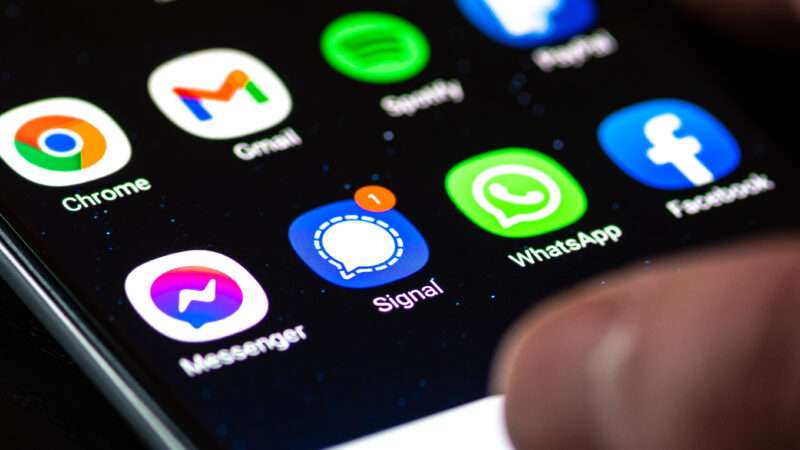
Someone holds a phone with Signal and WhatsApp | ID <a href="https://www.dreamstime.com/vilnius-lithuania-january-signal-app-cross-platform-encrypted-messaging-service-developed-signal-foundation-signal-image207308888">207308888</a> | <a href="https://www.dreamstime.com/photos-images/encrypted-messaging.html">Encrypted Messaging</a> ©  <a href="https://www.dreamstime.com/micheleursi_info">Michele Ursi</a> | <a href="https://www.dreamstime.com/stock-photos">Dreamstime.com</a>

As I write, European Union (E.U.) officials are debating the details of a proposal to either require or pressure tech companies to scan all private messages for child sexual abuse material. Dubbed “chat control,” the scheme inevitably entails mass surveillance of private communications—targeting one sort of content for the moment, though it’s difficult to see how that would long remain limited in any way. It’s an illustration of the continuing decline in online liberty documented in a new report from Freedom House.

No Right to Private Messages?

As the E.U.’s discussion over chat control heated up over the summer, Danish Minister of Justice Peter Hummelgaard, a proponent of surveillance, commented, “We must break with the totally erroneous perception that it is everyone’s civil liberty to communicate on encrypted messaging services.”

Since Hummelgaard’s Orwellian comments, which would have necessitated government backdoors into all encryption used by the public, the E.U. has backed off a bit from mandating such access. Current proposals would make private companies liable for the content of their customers’ communications, leaving them to choose how to mitigate their legal liability—with scanning messages a likely choice.

“Chat Control is not dead,” privacy activist and former member of the European Parliament Patrick Breyer commented, “it is just being privatized.”

More accurately, private companies are likely going to be jawboned—strong-armed—into doing the government’s dirty work. And there’s a lot of dirty government work to go around on today’s internet.

“Suppression of mass protests, deepening censorship, and threats to free speech fueled the 15th consecutive year of decline in global internet freedom,” the U.S.-based Freedom House notes in its report, Freedom on the Net 2025, released November 13.

It’s unsurprising that countries already recognized as authoritarian are continuing repressive practices. Nobody expects China or Iran to suddenly develop a taste for protecting online dissent and respecting privacy of communications. More disturbingly though, as seen in the European debate over chat control, nominally free countries are becoming increasingly intrusive when it comes to the digital world.

Online Authoritarianism in the ‘Free’ World

“In a concerning sign, half of the 18 countries with an internet freedom status of Free suffered score declines during the coverage period, while only two received improvements,” according to the report. “People in Georgia experienced the most significant decline among these countries, followed by Germany and the United States.”

Georgia made the list by forcing private organizations and media operations that receive foreign funding to register with the government. The government also imposed “criminal penalties of up to 45 days in prison for insulting public officials.”

As the report notes, Germany’s government has infamously “pursued criminal prosecutions against people who made memes about politicians, invoking laws against insult and hate speech.” Such censorship continues even after the replacement of the previous thin-skinned traffic light coalition of the Social Democratic Party (SDP), the Free Democratic Party (FDP), and the Greens by a grand coalition of the Christian Democratic Union (CDU), its ally the Christian Social Union (CSU), and the SDP.  That suggests there’s little appetite among the country’s political class for leaving people alone.

In the U.S., “the administration of President Donald Trump,” the report says, “detained several foreign nationals for one to two months after revoking their visas over nonviolent online expression” and that the government “threatened or carried out politicized investigations into civil society organizations and media and technology companies, often focusing on their content moderation, editorial decision-making, or forms of speech that are protected by the US Constitution’s First Amendment.” It should have also included the pressure brought by the previous Biden administration on social media companies to suppress criticism of administration policies and stories inconvenient to the powers that be.

Some countries did register improvements in online freedom. But “of the 72 countries assessed in Freedom on the Net 2025, conditions deteriorated in 28, while 17 countries registered overall gains.” And, as mentioned above, half of the countries ranked as “free” lost ground over the assessed period, while only two improved. Consequences for those targeted for suppression could be severe.

“People in at least 57 of the 72 countries covered by Freedom on the Net 2025 were arrested or imprisoned for online expression on social, political, or religious topics during the coverage period—a record high.”

Politicians Want to Regain Lost Control

It’s interesting to speculate on why government officials around the world seem so intent on suppressing online speech and monitoring digital communications, but the most likely explanation, to my mind, is the democratization of communications brought about by the internet. People can share ideas—good, bad, or flat-out nuts—with one another without the permission or assistance of governments or established media companies which long dominated mass communication.

“Whereas establishment institutions once exercised an informational monopoly, managing media and mainstream discourse to protect elite interests and perspectives, social media makes such narrative control impossible,” Dan Williams, an academic philosopher from the United Kingdom, wrote this week.

Williams builds on arguments advanced by former CIA analyst Martin Gurri, the author of The Revolt of the Public and the Crisis of Authority in the New Millennium (2014). Gurri believes “technology has categorically reversed the balance of power between the public and the elites who manage the great hierarchical institutions of the industrial age—government, political parties, and the media.”

Surveillance and censorship are ways to try to reassert that lost control. By monitoring people’s private communications and punishing them for their online statements, government officials, even in countries that once prided themselves on open debate, try to regain power over ideas expressed by the public and the esteem (or lack thereof) in which people regard officialdom.

That’s not going to happen. Politicians can’t regain status and respect by pushing for mass surveillance and muzzling their critics. They can erode norms around privacy and free speech to punish dissenters. But they undermine their own standing even as they lash out and further alienate the public.

The post The 'Free' World Is Coming for Your Private Messages appeared first on Reason.com.

from Latest – Reason.com https://ift.tt/YR6ICfw
via IFTTT

Our Obsession With Statistical Significance Is Ruining Science


A woman drinking tea with Guinness and a normal curve | Illustration: Eddie Marshall | Midjourney | Marilyn Gould | Dreamstime.com

A century ago, two oddly domestic puzzles helped set the rules for what modern science treats as “real”: a Guinness brewer charged with quality control and a British lady insisting she can taste whether milk or tea was poured first.

Those stories sound quaint, but the machinery they inspired now decides which findings get published, promoted, and believed—and which get waved away as “not significant.” Instead of recognizing the limitations of statistical significance, fields including economics and medicine ossified around it, with dire consequences for science. In the 21st century, an obsession with statistical significance led to overprescription of both antidepressant drugs and a headache remedy with lethal side effects. There was another path we could have taken.

Sir Ronald Fisher succeeded 100 years ago in making statistical significance central to scientific investigation. Some scientists have argued for decades that blindly following his approach has led the scientific method down the wrong path. Today, statistical significance has brought many branches of science to a crisis of false-positive findings and bias.

At the beginning of the 20th century, the young science of statistics was blooming. One of the key innovations at this time was small-sample statistics—a toolkit for working with data that contain only a small number of observations. That method was championed by the great data scientist William S. Gosset. His ideas were largely ignored in favor of Fisher’s, and our ability to reach accurate and useful conclusions from data was harmed. It’s time to revive Gosset’s approach to experimentation and estimation.

Fisher’s approach, “statistical significance,” is a simple method for drawing conclusions from data. Researchers gather data to test a hypothesis. They compute the p-value under the null hypothesis—that’s the probability of observing their data if the effect they are testing is absent. They compare that p-value to a cutoff, usually 0.05. If the p-value is below the cutoff—in other words, the data we observe are unlikely under the null hypothesis—then the effect is present.

Fisher pioneered many statistical tools still in use today. But writing in the early 20th century, when science was carried out with fountain pens and slide rules, he could not have anticipated how those tools would be misused in an era of big data and limitless computing power.

Fisher was able to attend Cambridge only by virtue of winning a scholarship in mathematics. In 1919 he was offered a job as a statistician at the Rothamsted Agricultural Experiment Station, the oldest scientific research farm in England. At Rothamsted, then at University College London and Cambridge, Fisher grew into an awesomely productive polymath. He invented p-values, significance testing, maximum likelihood estimation, analysis of variance, and even linkage analysis in genetics. The Simply Statistics blog estimates that if every paper that used a Fisherian tool cited him by 2012 he would have amassed over 6 million citations, making him the most influential scientist ever.

In 1925 Fisher published his first textbook, Statistical Methods for Research Workers, which defined the field of statistics for much of the 20th century. Before its publication, a researcher who wished to draw conclusions from data would make use of a large-sample formula such as the normal distribution. Discovered a hundred years earlier by Carl Friedrich Gauss, the normal distribution is the standard “bell curve” formula for an entire population of observations around a central mean. Fisher’s textbook provided tools to analyze more limited samples of data.

How Beer Led to a Breakthrough

The most important small-sample formula in Statistical Methods was discovered by a correspondent of Fisher’s, William Sealy Gosset, who studied mathematics and chemistry at Oxford. Instead of staying in academia, Gosset moved to Dublin to work for Guinness.

Guinness was expanding rapidly and shipping its product worldwide. By 1900 it was the largest beer maker in the world, producing over a million gallons of stout porter each year. At such scale, it no longer made sense to test each batch by taste and feel. Guinness set up an experimental lab within its giant brewery in St. James’s Gate, Dublin, to systematically improve quality and yield, and staffed it with talented young university graduates. Gosset and his colleagues were among the first industrial data scientists.

Gosset’s interest in small-sample statistics flowed from his everyday work. Beer takes three ingredients: yeast, hops, and grain. The grain in Guinness is malted barley. To prepare the barley, you steep it in water, allow it to germinate, and then dry and roast it, which malts the starch into sugar that the yeast can digest. The amount of sugar in a batch of malt affects the taste of the beer, its shelf life, and its alcohol content, and was measured at that time in “degrees saccharine.”

Guinness had established that 133 degrees saccharine per barrel was the ideal level, and was willing to tolerate a margin of error of 0.5 degrees on either side. The brewer could take spoonfuls from a barrel of malt, test each spoonful, then take the average. But how accurate would that average be—should he take five spoonfuls or 10? Gosset verified that small-sample estimates are more spread out than a normal distribution, because you might draw a spoonful that is unusually high or unusually low in sugar, and in a small sample such outliers will have outsize influence.

Gosset was unable to mathematically solve the distribution of a small sample. Impressively, he wrote out a formula based solely on his intuition. To check his work, Gosset made use of a set of physical measurements taken by the British police from 3,000 prisoners. He wrote each prisoner’s height and finger length on a card, then shuffled the cards and divided them into groups of four. The averages of the four-card samples had a distribution that matched closely with his formula.

That formula was immediately useful in his job of industrial quality control. Guinness now had an exact formula for the number of samples that would yield a desired level of accuracy. Guinness scientists were allowed to publish their work in academic journals on two conditions: The paper must not mention Guinness or any beer-related topics, and it must use a pseudonym. Under the name “Student”—he kept his laboratory notes in a notebook whose cover read “The Student’s Science Notebook”—Gosset published his small-sample formula in 1908.

The height of plants and prisoners, the degrees saccharine of a batch of malt, the test scores of college applicants, and many other real-world examples are approximately normally distributed. Thus, knowing the distribution of a small sample drawn from such a population would be useful in many areas of science. Ronald Fisher, then a Cambridge undergraduate, recognized the potential of Student’s distribution, and in 1912 he mathematically proved the formula that Gosset had guessed.

Gosset’s formula was a product of his work at Guinness. But the formal proof was all Fisher, as was the organization of Statistical Methods for Research Workers. One of the reasons Fisher’s textbook was so influential was an innovative feature: It included a set of statistical tables. The researcher could pick the distribution that corresponded to their data and look up the p-value in the corresponding table.

Gosset was unimpressed with this emphasis on p-values. In a 1937 letter, talking about a comparison of crop yields at different farm stations, he wrote that “the important thing in such is to have a low real error, not to have a ‘significant’ result at a particular station. The latter seems to me to be nearly valueless in itself.” Gosset was not interested in statistical significance, and he had no null hypothesis to test. His interest was in accurately measuring the yield. The economists Aaron Edlin and Michael Love call this philosophy “estimation culture.”

The Flaws in Fisher

In his 1936 textbook, The Design of Experiments, Fisher formally laid the foundation of significance testing. On page 6, Fisher describes an acquaintance, a British lady who claims that she can distinguish by taste whether the milk or the tea was poured first. Fisher is skeptical. He proposes having the lady drink eight cups of tea, four milk-first and four tea-first, in random order, and try to guess which was which. How, he asks, should we evaluate the data from this experiment?

Fisher advised calculating the probability of observing your data under the null hypothesis that the lady has no tea-tasting ability. If she is picking at random, she might get all eight cups of tea correct by chance, but the probability of that happening is one in 72—a p-value of 0.014. Fisher then proposes that a p-value under 5 percent is “statistically significant,” while a p-value greater than 5 percent is not.

The Fisherian approach flows from the specifics of the tea-tasting example. The binary, yes-or-no approach arises because the fundamental question is “Does the lady have tea-tasting ability, or does she not?” We are not trying to estimate how much tea-tasting ability she has. This feature of the tea-tasting experiment—the binary yes-or-no question—is critical to the Fisherian approach. Without it, statistical significance is unhelpful at best, actively misleading at worst.

The original sin of statistical significance is that it sets up an artificial yes-or-no dichotomy in how we learn from data. Fisher himself would agree that his 0.05 threshold for significance is arbitrary. But this arbitrary cutoff leads us to discard useful information. Imagine you run an expensive randomized trial of a new drug and find that it miraculously cures patients of pancreatic cancer—but only in a few rare cases, so that p = 0.06 and the result is statistically insignificant. Hopefully, we would not toss the project. Put differently, experiments do not exist merely to test the null hypothesis. Their purpose is to advance human knowledge, such as finding cancer cures.

Many important scientific experiments are completely outside of the Fisherian statistical significance model. For one sterling example, 16 years before the publication of The Design of Experiments, Robert Millikan and his graduate student, Harvey Fletcher, performed their oil-drop experiment at the University of Chicago. Millikan and Fletcher set up a mechanism that sprayed droplets of oil past an X-ray tube and then between two metal plates wired with an electric current.

As the droplets passed the X-ray tube, they became ionized—that is, they absorbed one or more extra electrons and gained a negative charge. By gently varying the voltage between the metal plates, Millikan and Fletcher could see when the oil drops floated in midair, precisely balancing the electrical force with the pull of gravity. That level of electrical current, plus the weight of the average oil drop, let them estimate the charge of the electron.

The oil-drop experiment was such a tour de force that Millikan received the Nobel Prize in physics just 14 years later, in 1923—two years before the publication of The Design of Experiments. But what null hypothesis were they testing? Nobody thought that the charge of an electron might be zero. Instead, the oil-drop experiment is a towering example of estimation culture: an experiment to measure the world we live in.

How Statistical Significance Causes Publication Bias

Significance culture versus estimation culture might seem like a minor technical debate. If you’re not a tenure-track academic, you may find it hard to believe how much one’s career depends on getting “significant” publishable results. In my own field of economics, Isaiah Andrews and Maximilian Kasy estimated that a statistically significant result is 30 times more likely to be published than a nonsignificant result. In the prestigious American Economic Review in 1983, the economist Ed Leamer wrote, “This is a sad and decidedly unscientific state of affairs…hardly anyone takes anyone else’s data analysis seriously. Like elaborately plumed birds who have long since lost the ability to procreate but not the desire, we preen and strut and display our [p]-values.”

We might imagine that medical studies are held to a higher standard. But in a 2008 study in the New England Journal of Medicine, researchers gathered data from 74 preregistered studies of antidepressant medications. Of the 38 studies that found a statistically and medically positive result, 37 were ultimately published. Of the 36 that found negative or insignificant results, 33 were either not published or published in a way the researchers considered misleading.

If a doctor relied on the published literature, then, they would see 94 percent of studies yielding a positive outcome. In reality, only 51 percent of studies found a positive outcome—no better than a coin flip.

Individual findings are also distorted by significance culture. Vioxx is a nonsteroidal anti-inflammatory drug (or NSAID) similar to aspirin. In the year 2000, a clinical trial funded by its producer—the pharmaceutical firm Merck—reported that the difference between the treated and control groups in the rate of cardiac complications “did not reach statistical significance.”

But heart issues were quite rare in their patient population. One patient out of 2,772 in the control group had cardiac complications. In the treated group, five patients out of 2,785 had cardiac complications. The risk of the deadly side effect was five times higher among treated patients. But because one and five out of 2,800 are both very low numbers, the p-value of the difference is above 0.05. As a result, it was reported and marketed as having no significant difference.

Less than a year later, Merck pulled Vioxx from the market; follow-up studies had found the NSAID led to an increased risk of heart attack and stroke. In the meantime, millions of prescriptions were handed out.

Statistical significance had a doubly malign effect on the Vioxx study. First, it caused the researchers, editors, and reviewers to ignore the higher rate of cardiac complications because the difference was not statistically significant. Second, and more insidiously, statistical significance meant that they did not think about the relative costs and benefits. We already have aspirin, Tylenol, Advil, and other NSAID drugs, so the contribution to human well-being of Vioxx’s ability to alleviate aches and pains was always going to be modest. By contrast, an increase in the risk of cardiac complications is deadly serious. But statistical significance does not consider the importance of the outcome; all that matters is the p-value.

The false-positive problem is getting worse, not better, in the world of big data. As we run more and more studies, we sieve down to smaller and less important effects. At the same time, we increase our sample sizes and run more and more significance tests. As a result, the flood of nonsense findings is rising over time—as predicted in a 2005 PLoS Medicine article by John Ioannidis titled “Why Most Published Research Findings Are False.”

Can “Estimation Culture” Improve Practical Science?

Gosset disliked statistical significance. He was interested in estimating useful quantities in the real world, quantifying his confidence around that estimate, and adding up the costs and benefits involved. His 1908 Biometrika paper on the small-sample formula states that “any series of experiments is only of value in so far as it enables us to form a judgment as to the statistical constants of the population.” That’s estimation culture.

Could we shift the norms and practices of entire fields (social science and medicine, for starters) toward estimation culture? More than 100 years later, we can still look to industry for inspiration. In recent years, there’s been a flood of quantitative researchers into software and marketing jobs analyzing the oceans of data collected by companies such as Google and Microsoft.

A 2025 Information Research Studies paper examined over 16,000 statistical tests run by e-commerce data scientists. The researchers found no evidence of p-hacking or selective publication. Unlike academics, data scientists in industry don’t need to publish or perish, so they have no incentive to distort their findings; they are paid for accuracy. Just like their forebear at the Guinness brewery, they naturally cleave to estimation culture.

Academics and journalists should do likewise. Start with the estimate itself and our confidence in that estimate. Put the number in context, evaluate its relevance and plausibility, and try to add up the potential costs and benefits on each side. Finally, recognize that the scientific record in many fields presents a severely distorted picture. When reading the academic literature—to say nothing of the media coverage—keep in mind that we see all the positive and significant findings, and far fewer of the negative or insignificant findings.

There is a better way, and it was there in the Guinness brewery with William Gosset 100 years ago. It starts with dethroning statistical significance, moving away from all-or-none frequentist thinking and toward estimation culture.

The post Our Obsession With Statistical Significance Is Ruining Science appeared first on Reason.com.

from Latest – Reason.com https://ift.tt/4XifhMD
via IFTTT

The Impossible Two Percent: Why Central Banks Cannot Afford Price Stability

The Impossible Two Percent: Why Central Banks Cannot Afford Price Stability

Authored by Hamoon Soleimani via The Mises Institute,

The Two percent inflation target—monetary policy’s sacred commandment for three decades—has become structurally impossible to achieve. Not because central bankers lack skill, but because every attempt to hit the target destroys the financial architecture that previous monetary expansion built. This is the endgame of central planning: a system that cannot tolerate its own success criteria without collapsing.

The Arbitrary Anchor

New Zealand invented the two percent target in 1989 by looking backward at what inflation had been when things felt stable—hardly rigorous science. Other central banks copied this guess, transforming it into dogma. But the economy of 2025 bears no resemblance to 1989. We’ve financialized every asset class, built supply chains optimized for fragility, and erected a debt tower requiring perpetual refinancing at suppressed rates just to avoid collapse. The two percent target was designed for a world we’ve already destroyed.

The Cantillon Trap: Winners and Losers by Design

Monetary expansion doesn’t spread evenly. New money concentrates where it enters—in financial assets, real estate, and the balance sheets of those with credit access. This creates two economies: one for asset-holders, enriched by expansion; another for wage-earners, crushed by the cost increases that follow.

To hit 2 percent consumer inflation, central banks must restrict money supply enough to destroy demand among ordinary households—the people furthest from the monetary spigot. But they’ve already inflated assets to the point where millions of families, pension funds, and governments depend on continued expansion to stay solvent. Tightening enough to hit 2 percent CPI means liquidating the phantom wealth propping up the entire system. We glimpsed this in 2022-2023: modest rate increases triggered bank failures and sovereign debt crises.

The trap is complete: monetary expansion enriches the few while punishing the many, but contraction would bankrupt both.

The Measurement Mirage

The CPI doesn’t measure what people experience. Housing costs appear through “owner’s equivalent rent”—a fiction understating reality by a significant amount. Healthcare, education, childcare—costs that have doubled or tripled—receive minimal weight. Meanwhile, falling electronics and import prices pull the average down.

A family whose rent has doubled, childcare tripled, and healthcare quadrupled is told inflation is “only” three percent. Central banks fight to hit a target disconnected from lived reality, using tools that damage those already most hurt by mismeasured inflation.

The Sovereign Debt Vise

The United States now carries $38.12 trillion in debt, with deficits locked in structural overdrive. For fiscal year 2025 (ending September 30, 2025), the federal budget deficit totaled approximately $1.8 trillion—marking one of the largest annual deficits in US history in nominal terms. In calendar year 2025 alone (through November), the debt has already climbed by over $1 trillion, representing one of the fastest accumulations outside of pandemic-era spikes.

The Fed cannot pursue “price stability” without triggering sovereign default. It cannot monetize the debt without abandoning its inflation target. Monetary and fiscal policy have fused into a single system where every path leads to ruin.

The Trump Tariff Dividend: Fiscal Lunacy as Stimulus

Trump’s proposed $2,000 “tariff dividend” crystallizes the absurdity. Tariffs might generate $300-400 billion annually. Distributing $2,000 to 150 million Americans costs $300 billion, consuming all revenue and leaving nothing for Trump’s simultaneous promise to “substantially pay down national debt.”

But fiscal arithmetic is merely the surface problem. This is stimulus injected into an economy already overheating from tariff-induced price increases. Tariffs function as a regressive consumption tax, raising prices across the board. What is the proposed solution? Send everyone cash, which immediately bids prices higher in a textbook demand-pull spiral. We learned this during the pandemic: stimulus checks fueled the inflation that hit 9 percent.

The circularity is perfect: American consumers pay the tariffs, raising prices. The government sends that revenue back, and consumers use it to pay higher tariff prices. It’s a perpetual motion machine of economic waste. Tariffs misallocate capital by making inefficient domestic production appear profitable, while dividends provide purchasing power divorced from productive activity. We’re restricting supply through tariffs while boosting demand through dividends—engineering an inflationary explosion while calling it economic nationalism.

The QT Surrender: Why the Fed Can’t Stop Printing

The Federal Reserve announced in October 2025 that quantitative tightening will end in December after reducing its balance sheet from $9 trillion to $6.6 trillion. This isn’t a policy choice—it’s mathematical surrender.

The Fed’s balance sheet remains bloated with low-yielding assets from QE rounds dating to 2008, earning two-three percent while the Fed pays 4.5 percent on reserves it created to buy them. The Fed operated at a loss for three consecutive years.

But the Fed cannot shrink its balance sheet to pre-crisis levels without triggering a liquidity crisis. The modern financial system operates under an “ample reserves framework”—a euphemism for permanent monetary expansion. Banks, pension funds, and Treasury markets have become structurally dependent on massive reserve creation. When the Fed attempted modest QT reductions, repo markets showed stress. They’re stopping, not because inflation is conquered, but because the financial system cannot handle genuine monetary normalization.

The QT cessation sets the stage for QE’s inevitable return. The Fed is now in what Austrian economists call the “crack-up boom” phase—the point where monetary authorities choose between deflation (and cascading debt defaults) or continued inflation (and currency destruction). The QT cessation signals their choice.

The Perfect Storm

The Fed needs tight policy to combat inflation—inflation partly driven by tariffs Trump defends as revenue generators. But tightening is impossible because government debt service already consumes $1 trillion annually and the financial system requires ongoing liquidity support. So the Fed will maintain its swollen balance sheet, ready to expand again at the first crisis signal, while Trump pumps fiscal stimulus through tariff dividends into the economy.

The 2 percent inflation target becomes farcical. How can the Fed hit an inflation target when fiscal policy is overtly inflationary, when monetary policy cannot genuinely tighten without breaking the system, and when political pressure tilts entirely toward more spending? The Fed’s QT announcement is an admission they’ve lost control, even if they won’t admit it.

Policy Checkmate—The Impossible Choice

High inflation destroys savings, distorts price signals, and creates social instability. But we must be honest: the 2 percent target cannot be achieved without either.

The options seem to be: 1) a deflationary depression that liquidates the debt overhang—and likely the social order with it; 2) a financial repression that slowly confiscates wealth through negative real rates; or, 3) a restructuring of how we conceptualize monetary stability in a hyper-financialized economy.

The first option is politically impossible and humanly catastrophic. The second is what we’re already doing, just with more dishonesty. The third requires admitting central banking as currently practiced has failed.

The Austrian Vindication

Precision inflation targeting was always hubris—imposing mechanical control over an organic, complex system. The error wasn’t choosing two percent specifically; it was believing any centrally-planned monetary system could generate sustainable prosperity while coupled with fiscal incontinence.

We’ve created a monetary system that cannot tolerate the price discovery necessary for genuine economic coordination. Every attempt to hit an arbitrary inflation target generates distortions making the next cycle more severe. The Fed’s balance sheet cannot shrink because the economy was restructured around permanent monetary expansion. Interest rates cannot normalize because the debt burden makes higher rates catastrophic.

The 2 percent target isn’t failing because central bankers lack competence—it’s failing because it represents an impossible constraint on a system that has already inflated beyond the point of return.

The Endgame

The question isn’t whether we’ll abandon the two percent target. The Fed’s QT cessation and Trump’s tariff dividend have already abandoned it in practice, whatever they claim in theory. The real question is whether we’ll do so explicitly, through honest debate about what comes after central banking’s failure, or implicitly, through the slow-motion credibility crisis we’re witnessing—where inflation stays persistently above target, the Fed’s balance sheet can never shrink, and fiscal policy becomes increasingly untethered from reality.

This is the endgame of monetary central planning: not with hyperinflationary bang or deflationary whimper, but with the confused stumbling of policymakers who cannot admit their tools have welded them into a cage. The two percent target, tariff dividends, ample reserves frameworks, and technocratic jargon cannot obscure the simple truth: we have built an economic system requiring perpetual monetary expansion to avoid collapse, and we’ve run out of ways to pretend this is sustainable policy rather than slow-motion currency debasement with extra steps.

Tyler Durden
Mon, 12/01/2025 – 08:05

via ZeroHedge News https://ift.tt/ugIFBaX Tyler Durden

Black Friday Turnout Solid: Goldman, UBS Highlight Decent Start To Holiday Spending Season

Black Friday Turnout Solid: Goldman, UBS Highlight Decent Start To Holiday Spending Season

Heading into Black Friday and Cyber Monday, there were mounting concerns about consumers, especially lower-tier ones – a cohort we’ve repeatedly warned as facing tough times. But early shopping data from this past weekend from Goldman and UBS suggest that, in aggregate, consumers held up better than feared

Goldman’s top sector specialist, Scott Feiler, penned a note to clients earlier that “U.S. consumer does continue to show up for events, this Black Friday included. After all, Adobe did say Friday and Saturday both came in above their forecasts.”

Feiler cited high-frequency data from Mastercard SpendingPulse, Adobe Analytics, Salesforce, and internal sources, all of which indicated a strong weekend. These are numbers that President Trump’s economic team will likely highlight this week as economic proof that consumers are holding up late in the year.

Here’s a snapshot of those data points:

Mastercard SpendingPulse

  • Retail sales (ex. auto) increased +4.1% y/y on Black Friday. 

  • Last year, Mastercard said Black Friday sales were +3.4% Y/Y.

  • The breakdown of this year’s +4.1%v was in-store sales +1.7%, while online sales were +10.4%

  • It’s 1 day only, but that +4.1% was compares to Mastercard’s holiday prediction of +3.6%. They noted strength in apparel (+5.7%) and jewelry (2.3%).

Adobe Analytics

  • Online sales grew +9.1% YoY, slightly below last year’s +10.2%, but both Thanksgiving and Black Friday exceeded initial forecasts.

Salesforce

  • Global online spend hit $79B (+6%), with U.S. online at $18B (+3%). Gains were price-driven, with unit volumes down YoY.

Goldman Sachs Store Checks:

  • The GS Research team published takes this morning from their weekend store visits . They noted overall traffic at “traditional” Black Friday weekend destinations were in line to slightly better than last year. There were certain retailers where traffic was a little stronger than average like TGT, ULTA, ASO and at the mall at BBWI, Garage (GRGD) and Victoria’s Secret (VSCO). They think toys, kids apparel, beauty and footwear were the areas within stores with the most traffic, while home goods traffic was lighter.

  • Store traffic remains muted vs online.

Sensormatic

  • Said physical retailer traffic dropped 2.1% y/y on Black Friday, compares to the 2025 average of -2.2%.

RetailNext

  • Said Friday/Saturday traffic was -5.3% Y/Y. Friday was much stronger than Saturday. Would note most regions were consistent, but the negative Saturday data looks wonky, skewed by an outlier read in the Midwest. The total conclusion though is in store traffic remains soft, compares to online.

In a separate note, Goldman analyst Natasha de la Grense said that Black Friday data came in slightly better than expected

De La Grense noted, “Black Friday, Aspirational Luxury and the return of “boom boom.” 

Here are her top observations from the weekend:

  • Reassuring start to Holiday trading in the U.S., with Black Friday data coming in slightly better than feared, following last week’s disappointing confidence print. In summary, retail sales growth was in line with NRF’s forecast for the season as a whole, with discount levels that were very similar to last year.

  • Lots of focus recently on the “K-shape” economy, with commentators observing that the top income earners are increasingly holding up discretionary spending in the U.S. While we do think this cohort is outperforming (driven by equity market wealth creation which accrues more to higher-income households), the very top of the income pyramid participates less in discount shopping events. Therefore, Black Friday is a good first check on gifting trends and mass-market spending ahead of holiday. By many accounts, retailers were pleased with their level of business – WWD cites a broad number of players confirming this.

  • By category, it sounds like apparel did well (benefiting from cold weather), while jewellery remains strong and we are continuing to see signs of life in the handbag category. I still think that aspirational spending is recovering in the U.S. – that was a theme emerging from Q3 earnings season and seems to have continued into Q4 based on 1) November guidance raises at Ralph Lauren, Tapestry and The RealReal; 2) qualitative commentary over Black Friday weekend. Note that a number of retailers have called out younger cohorts showing up to spend on Black Friday – consistent with Deloitte’s survey heading into the event.

  • Our preferred sub-sector within Consumer Discretionary right now remains Luxury Goods. While Black Friday isn’t a perfect read for this sector (given the cohort behaviour mentioned above), there’s enough data suggesting that high end spending is improving QTD in the U.S. Outside of the U.S., China luxury is also recovering (off a low base) – the high frequency data here is a bit mixed as handbag imports through October were not as good as Q3 (although with the caveat that the 2-year comp is very tough). However, jewellery/cosmetics sales in China have been strong, Macau GGR just beat expectations meaningfully (+14% YoY this morning and reaching the highest recovery level vs pre-pandemic since reopening) and micro feedback/channel checks are good.

UBS analyst Michael Lasser struck a similar tone to Goldman, pointing to the same data and noting that “spending has been decent, but the shape of the season has yet to be determined.”

Here’s from Lasser:

Overall, the data points to steady demand during the key holiday weekend for retailers. Though, it is still quite early. Plus, we suspect that there will be steep drop off following Cyber Monday as consumers have tended to concentrate their spending around key events. This has been the pattern for some time. Importantly, there’s still a good amount of time remaining. For many retailers, we think December can account for 40% to 45% of the fourth quarter. Thus, we think it’s best to reserve judgement on the overall result of the holiday season for the next few weeks.

However, the analyst said it’s still too early to draw conclusions about the overall shopping season. He noted several important considerations to keep in mind as the Christmas shopping period quickly approaches:

  • Consumers are likely prioritizing essentials and seeking discounts this year as inflation continues to weigh on budgets. This favors retailers like Walmart and Costco who are perceived to be pricing aggressively.

  • We believe retailers have been more aggressive with promotions to drive sales. Best Buy and Dick’s Sporting Goods suggested last week that promotions were higher this year than in the past. Yet, we think that many retailers are finding ways to mitigate the impact to their profits. This is from areas like improving shrink, generating growth in retail media, and driving increases in third party marketplaces.

  • The adoption and influence of Artificial Intelligence is in its early stages, but is having a growing impact. Data from Adobe shows that the use of this technology is up significantly YoY. This follows recent announcements from retailers like Walmart and Target, which are partnering with OpenAI in various ways. We suspect that with each passing day, the effect that this technology is going to have on the retail sector is going to significantly grow. This will favor the larger, well-positioned retailers, in our view.

While the consumer in aggregate is still holding up, the split (read report) between lower-income shoppers and higher-income households has increasingly widened. Trump’s “Operation Affordability” initiative is framed as an effort to reverse the Biden-era inflation that has squeezed the working poor and younger Americans.

Tyler Durden
Mon, 12/01/2025 – 07:45

via ZeroHedge News https://ift.tt/y2WpnBD Tyler Durden