Key Events This Busy Week: ISM Mfg and Services, ADP, Core PCE And More

Key Events This Busy Week: ISM Mfg and Services, ADP, Core PCE And More

As noted earlier, Asia kickstarted December in a weak mood with Bitcoin down another -6% this morning and Nasdaq and S&P 500 futures both notably lower. 10yr US Treasuries are +3bps and 10yr JGBs are +6.7bps as Ueda said at a speech this morning “At the Monetary Policy Meeting (MPM), the Bank will examine and discuss economic activity and prices at home and abroad as well as developments in financial and capital markets, including the point I just mentioned, based on various data and information, and will consider the pros and cons of raising the policy interest rate and make decisions as appropriate.”

DB’s Japanese economist believes this strongly suggests an interest rate hike at the December meeting and has pushed forward his view of a hike from January to the meeting later this month, the Friday before Christmas. Market pricing has increased from a probability of just under 60% to 83%. This story brings shades of the 2022 meeting just before Xmas when the BoJ lifted its cap on 10yr JGBs from 0.25% to 0.5%. That saw the market spooked a little. The Yen has risen by +0.39% and the Nikkei is -2.04% lower this morning with 2yr yields +5bps, surpassing the 1% threshold and reaching their highest point since June 2008. 

This coming week will allow forecasters to also fine-tune their Fed views ahead of that. There is plenty of data to get through, both shutdown-delayed and routine. Globally, we have European CPI tomorrow and PPI on Wednesday, following German and French CPI prints today. Various global PMIs are also out today, and we also have Cyber Monday, which follows what seems to have been a decent Black Friday weekend. As an example, Mastercard’s SpendingPulse index was up +4.1% on Friday, up from 3.4% last year. Newsflow continues to bubble up around peace negotiations for the war in Ukraine, so that’s one to watch as well.

Focusing in on the US, the Federal Reserve is firmly in its pre-meeting communications blackout ahead of the 10 December FOMC decision, leaving economic releases to do the talking. Markets have already priced an 80% chance of a 25bp cut next week, and this week’s data will help shape that view as well as expectations for 2026.

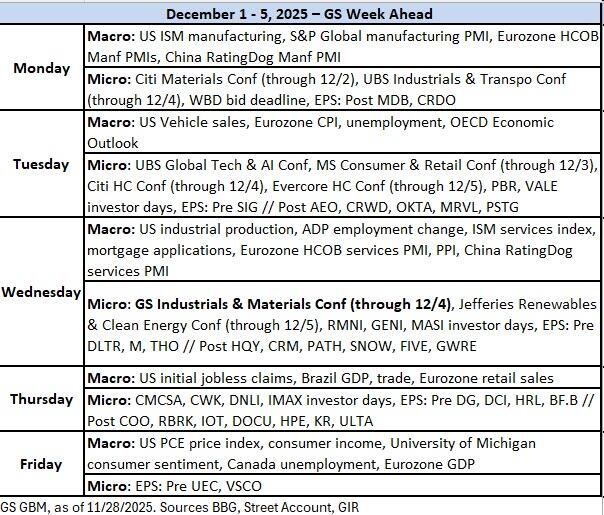
The US calendar begins today with the ISM Manufacturing Index, expected to hold near recent averages at 48.5, signalling continued softness in factory activity. Tomorrow brings unit motor vehicle sales, forecast at 15.8 million units, a modest improvement from October. Wednesday is the busiest day, featuring the ADP employment report, expected to show a gain of 50,000 jobs versus 42,000 previously. This report will take on added significance as it will be the most up-to-date labor market data available to Fed officials before they meet. Also due Wednesday are industrial production, likely to rise 0.1% after a slight decline last month, and the ISM Services Index, projected at 51.8, close to its two-year trend. On Thursday, factory orders should show a 0.5% increase, pointing to resilient capital spending. Friday rounds out the week with the delayed September personal income and consumption report, and within it, the more important core PCE. This is expected to hold at 0.23% month-on-month, keeping the annual rate near 2.9%, a tenth above what the Fed was tracking when they only had CPI to use. The preliminary University of Michigan consumer sentiment survey is also anticipated to edge up to 54.0 from 51.0. While sentiment remains depressed—its 24-month average is comparable to Great Recession levels according to our economists—real GDP growth of 2.6% annualized over the past eight quarters and inflation-adjusted consumer spending growth of 2.8% underscore the economy’s resilience. Note that the combined September and October JOLTS report has been rescheduled for 9 December, while October and November payrolls and unemployment data will not arrive until 16 December, well after the FOMC meeting.
Across Europe, inflation will dominate the agenda. Country-level CPI prints for Germany and France set the tone today, followed by the Eurozone flash CPI for November tomorrow. Switzerland reports inflation figures on Wednesday, and Sweden follows on Thursday. These data points will be closely watched for confirmation that disinflation trends remain intact across the continent.

In Asia, the focus turns to manufacturing and policy signals. Most of China’s PMI data came out yesterday and this morning, but we still have the private-sector services PMI on Wednesday.

Geopolitical developments will also feature prominently. US and Ukrainian delegates met in Florida yesterday without any incremental headlines of note. The US’s main negotiator Witkoff is expected to travel to Moscow today and likely meet Putin tomorrow. EU defence ministers meet today on the same topic, followed by NATO foreign affairs ministers on Wednesday for further strategic discussions. French President Macron undertakes a state visit to China from Wednesday to Friday, underscoring diplomatic engagement in Asia.

Courtesy of DB, here is a day-by-day calendar of events

Monday December 1

  • Data: US November ISM index, China manufacturing PMI, UK October net consumer credit, M4, Japan November monetary base, Italy November manufacturing PMI, budget balance, new car registrations, Canada November manufacturing PMI
  • Central banks: BoJ’s Ueda speaks, ECB’s Nagel speaks, BoE’s Dhingra speaks
  • Other: EU foreign affairs council (defence)

Tuesday December 2

  • Data: US November total vehicle sales, Japan November consumer confidence index, France October budget balance, Italy October unemployment rate, PPI, Eurozone November CPI, October unemployment rate
  • Central banks: Fed’s Powell and Bowman speak, ECB’s Dolenc speaks
  • Earnings: Crowdstrike, Marvell
  • Other: OECD economic outlook

Wednesday December 3

  • Data: US November ISM services, ADP report, September industrial production, import price index, export price index, capacity utilisation, China services PMI, UK November official reserves changes, Italy November services PMI, Eurozone October PPI, Canada Q3 labor productivity, Australia Q3 GDP, Switzerland November CPI
  • Central banks: ECB’s Lagarde and Lane speak, BoE’s Mann speaks
  • Earnings: Salesforce, Snowflake, Inditex, Macy’s, Dollar Tree, Royal Bank of Canada
  • Other: NATO foreign affairs ministers meeting

Thursday December 4

  1. Data: US initial jobless claims, UK November new car registrations, construction PMI, Japan October household spending, Germany November construction PMI, Eurozone October retail sales, Sweden November CPI
  2. Central banks: Fed’s Bowman speaks, ECB’s Kocher, Cipollone and Lane speak, BoE’s Mann speaks, BoE’s DMP survey
  3. Earnings: Kroger, Dollar General, HPE

Friday December 5

  • Data: US September PCE, personal income, personal spending, December University of Michigan survey, October consumer credit, Japan October leading index, coincident index, Germany October factory orders, France October trade balance, current account balance, industrial production, Italy October retail sales, Canada November labour force survey
  • Central banks: ECB’s Lane speaks

Finally, looking at just the US, Goldman writes that the key economic data releases this week are the ISM manufacturing and services indexes on Monday and Wednesday and core PCE inflation and the University of Michigan report on Friday. There are no speaking engagements by Fed officials this week, reflecting the FOMC’s blackout period.

Monday, December 1 

  • 09:45 AM S&P Global US manufacturing PMI, November final (consensus 51.9, last 51.9)
  • 10:00 AM ISM manufacturing index, November (GS 49.0, consensus 49.0, last 48.7): We estimate that the ISM manufacturing index rebounded 0.3pt to 49.0 in November, reflecting slight improvement in our manufacturing survey tracker (+0.1pt to 51.6).

Tuesday, December 2 

  • 05:00 PM Lightweight motor vehicle sales, November (GS 15.4mn, consensus 15.5mn, last 15.3mn)

Wednesday, December 3 

  • 08:15 AM ADP employment change, November (GS -20k, consensus +10k, last +42k)
  • 08:30 AM Import price index, September (consensus +0.1%, last +0.3%)
  • 09:15 AM Industrial production, September (GS flat, consensus +0.1%, last -0.1%): Manufacturing production, September (GS flat, consensus +0.1%, last +0.1%); Capacity utilization, September (GS 75.8%, consensus 77.3%, last 75.8%): We estimate that industrial production was unchanged in September, as declines in auto manufacturing and natural gas production were offset by increases in non-auto manufacturing and electricity, oil and gas production. We estimate capacity utilization was unchanged at 75.8%, following the recent downward adjustment implied by the annual revision to the industrial production index. 
  • 09:45 AM S&P Global US services PMI, November final (consensus 55.0, last 55.0)
  • 10:00 AM ISM services index, November (GS 52.5, consensus 52.0, last 52.4): We estimate that the ISM services index increased 0.1pt to 52.5 in November, reflecting sequential improvement in our non-manufacturing survey tracker (+0.6pt to 53.1).

Thursday, December 4 

08:30 AM Initial jobless claims, week ended November 29 (GS 215k, consensus 222k, last 216k): Continuing jobless claims, week ended November 22 (consensus 1,956k, last 1,960k)

Friday, December 5 

  • 10:00 AM Personal income, September (GS +0.3%, consensus +0.4%, last +0.4%); Personal spending, September (GS +0.2%, consensus +0.3%, last +0.6%); Core PCE price index, September (GS +0.22%, consensus +0.2%, last +0.2%); Core PCE price index (YoY), September (GS +2.85%, consensus +2.8%, last +2.9%); PCE price index, September (GS +0.29%, consensus +0.3%, last +0.3%); PCE price index (YoY), September (GS +2.81%, consensus +2.8%, last +2.7%): We estimate that personal income and personal spending increased by 0.3% and 0.2%, respectively, in September. We estimate that the core PCE price index rose 0.22% in September, corresponding to a year-over-year rate of +2.85%. Additionally, we expect that the headline PCE price index increased 0.29% in September, corresponding to a year-over-year rate of +2.81%. We estimate that market-based core PCE rose 0.23% in September.
  • 10:00 AM University of Michigan consumer sentiment, December preliminary (GS 52.5, consensus 52.0, last 51.0): University of Michigan 5-10-year inflation expectations, December preliminary (GS 3.3%, last 3.4%)

Source: DB, Goldman

Tyler Durden
Mon, 12/01/2025 – 09:40

via ZeroHedge News https://ift.tt/nzy3aXp Tyler Durden

Solicitor General Briefs Now Include An “Introduction” Section

On the Monday after Thanksgiving, the New York Times published a lengthy article about turnover and partisanship in the Solicitor General’s Office. Yet, there is very little new information. In April, the Washington Post reported on departures from OSG after Trump took office, and that there were now two principal deputies. The Times adds that the Office brought on several new deputies who (gasp!) clerked for Justices Kavanaugh and Barrett. But in the end, there is not even a hint that there is dissension within the office.

So far, people familiar with the office said the turnover had not affected morale; Mr. Kneedler and other recently departed attorneys returned for a recent happy hour with their former colleagues.

In 2024, I wrote about how there was some dissatisfaction with how Solicitor General Elizabeth Prelogar was taking more than her fair share of oral arguments. There were also departures. But Prelogar was praised with glamor shots.

So what do we learn from the Times? Michael Luttig is unhappy with his two former clerks, John Sauer and Hash Mooppan. Should we be surprised?

I think the biggest takeaway here is that a conservative Solicitor General is managing an office geared to a conservative Supreme Court, and he is strategically picking and choosing the cases that will lead to victories. Lisa Blatt’s quote is on point:

Even critics of the president admit the office has an impressive record.

“It’s like an 18-wheeler truck,” said Lisa Blatt, a veteran of the Supreme Court bar and a partner at Williams & Connolly who has been critical of President Trump. “They’re crushing it.”

There was one useful piece of new information: introductions.

For years, it has bothered me that SG briefs lacked an introduction. Whenever I pick up a Supreme Court brief, I will immediately skim the intro to get a sense of what the argument is. If I am in a real hurry, I will scan the Table of Contents, as a good outline provide a short roadmap of the arguments. But the SG briefs never had introductions or descriptive table of contents. At some point this year, the practice changed. The New York Times has details:

For the first time in modern memory, the office’s merits briefs, the legal filings it makes before the justices hear a case, begin with an “introduction,” a section often filled with unusually charged language, including direct quotes from Mr. Trump. . . .

The new “introduction” section of briefs has been another point of contention. Government filings have typically begun with the legal argument, but now they open with a summary, often using punchy language. Ms. Baldassarre, the Justice Department spokeswoman, said the introductions offer a preview of the government’s argument for the justices and make it more accessible for a general audience.

I, for one, welcome this change.

Now if the SG would only stop using Courier font for emergency applications. It is ghastly.

The post Solicitor General Briefs Now Include An "Introduction" Section appeared first on Reason.com.

from Latest – Reason.com https://ift.tt/vmVbi5E
via IFTTT

Third Circuit Affirms Disqualification of Alina Habba

This morning the U.S. Court of Appeals for the Third Circuit affirmed the district court decision disqualifying Alina Habba from acting as the U.S. Attorney for the District of New Jersey.

This is the first appellate decision weighing in on the Trump Administration’s efforts to bypass the traditional route for appointing U.S. Attorneys in districts for which it has been unable to secure its preferred nominee’s confirmation. It also comes on the heels of the Eleventh Circuit’s decision affirming sanctions against Habba.

Senior Judge Fisher wrote for the panel in United States v. Giraud, joined by Senior Judge Smith and Judge Restrepo. (For those who care about such things, both Fisher and Smith were appointed by President George W. Bush, and Restrepo was appointed by President Obama.)

Judge Fisher’s opinion begins:

The United States Attorneys’ offices are some of the most critical agencies in the Federal Government. They play an important role in the criminal and civil justice systems and are vital in keeping our communities safe. The U.S. Attorney leading each office is an officer whose appointment requires Senate confirmation. Where a vacancy exists, Congress has shown a strong preference that an acting officer be someone with a breadth of experience to properly lead the office. It is apparent that the current administration has been frustrated by some of the legal and political barriers to getting its appointees in place. Its efforts to elevate its preferred candidate for U.S. Attorney for the District of New Jersey, Alina Habba, to the role of Acting U.S. Attorney demonstrate the difficulties it has facedyet the citizens of New Jersey and the loyal employees in the U.S. Attorney’s Office deserve some clarity and stability.

Congress has crafted various means through which agency authority is exercised absent a Senateconfirmed officer. When a presidentially appointed and Senateconfirmed officer resigns, the generally applicable Federal Vacancies Reform Act (FVRA) authorizes certain people to perform that officer’s duties in an acting capacity subject to time limitations. In addition to the FVRA, other statutes expressly authorize the President, a court, or the head of an agency to designate someone to perform the duties of specified offices in an acting or interim capacity. Parallel to these grants of acting or interim authority, many statutes grant agency heads broad authority to delegate their own duties to other employees of their agencies.

These cases require us to consider the intersection of these various statutes to determine whether Habba is lawfully acting as U.S. Attorney for the District of New Jersey under the FVRA or has been lawfully delegated the full scope of powers of an Acting U.S. Attorney. The defendants in two criminal cases moved to dismiss their indictments and to disqualify Habba from participating in their prosecutions, arguing that she is unlawfully serving as Acting U.S. Attorney. The District Court denied the motions to dismiss, but it granted the motions to disqualify Habba from the prosecutions. The Government appeals. We will affirm.

The opinion concludes:

Habba is not the Acting U.S. Attorney for the District of New Jersey by virtue of her appointment as First Assistant U.S. Attorney because only the first assistant in place at thetime the vacancy arises automatically assumes the functions and duties of the office under the FVRA. Additionally, because Habba was nominated for the vacant U.S. Attorney position, the FVRA’s nomination bar prevents her from assuming the role of Acting U.S. Attorney. Finally, the Attorney General’s delegation of all the powers of a U.S. Attorney to Habba is prohibited by the FVRA’s exclusivity provision. Therefore, we will affirm the District Court’s disqualification order.

The opinion strikes me as correct, though I won’t claim to be an expert on the intricacies of the FVRA. (On such matters I typically defer to Anne Joseph O’Connell, author of some of the most important work in this area.)

I expect the Trump Administration will seek further review. The question is whether it will file a petition for rehearing en banc before proceeding to the Supreme Court. I suspect the Administration will lean toward the latter.

The Third Circuit leans slightly to the right, as there are eight Republican appointees and six Democratic appointees. The best case for the Trump Administration would seem to be that the court splits along party lines, but if the two senior judges on today’s decision participate, the decision would still be affirmed on a party-line vote (and that is assuming neither Judge Bove nor Judge Mascott is required to recuse). So this leads me to think the next stop is One First Street.

The post Third Circuit Affirms Disqualification of Alina Habba appeared first on Reason.com.

from Latest – Reason.com https://ift.tt/EVC5OXr
via IFTTT

How Tim Walz funnels federal tax dollars to terrorists

In 1862, in the midst of the Civil War, the Union government under Abraham Lincoln passed the Homestead Act, offering 160 acres of land, for free, to just about anyone, as long as you were willing to farm it.

For thousands of Norwegians, Swedes, and Germans facing poverty and land scarcity back in Europe, 160 acres of free land was an irresistible invitation.

Minnesota’s vast prairies, dense forests, and endless lakes bore a striking resemblance to their native Scandinavian landscapes, and soon waves of settlers poured in, building farms, churches, and towns from the ground up.

Over time, they forged a deeply rooted culture—agrarian, devout, self-reliant, and fiercely community-oriented—that would shape the identity of the North Star State for generations.

Later waves of immigrants chose Minnesota for entirely different reasons.

In the early 1990s, Somalia collapsed into chaos after the fall of its government, and the US quickly found itself entangled.

President George H. W. Bush deployed American troops under the banner of humanitarian intervention. But after the infamous Black Hawk Down incident in 1993 in which 18 US service members were killed, President Clinton pulled the plug.

With Somalia descending even further into civil war, and the US eager to distance itself from direct military involvement, the Clinton administration came up with a new solution: asylum.

Tens of thousands of Somalis were granted refugee status, brought to America, and then placed in various cities across the country.

Some ended up in the South. Others landed in San Diego. But a small group—almost by accident—found their way to rural Minnesota, where meatpacking plants offered something no other place did: immediate employment that didn’t require English fluency.

These early Somali immigrants seized the opportunity. They moved to Minneapolis… and then started telling their friends.

As one immigrant later said, they “loudly blew the whistle” to urge fellow Somalis to come to Minnesota.

And word spread fast: the jobs were real, the welfare system was generous, and the community was growing. And that’s how the Twin Cities—snow and all—became the unlikely capital of Somali America.

Today, Minnesota is home to an estimated 60,000-80,000 Somalis—the largest Somali population outside of Somalia itself.

And many have found that meatpacking is no longer their most promising opportunity.

Minnesota has gone out of its way to build a welfare machine so outrageous that it seems to have been designed for fraud.

Under Governor Tim Walz, Minnesota has become ground zero for the most staggering welfare fraud in the nation.

Programs were built around low barriers to entry and minimal oversight. And the results have been both predictable and catastrophic.

Take “Feeding Our Future”, a nonprofit meant to provide food for impoverished kids. In 2019, they received $3.4 million in federal funding. But once COVID hit, the grift went into overdrive.

By 2021, Feeding Our Future pulled in nearly $200 million, supposedly serving millions of meals across Minnesota. The reality? Fake attendance rosters, falsified meal counts, and fabricated invoices.

The money was instead spent on luxury cars, real estate in Africa, and lavish lifestyles. Somalis were at the heart of this fraud.

Then there’s the Housing Stabilization Services (HSS) program. Launched in 2020 with a $2.6 million estimate, the program ballooned to $104 million by 2024.

Investigators uncovered that many of the “providers” were nothing more than fictitious storefronts, billing Medicaid for services never rendered. Federal authorities have stated outright that the “vast majority” of HSS payments were fraudulent.

Federally funded autism services were the next target. In just five years, autism-related claims in Minnesota exploded over 100x from $3 million to nearly $400 million.

It turns out that many of these were fabricated diagnoses, providing an intricate system of kickbacks to parents who were willing to pretend that their children were autistic.

Many of these came from the Somali community, with one Somali-American woman alone accused of siphoning $14 million from the program.

Under Tim Walz’s administration, at least 28 separate fraud scandals have emerged, with most of the large-scale rings being perpetrated by members of Minnesota’s Somali community.

When government agencies or journalists raise red flags, they’re often met with a predictable defense: accusations of racism and xenophobia; Feeding Our Future even sued the state for racial discrimination when scrutiny increased.

The tactic worked. Timid politicians, unwilling to risk alienating a key voting bloc, turned a blind eye.

But the worst part is where most of that money ended up.

In 2023, the Somali diaspora sent back $1.7 billion to Somalia—more than the entire Somali government’s budget.

And Al-Shabaab, Somalia’s al-Qaida-linked terrorist group, takes a cut of every dollar remitted.

Investigators found that many of the senders were on public assistance themselves—meaning US taxpayers were indirectly funding a terror group that wants to destroy America.

The irony is that the US government has stacks of legislation—Bank Secrecy Act, PATRIOT Act, AML compliance, FinCEN regulations—all supposedly crafted to keep money out of the hands of terrorist and money launderers.

And yet, somehow, a network of welfare scammers in Minneapolis can funnel billions of taxpayer money overseas to fund a notorious terror group.

There are zero red flags, no meaningful enforcement, and absolutely no accountability.

You couldn’t invent a dumber system if you tried.

Source

from Schiff Sovereign https://ift.tt/k9KeFwr
via IFTTT

Solicitor General Briefs Now Include An “Introduction” Section

On the Monday after Thanksgiving, the New York Times published a lengthy article about turnover and partisanship in the Solicitor General’s Office. Yet, there is very little new information. In April, the Washington Post reported on departures from OSG after Trump took office, and that there were now two principal deputies. The Times adds that the Office brought on several new deputies who (gasp!) clerked for Justices Kavanaugh and Barrett. But in the end, there is not even a hint that there is dissension within the office.

So far, people familiar with the office said the turnover had not affected morale; Mr. Kneedler and other recently departed attorneys returned for a recent happy hour with their former colleagues.

In 2024, I wrote about how there was some dissatisfaction with how Solicitor General Elizabeth Prelogar was taking more than her fair share of oral arguments. There were also departures. But Prelogar was praised with glamor shots.

So what do we learn from the Times? Michael Luttig is unhappy with his two former clerks, John Sauer and Hash Mooppan. Should we be surprised?

I think the biggest takeaway here is that a conservative Solicitor General is managing an office geared to a conservative Supreme Court, and he is strategically picking and choosing the cases that will lead to victories. Lisa Blatt’s quote is on point:

Even critics of the president admit the office has an impressive record.

“It’s like an 18-wheeler truck,” said Lisa Blatt, a veteran of the Supreme Court bar and a partner at Williams & Connolly who has been critical of President Trump. “They’re crushing it.”

There was one useful piece of new information: introductions.

For years, it has bothered me that SG briefs lacked an introduction. Whenever I pick up a Supreme Court brief, I will immediately skim the intro to get a sense of what the argument is. If I am in a real hurry, I will scan the Table of Contents, as a good outline provide a short roadmap of the arguments. But the SG briefs never had introductions or descriptive table of contents. At some point this year, the practice changed. The New York Times has details:

For the first time in modern memory, the office’s merits briefs, the legal filings it makes before the justices hear a case, begin with an “introduction,” a section often filled with unusually charged language, including direct quotes from Mr. Trump. . . .

The new “introduction” section of briefs has been another point of contention. Government filings have typically begun with the legal argument, but now they open with a summary, often using punchy language. Ms. Baldassarre, the Justice Department spokeswoman, said the introductions offer a preview of the government’s argument for the justices and make it more accessible for a general audience.

I, for one, welcome this change.

Now if the SG would only stop using Courier font for emergency applications. It is ghastly.

The post Solicitor General Briefs Now Include An "Introduction" Section appeared first on Reason.com.

from Latest – Reason.com https://ift.tt/vmVbi5E
via IFTTT

Third Circuit Affirms Disqualification of Alina Habba

This morning the U.S. Court of Appeals for the Third Circuit affirmed the district court decision disqualifying Alina Habba from acting as the U.S. Attorney for the District of New Jersey.

This is the first appellate decision weighing in on the Trump Administration’s efforts to bypass the traditional route for appointing U.S. Attorneys in districts for which it has been unable to secure its preferred nominee’s confirmation. It also comes on the heels of the Eleventh Circuit’s decision affirming sanctions against Habba.

Senior Judge Fisher wrote for the panel in United States v. Giraud, joined by Senior Judge Smith and Judge Restrepo. (For those who care about such things, both Fisher and Smith were appointed by President George W. Bush, and Restrepo was appointed by President Obama.)

Judge Fisher’s opinion begins:

The United States Attorneys’ offices are some of the most critical agencies in the Federal Government. They play an important role in the criminal and civil justice systems and are vital in keeping our communities safe. The U.S. Attorney leading each office is an officer whose appointment requires Senate confirmation. Where a vacancy exists, Congress has shown a strong preference that an acting officer be someone with a breadth of experience to properly lead the office. It is apparent that the current administration has been frustrated by some of the legal and political barriers to getting its appointees in place. Its efforts to elevate its preferred candidate for U.S. Attorney for the District of New Jersey, Alina Habba, to the role of Acting U.S. Attorney demonstrate the difficulties it has facedyet the citizens of New Jersey and the loyal employees in the U.S. Attorney’s Office deserve some clarity and stability.

Congress has crafted various means through which agency authority is exercised absent a Senateconfirmed officer. When a presidentially appointed and Senateconfirmed officer resigns, the generally applicable Federal Vacancies Reform Act (FVRA) authorizes certain people to perform that officer’s duties in an acting capacity subject to time limitations. In addition to the FVRA, other statutes expressly authorize the President, a court, or the head of an agency to designate someone to perform the duties of specified offices in an acting or interim capacity. Parallel to these grants of acting or interim authority, many statutes grant agency heads broad authority to delegate their own duties to other employees of their agencies.

These cases require us to consider the intersection of these various statutes to determine whether Habba is lawfully acting as U.S. Attorney for the District of New Jersey under the FVRA or has been lawfully delegated the full scope of powers of an Acting U.S. Attorney. The defendants in two criminal cases moved to dismiss their indictments and to disqualify Habba from participating in their prosecutions, arguing that she is unlawfully serving as Acting U.S. Attorney. The District Court denied the motions to dismiss, but it granted the motions to disqualify Habba from the prosecutions. The Government appeals. We will affirm.

The opinion concludes:

Habba is not the Acting U.S. Attorney for the District of New Jersey by virtue of her appointment as First Assistant U.S. Attorney because only the first assistant in place at thetime the vacancy arises automatically assumes the functions and duties of the office under the FVRA. Additionally, because Habba was nominated for the vacant U.S. Attorney position, the FVRA’s nomination bar prevents her from assuming the role of Acting U.S. Attorney. Finally, the Attorney General’s delegation of all the powers of a U.S. Attorney to Habba is prohibited by the FVRA’s exclusivity provision. Therefore, we will affirm the District Court’s disqualification order.

The opinion strikes me as correct, though I won’t claim to be an expert on the intricacies of the FVRA. (On such matters I typically defer to Anne Joseph O’Connell, author of some of the most important work in this area.)

I expect the Trump Administration will seek further review. The question is whether it will file a petition for rehearing en banc before proceeding to the Supreme Court. I suspect the Administration will lean toward the latter.

The Third Circuit leans slightly to the right, as there are eight Republican appointees and six Democratic appointees. The best case for the Trump Administration would seem to be that the court splits along party lines, but if the two senior judges on today’s decision participate, the decision would still be affirmed on a party-line vote (and that is assuming neither Judge Bove nor Judge Mascott is required to recuse). So this leads me to think the next stop is One First Street.

The post Third Circuit Affirms Disqualification of Alina Habba appeared first on Reason.com.

from Latest – Reason.com https://ift.tt/EVC5OXr
via IFTTT

‘Kill Everybody’


Secretary of War Pete Hegseth | Orlando Barría/EFE/Newscom

Pete Hegseth likes killing people. He’s said as much repeatedly. Back in early September, he declared that the newly renamed Department of War would favor “maximum lethality, not tepid legality.”

The secretary of war clearly meant it, judging from a story in The Washington Post. The paper reports that Hegseth issued verbal orders to the military forces striking suspected drug traffickers in the Caribbean and Pacific to “kill everybody.”

When the inaugural strike in this campaign against a boat off the Trinidadian coast left two survivors clinging to the wreckage of the craft, the commander in charge of the operation, in accordance with Hegseth’s spoken directive, ordered a second strike to take them out too.

Some 80 people have reportedly been killed to date in the U.S. military’s current anti-drug campaign.

The administration’s officially secret legal justification for these strikes asserts that “narco-terrorists” are using the money earned from trafficking drugs to finance their war against the United States and its allies. Suspected drug smugglers are therefore, it claims, a legitimate counter-terrorism target.

Many international law experts have retorted that the boats themselves pose no imminent threat to Americans, and that the people on board the boats are not combatants but suspected criminals who one would normally expect to be arrested, not executed.

The administration’s position “can justify almost anything the government wants to do to anyone,” wrote Reason‘s Matthew Petti back in September.

These criticisms haven’t stopped the Trump administration from carrying out its anti-drug campaign. A resolution that would have required congressional authorization for any military action against Venezuela failed in a close 49–51 vote in the U.S. Senate in early November.

Even if one accepts the dubious idea that these strikes are legal, the second strike described in the Post report would violate the laws of war. More plainly, it would be murder.

An order to kill boat occupants no longer able to fight “would in essence be an order to show no quarter, which would be a war crime,” Todd Huntley, a former military lawyer who advised Special Operations, told the Post.

Over the weekend, the armed services committees in the House and Senate announced they would conduct investigations into the first boat strike.

Trump himself has said that the first boat strike was “very lethal, it was fine,” but that he would not have wanted a second strike.

In a lengthy X post on Friday, Hegseth accused the Post of “fabricated, inflammatory, and derogatory reporting” but did not directly address the allegation about the second strike.

“Our current operations in the Caribbean are lawful under both U.S. and international law, with all actions in compliance with the law of armed conflict,” he said.

If the Post‘s reporting is borne out, the second strike on helpless survivors would add a degree of barbarism to the administration’s anti-drug campaign.

The increasingly granular debates about the legality of the boat strikes nevertheless feels somewhat tiresome and trivial, given the already established context of these attacks.

The Trump administration is using the military to target people suspected of breaking criminal laws against drug trafficking. It’s choosing to kill these suspected criminals when they pose to immediate threat to anyone, instead of simply arresting them.

The justification for killing the suspected drug smugglers relies on an incredibly broad view of the executive power and on circular logic about who is a worthy target of military force.

The Post story highlights how murderous this whole operation is. That it is murderous is something we already knew.

Trump talks with Maduro. While the U.S. wages a quasi-war against suspected drug boats departing from Venezuela, it’s also inching closer to fighting an actual war against that country. A phone call between Trump and Venezuelan President Nicolás Maduro has done little to defuse tensions.

Over the weekend, The New York Times reported that the presidents held a phone call the week prior to discuss a possible meeting between the two leaders. Trump confirmed on Sunday that the call took place but offered no details about what was discussed.

The Miami Herald reports that Maduro was told on the call that he could save himself and his family from U.S. intervention if he agreed to immediately leave Venezuela and turn control of the country over to the opposition.

According to the Herald, Maduro demanded he be given global amnesty. He allegedly also demanded that his regime retain control of the armed forces in exchange for allowing new elections.

According to the Herald‘s anonymous source, the Trump administration rejected these demands.

Since that call, the U.S. has declared Venezuelan airspace closed. Washington had already moved warships to the waters off the South American country, as well as declaring Maduro and members of his government members of a terrorist organization and putting a $50 million bounty on the Venezuelan president’s head.


Scenes from D.C.: One of the two West Virginia National Guard members shot in D.C. last week has died, and another remains in critical condition.

Twenty-year-old Sarah Beckstrom died on Thanksgiving Day after being shot in a close-quarters ambush outside a metro station in downtown D.C., just a few blocks from the White House. The other injured guardsman, Andrew Wolfe, remains hospitalized.

The suspect, 29-year-old Rahmanullah Lakanwal, is an Afghan national who had been a member of a CIA-organized counterterrorism unit. He came to the United States in 2021 under a Biden administration program that admitted Afghan allies following the country’s fall to the Taliban. He travelled from Washington state, where he’d settled, to D.C., where he allegedly shot the two Guard members.


Quick Hits

  • Secretary of Transportation Sean Duffy longs for a lost age of air travel where people didn’t fly in their pajamas.
  • Works in Progress publishes a lengthy history of the West’s turn against dense development.
  • Minnesota officials push back on Trump after he called Gov. Tim Walz “seriously retarded” in a social media post that also decried the impact of Somali immigration on the state.
  • Hong Kong has arrested 13 people as part of an investigation into an apartment fire that left at least 151 people dead.
  • Israeli Prime Minister Benjamin Netanyahu has requested a pardon in his ongoing corruption trial.

The post 'Kill Everybody' appeared first on Reason.com.

from Latest – Reason.com https://ift.tt/MEC7Pbs
via IFTTT

Paintings Loaned by the National Gallery of Art to the Supreme Court

I am researching some of the unique benefits of being a Supreme Court Justice. One of the perks is the ability to borrow priceless artwork from the National Gallery of Art. Over the years, I have seen scattered reports of which paintings the Justices have displayed in their chambers, but I could not find a complete list. I realized no such list exists.

Then I figured out a crude way to search for them. The National Gallery of Art includes an “Artwork History” section for each piece of art in its collection. A search for “Extended loan for use by Justice” or “Extended loan for use by Chief Justice” brings up artwork that was loaned to members of the Supreme Court. I suspect artifacts from the Smithsonian Institution may also be loaned to the Justices, but I could not (yet) figure out a comprehensive way of searching. 

Here is the list, with the Justices sorted by their date of appointment. Several pieces of art were passed between two Justices. 

Chief Justice Rehnquist, by far, had the mot paintings. Justices Stevens and Rehnquist had about the same amount.

There were also a number of paintings that were on loan to the Supreme Court, but not to any particular Justice. I have to assume that these paintings were on display in individual chambers.

Chapala Beach, Mexico (Lily Cushing) 1970-86, Posada Garden with a Monkey (Lily Cushing) 1970-86, Anna Maria Cumpston (Charles Peale Polk) – 1971-81, Mrs. Day (Ammi Phillips) – 1971-82, The Singing Party (Attributed to Philip Mercier), 1972, Winter Valley (Lamar Dodd) – 1972, Dutch Ships in a Lively Breeze (probably 1650s) 1972-86, Curious Grassy Bluffs, St. Peter’s River (George Catlin) – 1972-91, The Island (John Hultberg) – 1972-86, Faraduro, Portugal (Leonid) 1972-73, The Square of Saint Mark’s, Venice (Follower of Francesco Guardi), 1973-80, Leaving the Manor House (American 19th Century) – 1973-93, Washington at Valley Forge (American 19th Century) 1974-82, The Flags, Saint Mark’s, Venice – Fête Day (Eugène Vail) 1974-82, Slaves’ Dance – Saukie (George Catlin)) – 1976-77, 1977-78, Catlin and Indian Attacking Buffalo (George Catlin) 1976-77, Vapor Bath – Minatarree (George Catlin) – 1976-77 Fruit and Flowers (American 19th Century) – 1977-81, Southern Resort Town (Dana Smith) 1977-78, Stylized Landscape (American 19th Century) – 1977-80, The Taj Mahal (Erastus Salisbury Field) 1980-81, Southern Resort Town (Dana Smith) 1984-1993, Composition (Hans Hartung), 1976-77, Untitled (Enrique Castro-Cid)Marble Mantel (Karl Knaths) 1980-1993, 1988-89, Behind the Scenes (Jean-Louis Forain) 1987-98, Race Course at Longchamps (French 19th Century) – 1989-91, The Island of Raguenez, Brittany (Henri Moret) – 1989-96, Flowers in a Classical Vase (French 17th Century) – 1989, Heaton Park Races (John Ferneley) 1989-1994, Paris, rue du Havre (Jean Béraud) 1989-?, 

I am reasonably confident these lists are incomplete, as there are no listed pieces of art loaned after the early 1990s. The only exception was a painting of George Washington that moved from Justice Scalia’s chambers to Chief JusticeRoberts’s chambers. Maybe these records are no longer kept public? Or maybe the Justices no longer borrow art.

I hope these lists are useful to those who know something about art–I do not.

The post Paintings Loaned by the National Gallery of Art to the Supreme Court appeared first on Reason.com.

from Latest – Reason.com https://ift.tt/2ogKFWp
via IFTTT

Watch: Unrepentant Trump Unloads On Fake News Reporters

Watch: Unrepentant Trump Unloads On Fake News Reporters

Authored by Steve Watson via Modernity.news,

A gaggle of fake news reporters gathered around President Tump aboard Airforce One Sunday as he traveled back to Washington D.C. after the Thanksgiving weekend, and he let them all know exactly what he thought of them.

Trump dropped several truth bombs as the panicked reporters attempted gotcha questions regarding his third world migration moratorium.

When asked how long he intends to pause migration from countries including Afghanistan and Somalia, Trump shot back, “A long time. We don’t want those people, we have enough problems…You know why we don’t want them? Because many of them are no good and they should NOT be in our country.”

Trump highlighted people from “Countries like Somalia, that have virtually no government, no military — all they do is go around killing each other, then they come into our country and tell us how to run our country. We don’t want them.”

Referring to Democrat Rep. Ilhan Omar, Trump blasted “She supposedly came into our country by marrying her brother. Well, if that’s true, she shouldn’t be a congresswoman, and we should throw her the HELL out of the country!”

Trump clarified that he will strip naturalisation from those who break the oath to America.

“If we have criminals that came into our country, and they were naturalized maybe through Biden or somebody that didn’t know what they were doing, if I have the power to do it… I would denaturalise, absolutely!” he stated.

When asked “What do you mean [by] ‘remigration?’” the President responded, “It means – get people OUT that are in our country. Get ’em out of here! I want to get them out! We got a lot of people who shouldn’t be here.”

When the gaggle attempted to get Trump to turn on Secretary of War Pete Hegseth over the narco boat strikes, he was having none of it.

He also stated that he has a replacement in mind for Federal Reserve Chair Jerome Powell, but was not going to tell the fake news.

When asked if he stands by calling Tim Walz “retarded,” in his Thanksgiving message,Trump responded, “Yeah! I think there’s something wrong with him. Absolutely. Sure. You have a problem with it?”

“Anybody that would do what he did – allow those [Somalians] into his state, and pay billions out to Somalia…it’s not even a country, it doesn’t function like a country! There’s something wrong with Walz!” Trump added.

Trump ended the exchange by bodying the two lead Karens at the head of the gaggle, who were pestering him for details of an MRI he recently had.

“It wasn’t on the brain, ’cause I took a cognitive test and aced it! Which you would be incapable of doing,” he told one of the women before turning to the other and bellowing “YOU TOO!”

You can clearly see that Trump absolutely loves intellectually demolishing these fake media wage monkeys.

Your support is crucial in helping us defeat mass censorship. Please consider donating via Locals or check out our unique merch. Follow us on X @ModernityNews.

Tyler Durden
Mon, 12/01/2025 – 09:00

via ZeroHedge News https://ift.tt/0LndRvu Tyler Durden

Crypto Crushed By Triple-Whammy Overnight

Crypto Crushed By Triple-Whammy Overnight

After an ugly November (the worst since 2018), December is continuing that trend with a big drop overnight that shook what had appeared to be a stabilizing market.

Hawkish BoJ

The overnight plunge appeared to be triggered by Japanese government bond (JGB) futures tumbling on expectations that the Bank of Japan would raise borrowing costs at its December meeting.

Japan’s 2-year government bond yield briefly touched 1.01 percent, the highest since 2008, as traders bet the Bank of Japan’s long era of near-zero rates is ending. 

Some 90 minutes later, BOJ Governor Kazuo Ueda said in a speech that his board might increase interest rates soon.

Traders raised the odds of a BOJ rate hike in December to about 80% after Ueda told business leaders that the central bank “will consider the pros and cons of raising the policy interest rate and make decisions as appropriate.”

Any hike would be an adjustment in the degree of easing, with the real interest rate still at a very low level, he said.

As Bloomberg reports, the reaction underscored how crypto investors must now reckon with macro forces far beyond the Fed which is widely expected to ease monetary policy at next week’s meeting.

“In the early days, Bitcoin mostly moved to whatever the Fed was signaling, rate cuts, hikes, or balance sheet shifts,” said Rachael Lucas, an analyst at BTC Markets.

“These days, Bitcoin reacts to the whole central-bank landscape, not just one player.”

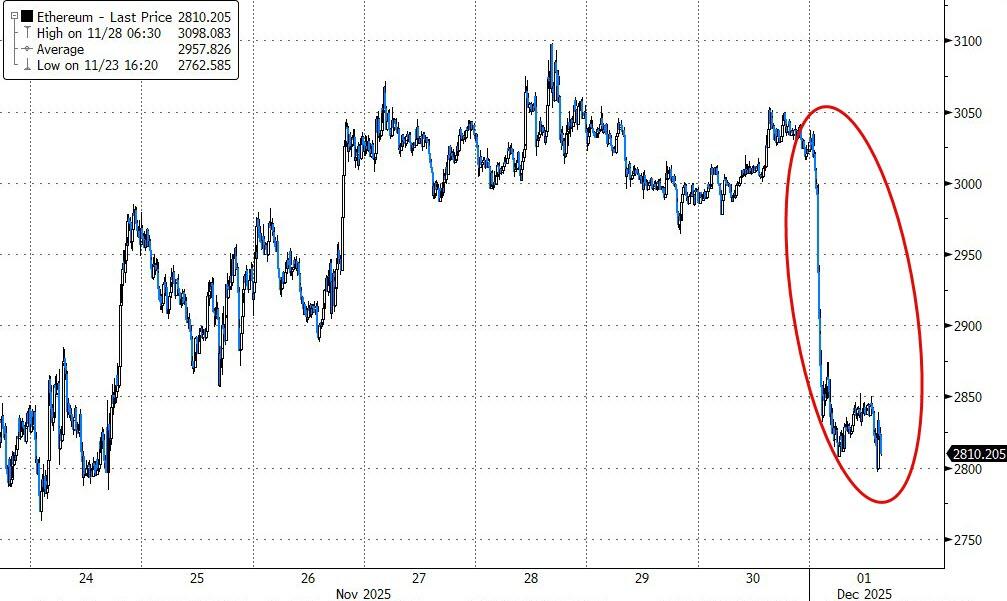
The reaction was swift and violent as the the threat to the ‘yen carry trade’ tanked risk assets broadly, but most of all bitcoin as the largest cryptocurrency plunged from around $92,000 to $84,000 before a small rebound back above $86,000.

“It’s a risk off start to December,” said Sean McNulty, APAC derivatives trading lead at FalconX.

“The biggest concern is the meagre inflows into Bitcoin exchange traded funds and absence of dip buyers. We expect the structural headwinds to continue this month. We are watching $80,000 on Bitcoin as the next key support level.”  

Over 180,000 traders were liquidated in the past 24 hours, with total liquidations at $539 million and the majority of that in the past few hours, reported CoinGlass. Almost 90% of those liquidations were long positions, predominantly in BTC and Ether 


Ethereum also tanked, back below $3,000…

Strategy selling?

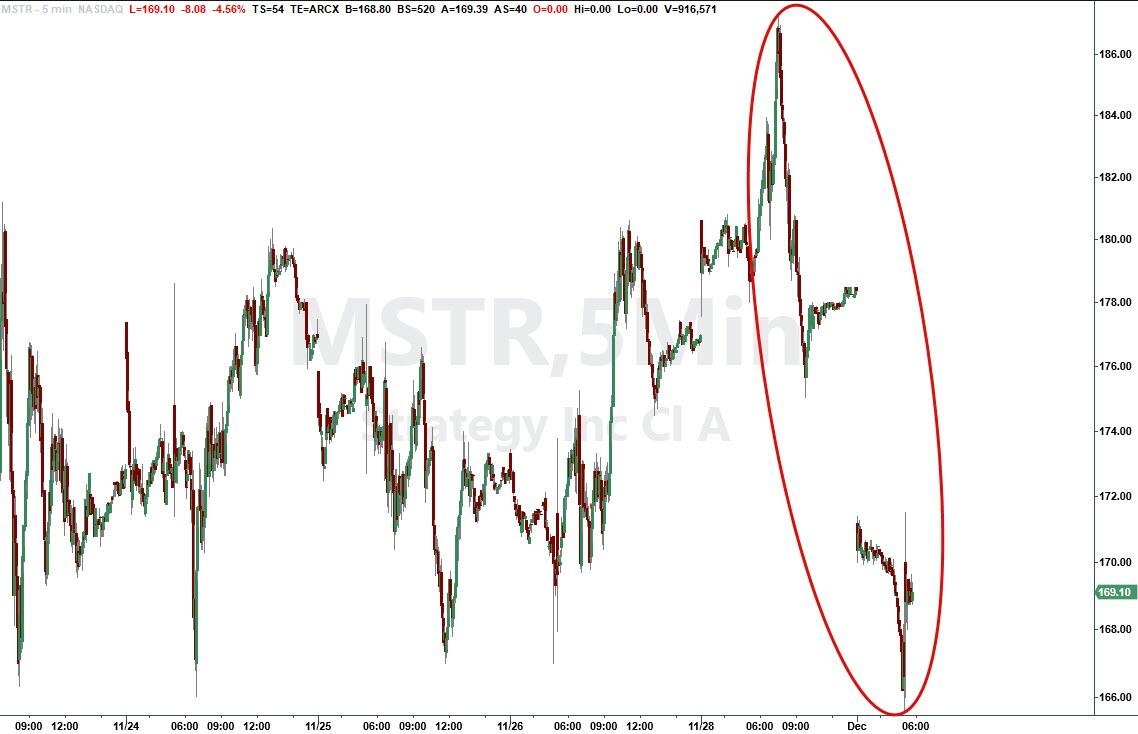
Things worsened this morning as Bloomberg reports that concerns are rising that Strategy Inc. soon may be forced to sell some of its roughly $56 billion cryptocurrency haul if token prices continue to fall, leading its shares to wobble in pre-market trading.

Strategy’s mNAV — a key valuation metric comparing the firm’s enterprise value to the value of its Bitcoin holdings — sat at about 1.2 on Monday, according to its website, spurring investor fears it may soon turn negative.

“We can sell Bitcoin and we would sell Bitcoin if we needed to fund our dividend payments below 1x mNAV,” Phong Le, Strategy’s chief executive officer, said on a podcast on Friday, noting that it would only be carried out as a last resort.

“There’s the mathematical side of me that says that would be absolutely the right thing to do, and there’s the emotional side of me, the market side of me, that says we don’t really want to be the company that’s selling Bitcoin,” Le added.

“Generally speaking, for me, the mathematical side wins.”

MSTR is trading down 5% in the pre-market

However, after a week of not adding to its Bitcoin hoard, Strategy Chairman Michael Saylor appeared to hint in a Sunday post on X that it might soon make further purchases.

China notices ‘speculation’, issues re-ban

Finally, we note that China’s central bank has flagged stablecoins as a risk and has promised to refresh its crackdown on crypto trading, which it has banned since 2021.

The People’s Bank of China said on Saturday, after a meeting with 12 other agencies, that “virtual currency speculation has resurfaced” due to various factors, posing new challenges for risk control.

“Virtual currencies do not have the same legal status as fiat currencies, lack legal tender status, and should not and cannot be used as currency in the market,” the bank said, according to a translation of its statement.

“Virtual currency-related business activities constitute illegal financial activities.”

China’s central bank banned crypto trading and mining in 2021, citing a need to curb crime and claiming that crypto posed a risk to the financial system.

So a triple-whammy for an already sensitive crypto market overnight – is this the weak hand flush needed for the Santa Claus rally to start?

Tyler Durden
Mon, 12/01/2025 – 08:45

via ZeroHedge News https://ift.tt/1FX2Ksq Tyler Durden