Retail Workers Currently Earning 51.6% Less Than Needed To Afford Rent: Report

Retail Workers Currently Earning 51.6% Less Than Needed To Afford Rent: Report

Authored by Naveen Athrappully via The Epoch Times (emphasis ours),

An American retail worker earns 51.6 percent less than the amount required to afford a typical rental apartment, real estate brokerage Redfin said in a statement released on Nov. 26.

A rent sign seen in Maryland on Nov. 12, 2023. Madalina Vasiliu/The Epoch Times

The typical retail worker in America earns $34,436 per year,” the company said.

A renter would need to earn $71,172 to afford the typical apartment, which costs $1,779 per month.

This signifies a shortfall of $36,736 needed to afford an apartment, even though overall affordability has improved slightly in recent years.

In Cleveland, a typical retail worker earns 32.9 percent less than needed to afford a residence, the smallest shortfall among 40 metropolitan areas analyzed by the brokerage. This was followed by St. Louis, San Antonio, Kansas City, and Milwaukee. These places have some of the lowest rents in the country.

In contrast, the shortfall was highest in New York, where a retail worker earned 71 percent less. This was followed by Boston, San Jose, Miami, and San Diego. These locations rank among the most expensive rental locations.

Besides the rent struggle, the U.S. retail sector is also seeing large layoffs.

Retailers have announced 88,664 job cuts through October this year, a 145 percent jump compared to the same period last year, according to a Nov. 6 report by outplacement company Challenger, Gray & Christmas.

Incomes and Rent Growth

“As the cost of living has increased, so have the sacrifices renters must make to afford a place to live,” Redfin Chief Economist Daryl Fairweather said.

However, “the good news is rents are no longer rising as fast as they were during the pandemic, so rental affordability has actually improved slightly in recent years,” Fairweather added.

The average rent in a primary city residence grew by almost 3.4 percent between September 2024 and 2025, according to data from the Federal Reserve Bank of St. Louis.

A Nov. 19 report from real estate marketplace Zillow noted that U.S. incomes grew faster than asking rents this year amid a general slowdown in rent growth.

“Affordability is improving most significantly in markets where rents have fallen from year-ago levels, including Austin (where the typical asking rent is down 3.1 percent annually), Denver (-2.1 percent), San Antonio (-0.8 percent), and Phoenix (-0.7 percent),” the report said.

“Though incomes have understandably outpaced rents in markets where rent growth has turned negative, affordability improvements have even reached metros where rent growth remains strong.

A monthly rental budget of $2,000 will net different types of properties based on the region, according to a Nov. 10 report from online rental marketplace Apartments.

“Renters in smaller cities like Memphis, Buffalo, and Indianapolis can afford three-bedroom apartments within a $2,000 budget, while in big cities like Boston, Los Angeles, and Seattle, that same budget often only covers a studio,” it said.

Meanwhile, there have been proposals to freeze the amount that can be charged on rental properties.

Zohran Mamdani, a self-described democratic socialist who won the New York City mayoral race this month, proposed a rent freeze during his campaign. Washington state, Oregon, and California have already implemented statewide rent control.

Supporters of rent-freeze policies argue that such measures are required to ease the burden on American families. However, critics warn that pursuing these policies could deter investment in the rental market, further exacerbating the issue in the long run.

A survey of The Epoch Times readers conducted on Oct. 29 found that most opposed rent-freeze measures and advocated pursuing market solutions.

Nearly 40 percent suggested that builders cut costs to reduce the housing shortage, which could then bring down rents.

Tyler Durden
Mon, 12/01/2025 – 12:20

via ZeroHedge News https://ift.tt/fHQzx6c Tyler Durden
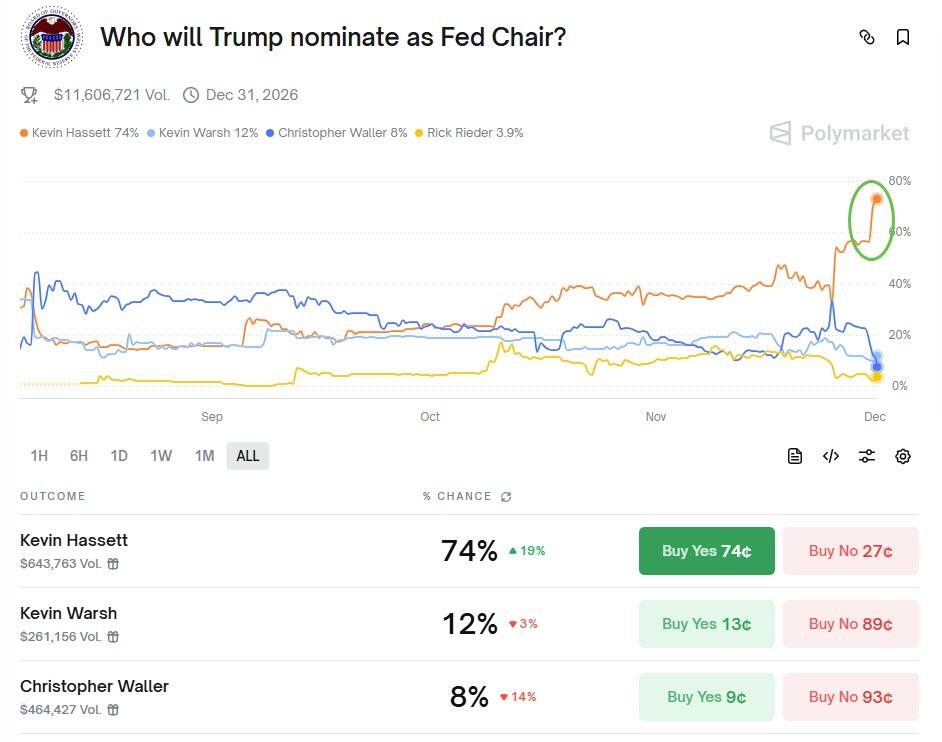
Hassett Odds Soar As Trump Confirms He’s Made Decision On Next Fed Chair

Hassett Odds Soar As Trump Confirms He’s Made Decision On Next Fed Chair

President Donald Trump said on Nov. 30 that he has already decided on his pick to replace Federal Reserve Chair Jerome Powell, adding that an announcement is forthcoming, but declining to identify his nominee.

“I know who I am going to pick, yeah,” Trump told reporters on Air Force One on his way back from Florida to Washington on Sunday.

When asked whether he would nominate National Economic Council Director Kevin Hassett, the current frontrunner to replace Powell according to betting markets, Trump smiled and replied, “I’m not going to tell you, we’ll be announcing it.”

Hassett now has an 75% chance of getting the nomination according to prediction market Polymarket. Former Fed Gov. Kevin Warsh is at 12% with Fed Gov. Christopher Waller down to 8%.

Source: Polymarket

Earlier Sunday, Hassett, on CBS’ “Face The Nation,” said the market’s reaction to reports that Trump was close to a pick is a positive sign.

“Once it became clear that the president’s getting closer to make a decision, the markets really celebrated, interest rates went down, we had one of our best Treasury auctions ever,” Hassett said on Fox.

“I think that the market expects that there’s going to be a new person at the Fed, and they expect that President Trump’s going to pick a new one. And if he picks me, I’d be happy to serve.”

Hassett, who has strongly defended Trump’s economic policies, including tariffs and interest rates, said he would be happy to serve as Fed chief if Trump nominated him.

“I’m really honored to be amongst a group of really great candidates,” Hassett told CBS.

“I think that the American people could expect President Trump to pick somebody who’s going to help them, you know, have cheaper car loans and easier access to mortgages at lower rates.”

We do note that rates are higher this morning after Trump’s comments (and the yield curve is steeper – policy error), but there are a lot of moving parts after the long weekend (from mixed manufacturing data to a hawkish BoJ) impacting markets.

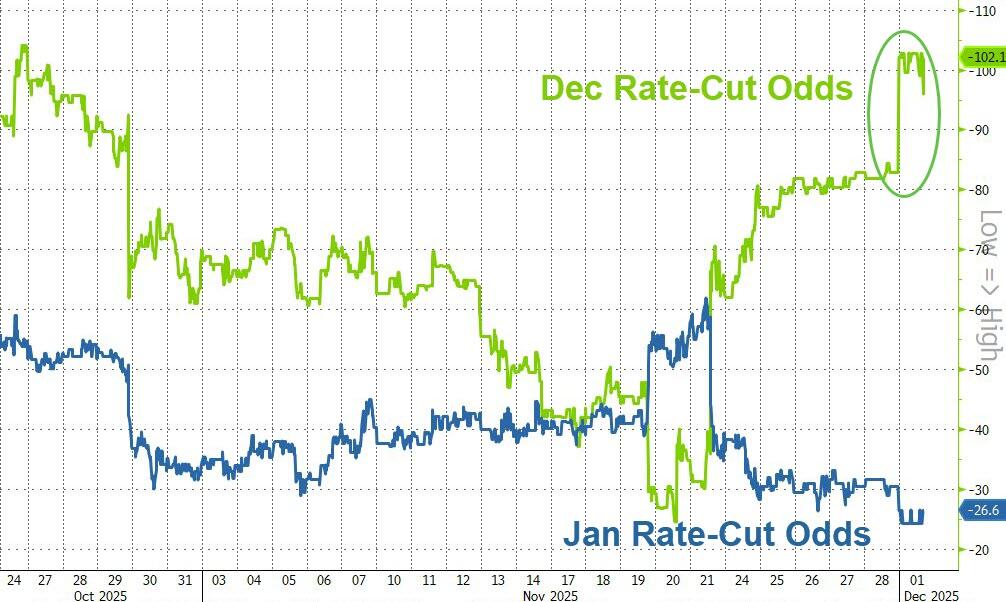
Market-implied odds have soared to fully price in a rate-cut in December…

Finally, we note that Hassett’s financial disclosure reveals at least a seven‑figure Coinbase stake and compensation for serving on the exchange’s Academic and Regulatory Advisory Council, placing him unusually close to the crypto industry for a potential Fed chair.​

Still, crypto has been burned before by reading too much into “crypto‑literate” resumes. Gary Gensler arrived at the Securities and Exchange Commission with MIT blockchain courses under his belt, but went on to preside over a wave of high‑profile enforcement actions, some of which critics branded as “Operation Chokepoint 2.0.”

A Hassett-led Fed might be more open to experimentation and less reflexively hostile to bank‑crypto activity. Still, the institution’s mandate on financial stability means markets should not assume a one‑way bet on deregulation.​

Tyler Durden
Mon, 12/01/2025 – 12:00

via ZeroHedge News https://ift.tt/RlBVcu0 Tyler Durden

Strategy Sets Up $1.4 Billion Cash Reserve, Lifts Bitcoin Stash To 650,000BTC

Strategy Sets Up $1.4 Billion Cash Reserve, Lifts Bitcoin Stash To 650,000BTC

Authored by Helen Partz via CoinTelegraph.com,

Michael Saylor’s Strategy, the world’s largest public Bitcoin holder, is creating a $1.44 billion US dollar reserve to support dividend payments on its preferred stock and interest on its outstanding debt.

Strategy on Monday announced the establishment of a US dollar reserve funded through proceeds from the sale of Class A common stock under its at-the-market offering program.

“Strategy’s current intention is to maintain a USD Reserve in an amount sufficient to fund at least twelve months of its dividends, and Strategy intends to strengthen the USD Reserve over time, with the goal of ultimately covering 24 months or more of its dividends,” the company said.

Alongside the launch of the reserve, Strategy disclosed an additional purchase of 130 Bitcoin for $11.7 million, bringing its total holdings to a symbolic value of 650,000 BTC, acquired for $48.38 billion.

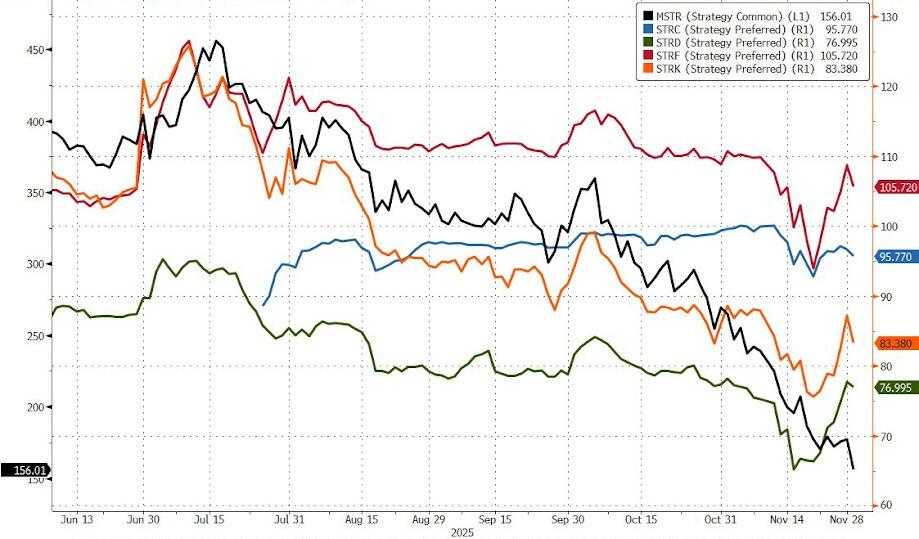
Notably, while MSTR has been in decline, the last few days have seen the preferreds bid…

The Strategy preferred now yields from 9% to nearly 13%, considerably above the 6% rate on preferred stock from major banks like Bank of America and JPMorgan Chase.

Primary means for funding dividends

According to the Strategy’s company update on Monday, its US dollar reserve will be the primary source of funding dividends paid to holders of its preferred stocks, debt and common equity.

The update details that the $1.44 billion reserve is 2.2% of Strategy’s enterprise value, 2.8% of equity value and 2.4% of Bitcoin value.

Strategy’s funding of the USD Reserve. Source: Strategy

“We believe this improves the quality and attractiveness of our preferreds, debt and common equity,” Strategy said, adding that it raised $1.44 billion in less than nine trading days by selling its common A stock MSTR.

USD reserve to complement BTC holdings

“Establishing a USD Reserve to complement our BTC Reserve marks the next step in our evolution,” Strategy founder Saylor said, adding that the new financial tool will better position the company to navigate short-term market volatility.

Strategy CEO and president Phong Le highlighted that the company’s latest BTC purchase — made in the past two weeks — brings its total holdings to 650,000 BTC, or about 3.1% of the 21 million BTC that will ever exist.

An excerpt from Strategy’s Form 8-K. Source: SEC

“In recognition of the important role we play in the broader Bitcoin ecosystem, and to further reinforce our commitment to our credit investors and shareholders, we have established a USD Reserve that currently covers 21 months of dividends,” Le noted.

Strategy lowers 2025 KPI targets

Alongside its reserve and 650,000 BTC holdings, Strategy has significantly lowered its KPI targets and corresponding assumptions for 2025 results.

According to the update, Strategy now expects its BTC yield to end the year between 22% and 26%, with a projected BTC price estimate of $85,000–$110,000 by Dec. 31.

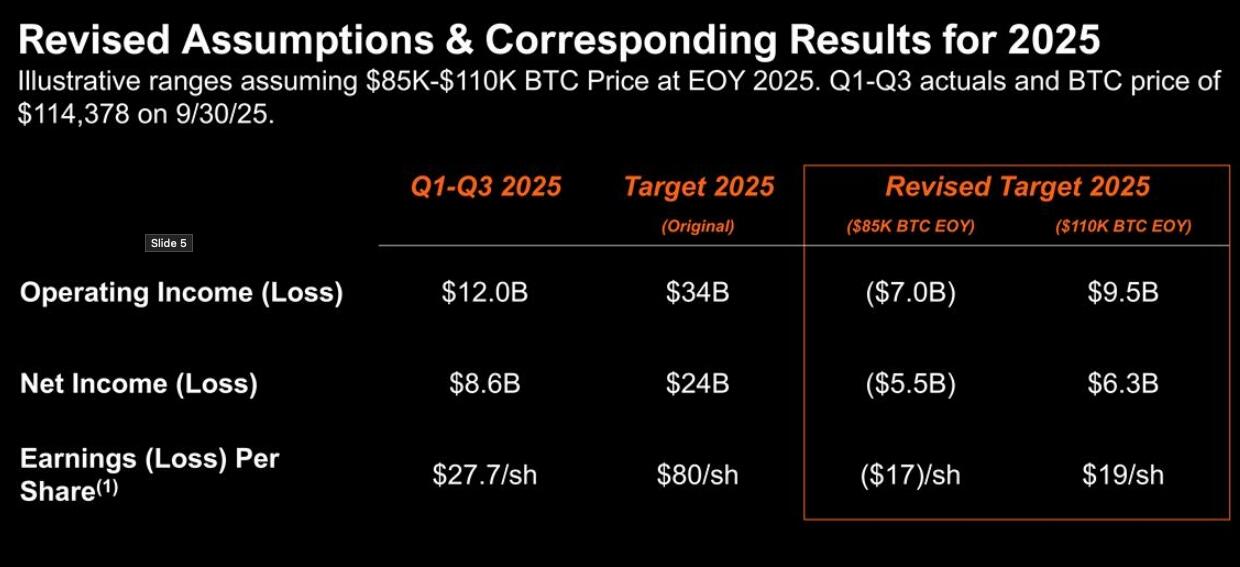
Revised assumptions and corresponding results for 2025. Source: Strategy

The company has also significantly reduced its targeted BTC gains, cutting its previous expectation of $20 billion to a revised range of between $8.4 billion and $12.8 billion.

The revised target for operating income is between $7 billion and $9.5 billion, down from the originally projected $34 billion.

Tyler Durden
Mon, 12/01/2025 – 11:40

via ZeroHedge News https://ift.tt/60wb8Kv Tyler Durden

Sky’s The Limit

Sky’s The Limit

By Benjamin Picton, Senior Market Strategist at Rabobank

Major US indices closed high on Friday evening as trading resumed following the Thanksgiving holiday. The S&P500 was up 0.54%, the Dow up 0.61% and the NASDAQ up 0.65%, but US equity futures are pointed lower this morning and Asian equity markets are showing mixed performance. Bond yields are mostly higher. Yields on US 10s rose 2.1bps to 4.03% while yields on 2-year JGBs reached their highest level in 17 years after BOJ Governor Ueda hinted that he is seriously considering a rate hike this month.

Brent crude is up 1.20% in early trade following news that Ukrainian drones had struck two Russian ‘Shadow Fleet’ tankers bound for the Novorossiysk oil terminal in the Black Sea. The terminal itself was later struck by Ukrainian drones, prompting a halt in operations, while Moldova reported incursions of Russian drones into its own airspace in an apparent continuation of Russia’s ‘grey-zone’ tactics that has seen Russian drones violate the airspace of Poland, Germany, Denmark, Norway, Romania and the Baltic states in recent months.

NATO allies have stationed fighter jets in Poland under Operation Eastern Sentry that can be scrambled to shoot down Russian drones, but this is a high cost response to the very cheap probing of NATO’s defences that is being conducted by the Kremlin. This as the Wall Street Journal reports that ‘Russia Gains the Upper Hand in Drone Battle, Once Ukraine’s Forte’ and quotes a Ukrainian drone unit commander who says that Russia is receiving superior supply chain support from China than Ukraine is receiving from the United States and Europe combined.

Ukrainian officials met with Secretary of State Marco Rubio, Special Envoy Steve Witkoff and Jared Kushner in Florida to progress talks to end the Russo-Ukrainian war. The Ukrainian delegation was missing erstwhile Zelenskyy Chief of Staff Andriy Yermak, who has resigned his position following anti-corruption raids on his home relating to investigations over illegal kickbacks in Ukraine’s energy sector. Rubio told journalists after the meeting that progress had been made but that there was still more work to be done.

Witkoff is set to travel to Moscow today to meet with President Putin to progress a deal. Yermak’s departure may have placed Zelenskyy further on the back foot in the bargaining process as his image is tarnished by whiffs of corruption at the heart of his government. President Trump speculated as much aboard Air Force One, where he told journalists that he thought there was a “good chance” of a deal to end the war being signed, but that the Ukrainian corruption scandal was “not helpful”.

While negotiations over the fate of Ukraine continue, another risk event for energy markets continues to unfold in Venezuela. President Trump took to Truth Social over the weekend to declare “THE AIRSPACE ABOVE AND SURROUNDING VENEZUELA TO BE CLOSED IN ITS ENTIRETY.” This comes following the largest US deployment of military assets to the region in decades and series of missile strikes on small boats thought to be engaged in drug smuggling.

The purpose of US pressure on Venezuela has very likely now expanded from enforcement action against drug trafficking to efforts toward regime change (see here for RaboResearch’s further thoughts). Donald Trump told journalists aboard Air Force Once that he had been in contact with Venezuelan President Maduro over the phone, but didn’t disclose details of the conversation. He had previously indicated that the US would soon begin land strikes in Venezuela. “If we can save lives, if we can do things the easy way that’s fine. If we have to do it the hard way, that’s fine too.”

Tyler Durden
Mon, 12/01/2025 – 11:25

via ZeroHedge News https://ift.tt/ucdS3jJ Tyler Durden

France & UK Still Insist On Sending Troops To Ukraine, In Effort To Sabotage Trump Peace Plan

France & UK Still Insist On Sending Troops To Ukraine, In Effort To Sabotage Trump Peace Plan

As we reported earlier, the important Miami meeting wherein American and Ukrainian delegations hammered out a revised ceasefire draft for some five hours on Sunday did not have European participation. But this is where the real deal-making is taking place. Trump envoy Steve Witkoff is en route to Moscow, where he’s expected to meet with President Putin on Tuesday, in order to present where things stand on the peace plan.

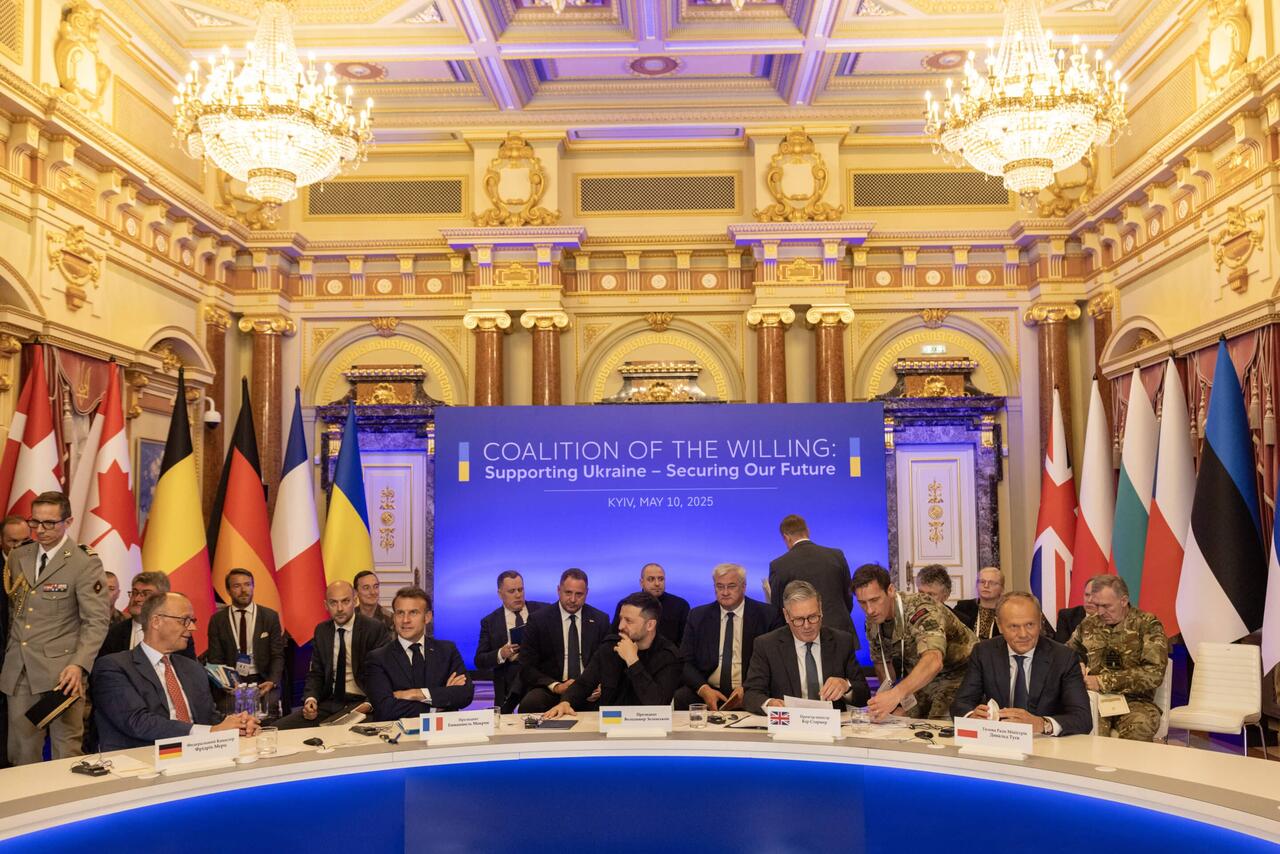
The Miami meeting reportedly focused on where the new de facto border would be in the east, after the 19-point plan featured significant territorial concessions in the Donbass and Crimea. As for Europe, is still touting a “coalition of the willing” which are vowing ongoing military support to the Zelensky government.

At this moment, France and the United Kingdom especially are continuing to push for the deployment of troops from NATO-member states to Ukraine as part of their version of peace settlement, despite this being very obviously unacceptable to Moscow. 

Image source: British prime minister’s office, 10 Downing St

Last week Politico reported that when US Secretary of State Marco Rubio joined a discussion involving the coalition of the willing via phone call, he made clear to all that the White House wants a peace agreement in place before committing to any long-term security guarantees for Kiev.

But UK Prime Minister Kier Starmer tried to push back, arguing that a “multinational force” would be essential for ensuring Ukraine’s future security.

Bloomberg then followed with a report saying that UK officials have already selected the military units they plan to deploy, based on several reconnaissance trips to Ukraine.

France’s President Emmanuel Macron proposed that such troops could operate in the capital area or western regions of the country, far from the front lines. But this would flagrantly cross all Russia’s red lines. NATO troops on its doorstep was key Putin’s decision-making in launching the ‘special military operation’ in the first place.

It must be recalled that the original US-drafted 28-point peace plan, which leaked to the press and more recently was condensed down to 19 points, included an explicit prohibition on deploying NATO troops to Ukraine.

The European-proposed counter-plan, which was also quickly leaked to the media, greatly softened that stance and laid out that instead of a blanket ban, NATO would not “permanently station troops under its command in Ukraine in peacetime.”

At a moment Trump’s peace plan advances, and with Witkoff on his way to meet with President Putin, hawks in Europe are growing even more hawkish:

Such intentionally vague language leaves open the possibility of NATO troop rotations into Ukraine. The Kremlin has time and again said it would not tolerate this, and such a move would lead to direct war with the West.

Europe’s plan also seeks to leave open a Ukrainian path to NATO, but this is also a sticking point which the US plan leaves out, given it would of course be dead on arrival if presented to Putin.

Tyler Durden
Mon, 12/01/2025 – 11:05

via ZeroHedge News https://ift.tt/gG3XbzA Tyler Durden

Lawmakers To Consider 19 Bills for Childproofing the Internet


Adult verification notice | Photo by <a href="https://unsplash.com/@zulfugarkarimov?utm_source=unsplash&utm_medium=referral&utm_content=creditCopyText">Zulfugar Karimov</a> on <a href="https://unsplash.com/photos/adult-content-18-confirm-your-age-gQth0cwzI9A?utm_source=unsplash&utm_medium=referral&utm_content=creditCopyText">Unsplash</a>

Can you judge the heat of a moral panic by the number of bills purporting to solve it? At the height of human trafficking hysteria in the 2010s, every week seemed to bring some new measure meant to help the government tackle the problem (or at least get good press for the bill’s sponsor). Now lawmakers have moved on from sex trafficking to social media—from Craigslist and Backpage to Instagram, TikTok, and Roblox. So here we are, with a House Energy and Commerce subcommittee hearing on 19 different kids-and-tech bills scheduled for this week.

The fun kicks off tomorrow, with legislators discussing yet another version of the Kids Online Safety Act (KOSA)—a dangerous piece of legislation that keeps failing but also refuses to die. (See some of Reason‘s previous coverage of KOSA here, here, and here.)

The new KOSA no longer explicitly says that online platforms or have a “duty of care” when it comes to minors—a benign-sounding term that could have chilled speech by requiring companies to somehow protect minors from a huge array of “harms,” from anxiety and depression to disordered eating to spending too much time online. But it still essentially requires this, saying that covered platforms must “establish, implement, maintain, and enforce reasonable policies, practices, and procedure” that address various harms to minors, including threats, sexual exploitation, financial harm, and the “distribution, sale, or use of narcotic drugs, tobacco products, cannabis products, gambling, or alcohol.” And it would give both the states and the Federal Trade Commission the ability to enforce this requirement, declaring any violation an “unfair or deceptive” act that violates the Federal Trade Commission Act.

Despite the change, KOSA’s core function is still “to let government agencies sue platforms, big or small, that don’t block or restrict content someone later claims contributed to” some harm, as Joe Mullin wrote earlier this year about a similar KOSA update in the Senate.

Language change or not, the bill would still compel platforms to censor a huge array of content out of fear that the government might decide it contributed to some vague category of harm and then sue.

KOSA is bad enough. But far be it for lawmakers to stop there.

As part of the “Legislative Solutions to Protect Children and Teens Online,” members of the House subcommittee on Commerce, Manufacturing, and Trade will also consider the Shielding Children’s Retinas from Egregious Exposure on the Net (SCREEN) Act (H.R. 1623), which would create a federal age verification for adult websites, and the App Store Accountability Act (H.R. 3149), which would require app stores to verify the ages of everyone who uses them.

They’ll consider the Reducing Exploitative Social Media Exposure for Teens (RESET) Act, which would ban people under age 16 from creating social media accounts and require platforms to delete existing accounts, and another bill (H.R. 6257) that would ban minors from sending messages that disappear.

There’s one on chatbots: the Safeguarding Adolescents From Exploitative (SAFE) Bots Act. There’s one on gaming: the Safer Guarding of Adolescents from Malicious Interactions on Network Games. There’s an updated version of the Children’s Online Privacy Protection Act, which would extend regulations aimed at children under 13 to anyone under age 17.

All in all, the number and breath of these measures is staggering. Other bills in this suite of so-called safety measures include:

Techdirt editor in chief Mike Masnick calls this week’s hearings a sort of “shock and awe campaign,” in which lawmakers say the measures they’re debating are about protecting children but most of them “are actually about censorship and control.”

“Don’t buy the framing,” added Masnick. “It’s always the same damn thing.”

If you’ve got a masochistic streak, you can tune in to a livestream of the hearing tomorrow starting at 10:15 a.m.


Does Big Tech do more good than harm?

Reason

In the next installment of Reason‘s debate series, Robby Soave and I will be arguing that Big Tech does more good than harm. We’re up against Breaking Points‘ Emily Jashinsky and Ryan Grim. If you’re in the D.C. area, you can check it out live on December 10 at the Miracle Theatre, starting at 7 p.m. Tickets are $25 if you get them by December 3 ($30 after).


More Sex & Tech News

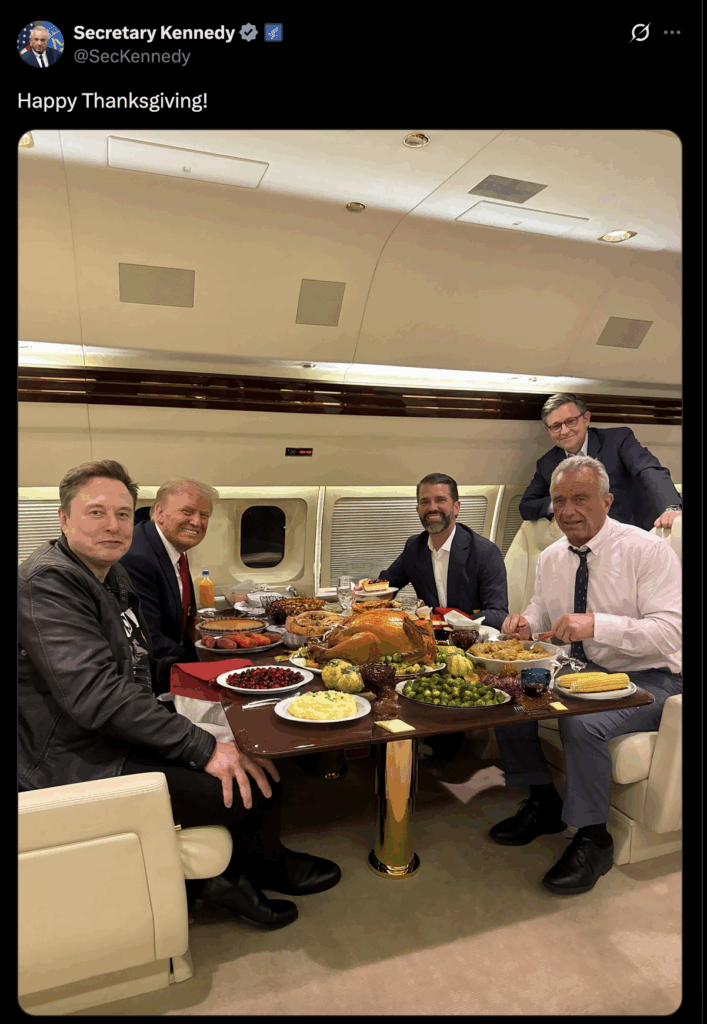
• Health and Human Services secretary Robert F. Kennedy Jr. shared a Thanksgiving greeting on X with a picture of himself enjoying what appears to be an AI-generated (or at least very badly Photoshopped) Thanksgiving feast aboard Air Force One. As many users pointed out, the image appears to be a revised version of an image from November 2024 in which Kennedy, Donald Trump, Donald Trump Jr., Elon Musk, and House Speaker Mike Johnson were eating McDonalds.

@SecKennedy/X

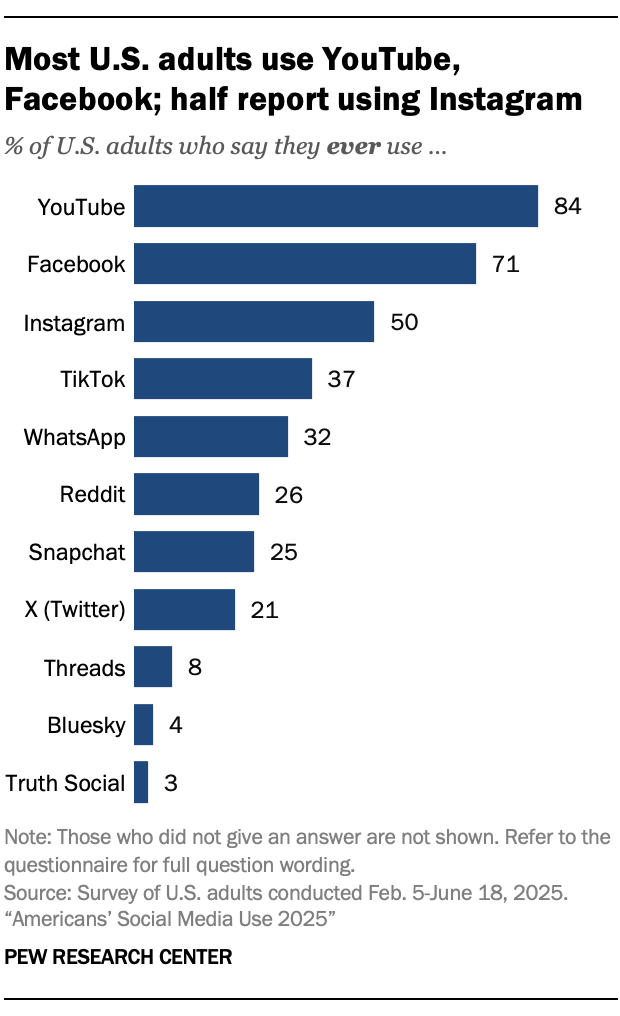
• If it seems to you like no one is using Facebook anymore…you’re wrong. According to the Pew Research Center, it’s still the second-most popular social media platform in the U.S., bested only by YouTube. Some 84 percent of the U.S. adults polled said they sometimes use YouTube, while 71 percent say they use Facebook. “Half of adults say they use Instagram, making it the only other platform in our survey used by at least 50% of Americans,” notes Pew.

Pew Research Center

• J.D. Tuccille on the European Union’s latest online surveillance scheme:

As I write, European Union (E.U.) officials are debating the details of a proposal to either require or pressure tech companies to scan all private messages for child sexual abuse material. Dubbed “chat control,” the scheme inevitably entails mass surveillance of private communications—targeting one sort of content for the moment, though it’s difficult to see how that would long remain limited in any way. It’s an illustration of the continuing decline in online liberty documented in a new report from Freedom House.

• The Atlantic‘s Charlie Warzel reflects on three years of ChatGPT.

• Missouri’s age verification for porn law took effect yesterday.

Today’s Image

Palm Springs | 2025 (ENB/Reason)

The post Lawmakers To Consider 19 Bills for Childproofing the Internet appeared first on Reason.com.

from Latest – Reason.com https://ift.tt/vDTi1nZ
via IFTTT

Multiple Failures In Vetting Process Of Afghans, Says Tom Homan

Multiple Failures In Vetting Process Of Afghans, Says Tom Homan

Authored by Naveen Athrappully via The Epoch Times,

There has been a massive failure in the vetting process that allowed Afghan nationals to enter the United States under the Biden administration, border czar Tom Homan said in a Nov. 30 interview with Fox News.

When the United States withdrew from Afghanistan in 2021, the Biden administration initiated the Operation Allies Welcome program to resettle thousands of Afghan nationals in America, which included those who worked alongside U.S. authorities in Afghanistan over the previous two decades.

“It’s the biggest national security failure in the history of the nation,“ Homan said, noting that the DHS Inspector General came out with a report at the time stating multiple failures in the vetting process.

“People need to understand, in these third-world nations, they don’t have systems like we do. So, a lot of these Afghans, who did get here to get better, they had no identification at all. Not a single travel document, not one piece of identification. And we’re going to count on the people that run Afghanistan, the Taliban, to provide us any information who the bad guys were or who the good guys are? Certainly not.”

On Nov. 26, a gunman shot two West Virginia National Guard members. One of the victims has since died, while the second remains in critical condition. The suspected shooter was identified as 29-year-old Rahmanullah Lakanwal from Afghanistan, who entered the country as part of Operation Allies Welcome. In 2022, the operation was renamed Enduring Welcome.

More than 190,000 Afghan nationals were resettled in the United States as part of the effort, according to the State Department.

A 2022 report from the Department of Homeland Security’s (DHS’s) Office of Inspector General, mentioned by Homan in the interview, said that the Biden-era DHS failed to fully vet some of the 80,000 Afghans allowed entry into the United States at the time.

An audit of 88,977 evacuee records inspected by authorities found that more than 11,000 recorded their birth date as Jan. 1. In addition, 7,800 had missing or invalid travel document numbers, the report said.

More than 36,000 records listed “facilitation document” as the travel document type, and Customs and Border Protection (CBP) was unable to define what the “facilitation document” was, according to the DHS.

The Epoch Times reached out to the DHS Office of Inspector General for comment but did not receive a response by publication time.

Inspector General Joseph V. Cuffari was confirmed by the Senate to his post in 2019 during the first Trump administration.

Following the attack on the two National Guard members, the State Department announced on Nov. 28 that it had “IMMEDIATELY paused visa issuance for individuals traveling on Afghan passports.”

On the same day, Citizenship and Immigration Services Director Joseph B. Edlow said in an X post that the agency had halted all asylum decisions “until we can ensure that every alien is vetted and screened to the maximum degree possible.”

President Donald Trump said the asylum restriction applies to 19 nations, which he had labeled as “countries of identified concern” via a presidential action in June. The list includes Afghanistan, Iran, Somalia, and Turkmenistan.

In the interview, Homan said approximately 10.5 million illegal immigrants had crossed into the United States under the previous administration.

This figure does not include the hundreds of thousands who came via the CHNV program and the more than 2 million known gotaways, he said.

CHNV was a Biden-era parole program for Cubans, Haitians, Nicaraguans, and Venezuelans, while gotaways refers to illegal immigrants who evaded U.S. border patrol and law enforcement authorities after crossing the border.

Since the Afghans were allowed entry via government programs, there are at least photographs and fingerprints of some of these individuals, Homan said, adding that the government has no details on the millions of gotaways.

The current administration’s policies have ensured “the most secure border in the history of this nation,” Homan said.

“Now we know who’s coming, now we clear who’s coming. We don’t have 10,000, up to 12,000 people a day, entering this country illegally,” he added.

In a Nov. 13 statement, the CBP said the Trump administration delivered the sixth straight month of zero releases at the border in October. There were 7,899 Border Patrol apprehensions on the southwest border, approximately 95 percent lower than the monthly average of the prior administration.

Tyler Durden
Mon, 12/01/2025 – 10:45

via ZeroHedge News https://ift.tt/IJBXeMt Tyler Durden

UK Man Arrested For Posing With Gun In Photo Taken While In The US

UK Man Arrested For Posing With Gun In Photo Taken While In The US

Last year during sweeping British protests triggered by the stabbing murders of three young girls at a dance recital by the radicalized 17-year-old child of Rwandan migrants, London Metropolitan Police Commissioner Mark Rowley threatened to have American citizens “arrested and extradited” to the UK for “stoking racial violence” (i.e. pointing out that third world migrants and often the children of third world migrants are a societal net negative and should be deported). 

The event sparked a series of thousands of arrests of UK citizens for crimes as meager as posting memes online and hoisting British flags in the presence of immigrants.  In the past year at least 12,000 such arrests have been made in the name of “quelling hate speech”, an ill defined violation based on arbitrary guidelines and left up the whims of leftist bureaucrats. 

No US citizens have been extradited, likely because the action would start 1776 Part II and a handful of armed Americans delivered on a Carnival Cruise Liner would end up conquering the UK in a week or less.

However, it would seem that the British authorities have decided to take out their frustrations on their own citizens who dare to visit the US to enjoy some of the freedoms they don’t have at home.  

A British IT consultant was arrested by West Yorkshire Police after posting pictures on LinkedIn of himself holding guns during an American vacation.  Jon Richelieu-Booth, 50, shared the photograph taken at a Florida homestead on August 13.  The post sparked a 13-week ordeal, which began with a police warning at his residence.  Officers cautioned him about online content and its “potential impact on others’ feelings”.

Despite Mr Richelieu-Booth’s offer to demonstrate the photograph’s American origin, authorities chose to arrest him on August 24.  All charges were ultimately thrown out, but police continued to harass Booth until October, when they arrested him yet again for “bail violations”.  

Whilst the original firearms and stalking charges were dismissed, prosecutors pursued a public order offense regarding a separate social media post.  Mr Richelieu-Booth was scheduled to face Bradford magistrates on November 25th for allegedly displaying material intended to cause distress, but this charge was also eventually withdrawn.  He originally faced a potential prison sentence of six months if convicted.

Elon Musk, who has been highly critical of the UK’s censorship policies, reposted a summary of the story to his 229 million followers on X, writing:

“And this is why we have the first and second amendments in America…The first amendment in the US protects freedom of speech, while the second amendment relates to the right to bear arms…”

Though the incident has ended with Booth avoiding jail time, there is a cottage industry of Europeans traveling to the US to experience life away from progressive authoritarianism.  This includes shooting firearms for recreation.  Often these adventures are documented on YouTube and other platforms, and might be considered an embarrassment for some officials overseas.  

Booth’s arrest could be an attempt to chill the waters on British travelers who make life in America look “too good”. 

Some firearms are technically “legal” in the UK, but the application process is arduous and subject to arbitrary police examination, which is why only 0.25% of the population has successfully acquired a firearms certificate.  The behavior of UK police is reminiscent of a communist regime; no crime has been committed, but the government wants to dissuade from certain behaviors anyway. 

A conviction isn’t necessarily the goal.  Instead, the process is the punishment.  The ongoing struggle session for one man sends a warning to the rest of the populace.  The goal is to frighten the public into walking on eggshells.  It’s much easier to control a population that censors itself.  The message is clear:  No matter where you travel in the world, the government at home owns you.  

Tyler Durden
Mon, 12/01/2025 – 10:30

via ZeroHedge News https://ift.tt/czs4Flu Tyler Durden

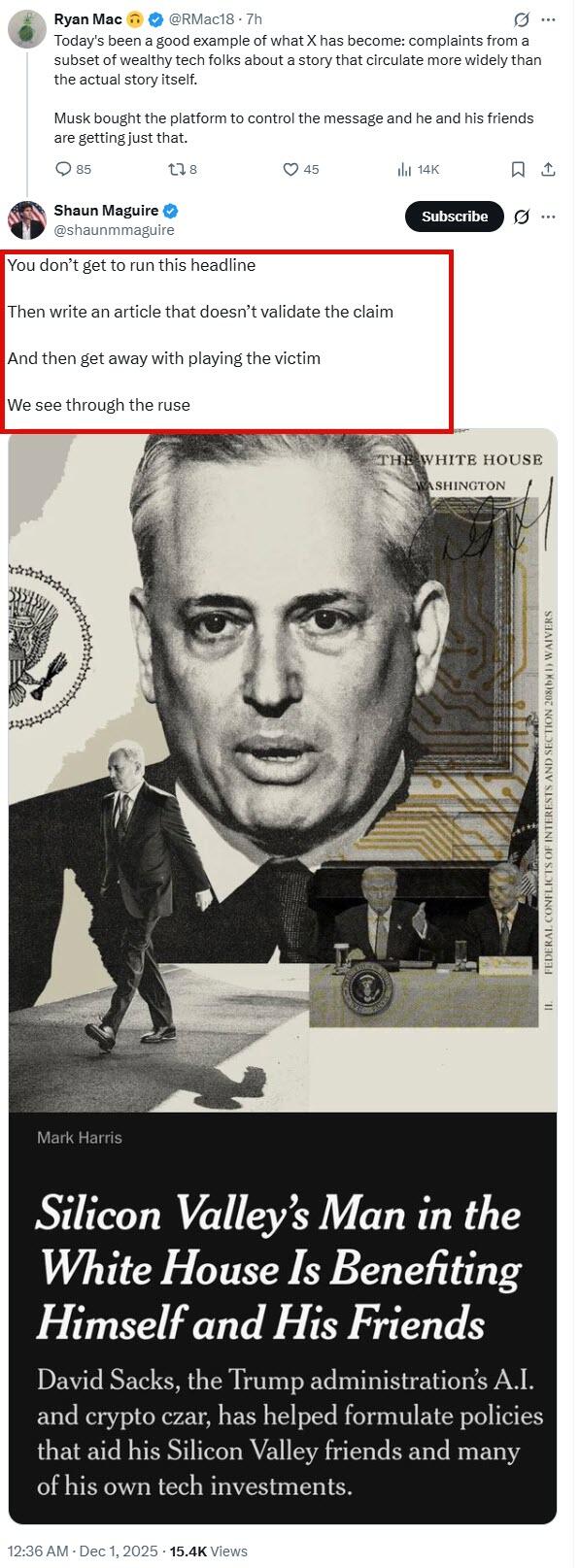
‘Inside NYT’s Hoax Factory’: Trump’s AI/Crypto Czar Dismisses Hit-Piece As ‘Nothing Burger’

‘Inside NYT’s Hoax Factory’: Trump’s AI/Crypto Czar Dismisses Hit-Piece As ‘Nothing Burger’

Authored by Jesse Coghlan via CoinTelegraph.com,

White House AI and crypto czar David Sacks has fired back at The New York Times over a report detailing how his government advisory role could benefit his investments and those of his close associates.

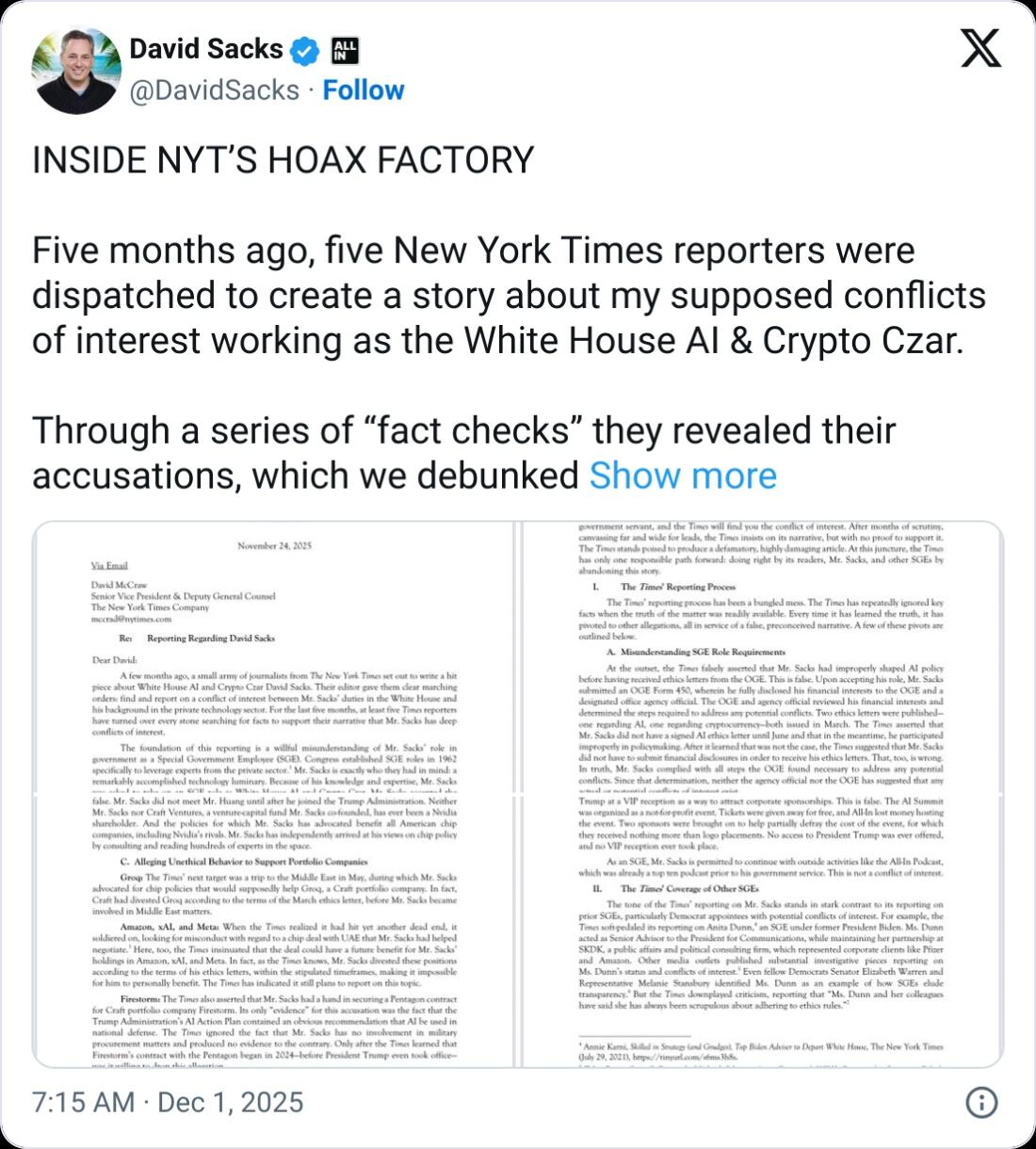
Sacks said in a post to X that despite having “debunked in detail” the Times’ reporting over the past five months, the outlet continued to publish the article on Sunday about his supposed conflicts of interest.

“Today they evidently just threw up their hands and published this nothing burger,” Sacks wrote. “Anyone who reads the story carefully can see that they strung together a bunch of anecdotes that don’t support the headline.”

Sacks is a co-founder and partner at the venture firm Craft Ventures, and his special government employee role at the White House has drawn scrutiny in the past, with Democrat Senator Elizabeth Warren saying in May that he is “financially invested in the crypto industry, positioning him to potentially profit from the crypto policy changes he makes at the White House.”

Source: David Sacks

Before he became crypto czar, Sacks and Craft divested over $200 million in crypto and crypto-tied stocks, at least $85 million of which Sacks owned, but Sacks retained an interest in several illiquid investments of “private equity of digital asset-related companies.”

Sacks retains 20 crypto investments, The Times reports

The Times reported that its analysis of Sacks’ financial disclosure found he has retained 708 tech investments, 449 of which are AI-related and 20 are tied to crypto, all of which could benefit from the policies Sacks supports.

In one example of a perceived conflict in Sacks’ role, the outlet stated that Craft Ventures is invested in the crypto infrastructure company BitGo, which offers a stablecoin-as-a-service.

BitGo filed to go public in September, with regulatory filings showing Craft owned 7.8% of the company.

The Times noted that Sacks was a major backer of the stablecoin-regulating GENIUS Act, which was signed into law earlier this year. Many crypto commentators predicted that this would boost the use and adoption of the tokens by institutions.

Other examples noted by the Times involved Sacks’ and Craft’s ties to companies involved with AI, which have skyrocketed in value as the White House and Wall Street bet on the technology’s potential.

The Times noted that Sacks’ ethics waivers, shared in March, stated he would sell his interests in AI and crypto; however, they don’t disclose when he sold the assets and do not detail the value of his remaining investments.

NYT created “bogus narrative,” says Sacks

In his X post, Sacks shared a letter to the Times sent by his lawyers at Clare Locke accusing the outlet of setting out “to write a hit piece” and giving their reporters “clear marching orders” to find conflicts of interest.

Sacks added it was “very clear how NYT willfully mischaracterized or ignored the facts to support their bogus narrative.”

Sacks’ spokesperson Jessica Hoffman told the Times that he has complied with rules for special government employees, and the Office of Government Ethics said that Sacks should sell his investments in certain types of companies but not others.

Sacks’ role as a special government employee is limited to 130 days, and in September, Democratic lawmakers questioned whether he had exceeded the number of days allowed with his appointment.

However, Sacks reportedly carefully manages the days he spends as a special government employee to ensure that he stays under the limit.

Tyler Durden
Mon, 12/01/2025 – 10:15

via ZeroHedge News https://ift.tt/ASiaEX1 Tyler Durden

‘Worse Than COVID’: Weak US Manufacturing Surveys Signal Stagflation In November

‘Worse Than COVID’: Weak US Manufacturing Surveys Signal Stagflation In November

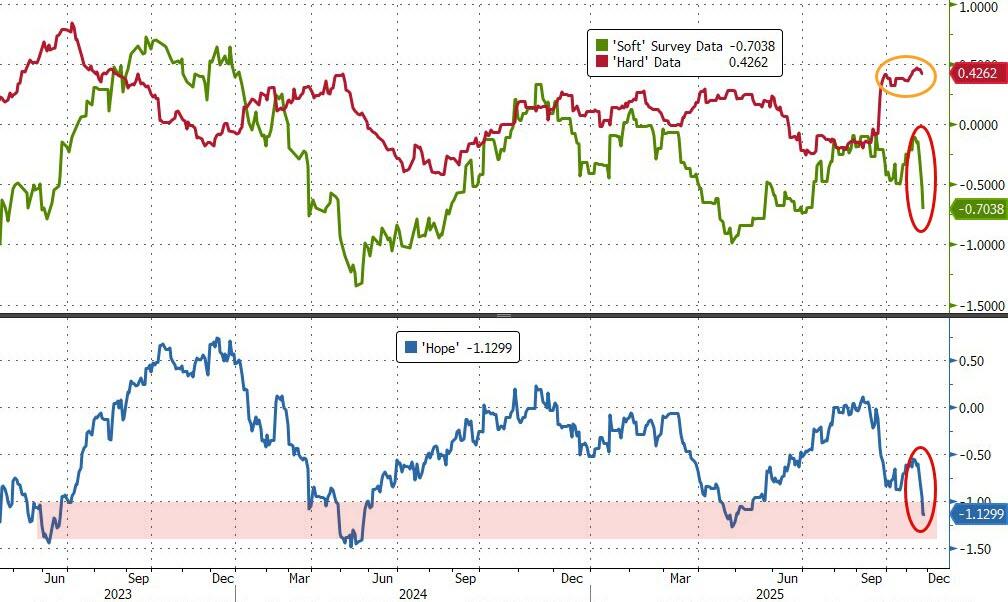
This morning’s survey data on the US manufacturing economy comes as the post-shutdown slump in ‘soft’ data has dominated desk conversations amid the vacuum of hard macro data…

But the picture remains mixed:

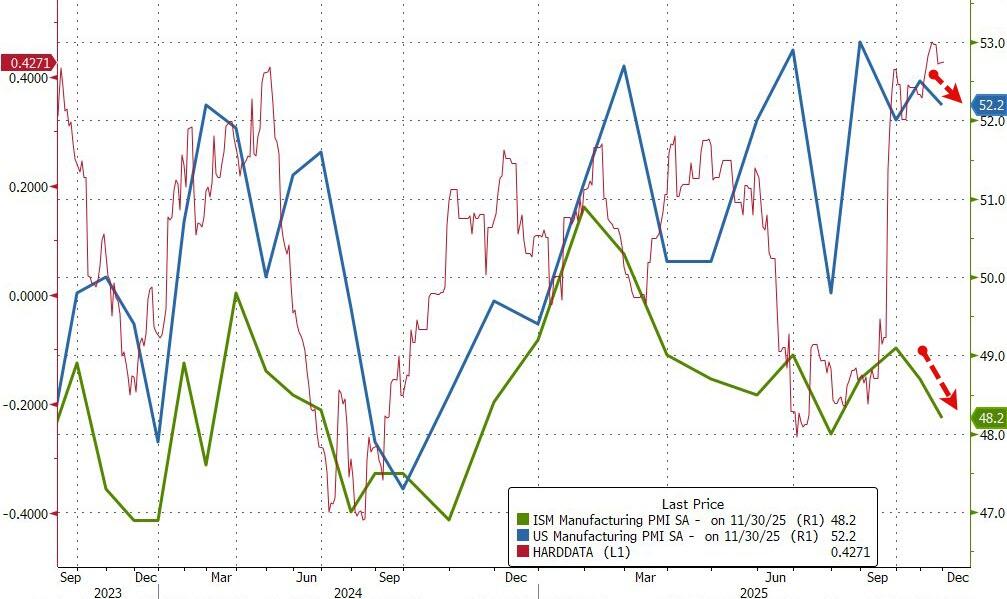
  • S&P Global’s US Manufacturing PMI BEAT expectations in November but dipped on a MoM basis from 52.5 to 52.2 (still in expansion territory and up from the 51.9 flash print).

  • ISM’s Manufacturing PMI MISSED expectations, dropping from 48.7 to 48.2 (well below the 49.0 expectation) and in contraction for the ninth month in a row.

Although the headline PMI signalled a further expansion of factory activity in November, “the health of the US manufacturing sector gets more worrying the more you scratch under the surface,” according to Chris Williamson, Chief Business Economist at S&P Global Market Intelligence.

“The main impetus came from a strong rise in factory production, but growth in new order inflows slowed sharply, hinting at a marked weakening of demand growth.”

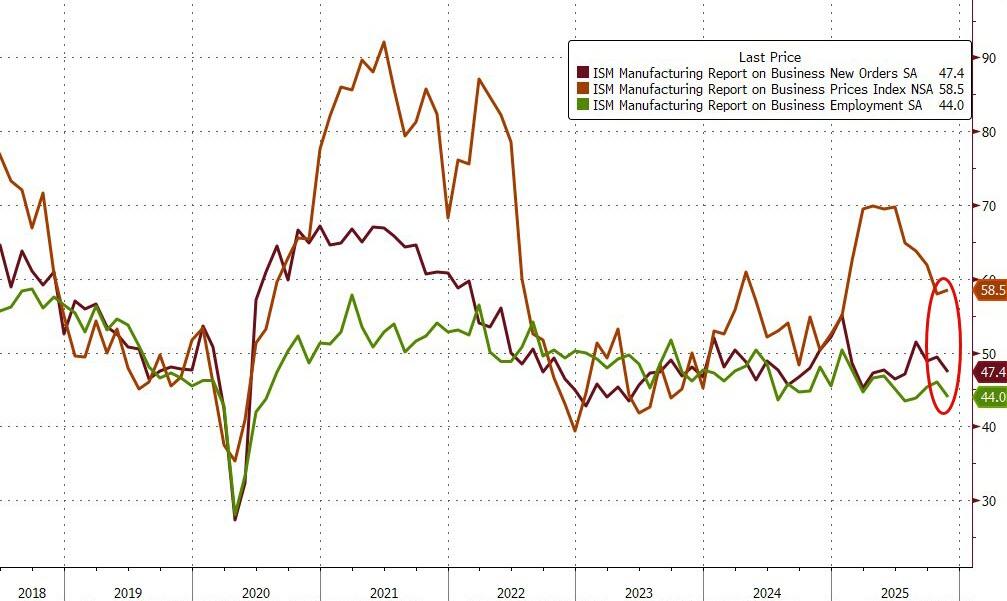
Under the hood, ISM shows Price Paid higher, and new orders and employment worsening…

For two successive months now, warehouses have filled with unsold stock to a degree not previously seen since comparable data were available in 2007. This unplanned accumulation of stock is usually a precursor to reduced production in the coming months.

Profit margins are meanwhile coming under pressure from a combination of disappointing sales, stiff competition and rising input costs, the latter widely linked to tariffs.

In short, Williamson notes that manufacturers are making more goods but often not finding buyers for these products. 

“This combination of sustained robust production growth alongside weaker than expected sales led to a worryingly steep rise in unsold inventories.”

ISM Respondents were pretty clear with blame for weakness being placed at Trump’s feet in Washington:

  • “New order entries are within the forecast. We have increased requests from customers to get their orders sooner. Transit time on imports seems to be longer.” (Machinery)

  • “We are starting to institute more permanent changes due to the tariff environment. This includes reduction of staff, new guidance to shareholders, and development of additional offshore manufacturing that would have otherwise been for U.S. export.” (Transportation Equipment)

  • Tariffs and economic uncertainty continue to weigh on demand for adhesives and sealants, which are primarily used in building construction.” (Chemical Products)

  • “No major changes at this time, but going into 2026, we expect to see big changes with cash flow and employee head count. The company has sold off a big part of the business that generated free cash while offering voluntary severance packages to anyone.” (Petroleum & Coal Products)

  • “Business conditions remain soft as a result of higher costs from tariffs, the government shutdown, and increased global uncertainty.” (Miscellaneous Manufacturing)

  • “The unstable market has made pricing fluctuate in a very volatile way; I have had to reduce suppliers for raw materials to maintain a better direct cost structure. Reducing my suppliers has reduced the availability of some items and created longer lead times.” (Fabricated Metal Products)

  • Business continues to be a struggle regarding long-term sourcing decisions based on tariffs and landing costs. External (or international) sourcing remains the lowest-cost solution compared to U.S. production/manufacturing. The delta is smaller now, reducing margins.” (Computer & Electronic Products)

  • The government shutdown has impacted our access to agricultural data, impacting agricultural markets and, as a result, decisions we make. Optimism for a tariff exemption on palm oil percolated but hasn’t come to fruition at this time.” (Food, Beverage & Tobacco Products)

  • Trade confusion. At any given point, trade with our international partners is clouded and difficult. Suppliers are finding more and more errors when attempting to export to the U.S. — before I even have the opportunity to import. Freight organizations are also having difficulties overseas, contending with changing regulations and uncertainty. Conditions are more trying than during the coronavirus pandemic in terms of supply chain uncertainty.” (Electrical Equipment, Appliances & Components)

  • “Domestic and export business have been lackluster. Our customers are taking prompt orders only and still don’t have confidence to build inventory, much less make expansion plans. In fact, most of any kind of ‘planning’ has been undermined by unpredictability due to inconsistent messaging from Washington. Artificial intelligence is in its infancy stages, producing confusing and most often inaccurate information. This also causes apprehensive consumer buying patterns, contributing to the challenge of forecasting demand.” (Wood Products)

However, there is hope, as manufacturers have grown more optimistic about the year ahead, with the ending of the government shutdown helping lift confidence from the sharp drop suffered in October.

“Optimism is being fueled by hopes of improved policy support, including lower interest rates, as well as greater political stability, though it is clear that uncertainty remains elevated and a drag on business growth in many firms, holding confidence well below levels seen at the start of the year.”

Tyler Durden
Mon, 12/01/2025 – 10:08

via ZeroHedge News https://ift.tt/YL8IjTp Tyler Durden