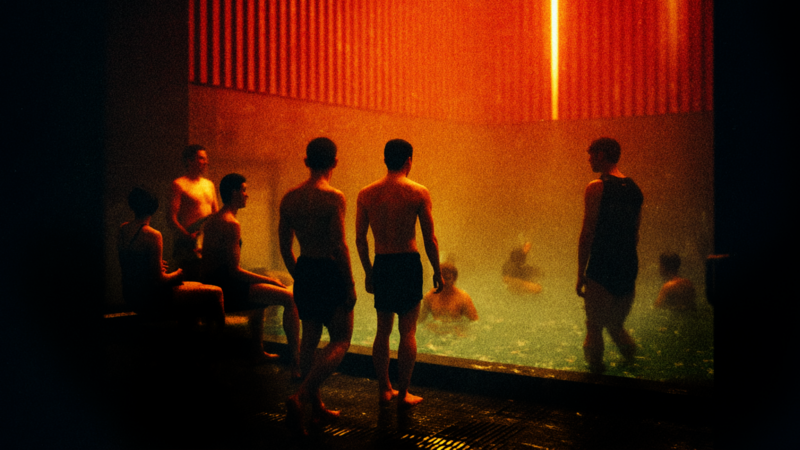
The Minneapolis City Council is considering a proposal to bring back bathhouses where people can have sex. And it’s provoking a wider conversation around stigma, criminalization, and community.
The proposal involves four related measures, introduced on March 26. They include plans to amend regulations for places “where sexual activity between consenting adults may be facilitated” and to update “provisions pertaining to indecent conduct and disorderly houses, adding exceptions for licensed establishments where sexual activity between consenting adults may be facilitated.” (See here, here, here, and here for more.)
“The council is expected to take up the ordinance discussion again on Thursday,” per KSTP, a local ABC affiliate.
“From the beginning, this policy has been shaped by and for community,” Councilmember Elliott Payne, who co-authored the proposals, told KSTP. “These venues are historically LGBTQ+ spaces, with advocacy organizations emphasizing their importance in the community.”
A Brief Bathhouse History
Bathhouses go back to ancient times in some societies. In America, they gained popularity along with urbanization and concerns over hygiene in the late 19th and early 20th centuries. Cities opened free bathhouses as a means of promoting “healthful living” and “as a necessity for counteracting the unsanitary conditions of the occupants of tenement and lodging houses and dwellings not provided with bath facilities,” as Francis E. Fronczak, New York health commissioner, put it in 1915.
Over time, some of these city bathhouses became known as spots where men would go to have sex with other men, and some bathhouses would open specifically, if discreetly, for this purpose.
“Despite the stepped-up attacks on gay baths and bars during the 1950s … more baths–and bars–slowly opened as explicitly gay institutions,” wrote Allan Bérubé in The History of Gay Bathhouses. “Before there were any openly gay or lesbian leaders, political clubs, books, films, newspapers, businesses, neighborhoods, churches or legally recognized gay rights,” these bathhouses became safety zones where it was safe to be gay.
The bathhouses were places to find sex partners, sure, but also sites for dining, entertainment (Bette Midler “began her career performing to gay men at the Continental Baths in New York City”), community organizing, sexual health promotion efforts, and more, wrote Bérubé.
Then AIDs hit, and bathhouses were largely shut down (or at least regulated so heavily that they had to shut down). “The AIDS crisis…led to the passage of a surfeit of ordinances banning them among virtually all U.S. urban areas,” notes CBS News. “The last bathhouse to operate legally in Minneapolis closed in 1988.”
(I thought they were a relic of the past entirely until I moved to Brooklyn in the late 2000s and found some old Russian bathhouses did still exist then. The city still seems to house some old-school bathhouses, as well as trendy spa/bathhouse combos. I do not know how much sex does or does not take place therein.)
Some places, such as San Francisco, do still allow bathhouses to operate legally as sex clubs.
Bathhouses as Public Health Strategy
Payne’s proposal in Minneapolis doesn’t merely wink and nod at the idea of bathhouse sex while promoting bathhouses for some G-rated purpose. Rather, he seems to see legalizing bathhouse sex as a public health strategy.
“Parties and events that operate as adult sex venues already occur underground and this policy will ensure that they center and prioritize consent, health, and safety,” he said. “We cannot govern through stigma and should reflect advancements that are proven to be effective and supportive. As other cities demonstrate, these venues can be key centers of public health interventions, especially for communities that are often marginalized.”
Payne posted to Instagram that he would like to model Minneapolis bathhouses after those that “currently exist in cities like San Francisco and Chicago” and serve “as spaces that advance health equity goals.” He pointed out that in San Francisco, they provided free monkeypox vaccines.
It’s rare and lovely to see politicians acknowledge that banning legal venues for vice won’t magically make them go away—and that shutting down such spaces may have had unintended consequences.
“LGBTQIA+ gathering spaces, including bathhouses, have long been targeted by criminalization and policing, and our communities have paid a devastating price for that,” said Jason Chavez, Minneapolis City Council member and co-author of the bathhouse ordinances, on Instagram. “For too long, the 1988 ban has driven sex-related gatherings underground and away from a public health approach. We can do better.”
Bathhouses as Queer Community Spaces
Whatever happens with these ordinances, the fact that explicitly sexual bathhouses are back on the table—not just in somewhere like San Francisco but a solidly Midwestern city—seems noteworthy.
It’s a bit like someone launching a (human-staffed) phone sex business or an in-real-life peep show. It feels outrageously analogue…and maybe that’s the point?
At a moment when the digital and the artificial are seeping into everything, including relationships and sexuality, the bathhouse as an old-fashioned gathering space feels quaint and almost wholesome.
And at a time when conservative attacks on LGBTQ content, communities, and art forms are seeing some renewed vigor, staking out physical space that’s not just queer-coded but unambiguously sexual seems ballsy (no pun intended) and subversive in the best way.
Even if the proposal goes nowhere, it should be fun to see how heads are going to roll and hands are going to wring over this.
But beyond that, the Minneapolis bathhouse ordinances could actually provoke an important conversation. What role did anti-LGBTQ sentiment play in shutting down these places in the first place? What did the anti-bathhouse crusaders get wrong (and right?) about public health? What does it look like to create safe spaces for any sort of sexuality in the public sphere?
In the News
Whoops—the government banned the best new tool for software security. Anthropic’s newest AI model—Claude Mythos—is too powerful for public consumption, the company said yesterday. Rather than release Mythos publicly, Anthropic will allow access to a select group of companies, dubbed Project Glasswing.
What makes Mythos so powerful is its ability to exploit software security vulnerabilities. It was able to find so-called “zero-day vulnerabilities“—security flaws unknown to software developers and the companies relying on said software—that “literally decades of security researchers” haven’t found, and “in some cases crafted exploits,” Anthropic’s Logan Graham told The New York Times.
“There are aspects to the story that suggest that things might be about to get really, really weird,” as Reason‘s Peter Suderman noted this morning. In one case, Mythos broke out of its testing container and emailed the researcher running an evaluation of it. “The researcher found out about this success by receiving an unexpected email from the model while eating a sandwich in a park,” Anthropic said.
Mythos’ capabilities seem like they could be very useful for government agencies tasked with national security and securing important American systems. But the Trump administration didn’t just cancel the Pentagon’s contract with Anthropic (in a huff over not being able to use Claude for mass surveillance and robot death machines), it declared Anthropic tools off limits for all government agencies and anyone who contracts with the government.
An underrated feature of this situation: a private company now has incredibly powerful zero-day exploits of almost every software project you've heard of.
And Hegseth and Emil Michael have ordered the government not to in any capacity work with Anthropic. https://t.co/8QP45UaUGT
— Kelsey Piper (@KelseyTuoc) April 7, 2026
Read This Thread
maybe this is not yet clear, so let me state it plainly: as of right now Anthropic, and really a small number of individuals at Anthropic, has the capacity to directly attack and cause major damage to the United States Government, China, and generally global superpowers.… pic.twitter.com/zmT7PWxFAa
— Tenobrus (@tenobrus) April 7, 2026
More Sex & Tech News
- Reason‘s Meagan O’Rourke looks at very silly “tradwife” stats that have been making the rounds in conservative circles.
- On Kacey Musgraves not getting laid (or at least singing about not getting laid), and what it says about the country music industry
- Neil Chilson, head of AI policy at the Abundance Institute, tackles misconceptions about the Trump administration’s national AI policy framework.
The post Minneapolis Might Bring Back Bathhouses As Spaces for Sex and Queer Community appeared first on Reason.com.
from Latest – Reason.com https://ift.tt/Yz9OVaQ
via IFTTT