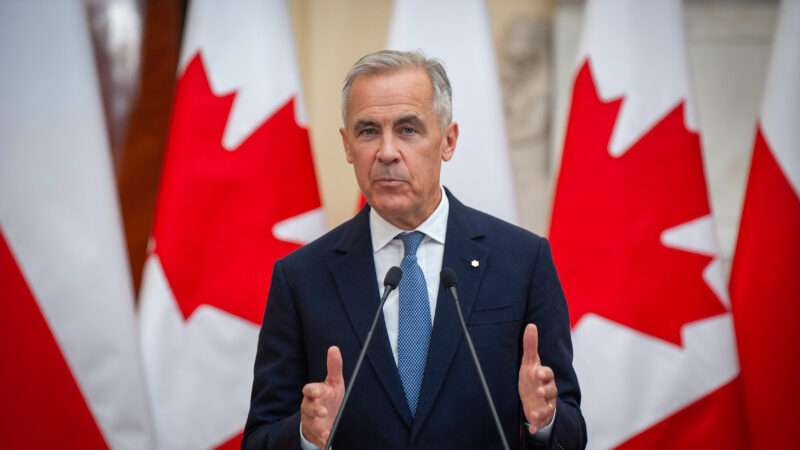
Amid the reshaping of the global economic order, thanks in part to President Donald Trump’s tariffs and trade policies, Canadian Prime Minister Mark Carney is proposing his own restructuring of Canada’s economy.
On Monday, Carney announced the creation of a new “sovereign wealth fund,” called the Canada Strong Fund. The fund will begin at 25 billion Canadian dollars (about $18.4 billion) and will be used to finance various infrastructure projects.
“The order which Canada helped build…is crumbling,” Carney said on Monday. Canada’s “former strengths built on [its] close ties to the United States have become [its] weakness,” he added.
To rectify this, Carney’s proposed wealth fund would serve as “a national savings and investment account,” and be modeled after Norway’s $2 trillion investment fund. Except, this is not what the Canadian government is proposing.
While the Norwegian investment fund is financed by the country’s oil and gas revenues, only spends the return it makes, and can only make expenditures outside of the country (a measure to prevent corruption and political horse-trading), Carney’s proposal would be funded by borrowing and its money spent on Canadian companies. In his announcement, Carney said that the fund will go toward investments in infrastructure, advanced manufacturing, energy, and mining, where “leading Canadian companies” will receive the money.
“It’s not a sovereign wealth fund. It’s a debt-fueled corporate slush fund,” Franco Terrazzano, federal director of the Canadian Taxpayers Federation, tells Reason. “Carney’s fund is not built on wealth or savings. It’s built on borrowed money, and it’s going to gamble tax dollars on risky corporate handouts.”
The exact details of what projects the government will spend its borrowed money on are yet to be announced, but Canadian public finances will likely take the hit. The government is already predicting a $66.9 billion deficit for FY 2026, and federal debt has climbed to over $1.2 trillion, which is 41.2 percent of Canada’s GDP.
Despite this precarious position, Carney is going full steam ahead with this scheme. According to Terrazzano, “this isn’t the only slush fund the government has.” He points out that the government already has the Canada Infrastructure Bank, the Canada Growth Fund, and “billions of dollars in other types of subsidies.” All of these programs have a checkered history of irresponsibly spending public money.
The Canada Infrastructure Bank, for instance, was launched in 2017 with $35 billion of taxpayer money. It committed to funding over 100 projects, of which only 11 were finished. Failed bank projects include the Lake Erie Connector project, which aimed to build a high-voltage power line from Ontario to Pennsylvania. After spending $655 million on the $1.7 billion venture, its developer canceled the project due to “rapid cost escalation.” (The bank’s first CEO, Pierre Lavallée, resigned in April 2020, and despite not completing a single project under his tenure, was given generous six-figure bonuses after his resignation.)
Meanwhile, the Canada Growth Fund, which aimed to finance projects that boost the economy and reduce greenhouse gas emissions, has effectively been used as a mechanism for corporate welfare. In 2024, the Canadian government announced that Strathcona Resources, one of the nation’s largest oil producers (which recorded over $4 billion in revenue that year), would get $500 million of taxpayer cash (with the potential to receive up to $1 billion) via the fund to begin engineering work for carbon capture projects across its facilities in Saskatchewan and Alberta. The projects are still underway, but the company expects to recoup “substantially all of [its] share of capital costs” through federal tax credits.
“I think it’s the same politics in Canada that you see all around the world,” says Terrazzano. “Politicians like to spend other people’s money, have press conferences, smile for the camera, and cut ribbons.”
Carney believes that the Canada Strong Fund is needed to make Canada prosperous. But given Canada’s existing fiscal problems and the bevy of other wasteful programs, creating another way for the government to spend more taxpayer money seems like a poor way to achieve this objective.
The post Canada's New 'Sovereign Wealth Fund' Is Actually a Debt-Fueled Spending Scheme appeared first on Reason.com.
from Latest – Reason.com https://ift.tt/D32a1ZV
via IFTTT