ECB Holds Rates At 2%, As Expected, With Stagflation Looming
The European Central Bank kept interest rates unchanged, as expected, with officials signaling they need more time to assess the extent of the Iran war’s jolt to the economy. The deposit rate was left at 2%, where it’s been since June 2025 and in line with the predictions of all analysts in a Bloomberg survey. The ECB offered no guidance on future decisions, reiterating it will act one meeting at a time based on information as it arrives.
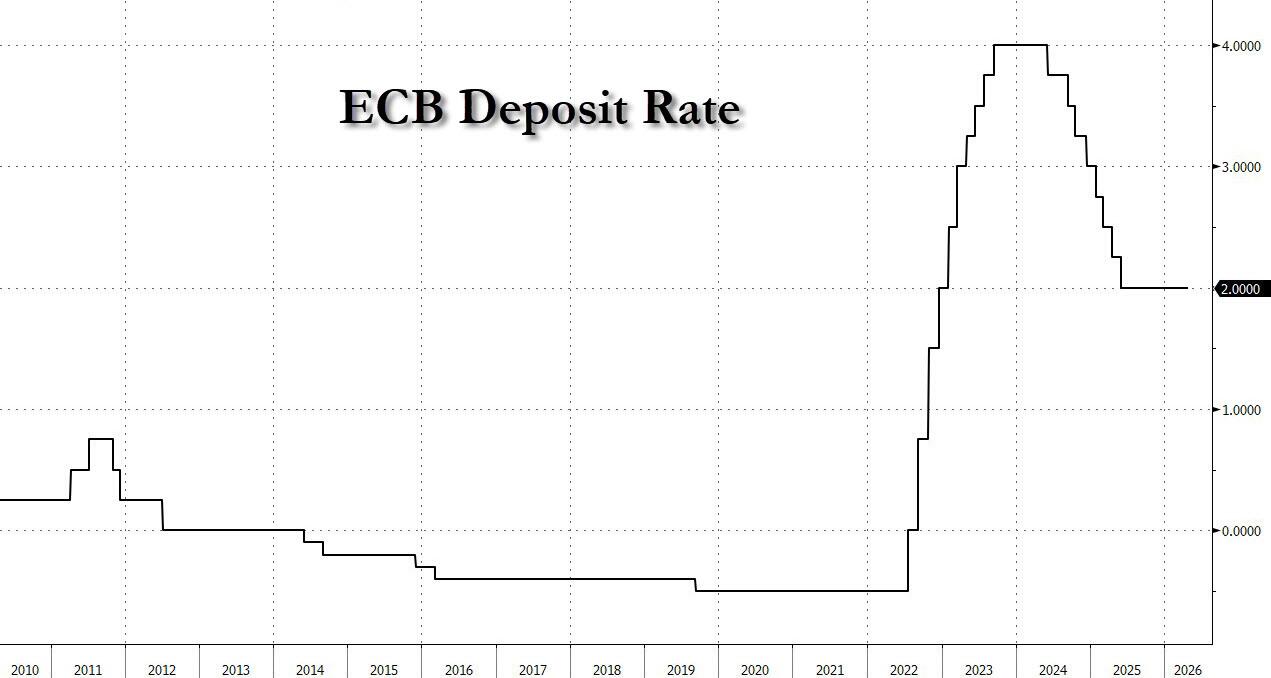
In the statement, the committee cited the usual stagflationary cocktail as cause for concern, namely upside risks to inflation and the downside risks to growth have intensified. As usual, they emphasize the data-dependent and meeting-by-meeting approach and added that their assessment of the inflation outlook and its risks, will be informed by incoming economic and financial data, as well as the dynamics of underlying inflation and the strength of monetary policy transmission.
“The upside risks to inflation and the downside risks to growth have intensified,” the Governing Council said on Thursday in a statement. The Governing Council remains well positioned to navigate the current uncertainty.”
Commenting on the decision, DB’s Chief European Economist Mark Wall said that “the accompanying statement flags an intensification of risks. These are symmetric: upside risks to inflation, downside risks to growth. There remains a sense of calm confidence, with references to the resilience of the economy in recent quarters and longer-term inflation expectations remaining well-anchored. But there is also a sense of rising concern the longer the conflict in the Middle East continues. Overall, this is a statement that does not pre-commit the ECB to hiking in June. But it does not stop the ECB from hiking in June either.”
Here are the statement highlights:
RATES:
- ECB Governing Council holds three key interest rates unchanged
- Deposit facility rate held at 2.00% (exp. 2.00%)
- Main refinancing operations rate held at 2.15% (exp. 2.15%)
- Marginal lending facility rate held at 2.40% (exp. 2.40%)
GUIDANCE:
- ECB not pre-committing to a particular rate path
- Governing Council to follow data-dependent, meeting-by-meeting approach to policy stance
- Interest rate decisions to be based on inflation outlook and risks, incoming economic and financial data, underlying inflation dynamics, and strength of monetary policy transmission
- Governing Council stands ready to adjust all instruments within its mandate to ensure inflation stabilises at 2% in the medium term
- Transmission Protection Instrument available to counter unwarranted, disorderly market dynamics that pose a serious threat to monetary policy transmission
INFLATION:
- Upside risks to inflation have intensified
- Euro area entered current period with inflation at around the 2% target
- Shorter-horizon inflation expectations have moved up significantly
- Longer-term inflation expectations remain well anchored
- War in the Middle East has led to a sharp increase in energy prices, pushing up inflation
- Longer the war continues and energy prices remain high, the stronger the likely impact on broader inflation
ECONOMY:
- Downside risks to growth have intensified
- War in the Middle East weighing on economic sentiment
- Euro area economy has shown resilience over recent quarters
- Implications of war for medium-term inflation and activity will depend on intensity and duration of energy price shock and scale of indirect and second- round effects
While policymakers have stressed since the conflict broke out that they’ll act decisively if inflation shows signs of spiraling, data available so far haven’t convinced them. The ECB isn’t alone in holding fire: The Federal Reserve sat tight on Wednesday and the Bank of England decided against a move earlier on Thursday.
The ECB is also mindful of the blow to output, with data published shortly before its rate announcement showing first-quarter gross domestic product grew by a less-than-expected 0.1% in the euro zone — feeding stagflation fears.
Markets reckon officials will focus on the upswing in prices, which jumped by 3% in April — the quickest since the autumn of 2023 — due to the ramp-up in energy costs. Traders are fully pricing three quarter-point increases in borrowing costs by year-end.
President Christine Lagarde will offer her thoughts at a news conference at 2:45 p.m. Watch it live below:
Tyler Durden
Thu, 04/30/2026 – 08:29
via ZeroHedge News https://ift.tt/fyln3Cj Tyler Durden