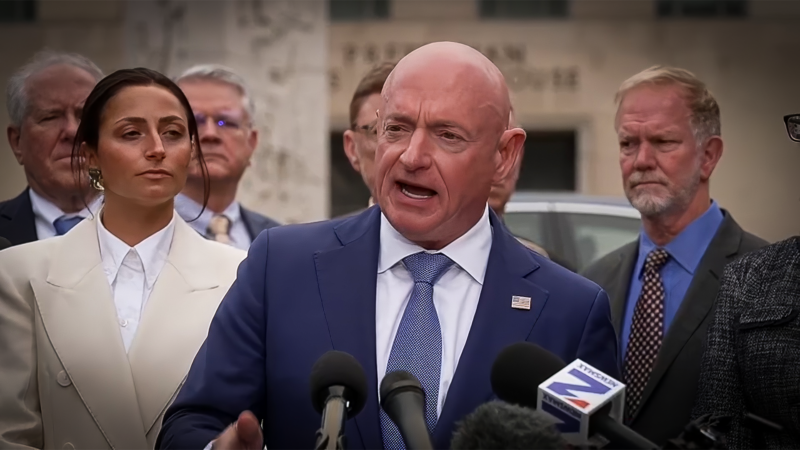
Defense Secretary Pete Hegseth maintains that he has the authority to punish Sen. Mark Kelly (D–Ariz.), a retired U.S. Navy captain, for speech he unilaterally deems “prejudicial to good order and discipline” in the military. That claim, which is at the center of Kelly’s First Amendment lawsuit against Hegseth, ran into stiff resistance at the U.S. Court of Appeals for the D.C. Circuit during oral arguments on Thursday.
Hegseth is asking the appeals court to overturn a preliminary injunction that U.S. District Judge Richard Leon issued on February 12. Leon’s order bars Hegseth from proceeding with disciplinary action against Kelly, including a possible reduction in his retirement rank and pay, based primarily on a November 18 video in which the senator and five other Democratic legislators reminded military personnel of their well-established duty to resist unlawful orders. Leon, a George W. Bush appointee, concluded that Kelly was likely to prevail in his claim that such retaliation would violate the First Amendment.
During Thursday’s D.C. Circuit hearing in Kelly v. Hegseth, the senator’s lawyer, Benjamin Mizer, argued that “the punishments imposed on Senator Kelly are textbook retaliation against disfavored speech.” The letter of censure that Hegseth sent Kelly on January 5, Mizer noted, “says on its face that it is targeting the senator for his public statements.”
Those statements include Kelly’s “criticism of the military leaders for firing admirals and generals, his criticism of them for surrounding themselves with ‘yes men,'” Mizer noted. “And [the letter] even attacks him for saying that he will always defend the Constitution. The senator made all those statements, including [the video], as a member of the Senate Armed Services Committee and the Senate Intel Committee, which gives him a constitutional duty to oversee the military. The fact that he is also a highly decorated war veteran who receives a military pension does not give defendants license to retaliate against his protected political expression.”
According to Hegseth, it does. His argument relies mainly on the Supreme Court’s 1974 decision in Parker v. Levy, which upheld a prison sentence that a court martial imposed on an active-duty officer who had publicly urged soldiers to disobey deployment orders during the Vietnam War. That decision emphasized the “fundamental necessity for obedience” within the “specialized society” of the U.S. armed forces, which the Court said justified speech restrictions that otherwise “would be constitutionally impermissible.” The main issue in Kelly v. Hegseth is whether the logic of that decision also applies to retired officers like the senator, meaning they are not free to say things that the defense secretary views as deleterious to military discipline.
Justice Department lawyer John Bailey urged the D.C. Circuit panel to accept that proposition. But two of the three judges were clearly not inclined to equate Kelly with Capt. Howard Levy, the Army physician whose punishment the Supreme Court approved in Parker.
Judge Nina Pillard, a Barack Obama appointee, noted that Kelly, unlike Levy and contrary to what Hegseth repeatedly claimed in his letter of censure, never urged service members to disobey lawful orders. Rather, the video that offended Hegseth dealt specifically with the duty to “refuse illegal orders.” That is “something that’s taught at Annapolis to every cadet,” Pillard said.
The video, which faulted the Trump administration for “pitting our uniformed military and intelligence community professionals against American citizens,” did not include any specific examples of illegal orders. Pillard noted that Hegseth’s letter likewise “doesn’t identify specific orders or types of orders” that Kelly supposedly said should be disobeyed.
Judge Florence Pan, a Joe Biden appointee, emphasized the implications of the government’s position. If a retired officer “wants to make statements in the public sphere about obeying or disobeying illegal orders and things of that nature,” Pan said, “they have to give up their rank, their pay, [and] their retired status in order to say those things because [otherwise] they’re obligated not to say those things….These are people who serve their country. Many of them put their lives on the line. And you’re saying that they have to give up their retired status in order to say something that is a textbook example taught at West Point and the Naval Academy: that you can disobey illegal orders.”
When Hegseth says Kelly’s comments were “prejudicial to good order and discipline,” Pan said, it “means the soldiers would have to understand him to be telling them to disobey lawful orders, even though he said the opposite.” Hegseth also argues that the video, combined with Kelly’s criticism of President Donald Trump’s domestic military deployments and his murderous military campaign against suspected cocaine smugglers, amounts to urging defiance of orders related to those operations. That argument, Pan said, “assumes that the average soldier would know this whole context in order to draw that inference,” which “just seems implausible to me.”
Judge Karen Henderson, a George H.W. Bush appointee, was more sympathetic to Bailey’s argument, repeatedly noting that Kelly is “a senator with a bully pulpit,” meaning his words might be especially influential, potentially implicating Hegseth’s avowed concern about military discipline. Henderson also averred that Kelly’s public criticism of Trump’s National Guard deployments “has no meaning other than stop the deployment, stop the National Guard from going into cities.” And she noted that retired officers are “subject to court martial,” which she said means lesser penalties “are necessarily included.”
Pillard, by contrast, noted that “there are no cases” addressing “the speech rights of retired service members”—a point that Leon emphasized in explaining why he decided to issue an injunction. “The government argued that the speech at issue here was unprotected under the First Amendment” based on Parker, Pan said. Yet that case “involved an active-duty officer,” while Kelly “is a retired officer,” and the facts were quite different: Levy “was saying that people should refuse orders to fight in Vietnam,” while “all Senator Kelly said was a truism, which is that you should decline to follow illegal orders, and nobody disputes that.”
The question for the appeals court is whether Parker “governs the situation,” Pan said. “If it does not, that’s it.” Leon “did not affirmatively adopt some standard that equates retired service members with civilians,” she added. “All [he] did was reject the only argument the government made, which was [that] under Parker v. Levy this is unprotected conduct. That’s all that we have before us.”
It is possible “there’s a different standard for military retirees” that gives them more leeway than active-duty soldiers but less than ordinary civilians, Pan conceded. “But that was never sort of fleshed out because the government never made that argument. So all [Leon] had to do was reject the argument that you did make, which was that military retirees are equal” to active-duty service members.
If that were true, Hegseth would have the power to regulate the speech of 2 million or so retired officers. In a brief supporting Kelly, 73 former admirals, generals, and service secretaries who held positions under presidents of both major parties emphasize the speech-chilling impact of that situation.
The speech of military retirees “is now being chilled because of the actions of defendants in this case,” Mizer told the D.C. Circuit panel. “They are afraid to speak freely on matters of public policy. They’re afraid to post on social media their views about the secretary of defense because they’re afraid for their pension. And that is an extraordinary chilling effect.”
According to the government, retired officers must “give up their pension” if they don’t want the secretary of defense to police their speech, Mizer noted. “That position is as much an insult to the service that veterans have given this country as it is to the First Amendment.”
The post D.C. Circuit Seems Disinclined To Let Pete Hegseth Punish a Senator for His Speech appeared first on Reason.com.
from Latest – Reason.com https://ift.tt/ERnvT3I
via IFTTT