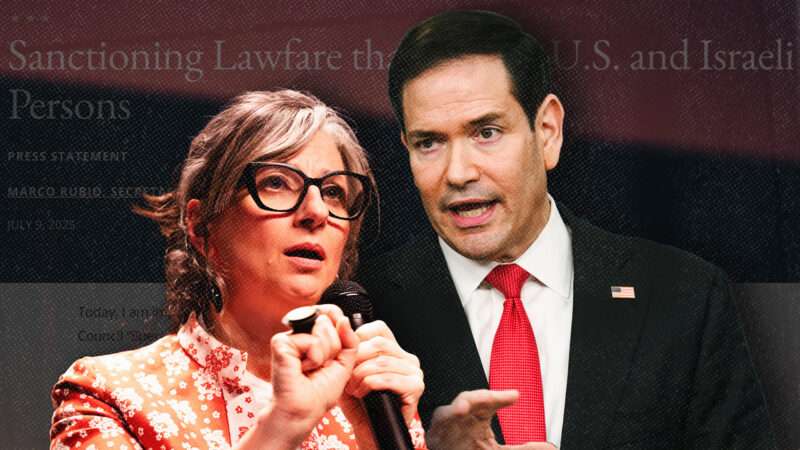
Over the past few years, the U.S. government has been experimenting with using economic sanctions to shut up voices that annoy it. In 2021, the Biden administration seized the websites of several news outlets it accused of being Iranian propagandists (including some that turned out to be Iranian dissident outlets). And in 2025, the Trump administration sanctioned U.N. Special Rapporteur Francesca Albanese for recommending prosecutions of companies that benefit from the Israeli-Palestinian conflict. Secretary of State Marco Rubio accused Albanese of waging “lawfare that targets U.S. and Israeli persons.”
On Wednesday, a U.S. federal court blocked the Department of the Treasury from enforcing the sanctions on Albanese, ruling that Albanese’s family is “likely to succeed” in their First Amendment lawsuit against the government. “Albanese has done nothing more than speak! It is undisputed that her recommendations have no binding effect on the [International Criminal Court’s] actions—they are nothing more than her opinion,” Judge Richard Leon wrote in the ruling.
Leon cited Rubio’s own sanctions announcement—which accused Albanese of “unabashed antisemitism…support for terrorism, and open contempt for the United States, Israel, and the West”—as evidence that the sanctions were meant to punish mere speech.
The ruling did not mention the other constitutional issues that the Albanese family mentioned in their lawsuit. The family’s original complaint claimed that the government was violating the Fourth Amendment by seizing their property without due process and the Fifth Amendment by treating family ties as criminal. The State Department also sanctioned Albanese’s husband, World Bank economist Massimiliano Cali, banning him from visiting the bank’s headquarters in Washington.
Albanese told The Guardian last month that the sanctions turned her life into a “rollercoaster.” Her apartment in Washington was seized by the U.S. government, and she was frozen out of the bank account and insurance plan she shares with her husband. Georgetown University even closed her faculty email account because the university claimed it was “prohibited by federal law from affiliating with individuals subject to U.S. sanctions.” And the sanctions have followed Albanese around the world, including to her home country of Italy, due to fear of the U.S. Treasury. Hotels refuse to give Albanese bookings, and foreign banks won’t process her payments.
Albanese and Cali were sanctioned under Executive Order 14203, which bans cooperation with the International Criminal Court in the Hague over its investigations of the Israeli and U.S. militaries. (Members of Congress have also tried to ban sharing information about Israeli businesses with international investigators.) Albanese’s infamous report “urges the International Criminal Court and national judiciaries to investigate and prosecute corporate executives” for their involvement in Israel. But that’s all she has the power to do: urge. U.N. special rapporteurs are unpaid outside researchers invited to advise the U.N. Human Rights Council, with no real authority.
While the Trump administration’s lawyers claimed that Executive Order 14203 “is a regulation of conduct, not speech,” Leon pointed out in his ruling that Albanese was guilty of “nothing more than ‘communicating a message’ with which defendants disagree.”
The administration also tried to argue that Albanese was not protected by the First Amendment because she was not American and her activism took place outside of America. Leon countered that the government punished her “by taking action against Albanese’s extensive connections to the United States,” including her property, her connections to American organizations, and her ability to be with her American daughter, making it a relevant First Amendment issue.
Leon’s ruling might be the first successful First Amendment challenge to U.S. sanctions law. Under the Biden administration, the Treasury tried to argue that hosting sanctioned individuals at an academic conference would be providing them with an illegal “service,” only to back down after a lawsuit.
There’s no guarantee that a higher court won’t overturn Leon’s ruling. (After all, in 2010, the Supreme Court ruled that the government could ban Americans from giving peace-building and human rights classes to Kurdish and Tamil rebels under counterterrorism sanctions.) But it is a recognition by a court that the Treasury’s arbitrary, total, global control over individuals’ property might be a dangerous power to give the government.
The post Judge Stops U.S. Treasury From Sanctioning Someone's Speech appeared first on Reason.com.
from Latest – Reason.com https://ift.tt/zOSQXyK
via IFTTT