Iran’s Floating Oil Stockpile Jumps 65% As U.S. Naval Blockade Bites
By Charles Kennedy of OilPrice.com
The volumes of Iranian oil stored at tankers in and around the Strait of Hormuz have jumped in recent weeks as Iran considers ways to circumvent the U.S. blockade in the Gulf of Oman aimed at choking Iranian oil exports.
The number of tankers laden with crude but sitting in the Persian Gulf and near the Strait of Hormuz has jumped since the U.S. initiated in the middle of April a naval blockade to prevent Iranian oil exports and force Tehran into a deal, a Financial Times analysis of shipping and satellite imagery data showed on Tuesday.
Data from the U.S.-based non-profit United Against Nuclear Iran (UANI) showed that the number of tankers in the Gulf laden with Iranian crude and petrochemicals has now jumped to 49, up from 29 before the U.S. blockade began on April 13.
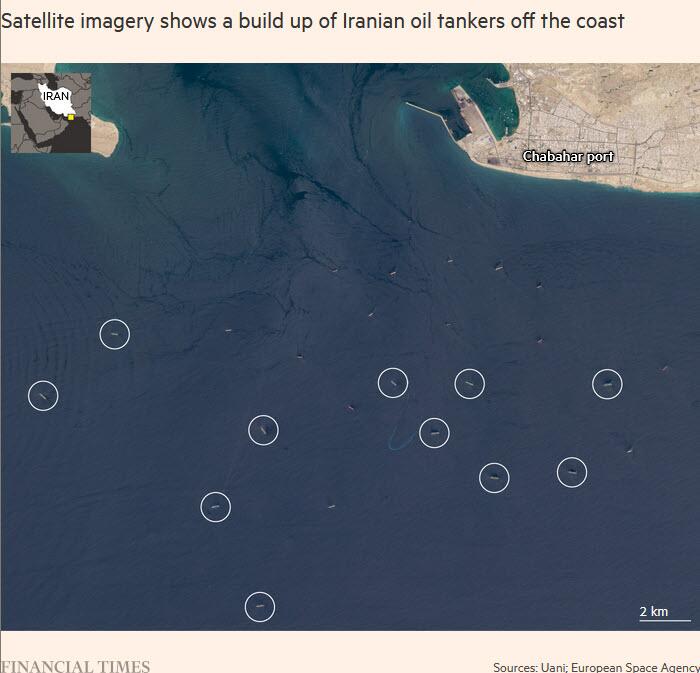
Separately, UANI and FT have identified more than a dozen tankers clustered near the Iranian port Chabahar outside the Strait of Hormuz but within the line of the U.S. blockade.
Ship-tracking and maritime intelligence analyses pointed three weeks ago that Iranian tankers laden with oil were loitering in a cluster near the port of Chabahar. The cluster signals that Iran continues to load oil on Iranian tankers that are trying to leave the Middle East region. On the other hand, the piling up of ships outside the Strait of Hormuz but inside the U.S. blockade line suggests that the American interception of vessels is working.
Tanker Tally at Iran’s Kharg Island Hits Post-Blockade Peak: BBG
Running out of tankers to store oil.
— zerohedge (@zerohedge) May 18, 2026
About 42 million barrels of Iranian crude are now sitting on Iranian tankers, many of these old vessels, in the Middle East, a 65% surge compared to the beginning of the war, per Kpler estimates cited by FT.
Loadings at Kharg Island, Iran’s key export port, have come to a standstill, maritime intelligence firm Windward said in a report last week.
“At the same time, dark tanker concentrations across northern Hormuz, eastern Hormuz, and Chabahar indicate that Iran is increasingly relying on protected holding zones to buffer export capacity and manage outbound flows,” Windward’s analysts said.
“Persistent ship-to-ship transfer activity, bunkering operations, and prolonged dark anchorage behavior reinforce indications that covert cargo-transfer and sanctions evasion operations are expanding inside Iranian territorial waters.”
Tyler Durden
Tue, 05/19/2026 – 14:20
via ZeroHedge News https://ift.tt/gO3GtwK Tyler Durden