Samsung Union Authorizes Massive Strike At Memory-Chip Plants After Mediation Talks Collapse
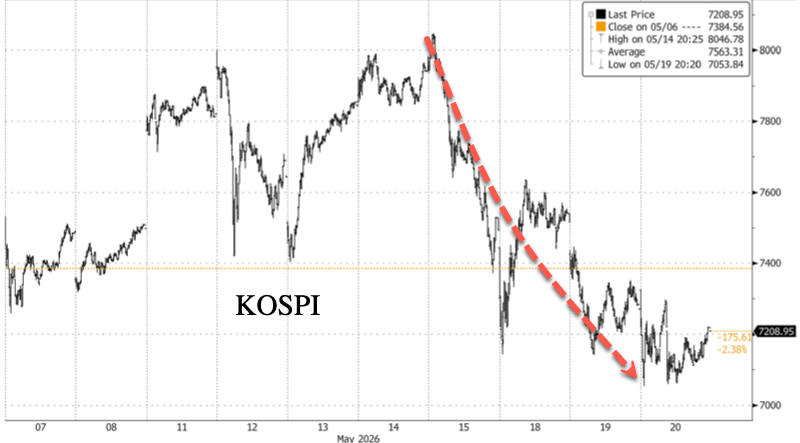
Asian equities extended losses for a fourth straight session, with South Korea’s benchmark KOSPI falling about 1% as the market priced in the shock of an imminent labor action at Samsung Electronics.
A full-scale, 18-day strike involving more than 47,000 workers at the world’s largest memory-chip maker is set to begin Thursday, raising the risk of production disruptions across the global semiconductor supply chain, which is already tight due to AI data center buildouts.
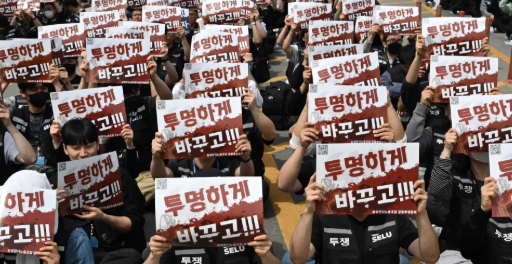
Samsung Electronics’ talks with its largest union collapsed overnight as union negotiators demanded the removal of a bonus cap, allocation of 15% of operating profit to worker bonuses, and that those terms be written into contracts, citing memory-chip maker SK Hynix’s 10% profit-sharing arrangement.
Samsung negotiators accepted most of the demands, including a proposed 10% operating profit bonus pool and special compensation, but called the union’s remaining requests unsustainable.
“We deeply regret that the post-mediation process has concluded [without resolution] due to delays in decision-making by the management,” Samsung Electronics Labor Union Chairman Choi Seung-ho told reporters at the National Labor Relations Commission in the city of Sejong. “We cannot help but feel disappointed that the mediation ended without the company ultimately reaching a decision.”
Japan’s financial outlet Nikkei Asia reported, “The strike would affect only the company’s domestic plants, which are the base of its chipmaking operations.”
The collapse in talks comes as Samsung shares surge on record profits, driven by soaring demand for memory chips, even as hyperscalers are set to deploy $700 billion in capex to build AI infrastructure in the US. Demand is also rising globally as the race for AI compute intensifies.
TrendForce data show that Samsung is the world’s largest memory chipmaker, with a 36% market share in DRAM chips and one-third in NAND Flash chips.
Commenting on the market reaction, UBS analyst Joe Dickinson noted:
“Asia was lower for a fourth consecutive session, with the KOSPI dropping as much as 3% on Samsung strike risk before partially recovering.”
UBS analyst Kevin Loke commented on the FX reaction:
USDKRW initially traded with an offered tone, with spot opening at 1513.4 and falling nearly 10 won to a low of 1503.8. However, headlines that the Samsung union strike will proceed as planned on Thursday, following a breakdown in talks, pushed the pair back higher toward 1510.
A BoK report to the president estimated a potential impact of up to KRW30 trillion in lost production. For now, USDKRW is likely to remain within a broader 1480–1520 range, with the pair relatively less sensitive to the recent thematic shift toward the global bond sell-off.
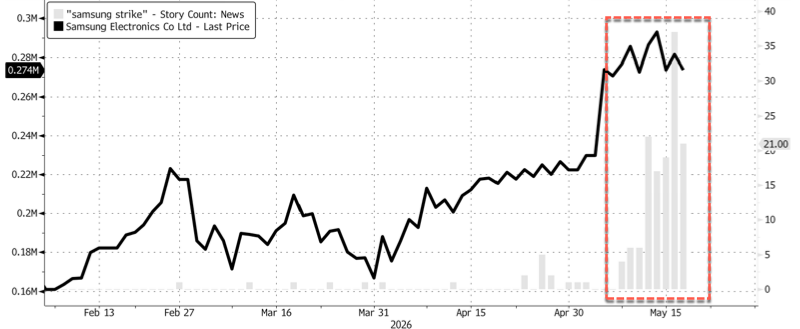
Samsung shares fell as much as 4.4% before reversing their losses. Notice “Samsung Strike” headlines in corporate media weighing on shares…
Coverage:
-
Samsung Strike Threat Sparks Selling Contagion In Memory Stocks
-
Samsung, South Korean Union Resume Talks As Strike Threat Risks Disrupting Memory Chip Fabs
-
Samsung, Union Resume Talks After Labor Action Scare; Goldman Says “Korea: Buy”
Bloomberg pointed out, “The government has previously hinted that it could resort to rarely used emergency powers to prevent a strike if the parties fail to reach an agreement. South Korea has invoked the emergency arbitration mechanism only four times since 1969.”
Tyler Durden
Wed, 05/20/2026 – 07:20
via ZeroHedge News https://ift.tt/08inDyj Tyler Durden