Food Stamp Fraud Pipeline Exposed: U.S. Taxpayer-Funded Groceries Shipped Overseas And Sold For Profit
Submitted by Anthony Rubin of Muckraker.Org,
Food stamps and food pantries are intended to keep struggling Americans fed.
What we found is that, in some communities, that food never reaches an American table. Instead, it gets shipped overseas and sold for profit.
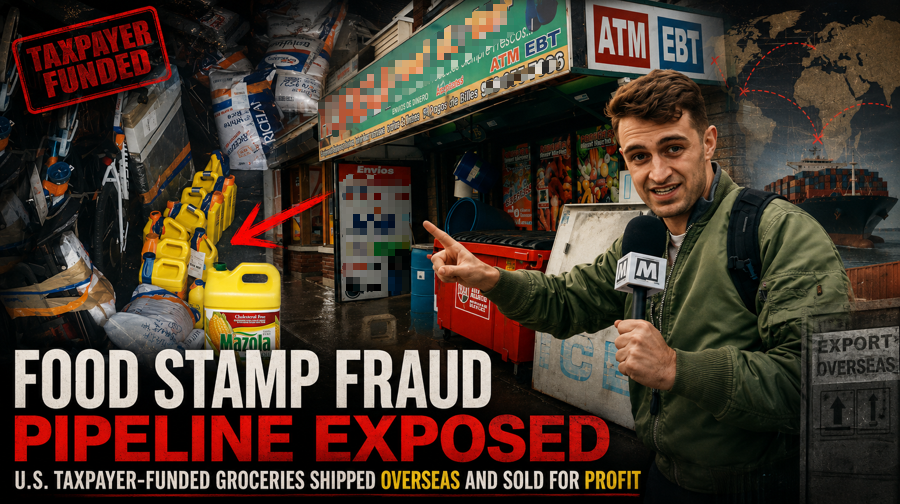
The scheme works like this. Residents in cities like Lawrence, Massachusetts collect food through two channels: purchasing it at local markets using EBT cards, and picking it up for free from food banks and churches. That food is then packed into large blue barrels, dropped off at shipping companies, and sent by container ship to the Dominican Republic. Once it arrives, it is sold for profit in local stores. The people doing this see nothing wrong with it. In many cases, they do it openly.
According to a local that assisted us with this story, this fraud has been happening for over a decade.
Over the course of several weeks, Muckraker Foundation traced the full pipeline from food pantry lines in Lawrence, Massachusetts, through shipping warehouses in New York, to store shelves in Santo Domingo. This is what we found.
Lawrence, Massachusetts
Lawrence is a small city about 30 miles north of Boston. It has the highest concentration of Dominican immigrants of any city in Massachusetts, and the highest rate of SNAP enrollment in the state.
John has been delivering goods in Lawrence for over 11 years, six days a week, 35 stops a day. He knows the community intimately.
“I’ve been witnessing the Dominican residents going to food bank lines and collecting non-perishable goods,” he told us, “and then packing it in barrels and in boxes, and then they ship it back to the Dominican Republic.”
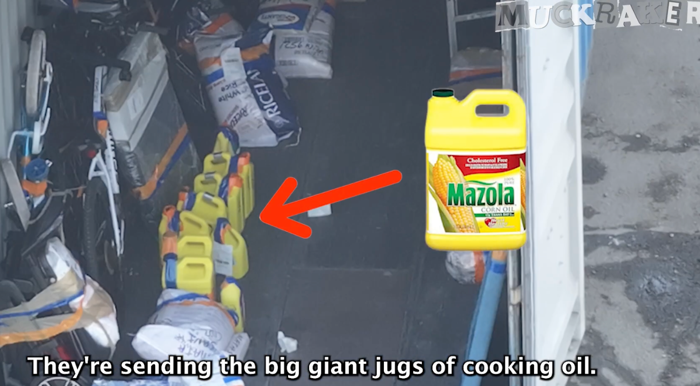
We asked him how he knew the food was being purchased with food stamps.
“Some of them have openly told me and my wife that that’s what they’re doing,” he said. “And then the other way is the math.”
The math is straightforward. A 50-pound bag of rice costs $30 in Lawrence. That same bag costs $35 in the Dominican Republic. Add shipping, and the economics make no sense unless the food was free or paid for with government benefits.
John drove us through the streets of Lawrence and showed us the evidence hiding in plain sight: blue shipping barrels, stacked outside corner stores, for sale. Not one store. Not two. Store after store after store.
“These barrels aren’t trash cans,” John said. “They’re being used to ship the product.”
Every one of those stores also advertised, prominently, that they accept EBT.
Abigail has worked in Lawrence since 2011. She asked us not to disclose her profession, but her job takes her inside people’s homes on a daily basis.
“Many of them will have large boxes, large bins in their apartments full of the food that they give out at the pantries here,” she told us. “And when I ask them what it’s for, they say they mail it back so it can either be given to their families there or be sold in the bodegas there.”
We asked if these patients knew they were doing something wrong.
“No,” she said, and laughed quietly. “They feel entitled. They feel like that’s what we come here for.”
We asked how widespread she believed the fraud to be among the patients she visits.
“About half,” she said. “Half the people I see.”
New York
Massachusetts has some of the strictest wiretapping laws in the country, which limited what we could capture on camera. So we moved the investigation to New York.
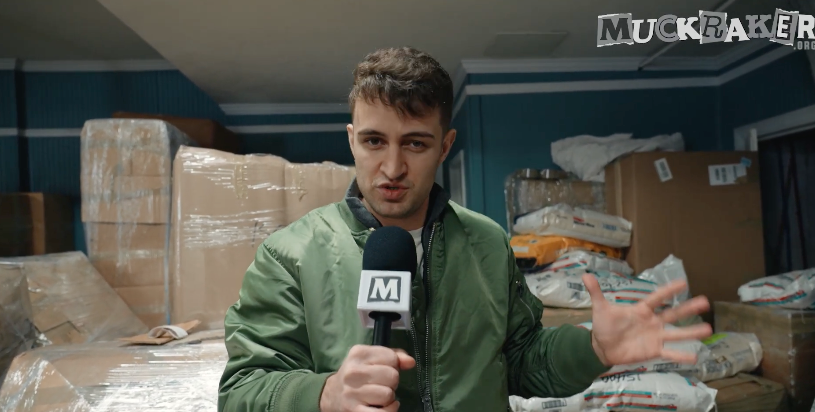
In the Bronx, we located a storage facility being used by numerous Dominican shipping companies as a distribution hub. We sent in an associate with a hidden camera. A worker confirmed explicitly, on camera, that people are using EBT to purchase the food being shipped in those boxes.
From there, the food moves to Port Newark, one of the largest container terminals on the East Coast. It is from Port Newark that tens of thousands of pounds of food, likely amounting to millions of dollars, is loaded onto ships bound for the Dominican Republic.
Santo Domingo
Inside a small bodega in Santo Domingo, Dominican Republic, a shop owner told us on camera that the inventory is purchased with EBT cards in New York. The prices on the shelves told the same story. The food was selling for roughly the same price as it does in the United States. After shipping costs, that price only makes sense if the food was obtained for free.
At a second shop in Santo Domingo, the owner told us she gets her inventory from churches in New York City, and that when she goes to collect the food, she uses her Dominican ID and her mother’s American address.
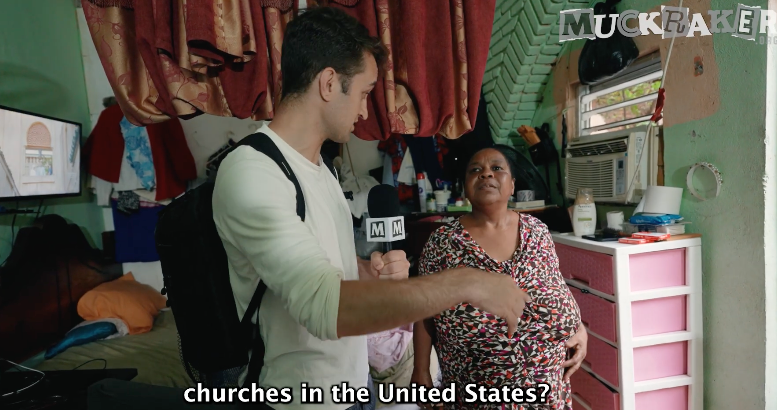
In boxes behind her: Ronzoni pasta, Campbell’s chicken noodle soup, Goya beans, Quaker oats, and more. Food donated by Americans, intended for Americans, now sitting in a bodega in Santo Domingo.
The Bigger Picture
When food stamps were first introduced in 1964, the program served fewer than 400,000 people, less than one fifth of one percent of the American population. Applicants had to appear in person at state welfare offices, pass strict income and asset tests, and have their eligibility certified by state caseworkers.
Today, nearly 42 million Americans receive SNAP benefits, roughly one in eight people in this country, at a cost to taxpayers of over $100 billion in 2025 alone.
What began as a modest safety net has become one of the largest federal assistance programs in American history. And as this investigation shows, it is being exploited in broad daylight, on the main streets of American cities, by people who see nothing wrong with it.
Watch
Muckraker is calling on federal authorities to investigate what we have uncovered. We are prepared to share our findings, our footage, and our sources with any legitimate investigative body.
Tyler Durden
Wed, 05/27/2026 – 11:40
via ZeroHedge News https://ift.tt/zeSdQ7W Tyler Durden