‘Crypto Spring’: StanChart Sees Ethereum Outperforming As Mt. Gox Moves $739M BTC From Cold Wallets
“Over the past week, we acquired 26,497 ETH,” Bitmine Immersion Technologies Chair, Tom Lee, said in a statement on Monday.
“In our view, ETH prices are not reflecting the strengthening of Ethereum fundamentals, but then again, this is not surprising given we are in the early stages of crypto spring.”

As CoinTelegraph reports, Bitmine is the largest Ether treasury company with 5.4 million ETH worth more than $10.5 billion.
It had slowed its pace of buying earlier this month after scooping up more than 100,000 Ether a week for three straight weeks.
Lee told CNBC on Monday that there is disappointment in crypto at the moment because it hasn’t moved while other sectors like software are rallying, but argued that it “always happens at the end of crypto winter.”
Lee argued that the thesis for Bitcoin and Ethereum that he believes in still stands; that they are likely to be the future of money, despite the short-term price downturn across the market and some long-term holders and whales selling.
“As AI systems evolve, we’re now talking about using commerce and operating websites, you need decentralized identity and verification, and that’s really what crypto does,” he said.
“We know Wall Street wants to go toward tokenization; it’s a vast improvement in efficiency of how money actually moves, and it’s an innovation. That only happens on Bitcoin, Ethereum and other smart contracts. The future isn’t changed.”
Meanwhile, Bitcoin has tumbled to two-month lows, dramatically diverging from traditional equity markets’ recent surge…
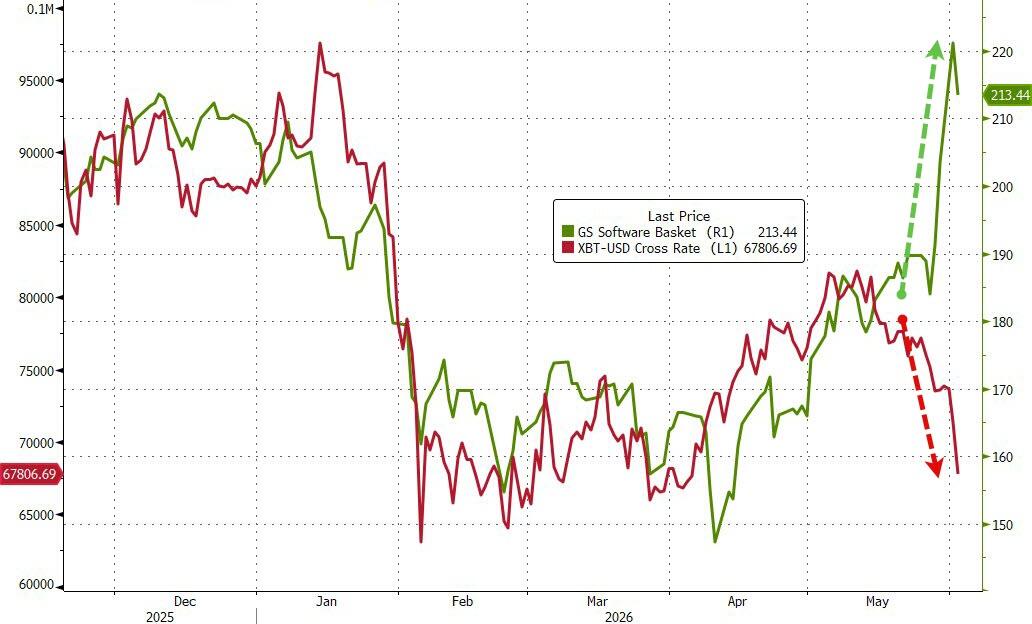
Andri Fauzan Adziima, research lead at Bitrue Research Institute, told Cointelegraph that some analysts have noted that Bitcoin is the only major asset in contraction right now, and the divergence is notable.
“It shows Bitcoin is trading more like a high-beta risk asset tied to macro sentiment rather than an independent hedge,” he added.
“This gap highlights current weakness, but it also sets up potential for stronger relative performance once macro conditions improve. I view it as a temporary phase in the cycle, not a permanent shift.”
Analytics platform Santiment said on Monday that “the gap between traditional equities and crypto has become increasingly difficult for traders to ignore.”
However, Santiment said that this pattern won’t last forever, and “mainstream influencers” discussing stock dominance over crypto is often a good sign that the crowd is leaning too far into the “equity FOMO and crypto FUD.” Markets generally move opposite to the majority of traders’ expectations, it added.
This most recent decline in bitcoin comes after Michael Saylor’s Strategy actually sold some of its holdings (admittedly a de minimus amount) and perhaps even more ominously, as CoinTelegraph reports, defunct Japanese crypto exchange Mt. Gox moved roughly $739 million worth of Bitcoin from its cold wallets early Tuesday, its first onchain movement in over two months, according to Arkham Intelligence data.
Blockchain data shows the exchange transferred 10,306 Bitcoin (BTC), worth approximately $730.8 million, from its cold wallet to an unmarked address at 4:47 am UTC.
The transferred Bitcoin is currently marked as “unspent” by Arkham. The exchange also made a separate transfer of 116.3 BTC, worth around $8.25 million, to its hot wallet at the same time, which is marked as “spent.”
The transferred Bitcoin being marked “unspent” means the funds are sitting in the new address and have not yet been sent anywhere further. On the other hand, “spent” means those funds have already been moved on again to another address.

The large movement has raised questions about whether creditor distributions are imminent, which could weigh on markets, as creditors who have waited over a decade to recover their funds may choose to sell once they receive their Bitcoin.
Bringing all of this together, Standard Chartered’s Geoffrey Kendrick sees opportunity in buying Ethereum against Bitcoin here, suggesting it’s only a matter of time before ETH catches up to improving internal metrics.
Internal metrics for Ethereum (ETH) continue to improve – transaction numbers and total value locked (measured in ETH terms) both remain close to all-time highs.
However, the ETH price continues to underperform in both absolute and relative terms – ETH-USD has fallen 57% from its August 2025 high to around USD 2,100, while ETH-BTC is down 37% over the same period.
Describing Amazon during the 2001 dot-com bust, Jeff Bezos said, “While the stock price was going the wrong way, everything inside the company was going the right way”.
We think the same applies to the current ETH price.
Similar to the Amazon example, we see significant scope for the ETH price to catch back up to internal metrics.
Ethereum is poised to benefit as traditional finance (TradFi) equivalents migrate to digital assets.
We project that stablecoin market cap will increase 6x from current levels by end-2028, and that the market cap of tokenised, non-stablecoin real-world assets (RWAs) will multiply 50x over the same period. Ethereum dominates both of these segments, with 50-65% of each underlying market being on Ethereum. These segments now account for more than half of the value locked on Ethereum.
As such, Kendrick reaffirms his ETH forecasts of USD 4,000 for end-2026 and USD 40,000 for end-2030. This would take ETH-BTC back to the 2021 highs around 0.08.
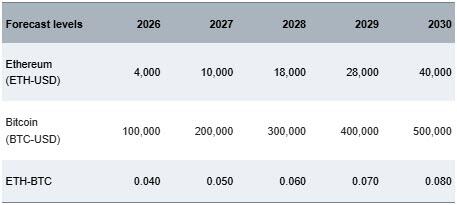
And Kendrick notes that yesterday saw the beginning of ETH outperformance relative to BTC.
The market reaction to MSTR’s sale of 32 BTC (a ridiculously small amount for MSTR to sell, given it still owns 843,706 BTC) was telling.
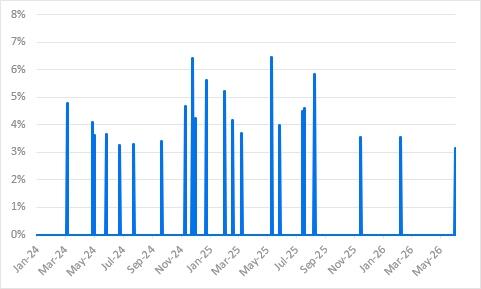
Specifically, on days where the BTC price falls, yesterday was one of the largest ETH-BTC topside moves of the past few years (there have been just 23 days since the start of 2024 more than yesterday).
The StanChart analyst highlights the larger moves in this chart:
Figure – ETH-BTC price moves on BTC down days (that are bigger than yesterday)
Further, MSTR’s selling (whilst small) highlights the different business models of the BTC DATs from the ETH DATs.
Specifically, because ETH has a 3% staking yield there is zero need for the ETH DATs to ever sell ETH (differently to the BTC DATs).
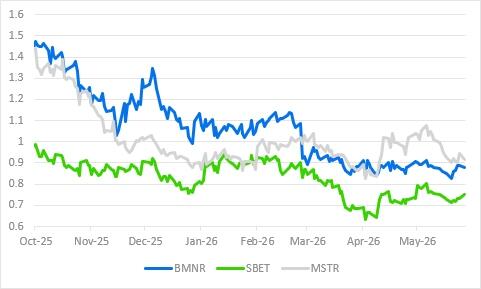
As such I would expect the mNAVs of the main ETH DATs to go back above that of MSTR (and a higher mNAV makes these businesses more sustainable).
I highlight the mNAV of BMNR and SBET here:
Figure – mNAV of BMNR and SBET v MSTR
Days like yesterday form important turning points for ETH-BTC.
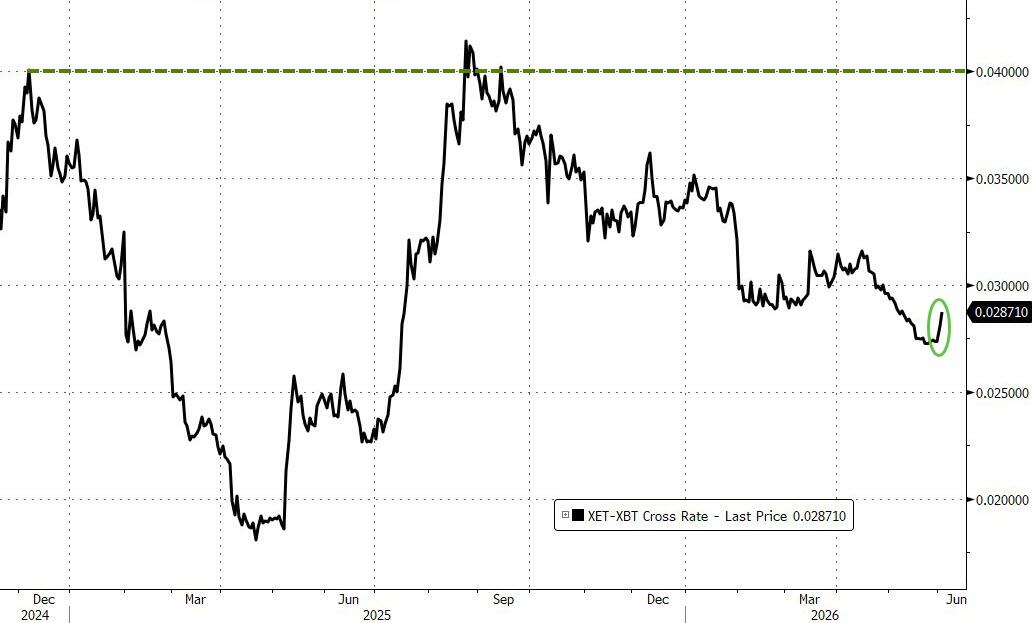
Kendrick sees that cross back at 0.040 by year-end (from 0.028 today), even if (as is likely) MSTR this week buys a large multiple of the 32 BTC it sold last week.
Tyler Durden
Tue, 06/02/2026 – 13:15
via ZeroHedge News https://ift.tt/RPq58jy Tyler Durden