In a special America 250 issue, Reason takes a look back at our country’s founding people and ideas. Read more here.
Supreme Court Justice Neil Gorsuch has a new children’s book, Heroes of 1776: The Story of the Declaration of Independence, co-authored with attorney Janie Nitze. It tells the story of the people behind the Declaration, and the risks and courage it took to bring that document into being.
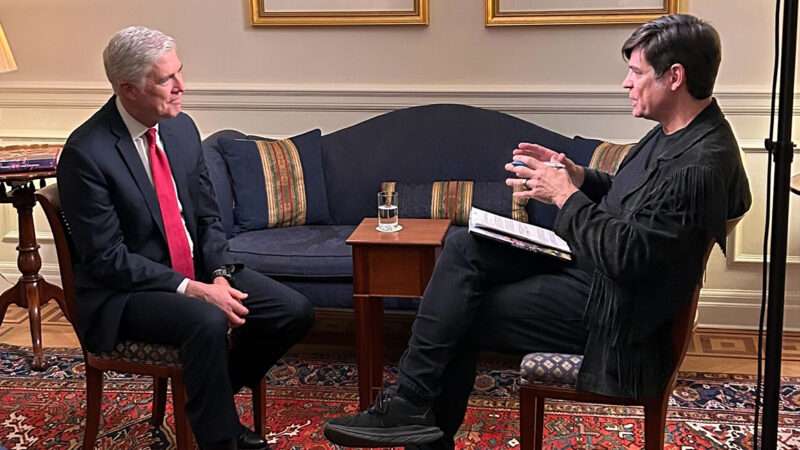
In May, Reason‘s Nick Gillespie joined Gorsuch at the U.S. Supreme Court to discuss the book as the country approached its 250th anniversary. Gorsuch argues that the core ideas of America’s Founding—equality, inalienable rights, and self-government—still demand courage to defend.
Their conversation moves from the Founding to the present, touching on what it means to call the United States a “creedal nation” built on shared ideas rather than ethnicity or religion. They discuss originalism, equal justice under law, the expanding scope of federal and state regulation, and what all of that means for the future of the American project.
Reason: What is the main lesson America should be thinking about as we approach our 250th birthday?
Gorsuch: We’re going to have a lot of fireworks, and there are going to be some good barbecues and parades, but I hope we take a moment, too, to reflect on the gift we’ve been given and the challenge we face. What I mean by that is, the Declaration of Independence had three great ideas in it: that all of us are equal; that each of us has inalienable rights given to us by God, not government; and that we have the right to rule ourselves.
Our nation is not founded on a religion. It’s not based on a common culture even, or heritage. It’s based on those ideas. We’re a creedal nation. I hope we take a moment to reflect on that and to recommit ourselves to that.
One more thing: the courage it takes to defend those ideas. They were not inevitable. The stories of the men, women, and children in the book, I hope, will inspire children to realize the courage it takes to carry those ideas forward in their own time.
The way American history is often taught, especially to kids, it can feel like “this happened, then this happened, and of course here we are.” How do you focus on the idea that this wasn’t inevitable?
There are a bunch of things in the book we point to. Those three ideas. We point out what Europe was like at the time. It was monarchies. The notion that all people are created equal? No, there are kings and serfs. The notion that you have rights from God, from your creator? No, everything came from government. And self-rule certainly was a very dangerous proposition in the world of the Declaration.
You’re right. We take it as the air we breathe. Fish in the water don’t even realize. But those things were dangerous, and they were traitors for declaring them. The British said that Americans had declared for themselves an inalienable right to talk nonsense. We walk through how the vote originally wasn’t going to go through unanimously.
This is at the Continental Congress.
Yes, the Continental Congress. There was huge debate over it. You have to remember, only about 40 percent of colonists actually supported the patriot cause. Another 20 to 30 percent were Loyalists. A whole bunch of people were undecided. Much as [in] our own age. They were divided. People were divided. There was nothing inevitable about it. Absolutely nothing.
Let’s talk a bit about originalism, the judicial philosophy you follow. The Declaration of Independence isn’t law in the same way that some of the things that come before you in the Supreme Court are, so how do you stay true to its text and meaning without opening the door to people simply asserting, “It’s in the Declaration. If I have the right number of guns or the right number of votes, I can just make that happen.” How do you anchor an understanding of the American project in a text rooted in a particular time?
If you think of the Declaration as our mission statement and the Constitution as the how-to manual, well, the Constitution is all about dividing power. [James] Madison realized men are not angels and that their aspirations for power need to be checked and checked and checked again. So how do we set up our system of government? Three branches, and that’s just at the federal level. That’s horizontally, separated vertically too: States have powers, and the people have powers that are reserved to them as well.
What’s my role in it? My role is as a judge. Judge is an important role, but a modest station at the end of the day. My role’s not to make war. I’m not the commander in chief. My role is not to make the laws. They do that across the street in Congress. My job is to make sure that anybody who comes to court in a dispute has equal justice under law. That is to say, the rich and the poor, as our judicial oath says, come to us equally. You may be very unpopular, but if you have a good, winning legal argument, that’s my job to vindicate it.
That legal argument is bounded by what’s actually on the page. How do you know you’re not just projecting your fantasy onto a particular law?
Once you realize what your role is, not to make law and certainly not to change the Constitution—we the people do that through the amendment process. You’ve got an important job, but it’s a modest job. How do you go about doing that? For me—not for everybody, but the way I see it—my job is to apply the law as a reasonable person would have understood it at the time it was enacted. That way I’m making sure I’m not projecting my hopes and dreams onto the legal text. The text was passed with bicameralism and presentment across the street or through the amendment process and the Constitution itself. If I start changing that and tinkering with that or evolving it based on what I like, who elected me to do that? That’s not my job.
You’re appointed, right? You get a life appointment.
But to do a job. The job is not to be a philosopher king. It’s not to assert Congress’ role. It’s certainly not to assert the amendment process of the Constitution. It’s to ensure that the people who come before me get the promises of the Constitution and the laws. That’s it. That’s my job.
There’s the federal government, there’s state governments, and then there’s the rights of the people. How do you decide when the federal government doesn’t have jurisdiction, but the states or the people do? How do you make that distinction?
I’m particularly interested in unenumerated rights that reside with the people, because it is one thing when the federal government says, “We can’t do this,” but then a state government might say, “We can ban this.” At the end of the day, is America more of a libertarian project than a conservative or liberal project?
I think it is a very tolerant project. Look at the First Amendment: You have a right to speak and worship freely. Those ideas were not, again, inevitable. They were not popular in a lot of Europe. They’re popular today—
Less and less, if you ask me.
That worries me. But it’s a tolerant idea. It’s an idea that you have a right to make your way and your life and pursue happiness, and so do I. We can do that together. When I’m asking, “Hey, what rights can government not touch?” the Bill of Rights is your starting place. That’s absolutely your starting place. Most of the things we care about are there. Look at what the First Amendment covers: the press, the right to petition your government for grievances, the right to assemble. That’s a very important right if you think about it.
You previously co-authored a couple other books with Janie Nitze, including Over Ruled: The Human Toll of Too Much Law, which argues that there are too many laws in America governing people’s behavior. How do we know when a law just shouldn’t be there?
We can’t live without law. You and I, our rights, would be endangered without law. It would be in the state of nature. We couldn’t live with any assurance or security. But there’s also such a thing as too much law. There really is a golden mean. When we speak of the rule of law, what do we mean? We certainly don’t mean just rule by law. Nazi Germany had a whole lot of laws. So it can’t be that. There’s got to be a golden mean to this operation.
Madison talked about it at the beginning of the country, and he said, “The thing I fear most is a proliferation of law.” That’s why they made the lawmaking process so hard. We complain about it today: “Congress doesn’t do anything.” That was by design, because every law is a restriction on your liberty. Why do I say we have too much law? I’ve been a judge for over 20 years now, and I’ve just seen too many cases in which ordinary people who, intending no harm to anyone, just get swallowed up.
Can you give a specific example?
The book is a book of examples. It’s a book of stories and people we knew, we interviewed, talked to. Let me give you one: John and Sandra Yates. He’s a commercial fisherman down in Florida. One day he’s out for red grouper, and alongside comes a state wildlife official who’s cross-deputized with [the National Oceanic and Atmospheric Administration]. He says, “I see some of the red grouper hanging there look a little too small. Can I measure them?” John says, “Well, I’ve been out for weeks. I’ve got thousands of them.” He says, “I have all day.” He spends all day measuring each of John’s red grouper. The limit at the time is 20 inches. He says, “You have 72 red groupers that are slightly below 20 inches.” John disputes the measurements because he says, “This guy doesn’t know red grouper.” He says, “You’re missing the jaw.” But any rate, fine. He says, “See me when you come back to the dock.” Comes back to the dock. The guy does it again, and this time he finds 69 red grouper and he’s suspicious. “Why are there 69 rather than 72?” John hears nothing for years. Nothing. Then one day federal agents surround his home with weapons, the whole body, the whole thing, and arrest him. What do they arrest him for? You ever heard of the Sarbanes-Oxley Act? It was drafted after the Enron and Arthur Andersen—
The tech bubble burst, and it expiated all the sins of a hot stock market in the ’90s.
Among other things, this is: Don’t shred documents. Don’t destroy documents and other tangible objects when you know you’re subject to a federal investigation, because that was what Arthur Andersen allegedly did.
[John Yates] gets charged with violating the Sarbanes-Oxley Act and faces 20 years in prison. What does that have to do with red grouper? The theory is that John threw the 72 red grouper overboard and replaced them, [with still-] undersized 69. He destroyed a tangible object is the government’s theory. This case, I won’t belabor all the details, goes on for years. By the time they bring the prosecution, the size limit for a red grouper is 18 inches. John winds up spending Christmas in prison. He loses his commercial fisherman’s license. His livelihood is destroyed. For what? Maybe he deserved a ticket, something, but his entire livelihood and years through the legal system.
Do you feel like that’s accelerating throughout American society at every level?
Yes.
What’s the cause of that proliferation? Because people aren’t evil. What’s going on?
It’s all done with the very best of intentions. I don’t question that, but it is going on at all levels. When people say that Congress doesn’t do enough, we add about 2 to 3 million words to the federal code every year. The Federal Register, which started off as 16 pages in the 1930s, it’s like 70 or 80,000 added every year.
Why? That’s a really interesting question. I’ve thought a lot about it, and I don’t pretend to have all the answers, but one thing that I can’t help but wonder as part of it is a loss of trust in one another and trust in our ability to solve problems in our immediate community. If I trust you and you trust me, we’re going to work out our problems. We won’t need to appeal to some higher authority. What happens when you don’t trust one another, and you want to command and control, and you want it from the highest possible level, and you want it as quickly as you can, and maybe you’re willing even to forgo bicameralism and presentment just to get it done?
Since 2021, the Supreme Court has seen a decline in trust and confidence from people. How can it model good-faith disagreement in a way that reassures people this isn’t a rigged system?
The judicial branch isn’t a popularity contest. As we talk about in the book, one of the major grievances that the colonists had was that they didn’t have independent judges. They had politicized judges, and they wanted no part of that. You wouldn’t hire a judge to write the laws for the country. That’s not self-rule. But you would hire a life-tenure judge who didn’t care what anybody thought about his decisions and was just trying to do the law, and insulate him.
How do we model it? I think we do pretty darn well. You give us the 70 hardest cases in the country—we only take the cases where the lower court judges have disagreed. That’s our job, is to resolve their disagreements. By and large, that’s our daily fare. There are nine of us from all over the country, appointed by five different presidents.
And from the same two schools.
We got a couple more than that these days. But there are nine of us from all over the country, appointed by five different presidents over 30 years. Take nine people you went to school with. Do you think you can agree on where to go to lunch? I don’t think you can.
I’m an originalist. My friend [Justice] Sonia Sotomayor is not an originalist. I’m never going to persuade her. She’s never going to persuade me. We know that. That’s part of our job. We accept that. Lawyers and judges acknowledge there’s disagreement. That’s the nature of our profession, but we can be friends. And I think we’re doing a pretty good job.
Let me just give you a couple of figures to highlight that. Out of those 70 cases, we’re unanimous, the nine of us, about 40 percent of the time. Now that’s cases where everybody else is disagreeing. How does that happen? By listening to one another. By finding out where, “OK, we come from very different schools of thought, but what can we agree on here? And let’s start there.” That’s hard work that goes into that.
Then you say, “What about our disagreements?” The 5–4, the 6–3. That’s about a third of our docket. Only about half of those are the 5–4 or 6–3 you’re thinking about. The others are scrambled every which way. You don’t hear about that, but that’s the truth.
Can you give an example of a specific case where you changed your mind dramatically because of the arguments that you encountered?
That’s the job. I’m not going to talk about specific cases. Sorry, you’re not going to get that out of me. But the process for deciding a case is very rigorous. We start with a stack of briefs somewhere in that range. I spend a lot of time reading. Then I read the cases behind them—they’re cited. Then I talk to my law clerks. Then I listen to the arguments. The lawyers who’ve lived with the case for two years. We had a case today that’s been going on since, I think, 2011. They know the case. I’m coming to it with a lot of information, but not the deep living experience.
You get there, and then you sit around a table. We sit around in a conference room, and each of us has an opportunity to speak in turn. Nobody interrupts. I’ve never heard a voice raised in that conference room, no matter how difficult the decision before us. And we reach a decision. All the way along there, I can change my mind, and I have.
This interview has been condensed and edited for style and clarity.
The post Neil Gorsuch on the Declaration of Independence, Originalism, and Separation of Powers appeared first on Reason.com.
from Latest – Reason.com https://ift.tt/S8rYLoi
via IFTTT