Sam Altman Pushes Plan For Backdoor Government Backstop By Handing Out Small Equity Stake To Americans
Back in November, amid mounting speculation that OpenAI’s massive cash burn was massively unsustainable in light of the $1.4 trillion of funding commitments by the AI company, which in turn has sparked the biggest capex flood in modern history all on the hope that the company’s promised payments will be made good, OpenAI CFO Sarah Friar sparked a market selloff when amid an admission that OpenAI was “looking for an ecosystem of banks [and] private equity” to support its ambitious plans, she explicitly said that the US government would have to “backstop the guarantee that allows the financing to happen.”
In other words, as we explained at the time, when all the other sources of funds dried up – clearly a scenario the company is considering judging by her response – the company would have to come to the US taxpayer.
Friar further explained that “Federal loan guarantees would really drop the cost of the financing,” enabling OpenAI and its investors to borrow more money at lower rates to meet the company’s ambitious targets. Right… because there is nothing like a company with $14BN in revenue, $1 trillion in “valuation” and $1.4 trillion in commitments, than loading up to the gills with government-backstopped debt… if only Enron and Lehman had thought to do the same, both would still be around.
Anyway, after the market vividly demonstrated it was less than enthused by this proposal, sending shares in the AI sector sharply lower as it signaled OpenAI itself doubted it would have the financial wherewithal to meet its obligations, the company promptly shelved any discussion of a taxpayer bailout backstop Federal loan guarantee, and even prompted a rare tweet from Sam Altman to explain why Sarah didn’t really mean the things she said.
All that changed late last week, when Donald Trump caught much of the AI industry by surprise when he threw his weight behind a radical proposal for companies such as OpenAI to hand equity stakes to the American people.
Elements of the idea, which had started as a fringe argument on the progressive left, have recently drawn support from an unlikely cast of characters including Trump cabinet members, democratic socialists such as Bernie Sanders and Maga populists such as Steve Bannon.
But the concept suddenly gained more traction in the White House when – six months after OpenAI first flirted with the idea of a backstop – OpenAI chief executive Sam Altman visited Capitol Hill this week.
According to the FT, the plan proposed by his company, alongside others, would involve setting up a sovereign-wealth-style fund into which AI companies would contribute equity so the American public can share in the lossmaking sector’s soaring valuations. What was left unsaid is that while the “American public” would share in the soaring valuations, they would also share in the AI sector’s continued losses and, more importantly, would be on the hook for the hundreds of billions in commitments if OpenAI is unable to fund them.
Translation: OpenAI – which reportedly is worth just shy of $1 trillion on pre-IPO paper, is once again seeking a government bailout, pardon, backstop.
Such a plan would be distinct from the $9bn stake the Trump administration took in chipmaker Intel last year, as the public would own shares individually, rather than the US government directly owning equity, according to a person with knowledge of OpenAI’s plans.
In response to a question about equity stakes on Air Force One on Friday, Trump suggested “pieces [of AI companies] could be given to the American public” in an effort to quell the growing alarm around the rapid rollout of the technology. As if the American public can somehow sell its shares of OpenAI to offset soaring electricity prices.
ALTMAN COMPLETELY FLIPS AI NARRATIVE AS HE PLANS IPO
Then: Sam Altman warned AI would wipe out entire job categories.
Now: he says companies blaming AI for layoffs are adopting AI the least.
What changed? OpenAI is racing to go public this year at up to $1 trillion+ pic.twitter.com/zcvnk8LTG7
— Official Layoff (@LayoffAI) June 2, 2026
Industry sources told the FT that a voluntary contribution of small amounts of equity — led by OpenAI — was the most likely outcome. This would be used to build a fund that is distributed to Americans, similar to the scheme Alaska has for redistributing oil revenues.
Brad Gerstner, a large investor in Anthropic and OpenAI, said on Friday he was “encouraging founders/companies to donate shares for the direct benefit of all citizens” and that this could filter through to Americans via a previously established plan for the Trump administration to put $1,000 in an investment account for every child born between 2025 and 2028.
According to the FT, OpenAI – which has a philanthropic arm sitting on more than $200bn in largely undisbursed funds – has floated the idea of giving the government a stake in the company with administration officials in recent months.
In a paper published in April, OpenAI proposed that policymakers and AI companies work together to seed a “Public Wealth Fund that provides every citizen – including those not invested in financial markets – with a stake in AI-driven economic growth”. Treasury secretary Scott Bessent has shown interest in similar proposals, according to a person familiar with the matter.
However, some White House officials and OpenAI rivals, including Anthropic, were caught by surprise by Trump’s Friday announcement. Altman had no plans to be in Washington next week, according to a person close to the discussions, despite Trump announcing a White House meeting with AI bosses for the coming week.
A person close to Anthropic, which the US government has designated as a “supply-chain risk”, said the company was not having conversations with the administration about providing equity to the government, suggesting that Antrhopic’s cash burn is now ostensibly far less than that of OpenAI. After all, who voluntarily cedes equity in their venture unless they want something in return.
Which brings us to the next question: Why is this happening now?
The idea of public ownership of AI companies had been gaining traction on the progressive left for some weeks and was supercharged by an intervention from Sanders, the Vermont senator, in the past few days. Sanders proposed a one-off 50% tax raid on AI labs.
His proposal has won qualified support from some on the populist right, including Bannon, Trump’s former chief of staff, who has long railed against the power of AI companies. Strategists from the Democratic and Republican parties are simultaneously grappling with how to appease voters increasingly worried about the threat AI poses to jobs ahead of November’s elections, not to mention AI’s relentless impact on higher electricity prices, which is rapidly becoming one of the top political topics into the midterms.
OpenAI’s Altman was in Washington this week, where he met Sanders and other lawmakers from both political parties. He did not discuss these proposals with Trump this week, according to media reports.
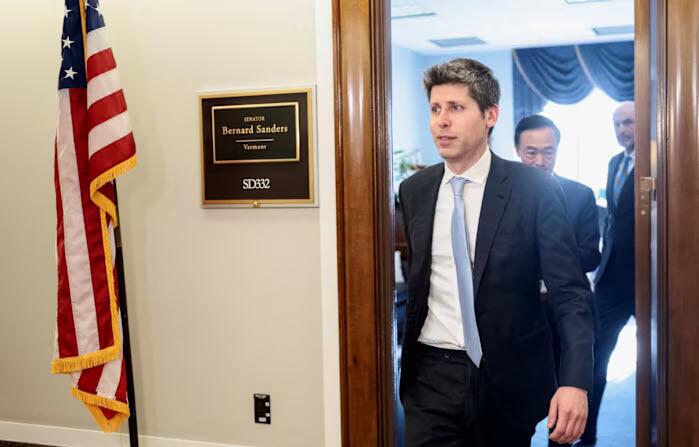
His company, valued at close to $1tn, is likely to go public soon, while Anthropic and Elon Musk’s SpaceX, which owns xAI, are also racing to the public markets. This prompted us to ask, tongue-in-cheek, if the OpenAI taxpayer bailout would come before the IPO, or after.
Question is will OpenAI do the IPO before the government bailout or after https://t.co/mckJPwGJfM pic.twitter.com/k20K84YTeG
— zerohedge (@zerohedge) June 5, 2026
Is there any precedent?
The Trump administration has broken with economic orthodoxy by aggressively pursuing equity stakes in key sectors as part of an America First industrial strategy. Last year, it spent $9bn taking a 10 per cent stake in Intel and has invested billions of dollars in rare-earths and quantum computing start-ups in exchange for stock.
However, there is certainly no precedent whatsoever for the government taking a stake in lossmaking AI labs collectively worth trillions of dollars (based on laughable hockeystick projections which assume China will never be able to undercut prevailing pricing models). Additionally, the Intel equity was bought using funds already appropriated by the Biden-era Chips Act. Buying a stake in leading AI companies, rather than accepting a donation, would be expensive and probably require approval from Congress.
Will there be a backlash?
The initial response from pro-business Republicans and AI investors has been muted. In a post before Trump’s comments, billionaire Silicon Valley investor and White House adviser David Sacks warned against the government assuming “direct ownership and control” of AI companies – a post that was endorsed by Republican senator Ted Cruz.
If the Trump administration did go for equity stakes in leading labs, the backlash would be even more widespread, said Samuel Hammond, director of AI policy at the pro-tech Foundation for American Innovation, with protests from investors and companies that were not cut in on the deal.
“Even if taking partial ownership of frontier AI companies can make sense on paper, in practice it’s a recipe for political favouritism and corruption,” he added.
Sacks, who was previously Trump’s AI tsar and was one of the most accelerationist voices in the administration, left his role this year. His lieutenant Sriram Krishnan announced on Saturday that he would be leaving the Trump administration at the end of this month.
Tyler Durden
Sun, 06/07/2026 – 20:25
via ZeroHedge News https://ift.tt/0EjpxPM Tyler Durden