President Donald Trump claimed on Monday morning that a peace deal in the Middle East is just around the corner, “subject to ignorance or stupidity getting in its way.” He posted this statement a few hours after Iran and Israel bombed each other for the first time since a ceasefire took effect on April 7.
That ceasefire originally gave both sides two weeks to hammer out a final agreement to end the U.S.-Iranian conflict and work towards regional peace. Two months later, there is no deal and the two sides have been engaged in increasingly violent tests of each others’ limits, which Trump calls “love taps.“
The Sunday night air raids started over Lebanon, where Israel has been fighting the pro-Iran militia Hezbollah. Iran has been demanding that any peace deal include an unconditional ceasefire in Lebanon, while the U.S. wants the ceasefire to be “contingent” on a Hezbollah withdrawal and direct Israeli-Lebanese talks, a plan that the Lebanese government likes but Hezbollah rejects.
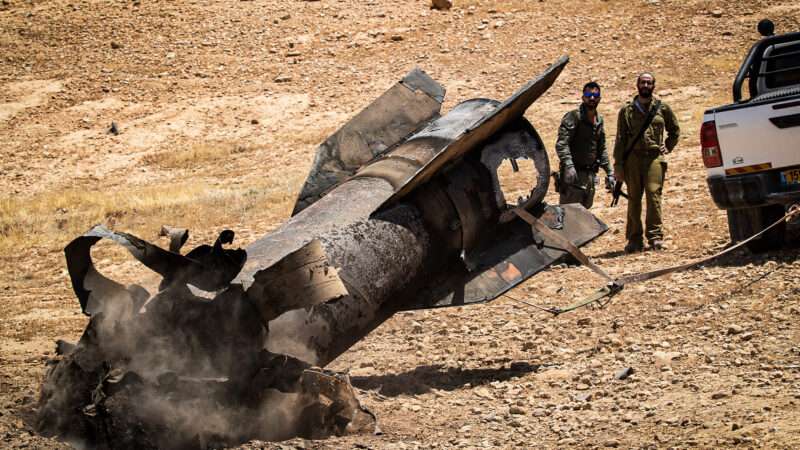
Despite its demands, Iran had seemed content to sit out of the fighting in predominantly Shi’ite Muslim areas of southern Lebanon near the border. On Sunday, the Israeli army bombed what it called a “terrorist headquarters” and killed two people in Beirut, the Lebanese capital, which had previously been off-limits to fighting. A few hours later, the Iranian military claimed to target Israel’s Ramat David Air Base with missiles, the first Iranian attack on Israeli soil since the April ceasefire.
“The Iranian strikes didn’t hurt anybody. Hopefully, Israel is not going to retaliate. If [Israeli Prime Minister Benjamin Netanyahu] strikes them back, it’s just gonna keep going like the last 47 years, or the last 3,000 years,” Trump told reporter Barak Ravid. An anonymous U.S. source then told Ravid that Trump “bought a little time” and avoided an “imminent” outbreak of combat.
That prediction turned out to be wrong. A few hours later, the Israeli army claimed an attack on the Karun petrochemical factory in Iran, which “produced unique materials that serve as critical components for the development of ballistic missiles.” (The factory makes precursors for plastic products such as polyurethane foam and wood lamination.) After that, Iranian forces claimed an attack on the Israeli oil refinery in Haifa.
Trump then wrote on Truth Social that “both sides, Israel and Iran, are looking to do an immediate CEASEFIRE!” and insisted that a final peace deal is just around the corner. Iran’s Islamic Revolutionary Guard Corps announced that it was ceasing “military operations” unless “the violations and mischief continue, including in southern Lebanon.”
It’s unclear how long this ceasefire-within-a-ceasefire holds. Israeli forces and Hezbollah continue to shoot at each other in southern Lebanon. “Any Iranian attempt to link Lebanon and Iran and attack Israel will be met with great force,” Israeli Defense Minister Israel Katz said on Monday, though his statement implied that Israel would now only attack Beirut in response to attacks on Israeli soil.
Several weeks ago, the economist Esfandyar Batmanghelidj wrote that Iran was not insisting on Lebanon “for the sake of Hezbollah or Lebanese Shias” but in order to “test” Trump’s seriousness about a peace agreement. After all, he had promised a ceasefire in Lebanon as part of the April 7 deal, only to walk it back on Israel’s insistence.
Sunday’s blowup also follows weeks of escalating “tests” elsewhere in the region. Last month, Iran shot down a U.S. drone over the Persian Gulf, the U.S. military retaliated by bombing Iranian naval bases, and the Iranian military retaliated by firing missiles at a U.S. base in Kuwait. Although the U.S. military claimed it shot down all of the Iranian missiles, ABC reports that several American troops were wounded.
On Saturday, the U.S. military bombed Iranian bases again in response to Iranian drones menacing shipping, and the Iranian military bombed the U.S. naval base in Bahrain and the international airport in Kuwait, killing a civilian worker.
Sources in the U.S. Treasury leaked to CBS and the Financial Times over the weekend that they were looking to seize Iranian property abroad—such as oil tankers or money in foreign bank accounts—to pay for damages in Arab states. Iranian government advisor Mohsen Rezaei told CNN that the fate of those bank accounts was another “a test of trust” in the ceasefire.
Ultimately, Trump is right that a permanent peace is just within reach. Both sides roughly agree on what the price would be at this point. Iran and the U.S. would have to lift their mutual blockades of Hormuz, renounce the use of force, and then trade their leverage on the remaining issues: the Iranian nuclear program for U.S. economic sanctions.
But hawks in the U.S. and Israel are unsatisfied with the offer on the table, and Trump is sensitive to their criticism. Helping Israel continue the war in Lebanon, skirmishing in the gulf, and threatening the Iranian economy are all ways for Trump to nibble away at Iran’s leverage.
“It’s just a love tap,” Trump told ABC after an air raid on Iran last month. “The ceasefire is going.”
The strategy of piecemeal peace had worked out for the U.S. and Israel before. In November 2024, the Biden administration brokered a truce in Lebanon that made Israeli withdrawal contingent on Hezbollah disarming. The Israeli army was able to push further into Lebanon under this ceasefire than it had during the war. The Trump administration unfroze and refroze the conflicts in Gaza and Yemen seemingly at its leisure.
But Iran—unlike Hezbollah, Hamas, or the Houthi movement—has the same ability to push the boundaries of the ceasefire. And Trump is clearly more averse than either Israel or Iran to resuming a full-on war, as his reaction to the fighting on Sunday shows. So for now, the region is stuck in a state of neither war nor peace. It is, to borrow an old turn of phrase from cable news, “fiery but mostly peaceful.”
The post Trump's Middle Eastern Ceasefire: Fiery But Mostly Peaceful appeared first on Reason.com.
from Latest – Reason.com https://ift.tt/mao1Rif
via IFTTT