“The Situation Has Become Unsustainable”: Apple To Hike Prices To Offset Soaring Memory Costs
Up until now, Americans primarily hated the flood of data centers popping up around the country like mushrooms (at least those that haven’t been canceled or delayed due to regulatory pushback, lack of electricity or outright hostility) because of surging electricity prices and the rising tide of unemployment as chabots gradually make America’s white collar workers obsolete. Now they can add surging consumer price inflation to the list of reasons to hate data centers, whose ravenous demand for memory has sent prices to record highs.
According to the WSJ, Apple plans to raise prices on its products to offset the surging costs of memory and storage chips, CEO Tim Cook said in an interview with The Wall Street Journal.
“Unfortunately, price increases are unavoidable,” he said. “We’re doing our best to mitigate the huge increases that are being passed to us, and we’ve been trying to shield our customers from the increases, but the situation has become unsustainable.”
Cook declined to offer details on the timing or scale of the planned price increases, nor which products would be affected. Apple’s next major product launch is likely to be in September when it releases the iPhone 18 lineup, expected to include a new foldable iPhone.
Price increases, especially for Macs and iPads, could come sooner. Apple – which is only the first major consumer electronics company to succumb to surging input prices and pass them through to consumers – raised the starting price of the Mac Mini last month in between launch events.
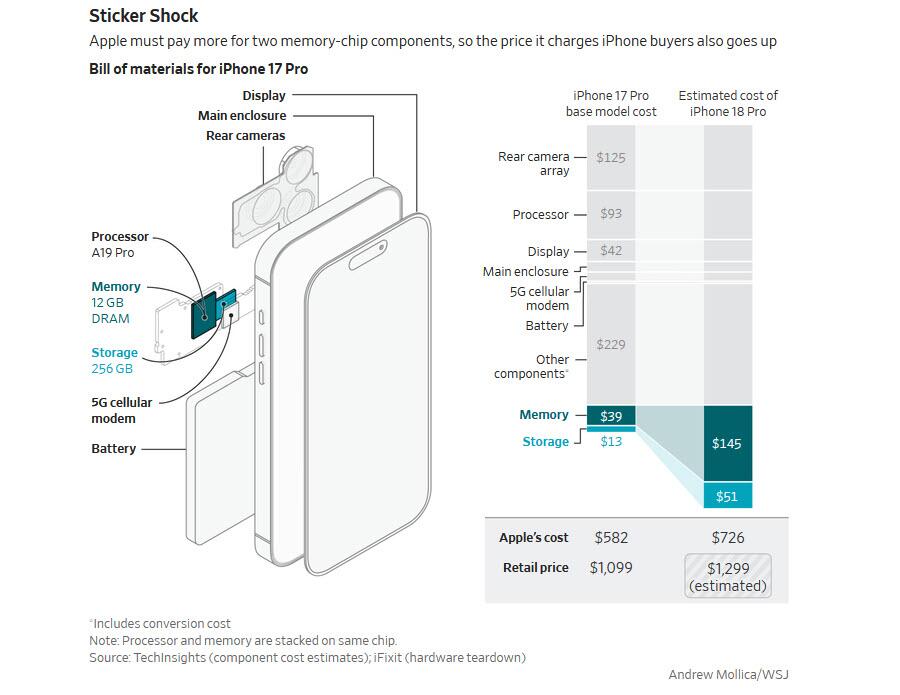
Skyrocketing demand for memory and storage chips from artificial-intelligence companies has pushed up their cost so much that Apple would have to raise device prices substantially to maintain its profit margins. Passing the higher cost on to consumers while maintaining its profit margin would add about $270 to the price of the next iPhone Pro model, or a price increase of more than 20% estimates research firm TechInsights.
While Apple doesn’t report the gross profit margins on individual products, the TechInsights research suggests the margin on the $1,099 iPhone 17 Pro was a tidy 47%. To maintain that profit margin for the iPhone 18 Pro, based on estimated costs, the company would have to charge $1,371. Because the company likes standardized pricing, the starting price tag would more likely be $1,299, yielding a 44% gross profit.
And this calculation doesn’t account for a potential new camera system that will also cost Apple about 50% more than previous models, according to supply chain analyst Ming-Chi Kuo. In that case, following the same math, Apple could set the starting price of the iPhone 18 Pro at $1,399—or higher.
A full breakdown of the math behind the increase can be found in this WSJ article.
While chips have emerged as the key bottlenecks for agentic-focused data centers, even more so than GPUs/CPUs, the resulting price surge has prompted manufacturers like Samsung and SK Hynix to focus production on high end HBM products, while shrinking supply for more modest DRAM products which however are used in virtually every modern product; chips for memory and storage are key components inside most computing devices, including smartphones, laptops, game consoles, medical equipment and even cars. But with AI servers gobbling up rapidly increasing volumes of those chips – with little to none price discrimination since it is the latest batch of bondholders who ends up footing the bill – even a company as rich and powerful as Apple is struggling to secure supply.
Since last year, when Google, Microsoft, Meta and Amazon began announcing big increases in their capital spending budgets, the prices for memory and storage chips have both quadrupled. TechInsights expects both prices to continue increasing into 2027, unless a flood of Chinese chips hits the market .
Memory, also called DRAM, and storage, also called NAND, are like elements of a mid-20th-century office: The memory is a desk that holds all the papers a worker needs to perform a task, while storage is the filing cabinet that holds everything else. Smartphones use DRAM memory to run apps currently in use; they use NAND storage to file away photos and videos, for example. And since both products were (and are) a pure commodity, there were are substitute makers in the Western world besides the big memory companies.
Cook said prices for memory and storage are both issues for the company, though he focused on the DRAM market in particular, calling out the increased allocations going to so-called high-bandwidth memory that is used for AI servers.
“There’s less supply at a time when consumers want devices and the memory guys are passing along huge price increases,” said Cook. “We definitely need memory pricing and supply to return to reasonable levels for consumer products. That’s the bottom line.”
Three companies dominate the market for DRAM memory: Samsung and SK Hynix in South Korea, and Micron in the U.S. Makers of NAND storage include those three companies as well as Kioxia and Sandisk. Their stock prices, along with their profits, have exploded over the past twelve months: Micron and SK Hynix shares have risen more than 800% while Kioxia and Sandisk have risen 4,600%.
Seeing the unprecedented demand, memory companies are building more factories: Morgan Stanley forecasts that production capacity for DRAM wafers, the silicon discs on which chips are patterned, will grow 30% by 2027. Yet as suppliers prioritize the specialized AI memory, wafers for consumer tech will fall up to 15% short of demand, Morgan Stanley estimates, although the bank may be conflicted due to its substantial exposure to various companies in the AI ecosystem, which would be terribly vexed if Morgan Stanley were to reach a different conclusion (like, for example, that China – that great commodity crushed – is coming online with massive output in the coming months which will send prices for at least baselines DRAM and NAND sharply lower).
While China has national champion companies in memory and storage, but due to national-security rules, American companies would likely require licenses to work with them. When asked if those restrictions should be loosened, Cook said: “I think everything needs to be on the table,” adding, “I think we should look at all supply.”
He is right: as we showed recently, chips and memory have emerged as one of the biggest drivers of wholesale inflation, and now that it is being passed on to consumers, it is only a matter of time before the inflation-averse White House starts making very loud noises, demanding an artificial limit on how high memory prices can rise.
Apple is late to the party: Companies that make PCs, game consoles, smartphones and more have already raised prices, including Hewlett-Packard, Dell and Nintendo. A consortium of industry associations recently sent a letter to Treasury Secretary Scott Bessent and Commerce Secretary Howard Lutnick complaining about the overallocation of memory to AI buyers and asking for help to increase supply.
Morgan Stanley estimates a 15% bump for prices of smartphones and PCs in the U.S. this year. This price hike will have a limited impact on the consumer price index, which has only a small weighting for such devices. Yet any price increase on the popular iPhone will immediately grab Washington’s attention.
Compounding the issue is Apple’s need for additional DRAM to support more AI features, including a rebooted Siri announced last week. And the company has long used NAND storage upgrades to boost profits, charging $100 to $200 for extra increments that cost it just a fraction of that.
In the interview, Cook said Apple stands ready to use its cash reserves to boost memory supply. “We’re willing to use our balance sheet to help be a part of the solution,” he said but added that “obviously, more capacity is needed.”
Cook declined to offer specifics. It is unclear how Apple could match, let alone beat, the deal terms that AI hyperscalers are offering to lock up supply, and how much of a hit to the company’s profits such a move would be. Those companies are signing three-to-five year agreements with huge cash prepayments that Apple is unlikely willing to match, given its long history of disciplined spending.
Cook said Apple wouldn’t use its cash and silicon expertise to build its own memory and storage factories. “We can’t do everything,” said Cook. “We know what we’re good at.”
Apple spends in the low tens of billions of dollars per year on memory and storage, according to people familiar with its costs, making it one of the largest customers in the world. Historically it has used its heft to wring the lowest prices out of suppliers, playing them off each other and leaving them little profit. As AI companies have stormed into the market, suddenly Apple has to wait in line.
Cook said during his time working in the electronics supply chain, from IBM to Compaq to Apple, he had never seen a commodity price swing like the one from the past six months. “This is a hundred-year flood,” said Cook. “I’ve never seen anything like it in any area in over 40 years.”
Luckily, every flood comes with a drain, and as usual it is made in China. A few weeks ago, we reported that “China Begins Flooding The Market With DRAM And NAND Memory Chips“, and followed up with a report yesterday that China’s DRAM giant CXMT has gotten a final node for the largest mainland IPO since 2022 (as has YMTC, China’s leading NAND flash maker, #4 globally). In short, CHina is preparing to do to this commodity market what it has done to every other one in recent years: unleash massive price cuts to steal market share, and leave the incumbents in the trash heap (just look at Europe’s imploding auto manufacturing sector).
Sure enough, we are now getting reports that none other than Google is evaluating procuring DRAM from Chinese vendors.
And once Google can do it, so will everyone else, at which point sit back and watch as the epic memory bubble crashes and burns.
Tyler Durden
Wed, 06/17/2026 – 20:52
via ZeroHedge News https://ift.tt/lcHjfYF Tyler Durden